
Meteora UNESCO World Heritage Guide: Monasteries in the Sky
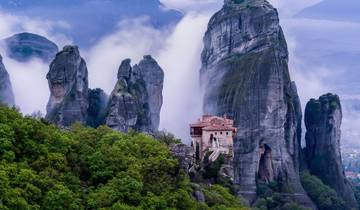
Rising over 400 meters above the Thessalian plain in central Greece, Meteora’s sandstone pinnacles support six active Byzantine monasteries that represent one of the world’s most extraordinary examples of monastic architecture and spiritual devotion. Inscribed as a UNESCO World Heritage Site in 1988, this sacred complex combines geological wonder with centuries of Orthodox Christian tradition, preserving 16th-century frescoes that mark a vital stage in post-Byzantine painting. This guide explores Meteora’s geological origins, monastic history, architectural achievements, artistic treasures, and enduring spiritual significance.
Key Takeaways
- Unique geological canvas: Meteora’s sandstone formations, created 60 million years ago from deltaic deposits and sculpted by millennia of erosion, rise 400+ meters above ground, creating the dramatic “columns of the sky” that gave the site its name
- Historical monastic achievement: Twenty-four monasteries were constructed between the 11th and 16th centuries under nearly impossible conditions, with six remaining active today housing approximately 67 monks and nuns
- Dual UNESCO recognition: The 1988 inscription recognizes both outstanding cultural significance (monastic architecture, post-Byzantine frescoes) and exceptional natural beauty, making Meteora one of Greece’s mixed heritage sites
- Architectural innovation: Monastery construction required extraordinary engineering solutions including rope-and-pulley systems, hand-carved staircases, and structural integration with rock formations, representing medieval architectural ingenuity at its peak
- Living heritage: Unlike many heritage sites, Meteora remains an active monastic center where Orthodox Christian traditions continue unbroken from the 11th century, maintaining both spiritual practice and cultural preservation
- Artistic significance: The 16th-century frescoes within Meteora’s katholikons (main churches) represent a pivotal transition in post-Byzantine painting, blending traditional iconographic principles with emerging Renaissance influences
People Also Ask About Meteora UNESCO World Heritage
How many monasteries were built at Meteora and how many remain active?
Twenty-four monasteries were constructed on Meteora’s rock pinnacles between the 11th and 16th centuries, representing the peak of the monastic community during the 14th-15th century hermitic revival. Six monasteries remain active and open to visitors: Great Meteoron (Transfiguration), Varlaam, Holy Trinity, St. Stephen, Rousanou, and St. Nicholas Anapafsas. The remaining eighteen monasteries fell into ruin over centuries due to economic decline, Ottoman taxation, political instability, and the challenges of maintaining structures in such extreme locations. The six active monasteries house approximately 50 nuns and 17 monks who continue the Orthodox Christian traditions established over 900 years ago.
When was Meteora inscribed as a UNESCO World Heritage Site and why?
Meteora received UNESCO World Heritage status in 1988 under both cultural and natural criteria, recognizing its exceptional universal value. The cultural inscription (Criteria i, ii, iv, v) honors the monasteries as masterpieces of human creative genius representing monastic architecture, the 16th-century frescoes as vital stages in post-Byzantine painting development, and the extraordinary adaptation of human habitation to an extreme natural environment. The natural recognition (Criterion vii) acknowledges the exceptional natural beauty of the sandstone formations. This dual recognition places Meteora among a select group of sites globally that represent both outstanding cultural achievement and natural wonder.
What makes Meteora’s geological formation unique?
Meteora’s sandstone pinnacles formed through an exceptional geological sequence spanning 60 million years. The rocks originated as deltaic deposits from a river that flowed into a prehistoric sea covering the Thessalian plain, creating thick sedimentary layers of sandstone and conglomerate. Tectonic activity uplifted these deposits while simultaneously fracturing them along fault lines. Millions of years of erosion by water, wind, and earthquakes sculpted the fractured sedimentary rock into the distinctive vertical pillars visible today, with minimal horizontal stratification creating smooth, column-like formations. This combination of uniform sedimentary composition and localized vertical erosion produces Meteora’s distinctive “suspended in air” appearance that gives the site its name.
Why did monks choose such inaccessible locations for their monasteries?
The extreme inaccessibility of Meteora’s pinnacles served multiple spiritual and practical purposes for Orthodox Christian monks. Spiritually, the physical isolation supported the hermitic ideal of separation from worldly concerns, creating ideal conditions for contemplation, prayer, and spiritual ascension—the vertical rock formations themselves symbolized the journey toward heaven. Practically, the inaccessible heights provided security during the turbulent 14th century when Byzantine power weakened and Ottoman expansion threatened Thessaly, offering refuge from invaders and raiders. The difficulty of access also screened potential monks, ensuring only those with absolute commitment would undertake the demanding journey to join the monastic communities.
Extended multi-day tours – 5+ days
Featured Meteora Multi-Day Tour Packages
2 days
Two Days Tour from Athens to Meteora
- ✓ Comprehensive Meteora tour
- ✓ Expert local guides included
- ✓ All accommodation arranged
- ✓ Transportation provided

6 days
6 Days in Athens, Sightseeing Tourist Bus, Delphi and Meteora Tour & Day Cruise.
- ✓ Comprehensive Meteora tour
- ✓ Expert local guides included
- ✓ All accommodation arranged
- ✓ Transportation provided

2 days
2-Day Delphi & Meteora Tour
- ✓ Comprehensive Meteora tour
- ✓ Expert local guides included
- ✓ All accommodation arranged
- ✓ Transportation provided
5 days
5-Day Journey Through Classical Greece
- ✓ Comprehensive Meteora tour
- ✓ Expert local guides included
- ✓ All accommodation arranged
- ✓ Transportation provided
Multi-day tour packages powered by TourRadar. Prices and availability subject to change.
Introduction: Where Earth Meets Heaven
Meteora occupies a singular position in world heritage—a place where geological accident created the conditions for extraordinary human achievement. The name itself, derived from the Greek μετέωρα meaning “suspended in air” or “in the heavens,” captures the essential character of this landscape where massive sandstone pillars thrust 400 meters skyward from the Thessalian plain, their summits crowned with Byzantine monasteries that seem to defy gravity and human capability alike.
Located in central Greece near the towns of Kalambaka and Kastraki, approximately 350 kilometers northwest of Athens and 230 kilometers southwest of Thessaloniki, Meteora encompasses 271.9 hectares of protected area with an additional 1,884.1-hectare buffer zone. The site lies at the northwestern edge of the Thessalian plain, where the Pindos mountain range begins its ascent, creating the geological conditions that would eventually produce Meteora’s distinctive rock formations.
The monasteries of Meteora represent one of Orthodox Christianity’s most important monastic centers, ranking second only to Mount Athos in spiritual and historical significance within the Greek Orthodox Church. Yet unlike Mount Athos, which restricts access to male pilgrims only, Meteora welcomes all visitors, making its treasures—architectural, artistic, and spiritual—accessible to the broader world while maintaining its active role as a center of Orthodox Christian worship and contemplation.
This accessibility, combined with the site’s extraordinary visual drama, has made Meteora one of Greece’s most visited heritage sites, attracting over 400,000 annual visitors. The challenge for contemporary Meteora lies in balancing this tourism pressure with the preservation needs of both the fragile rock formations and the living monastic communities that continue centuries-old traditions. Understanding Meteora requires engaging with multiple dimensions: the geological processes that created this landscape, the historical forces that drove monks to such extreme heights, the architectural and artistic achievements preserved in the monasteries, and the ongoing spiritual practice that gives the site its living character.
Geological Formation and Natural Landscape
Meteora’s sandstone and conglomerate pillars formed through a complex geological sequence beginning approximately 60 million years ago during the Paleogene period. A large river system flowed through the region, depositing sediments into a prehistoric sea that covered what is now the Thessalian plain. These river deltas accumulated thick layers of sand, gravel, and other sedimentary materials that consolidated over millions of years into sandstone and conglomerate rock formations reaching depths of several hundred meters.
Tectonic forces associated with the Alpine orogeny—the same mountain-building processes that created the Alps, Himalayas, and other major ranges—uplifted the Thessalian basin approximately 30 million years ago. This uplift raised the sedimentary deposits above sea level while simultaneously creating extensive fracture networks throughout the rock mass. These fractures, oriented primarily vertically rather than horizontally, would prove critical to the subsequent erosion patterns.
The distinctive vertical pillars emerged through differential erosion over the past several million years. Water infiltrating the vertical fractures weathered and removed material along these weakness planes, gradually separating the rock mass into individual pillars. The relatively uniform composition of the sandstone, with minimal horizontal stratification layers, allowed erosion to proceed vertically with little resistance from harder horizontal bands. Wind erosion, freeze-thaw cycles, and seismic activity further refined the pillars, creating the smooth, column-like surfaces and dramatic overhangs visible today.
The rock formations rise to heights exceeding 400 meters above the surrounding plain, with monastery sites perched at elevations between 300 and 700 meters above sea level. Individual pinnacles vary significantly in size and shape—some massive and broad-topped like Platys Lithos (“Wide Stone”) that supports Great Meteoron, others slender and precarious like the needle-like formation supporting Holy Trinity monastery. The diversity of forms within a relatively small geographic area contributes to Meteora’s exceptional aesthetic quality.
The geological instability that created these formations continues today. Rockfalls remain a constant threat, with significant collapses occurring periodically—a major rockfall in 2005 temporarily blocked the main access road. A magnitude 7 earthquake struck the region in 1954, yet the formations proved remarkably resilient, sustaining minimal structural damage despite their apparent fragility. This ongoing geological activity requires continuous monitoring and conservation intervention to protect both the natural formations and the human structures built upon them.
The exposed rock faces support surprisingly diverse vegetation, with plants colonizing cracks, ledges, and erosion pockets where soil accumulates. Water seeping from fissures creates localized microhabitats supporting endemic and endangered species. The Meteora-Antichassia area, which includes the monastery complex, forms part of the Natura 2000 protected area network (GR1440003/2000), recognizing significant botanical and zoological values including rare raptors, endemic plant species, and specialized cliff-dwelling fauna adapted to the extreme vertical environment.
Historical Development of Meteora Monasticism
Human occupation of the Meteora region extends back over 50,000 years, with archaeological evidence from the Theopetra Cave—located four kilometers from Kalambaka—documenting continuous habitation from the Middle Paleolithic through the Neolithic periods. The cave preserves evidence of two major cultural transitions: the replacement of Neanderthal populations by anatomically modern humans, and the subsequent shift from hunter-gatherer societies to agricultural communities following the last glacial maximum. A stone wall constructed approximately 23,000 years ago to seal the cave entrance represents the oldest known architectural structure in the region.
Despite this long human history, Meteora itself receives no mention in classical Greek literature or mythology. Neither Herodotus, Strabo, nor other ancient geographers who documented Thessaly’s landscape referenced the rock formations, suggesting they held no particular significance in pre-Christian times. The transformation of Meteora from geological curiosity to sacred landscape began with the arrival of Christian hermits.
Orthodox Christian hermits first settled in Meteora’s caves and rock shelters during the 9th-11th centuries, part of a broader hermitic movement seeking isolation for contemplative prayer. These early anchorites lived in extreme solitude, occupying natural cavities in the rock faces and meeting only occasionally for communal worship. By the late 11th century, a small skete (monastic community) had formed, with hermits gathering at the Panaghia Doupiani chapel built at the base of one pinnacle for Sunday liturgy.
The transition from individual hermitages to organized monasteries began in the mid-14th century, driven by the combination of spiritual revival and political crisis. Saint Athanasios the Meteorite, a scholar monk from Mount Athos, arrived at Meteora around 1340-1344, fleeing Serbian invasions of the Athos peninsula. Recognizing the strategic and spiritual potential of the highest rock formation—Platys Lithos—he established the Great Meteoron monastery, implementing the strict cenobitic rule of Saint Basil that emphasized communal life, obedience, and manual labor alongside prayer.
Athanasios’s foundation attracted royal patronage when Ioannis Uroš, the titular Serbian Emperor who had become a monk under the name Joasaph, joined the community and endowed it with significant resources. This combination of Athonite spiritual discipline and imperial funding established Great Meteoron as the model for subsequent foundations. The monastery became the largest and wealthiest in the complex, setting architectural and liturgical standards other foundations would emulate.
The period from 1350 to 1550 saw explosive monastic growth. Political instability in 14th-century Thessaly as Byzantine authority weakened and Ottoman power expanded drove monks to seek increasingly secure locations. The inaccessible pinnacles offered practical refuge from Turkish raiders, Catalan mercenaries, and general lawlessness. By the late 15th century, twenty-four monasteries occupied Meteora’s rock formations, creating one of Orthodox Christianity’s most significant monastic centers.
The 16th century represented Meteora’s golden age. The monastic population reached its historical peak, with hundreds of monks distributed across the twenty-four foundations. This prosperity funded extensive construction programs—expansion of katholikons (main churches), construction of refectories and libraries, and commissioning of elaborate fresco programs. The relative security under Ottoman rule, combined with continued patronage from Orthodox nobility in Wallachia and Moldavia, sustained the communities even as Byzantine political power vanished entirely after 1453.
Decline began in the 17th century and accelerated through the 18th and 19th centuries. Ottoman taxation policies targeting monasteries, combined with broader economic changes reducing traditional patronage networks, undermined the communities’ financial base. The Greek War of Independence (1821-1829) brought violence and instability. During World War II and the subsequent Greek Civil War, several monasteries suffered damage from both military action and looting. By 1900, many foundations had been abandoned entirely, and the monastic population had dwindled to a fraction of its historical peak.
The mid-20th century marked a turning point. Beginning in the 1960s, the Greek government initiated systematic restoration programs for the surviving monasteries. Road construction improved access, and the growing tourism industry provided economic incentives for preservation. UNESCO World Heritage inscription in 1988 brought international recognition and conservation resources. Today, while only six monasteries remain active, they have stabilized both structurally and institutionally, supported by entrance fees, government funding, and international heritage programs.
The Six Active Monasteries: Individual Portraits
Six monasteries continue active monastic life at Meteora, each with distinctive architectural character, historical significance, and spiritual identity. These foundations maintain Orthodox Christian worship, welcome visitors under appropriate conditions, and preserve centuries of accumulated artistic and liturgical heritage.
Great Meteoron (Holy Monastery of the Transfiguration)
Great Meteoron occupies the broadest and most prominent rock formation in the complex, Platys Lithos, standing at the highest elevation among active monasteries. Founded by Saint Athanasios the Meteorite in the 1340s, it represents the original monastery from which the entire complex developed. The katholikon, dedicated to the Transfiguration of Christ, was constructed in the mid-14th century and expanded in the 16th century when the monastery reached its peak prosperity.
The architectural complex includes the katholikon with its distinctive cruciform plan and central dome, an extensive refectory, former hospital, library, wine cellars, and defensive tower. The katholikon preserves exceptional 16th-century frescoes depicting scenes from the life of Christ, martyrdom of saints, and biblical narratives, painted in the distinctive Cretan style that dominated post-Byzantine art. The refectory, now serving as a museum, displays liturgical vessels, illuminated manuscripts, and carved wooden objects demonstrating the monastery’s historical wealth.
Great Meteoron remains a male monastery with a small community of monks maintaining daily services. The monastery operates as both active religious center and museum, with clearly demarcated areas for worship and visitor access. Its historical role as the dominant foundation continues to shape Meteora’s institutional structure and spiritual life.
Varlaam Monastery
Varlaam takes its name from the hermit monk Varlaam who first occupied the rock in the mid-14th century, constructing three small chapels and a cistern. After his death, the site remained abandoned for nearly 200 years until 1517 when two brothers from Ioannina, Theophanes and Nektarios Apsarades, re-established the monastery. The current katholikon, dedicated to All Saints, was constructed rapidly in 1541-1542, with the brothers completing the building in just 20 days according to an inscription—though this likely refers to the structural shell rather than the complete decorated interior.
The monastery’s architectural distinction lies in its tower, the tallest among Meteora’s monasteries, originally serving defensive purposes and housing the winding mechanism for the net system that raised supplies and people before stair construction. The katholikon preserves a complete fresco program painted by Frangos Katelanos in 1548, representing one of the finest examples of post-Byzantine painting at Meteora. The refectory houses a museum displaying portable icons, liturgical textiles, and the monastery’s collection of illuminated manuscripts.
Varlaam remains an active male monastery, distinguished by its well-preserved buildings and the dramatic approach bridge crossing a deep chasm between rock formations. The monastery’s museum collections, particularly the fresco program and icon collection, make it an essential stop for understanding Meteora’s artistic heritage.
Holy Trinity Monastery
Holy Trinity occupies perhaps the most dramatically positioned rock formation at Meteora, perched atop a slender pinnacle with sheer vertical drops on all sides. The monastery’s foundation date remains uncertain—traditional accounts attribute it to the monk Dometius in 1438, though architectural analysis suggests construction occurred between 1475-1476. The katholikon, dedicated to the Holy Trinity, features a compact cruciform plan with central dome supported by two columns, reflecting space constraints on the narrow rock summit.
The monastery complex includes the katholikon, a small treasury (skeuophylakion) built in 1684, and monastic cells arranged around a confined courtyard. The katholikon’s original 15th-century frescoes were replaced in 1741 by paintings created by two resident monks, though some earlier fragments survive. The confined space and dramatic location create an atmosphere of isolation exceeding even other Meteora foundations.
Holy Trinity achieved international fame as a filming location for the 1981 James Bond film “For Your Eyes Only,” where Roger Moore’s character scales the rock face. This exposure brought tourism attention but also highlighted access challenges—until recent decades, the monastery could only be reached by climbing 140 rock-cut steps or being winched up in a net. A modern bridge and improved stairway now facilitate access while maintaining the site’s dramatic character. The monastery operates as an active male foundation with a small community.
Rousanou Monastery (Saint Barbara)
Rousanou monastery, dedicated to Saint Barbara though named for an earlier hermit whose identity remains uncertain, was established in 1545 by two monks from Ioannina, Maximos and Ioasaph. The monastery occupies a lower, more accessible rock formation between Saint Nicholas Anapafsas and Varlaam, connected to the access road by a bridge crossing a narrow chasm.
The katholikon, smaller than those at Great Meteoron and Varlaam, features well-preserved 16th-century frescoes depicting the life of Saint Barbara, scenes from Christ’s life, and martyrdom narratives. The compact architectural layout, necessitated by the limited summit area, creates an intimate atmosphere distinct from the grander scale of larger foundations. The monastery suffered significant damage during World War II from both military action and systematic looting, though post-war restoration recovered much of its character.
Rousanou converted to a convent in 1988, becoming one of two female monastic communities at Meteora alongside Saint Stephen. The community of nuns has revitalized the monastery, maintaining active worship schedules and welcoming visitors. The relatively easy access and beautiful fresco program make Rousanou among the most visited monasteries in the complex.
Saint Nicholas Anapafsas
Saint Nicholas Anapafsas, named for its founder though his dates remain uncertain, occupies a narrow rock formation requiring a vertical architectural arrangement unique among Meteora’s monasteries. Constructed in the early 16th century, the monastery’s buildings are stacked in multiple levels connected by narrow staircases, adapting to the extremely confined summit area.
The katholikon, dedicated to Saint Nicholas, contains the complex’s most significant artistic treasure: a complete fresco cycle painted by Theophanes the Cretan in 1527. Theophanes, one of the most important post-Byzantine painters, created exceptional work at Saint Nicholas before moving to Mount Athos where he decorated the katholikon of the Great Lavra. His Meteora frescoes demonstrate the mature Cretan style—refined drawing, sophisticated color harmonies, and psychological depth in figural representation. The small space intensifies the visual impact, with every surface covered in biblical narratives, liturgical scenes, and decorative patterns.
Saint Nicholas remains an active male monastery with a very small community. The limited space restricts both monastic population and visitor capacity. The monastery typically sees fewer tourists than larger foundations, creating a quieter contemplative atmosphere. The necessity to climb narrow staircases through multiple levels gives visitors a direct experience of the vertical architecture that characterizes monastic life at Meteora.
Saint Stephen Monastery
Saint Stephen occupies the most accessible location among Meteora’s monasteries, positioned on a rock formation directly adjacent to the modern road and requiring only a short bridge crossing to reach. Founded in the late 14th century, with the katholikon constructed around 1400 by Saint Antoninus Cantacuzene—possibly a son of the Serbian ruler Nicephorus II of Epirus—the monastery benefited from noble patronage throughout its history.
The monastery complex includes two churches: the original small katholikon dedicated to Saint Stephen, and a larger 18th-century church dedicated to Saint Charalambos, whose relics the monastery preserves. The more recent church, built in 1798, features a spacious interior reflecting late Byzantine architectural principles. The monastery’s treasury contains important collections of portable icons, liturgical vestments, and illuminated manuscripts, displayed in a well-organized museum.
Saint Stephen suffered severe damage during World War II when German and Italian forces occupied the complex, and during the Greek Civil War when it served as a defensive position. Post-war abandonment lasted until the 1960s when restoration began. In 1961, Saint Stephen converted to a convent, becoming one of Meteora’s two female communities. The community of nuns has developed an active spiritual and cultural life, maintaining regular worship, creating ecclesiastical textiles and icons, and welcoming visitors with particular attention to educational programming.
The easy access makes Saint Stephen particularly important for visitors with mobility limitations who cannot manage the steep staircases required at other monasteries. The museum collections, well-maintained buildings, and active monastic community create a comprehensive experience of Meteora’s living heritage.
Architecture and Construction Achievement
Constructing monasteries atop Meteora’s sandstone pillars required solving extraordinary engineering challenges without modern equipment, mechanical advantage beyond simple pulleys and levers, or any practicable roads. The achievement represents medieval architectural ingenuity at its highest level, combining practical problem-solving with spiritual determination.
Initial access to the rock summits presented the first fundamental challenge. Early hermits used removable wooden ladders that could be drawn up for security, or carved precarious footholds directly into the rock faces. For major construction programs, monastics developed rope-and-net systems operated by windlasses—visitors and materials were placed in large nets and hauled up the vertical faces by teams of monks turning mechanical drums. This system remained in use for centuries; some monasteries relied on net access exclusively until the 1920s when permanent staircases were finally constructed.
Moving construction materials to the building sites required elaborate logistical planning. Local limestone for mortar was crushed and hauled up in loads small enough for the net system. Timber for roof beams, floors, and scaffolding came from Pindos mountain forests kilometers away, transported by donkey to the rock bases and then hauled aloft. Water for construction and daily use was collected in cisterns from rainfall and seepage, since hauling water up 400-meter cliffs in quantities sufficient for masonry work would have been prohibitively difficult.
The katholikon (main church) represents the architectural heart of each monastery, typically following a compact cruciform plan with central dome supported by columns or pendentives. This plan type, standardized across Athonite monasteries, adapted to Meteora’s constrained summit areas through reduced scale and simplified decoration. The architectural program emphasized vertical development—stacking levels to maximize usable space within limited footprints—rather than horizontal expansion impossible on narrow rock summits.
Structural integration with the rock formations themselves provided essential stability. Builders carved foundation trenches directly into the bedrock, keying masonry walls into the stone substrate. Some structures, particularly defensive towers and exterior walls, incorporated natural rock outcrops as integral structural elements, blurring the boundary between natural formation and built architecture. This intimate integration helps buildings resist seismic forces that would collapse freestanding structures of similar height and mass.
Defensive architecture featured prominently in original designs. Most monasteries include towers positioned to survey approach routes, gates that could be sealed against attackers, and limited access points easily defended by small numbers. The katholikon typically occupied the most protected interior position, with monastic cells, refectories, and work spaces arranged around it in defensive layers. These defensive features prove that security concerns, not merely spiritual isolation, motivated the choice of such inaccessible sites.
Water management systems demonstrate sophisticated hydraulic engineering. Each monastery includes cisterns carved into bedrock or built with waterproofed masonry to capture and store rainfall from roofs and paved surfaces. Some foundations developed elaborate systems channeling water from rock fissures and natural springs into storage facilities. The capacity to store sufficient water for communities of dozens of monks through multi-month dry periods required careful calculation and substantial construction investment.
Later additions modified original medieval structures as needs changed and technologies evolved. The 20th century brought electric lighting, though many monasteries retain oil lamps for liturgical use. Staircases carved into rock faces or supported by steel frameworks replaced net systems for visitor access, though several monasteries preserved the old windlasses as historical artifacts. Modern structural reinforcement, using techniques developed for conservation of heritage buildings, stabilizes aging masonry and addresses earthquake damage without altering historical character.
Art and Frescoes: Post-Byzantine Painting Tradition
The 16th-century fresco programs preserved in Meteora’s katholikons represent a pivotal stage in post-Byzantine painting, recognized in UNESCO’s inscription criteria as marking a fundamental development in Eastern Orthodox artistic tradition. Understanding their significance requires examining both technical execution and historical context.
Post-Byzantine painting emerged after 1453 when Constantinople’s fall to the Ottomans ended Byzantine political power but Orthodox artistic traditions continued under new circumstances. Painters working in Ottoman-controlled territories, Venetian-held regions like Crete, and independent Orthodox states developed variations on Byzantine iconographic principles while absorbing influences from Italian Renaissance art filtering through trade and cultural contact. Meteora’s frescoes capture this transitional moment when traditional Byzantine formalism began incorporating Renaissance naturalism.
The fresco technique itself followed established Byzantine protocols. Artists prepared wall surfaces with multiple layers of progressively finer plaster, creating smooth grounds for painting. Pigments, ground from mineral sources and bound with lime water or egg tempera, were applied to fresh plaster that absorbed the colors as it dried, chemically bonding them to the wall. This true fresco technique, practiced across medieval Europe, achieved exceptional durability—many Meteora frescoes survive 500 years with colors intact despite humidity, temperature fluctuations, and minimal conservation intervention.
Iconographic programs followed liturgical requirements rather than decorative choices. The katholikon’s dome received the Pantocrator (Christ as universal ruler), gazing downward upon the congregation. Prophets, apostles, and hierarchs (church fathers) occupied zones descending toward ground level, representing the hierarchy of heaven. Narrative cycles depicting Christ’s life, the Passion, and major feast days covered walls and vaults. The narthex (entrance vestibule) typically received Last Judgment scenes, while the apse behind the altar displayed the Virgin Platytera (broader than the heavens). This standardized program created theological architecture, transforming the physical building into a visual representation of Orthodox Christian cosmology.
Several master painters worked at Meteora during the 16th century, bringing regional styles and personal innovations. Theophanes the Cretan, who decorated Saint Nicholas Anapafsas in 1527, represents the Cretan school at its peak. His work demonstrates exceptional technical refinement—sophisticated color modulation creating three-dimensional form, psychological expressiveness in faces, and dynamic composition animating traditional static subjects. Frangos Katelanos, who painted Varlaam’s katholikon in 1548, worked in a more conservative style emphasizing linear precision and clear narrative legibility over Theophanes’s painterly effects.
The post-Byzantine character appears in details distinguishing these works from earlier Byzantine painting. Architectural backgrounds show rudimentary perspective rather than purely symbolic space. Figures demonstrate more naturalistic anatomy and posture, though still idealized rather than directly observed. Landscape elements include observed details—specific plants, geological formations, atmospheric effects—alongside traditional symbolic features. This selective naturalism coexists with maintained iconographic conservatism in religious subject matter, creating distinctive hybrid character.
Conservation challenges threaten these irreplaceable artworks. Humidity from groundwater seepage, temperature fluctuations between heated interior winters and hot summers, and structural movement in aging buildings all stress the fresco surfaces. Atmospheric pollutants from increasing vehicle traffic deposit damaging compounds. Past restoration attempts using inappropriate materials have sometimes caused additional damage. Contemporary conservation requires specialized expertise combining art historical knowledge, chemical analysis of original materials, and careful intervention using reversible treatments that don’t preclude future conservation as techniques improve.
Beyond their artistic quality, the frescoes serve continuing liturgical function for the monastic communities. They are not museum pieces but active elements in Orthodox worship, their images mediating between worshippers and divine realities according to Orthodox theology. This living religious context differentiates Meteora from purely historical sites where art functions only as aesthetic or educational resource. Understanding the frescoes requires recognizing both their art historical significance and ongoing spiritual function.
Contemporary Monastic Life and Spiritual Practice
Approximately 67 monastics—50 nuns and 17 monks—maintain active religious life across Meteora’s six functioning monasteries, continuing Orthodox Christian traditions established over nine centuries ago. Understanding contemporary monastic life illuminates how these communities balance spiritual vocation with heritage preservation and visitor management responsibilities.
Daily monastic routine follows the ancient pattern of liturgical hours dividing the day into periods of communal prayer, individual meditation, manual work, and rest. The cycle begins before dawn with Orthros (Matins), continues through the Hours (Third, Sixth, and Ninth), includes Vespers at sunset, and concludes with Apodeipnon (Compline) before sleep. On Sundays and feast days, Divine Liturgy (the Eucharistic service) follows Orthros. This rhythm, established by early Christian desert fathers and formalized in monastic rules like Saint Basil’s, structures time according to spiritual rather than secular priorities.
The monastic communities follow the cenobitic rule emphasizing common life under an abbot or abbess. Decisions affecting the monastery require consultation with the monastic assembly, though ultimate authority rests with the superior. Monks and nuns take vows of poverty (owning no personal property), chastity (celibacy), and obedience (submission to monastic authority and rule). These traditional vows create the framework within which individual spiritual development occurs through prayer, ascetic practice, and participation in community life.
Work forms an essential component of monastic life, both as practical necessity and spiritual discipline. Monks and nuns maintain buildings, cultivate gardens producing food for the community, create icons and liturgical items, and manage visitor access. These activities balance the contemplative focus of prayer with active engagement, following the principle “pray and work” (ora et labora) central to Christian monasticism. The work itself becomes a form of prayer when performed with proper attention and intention.
The tourist dimension creates particular challenges for Meteora’s communities. Hundreds of thousands of annual visitors provide essential economic support through entrance fees that fund conservation and daily operations. Yet the continuous presence of tourists disrupts the contemplative atmosphere monastics seek, reduces time available for liturgical observance, and requires monks and nuns to function as de facto museum guides and cultural interpreters. Managing this tension between spiritual vocation and public responsibilities requires careful scheduling—restricted visiting hours, closed days for purely monastic observance, and clearly defined spaces where visitors cannot intrude.
Recruitment and retention of new monastics presents ongoing concerns. The demanding lifestyle, extreme isolation, and rigorous spiritual discipline appeal to fewer young Greeks than in previous generations. Most monastics joining Meteora’s communities today are middle-aged or older, converting to monastic life after careers and family experiences rather than entering directly from youth. This demographic pattern raises questions about long-term sustainability—without younger members, communities may struggle to maintain their populations as current monastics age.
The relationship between the monastic communities and Greek Orthodox Church hierarchy structures governance and spiritual oversight. Each monastery functions as a dependency of the Metropolis of Stagoi and Meteora, the regional Orthodox diocese. The Metropolitan (regional bishop) exercises canonical authority over the monasteries while respecting their internal autonomy under their respective superiors. This hierarchical connection integrates Meteora into the broader Orthodox Church structure while preserving the communities’ distinctive identities.
Spiritual outreach beyond the monastic communities takes multiple forms. The monasteries welcome Orthodox pilgrims seeking spiritual counsel, confession, or participation in liturgical life. Monks and nuns occasionally leave the monasteries to serve parishes, teach, or assist with diocesan activities. The monasteries publish spiritual literature, maintain websites explaining Orthodox faith and practice, and participate in pan-Orthodox gatherings addressing contemporary challenges facing the Church. This engagement with the broader Orthodox world balances Meteora’s isolation with connection to living religious tradition.
UNESCO World Heritage Status and Conservation Framework
Meteora’s 1988 UNESCO World Heritage inscription recognizes exceptional universal value under multiple criteria, creating international obligations and support mechanisms for conservation. Understanding the inscription criteria and resulting conservation framework illuminates how global heritage principles apply to this specific site.
The cultural inscription under Criterion (i) recognizes the monasteries as masterpieces of human creative genius, representing extraordinary architectural achievement in adapting monastic building types to extreme natural conditions. The sheer technical accomplishment of constructing substantial stone buildings atop inaccessible pinnacles, using only medieval technology, demonstrates human ingenuity at its peak. This criterion emphasizes the creative problem-solving and determination required to realize spiritual vision in such challenging circumstances.
Criterion (ii) acknowledges Meteora as exhibiting important interchange of human values in architectural and artistic development. The monasteries transplanted Athonite monastic architecture to dramatically different topography, requiring innovations that influenced subsequent Orthodox monastic construction. The fresco programs synthesized Byzantine iconographic tradition with emerging Renaissance influences, contributing to post-Byzantine painting development. This criterion recognizes Meteora’s role in broader cultural exchange networks.
Criterion (iv) identifies the monasteries as outstanding examples of architectural ensembles illustrating significant stages in human history—specifically the 14th-16th century revival of hermitic monasticism and the adaptation of human habitation to extreme environments. The twenty-four monasteries (six surviving) represent complete realization of the eremitic ideal in architectural form, creating communities dedicated to spiritual isolation while maintaining necessary connections to material support systems. This criterion emphasizes historical representativeness.
Criterion (v) recognizes Meteora as exceptional example of traditional human settlement vulnerable to irreversible change. The inscription text specifically mentions the fragility of the traditional way of life, symbolized by the rope-and-net access systems gradually replaced by modern staircases. This criterion acknowledges both the achievement of sustaining human habitation in such extreme conditions and the vulnerability of these communities to abandonment, natural disasters, and overwhelming tourism pressure.
Criterion (vii) under natural heritage criteria recognizes exceptional natural beauty and aesthetic importance. The sandstone formations themselves, independent of human construction, constitute an outstanding natural phenomenon. The combination of geological uniqueness with the visual drama of monasteries perched impossibly atop vertical pillars creates aesthetic power recognized as having universal significance. This criterion places Meteora among select sites valued for both natural and cultural attributes.
The inscription defines protected area extent as 271.9 hectares encompassing the main rock formations and monastery sites, surrounded by a 1,884.1-hectare buffer zone restricting development that could impact the site’s visual integrity or environmental conditions. Greek national law provides legal protection, with the Ministry of Culture and Sports holding regulatory authority over changes to buildings, archaeological interventions, and land use within the protected zone. The monasteries themselves remain under Greek Orthodox Church ownership and control, creating collaborative management between religious and governmental authorities.
Conservation work follows international heritage standards established by UNESCO, ICOMOS (International Council on Monuments and Sites), and ICCROM (International Centre for the Study of the Preservation and Restoration of Cultural Property). Annual interventions address structural stabilization, fresco conservation, water infiltration prevention, and monitoring of geological stability. Funding comes from multiple sources: the Greek Ministry of Culture and Sports, European Union co-financed programs, monastic communities’ entrance fee revenues, and international heritage organizations. This diversified funding model provides stability while creating accountability to multiple stakeholders.
Tourism management represents a critical conservation challenge. The site receives over 400,000 annual visitors, concentrated in May-September peak season. This volume creates multiple pressures: physical wear on access staircases and floor surfaces, atmospheric pollution from vehicle emissions, disruption of monastic life, and strain on local infrastructure in Kalambaka and Kastraki. Management strategies include: regulated visiting hours limiting daily visitor numbers, entrance fees funding conservation while discouraging casual visits, clearly marked routes preventing visitor dispersal across sensitive areas, and educational programs promoting appropriate behavior including dress code compliance and photographic restrictions in sacred spaces.
Climate change presents emerging threats requiring adaptive conservation strategies. Increased frequency and intensity of extreme weather events—heavy rainfall events accelerating erosion, heat waves stressing buildings and frescoes, drought affecting vegetation stability on rock faces—all impact the site’s physical integrity. Conservation planning increasingly incorporates climate projections, developing interventions that enhance resilience to changing environmental conditions while respecting heritage values preventing incompatible modifications.
Visitor Access, Dress Code, and Practical Guidance
Visiting Meteora’s active monasteries requires understanding both practical logistics and religious protocols that govern access to sacred spaces. The monasteries function primarily as religious institutions, with tourism accommodation secondary to spiritual purpose. Respectful engagement with these guidelines enables meaningful visits while honoring the communities’ spiritual vocation.
Access to the monastery complex centers on the towns of Kalambaka (population approximately 12,000) and the smaller village of Kastraki. Kalambaka lies 350 kilometers northwest of Athens and 230 kilometers southwest of Thessaloniki, connected by bus and train services. The rail journey from Athens takes approximately 4.5 hours, while buses require 5-6 hours depending on route. From Thessaloniki, trains and buses both take approximately 3 hours. Visitors arriving without vehicles can reach the monasteries via local bus service (limited schedules, primarily summer operation), taxi from Kalambaka, organized tours, or hiking the network of trails connecting the sites.
Self-driving provides maximum flexibility for visiting multiple monasteries. A paved road loops through the complex, with parking areas near each active monastery. The circuit drive takes approximately 30-40 minutes without stops, though navigating between specific monasteries adds time. Visitors can realistically visit 3-4 monasteries in a half-day, or all six with a full day and careful timing around variable opening hours.
Each monastery maintains independent visiting schedules that vary seasonally and occasionally change without notice. General patterns include: summer hours (April-October) typically 9:00 AM-5:00 PM with midday closures, winter hours (November-March) typically 9:00 AM-3:00 PM with earlier closures. Each monastery closes one full day weekly, distributed across different weekdays to ensure some monasteries remain open daily. Current schedules should be verified from official sources immediately before visiting, as changes occur frequently.
Entrance fees apply at each monastery independently, typically €3 per person at each site. Fees support conservation work, daily operations, and the monastic communities. Some monasteries offer reduced rates for students, children, or groups, though policies vary. Photography restrictions apply in katholikons and areas with frescoes, both to protect light-sensitive artworks and respect sacred space. Visitors must comply with restrictions—guards monitor compliance and may require offenders to delete photos.
Dress code requirements reflect Orthodox Christian standards of modesty for entering sacred space. Men must wear long pants (shorts forbidden) and shirts covering shoulders. Women must wear skirts reaching below the knee (pants forbidden) and tops covering shoulders. Some monasteries provide wrap-around skirts at entrances for women wearing pants, though relying on this accommodation is discouraged. Sleeveless tops, low necklines, and beach attire are always forbidden. These requirements apply regardless of visitor religious affiliation or beliefs—they represent respect for the host community’s sacred norms rather than imposition of religious doctrine.
Physical accessibility varies significantly among monasteries. Saint Stephen offers easiest access, requiring only a short bridge crossing with no steps, making it suitable for visitors with mobility limitations, wheelchairs, or strollers. Other monasteries require climbing 140-300 steps, often steep and uneven, making them inaccessible for those unable to manage sustained stair climbing. Visitors should research specific access requirements before visiting to avoid disappointment.
Behavioral expectations beyond dress code include: maintaining quiet voices within monastery grounds, refraining from eating and drinking except in designated areas, respecting restricted access zones marked by signs or barriers, not touching frescoes or liturgical objects, and avoiding intrusion during liturgical services when monastics are actively worshipping. These courtesies acknowledge that visitors enter functioning religious communities, not purely historical museums.
Optimal visiting strategies balance multiple considerations. Early morning visits (arriving when monasteries open) avoid crowds and capture morning light ideal for photography of exterior views. Weekday visits encounter fewer tourists than weekends. Spring (April-May) and autumn (September-October) offer moderate temperatures, lower visitor volumes than summer, and good visibility. Winter visits provide maximum solitude but risk closures due to weather and reduced hours. Focusing on 2-3 monasteries allows time for contemplative experience rather than rushed monument-checking.
Hiking between monasteries via historical footpaths offers alternative to driving, providing landscape immersion and physical engagement with the terrain that deepens appreciation for the monastics’ achievement. Well-maintained trails connect most monasteries, ranging from 20-minute walks to 90-minute hikes. Trail maps available from tourist information in Kalambaka mark routes, distances, and difficulty levels. Spring and autumn provide ideal hiking weather, while summer heat and winter ice make trails less pleasant or potentially hazardous.
Meteora in Contemporary Greek Culture and Global Imagination
Beyond its UNESCO recognition and religious significance, Meteora occupies important space in Greek national identity and global cultural imagination, serving as symbol, pilgrimage destination, and creative inspiration across multiple domains.
Within Greek culture, Meteora represents Orthodox Christian continuity and resistance to historical adversity. The monasteries preserved Greek language, liturgy, and artistic traditions during Ottoman occupation when Byzantine political power had vanished. Libraries and scriptoria maintained manuscript traditions, while frescoes and icons perpetuated artistic techniques. This preservation role makes Meteora symbolically important to Greek national narratives emphasizing cultural survival despite political subjugation. The site figures prominently in Greek educational curricula, patriotic imagery, and cultural tourism promotion.
Orthodox Christian pilgrimage to Meteora continues alongside secular tourism, though distinguishing pilgrims from tourists proves difficult in practice. For Orthodox faithful, visiting the monasteries offers spiritual benefits: veneration of relics and icons believed to mediate divine grace, participation in liturgical services in historically sacred spaces, and opportunity for confession and spiritual counsel with monastics recognized for their spiritual authority. Major Orthodox feast days attract particular pilgrimage attention, with Divine Liturgy celebrated in the katholikons drawing faithful from across Greece and the Orthodox diaspora.
The site’s dramatic visual character has made it irresistible to filmmakers seeking spectacular natural settings. The 1981 James Bond film “For Your Eyes Only” featured Holy Trinity monastery prominently in action sequences, bringing international attention to the site. Numerous documentaries, television programs, and feature films have used Meteora as setting or subject, cementing its place in global visual culture. This exposure drives tourism but also reduces the site to scenic backdrop, potentially obscuring the spiritual and historical depth beneath surface spectacle.
Rock climbers discovered Meteora in the late 20th century, attracted by the vertical sandstone faces offering challenging routes. Climbing at Meteora generates controversy, with monastics and some heritage advocates arguing it shows disrespect for sacred space and risks damage to formations. Others defend climbing as legitimate engagement with natural landscape, arguing human-imposed restrictions on rock formations contradict environmental ethics. The Greek Mountaineering Association maintains relationships with monasteries and conservation authorities, developing protocols that permit limited climbing while respecting religious sensitivities and conservation requirements.
Artistic inspiration drawn from Meteora spans multiple media. The otherworldly landscape has influenced painters, photographers, writers, and musicians seeking to capture its spiritual atmosphere and visual drama. The juxtaposition of geological power with human achievement, permanence with fragility, isolation with community, provides rich symbolic material for creative interpretation. Understanding these artistic responses illuminates how Meteora functions as more than physical place, becoming metaphor for spiritual aspiration, human determination, and the relationship between nature and culture.
The tension between preservation and access defines contemporary Meteora experience. Mass tourism provides economic support enabling conservation while threatening to overwhelm the fragile balance between monastic life, heritage preservation, and visitor accommodation. Finding sustainable equilibrium requires ongoing negotiation among stakeholders with different priorities: monastics seeking contemplative space, heritage authorities responsible for conservation, local communities economically dependent on tourism, visitors seeking authentic experiences, and scholars studying the site’s multiple dimensions. No permanent solution exists—only continuous adaptive management responding to changing conditions while maintaining core values.
Regional Context: Meteora Within Thessaly’s Cultural Landscape
Meteora exists not in isolation but as the most prominent element within Thessaly’s broader cultural and natural landscape. Understanding regional context enriches appreciation for how this extraordinary site relates to surrounding history, geography, and contemporary life.
Thessaly’s geographical position as a fertile plain surrounded by mountains has shaped regional history for millennia. The plain supported significant agricultural populations since Neolithic times, evidenced by settlement mounds (tells) scattered across the landscape. Classical Greek city-states including Larissa and Pharsala competed for control of the productive farmland. Roman occupation brought administrative reorganization and infrastructure development including the Via Egnatia, the major east-west route connecting the Adriatic to Constantinople that passed through southern Thessaly.
Byzantine Thessaly experienced periodic invasion and occupation as various powers contested control of the strategic plain linking northern and southern Greece. This instability drove monks to seek refuge in Meteora’s inaccessible heights during the 14th century, when central Byzantine authority could no longer provide security. The monasteries’ defensive architecture and isolated positions reflect the violent uncertainty of late Byzantine Thessaly, when Serbian, Turkish, Catalan, and Byzantine forces alternately controlled the region.
Ottoman occupation from the 15th century through Greek independence in the 19th century transformed Thessaly’s religious landscape. While the Ottoman Empire permitted Orthodox Christianity to continue under millet system allowing religious autonomy, taxation policies and periodic violence stressed Christian communities. Meteora’s monasteries maintained Greek Orthodox traditions but adapted to new political realities, accepting Ottoman oversight while preserving internal autonomy. The Greek War of Independence affected Thessaly less directly than southern Greece, though the monasteries provided refuge for resistance fighters and maintained nationalist sentiment.
The Theopetra Cave, located four kilometers from Kalambaka, provides archaeological evidence for human occupation extending back 130,000 years, spanning from Neanderthal presence through modern human settlement and agricultural development. The cave’s 500-square-meter chamber preserved stratified deposits documenting climatic changes, technological evolution, and subsistence strategies across the Middle Paleolithic, Upper Paleolithic, Mesolithic, and Neolithic periods. A stone wall constructed approximately 23,000 years ago represents Europe’s oldest known architectural structure. This deep human history contextualizes Meteora within a landscape of continuous habitation and cultural development.
Contemporary Thessaly retains agricultural character while developing tourism infrastructure around Meteora and Mount Olympus to the north. Kalambaka and Kastraki have transformed from agricultural villages to tourism-dependent towns, with hotels, restaurants, and tour services dominating local economy. This economic transformation creates opportunities and challenges—prosperity from tourism supports local communities but also makes them vulnerable to fluctuations in travel patterns, economic conditions affecting discretionary spending, and competition from other destinations.
The broader Natura 2000 protected area encompassing Meteora and the adjacent Antichassia mountains preserves significant biodiversity beyond the monastery complex itself. Rare raptors including golden eagles, Egyptian vultures, and various hawk species nest on the rock faces. Endemic plant species adapted to the limestone and sandstone substrates occupy specialized niches. Protecting this biodiversity requires managing not only the immediate monastery area but surrounding landscapes that provide habitat, foraging territories, and ecological connectivity.
Practical Visitor Planning: Logistics and Optimization Strategies
Successful Meteora visits require strategic planning addressing transportation, accommodation, timing, and site selection. These practical considerations significantly impact experience quality, particularly for visitors with limited time or specific interests.
Base location choice affects access efficiency. Kalambaka offers more accommodation options, restaurants, and services, positioned at the southeastern entrance to the monastery complex. Kastraki, smaller and quieter, sits at the northwestern edge, providing walking access to several monasteries and a more village-like atmosphere. Both locations work well, with choice depending on preferences for amenities versus atmosphere. Booking accommodation in advance proves essential during peak season (May-September) when both towns reach capacity.
Day-trip feasibility from Athens or Thessaloniki depends on transportation mode and visitor priorities. Train day trips from Athens prove extremely challenging given 9+ hours round-trip travel time, leaving minimal time at the monasteries. Organized bus tours solve this by optimizing schedules and providing guided interpretation, though they limit flexibility and force rapid monastery visits. Overnight stays allow experiencing morning and evening light, visiting monasteries at different times to avoid crowds, and engaging more deeply with the landscape rather than rushing through checklist visits.
Multi-day itineraries incorporating Meteora into broader Greek travel require considering logical geographic connections. Meteora combines well with: Delphi (3 hours south), creating a circuit of major archaeological and religious sites; Thessaloniki (3 hours northeast), pairing Byzantine religious heritage with contemporary urban culture; Mount Olympus (2 hours north), combining natural and religious landscapes; or the Pindos mountain villages (1-2 hours west), adding traditional mountain culture to the itinerary. These combinations create thematically coherent routes rather than inefficient backtracking.
Seasonal considerations extend beyond weather to visitor experience quality. Summer (June-August) brings intense heat, maximum crowds, and extended operating hours. Spring (April-May) offers moderate temperatures, wildflower blooms, and growing visitor numbers. Autumn (September-October) provides excellent weather, reduced crowds, and beautiful light for photography. Winter (November-March) delivers maximum solitude and atmospheric conditions but risks monastery closures, reduced hours, and challenging weather for hiking. No perfect season exists—all involve tradeoffs requiring alignment with visitor priorities.
Photography optimization requires planning around light conditions, crowd avoidance, and access restrictions. Morning light illuminates the eastern faces of most rock formations, ideal for photographing monasteries from viewpoints along the access road. Late afternoon and sunset provide dramatic side-lighting emphasizing vertical relief. Overcast conditions actually improve photography of monastery interiors where permitted, providing even illumination without harsh shadows. Tripods prove essential for interior photography in low light, though some monasteries forbid tripod use. Drone photography is generally prohibited both for safety and respect for sacred space.
Specialized interests warrant customized approaches. Architecture enthusiasts should prioritize Great Meteoron, Varlaam, and Saint Nicholas Anapafsas for diverse building types and construction solutions. Art historians must visit Saint Nicholas Anapafsas for Theophanes the Cretan’s fresco masterwork, plus Varlaam for Frangos Katelanos’s complete program. Natural history interests suggest combining monastery visits with Theopetra Cave and hiking routes revealing geological processes and endemic species. Spiritual pilgrims should time visits to participate in liturgical services, checking monastery schedules for Divine Liturgy times and feast day celebrations.
Frequently Asked Questions About Meteora UNESCO World Heritage Site
What does “Meteora” mean and why was this name chosen?
Meteora derives from the Greek μετέωρα (meteōra), meaning “suspended in air,” “suspended in the heavens,” or “in the sky.” The name perfectly captures the visual impression of monasteries perched impossibly atop vertical rock pinnacles, appearing to float above the landscape. Greek monks used this term from the earliest monastic settlements, recognizing how the extreme vertical geography created spaces literally elevated toward heaven, supporting the spiritual aspiration for transcendence from earthly concerns that motivated the hermitic life. The name emphasizes both physical reality—structures suspended hundreds of meters above ground—and spiritual metaphor—communities dedicated to ascending toward divine union.
How did monks originally access the monastery summits before staircases were built?
Before permanent staircases were constructed in the 20th century, monks accessed the rock summits using three primary methods. Removable wooden ladders that could be drawn up provided the simplest approach, though these required extraordinary courage to climb and offered minimal security against falls. More commonly, monasteries operated rope-and-net systems where visitors and supplies were placed in large fishing-style nets and winched up the vertical rock faces using hand-cranked mechanical drums operated by teams of monks. This method remained standard at some monasteries until the 1920s-1960s. Third, certain routes featured carved footholds and handholds creating precarious climbing paths accessible only to the most agile and determined. These access systems served dual purposes—facilitating necessary movement while maintaining isolation through difficulty, ensuring only genuinely committed individuals would undertake the dangerous journey to join the communities.
Can non-Orthodox Christians or non-religious visitors enter the monasteries?
Yes, all six active monasteries welcome visitors regardless of religious affiliation or belief. The monasteries function as both active religious institutions and UNESCO World Heritage Sites open to public access. Visitors must comply with behavioral and dress code requirements—modest clothing covering shoulders and legs, quiet voices, photography restrictions in sacred spaces—which represent respect for the host community’s sacred norms rather than acceptance of religious doctrine. Non-Orthodox and non-religious visitors should understand they are entering active places of worship where monastic communities maintain centuries-old spiritual practices. Respectful engagement with this reality enables meaningful visits that honor both heritage appreciation and living religious tradition. Participation in liturgical services remains open to all, though understanding Orthodox worship patterns enhances the experience.
Are there any monasteries at Meteora that visitors cannot access?
Yes, eighteen of the original twenty-four monasteries exist only as ruins or have disappeared entirely, inaccessible to contemporary visitors. These abandoned foundations collapsed from structural failure, natural erosion, earthquake damage, or deliberate dismantling for building materials. Some ruins remain visible from the access road—recognizable architectural fragments, foundation walls, or carved cisterns on pinnacles that no longer support complete structures. These remnants provide evidence of Meteora’s historical extent as a much larger monastic complex. Additionally, certain caves and hermitages used by early anchorites before organized monasteries were built remain accessible only to experienced climbers, though entering these sites without authorization violates heritage protection regulations. The six active monasteries represent the surviving minority of a once-extensive sacred landscape.
How long does it take to visit all six active monasteries?
Visiting all six active monasteries requires a minimum of 6-8 hours for a rushed experience, or ideally 10-12 hours for meaningful engagement allowing time to appreciate architecture, frescoes, and landscape. Each monastery visit typically takes 45-90 minutes including entrance procedures, climbing access stairs, viewing the katholikon and frescoes, visiting museum collections where available, and experiencing the unique character of each site. Driving time between monasteries on the circuit road adds 5-15 minutes per transition. Variable opening hours and mandatory weekly closure days for each monastery complicate scheduling—visiting all six in a single day requires careful advance planning and some luck with timing. Most visitors find that focusing on 3-4 carefully chosen monasteries allows deeper appreciation than attempting to complete all six in rushed succession.
What happened to the monasteries during World War II and the Greek Civil War?
Meteora suffered significant damage during World War II when German and Italian occupation forces used some monasteries as military positions and storage facilities. Several foundations experienced systematic looting—portable icons, manuscripts, liturgical vessels, and other valuable objects were stolen, many never recovered. Saint Stephen monastery sustained particularly severe damage when it served as a defensive position during both the German occupation and the subsequent Greek Civil War (1946-1949). The combination of military occupation, civilian displacement, economic collapse, and widespread violence during this period caused several monasteries to be completely abandoned, accelerating decades of decline. Post-war recovery began slowly in the 1960s with government restoration programs, though some damage—particularly lost manuscripts and portable art objects—proved permanent. The destruction exemplifies how armed conflict threatens cultural heritage, and the subsequent restoration demonstrates the importance of systematic conservation interventions in recovering damaged sites.
Do the monasteries still use the rope-and-net system for transporting supplies?
Most monasteries have preserved their historical windlass mechanisms and net systems as heritage artifacts, but they no longer serve as primary access for either people or supplies. Modern roads reaching close to each monastery allow delivery vehicles to bring supplies, which are then carried up improved staircases by hand or, in some cases, transported via small mechanical lifts or cable systems. Saint Stephen and Rousanou, which have relatively easy access via bridges, receive supplies through conventional methods. The preserved windlass mechanisms at Great Meteoron and Varlaam remain operational and are occasionally demonstrated for visitors, showing how the systems functioned historically. Some monasteries still use modified cable systems for moving particularly heavy or bulky items—construction materials, furniture, large equipment—where hauling them up staircases would be impractical, though these modern systems use motorized winches rather than hand-cranking.
What is the best way to experience Meteora’s spiritual atmosphere beyond tourist visits?
Experiencing Meteora’s spiritual dimension requires moving beyond conventional tourist approaches to engage with the site’s religious character. Attending Divine Liturgy (typically Sunday mornings at 7:00-9:00 AM) or Vespers services allows participation in active worship rather than merely observing empty spaces. Arriving at dawn before crowds or remaining until evening after most visitors depart permits contemplative solitude in the landscape. Hiking the historical footpaths connecting monasteries creates physical engagement with the terrain, offering perspective on the monks’ daily experience of this extreme topography. Extended stays of several days rather than rushed day trips allow rhythm to develop, repeated visits to favorite monasteries revealing details missed in single encounters. Reading Orthodox spiritual literature—works by contemporary Athonite monks or translations of early desert fathers—before and during a visit provides theological and spiritual context for understanding monastic motivations. Finally, approaching with humility and openness rather than consumerist expectation of entertainment creates receptivity to genuine encounter with sacred space and living tradition.
Are there accommodation options that allow staying closer to the monasteries rather than in Kalambaka?
Kastraki village, located at the northwestern edge of the monastery complex, offers accommodation closer to several monasteries than Kalambaka while maintaining a village atmosphere. Several small hotels, guesthouses, and rooms-to-rent establishments provide lodging within walking distance of Holy Trinity, Saint Stephen, and Rousanou monasteries. Kastraki’s position directly beneath the rock formations creates immediate landscape immersion, with monasteries visible from many accommodations. The village maintains quieter character than Kalambaka with fewer tourist-oriented services but sufficient tavernas and shops for basic needs. No accommodations exist within the monastery complex itself—the monasteries do not operate guest houses or lodging facilities, maintaining clear separation between monastic space and visitor facilities. This separation preserves the communities’ contemplative character while ensuring visitors have appropriate secular facilities meeting modern expectations for comfort and amenities.
What conservation challenges threaten Meteora’s future preservation?
Multiple interconnected conservation challenges threaten Meteora’s long-term preservation. Geological instability continues as the formations erode, with rockfalls posing immediate danger and long-term structural threats to both natural pillars and built structures. Climate change accelerates weathering through increased extreme weather events—intense rainfall, freeze-thaw cycles, heat waves—stressing both rock formations and masonry buildings. Atmospheric pollution from vehicle emissions deposits damaging compounds on frescoes and building surfaces. Tourism pressure creates physical wear on access stairs, floors, and wall surfaces while generating vibrations, humidity fluctuations, and contamination that degrade fragile materials. The aging monastic populations raise questions about whether communities can maintain sufficient numbers to sustain active religious life and building maintenance. Funding constraints limit conservation interventions, particularly for preventive maintenance rather than crisis responses. Balancing these multiple pressures requires coordinated efforts among monasteries, government agencies, international heritage organizations, and local communities, implementing comprehensive management plans that address both immediate threats and long-term sustainability.