
Messina Best Tours & Walking Routes 2026: Secret Spots & Lesser-Known Treasures
Messina rewards the visitor who looks beyond the cruise-ship itinerary. Perched at the northeastern tip of Sicily across the narrowest ribbon of water separating the island from mainland Italy, this resilient city pairs a world-famous Astronomical Clock with brackish coastal lagoons, Norman churches that survived the 1908 earthquake, and a living swordfish-fishing tradition unchanged for centuries. This guide maps every route, tour, and secret spot worth your time in 2026 — from free self-guided circuits to boat crossings on the mythologised Strait.
Key Takeaways
- Messina Cathedral is free to enter; the Bell Tower’s Astronomical Clock show runs daily at noon for about twelve minutes and costs just €5 per adult — arrive in Cathedral Square by 11:45am for a front-row position.
- Shared city walking tours with a licensed guide start at €35 per person for a 2.5-hour group experience covering Cathedral Square, the Church of the Annunciation of the Catalans, the Gargano Family Puppet Museum, and a Sicilian sweet tasting.
- The Regional Museum of Messina charges €9 full price (€5 reduced) and houses two late Caravaggio paintings and works by Antonello da Messina; entry is free on the first Sunday of every month.
- Ganzirri Lakes — two brackish saltwater lagoons inside a protected nature reserve about 9 km north of the city centre — are free to visit, undervisited by tourists, and spectacular at sunset.
- Strait of Messina boat tours range from approximately €28 for a two-hour coastal excursion to €95–100 for a full-day crossing to Scilla and Cape Peloro; book in advance through local operators between June and September.
- Spring (April–May) and early autumn (September–October) offer the most comfortable touring conditions — mild temperatures, manageable crowds, and access to every outdoor route on this list.
People Also Ask About Messina Tours 2026
What are the best walking routes in Messina for 2026?
Messina’s best self-guided walking routes in 2026 divide naturally across three circuits. The Cathedral Quarter Circuit (1–1.5 hours) connects Cathedral Square, the Orion Fountain, the Neptune Fountain, and the Church of the Annunciation of the Catalans entirely on foot, ending in Antonello Square. The Waterfront Promenade Walk (45–60 minutes) runs from the cruise port south along Liberty Avenue past Zanca Palace and the Vittorio Emanuele II Gallery. The Panoramic Hill Circuit (2–3 hours round-trip) climbs from the city centre to the Christ the King Sanctuary and continues a short distance to the Montalto Sanctuary, returning views across the full sweep of the Strait. Each route is free of admission charges and walkable in comfortable shoes. Guided walking tours using the same itinerary start at €35 per person for a shared group, adding a licensed guide, puppet museum entry, and a sweet tasting.
How much do guided tours in Messina cost in 2026?
In 2026, guided Messina tours range from €28 per person for large cruise groups (minimum ten) to €80 per person for fully private experiences. Standard shared walking tours (maximum 35 participants) run at €35 per person and cover 2.5 hours, including the Cathedral, the Gargano Family Puppet Museum, and a tasting stop. Small-group tours (maximum 16 people) cost €50 per person and offer more interaction with the guide. Strait of Messina boat excursions start at approximately €28–30 for a two-hour coastal trip and reach €95–100 for a six-hour dinghy crossing to Scilla and the Chianalea fishing village. Day-trip extensions to Taormina or Savoca, departing by minibus from Messina, run €80–130 per person depending on group size and operator. Check official booking platforms and local operators for current rates, as prices may vary seasonally.
What are the most overlooked hidden gems in Messina in 2026?
Messina’s most overlooked treasures in 2026 include Ganzirri Lakes, where mussel farmers work brackish lagoons flanked by waterside restaurants serving the freshest seafood in the province; the Gargano Family Puppet Museum, whose collection of hand-crafted Sicilian puppets represents a UNESCO Intangible Cultural Heritage art form; the Pietro Castelli Botanical Garden inside the University of Messina campus, a quiet green oasis rarely on tourist maps; and the Chapel of Saint Paul in Briga Marina, a 13th-century church in the southern fishing village where, by local tradition, the apostle Paul is said to have preached. North of the city, Torre Faro village and the giant decommissioned steel pylons that once carried high-voltage cables across the Strait are a surreal and photogenic landmark almost entirely unknown to visitors staying only at the port.
Is Messina worth spending a full day exploring in 2026?
Messina comfortably fills a full day in 2026 — and rewards a second. A morning circuit of Cathedral Square, the Cathedral’s interior, and the noon Astronomical Clock show occupies two to three hours; the Regional Museum of Messina requires at least ninety minutes to see the Caravaggio canvases and Antonello da Messina works properly. An afternoon drive along the northern coastal road to Ganzirri Lakes, Torre Faro, and Cape Peloro adds a completely different landscape — saltwater lagoons, fishing boats, and panoramic views where the Ionian and Tyrrhenian seas meet. Visitors arriving by cruise ship with only four to five hours in port focus best on the Cathedral Quarter circuit plus a guided walking tour; independent travellers staying overnight should add the Regional Museum, a Strait boat excursion, and the northern lagoon drive to make the most of a 24-hour stay.
Extended multi-day tours – 5+ days
Featured Sicily Multi-Day Tour Packages
3 days
Sicily 3-Day Discovery Tour
- ✓ Comprehensive Sicily experience
- ✓ Expert local guides included
- ✓ All accommodation included
- ✓ Transportation provided
5 days
Sicily 5-Day Highlights Experience
- ✓ Comprehensive Sicily experience
- ✓ Expert local guides included
- ✓ All accommodation included
- ✓ Transportation provided
7 days
Sicily 7-Day Cultural Journey
- ✓ Comprehensive Sicily experience
- ✓ Expert local guides included
- ✓ All accommodation included
- ✓ Transportation provided
10 days
Sicily 10-Day Complete Adventure
- ✓ Comprehensive Sicily experience
- ✓ Expert local guides included
- ✓ All accommodation included
- ✓ Transportation provided
Multi-day tour packages powered by TourRadar. Prices and availability subject to change.
Messina in 2026: Sicily’s Gateway Worth Discovering on Its Own Terms
Most visitors to northeast Sicily treat Messina as a threshold rather than a destination — a port where ferries arrive from the mainland, and a transit point before Taormina. That reputation is understandable: the city was almost entirely destroyed by the catastrophic earthquake of December 1908, one of the deadliest seismic events in European history, which left at least 60,000 people dead and reduced what had been one of the Mediterranean’s great mercantile cities to rubble. It was then bombed again during the Second World War in 1943, erasing much of what the post-earthquake reconstruction had rebuilt. Messina has been remade multiple times, and the result is a city whose identity is inseparable from the idea of resilience.
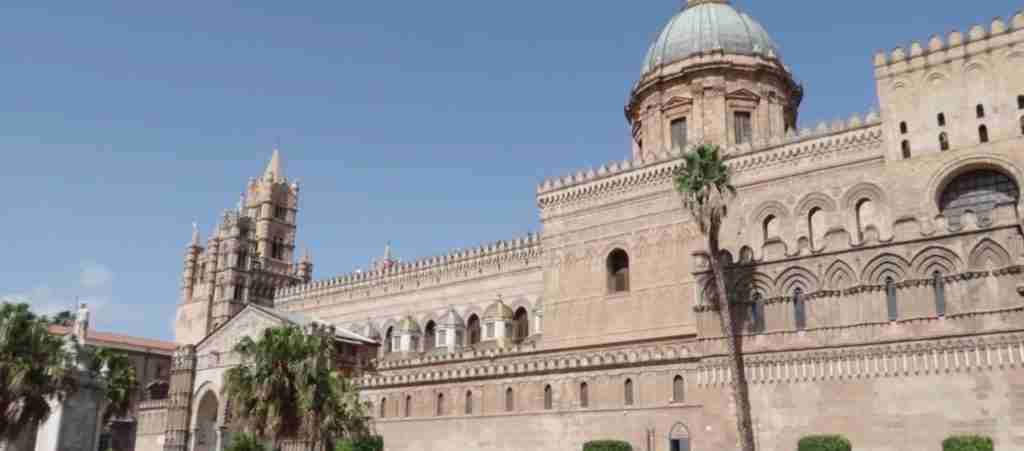
What survived — or was painstakingly restored — repays careful attention. The Cathedral, rebuilt from its perimeter walls outward and reconsecrated in 1929, still carries mosaics in its apses and a carved portal on its façade. The Bell Tower alongside it contains one of the most elaborate mechanical clocks ever made. The Church of the Annunciation of the Catalans, a compact Norman building from the 12th century, is among the very few structures that the 1908 earthquake left standing. The Orion Fountain in Cathedral Square, sculpted in the mid-16th century by Giovanni Angelo Montorsoli, survived not the earthquake but the centuries before it, and is considered one of the finest Renaissance fountains in southern Italy. The Regional Museum of Messina holds two of Caravaggio’s final works — painted in Messina in 1609 — which alone would justify a detour of considerable distance.
Beyond the historic centre, Messina offers a landscape unique in Sicily. The Strait that separates the island from Calabria is only about three kilometres wide at its narrowest, a corridor of current-driven water where the Ionian and Tyrrhenian seas exchange water every six hours. Ancient navigators imagined the whirlpools and eddies as the monsters Scylla and Charybdis; modern travellers can watch traditional fishing boats — the narrow, high-masted felucca — hunt swordfish through the same waters in summer, a practice unchanged in its essential method for centuries. North of the city, the coastal road to Ganzirri Lakes and Cape Peloro opens into a different Sicily entirely: brackish lagoons, artisan mussel farms, beachside trattorias, and a quiet that the city centre rarely achieves.
This guide organises Messina’s tours, walking routes, and hidden spots into a practical framework for 2026 visitors — whether you have three hours, a full day, or the luxury of an overnight stay.
Self-Guided Walking Routes Through Messina in 2026
Messina’s self-guided walking options divide into three circuits of different length and ambition. All are free of cost, pedestrian-friendly in their core sections, and anchored by verifiable landmarks you can identify without a guide.
Route 1: The Cathedral Quarter Circuit in 2026 (1–1.5 Hours)
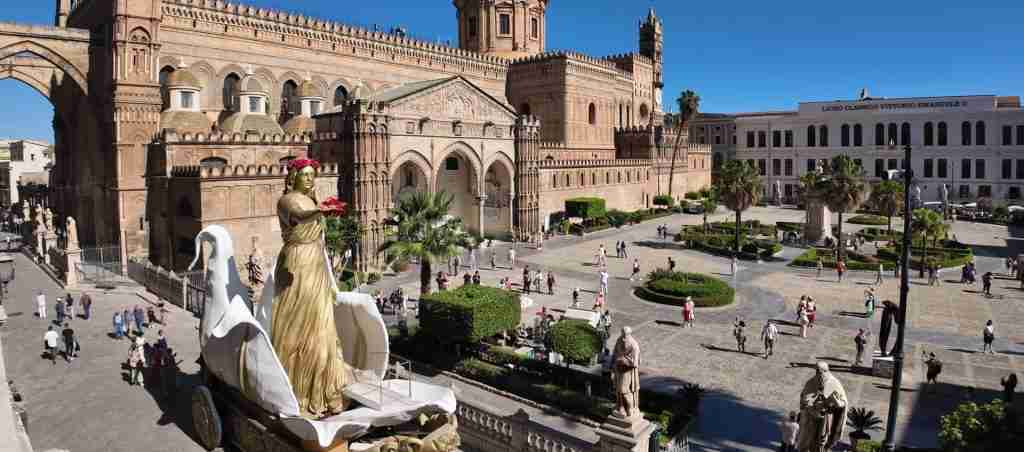
The Cathedral Quarter Circuit is the essential Messina walk and takes between one and one and a half hours at a leisurely pace, not counting time inside the Cathedral. It begins and ends in Cathedral Square, the broad piazza at the heart of the historic centre where Messina’s most concentrated cluster of monuments occupies a single walkable space.
Begin in Cathedral Square itself, where the Orion Fountain stands in the centre. Sculpted by Giovanni Angelo Montorsoli, the Florentine artist who trained in the circles of Michelangelo and settled in Messina in the mid-16th century, the fountain was completed in 1553 in collaboration with the sculptor Domenico Vanello. Its tiers depict river gods, mythological figures, and a commanding central Neptune — a monument the earthquake and subsequent fire of 1943 damaged but did not destroy. The Neptune Fountain, also attributed to Montorsoli, stands in nearby Antonello Square and rewards a five-minute detour east at the end of the circuit.
Cross the square to the Cathedral itself. The building dates from the Norman period and was consecrated in 1197, though what stands today is largely the product of reconstruction after 1908, completed and reconsecrated on 13 August 1929. Entry to the Cathedral is free. Inside, the apsidal mosaics and the tomb chapels of archbishops that survived the earthquake convey something of the pre-disaster grandeur. The organ is one of the largest in Europe.
Immediately outside the Cathedral’s south flank, the Bell Tower (height approximately 60 metres) houses what is reliably described as the largest and most complex mechanical and astronomical clock in the world. Built by the Ungerer Company of Strasbourg and inaugurated in 1933, the clock’s mechanism animates a procession of gilded bronze figures — a lion, a rooster, the legendary heroines Dina and Clarenza, the cycle of the ages, and the days of the week — every day at noon, for approximately twelve minutes. Admission to the Bell Tower is €5 for adults and €3 for visitors under 18 in 2026; check the official Messinarte website for current rates, as prices may be updated. Position yourself in Cathedral Square by 11:45am; the mechanism draws crowds, particularly from cruise-ship passengers, and a clear view is worth arriving early for. The Bell Tower interior can also be visited independently of the noon show; combined Bell Tower and Cathedral Treasury tickets cost approximately €8 for adults and €4 for visitors under 18.
From Cathedral Square, walk south along the main axis of the old town for three minutes to reach the Church of the Annunciation of the Catalans, known in English as the Catalani Church. This is the building that best represents what Messina’s historic centre looked like before 1908 — a compact, low-set Norman structure dating from the 12th century, built in the Arab-Norman style that characterises the finest Sicilian religious architecture of the period: alternating courses of dark basalt and pale limestone, blind arcading on the exterior, and a plan that mixes Norman discipline with the decorative instincts the Sicilian court absorbed from its Arab builders. It is one of the very few monuments in Messina that the 1908 earthquake left substantially intact. Entry is free.
The circuit closes back in Cathedral Square with a coffee at one of the bars on the eastern side of the piazza — Bar Duomo has occupied the corner since 1968 — before heading north five minutes on foot to Antonello Square to see the Neptune Fountain and the Vittorio Emanuele II Gallery, whose neoclassical arcade facing the square is a photogenic piece of the post-earthquake rebuilding effort.
Route 2: The Waterfront Promenade Walk in 2026 (45–60 Minutes)
The Waterfront Promenade Walk follows Liberty Avenue south from the cruise port, tracing Messina’s rebuilt seafront through a succession of civic set pieces that document the ambition of the post-1908 reconstruction. The walk takes 45–60 minutes at a relaxed pace and is entirely flat, making it suitable for all levels of mobility. No admission is charged at any point along the route.
The starting point is the cruise terminal on Via Vittorio Emanuele II, directly accessible from the ship gangway. Walking north from the port entrance, the first major landmark is the bronze statue of John of Austria (Don Giovanni d’Austria), created by the sculptor Andrea Calamech and dedicated in 1572 to honour the commander who led the Christian fleet to victory over the Ottoman navy at the Battle of Lepanto the previous year. Much of that fleet had assembled in Messina’s harbour before sailing south, and the city’s civic pride in the event has been marked by this monument for over 450 years. The bronze is on a high pedestal with relief plaques on its sides depicting the fleet and the battle.
Continuing along the waterfront, Zanca Palace (the City Hall) presents the longest neo-classical building façade in Messina — described by local guides as the largest single structure rebuilt after the 1908 earthquake. The broad, colonnaded exterior gives onto Antonello Square on its inland side, where the Neptune Fountain occupies the centre. The square takes its name from Antonello da Messina, the 15th-century painter whose work is the jewel of the Regional Museum of Messina; a street-level plaque marks the approximate site of his birth.
South of Antonello Square, Liberty Avenue continues as a wide, light-filled boulevard lined with late-19th and early-20th-century buildings that give the city a slightly different character from the older parts of the island. The Vittorio Emanuele II Gallery, a covered arcade in the neoclassical style, punctuates the walk midway along the route. The Madonnina del Porto — a small statue of the Virgin Mary at the southern tip of the port breakwater — is visible from the promenade on clear days, watching over the city from the harbour entrance as it has done for decades. The walk ends naturally at the pedestrian zone near the train station, from where it is a short trip by tram or taxi to the Regional Museum of Messina to the north.
Route 3: The Panoramic Hill Circuit in 2026 (2–3 Hours Round-Trip)
The Panoramic Hill Circuit is the most demanding of Messina’s self-guided routes and the most rewarding for views. It climbs from the city centre to the two hilltop sanctuaries — the Christ the King Sanctuary and the Montalto Sanctuary — that offer the broadest panoramas of the city, its crescent harbour, and the Strait. The circuit takes two to three hours including stops, depending on fitness. Parts of the ascent involve narrow streets and some steps. A taxi or rideshare to the Christ the King Sanctuary eliminates the uphill section and reduces the total time to about an hour.
The Christ the King Sanctuary stands on a panoramic hill above the city on Prince Umberto Avenue. The building is in neo-baroque style and serves as a war memorial to Messina’s fallen in both world wars. It occupies the site of the ancient castle of Rocca Guelfonia, sometimes also called Matagriffone — a fortified outcrop whose history stretches back to antiquity and which, in 1190–1191, served as the base of King Richard I of England (Richard the Lionheart) during his winter stay in Messina before departure on the Third Crusade. The ground floor of the sanctuary is free and open to visitors; the upper section, which gives access to the finest viewpoints, charges €5 for entry and opens from 9:45am. The panorama from the upper terrace takes in the full arc of the harbour, the city grid below, and the Calabrian mountains across the water.
From the Christ the King Sanctuary, a short path continues north along the ridge to the Montalto Sanctuary, a church set on the Capperina hill whose history is bound up with the medieval legend of the Madonna di Montalto, said to have appeared to a hermit on this site. The current structure is the product of several reconstructions, the most recent following the 1908 earthquake. Entry to the Montalto Sanctuary is free. The views from the terrace outside the church extend northward along the coast toward Ganzirri Lakes and Cape Peloro, giving orientation for anyone planning the northern lagoon drive described later in this guide.
Best Guided Tours in Messina 2026
Messina’s licensed guide community is heavily oriented toward cruise passengers, which means guided tours are plentiful, professionally run, and genuinely good value by comparison with other Sicilian cities. The main categories in 2026 are city walking tours, Strait of Messina boat tours, culinary experiences, and specialty or private options.
City Highlights Walking Tours 2026
The standard city walking tour in Messina runs 2.5 hours and covers the Cathedral Quarter Circuit described above, with a licensed guide adding historical context, legend, and logistical expertise (including precise positioning for the noon clock show). The itinerary typically includes the Cathedral, the Bell Tower, the Catalani Church, the Gargano Family Puppet Museum, and a tasting stop at a central pastry shop where cannoli or granita are included in the price.
Prices in 2026 through established local operators start at €35 per person for a shared group (up to 35 participants), €50 per person for a small group of up to 16 people, and €80 per person for a fully private experience. Groups of ten or more travelling together can negotiate rates from €28 per person. All prices include guide services, the Puppet Museum entrance fee, and the food tasting; audio headsets are available on some tours, allowing the guide to speak at a normal volume while walking. Check official booking platforms for current availability and pricing, as seasonal demand — particularly during the peak summer cruise season of June through August — can affect both price and availability. Most operators guarantee return to the port gate before ship departure time, a key feature for cruise passengers.
Strait of Messina Boat Tours 2026
The Strait of Messina is one of the most historically charged bodies of water in the Mediterranean — the setting of the Homeric monsters Scylla and Charybdis, the scene of the Battle of Lepanto’s preparatory manoeuvres, and today a living working strait where swordfish are hunted using boats whose basic design has changed little in centuries. Boat tours allow visitors to see both the Sicilian and Calabrian coasts from the water and to cross between them outside the utilitarian ferry route.
The shortest boat options run approximately two hours and trace the northern Sicilian coast from the city harbour to Ganzirri Lakes and Cape Peloro, pricing from approximately €28–30 per person. A mid-range option covers four hours and crosses the Strait to reach Scilla — the picturesque Calabrian fishing village where the houses of the Chianalea quarter overhang the water — as well as Cape Peloro and the Violet Coast, at approximately €90–100 per person. Six-hour dinghy tours covering the same route at a more exploratory pace, with swimming stops, cost from approximately €95–100 per person. Fully private group crossings run considerably higher and are priced on application to local operators.
The peak season for boat tours is mid-June through mid-September, when sea conditions in the Strait are calm and the swordfish season is in full swing. Spring (April–May) and autumn (September–October) tours operate with fewer participants and equal scenery; winter trips may be weather-dependent and should be confirmed closer to travel. Book through official local operators (Discover Messina Sicily operates from the city centre) or through established booking platforms; check official sites for current rates, which may vary by date and group composition.
Culinary and Food Tours in Messina 2026
Messina’s street-food culture is distinct from the rest of Sicily and organised around a handful of local products that visitors rarely encounter in the same form elsewhere on the island. The granita con brioche — a half-frozen fruit or nut ice eaten for breakfast with a soft, slightly sweet bread roll — is the city’s morning ritual and can be sampled at any bar in the city centre; the finest versions use locally sourced citrus or Bronte pistachios. A combined pizza-making class, cannoli workshop, and walking tour is available in 2026 from approximately €115 per person, covering a four-hour morning session with instruction and tasting.
At Ganzirri Lakes, the waterside restaurants around the lake perimeter specialise in mussels, clams, and oysters farmed in the lagoons a few metres from the table. Mussels are the signature dish of the area; the local farms have operated continuously for generations, and the proximity of the Ionian and Tyrrhenian waters creates an unusual flavour profile. A light seafood lunch at Ganzirri typically runs €20–35 per person depending on portions and whether fish or shellfish mains are added. These restaurants are popular with Messinese families on weekend lunches and are genuinely local rather than tourist-oriented — an important distinction that improves both food quality and price.
Swordfish (pesce spada) is the prestige ingredient of Messinese cuisine and appears on nearly every restaurant menu in the city from June through September, when the seasonal harvest from the Strait is at its peak. Grilled, rolled and stuffed (involtini di pesce spada), or braised with local tomatoes and capers, it is significantly better in Messina than versions served inland or out of season. Several restaurants near the port and along the northern coastal road combine the freshest catch with a view of the Strait from which the fish was taken that morning.
Specialty and Private Tours in Messina 2026
Beyond walking and boat tours, Messina offers a cluster of specialty experiences suited to visitors with specific interests. Photography tours depart early morning to catch the cathedral façade in raking light before the noon crowd assembles, and continue to the panoramic terraces of the Christ the King Sanctuary for views over the awakening harbour. Wine and food tours combine a city orientation with a drive to hillside producers in the Peloritani Mountains behind the city, where small-scale viticulture on north-facing slopes produces wines largely unknown outside the province.
The Godfather tour — departing from Messina to the mountain village of Savoca, where the Bar Vitelli from Francis Ford Coppola’s film has been preserved and extended into a dedicated museum — is one of the most popular specialist day trips from Messina and typically combines Savoca with a visit to Taormina in a five to six-hour circuit. These tours run from approximately €80–120 per person in a shared minibus. Private car tours, allowing full itinerary flexibility, are priced from approximately €180 for a half-day. The Roots Tourism operators working from Messina also run ancestry travel experiences for visitors of Sicilian heritage, connecting them with civil and parish records, cemeteries, and family localities — a niche but well-regarded service for the significant diaspora of Messinese descent.
Hidden Gems and Secret Spots of Messina 2026
Messina’s hidden layer is extensive. The list below covers spots that most visitors — including those on repeat visits — overlook, ranging from protected natural lagoons to ancient chapels and living craft traditions.
Ganzirri Lakes: Messina’s Coastal Lagoon Reserve
Ganzirri Lakes are the most spectacular secret in Messina’s immediate surroundings and the one most likely to change a visitor’s perception of the city entirely. Located about 9 km north of the city centre along the coastal road, the two lakes — Ganzirri Lake and Faro Lake — are brackish saltwater lagoons connected to the sea by a network of historic channels. Ganzirri Lake (the larger of the two) stretches roughly 338,000 square metres and reaches a maximum depth of about 6.5 metres; its waters are connected to the Ionian side of the Strait through the Canale degli Inglesi (the English Channel, a local name for a historic canal), while Faro Lake connects to the Tyrrhenian side. Together the lakes form the core of the Cape Peloro Oriented Nature Reserve, a protected natural area established in 2001 and also designated a Site of Community Importance under European Union habitat law.
The human landscape around the lakes is as interesting as the natural one. Artisanal mussel and clam farms operate on the lake surface, with wooden walkways extending over the water to where the shellfish are cultivated in traditional net structures. The fishermen’s houses in the village of Ganzirri sit between the lake edge and the road, making the inhabited and the natural practically continuous. The waterfront restaurants around Ganzirri Lake are the best place in the province to eat shellfish: the mussels arrive from the farm to the kitchen the same morning, and the terraces overlooking the water make the meal into an occasion. Sunset here, when the light turns the lake surface copper and the silhouette of the Calabrian mountains appears across the Strait, is among the most quietly beautiful moments Messina offers.
Getting to Ganzirri Lakes without a car is straightforward: Messina’s urban bus service reaches the lake village directly from the city centre, and the journey takes about 25–30 minutes. The lakeside walk around the perimeter of Ganzirri Lake takes approximately an hour and is flat throughout. Admission is free. The best visiting window is late afternoon (from 4pm), combining the sunset experience with an early dinner at one of the waterside restaurants.
The Catalani Church: Messina’s Surviving Norman Gem
While the Church of the Annunciation of the Catalans is technically on the standard walking tour itinerary, most visitors file past it on the way to or from the Cathedral and never stop to look closely. The building deserves close attention: this compact Norman structure, dating from the 12th century, is built in the Arab-Norman style that the Sicilian royal court developed under the Norman dynasty — a synthesis of Byzantine spatial planning, Arab decorative vocabulary (geometric blind arcading, interlaced stonework), and Norman structural discipline. The alternation of dark volcanic stone and pale tufa on the exterior, the blind arcades on the apse drum, and the quality of the masonry around the portal are best appreciated by standing back from the building at the corner of the small square in front and spending five minutes looking at the whole composition before entering.
The church’s survival of the 1908 earthquake — when nearly every other significant building in the city either collapsed or was left too unstable to use — makes it the most direct physical link Messina has with its pre-catastrophe built heritage. Local guides often use it as the starting point for conversations about what Messina looked like before 1908, when it was a prosperous medieval and baroque city with a skyline of campaniles and a dense historic centre. That city is largely gone; the Catalani Church is its most legible remnant. Entry is free, and the interior is open during regular church hours.
The Gargano Family Puppet Museum: A UNESCO Heritage Art Form
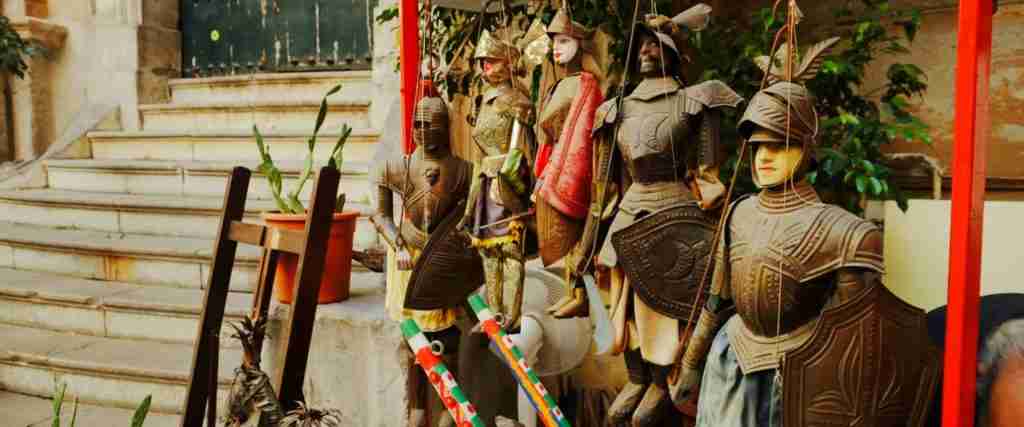
The Gargano Family Puppet Museum does not appear on most tourist maps of Messina, yet it is among the most genuinely distinctive cultural experiences the city offers. The Gargano family has preserved and performed the Sicilian puppet theatre tradition (the Opera dei Pupi) since the early 19th century; the museum’s collection comprises historic puppets — some armoured knights reaching 80 centimetres in height — together with hand-painted backdrops, carved weapon sets, and handwritten performance scripts from the family’s earliest generations. The UNESCO organisation recognised the Sicilian Puppet Theatre tradition as an Intangible Cultural Heritage of Humanity in 2008, and the Gargano collection is one of the finest private expressions of that tradition.
The museum is included in the price of most guided walking tours in Messina (entrance at approximately €35 for shared tours), and the family welcomes independent visitors by arrangement. The performance tradition — which staged epic narratives from Carolingian romance (the knights of Charlemagne, the paladins of France, the battles with the Saracens) over multiple evenings for popular audiences — is explained in the museum through a combination of the object collection and the family guide’s narration. For visitors with children, it is the most engaging stop in the city centre.
The Pietro Castelli Botanical Garden: A Forgotten Green Oasis
Inside the campus of the University of Messina, the Pietro Castelli Botanical Garden is a genuine urban secret — rarely signposted for visitors, virtually empty on weekday mornings, and genuinely beautiful. The garden is named after Pietro Castelli (1571–1659), a physician and botanist who worked in Messina in the 17th century and established the botanical study of the local flora as an academic discipline at the university; the current garden has maintained a continuous botanical collection since that period. The collection includes Mediterranean species, tropical plants brought to Messina through its historic role as a port, succulents, and several specimen trees of considerable age. The garden is located near the historic city centre, walkable from Cathedral Square in about ten minutes. Check with the University of Messina for current visiting hours and any access requirements, as hours may vary during academic periods.
Briga Marina and the Chapel of Saint Paul
The small fishing community of Briga Marina, south of the city centre on the Ionian coast, is almost entirely off the tourist circuit. At its edge stands the Chapel of Saint Paul (13th century), a small church in a coastal setting that local tradition links to the apostle Paul’s landing in Messina in 38 AD — the saint is said to have preached at the stone near the chapel, which is still visible and marked. Whether the tradition reflects historical fact is uncertain and not documented in early records; it is best understood as the kind of founding legend that coastal communities across the ancient Mediterranean attached to apostolic visitors. What is certain is that the building itself is genuinely medieval, that the fishing village around it is authentic and almost entirely unvisited by tourists, and that the setting — a small church on the edge of a working harbour with the Strait visible to the north — is striking. Getting there requires a car or taxi (about 20 minutes south of the city centre); the chapel is free to visit when open.
Horcynus Orca Park: Where Literature Meets the Strait
At Cape Peloro, the Horcynus Orca Park takes its name from the monumental novel by Messina-born writer Stefano D’Arrigo, published in 1975 after over twenty years of work — a vast, mythologised account of a soldier returning to the Strait at the end of the Second World War, written in a language of extraordinary density and invention. The park contains a permanent exhibition called Alphabets of the Two Seas, which approaches the ecology, fishing culture, and natural history of the Strait as a kind of multimedia installation — combining scientific display with artistic interpretation. The collection includes abyssal fish specimens, documentation of the swordfish and whale populations of the Strait, material on the currents and geology of the seabed, and references to the myths and legends that the Strait has generated over three thousand years of navigation. It is the kind of exhibition that works best for visitors who have already spent time at Ganzirri Lakes and on the water, because it puts a scientific and literary frame around things they have already encountered directly. Check current opening hours and admission prices directly with the park before visiting, as schedules can be seasonal.
Messina’s Northern Coast and the Strait in 2026
The northern coastal road from Messina to Cape Peloro is itself a route worth experiencing — a 9-km drive (or cycle) along the edge of the Strait, passing through the waterfront neighbourhoods of Pace, Mortelle, and Paradiso before arriving at the Ganzirri Lakes and Torre Faro. The road is busy in summer and quiet in winter, but the scenery is available in all seasons: the water of the Strait close to the road on the right, the forested ridge of the Peloritani Mountains rising steeply on the left, and small fishing boats moored in every inlet.
Torre Faro Village and the Messina Pylons
Torre Faro is a compact fishing village at the tip of Sicily, a few hundred metres from Cape Peloro. It is best known locally for its beaches — popular with Messinese families in summer — and for an extraordinary piece of 20th-century industrial infrastructure: the Messina pylons, two giant steel towers (232 metres high, with 1,250 steps each) that once carried high-voltage power cables across the Strait. Decommissioned and stripped of their cables, the pylons now stand as landmarks visible from both sides of the water, floodlit at night by 32 spotlights. They are open for climbing visits, giving access to views from 200 metres above the Strait — a perspective that makes the narrowness of the crossing between Sicily and the mainland vividly clear. Torre Faro is the natural end point of the northern coastal drive and the departure point for several of the boat tours described elsewhere in this guide.
The Felucca Swordfish Fishing Experience
Between June and September, the Strait of Messina hosts one of the world’s most ancient forms of large-scale fishing: the swordfish hunt using the felucca or spadara, a long, narrow boat fitted with a tall observation platform at the bow from which a lookout spots the fish near the surface, and a long bowsprit extending over the water from which the fisherman strikes. The boats navigate the strong Strait currents following the swordfish as they pass through on their Mediterranean migration routes. The fish can exceed 300 kg; the technique requires patience, coordination, and exact knowledge of the currents.
Tour operators based at the northern coast offer direct participation experiences — boarding a working felucca with a crew of local fishermen, joining the hunt, and learning about both the technique and the ecology of the Strait from the crew. These tours depart daily from embarkation points along Via Consolare Pompea on the northern coast, with the exact GPS coordinates communicated by the operator in advance. Duration is flexible, from two to eight hours depending on preference. A granita stop at Ganzirri village is typically included before or after the water portion of the experience. Check current prices and booking availability directly with specialist operators such as Discover Messina Sicily, as seasonal schedules vary.
Crossing to Scilla by Boat
Scilla, the Calabrian fishing village that once lent its name to one of Homer’s monsters, sits directly across the Strait from the Sicilian coast north of Messina. Seen from the water on a boat crossing, it is one of the most dramatic village settings in Italy: a volcanic rock rising from the sea with a castle (Castello Ruffo) at its peak, the fishing village of Chianalea clinging to the base where the houses overhang the water directly, and the Violet Coast (Costa Viola) extending north with its distinctive reddish cliff tones. The crossing by boat from the Messina area takes about 20–30 minutes and forms the climax of the Strait boat tours described above. Independent travellers who prefer a cheaper approach can take the regular ferry from Villa San Giovanni (near Reggio Calabria) to Messina and then arrange local transport north, but a dedicated boat tour is the most practical option for reaching Scilla with time to explore.
Panoramic Sanctuaries: Messina’s Hidden Heights in 2026
Messina’s two hilltop sanctuaries — the Christ the King Sanctuary and the Montalto Sanctuary — are described individually in the Panoramic Hill Circuit walking route section above, but they deserve separate treatment as destinations in their own right, particularly for visitors who arrive by car or taxi rather than on foot.
The Christ the King Sanctuary opens from 9:45am and charges €5 for the upper viewing section. The war memorial rooms on the ground floor are free and contain photographic documentation of the 1908 earthquake and the reconstruction effort that followed — a deeply affecting exhibition that gives the panoramic views their full weight. Standing at the terrace and looking down at the rebuilt city grid below, the scale of what was lost and what was reconstructed becomes legible in a way that cannot be conveyed on the street level. The site sits roughly where the Rocca Guelfonia castle stood in medieval times; Richard I of England spent the winter of 1190–1191 here, preparing his crusading fleet before crossing to the Holy Land.
The Montalto Sanctuary, a short walk north along the ridge, is associated with a Norman-period legend of the Virgin’s appearance and has been rebuilt multiple times; the current structure dates from the post-1908 reconstruction. Its terrace faces north toward Cape Peloro and gives a different viewpoint from the Christ the King Sanctuary — the whole northern coast laid out below, the lagoons of Ganzirri visible as silver ovals among the coastal vegetation, and the peaks of the Calabrian mountains catching the afternoon light across the water. Entry is free. The combination of both sanctuaries in a single hilltop visit takes about two to three hours including travel and makes a strong complement to a morning in the city centre.
Day Trips from Messina in 2026
Messina’s position at the northeastern corner of Sicily and directly opposite the Calabrian coast makes it one of the best-connected bases for day trips on the island. The options below represent the four most practical and rewarding excursions in 2026, with verified travel times and approximate costs.
Taormina Day Trip from Messina in 2026
Taormina is the most popular day trip from Messina and the most straightforward. The distance is approximately 55 km by road; by train from Messina Centrale station, the journey takes 40–50 minutes on regional services with departures roughly every hour throughout the day. By car or organised minibus tour, the drive runs about 45–55 minutes along the A18 motorway. The target attraction in Taormina is the Ancient Theatre — a Greek theatre subsequently rebuilt by the Romans, positioned on a cliff with a stage backdrop that frames Mount Etna — which charges €10 for entry and is open daily. Combined Taormina and Savoca minibus tours from Messina, led by licensed guides, run approximately five to six hours and cost from €80 to €130 per person depending on group size and operator.
Savoca and the Godfather Film Tour from Messina 2026
Savoca is a medieval hilltop village in the Peloritani Mountains about 30 km south of Messina that became internationally known after Francis Ford Coppola used it as the setting for the Sicilian sequences in The Godfather (1972). The Bar Vitelli, where Michael Corleone meets Apollonia’s family in the film, has been maintained as a museum and meeting point with original film props, photographs, and documentation of the production. The drive from Messina to Savoca takes approximately 40 minutes; the village is poorly served by public transport, making an organised tour or rental car the practical option. Most Savoca tours combine the village with Taormina for a six-hour day. The combination of authentic medieval hill-town atmosphere and cinematic history makes Savoca the most distinctive half-day option near Messina.
Reggio Calabria by Hydrofoil in 2026
Reggio Calabria on the Calabrian mainland is 15–20 minutes from Messina by hydrofoil — one of the shortest international-adjacent crossings in Europe. The primary reason to make the trip is the National Museum of Magna Graecia in Reggio, which holds the Riace Bronzes: two life-size 5th-century BC Greek bronze warriors found on the Calabrian seabed in 1972 and generally considered among the finest surviving examples of ancient Greek sculpture. The museum charges admission (check current prices directly with the museum before visiting); the hydrofoil crossing operates multiple times daily from the Messina port terminal and costs a modest fixed ferry fare for foot passengers. Reggio itself, a pleasant coastal city rebuilt after its own 1908 earthquake damage, has a lungomare (seafront promenade) directly below the museum with clear views back across the Strait to Messina. A half-day excursion covers the crossing, the museum, a seafront lunch, and the return with time to spare.
Aeolian Islands from Messina in 2026
The Aeolian Islands — the volcanic archipelago north of Sicily that includes Stromboli, Vulcano, and Lipari — are reachable from Milazzo, approximately 35 km west of Messina. By car, Milazzo takes about 30 minutes; by train from Messina Centrale, the journey takes about 25 minutes on regional services. From Milazzo port, high-speed hydrofoils and slower car ferries serve all the Aeolian Islands; Lipari (the main island) is about 55 minutes by hydrofoil, Stromboli about two hours. An Aeolian day trip from Messina covering Milazzo, the hydrofoil crossing to Lipari, a few hours on the island, and the return is feasible with an early start, though most visitors will find a two-day stay more satisfying. Ferry and hydrofoil tickets are purchased through Siremar, Liberty Lines, or Alilauro directly at the Milazzo terminal or online; prices vary by destination and season but hydrofoil tickets to Lipari typically run approximately €25–35 each way.
Seasonal Timing: When to Tour Messina in 2026
Messina’s climate is Mediterranean, with hot, dry summers and mild, occasionally rainy winters. The best windows for touring depend on what the visitor prioritises.
April and May are the optimal months for a first visit. Temperatures range from 15°C to 22°C, sea conditions allow boat tours from mid-April onward, the Cathedral Square and walking routes are uncrowded, and the flowering vegetation on the hillside routes to the sanctuaries is at its most vivid. The Ganzirri Lakes waterfront restaurants begin their full season in May. Cruise ship traffic is present but not yet at summer peak volumes.
June through August brings Messina’s busiest tourist period. Daily temperatures reach 28°C–34°C in July and August; early-morning and late-afternoon touring is strongly preferable to midday. The noon Astronomical Clock show draws its largest crowds in these months, and Cathedral Square can be uncomfortably packed between 11:30am and 12:30pm. Boat tours operate at maximum frequency and the swordfish felucca experience is at its best. Ganzirri Lakes and Torre Faro beach are popular with local families on weekends. Book walking tours and boat experiences well in advance — sometimes weeks ahead during August.
September and October offer conditions nearly as good as spring with the additional advantage of warmer sea temperatures (22°C–24°C), making boat tours and any swimming components of Strait excursions more appealing. Crowds diminish after the first week of September. The swordfish season runs through September; the restaurants at Ganzirri Lakes typically remain open through the end of October. October rain is possible but infrequent; touring days are generally clear and comfortable at 18°C–24°C.
November through March sees Messina at its quietest. Most boat tour operators reduce schedules or suspend until spring; the walking routes and city-centre attractions remain fully accessible and far less crowded. The Regional Museum of Messina is particularly rewarding in winter, when the galleries can be explored without competition for space in front of the Caravaggio canvases. The Christmas and New Year period brings local festivities and the December 28 anniversary of the 1908 earthquake, which is marked by commemorative events in the city.
Practical Planning for Messina Tours in 2026
Messina’s city centre is compact enough to navigate on foot, with the key historic sites within a 20-minute walk of each other. The following practical information covers the logistics most commonly needed by 2026 visitors.
Getting around the city. Messina has a tram system that runs along the seafront and serves several key stops including the Regional Museum of Messina (at the northern end of Liberty Avenue). A tram or bus ticket covers multiple stops and is the easiest way to reach the museum from Cathedral Square or the cruise terminal. Taxis and rideshare services are available for the hill circuits to the sanctuaries, where the uphill walk is steep enough that many visitors prefer to drive up and walk back down, or drive in both directions.
Meeting points for tours. Walking tour operators in Messina typically meet at the cruise terminal Gate 5 for cruise passengers or at a city-centre agency location. The Discover Messina Sicily office is in Via G. Garibaldi, a few minutes walk from Cathedral Square. Confirm the exact meeting point when booking, as different operators use different locations and some offer hotel pickup.
The noon clock show. The Astronomical Clock mechanism runs every day, year-round, at exactly noon for approximately twelve minutes. No advance booking is required — it is free to watch from Cathedral Square. The Bell Tower interior (€5) can be visited from around 10am to see the mechanism up close and access rooftop views, but the noon show itself is watched from the square. Rain or high wind may occasionally cause the Bell Tower interior to close; the square show continues in all but exceptional weather.
Museum free days. The Regional Museum of Messina offers free admission on the first Sunday of each month. If your visit coincides with this date, the museum can become busy by mid-morning; plan to arrive when it opens.
Currency and payments. All tour operators, museums, and transport accept cash; credit and debit cards are increasingly accepted by tour operators and some larger cafés but are not guaranteed at smaller establishments, market stalls, or waterfront restaurants at Ganzirri. Carry €20–50 in cash for incidentals.
What to wear. The Cathedral and all churches in Messina require shoulders and knees to be covered for entry. Lightweight scarves or a spare shirt for women and shorts with covered shoulders for men is the practical solution in summer. The hill circuit to the sanctuaries involves uneven ground; rubber-soled shoes rather than sandals are recommended.
Booking advice. For the peak summer months (July–August), book walking tours and boat tours at least one week in advance, and ideally two to three weeks for private options. Spring and autumn tours can generally be booked a day or two ahead. The Regional Museum of Messina does not require advance booking. The Cathedral Treasury and Bell Tower require payment on arrival, not pre-booking, though hours can change for religious services.
Frequently Asked Questions About Messina Tours and Hidden Gems 2026
What is the best way to see the Astronomical Clock in Messina in 2026?
The best way to experience the Astronomical Clock in 2026 is to arrive in Cathedral Square no later than 11:45am and position yourself directly in front of the Bell Tower façade, approximately 15–20 metres from the tower base. The noon show runs for about twelve minutes and animates a full sequence of gilded bronze figures — the lion, the rooster, the heroines Dina and Clarenza, a procession of ages, and the days of the week — set to a musical accompaniment. No ticket is required to watch from the square. The Bell Tower interior can be visited separately for €5 per adult (under-18: €3), giving access to the mechanism floors and a rooftop view; this is worth adding if you have the time, but the noon show itself is fully visible from the square without paying. Guided walking tours are timed to arrive at the square for the noon show, which is a reliable option for cruise passengers who want the show framed by historical context.
How much does it cost to visit the Regional Museum of Messina in 2026?
The Regional Museum of Messina (also known as MuMe) charges €9 for a full-price ticket and €5 for a reduced ticket in 2026; check the museum’s official website for current rates and any temporary closures. Admission is free on the first Sunday of every month. The museum is located at Liberty Avenue 465, on the northern side of the city, accessible by tram from the city centre. Plan at least 90 minutes for a meaningful visit — the collection covers Messinese figurative art from the 12th to the 18th centuries and includes two major late works by Caravaggio (“The Adoration of the Shepherds” and “Resurrection of Lazarus,” both 1609), sculpture and altarpieces by Antonello da Messina, and works salvaged from churches destroyed in the 1908 earthquake. The last admission is at 6pm; check the official museum website for current opening days and hours, as Monday closures are common at Sicilian regional museums.
Are there boat tours on the Strait of Messina in 2026?
Multiple boat tour operators offer Strait of Messina excursions in 2026, ranging from short two-hour coastal loops to full-day crossings to the Calabrian shore. Entry-level options covering the northern Messina coast to Ganzirri Lakes and Cape Peloro start from approximately €28–30 per person for about two hours. Mid-range four-hour tours crossing to Scilla, exploring the Chianalea fishing village and the Violet Coast, and returning with a swim stop run approximately €90–100 per person. Six-hour dinghy tours with a private option cover the same territory more leisurely at similar per-person pricing. Specialist felucca fishing experiences, joining the swordfish hunt on a traditional working boat, are available from late June through September through operators including Discover Messina Sicily; check their website for current schedules and pricing. Book any boat experience in advance during July and August, when demand from cruise passengers peaks. Check official booking platforms and local operators for current rates, as seasonal pricing applies.
Can I reach Ganzirri Lakes by public transport in 2026?
Ganzirri Lakes are accessible by Messina’s urban bus network in 2026. Bus services from the city centre reach the Ganzirri village stop on the lakeside road; the journey takes approximately 25–30 minutes depending on traffic. Buses run throughout the day with increasing frequency in summer. Alternatively, the northern coastal road is a pleasant cycle route on a hired bicycle if you can find a rental in Messina. The tram system does not extend to Ganzirri; it serves only the city’s core waterfront. By car or taxi, the drive from Cathedral Square takes about 20 minutes. For the complete northern coastal experience — Ganzirri Lakes, Torre Faro village, and Cape Peloro — a car gives the most flexibility, allowing stops at viewpoints along the Strait that buses do not serve.
How long does the Messina city walking tour take in 2026?
Guided Messina city walking tours in 2026 run 2.5 hours and cover the Cathedral Quarter, including Cathedral Square, the Cathedral interior, the Bell Tower’s noon clock show, the Catalani Church (Church of the Annunciation of the Catalans), the Gargano Family Puppet Museum, and a tasting stop at a central pastry shop. All of these are included in the standard €35 shared-group price; audio headsets are used on some tours to allow continuous narration while walking. For self-guided walkers, the Cathedral Quarter Circuit described in this guide takes 1–1.5 hours without the museum and tasting; a self-guided tour incorporating both would take about the same 2–2.5 hours as the guided version. Cruise passengers with four hours in port have time for the full guided circuit plus thirty minutes of independent exploration in Cathedral Square before returning to the ship.
What is the Gargano Family Puppet Museum and is it worth visiting in 2026?
The Gargano Family Puppet Museum is a private collection maintained by one of Messina’s oldest puppet theatre families, documenting the Sicilian Opera dei Pupi tradition — a form of theatrical entertainment using elaborately armoured puppets to stage chivalric narratives of knights and battles — since the early 19th century. The UNESCO organisation inscribed the Opera dei Pupi on its Intangible Cultural Heritage of Humanity list in 2008, and the Gargano collection is among the most historically continuous in Sicily. The museum is included as a standard stop on most Messina guided walking tours (entry covered in the tour price of €35 for shared groups) and is independently visitable by arrangement. For visitors interested in craft traditions, folk performance, or material culture, it is genuinely worthwhile and takes about 30–40 minutes to see properly. For visitors with limited time who need to prioritise, it is more rewarding than it initially sounds from the outside.
What day trips can I do from Messina in 2026?
Messina’s location makes it one of Sicily’s best-connected cities for day trips in 2026. The four strongest options are: Taormina (45–55 minutes by train or car, €10 Ancient Theatre entry); Savoca and the Godfather film village (40 minutes by car, best combined with Taormina in an organised tour for €80–130 per person); Reggio Calabria across the Strait by hydrofoil (15–20 minutes by hydrofoil, with the National Museum of Magna Graecia holding the Riace Bronzes as the main draw); and the Aeolian Islands via Milazzo (30 minutes to Milazzo by train, then 55 minutes by hydrofoil to Lipari at approximately €25–35 each way). Mount Etna is a practical day trip by car (about 1.5 hours to the crater area via Catania) or by organised tour from Messina. Alcantara Gorge, where the river cuts through a lava channel, is about an hour by car and is often combined with Taormina in a single day by organised tour.
When is the best season to visit Messina in 2026?
The best seasons for visiting Messina in 2026 are spring (April–May) and early autumn (September–October). Both offer comfortable temperatures (15°C–24°C), all walking routes and boat tours operating fully, and significantly fewer crowds than the summer peak. April and May have the advantage of the city’s green hillside landscapes and the start of the seafood season; September and October have the advantage of warmer sea temperatures for any water-based activities and the peak of the swordfish season. Summer (June–August) is fully operational but hot (up to 34°C in August) and crowded at the Cathedral Square noon show; plan morning tours before 10am and late-afternoon activities after 4pm. Winter (November–March) is quiet, pleasant, and best for the Regional Museum of Messina and the indoor cultural experience; most boat tours are suspended or reduced in this period.
How do I get between Messina and Taormina in 2026?
The most convenient options for the Messina-to-Taormina journey in 2026 are: regional train from Messina Centrale station (journey time 40–50 minutes, departures roughly every hour, ticket price approximately €5–7 each way at current tariffs — check Trenitalia for current fares); organised minibus tour from Messina (typical duration five to six hours total including Taormina and Savoca, approximately €80–130 per person including guide); or private car (the A18 motorway south covers the distance in about 45 minutes, with parking in Taormina requiring payment at official car parks below the historic centre and a shuttle bus or cable car up to the town). Note that Taormina’s historic centre is car-free; parking below and walking up is standard for all visitors. Taormina-Giardini Naxos, the resort town below Taormina on the coast, has its own train station closer to the beach area.
What are the hidden gems most tourists miss when visiting Messina in 2026?
The hidden gems most tourists overlook when visiting Messina in 2026 include: Ganzirri Lakes and Cape Peloro (9 km north of the city, a free nature reserve with artisanal mussel farms, waterside restaurants, and sunset views over the Strait); the Pietro Castelli Botanical Garden (inside the University of Messina campus, a 17th-century teaching collection of Mediterranean and tropical flora rarely visited by tourists); Briga Marina south of the city, with its medieval Chapel of Saint Paul and working fishing harbour; Horcynus Orca Park at Cape Peloro, a permanent exhibition on the marine culture and natural history of the Strait that combines scientific display with artistic installation; the Torre Faro pylons (two 232-metre decommissioned steel towers at the tip of Sicily that can be climbed for panoramic views); and the felucca swordfish fishing experience, available June through September, which puts visitors on a traditional working fishing boat in waters where this ancient hunting method is still practised daily. All of these are either free or low cost and none requires advance specialist knowledge to enjoy.