
Malta UNESCO World Heritage Sites: Complete Guide
Malta’s UNESCO World Heritage portfolio represents an extraordinary concentration of cultural treasures spanning over 5,000 years of Mediterranean civilization, from Neolithic temple complexes predating Stonehenge to Renaissance fortified cities that shaped European military architecture. The archipelago’s three inscribed sites — the Megalithic Temples, the Ħal Saflieni Hypogeum, and the City of Valletta — each tell distinct chapters of human achievement while collectively illustrating Malta’s position as a crossroads of ancient ritual innovation, prehistoric burial practices, and strategic military engineering.
Key Takeaways About Malta’s UNESCO World Heritage Sites
- Three Cultural Treasures: Malta possesses three UNESCO World Heritage Sites, all designated for their cultural significance: the Megalithic Temples of Malta (seven temple complexes), Ħal Saflieni Hypogeum (a unique underground necropolis), and the City of Valletta (a complete Renaissance fortified city).
- Ancient Architectural Pioneers: The Megalithic Temples, built between 3600 BC and 2500 BC, represent some of humanity’s earliest free-standing stone architecture, demonstrating sophisticated engineering and astronomical knowledge during the Neolithic period before the construction of Egypt’s pyramids.
- Unprecedented Underground Monument: The Ħal Saflieni Hypogeum stands as the world’s only known prehistoric underground temple and burial complex, carved entirely from living rock across three levels reaching 10.6 meters below ground, containing evidence of approximately 7,000 burials.
- Renaissance Military Masterpiece: Valletta, founded by the Knights of St. John in 1566 following the Great Siege of Malta, exemplifies ideal Renaissance urban planning with 320 monuments concentrated within 55 hectares, maintaining its original 16th-century street grid and fortification system virtually intact.
- Remarkable Geographic Concentration: All three UNESCO sites exist within the confines of the Maltese archipelago measuring just 316 square kilometers, making Malta one of the world’s most heritage-dense destinations where visitors can experience millennia of human achievement within short distances.
- Ongoing Conservation Challenges: Malta’s globigerina limestone, the primary building material across all three sites, presents continuous conservation challenges due to its porosity and vulnerability to weathering, requiring specialized preservation techniques and visitor management strategies to protect these irreplaceable monuments for future generations.
People Also Ask About Malta’s UNESCO World Heritage Sites
How many UNESCO World Heritage Sites does Malta have?
Malta has three UNESCO World Heritage Sites, all inscribed in 1980 during the 4th Session of the World Heritage Committee. These sites consist of the Megalithic Temples of Malta (expanded in 1992 to include seven individual temple complexes), the Ħal Saflieni Hypogeum, and the City of Valletta. All three inscriptions recognize cultural heritage rather than natural heritage, reflecting Malta’s extraordinary archaeological and architectural significance despite its small geographic size. Malta accepted the UNESCO World Heritage Convention on November 14, 1978, and secured its first inscriptions remarkably quickly just two years later, demonstrating the international recognition of the archipelago’s outstanding universal value to human civilization.
What makes the Maltese megalithic temples unique among world heritage sites?
The Megalithic Temples of Malta represent humanity’s earliest known examples of complex stone architecture, predating both Stonehenge and the Egyptian pyramids. Built during three distinct periods between approximately 3600 BC and 2500 BC, these structures demonstrate remarkable architectural sophistication including corbelled roofing techniques, precisely cut stone blocks weighing multiple tons, carved decorative elements, and astronomical alignments. Unlike later megalithic monuments found across Europe, Malta’s temples exhibit a distinctive apsidal plan with multiple semi-circular chambers radiating from central corridors, suggesting unique ritual purposes developed independently on the isolated Mediterranean islands. The temples’ construction required advanced engineering knowledge to quarry, transport, and position massive limestone blocks without metal tools or wheeled vehicles, representing an extraordinary achievement of Neolithic technology and social organization.
Why is visitor access to the Ħal Saflieni Hypogeum so restricted?
The Ħal Saflieni Hypogeum operates under strict visitor limitations to prevent environmental degradation of this unique underground monument. Only 80 visitors enter daily in small groups of eight people per hour, with advance booking required weeks or months ahead. These restrictions protect the site from damage caused by elevated carbon dioxide levels, humidity changes, and temperature fluctuations generated by human presence in the confined underground chambers. The hypogeum’s painted ochre decorations, carved architectural details, and archaeological integrity depend on maintaining stable environmental conditions, making visitor management essential for long-term preservation. Photography remains prohibited throughout the site to eliminate additional environmental stress from flash equipment and to maintain the contemplative atmosphere appropriate for this ancient burial sanctuary.
Can visitors walk through all areas of Valletta’s fortifications?
Valletta’s extensive fortification system remains largely accessible to visitors, with public access to major bastions, gates, and defensive walls forming integral parts of the urban experience. The Upper Barrakka Gardens and Lower Barrakka Gardens provide spectacular viewpoints along the fortifications overlooking Grand Harbour, while the Saluting Battery offers daily cannon ceremonies. Certain military installations including Fort St. Elmo (now housing the National War Museum) and Fort St. Angelo require admission tickets but welcome public exploration. Some sections of the fortifications remain in military use or undergoing restoration, limiting access, but the majority of Valletta’s defensive perimeter integrates seamlessly with the living city, allowing visitors to appreciate the engineering genius of 16th-century military architecture while walking through one of Europe’s most remarkably preserved Renaissance urban landscapes.
Extended multi-day tours – 5+ days
Featured Malta Multi-Day Tour Packages

3 days
Malta 3-Day Discovery Tour
- ✓ Comprehensive Malta experience
- ✓ Expert local guides included
- ✓ All accommodation included
- ✓ Transportation provided

5 days
Malta 5-Day Highlights Experience
- ✓ Comprehensive Malta experience
- ✓ Expert local guides included
- ✓ All accommodation included
- ✓ Transportation provided
7 days
Malta 7-Day Cultural Journey
- ✓ Comprehensive Malta experience
- ✓ Expert local guides included
- ✓ All accommodation included
- ✓ Transportation provided

10 days
Malta 10-Day Complete Adventure
- ✓ Comprehensive Malta experience
- ✓ Expert local guides included
- ✓ All accommodation included
- ✓ Transportation provided
Multi-day tour packages powered by TourRadar. Prices and availability subject to change.
Introduction: Malta’s Extraordinary UNESCO Heritage
The Maltese Islands occupy a unique position in Mediterranean history, serving as a cultural crossroads where prehistoric innovators, ancient civilizations, medieval crusaders, and modern nations left indelible marks on a compact archipelago. Malta’s three UNESCO World Heritage Sites encompass this remarkable historical depth, presenting visitors with opportunities to explore some of humanity’s earliest architectural achievements, witness Byzantine and medieval artistic traditions preserved underground, and walk through a complete Renaissance city conceived as a unified military and urban masterpiece.
Malta’s inscription on the UNESCO World Heritage List occurred in 1980, just two years after the nation ratified the World Heritage Convention in 1978. This rapid recognition underscored the international archaeological and architectural community’s appreciation for Malta’s exceptional contributions to human cultural development. The simultaneous inscription of all three sites — the Megalithic Temples (initially only Ġgantija), the Ħal Saflieni Hypogeum, and the City of Valletta — demonstrated Malta’s multifaceted significance spanning prehistoric innovation through Renaissance military engineering.
The Megalithic Temples of Malta represent humanity’s earliest complex stone architecture, constructed by Neolithic communities between 3600 BC and 2500 BC. These seven temple complexes distributed across Malta and Gozo showcase sophisticated understanding of megalithic construction techniques, astronomical observation, and ritual space organization that developed independently on these Mediterranean islands. The temples’ original 1980 UNESCO inscription covered only the Ġgantija temples on Gozo, but international recognition of the entire temple-building tradition’s significance led to the 1992 extension incorporating six additional complexes: Ħaġar Qim, Mnajdra, Tarxien, Ta’ Ħaġrat, Skorba, and the completion of the Ġgantija recognition.
The Ħal Saflieni Hypogeum presents an archaeological enigma unparalleled anywhere on Earth: a vast underground complex carved entirely from living limestone rock, functioning simultaneously as temple and necropolis for Neolithic communities. Discovered accidentally in 1902 during construction work, the hypogeum reveals three distinct levels reaching 10.6 meters underground, containing elaborately carved chambers that mirror above-ground temple architecture, painted ochre decorations, and evidence of approximately 7,000 burials spanning centuries of use. This subterranean monument demonstrates prehistoric Malta’s spiritual sophistication and technical mastery of stone carving on an extraordinary scale.
Valletta represents Renaissance military and urban planning ideals executed with precision on a peninsula jutting into the Mediterranean. Founded in 1566 by Grand Master Jean Parisot de Valette following the Knights of St. John’s successful defense during the Great Siege of Malta, the city embodies 16th-century strategic thinking while creating a livable urban environment for its population. Valletta’s grid plan, comprehensive fortification system, baroque churches, aristocratic palaces, and public institutions occupy just 55 hectares while incorporating 320 monuments, making it one of the world’s most concentrated historic urban areas.
The geographic concentration of these three UNESCO sites within Malta’s 316 square kilometers creates extraordinary opportunities for cultural heritage tourism. Visitors can experience Neolithic temples in the morning, explore an underground burial sanctuary at midday, and walk Renaissance fortifications by evening, all without extensive travel between locations. This density of world-class heritage sites relative to geographic size positions Malta uniquely among UNESCO World Heritage destinations, offering comprehensive historical narratives accessible within compact timeframes.
Malta’s limestone geology, specifically the widespread use of globigerina limestone as primary building material across all three UNESCO sites, creates both aesthetic unity and conservation challenges. This honey-colored sedimentary rock, formed from compressed marine organisms millions of years ago, provides the distinctive golden appearance that characterizes Maltese architecture from prehistoric temples through Renaissance palaces. However, globigerina limestone’s porosity and softness make it vulnerable to weathering, salt damage from the marine environment, and structural deterioration, requiring ongoing conservation efforts to preserve these irreplaceable monuments.
The cultural significance of Malta’s UNESCO sites extends beyond their individual architectural and archaeological merits. Collectively, these sites illustrate the Mediterranean’s role as humanity’s innovation laboratory, where geographic isolation on small islands combined with maritime connectivity fostered unique cultural developments while facilitating exchange with broader Mediterranean civilizations. Malta’s prehistoric communities developed distinctive temple architecture without external models, medieval and Renaissance societies adapted international military and religious architectural traditions to local conditions and materials, and modern conservationists work to preserve these legacies for global benefit.
Understanding Malta’s UNESCO World Heritage Sites requires appreciating multiple temporal scales: the millennium-long temple-building tradition of Neolithic Malta, the centuries of hypogeum use spanning prehistoric and early historic periods, and Valletta’s five centuries of continuous occupation maintaining Renaissance urban character. These sites present not merely ancient ruins or museum cities but living testimonies to human creativity, adaptability, and reverence for heritage preservation across generations.
The Megalithic Temples of Malta: Humanity’s Earliest Stone Architecture
The Megalithic Temples of Malta constitute seven separate temple complexes recognized collectively as a single UNESCO World Heritage property. These structures, built during the Neolithic period between approximately 3600 BC and 2500 BC, represent some of the earliest free-standing stone buildings in human history. The temples’ construction predates Stonehenge by approximately 1,000 years and the Egyptian pyramids by several centuries, positioning Malta’s prehistoric communities at the forefront of monumental stone architecture development.
The temple complexes demonstrate remarkable architectural sophistication despite the technological limitations of their Neolithic builders. Construction involved quarrying massive limestone blocks, some weighing over 20 tons, transporting them to building sites without wheeled vehicles, and positioning them with precision using only stone tools, wooden levers, and rope. The temples employ advanced techniques including corbelled roofing to span interior spaces, precisely fitted megalithic blocks creating stable walls without mortar, and carved decorative elements showcasing artistic traditions alongside engineering expertise.
Archaeological evidence indicates the temples served ritual and ceremonial purposes rather than residential functions. The structures’ apsidal plan, featuring multiple semi-circular chambers arranged around central corridors, created distinct spaces likely dedicated to different aspects of religious practice. Excavations have uncovered animal bones suggesting ritual feasting, libation holes for liquid offerings, oracle chambers with acoustic properties, and numerous figurines depicting rotund human forms interpreted as representations of fertility or divinity. These findings collectively suggest complex ritual activities focused on agricultural fertility, ancestor veneration, or cosmic order maintenance.
Ġgantija Temples (Gozo): The Foundation of Malta’s UNESCO Recognition
The Ġgantija temple complex on Malta’s sister island of Gozo represents the earliest and most impressive of Malta’s megalithic temples. Built during the Ġgantija phase (3600-3200 BC), these twin temples showcase Bronze Age engineering at its most ambitious. The complex’s name derives from the Maltese word “ġgant” (giant), reflecting local folklore attributing construction to a race of giants — the only plausible explanation villagers could conceive for structures built from stones weighing multiple tons.
Ġgantija’s outer wall, constructed from coralline limestone blocks, reaches over five meters in height and demonstrates extraordinary construction expertise. The builders selected harder coralline limestone for external walls requiring weather resistance while using softer globigerina limestone for interior elements and decorative work. This material selection shows sophisticated understanding of stone properties and their appropriate architectural applications. The wall’s massive stones fit together with remarkable precision despite irregular shapes, creating stable structures that have survived over 5,500 years of Mediterranean weather.
The two Ġgantija temples, though adjacent and sharing an outer wall, represent separate construction phases and maintain distinct internal layouts. The southern temple, larger and earlier, features five apses arranged in a cloverleaf pattern around a central corridor, creating spaces likely dedicated to different ritual functions. The northern temple, slightly smaller and later in construction, follows similar planning principles while showing architectural refinements. Both temples contain raised thresholds, stone hearths, libation holes carved into floor slabs, and evidence of decorative elements including carved stone blocks depicting spirals and other geometric patterns.
Ġgantija’s excavation history illuminates the challenges and triumphs of early archaeological methodology. Initial excavations in the 1820s and subsequent 19th-century investigations operated under primitive archaeological standards, resulting in lost contextual information and artifact dispersal. However, more scientific 20th-century excavations recovered important data about construction techniques, ritual practices, and the temple’s role within Neolithic Gozo’s social structure. Ongoing conservation efforts balance public access with preservation needs, maintaining Ġgantija as both active archaeological resource and accessible heritage site.
Ħaġar Qim and Mnajdra: Clifftop Temple Complexes Overlooking the Mediterranean
The temple complexes of Ħaġar Qim and Mnajdra occupy a spectacular clifftop location on Malta’s southern coast, commanding views across the Mediterranean toward the uninhabited islet of Filfla. These temples, located approximately 500 meters apart, date to the later temple-building period (3200-2500 BC) and demonstrate architectural refinements developed as Malta’s temple-building tradition matured. Their coastal location, combined with sophisticated astronomical alignments, suggests these sites held particular significance within Malta’s Neolithic ritual landscape.
Ħaġar Qim, whose name translates as “standing stones,” consists of a main temple with four semi-circular apses and several additional structures representing different construction phases. The complex showcases some of Malta’s finest prehistoric stone carving, including decorative blocks featuring geometric patterns, plant motifs, and architectural elements carved in relief. One particularly impressive feature includes a massive trilithon entrance, where two upright megaliths support a horizontal lintel stone weighing several tons. The temple’s builders demonstrated exceptional skill in working globigerina limestone, carving fine details while managing the stone’s inherent softness and fragility.
Mnajdra, located downhill from Ħaġar Qim, comprises three separate temple structures built at different periods. The complex demonstrates remarkable astronomical alignment, with the main temple oriented to mark solstices and equinoxes through sunlight penetrating specific chambers at these calendrical moments. During the spring and autumn equinoxes, sunrise illuminates a stone slab along the main temple’s axis, while solstice sunrises highlight different architectural features. These alignments suggest sophisticated astronomical observation and the integration of celestial cycles into ritual practice, positioning Mnajdra’s builders among humanity’s earliest astronomical engineers.
The environmental challenges facing Ħaġar Qim and Mnajdra prompted innovative conservation responses. Exposure to Mediterranean weather, salt-laden winds, and intense summer sun accelerated stone deterioration, threatening these irreplaceable monuments. In 2009, protective tent structures designed by architects working with conservation engineers were installed over both temple complexes. These tensile fabric coverings shield the monuments from direct rainfall and intense sunlight while maintaining visual transparency, allowing visitors to appreciate the temples’ dramatic coastal setting while extending the limestone’s preservation timeline. Adjacent visitor centers provide introductory exhibitions, audio-visual presentations, and archaeological context enhancing temple visits.
Tarxien Temples: Malta’s Most Elaborately Decorated Prehistoric Sanctuary
The Tarxien Temples, located in the town of Tarxien near Malta’s modern capital, represent the culmination of Malta’s temple-building tradition. Constructed during the final temple-building phase (3000-2500 BC), Tarxien demonstrates the most sophisticated stone carving, largest scale construction, and most elaborate decorative programs of any Maltese temple complex. The site comprises four interconnected temple structures covering approximately 2,000 square meters, making it Malta’s most extensive prehistoric monument.
Tarxien’s discovery in 1913 by a farmer investigating damage to his plow uncovered Malta’s richest temple site. Archaeological excavations under the direction of Sir Themistocles Zammit revealed elaborately carved stone blocks featuring spirals, animal reliefs, and geometric patterns demonstrating extraordinary artistic achievement. One particularly significant discovery included the lower portion of a colossal statue depicting a seated figure, originally standing approximately 2.5 meters tall. This monumental sculpture, rendered in soft globigerina limestone, represents the largest known example of Neolithic statuary in the Mediterranean, suggesting Tarxien’s importance as a major religious center.
The temples’ internal architecture demonstrates advanced understanding of spatial organization and ritual movement. Visitors approaching from the main entrance pass through successive thresholds into increasingly elaborate chambers, experiencing architectural progression from public forecourts through semi-public spaces to inner sancta accessible perhaps only to religious specialists. Stone screens carved with geometric patterns and architectural details created visual separation between spaces while maintaining physical connection. Stone altars, offering tables, and libation holes indicate ritual activities involving animal sacrifice, liquid offerings, and ceremonial feasting.
Tarxien’s decorative elements provide invaluable insights into Neolithic Malta’s artistic traditions and symbolic systems. Carved reliefs depicting bulls, goats, and pigs represent domestic animals central to agricultural communities’ subsistence and ritual life. Spiral patterns, found throughout Malta’s temples but particularly elaborate at Tarxien, may represent water, agricultural fertility, cyclical time, or cosmic order. Stone blocks carved to resemble architectural elements like doorways or niches demonstrate the builders’ sophisticated engagement with visual representation and symbolic communication through built form.
The site’s later history adds archaeological complexity. After the temple-building culture’s collapse around 2500 BC, subsequent Bronze Age communities used Tarxien as a cremation cemetery, depositing urns containing cremated remains among the megalithic ruins. This secondary use demonstrates the temple’s continued significance as a sacred place even after original ritual practices ceased. In modern times, Tarxien suffers from urban encroachment, air pollution, and visitor pressure, requiring ongoing conservation interventions to preserve Malta’s most elaborate prehistoric sanctuary.
Ta’ Ħaġrat and Skorba: Windows into Temple-Building Tradition Development
The temple complexes of Ta’ Ħaġrat and Skorba, located near the town of Mġarr in northern Malta, occupy positions in the chronological development of Malta’s temple-building tradition that illuminate how this architectural form evolved. These sites, smaller and less elaborate than Ġgantija, Ħaġar Qim, or Tarxien, demonstrate early temple-building phases and the transition between different architectural traditions, providing archaeologists with crucial evidence about prehistoric Malta’s cultural evolution.
Ta’ Ħaġrat consists of two temples, the older dating to approximately 3600-3200 BC (contemporary with Ġgantija) and the younger to 3300-3000 BC. The complex demonstrates architectural elements characteristic of early temple construction: relatively small-scale structures, simple apsidal plans without extensive elaboration, and less sophisticated stone working compared to later temples. However, even these early temples incorporate trilithon doorways, internal hearths, and spatial organization suggesting ritual use. Ta’ Ħaġrat’s archaeological importance derives from its chronological position, showing temple architecture’s emergence and early development.
Skorba, located adjacent to Ta’ Ħaġrat, represents an even more significant archaeological resource due to its exceptionally long occupation sequence. The site contains evidence spanning from early Neolithic village settlements through the temple-building period into Bronze Age occupation. Excavations revealed pre-temple phase domestic structures, demonstrating that temple architecture evolved from simpler community buildings rather than appearing fully formed. Skorba’s stratigraphy (the layered sequence of archaeological deposits) provides Malta’s most complete record of prehistoric cultural development, making it invaluable for understanding not just temple architecture but the broader social and economic context within which temples emerged.
Both Ta’ Ħaġrat and Skorba receive fewer visitors than Malta’s more spectacular temple sites, creating opportunities for more contemplative visits. The sites’ presentation emphasizes archaeological context through informational panels explaining excavation results, chronological development, and connections to other Maltese temples. These less-crowded temples allow visitors interested in archaeology to examine construction details, spatial organization, and decorative elements at close range, appreciating the subtleties sometimes lost amid the grandeur of larger complexes.
The Temple-Building Culture’s Rise and Collapse
Malta’s temple-building tradition spanned approximately 1,100 years from 3600 BC to 2500 BC, during which time successive generations constructed, modified, and elaborated at least 23 megalithic temples across Malta and Gozo (though only seven achieved UNESCO inscription). This tradition represents one of human history’s most sustained architectural achievements, requiring social organization capable of mobilizing labor for monument construction while maintaining agricultural production to feed communities.
Archaeological evidence suggests temple construction required specialized knowledge and coordinated labor. Quarrying, transporting, and positioning massive limestone blocks demanded technical expertise in stone working, structural engineering, and logistics. The temples’ sophisticated astronomical alignments required observation and mathematical capabilities. Decorative carving needed artistic training and time investment beyond subsistence activities. This specialization implies social hierarchies with religious specialists, craft experts, and perhaps dedicated laborers supported by agricultural surpluses from the broader population.
The temple-building culture’s sudden collapse around 2500 BC remains archaeologically mysterious. Temples ceased to receive new construction or significant maintenance, elaborate ritual practices apparently ended, and Malta’s population may have declined dramatically. Various theories attempt to explain this collapse, including environmental degradation through deforestation and soil erosion, climate change affecting agricultural productivity, epidemic disease, social conflict, or the arrival of new populations with different cultural traditions. The absence of clear evidence makes definitive explanation impossible, but the collapse’s rapidity and completeness suggest systematic social breakdown rather than gradual cultural change.
Following the temple-building culture’s end, Malta’s Bronze Age and later Iron Age communities maintained memory of the megalithic structures while developing different religious and social practices. The temples’ massive stones and mysterious origins inspired folklore traditions, including legends of giants, supernatural builders, or divine creation. This folkloric memory, transmitted across millennia, demonstrates the temples’ psychological impact and suggests their continuous presence in Malta’s cultural landscape even as their original purposes were forgotten.
Ħal Saflieni Hypogeum: The World’s Only Prehistoric Underground Temple
The Ħal Saflieni Hypogeum represents a unique monument in global archaeology: an entirely underground complex carved from living limestone rock, functioning as both temple and necropolis for Neolithic communities. Located in the modern town of Paola on Malta’s eastern side, the hypogeum extends across three levels reaching 10.6 meters below the current surface. Its chambers, decorated with painted ochre designs and carved architectural details mimicking above-ground temple architecture, create an extraordinary subterranean sacred space unparalleled anywhere on Earth.
The hypogeum’s accidental discovery in 1902 occurred during construction work for residential housing. Workers breaking ground encountered underground chambers filled with human bones and archaeological artifacts. Initial investigations, conducted under primitive archaeological standards and complicated by the site’s private location within ongoing construction, resulted in significant disturbance before authorities halted development and initiated scientific excavation. Despite these early challenges, subsequent investigations recovered crucial information about the hypogeum’s construction, use, and significance within prehistoric Malta’s ritual landscape.
The structure’s architecture demonstrates extraordinary technical achievement. Neolithic builders excavated entirely with stone tools, carefully removing globigerina limestone to create interconnected chambers across three distinct levels. The upper level, closest to the original surface, consists of natural caves modified for burial use. The middle level contains the hypogeum’s most elaborate chambers, including the main hall, oracle room, and Holy of Holies, featuring carefully carved architectural details. The lower level, reaching 10.6 meters depth, comprises additional chambers accessed through a complex of passages and vertical shafts.
The middle level showcases the most sophisticated carving and decoration. Chambers replicate above-ground temple architecture with remarkable fidelity, including carved trilithon doorways, corbelled ceiling elements, and architectural details mimicking megalithic construction despite being carved from continuous living rock. This architectural mimicry suggests close connections between underground and above-ground ritual spaces, perhaps representing efforts to extend temple architecture into the chthonic realm associated with death and the underworld in many ancient Mediterranean cultures.
The hypogeum’s painted decorations represent Malta’s finest prehistoric art. Red ochre spirals, geometric patterns, and architectural details cover ceilings and walls in several chambers, particularly the main hall and Holy of Holies. These paintings, created from natural ochre pigments, demonstrate artistic traditions paralleling carved decoration at surface temples while adapting to the underground environment. The paints’ chemical analysis reveals sophisticated pigment preparation techniques, including mixing with binding agents to improve adhesion to limestone surfaces.
The oracle room presents one of the hypogeum’s most intriguing features. This small chamber, featuring a carved niche at head height, possesses remarkable acoustic properties. Sound resonates within the niche, amplifying male voices in the baritone range while having minimal effect on higher frequencies. These acoustic characteristics may have enabled ritual specialists to create impressive auditory effects during ceremonies, with voices seeming to emanate from the carved niche or resonating throughout adjacent chambers. Whether these acoustic properties resulted from deliberate design or fortunate accident remains debated, but their ritual exploitation seems certain.
The hypogeum functioned primarily as a burial sanctuary, though its elaborate architecture and decoration suggest temple-like ritual activities beyond simple interment. Excavations recovered approximately 7,000 individuals’ skeletal remains, representing centuries of burial practice from approximately 3300 BC to 3000 BC. The bodies appear to have been deposited in chambers following preliminary excarnation (flesh removal through natural decomposition or deliberate processing), with bones subsequently consolidated as chambers filled. Grave goods including pottery vessels, personal ornaments, and figurines accompanied burials, suggesting belief in afterlife continuation requiring material provisions.
The sleeping lady figurine, discovered in the hypogeum during early excavations, ranks among Malta’s most celebrated archaeological objects. This terracotta figurine, depicting a corpulent female figure reclining on a couch, exhibits exceptional artistic quality and may represent a sleeping person, deceased individual, or divine being. The figurine’s discovery context within a burial chamber suggests connections to death, afterlife, or divine protection of the deceased. Today housed in the National Museum of Archaeology in Valletta, the sleeping lady has become an iconic symbol of Malta’s prehistoric artistic achievements.
Modern conservation challenges necessitate strict visitor management. The hypogeum’s underground environment, while protected from rainfall and direct sunlight, proves extremely vulnerable to human presence. Visitors exhale carbon dioxide and water vapor while generating body heat, all of which alter the carefully balanced microclimate. Elevated carbon dioxide corrodes limestone surfaces through acid formation, moisture promotes biological growth including algae and fungi, and temperature fluctuations stress painted surfaces. These conservation concerns led to the hypogeum’s temporary closure in the 1990s for comprehensive restoration and the implementation of current visitor restrictions limiting access to 80 people daily in groups of eight per hour.
Visiting the hypogeum requires advance planning due to strict entrance limitations. Tickets must be reserved online weeks or months ahead, particularly during summer tourism seasons. Visitors descend into the complex via modern stairs, following a defined route through the most significant chambers while audio guide narration provides historical and archaeological context. Photography prohibition protects the site from additional environmental stress while maintaining contemplative atmosphere. The one-hour visit offers an extraordinary experience of humanity’s oldest underground sacred architecture, though the necessarily restrictive access ensures preservation for future generations.
City of Valletta: The Complete Renaissance Fortified City
Valletta represents the Renaissance ideal of the fortified city executed with precision on a peninsula jutting into the Mediterranean between two natural harbors. Founded in 1566 following the Knights of St. John’s successful defense of Malta during the Great Siege of 1565, the city embodies 16th-century military engineering, urban planning principles, and baroque architectural aesthetics. Valletta’s remarkably intact urban fabric, incorporating 320 monuments within just 55 hectares, makes it one of Europe’s most concentrated historic areas and a living testimony to Renaissance military and civil architecture.
The city’s foundation followed one of history’s most dramatic military conflicts. In 1565, Ottoman forces besieged Malta, seeking to eliminate the Knights of St. John and establish Mediterranean naval dominance. The four-month siege witnessed desperate fighting, massive casualties, and ultimate Maltese-Christian victory despite numerical disadvantage. This successful defense demonstrated fortification effectiveness and convinced the Knights to abandon their previous capital Birgu for a new, purpose-built fortress city on the Sciberras Peninsula. Grand Master Jean Parisot de Valette, who led the successful defense, initiated construction and gave his name to the new capital.
Valletta’s urban plan reflects Renaissance planning ideals synthesized by military engineer Francesco Laparelli, commissioned by the Knights to design their new city. Laparelli created a grid plan with straight streets running perpendicular and parallel to the peninsula’s spine, maximizing defensive firing lines while facilitating troop movement. The grid accommodated sloping terrain through stepped streets descending from the peninsula’s crest toward harbor edges. This plan incorporated baroque architectural principles including dramatic vistas, monumental public buildings positioned at visual terminals, and integration of fortifications with urban fabric.
The fortification system surrounding Valletta represents state-of-the-art 16th-century military engineering. Massive curtain walls of globigerina limestone rise from steep scarps, creating barriers resistant to artillery bombardment. Angular bastions project from the walls at regular intervals, providing overlapping fields of fire that eliminate defensive blind spots. Cavaliers (raised platforms behind bastions) enable defenders to fire over bastion parapets, creating additional defensive layers. Ravelins, demi-lunes, and other outworks create complex defensive zones forcing attackers into kill zones under concentrated fire. This system, improved by subsequent engineers including Girolamo Cassar and later military architects, created perhaps Europe’s most sophisticated fortification complex.
St. John’s Co-Cathedral dominates Valletta’s religious architecture and ranks among the Mediterranean’s finest baroque churches. Originally built as the conventual church of the Knights of St. John, the cathedral’s austere exterior contrasts dramatically with its elaborately decorated interior. The nave’s floor consists entirely of marble tombstones covering Knights’ graves, creating a remarkable mortuary pavement documenting the Order’s membership across centuries. Baroque side chapels dedicated to different langues (national divisions within the Order) feature paintings by Caravaggio and other masters. The cathedral’s museum houses tapestries, illuminated manuscripts, and liturgical treasures illustrating the Knights’ wealth and artistic patronage.
The Grand Master’s Palace, originally residence of the Order’s supreme leader and now serving as Malta’s presidential palace and Parliament house, exemplifies Renaissance civic architecture adapted to Mediterranean climate and defensive requirements. The palace occupies an entire city block, organized around two courtyards providing light and ventilation. State apartments feature decorative programs celebrating the Knights’ military victories and administrative achievements through frescoes, carved details, and portrait galleries. The palace armory houses one of Europe’s finest historical weapon collections, including armor worn during the Great Siege and later conflicts.
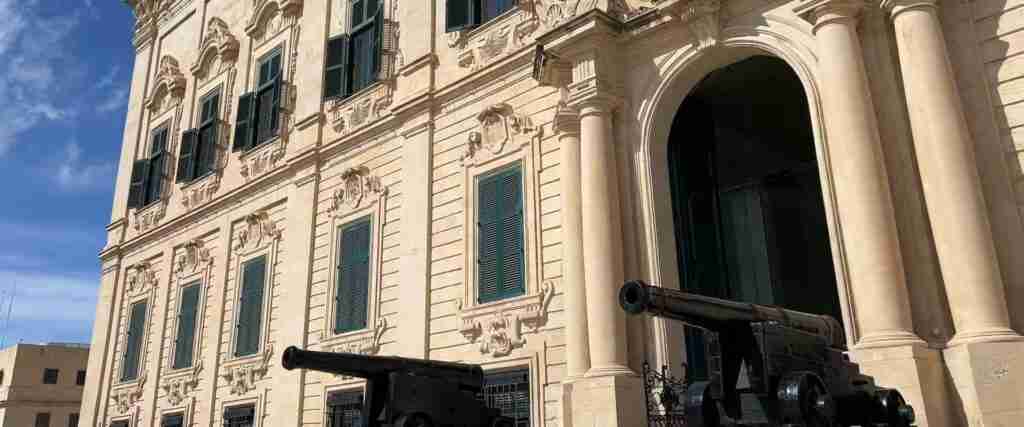
The Auberges, residential palaces housing Knights from each langue, demonstrate how Valletta accommodated the Order’s international structure while creating architectural unity. Eight auberges provided accommodation, administration, and social spaces for Knights from different linguistic regions including Castile, Aragon, France, Auvergne, Provence, Italy, Germany, and England. Each auberge’s baroque architecture reflects both international renaissance styles and local limestone construction traditions. Today these buildings serve various institutional functions, including government offices, museums, and cultural centers, maintaining public access while preserving architectural heritage.
Valletta’s grid plan incorporates baroque principles through strategic placement of monuments and creation of urban vistas. St. John’s Co-Cathedral, the Grand Master’s Palace, and other major buildings occupy positions creating dramatic perspectives along major streets. The peninsula’s natural topography enhances these effects, with ascending and descending streets creating varied viewing angles. Public squares including Palace Square, St. George’s Square, and Freedom Square provide open spaces contrasting with dense urban fabric while accommodating civic ceremonies and commercial activities.
The Upper Barrakka Gardens and Lower Barrakka Gardens, positioned along Valletta’s southern fortifications overlooking Grand Harbour, represent the city’s most popular public spaces. These elevated gardens provide spectacular harbor views, monument vistas, and respite from urban density. The Upper Barrakka Gardens feature the Saluting Battery, where cannon ceremonies occur daily at noon, continuing historic military traditions. The gardens’ baroque details, including arches, memorials, and landscaping, illustrate how Valletta integrates defensive infrastructure with public amenity.
Valletta’s residential fabric demonstrates Renaissance and baroque housing adapted to Mediterranean climate and defensive constraints. Townhouses ranging from aristocratic palaces to modest merchants’ residences feature characteristic enclosed wooden balconies (gallariji) projecting from upper floors, providing shade, privacy, and additional interior space. These distinctive architectural elements, painted in bright colors, create Valletta’s characteristic streetscape while demonstrating practical responses to climate and dense urban development. Courtyards, internal staircases, and thick limestone walls provide additional climate control predating mechanical cooling systems.
The city’s continuous occupation since 1571, serving as Malta’s capital through Knights’ rule, French occupation, British colonial period, and independent nation, required adaptation to changing functions while maintaining historic character. This living city status creates both opportunities and challenges. Valletta functions as government seat, residential neighborhood, commercial center, and tourist destination simultaneously, requiring balance between preservation imperatives and contemporary urban needs. Adaptive reuse of historic buildings, infrastructure modernization hidden within historic fabric, and pedestrianization of major streets attempt to maintain Valletta’s heritage value while ensuring livability.
Valletta’s designation as European Capital of Culture 2018 catalyzed significant investment in restoration, infrastructure improvement, and cultural programming. Major projects included City Gate redesign by Renzo Piano, Parliament Building construction, MUŻA (National Community Art Museum) establishment, and streetscape enhancement throughout the city. These interventions sparked debate about appropriate balance between preservation, modernization, and architectural innovation within a UNESCO World Heritage urban context, illustrating ongoing tensions inherent in managing living historic cities.
UNESCO Recognition and Outstanding Universal Value
Malta’s three UNESCO World Heritage Sites achieved inscription based on different criteria reflecting their diverse contributions to human cultural achievement. Understanding these criteria illuminates what makes each site globally significant beyond national or regional importance, justifying international recognition and protection.
The Megalithic Temples of Malta achieved inscription under criterion (iv): to be an outstanding example of a type of building, architectural or technological ensemble or landscape which illustrates a significant stage in human history. The temples demonstrate humanity’s transition from simple architecture to complex monumental structures during the Neolithic period. Their construction techniques, spatial organization, and decorative programs represent innovations appearing nowhere else with similar sophistication at equivalent dates. The temples collectively illustrate the emergence of specialized ritual architecture as distinct from domestic building, reflecting social complexity sufficient to mobilize resources for monument construction beyond immediate subsistence needs.
The Ħal Saflieni Hypogeum earned inscription under criterion (iii): to bear a unique or at least exceptional testimony to a cultural tradition or to a civilization which is living or which has disappeared. The hypogeum’s unique status as the only known prehistoric underground temple and burial complex makes it irreplaceable evidence of Neolithic burial practices, religious beliefs, and technical capabilities. The structure bears testimony to a disappeared civilization’s spiritual sophistication, architectural innovation, and artistic achievement, providing insights into aspects of prehistoric life rarely preserved in archaeological record.
The City of Valletta received inscription under criteria (i) and (vi): criterion (i) recognizes the city as a masterpiece of human creative genius in its integration of military engineering with baroque urban planning, while criterion (vi) acknowledges Valletta’s association with the Knights of St. John and their pivotal role in Mediterranean history. The city represents an ideal Renaissance fortified capital executed with extraordinary completeness, demonstrating how military necessity could inspire architectural magnificence. Valletta’s preservation of its 16th-century urban plan and architectural fabric provides exceptional testimony to Renaissance urban design principles.
The concept of Outstanding Universal Value, central to World Heritage designation, requires nominated sites to demonstrate cultural or natural significance transcending national boundaries and holding importance for present and future generations globally. Malta’s three sites meet this standard through different attributes. The Megalithic Temples represent universal human capacity for architectural innovation and religious expression during humanity’s agricultural transition. The Hypogeum demonstrates universal concern with death, afterlife, and appropriate treatment of deceased community members. Valletta illustrates universal patterns of urban development, defensive architecture, and cultural identity expression through built environment.
Authenticity and integrity, additional requirements for World Heritage inscription, receive different treatment across Malta’s three sites. The megalithic temples maintain high authenticity despite some early 20th-century restoration interventions, with original construction materials, techniques, and spatial organization clearly evident. However, temple sites’ integrity faces challenges from urban encroachment (particularly Tarxien), environmental stress, and visitor pressure. The Hypogeum’s authenticity remains exceptional due to its underground location protecting against weather and human intervention, though its integrity requires strict visitor management. Valletta maintains remarkable authenticity in urban plan, fortifications, and major monuments, though residential fabric evolution and commercial development present ongoing integrity challenges.
UNESCO’s periodic monitoring evaluates World Heritage Sites’ conservation status and emerging threats. Malta’s sites undergo regular State of Conservation reporting examining preservation measures, management effectiveness, and challenge response. Recent reports have addressed limestone conservation at megalithic temples, visitor management at the Hypogeum, and urban development pressures in Valletta. Malta’s government, Heritage Malta (the national heritage agency), and international conservation experts collaborate to address identified concerns and implement best-practice preservation strategies.
Conservation Challenges and Preservation Strategies
Malta’s UNESCO World Heritage Sites face conservation challenges requiring sophisticated technical responses and sustained resource commitment. The primary material comprising all three sites — globigerina limestone — creates inherent preservation difficulties due to the stone’s porosity, softness, and chemical vulnerability. Environmental factors including Mediterranean climate, marine salt exposure, and biological growth combine with human pressures including tourism, urban development, and pollution to threaten these irreplaceable monuments.
Globigerina limestone, formed approximately 25 million years ago from compressed marine organism remains, possesses qualities making it simultaneously ideal and problematic as building material. Its workability enabled prehistoric and historic builders to carve, shape, and construct remarkable monuments with available technology. The stone’s honey-colored appearance provides aesthetic appeal connecting ancient and modern Maltese architecture. However, limestone porosity allows water infiltration, salt crystallization within stone structure, and biological colonization by algae, lichens, and microorganisms. The stone’s relative softness permits mechanical damage from contact, wind erosion, and structural stress.
Salt damage represents the most severe threat to Malta’s limestone monuments. Marine aerosols carry salt crystals that deposit on exposed surfaces. These salts infiltrate porous limestone, where humidity changes cause repeated dissolution and recrystallization cycles. Salt crystal growth within stone structure generates mechanical stresses exceeding limestone’s cohesive strength, causing spalling (surface flaking), granular disintegration, and structural weakening. Advanced stone deterioration shows honeycomb weathering patterns, loss of carved details, and structural instability threatening monument integrity.
Conservation interventions to address limestone deterioration employ various strategies. Desalination treatments extract salt from stone using poultices or physical methods, reducing future crystallization damage. Consolidation treatments apply chemical compounds strengthening deteriorated limestone, though this requires careful selection of compatible materials avoiding incompatibility problems. Protective coatings create barriers against water infiltration while permitting water vapor transmission, preventing internal moisture accumulation. Each treatment requires research ensuring effectiveness without unintended negative consequences, as inappropriate interventions can accelerate rather than prevent deterioration.
The protective shelters installed over Ħaġar Qim and Mnajdra represent innovative responses to environmental challenge. These tensile fabric structures, designed to minimize visual impact while providing effective protection, shield temples from direct rainfall and intense solar radiation. The shelters reduce water infiltration, moderate temperature extremes, and slow deterioration rates while maintaining site accessibility and dramatic coastal setting visibility. Monitoring studies demonstrate measurable reduction in deterioration rates since shelter installation, validating this controversial but effective conservation strategy.
Biological colonization presents additional conservation challenges. Algae, lichens, mosses, and other organisms colonize limestone surfaces, particularly in shaded, humid areas. Biological growth creates aesthetic issues, obscuring carved details and creating unsightly discoloration. More seriously, organisms’ metabolic activities produce acids and other chemicals accelerating stone dissolution. Organism removal requires careful approaches balancing effectiveness against potential damage from overly aggressive cleaning. Biocide applications control future colonization but require selection of environmentally appropriate compounds minimizing ecosystem impacts.
The Hypogeum’s underground environment creates unique conservation requirements. The site’s enclosed nature protects against rainfall and direct sunlight while creating extremely stable environmental conditions with constant temperature and humidity. However, this stability proves vulnerable to human presence. The strict visitor limitations maintain microclimate stability, preventing the accelerated deterioration experienced during periods of unrestricted access. Continuous environmental monitoring tracks carbon dioxide levels, humidity, temperature, and other parameters, allowing immediate response to concerning trends. The conservation investment required to protect the Hypogeum demonstrates that unique monuments may necessitate severe access restrictions despite tourism revenue implications.
Valletta’s conservation challenges derive from its status as a living city requiring continuous adaptation to contemporary needs while preserving historic character. Building maintenance, infrastructure modernization, and accommodation of motor traffic create pressures on historic fabric. Conservation philosophy governing Valletta intervention emphasizes retention of architectural authenticity while permitting necessary modifications for livability and safety. This approach permits internal building modifications, infrastructure upgrades, and adaptive reuse while requiring preservation of facades, street patterns, and significant interior elements. Heritage Malta, Malta’s planning authority, and preservation organizations collaborate to review proposed interventions, ensuring compatibility with World Heritage status.
Tourism management represents an increasingly significant conservation concern. Malta’s compact size and extraordinary heritage density attract substantial visitor numbers relative to geographic area. While tourism provides economic benefits and enhances international appreciation for Malta’s heritage, visitor pressure threatens site conservation through physical wear, environmental stress from crowding, and infrastructure demands. Visitor management strategies including timed ticketing, group size limitations, designated circulation routes, and off-season tourism promotion attempt to balance access and preservation imperatives.
Climate change introduces emerging conservation challenges requiring adaptive responses. Rising sea levels threaten coastal monuments including Ħaġar Qim and Mnajdra, while increased storm intensity may accelerate erosion and structural damage. Temperature increases and changing precipitation patterns affect limestone weathering rates, biological growth patterns, and visitor comfort. Long-term conservation planning must incorporate climate change projections, developing resilient strategies protecting monuments against evolving environmental threats while acknowledging uncertainty inherent in climate modeling.
International cooperation enhances Malta’s conservation capabilities through technical expertise, funding assistance, and knowledge exchange. UNESCO provides advisory missions, technical guidance, and international attention to conservation challenges. The International Council on Monuments and Sites (ICOMOS), UNESCO’s heritage advisory body, conducts monitoring missions and offers specialized expertise. International conservation programs, research collaborations, and training initiatives strengthen Malta’s institutional capacity while embedding local conservation efforts within global best-practice frameworks.
Visiting Malta’s UNESCO World Heritage Sites: Practical Guidance
Experiencing Malta’s three UNESCO World Heritage Sites requires planning to maximize meaningful engagement while respecting conservation requirements. Each site presents distinct visiting logistics, interpretive resources, and experiential opportunities that together create comprehensive understanding of Malta’s extraordinary cultural heritage spanning over 5,000 years.
The Megalithic Temples operate under Heritage Malta management, with most sites open daily throughout the year except major public holidays. Visiting hours typically extend from morning through late afternoon, with seasonal variations accommodating summer daylight extension and winter sunset times. Combined tickets covering multiple temple sites offer economic value for visitors planning comprehensive temple exploration. Audio guides available at major temples provide archaeological context, construction technique explanations, and cultural significance interpretation enhancing self-guided visits.
Ġgantija on Gozo requires ferry travel from Malta’s main island, adding transit time but rewarding visitors with Gozo’s quieter atmosphere and opportunity to explore the island’s additional attractions. The temple site includes a modern visitor center featuring introductory exhibitions about temple construction, ritual practices, and archaeological discoveries. The center’s interpretive displays provide essential context before approaching the temples themselves, where informational panels and audio guide content build understanding while examining actual megalithic structures.
Ħaġar Qim and Mnajdra benefit from their proximity, allowing visitors to explore both temple complexes during single visits. The shared visitor center provides comprehensive introduction to both sites through exhibitions, audio-visual presentations, and scale models illustrating temple construction phases. The center’s location between temples enables visitors to examine Ħaġar Qim first, return to the center for reflection, then walk downhill to Mnajdra’s coastal location. This sequencing creates natural progression from initial temple encounter through reinforced learning to second temple examination with enhanced understanding.
Tarxien’s urban location within walking distance of Ħal Saflieni Hypogeum enables efficient combined visits to Malta’s most significant prehistoric sites. The temple’s residential neighborhood setting illustrates how Malta’s ancient monuments coexist with modern communities, though this proximity contributes to conservation challenges including pollution and vibration from traffic. The site’s interpretation emphasizes Tarxien’s exceptional decorative programs through close-range viewing of carved stone blocks, though original monuments remain in situ while certain significant pieces reside in the National Museum of Archaeology.
Ta’ Ħaġrat and Skorba, located near Mġarr in northern Malta, receive fewer visitors than more spectacular temples, creating quieter visiting experiences for those interested in archaeological context and temple-building tradition development. These sites’ presentation emphasizes stratigraphic evidence and chronological sequences rather than architectural grandeur, appealing particularly to visitors with archaeological interests or desire for contemplative engagement with less-crowded monuments.
The Ħal Saflieni Hypogeum requires advance booking through Heritage Malta’s online reservation system, typically weeks to months before desired visit dates during summer seasons. Ticket availability limitations reflect strict visitor quotas protecting the site’s fragile environment. Advance purchase proves essential, as on-site ticket purchases rarely succeed due to capacity constraints. Visitors should arrive punctually for scheduled entry times, as late arrivals forfeit admission without refund. The one-hour guided tour follows a defined route through accessible chambers while audio guide narration provides context in multiple languages.
Valletta exploration requires no advance booking, as the entire capital functions as an open heritage site beyond specific museums and attractions requiring admission. Walking Valletta’s streets, examining fortifications from public spaces, and experiencing the city’s baroque urban character costs nothing while providing rich heritage encounters. St. John’s Co-Cathedral requires paid admission and modest dress (covered shoulders and knees), but represents essential Valletta experience. The Grand Master’s Palace State Rooms and Armory admit visitors when not occupied by state functions, with ticket availability confirmed through advance checking.
Heritage Malta offers combined tickets covering multiple sites, providing economic advantages for visitors planning extensive exploration. Multi-site passes include various combinations of temples, the Hypogeum, museums, and other Heritage Malta properties across Malta and Gozo. Annual passes suit visitors with extended Malta stays or those planning return visits, covering admission to all Heritage Malta sites for one year from purchase. Senior discounts, student rates, and family tickets reduce costs for qualifying visitors, while children typically receive free or reduced admission.
Photography policies vary by site. Most megalithic temples permit photography for personal use without flash, enabling visitors to document their experiences and examine architectural details through photographs. The Hypogeum prohibits all photography to protect fragile environmental conditions and maintain contemplative atmosphere, a policy strictly enforced throughout visits. Valletta’s public spaces and exteriors welcome photography, though interior photography within churches, museums, and palaces may face restrictions or require permission. Visitors should observe posted signage and respect staff guidance regarding photography limitations.
Accessibility provisions accommodate visitors with mobility limitations at most sites, though ancient monument characteristics create inherent challenges. Ġgantija, Ħaġar Qim, Mnajdra, and Tarxien provide wheelchair-accessible routes enabling close approaches to temple structures, though original prehistoric ground surfaces with threshold stones and level changes prevent complete access. The Hypogeum’s underground nature and stairway access preclude wheelchair visits, though virtual tour technology may provide alternative engagement for visitors unable to descend stairs. Valletta’s hilly topography and stepped streets create mobility challenges, though level routes along the peninsula’s spine and elevator access to waterfront areas improve accessibility beyond initial appearances suggest.
Optimal visiting seasons balance climate comfort with crowd levels and operational considerations. Spring (April-May) and autumn (September-October) offer pleasant temperatures, fewer crowds than peak summer, and full site operations. Summer (June-August) brings intense heat making midday temple exploration uncomfortable despite longer daylight hours and extended opening times. Winter (November-March) provides mild weather and minimal crowds but shorter days and occasional rain closures. Valletta remains accessible year-round, with indoor attractions providing refuge from occasional inclement weather.
Combining UNESCO site visits with broader Malta exploration creates comprehensive appreciation for the archipelago’s layered history. The National Museum of Archaeology in Valletta houses artifacts from megalithic temples and the Hypogeum, including the sleeping lady figurine and other significant objects providing context beyond site visits. The National War Museum in Fort St. Elmo examines Malta’s military history beyond the Knights’ period, while MUŻA (National Community Art Museum) displays fine arts collections illustrating artistic traditions. Additional Heritage Malta sites including Mdina’s medieval fortified city, the Three Cities across Grand Harbour from Valletta, and various fortifications supplement UNESCO site understanding within broader historical narratives.
Malta’s UNESCO World Heritage Sites in Global Context
Understanding Malta’s three UNESCO World Heritage Sites within global heritage frameworks illuminates their significance beyond local or national importance. Comparative analysis with similar sites worldwide, examination of their contributions to archaeological and architectural knowledge, and appreciation of their roles in contemporary heritage discourse positions Malta’s monuments within humanity’s collective cultural inheritance.
The Megalithic Temples of Malta occupy unique chronological and architectural positions within global megalithic monument traditions. While numerous cultures across Europe, Africa, and Asia constructed megalithic monuments, Malta’s temples represent some of humanity’s earliest free-standing stone architecture. Göbekli Tepe in Turkey, discovered after Malta’s UNESCO inscription, predates Maltese temples but consists primarily of carved pillars rather than roofed structures. Stonehenge and other northwestern European megalithic monuments postdate Malta’s temples by centuries to millennia. This chronological primacy positions Malta’s temple builders at the forefront of architectural innovation during humanity’s Neolithic agricultural revolution.
The temples’ architectural sophistication distinguishes them within megalithic traditions. While many megalithic cultures created stone circles, dolmens, and simple chambers, Malta’s builders achieved roofed structures with multiple internal spaces, carved decorations, and apparent astronomical alignments. The apsidal plan with radiating chambers appears uniquely Maltese, contrasting with circular plans dominating elsewhere. This architectural distinctiveness suggests independent innovation rather than diffusion from external sources, illustrating how isolated island communities developed unique solutions to universal human needs for ritual space and symbolic expression.
The Ħal Saflieni Hypogeum’s uniqueness presents both opportunities and challenges for comparative analysis. No other prehistoric culture created comparable underground temple-burial complexes, making direct parallels impossible. However, the hypogeum can be contextualized within broader patterns of underground sacred architecture including Cappadocian rock-cut churches, Nabataean Petra, and Etruscan necropolises, all postdating the hypogeum significantly. The hypogeum represents humanity’s earliest known substantial underground architecture created purely through excavation rather than utilizing natural caves, positioning Neolithic Maltese builders as pioneers of subterranean construction techniques.
Valletta’s global significance derives from its completeness and preservation rather than absolute uniqueness. Numerous Renaissance fortified cities exist across Europe and Mediterranean regions, many predating Valletta. However, few maintain original urban fabric with Valletta’s integrity, as most evolved substantially through subsequent centuries. Valletta’s relatively brief period as an independent power center (Knights’ rule ended 1798) ironically preserved its 16th-century character, as limited resources for modernization prevented large-scale rebuilding. This preservation accident created a Renaissance urban time capsule demonstrating ideal fortified city planning executed at one historical moment and maintained with remarkable continuity.
Comparing Valletta with other fortified heritage cities illuminates preservation challenges and opportunities. Italian cities including Lucca, Ferrara, and Bergamo maintain impressive Renaissance fortifications but experienced substantial internal urban evolution. Carcassonne in France underwent controversial 19th-century restoration creating visual impact but questionable authenticity. Dubrovnik suffered extensive war damage in the 1990s requiring reconstruction. Valletta’s combination of preservation completeness, authentic fabric retention, and functioning urban vitality distinguishes it within fortified city heritage, though this status requires continuous vigilance against inappropriate development and gradual authenticity erosion.
Malta’s UNESCO sites contribute significantly to archaeological and architectural scholarship beyond their heritage tourism value. The megalithic temples provide data for understanding Neolithic societies’ organizational capabilities, religious beliefs, and technological achievements. Ongoing archaeological research at temple sites continues yielding new insights about construction sequences, ritual practices, and social structures. The hypogeum’s exceptional preservation enables detailed analysis of prehistoric burial practices, artistic traditions, and acoustic engineering rarely possible at surface sites. Valletta’s documentation provides comprehensive record of Renaissance military engineering, baroque urban planning, and architectural conservation approaches applicable to similar monuments worldwide.
The sites’ inscription in 1980, early in UNESCO’s World Heritage program, established them as heritage benchmarks influencing subsequent inscription standards and conservation approaches. Malta’s experiences with limestone conservation, visitor management, and balancing preservation with contemporary urban needs provide lessons applicable to heritage sites globally. International conservation collaborations focused on Malta’s monuments have developed methodologies and technologies subsequently applied elsewhere, amplifying Malta’s contributions beyond its geographic boundaries.
Malta’s engagement with heritage tourism creates both opportunities and challenges echoed at UNESCO sites worldwide. Tourism provides economic benefits supporting monument conservation and heritage sector employment while raising international awareness. However, visitor pressure threatens the very authenticity attracting tourists, creating tensions requiring balanced management. Malta’s approaches to visitor limits at the Hypogeum, protective structures at temples, and urban heritage management in Valletta offer case studies in reconciling access and preservation imperatives.
Contemporary heritage discourse increasingly emphasizes community engagement, intangible heritage, and sustainable tourism alongside traditional monument preservation. Malta’s UNESCO sites increasingly incorporate these broader concerns through educational programs engaging Maltese communities, interpretation addressing cultural practices beyond physical monuments, and sustainable tourism initiatives reducing negative impacts. This evolution reflects global heritage sector recognition that World Heritage Sites serve living communities and contemporary societies rather than existing as museum pieces divorced from present contexts.
Educational Resources and Academic Research
Malta’s UNESCO World Heritage Sites serve as educational resources for audiences ranging from primary school students through advanced researchers, with interpretation and scholarly engagement operating at multiple levels. Understanding available educational materials, ongoing research programs, and academic publications enhances appreciation for these sites’ continuing contributions to knowledge beyond their heritage tourism functions.
Heritage Malta maintains educational programs designed for Maltese students from primary through secondary levels, using the UNESCO sites as teaching resources for history, archaeology, art, science, and citizenship education. School visit programs provide age-appropriate guided tours emphasizing hands-on learning and curriculum connections. Educational materials including teacher guides, student worksheets, and digital resources support classroom preparation and follow-up activities. These programs aim to build Maltese students’ appreciation for their heritage while developing broader skills including critical thinking, historical reasoning, and cultural identity awareness.
International educational programs incorporate Malta’s UNESCO sites into broader Mediterranean studies, prehistoric archaeology, Renaissance history, and heritage conservation curricula. Universities offering field schools in Malta provide students with direct archaeological and conservation experience at or near UNESCO sites. Study abroad programs use Malta’s concentrated heritage resources to teach comparative history, art history, and urban planning within manageable geographic scope. These academic programs benefit from Malta’s English-language environment, European Union membership facilitating student mobility, and heritage site accessibility enabling intensive study within short timeframes.
Archaeological research at Malta’s prehistoric sites continues revealing new insights through modern analytical techniques applied to previously excavated materials and limited new excavations addressing specific research questions. Radiocarbon dating refinements improve chronological precision for temple construction phases and hypogeum use periods. Isotopic analysis of skeletal remains from the hypogeum provides data about prehistoric diet, mobility patterns, and population origins. Architectural analysis using digital documentation techniques reveals construction details invisible to earlier observers. These ongoing studies demonstrate that even extensively investigated sites yield new knowledge through contemporary methodologies.
Architectural historians study Valletta’s Renaissance and baroque monuments to understand design intentions, construction techniques, and stylistic developments within Mediterranean architectural traditions. Digital documentation projects create comprehensive records of Valletta’s built heritage using laser scanning, photogrammetry, and building information modeling, generating data supporting conservation planning and scholarly analysis. Research into Knights of St. John archives housed in Malta and elsewhere illuminates building histories, patronage networks, and cultural exchanges connecting Malta with broader European contexts.
Conservation science research addresses technical challenges threatening Malta’s monuments through investigation of stone deterioration mechanisms, testing of conservation treatments, and development of monitoring methodologies. Studies examine salt weathering processes in limestone, evaluating desalination and consolidation techniques’ effectiveness. Climate change impact research projects future environmental stresses on heritage sites, informing adaptation strategies. These studies contribute to heritage conservation science broadly while addressing Malta-specific challenges derived from globigerina limestone properties and Mediterranean marine environment.
Digital humanities projects increasingly incorporate Malta’s UNESCO sites into virtual reality reconstructions, three-dimensional models, and interactive learning environments. These technologies enable remote exploration for audiences unable to visit physically while providing visualization tools for researchers and educators. Virtual reality experiences allow examination of spatial relationships, architectural details, and archaeological contexts difficult to appreciate through static images or text descriptions. Digital reconstructions of destroyed or altered elements including original temple roofs, hypogeum chambers’ complete layouts, and Valletta’s historical appearance at different periods enhance understanding beyond current preservation states.
Academic publications addressing Malta’s UNESCO sites span multiple disciplines and languages, reflecting international scholarly interest. Archaeological journals regularly publish excavation reports, artifact studies, and interpretive syntheses advancing understanding of Malta’s prehistory. Architectural history journals examine Valletta’s monuments within Renaissance and baroque contexts. Conservation science literature discusses technical challenges and intervention strategies. Heritage management publications analyze visitor impacts, interpretation strategies, and sustainable tourism approaches. This scholarly output demonstrates Malta’s significance as research subject while contributing to broader disciplinary conversations.
The National Museum of Archaeology, Malta’s National Library, and various academic institutions maintain research collections supporting scholarly investigation. Archaeological archives preserve excavation documentation, artifact catalogs, and historical photographs recording sites’ conditions before modern interventions. Manuscript collections include Knights of St. John administrative records, architectural plans, and historical accounts documenting Valletta’s development. These primary source materials enable original research while requiring preservation ensuring continued accessibility for future scholarship.
Public archaeology initiatives increasingly engage broader audiences with Malta’s archaeological heritage beyond formal educational contexts. Heritage Malta organizes public lectures, archaeological site open days, and special exhibitions making research accessible to non-specialists. Social media platforms share archaeological discoveries, conservation activities, and behind-the-scenes heritage work, building public appreciation and support for monument preservation. Citizen science projects invite public participation in heritage documentation and monitoring, democratizing heritage engagement while generating useful data.
Malta’s Tentative List and Future UNESCO Nominations
Beyond the three inscribed UNESCO World Heritage Sites, Malta maintains a Tentative List identifying properties under consideration for future World Heritage nomination. Understanding these potential sites provides context for Malta’s heritage priorities and illustrates how UNESCO recognition remains an ongoing process rather than static achievement. The Tentative List includes natural, cultural, and mixed properties deemed to possess outstanding universal value meriting international protection.
The Knights’ Fortifications around the Harbours of Malta represents the most significant Tentative List property currently advancing toward formal nomination. This serial property would encompass fortification systems encircling Grand Harbour, Marsamxett Harbour, and associated coastal defenses constructed by the Knights of St. John between 1530 and 1798. The nomination would complement existing Valletta inscription by recognizing the broader fortification landscape within which Valletta functions as centerpiece. These defensive works demonstrate evolution of military engineering across nearly three centuries, responding to changing artillery technology and strategic threats while creating the Mediterranean’s most comprehensive fortification complex.
The proposed fortifications nomination would include Forts St. Angelo, St. Michael, and St. Elmo (already within Valletta’s boundaries), plus additional fortifications at the Cottonera Lines, Floriana, and various coastal batteries and redoubts. These structures collectively illustrate defensive architecture’s progression from medieval castles through Renaissance bastioned fortifications to 18th-century refinements. The Knights’ continuous investment in fortification improvements created layered defensive systems where earlier works received upgrading rather than replacement, preserving architectural evolution unusually complete documentation.
Mdina, Malta’s medieval capital before the Knights established Valletta, occupies a prominent position on Malta’s Tentative List. This fortified hilltop city, known as the Silent City due to its quiet atmosphere and restricted motor traffic, preserves a medieval urban core with Norman, Arabic, and later architectural elements. Mdina’s narrow winding streets contrast dramatically with Valletta’s Renaissance grid, illustrating different urban planning approaches separated by centuries. The city’s cathedral, aristocratic palaces, and defensive walls create atmospheric heritage environment popular with visitors but lacking current UNESCO recognition.
The Maltese Catacomb Complexes represent another Tentative List property with significant heritage value. These underground burial chambers, carved from limestone and dating from Roman through medieval periods, demonstrate continuity in burial practices and religious traditions. The catacombs exhibit architectural features including carved tomb niches, chapels, and decorative elements illustrating early Christian and later religious art. Their preservation varies, with some complexes accessible to visitors while others remain closed due to conservation concerns or limited archaeological investigation.
The Victoria Lines, a 19th-century fortification system crossing Malta from east to west, represent British colonial military engineering adapting to changing strategic requirements and technological developments. These defensive works, though never tested in combat, demonstrate late Victorian fortification design and Britain’s investment in Malta’s strategic importance as Mediterranean naval base. The Victoria Lines’ relative integrity and dramatic landscape setting create heritage resource with recreational and interpretive potential beyond military history significance.
Natural heritage properties on Malta’s Tentative List include coastal cliff formations, underwater archaeological sites, and geological features. These nominations reflect UNESCO’s emphasis on natural heritage alongside cultural monuments. Malta’s coastal geology creates dramatic limestone cliffs, sea caves, and offshore formations demonstrating Mediterranean karst landscape processes. The Azure Window’s 2017 collapse heightened awareness of natural heritage fragility while underscoring importance of protecting remaining natural monuments.
The Tentative List nomination process requires extensive documentation demonstrating outstanding universal value, authenticity, integrity, and protection adequacy. Preparing formal nominations demands years of research, conservation planning, management system development, and stakeholder consultation. Malta’s limited resources require prioritizing among Tentative List properties, with the Knights’ Fortifications nomination advancing most rapidly toward formal submission given its direct connection to existing Valletta inscription and strong outstanding universal value case.
UNESCO World Heritage status brings international recognition, conservation support, and tourism benefits while imposing management obligations and restricting certain development options. Malta must weigh UNESCO inscription advantages against management resource requirements and potential constraints on land use and urban development. This calculus influences which Tentative List properties advance toward formal nomination and how quickly nomination processes proceed.
Sustainable Tourism and Community Engagement
Malta’s UNESCO World Heritage Sites operate within complex tourism contexts requiring balance between access, economic benefit, conservation, and community needs. Sustainable tourism approaches aim to maximize heritage sites’ positive contributions to Malta’s economy and society while minimizing negative impacts including monument deterioration, community disruption, and cultural authenticity erosion. Understanding these sustainability challenges and management responses provides crucial context for responsible heritage tourism.
Tourism represents a major component of Malta’s economy, with heritage attractions including UNESCO sites serving as primary visitor motivations. International arrivals exceeding two million annually relative to Malta’s population under 500,000 create intense tourism pressure concentrated on limited geographic area. UNESCO sites absorb substantial portions of visitor flows, generating admission revenues supporting conservation while creating management challenges. This tourism dependence creates economic incentives maximizing access and visitor numbers, sometimes conflicting with conservation imperatives limiting site capacity.
Visitor management strategies attempt to reconcile access and preservation through various mechanisms. Timed ticketing systems at major sites including the megalithic temples spread visitor arrivals throughout operating hours, reducing crowding and environmental stress. The Hypogeum’s strict capacity limits represent the most restrictive management approach, prioritizing conservation over access maximization. Valletta’s status as functioning city precludes access restrictions, requiring alternative approaches including pedestrianization, signage systems, and informal visitor flow management through street design and monument positioning.
Seasonal tourism concentration creates additional management challenges. Summer months attract majority visitor arrivals, overwhelming sites during peak periods while leaving capacity unutilized during winter. Promotional campaigns encouraging off-season visitation, variable pricing strategies making winter visits economically attractive, and special events distributing demand more evenly address seasonality impacts. However, Malta’s position as sun-and-sea destination means cultural heritage tourism remains secondary motivation for many visitors, limiting off-season promotion effectiveness.
Community engagement initiatives aim to ensure Maltese residents maintain connections with heritage sites despite tourism pressures. Free or reduced admission for residents encourages local visitation on terms distinguishing resident experience from tourist visits. Educational programs for schools strengthen young Maltese citizens’ heritage knowledge and appreciation. Community consultation regarding site management decisions incorporates local perspectives into heritage planning. These initiatives recognize that UNESCO sites serve local communities first, with international tourism functioning as means of supporting heritage preservation benefiting primarily local populations.
Heritage interpretation increasingly incorporates diverse narratives beyond traditional monument-focused presentations. Oral history projects capture community memories and personal connections to heritage sites, enriching interpretation with lived experience alongside archaeological and architectural analysis. Intangible heritage elements including traditional crafts, religious festivals, and culinary traditions receive attention complementing tangible monument focus. This broadened interpretation approach recognizes that heritage encompasses cultural practices and community identities beyond physical structures.
Sustainable tourism certification programs and responsible tourism guidelines provide frameworks for heritage site management aligned with sustainability principles. These programs emphasize environmental protection, social equity, economic benefit distribution, and cultural authenticity preservation. Malta’s participation in international sustainable tourism networks facilitates knowledge exchange and best practice adoption. However, implementing sustainability principles amid intense commercial pressures and limited management resources remains ongoing challenge requiring sustained commitment.
Digital technology offers opportunities for enhanced visitor experiences reducing physical site pressures. Virtual reality applications enable remote exploration, reducing need for physical visits while serving audiences unable to travel to Malta. Augmented reality applications overlay reconstructions and interpretive information on actual monuments, enhancing understanding without physical interventions. Mobile applications provide self-guided tour options, reducing demand for guided tours requiring staff resources. These technologies complement rather than replace physical visitation but offer management tools for balancing access and conservation.
The COVID-19 pandemic’s tourism disruptions prompted reflection on heritage tourism sustainability and resilience. Dramatic visitor number declines demonstrated Malta’s tourism economic vulnerability while providing unintended conservation benefits through reduced site stress. Recovery planning increasingly emphasizes tourism quality over quantity, seeking visitors genuinely interested in cultural heritage over those treating monuments as photo backdrops. This quality focus aligns with sustainable tourism principles while potentially enhancing visitor experiences and economic returns per visitor.
Malta’s Heritage in Mediterranean Context
Situating Malta’s UNESCO World Heritage Sites within broader Mediterranean heritage contexts illuminates the archipelago’s historical position as cultural crossroads where diverse civilizations met, clashed, and blended. The Mediterranean’s role as humanity’s innovation laboratory, trade network, and cultural exchange zone profoundly shaped Malta’s heritage, while Malta’s geographic position and strategic importance made it central participant in Mediterranean historical narratives.
Malta’s prehistoric temples demonstrate the Mediterranean Neolithic period’s creativity and regional diversity. While agricultural practices and basic technologies spread across Mediterranean regions through population movements and cultural exchange, local communities developed distinctive material cultures and architectural traditions. Malta’s megalithic temples show one pathway of Neolithic cultural development, contrasting with contemporary developments in Sicily, southern Italy, Sardinia, and eastern Mediterranean regions. This regional diversity within shared Neolithic foundations illustrates how geography and isolation fostered innovation while connectivity enabled fundamental technology diffusion.
The Phoenicians, Greeks, Carthaginians, and Romans who successively controlled Malta integrated the archipelago into broader Mediterranean trade and political networks while leaving archaeological and cultural traces. Though these civilizations’ monuments receive less international recognition than Malta’s prehistoric and Renaissance heritage, their influences shaped Malta’s cultural development profoundly. The catacombs on Malta’s Tentative List demonstrate early Christian traditions connecting Malta with broader Mediterranean religious movements. Medieval Arab rule introduced architectural and linguistic elements persisting in modern Maltese culture despite subsequent Christian reconquest.
The Knights of St. John’s selection of Malta as base following their expulsion from Rhodes in 1530 positioned the archipelago centrally within Mediterranean religious and military conflicts defining the early modern period. The Knights’ successful defense during the 1565 Great Siege became legendary across Christian Europe, demonstrating that Ottoman expansion could be contained. Valletta’s subsequent construction created Renaissance ideals’ physical manifestation while serving practical military functions. The city’s baroque churches, aristocratic palaces, and military installations connected Malta with broader European architectural and cultural movements despite geographic marginality.
British colonial rule from 1800 to 1964 integrated Malta into different Mediterranean power structures while introducing new architectural traditions, administrative systems, and cultural influences. Victorian and Edwardian military engineering including the Victoria Lines and dockyard facilities reflect Malta’s strategic importance as Mediterranean naval base. British colonial architecture in Valletta and surrounding areas creates stylistic diversity within predominantly baroque urban fabric. English language adoption facilitated Malta’s post-independence integration into global tourism and finance networks.
Contemporary Malta’s European Union membership positions the archipelago within institutional frameworks emphasizing heritage protection, cultural exchange, and sustainable development. EU structural funds support heritage conservation projects, cross-border cultural programs connect Maltese institutions with counterparts across Europe, and shared heritage policies harmonize protection standards. This institutional context contrasts with Malta’s historical experiences as contested prize among Mediterranean powers, creating new opportunities for heritage preservation and presentation serving peaceful educational and cultural purposes.
Mediterranean heritage tourism increasingly operates within regional networks connecting UNESCO sites across national boundaries. Thematic routes including Phoenician heritage, Crusader castles, baroque cities, and prehistoric monuments position individual sites within broader narratives transcending national contexts. These networks enhance individual sites’ tourism appeal while educating visitors about Mediterranean history’s interconnected nature. Malta’s participation in such networks amplifies its heritage tourism profile while situating local sites within compelling broader stories.
Frequently Asked Questions About Malta’s UNESCO World Heritage Sites
How long does it take to visit all three of Malta’s UNESCO World Heritage Sites?
Visiting all three of Malta’s UNESCO World Heritage Sites properly requires at least three full days, though condensed visits can cover primary locations in two days. The Megalithic Temples, distributed across Malta and Gozo, demand a full day for comprehensive exploration visiting Ġgantija, Ħaġar Qim, Mnajdra, and Tarxien. The Ħal Saflieni Hypogeum consumes approximately two hours including pre-tour orientation and the one-hour guided underground visit. Valletta exploration deserves a full day at minimum, covering major monuments including St. John’s Co-Cathedral, the Grand Master’s Palace, fortifications, and the city’s atmospheric streets, though thorough Valletta exploration could easily occupy multiple days. Visitors with limited time might condense visits into two intensive days by visiting Tarxien and the Hypogeum in one morning, exploring Valletta in the afternoon, then dedicating a second day to Ħaġar Qim, Mnajdra, and if traveling to Gozo, Ġgantija. However, this rushed schedule sacrifices depth for breadth and leaves little time for reflection or serendipitous discoveries that enhance heritage experiences.
Can you visit the Ħal Saflieni Hypogeum without advance booking?
No, visiting the Ħal Saflieni Hypogeum without advance booking proves virtually impossible due to strict visitor limitations protecting the site’s fragile underground environment. Only 80 visitors enter daily in hourly groups of eight people, with tickets typically selling out weeks to months in advance, particularly during March through October tourist seasons. Heritage Malta’s online booking system opens reservations months ahead, and visitors should book as early as possible after deciding travel dates. The hypogeum occasionally offers limited same-day tickets at the site entrance when cancellations create availability, but relying on this possibility risks disappointment. Last-minute tickets, when available, cost significantly more than advance-purchase tickets. The booking requirement reflects genuine conservation necessity rather than artificial scarcity, as the underground environment’s stability requires limiting human presence and associated carbon dioxide, humidity, and temperature impacts. Visitors unable to secure hypogeum tickets should not feel their Malta experience is incomplete, as the megalithic temples and Valletta offer extraordinary heritage experiences, though the hypogeum’s uniqueness makes advance planning efforts worthwhile for those able to secure tickets.
Are Malta’s UNESCO sites suitable for young children?
Malta’s UNESCO World Heritage Sites offer varying suitability for young children depending on the site and child’s age, temperament, and interests. The megalithic temples generally welcome families with children and provide open outdoor environments where children can move freely while adults examine monuments. However, the sites’ ancient nature means parents must supervise children carefully to prevent climbing on fragile prehistoric structures or accessing restricted areas. The temples’ archaeological focus and lack of interactive elements may not engage very young children fully, though older children with history interests or those who enjoyed preparatory activities including children’s books about prehistoric Malta often find temple visits fascinating. Ġgantija’s visitor center includes some family-friendly interpretation, while Ħaġar Qim and Mnajdra’s dramatic coastal setting provides nature interest beyond archaeological monuments. The Ħal Saflieni Hypogeum admits children over five years old but may prove challenging for young children due to the one-hour guided tour’s length, confined underground spaces, and prohibition on running or loud voices in the fragile environment. Parents should honestly assess whether young children will tolerate these constraints before booking, as disruptive behavior affects other visitors’ experiences and site preservation. Valletta proves most family-friendly due to its functioning city character offering cafes, playgrounds, harbor views, and varied activities beyond monument viewing. Children can experience Renaissance urban planning and fortifications while parents manage visit pacing to accommodate shorter attention spans. Many families find distributing heritage site visits across multiple days with breaks for beaches, swimming, or playgrounds creates balanced itineraries maintaining children’s engagement.
What is the best time of year to visit Malta’s UNESCO sites?
The optimal periods for visiting Malta’s UNESCO World Heritage Sites fall during shoulder seasons from April through May and September through October, when pleasant temperatures, moderate crowds, and full site operations combine to create ideal visiting conditions. Spring months offer warm but not oppressively hot weather perfect for outdoor temple exploration, wildflowers blooming across Maltese countryside, and longer days providing ample daylight for sightseeing. Autumn similarly provides comfortable temperatures following summer heat, with September often experiencing calmer winds and more stable weather than spring months. These shoulder seasons avoid peak summer tourist crowds reducing site congestion and improving visitor experiences while maintaining full Heritage Malta operations including all sites’ opening and complete interpretive services. Winter months from November through March offer advantages including minimal tourist crowds, mild temperatures rarely dipping below 10°C, and lower accommodation costs, though shorter daylight hours compress available sightseeing time and occasional rainfall may force itinerary adjustments. Winter visitors should verify site opening hours, as some locations reduce operations during low season. Summer months from June through August bring intense heat making midday temple exploration uncomfortable despite long daylight hours, peak tourist crowds creating site congestion particularly at popular Ħaġar Qim and Mnajdra, and the hypogeum’s advanced booking difficulty as summer tickets sell out earliest. Summer visitors should plan temple visits for early morning or late afternoon avoiding peak heat, bring substantial sun protection and water, and book the hypogeum many months ahead. Valletta proves accessible year-round regardless of season, with indoor attractions including St. John’s Co-Cathedral, museums, and palaces providing refuge from weather extremes whether heat or occasional rain.
Do you need a guide to visit Malta’s UNESCO sites or can you explore independently?
Malta’s UNESCO World Heritage Sites accommodate both guided tours and independent exploration, with the optimal approach depending on visitor interests, prior knowledge, and desired engagement depth. Independent visits work well for travelers preferring self-paced exploration, those with archaeological or architectural backgrounds enabling confident self-guided interpretation, and visitors who researched sites beforehand or utilize audio guides, mobile apps, and printed materials available at most locations. The megalithic temples, Valletta’s streets, and fortifications prove accessible for independent exploration, with informational panels, audio guide rentals, and visitor center exhibitions providing context without human guide necessity. The Ħal Saflieni Hypogeum’s mandatory guided tour format provides expert interpretation regardless of whether visitors arrive independently or through organized tours. However, guided tours led by knowledgeable archaeologists, historians, or heritage specialists significantly enhance understanding for visitors lacking specialized backgrounds or those desiring deeper engagement with complex archaeological and historical material. Professional guides explain construction techniques, ritual practices, architectural symbolism, and historical contexts difficult to appreciate without expertise. They answer questions, point out details easily overlooked, and connect physical monuments to broader cultural narratives. Various tour operators offer UNESCO site tours ranging from half-day focused visits to comprehensive multi-day itineraries covering all three properties plus related archaeological sites. Heritage Malta occasionally offers specialized guided tours led by archaeologists or curators providing expert perspectives. Group tours create social experiences and handle logistics including transportation between dispersed temple sites, while private tours offer customization meeting specific interests. Visitors should balance guided tours’ educational benefits against costs and reduced flexibility, perhaps combining guided experiences at one or two sites with independent exploration elsewhere. Many travelers find hiring guides for megalithic temples particularly valuable given archaeological complexities, while exploring Valletta independently proves straightforward given the city’s self-explanatory urban character and abundant public historical signage.
How accessible are Malta’s UNESCO sites for visitors with mobility limitations?
Accessibility provisions at Malta’s UNESCO World Heritage Sites vary considerably, with some locations offering good wheelchair access while others present inherent challenges due to ancient monument characteristics and topographic constraints. Among the megalithic temples, Ġgantija, Ħaġar Qim, Mnajdra, and Tarxien provide wheelchair-accessible paths enabling close monument approaches and views, though original prehistoric ground surfaces with threshold stones, uneven paving, and level changes prevent complete unrestricted access throughout all temple areas. Visitor centers at major temple sites offer fully accessible facilities including barrier-free exhibitions, accessible restrooms, and level circulation routes. The protective tent structures over Ħaġar Qim and Mnajdra incorporate accessibility considerations in their designs, facilitating wheelchair movement within sheltered areas. Ta’ Ħaġrat and Skorba present more challenging access due to less developed facilities and rougher terrain. The Ħal Saflieni Hypogeum, unfortunately, remains inaccessible to wheelchair users due to the underground complex’s nature requiring stairway descent. The site’s multiple levels, narrow passages, and stepped transitions between chambers make wheelchair access impossible without fundamental site alterations that would damage the monument. Heritage Malta acknowledges this limitation, noting that virtual reality technology may eventually provide alternative experiences for visitors unable to descend physically. Valletta presents mixed accessibility depending on specific locations. The city’s grid plan includes steep streets running perpendicular to the peninsula’s crest, creating significant slopes challenging for wheelchair users and those with limited mobility. However, level routes along the peninsula’s spine including Republic Street enable accessibility to many major monuments, shops, and restaurants. Public elevators connect different city levels at several locations, improving vertical circulation. St. John’s Co-Cathedral, the Grand Master’s Palace, and major museums maintain accessible entrances and ground-floor galleries, though upper floors may lack elevator access in some historic buildings where installation would damage architectural integrity. Visitors with mobility limitations planning Malta visits should research specific site accessibility ahead, contact Heritage Malta for detailed information, consider hiring accessible transportation for temple visits, and plan Valletta itineraries emphasizing level routes and accessible monuments. While Malta’s ancient sites cannot achieve complete accessibility without compromising their integrity, ongoing efforts improve access within heritage preservation constraints.
Are there any UNESCO site combination tickets or passes available?
Yes, Heritage Malta offers several combination tickets and passes providing economical access to multiple UNESCO sites and other heritage properties across Malta and Gozo. The Multi-Site Pass covers admission to numerous Heritage Malta sites including the megalithic temples (Ġgantija, Ħaġar Qim, Mnajdra, Tarxien, Ta’ Ħaġrat, Skorba), museums, palaces, and fortifications, though the Ħal Saflieni Hypogeum requires separate advance booking due to capacity restrictions regardless of pass type. This pass offers significant savings versus purchasing individual site tickets, particularly for visitors planning comprehensive heritage exploration. The pass remains valid for 30 days from first use, enabling visit distribution across extended Malta stays without rushing through sites in single days. Heritage Malta’s Adult, Senior, Student, and Youth passes provide tiered pricing reflecting different visitor categories, with children under 12 often receiving free admission. The Senior Heritage Malta Pass, available to visitors over 60, offers reduced rates recognizing older travelers’ frequent interests in cultural heritage. Student passes require valid international student identification card presentation, providing discounted access for university and college students. Annual passes suit long-term Malta residents, frequent visitors, or those planning extended stays exceeding 30 days. These passes cover unlimited admission to all Heritage Malta sites for one year from purchase, proving economical for anyone visiting sites multiple times or exploring comprehensively. Family passes accommodate two adults and up to three children, providing economical options for families with young children. Pass purchases occur online through Heritage Malta’s website or in person at major sites including the National Museum of Archaeology in Valletta, though online purchase proves convenient for advance planning. Visitors should note that while passes cover site admission, additional fees may apply for special exhibitions, guided tours beyond standard access, or specific facilities. The passes exclude private tour operators’ guided experiences, though they permit independent site exploration at participating locations. Heritage Malta’s website provides current pass prices, covered sites, and terms, with information subject to change based on heritage management policies.
Can you take photographs inside Malta’s UNESCO World Heritage Sites?
Photography policies vary across Malta’s UNESCO World Heritage Sites depending on conservation requirements and site-specific conditions. Most megalithic temples including Ġgantija, Ħaġar Qim, Mnajdra, Tarxien, Ta’ Ħaġrat, and Skorba permit photography for personal, non-commercial use without flash, enabling visitors to document their experiences and study architectural details through photographs later. The protective tent structures over Ħaġar Qim and Mnajdra sometimes create challenging lighting conditions for photography, but natural light filtering through translucent coverings generally produces acceptable results. Tripods and other professional photography equipment may require permission or face restrictions to prevent interference with other visitors and potential monument damage from equipment contact. The Ħal Saflieni Hypogeum prohibits all photography absolutely, a policy strictly enforced throughout the underground tour. This prohibition serves multiple purposes: flash photography would severely stress the fragile underground environment and painted decorations, even non-flash photography generates distraction from the contemplative atmosphere appropriate for this ancient burial sanctuary, and conservation scientists have determined that eliminating all photography-related activity reduces environmental pressures. Staff monitor visitors closely during hypogeum tours ensuring compliance, and violators may face tour termination without refund. Visitors should respect this prohibition recognizing that environmental protection enabling site preservation for future generations outweighs individual desires for photographs. Heritage Malta produces high-quality photographs and virtual tour content available through official channels for those desiring hypogeum imagery. Valletta photography proves generally permissible throughout public spaces including streets, squares, fortifications, and building exteriors, enabling visitors to document the Renaissance city’s architectural character freely. However, interiors of churches, museums, and palaces maintain varying photography policies. St. John’s Co-Cathedral prohibits photography inside the church sanctuary protecting the baroque interior’s integrity and maintaining appropriate religious atmosphere, though the cathedral museum’s separate galleries may permit photography. The Grand Master’s Palace State Rooms and Armory generally allow photography for personal use, though flash use faces restrictions protecting artwork and historic artifacts. Museums including the National Museum of Archaeology maintain photography policies protecting collections while accommodating visitor documentation desires. Visitors should observe posted signage at each location, seek staff clarification when uncertain, and respect restrictions recognizing they serve legitimate conservation and cultural purposes. Commercial photography, videography, and drone operation at any UNESCO site require advance permission from relevant authorities and may incur fees.
What should visitors wear when exploring Malta’s UNESCO sites?
Appropriate clothing for visiting Malta’s UNESCO World Heritage Sites balances practical considerations including weather, walking conditions, and cultural sensitivity with specific site requirements. For the megalithic temples, comfortable walking shoes prove essential as sites feature uneven ground surfaces, scattered rocks, and in some cases (particularly Mnajdra) sloped approaches down to coastal locations. Temple sites offer minimal shade despite protective structures at Ħaġar Qim and Mnajdra, making sun protection including wide-brimmed hats, sunglasses, and high-SPF sunscreen necessary during all seasons except perhaps winter. Lightweight, breathable clothing works best in Mediterranean climate, with layers enabling adjustment to temperature changes between sites and throughout days. Weather can shift quickly particularly in spring and autumn, so carrying a light jacket or windbreaker proves prudent. Summer visitors should prepare for intense heat making midday exploration uncomfortable; loose, light-colored clothing providing maximum coverage while maintaining breathability offers best sun protection combined with comfort. The Ħal Saflieni Hypogeum maintains constant cool temperature around 16-17°C year-round, making light sweaters or jackets comfortable during the underground tour even during summer when surface temperatures exceed 30°C. The temperature contrast between summer surface heat and hypogeum’s coolness can feel dramatic, so visitors should prepare for this transition. Closed-toe shoes prove safer than sandals in the underground environment with uneven rock-cut floors and narrow passages. Valletta exploration requires comfortable walking shoes capable of handling extended urban walking on stone-paved streets, as the city’s compact nature encourages extensive pedestrian exploration. The city’s hilly topography with steep streets means flat, supportive footwear prevents foot fatigue during full days of sightseeing. Visiting St. John’s Co-Cathedral and other active churches requires modest dress covering shoulders and knees out of respect for religious spaces. Tank tops, shorts above knee length, and revealing clothing face entry denial at religious sites. Many visitors carry lightweight scarves or shawls covering shoulders when entering churches, providing simple solutions enabling appropriate dress without restricting clothing choices elsewhere. Men should wear long pants or knee-length shorts with shirts for church entry. General modesty in dress proves appropriate throughout Malta given the population’s predominantly Catholic character, though tourist areas and beaches maintain more relaxed standards than residential neighborhoods or inland villages. Winter visitors should pack layers as temperatures while mild (typically 10-18°C) feel cooler than expected due to wind and humidity, and heating in older buildings may prove limited. Rain gear including compact umbrellas or waterproof jackets proves useful during winter months when rainfall occurs more frequently. Overall, practical comfort, weather protection, and cultural sensitivity should guide clothing choices, with specific requirements at religious sites mandating conservative coverage options.
How has climate change affected Malta’s UNESCO World Heritage Sites?
Climate change presents emerging challenges for Malta’s UNESCO World Heritage Sites through various mechanisms including rising sea levels, increased storm intensity, changing precipitation patterns, and temperature increases, all affecting monument preservation and management strategies. Rising sea levels threaten coastal monuments particularly Ħaġar Qim and Mnajdra, positioned on cliffs above the Mediterranean. Accelerated coastal erosion, increased wave energy during storms, and potential cliff instability from sea level rise and intensified weathering create risks requiring monitoring and potentially protective interventions. The protective tent structures currently shielding these temples from rain and sun may require enhancement or complementary measures addressing coastal erosion and increased storm damage risks. Valletta’s position on a peninsula with fortifications rising from steep coastal scarps faces similar sea level rise implications, though the city’s robust limestone construction and elevated position provide greater resilience than low-lying coastal areas. Increased storm frequency and intensity accelerate stone weathering at all sites through wind-driven rain, temperature fluctuations stressing limestone structure, and salt aerosol deposition increasing salt weathering damage. Malta’s globigerina limestone’s porosity makes it particularly vulnerable to weathering intensification, requiring enhanced conservation interventions including more frequent desalination treatments, consolidation reapplications, and protective coating renewals. Climate change modeling suggests Mediterranean regions may experience reduced rainfall totals but more intense individual precipitation events, creating flash flooding risks in urban areas including Valletta while potentially extending dry periods stressing vegetation and accelerating certain weathering processes. Temperature increases affect visitor comfort and site operations, potentially extending optimal visiting seasons into traditionally cooler months but making summer visitation increasingly uncomfortable. Higher temperatures accelerate biological colonization of limestone surfaces by algae, lichens, and other organisms, requiring more intensive biological growth management. The Ħal Saflieni Hypogeum’s underground environment remains relatively buffered from surface climate changes, though temperature increases could affect the careful environmental equilibrium maintained through visitor restrictions if ambient temperatures rise substantially. Climate change adaptation strategies for Malta’s UNESCO sites include enhanced monitoring of environmental conditions and deterioration rates enabling early detection of accelerating damage, research into climate-resilient conservation materials and techniques appropriate for limestone preservation, contingency planning for extreme weather events including flooding, storm damage, and heat waves, and long-term strategic planning incorporating climate projections into conservation decision-making. International cooperation through UNESCO networks enables Malta to access climate change adaptation research and methodologies developed elsewhere while contributing its own experiences to global knowledge. Climate change represents a multi-generational challenge requiring sustained responses, acknowledging that complete damage prevention may prove impossible while focusing on damage limitation and enhancement of sites’ resilience to evolving environmental stresses. The reality that some heritage loss may prove inevitable despite best efforts underscores urgency in documenting sites comprehensively through digital technologies, maintaining detailed conservation records, and educating global audiences about these irreplaceable monuments’ significance.