Mahabalipuram Day Trip from Chennai 2026: UNESCO Shore Temples
Mahabalipuram — also known as Mamallapuram — stands 60 kilometres south of Chennai on the Coromandel Coast, where 7th and 8th-century Pallava kings carved an astonishing complex of rock-cut temples, monolithic rathas, and bas-relief sculptures directly into the granite shoreline. Designated a UNESCO World Heritage Site in 1984, the Group of Monuments at Mahabalipuram is one of the most important archaeological sites in South Asia and one of the most accessible UNESCO destinations in India — easily reached from Chennai in a single day and delivering a profound encounter with the earliest flowering of Dravidian stone architecture.
Key Takeaways
- Mahabalipuram’s Group of Monuments was designated a UNESCO World Heritage Site in 1984, recognising its outstanding universal value as a collection of Pallava-era rock-cut and structural temples from the 7th–8th centuries AD.
- Entry to the Group of Monuments costs ₹40 for Indian nationals and ₹600 for foreign nationals (check official ASI rates for current 2026 pricing); a single ticket covers all monuments in the complex including the Shore Temple, Five Rathas, and Arjuna’s Penance.
- The monument complex is open daily from 6:30 AM to 6:00 PM (sunrise to sunset); ticket counters close at 5:30 PM.
- The journey from Chennai to Mahabalipuram takes 1.5 hours by taxi via the scenic East Coast Road (ECR), or 2–2.5 hours by bus from Thiruvanmiyur or Koyambedu; one-way taxi fares run ₹1,000–1,500.
- Start the day trip by 7–7:30 AM to beat both the heat and weekend crowds, particularly at the Shore Temple which gets significantly crowded by 10 AM.
- DakshinaChitra cultural museum (₹300–600 entry) lies on the ECR route at 25 km from Chennai, making it an ideal stop on the return journey to add depth to the day trip.
People Also Ask About Mahabalipuram Day Trip 2026
How do I get from Chennai to Mahabalipuram in 2026?
The most practical options for the 60 km journey from Chennai to Mahabalipuram in 2026 are taxi (1.5 hours via East Coast Road, ₹1,000–1,500 one way) and public bus (2–2.5 hours from Thiruvanmiyur Depot or Koyambedu Bus Terminus, ₹200–245). The taxi route via ECR is the most enjoyable, with coastal scenery, fishing villages, and the option to stop at DakshinaChitra (km 25), Crocodile Bank (km 40), and Covelong Beach along the way. Buses are a viable budget option but offer less flexibility for stopping at intermediate attractions.
How much does the Mahabalipuram entry fee cost in 2026?
Entry to the Group of Monuments at Mahabalipuram costs ₹40 for Indian nationals and ₹600 for foreign tourists (check the Archaeological Survey of India website for current 2026 rates as ASI fees are revised periodically). A single ticket purchased at any one of the complex’s ticket counters is valid for all monuments within the UNESCO site — the Shore Temple, Five Rathas, Arjuna’s Penance, Krishna’s Butter Ball, and the cave mandapas. Children under 15 years enter free of charge. Photography within the complex is free; video recording carries an additional ₹25 fee.
How long does it take to see Mahabalipuram properly in 2026?
A thorough visit to Mahabalipuram’s main UNESCO monuments requires 3.5–5 hours. Arjuna’s Penance and the rock-cut mandapas take 30–45 minutes; the Five Rathas complex requires 30–40 minutes; and the Shore Temple warrants 30–45 minutes minimum. Allow additional time for Krishna’s Butter Ball, the Mahishasuramardini Cave, and the Varaha Cave — all included in the single entry ticket. A full day (6–7 hours including lunch) allows for an unhurried exploration of every monument with time to appreciate the architectural details that reward careful observation.
What is the best time to visit Mahabalipuram in 2026?
October through March represents the best visiting period for Mahabalipuram in 2026, with the cool season from November through February offering ideal conditions: temperatures of 22–28°C with low humidity and clear skies that make outdoor monument exploration comfortable from early morning through late afternoon. Avoid visiting between April and June when coastal heat is intense (35–40°C). The Mahabalipuram Dance Festival, typically held in January or February, offers an extraordinary opportunity to see classical Indian dance performances staged against the Shore Temple backdrop — check Tamil Nadu Tourism’s official calendar for 2026 confirmed dates.
Extended multi-day tours – 5+ days
Featured Chennai Madras Multi-Day Tour Packages
3 days
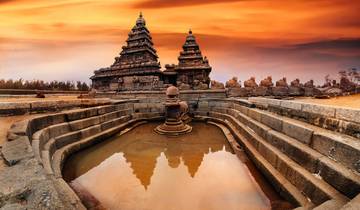
Chennai, Kanchipuram, Vellore, Pondicherry & Mahabalipuram (3 Days)
- ✓ Comprehensive Chennai Madras tour
- ✓ Expert local guides included
- ✓ All accommodation arranged
- ✓ Transportation provided
2 days
Chennai to Kanchipuram, Gingee Fort, Pondicherry & Mahabalipuram
- ✓ Comprehensive Chennai Madras tour
- ✓ Expert local guides included
- ✓ All accommodation arranged
- ✓ Transportation provided
3 days
3-Day Chennai, Mahabalipuram & Pondicherry Tour | Tamil Nadu Heritage & Beach Escape
- ✓ Comprehensive Chennai Madras tour
- ✓ Expert local guides included
- ✓ All accommodation arranged
- ✓ Transportation provided
6 days
Chennai Pondicherry Tour
- ✓ Comprehensive Chennai Madras tour
- ✓ Expert local guides included
- ✓ All accommodation arranged
- ✓ Transportation provided
Multi-day tour packages powered by TourRadar. Prices and availability subject to change.
Introduction: Why Mahabalipuram Deserves a Full Day in 2026
It takes a moment, arriving at Mahabalipuram for the first time, to fully grasp the ambition of what the Pallava kings accomplished here. Imagine a working port city in the 7th century AD, its stone beaches strewn with the finest granite that the Coromandel Coast could offer, and a dynasty of rulers who decided to commission not just temples and shrines but an entirely new visual language for Indian stone architecture — one that would influence every subsequent tradition of Dravidian temple-building across South India and Southeast Asia for the next thousand years.
The Group of Monuments at Mahabalipuram, inscribed as a UNESCO World Heritage Site in 1984, encompasses this entire extraordinary creative moment: the cave temples cut into living rock, the monolithic rathas carved from single boulders as if the stone itself were soft clay, the titanic bas-relief of Arjuna’s Penance stretching 27 metres across a sheer granite face, and the Shore Temple — one of the oldest structural stone temples in South Asia, standing on the beach where it has endured storms, tsunamis, and thirteen centuries of saltwater exposure while continuing to face the sea with its distinctive stacked sikharas.
For the 2026 day tripper from Chennai, Mahabalipuram represents an ideal combination: sufficiently close to make a same-day return comfortable, sufficiently rich to reward a full day’s exploration, and set within a town that has evolved around the monuments to offer excellent seafood restaurants, a functional beach, and a community of stone-carvers maintaining the Pallava craft tradition into the present century. This guide gives you everything needed to plan the perfect 2026 day trip — from transport logistics and entry arrangements to the specific monuments worth prioritising and the best places to eat within walking distance of the UNESCO site.
Understanding Mahabalipuram’s UNESCO Status 2026
The Group of Monuments at Mahabalipuram was inscribed on the UNESCO World Heritage List in 1984, recognised under criteria I, II, and III: as a masterpiece of human creative genius, as a demonstration of an important interchange of human values, and as an outstanding example of an architectural ensemble illustrating significant stages of human history.
The inscription covered a remarkable breadth of monument types created primarily during the reign of two Pallava kings: Narasimhavarman I (also known as Mamalla, after whom the town takes its alternative name, Mamallapuram) who ruled from approximately 630–668 AD, and his successor Narasimhavarman II (also called Rajasimha) who ruled from 700–728 AD. Together, their patronage transformed what had been a functioning port city into one of the most concentrated displays of architectural experimentation in early Indian history.
The UNESCO designation specifically covers the following categories of monuments at the site:
The rock-cut temples and mandapas represent the earliest phase of Pallava monumental architecture — cave sanctuaries cut directly into the pink-grey granite hills, with elaborately carved interior pillars, sculpted panels depicting scenes from Hindu mythology, and painted ceilings of which only traces remain. The Varaha Cave, the Mahishasuramardini Cave, and the Trimurti Cave are the most significant examples, each containing sculptural programmes of extraordinary quality.
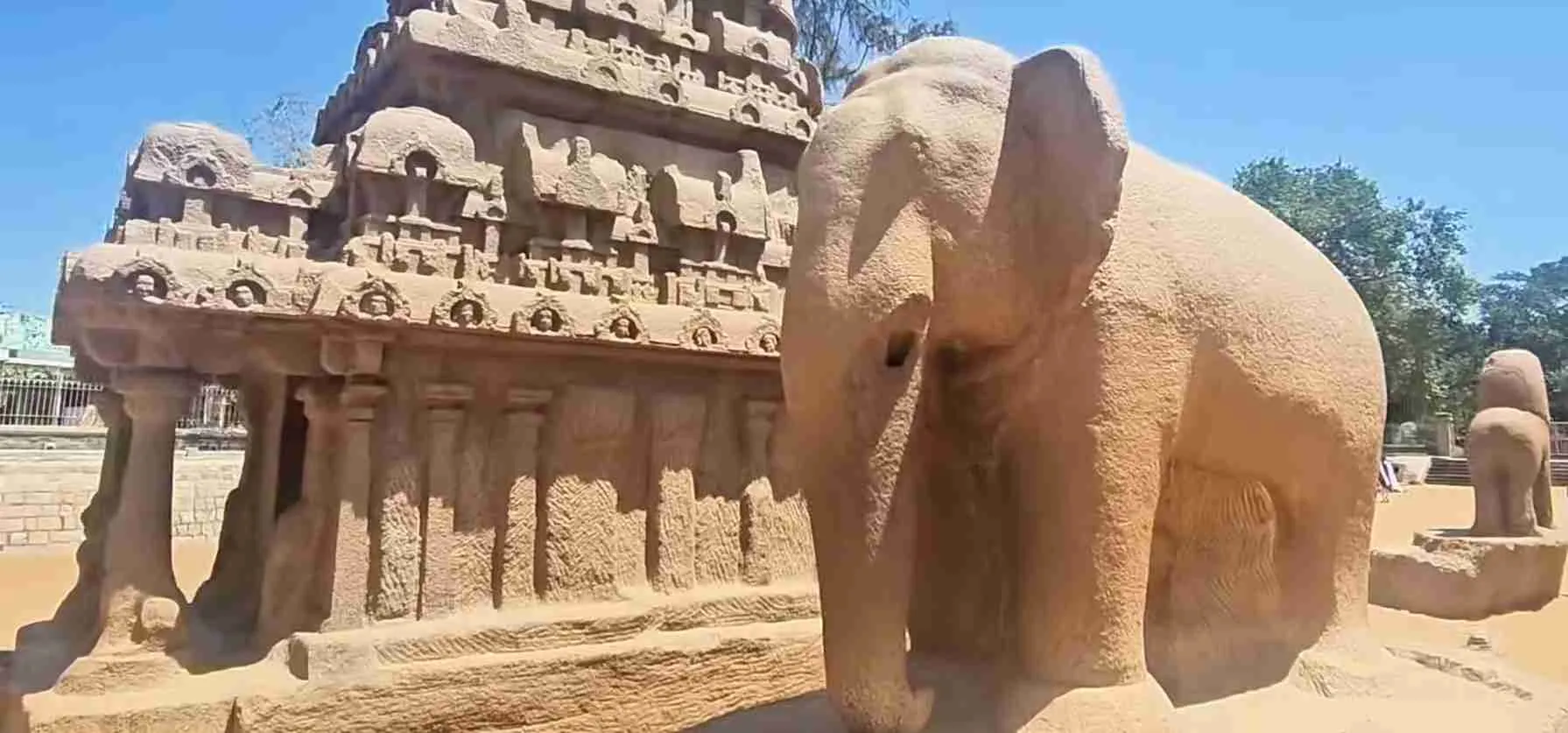
The Five Rathas (Pancha Rathas) represent one of the most astonishing experiments in architectural history: five monolithic shrines, each carved from a single granite boulder and left unfinished, perhaps as architectural prototypes for different temple forms. Named (somewhat inaccurately, given they predate the Mahabharata characters they are named after) after the Pandava brothers and Draupadi, each ratha explores a different architectural typology — from the simple barrel-vaulted Draupadi Ratha to the multi-storey pyramidal Dharmaraja Ratha. Colossal sculptures of elephants, lions, and the bull Nandi — all carved from the same boulders — accompany the temples.
The Descent of the Ganges (Arjuna’s Penance) is the largest bas-relief in the world, covering two enormous rock faces that meet at a natural fissure representing the sacred river descending from heaven. The relief teems with life — gods, gandharvas, celestial beings, sages, elephants, deer, serpents, and ordinary people rendered with a naturalism and vitality that modern sculptors continue to study. The central fissure once channelled water from a cistern above, creating the illusion of the divine river’s descent during festivals.
The Shore Temple — formally the Temple of Narasimha Rajasimhapallava Pallavesvara-griham — is the structural masterpiece of the complex and one of the oldest surviving freestanding stone temples in South India. Unlike the rock-cut and monolithic monuments, it was built from dressed granite blocks, the first great structural temple of the Pallava dynasty. Its design — two stacked sikharas of different heights facing east toward the sea, connected by an enclosed mandapa — established architectural conventions that would be refined for centuries in Tamil Nadu’s great temple cities.
Getting to Mahabalipuram from Chennai 2026
The 60 km journey from Chennai to Mahabalipuram can be completed via several routes and transport modes. Choosing the right combination determines both the cost and the richness of the experience, since the East Coast Road itself passes through some of the most scenically engaging coastline in Tamil Nadu.
By Taxi via ECR (Recommended) 2026: The East Coast Road (ECR) is the most scenic and popular route, running parallel to the Bay of Bengal with sea views, fishing village scenes, and several worthwhile stopping points. One-way taxi fares from central Chennai to Mahabalipuram run approximately ₹1,000–1,500 for a sedan, depending on the service provider and starting point (check current rates on Ola or Uber apps for 2026 pricing). A round-trip day package with a waiting driver at Mahabalipuram runs ₹2,500–4,000, covering the return journey and full-day vehicle availability. For groups of two to four people sharing the cost, a taxi represents excellent value compared to the inflexibility of bus services.
The ECR drive from Chennai takes approximately 1.5 hours without stops. With stops at DakshinaChitra (km 25) and the Crocodile Bank (km 40), plan 3–3.5 hours one way. Starting from southern Chennai neighbourhoods like Thiruvanmiyur or Besant Nagar reduces total travel time by 20–30 minutes and eliminates the need to cross the city centre.
By Bus 2026: Tamil Nadu State Transport Corporation (TNSTC) and several private operators run regular bus services from Chennai to Mahabalipuram. Buses depart from Thiruvanmiyur Bus Depot (southern Chennai, convenient for those staying in that area) and from Chennai Mofussil Bus Terminus (CMBT) at Koyambedu in the northwest of the city. The journey takes 2–2.5 hours depending on traffic and the specific route. Private bus tickets on this route start at approximately ₹200–245 per person (check current fares with operators, as these vary). The state-run MTC buses are cheaper still but take longer. Buses drop passengers at the Mahabalipuram Bus Stand, a short walk or ₹50 auto ride from the main monument complex.
By Organised Tour 2026: Tamil Nadu Tourism Development Corporation (TTDC) and numerous private tour operators run day trips from Chennai to Mahabalipuram, typically departing at 6–7:30 AM from central Chennai and returning by 6–7 PM. These tours usually include Mahabalipuram, Kanchipuram (for silk weaving and temple visits), and sometimes DakshinaChitra. Package prices from reputable operators typically run ₹600–1,500 per person including transport and guide but excluding entry fees and meals. Organised tours suit solo travellers or those who prefer not to navigate independently, but they impose a fixed schedule that limits time at any single monument.
Practical Departure Advice 2026: Regardless of transport mode, departing Chennai no later than 7:30 AM on weekdays or 7:00 AM on weekends is strongly recommended. The Shore Temple and Five Rathas attract significant weekend crowds by 10–11 AM. Arriving before 9 AM means nearly empty monuments, better photography conditions with soft morning light, and cooler temperatures for outdoor exploration. The ECR can become congested on weekend mornings with day-trippers from Chennai; weekday visits offer noticeably smoother travel and fewer crowds at the monuments.
The Monuments: A Site-by-Site Guide 2026
The Group of Monuments at Mahabalipuram is spread across the small town rather than concentrated in a single enclosed area. Understanding the geography before arrival prevents confusion and optimises the visiting sequence for both logical flow and light conditions.
Arjuna’s Penance (Descent of the Ganges) — Begin here. The two massive rock faces are located in the town centre and benefit from early morning light that enhances the three-dimensional quality of the carvings. The relief measures approximately 27 metres wide by 9 metres high and rewards 30–40 minutes of careful observation. Look for the famous panel of meditating cats surrounded by adoring mice (a celebrated satirical scene unique in ancient Indian sculpture), the family of elephants rendered with extraordinary anatomical accuracy, and the celestial beings descending toward the divine river. The site is open terrain with good shade in the morning. Arrive before 8:30 AM for optimal light and before the tour buses arrive.
Krishna’s Butter Ball — Adjacent to Arjuna’s Penance, this improbably balanced boulder (approximately 6 metres in diameter, weighing an estimated 250 tonnes) resting on a smooth inclined granite slope has become one of Mahabalipuram’s most photographed images. The boulder defies obvious physical intuition about stability and has reportedly resisted all historical attempts to move it, including by an elephant team deployed during the 7th century. The surrounding area contains additional rock-cut relief panels worth examining.
Cave Mandapas (Trimurti Cave, Varaha Cave, Mahishasuramardini Cave) — These rock-cut temples are scattered across the Mahabalipuram hill and require a short uphill walk. The Varaha Cave contains two celebrated relief panels: Varaha lifting the earth goddess from the cosmic ocean, and the Trivikrama manifestation of Vishnu striding across the universe. The Mahishasuramardini Cave’s western wall carries a masterpiece of Pallava sculpture — the four-armed goddess Durga riding her lion to battle the buffalo demon, depicted with violent energy that contrasts dramatically with the serene Vishnu reclining on the opposite wall. Climbing to the lighthouse summit (a short additional walk from the cave mandapas) rewards with panoramic views across the monument complex and sea. Allow 45–60 minutes for the cave circuit including the lighthouse viewpoint.
Five Rathas (Pancha Rathas) — Located at the southern end of the monument complex, the Five Rathas are enclosed within a walled compound that is open to the sky. The compound also contains remarkable freestanding sculptures: a massive carved elephant, a seated Nandi (Shiva’s sacred bull), and a magnificent lion in full roar. The rathas themselves require careful examination of both their exterior sculptural programmes and their interiors (accessible at most). The Arjuna Ratha and Dharmaraja Ratha are the tallest and most complex; the tiny Draupadi Ratha, roofed like a village hut, is the most intimate. The single ticket covers this compound and all other monuments in the complex. Allow 35–45 minutes at the rathas.
Shore Temple — The most photographed monument and the emotional centrepiece of the UNESCO site, the Shore Temple stands on a promontory projecting into the Bay of Bengal, enclosed within a grassy compound separated from the beach by a sea wall. The temple complex contains three shrines: two dedicated to Shiva (facing east toward the sea and west) and one to Vishnu, the reclining form depicted in a now-worn but still recognisable panel between the two Shiva towers. The entire structure is encircled by a colonnade of Nandi sculptures, many weathered by thirteen centuries of sea spray. The temple is best photographed in early morning (golden light from the east) or late afternoon (warm light from the west). The compact interior spaces and surrounding sea wall create an atmosphere of contained intensity that is genuinely moving. Allow 30–40 minutes minimum; the setting rewards longer stays.
Recent excavations at the Shore Temple compound, accelerated after the 2004 tsunami exposed additional structures, have revealed the outlines of earlier temple remains and granite blocks extending toward the sea — physical evidence of the legendary Seven Pagodas, of which the Shore Temple was said to be the sole survivor. The underwater survey off Mahabalipuram’s coast has additionally confirmed the presence of submerged structures, lending credibility to the tradition that several temples now lie beneath the Bay of Bengal.
Planning Your Day: Sample 2026 Itinerary
7:00 AM — Depart Chennai by taxi via ECR. Optional stop at Covelong Beach (Kovalam, km 28) for a 15-minute stretch and coastal view.
8:30–9:00 AM — Arrive Mahabalipuram. Purchase entry ticket at first available counter (₹40 / ₹600 — valid for all monuments, check current ASI rates). Proceed immediately to Arjuna’s Penance in the town centre while light is still at its best angle from the east.
9:00–9:45 AM — Arjuna’s Penance and Krishna’s Butter Ball. These are open-air and benefit most from morning light before the sun climbs overhead.
9:45–10:45 AM — Cave Mandapas on the Mahabalipuram Hill. Climb to the lighthouse for panoramic views. The caves stay cooler than open-air sites and are a good midday option as temperatures begin to rise.
10:45–11:30 AM — Five Rathas compound. The enclosed garden compound offers some shade from surrounding walls; the morning light works well for photography of the ratha exteriors.
11:30 AM–12:30 PM — Shore Temple. Late morning light from a higher sun position provides even illumination on the temple’s carved surfaces; the sea backdrop is at its most vivid. Take time to walk the surrounding compound wall.
12:30–1:30 PM — Lunch. The streets surrounding the monument area offer numerous restaurants specialising in fresh seafood. Prawn curry with rice, fish fry, and crab masala are the local specialities. A full seafood lunch at one of the established beachside restaurants runs ₹400–700 per person for multiple dishes. Budget options (thali meals) are available for ₹150–250.
1:30–2:30 PM — Mahabalipuram Beach and town exploration. The beach adjacent to the Shore Temple is pleasant for a walk; the town’s main street is lined with stone-carving workshops where artisans produce granite and sandstone sculptures in the Pallava tradition — the craft alive and commercially active after 1,400 years. Purchasing a small granite figurine directly from an artisan’s workshop makes a historically resonant and durable souvenir.
2:30–3:00 PM — Depart for return to Chennai. Optional stop at DakshinaChitra (on ECR, 25 km before Chennai) for a 45-minute visit to the South Indian heritage museum.
3:45–4:30 PM — DakshinaChitra. Entry: ₹300 (Indian adults), ₹600 (foreign nationals). The museum’s collection of relocated traditional homes from Tamil Nadu, Kerala, Karnataka, and Andhra Pradesh provides excellent architectural context for the Dravidian traditions observed at Mahabalipuram earlier in the day.
5:00–6:30 PM — Return to Chennai. ECR traffic can be slow on weekend afternoons; a weekday return avoids the heaviest congestion.
Day cost summary 2026 (foreign national, self-drive taxi, sharing with one companion): Mahabalipuram entry ₹600, DakshinaChitra ₹600, taxi round trip shared ₹1,400 (₹2,800 total / 2 people), seafood lunch ₹600, snacks/refreshments ₹150. Total day cost: ₹3,350 per person (excluding Chennai accommodation).
Day cost summary 2026 (Indian national, bus travel): Mahabalipuram entry ₹40, bus fare round trip ₹500, DakshinaChitra ₹300, lunch ₹250, snacks ₹100. Total day cost: ₹1,190 per person (excluding Chennai accommodation).
Accommodation in Mahabalipuram 2026
While Mahabalipuram is primarily marketed and experienced as a day trip from Chennai, the town has its own accommodation scene that merits consideration for travellers who want to experience the Shore Temple at sunset and sunrise — the two most atmospheric times to visit the monuments.
Budget guesthouses in Mahabalipuram are concentrated on Thirukula Street and the streets leading to the beach, with rates from ₹700–1,500 per night for a simple double room with air conditioning. The accommodation quality is variable; checking recent reviews on booking platforms before committing is advisable. Mid-range beach resorts like Radisson Blu Resort Temple Bay (one of the most prestigious properties in the area), GRT Temple Bay, and several boutique properties offer rates from ₹4,000–12,000 per night with beach access and pool facilities. Staying overnight in Mahabalipuram permits visits to the Shore Temple at the 6:30 AM opening, when the first light strikes the sikhara towers from the east with the sea breeze still cool — an experience worth the extra night.
For those extending beyond Mahabalipuram, Pondicherry lies 100 km further south via ECR — an ideal continuation of a coastal Tamil Nadu itinerary, offering the Sri Aurobindo Ashram, the French Quarter, and excellent Pondicherry cuisine in a dramatically different atmosphere from Chennai or Mahabalipuram.
Eating in Mahabalipuram 2026
Mahabalipuram’s restaurant scene is shaped by its identity as a beach town and tourist destination. Fresh seafood is the dominant offering — lobster, tiger prawns, crab, barracuda, and various reef fish are all found on menus within walking distance of the Shore Temple.
The restaurants along Shore Temple Road and the beach-facing establishments near the monument offer the most consistent quality. A recommended approach for the 2026 day tripper: choose a restaurant with outdoor seating visible from the street where fresh catch is displayed on ice — an indication of daily sourcing. A prawn curry with parotta (a flaky layered flatbread native to Tamil Nadu), a fish fry, and a cold lime soda or buttermilk makes an excellent post-monument lunch for ₹400–600 per person. Vegetarian thali options are available at most restaurants at ₹150–250.
Street food near the bus stand and monument areas includes fresh coconut water (₹30–50), banana-leaf-wrapped sundal (₹20–30), and roasted corn sold by beach vendors — all safe, affordable, and refreshing in the coastal heat. The stone-carvers’ street (the workshop lane running parallel to the main road) has a few simple local tea shops serving filter coffee and snacks for ₹30–50.
What to Buy in Mahabalipuram 2026
The stone-carving tradition of Mahabalipuram is one of the most direct living continuations of the Pallava artistic legacy. The town supports a community of several hundred active sculptors who produce work ranging from small souvenirs carved in soapstone (₹100–500) to large-scale granite commissions destined for temples across India and internationally. Visiting the working workshops on and behind the main street provides genuine insight into the craft process — stone dust, chisels, and increasingly sophisticated works in progress are visible at every scale.
Recommended purchases from artisan workshops include: small granite Ganesha or Nataraja figures (₹500–2,000), soapstone miniatures of the Shore Temple or Five Rathas (₹200–800), and terracotta decorative panels (₹300–1,000). Bargaining is expected and accepted at most workshop shops; prices typically start 30–50% above the final accepted figure. Avoid purchasing from vendors directly adjacent to monument entry points, where prices are inflated; the best quality and most reasonable pricing come from the workshops slightly further into the town.
The Government Emporium at Mahabalipuram sells fixed-price stone carvings with authenticity guarantees — a useful reference point for quality and pricing before negotiating at private shops.
Nearby Attractions on the ECR Route 2026
The East Coast Road between Chennai and Mahabalipuram passes several worthwhile stops that can enhance a day trip with minimal additional time.
DakshinaChitra (25 km from Chennai, 35 km from Mahabalipuram) is India’s most comprehensive living museum of South Indian vernacular architecture. Traditional homes from Tamil Nadu, Kerala, Karnataka, and Andhra Pradesh have been carefully relocated and reconstructed on a 10-acre coastal site, with resident artisans demonstrating crafts including coir weaving, pottery, and bronze casting. Entry for Indian adults is ₹300; for foreign nationals ₹600 (check current rates). Open Wednesday through Monday, 10 AM to 6 PM. Allow 45–90 minutes.
Madras Crocodile Bank Trust (40 km from Chennai) is one of the world’s leading crocodilian conservation centres and the largest reptile park in Asia, founded in 1976 by herpetologist Romulus Whitaker. Over 5,000 individuals representing 14 species of crocodile, alligator, and gharial are housed here alongside cobras, pythons, and monitor lizards. Entry: ₹100 (children), ₹200 (adults) — check current rates. Open Tuesday through Sunday, 8:30 AM to 5:30 PM. A brief 30-minute visit is sufficient for most travellers; families with children often spend longer.
Covelong Beach (28 km from Chennai) is a fishing village and beach destination popular with Chennai residents for surfing and water sports. The bay is more sheltered than Mahabalipuram’s open coast and supports a surf school (lessons available from ₹600–1,000 per session). A brief stop here for tea and sea views adds minimal time to the ECR journey.
Tiger Cave (5 km north of Mahabalipuram) is a rock-cut monument featuring an extraordinary carved tiger-head archway — probably an open-air theatre or performance space connected to the Pallava royal court — located directly on the ECR. Entry is free and the site takes 15–20 minutes to visit. It makes a natural first or last stop when approaching or leaving Mahabalipuram from Chennai.
Photography Guide for Mahabalipuram 2026
Mahabalipuram presents exceptional photography opportunities across all monument types, with the Shore Temple being the most challenging (and rewarding) subject due to its coastal light conditions and complex geometry.
The Shore Temple is best photographed at two specific times: immediately after 6:30 AM opening, when the eastern facing shrine catches the first direct sunlight with the sea as a deep blue backdrop; and in the hour before 6 PM closing, when warm afternoon light from the west illuminates the western shrine facade and creates long shadows that emphasise the carved Nandi colonnade. Midday light (10 AM to 3 PM) is harsh and flattening — the temple’s worn surfaces lose detail in high-contrast overhead light.
Arjuna’s Penance photographs best with a wide-angle lens that can capture both rock faces simultaneously. A position at the northern end of the relief captures the central fissure (representing the divine river) as a vertical compositional element. A position at approximately 20 metres distance is optimal for showing the full scale while retaining carved detail. The relief’s elephants in the lower southern register make particularly powerful isolate subjects with a telephoto lens.
The Five Rathas benefit from early or late angled light that reveals the three-dimensional quality of the sikhara carvings. Shooting from the northwestern corner of the compound includes both the Dharmaraja Ratha (tallest) and the carved elephant in the same frame. The interior spaces of the Arjuna Ratha are interesting for available-light shots of the carved pillars — bring a camera that handles low-light well, as flash photography disrupts other visitors and rarely produces satisfactory results.
Photography within the monument complex is free (still photography). Video recording requires a ₹25 fee payable at the ticket counter.
Frequently Asked Questions About Mahabalipuram Day Trip 2026
Can I do Mahabalipuram in half a day from Chennai in 2026?
A half-day visit is possible but results in a rushed experience that fails to do justice to the site’s richness. If time is genuinely constrained, prioritise Arjuna’s Penance and the Shore Temple above all else, adding Krishna’s Butter Ball as a short detour between the two. The Five Rathas and cave mandapas require at least 90 minutes between them and should not be compressed into a hurried circuit. A full day — 6–7 hours at Mahabalipuram with the ECR drive each way — is the recommended approach for 2026 visitors who want to appreciate rather than simply tick off this UNESCO site.
Is the Shore Temple accessible for visitors with mobility limitations in 2026?
The Shore Temple compound is accessible at ground level with a flat walking surface, though the approach from the main entrance involves approximately 300–400 metres of walking on uneven granite paving. Battery-operated shuttle vehicles are available at the main gate for visitors who have difficulty walking, including senior citizens, pregnant women, and those with physical disabilities — this service is free with the monument entry ticket. The Five Rathas compound is similarly accessible at ground level. The cave mandapas on the hill require significant uphill walking and stair-climbing and are not suitable for visitors with severe mobility limitations.
What should I wear to Mahabalipuram in 2026?
Comfortable, lightweight clothing covering shoulders and knees is recommended both for sun protection during outdoor monument exploration and out of respect for the active religious sites within the complex. Footwear must be removed at the Shore Temple and at the active cave shrines — slip-on shoes or sandals simplify this requirement considerably. A hat and sunscreen are essential for outdoor sightseeing between 9 AM and 4 PM. Carry at least one litre of water per person; bottled water is available from vendors near the ticket counters and throughout the monument area (₹20–25 per bottle).
Is the Mahabalipuram Dance Festival worth timing a 2026 visit around?
The Mahabalipuram Dance Festival — held annually in January and February with confirmed 2026 dates to be announced by Tamil Nadu Tourism — is one of the most visually spectacular cultural events in South India. Classical dance forms including Bharatanatyam, Kuchipudi, Mohiniattam, and Odissi are performed on an open-air stage erected directly in front of the Shore Temple, with the illuminated medieval monument as the backdrop. Performances typically begin at dusk and run for two to three hours. Entry is free or available for a nominal fee. For those with an interest in classical Indian arts, timing a visit to coincide with the festival adds extraordinary cultural depth to the Mahabalipuram experience — and the January–February weather conditions are the most comfortable of the year for both travel and outdoor events.
Are there guides available at Mahabalipuram in 2026?
Licensed guides are available near the main ticket counter and at the entrance to major monuments. An official ASI-registered guide typically charges ₹500–800 for a 2–3 hour guided tour of the main monuments. For first-time visitors unfamiliar with Hindu iconography and Pallava history, a knowledgeable guide transforms the experience from visually impressive to genuinely illuminating — many of the sculptural panels’ narrative content and symbolic significance is not apparent without contextual explanation. Guides can also navigate visitors efficiently between monuments, preventing the backtracking that adds unnecessary walking time in the heat.
What is the significance of the Seven Pagodas legend at Mahabalipuram?
The Seven Pagodas legend holds that Mahabalipuram was originally home to seven great temple towers (pagodas), of which only the Shore Temple survived — the other six having been swallowed by the sea due to the jealousy of the gods at the city’s excessive beauty. European sailors and merchants who traded on the Coromandel Coast from the 17th century onward recorded this tradition, which they took to be mythological. The 2004 Indian Ocean tsunami dramatically altered the archaeological picture: as the tsunami drew the ocean back before impact, it briefly exposed stone structures on the seabed that had not been visible for centuries. Subsequent underwater surveys by India’s National Institute of Oceanography confirmed the presence of granite walls, platforms, and stone objects offshore — providing physical evidence of a once-substantial stone building programme now partially submerged. The exact nature and number of submerged structures remains under investigation, but the legend appears to have a factual basis in the gradual erosion and submersion of Pallava-era coastal construction.
Can I combine Mahabalipuram with Kanchipuram in one day from Chennai in 2026?
Combining Mahabalipuram and Kanchipuram in a single day is possible but requires a long, tiring itinerary and forces significant compromise at both destinations. The two towns lie in opposite directions from Chennai — Mahabalipuram 60 km south via ECR, Kanchipuram 75 km southwest — making the combined round trip approximately 200 km. Tamil Nadu Tourism Development Corporation (TTDC) and several private operators offer day tours combining both destinations, typically running 8–9 hours. These tours work best for visitors with limited time who prioritise breadth over depth; for those who want to properly experience either Mahabalipuram’s UNESCO monuments or Kanchipuram’s extraordinary temple complex, a dedicated full-day visit to each is far preferable. Consider visiting Mahabalipuram on one day and Kanchipuram on a second day from Chennai for a satisfying exploration of both sites.
What are the photography restrictions at Mahabalipuram in 2026?
Still photography is free throughout the Mahabalipuram monument complex and is permitted at all major sites including the Shore Temple, Five Rathas, and cave mandapas. Video recording carries a ₹25 fee payable at the ticket counter. Flash photography should be avoided inside the cave mandapas as it damages the sculpted surfaces over time and disturbs other visitors. Commercial photography or film shoots at ASI-protected sites require separate permissions from the Archaeological Survey of India. Drone photography at the monument complex requires specific government approval and is not available for casual day-trippers.
Is Mahabalipuram beach safe for swimming in 2026?
The beach immediately adjacent to the Shore Temple is not recommended for swimming. The open Bay of Bengal coastline at Mahabalipuram experiences strong currents, undertow, and sudden depth changes. Several drowning incidents have occurred here over the years. The beach is excellent for walking, watching fishing boats, and experiencing the dramatic intersection of sea, sky, and ancient stone — but swimming should be undertaken only at designated, supervised areas. For water activities, Covelong Beach (28 km north on ECR) is the preferred local option with more sheltered conditions and surf school supervision.