Leeds Architectural Heritage Road Trip 2026: Navigating Kirkstall Abbey, Harewood House & Temple Newsam Without a Car
Leeds sits at the centre of one of England’s most architecturally compressed day-trip corridors: within a forty-minute transit radius of the city station lie a ruined Cistercian monastery, a Georgian neo-classical stately home, and a sprawling Tudor-Jacobean manor — three distinct eras of English building patronage accessible entirely by rail and bus. This guide maps the exact transit connections, timetable windows, entry logistics, and crowd-mitigation strategies for each of the three sites so that visitors arriving without a car in 2026 can complete all three stops in a single extended day, or spread them across a relaxed overnight itinerary based in the city centre.
Key Takeaways
- All three sites — Kirkstall Abbey, Harewood House, and Temple Newsam — are reached from Leeds City Station by scheduled public transport in 2026 using the Airedale/Wharfedale rail line and two bus services: the TransDev 36 to Harewood and the First Leeds 19 to Temple Newsam.
- Kirkstall Abbey grounds are free to enter year-round; Harewood House adult admission runs approximately £18–23 ($23–29) for house and grounds in 2026 — verify at harewood.org before visiting; Temple Newsam house admission is approximately £5–7 ($6–9) with free access to the estate grounds and Home Farm.
- A West Yorkshire Day Rider bus pass (approximately £6–7 / $8–9 in 2026 — check current pricing at wymetro.com) covers the bus legs of the route; a short rail single (approximately £3–4 / $4–5) for the Kirkstall Forge leg optimises the morning timing and delivers the best early light at the abbey ruins.
- Harewood House demands the most time — allow a minimum of three hours for the state rooms, terrace gardens, and bird garden — so scheduling it as the middle stop after Kirkstall gives the morning house crowds time to thin before a midday arrival.
- Budget travelers completing the full three-stop circuit should allow approximately £40–50 per person ($50–63) for the day, covering transport, all entry fees, and basic refreshments; mid-range visitors adding a cafe lunch at Harewood should budget £58–70 per person ($73–88).
- Photography of the Kirkstall Abbey nave arcades peaks before 10 AM (east-facing ruins in morning raking light); the Harewood House south facade is well-lit from late morning through early afternoon; Temple Newsam’s Jacobean south front reads best in mid-afternoon and in autumn slant light.
People Also Ask About Leeds Architectural Heritage 2026
How do you get from Leeds City Station to Kirkstall Abbey without a car in 2026?
The fastest option uses the Airedale or Wharfedale rail line from Leeds City Station to Kirkstall Forge station — approximately eight minutes. From Kirkstall Forge, cross the footbridge and follow the riverside path south along the River Aire for approximately 0.7 miles, a fifteen-minute walk. Alternatively, the First Leeds 33 or 33A bus from Leeds City Bus Station stops directly at the abbey entrance on Abbey Road, taking approximately twenty to twenty-five minutes depending on traffic. The bus option is covered by a West Yorkshire Day Rider pass and avoids the riverside walk; the rail option is faster and gives the better approach through the river meadow. Verify current timetables at nationalrail.co.uk and travelineyorkshire.com before your visit.
Is Harewood House accessible by public transport from Leeds in 2026?
Yes. The TransDev 36 bus — also operated as the Harrogate Bus Company 36 — runs from Leeds city centre along the A61 trunk road to Harrogate and calls at a stop approximately four hundred metres from the Harewood House entrance gates. Journey time from Leeds is approximately thirty-five to forty minutes. Services run roughly every thirty minutes on weekdays, with reduced frequency on Sundays and bank holidays; check the current timetable at travelineyorkshire.com before visiting. Adult admission to house and grounds runs approximately £18–23 ($23–29) in 2026; verify current pricing and book timed house entry in advance at harewood.org to avoid sold-out slots on busy summer days.
What is the MCard and does it cover the full heritage circuit in 2026?
MCard is West Yorkshire’s integrated travel smart card, administered by West Yorkshire Combined Authority, available in daily, weekly, monthly, and annual versions covering bus and rail within defined zone bands. For a single-day heritage circuit, the West Yorkshire Day Rider bus pass is the most practical option — it covers the TransDev 36 to Harewood and the First Leeds 19 and 33 services to Kirkstall and Temple Newsam, and can be purchased on the bus or via the My Ticketer app. A short rail single (Leeds to Kirkstall Forge) is purchased separately as a point-to-point ticket. Multi-day visitors staying in Leeds for two or more nights will typically find a weekly MCard zone pass more economical than daily passes; check current pricing and zone maps at wymetro.com before buying.
How long does the full three-stop heritage circuit take from Leeds in 2026?
Allow a full day — approximately nine to ten hours from departure at Leeds City Station. A recommended sequence: depart Leeds at 9 AM, reach Kirkstall Abbey by 9:15 AM, spend ninety minutes on site, return to Leeds by 11:30 AM; depart for Harewood by bus at noon, arrive by 12:40 PM, spend three hours at the house and grounds; return to Leeds by 4:30 PM; depart for Temple Newsam at 4:45 PM, arrive by 5:15 PM, spend sixty to ninety minutes before last admission. Confirm opening hours directly with each site before committing to this schedule, as Temple Newsam’s closing time varies by season and can compress the final leg significantly in spring and autumn.
Extended multi-day tours – 5+ days
Featured Yorkshire Multi-Day Tour Packages

3 days
Yorkshire 3-Day Discovery Tour
- ✓ Comprehensive Yorkshire experience
- ✓ Expert local guides included
- ✓ All accommodation included
- ✓ Transportation provided

5 days
Yorkshire 5-Day Highlights Experience
- ✓ Comprehensive Yorkshire experience
- ✓ Expert local guides included
- ✓ All accommodation included
- ✓ Transportation provided
7 days
Yorkshire 7-Day Cultural Journey
- ✓ Comprehensive Yorkshire experience
- ✓ Expert local guides included
- ✓ All accommodation included
- ✓ Transportation provided

10 days
Yorkshire 10-Day Complete Adventure
- ✓ Comprehensive Yorkshire experience
- ✓ Expert local guides included
- ✓ All accommodation included
- ✓ Transportation provided
Multi-day tour packages powered by TourRadar. Prices and availability subject to change.
Introduction: Leeds as a Multi-Period Architectural Base 2026
West Yorkshire does not market its heritage with the same vocabulary as the Cotswolds or the Wye Valley, yet the transit arc around Leeds contains one of England’s most concentrated chronological sequences in built form: Cistercian Gothic stonework from the twelfth century, Palladian facades from the 1760s, and Jacobean brickwork from the early seventeenth century lie within a nine-mile radius of Leeds City Station. The challenge for the car-free visitor is purely logistical: these three sites occupy different compass bearings from the city, each served by a distinct transit corridor, so Leeds itself must be treated as the routing hub rather than as a waypoint on a linear journey between the sites.
This guide addresses that logistical problem directly. It is not a deep architectural history of the sites — the individual destination articles on machupicchu.org cover the construction chronology, patronage, and stylistic context of each building in full — but a practical 2026 transit and timing document. It specifies which services to take, which stops to use, how to sequence the three visits for the most efficient use of a long day, and which timing windows minimise crowds at each site. All transport information is drawn from publicly available 2026 timetables and pricing data; fares and timetables change, and checking wymetro.com, travelineyorkshire.com, and the individual site websites before visiting remains essential.
Three architectural eras structure the day. Kirkstall Abbey presents the Cistercian monastic building programme at its most legible in West Yorkshire — roofless after the 1539 Dissolution but remarkably complete in plan, with nave arcades, cloister ranges, and chapter house surviving from the late twelfth and early thirteenth centuries. Harewood House represents a concentrated example of Georgian collaborative patronage: the external Palladian shell by John Carr (1759–1772), the interior neoclassical programme by Robert Adam, and the purpose-designed furniture suite by Thomas Chippendale, all created for a single patron in overlapping phases of the same decade. Temple Newsam extends the reading into the early modern period, its long, low Jacobean facade a product of Sir Arthur Ingram’s rebuilding programme of the 1620s and 1630s. Together the three sites sketch a five-hundred-year arc through English domestic and monastic architecture that is unusually readable precisely because the buildings are modest enough in scale to be taken in fully on a single extended day.
For visitors staying in Leeds overnight, no accommodation move is required: the city offers a full range of accommodation within easy walking distance of both the rail station and the city bus station. For day visitors arriving from other northern cities by rail — Bradford, Sheffield, York, Manchester — Leeds City Station is itself the primary interchange, and all transit legs begin immediately on arrival. The city’s position on the East Midlands/TransPennine rail corridor makes it a viable day-trip origin from London (approximately two hours fifteen minutes on the faster East Midlands Railway services), Edinburgh (approximately two hours twenty minutes), and Manchester (approximately one hour).
The Northern Transport Hub: Crafting a Public Transit Itinerary from Leeds City Station 2026
Leeds City Station is the largest rail station in the north of England by passenger throughput and serves as the principal interchange for the West Yorkshire rail network. It is directly adjacent to Leeds City Bus Station — the two termini share the same forecourt area on Neville Street and the adjacent streets — making the transition between rail and bus connections straightforward. All three heritage legs in this itinerary begin from this cluster, so any visitor arriving in Leeds by national rail is already at the correct departure point for the day’s circuit without any additional transit.
West Yorkshire’s integrated transport network has been progressively developed under the MCard umbrella since the early 2020s. Bus frequency on the three heritage corridors — the A65 northwest toward Kirkstall, the A61 north toward Harewood, and the eastern routes toward Temple Newsam — has reached a level that makes day-visitor scheduling viable without long waits. The opening of Kirkstall Forge station in 2016 added a rail alternative for the first leg. For 2026, the most relevant operational update for heritage visitors is the continued expansion of contactless payment acceptance across West Yorkshire buses, which has eliminated the need to carry exact change and speeds boarding on busy services.
Rail and Bus Logistics: Timetables and Express Services to Wharfe Valley Heritage Sites 2026
The three transit legs operate on different services and require a brief orientation before departure. Here is the 2026 service summary for each leg:
Leg 1 — Kirkstall Abbey via Kirkstall Forge Station: From Leeds City Station platform (check departure boards for current platform allocation), take any Airedale Line service toward Skipton or any Wharfedale Line service toward Ilkley — both patterns call at Kirkstall Forge, the second or third stop from Leeds depending on the service variant. The journey takes approximately eight minutes. Services run at roughly ten-minute intervals during peak hours and fifteen to twenty minutes off-peak on weekdays. Kirkstall Forge station is unstaffed; buy your ticket at Leeds City Station or via a rail app before boarding. From the station, cross the pedestrian bridge over the River Aire and follow the signed riverside path southward for approximately 0.7 miles (fifteen minutes walking) to Kirkstall Abbey.
Bus alternative for Day Rider holders: the First Leeds 33 or 33A from Leeds City Bus Station runs along the A65 Kirkstall Road and stops at the abbey entrance on Abbey Road, a journey of approximately twenty to twenty-five minutes. This option requires no rail ticket purchase and deposits visitors at the gate, but is subject to A65 traffic delays in the morning peak. The net journey time difference between rail (with the walk) and bus is small — the bus is often faster door-to-door, while the riverside walk from Kirkstall Forge is architecturally rewarding in its own right, following the Aire through the industrial archaeology of the former Kirkstall Forge site.
Leg 2 — Harewood House via the 36 Bus: From Leeds City Bus Station, take the TransDev/Harrogate Bus Company 36 service in the direction of Harrogate. The route follows the A61 through Moortown and Alwoodley and crosses into the Wharfe Valley north of Bramhope before descending into Harewood village, with a stop on the A61 close to the estate entrance. Journey time is approximately thirty-five to forty minutes. In 2026 the service runs approximately every thirty minutes on weekdays; Sunday frequency is lower. Verify the current departure stand at Leeds City Bus Station from the information boards on arrival — stands are subject to periodic reallocation. Check the full timetable at travelineyorkshire.com or via the Traveline app.
From the A61 bus stop at Harewood, walk south along the road shoulder (pavement present) for approximately four hundred metres to the main entrance gates of Harewood House on your right. The estate’s internal shuttle between the car park and the house may be available to visitors arriving on foot; confirm with Harewood directly at harewood.org or by telephone before visiting, as this service has varied seasonally.
Leg 3 — Temple Newsam via the 19 Bus: From Leeds City Bus Station, take the First Leeds 19 service in the direction of Temple Newsam. The route runs east through Harehills and Halton Moor before reaching the estate access road. Journey time is approximately twenty-five to thirty-five minutes, variable with afternoon traffic. Services run every fifteen to twenty minutes during the daytime on weekdays; frequency reduces in the early evening, which is relevant if you are planning an extended visit to Temple Newsam. From the bus stop on Temple Newsam Road, walk approximately three hundred metres to the main estate entrance. Verify current timetable and stop details at travelineyorkshire.com before visiting.
Suggested full-day departure schedule 2026:
- 09:00 — Depart Leeds City Station (Airedale/Wharfedale Line toward Skipton or Ilkley)
- 09:08 — Arrive Kirkstall Forge station; walk riverside path south (~15 min)
- 09:25–11:00 — Kirkstall Abbey (95 minutes on site)
- 11:00–11:30 — Return to Leeds: bus 33A from Abbey Road, or walk back to Kirkstall Forge for train
- 11:45 — Brief transit break at Leeds City Bus Station (coffee available from surrounding cafes)
- 12:00 — Depart Leeds Bus Station on 36 bus toward Harrogate
- 12:40 — Arrive Harewood bus stop A61; walk to house entrance (~8 min)
- 12:50–16:00 — Harewood House: house tour, terrace gardens, bird garden (3 hrs 10 min)
- 16:00 — Board 36 bus back toward Leeds at the A61 stop
- 16:45 — Arrive Leeds City Bus Station
- 17:00 — Depart on 19 bus toward Temple Newsam
- 17:30 — Arrive Temple Newsam estate entrance
- 17:30–19:00 — Temple Newsam grounds and house (90 min; confirm last admission time)
- 19:00–19:30 — Return bus 19 to Leeds city centre
This schedule works reliably on long summer weekdays with 6 PM or later closing times. In spring and autumn, Temple Newsam’s last admission falls earlier (often 4:30 PM or 5 PM), which may require either curtailing the Harewood visit or treating Temple Newsam as a separate half-day trip. Always verify opening hours directly with each venue before building your schedule around it.
MCard Integration and Ticketing Strategy for the 2026 Heritage Circuit
West Yorkshire’s MCard system offers several ticket types relevant to different visitor profiles. Understanding which product to buy before departure saves time and money. Prices quoted below are approximate 2026 figures; check wymetro.com for current rates, which are reviewed annually.
For most single-day heritage visitors, the West Yorkshire Day Rider bus pass is the optimal purchase. Priced at approximately £6–7 ($8–9) for an adult in 2026, it covers unlimited travel on participating bus services across West Yorkshire on the day of purchase, including the TransDev 36 to Harewood, the First Leeds 19 to Temple Newsam, and the 33/33A to Kirkstall. It can be bought on board any participating bus using a contactless bank card, via the My Ticketer app, or at some Leeds City Bus Station ticket points. A separate short-hop rail single (Leeds to Kirkstall Forge, approximately £3–4 / $4–5 in 2026) is purchased at Leeds City Station or via a rail booking app for the first leg.
For the Kirkstall Abbey leg, the practical question is whether to use the included bus service (33/33A) or add the rail single for Kirkstall Forge. If you have a Day Rider and the bus is already covered, taking the 33A delivers you to the abbey gate with no additional cost and no riverside walk. If you prioritise the early morning light on the abbey ruins — and the light from the east across the nave arcades before 10 AM is significantly better than midday — the shorter journey time of the train plus the atmospheric approach along the riverside path makes the extra £3–4 worthwhile.
Visitors spending two or more days in Leeds and planning multiple heritage excursions will typically find a weekly MCard bus and rail zone pass more economical. Weekly passes are available via the My Ticketer app or at MCard retail points in the city; they cover all West Yorkshire zones within the selected band. National railcard holders — 16–25 Railcard, Senior Railcard, Two Together Railcard — should apply their discount to the Kirkstall Forge rail leg when purchasing, as railcard discounts apply to standard rail point-to-point tickets and can reduce the cost of the short hop to under £3.
A practical note on the TransDev 36: this service is operated by Harrogate Bus Company / TransDev and may have a slightly different fare structure from the standard West Yorkshire bus network. In 2026, the Day Rider is accepted on this service, but confirm at travelineyorkshire.com that coverage has not changed since publication of this guide. If paying a single fare rather than using a Day Rider, carry contactless — the 36 accepts card and app payment. For Sunday visits to Harewood, note that bus frequency drops significantly; build in more buffer time between connections or consider a taxi for part of the circuit.
Medieval Cistercian to Georgian Neo-Classical: A 3-Stop Self-Guided Architectural Route 2026
The three stops on this itinerary span roughly five hundred and fifty years of English building history, but they cohere around a single thread: each site was built by an exceptionally ambitious patron, and in each case the architecture outlasted the social order that produced it. Kirkstall Abbey’s Cistercian community was dissolved in 1539 under Henry VIII, the monks dispersed and the endowment seized. Harewood House’s Georgian grandeur was built substantially on wealth derived from Caribbean plantation ownership — a history the estate now addresses directly in its public interpretation programme. Temple Newsam passed through so many hands, and deteriorated so severely by the early twentieth century, that Leeds City Council purchased it in 1922 specifically to prevent demolition. The buildings survive; the contexts that produced them have all been radically revised. Reading the three in chronological sequence produces an encounter with the full arc of that pattern.
Stop 1: Kirkstall Abbey’s 12th-Century Norman Masonry via the Airedale Line 2026
Kirkstall Abbey was founded in 1152 by a community of Cistercian monks who settled in the Aire Valley following an unsuccessful attempt to establish their house at Barnoldswick in Lancashire. Construction of the permanent church and monastic buildings proceeded rapidly through the late twelfth and into the early thirteenth century, funded by grants from local noble patrons. The abbey was suppressed in 1539 during the Dissolution of the Monasteries; unlike many Yorkshire abbeys, it was not systematically quarried for building stone in the centuries immediately following, which accounts for the unusual completeness of its standing fabric.
What survives at Kirkstall is one of the most legible Cistercian plans in England: the full length of the nave with its arcade piers still standing to near-original height, the claustral ranges east and south of the church, the chapter house with its surviving doorway, and sections of the precinct wall. The site is managed as an open ruin by Leeds City Council, which means there is no roof, no interior lighting, and no interpretive staging — just the stone, the sky, and the plan laid out across the ground.
The masonry is predominantly Magnesian Limestone, the pale yellowish-cream stone that runs in a broad band through the eastern flank of the Pennines from Nottinghamshire to the Vale of York. At Kirkstall, centuries of exposure to the West Yorkshire atmosphere have given the stone a warm, variably weathered surface that reads very differently in different light conditions — cream-grey under overcast sky, pale gold in early morning sun from the east, almost white in direct overhead noon light. The early morning visit is strongly recommended for this reason alone.
Architecturally, the most instructive element of Kirkstall is the transition between two phases of medieval construction visible within a single walking circuit. The nave arcades and the crossing piers display the rounded arches and heavy cushion capitals of the Norman Romanesque tradition; the chapter house to the east of the cloister introduces the pointed arch of the Early English Gothic. This two-phase legibility — Romanesque and Gothic in adjacent structures, built perhaps fifty years apart — is one of the clearest such sequences available in any English ruin of comparable scale. The Cistercian order’s strict regulations against sculptural ornament mean that the surfaces are strikingly plain: no figured carving, no colour, and minimal moulding beyond the elementary profiles of arch orders and column bases. This austerity, which would seem impoverished at a Benedictine or cathedral church, is at Kirkstall a productive condition: with decoration eliminated, the visitor’s attention falls directly on structural form, proportion, and the quality of stonework.
Getting there (2026): Airedale or Wharfedale Line train from Leeds City Station to Kirkstall Forge (approximately 8 minutes); riverside path walk south to the abbey (15 minutes, 0.7 miles). Or First Leeds 33/33A bus from Leeds City Bus Station direct to the abbey entrance on Abbey Road (20–25 minutes). Check nationalrail.co.uk and travelineyorkshire.com for current timetables.
Practical information (2026): Grounds free, open year-round. Abbey House Museum (the former gatehouse) has its own admission charge covering Victorian life exhibitions. No food provision within the ruins; cafes and bakeries on the A65 Kirkstall Road are ten minutes’ walk north. Restrooms on site. Surfaces are primarily grass and compacted earth, with some uneven areas; accessible in dry conditions, more difficult after rain. Allow ninety minutes for a thorough circuit including the chapter house and cloister garth.
What to prioritise: The full length of the nave seen from the west entrance, looking east toward the crossing tower remains, establishes the building’s scale. The chapter house doorway is among the better-preserved Norman decorative elements on the site. From the south nave aisle, looking north across the cloister garth toward the east range, the layering of ruined walls creates the most complex architectural picture the site offers. In early morning, stand at the east end of the nave and look west: the long shadows of the arcade piers fall in parallel diagonals across the floor, and the surviving tower section is silhouetted against the sky.
Stop 2: Harewood House’s Robert Adam Interiors via the 36 TransDev Bus 2026
Harewood House is the most ambitious example in Yorkshire of the Georgian practice of engaging an architect, an interior designer, and a furniture maker simultaneously — each working to a unified decorative brief — for a single patron and a single building campaign. Edwin Lascelles commissioned John Carr of York to design the main house in 1759; Carr produced a disciplined Palladian composition of a long central block linked by quadrant screens to flanking service wings. Robert Adam, engaged from around 1759–1760, initially to design the principal interiors, progressively extended his involvement to modifications of the exterior and the design of the terrace front. Thomas Chippendale supplied the principal furniture, working from Adam’s interior schemes to produce pieces whose colour, ornament, and scale are coordinated with the decorative programme of the specific rooms they were made for.
The result is one of the most completely preserved Georgian interior ensembles in England, in the specific sense that the Adam decorative programme and the Chippendale furniture have not been significantly separated or displaced: the pieces remain in the rooms for which they were designed, against the walls, floors, and ceilings they were intended to complement. Adam’s interiors at Harewood display the characteristic features of his mature neoclassical manner: shallow coffered ceilings with painted roundels and low-relief arabesques in plaster, doorcases with delicate frieze ornament incorporating classical urns and anthemion bands, chimneypieces in coloured marble with swag and medallion decoration, and colour schemes — pale green, rose, blue, cream — that coordinate with the upholstery fabrics Chippendale’s workshop specified for the seat furniture. The Gallery, approximately ninety feet in length, is the showpiece: its barrel-vaulted ceiling carries a comprehensive Adam plasterwork programme, and the Chippendale furniture in the room represents some of the most fully realised pieces of the commission.
Harewood’s public programme extends substantially beyond the state rooms. The house’s interpretation of the Lascelles family’s history of Caribbean plantation ownership — which financed the construction — is addressed in a dedicated Below Stairs exhibition accessible on the general house ticket and provides essential context for reading the wealth on display in the state rooms. The terrace gardens, redesigned by Charles Barry in the mid-nineteenth century, sit on the south slope below the house and are among the most formally elaborate surviving Victorian garden layouts in northern England. The bird garden, managed as a wildlife and conservation collection with substantial aviaries, adds a third distinct programme for visitors who want more than the house and terrace.
Thomas Chippendale was born in Otley, West Yorkshire, approximately twelve miles from Harewood — a fact the estate notes in its interpretation. The Harewood commission is significant in his career both for its scale and for the degree of integration between his work and Adam’s: the pieces were designed in direct response to the decorative vocabulary of the rooms, rather than being a separate furniture collection introduced into a completed interior. Several pieces in the Harewood Collection represent the transition in English furniture design from the rococo of the 1750s toward the neoclassical of the 1770s, and the sequence of state rooms at Harewood allows that shift to be read across a single commission.
Getting there (2026): TransDev/Harrogate Bus Company 36 bus from Leeds City Bus Station toward Harrogate; alight at the Harewood stop on the A61 (approximately 35–40 minutes); walk south along the A61 approximately 400 metres to the entrance gates on the right. Buses run roughly every 30 minutes on weekdays. Verify timetable at travelineyorkshire.com.
Practical information (2026): Adult house and grounds admission approximately £18–23 ($23–29); check harewood.org for current 2026 pricing and advance-booking options, which may offer a discount. Timed house entry is in operation on busy days; pre-booking strongly recommended for any weekend visit between May and September. Estate cafe and restaurant on site; cafe near the stable block suits a midday lunch stop. House typically open late March through October, with reduced winter access. Ground-floor state rooms largely accessible; upper floors not accessible to wheelchair users.
What to prioritise: Pre-book the first available house entry slot to tour the state rooms before the midday volume builds. The Gallery is the essential room; the Rose Drawing Room and the Cinnamon Drawing Room show the breadth of the Adam-Chippendale colour range. In the terrace gardens, the central steps looking back toward the south facade give the best composed view of Carr’s Palladian elevation in its designed landscape setting. The bird garden adds thirty to forty-five minutes for those with an interest in the conservation programme. Allow a minimum of three hours for house, terrace, and bird garden combined.
Stop 3: Temple Newsam’s Tudor-Jacobean Brickwork via Local Transit Links 2026
Temple Newsam is among the largest surviving Jacobean country houses in northern England, and the most accessible in West Yorkshire. The name derives from a connection to the Knights Templar, who held the estate in the medieval period, though the house visible today dates primarily from the early seventeenth century. The principal rebuilding of the existing structure was carried out by Sir Arthur Ingram, a wealthy merchant and political operator who served as Secretary of the Council in the North, during a programme that is generally dated to the 1620s and 1630s. Ingram created a substantial courtyard house in the fashionable red brick of the early Stuart period, with pale stone dressings at windows, corner quoins, and the roofline parapet that carries a lettered Protestant motto in large stone characters — an unusual instance of inscription used as a primary decorative element on an English country house of this period.
The house is managed by Leeds City Council as part of the Leeds Art Fund collection, and its period rooms display the city’s outstanding holdings of decorative arts spanning the sixteenth to the twentieth centuries: furniture, ceramics (including an exceptional delftware and Leeds creamware collection), silver, textiles, and paintings. The room settings at Temple Newsam are period-arranged rather than architecturally unified in the manner of Harewood — the house was substantially altered by successive owners in the eighteenth century, with one wing demolished and interiors remodelled — and the decorative arts collection is the primary draw for most visitors. For those tracing architectural history across the three stops of this itinerary, Temple Newsam provides the Jacobean counterpoint to Kirkstall’s medieval ecclesiastical stone and Harewood’s Georgian polish.
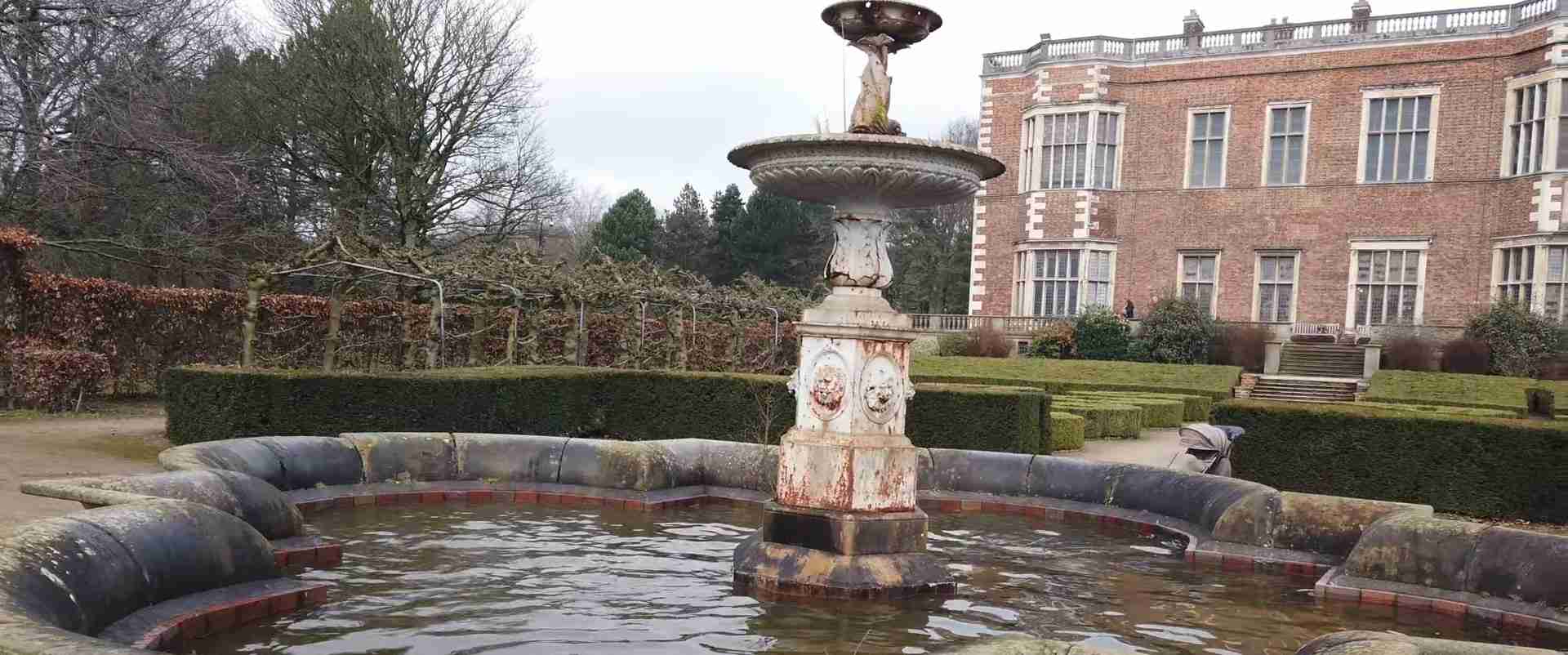
The south elevation is architecturally the most rewarding element. Viewed from the formal approach, it presents the characteristic Jacobean massing: a long two-storey range articulated by large mullioned and transomed windows, projecting bays at the terminal ends, and the emphatic parapet lettering that spells out the pious motto across the full width of the frontage. The brickwork is a deep ochre-red, weathered by nearly four centuries to a varied, uneven surface that reads very differently from the machine precision of later industrial brickwork — the colour shifts from section to section as the original brick batches have aged at slightly different rates, and the lime pointing is irregularly repointed across the surface in a way that exposes the history of maintenance. This materiality is the primary architectural argument of the exterior.
The estate extends to extensive parkland that is freely accessible without house admission, including a Home Farm operating as a rare-breeds centre — the largest rare-breeds collection in northern England, according to the estate’s own description. The parkland provides a substantial walking programme even for visitors who do not take house admission, and offers distant views of the south and east elevations from the grassland to the south and east of the house.
Getting there (2026): First Leeds 19 bus from Leeds City Bus Station toward Temple Newsam; alight at the Temple Newsam Road stop (approximately 25–35 minutes); walk approximately 300 metres to the estate entrance. Services run every 15–20 minutes on weekdays. Check travelineyorkshire.com for current timetables and confirm the correct stop, as routing details have changed in recent years.
Practical information (2026): Estate grounds and Home Farm free, open year-round. House admission approximately £5–7 ($6–9) for adults; check leedsarts.co.uk for current 2026 pricing and any timed entry requirements during peak periods. House typically open Wednesday through Sunday, approximately 10 AM to last admission around 4:30–5 PM depending on season. Estate cafe on site. Ground floor of house largely accessible; upper floors involve stairs only. Allow sixty to ninety minutes for house and gardens; add thirty minutes for the parkland walk and Home Farm if time permits.
What to prioritise: The south front exterior from the formal approach is the essential architectural view. The White Drawing Room and Long Gallery preserve the best sense of the original Jacobean spatial volumes. The Home Farm is a thirty-minute addition well worth making if travelling with children or if an interest in agricultural heritage is part of the day. From the parkland to the east of the house, a five-minute walk delivers the best distant view of the east wing and the full breadth of the Jacobean composition.
Crowd Mitigation and Timing: Best Hours for Photography and Off-Peak Entry 2026
All three sites attract different visitor profiles at different times of day and year, and effective crowd mitigation requires a different approach at each.
Kirkstall Abbey, as a free open-air ruin, draws a local audience throughout the day: dog walkers, school groups, joggers, and weekend families. It is effectively uncrowded before 10 AM on weekdays and in the early evening during British Summer Time, when the ruins take on a different character as the day visitors clear and the low light from the west illuminates the tower remains. For photography, the east-facing nave arcades are best between 8 AM and 10 AM in summer, when direct morning sun reaches the interior through the east end and the long shadows of the arcade piers fall diagonally across the nave floor. After 10 AM on a summer weekend, the site becomes busy enough to make crowd-free photography of the interior difficult. In winter, the morning sun angle is too low to light the nave interior usefully, and the west front and tower remains are the better subjects, in overcast light that eliminates harsh shadow.
Harewood House presents the most acute crowd issue of the three sites. As a ticketed attraction with state rooms in a sequential layout, visitor flow is managed through timed house entry; on summer weekends and bank holidays, available slots fill weeks in advance. For 2026, the practical implications are: book house entry online at harewood.org for any visit between May and September regardless of the day of week; for weekend visits, aim to book four to six weeks in advance. Weekday visits in May, June, and September have better walk-up availability, though booking ahead is still sensible. If following the itinerary described in this guide — Kirkstall first, Harewood second — you will arrive at Harewood around midday, which falls within the busiest touring window. The trade-off is that the terrace gardens are well-lit in early afternoon for south-facing photography, and the state rooms feel no more crowded at noon than at 10 AM once timed entry controls visitor numbers within the rooms.
Temple Newsam is the least crowded of the three sites on typical weekdays. The Home Farm reverses this dynamic during school holidays and bank holidays, when local families fill the estate. For architectural photography of the south front, the best combination is a weekday morning in September or October: the lower sun angle in autumn produces exceptional modelling across the relief of the Jacobean brickwork, the formal gardens retain some late-season colour, and the parkland trees behind the east wing begin to yellow in a way that contrasts productively with the deep red of the south elevation.
Seasonal timing:
- March–April: Lower visitor numbers at all three sites. Harewood house may have reduced opening hours or limited access in early spring — check the website before visiting. Kirkstall in early spring is excellent: bare trees extend sight lines through the ruins and the winter-low sun produces useful raking light on the masonry well into the morning. Temple Newsam Home Farm has spring breeding activity, which draws local families on weekends.
- May–June: The optimal single period for the full circuit. Days are long, all three sites are operating at full hours, Harewood’s terrace gardens are at their peak in late May to early June, and weekday crowds are manageable. Pre-book Harewood house entry for any weekend visit.
- July–August: Peak season across all three sites. Harewood house entry sells out on weekends; book at least four weeks ahead. Kirkstall fills with local visitors and school groups; arrive before 9:30 AM for crowd-free conditions. Temple Newsam is at its busiest on August bank holiday weekend. The sites are all fully operational and programming is at its richest, but timing management becomes essential.
- September–October: The best photographic season. Crowds thin from the second week of September as schools return. Autumn light at Temple Newsam is outstanding. All three sites continue full programming through October. The combination of low-angle golden light and manageable visitor numbers makes this the recommended window for visitors whose primary interest is architecture and photography.
- November–February: Kirkstall is open and freely accessible year-round and is worth visiting in any season. Harewood house is typically closed to general visitors in winter, with limited grounds access for specific events; check harewood.org. Temple Newsam has reduced winter hours. This period suits Kirkstall as a primary destination, with Temple Newsam grounds as a secondary visit; Harewood is not practically part of the winter circuit.
Photography timing summary:
- Kirkstall Abbey: East-facing nave arcades: 8 AM–10 AM summer. Tower remains and cloister: any time in diffuse light. Avoid noon–2 PM in summer (harsh overhead light flattens the stonework).
- Harewood House: South facade: late morning through early afternoon (front-lit in summer; the afternoon sun tracks west and the facade falls into shade after approximately 3 PM in summer). Terrace gardens: early morning or late afternoon for raking light on the stone balustrade. Interior Gallery: late morning when the high south-facing windows admit direct light.
- Temple Newsam: South front: mid to late afternoon in summer, providing front lighting on the south elevation. The east wing from the parkland: mid-morning. In October, any time on a clear day produces excellent autumn brick-and-foliage combinations.
Day Budget for the Leeds Heritage Circuit 2026
The following per-person daily costs assume two adults sharing accommodation where overnight stays are included. Day-trip costs assume no hotel. All prices are approximate 2026 figures in GBP with USD conversion at the prevailing exchange rate; verify all fares and admission prices before travel.
Budget option (day trip, packed lunch from Leeds):
- West Yorkshire Day Rider bus pass: approximately £6.50 ($8)
- Rail single Leeds to Kirkstall Forge: approximately £3.50 ($4)
- Kirkstall Abbey admission: free
- Harewood House adult admission: approximately £19 ($24) — check harewood.org for current 2026 rates; this is the first mention and the price is subject to seasonal variation
- Temple Newsam house admission: approximately £6 ($8) — check leedsarts.co.uk for current 2026 rates
- Packed lunch (brought from Leeds): £0
- Two coffees or snacks across the day: approximately £6–9 ($8–11)
Budget day total: approximately £40–48 per person ($50–60).
Mid-range option (day trip, cafe lunch at Harewood):
- Day Rider bus pass plus Kirkstall Forge rail single: approximately £10 ($13)
- Kirkstall Abbey: free
- Harewood House (advance booking, premium ticket): approximately £22 ($28)
- Temple Newsam: approximately £6 ($8)
- Cafe lunch at Harewood estate cafe: approximately £14–17 ($18–21)
- Additional drinks and snacks across the day: approximately £8–10 ($10–13)
Mid-range day total: approximately £60–65 per person ($75–82).
With one overnight in Leeds (mid-range, two sharing): A mid-range Leeds city-centre hotel in 2026 runs approximately £110–150 ($138–188) per room per night, dividing to £55–75 ($69–94) per person for two sharing. Adding the mid-range day costs above, the total for one night plus the full heritage circuit runs approximately £115–140 per person ($144–175).
These totals are per person for the full three-stop circuit. Visitors choosing to omit Harewood House admission (grounds-only visit or an exterior walk) reduce the day budget by £18–22 per person and the total falls to approximately £18–28 per person ($23–35) for a Kirkstall-and-Temple-Newsam-focused day including transport and Temple Newsam house entry.
Where to Eat Along the 2026 Heritage Circuit
Food provision across the three sites varies significantly; planning meals in advance prevents wasted time searching on the day.
Near Kirkstall Abbey: The abbey grounds have no food provision. The suburb of Kirkstall on the A65 has a cluster of cafes, bakeries, and independent food shops within a ten-minute walk north of the ruins along Abbey Road and Kirkstall Road. For visitors making a very early start (before 9 AM), picking up coffee and a pastry from Kirkstall Road before entering the grounds is a sensible pre-tour routine. The Kirkstall area also has a Morrisons supermarket for provisioning a packed lunch for the rest of the day at lower cost than estate or cafe food at the subsequent stops.
At Harewood: The estate operates a cafe adjacent to the stable courtyard and a more formal restaurant with a midday menu. The stable cafe suits visitors who want a light lunch before or after the house tour and accepts all major card payment methods. Quality and pricing are typical of quality heritage estate catering — above average in produce quality, above high-street prices. The village of Harewood itself, a short walk from the estate entrance gates along the A61, has a traditional pub that can substitute for estate catering if the cafe is crowded during peak summer days. Given that Harewood falls at the midpoint of the recommended circuit, eating here — whether at the estate cafe or the village — is the most practical lunch option and avoids arriving at Temple Newsam hungry and time-pressed in the late afternoon.
At Temple Newsam: The estate has a cafe operating within the main courtyard. As the final stop of the day on the recommended itinerary schedule (typically arriving mid-to-late afternoon), Temple Newsam is better treated as a drinks and snacks stop rather than a full meal venue. Most visitors who have eaten lunch at Harewood mid-morning will not need another significant meal before the bus return to Leeds. The Leeds city centre, thirty minutes by bus, has a full range of evening dining options across all price points.
Accessibility Considerations for the 2026 Heritage Circuit
Accessibility varies substantially across the three sites and deserves specific planning for visitors with mobility requirements.
Kirkstall Abbey: The abbey grounds are flat and primarily grass paths between ruined walls. Access is possible for wheelchair and buggy users in dry conditions; after significant rainfall the ground becomes soft and uneven in areas. The chapter house interior has a level threshold. The First Leeds 33/33A bus drops visitors directly at the Abbey Road entrance, which is preferable to the Kirkstall Forge riverside path (which involves some uneven ground) for accessibility. The entrance gate area has a dropped kerb. Restrooms on site.
Harewood House: The principal ground-floor state rooms are accessed via a ramped entrance from the main forecourt and are largely accessible to wheelchair users. Upper-floor rooms are reached only by stairs and are not accessible. The terrace gardens are largely level with paved and gravel paths; some areas are grass. The estate provides detailed accessibility information at harewood.org and can be contacted by telephone in advance to discuss specific requirements; calling ahead to confirm current 2026 access provisions is recommended, as the estate has undertaken various accessibility improvements in recent years.
Temple Newsam: The house ground floor is largely accessible, with most principal rooms reachable without stairs. Upper-floor rooms involve staircase access only; no lift is present in the historic building. The estate grounds are accessible on the main surfaced paths. The bus 19 stop on Temple Newsam Road involves a standard pavement approach of approximately 300 metres to the entrance — level, with standard kerbing.
All three sites provide designated parking for Blue Badge holders who arrive by car; for the purposes of this car-free guide, the key accessibility point is that in all three cases the bus or rail stop is within 400 metres of the site entrance on level ground, and the sites themselves have been progressively improved for ground-floor access. Visitors with specific requirements should contact each site directly before visiting to confirm current 2026 provision.
Frequently Asked Questions About the Leeds Heritage Circuit Without a Car 2026
Can all three sites genuinely be visited in one day by public transport from Leeds in 2026?
Yes, with an early start and disciplined scheduling. Departing Leeds by 9 AM and following the Kirkstall–Harewood–Temple Newsam sequence allows approximately ninety minutes at Kirkstall, three hours at Harewood, and ninety minutes at Temple Newsam, with transit time accounted for across the day. The total duration is approximately nine to ten hours. The schedule is achievable on long summer weekdays when Temple Newsam closes at 5 PM or later; in spring and autumn, Temple Newsam’s earlier closure compresses or eliminates the final leg and may require treating the three sites as a two-day programme. Pre-booking Harewood house entry is essential for this schedule to work on busy days — arriving without a booking to find the next available slot is two hours away effectively breaks the circuit.
What does the full three-site circuit cost per person in 2026?
Budget visitors carrying a packed lunch should expect to spend approximately £40–50 per person ($50–63) for the full day, covering transport (Day Rider pass plus Kirkstall Forge rail single), Harewood House admission (approximately £19–20), Temple Newsam house entry (approximately £6), Kirkstall (free), and two or three drinks across the day. Mid-range visitors adding a cafe lunch at Harewood should budget approximately £60–68 per person ($75–85). All figures are approximate; check current admission prices at harewood.org and leedsarts.co.uk, and current transport fares at wymetro.com and nationalrail.co.uk, before visiting.
Do I need to book Harewood House in advance in 2026?
Advance booking is strongly recommended for any weekend visit between May and September, and for bank holiday visits at any time. Timed house entry slots at Harewood fill weeks in advance during the summer peak. Weekday visits in May, September, and October have better availability on a turn-up basis, but booking a timed entry slot online at harewood.org is still advisable to guarantee your preferred time and to avoid arriving at a sold-out house. The bird garden and estate grounds do not require timed entry. If you are following the transit-based itinerary in this guide and arriving around midday, booking the 12:30 PM or 1 PM house entry slot in advance is the most reliable approach.
Is there a direct bus between Kirkstall and Harewood without going back through Leeds?
There is no direct scheduled bus service connecting Kirkstall Abbey and Harewood House in 2026 that avoids returning to Leeds. The transit connection requires taking the 33A bus or train back to Leeds City Bus Station and picking up the 36 bus to Harewood, adding approximately forty-five to sixty minutes of transit time compared to driving directly between the two sites. Visitors who find this transit loop time-consuming should consider a taxi for the Kirkstall-to-Harewood leg, which is approximately nine miles by road and takes around twenty minutes; a taxi or private hire will cost significantly more than public transport but eliminates the Leeds detour. Book through a Leeds-registered taxi firm and confirm the fare estimate before boarding.
What is the architectural significance of the Chippendale furniture at Harewood House?
Thomas Chippendale — born in Otley, West Yorkshire, approximately twelve miles from Harewood — supplied furniture for Harewood House from the mid-1760s as part of the integrated Adam–Chippendale decorative programme. The significance of the commission lies in the degree of coordination between furniture and interior: Chippendale designed pieces in direct response to Adam’s colour schemes, ceiling programmes, and proportional systems for each room, so the furniture is not a collection inserted into a completed interior but a component of the same decorative argument as the plasterwork. The Harewood Collection includes several pieces that mark the stylistic transition in English furniture from the rococo of the 1750s toward the neoclassical of the 1770s, and seeing them in their original rooms against the Adam decoration for which they were made is a different experience from seeing Chippendale pieces in a museum setting. The collection is among the most substantial intact Chippendale commissions held in the rooms for which the furniture was made.
How does Kirkstall Abbey compare to other Yorkshire Cistercian ruins?
Yorkshire’s Cistercian ruins form an exceptional group: Fountains Abbey (a World Heritage Site), Rievaulx, Byland, Jervaulx, and Kirkstall all preserve significant fabric from the twelfth and thirteenth centuries. Kirkstall’s specific contribution is accessibility and plan legibility: it is the only major Cistercian ruin in England situated within the built-up area of a large modern city, reachable by rail in under ten minutes from the city centre, and its plan — nave, cloister garth, chapter house east range, refectory south range — is more complete on the ground than the more famous ruins at Byland or Jervaulx. Fountains preserves more spectacular standing fabric, including the complete north tower; Rievaulx is more dramatically sited in a deep valley; Kirkstall occupies a middle position that rewards the architectural reader who takes time to trace the monastic organisation across the surviving walls and foundations.
What is the best Leeds neighbourhood to stay in for access to the heritage circuit?
The city centre — specifically the area within ten minutes’ walk of Leeds City Station and City Bus Station — is the optimal base for this itinerary. The transit legs for all three sites begin from this cluster, and accommodation is available across all price bands in the immediate vicinity: budget hostels, aparthotels, mid-range chain hotels, and a small number of independent hotels. The Headingley neighbourhood, approximately two miles northwest of the city centre on the A65, is also convenient for visitors who wish to be closer to Kirkstall Abbey specifically; it is served by the 33/33A bus to the abbey and has a well-developed independent cafe and restaurant scene. However, staying in the city centre gives better flexibility for the Harewood and Temple Newsam legs.
Is Temple Newsam worth visiting as a grounds-only visit if the house is closed?
Yes. The estate grounds extend to approximately 1,500 acres and include the Home Farm with its rare-breeds programme, parkland walks with views of the south and east elevations of the house, and formal gardens. The Jacobean south front of the house is fully visible from the formal forecourt approach — the most architecturally rewarding elevation — without entering the house. For visitors whose primary interest is the exterior architecture and the Tudor-Jacobean massing, a grounds-only visit delivers the essential experience. The parkland walk south and east of the house places the building in its designed landscape and gives distant views of the east wing composition that are not visible from the entrance approach. A grounds-only visit justifies sixty to ninety minutes comfortably.
Can the heritage circuit be done as a day trip from other northern cities in 2026?
Yes. From Manchester, direct TransPennine Express services reach Leeds City Station in approximately one hour, giving a realistic Leeds arrival of 9:30 AM from a 8:30 AM Manchester departure — tight but feasible for the full circuit if Temple Newsam is kept to a grounds visit rather than a full house tour. From York, the journey is approximately twenty-five minutes, making Leeds very comfortably reachable for a 9 AM start. From Sheffield, approximately forty-five to fifty-five minutes to Leeds. From Bradford, approximately fifteen minutes to Leeds City Station. All of these allow the full nine-to-ten-hour heritage circuit described in this guide. From Edinburgh, the journey is approximately two hours twenty minutes, making Leeds accessible by 10 AM for a 7:45 AM Edinburgh departure — feasible but requiring the Kirkstall leg to be kept brief to stay on schedule.
Are there any combined ticket offers covering multiple Leeds heritage sites in 2026?
There is no current integrated multi-site ticket covering Kirkstall Abbey, Harewood House, and Temple Newsam as a package, as the three venues are managed by different organisations (Leeds City Council, the Harewood Estate Trust, and Leeds City Council respectively). Kirkstall Abbey grounds are free, removing it from any ticket bundle calculation. Individual admission prices apply at Harewood and Temple Newsam, and both venues periodically offer discounted tickets for advanced online purchase at their own websites — checking these before visiting is the most reliable way to reduce admission costs. English Heritage and National Trust memberships do not cover these specific sites. Leeds Card, the city’s visitor discount card, should be checked at leedscard.com for any current heritage partner discounts applicable in 2026.