Khajuraho Temples from Delhi 2026: UNESCO Erotic Art Guide
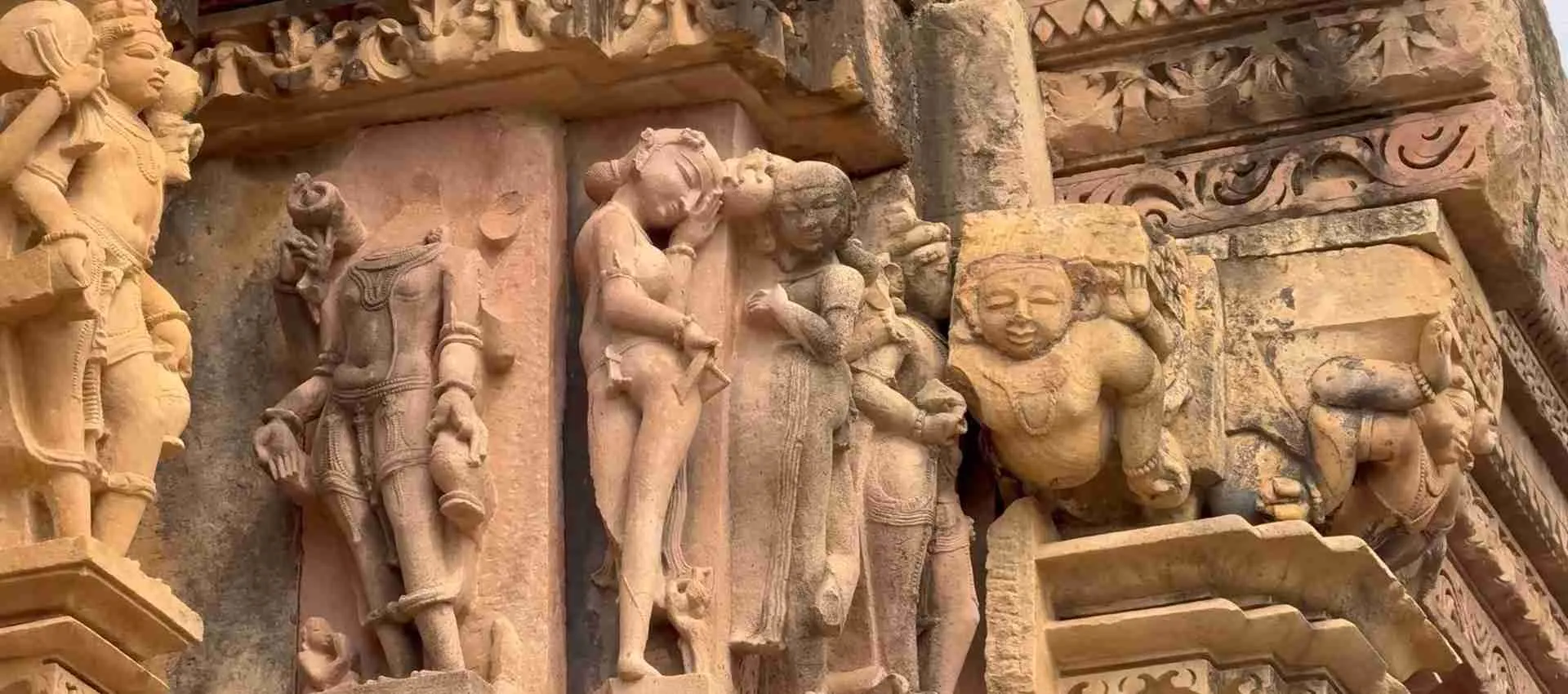
Khajuraho’s medieval temples represent one of the most paradoxical and compelling UNESCO World Heritage Sites in India — simultaneously a sacred complex of profound religious architecture and the location of some of the most explicit erotic sculpture ever carved in stone. Built between 950 and 1050 CE by the Chandela dynasty in what is now Madhya Pradesh, the temples are accessible from Delhi in just over an hour by direct flight, making them one of the most culturally revelatory day trips or short-break destinations available to travelers planning India itineraries in 2026.
Key Takeaways for Your Khajuraho Visit in 2026
- UNESCO Status: The Khajuraho Group of Monuments was inscribed on UNESCO’s World Heritage List in 1986, recognized for their exceptional testimony to Chandela dynasty civilization and the extraordinary quality of Nagara-style temple architecture.
- Scale of the Complex: Originally 85 temples spread over 20 square kilometers, today 25 temples survive across three groups: Western, Eastern, and Southern — the Western Group contains the largest and most famous temples.
- Entry Fees 2026: The Western Group charges ₹40 for Indian nationals and ₹600 for foreign visitors; the Eastern Group charges ₹35 for Indians and approximately ₹550 for foreigners. Check official ASI website for current rates.
- Flight from Delhi: IndiGo operates direct flights from Delhi (DEL) to Khajuraho (HJR) twice daily; the flight takes approximately 1 hour 5-25 minutes, making Khajuraho viable as an overnight trip from Delhi.
- Best Season: October through March offers the best visiting conditions; the Khajuraho Dance Festival held in late February/early March transforms the temple complex into a backdrop for one of India’s most celebrated classical dance events.
- Cultural Context First: The erotic sculptures represent approximately 10-15% of total temple decoration — understanding the philosophical context of kama within Hindu dharma is essential for a meaningful visit rather than a merely sensational one.
People Also Ask About Khajuraho Temples from Delhi 2026
How do you get from Delhi to Khajuraho in 2026?
The fastest and most practical option is a direct IndiGo flight from Delhi’s Indira Gandhi International Airport (DEL) to Khajuraho Civil Airport (HJR), taking approximately 1 hour 5-25 minutes. Flights depart twice daily; fares range from ₹7,000-8,000 one-way (check current rates on airline websites for 2026 booking). The Khajuraho airport sits just 2 km from the temple complex — the shortest airport-to-heritage-site connection of any UNESCO site in India. The overnight train option (Khajuraho-Hazrat Nizamuddin Express 22448) takes approximately 13-14 hours but costs just ₹600-1,500.
What is the entry fee for Khajuraho temples for foreign tourists in 2026?
The Western Group of Temples — the main complex and most visited — charges ₹600 per foreign visitor and ₹40 for Indian nationals. The Eastern Group charges approximately ₹35-40 for Indians and ₹550-600 for foreigners. The Archaeological Museum adjacent to the Western Group charges ₹10 for Indians and ₹250 for foreigners. The separate Light and Sound Show at the Western Group costs ₹250 for Indians and ₹700 for foreigners. Children under 15 enter all sites free. Verify current rates at asi.nic.in before your 2026 visit.
What are the erotic sculptures at Khajuraho and why do they exist?
The erotic sculptures (mithuna figures) at Khajuraho are carved on the exterior walls of several temples, depicting couples and groups in explicit sexual positions. They represent approximately 10-15% of total temple decoration and appear primarily on the outer walls — never in the inner sanctum. Scholars propose multiple interpretations: that they symbolize the transition from worldly existence (kama) to spiritual liberation (moksha) encountered as worshippers enter the sacred interior; that they reflect the tantric traditions of Chandela court culture; or that they served as protective talismans against lightning, based on the folk belief that celestial beings associated with lightning would be too embarrassed to strike a temple adorned with such imagery.
Can you visit Khajuraho temples in one day from Delhi in 2026?
Yes — the Delhi-Khajuraho route is genuinely viable as a day trip or overnight excursion from Delhi in 2026. An early morning IndiGo flight (departs approximately 9:25 AM from DEL, arrives ~10:30 AM at HJR) gives you a full day at the temples, with an evening return flight. More comfortably, a single night in Khajuraho allows a relaxed full-day exploration of all three temple groups plus the evening Light and Sound Show, which runs for approximately 55 minutes at the Western Group with English and Hindi language options.
Extended multi-day tours – 5+ days
Featured Delhi Multi-Day Tour Packages

3 days
Delhi 3-Day Discovery Tour
- ✓ Comprehensive Delhi experience
- ✓ Expert local guides included
- ✓ All accommodation included
- ✓ Transportation provided

5 days
Delhi 5-Day Highlights Experience
- ✓ Comprehensive Delhi experience
- ✓ Expert local guides included
- ✓ All accommodation included
- ✓ Transportation provided

7 days
Delhi 7-Day Cultural Journey
- ✓ Comprehensive Delhi experience
- ✓ Expert local guides included
- ✓ All accommodation included
- ✓ Transportation provided

10 days
Delhi 10-Day Complete Adventure
- ✓ Comprehensive Delhi experience
- ✓ Expert local guides included
- ✓ All accommodation included
- ✓ Transportation provided
Multi-day tour packages powered by TourRadar. Prices and availability subject to change.
Introduction: The Temples That Shocked the World
When a British engineer named T.S. Burt rediscovered Khajuraho’s temples in 1838 — they had never been truly lost to local people but had faded from broader awareness after the Chandela dynasty’s decline — his published accounts caused a sensation in Victorian Europe. The explicit sexuality carved in stone on the exterior walls of what were clearly places of serious religious devotion challenged every assumption the Western world held about the relationship between religious piety and physical desire in ancient India.
That controversy, more than 180 years old, persists in modified form today. Visitors arriving at Khajuraho in 2026 still bring the same essential question: what does erotic sculpture have to do with religious temples? The answer requires understanding a concept that has no direct Western equivalent — the Hindu notion of kama as one of the four legitimate goals of human existence, alongside dharma (righteous duty), artha (material prosperity), and moksha (spiritual liberation). Within this framework, the denial of physical experience is not considered a prerequisite for spiritual progress; rather, the full and conscious engagement with all aspects of human existence — including sexuality — becomes part of the path toward understanding the divine.
But Khajuraho is not primarily about erotic sculpture. The mithuna figures (literally “couples” in Sanskrit) represent approximately 10-15% of the temples’ total decorative program. What dominates the remaining 85-90% is a comprehensive cosmological vision carved in pale sandstone: celestial nymphs (apsaras), court attendants, warriors, elephants, horsemen, musicians, dancers, devotional figures, divine beings from Hindu and Jain mythology, and the architectural forms of the Nagara shikhara (tower) that reaches toward the mountain peak as a symbol of Mount Meru, the cosmic axis of Hindu cosmology.
UNESCO recognized all of this in 1986 when it inscribed the Khajuraho Group of Monuments as a World Heritage Site, citing the “unique artistic achievement” of the temple complex and its “outstanding example of a type of building or architectural ensemble or technological ensemble or landscape which illustrates significant stage(s) in human history.” For travelers in 2026, Khajuraho delivers on this UNESCO designation with a density of artistic achievement in a compact, accessible, beautifully maintained complex that rewards even a single day of exploration.
Historical Background: The Chandela Dynasty
The Chandela Rajputs ruled a medieval kingdom centered on Mahoba in what is now Bundelkhand, the semi-arid plateau region where Madhya Pradesh meets Uttar Pradesh. According to the dynastic legend preserved in inscriptions and bardic poetry, the Chandelas traced their origin to the moon god Chandra through a semi-divine ancestor — a genealogy that gave them both mythological legitimacy and a connection to the cosmic forces that their temples would later monumentalize in stone.
The Chandelas rose to prominence during the 9th century CE, initially as feudatories of the Gurjara-Pratihara empire and later as an independent power following Pratihara decline. The temple-building program at Khajuraho began in earnest under Yasovarman (around 925-954 CE), who commissioned the Lakshmana Temple — one of the complex’s finest surviving structures — and continued under his successors Dhanga (954-1002 CE) and Vidyadhara (1003-1035 CE). Together, these three rulers oversaw the construction of the majority of Khajuraho’s surviving temples, transforming what had been a relatively modest settlement into one of the architectural showcases of medieval India.
Why did the Chandelas choose Khajuraho as their temple city? The site had religious significance predating the dynasty — a grove of date palm trees (khajur in Sanskrit, from which the modern name derives) associated with local deity worship. More practically, the location provided both building materials (pale sandstone quarried from nearby geological formations) and water resources (the Shiv Sagar, Khajur Sagar, and other tanks that still exist around the complex). The temples were concentrated in a discrete sacred zone distinct from the royal administrative capital at Mahoba, suggesting a deliberate choice to create a pilgrimage center rather than a royal showcase.
Muslim armies under Qutb-ud-din Aibak raided the region in 1203 CE as part of the broader conquest that established the Delhi Sultanate, and Chandela power fragmented in subsequent decades. Several of the original 85 temples were likely destroyed or damaged during this period; others fell to gradual neglect as the local population shifted toward different forms of religious observance. The 25 temples surviving today represent those that either escaped attention or were substantially complete and structurally sound enough to resist time’s erosion.
Nagara Architecture: Understanding the Temples’ Visual Language
Before walking the Western Group temple circuit, understanding the Nagara architectural style transforms an aesthetic experience into an intellectual one. Nagara is the North Indian temple tradition as distinct from the Dravida style of the south, and Khajuraho represents its mature phase at the moment of greatest complexity and ambition.
Every Khajuraho temple stands on a high platform (jagati) that elevates it above the surrounding landscape, creating visual monumentality and practical flood protection. The temple complex rises through a series of functional zones: the entrance porch (ardha-mandapa), the outer hall (mandapa), the inner hall (maha-mandapa in the larger temples), the vestibule (antarala), and finally the inner sanctum (garbhagriha — literally “womb chamber”) where the principal deity image resides. Above the garbhagriha rises the distinctive shikhara — the curved tower that terminates in a flat platform (amalaka) topped by a pot-shaped finial (kalasha).
What makes Khajuraho’s shikharas visually extraordinary is their clustered form. Rather than a single smooth tower, Chandela architects designed shikharas that appear to be composed of dozens of smaller towers emerging from the main mass — a visual effect created by applying a repeated motif of miniaturized shikhara elements (uruśringas) to the main tower’s surface. The result, viewed from a distance, is a mountain of stone that seems to erupt from the platform in organic clusters, mimicking the silhouette of the Himalayan peaks that in Hindu cosmology represent the abodes of the gods.
The sculptural program runs horizontally in bands across the entire temple exterior, from the platform level to approximately two-thirds of the shikhara’s height. These bands alternate between narrative friezes (scenes of battle, procession, hunting, and daily life), devotional figures (apsaras, dikpalas, and attendants), and the mithuna groups whose erotic content draws most visitor attention. The consistency and technical quality across these thousands of individual figures — each carved with individualized facial expressions, jewelry, clothing patterns, and poses — required an organized system of architectural patronage and master craftsmen that we can only partially reconstruct from temple inscriptions.
The Three Temple Groups in 2026
The Western Group: Heart of Khajuraho
The Western Group is the main complex and the focus of most visitors’ time at Khajuraho. Enclosed within a maintained park managed by ASI, the Western Group contains the largest and most elaborately decorated temples, including the supreme achievement of Chandela architecture: the Kandariya Mahadeva Temple.
Dedicated to Shiva, the Kandariya Mahadeva rises to approximately 30 meters — the tallest surviving temple at Khajuraho — and displays 872 sculptures on its exterior surfaces, approximately 220 of which are larger than half a meter in scale. The temple’s clustered shikhara creates what many architectural historians consider the most perfect expression of the Nagara form in Indian temple architecture. The mithuna figures at Kandariya Mahadeva are the most explicit at Khajuraho, displayed on bands that run approximately at human eye level on the exterior walls — a deliberate placement that forces the worshipper to consciously pass through the realm of kama on their way to the sacred interior.
Immediately adjacent, the Devi Jagadambi Temple (dedicated to the Great Goddess) is smaller but notable for its sculptural program’s focus on female beauty — the apsaras carved here are among the finest at Khajuraho, their poses combining sensuality with a naturalistic grace that reflects direct observation of the living female form. The Vishwanatha Temple (another Shiva temple, with an intact Nandi shrine opposite) and the Chitragupta Temple (dedicated to Surya, the sun god) complete the principal structures of the Western Group. The Lakshmana Temple, the oldest major Chandela temple built under Yasovarman, displays a relatively more restrained sculptural program but is architecturally complete — its porch, mandapa, and garbhagriha all intact — making it the best starting point for understanding temple spatial organization before the visual abundance of Kandariya overwhelms the visitor’s architectural attention.
The Eastern Group: Jain Excellence
The Eastern Group, located approximately 1.5 km from the Western complex, divides into two sub-clusters: Hindu temples on a slight rise and a group of Jain temples in a more compact area managed jointly by ASI and the local Jain community. The Eastern Group charges a lower entry fee (approximately ₹35-40 for Indians, ₹550 for foreigners) and attracts significantly fewer visitors, creating a quieter atmosphere particularly suited to contemplative photography.
The Parsvanatha Temple is the largest and most important Jain temple at Khajuraho, dedicated to the 23rd Jain tirthankara. Despite its Jain dedication, the temple’s exterior sculpture includes numerous Hindu deities — Vishnu, Shiva, and their attendants appear alongside Jain figures in an eclectic program that reflects the inter-religious artistic vocabulary of Chandela court culture. The Vamana Temple, dedicated to Vishnu in his dwarf-avatar form, is notable for a beautifully proportioned tower and a sculptural program whose apsara figures are carved with particular delicacy.
The Javari Temple, the smallest significant temple in the Eastern Group, rewards careful study precisely because of its intimate scale — the same carving techniques visible at Kandariya Mahadeva appear in miniaturized form at Javari, making it possible to appreciate individual sculptural decisions at close range without the visual complexity of the larger temples. The Brahma Temple, confusingly dedicated to Vishnu despite its name, stands at the edge of the Khajur Sagar tank and reflects beautifully in the water — one of Khajuraho’s most photogenic spots.
The Southern Group: Quiet Masterpieces
The Southern Group, the smallest and least visited of the three complexes, contains two temples of significant interest. The Duladeo Temple, dedicated to Shiva and built slightly later than most Khajuraho temples (early 12th century CE), shows the architectural style transitioning toward a somewhat stiffer and more mechanical quality — interesting for understanding how the Chandela tradition evolved as its creative peak passed. The Chaturbhuja Temple contains a magnificent four-armed Vishnu image in its garbhagriha, the largest single sculpted image at Khajuraho at approximately 2.7 meters in height, displayed in the calm of an inner sanctum that rarely receives more than a handful of simultaneous visitors.
The Erotic Sculptures: Cultural Context for 2026 Visitors
No aspect of Khajuraho generates more visitor questions — and more potential for cultural misunderstanding — than the mithuna sculptures. Several scholarly interpretations have been proposed since the temples entered international awareness in the 19th century, and it is worth reviewing the principal theories before visiting rather than encountering the sculptures unprepared.
The most widely cited scholarly interpretation frames the mithuna as threshold imagery. In Hindu sacred geography, the transition from the profane exterior world to the sacred interior of the garbhagriha is never casual — it involves crossing a threshold that architecturally and conceptually separates the realm of worldly existence from the realm of the divine. The mithuna figures positioned on outer walls at approximately eye level compel the visitor to consciously register their presence, and in doing so, to consciously acknowledge the realm of kama — physical desire and its fulfillment — before entering the domain of moksha. The erotic is not opposed to the spiritual; it marks its approach.
A second interpretation, less widely accepted but historically documented, connects the mithuna figures to tantric practices current in the Chandela court. Tantra as a spiritual discipline uses the energies of desire — rather than suppressing them — as fuel for transcendence. Some temples at Khajuraho show mithuna figures in positions associated with specific tantric practices described in texts like the Kamashastra tradition, suggesting that the sculptures may have had initiatory significance for practitioners familiar with these traditions.
A third interpretation, drawn from ethnographic sources, notes the folk belief that the goddess of lightning (Bijasena) would be embarrassed to strike a temple displaying such imagery — making the mithuna figures a protective magical program as well as a theological statement. This interpretation aligns with similar protective functions assigned to erotic imagery in other South Asian and Southeast Asian religious contexts.
What all scholars agree upon is that the erotic sculptures at Khajuraho were neither pornographic in intent nor exceptional within their original cultural context. The Kama Sutra, compiled by Vatsyayana in roughly the 4th century CE, treats sexual knowledge as one component of a sophisticated education rather than a taboo subject, and the Chandela dynasty’s court culture operated within this tradition. Understanding this context transforms the visitor experience: rather than reacting with embarrassment, prurience, or incomprehension, the prepared visitor can engage with the mithuna as what they genuinely are — sophisticated theological statements encoded in stone by artists working at the height of their technical and conceptual powers.
Tickets, Hours, and Practical Planning for 2026
Entry Fees and Site Access 2026
The Western Group of Temples charges ₹600 for foreign visitors and ₹40 for Indian nationals (check asi.nic.in for any 2026 updates, as ASI revises fees periodically). The Eastern Group is slightly less — approximately ₹35-40 for Indians and ₹550 for foreigners. Children under 15 enter free at all groups. The Archaeological Museum adjacent to the Western Group charges ₹10 for Indians and ₹250 for foreigners, and contains a well-organized collection of sculpture removed from ruined temples or recovered during excavation, including pieces that provide useful context for understanding the iconographic programs visible at the temples themselves.
The separately managed Light and Sound Show at the Western Group costs ₹250 for Indian visitors and ₹700 for foreign tourists (check current rates on MP Tourism website). The show runs approximately 55 minutes in English and Hindi on separate schedules; winter timing (October-February) is 6:30-7:25 PM and summer timing (March-September) is 7:30-8:25 PM. The illuminated Kandariya Mahadeva Temple viewed in sequence with the narrated history of the Chandela dynasty makes for a genuinely memorable evening experience.
Opening Hours and Closure Days 2026
The Western Group of Temples opens daily from 8:00 AM to 6:00 PM with no weekly closure — unlike many ASI-managed sites, the Western Group is accessible all seven days of the week. The Eastern Group follows similar hours, generally 8:00 AM to 6:00 PM. The Archaeological Museum opens Tuesday through Sunday from 10:00 AM to 5:00 PM and closes on Mondays. Morning hours (8:00-10:00 AM) offer the advantages of cooler temperatures, softer light on the pale sandstone, and reduced crowds — particularly valuable for the Western Group, which by 10:30 AM during peak season has multiple tour groups navigating the circuit simultaneously.
Getting from Delhi to Khajuraho in 2026
By Flight (Recommended)
IndiGo operates two daily direct flights from Delhi’s Indira Gandhi International Airport (DEL) to Khajuraho Civil Airport (HJR). The earliest departure leaves DEL at approximately 9:25 AM, arriving at HJR around 10:30 AM — arriving at the temple complex by 10:45 AM after the 2-minute taxi ride from the airport. Fares typically range from ₹7,000-8,000 one-way for economy class on IndiGo (check current rates at goindigo.in; prices vary significantly with booking advance and season). Air India and other carriers also serve the route with connections via intermediate airports, adding 3-8 hours of total travel time. Book direct IndiGo flights 4-8 weeks in advance for optimal pricing in 2026.
The Khajuraho airport is one of India’s most conveniently positioned relative to its tourist attraction — literally 2 km from the Western Group temple complex. Taxis from the airport to any Khajuraho hotel or directly to the temple gates cost ₹100-200 and take 5 minutes. The same applies on departure: factor no more than 30 minutes between leaving your hotel and reaching the airport, allowing for a leisurely morning at the temples before catching an afternoon return flight to Delhi.
By Train (Budget Option)
The Khajuraho-Hazrat Nizamuddin Express (Train 22448) is the only direct train service between Delhi and Khajuraho. Departing Khajuraho at 20:20 and arriving at Hazrat Nizamuddin (Delhi) at 10:30 the following morning, this overnight service in the Delhi-to-Khajuraho direction runs as Train 22447, departing Hazrat Nizamuddin at 21:10 and arriving Khajuraho at 11:00. The journey covers approximately 632 km in 13-14 hours. Sleeper class (3AC) costs approximately ₹600-1,500 depending on booking class. Book via IRCTC (irctc.co.in) well in advance, particularly for the October-March peak season.
By Road and Bus
The road distance from Delhi to Khajuraho is approximately 632-655 km, making it a 10-13 hour drive depending on route and traffic conditions. Private taxis for this journey cost ₹12,000-20,000 one-way. Bus services from Delhi (Kashmere Gate ISBT) operate to Chhatarpur (the nearest major town, 44 km from Khajuraho) and occasionally direct to Khajuraho, taking 13-14 hours. Road travel is most practical as part of a multi-destination Madhya Pradesh itinerary combining Khajuraho with Orchha, Gwalior, and Bandhavgarh — a circuit that many independent travelers plan as a 7-10 day journey from Delhi.
Sample 2026 Itineraries from Delhi
Option A: Overnight Excursion (2 Days, 1 Night)
Day 1 from Delhi: Take the 9:25 AM IndiGo flight from DEL; arrive Khajuraho 10:30 AM. Taxi directly to the Western Group (₹100-150). Spend 3-4 hours exploring the Western Group temples — Lakshmana, Vishwanatha, Kandariya Mahadeva, Devi Jagadambi, Chitragupta. Lunch at one of the restaurants along the temple road (₹400-700 per person). Afternoon: Archaeological Museum (₹250 for foreigners). Early evening: Light and Sound Show at the Western Group (₹700 for foreigners). Overnight in Khajuraho.
Day 1 costs excluding accommodation: flight ₹7,000-8,000 (one-way), Western Group entry ₹600, Museum ₹250, Light and Sound Show ₹700, lunch ₹400-700, taxi ₹200-300. Day total approximately ₹9,150-10,550 per person (excluding accommodation).
Day 2: Morning: Eastern Group temples (Parsvanatha, Vamana, Javari) and Southern Group (Duladeo, Chaturbhuja). Budget 2-3 hours. Return to the Western Group for any temples you missed or want to revisit in different light. Lunch (₹400-700). Afternoon flight back to Delhi. Day 2 costs excluding accommodation: Eastern Group entry ₹550, lunch ₹400-700, taxi ₹200-300, return flight ₹7,000-8,000. Day total approximately ₹8,150-9,550 per person (excluding accommodation).
Option B: Day Trip (Ambitious But Possible)
The 9:25 AM IndiGo departure from DEL and approximately 6:00 PM return flight gives approximately 7 hours at Khajuraho — enough time for a thorough Western Group visit, lunch, and a brief look at the Eastern Group without the Light and Sound Show. This option eliminates hotel costs but requires organizational precision. Total transport cost: approximately ₹14,000-16,000 round-trip by air. Day costs: Western Group ₹600, Eastern Group ₹550, lunch ₹400-700, taxis ₹400-600. Total day trip cost approximately ₹15,950-18,450 per person (transport, entries, meals).
Option C: Train Budget Trip (2 Nights)
Overnight train from Delhi (depart 21:10, arrive Khajuraho 11:00 next morning). Day 1 in Khajuraho: afternoon Western Group and evening Light and Sound Show. Day 2: Eastern and Southern Groups, Panna Tiger Reserve safari option (40 km from Khajuraho; jeep safari entry approximately ₹2,000-3,000 per person). Overnight train return from Khajuraho (depart 20:20). Total transport ₹1,200-3,000 round-trip. Two nights accommodation ₹1,500-6,000. Site entries and show approximately ₹2,100. Estimated total budget ₹5,000-12,000 per person ($60-145 USD) — the most economical approach to experiencing Khajuraho from Delhi.
Accommodation in Khajuraho 2026
Khajuraho is a small town whose accommodation sector caters primarily to heritage tourists. Options range from international-standard hotels to basic guesthouses, with most properties concentrated within 1-3 km of the Western Group temple complex.
At the upper end, the Lalit Temple View Khajuraho offers luxury rooms with direct visual access to the illuminated temples from selected rooms, at approximately ₹10,000-18,000 per night. The Radisson Jass Hotel provides consistent international-standard comfort at ₹6,000-10,000 per night. Mid-range options include the Hotel Harmony and Ken River Lodge at ₹3,000-6,000 per night. Budget guesthouses along the main tourist road charge ₹800-2,000 per night with basic amenities; many have rooftop restaurants with temple views.
Khajuraho’s compact size means that virtually any accommodation is within walking distance or a short auto-rickshaw ride of the Western Group. Staying one night allows comfortable participation in the Light and Sound Show, a morning temple visit in the golden hour light that transforms the pale sandstone into amber, and unhurried exploration of the Eastern and Southern Groups.
The Khajuraho Dance Festival 2026
The annual Khajuraho Dance Festival — held during late February and early March each year — transforms the Western Group temple complex into one of India’s most spectacular performance venues. The 52nd edition of the festival runs from February 20-26, 2026, presenting classical Indian dance forms — Bharatanatyam, Kathak, Odissi, Manipuri, Kuchipudi, and others — performed against the illuminated backdrop of the Kandariya Mahadeva Temple in open-air evening performances.
The festival attracts India’s foremost classical dancers and receives international media coverage as one of the country’s premier cultural events. For visitors planning a 2026 trip to Khajuraho, timing the visit to coincide with the Dance Festival adds an extraordinary experiential dimension: the living continuation of the classical dance traditions depicted in the temple sculptures, performed in the architectural setting that inspired them. Tickets for individual performances range from ₹500-2,000 depending on seating category; advance booking through MP Tourism (mptourism.com) is essential as popular performances sell out weeks in advance.
Practical Tips for Visiting Khajuraho in 2026
The Western Group temples are best visited in a specific sequence to build understanding progressively. Begin with the Lakshmana Temple — the oldest major structure and the most architecturally complete — to establish the spatial logic of a Chandela temple before the visual abundance of Kandariya Mahadeva introduces the complex’s full decorative program. After Lakshmana, proceed to Vishwanatha with its intact Nandi shrine, then Chitragupta (noting the solar imagery throughout), and only then to Kandariya Mahadeva. This sequence allows the escalating sculptural richness to accumulate meaning rather than simply overwhelm.
The Kandariya Mahadeva’s exterior sculptural program is best understood by circling the entire temple slowly at close range, examining bands at different heights. The lowest bands at ground level typically depict elephants and horses; the middle bands include the narrative and devotional figures; and the upper bands, approaching the shikhara, concentrate the celestial beings who inhabit the space between earth and the divine.
Hire a certified government guide from the official guide stand near the Western Group entrance rather than accepting offers from unofficial guides at the road approach. Government-licensed guides have completed formal heritage training and carry identification badges; they understand iconographic programs across all three temple groups and can explain specific sculptural scenes with scholarly accuracy. The guide fee is approximately ₹500-1,000 per group for a 2-hour Western Group tour; agree on the total fee before starting.
The pale Vindhyan sandstone from which all Khajuraho temples are built has a distinctive quality in different light conditions. The morning hours between 8:00 and 10:00 AM produce warm amber tones; midday renders the stone almost bleached white; late afternoon (4:00-6:00 PM) returns warm tones and creates deep shadows in the sculptural relief. Photographers planning dedicated photographic work should arrive at opening and return for the late afternoon golden hour — Khajuraho’s two-to-three hour visiting distance from the airport makes this practical even on a single overnight trip.
The temples are active religious sites as well as heritage monuments. The Matangeshvara Temple adjacent to the Western Group complex remains an active Shiva temple visited daily by local devotees — entering respectfully in modest dress and observing religious practice with quiet attention rather than photographic intrusion honors both the living faith and the UNESCO heritage designation.
Beyond the Temples: Panna Tiger Reserve 2026
Located 40-45 km from Khajuraho, Panna Tiger Reserve offers a compelling natural heritage addition to a Khajuraho itinerary. The Ken River flows through the reserve creating a dramatic gorge habitat that supports Bengal tigers, leopards, Indian wolves, sloth bears, and excellent bird diversity including various raptors and waterbirds. Jeep safaris depart on fixed schedules from Panna gate (approximately ₹2,000-3,000 per person including entry and guide fees; check the Panna reserve official website for current 2026 permit rates). Full-day combined Khajuraho temples plus Panna safari itineraries are available through local tour operators for approximately ₹4,000-6,000 per person excluding transport from Delhi.
Frequently Asked Questions About Khajuraho from Delhi 2026
Is Khajuraho a UNESCO World Heritage Site?
Yes. The Khajuraho Group of Monuments was inscribed on UNESCO’s World Heritage List in 1986. The inscription recognized the exceptional testimony to Chandela dynasty civilization (10th-11th centuries CE), the extraordinary quality of medieval Indian temple architecture in the Nagara style, and the artistic achievement represented by the complex’s sculptural programs. The inscribed property encompasses all three temple groups — Western, Eastern, and Southern.
How many temples are there at Khajuraho?
25 temples survive today from an original complex of approximately 85 temples spread across 20 square kilometers, constructed primarily between 950 and 1050 CE. The Western Group contains the largest concentration of major temples (approximately 8-10 significant structures). The Eastern Group includes both Hindu and Jain temples totaling approximately 8-10 structures. The Southern Group contains 2 principal temples. The Archaeological Survey of India manages all surviving temples.
What do the erotic sculptures at Khajuraho represent?
The mithuna (erotic couple) sculptures represent approximately 10-15% of total temple decoration and appear exclusively on exterior walls — never in the inner sanctum. Scholarly interpretations include their function as threshold imagery symbolizing the transition from worldly kama toward spiritual moksha, their connection to tantric practices current in Chandela court culture, and their role as protective talismans against lightning. All interpretations place the erotic sculpture within a coherent religious and cosmological framework rather than treating it as decoration separate from the temples’ spiritual purpose.
When is the Khajuraho Dance Festival in 2026?
The 52nd Khajuraho Dance Festival runs from February 20-26, 2026. Evening performances of classical Indian dance forms — Bharatanatyam, Kathak, Odissi, Manipuri, Kuchipudi, and others — are staged against the illuminated Western Group temple backdrop. Tickets range from ₹500-2,000 depending on seating. Book through MP Tourism (mptourism.com) well in advance, as popular performances sell out weeks before the event.
What is the best time to visit Khajuraho in 2026?
October through March offers the best visiting conditions. The Khajuraho Dance Festival (February 20-26, 2026) makes late February an especially rewarding time. November and December deliver excellent weather (15-25°C) with moderate tourist numbers. January is peak season with highest accommodation prices. March remains comfortable. April through June should be avoided — summer temperatures in Madhya Pradesh regularly exceed 42°C and make extended outdoor temple walking extremely uncomfortable.
Is there direct transport from Delhi airport to Khajuraho?
Yes — IndiGo operates two direct daily flights from Indira Gandhi International Airport (DEL) to Khajuraho Civil Airport (HJR). Flight duration is approximately 1 hour 5-25 minutes. The Khajuraho airport is 2 km from the Western Group temple complex; taxis from the airport to the temples take 5 minutes and cost ₹100-200. No direct train runs from Delhi airport; travelers taking the overnight train use Hazrat Nizamuddin station (HNZ), accessible from central Delhi in 30-45 minutes by metro or taxi.
What should I wear at Khajuraho temples?
Comfortable, lightweight walking clothes suitable for warm weather and extended outdoor walking. The temple complex involves walking on stone-paved paths and uneven surfaces; comfortable closed-toe shoes are advisable. Modest dress (covered shoulders and knees) is requested at the active Matangeshvara Temple adjacent to the Western Group complex where Hindu religious practice continues. Sun protection — hat, sunscreen, sunglasses — is essential for visits during warm months when the pale sandstone reflects significant heat.
How long do I need at Khajuraho temples?
A minimum of 3-4 hours for a focused Western Group visit covers the principal temples adequately. A full day (8-9 hours) allows a thorough Western Group exploration, museum visit, Eastern and Southern Group temples, lunch, and the evening Light and Sound Show. A second day enables deeper engagement with specific temples and possible excursions to Panna Tiger Reserve. The majority of international visitors spend 1-2 nights in Khajuraho to explore all three temple groups and the evening show comfortably.
Are photography restrictions in place at Khajuraho in 2026?
Photography of the temples and their exterior sculpture is generally permitted without special fees at all three temple groups. Interior photography rules vary by individual temple — some inner sanctums prohibit photography to protect religious practice and limit flash impact on older stone surfaces. The Archaeological Museum prohibits photography of its collections. The Light and Sound Show prohibits camera equipment (but not smartphones). Professional photography with tripods may require advance permission from ASI — contact the site office directly for current 2026 protocols.
Can I combine Khajuraho with other UNESCO sites in Madhya Pradesh?
Yes — Madhya Pradesh contains several UNESCO sites accessible by road from Khajuraho. The Bhimbetka Rock Shelters (prehistoric rock paintings, inscribed 2003) lie approximately 300 km from Khajuraho via Bhopal. The Sanchi Stupa complex (Great Stupa, inscribed 1989) sits approximately 340 km from Khajuraho. A dedicated 7-10 day Madhya Pradesh heritage circuit combining Khajuraho with Orchha, Gwalior, Sanchi, and Bhimbetka provides one of India’s most rewarding UNESCO heritage itineraries — a journey that requires independent travel research or a specialist tour operator for efficient routing.