
Keswick and the Northern Lake District Road Trip 2026: Castlerigg Stone Circle, Honister Pass & Borrowdale Without the Crowds
The arc from Keswick eastward to Castlerigg, south through the gorge of Borrowdale, and over Honister Pass to Buttermere is one of the most scenically compressed road trip circuits in England — barely thirty miles yet encompassing Neolithic prehistory, Atlantic temperate rainforest, Victorian slate heritage, and glacier-carved lake scenery of exceptional character. This 2026 guide covers the bus routes that make Day 1 car-free, the parking bays that fill before 9 a.m. on bank holidays, the early-morning windows at Castlerigg that eliminate crowds, and the weather-contingency strategies that keep both days viable.
Key Takeaways
- Budget travelers spending two days on this circuit typically need £60–90 per person per day (two sharing a B&B), with a two-day trip total of approximately £90–140 per person; mid-range travelers should budget £110–145 per person per day, or roughly £165–220 per person for the full circuit.
- Castlerigg Stone Circle is free to enter and open during daylight hours year-round; arriving before 8 a.m. on summer weekdays consistently delivers near-solitude and optimal low-angle photography light, while the 30-minute walk from Keswick town center is always quieter than the roadside pull-in.
- The Stagecoach Borrowdale Bus 78 (open-top, every 30 minutes in summer) and the Honister Rambler 77/77A (hourly, Easter to November) allow a genuinely car-free two-day circuit using a single Stagecoach day ticket from approximately £12, with each individual journey capped at £3 until at least March 2027.
- Honister Slate Mine guided tours cost £20 per adult in 2026 and run at 10:30, 12:30, and 14:30 daily; parking is free for paying customers, and advance booking is strongly recommended in July and August.
- The Derwentwater Launch offers hop-on-hop-off ferry access to seven jetties around the lake, with an adult round-trip at £15.25; the Lodore jetty gives a shorter walking connection into Borrowdale, effectively substituting boat for car for the first leg of Day 1.
- At least 700 public charge points are now operational across Cumbria; EV drivers based in Keswick can use the InstaVolt rapid charger (up to 120 kW) at Booths Supermarket on Tithebarn Street or the GeniePoint fast charger (43 kW CCS) at Central Car Park, with ZapMap recommended for live availability checking along the B5289.
People Also Ask About the Northern Lakes Road Trip 2026
How much does the Northern Lakes road trip cost per person in 2026?
For a two-day circuit based in Keswick, budget travelers sharing a room at a B&B or basic guesthouse typically spend between £90 and £140 per person in total — approximately £60–90 per person on each day. That figure assumes one night’s accommodation (room £70–90 divided between two guests), breakfasts included in the B&B rate, two pub lunches, car parking or bus day tickets, and free admission to the majority of sites including Castlerigg Stone Circle, Friar’s Crag, the Borrowdale oak woods, and the Buttermere perimeter trail. The only significant paid attraction in the itinerary is the Honister Slate Mine tour at £20 per adult; adding the Derwentwater Launch round trip (£15.25 per adult) raises the total modestly. Mid-range travelers who prefer a country-house B&B, restaurant dinners, and all paid attractions should allow £165–220 per person for the circuit, or roughly £110–145 on each day.
Is the Honister Rambler bus a practical alternative to driving in 2026?
Yes, and it is arguably the more satisfying option on Day 2 of this itinerary. The Stagecoach Honister Rambler 77/77A runs a circular route from Keswick through Portinscale, along the western shore of Derwentwater to Catbells, over the Honister Pass to Buttermere, and back via Lorton and Whinlatter Forest — with both the 77 (clockwise) and 77A (anticlockwise) operating in opposite directions so you can hop on and off at any stop and always find a bus back. Journeys run approximately hourly from Easter to early November 2026, with individual journeys capped at £3 and a Stagecoach day ticket covering unlimited travel from around £12. The practical constraint is the mine tour itself: tour departures are at 10:30, 12:30, and 14:30, so cross-reference the bus timetable on the Stagecoach Cumbria website or the Traveline app to confirm connections, especially for the 10:30 tour if you are starting from Keswick. Driving offers more flexibility for early-morning Honister Pass photography but introduces parking and single-track road stress that the bus entirely eliminates.
When is the best time to visit Castlerigg Stone Circle without crowds in 2026?
Arriving between 6:30 and 8:30 a.m. on any day between April and October gives a near-certain window of solitude at Castlerigg in 2026. The site is free and has no opening time, so there is nothing to prevent a pre-dawn arrival. The field is grazed by sheep so the approach along Castle Lane is passable in all weathers; the plateau’s elevation means summer sunrise light hits the eastern stone faces at a low, warm angle and the surrounding fell panorama — Blencathra, Skiddaw, the Helvellyn range — emerges progressively from morning shadow. By 9 a.m. on summer weekends the limited roadside parking fills and coach parties arrive from Keswick; by 10 a.m. the site routinely holds 50 to 100 visitors. The reverse holds for evening: arriving around 6:30 to 7:30 p.m. in high summer produces equally good light and a thinning crowd, though the walk back from Castle Lane to Keswick becomes dim by late August. Overcast or drizzly mornings also produce dramatically reduced visitor numbers while rarely spoiling the atmospheric quality of the site itself.
Are there EV charging stations at Keswick and along the B5289 route in 2026?
Keswick is reasonably well served for EV charging, with multiple options in the town center suitable for overnight and daytime top-ups. The InstaVolt rapid hub at Booths Supermarket on Tithebarn Street (CA12 5EA) provides CCS and CHAdeMO connectors at up to 120 kW, 24 hours daily, with simple contactless payment at 85p/kWh. The GeniePoint charger at Central Car Park (CA12 5DF) offers both a 43 kW CCS fast charge and a 7 kW Type 2 socket. Across Cumbria, around 700 public charge points are now operational, including approximately 170 rapid and ultra-rapid units. Along the B5289 into Borrowdale and toward Honister Pass, fast charge provision is sparse and the narrow roads are not suitable for lingering searches — the best strategy is to charge fully in Keswick before departing and check live availability through ZapMap, which has a live data partnership with several Cumbrian networks and can show real-time connector status before you leave the hotel car park.
Extended multi-day tours – 5+ days
Featured Uk Lake District Multi-Day Tour Packages
3 days
From Manchester: 3 Day Lake District Explorer
- ✓ Comprehensive Uk Lake District tour
- ✓ Expert local guides included
- ✓ All accommodation arranged
- ✓ Transportation provided

7 days
Literary Walking in the Lake District
- ✓ Comprehensive Uk Lake District tour
- ✓ Expert local guides included
- ✓ All accommodation arranged
- ✓ Transportation provided

3 days
From Edinburgh: 3 Day The Lake District Explorer
- ✓ Comprehensive Uk Lake District tour
- ✓ Expert local guides included
- ✓ All accommodation arranged
- ✓ Transportation provided
3 days
Lake District From Edinburgh – 3 days
- ✓ Comprehensive Uk Lake District tour
- ✓ Expert local guides included
- ✓ All accommodation arranged
- ✓ Transportation provided
Multi-day tour packages powered by TourRadar. Prices and availability subject to change.
Planning Your 2026 Northern Lakes Road Trip: Route Overview and Seasonal Context
The circuit described in this guide is a logical two-day itinerary radiating from Keswick as a basecamp. On Day 1, the route moves east to the Neolithic plateau at Castlerigg before looping back to the lakeshore at Friar’s Crag, then driving south along the B5289 corridor through the narrowing glacial trough of Borrowdale to the Atlantic oak woodland around Seatoller. On Day 2, the road climbs the near-vertical ramp of Honister Pass (maximum gradient 1 in 4) to the slate mine at the summit before descending into Buttermere and returning to Keswick via the Newlands Valley.
Both days involve driving conditions that are unfamiliar to visitors from urban or lowland England. The B5289 through Borrowdale and the approach to Honister are single-track or near-single-track with passing places for extended sections; the Honister Pass summit road carries significant HGV slate delivery traffic on weekday mornings; and Buttermere is connected by two separate mountain passes (Honister from the east, Newlands from the north), either of which can become temporarily impassable after heavy snowfall between November and March. The 2026 visitor season for this specific circuit runs from late March — when the Honister Rambler resumes — to late October, when days shorten to the point that a two-day itinerary at this pace becomes compressed.
Peak congestion on this route is concentrated in a narrow corridor: July and August bank holidays, school half-terms, and any Saturday or Sunday that follows a forecasted sunny spell. On those days, the car parks at Seatoller, Great Wood, and Surprise View fill before 9 a.m. and the narrow B5289 through Grange and Rosthwaite can see queuing at passing places. The practical counter-strategy — early starts or bus travel — is not merely advice but a structural necessity for anyone who wants to reach any of the Day 1 sites by car without spending the first hour of the morning behind a campsite van.
The Lake District was designated a UNESCO World Heritage Site in July 2017, recognized for its outstanding universal value as a cultural landscape. The Northern Lakes sub-region covered by this itinerary — Keswick, Borrowdale, Derwentwater — is among the most intensely visited corners of that designation. The tension between access and conservation is explicit in the National Trust’s management of the Borrowdale valley, which holds nine pay-and-display car parks and actively promotes bus, ferry, and walking alternatives. Visitors who arrive by bus on the 78 or the 77A not only avoid the parking scramble but contribute measurably to the park authority’s stated objective of reducing single-occupancy car journeys on the B5289, where traffic counts remain well above the road’s comfortable capacity on peak summer days.
For visitors with two or three days and a base in Keswick, this circuit provides an efficient framework to experience the Northern Lakes’ full range — from prehistory to industrial heritage, from lakeside meadow to exposed mountain col — without retracing steps or spending long periods on the A66. The itinerary below is written for drivers and bus users in parallel, with each section flagging where the two approaches diverge meaningfully in timing, cost, or experience.
Transport Strategy & Seasonal Routes: Navigating Honister Pass and Borrowdale via Bus 78 & Car
Getting the transport layer right on this route is the single most consequential planning decision of the trip. The road infrastructure — the B5289 from Keswick to Seatoller and the unclassified summit road over Honister — was not designed for modern tourism volumes, and in peak season it shows. A well-timed bus strategy or a well-timed early-morning car start both work; a mid-morning bank-holiday car start with no parking pre-plan frequently does not.
The basic public transport architecture for this two-day circuit is built from three Stagecoach routes, all of which accept the same Stagecoach Cumbria day ticket (approximately £12 at 2025–2026 prices) and are individually capped at £3 per single journey until at least March 2027 as part of a government fare-capping scheme. The three routes are: the 555 Lakeslink (Lancaster to Kendal to Windermere to Ambleside to Keswick, hourly or better, year-round, useful if arriving from the south without a car); the 78 Borrowdale Bus (Keswick to Rosthwaite to Seatoller, open-top double-decker, every 30 minutes in summer, year-round service); and the 77/77A Honister Rambler (Keswick circular via Catbells, Honister Pass, Buttermere, and Whinlatter Forest, hourly in each direction, Easter to early November). The 77 runs clockwise (Keswick → Whinlatter → Buttermere → Honister → Seatoller → Keswick) and the 77A runs anticlockwise — a critical detail for planning which direction to tackle the loop, since travelling anticlockwise on the 77A means you pass Catbells and Grange in the morning light and reach Honister around midday, which is logistically convenient for the 12:30 mine tour.
For drivers, the B5289 from Keswick to Seatoller is 9.5 miles and under normal mid-week conditions takes 20 to 30 minutes. The road is full width from Keswick through Grange, narrowing significantly between Grange and Rosthwaite and again at the tight bridge at Rosthwaite itself. Oncoming vehicles at this bridge are a daily occurrence; the protocol is that the vehicle with fewer options for reversing yields. The unclassified road from Seatoller over Honister to Buttermere is a further 5.5 miles and at peak ascent reaches 25% gradient — first gear is required on the steepest sections, and the surface is wet and mossy on the descent into Buttermere in anything other than dry weather. Caravans and motorhomes above 5 metres are strongly discouraged on this road; the Lake District National Park Authority requests that HGVs use the B5289 alternate. The Newlands Pass return (B5292) from Buttermere over Scope End to Braithwaite is somewhat gentler (maximum 20%) but equally narrow in its upper sections.
Parking Timings, Single-Track Etiquette, and Evading Peak Holiday Congestion at Derwentwater
The first parking decision of the trip is Keswick itself. Visitors driving to Castlerigg for a dawn visit should note that Castle Lane, the narrow road leading to the stone circle, has limited informal roadside parking for perhaps fifteen to twenty cars. This fills rapidly after 8 a.m. on summer weekends, and parking on the verge beyond the marked areas risks blocking farm access. For an early visit, this is rarely a problem; for a mid-morning visit on a July Saturday, consider the 30-minute walk from Keswick Market Place as both the reliable and the more rewarding option.
In Keswick itself, the best-value all-day car park for visitors planning to walk to Castlerigg and then drive south is Keswick Rugby Club on Crow Park Road (CA12), at £5 for the full day, which includes a 15% discount voucher for the Derwentwater Launch — a useful bonus if you intend to use the ferry for the Borrowdale leg. The Fitz Park Trust car park on Crosthwaite Road charges £4 all day for cars. Cumberland Council’s town-centre parks range up to £9.80 for a 12-hour stay and fill earlier due to proximity to the shops.
At Derwentwater and into Borrowdale, the nine National Trust car parks range from £1 to £8.50 per day for non-members, with free parking for NT members who scan their membership card (which also directs £1 per scan to NT conservation funds in the valley). The most tactically useful for Day 1 are Great Wood (CA12 5UP), which sits immediately south of the Friar’s Crag viewpoint and is a convenient walk to the boat landing; Kettlewell (CA12 5UN), right on the Derwentwater shore; Seatoller (CA12 5XN), the largest in the valley and the Day 1 endpoint; and Rosthwaite (CA12 5XB), the heart of the village and a good base for the Borrowdale woodland walks. Payment is by coin machine or the JustPark app; phone signal is limited in the valley bottom, so downloading the app and pre-registering payment details before departure is recommended.
The critical timing rule on peak days: if you aim to park at Seatoller or Great Wood in July or August and are not prepared to arrive by 8:30 a.m., plan on the bus. The 78 runs from Keswick Bus Station from 8:10 a.m. and reaches Seatoller by 8:38 on the first departure — a bus journey that takes exactly the same time as the drive on a congested day but requires zero parking anxiety. On quieter mid-week days in May, June, September, or October, parking is generally available until mid-morning without difficulty, and the valley is considerably more pleasant for it.
Single-track etiquette on the B5289 is straightforward: passing places are marked, and the convention is that the vehicle pointing uphill defers to the downhill vehicle where neither has a nearby passing place. Honister Pass amplifies this: the summit stretch is effectively single-track in both directions, and the slate mine’s delivery vehicles use the road regularly on weekday mornings. If your timing is flexible, arriving at Honister Pass after 11 a.m. on a weekday avoids the delivery window. In the event of oncoming traffic on the steepest section between the cattle grid and the mine car park, reversing to the last passing place is standard — this section is short enough (under 400 metres) that reversing is manageable in most vehicles.
Integrating the Open-Top 555 and 78 Bus Routes for Point-to-Point Ridge Walks
The open-top 78 Borrowdale Bus makes a particular type of walking possible that is impractical with a single car: linear point-to-point routes that begin at one valley car park and end at another, with the bus connecting the terminus back to the starting point. The most useful application on this itinerary is the circuit from Keswick Boat Landing south along the Derwentwater east shore path (the full 9-mile lakeside circuit or any section thereof) to Lodore or High Brandelhow, then continuing on foot into Borrowdale to Rosthwaite or Seatoller, and returning to Keswick on the 78. This avoids the need to leave a car at either end and means the entire Day 1 experience — Friar’s Crag, the lakeside path, the Borrowdale oak woods — flows as a single uninterrupted walk rather than a series of return segments from a parked vehicle.
The 555 Lakeslink is the arrival and departure spine. Running at least hourly every day of the year from Lancaster through Kendal, Windermere, and Ambleside to Keswick, it connects this circuit to the national rail network (Windermere station, off the main west coast line via Oxenholme). Passengers arriving from Manchester, London, or Edinburgh without a car can reach Keswick by rail and bus in around two to four hours, and the entire two-day itinerary is achievable car-free if the Honister Rambler is used for Day 2. The 555 also provides a reliable weather-escape valve: if Honister is in thick cloud on Day 2 morning, a 555 bus south to Grasmere or Ambleside offers immediate access to an entirely different landscape without the stress of driving a fog-obscured mountain pass.
For walkers combining ridge work with the bus network, the 77A is particularly useful: disembarking at Catbells halt gives direct access to the Catbells–Maiden Moor ridge without the car-park scrum at Hawse End; disembarking at Seatoller allows the ascent of Castle Crag or Glaramara with the return by the 77 over Honister or the 78 down the valley to Keswick. Timetables are available on the Stagecoach Cumbria website and the Traveline app; downloading the offline version before entering the valley is recommended, as phone signal is absent along most of the B5289 south of Grange.
Day 1 2026: Megalithic Foundations to Glacial Valleys (Keswick to Borrowdale)
Day 1 covers the greatest range of human time — from Neolithic ritual circa 3000 BC to Victorian leisure boating to one of England’s most significant surviving remnants of ancient Atlantic woodland — all within a geographic radius of roughly six miles from Keswick Market Place. The driving distance from the town center to Seatoller at the head of Borrowdale is only 9.5 miles, which means the pace of Day 1 is determined not by distance but by how long you choose to spend at each site. A full day leaves time for Castlerigg, a Derwentwater Launch crossing or shoreline walk, Friar’s Crag, and a substantial stretch of the Borrowdale valley including the Bowder Stone and one of the Atlantic oak woodland trails. Visitors with a half-day on Day 1 should prioritize Castlerigg and Friar’s Crag, as both are immediately accessible from Keswick and require no extended driving.
Morning 2026: Castlerigg Stone Circle – Dawn Access, Photography Angles, and Crowd Evasion
Castlerigg Stone Circle stands on a natural plateau 1.5 miles east of Keswick town center, managed jointly by the National Trust and English Heritage and free to enter at any reasonable time during daylight hours. Arriving at or before sunrise — between 5:45 and 6:15 a.m. in midsummer, 7:00 to 7:30 a.m. in May and September — gives a window of complete solitude that is rare at any major prehistoric monument in England. The circle consists of 38 standing stones arranged in a near-oval roughly 30 metres in diameter, with an internal rectangular enclosure of ten stones in the southeast quadrant whose purpose remains unclear. Dating to approximately 3000 BC, it is one of the earliest stone circles in Britain — contemporary with Avebury and predating Stonehenge’s sarsen phase — and its setting is among the most dramatic of any: the encircling panorama of Skiddaw, Blencathra, the Helvellyn range, High Seat, and the ridges of the Cumbrian fells creates an almost total horizon of open fell that has changed little since the Neolithic.
The photography problem at Castlerigg is a well-known one: by mid-morning the combination of other visitors and midday overhead light eliminates both solitude and drama. The pre-dawn solution resolves both. Walking from Keswick Market Place along Station Road and Castle Lane takes 25 to 30 minutes at a comfortable pace; cycling takes under 10 minutes. The walk climbs gently onto the plateau and delivers you to the field gate on Castle Lane before motorists begin competing for the handful of roadside spaces. Early-arriving photographers will find the eastern stones lit by the first light while the western stones remain in silhouette — a natural backlighting effect that requires no artificial enhancement and is repeatable every clear morning from late March to mid-September.
For specific photography angles in 2026: the most reproduced view — the arc of stones with Blencathra and the edge of Skiddaw rising directly behind — is taken from the western perimeter looking northeast, ideally at an oblique angle that captures three to five stones in depth rather than the full circle in elevation. The internal rectangular enclosure photographed from the north gives a geometry of shadow that reads well in morning light. The 360-degree fell panorama from the center of the circle, shot with a wide-angle lens, requires low light (pre-9 a.m.) to minimize white sky. In overcast conditions, the stones’ rough grey Borrowdale volcanic slate surface takes on a texture that is frequently more photogenic than in direct sun.
Access note: the site is grazed by sheep year-round, which means the field can be wet and muddy near the gate after rain — waterproof footwear is useful even on days that begin dry. Dogs are welcome on leads. There is no visitor center, no shop, and no toilets at the site itself; the nearest facilities are in Keswick town center. English Heritage occasionally hosts free volunteer talks on summer Saturdays; check the English Heritage website for 2026 event dates.
After Castlerigg, the drive back toward Keswick (westbound on Castle Lane, then south along the A591 or through the town center toward the B5289) takes under 15 minutes. Walkers can descend from the plateau via the signed path network toward Chestnut Hill and the lakeshore without returning to Castle Lane at all, joining the Derwentwater shore path directly.
Afternoon 2026: Friar’s Crag and the Borrowdale Oak Woods (Ancient Temperate Rainforest Access)
Friar’s Crag sits at the northeastern tip of Derwentwater, reached by a short five-minute walk from the Keswick Boat Landing along a National Trust path that is fully accessible and signed. The promontory juts into the lake between the first and second of the Launch’s eastshore jetties, giving an uninterrupted view south down the lake toward the wooded Cat Bells ridge and the “Jaws of Borrowdale” — the point where the valley narrows dramatically around the volcanic crag. The view from this spot was described by the art critic John Ruskin as one of the most beautiful he had seen in Europe; whether or not one shares the Victorian superlative, the framing of islands, water, and fell is undeniably precise. Entry is free and the path is open throughout the year.
The Derwentwater Launch departs from the Keswick Boat Landing (five minutes walk south along the lakeshore from the town center car parks) and serves seven jetties in both clockwise and anticlockwise directions. In summer 2026, the launch runs approximately every 30 minutes from 9:45 a.m., with the full clockwise circuit taking around 50 minutes. A round-trip adult ticket costs £15.25 (children aged 5–15 £8.50; under-5s free); alternatively, single-stage fares start from £3.30, which allows you to take the boat one way to Lodore or High Brandelhow and walk back along the lakeside path. For this itinerary, the most useful use of the launch is a hop to the Lodore jetty (stage 3 clockwise; adult £9.50 for a three-stage single), from which the path north along the eastern shore connects directly to the Borrowdale oak woods trails — effectively using the boat as a car-free shuttle that deposits you at the valley entrance without driving the B5289.
The Borrowdale oak woods — formally designated as the Borrowdale Woodlands National Nature Reserve — are among the most ecologically significant stretches of ancient woodland in England. They represent one of the best-preserved examples of Atlantic temperate rainforest in Britain: a coastal fringe ecosystem of sessile oak, birch, rowan, and hazel that persists in a permanently humid, mild climate and hosts an extraordinary richness of lichens, bryophytes (mosses and liverworts), and fungi that rival the biodiversity of tropical systems in terms of species density per unit area. The terms “temperate rainforest” and “Atlantic oakwood” describe the same ecosystem; the former has entered common usage in recent years but refers to precisely the same habitat type that ecologists have documented in the Borrowdale valley for over a century. The woodlands are internationally recognized under the Ramsar and Special Area of Conservation designations.
Access to the Borrowdale woodland NNR is free. The Great Wood National Trust car park (CA12 5UP) gives direct entry to way-marked trails through the southern end of the wood toward Calfclose Bay; the Bowder Stone car park (CA12 5XA) gives access to the northern end of the forest around the famous house-sized boulder balanced on its narrowest edge (an early nineteenth-century tourist attraction that remains reliably arresting). Both car parks charge £1–8.50 per day for non-NT-members. The 4.5-mile full trail from Great Wood through the National Nature Reserve core zone and back via the valley floor takes approximately two to three hours at a walking pace and is well signed, though waterproofs and walking boots are advisable — this is, by definition, a very wet woodland.
Seatoller, the hamlet at the head of the B5289 and the foot of Honister Pass, is the natural end point of Day 1. The National Trust car park here (CA12 5XN) is the largest in the valley, with accessible toilets and a bus stop served by both the 78 (return to Keswick) and the 77/77A (Honister and Buttermere, Day 2). There is no fuel in Borrowdale; the nearest filling station is at Keswick. Day 1 ends here, with the option of driving back to Keswick (20 minutes on a quiet evening) or, for walkers who have bused in, catching the last 78 service — confirm the evening timetable from the Stagecoach app before starting the day.
Day 2 2026: High Passes and Slate Heritage (Honister Pass to Buttermere)
Day 2 is the more physically dramatic of the two days, trading the horizontal richness of Borrowdale’s woodland floor for the vertical exposure of a mountain pass and the sublime enclosed basin of Buttermere. The driving distance from Seatoller to Keswick via Honister Pass and Newlands is approximately 20 miles, but the quality of the road — and the possibility of stopping at the slate mine, walking the Buttermere perimeter, and pausing on Newlands Pass — means a comfortable Day 2 occupies most of a standard tourism day between approximately 9 a.m. and 5 p.m. Visitors using the Honister Rambler bus should plan around the mine tour times (10:30, 12:30, or 14:30) and confirm that the afternoon timetable gives adequate time in Buttermere before the last bus toward Keswick.
Morning 2026: Honister Slate Mine – The Subterranean Pass and Mountain Road Transit
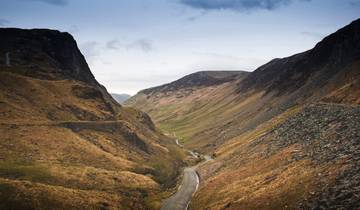
Honister Slate Mine occupies the summit of Honister Pass at approximately 356 metres above sea level, in a setting that requires no supplementary scenery: the mine building perches directly beneath the summit ridge of Fleetwith Pike with the raw scree of the fell face behind and the Borrowdale valley panorama falling away to the north. This is England’s last working slate mine, producing Westmorland Green Slate — a 450-million-year-old volcanic greenish-grey stone that has been extracted from Fleetwith Pike since at least the early eighteenth century and remains in active production, used for roofing, flooring, and interior architecture in buildings from Cumbria to London.
The guided mine tour in 2026 costs £20 per adult (children aged 3–15 £12.50) and lasts approximately 90 minutes, descending around 50 steps into the underground tunnel system of Fleetwith Pike with helmets and lamps provided. Tours depart at 10:30, 12:30, and 14:30 daily and include illuminated caverns, demonstrations of traditional slate-splitting technique, enhanced reality elements illustrating the industrial history of the mine, and a controlled atmospheric event (a simulated explosion sound effect) that is particularly effective in the enclosed tunnel. The practical content of the tour — scale of the underground workings, the mechanics of water-powered extraction, the physical conditions experienced by nineteenth-century miners — is substantial and well-researched rather than purely theatrical. Booking online in advance is strongly recommended for July and August; walk-up places at the 10:30 tour are available on quieter days between Easter and June and in September. Check the honister.com website for current 2026 availability.
Parking at the mine is free for customers (i.e., for anyone who purchases a tour, activity, or café/shop transaction); a £5 non-customer charge applies per vehicle. Visitors who arrive early for the 10:30 tour and wish to walk the summit ridge before the tour departs will find the mine café open from around 9:30 a.m. Overnight parking is available for motorhomes at £15 per night — useful for visitors who want a dawn start on the fell without driving Honister in darkness.
The drive up to Honister from Seatoller (2.3 miles, 25% maximum gradient) is best taken in second gear throughout. The surface is tarmac but narrow, with limited passing opportunities on the steepest sections. The descent into Buttermere is more sheltered but the hairpin at the bottom requires careful approach speed — first gear is appropriate in most modern cars. The Honister Pass road is generally passable year-round in normal conditions; in hard frost or snowfall (most likely December to February), check the Lake District National Park road condition reports before attempting it. For the 2026 spring season (March onwards), the pass typically reopens to normal traffic around the same time as the Honister Rambler bus resumes.
Weather contingency: Honister Pass at 356 metres frequently sits in cloud or rain even when Keswick (at 72 metres) is clear. Cloud here reduces visibility on the mine approach road and significantly changes the atmosphere of the site — the underground tour is unaffected by weather and in wet conditions becomes an even more logical use of the morning than surface activities. Visitors should carry waterproofs regardless of the Keswick forecast, and plan an earlier return to the valley if high winds are forecast (the summit ridge above the mine can be genuinely dangerous in gale conditions, though the mine approach road itself is not significantly exposed).
Afternoon 2026: Buttermere Perimeter Trail and Newlands Pass Return Route
Buttermere is the innermost of the Northern Lakes, a glacial ribbon enclosed on all sides by fell ridges — Fleetwith Pike and Haystacks to the east, High Stile and Red Pike to the south and west, Rannerdale Knotts to the northwest. The lake’s remoteness is almost entirely a function of road access: Buttermere can only be reached by one of two mountain passes (Honister from the east or Newlands from the north), and the single narrow road through the village of Buttermere connects them. This topographic confinement means the village and lakeshore receive far fewer visitors than comparably scenic sites with low-level access, and in mid-week the perimeter trail feels genuinely quiet even in summer.
The Buttermere perimeter trail is a 4.5-mile circuit of the lake (allow 2 to 3 hours at a comfortable pace) that begins at the National Trust car park in Buttermere village (CA13 9UZ, approximately £1–8.50/day for non-members, with toilets and bus access). The path hugs the lakeshore for the first mile on the southeastern side, passing through a short fell tunnel blasted through the crag beside the lake to bypass the steepest section of shoreline. This tunnel — a Victorian engineering feature rather than a natural formation — is low enough to require crouching for taller walkers and adds a slightly surreal transition to an otherwise conventional lakeside stroll. The northwestern return follows the flat valley floor above the lake, giving views across the water toward the southern fells. The full circuit involves minimal ascent and is suitable for most walkers in reasonable footwear; the sections immediately after rain can be muddy but the path is generally well-drained.
The Honister Rambler 77/77A stops at Buttermere village, giving bus users 1.5 to 3 hours at the lake between services if they plan around the hourly timetable. The last afternoon buses toward Keswick depart Buttermere in the mid-to-late afternoon (confirm the current 2026 timetable on the Stagecoach Cumbria website or Traveline app before departure); arriving on the midday service from Honister gives the maximum afternoon window at the lake. The village pub — the Fish Inn — serves food and is the only food and drink option within the Buttermere basin; it fills rapidly from midday on summer weekends, so a pre-noon arrival is useful for table availability.
The Newlands Pass return (B5292) from Buttermere northward over Scope End to Braithwaite and Keswick is an attractive alternative to retracing the Honister road and adds variety to the loop without meaningfully extending journey time (approximately 45 minutes from Buttermere to Keswick in normal traffic). Newlands Pass crests at Scope End at around 333 metres — marginally lower than Honister — with gentler gradients and a wider road surface on the upper section before narrowing again through the lower Newlands Valley. The descent through Braithwaite brings you back to the A66 and Keswick from the west. For drivers, this completes the full circuit; for bus users, the 77 anticlockwise (which travels Keswick → Whinlatter → Buttermere → Honister) or the 77A clockwise gives the same return option. The Newlands Pass is not served by a separate bus route — return from Buttermere must be via the 77/77A toward either Honister or Lorton/Whinlatter.
Budget Breakdown for the 2026 Northern Lakes Road Trip
All figures below are per person, per day, assuming two people sharing accommodation. Hotel and B&B room rates are divided by two before being added to individual costs. Budget ranges are pre-calculated; the same ranges apply throughout this guide in the Key Takeaways, PAA answers, and FAQ.
Budget tier — self-catering breakfast or B&B with breakfast included, packed lunches, pub evening meal, bus or budget parking:
- Accommodation: £35–45 per person (two sharing a B&B room at £70–90 per night)
- Food: £22–32 per person (lunch £5–9, evening pub meal £12–18; B&B breakfast included)
- Transport: £8–12 per person (Stagecoach day ticket £12, or parking £4–6 plus fuel share)
- Attractions: £0–8 per person (Castlerigg free, Friar’s Crag free, Borrowdale walks free, Buttermere free; optional launch hop £3.30)
- Daily total: approximately £65–95 per person
- Two-day trip total: approximately £90–140 per person (one overnight stay)
Mid-range tier — country house B&B with breakfast, restaurant dinners, car plus NT parking, paid Derwentwater Launch and Honister Mine:
- Accommodation: £50–75 per person (two sharing a room at £100–145 per night)
- Food: £34–45 per person (pub lunch £12–15, restaurant dinner £22–30; B&B breakfast included)
- Transport: £6–10 per person (NT car park £1–8.50; Keswick car park £5 all day)
- Attractions: £15–20 averaged per person per day (Derwentwater Launch round trip £15.25 on Day 1; Honister Mine £20 on Day 2)
- Daily total: approximately £110–145 per person
- Two-day trip total: approximately £165–220 per person
Day-by-day breakdown for mid-range travelers:
- Day 1 (Castlerigg / Friar’s Crag / Borrowdale): accommodation £50–75 + food £34–45 + transport £6–10 + Derwentwater Launch £15 = approximately £105–145 per person
- Day 2 (Honister Pass / Buttermere / Newlands): food £34–45 + transport £3–5 (mine parking free for customers) + Honister Mine £20 = approximately £57–70 per person (no second night if departing after Day 2)
Additional costs to factor for 2026:
- Via Ferrata at Honister: priced separately from the mine tour; check honister.com for 2026 pricing (was approximately £35–40 in 2025; book well in advance for summer weekends)
- Derwentwater rowing boat hire: available at the Keswick Boat Landing by the hour
- EV charging: at the InstaVolt Booths hub (85p/kWh) a 30-minute rapid session (approximately 30 kWh recovered) costs approximately £25; overnight destination charging at a hotel with an included charger significantly reduces this
- National Trust membership: at approximately £72 per adult per year (2025 rate), it eliminates parking charges at all nine Borrowdale car parks and many stops along the route; members undertaking two or more Lake District visits per year will typically recoup the annual cost
Money-saving notes specific to this circuit: the majority of the most spectacular sites on this itinerary — Castlerigg, Friar’s Crag, the full Derwentwater lakeside path, the Borrowdale temperate rainforest trails, the Bowder Stone, the Buttermere perimeter circuit, and the Newlands Pass — are entirely free to access. The only mandatory costs are accommodation, food, and transport. Visitors who carry packed lunches and bus rather than drive can complete the full two-day circuit for well under £100 per person including a B&B night, which represents exceptional value for a UNESCO World Heritage itinerary of this quality.
Practical Logistics & Basecamp Strategy for 2026
Keswick operates as an effective basecamp for this itinerary because everything needed for both days is within a ten-minute walk of most accommodation: the bus station (from which the 78, 77/77A, 555, and all other Stagecoach services depart), the Derwentwater Boat Landing, the town’s independent gear shops (useful if you arrive without waterproofs), two supermarkets (Booths and Co-op) for stocking packed lunches, and a range of independent cafés for pre-dawn breakfast.
For those arriving by car, the optimal basecamp strategy is to park once in a Keswick all-day car park on Day 1 (Keswick Rugby Club at £5 is best value, with the Launch voucher as a bonus) and not re-use the car until Honister Pass on Day 2, using the 78 for all Borrowdale movements on Day 1. On Day 2, the car returns to Honister, parks free at the mine for the tour, and continues the loop to Buttermere and back via Newlands. This approach avoids every Borrowdale parking pinch point while still giving the flexibility of a vehicle for the higher-altitude sections where bus timing constraints are greatest.
EV Charging Network, Off-Peak Parking Bays, and Heritage Boat Shuttle Schedules
As of mid-2026, Keswick’s EV charging infrastructure covers both slow overnight and rapid daytime needs. The InstaVolt hub at Booths Supermarket (Tithebarn Street, CA12 5EA) is the highest-capacity rapid charging location in the town, with four connectors reaching up to 120 kW, operating 24 hours with contactless payment at approximately 85p/kWh. A 20-minute session here recovers around 25–30 kWh, sufficient to cover the full Day 2 Honister–Buttermere–Newlands loop with meaningful range to spare. The GeniePoint charger at Central Car Park (CA12 5DF) provides a 43 kW CCS fast charger and two 7 kW Type 2 sockets; the pricing at this location was 90p/kWh in mid-2026 (check the GeniePoint app for current rates). Several hotels and guesthouses in and around Keswick offer proprietary destination charging at rates from around 45–55p/kWh for guests — worth confirming at booking stage. For live availability across all networks in the Cumbrian charging network, ZapMap is the most reliable tool, with a live data feed that shows real-time connector status at most major sites.
Along the B5289 corridor into Borrowdale and at Honister Pass, public charging is absent. The Honister Mine itself has no public charge point. Planning the Day 2 drive therefore requires starting with sufficient charge at Keswick; the round trip from Keswick to Honister Pass (9 miles each way via Seatoller) and Buttermere loop (a further 15 miles via Newlands) totals approximately 35–40 miles from basecamp, well within the range of any current EV on a full overnight charge. For drivers of plug-in hybrid vehicles with limited electric range, the fuel availability note is worth repeating: the nearest filling station is in Keswick, and there is no fuel anywhere along the B5289 or at Honister or Buttermere.
Off-peak parking across the Northern Lakes rewards early arrival systematically. National Trust car parks in Borrowdale open as soon as the gate is accessible (no formal opening time for open-air sites), so arriving before 8:30 a.m. on any summer day virtually guarantees a space. The Keswick town-center car parks are under greater pressure from commuters and shoppers on weekday mornings; for tourism-only use, the all-day peripheral options (Rugby Club, Football Club) are consistently available until at least 8:45 a.m. even on peak weekends.
The Derwentwater Launch summer timetable in 2026 runs from 21 March through to 8 November, daily (clockwise and anticlockwise circuits from approximately 9:45 a.m.). The clockwise service departs Keswick heading south with stops at Ashness Gate, Lodore, High Brandelhow, Low Brandelhow, Hawes End, and Nichol End before returning to Keswick in approximately 50 minutes for the full round trip. The anticlockwise service leaves Keswick at 9:45 a.m. and stops in the reverse order. Both circuits operate simultaneously from Keswick, giving an effective 30-minute frequency for the most popular southerly stops (Ashness Gate and Lodore). Tickets are purchased at the Keswick Boat Landing booking office or paid on board in cash or by card at jetties around the lake. Check the keswick-launch.co.uk website for the precise 2026 timetable before departure; the Nichol End jetty has been subject to periodic closures due to low water levels, which has historically affected the anticlockwise service.
Visitors planning a two-day car-free circuit should note: the Honister Rambler bus finished its 2025 season on 2 November and will resume just before Easter 2026 — approximately late March. Between November and Easter, the Borrowdale 78 continues to run to Seatoller but the Honister Pass service does not operate, making the mine and Buttermere inaccessible by public transport during winter. The winter strategy for this itinerary is to visit with a car and check road conditions on the Lake District National Park Authority website before departure.
Frequently Asked Questions
What is the best time of day to visit Castlerigg Stone Circle to avoid crowds in 2026?
Arriving between 6:30 and 8:30 a.m. on any day from April to October consistently delivers near-solitude. The site opens whenever daylight allows, so there is no formal time restriction on early access. By 9:00 a.m. on summer weekends, the limited roadside parking at Castle Lane begins to fill; by 10:00 a.m. the site can hold 50 to 100 people. Evening visits between 6:00 and 7:30 p.m. in midsummer offer comparable solitude and warm sidelight. The 30-minute walk from Keswick Market Place via Station Road avoids the Castle Lane parking entirely and gives a superior approach through the plateau landscape. Overcast or drizzly mornings markedly reduce visitor numbers while rarely diminishing the site’s atmospheric character.
How much does the Honister Slate Mine tour cost in 2026?
The standard guided mine tour is priced at £20 per adult (aged 16 and over) and £12.50 per child (aged 3–15); children under 3 enter free. Check the honister.com website for any limited-time promotional offers, as the “Kids Go Free” promotion (one free child per paying adult) has run periodically in recent seasons. Tours depart at 10:30, 12:30, and 14:30 daily and last approximately 90 minutes. Advance online booking is strongly recommended for July and August to secure your preferred departure time. Parking at the mine is free for any customer who purchases a tour or any other paid activity or product at the site. Via Ferrata and other adventure activities are priced separately from the mine tour; see the honister.com listings for current rates.
Is the Buttermere Perimeter Trail accessible without a car in 2026?
Yes, and it is among the most practically bus-accessible lake circuits in the Northern Lakes. The Stagecoach Honister Rambler 77/77A stops in Buttermere village, a three-minute walk from the perimeter trail trailhead at the National Trust car park. The bus runs hourly from Easter to early November 2026, with individual journeys capped at £3. The 4.5-mile perimeter trail takes 2 to 3 hours at a comfortable walking pace, which fits comfortably within the hourly bus window if you time your arrival for the service around midday. The path is suitable for most walkers; the famous fell tunnel section, where the path passes through a short crag cutting beside the lake, requires crouching in low clearance but is otherwise straightforward. The National Trust car park and pub at Buttermere village both provide toilet facilities.
What parking options are available at Borrowdale in 2026?
The National Trust operates nine pay-and-display car parks in Borrowdale and Derwentwater, ranging from small sites with 15 spaces (Ashness Bridge) to the large valley-floor car park at Seatoller (CA12 5XN). Non-member charges are typically £1–8.50 per day, with payment by coin machine or the JustPark app. NT members park free at all nine sites and generate a £1 donation to the valley’s conservation fund each time they scan their membership card. The most important tactical note is that Seatoller, Great Wood, and Kettlewell all fill before 9:30 a.m. on peak summer days — if your timing is flexible, the 8:10 a.m. Bus 78 from Keswick Bus Station reaches Seatoller by 8:38 a.m. and eliminates parking competition entirely. Honister Mine has its own parking area (free for customers, £5/vehicle otherwise) at the pass summit.
How does the Derwentwater Launch integrate with Day 1 of this 2026 road trip?
The Derwentwater Launch functions as a car-free shuttle that deposits you at the head of Borrowdale without driving the B5289 — the Lodore jetty (stage 3 clockwise) is a 15-minute walk from the Borrowdale woodland trails, meaning the boat effectively replaces the car for the first leg of Day 1. An adult round-trip ticket costs £15.25; a three-stage single from Keswick to Lodore costs £9.50 for an adult. The launch departs from the Keswick Boat Landing, five minutes’ walk from the Rugby Club all-day car park, and runs approximately every 30 minutes in summer from around 9:45 a.m. For visitors using Keswick Rugby Club parking (£5 all day), the included 15% launch discount voucher brings the round-trip adult fare down to approximately £13. The boat integrates well with the lakeside path from Friar’s Crag south: walk the path, board the launch at Lodore, and bus or walk the woodland trails back to Keswick in the evening.
What is the total driving distance of the loop from Keswick to Buttermere and back in 2026?
The full Keswick–Castlerigg–Borrowdale–Honister–Buttermere–Newlands–Keswick loop is approximately 35 to 40 miles depending on the specific stops. The Castlerigg detour (3 miles east and return) adds 6 miles; the B5289 from Keswick to Seatoller is 9.5 miles; Seatoller to Honister Pass summit is 2.3 miles; Honister to Buttermere village is 3.5 miles; and the Newlands Pass return from Buttermere to Keswick via Braithwaite is approximately 12 miles. The total driving time at the unhurried pace this road requires is around 2.5 to 3 hours cumulative over the two days, leaving the majority of both days for stops rather than transit. This makes the circuit exceptionally time-efficient compared to the visual and ecological diversity it delivers.
Can I do this 2026 Northern Lakes circuit in a single day from Keswick?
It is physically possible to visit Castlerigg, Friar’s Crag, and Honister Mine plus a short walk at Buttermere in a single long day (approximately 8 a.m. to 7 p.m. in summer), but this pace sacrifices the primary appeal of the circuit — the ability to spend meaningful time in Borrowdale’s temperate rainforest and on the Buttermere perimeter. A single-day version should prioritize either the Borrowdale valley (Day 1 elements, car-free via the 78) or Honister and Buttermere (Day 2 elements, by car or 77/77A), not both. Visitors with only one day would make the most natural choice by deciding between the prehistoric and woodland experience of Castlerigg–Friar’s Crag–Borrowdale, or the industrial heritage and mountain drama of Honister–Buttermere. The two-day version exists precisely because the circuit’s character changes so substantially between the woodland valley and the exposed mountain pass that compressing it loses much of that contrast.
Is Honister Pass accessible in winter 2026?
Honister Pass is a public road and remains generally open during winter, but it is subject to temporary closure after significant snowfall or in freezing fog that creates black ice on the steep gradients. Closures are typically brief — a matter of hours while gritting is completed — but can extend to a day or more after heavy snow events. The Lake District National Park Authority publishes road condition updates, and the Lake District Weather line (check the LDNPA website for current 2026 contact details) gives fell-specific forecasts. The practical winter strategy is to check conditions the evening before and have a low-level alternative in mind: the B5289 through Borrowdale to Seatoller remains passable in most winter conditions, even when the pass above is closed. The Honister Rambler bus does not operate between early November and late March, so the mine is accessible in winter only by car or on foot.
What weather contingencies should I plan for on this 2026 Northern Lakes road trip?
The most common weather scenario on this circuit is low cloud and light rain at pass level while the Derwentwater shoreline remains clear — typical lake-district orographic cloud. The contingency for this on Day 2 is to remain in Borrowdale (car-free via the 78, woodland walks, Bowder Stone, Lodore Falls — a short detour from the Lodore Launch jetty) and defer Honister to the afternoon if the cloud lifts. The Honister Mine tour itself is entirely underground and fully weather-proof, so a mine visit in poor surface conditions is particularly well-suited to a wet morning. On Day 1, Castlerigg in early cloud can be dramatically beautiful; the stone circle’s moody fog-diffused appearance is a frequently sought photographic effect. For severe forecast weather (amber or red wind or rain warnings from the Met Office), defer all mountain pass driving and use the day for Keswick town center, the Derwent Pencil Museum, and the lakeside path, which are all pleasant in sustained rain.
How do I book Honister Slate Mine tours in advance for 2026?
Book directly through honister.com, where all tour times are available for advance reservation. The website shows live availability by date and time. Credit card payment is required to secure a booking. For the 10:30 and 12:30 tours in July and August, advance booking of at least two to three weeks is recommended; September and off-peak dates typically have walk-up availability but online pre-booking guarantees your slot and avoids disappointment on arrival after the Honister Pass drive. If your travel dates are not yet fixed, a loose strategy of choosing between the 12:30 and 14:30 tours gives flexibility to check conditions in Keswick before committing to the drive. Cancellation policies are listed on the honister.com booking page; check current terms when booking for 2026.