
Itmad-ud-Daulah (Baby Taj) Agra: Hidden Gem Guide
Tucked along the eastern bank of the Yamuna River sits a masterpiece that predates the Taj Mahal yet remains overshadowed by its more famous successor—Itmad-ud-Daulah, often called the “Baby Taj” or “Jewel Box.” This exquisite white marble mausoleum, commissioned by Empress Nur Jahan for her father between 1622 and 1628, represents a pivotal moment in Mughal architectural evolution, introducing the refined marble work and pietra dura inlay techniques that would reach their zenith in the Taj Mahal while maintaining an intimate scale and delicate beauty that many visitors find even more appealing than the monument it inspired.
Key Takeaways
- Architectural Pioneer: First Mughal structure built entirely in white marble, marking the transition from red sandstone to marble that would define later Mughal monuments including the Taj Mahal
- Innovative Technique: Introduced pietra dura inlay work to Mughal architecture, using semi-precious stones including carnelian, jasper, lapis lazuli, onyx, and topaz to create intricate floral and geometric patterns
- Personal Commission: Built by Empress Nur Jahan, one of the Mughal Empire’s most powerful women, as a loving tribute to her father Mirza Ghiyas Beg, who held the title “Itmad-ud-Daulah” (Pillar of the State)
- Intimate Scale: Much smaller than the Taj Mahal, measuring approximately 7 meters per side, creating a more accessible and human-scaled experience that allows close appreciation of intricate details
- Exceptional Craftsmanship: Features the finest marble jali (lattice screen) work in Agra, with delicate geometric and floral patterns carved so precisely that light filters through creating ethereal interior atmospheres
- Hidden Treasure Status: Receives far fewer visitors than the Taj Mahal despite comparable artistic merit, offering peaceful exploration and intimate encounters with Mughal artistry without overwhelming crowds
People Also Ask About Itmad-ud-Daulah
Why is Itmad-ud-Daulah called the Baby Taj?
Itmad-ud-Daulah earned the nickname “Baby Taj” from tourists and guides emphasizing its architectural similarities to the more famous Taj Mahal, despite being built earlier and actually serving as the Taj Mahal’s inspiration rather than its smaller imitation. The name references both the monument’s smaller scale—the central tomb structure measures just 7 meters per side compared to the Taj Mahal’s massive proportions—and its white marble construction with pietra dura inlay work similar to techniques perfected later in the Taj. However, the “Baby Taj” nickname misleads in important ways: chronologically, Itmad-ud-Daulah came first (1622-1628) while the Taj Mahal was built later (1632-1653), making it more accurate to view the Taj as the “grown-up Itmad-ud-Daulah” than vice versa. Architecturally, many experts consider Itmad-ud-Daulah’s jali work more delicate and its overall design more intimate than the Taj Mahal’s grander approach. The nickname also obscures Itmad-ud-Daulah’s independent significance as a monument commissioned by a powerful empress honoring her father, not as a romantic gesture but as filial devotion. Art historians prefer calling it the “Jewel Box” for its gem-like perfection, or simply using its proper name honoring the man entombed within. Understanding Itmad-ud-Daulah on its own terms rather than as the Taj Mahal’s little sibling reveals its pivotal role in Mughal architectural evolution and its exceptional artistic merit deserving recognition beyond comparison.
Who was Mirza Ghiyas Beg and why did he receive such an elaborate tomb?
Mirza Ghiyas Beg, the man for whom Itmad-ud-Daulah was built, rose from Persian refugee to the highest ranks of Mughal power through a remarkable combination of administrative talent, political acumen, and fortunate family connections. Born in Persia (modern Iran), he arrived in India as a poor merchant seeking opportunity at the Mughal court. Legend holds that during his journey to India, his wife gave birth to a daughter they initially considered abandoning due to poverty, but the infant’s persistent cries changed their minds—that daughter would become Nur Jahan, later the Mughal Empire’s most powerful empress. Ghiyas Beg’s administrative abilities impressed Emperor Akbar, who appointed him to increasingly responsible positions. When Ghiyas Beg’s daughter married Prince Salim (later Emperor Jahangir) in 1611, the father’s influence grew exponentially. Jahangir elevated him to the empire’s highest administrative position, granting him the title “Itmad-ud-Daulah” meaning “Pillar of the State” and control over the empire’s finances as Lord Treasurer. He commanded a mansab (military rank) of 7,000—among the highest honors possible for non-royals. When Ghiyas Beg died in 1622 shortly after his wife’s death, his daughter Nur Jahan commissioned this magnificent tomb both as loving tribute and political statement. As Jahangir’s chief wife and de facto ruler during his later reign, Nur Jahan possessed the resources and authority to create architectural masterpieces. The tomb’s exceptional quality reflects both her deep affection for her father and her desire to demonstrate her family’s elevated status through permanent architectural achievement that would rival royal tombs.
How did Itmad-ud-Daulah influence the Taj Mahal?
Itmad-ud-Daulah served as both architectural laboratory and aesthetic inspiration for the Taj Mahal, introducing technical innovations, design concepts, and decorative approaches that Shah Jahan would refine and expand when building his wife’s mausoleum a decade later. The most significant innovation was extensive use of white marble with pietra dura inlay work—Itmad-ud-Daulah marked the first time a complete Mughal structure used white marble throughout rather than red sandstone, establishing marble as the supreme material for commemorative architecture. The tomb’s pietra dura decoration, using semi-precious stones inlaid in marble to create floral patterns, geometric designs, and abstract compositions, pioneered techniques requiring specialized craftsmen to cut stones precisely and set them flush with marble surfaces. These same craftsmen trained at Itmad-ud-Daulah likely worked on the Taj Mahal, bringing refined skills to the larger project. Architecturally, Itmad-ud-Daulah introduced design elements the Taj would adopt and expand: a square tomb structure elevated on a platform, corner minarets providing vertical accents, a central chamber housing cenotaphs, extensive jali screens filtering light, and integration with formal charbagh gardens. The tomb demonstrated how Persian architectural traditions could merge with Indian decorative sensibilities using local materials and craftsmen, achieving aesthetic synthesis that became the Mughal style’s hallmark. Shah Jahan, who was Nur Jahan’s nephew by marriage (his wife Mumtaz Mahal was Itmad-ud-Daulah’s granddaughter), would have known this tomb intimately and recognized its artistic success. When commissioning the Taj Mahal, he essentially asked his architects to apply Itmad-ud-Daulah’s aesthetic approach at monumental scale with unlimited resources, resulting in the Taj’s perfection built on foundations Nur Jahan’s commission established.
Why is Itmad-ud-Daulah considered a hidden gem despite being well-known?
Itmad-ud-Daulah qualifies as a “hidden gem” not from complete obscurity but from being dramatically undervisited and underappreciated relative to its artistic merit and historical significance. The tomb suffers from proximity to the Taj Mahal—located just 6 kilometers away, it attracts only a small fraction of the Taj’s eight million annual visitors, with many tourists spending hours photographing the Taj while skipping Itmad-ud-Daulah entirely or allotting it a rushed 30-minute stop. This disparity creates the “hidden” status: a monument of exceptional quality remains far less known and celebrated than it deserves because an even more spectacular monument overshadows it. The hidden gem designation also reflects the tomb’s intimate qualities that reveal themselves only through patient observation rather than dramatic first impressions. Unlike the Taj Mahal’s immediate overwhelming impact, Itmad-ud-Daulah rewards slow exploration—getting close to examine jali work’s delicate precision, noticing how light creates patterns through carved screens, appreciating color variations in pietra dura flowers, understanding proportional relationships between elements. These subtle pleasures require time and attention that rushed tourists rarely provide. The smaller scale creates a different relationship with visitors—where the Taj Mahal inspires awe through monumental grandeur, Itmad-ud-Daulah offers beauty accessible at human scale, allowing intimate connection with architectural artistry. The peaceful atmosphere contributes to the hidden gem experience: visiting the tomb often means exploring nearly empty gardens and chambers where you can sit quietly, photograph without crowds, and contemplate details without distraction—experiences impossible at the perpetually mobbed Taj Mahal. For photographers, historians, and architecture enthusiasts who discover Itmad-ud-Daulah, it often becomes a favorite precisely because its overlooked status preserves the contemplative atmosphere appropriate to its artistic achievements.
Extended multi-day tours – 5+ days
Featured Agra Multi-Day Tour Packages
3 days
Agra 3-Day Discovery Tour
- ✓ Comprehensive Agra experience
- ✓ Expert local guides included
- ✓ All accommodation included
- ✓ Transportation provided
5 days
Agra 5-Day Highlights Experience
- ✓ Comprehensive Agra experience
- ✓ Expert local guides included
- ✓ All accommodation included
- ✓ Transportation provided
7 days
Agra 7-Day Cultural Journey
- ✓ Comprehensive Agra experience
- ✓ Expert local guides included
- ✓ All accommodation included
- ✓ Transportation provided

10 days
Agra 10-Day Complete Adventure
- ✓ Comprehensive Agra experience
- ✓ Expert local guides included
- ✓ All accommodation included
- ✓ Transportation provided
Multi-day tour packages powered by TourRadar. Prices and availability subject to change.
Introduction: The Jewel Box on the Yamuna
Every visitor to Agra arrives with one monument dominating their imagination—the Taj Mahal, marble manifestation of eternal love and architectural perfection. Yet along the Yamuna River’s eastern bank, a quieter masterpiece awaits those willing to look beyond the obvious: Itmad-ud-Daulah, a tomb so exquisite in its proportions, so delicate in its decoration, and so innovative in its design that it deserves recognition as one of Mughal architecture’s pivotal achievements. Often dismissed as the “Baby Taj” or overlooked entirely in rushed Agra itineraries, this monument repays careful attention with rewards the Taj Mahal’s crowds and commercialization cannot provide—intimate encounters with supreme craftsmanship, peaceful contemplation in beautiful gardens, and understanding of the artistic evolution that made the Taj possible.
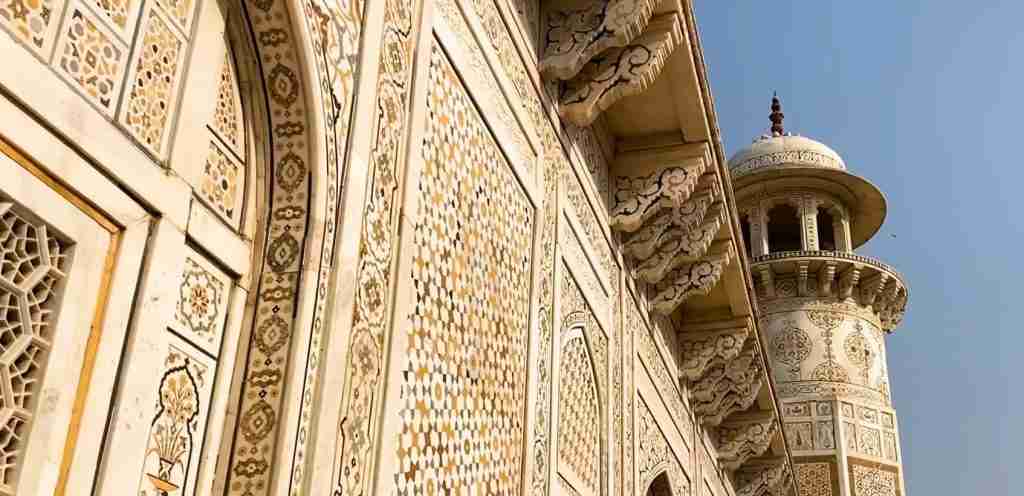
Built between 1622 and 1628 by Empress Nur Jahan for her father Mirza Ghiyas Beg, Itmad-ud-Daulah marks a watershed in Mughal architectural development. Before this tomb, major Mughal monuments used red sandstone with white marble reserved for decorative accents. Itmad-ud-Daulah reversed this relationship, creating the first Mughal structure built entirely of white marble, establishing a precedent the Taj Mahal would follow with even greater resources and ambition. The tomb introduced pietra dura inlay work on unprecedented scale, using semi-precious stones—carnelian, lapis lazuli, jasper, onyx, topaz—cut and fitted with jeweler’s precision to create floral patterns, geometric designs, and abstract compositions covering walls, ceilings, and exterior surfaces.
The monument’s nickname “Jewel Box” captures its essence more accurately than “Baby Taj”—this is architecture operating at the scale of jewelry, where every detail receives attention appropriate to precious objects rather than monumental structures. The central tomb chamber measures just 7 meters per side, creating intimate space rather than overwhelming grandeur. This small scale allows visitors to examine closely what would be invisible details in larger buildings: individual stone inlays no bigger than fingernails, jali screens carved so thin light passes through marble, calligraphic inscriptions forming decorative bands, and paint traces suggesting the original polychrome decoration enhancing the all-white appearance we see today.
Nur Jahan’s commission of this tomb reveals much about her extraordinary position in Mughal society. As Emperor Jahangir’s principal wife, she wielded unprecedented power for a Mughal empress, issuing farmans (imperial orders) in her own name, controlling the empire’s finances, and effectively governing during Jahangir’s declining years. Building an elaborate tomb for her father served multiple purposes: it honored genuine filial devotion, demonstrated her family’s elevated status, provided employment for the empire’s finest craftsmen, and created permanent architectural testament to her taste, wealth, and authority. The tomb’s exceptional quality reflects both unlimited resources and sophisticated aesthetic judgment—Nur Jahan knew what she wanted and could command the best talent to achieve it.
Today, Itmad-ud-Daulah receives perhaps 10% of the Taj Mahal’s visitor numbers despite being just 6 kilometers away. This disparity creates both challenge and opportunity—the tomb deserves greater recognition and appreciation, yet its relative obscurity preserves the peaceful atmosphere appropriate to contemplative architecture. Walking through Itmad-ud-Daulah’s gardens on a quiet morning, examining jali screens with afternoon light filtering through them, or photographing pietra dura details without crowds pressing behind you provides experiences increasingly rare at India’s most famous monuments. For many visitors who discover it, Itmad-ud-Daulah becomes a highlight of Agra equal to or surpassing the Taj Mahal—not from superior architecture (though some argue this) but from the quality of engagement its intimate scale and uncrowded spaces allow.
Historical Context: A Daughter’s Devotion and Imperial Power
Understanding Itmad-ud-Daulah requires understanding the remarkable woman who commissioned it and the man she honored. The story begins not in India but Persia, where Mirza Ghiyas Beg lived as a struggling merchant before circumstances drove him to seek fortune in the Mughal Empire. The journey from Persia to India tested the family severely—legend holds that Ghiyas Beg’s wife gave birth to a daughter during the difficult crossing, and poverty nearly drove the parents to abandon the infant. But the baby’s persistent cries convinced them to keep her, a decision that would ultimately elevate the entire family to unprecedented heights. That daughter, named Mehr-un-Nissa at birth, would later become Nur Jahan, “Light of the World,” the Mughal Empire’s most powerful empress.
Ghiyas Beg’s fortunes improved after arriving in India. His administrative capabilities impressed Mughal officials, earning him positions of increasing responsibility under Emperor Akbar. His daughter Mehr-un-Nissa married a Persian nobleman and seemed destined for comfortable obscurity until her husband died, leaving her a young widow at the Mughal court. In 1611, Prince Salim, who had recently become Emperor Jahangir after his father Akbar’s death, married the widow and renamed her Nur Jahan. This marriage transformed both Nur Jahan and her father—she became Jahangir’s chief wife and most influential advisor, while he received promotion to the empire’s highest administrative position with the title “Itmad-ud-Daulah” (Pillar of the State).
Itmad-ud-Daulah’s position as Lord Treasurer gave him control over the empire’s finances, making him arguably the second most powerful person in the realm after the emperor—and since Nur Jahan effectively governed during Jahangir’s declining health, the father-daughter team wielded extraordinary influence. Itmad-ud-Daulah commanded a mansab (military rank) of 7,000, among the highest honors granted to non-royal officials, and accumulated enormous wealth through his position. His granddaughter Arjumand Banu (daughter of his son Asaf Khan) married Prince Khurram, later Emperor Shah Jahan, further intertwining the family with Mughal royalty—when Shah Jahan built the Taj Mahal for his beloved wife Mumtaz Mahal, he was honoring Itmad-ud-Daulah’s granddaughter.
Itmad-ud-Daulah died in 1622, shortly after his wife Asmat Begum’s death. Nur Jahan immediately commissioned an elaborate tomb for both parents, choosing a site on the Yamuna’s eastern bank in gardens the family owned. The commission revealed Nur Jahan’s multifaceted motivations: genuine love for her father, political statement about her family’s status, architectural patronage demonstrating cultural sophistication, and perhaps competitive desire to create a monument rivaling royal tombs.
Nur Jahan’s unprecedented power as empress allowed her to command resources and artisans unavailable to lesser patrons. She controlled substantial wealth from trade ventures, land holdings, and her father’s accumulated riches inherited at his death. Unlike most Mughal women relegated to zenana (women’s quarters) seclusion, Nur Jahan participated actively in governance, issued orders, received ambassadors, and commissioned architecture—privileges reflecting both Jahangir’s trust and her exceptional abilities. The Itmad-ud-Daulah tomb represents one of several building projects she sponsored, though it remains her most famous architectural legacy.
Construction spanned six years (1622-1628), employing the empire’s finest marble workers, stone carvers, inlay specialists, and other craftsmen. The project’s timing proved significant—these years coincided with early Mughal experimentation with white marble and pietra dura techniques that would culminate in the Taj Mahal beginning in 1632. Itmad-ud-Daulah essentially functioned as training ground and proving ground for craftsmen and techniques later perfected at the Taj. The tomb also established white marble as appropriate material for commemorative architecture, overcoming conservative resistance to abandoning traditional red sandstone.
Nur Jahan’s architectural choices reflected both Persian heritage and Mughal context. The tomb’s design incorporates elements from Persian tomb traditions—platform placement, garden integration, emphasis on decoration over monumentality—while adopting Indian construction techniques and decorative vocabularies. This cultural synthesis characterized much Mughal art and architecture, but Itmad-ud-Daulah achieved particularly successful integration of diverse influences into coherent aesthetic statement.
The tomb completed in 1628, the year Jahangir died and Nur Jahan’s political power collapsed. Shah Jahan, Jahangir’s son and successor, removed Nur Jahan from political influence though he respected her personally and maintained her in comfortable if restricted circumstances. She spent her remaining years (dying 1645) in Lahore, where she built another elaborate tomb for Jahangir featuring similar architectural vocabulary to her father’s tomb. These two monuments—Itmad-ud-Daulah and Jahangir’s tomb—represent Nur Jahan’s architectural legacy, demonstrating her sophisticated aesthetic judgment and her ability to command the Mughal building machine to realize her visions.
Itmad-ud-Daulah’s historical significance extends beyond honoring one official’s death. The tomb represents a woman’s architectural patronage at the highest level, unusual in patriarchal Mughal society. It demonstrates how family connections, political power, and cultural sophistication could elevate Persian immigrants to the empire’s summit. It shows how architectural innovation happens—not through sudden revolution but gradual evolution as patrons experiment with new materials, craftsmen refine techniques, and cultural influences synthesize into new aesthetic vocabularies. And it established design precedents and trained artisans whose skills would produce the Taj Mahal, making Itmad-ud-Daulah architecturally significant beyond its own considerable artistic merit.
Architectural Analysis: Perfection in Miniature
Itmad-ud-Daulah’s architecture deserves detailed examination for both its intrinsic beauty and its pioneering role introducing elements that became Mughal hallmarks. The tomb demonstrates how exceptional design works across scales—the same principles producing monumental grandeur at the Taj Mahal create intimate perfection here through precise proportions, refined details, and coherent aesthetic vision.
The tomb sits in the center of a large Mughal charbagh (four-garden) design, though the original garden layout survives only partially. Water channels once divided the square garden into quarters and sub-quarters, creating geometric patterns visible from elevated viewing positions while providing irrigation and aesthetic pleasure. Corner pavilions marked the garden’s boundaries, though only foundations survive. The eastern gateway provides current entry—visitors pass through a red sandstone portal contrasting dramatically with the white marble tomb visible at the garden’s center.
The tomb structure rises from a large red sandstone platform accessed by stairs on all four sides. This platform elevates the tomb above ground level, creating physical and symbolic separation from earthly realm while improving drainage and providing commanding presence. The platform’s red sandstone contrasts with the tomb’s white marble, emphasizing the precious material’s rarity and value. This color contrast—red platform supporting white structure—became standard in later Mughal tombs including the Taj Mahal.
The central tomb building measures approximately 7 meters per side, creating an intimate human-scaled structure rather than overwhelming monument. This modest size allows unprecedented attention to decorative detail—every surface receives ornamental treatment impossible to maintain at larger scales. The tomb’s square plan includes corner minarets (actually six-sided towers crowned with domed kiosks called chhatris) providing vertical accents and framing the central mass. These minarets stand detached from the main structure, connected only at platform level, allowing light and air circulation around the tomb.
The tomb’s exterior walls showcase Mughal marble work at its finest. White marble surfaces receive extensive pietra dura inlay depicting cypress trees, wine bottles, flowers, fruit, and abstract geometric patterns using semi-precious stones cut and fitted with jeweler’s precision. Colors range from deep blue lapis lazuli to orange carnelian, green jade to black onyx, creating polychrome compositions against white marble backgrounds. These inlay designs don’t follow Persian or Indian precedents exactly but synthesize both traditions, creating distinctive Mughal decorative vocabulary.
The jali (lattice screen) work represents perhaps the tomb’s most exceptional artistic achievement. Marble screens carved in geometric and floral patterns cover windows and openings throughout the structure, serving functional purposes (providing ventilation while maintaining privacy and security) while achieving extraordinary aesthetic effects. The screens’ geometric precision—hexagons, stars, interlocking patterns—required mathematical knowledge and extraordinary carving skill. The marble was carved so thin that light passes through, creating delicate shadows and filtering harsh sunlight into soft diffused illumination. Many architectural historians consider Itmad-ud-Daulah’s jali work the finest in Agra, more delicate and precisely executed than even the Taj Mahal’s screens.
The interior chamber houses cenotaphs (decorative tomb markers, with actual burials in a crypt below) for Itmad-ud-Daulah and his wife Asmat Begum. These cenotaphs represent the only asymmetrical elements in the otherwise rigorously symmetrical complex—they sit side by side rather than in perfect axial alignment, a design choice also used in the Taj Mahal where Shah Jahan and Mumtaz Mahal’s cenotaphs share similar side-by-side placement. The chamber’s walls and ceiling receive elaborate pietra dura decoration and painted designs—recent conservation revealed original polychrome painting suggesting the white marble appearance we see today represents only partial preservation of a more colorful original scheme.
The four corner towers deserve individual attention for their innovative design. Unlike later Mughal monuments where minarets serve purely decorative purposes, these towers combine function and ornament. Their six-sided (hexagonal) plan creates interesting geometric relationships, while the crowned chhatris (domed kiosks) provide small enclosed spaces potentially used for contemplation or simply as architectural punctuation. The towers’ detachment from the main structure represents sophisticated understanding of how independent elements can enhance rather than compete with central masses.
Environmental design features reveal Mughal sophistication in climate control. The jali screens provide cross-ventilation while blocking direct sunlight. The tomb’s orientation and the platform’s height catch prevailing breezes for natural cooling. Water channels in the platform and surrounding gardens provided evaporative cooling effects. The white marble reflects rather than absorbs heat, remaining cooler than darker materials would. These passive climate control strategies created comfortable interior environments in a region experiencing extreme summer heat.
Calligraphic inscriptions appear throughout the structure, though less extensively than in later Mughal monuments. Persian verses and Quranic passages in elegant nastaliq script form decorative bands while conveying religious and poetic content. The calligraphy demonstrates how Mughal architecture integrated text as visual element, treating written language as both message and ornament.
The tomb’s architectural elements synthesize influences from multiple traditions. The platform placement and corner towers reference Persian tomb architecture, while the chhatris (domed kiosks) derive from indigenous Indian architectural vocabularies. The extensive pietra dura inlay shows Italian influence (this technique originated in Florence), transmitted through Mughal contacts with European traders and craftsmen. The jali screens draw on long-standing Islamic traditions of geometric pattern-making while achieving unprecedented delicacy through Mughal technical refinement. This cultural synthesis—Persian, Indian, Central Asian, European—characterizes Mughal architecture generally, but Itmad-ud-Daulah achieves particularly successful integration of diverse sources into coherent aesthetic statement.
Comparing Itmad-ud-Daulah with contemporary structures reveals its pioneering nature. Earlier Mughal tombs like Humayun’s Tomb in Delhi or Akbar’s tomb at Sikandra used primarily red sandstone with limited white marble accents. Itmad-ud-Daulah reversed this relationship, establishing white marble as primary material worthy of structural and decorative use throughout. This material choice required solving technical challenges—white marble costs more than red sandstone and comes from distant quarries (primarily Makrana in Rajasthan), requiring sophisticated logistics to transport massive quantities. The builders’ success demonstrated feasibility of all-marble construction, encouraging later projects to adopt similar approaches.
The tomb also pioneered the extensive use of pietra dura decoration that would characterize later Mughal buildings. Earlier monuments included limited stone inlay, but Itmad-ud-Daulah covered entire surfaces with intricate designs requiring specialized craftsmen to cut stones precisely, fit them flush with marble backgrounds, and maintain design continuity across large areas. This technique’s complexity made it expensive and time-consuming, limiting use to the most important commissions. By demonstrating pietra dura’s aesthetic power at Itmad-ud-Daulah, Nur Jahan’s patronage encouraged Shah Jahan to employ it even more extensively at the Taj Mahal, where inlay work reaches unprecedented sophistication and coverage.
The Hidden Gem Experience: Why Itmad-ud-Daulah Rewards Discovery
Itmad-ud-Daulah’s “hidden gem” status creates visiting experiences fundamentally different from tourist-mobbed sites like the Taj Mahal. Understanding and appreciating these differences helps visitors maximize their time at this exceptional but undervisited monument.
The most immediate difference involves crowd density. Where the Taj Mahal receives 15,000-20,000 daily visitors during peak season, Itmad-ud-Daulah might see 500-1,000. This dramatic disparity means you can explore the tomb and gardens without fighting crowds, photograph architectural details without people in every frame, and sit quietly contemplating the space without constant noise and movement disrupting contemplation. Early morning visits often find the gardens nearly empty, allowing solitary communion with sublime architecture—experiences impossible at the perpetually crowded Taj.
The smaller scale creates intimacy enabling different relationships with architecture. At the Taj Mahal, overwhelming size and monumental grandeur inspire awe but also distance—you appreciate perfection from afar but can’t engage personally with details often too high or distant to examine closely. Itmad-ud-Daulah invites different engagement: you can stand inches from jali screens examining carving precision, crouch beside pietra dura panels studying individual stone inlays, touch marble surfaces feeling their cool smoothness, and notice subtle variations in materials and execution that would disappear in a larger building. This close engagement reveals architectural artistry’s human dimensions—the craftsmen’s skills, the designers’ intentions, the materials’ properties—in ways monumental architecture prevents.
The tomb rewards slow, contemplative exploration rather than quick photography sessions. Unlike the Taj Mahal where most visitors spend hours but engage superficially—taking selfies from standard viewpoints without understanding architectural significance—Itmad-ud-Daulah benefits from patient attention. Spend an hour sitting in the garden watching light change through jali screens. Study how pietra dura patterns vary across different wall sections. Notice how the tomb’s proportions create harmonious relationships between elements. Read the calligraphic inscriptions with translation help. Understand the building’s innovative role in Mughal architectural development. This deeper engagement transforms visiting from tourism into education, from seeing into understanding.
Photographers find Itmad-ud-Daulah especially rewarding. The absence of crowds enables compositions impossible at the Taj—empty garden perspectives, unobstructed architectural views, detail shots without people photobombing backgrounds. The smaller scale allows comprehensive photography of entire structures from multiple angles rather than partial views of overwhelming monuments. The white marble and colorful inlay respond beautifully to different lighting conditions—early morning provides soft golden light, midday creates dramatic contrasts, late afternoon generates warm tones, and overcast days eliminate harsh shadows ideal for detail work. The jali screens offer infinite compositional possibilities as light creates patterns through geometric perforations. Serious photographers could spend entire days here finding new perspectives and effects.
The peaceful atmosphere encourages reflection on larger themes beyond architectural appreciation. Itmad-ud-Daulah tells a story of filial devotion—a daughter honoring her father through supreme artistic achievement. This narrative contrasts with the Taj Mahal’s romantic love story, offering different emotional register. Considering Nur Jahan’s unprecedented power as a woman in patriarchal society adds layers of interpretation—this monument represents female patronage, aesthetic judgment, and political authority rarely acknowledged in Mughal contexts. Understanding the tomb’s pioneering architectural role inspires thinking about innovation, tradition, and evolution in artistic development. These contemplative dimensions emerge more easily in quiet environments than in crowded tourist sites.
The relative obscurity also means less commercial development and tourist infrastructure disrupting the experience. Unlike the Taj Mahal’s surrounding commercialization—aggressive vendors, tourist restaurants, souvenir shops—Itmad-ud-Daulah remains relatively uncommercial. This preservation of context enhances the historical atmosphere, allowing imaginative connection to how the site might have appeared in Nur Jahan’s time, before tourism transformed it into commodity.
For visitors who discover and appreciate Itmad-ud-Daulah, it often becomes their favorite Agra monument—not necessarily because it surpasses the Taj Mahal architecturally (though some argue this) but because the quality of engagement differs so dramatically. The ability to explore peacefully, examine details closely, photograph without obstacles, and contemplate quietly transforms the visit from tourist obligation into genuine aesthetic encounter. Many architecture students, historians, and serious travelers report feeling more moved and engaged at Itmad-ud-Daulah than at the Taj, precisely because the intimate scale and uncrowded environment allow deeper connection to architectural artistry.
This hidden gem status remains fragile. If Itmad-ud-Daulah became as famous and crowded as the Taj Mahal, it would lose much of what makes it special. The tomb’s intimate scale cannot accommodate massive crowds without destroying the peaceful, contemplative atmosphere essential to appreciating its subtle beauties. Conservation concerns also limit how many visitors the structure can sustainably accommodate—the delicate jali screens, intricate inlay work, and old marble surfaces require protection from excessive human traffic. The ideal future maintains Itmad-ud-Daulah’s elevated profile among those who appreciate architectural excellence while preventing mass tourism from overwhelming its capacity and character.
Visiting Itmad-ud-Daulah: Practical Information and Photography Tips
Itmad-ud-Daulah opens daily from sunrise to sunset, with specific hours varying seasonally—typically 6:00 AM to 6:00 PM. Entry costs ₹310 for foreign tourists and ₹30 for Indian citizens and visitors from SAARC and BIMSTEC countries. Children under 15 years enter free. Video cameras incur an additional ₹25 fee. These prices make Itmad-ud-Daulah one of Agra’s best value monuments—the quality of architecture and peaceful visiting experience rival or exceed sites charging much higher fees.
Tickets can be purchased at the entrance gate—no online booking system operates currently. The lower visitor numbers mean queues rarely form, even during peak tourist season. The entrance on the eastern side admits visitors who must pass through security screening similar to other protected monuments. Large bags, professional camera equipment like tripods, and drones are prohibited. Personal cameras and mobile phones for photography are permitted throughout the complex.
The tomb sits approximately 6 kilometers from the Taj Mahal and 4 kilometers from Agra Fort along the Yamuna River’s eastern bank. Most visitors reach it by hiring a taxi, autorickshaw, or including it in organized tours. No metro or efficient public transport serves the site, making private transportation necessary. The relatively short distances between Agra’s major monuments allow visiting multiple sites in one day—many itineraries combine morning at the Taj Mahal with afternoon visits to Agra Fort and Itmad-ud-Daulah.
Plan 1-2 hours for thorough exploration—enough time to walk the gardens, examine the tomb’s exterior details, enter the interior chamber, photograph from multiple angles, and sit quietly absorbing the atmosphere. Rushed 30-minute visits miss the subtle qualities that make this monument special. Serious photographers or architecture enthusiasts might spend 2-3 hours studying details and waiting for optimal light conditions.
The best visiting times depend on your priorities. Early morning arrivals (right at 6:00 AM opening) provide several advantages: cooler temperatures making walking comfortable, soft golden light ideal for photography, and minimal crowds allowing peaceful exploration. Morning light illuminates the tomb’s eastern facade beautifully. Late afternoon visits (4:00 PM onwards) offer warm golden hour light creating dramatic effects on white marble, though more tourists typically visit during afternoon hours. Midday visits should be avoided during hot months (April-June) when harsh sunlight creates unflattering photography conditions and extreme heat makes outdoor exploration uncomfortable.
Photography considerations: The white marble tomb surrounded by red sandstone platform creates strong color and tonal contrasts requiring careful exposure management. Early morning and late afternoon provide softer light reducing contrast while adding warmth to white marble. Overcast days eliminate harsh shadows ideal for detail photography of jali screens and pietra dura inlay. The absence of crowds enables compositions impossible at the Taj—empty garden vistas showing symmetrical layouts, unobstructed architectural views from multiple angles, and detail shots without people disrupting frames.
Specific photography recommendations: (1) Capture the tomb’s symmetry from the garden’s central axis for classic architectural views. (2) Approach closely to photograph jali screen details—the delicate geometric patterns reward macro photography. (3) Shoot from inside looking out through jali screens to show how they filter light. (4) Photograph pietra dura inlay panels showing color variations and design details. (5) Include the red sandstone platform in compositions to show material contrasts. (6) Visit at different times to observe how changing light creates different moods and effects. (7) Don’t neglect the garden—geometric water channels and pathways offer compositional opportunities. (8) Compare Itmad-ud-Daulah details with similar elements at Agra Fort and the Taj Mahal to understand architectural evolution.
The site includes minimal visitor facilities—basic restrooms exist but no restaurants or elaborate amenities. Bring water, especially during hot weather, though bottles can be purchased from vendors near the entrance. Modest clothing covering shoulders and knees respects cultural norms, though dress codes aren’t enforced as strictly as at active religious sites. Comfortable walking shoes help navigate gardens and stairs. The tomb requires shoe removal before entering the interior chamber—slip-on shoes simplify this process.
Accessibility remains challenging for visitors with limited mobility. The tomb sits atop a platform requiring stairs to access, though exterior viewing from ground level allows appreciating architecture without climbing. Interior access requires navigating steps and uneven surfaces. The gardens provide easier mobility with relatively flat pathways, though some paths include slight grades.
Hiring a guide enhances understanding for most visitors. Official guides available at the entrance provide historical context, architectural interpretation, and cultural information that non-specialists might miss. Guide fees run ₹300-500 for 1-2 hour tours. Quality varies, so asking guides to explain specific architectural features during hiring helps assess their knowledge. Some guides focus primarily on romantic legends while others provide serious architectural and historical analysis—communicate your interests clearly.
Best seasons for visiting: October through March offers pleasant weather and clear skies ideal for exploring outdoor monuments. April through June brings extreme heat making midday visits uncomfortable or dangerous—early morning becomes essential during hot months. July through September monsoon season brings rainfall, fewer tourists, and dramatic skies that create interesting photography conditions when rain clears. December and January occasionally experience fog limiting visibility but creating atmospheric effects some visitors enjoy.
Combining Itmad-ud-Daulah with other Agra sites maximizes limited travel time. Typical itineraries include: (1) Sunrise at Taj Mahal → breakfast → Agra Fort → lunch → Itmad-ud-Daulah → sunset at Mehtab Bagh for Taj views. (2) Early morning Taj Mahal → Itmad-ud-Daulah → Agra Fort → afternoon Fatehpur Sikri. (3) Dedicated “lesser monuments” day focusing on Itmad-ud-Daulah, Akbar’s Tomb at Sikandra, and other undervisited sites allowing deeper engagement away from major tourist crowds.
Comparative Analysis: Itmad-ud-Daulah, Taj Mahal, and Architectural Evolution
Understanding Itmad-ud-Daulah’s relationship to the Taj Mahal illuminates both monuments while revealing how architectural innovation develops through experimental refinement rather than sudden genius. The two tombs share numerous characteristics while differing fundamentally in scale, purpose, and execution—comparisons reveal both continuities and transformations.
Materials and construction: Both monuments use white marble as primary material, establishing marble’s association with commemorative architecture worthy of highest honors. However, Itmad-ud-Daulah pioneered this choice when red sandstone remained the standard building material. By demonstrating marble’s potential for creating refined structures, Nur Jahan’s commission encouraged Shah Jahan to adopt marble more extensively for the Taj. Both tombs include red sandstone platforms providing material and color contrast emphasizing the white marble’s preciousness. Both employ extensive pietra dura inlay with semi-precious stones, though the Taj’s inlay covers larger surfaces with more sophisticated designs reflecting a decade’s technical advancement.
Architectural form: Both monuments feature square central chambers elevated on platforms, though at dramatically different scales—Itmad-ud-Daulah’s 7-meter-sided structure versus the Taj’s much larger dimensions. Both include corner minarets providing vertical accents, though the Taj’s detached minarets stand much taller and serve different visual purposes. Both integrate with charbagh gardens using water channels and geometric layouts, though the Taj’s garden achieves more elaborate development. Both feature central domes (the Taj’s massive central dome versus Itmad-ud-Daulah’s flatter roof with small kiosks), though this represents a significant difference in architectural emphasis.
Decorative vocabulary: Both monuments showcase similar pietra dura designs—flowers, geometric patterns, calligraphy—using comparable stone types and techniques. The Taj develops these approaches more extensively, covering larger surfaces with more complex compositions, but the fundamental decorative language originated at Itmad-ud-Daulah. Both feature elaborate jali screens creating geometric patterns through perforated marble, though many experts consider Itmad-ud-Daulah’s screens more delicate and precisely executed than the Taj’s larger-scale versions. Both include calligraphic inscriptions as decorative elements, though the Taj’s inscriptions achieve greater prominence and sophistication.
Scale and impact: The most obvious difference involves size—the Taj Mahal overwhelms through monumental grandeur while Itmad-ud-Daulah achieves perfection through intimate refinement. This scale difference affects visitor experience profoundly: the Taj inspires awe through overwhelming beauty, while Itmad-ud-Daulah invites close appreciation of subtle details. The Taj functions as dramatic gesture visible for miles, while Itmad-ud-Daulah remains human-scaled architecture you must approach closely to fully appreciate. Neither scale approach is inherently superior—they serve different purposes and create different effects, both valid within Mughal architectural traditions.
Purpose and context: Itmad-ud-Daulah commemorates a high official honored by his powerful daughter, while the Taj Mahal memorializes an empress beloved by an emperor. This difference in commemorated persons affects architectural ambition—Shah Jahan commanded greater resources and felt more profound emotional investment than Nur Jahan, enabling and motivating the Taj’s superior scale and elaboration. Yet Itmad-ud-Daulah’s smaller scale reflects its patron’s sophistication—Nur Jahan chose refinement over monumentality, creating a jewel-like perfection appropriate to her father’s memory rather than pursuing grandiosity for its own sake.
Innovation versus perfection: Itmad-ud-Daulah represents architectural innovation, introducing materials, techniques, and forms that would define later Mughal monuments. The Taj Mahal represents perfection, taking those innovations and refining them to unprecedented heights through unlimited resources, technical mastery, and design genius. This distinction makes both monuments important: Itmad-ud-Daulah for pioneering new approaches, the Taj for perfecting them. Architectural history needs both—the experimental work that establishes possibilities and the masterwork that realizes them completely.
Chronological relationship: Itmad-ud-Daulah (1622-1628) preceded the Taj Mahal (1632-1653), making the “Baby Taj” nickname chronologically misleading. Understanding Itmad-ud-Daulah as prototype for rather than miniature of the Taj corrects this misconception. Shah Jahan learned from Nur Jahan’s commission, saw what worked aesthetically and technically, and applied those lessons at greater scale with more resources. The Taj’s perfection built on Itmad-ud-Daulah’s experiments, demonstrating how architectural development proceeds through iterative refinement.
Preservation and context: Both monuments face similar conservation challenges from air pollution, water infiltration, and visitor pressure. However, the Taj’s fame attracts far more visitors creating greater wear while generating more resources for preservation. Itmad-ud-Daulah’s relative obscurity protects it from excessive tourism while limiting funding for conservation. Both sites benefit from Archaeological Survey of India management and UNESCO interest, though the Taj receives disproportionate attention. The different visitor experiences—mobbed Taj versus peaceful Itmad-ud-Daulah—reflect these preservation pressures differently affecting the monuments.
Appreciating both monuments together enriches understanding of each individually. Visiting Itmad-ud-Daulah before the Taj helps viewers recognize innovations they’ll see perfected later, making the Taj’s achievements more comprehensible. Visiting Itmad-ud-Daulah after the Taj allows appreciating how restraint and intimacy create different but equally valid architectural effects. Many visitors report that experiencing both monuments strengthens appreciation for Mughal architectural achievement as a whole, demonstrating the tradition’s range from intimate jewel boxes to monumental masterpieces.
Conservation, Authenticity, and Future Challenges
Preserving Itmad-ud-Daulah faces challenges similar to other historic monuments in India while benefiting from its relatively low visitor numbers compared to the overwhelmed Taj Mahal. The Archaeological Survey of India (ASI) manages the site, balancing preservation needs with public access and limited resources.
Air pollution threatens the white marble and delicate inlay work. Industrial emissions, vehicle exhaust, and particulate matter deposit acidic compounds on surfaces, causing chemical deterioration. The Taj Mahal’s yellowing from pollution receives more attention, but Itmad-ud-Daulah suffers similar damage to its white marble and colored stone inlays. Conservation efforts include periodic cleaning using approved gentle methods that remove pollutants without damaging stone surfaces. However, long-term preservation requires addressing pollution sources through industrial regulation and transportation policies beyond ASI control. The tomb’s location slightly farther from Agra’s industrial areas provides some protection, but regional air quality affects all monuments.
Water infiltration poses structural and aesthetic threats. Rainwater penetrating through cracks or failing drainage systems causes multiple problems: salt crystallization breaking stone apart, biological growth including algae and lichens disfiguring surfaces, and structural weakening from water damage affecting foundations and walls. Maintaining functional drainage systems and repairing water damage requires ongoing attention. The tomb’s riverside location means high groundwater levels creating moisture-related challenges requiring specialized conservation approaches.
The delicate jali screens require particular care. These marble screens carved to extreme thinness remain structurally vulnerable to vibration, accidental impact, and environmental stress. Some screens show hairline cracks from age, previous damage, or structural movement. Conservation decisions about whether to repair, replace, or simply stabilize damaged screens involve difficult tradeoffs between authenticity (preserving original material even when damaged) and functionality (maintaining the screens’ intended aesthetic and practical purposes).
Pietra dura inlay work faces gradual deterioration from multiple causes. Individual stones can loosen from their marble settings due to adhesive failure, temperature fluctuations causing expansion and contraction, or simple age. Some colored stones fade from sunlight exposure or change chemically from moisture. Previous restoration attempts sometimes used inappropriate materials or techniques creating new problems. Current conservation follows more rigorous standards, using compatible materials and reversible techniques that future conservators can modify if better approaches emerge.
Visitor pressure, while much lower than at the Taj Mahal, still creates wear. Foot traffic on marble floors and stairs causes gradual abrasion. Touching surfaces transfers oils and dirt that accumulate over time. Interior humidity from breathing affects delicate materials. ASI has implemented some protective measures including requiring shoe removal before entering interior chambers and restricting access to certain fragile areas. Balancing public access with preservation needs remains an ongoing challenge—visitors deserve to experience this architectural masterpiece, yet excessive access threatens what they come to see.
Documentation efforts support both scholarship and preservation. Detailed photographs, measured drawings, materials analysis, and conservation records create knowledge bases informing treatment decisions. Digital technologies including photogrammetry and 3D scanning create virtual records preserving information about current conditions. These records serve multiple purposes: guiding restoration decisions, enabling virtual access for researchers unable to visit physically, providing insurance against loss from disasters, and tracking changes over time revealing deterioration patterns requiring intervention.
Funding limitations constrain conservation work. While Itmad-ud-Daulah generates revenue from entrance fees, conservation needs often exceed available resources. Comprehensive condition assessments, scientific analysis of deterioration mechanisms, specialized conservation treatments, and ongoing maintenance all require expertise and expenditure. The monument’s lower profile compared to the Taj means it attracts less international funding and donor attention, despite equally deserving heritage values.
Climate change poses emerging threats requiring long-term adaptive planning. Changing precipitation patterns, more intense storms, rising temperatures, and shifting seasonal patterns affect how monuments deteriorate and what conservation strategies work best. Planning for unknown future conditions while addressing present challenges requires flexibility and foresight difficult to achieve with limited resources and complex bureaucratic structures.
Authenticity questions arise in restoration discussions. When damaged elements require replacement, should conservators use modern materials and techniques for durability, or attempt to replicate original materials and methods for authenticity? When missing decorative elements can be reconstructed from historical evidence, should they be restored to show original appearance, or left incomplete documenting the monument’s actual survival? Different stakeholders—conservation professionals, government officials, local communities, tourism operators—hold varying opinions about appropriate intervention levels. ASI generally follows moderate approaches stabilizing structures while selectively restoring elements where strong historical evidence supports specific treatments.
The garden’s restoration raises particular authenticity concerns. The current layout represents educated guesses about original design based on archaeological evidence and historical descriptions, but uncertainty remains about many details including specific plant species, exact water channel configurations, and decorative elements. Some critics argue the garden restoration creates inauthentic historical fantasy rather than accurate recreation. Others defend restoration as bringing the monument closer to its original intended appearance even if specific details remain conjectural. These debates reflect broader philosophical questions about how we should preserve and present historic sites—as ruins documenting time’s passage, as restored monuments approximating original appearance, or some compromise between these extremes.
Frequently Asked Questions
Is Itmad-ud-Daulah a UNESCO World Heritage Site?
No, Itmad-ud-Daulah is not individually designated as a UNESCO World Heritage Site. While it possesses exceptional architectural and historical significance comparable to UNESCO-listed monuments, only the nearby Taj Mahal (inscribed 1983) and Agra Fort (inscribed 1983) hold World Heritage status in Agra. However, Itmad-ud-Daulah receives protection as a nationally protected monument under India’s Archaeological Survey of India, ensuring preservation oversight similar to UNESCO sites. Some heritage advocates argue Itmad-ud-Daulah deserves UNESCO recognition for its pioneering architectural innovations and exceptional artistic merit, or that Agra’s major Mughal monuments should receive collective designation acknowledging their interconnected significance.
How long does it take to visit Itmad-ud-Daulah?
A thorough visit to Itmad-ud-Daulah requires 1-2 hours for most visitors wanting to explore the gardens, examine architectural details, enter the tomb chamber, photograph the monument, and absorb the peaceful atmosphere. Rushed 30-minute visits allow seeing the structure but miss subtle qualities that make this monument special—the delicate jali work, intricate pietra dura details, harmonious proportions, and contemplative garden spaces deserve more than cursory attention. Serious photographers or architecture enthusiasts might spend 2-3 hours studying details, waiting for optimal light conditions, and comparing different decorative elements. The relatively small scale means you can see everything in less time than larger monuments require, but the exceptional quality rewards patient observation rather than quick photography sessions.
Can you visit Itmad-ud-Daulah and the Taj Mahal on the same day?
Yes, visiting both monuments in one day works easily given their proximity—just 6 kilometers separates them, a 10-15 minute drive. Most Agra itineraries include both sites plus Agra Fort in a full day of exploration. Typical scheduling puts sunrise visit to the Taj Mahal first (6:30-9:00 AM) when light is best and crowds smaller, followed by breakfast, then Agra Fort in late morning (10:00 AM-1:00 PM), lunch break, and Itmad-ud-Daulah in afternoon (2:00-4:00 PM). This sequence benefits from cooler morning temperatures at the Taj, allows midday break during hottest hours, and provides afternoon golden-hour light at Itmad-ud-Daulah. Some visitors prefer dedicating separate days to each monument for deeper engagement without rushing, but single-day visits covering all three major sites remain feasible with early start and efficient transport between locations.
Why is Itmad-ud-Daulah less famous than the Taj Mahal?
Several factors explain Itmad-ud-Daulah’s relative obscurity despite comparable artistic merit. The Taj Mahal’s dramatic romantic narrative—emperor building eternal monument for beloved dead wife—resonates more powerfully than Itmad-ud-Daulah’s story of daughter honoring father. The Taj’s monumental scale creates immediate visual impact photographs convey effectively, while Itmad-ud-Daulah’s intimate beauties require close examination photographs cannot capture. The Taj gained fame first and became synonymous with Mughal architecture and Indian heritage, leaving Itmad-ud-Daulah in its shadow. Tourism infrastructure reinforces this disparity—tour operators emphasize the Taj as must-see attraction while treating Itmad-ud-Daulah as optional lesser sight. The Taj’s inclusion in “Seven Wonders” lists and ubiquitous reproduction in media creates self-reinforcing fame cycle. However, among architecture scholars, serious travelers, and those who discover it, Itmad-ud-Daulah often receives equal or greater appreciation for its delicate refinement and peaceful atmosphere.
What is the best time of day to photograph Itmad-ud-Daulah?
Early morning visits right at 6:00 AM opening provide optimal conditions for photography: soft golden light illuminating the white marble beautifully, minimal crowds allowing unobstructed compositions, cooler temperatures making outdoor work comfortable, and peaceful atmosphere conducive to patient shooting. Morning light from the east illuminates the tomb’s main facade while creating long shadows emphasizing architectural details. Late afternoon (4:00-6:00 PM) offers warm golden-hour light creating dramatic effects on white marble, though more tourists typically visit during afternoon hours compared to early morning. Overcast days provide even lighting ideal for detail photography of jali screens and pietra dura inlay without harsh shadows complicating exposure. Avoid midday harsh sunlight during hot months which creates unflattering high-contrast conditions and makes outdoor photography physically uncomfortable.
Is there an entry fee for Itmad-ud-Daulah?
Yes, entry to Itmad-ud-Daulah requires paid admission. Foreign tourists pay ₹310, while Indian citizens and visitors from SAARC and BIMSTEC countries pay ₹30. Children under 15 years enter free. Video cameras incur an additional ₹25 fee, though still photography using personal cameras or mobile phones is included in the basic admission price. These rates make Itmad-ud-Daulah one of Agra’s best value monuments—the admission cost remains modest relative to the exceptional architectural quality and peaceful visiting experience. Tickets can be purchased only at the entrance gate; no online booking system currently operates. The lower visitor numbers mean queues rarely form even during peak tourist season.
What makes the jali work at Itmad-ud-Daulah special?
The jali (marble lattice screens) at Itmad-ud-Daulah represent some of the finest stone carving in Mughal architecture, perhaps in all of Indian architectural heritage. The screens achieve unprecedented delicacy—marble carved so thin light passes through while maintaining structural integrity and complex geometric patterns. The precision of geometric designs—hexagons, stars, interlocking shapes—required mathematical knowledge and extraordinary carving skill to execute in hard marble. The screens serve multiple functions simultaneously: providing ventilation for interior climate control, filtering harsh sunlight into soft diffused illumination, maintaining privacy and security while allowing views outward, and creating spectacular decorative effects as light creates shadows and patterns. Many architectural historians consider Itmad-ud-Daulah’s jali work more refined than even the Taj Mahal’s screens, citing superior delicacy and precision in execution. The screens reward close examination showing how individual geometric cells connect into larger patterns demonstrating sophisticated understanding of geometry and proportion.
How does Itmad-ud-Daulah relate to Nur Jahan?
Nur Jahan commissioned Itmad-ud-Daulah as memorial for her father Mirza Ghiyas Beg and mother Asmat Begum, making the monument a testament to both filial devotion and female architectural patronage. As Emperor Jahangir’s principal wife and the Mughal Empire’s most powerful empress, Nur Jahan commanded resources and authority unusual for women in Mughal society, enabling her to commission architecture rivaling royal tombs. The monument reflects her sophisticated aesthetic judgment, her access to the empire’s finest craftsmen, and her desire to honor her father’s memory through permanent architectural achievement. Nur Jahan’s Persian heritage influenced design choices incorporating Persian tomb traditions, while her position within Mughal culture ensured integration of Indian architectural elements. The tomb’s exceptional quality demonstrates both her refined taste and her ability to realize ambitious visions through effective patronage. Understanding Nur Jahan’s role reveals this monument as example of women’s cultural influence in patriarchal contexts—she left architectural legacy comparable to emperors despite formal power limitations.
What should I not miss when visiting Itmad-ud-Daulah?
Priority viewing includes: (1) The jali screens throughout the monument—get close to examine geometric precision and see how light filters through creating patterns. (2) Pietra dura inlay work on exterior walls showing cypress trees, flowers, and abstract designs using semi-precious stones. (3) The interior chamber with cenotaphs and extensive decoration—note the side-by-side placement unusual in Mughal tombs. (4) Corner towers with their distinctive chhatris providing vertical accents. (5) The view from inside looking out through jali screens showing how they frame and filter views. (6) The garden layout demonstrating charbagh design principles with water channels and geometric organization. (7) The red sandstone platform contrasting with white marble structure. (8) Individual decorative details including calligraphic inscriptions, carved moldings, and varied pietra dura patterns across different wall sections. (9) The overall proportions demonstrating how small-scale architecture achieves perfection through refinement rather than monumentality. Allow time beyond rushing through these highlights to sit quietly absorbing the peaceful atmosphere that makes this monument special.
How does Itmad-ud-Daulah compare to other Mughal tombs?
Itmad-ud-Daulah represents a pivotal transition in Mughal tomb architecture, marking the shift from red sandstone to white marble as primary building material and introducing pietra dura inlay work on unprecedented scale. Earlier Mughal tombs including Humayun’s Tomb in Delhi and Akbar’s tomb at Sikandra used primarily red sandstone with limited marble accents. Itmad-ud-Daulah reversed this relationship, establishing white marble’s association with commemorative architecture of highest quality. The tomb’s smaller scale compared to royal mausolea reflects the commemorated person’s official rather than imperial status, yet the exceptional quality demonstrates that architectural excellence operates independent of size. Later tombs including the Taj Mahal adopted and expanded Itmad-ud-Daulah’s innovations, using extensive white marble and pietra dura while increasing scale dramatically. Among all Mughal tombs, Itmad-ud-Daulah stands out for the delicacy of its jali work, the intimacy of its scale, and its pioneering role introducing techniques that would define later Mughal monuments.