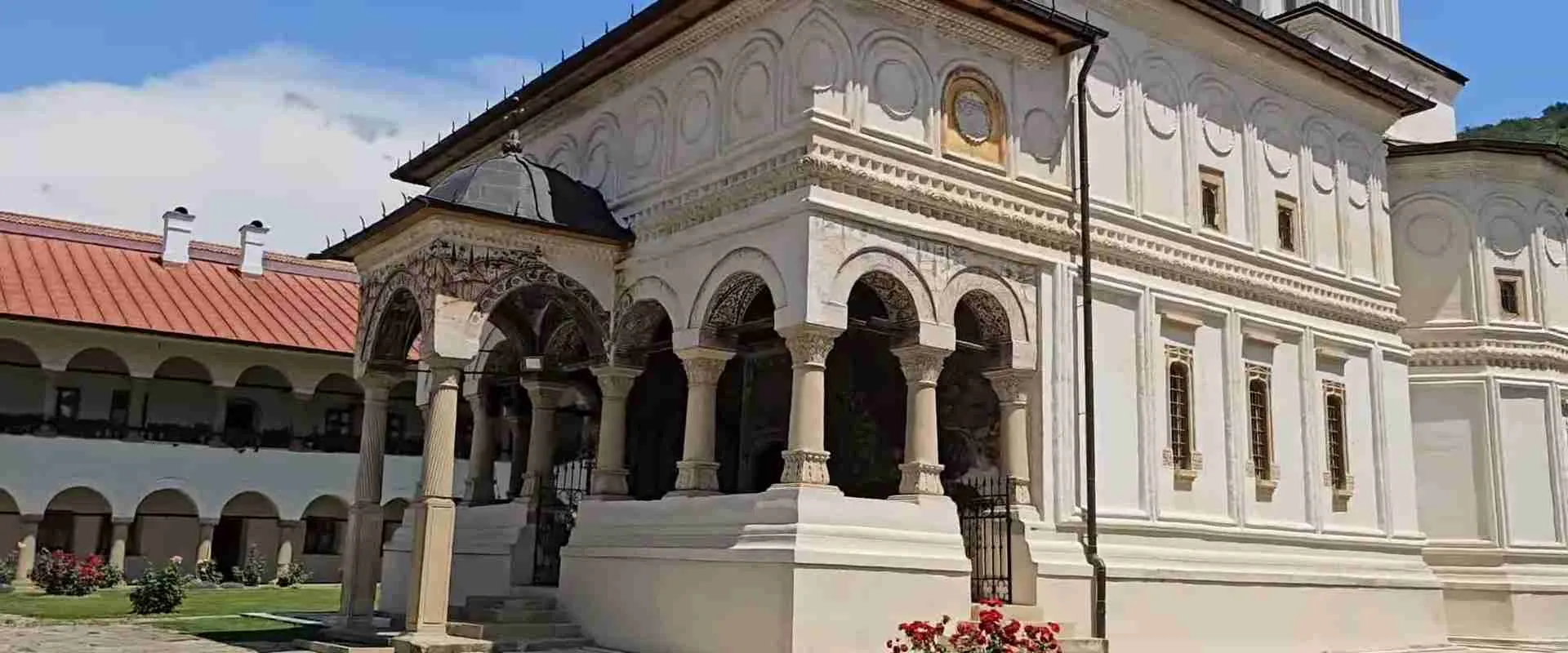
Horezu Monastery Romania: UNESCO Brancovan Baroque Complete Guide
Nestled in the wooded hills of Vâlcea County at the foot of the Căpățânii Mountains, Horezu Monastery stands as the most accomplished masterpiece of Brancovan architectural style and Romania’s most significant spiritual and artistic monument from the late 17th century. Founded by Prince Constantin Brâncoveanu between 1690 and 1697, this UNESCO World Heritage Site represents a unique synthesis of Byzantine tradition, Ottoman influence, and Italian Renaissance innovation that created Romania’s only original artistic style recognized throughout the Balkans.
Key Takeaways:
- UNESCO Recognition: Inscribed on the World Heritage List in 1993 under criterion (ii) for its exceptional interchange of cultural values and influence across the Balkan region during the 18th and 19th centuries
- Brancovan Style Masterpiece: The monastery epitomizes the Brâncovenesc architectural style, harmoniously blending Byzantine structures with Ottoman decorative elements, Italian Renaissance rationalism, and Baroque exuberance into a distinctly Romanian synthesis
- Artistic Legacy: The painting school established at Horezu in the 18th century became famous throughout the Balkans, producing master iconographers and fresco painters whose work influenced Orthodox art across southeastern Europe
- Architectural Significance: Represents the largest and best-preserved ensemble of medieval architecture in Wallachia, featuring exceptional sculptural detail, votive portraits, and painted decorations that maintain their original 17th-century character
- Living Monastery: Functions as an active nunnery since 1872, maintaining continuous religious life and artistic traditions for over three centuries while welcoming visitors who seek both spiritual reflection and cultural appreciation
- Cultural Context: Connected to the broader heritage of Horezu ceramics, a traditional craft separately inscribed on UNESCO’s Intangible Cultural Heritage list in 2012, creating a unique destination where architectural and artisanal traditions converge
People Also Ask About Horezu Monastery Romania
What Makes Horezu Monastery a UNESCO World Heritage Site?
Horezu Monastery earned UNESCO World Heritage inscription in 1993 under criterion (ii), which recognizes properties that exhibit an important interchange of human values over a span of time or within a cultural area. The monastery qualifies because it represents the pinnacle of Brancovan architectural style, which profoundly influenced religious architecture and decorative arts throughout the Balkan region during the 18th and 19th centuries. The site demonstrates exceptional architectural purity and balance, remarkable sculptural richness, masterful treatment of religious compositions and votive portraits, and extraordinary painted decorative works that synthesize multiple cultural traditions into a coherent Romanian artistic expression.
Who Was Prince Constantin Brâncoveanu and Why Did He Build Horezu Monastery?
Prince Constantin Brâncoveanu ruled Wallachia from 1688 to 1714, presiding over a remarkable period of cultural flowering, economic prosperity, and architectural achievement despite the principality’s vassal status under the Ottoman Empire. He commissioned Horezu Monastery as his spiritual masterwork, famously declaring “I will not enter the dwelling of my home; I will not allow my eyes to sleep nor let my mind rest until I shall make a sanctuary for the Lord of Jacob.” Brâncoveanu intended the monastery as his final resting place and as a center for preserving and advancing Orthodox Christian culture. His patronage extended to dozens of churches and monasteries across Wallachia, but Horezu remained his most ambitious and accomplished project. His martyrdom in Constantinople in 1714, when he and his four sons were executed for refusing to convert to Islam, elevated him to sainthood in the Romanian Orthodox Church and transformed Horezu into a pilgrimage site honoring both artistic achievement and religious sacrifice.
What Defines the Brancovan Architectural Style at Horezu Monastery?
The Brancovan style, also called Wallachian Renaissance or Romanian Baroque, represents a unique architectural synthesis that emerged at the crossroads of European and Oriental civilizations. At Horezu, this synthesis manifests through Byzantine structural principles providing the foundation, with traditional dome construction and cruciform church plans. Italian Renaissance influences appear in the clear rationalist proportions, balanced compositions, and harmonious spatial relationships that characterize the monastery’s layout. Ottoman decorative vocabulary enriches the exterior and interior surfaces with intricate carved stonework featuring geometric and floral patterns. Baroque exuberance animates the decorative program through abundant sculptural details, elaborate painted compositions, and ornamental richness that covers nearly every visible surface. The result transcends mere eclecticism to achieve a coherent, distinctly Romanian aesthetic characterized by architectural purity, decorative abundance, refined proportions, and masterful integration of diverse cultural elements into a unified artistic vision.
How Did the Painting School at Horezu Influence Balkan Art?
The painting school established at Horezu Monastery in the 18th century achieved legendary status throughout the Balkans, training generations of iconographers and fresco painters who carried Brancovan aesthetic principles across southeastern Europe. The school developed distinctive approaches to mural composition, iconographic treatment, color harmony, and decorative integration that balanced Byzantine iconographic conventions with more naturalistic Renaissance approaches to human figures and spatial representation. Masters trained at Horezu worked on commissions throughout Wallachia, Moldova, and across the Orthodox world, disseminating the Brancovan synthesis and influencing local artistic traditions. The school’s emphasis on technical excellence, meticulous attention to decorative detail, and sophisticated color palettes elevated regional standards for religious art. Surviving examples of Horezu-influenced work appear in numerous churches and monasteries across Romania, Bulgaria, Serbia, and Greece, documenting the school’s profound impact on Orthodox Christian visual culture during a formative period when Baroque and Ottoman aesthetics reshaped traditional Byzantine approaches.
Extended multi-day tours – 5+ days
Featured Romania Multi-Day Tour Packages

7 days
Authentic Transylvania: 7-Day Small-Group Journey
- ✓ Comprehensive Romania tour
- ✓ Expert local guides included
- ✓ All accommodation arranged
- ✓ Transportation provided
10 days
Best of Romania in 10 days
- ✓ Comprehensive Romania tour
- ✓ Expert local guides included
- ✓ All accommodation arranged
- ✓ Transportation provided
4 days
Transylvania Castles tour in 4 days from Bucharest
- ✓ Comprehensive Romania tour
- ✓ Expert local guides included
- ✓ All accommodation arranged
- ✓ Transportation provided
8 days
Transylvanian Village Life: 8-Day Carpathian Hiking & Cultural Journey
- ✓ Comprehensive Romania tour
- ✓ Expert local guides included
- ✓ All accommodation arranged
- ✓ Transportation provided
Multi-day tour packages powered by TourRadar. Prices and availability subject to change.
Introduction to Horezu Monastery and Brancovan Heritage
Horezu Monastery occupies a pivotal position in Romanian cultural history as the supreme expression of an architectural style that emerged at a critical juncture in southeastern European history. When Prince Constantin Brâncoveanu founded the monastery in 1690, Wallachia existed as a vassal principality of the Ottoman Empire, navigating complex diplomatic relationships with Constantinople, Vienna, and Moscow while maintaining its Orthodox Christian identity and Romanian cultural distinctiveness. This geopolitical position at the frontier between competing empires and civilizations created unique conditions for artistic synthesis, enabling Romanian craftsmen and patrons to draw upon Byzantine ecclesiastical traditions, Ottoman decorative arts, Italian Renaissance architectural principles, and emerging Baroque aesthetics.
The monastery complex that emerged from this cultural crucible between 1690 and 1697 represents more than architectural achievement. Horezu became the physical embodiment of Brâncoveanu’s vision for Romanian culture—rooted in Orthodox Christianity and Byzantine heritage yet open to artistic innovation and cultural exchange. The prince’s patronage extended across Wallachia, commissioning dozens of churches, monasteries, palaces, and public works, but Horezu remained his masterwork, the monument where all elements of his aesthetic vision achieved their fullest realization. The monastery’s dedication to Saints Constantine and Helena, the first Christian rulers who legalized Christianity in the Roman Empire, underscored Brâncoveanu’s own understanding of rulership as sacred responsibility and cultural stewardship.
The site’s name derives from “huhurezi,” the Romanian word for eagle owls, nocturnal birds whose distinctive calls echoed through the forested hills surrounding the construction site. Local legend holds that workers built the monastery primarily at night, fearful of Ottoman patrols and Turkish raids that periodically threatened Wallachia’s countryside. Whether historically accurate or not, this tradition emphasizes the monastery’s role as both spiritual refuge and cultural fortress, preserving Orthodox Christian civilization during a period of Ottoman dominance. The surrounding forest provided natural protection and contemplative isolation, creating an environment conducive to monastic life and artistic work.
Horezu’s significance extends beyond its 17th-century origins. The monastery functioned continuously for over three centuries, adapting to changing historical circumstances while maintaining its spiritual and cultural mission. Originally established for monks, the community transformed into a nunnery in 1872, a change that has characterized the monastery ever since. Throughout Romania’s turbulent 20th century—encompassing World Wars, communist dictatorship, and post-1989 transition—Horezu endured as a center of religious life and artistic preservation. The UNESCO inscription in 1993, just four years after the fall of communism, represented international recognition of the monastery’s universal cultural value and helped ensure resources for conservation and interpretation.
Today, Horezu functions simultaneously as active religious community, architectural monument, artistic treasure, and pilgrimage destination. The monastery receives over 60,000 visitors annually, including Orthodox pilgrims seeking spiritual connection, architecture enthusiasts studying Brancovan style, art historians examining the painting school’s legacy, and travelers discovering Romania’s cultural heritage. The monastery welcomes visitors who approach respectfully, maintaining the delicate balance between spiritual life and cultural tourism that characterizes many living religious sites designated as World Heritage properties.
Understanding Horezu requires appreciating multiple dimensions—the historical context of Brâncoveanu’s Wallachia, the artistic synthesis achieved through the Brancovan style, the monastery’s religious significance within Orthodox Christianity, the painting school’s influence across the Balkans, and the site’s contemporary role as heritage destination and active spiritual community. This guide explores each dimension systematically, providing the comprehensive context necessary to appreciate why UNESCO recognized Horezu as possessing outstanding universal value and why the monastery remains Romania’s most significant architectural monument from the early modern period.
Historical Context: Constantin Brâncoveanu and Wallachia’s Golden Age
Constantin Brâncoveanu ascended to the throne of Wallachia in 1688, inheriting a principality that had endured decades of instability, competing foreign influences, and economic hardship. His 26-year reign, lasting until his execution in 1714, transformed Wallachia into the most prosperous and culturally sophisticated Romanian principality of the early modern period. Brâncoveanu navigated the complex diplomatic landscape of southeastern Europe with remarkable skill, maintaining Wallachia’s nominal vassalage to the Ottoman Empire while cultivating relationships with the Habsburg Empire, Venice, Russia, and other Christian powers. This diplomatic balancing act required constant vigilance and substantial financial tribute to Constantinople, but it created the political stability necessary for cultural flowering and economic development.
Brâncoveanu came from the influential Cantacuzino boyar family, descended from the Byzantine imperial house of Kantakouzenos. This aristocratic pedigree connected him to centuries of Orthodox Christian civilization and Byzantine cultural heritage, influences that profoundly shaped his worldview and patronage priorities. His mother, Stanca Cantacuzino, belonged to Wallachia’s most powerful noble family, while his father’s Brâncoveni estate provided the family name. This combination of Byzantine heritage, boyar status, and landed wealth positioned the young Constantin for eventual rulership, though his path to the throne involved complex dynastic maneuvering characteristic of Wallachian succession politics.
Upon assuming power, Brâncoveanu implemented policies that prioritized economic development, agricultural productivity, trade expansion, and cultural patronage. He reorganized tax collection to increase state revenues while reducing arbitrary exactions that had impoverished the peasantry. He encouraged agricultural improvement through the introduction of new crops and farming techniques. He fostered commerce by establishing trading relationships with Venice, the Habsburg lands, and Russia, diversifying Wallachia’s economic partnerships beyond the Ottoman sphere. These policies generated substantial wealth, which Brâncoveanu reinvested in an unprecedented building campaign that transformed Wallachia’s architectural landscape.
The prince’s cultural patronage extended across multiple domains. He commissioned over 40 monasteries and churches throughout Wallachia, each contributing to a coherent architectural program that asserted Romanian cultural identity within the Ottoman system. He established printing presses that produced religious texts in Romanian, Greek, and Slavonic, making Orthodox Christian literature more widely available. He supported schools that educated boyar children in classical languages, theology, and administration, creating a cultivated administrative class. He patronized workshops for icon painting, manuscript illumination, textile production, and metalwork, sustaining traditional crafts while encouraging artistic innovation. He maintained diplomatic and cultural connections with Orthodox communities across southeastern Europe, the Middle East, and Russia, positioning Wallachia as a cultural bridge between Byzantine civilization and emerging European modernity.
Brâncoveanu’s architectural patronage achieved its supreme expression at Horezu Monastery, begun in 1690 when the prince was approaching the height of his power and wealth. The monastery’s location in the wooded hills west of the capital reflected strategic considerations—distant enough from Bucharest to provide monastic isolation, yet accessible via the main road connecting Wallachia with Transylvania and the Habsburg lands. The site’s natural beauty, with forested slopes, clear springs, and expansive views toward the Carpathian foothills, created an ideal environment for contemplative religious life. Brâncoveanu personally supervised the monastery’s design and construction, ensuring that every detail reflected his aesthetic vision and spiritual aspirations.
Construction required seven years of intensive work by master craftsmen drawn from across Wallachia and beyond. Stone masons shaped the monastery’s structural elements, carving capitals, columns, window frames, and decorative elements with exceptional precision. Bricklayers constructed the walls using distinctive red brick that would become characteristic of Brancovan architecture. Carpenters created the roof structures, gates, and interior furnishings. Painters executed the frescoes while construction continued, working from wooden scaffolding to cover walls and vaults with religious compositions. The collaborative effort required coordinating dozens of specialized craftsmen, managing complex logistics, and maintaining consistent aesthetic standards across multiple building campaigns. The result justified the effort—Horezu emerged as the most harmonious and accomplished example of Brancovan architecture, surpassing even the prince’s earlier commissions.
Brâncoveanu dedicated the monastery to Saints Constantine and Helena, the Roman Emperor who legalized Christianity and his mother who discovered the True Cross in Jerusalem. This dedication carried profound meaning—it aligned the Wallachian prince with the first Christian ruler, suggesting parallels between Constantine’s transformation of the Roman Empire and Brâncoveanu’s cultural patronage in Wallachia. It emphasized the prince’s role as defender of Orthodox Christianity against Ottoman pressure. It connected Romanian spirituality to the earliest Christian imperial tradition, anchoring Wallachia within universal Christian history. The annual feast of Saints Constantine and Helena on May 21 became the monastery’s dedication day, celebrated with special liturgies and pilgrimages.
The monastery functioned from its completion as both religious community and cultural center. Monks maintained the daily cycle of Orthodox liturgical services—vespers, matins, and the Divine Liturgy—that sanctified time and created the spiritual atmosphere essential to monastic life. The community included not only priests and monks but also skilled craftsmen, scribes, and artists who worked in the monastery’s workshops. The painting school, established shortly after the monastery’s completion, attracted talented young men who studied iconography, fresco technique, color preparation, and the theological principles governing Orthodox religious art. The monastery’s library accumulated manuscripts, liturgical books, and theological texts, becoming an important center for Orthodox learning. Guest houses accommodated visiting clergy, pilgrims, and travelers, extending Horezu’s influence beyond its walls.
Brâncoveanu’s reign ended in tragedy that transformed the prince into a martyr and saint. In 1714, Ottoman authorities, suspicious of his diplomatic contacts with Russia and Austria and resentful of his wealth and autonomy, summoned him to Constantinople under false pretenses. There, Sultan Ahmed III demanded that Brâncoveanu convert to Islam in exchange for even greater power and wealth. The prince refused, maintaining his Orthodox Christian faith despite threats and torture. The Sultan ordered Brâncoveanu and his four sons executed. According to Orthodox tradition, each son was beheaded in turn, youngest to eldest, while Brâncoveanu was forced to watch before his own execution. His steadfast refusal to renounce Christianity despite witnessing his sons’ deaths made him a powerful symbol of faith and resistance. The Romanian Orthodox Church canonized Constantin Brâncoveanu and his sons as saints and martyrs in 1992, establishing their feast day on August 16. Their martyrdom elevated Horezu from architectural masterpiece to sacred pilgrimage site, connecting the monastery’s physical beauty to the spiritual sacrifice of its founder.
After Brâncoveanu’s death, his artistic legacy continued to influence Romanian architecture and decorative arts throughout the 18th century. The Brancovan style he developed became the defining aesthetic for Wallachia’s religious and secular architecture, employed by subsequent rulers and boyar patrons who sought to connect themselves to the martyred prince’s cultural achievements. Horezu remained the style’s supreme exemplar, the monument against which later works were measured. The monastery survived the political instabilities and foreign occupations that characterized Romanian history over subsequent centuries, maintaining its spiritual and cultural significance through changing regimes. Its transformation from male monastery to nunnery in 1872 reflected changing demographics and monastic organization, but the architectural and artistic heritage remained intact, preserved by successive generations of religious communities who understood their responsibility as custodians of irreplaceable cultural patrimony.
Understanding Brancovan Architectural Style: Cultural Synthesis and Innovation
The Brancovan style, known in Romanian as “stilul brâncovenesc,” represents a unique architectural phenomenon that emerged from the specific historical, cultural, and geopolitical conditions of late 17th-century Wallachia. Often described as Romanian Renaissance or Romanian Baroque, the style transcends simple classification, achieving a synthesis of diverse cultural elements that created a distinctly Romanian architectural language. Understanding this synthesis requires examining the multiple traditions that informed it, the innovations that distinguished it, and the cultural dynamics that enabled its development during a period of Ottoman political dominance yet cultural creativity.
The Byzantine foundation provided the structural and theological basis for Brancovan architecture. Romanian Christianity descended from Byzantine Orthodoxy, adopting Constantinople’s liturgical practices, ecclesiastical organization, and architectural principles. Byzantine church architecture developed over centuries to serve specific liturgical requirements—centralized plans facilitating congregational participation in the Divine Liturgy, domed construction symbolizing heaven above the earthly church, hierarchical arrangements of sacred spaces reflecting spiritual hierarchy, and extensive painted decoration creating immersive environments for worship. These fundamental principles remained constant in Romanian church architecture, providing the framework within which Brancovan innovations operated. At Horezu, the central church follows traditional Byzantine planning with a cruciform layout, central dome, and tripartite division into narthex, nave, and sanctuary that corresponds to Orthodox liturgical requirements.
Ottoman decorative vocabulary substantially enriched the Brancovan aesthetic, introducing ornamental patterns, color sensibilities, and craftsmanship techniques from Islamic architecture. Wallachia’s vassal status under the Ottoman Empire created extensive cultural exchange despite political subordination. Ottoman craftsmen worked on Wallachian commissions, bringing expertise in carved stone decoration, ceramic tile work, decorative metalwork, and intricate geometric patterning. Islamic prohibition of figurative religious imagery produced highly developed traditions of abstract geometric and floral decoration, techniques that Romanian craftsmen adapted to Christian contexts. At Horezu, Ottoman influence appears in the intricate carved stonework surrounding windows and portals, the geometric patterns enriching surfaces, the arabesques and floral motifs decorating columns and capitals, and the overall decorative abundance that characterizes the exterior facades. This integration occurred without theological compromise—figurative Christian imagery remained central to the interior painted program, while abstract decorative elements enhanced rather than replaced Orthodox iconographic traditions.
Italian Renaissance principles contributed rational proportions, harmonious compositions, and classical architectural vocabulary to the Brancovan synthesis. Brâncoveanu maintained diplomatic and commercial relationships with Venice and other Italian states, facilitating cultural exchange and artistic influence. Italian architectural treatises circulated among Wallachia’s educated elite, introducing Renaissance theories of proportion, symmetry, and classical orders. Italian craftsmen occasionally worked on Wallachian commissions, bringing direct experience of Renaissance building techniques and aesthetic principles. At Horezu, Renaissance influence manifests in the monastery’s overall compositional clarity, the balanced relationships between architectural elements, the proportional systems governing window placement and spatial divisions, and the classical vocabulary appearing in columns, capitals, and ornamental details. The monastery achieves the Renaissance ideal of harmonious composition through mathematical proportions while maintaining distinctly Orthodox spatial organization and decorative richness.
Baroque exuberance animated the Brancovan style with dynamic movement, abundant decoration, and theatrical spatial effects characteristic of the Baroque aesthetic that dominated European architecture during Horezu’s construction period. Baroque principles emphasized emotional engagement, dramatic contrast, rich materials, and abundant ornamentation designed to overwhelm viewers with sensory experience and inspire spiritual elevation. At Horezu, Baroque influence appears in the proliferation of decorative elements covering nearly every visible surface, the dynamic interplay of carved stone ornament, the theatrical arrangement of votive portraits and religious scenes, and the overall sensory richness that distinguishes the monastery from more austere Byzantine models. The painted decorations, with their abundance of floral motifs, elaborate borders, and ornamental frames, demonstrate Baroque decorative principles adapted to Orthodox iconographic traditions.
The synthesis of these diverse elements distinguished Brancovan architecture from its sources. Rather than merely combining disparate influences, the style achieved coherent integration where Byzantine structure, Ottoman decoration, Renaissance proportion, and Baroque exuberance reinforced rather than contradicted each other. This integration reflected conscious aesthetic choices by Brâncoveanu and his craftsmen, who understood themselves as creating distinctly Romanian architecture appropriate to Wallachia’s cultural position at the crossroads of civilizations. The style asserted Romanian identity within the Ottoman political system—employing Ottoman decorative vocabulary while maintaining Orthodox Christian function and meaning, demonstrating cultural sophistication that commanded respect from both Eastern and Western observers.
Specific architectural elements characterize Brancovan buildings and appear throughout Horezu Monastery. The use of alternating courses of brick and stone in walls and decorative elements became a Brancovan signature, creating visual rhythm and structural expression. Elaborate stone carving enriched portals, window frames, capitals, and string courses with intricate floral motifs, geometric patterns, and occasional figural elements. Open arcades or loggias created transitional spaces between interior and exterior, providing shaded areas for gathering and circulation while articulating facades. Slender columns with richly carved capitals, often employing twisted or spiraling shafts, added vertical emphasis and decorative interest. Octagonal drums supporting domes featured windows that flooded interiors with light while creating dynamic exterior silhouettes. Elaborate rooflines with multiple levels and projecting eaves added visual complexity and provided weather protection for painted facades. Red ceramic roof tiles, often with decorative ridges and finials, created distinctive roofscapes visible from distance. Bell towers or belfries, typically positioned separately from the main church, punctuated monastery complexes with vertical elements that called the faithful to prayer.
The decorative program at Brancovan buildings achieved remarkable integration of architecture, sculpture, and painting. Carved stone ornament enriched three-dimensional architectural elements—columns, capitals, arches, frames—creating tactile surfaces that rewarded close examination. Painted decoration covered wall surfaces, vaults, and domes with religious imagery and ornamental borders, transforming architecture into comprehensive visual environment. The relationship between carved and painted decoration demonstrated sophisticated understanding of how different media could enhance each other—carved elements provided physical articulation and shadows that animated surfaces, while painted decoration added color, narrative content, and visual continuity across architectural divisions. At Horezu, this integration achieved exceptional refinement, with every element contributing to a unified aesthetic experience that served both artistic and spiritual purposes.
Brancovan architecture also incorporated innovations in construction technique and spatial organization. The use of high-quality brick in load-bearing walls enabled thinner walls and larger window openings than traditional stone construction, increasing interior light and creating lighter, more spacious interiors. Sophisticated vault construction techniques allowed complex spatial compositions with multiple domes, barrel vaults, and groin vaults creating varied ceiling heights and lighting conditions. The development of transitional spaces—narthexes, porches, arcades, courtyards—created graduated progression from secular to sacred space, enhancing the experiential dimension of approach and entry. The organization of monastic complexes around courtyards with carefully planned circulation patterns and view axes demonstrated sophisticated understanding of how architectural arrangement shapes daily life and spiritual experience.
The Brancovan style’s influence extended throughout Wallachia during the 18th century and into the 19th century, shaping religious and secular architecture across the principality. Subsequent rulers and boyar patrons commissioned churches, monasteries, and palaces in the Brancovan manner, adapting the style to different scales and contexts. The style’s prestige increased after Brâncoveanu’s martyrdom transformed the prince into a symbol of Orthodox faith and Romanian resistance. Even after stylistic fashions changed and Western neoclassical architecture displaced Baroque traditions, the Brancovan style retained symbolic significance as authentic Romanian architecture rooted in national tradition rather than foreign imitation. This cultural resonance contributed to the style’s revival during the late 19th and early 20th centuries, when Romanian architects sought historical models for national architecture. Horezu remained throughout these developments the acknowledged masterpiece, the monument that most perfectly embodied the style’s aesthetic principles and cultural significance.
Architectural Analysis of Horezu Monastery Complex
Horezu Monastery comprises a comprehensive monastic complex organized within two distinct precincts, each serving specific functions within the religious community’s daily life. The spatial organization reflects Orthodox monastic traditions adapted to the specific topography of the hillside site and enhanced by Brancovan aesthetic principles. Understanding the monastery’s architecture requires examining both the individual buildings that compose the ensemble and the relationships between structures that create functional and symbolic unity.
The outer precinct, encompassing the larger of the two walled enclosures, serves primarily protective and economic functions. High brick walls define the perimeter, separating sacred space from the surrounding landscape while providing security. These walls, constructed using characteristic Brancovan brickwork with decorative patterns and string courses, transform necessary fortification into architectural expression. The walls’ height and solidity recall monastic fortifications common throughout Orthodox lands where religious communities required protection from raids and warfare. At Horezu, these defensive qualities coexist with aesthetic refinement—the walls feature regular intervals of decorative elements, pilasters that articulate the surface, and careful attention to proportions that elevate utilitarian structure to architectural monument.
The main entrance to the outer precinct features a monumental gate that establishes the architectural vocabulary characterizing the entire complex. A wide vault spans the passage, its ceiling decorated with painted ornament that begins the visual experience visitors encounter. Massive wooden gates, reinforced with iron hardware and decorative metalwork, could be closed to secure the monastery while standing open to welcome visitors and pilgrims during normal circumstances. Above the gate, architectural elements create a vertical composition that draws the eye upward—carved stone frames define the opening, decorative cornices mark horizontal divisions, and the wall surface features painted decoration that continues the ornamental program from the interior vault to the exterior facade. This entrance sequence demonstrates the Brancovan principle of graduated transition from secular to sacred space, using architecture, sculpture, and painting to mark the threshold between everyday world and monastic precinct.
Within the outer precinct, auxiliary buildings serve the practical requirements of monastic life. Guest houses accommodate visiting clergy, pilgrims making extended stays, and travelers seeking monastic hospitality—a traditional obligation of Orthodox monasteries that connects them to broader Christian community. Workshops where craftsmen produced various necessities occupy dedicated structures, continuing traditions of monastic self-sufficiency that characterized medieval religious communities. Storage buildings house agricultural products from monastic lands and supplies necessary for the community’s operation. These functional structures, while less architecturally elaborate than the main church, maintain the aesthetic standards characterizing the entire complex. They employ similar materials—brick and stone, red ceramic roof tiles, carved decorative elements—creating visual continuity that unifies the ensemble. Their proportions and details reflect the same design sensibility governing more prominent buildings, demonstrating that Brancovan architecture extended comprehensive aesthetic control across all elements of built environment.
The inner precinct contains the monastery’s primary religious structures and forms the spiritual heart of the complex. Access from the outer to inner precinct occurs through a second gate that intensifies the sense of progression toward sacred center. The inner precinct’s walls define a more intimate enclosure, creating protected space that enhances the central church’s prominence. The proportions of this inner courtyard demonstrate careful planning—sufficient space for circulation and gathering during feast days and processions, yet scaled to create sense of enclosure and protection. The courtyard’s surface, paved with stone and brick in geometric patterns, transforms functional circulation space into decorative element that complements the surrounding architecture.
The katholikon, or main church, dominates the inner precinct as the architectural and spiritual focal point of the entire monastery. Dedicated to Saints Constantine and Helena and consecrated in 1697, the church exemplifies Brancovan architecture at its most accomplished. The building measures 32 meters in length and rises to 14 meters at the dome, substantial dimensions that create impressive interior volume while maintaining human scale characteristic of Orthodox church architecture. The church follows a modified cross-in-square plan common in Byzantine architecture, with a central dome over the crossing supported by four interior piers, transverse barrel vaults covering the arms of the cross, and lower side spaces creating aisles flanking the nave. This planning produced the traditional tripartite division of Orthodox churches—narthex or entry space where catechumens historically stood, naos or nave where the faithful gather for liturgy, and sanctuary or altar space reserved for clergy and prohibited to laity during services.
The exterior of the main church presents the full repertoire of Brancovan architectural elements in harmonious composition. The building rises in clearly articulated stages—solid lower walls punctured by relatively small windows, an octagonal drum supporting the central dome with larger windows that flood the interior with light, and smaller secondary domes over subsidiary spaces creating dynamic roofline. The walls feature alternating courses of brick and stone that create horizontal banding, a signature Brancovan detail that adds visual interest while expressing structural logic. Stone string courses at regular intervals divide the facade into horizontal zones, providing scale and proportion to large wall surfaces. Pilasters articulate the corners and subdivide wall surfaces, creating vertical emphasis that counterbalances horizontal banding. Window frames demonstrate exceptional stone carving, with elaborate surrounds featuring floral motifs, geometric patterns, and occasionally figural elements arranged in symmetrical compositions that frame the openings while themselves becoming focal points of decorative interest.
The church’s open portico or porch exemplifies the Brancovan innovation of transitional spaces that mediate between exterior and interior. This arcaded structure extends the full width of the western facade, creating covered space for gathering before and after services and protecting the painted decoration of the facade from weather. Slender columns with elaborately carved capitals support the arches, their proportions demonstrating Renaissance influence in the harmony of elements. The porch’s ceiling features extensive painted decoration including religious scenes, votive portraits, and ornamental borders that prepare visitors for the even richer decoration awaiting inside. This portico transforms the act of approaching and entering the church into a graduated processional experience, using architecture to create psychological and spiritual transition from everyday concerns to sacred worship.
The interior of the main church presents one of the most complete and well-preserved programs of Brancovan religious painting in existence. Every visible surface—walls, vaults, pendentives, drum, and dome—receives painted decoration that creates an immersive visual environment characteristic of Orthodox church interiors. The iconographic program follows traditional Orthodox hierarchies and arrangements developed over centuries to serve both theological and liturgical purposes. The dome, representing heaven, features Christ Pantocrator surrounded by angels and prophets. The pendentives below the dome display the four Evangelists, connecting heavenly realm to earthly church. The upper walls present scenes from Christ’s life arranged chronologically around the nave, allowing the faithful to follow salvation history as they stand for services. Lower walls include individual saints, martyrs, and Church Fathers who intercede for the faithful and provide models of Christian virtue. The sanctuary contains the most sacred images—the Theotokos (Virgin Mary) in the apse above the altar, flanked by the Communion of the Apostles and other Eucharistic imagery that relates directly to the Divine Liturgy celebrated at the altar below.
The narthex, or entrance space, contains particularly significant painted decoration that reveals the monastery’s patronage and commemorates its founder. Votive portraits present Prince Constantin Brâncoveanu and his family in formal poses typical of donor portraits in Orthodox churches. The prince appears in princely regalia, displaying both his temporal authority and his spiritual humility as ktetor or founder of this sacred space. These portraits, executed during the monastery’s construction while Brâncoveanu lived and ruled, provide invaluable historical documentation of the prince’s appearance, clothing, and the artistic conventions governing princely portraiture in late 17th-century Wallachia. After Brâncoveanu’s martyrdom, these images gained additional significance as representations of a saint, transforming historical portraits into sacred icons that pilgrims venerate alongside traditional religious imagery.
The painting style at Horezu demonstrates the synthesis characteristic of Brancovan art generally. The iconographic content remains thoroughly Orthodox, following Byzantine traditions for figure types, poses, attributes, and narrative arrangements. The painting technique, however, incorporates innovations influenced by Western European art—more naturalistic rendering of figures with subtle modeling creating sense of volume, attention to realistic details of clothing, architecture, and landscape, sophisticated color harmonies, and elegant decorative borders that frame compositions. The abundant use of floral and vegetal motifs in ornamental borders and background decoration reflects both Ottoman influence and Baroque decorative exuberance. Gold highlights and fine details demonstrate exceptional craftsmanship and precious materials worthy of the monastery’s significance. The integration of all these elements created a distinctive visual language that influenced Orthodox painting throughout the Balkans during the 18th century.
The belfry or bell tower stands separate from the main church, a common arrangement in Romanian monastic architecture that creates distinct vertical element visible from distance. The tower rises in stages with octagonal upper levels providing optimal acoustic properties for bells. Four substantial bells hang in the belfry, weighing between 300 and 1,000 kilograms each. Three bells bear inscriptions naming Prince Brâncoveanu, commemorating his patronage and establishing connection between the monastery’s physical structure and its founder’s spiritual legacy. These bells call the monastic community and visiting faithful to prayer throughout the daily cycle of services, their sounds carrying across the surrounding countryside and marking sacred time. The bells’ material substance—bronze cast using traditional techniques—represents significant investment of resources and technical expertise, underscoring the monastery’s importance and Brâncoveanu’s commitment to creating monastery of exceptional quality in all respects.
Additional structures within the inner precinct include smaller chapels or parekklesions that serve specific liturgical functions and provide additional spaces for prayer. Schitul Bolniţa, a small chapel located to the right of the main entrance, demonstrates refined architectural qualities despite modest scale. Cemetery structures house burials of community members and benefactors, maintaining physical and spiritual connection between living and dead within sacred precinct. Cells or living quarters for the monastic community line the inner precinct’s perimeter, creating continuous built environment that defines courtyard while providing necessary accommodations. These cells maintain simple, austere character appropriate to monastic vows of poverty while incorporating sufficient quality of construction and detail to harmonize with the more elaborate church architecture.
Conservation work throughout the monastery’s history has maintained the architectural and artistic integrity that UNESCO recognized in 1993. The Romanian government, Orthodox Church, and international heritage organizations have invested substantial resources in structural stabilization, roof repairs, painting consolidation, and other interventions necessary to preserve the monastery for future generations. These conservation efforts face challenges common to heritage sites—balancing preservation of authentic historic fabric with necessary repairs and maintenance, managing the impact of increased visitation following UNESCO inscription, adapting facilities for modern requirements while respecting historic character, and maintaining the spiritual function that gives the monastery continuing cultural relevance. The success of conservation efforts at Horezu demonstrates that careful stewardship can sustain living religious communities within designated heritage sites, allowing spiritual traditions to continue while protecting architectural and artistic patrimony.
The Painting School of Horezu: Artistic Legacy and Balkan Influence
The establishment of a painting school at Horezu Monastery during the early 18th century represented one of Prince Brâncoveanu’s most enduring cultural achievements, creating an institution that influenced Orthodox religious art throughout southeastern Europe for generations. The school trained iconographers and fresco painters in the distinctive Brancovan aesthetic while maintaining rigorous standards of technical excellence and theological correctness that characterized the best Orthodox artistic traditions. Understanding the school’s significance requires examining its pedagogical methods, artistic output, regional influence, and lasting legacy in Balkan visual culture.
The school emerged from the collaborative workshop environment that characterized medieval and early modern artistic production. Master painters who executed Horezu’s original frescoes remained at the monastery after completing their commissions, establishing workshops where they continued producing icons, frescoes, and illuminated manuscripts while training apprentices in their techniques. This model of artistic transmission through master-apprentice relationships had governed craft production throughout Europe for centuries, ensuring technical knowledge passed from generation to generation while maintaining quality standards and stylistic continuity. At Horezu, this traditional model operated within a monastic context that added spiritual dimensions to artistic training—painters learned not merely technical skills but also the theological principles governing Orthodox iconography, the liturgical contexts shaping their work, and the spiritual disciplines appropriate to creating sacred art.
The curriculum combined practical technical training with theological education. Apprentices learned to prepare painting surfaces, sizing and priming walls for fresco or wooden panels for icons according to traditional recipes that used natural materials—lime plaster, egg tempera, natural pigments ground from minerals and plants, gold leaf, and protective varnishes. They mastered drawing techniques, learning to render human figures in proportions and poses appropriate to Orthodox conventions while incorporating the more naturalistic approaches characteristic of Brancovan style. They studied color theory and mixing, developing sophisticated palettes that could express theological meanings through color symbolism while achieving harmonious compositions. They practiced the demanding fresco technique that required painting on fresh wet plaster before it dried, allowing no corrections or revisions and demanding absolute technical confidence. They learned icon painting on wooden panels prepared with multiple layers of gesso, mastering the patient layering of translucent pigments and fine details that created icons’ distinctive luminosity. They studied established iconographic types and narrative compositions, memorizing the traditional forms for representing Christ, the Virgin, saints, and biblical scenes that maintained continuity with centuries of Orthodox visual tradition.
Theological education complemented technical training, ensuring painters understood the spiritual significance of their work. Students learned Orthodox doctrine and liturgical practice, understanding how images functioned within church architecture and worship to teach theology, facilitate devotion, and create sacred environment. They studied the writings of Church Fathers addressing sacred art, including St. John of Damascus’s defense of icons and St. Theodore the Studite’s theological explanations of iconographic principles. They learned to distinguish between acceptable innovation in style and technique versus prohibited deviations from established iconographic types and theological meanings. This theological education distinguished the Horezu school from secular artistic training, producing painters who understood themselves as creating sacred objects serving spiritual purposes rather than merely decorative artworks demonstrating technical virtuosity.
The distinctive Brancovan aesthetic taught at Horezu represented a carefully balanced synthesis that maintained Orthodox theological correctness while incorporating stylistic innovations from multiple cultural sources. The school preserved Byzantine iconographic conventions—figure types, poses, attributes, and narrative arrangements developed over centuries remained foundational. Simultaneously, it incorporated Western European influences toward more naturalistic representation, particularly in figure modeling, drapery rendering, and spatial composition. Ottoman decorative vocabulary enriched ornamental borders and background elements with geometric patterns and floral arabesques adapted to Christian contexts. The integration of these diverse elements required sophisticated understanding of how to innovate while maintaining essential Orthodox character—introducing Renaissance naturalism in ways that enhanced rather than compromised theological content, adapting Ottoman decoration without importing Islamic aesthetics incompatible with Christian imagery, creating visual novelty that attracted patrons and viewers while preserving spiritual meanings that made images theologically valid.
The school’s influence extended across southeastern Europe through multiple channels. Graduates who completed their training at Horezu received commissions from churches and monasteries throughout Wallachia, spreading Brancovan style across the principality. Some painters traveled to Moldavia, the neighboring Romanian principality, introducing Brancovan aesthetics to northern regions where different artistic traditions had previously dominated. Others worked in Transylvania, the third Romanian principality under Habsburg rule, where Orthodox, Catholic, and Protestant communities coexisted and where Romanian painters navigated complex confessional boundaries. Painters trained at Horezu also received commissions beyond Romanian lands—in Bulgaria, where Orthodox communities under Ottoman rule sought skilled iconographers; in Serbia, where reconstruction after Ottoman wars required new church decoration; and throughout the Balkans wherever Orthodox communities needed religious art.
Surviving examples of Horezu-influenced painting demonstrate the school’s widespread impact. Churches across Wallachia contain frescoes and icons showing characteristic Brancovan features—elegant figure proportions, sophisticated color harmonies, abundant decorative borders, naturalistic details in drapery and landscape, and the distinctive integration of Byzantine iconographic conventions with Renaissance and Baroque stylistic elements. Some painters signed their works or documentary records identified their training at Horezu, establishing clear connections between the monastery school and regional artistic production. In other cases, stylistic analysis reveals Horezu influence even without explicit documentation, as painters adopted techniques and aesthetic approaches characteristic of the school. The geographic distribution of these works—extending from Transylvania through Wallachia and Moldavia into Bulgaria, Serbia, and beyond—demonstrates that Horezu functioned as a regional artistic center whose influence transcended political boundaries.
The school’s artistic standards elevated expectations for Orthodox religious art throughout the region. Patrons who had seen or heard of Horezu’s exceptional quality demanded similar standards from painters they commissioned, creating competitive pressure that improved overall artistic quality. Inferior work could be rejected as not meeting standards established by the Horezu school, giving communities leverage to demand excellence from painters. This quality improvement benefited Orthodox religious art broadly, ensuring that churches across the region received decoration worthy of sacred space and capable of facilitating worship and devotion. The school thus contributed to regional cultural development not only through its direct output and trained painters but also through its indirect influence on artistic standards and expectations.
The school’s theological soundness gave it authority within Orthodox communities concerned about preserving correct doctrine and practice. Church authorities who reviewed new icons and frescoes for theological correctness could approve Horezu-trained painters’ work with confidence, knowing they maintained proper iconographic conventions and theological meanings. This approval facilitated painters’ careers and helped disseminate Brancovan style as an accepted, orthodox aesthetic rather than questionable innovation. The combination of artistic excellence and theological correctness proved essential to the school’s influence—either quality alone would have proven insufficient, but together they established Horezu as the preeminent center for Orthodox religious art in the region.
The school continued operating for decades after Brâncoveanu’s death, sustained by the monastery’s reputation and the ongoing demand for skilled religious painters. Later generations of masters trained at Horezu maintained the school’s traditions while adapting to changing artistic fashions and patronage patterns. The school eventually declined as artistic production shifted to other centers and as Western European artistic influences increasingly displaced traditional Orthodox approaches. However, its influence persisted in regional artistic traditions that continued incorporating Brancovan elements long after the formal school ceased operation. The monastery’s role as training center for generations of painters represents a cultural achievement comparable to its architectural significance, contributing substantially to the Balkan region’s artistic heritage and justifying UNESCO’s recognition of Horezu’s outstanding universal value.
Cultural and Religious Significance in Romanian Orthodox Tradition
Horezu Monastery occupies a central position in Romanian Orthodox spirituality extending far beyond its architectural and artistic importance. The monastery functions as active religious community, pilgrimage destination, site of miraculous healings, symbol of Orthodox resistance, and embodiment of Romanian cultural identity expressed through sacred architecture. Understanding this multifaceted religious significance requires examining the monastery’s role within Orthodox Christianity, its connection to Constantin Brâncoveanu’s martyrdom and sainthood, its place in popular devotion, and its continuing function as living spiritual community.
The monastery’s primary function remains the opus Dei—the work of God—through the daily cycle of Orthodox liturgical services that sanctify time and connect earthly community to heavenly worship. The nuns who comprise the current monastic community maintain the Byzantine liturgical tradition that has characterized Orthodox monasticism for over a millennium. Daily services include Vespers in the evening, marking the transition from day to night and offering thanksgiving for the completed day. Compline follows Vespers, providing prayers for peaceful sleep and protection through the night. The Midnight Office at midnight or early morning hours joins the monastic community to Christ’s vigil in Gethsemane and prepares for morning prayer. Matins or Orthros at dawn welcomes the new day with hymns of praise and thanksgiving. The Divine Liturgy, the central act of Orthodox worship celebrating Christ’s sacrifice and resurrection, occurs on Sundays and feast days. The Hours—First Hour, Third Hour, Sixth Hour, and Ninth Hour—sanctify morning, midday, and afternoon, dividing the day into periods dedicated to prayer.
This liturgical cycle creates sacred temporal rhythm that structures monastic life and distinguishes sacred time from secular chronology. The services occur in the monastery’s katholikon where Brancovan frescoes surround the worshippers, creating immersive environment where architecture, art, and liturgy unite in comprehensive spiritual experience. The painted saints look down upon the living community, collapsing distinctions between earthly church and heavenly communion of saints. The liturgical chants echo through spaces designed to enhance acoustics, their melodies following Byzantine musical traditions preserved through oral transmission for centuries. Incense rises through the church, engaging the sense of smell in worship. The tactile experience of standing on stone floors, kissing icons, and handling prayer ropes involves the body in prayer. The comprehensive sensory engagement characteristic of Orthodox worship achieves particular intensity in settings like Horezu where exceptional architecture and art elevate ordinary human experience toward encounter with divine mystery.
The monastery’s connection to Constantin Brâncoveanu’s martyrdom adds dimension of sanctity that transforms architectural monument into holy site. The Romanian Orthodox Church’s canonization of Brâncoveanu and his sons in 1992 officially recognized what popular devotion had long understood—that the prince’s refusal to renounce Christianity despite witnessing his sons’ executions constituted genuine martyrdom worthy of saintly veneration. The monastery Brâncoveanu founded became the principal site for honoring his memory and seeking his intercession. His votive portrait in the narthex functions as sacred icon of a saint rather than merely historical donor portrait. Pilgrims venerate this image, lighting candles, offering prayers, and seeking Brâncoveanu’s help with spiritual and material concerns. The monastery celebrates his feast day on August 16 with special liturgies, processions, and celebrations that draw thousands of pilgrims from across Romania and the Orthodox world.
Popular tradition attributes miraculous healings and answered prayers to Brâncoveanu’s intercession at Horezu, following patterns common throughout Orthodox Christianity where saints’ shrines become sites of miraculous divine intervention. Pilgrims suffering physical illness, family problems, spiritual struggles, or material hardship journey to Horezu seeking saint’s help. They pray before his portrait, light candles, offer gifts to the monastery, participate in liturgical services, and request prayers from the nuns. Some pilgrims report experiencing healing, relief from suffering, solutions to problems, or spiritual consolation they attribute to Brâncoveanu’s intercession. These testimonies, transmitted through oral tradition and occasionally documented by the monastery, reinforce Horezu’s reputation as powerful spiritual site where prayer proves particularly efficacious. Whether understood as literal miracles, psychological benefits from pilgrimage and prayer, or some combination, these experiences shape how Orthodox believers relate to Horezu as living sacred site rather than merely historical monument.
The monastery represents Orthodox resistance to religious persecution and cultural pressure, themes with profound resonance in Romanian history. Romania endured centuries of Ottoman political dominance, Communist atheistic persecution, and various other challenges to Orthodox Christian identity. Brâncoveanu’s martyrdom symbolizes faithful resistance—his refusal to convert despite torture and execution models the steadfastness expected of Christians facing persecution. The monastery he founded embodies the cultural and spiritual vitality that survived despite political subordination, demonstrating that external powers might dominate politically while failing to suppress authentic cultural and religious life. This symbolism proved particularly powerful during Communist rule when state atheism pressured religious communities. Horezu’s continued function as active monastery despite government opposition testified to Orthodoxy’s resilience and provided hope that spiritual traditions would survive political oppression. The monastery’s UNESCO inscription in 1993, shortly after Communism’s collapse, represented not merely recognition of architectural significance but also acknowledgment of Romanian culture’s survival through decades of systematic suppression.
The monastery functions as pilgrimage destination attracting diverse visitors motivated by religious devotion, cultural interest, architectural appreciation, or combinations of these factors. Devout Orthodox pilgrims come seeking spiritual benefits—participating in liturgical services, venerating icons and relics, confessing to monastery priests, receiving spiritual counsel from experienced nuns, and experiencing temporary withdrawal from secular world’s demands. Romanian cultural enthusiasts visit to engage their national heritage, experiencing architecture and art that embody Romanian cultural achievement from a formative historical period. International tourists include Horezu in Romanian itineraries as outstanding example of Eastern European religious architecture and UNESCO World Heritage Site. Architecture and art history scholars study the monastery as supreme example of Brancovan style and important instance of cultural synthesis in early modern period. Each visitor category approaches Horezu with different priorities and interpretive frameworks, yet the monastery accommodates this diversity, functioning simultaneously as religious shrine, cultural monument, tourist attraction, and research site.
The monastic community that maintains Horezu comprises women who have taken vows of poverty, chastity, and obedience according to Orthodox monastic tradition. These nuns dedicate their lives to prayer, liturgical worship, manual labor, and spiritual development, following patterns of monastic life established in early Christianity and preserved through Orthodox tradition. Some nuns serve primarily contemplative vocations, spending most of their time in prayer, liturgical participation, and spiritual reading. Others manage the monastery’s practical operations—cooking, cleaning, maintaining buildings and grounds, managing agricultural work on monastic lands, overseeing guest accommodation, coordinating with civil and ecclesiastical authorities, and handling the complex logistics required to sustain both religious community and heritage site receiving tens of thousands of annual visitors. This combination of contemplative and active dimensions characterizes Orthodox monasticism, which understands physical labor as spiritual discipline and practical service as expression of love for God and neighbor.
The monastery offers accommodation for visitors seeking extended stays, maintaining the traditional Orthodox monastic practice of hospitality to pilgrims and travelers. Guest rooms provide simple but adequate lodging where visitors can participate in monastic life temporarily—attending services, eating with the community, observing monastic rhythms, experiencing the spiritual atmosphere, and gaining respite from secular world’s pressures. This hospitality extends Orthodox understanding of monasteries as serving not only those called to lifelong monastic vocation but also lay Christians needing temporary spiritual retreat and renewal. Visitors often describe profound experiences from even brief stays at Horezu—the beauty of liturgical services, the peace of monastic environment, conversations with wise and experienced nuns, and the tangible sense of sacred presence that characterizes spaces dedicated to prayer for centuries.
The monastery’s continuing religious function distinguishes it from many heritage sites that have become exclusively museums or tourist attractions. While Horezu welcomes cultural visitors and facilitates scholarly research, it remains fundamentally a working monastery where religious life continues as primary purpose. This living spiritual tradition gives the architecture and art their authentic context and meaning. The frescoes were painted not as decorative artworks but as aids to prayer and worship, and they continue serving these original purposes when contemporary worshippers pray surrounded by these sacred images. The bells ring not as historical curiosities but as calls to prayer summoning the community to worship. The monastery’s spaces accommodate not only tourists but also participants in ongoing liturgical life. This integration of heritage conservation and living religious tradition represents ideal outcome for sacred heritage sites, demonstrating that protection of cultural patrimony and continuation of spiritual traditions need not conflict but can reinforce each other when managed thoughtfully.
Horezu Ceramics: Complementary UNESCO Heritage and Cultural Continuity
The monastery’s location in the region known for Horezu ceramics creates unique convergence of UNESCO-recognized heritage—the Brancovan architectural masterpiece inscribed in 1993 and the traditional pottery craft inscribed on UNESCO’s Representative List of the Intangible Cultural Heritage of Humanity in 2012. Understanding this relationship enriches appreciation for both the monastery and the ceramics tradition, revealing how tangible architectural heritage and intangible craft knowledge together constitute comprehensive cultural landscape that has developed over centuries in this region of Vâlcea County.
Horezu ceramics represent a distinctive pottery tradition characterized by specific decorative motifs, color combinations, technical processes, and cultural meanings that distinguish this regional craft from other Romanian pottery traditions. The ceramics feature predominantly white, red, green, blue, and brown glazes applied to earthenware vessels and decorative objects. Designs combine geometric patterns—circles, spirals, zigzags—with stylized representations of natural forms including roosters, fish, trees, and floral elements. The rooster motif appears particularly frequently, functioning as cultural symbol associated with vigilance, morning, and solar symbolism. Potters organize these elements according to compositional principles governing pattern placement, color distribution, and visual balance that create recognizably “Horezu” aesthetic.
The pottery tradition predates the monastery, rooted in centuries-old Romanian ceramic practices and influenced by successive cultural contacts throughout the region’s complex history. However, the monastery’s establishment in 1690 and subsequent prominence likely stimulated local craft production as the monastic community required ceramic vessels for daily use and as pilgrims visiting Horezu created market for decorative ceramics as souvenirs and devotional objects. This reciprocal relationship between religious institution and local craft economy exemplifies patterns common throughout Europe where major monasteries, shrines, and pilgrimage sites stimulated regional economic development and craft specialization.
Traditional Horezu pottery production follows gender-divided labor processes that UNESCO documentation emphasizes as important aspect of the craft’s social organization. Men traditionally perform the physically demanding tasks of clay extraction and preparation—identifying appropriate clay deposits, excavating the raw material, transporting it to workshops, cleaning and processing the clay through repeated cycles of watering, kneading, and trampling that transform raw earth into workable clay body suitable for forming. Women primarily execute the pottery forming, with skilled female potters using kick wheels to throw vessels ranging from small cups to large storage jars. The throwing process requires years of practice to develop the physical strength, coordination, and aesthetic judgment necessary for creating well-proportioned vessels with even walls and refined profiles.
Both men and women participate in decorating pottery, though specific roles and techniques may vary by family and workshop. Decoration occurs after initial drying but before firing, using colored slips and sgrafitto techniques that scratch through applied slip layers to reveal contrasting clay beneath. Painters apply designs freehand without preliminary sketching, relying on internalized knowledge of traditional patterns and compositional principles acquired through years of observation and practice. This freehand approach means no two Horezu ceramics are identical—each piece represents unique creative act within traditional framework, balancing individual variation and conformity to established aesthetic norms.
The firing process uses traditional kilns that reach temperatures sufficient to vitrify glazes and mature clay bodies into durable earthenware. Kiln technology, fuel sources, firing schedules, and temperature management require specialized knowledge transmitted through apprenticeship and experience. Successful firing produces the characteristic glossy glazed surfaces and vibrant colors that distinguish Horezu ceramics, while unsuccessful firings result in cracked, warped, or improperly glazed pieces that must be discarded. The technical demands of pottery production—from clay preparation through forming, decorating, and firing—require comprehensive mastery of materials, tools, and processes that takes years to acquire.
UNESCO’s inscription of Horezu ceramics in 2012 recognized this pottery tradition as intangible cultural heritage worthy of international protection and promotion. The inscription acknowledged that Horezu ceramics represent unique cultural expression rooted in specific regional context, embodying knowledge and skills transmitted through generations, providing livelihood for communities of practitioners, and contributing to cultural diversity threatened by globalization and industrialization. UNESCO designation brought international attention to Horezu pottery, stimulated market demand for authentic traditional work, supported craftspeople economically, and helped ensure knowledge transmission to younger generations who might otherwise abandon traditional crafts for more lucrative occupations.
The relationship between monastery and ceramics tradition creates synergies beneficial to both. Visitors drawn to the monastery by its UNESCO World Heritage status discover the ceramics tradition, purchasing pottery from local workshops and supporting craft economy. Conversely, tourists interested in traditional crafts visit the region for its ceramics and discover the monastery. Museums and galleries in Horezu town display both historical ceramics demonstrating the tradition’s evolution and contemporary work by active master potters. Workshops offer demonstrations and classes where visitors can observe traditional techniques and attempt pottery making themselves, creating experiential engagement with intangible heritage. Annual ceramics festivals celebrate the craft through competitions, demonstrations, exhibitions, and sales that draw participants from across Romania and internationally.
The monastery occasionally incorporates Horezu ceramics in its own material culture—ceramic vessels used in refectories, decorative plates displayed in public spaces, ceramic icons combining pottery and iconographic traditions. These uses create tangible connections between architectural heritage and craft tradition, demonstrating cultural continuity across different heritage categories. Some contemporary iconographers have experimented with ceramic icons that adapt traditional painted icon techniques to ceramic surfaces, creating innovative works that bridge religious art and secular pottery traditions. These creative explorations demonstrate that living cultural traditions continue evolving while maintaining connection to historical roots.
The designation of both monastery and ceramics as UNESCO heritage creates comprehensive cultural landscape where visitors can engage multiple dimensions of regional identity. The monastery represents elite culture, monumental architecture, religious significance, and artistic achievement at the highest levels of patronage and craftsmanship. The ceramics represent vernacular culture, domestic production, economic livelihood, and folk artistic traditions rooted in daily life. Together, these complementary heritage categories present fuller picture of regional culture than either alone, demonstrating that cultural identity encompasses both extraordinary monuments and ordinary crafts, elite patronage and popular practice, religious and secular dimensions of life. This comprehensive approach to heritage preservation recognizes that culture functions as integrated system where different elements influence and sustain each other.
Conservation Challenges and UNESCO Stewardship
Horezu Monastery’s inscription on the UNESCO World Heritage List in 1993 initiated comprehensive conservation efforts addressing accumulated deterioration and establishing protocols for ongoing maintenance and protection. Heritage conservation at active religious sites presents unique challenges requiring balance between preserving historic fabric, accommodating continuing spiritual functions, and facilitating appropriate public access. Understanding these conservation challenges and management strategies provides insight into heritage stewardship complexities and the resources required to sustain outstanding universal value for future generations.
The monastery’s structural condition at the time of UNESCO inscription reflected decades of deferred maintenance during Romania’s Communist period when state resources for religious properties remained limited and state ideology discouraged investment in religious heritage. The main church required roof repairs to address water infiltration threatening interior frescoes. Exterior walls showed deterioration from weathering, requiring consolidation and repointing. Foundations required assessment and stabilization to address settlement and moisture migration. Brick and stonework needed cleaning to remove biological growth, pollution residues, and inappropriate previous repairs. These structural challenges demanded specialized expertise and substantial financial resources beyond what the monastery community could provide through its own limited means.
The fresco conservation presented particularly complex challenges given the paintings’ age, fragility, and exposure to environmental stresses. Three centuries of candle smoke, incense, humidity fluctuations, and pollutants had deposited layers of dirt and grime obscuring original colors and details. Earlier restoration attempts had introduced materials incompatible with original techniques, creating conservation problems requiring remedial treatment. Paint layers showed areas of flaking, detachment from substrate, and losses requiring consolidation and careful inpainting. The gilding and fine details required especially delicate treatment to avoid damage during cleaning. Comprehensive conservation demanded thorough documentation, scientific analysis of materials and condition, development of treatment protocols appropriate to specific conditions, execution by trained conservators under rigorous supervision, and establishment of preventive conservation measures to minimize future deterioration.
Conservation philosophy evolved significantly during the 20th century, moving from interventionist restoration that reconstructed or completed damaged works toward preservation-focused approaches that stabilize existing fabric while accepting historical changes and losses as legitimate aspects of heritage authenticity. Modern conservation follows internationally accepted principles articulated in documents like the Venice Charter that prioritize minimal intervention, reversibility of treatments, respect for all historical layers, clear distinction between original and new work, and thorough documentation of conditions and interventions. Applying these principles at Horezu required careful decision-making about which interventions proved necessary, what methods and materials would be employed, how to document work, and how to establish maintenance protocols preventing future deterioration.
The UNESCO inscription facilitated conservation efforts through multiple mechanisms. International recognition elevated the monastery’s profile, enabling fundraising from government sources, private donors, international organizations, and cultural heritage foundations. UNESCO provided technical expertise through advisory missions that assessed conditions, recommended interventions, and connected Romanian authorities with international conservation specialists. The World Heritage designation obligated Romania to implement the 1972 Convention Concerning the Protection of the World Cultural and Natural Heritage, requiring legal protection, adequate management, and sustained conservation funding. While UNESCO provides no direct conservation funding, the inscription creates framework encouraging national governments to prioritize World Heritage sites and facilitating international cooperation and expertise sharing.
Conservation work proceeded in phases addressing the most urgent threats first while developing comprehensive long-term management strategies. Emergency stabilization secured the most critically endangered elements—repairing roofs, stabilizing walls showing structural movement, consolidating detaching paint layers. Detailed condition surveys documented every aspect of the monastery’s physical state, creating baseline information for conservation planning and future monitoring. Scientific analysis of building materials, painting techniques, and deterioration mechanisms informed treatment decisions. Incremental interventions addressed specific conservation needs while maintaining overall ensemble integrity. Preventive conservation measures installed environmental monitoring, controlled public access to protect fragile areas, established maintenance schedules for routine tasks, and trained staff in conservation awareness. This phased approach balanced urgent needs with long-term sustainability, avoided overwhelming available resources, and allowed learning from early interventions to inform subsequent work.
Managing visitor impact represents ongoing conservation challenge requiring balance between public access and heritage protection. The approximately 60,000 annual visitors generate multiple conservation stresses—physical wear on floors and architectural elements from foot traffic, microclimate changes from breathing and temperature fluctuations when large groups enter interior spaces, security risks from uncontrolled access, erosion of surrounding landscape from parking and circulation. Management strategies address these impacts through visitor routing that channels circulation away from most fragile areas, capacity limits during peak seasons and special events, photography restrictions inside churches protecting paintings from flash exposure, barrier systems preventing touching of painted surfaces and sensitive elements, interpretation encouraging respectful behavior, and maintenance schedules addressing wear and cleaning needs. These interventions protect heritage while maintaining reasonable access for religious participants, cultural visitors, scholars, and tourists who support the monastery’s continuing relevance and economic sustainability.
Climate change introduces new conservation challenges requiring anticipatory management. Changing precipitation patterns could increase water infiltration and moisture-related deterioration. Temperature increases might alter biological growth patterns, introducing new organisms attacking building materials. Extreme weather events—severe storms, flooding, droughts—could cause acute damage. Conservation planning must incorporate climate adaptation strategies including improved drainage systems, enhanced monitoring of environmental conditions, modified maintenance protocols responding to changing threats, and structural reinforcements addressing increased stress from extreme events. These climate-related concerns affect heritage sites globally, requiring international cooperation in developing and sharing adaptation strategies.
The monastery’s active religious function complicates conservation by limiting treatment access and requiring ongoing use of conserved spaces. Conservation work must be scheduled around liturgical calendar to minimize disruption to services. Scaffolding for painting conservation blocks access to church interior, requiring temporary relocation of services to alternative spaces. Installation of environmental controls must accommodate liturgical requirements including candles and incense that conservators would prefer to eliminate as pollution sources. Documentation activities must respect sacred character of spaces and religious community’s privacy needs. These tensions between conservation imperatives and spiritual functions require negotiation, compromise, and creative problem-solving that respects both heritage protection and religious continuity. Success requires collaboration between conservation professionals, ecclesiastical authorities, monastic community, government officials, and other stakeholders with legitimate interests in the monastery’s future.
Legal protection for Horezu operates at multiple levels providing comprehensive safeguards. Romanian national legislation designates the monastery as historic monument under the country’s cultural heritage protection laws, regulating interventions and establishing criminal penalties for unauthorized alterations or damage. Local planning regulations create buffer zones around the monastery restricting development that could impact the setting and visual integrity. The Vâlcea County government coordinates with national heritage authorities on management and conservation. The Romanian Orthodox Church exercises ecclesiastical authority over religious functions and some aspects of property management. UNESCO World Heritage status adds international oversight through periodic reporting requirements and reactive monitoring if threats emerge. This multi-level governance structure provides redundant protections but also requires coordination among various authorities with overlapping jurisdictions.
Sustaining conservation achievements long-term requires adequate funding, trained personnel, institutional capacity, and public engagement. Conservation funding from government sources competes with numerous other priorities, requiring advocacy and demonstration of cultural heritage’s broader social value beyond monuments themselves. Training conservation professionals capable of working with historic buildings and traditional materials remains ongoing challenge, requiring educational institutions offering appropriate programs and opportunities for apprenticeship with experienced practitioners. Institutional capacity building strengthens government heritage agencies, religious authorities, and local organizations responsible for day-to-day management. Public engagement builds constituencies supporting conservation through education, interpretation, volunteer programs, and cultural tourism that generates economic benefits justifying heritage investment. These enabling conditions prove as important as technical conservation interventions themselves in ensuring long-term heritage sustainability.
Visiting Horezu Monastery: Access and Cultural Etiquette
Horezu Monastery welcomes visitors respectfully approaching the site as both religious shrine and cultural monument. Understanding appropriate visiting practices, expectations for behavior, and practical access information enables meaningful engagement with this exceptional heritage site while respecting the monastic community and sacred character of the environment. This section provides guidance for visitors planning to experience Horezu personally, whether motivated primarily by religious devotion, cultural interest, architectural appreciation, or combinations of these factors.
The monastery’s location approximately 50 kilometers northwest of Râmnicu Vâlcea and four kilometers north of Horezu town requires advance planning for access. Visitors traveling from Bucharest typically approach via Râmnicu Vâlcea, the county seat and nearest significant city. From Râmnicu Vâlcea, national road DN67 leads westward toward Târgu Jiu, passing through Horezu town. A well-marked turnoff directs visitors northward from the main road toward Româneşti de Sus village and the monastery beyond. The final approach traverses wooded hillsides, with the road ascending through forest before emerging at the monastery entrance. This scenic approach prepares visitors psychologically for transition from contemporary world to historic sacred site, the forest creating natural buffer between secular and sacred spaces.
Private automobile provides the most flexible access option for independent travelers, offering freedom to visit at preferred times and explore surrounding region without schedule constraints. Rental cars are available in Bucharest, Râmnicu Vâlcea, and other Romanian cities for visitors comfortable driving unfamiliar roads. Parking facilities near the monastery entrance accommodate tour buses and private vehicles, though spaces can fill during peak seasons, major feast days, and Sunday mornings when local faithful attend services. Road conditions generally remain good on primary routes, though winter weather occasionally creates challenging conditions requiring appropriate vehicles and driving caution.
Public transportation options serve visitors without private vehicles, though requiring more planning and schedule flexibility. Buses connect Râmnicu Vâlcea with Horezu town regularly throughout the day, providing reliable if somewhat slow service. From Horezu town, local buses or taxis complete the journey to the monastery. Some visitors choose to walk the four kilometers from town to monastery when weather permits, enjoying rural landscape and approaching the monastery as pilgrims traditionally did on foot. This walking approach creates different experiential dimension than arriving by vehicle, allowing gradual transition and building anticipation as the monastery’s distinctive roofline emerges above the trees. Organized tours from Bucharest, Sibiu, or other Romanian tourist centers typically include Horezu on multi-day itineraries exploring Wallachia’s cultural heritage, providing convenient access combined with professional interpretation.
The monastery maintains traditional Orthodox approach to visiting hours and access, welcoming visitors while preserving monastic routines and liturgical schedules. The complex opens daily for visitors, with hours typically spanning morning through late afternoon. Specific hours may vary seasonally and should be confirmed before visiting, particularly for those traveling significant distances. Liturgical services occur daily according to Orthodox schedules, with the Divine Liturgy typically celebrated Sunday mornings and on major feast days. Visitors interested in participating in or observing Orthodox worship should plan accordingly, arriving before services begin and remaining for complete service rather than entering and exiting during liturgy, which Orthodox tradition considers disrespectful.
Appropriate attire demonstrates respect for sacred space and Orthodox sensibilities regarding modesty. Men should wear long pants rather than shorts, covered shoulders rather than sleeveless shirts, and avoid conspicuously casual clothing. Women traditionally cover their heads with scarves when entering Orthodox churches, though enforcement varies and visitors uncertain of this practice often find scarves available at church entrances for borrowing. Women should wear modest clothing—skirts extending below the knee or full-length pants, covered shoulders and décolletage, nothing tight or revealing. These expectations reflect Orthodox understanding that sacred spaces merit dignified, modest appearance marking psychological and spiritual transition from everyday casual demeanor to reverent participation in or witness of divine worship. Visitors uncomfortable with these requirements might reconsider visiting, while those willing to dress appropriately demonstrate cultural respect that monastery communities appreciate.
Photography policies balance documentation and sharing interests against sacred space respect and conservation concerns. Exterior photography generally receives permission as the monastery’s architectural beauty merits documentation and sharing. Interior photography faces restrictions protecting both spiritual atmosphere and fragile frescoes from flash damage. Many Orthodox communities prohibit photography inside churches entirely, considering it disrespectful to treat sacred space as tourist spectacle. Others permit careful photography without flash, relying on available light and requiring discretion regarding subjects photographed. Posted signs and monastery staff indicate current policies, which visitors should respect regardless of personal opinions. Those strongly desiring interior photographs should inquire about obtaining special permission, which might be granted for scholarly research or professional documentation under appropriate conditions with supervision.
Behavioral expectations inside churches and monastery precincts reflect Orthodox spiritual understanding and monastic life requirements. Visitors should maintain quiet, avoiding loud conversation, mobile phone use, or other disturbances interrupting prayer and contemplation. Movement through churches should be deliberate and respectful rather than hurried tourist efficiency. Visitors should refrain from eating, drinking, or smoking anywhere within monastery grounds. Physical contact with frescoes, icons, and architectural elements should be avoided as oils from skin damage paintings while repeated touching erodes carved details. Religious objects—icons, candles, liturgical vessels—merit respectful treatment as sacred items rather than mere artifacts. Some areas remain closed to visitors, reserved for monastic community’s private use. Marked boundaries and closed doors indicate these restricted zones, which visitors should respect without attempting unauthorized access.
Interacting with the monastic community requires understanding and respecting their religious vocation. The nuns at Horezu have devoted their lives to prayer, spiritual development, and service to God, not to serving as tour guides or cultural interpreters for visitors. While many monastics appreciate opportunities to share their faith and explain their traditions to genuinely interested visitors, they should not be treated as obligated to provide such interaction. Visitors should greet nuns respectfully if encountering them but avoid imposing extended conversations or requests for personal guidance unless clearly invited. Photography of monastics should never occur without explicit permission, as many religious communities find such photography invasive and disrespectful. Visitors seeking spiritual counsel or longer conversation might inquire through proper channels about arranging meetings with abbess or designated community members, approaching with appropriate humility and recognition that such requests impose on monastic time and routines.
Donations to the monastery support both conservation needs and the religious community’s material requirements. Collection boxes positioned near entrances receive monetary gifts, while the monastery shop offers candles, icons, religious books, and other items for purchase. These economic contributions help sustain the monastery while allowing visitors to support heritage preservation and spiritual community actively. Visitors uncertain about appropriate donation amounts might reference practices at their own religious institutions or simply give according to their means and appreciation for the experience. The spiritual economy of Orthodox tradition understands charitable giving as benefiting donor spiritually as much as recipient materially, making donations expressions of gratitude and participation in sacred economy rather than mere commercial transactions.
Duration of visits varies dramatically based on visitor interests and participation. Tourists completing basic architectural survey and spending brief time inside the main church might require only 30-60 minutes. Visitors interested in thorough examination of architecture, detailed viewing of frescoes, exploration of all accessible buildings, and appreciation of monastery’s landscape setting might spend several hours. Those participating in complete liturgical service add service duration to their visit time—the Divine Liturgy typically lasts 60-90 minutes, while other services vary. Visitors staying for prayer, meditation, and spiritual reflection might remain several hours or arrange overnight accommodation for extended retreat experience. The monastery accommodates this diversity of visiting styles and durations, providing sacred space meaningful to quick cultural tourists and extended spiritual pilgrims alike.
Combining Horezu Monastery with other regional attractions creates fuller cultural experience while justifying travel to Vâlcea County. Horezu town, four kilometers south of the monastery, offers opportunities to engage the traditional ceramics craft through workshops, galleries, and artisan studios. The Horezu Ceramics Museum displays historical examples documenting the craft’s evolution and contemporary master works demonstrating continuing vitality. During annual ceramics festivals, demonstrations and workshops allow visitors to observe and participate in traditional pottery making. Cozia Monastery, located along the Olt River valley between Râmnicu Vâlcea and Sibiu, represents another important Wallachian monastery with exceptional medieval frescoes. The Căpățânii Mountains surrounding Horezu offer hiking, rural tourism, and opportunities to experience traditional village life persisting in foothill communities. Transalpina, one of Europe’s highest paved roads crossing the Carpathians, provides spectacular mountain scenery and access to Transylvania. Regional wine routes showcase Vâlcea’s viticulture, particularly the Drăgășani wine region producing distinctive Romanian varieties.
Horezu in Context: Related Brancovan Monuments and Romanian Heritage
While Horezu Monastery represents the pinnacle of Brancovan architectural achievement, understanding its significance requires situating it within the broader program of religious and secular construction that Prince Constantin Brâncoveanu sponsored throughout Wallachia. Over 40 churches, monasteries, palaces, and public works commissioned during his reign created comprehensive architectural legacy that transformed Wallachia’s built environment and established the Brancovan style as defining aesthetic for Romanian culture. Exploring selected examples from this extensive corpus reveals how Horezu relates to other manifestations of Brancovan architecture and demonstrates the style’s diversity within consistent aesthetic principles.
Mogoșoaia Palace, located approximately 15 kilometers northwest of Bucharest, exemplifies Brancovan secular architecture adapted to princely residential requirements. Completed between 1698 and 1702, the palace served Brâncoveanu as suburban retreat from Bucharest’s administrative demands, providing environment for cultivated leisure, political entertaining, and cultural pursuits. The complex organized around a large courtyard demonstrates sophisticated integration of residential quarters, reception spaces, service facilities, and gardens characteristic of European palace architecture while maintaining distinctly Romanian aesthetic through Brancovan decorative vocabulary. Open arcades with slender columns create transitional spaces between interior rooms and exterior courtyards, following patterns developed at Horezu but adapted to residential scale and functions. Elaborate stone carving enriches portals, window frames, and cornices with intricate floral and geometric patterns demonstrating exceptional craftsmanship. The palace’s waterside location on Lake Mogoșoaia provides scenic setting enhanced by formal gardens integrating architecture and landscape. Today the palace functions as museum displaying Brancovan art and architecture, allowing visitors to experience aristocratic domestic environment complementing Horezu’s monastic context.
Stavropoleos Monastery in Bucharest’s historic center demonstrates Brancovan architecture’s urban adaptation to constrained sites and different functional requirements than Horezu’s expansive rural setting. Founded in 1724, slightly after Brâncoveanu’s death but fully within the Brancovan stylistic tradition, the small monastery church nestles among commercial buildings in Bucharest’s oldest quarter. Despite limited dimensions, the church achieves remarkable decorative richness through exceptional stone carving covering facades with floral motifs, geometric patterns, and calligraphic inscriptions. The open porch features slender twisted columns supporting delicate arches, creating jewel-like architectural composition despite modest scale. The intimate interior features complete fresco program demonstrating continued vitality of painting traditions established at Horezu school. Stavropoleos survived Bucharest’s extensive 20th-century redevelopment that destroyed much of the historic urban fabric, remaining as precious survival of Brancovan architecture in metropolitan context contrasting dramatically with Horezu’s rural isolation.
Curtea de Argeș Monastery, significantly predating Brâncoveanu’s reign, influenced Horezu’s design while representing earlier phase of Wallachian religious architecture. Constructed during the 16th century under Prince Neagoe Basarab, Curtea de Argeș developed architectural vocabulary combining Byzantine planning with distinctive Romanian elaboration characterized by exceptionally intricate stone carving, multiple levels of blind arcading enriching facades, and complex roofline compositions. When Brâncoveanu commissioned Horezu, he consciously referenced Curtea de Argeș, creating spiritual and aesthetic continuity with this earlier architectural masterpiece while advancing the style through innovations that would characterize Brancovan architecture. The relationship between these two monuments demonstrates how architectural traditions develop through creative engagement with precedents rather than radical innovation, each generation building upon previous achievements while introducing refinements reflecting contemporary sensibilities and technical capabilities.
Snagov Monastery, located on an island in Snagov Lake north of Bucharest, presents another important Brancovan commission demonstrating the style’s adaptability to dramatically varied site conditions. The island setting creates powerful symbolic resonance—the monastery isolated from secular world by water becomes metaphorical refuge from worldly concerns, an island of sanctity in the sea of temporal existence. Brâncoveanu substantially renovated the medieval monastery during his reign, applying Brancovan decorative vocabulary to earlier structures and adding new buildings coordinated aesthetically with renovated fabric. The monastery’s legendary association with Vlad Țepeș (Vlad the Impaler, inspiration for Dracula legend) adds romantic historical dimension, though scholarly consensus questions whether the Impaler’s actual burial occurred at Snagov. Despite these legendary associations, the monastery’s architectural and artistic significance derives from its role within Brâncoveanu’s building program and the masterful adaptation of Brancovan principles to challenging site conditions.
Brâncoveanu commissioned numerous smaller churches throughout Wallachia, creating network of sacred architecture that reinforced Orthodox Christian identity across the principality while demonstrating princely piety and cultural patronage. These churches, while individually less grand than major monasteries, collectively established Brancovan aesthetic as characteristic Wallachian religious architecture. Village churches provided spiritual centers for rural communities while introducing sophisticated architectural and artistic standards to countryside. Urban churches in Bucharest and other towns asserted Romanian cultural identity within increasingly cosmopolitan urban environments influenced by Ottoman, Greek, and Western European presences. This comprehensive building program demonstrated that Brâncoveanu understood architecture as instrument of cultural policy, using aesthetic sophistication and spiritual investment to assert Romanian cultural vitality despite political subordination to Ottoman Empire.
Beyond Romania’s current borders, Brâncoveanu’s patronage extended to Orthodox communities throughout the Balkans and Eastern Mediterranean. He provided substantial financial support for renovations and maintenance of monasteries on Mount Athos, the autonomous monastic republic in Greece that functions as spiritual center of Orthodox monasticism. He commissioned repairs to the Church of the Holy Sepulchre in Jerusalem, one of Christianity’s holiest sites. He supported Orthodox communities in Ottoman-controlled territories, providing funds for church construction and maintenance where local Christian populations lacked resources. This extensive extra-territorial patronage demonstrated Brâncoveanu’s understanding of himself as patron and protector of Orthodox Christianity broadly, not merely Wallachian interests narrowly. It enhanced his prestige throughout the Orthodox world and created diplomatic relationships with Christian communities across southeastern Europe and the Eastern Mediterranean. When Ottoman authorities executed Brâncoveanu in 1714, news of his martyrdom spread rapidly through these networks of Orthodox communities he had supported, contributing to his rapid elevation to popular saint status even before formal canonization.
The preservation of Brancovan architectural heritage faces challenges common to historic monuments in countries with limited resources and competing priorities. Many Brancovan buildings deteriorated during the 20th century due to inadequate maintenance, war damage, earthquake damage (Romania experiences periodic seismic activity), inappropriate modifications, and general neglect during periods when historic preservation received low priority. Post-1989 democratic transition enabled increased attention to cultural heritage, with government agencies, religious authorities, and international organizations investing in conservation of important monuments. However, resources remain limited relative to preservation needs, requiring prioritization of most significant sites while accepting that some lesser monuments will continue deteriorating. Horezu’s UNESCO inscription ensures it receives adequate conservation resources, but many other Brancovan buildings lack similar protection and funding, creating risk that significant portions of architectural heritage could be lost to future generations.
Contemporary Romanian architects and cultural commentators periodically debate Brancovan architecture’s relevance to modern Romanian identity and contemporary design. Some advocate for neo-Brancovan approaches that adapt historical aesthetic principles to contemporary buildings, seeing the style as authentically Romanian alternative to international modernism. Others argue that historical styles belong to their original contexts and that contemporary architecture should address current conditions rather than imitating past forms. These debates reflect broader tensions in post-communist Romanian society about relationships between tradition and modernity, national particularity and European integration, preservation of distinctive cultural identity and participation in globalized culture. Horezu functions within these debates as touchstone—an acknowledged masterpiece whose exceptional quality all parties recognize while disagreeing about what lessons it offers for contemporary culture.
Tourism Development and Regional Economic Impact
Horezu Monastery’s UNESCO World Heritage designation created substantial opportunities for tourism development and regional economic growth, transforming what had been relatively obscure destination known primarily to Romanian pilgrims and cultural enthusiasts into site included on international heritage tourism itineraries. Understanding tourism’s economic dimensions and development challenges provides perspective on heritage’s practical contributions to communities hosting World Heritage Sites and illuminates tensions between preservation imperatives and economic exploitation.
Tourism generates significant economic activity in Horezu town and surrounding Vâlcea County through multiple channels. Visitor spending on accommodation, restaurants, local crafts, and other goods and services creates direct revenue for local businesses. The approximately 60,000 annual visitors represent substantial market for hospitality services, particularly during summer tourism season and around major Orthodox feast days when pilgrimage numbers peak. Hotels, guesthouses, and vacation rentals in Horezu and Râmnicu Vâlcea accommodate overnight visitors, while day-trippers contribute to restaurant and café revenues. Souvenir shops selling Horezu ceramics, icons, religious items, and generic tourist merchandise concentrate near the monastery entrance and in Horezu town center, capturing visitor spending on tangible mementos of their experience.
The ceramics industry benefits particularly from tourism drawn initially by the monastery but expanding engagement to include traditional crafts. Workshops welcome visitors for demonstrations of pottery making, providing experiential tourism that creates memorable personal connections with intangible cultural heritage. Some workshops offer classes where visitors can attempt pottery making themselves under artisan guidance, creating hands-on engagement that research shows generates deeper appreciation and more substantial economic impact than passive observation. Master potters sell their work directly from workshops and through galleries, commanding premium prices for exceptional pieces that collectors and informed buyers recognize as serious art rather than mere tourist souvenirs. This quality market sustains traditional craftsmanship economically while maintaining artistic standards that justify UNESCO recognition of Horezu ceramics as intangible heritage.
Employment represents another significant economic impact of heritage tourism. Hotels, restaurants, shops, and tour operators employ local workers in positions ranging from unskilled service jobs to specialized roles requiring language skills, cultural knowledge, or technical expertise. The monastery itself employs staff beyond the monastic community—maintenance workers, guides providing interpretation for large tour groups, administrative personnel managing visitor logistics, security staff, conservation specialists working on ongoing preservation projects. These employment opportunities, while modest compared to industrial or agricultural sectors, provide important economic alternatives in rural region where employment options remain limited and where young people otherwise might migrate to cities seeking opportunities.
Government tourism promotion increasingly features Horezu within Romanian cultural heritage tourism strategies. National tourism marketing includes Horezu in international campaigns promoting Romania’s UNESCO World Heritage Sites, medieval monasteries, traditional crafts, and cultural tourism generally. Regional authorities in Vâlcea County develop tourism infrastructure supporting visitation—improved road signage directing travelers to cultural sites, information centers providing orientation and interpretation, digital resources offering multilingual information, and coordination with private tourism sector to develop packages combining multiple regional attractions. These public investments aim to position Vâlcea County as cultural tourism destination capable of attracting visitors for multi-day stays generating more substantial economic impact than day-trips allow.
Tourism development creates tensions requiring careful management to balance economic benefits against heritage preservation imperatives and quality-of-life concerns for local residents. Excessive visitation damages fragile heritage sites through physical wear, microclimate changes, security risks, and degradation of spiritual atmosphere that constitutes part of intangible heritage. Commercial development targeting tourists can overwhelm historic town centers, displacing traditional businesses and residential uses with souvenir shops, tourist restaurants, and accommodation facilities. Increased traffic congestion, parking demands, and infrastructure strain from seasonal visitation peaks create problems for permanent residents. These overtourism challenges familiar from destinations worldwide—Venice, Barcelona, Dubrovnik, Machu Picchu—demonstrate that successful tourism development can transform into problematic overtourism unless proactively managed.
Horezu has not yet experienced severe overtourism problems affecting some World Heritage Sites, partly because its 60,000 annual visitors represent manageable level compared to sites receiving millions annually. However, preventive planning helps ensure that if visitation increases substantially, mechanisms exist to manage growth sustainably. Visitor capacity studies establish maximum sustainable visitation levels beyond which heritage degradation and visitor experience deterioration occur. Timed entry systems could limit visitors entering church interiors simultaneously, reducing crowding and microclimate stress. Seasonal pricing variations might encourage visitation during shoulder seasons rather than concentrated in peak summer months. Interpretation and education programs could encourage responsible visitor behavior and generate appreciation for why conservation measures prove necessary. These management strategies allow tourism benefits while protecting the heritage assets that attract tourism in first place—a fundamental principle since degrading heritage ultimately destroys tourism potential.
Sustainable tourism development prioritizes local community benefits ensuring that economic gains accrue primarily to residents rather than outside investors. Community-based tourism enterprises—locally owned guesthouses, restaurants featuring regional cuisine, craft cooperatives, guide services employing community members—keep tourism revenue circulating within local economy rather than leaking to distant corporations. Training programs prepare community members for tourism employment, developing language skills, cultural interpretation abilities, hospitality service competencies, and entrepreneurial capacities. Community participation in tourism planning ensures that development respects local values, protects quality of life, and distributes benefits equitably rather than concentrating wealth among narrow elite. These participatory approaches prevent tourism from becoming neocolonial exploitation where communities bear costs of hosting visitors while outsiders capture financial benefits.
Cultural tourism emphasizing quality over quantity provides development model potentially more compatible with heritage preservation than mass tourism emphasizing visitor numbers. Cultural tourists typically spend more per capita than mass tourists, stay longer, visit outside peak seasons, engage more deeply with destinations, behave more responsibly, and generate fewer negative impacts per visitor. Marketing strategies targeting educated, culturally curious travelers interested in authentic experiences and willing to pay premium prices for quality can generate comparable economic benefits from fewer visitors, reducing stress on heritage sites and local communities. Horezu possesses characteristics attractive to cultural tourists—exceptional architecture and art, continuing spiritual traditions, traditional crafts, rural landscape, relative isolation creating sense of discovery. Developing these assets appropriately through quality accommodation, sophisticated interpretation, authentic experiences, and responsible environmental stewardship could position Horezu as cultural tourism destination appealing to discerning visitors while avoiding mass tourism’s problems.
Regional development strategies increasingly recognize cultural heritage as economic asset contributing to diversified economies less dependent on declining traditional sectors. Vâlcea County’s economy historically depended on agriculture, forestry, and light industry, sectors that faced challenges during post-communist transition and that provide limited opportunities for prosperity and youth employment. Cultural tourism based on the monastery, ceramics, and other heritage assets offers economic alternative compatible with environmental sustainability, regional distinctiveness, and development aspirations. This heritage-based development requires sustained investment in conservation, interpretation, infrastructure, and marketing—investments justified by long-term economic returns from sustainable cultural tourism that preserves rather than depletes assets generating revenue.
Comparative Analysis: Horezu Within World Heritage Context
Situating Horezu Monastery within UNESCO’s broader portfolio of World Heritage Sites illuminates what makes this Romanian monument significant not merely nationally but at global level. The UNESCO World Heritage List includes over 1,100 cultural, natural, and mixed properties in over 160 countries, representing humanity’s most outstanding universal value. Understanding Horezu’s comparative significance requires examining how it relates to other religious architecture on the World Heritage List, what distinguishes it from apparently similar monuments, and what universal values it embodies that transcend its specific Romanian context.
Religious architecture comprises substantial portion of World Heritage cultural properties, reflecting architecture’s fundamental role in expressing and facilitating spiritual life across human societies. Christian monasteries inscribed on the World Heritage List represent diverse architectural traditions from various historical periods and geographic regions—early Christian monasteries in Egypt and Syria, Byzantine monasteries in Greece and Turkey, Romanesque and Gothic monasteries across Western Europe, Orthodox monasteries throughout Eastern Europe and Russia, colonial-era missions in the Americas, and many others. Each exemplifies specific architectural traditions and historical contexts while contributing to the global heritage of sacred architecture humanity has created across millennia and cultures.
Within Orthodox Christian architectural heritage, Horezu relates to numerous World Heritage Sites sharing Byzantine ecclesiastical traditions while demonstrating regional variations. Mount Athos in Greece, inscribed in 1988 as mixed cultural and natural property, represents Orthodox monasticism’s spiritual heartland, preserving over twenty major monasteries and numerous smaller foundations maintaining unbroken monastic traditions since Byzantine times. Painted Churches of Moldavia in Romania, inscribed in 1993 concurrently with Horezu, demonstrate distinctive Moldavian approach to church architecture and exterior fresco decoration representing different regional tradition than Wallachian Brancovan style. Rila Monastery in Bulgaria, inscribed in 1983, represents Bulgarian Orthodox monasticism during Ottoman period, sharing with Horezu the challenge of maintaining Christian culture under Islamic political dominance. Studenica Monastery in Serbia, inscribed in 1986, exemplifies Serbian medieval architecture synthesizing Byzantine and Romanesque influences. These Orthodox properties demonstrate both shared Byzantine heritage and remarkable regional diversity, with each site contributing distinctive architectural and artistic expressions to broader Orthodox tradition.
Horezu’s distinctiveness within Orthodox heritage sites derives from its exceptional embodiment of cultural synthesis during specific historical period. While many Orthodox monasteries reflect Byzantine influence modified by local traditions, few achieve the sophisticated integration of Byzantine, Ottoman, Renaissance, and Baroque elements that characterize Brancovan style. This synthesis occurred in specific geopolitical context of Wallachia as Orthodox principality navigating between Ottoman and Habsburg empires, creating unique conditions for cultural exchange and artistic innovation. Brâncoveanu’s conscious patronage program systematically developing distinctive national style represents relatively rare instance of coherent architectural policy creating recognizable aesthetic across multiple commissions. The painting school’s influence spreading Brancovan style throughout the Balkans demonstrates impact extending beyond single monument to broader regional cultural development. These factors combine to establish Horezu as uniquely significant within Orthodox architectural heritage.
Baroque religious architecture provides another comparative context, as Brancovan style’s art historical classification as “Romanian Baroque” suggests relationships with contemporaneous Catholic Baroque architecture in Western and Central Europe. The 17th and early 18th centuries witnessed extraordinary flowering of Baroque church architecture across Catholic Europe—Italy produced masterpieces by Bernini, Borromini, and other masters; Austria and southern Germany developed particularly elaborate ecclesiastical Baroque; Spain and Portugal created distinctive Iberian Baroque; and Baroque architecture spread to Latin American colonies where indigenous influences produced unique syntheses. World Heritage Sites representing Catholic Baroque include numerous Italian churches, Austrian and German abbeys, and Latin American cathedrals and missions. These monuments share with Horezu certain aesthetic principles—decorative abundance, dramatic spatial effects, emotional engagement, integration of architecture and painting—while manifesting these principles through Catholic liturgical requirements, Western European artistic traditions, and specific regional contexts quite different from Orthodox Wallachia.
The synthesis of diverse cultural influences at Horezu finds parallels in other World Heritage Sites demonstrating cultural exchange and artistic fusion. The Taj Mahal in India combines Persian, Islamic, and Indian architectural traditions in monument to transcendent love commissioned by Mughal emperor. The Alhambra in Spain preserves Islamic palace architecture created during Muslim rule, later adapted by Christian monarchs but maintaining its Moorish character. Rock-Hewn Churches of Lalibela in Ethiopia demonstrate unique architectural form—churches carved from solid rock—serving Orthodox Christianity in African context quite different from Byzantine heartlands. Borobudur in Indonesia represents Buddhist sacred architecture synthesizing Indian Buddhist principles and Javanese cultural expressions. These sites demonstrate that exceptional architecture often emerges from cultural crossroads where multiple traditions intersect, allowing creative syntheses impossible within monocultural contexts.
Horezu’s inscription under criterion (ii)—exhibiting important interchange of human values—reflects UNESCO’s recognition that the monastery represents not isolated achievement but node in networks of cultural exchange. The criterion specifically addresses properties demonstrating significant interchange on developments in architecture, technology, arts, or other cultural domains. At Horezu, this interchange manifested through multiple channels—Byzantine traditions transmitted across Orthodox world, Ottoman architectural and decorative influences absorbed despite political tensions, Italian Renaissance principles introduced through diplomatic and commercial contacts, and Baroque aesthetics arriving from Western Europe. The monastery then broadcast Brancovan synthesis back across the Balkans through the painting school, creating reciprocal rather than unidirectional cultural flows. This complex pattern of reception, synthesis, and transmission exemplifies the cultural interchange criterion meant to recognize.
The criterion (ii) inscription distinguishes Horezu from properties inscribed under other criteria that recognize different types of outstanding universal value. Criterion (i) recognizes masterpieces of human creative genius—properties that represent pinnacle achievements of human artistic or architectural creativity. Criterion (iii) recognizes properties bearing unique or exceptional testimony to cultural traditions or civilizations. Criterion (iv) recognizes outstanding examples of building types or architectural ensembles illustrating significant stages in human history. While Horezu might potentially qualify under these other criteria, UNESCO specifically recognized its significance as demonstrating cultural interchange—the synthesis of diverse influences and subsequent influence on regional architecture constituting its primary universal value rather than mere aesthetic excellence or representativeness of particular building type.
Integrity and authenticity, key concepts in World Heritage evaluation, apply to understanding Horezu’s outstanding universal value. Integrity addresses whether a property possesses all elements necessary to express its significance and whether it maintains adequate size and protection to sustain that significance. Horezu demonstrates high integrity—the monastery complex retains all essential buildings, the architectural fabric maintains its historic character despite necessary conservation interventions, the surrounding landscape preserves the rural setting contributing to spiritual atmosphere, and legal protections guard against destructive development or alterations. Authenticity addresses whether a property truthfully conveys its values through form, materials, workmanship, setting, and other attributes. Horezu demonstrates substantial authenticity—original construction materials survive, conservation follows appropriate principles prioritizing preservation over reconstruction, traditional craftsmanship is maintained for repairs, and continuing religious function maintains the spiritual purpose for which the monastery was created. These qualities of integrity and authenticity justified UNESCO’s inscription decision and continue supporting the monastery’s World Heritage status.
Understanding Horezu within World Heritage context demonstrates that exceptional architecture serves both particular and universal purposes. The monastery functions specifically as Romanian Orthodox religious center, embodying distinctive national architectural style developed in response to specific historical circumstances. Simultaneously, it represents universal human impulses toward spiritual expression through architecture, cultural synthesis creating innovation from diverse traditions, artistic excellence transcending particular contexts, and heritage preservation ensuring future generations can experience humanity’s creative achievements. This dual particular and universal significance characterizes all successful World Heritage properties, connecting specific places to broader human stories and values.
Frequently Asked Questions About Horezu Monastery
How did Horezu Monastery influence architecture beyond Romania?
The painting school established at Horezu Monastery in the 18th century functioned as the primary mechanism through which Brancovan artistic principles spread beyond Wallachia’s borders. Master iconographers and fresco painters trained at Horezu received commissions throughout the Balkans—in Moldavia, Transylvania, Bulgaria, Serbia, and other regions of southeastern Europe where Orthodox communities required religious art. These painters carried Horezu’s distinctive aesthetic—the synthesis of Byzantine iconography with Renaissance naturalism, Ottoman decorative abundance, and Baroque compositional sophistication—to distant churches and monasteries. Their work influenced local artistic traditions, elevating technical standards and introducing stylistic innovations that enriched regional Orthodox art. The school’s reputation extended its influence beyond graduates’ direct work, as painters throughout the region studied and emulated Brancovan style even without formal training at Horezu. This widespread dissemination established the monastery as one of the most influential artistic centers in Orthodox southeastern Europe during the 18th century, comparable to major icon-painting schools on Mount Athos or in Russian monastic centers.
What architectural elements specifically characterize Brancovan style at Horezu?
Brancovan architectural style demonstrates itself at Horezu through multiple distinctive elements working together to create coherent aesthetic. Alternating horizontal bands of brick and stone create visual rhythm while expressing structural logic, a signature detail appearing throughout the monastery’s walls. Elaborately carved stone surrounds every opening—portals, windows, and arches—with intricate floral motifs, geometric patterns, and occasionally figural elements demonstrating exceptional craftsmanship and decorative abundance. Slender columns with twisted or spiraling shafts and richly carved capitals, often positioned in open arcades or porches, add vertical emphasis and create transitional spaces between interior and exterior. The octagonal drums supporting domes feature large windows flooding interiors with light while creating dynamic exterior silhouettes. Multiple roof levels with projecting eaves protect painted wall surfaces from weather while generating complex, picturesque rooflines. Extensive painted decoration covers every interior surface and portions of exterior walls, integrating architecture and art into comprehensive visual environment. The synthesis appears in how these diverse elements—showing Byzantine structural principles, Ottoman decorative vocabulary, Renaissance proportional harmony, and Baroque ornamental exuberance—achieve coherent integration rather than remaining disparate influences awkwardly combined.
Why is Prince Constantin Brâncoveanu considered a saint in Romanian Orthodox tradition?
Constantin Brâncoveanu achieved sainthood through his martyrdom in Constantinople in 1714, when Ottoman Sultan Ahmed III executed him and his four sons for refusing to convert to Islam. The prince was summoned to Constantinople ostensibly for political consultation but actually faced demands to renounce Christianity in exchange for greater autonomy and wealth for Wallachia. Brâncoveanu refused conversion despite threats, torture, and the horrific ordeal of watching his sons beheaded in order from youngest to eldest before his own execution. Orthodox tradition emphasizes that he maintained unwavering faith throughout, encouraging his sons to die rather than apostatize, and accepting martyrdom as witness to Christ. This sacrifice fulfilled Christianity’s highest spiritual standard—willingly accepting death rather than denying faith—the same standard by which early Christian martyrs earned sainthood. The Romanian Orthodox Church formally canonized Constantin Brâncoveanu and his sons in 1992, establishing their feast day as August 16 and designating them as saints and martyrs. Their relics, recovered from Constantinople and returned to Romania, are venerated at several churches. His martyrdom transformed Horezu from merely architectural masterpiece into sacred pilgrimage site honoring a saint, adding spiritual significance to aesthetic excellence.
What conservation challenges threaten Horezu Monastery’s preservation?
Horezu faces multiple conservation challenges requiring ongoing attention and resources. Structural deterioration from age, weathering, and previous periods of inadequate maintenance affects roofs, walls, and foundations, requiring periodic major interventions beyond routine maintenance capacity. The frescoes, over three centuries old, deteriorate from environmental stresses including humidity fluctuations, temperature variations, air pollution, biological growth, and accumulated dirt from candle smoke and incense. Previous restoration attempts sometimes introduced incompatible materials creating additional conservation problems. Visitor impact generates physical wear on floors and architectural elements, microclimate changes affecting painted surfaces, and security risks from uncontrolled access. The monastery’s continuing religious function, while culturally valuable, complicates conservation by limiting access for treatment, requiring accommodation of practices like candles and incense that conservators would prefer to eliminate, and necessitating ongoing use of spaces that would ideally rest during treatment. Climate change introduces new challenges through altered precipitation patterns, temperature increases affecting biological deterioration, and extreme weather events potentially causing acute damage. Managing these various threats requires sustained funding, specialized expertise, appropriate materials and techniques, and coordination among religious authorities, government agencies, conservation professionals, and other stakeholders—all resources not always available in sufficient quantities given Romania’s economic constraints and competing priorities.
Can visitors attend religious services at Horezu Monastery?
Horezu Monastery welcomes respectful visitors to attend Orthodox liturgical services, which occur daily according to traditional monastic schedules. The Divine Liturgy, Orthodoxy’s central worship service celebrating Christ’s resurrection and making present his sacrifice, typically occurs Sunday mornings and on major feast days. Vespers, matins, and other services from the daily cycle of Orthodox prayer occur regularly throughout the week. Visitors interested in attending should arrive before services begin—Orthodox tradition considers entering during liturgy disruptive and disrespectful. Services typically last 60-90 minutes for the Divine Liturgy, with other services varying in duration. Visitors should wear modest, respectful clothing—men in long pants and covered shoulders, women in skirts or full-length pants with covered shoulders and heads traditionally covered with scarves. During services, visitors should stand quietly (Orthodox worship involves minimal seating), refrain from photography or mobile phone use, avoid conversation, and generally behave as they would in any sacred worship context. Non-Orthodox visitors should not receive communion, which Orthodox tradition reserves for Orthodox Christians in good standing who have properly prepared through fasting and confession. The experience of Orthodox liturgical worship, especially in settings like Horezu where exceptional architecture and frescoes surround the service, often proves deeply meaningful even for visitors unfamiliar with Orthodox tradition, providing insight into how architecture, art, music, and ritual unite in Orthodox spiritual life.
What is the relationship between Horezu Monastery and Horezu ceramics?
Horezu Monastery and Horezu ceramics represent complementary dimensions of regional cultural heritage, both recognized by UNESCO but under different programs. The monastery received World Heritage inscription in 1993 as tangible cultural property representing outstanding architectural achievement, while the traditional pottery craft received inscription on UNESCO’s Representative List of the Intangible Cultural Heritage of Humanity in 2012 recognizing craft knowledge and skills transmitted through generations. The monastery’s establishment in 1690 likely stimulated local ceramics production as the religious community required pottery for daily use and as pilgrims visiting the monastery created market for decorative ceramics as devotional souvenirs. This reciprocal economic relationship between major religious institution and local craft economy exemplifies patterns common throughout Europe where monasteries, shrines, and pilgrimage sites fostered regional economic development. Today, the two heritage elements create synergies beneficial to both—visitors drawn to the monastery by its World Heritage status discover the ceramics tradition and purchase pottery, supporting craft economy, while tourists interested in traditional crafts visit for the pottery and discover the monastery. Museums, workshops, and galleries in Horezu town allow visitors to engage both architectural and craft heritage, creating comprehensive cultural experience. Some contemporary artistic experiments combine the traditions through ceramic icons that adapt iconographic imagery to pottery surfaces, demonstrating creative evolution within living cultural heritage.
How does Romanian Brancovan architecture differ from Byzantine architecture?
While Brancovan architecture maintains fundamental Byzantine ecclesiastical principles—centralized plans with domes, traditional liturgical space divisions, hierarchical painted decoration—it substantially departs from Byzantine precedents through synthetic incorporation of Ottoman, Renaissance, and Baroque elements creating distinctly Romanian aesthetic. Byzantine architecture emphasized spiritual symbolism and theological expression through form, with relatively austere exterior treatment and decorative richness concentrated on interior mosaic or fresco programs. Brancovan architecture maintains this theological emphasis while adding extraordinary exterior decorative elaboration showing Ottoman influence—elaborate stone carving covering facades, alternating brick and stone banding creating visual rhythm, intricate window surrounds becoming focal points of decorative interest. Renaissance influence appears in proportional harmonies, compositional clarity, and classical architectural vocabulary absent from medieval Byzantine models. Baroque influence manifests in decorative abundance, dynamic spatial effects, and theatrical approach to religious experience through comprehensive sensory engagement. The painted decoration, while following Byzantine iconographic conventions, incorporates Renaissance naturalism in figure rendering and Baroque compositional sophistication absent from traditional Byzantine painting. The synthesis transcends mere combination of disparate influences to achieve coherent architectural language that contemporaries and modern observers recognize as distinctly Romanian—rooted in Byzantine Orthodox tradition yet substantially transformed through creative engagement with diverse cultural sources available in 17th-century Wallachia’s crossroads position between Orthodox, Ottoman, and Western European civilizations.
What role does Horezu Monastery play in contemporary Romanian society?
Horezu Monastery functions in contemporary Romania as simultaneously active religious community, national cultural symbol, heritage tourism destination, and embodiment of Romanian identity rooted in Orthodox Christianity and distinctive national cultural achievements. For devout Orthodox believers, the monastery remains living spiritual center where traditional monastic life continues, liturgical services maintain unbroken connection to Byzantine Christian tradition, and Constantin Brâncoveanu’s martyrdom inspires faith and resistance to secularization. Annual pilgrimages on major feast days draw thousands who seek spiritual connection, miraculous intervention, and communal religious experience increasingly rare in secularizing society. For culturally engaged Romanians, Horezu represents authentic national artistic achievement—the supreme example of distinctive Romanian architecture created during formative historical period and recognized internationally through UNESCO World Heritage inscription. The monastery embodies cultural sophistication challenging stereotypes of Romanian backwardness and demonstrating that Romanian culture produced achievements worthy of comparison with Western European monuments. For post-communist Romanian society navigating complex relationships with national past, European integration, and global modernity, Horezu offers touchstone connecting contemporary Romania to historical roots while demonstrating openness to diverse influences—the same cultural synthesis characterizing Brancovan architecture remains relevant as contemporary Romanians synthesize national tradition with European modernity. The monastery’s preservation and interpretation thus constitute not merely technical heritage conservation but ongoing negotiation of Romanian cultural identity and values.
Are there other significant works by the artists who decorated Horezu Monastery?
The master painters who executed Horezu’s original frescoes and established the painting school produced substantial additional work throughout Wallachia and beyond, though attribution and documentation remain incomplete for many works. The decentralized organization of early modern artistic production, where workshops rather than individual masters often received commissions and where documentary evidence about specific artists was incompletely preserved, complicates efforts to trace individual hands across multiple commissions. However, art historians have identified numerous churches and monasteries throughout Wallachia showing stylistic characteristics consistent with Horezu school, including sophisticated color harmonies, elegant figure proportions, refined decorative borders, and the distinctive synthesis of Byzantine iconographic conventions with Renaissance and Baroque stylistic elements. Some church documents and monastery records identify specific masters trained at Horezu who executed commissions at identified locations, establishing verified connections. In other cases, stylistic analysis reveals Horezu influence even without explicit documentation. The geographic distribution of these works—extending throughout Wallachia, into Moldavia and Transylvania, and south into Bulgaria—demonstrates that Horezu-trained painters worked across southeastern Europe, establishing the monastery’s painting school as regionally significant artistic center. Contemporary research continues identifying and analyzing works potentially connected to Horezu school, gradually reconstructing the full extent of its influence on Balkan Orthodox religious art.
What practical information should first-time visitors know about visiting Horezu Monastery?
First-time visitors should plan their visit understanding that Horezu functions as working monastery rather than museum, requiring respectful behavior appropriate to sacred space. The monastery welcomes visitors daily during daylight hours, though specific opening times vary seasonally and should be confirmed before traveling. Access requires private vehicle, organized tour, or combination of public bus to Horezu town followed by local bus or taxi for the final four kilometers to the monastery. Visitors should wear modest, respectful clothing—long pants for men, skirts or full pants for women, covered shoulders for all, and women traditionally cover heads with scarves when entering churches. Photography policies restrict interior photography while generally permitting exterior shots. Visitors should maintain quiet, avoid touching painted surfaces and architectural elements, respect closed areas reserved for monastic community, and refrain from eating, drinking, or smoking within monastery grounds. Basic visitor facilities including restrooms and small shop selling religious items and souvenirs are available. Those wishing to attend Orthodox services should arrive before services begin and behave appropriately during worship—standing quietly, no photography, no communion for non-Orthodox. Visits can range from brief 30-60 minute architectural survey to several hours of thorough exploration to overnight stays for extended retreat. Combining Horezu with other regional attractions—Horezu ceramics workshops, Cozia Monastery, Căpățânii Mountains hiking—creates fuller cultural experience justifying travel to relatively remote location. The monastery’s rural setting and functioning religious community create atmosphere quite different from urban museums, offering visitors meaningful encounter with living spiritual tradition within exceptional architectural and artistic environment.