Guide to Botticelli at the Uffizi: Birth of Venus & Primavera
Sandro Botticelli’s Birth of Venus and Primavera stand as the undisputed masterpieces of the Uffizi Gallery, representing Renaissance Florence’s supreme achievement in mythological painting. These two monumental works, housed in the museum’s iconic Rooms 10-14, demonstrate Botticelli’s revolutionary synthesis of classical mythology, Neoplatonic philosophy, and unprecedented technical mastery that transformed Western art forever.
Key Takeaways
- The Birth of Venus depicts the goddess emerging from the sea on a shell, creating one of art history’s most recognizable and revolutionary compositions that established mythological painting as a legitimate artistic subject in Renaissance Florence.
- Primavera presents nine figures in an allegorical garden scene representing the arrival of spring, incorporating complex Neoplatonic symbolism that scholars continue debating five centuries after its creation.
- Both paintings were commissioned by the powerful Medici family for Lorenzo di Pierfrancesco de’ Medici’s villa, demonstrating the intersection of political power, humanist scholarship, and artistic patronage in 15th-century Florence.
- Botticelli’s distinctive linear style, characterized by flowing contours and ethereal figures that seem to float rather than stand, revolutionized Renaissance painting by prioritizing grace and movement over the period’s typical emphasis on sculptural solidity.
- The Uffizi’s Botticelli rooms preserve the world’s most comprehensive collection of the artist’s work, allowing visitors to trace his artistic development from early religious paintings through his mythological masterpieces to his late mystical works.
- Understanding the cultural context of Medicean Florence, including Neoplatonic philosophy and classical revival, transforms these paintings from beautiful images into profound intellectual statements about love, beauty, and humanity’s relationship with the divine.
People Also Ask About Botticelli at the Uffizi
What is the meaning behind Botticelli’s Birth of Venus?
The Birth of Venus represents the goddess of love emerging fully formed from the sea foam, standing on a giant scallop shell as Zephyrus (the west wind) and Chloris blow her toward shore, where the Hora of Spring waits with a flowered mantle. The painting embodies Neoplatonic philosophy central to Medici intellectual circles, specifically the concept that divine beauty manifests in the physical world through love. The nudity of Venus represents not sensuality but rather the naked truth of divine beauty unadorned by earthly trappings.
Beyond its philosophical meaning, the painting served multiple functions in Renaissance Florence. It demonstrated the Medici family’s sophisticated understanding of classical culture, displayed their wealth and taste, and participated in the broader humanist project of reviving ancient wisdom. The choice to depict a pagan goddess at full scale represented a bold artistic statement, legitimizing mythological subjects as worthy of the same serious treatment previously reserved for religious themes. Botticelli’s composition draws on ancient descriptions of similar lost paintings, attempting to recreate through imagination what classical art might have looked like.
How large are the Birth of Venus and Primavera paintings?
The Birth of Venus measures 172.5 × 278.9 centimeters (67.9 × 109.6 inches), creating a horizontal composition that emphasizes the movement from left to right as Venus arrives at shore. Primavera stands even larger at 202 × 314 centimeters (80 × 124 inches), making it one of the largest secular paintings on canvas from the early Renaissance. The substantial dimensions of both works reflect their original function as permanent decorations in aristocratic villas rather than portable devotional images.
These dimensions allowed Botticelli to work at nearly life-size scale, creating figures that maintain impressive presence and detail even when viewed from across a room. The horizontal format of both paintings suited their intended placement on villa walls, where they would be viewed by educated guests during philosophical discussions and social gatherings. The size also enabled Botticelli to include remarkable detail in botanical elements, fabric patterns, and facial expressions that would be lost in smaller works.
Why did Botticelli paint mythological subjects instead of religious themes?
Botticelli painted mythological subjects because Renaissance Florence experienced a profound cultural shift toward classical revival, driven by humanist scholars and wealthy patrons like the Medici family who sought to reconnect with ancient Greek and Roman wisdom. The Medici court, particularly under Lorenzo the Magnificent’s influence, fostered an intellectual environment where classical mythology was studied not as pagan error but as encoded wisdom compatible with Christian truth when properly interpreted through Neoplatonic philosophy.
This cultural context made mythological painting intellectually respectable and commercially viable. Wealthy patrons commissioned mythological works to demonstrate their education, cultural sophistication, and connection to the prestigious humanist movement. Botticelli himself remained deeply religious throughout his life and continued producing religious paintings alongside his mythological works. The mythological subjects represented an expansion of artistic subject matter rather than a rejection of Christian themes, reflecting Renaissance Florence’s unique ability to synthesize classical and Christian traditions into a coherent cultural vision.
Where exactly are the Botticelli paintings located in the Uffizi?
The Birth of Venus and Primavera occupy Rooms 10-14 of the Uffizi Gallery, specifically located on the museum’s second floor in the eastern corridor section. After ascending the main staircase and passing through the entrance gallery, visitors proceed through the chronologically arranged rooms until reaching the Botticelli section, which forms the museum’s most celebrated concentration of works by a single artist. The paintings hang in climate-controlled environments with carefully regulated lighting to preserve these five-century-old tempera works.
The Uffizi positions these masterpieces to allow viewing from multiple distances, enabling visitors to appreciate both the overall composition from across the room and the intricate details up close. The museum’s layout follows a chronological progression through art history, placing Botticelli’s works at the culmination of the early Renaissance section, immediately before rooms dedicated to High Renaissance masters like Leonardo da Vinci and Raphael. This arrangement demonstrates Botticelli’s pivotal role in bridging early Renaissance innovations with the achievements that followed.
Extended multi-day tours – 5+ days
Featured Florence Multi-Day Tour Packages
3 days
Florence 3-Day Discovery Tour
- ✓ Comprehensive Florence experience
- ✓ Expert local guides included
- ✓ All accommodation included
- ✓ Transportation provided

5 days
Florence 5-Day Highlights Experience
- ✓ Comprehensive Florence experience
- ✓ Expert local guides included
- ✓ All accommodation included
- ✓ Transportation provided

7 days
Florence 7-Day Cultural Journey
- ✓ Comprehensive Florence experience
- ✓ Expert local guides included
- ✓ All accommodation included
- ✓ Transportation provided

10 days
Florence 10-Day Complete Adventure
- ✓ Comprehensive Florence experience
- ✓ Expert local guides included
- ✓ All accommodation included
- ✓ Transportation provided
Multi-day tour packages powered by TourRadar. Prices and availability subject to change.
Introduction
The Uffizi Gallery preserves Western civilization’s most comprehensive collection of Sandro Botticelli’s paintings, with the Birth of Venus and Primavera representing not merely the highlights of this collection but arguably the most significant mythological paintings of the entire Renaissance period. These two monumental works, created in the 1480s for the Medici family, revolutionized European art by demonstrating that secular, mythological subjects could achieve the intellectual depth, technical sophistication, and spiritual resonance previously reserved exclusively for religious painting. Their presence in the Uffizi transforms a museum visit into an encounter with works that fundamentally altered the trajectory of Western visual culture.
Understanding these paintings requires engaging with multiple contexts simultaneously: the biographical story of Sandro Botticelli himself, the complex political and cultural environment of Medicean Florence, the philosophical currents of Neoplatonism that shaped how educated viewers interpreted mythological imagery, and the technical innovations that allowed Botticelli to create his distinctive linear style. Each painting operates on multiple levels—as beautiful decorative objects, as demonstrations of classical learning, as philosophical statements about love and beauty, and as displays of Medici power and sophistication. This guide provides the context necessary to appreciate these masterpieces fully, examining their creation, meaning, and enduring significance.
The Birth of Venus and Primavera share numerous characteristics while remaining distinct masterpieces. Both employ large-scale canvas formats unusual for the period, when panel painting dominated. Both draw on classical mythology filtered through Renaissance Neoplatonic interpretation. Both feature Botticelli’s signature linear style, characterized by flowing contours, elongated figures, and an ethereal quality that seems to suspend his subjects between earth and heaven. Both were commissioned by the Medici family for the same patron and hung in the same villa. Yet they differ profoundly in composition, meaning, and emotional tone, with the Birth of Venus presenting a single focused moment of divine manifestation while Primavera creates a complex allegorical narrative involving multiple interacting figures.
This guide examines each painting in depth, exploring Botticelli’s artistic development, the cultural context that made these works possible, the symbolism and meaning embedded in every detail, and practical information for experiencing these masterpieces at the Uffizi. Whether encountering these paintings for the first time or returning for deeper study, visitors gain profound insight into Renaissance Florence’s supreme artistic achievement and the enduring questions about beauty, love, and human nature that Botticelli’s mythological masterpieces continue raising five centuries after their creation.
Botticelli’s Life and Artistic Development
Alessandro di Mariano di Vanni Filipepi, universally known as Sandro Botticelli, was born in Florence around 1445, entering a world where artistic innovation and cultural transformation were reshaping European civilization. The nickname “Botticelli” (little barrel) came either from his brother or his master, and it replaced his given name so completely that even contemporary documents refer to him by this diminutive. He trained initially in his father’s leather workshop before demonstrating artistic talent that led to apprenticeship with Fra Filippo Lippi, one of Florence’s most innovative painters, whose influence on Botticelli’s development of graceful, emotionally expressive figures proved fundamental and lasting.
By the late 1460s, Botticelli had established his own workshop in Florence, quickly gaining recognition for religious paintings that combined Lippi’s graceful figures with increasingly sophisticated composition and unprecedented linear elegance. His early works demonstrate mastery of tempera technique and ability to create deeply moving religious narratives, skills that attracted attention from Florence’s most powerful families. The Medici family, whose patronage could make or break artistic careers, recognized Botticelli’s exceptional talent and began commissioning works in the early 1470s, initiating a relationship that would produce his most celebrated masterpieces and define his artistic legacy.
The 1470s and 1480s mark Botticelli’s mature period, when he created the mythological paintings that secured his immortal reputation. This era coincided with Lorenzo de’ Medici’s cultural patronage transforming Florence into Renaissance Europe’s intellectual capital, where humanist scholars, poets, philosophers, and artists gathered to discuss classical texts and Neoplatonic philosophy. Botticelli absorbed this intellectual atmosphere, translating complex philosophical concepts into visual form with unprecedented success. His workshop became one of Florence’s most productive, training numerous assistants and producing works ranging from intimate devotional panels to large-scale altarpieces and mythological paintings.
The death of Lorenzo de’ Medici in 1492 and subsequent political upheavals in Florence profoundly affected Botticelli’s later career. The rise of Girolamo Savonarola, whose apocalyptic preaching condemned worldly vanity and pagan learning, created cultural conditions hostile to the mythological subjects and classical revival that had characterized Botticelli’s mature work. Some sources suggest Botticelli himself fell under Savonarola’s influence, though evidence remains inconclusive. His late paintings certainly demonstrate increasingly mystical, spiritual intensity and return to exclusively religious subjects. His style evolved toward more austere compositions and emotional expression that contrasts sharply with the lyrical grace of his mythological period.
Botticelli died in Florence in 1510, having witnessed profound transformations in artistic style that left his linear grace seeming old-fashioned compared to the High Renaissance achievements of Leonardo, Michelangelo, and Raphael. His reputation declined precipitously after his death, and for nearly four centuries, his work was largely forgotten except by specialists. Only in the late 19th century did the Pre-Raphaelites and Aesthetic Movement rediscover Botticelli, championing his linear elegance and decorative beauty as alternatives to academic realism. This revival established the Birth of Venus and Primavera as iconic images recognized globally, transforming Botticelli from an obscure early Renaissance master into one of history’s most beloved and widely reproduced artists.
The Cultural Context of Medicean Florence
Florence in the 1470s and 1480s represented the epicenter of Renaissance cultural transformation, where ancient classical learning experienced systematic revival and synthesis with Christian tradition under Medici patronage and guidance. Lorenzo de’ Medici, known as “the Magnificent,” wielded effective political control while maintaining Florence’s republican facade, using cultural patronage to legitimize Medici power and establish Florence as Europe’s intellectual capital. His court attracted the period’s greatest scholars, philosophers, poets, and artists, creating an unprecedented concentration of talent and fostering the intellectual environment that made Botticelli’s mythological masterpieces conceptually possible and culturally significant.
The Platonic Academy, sponsored by the Medici family, became the institutional center of Neoplatonic philosophy in Renaissance Europe. Marsilio Ficino, the Academy’s leader, translated Plato’s complete works into Latin for the first time, making classical philosophy accessible to Western scholars and developing elaborate philosophical frameworks that reconciled Platonic thought with Christian doctrine. Ficino’s Neoplatonism, heavily influenced by Plotinus and other late classical philosophers, posited a universe where divine beauty and love emanate from God downward through hierarchical levels of being, manifesting in physical beauty that should inspire souls to contemplate higher spiritual realities.
This philosophical framework transformed how educated Florentines understood mythological imagery and artistic beauty. Classical myths were interpreted not as false pagan stories but as encoded wisdom containing truths about human nature, cosmic order, and the soul’s journey toward divine union. Venus, for example, represented not merely the goddess of physical love but Humanitas itself—the principle of divine beauty manifesting in the world to guide souls upward toward their source. This interpretive approach, combining sophisticated classical scholarship with Christian theology, enabled mythological painting to achieve intellectual seriousness and moral legitimacy previously reserved for religious art.
The revival of classical learning extended beyond philosophy to encompass literature, poetry, history, and visual arts. Humanist scholars systematically recovered ancient texts, studied classical languages, and attempted to understand ancient civilization on its own terms rather than through medieval interpretations. This scholarly work revealed that ancient Greece and Rome had achieved cultural heights matching or exceeding medieval Christian civilization, challenging assumptions about cultural progress and inspiring efforts to equal classical achievements. Wealthy patrons commissioned works demonstrating their participation in this classical revival, using mythological imagery to display education, sophistication, and connection to prestigious intellectual currents.
The Medici family’s political situation gave them particular reason to invest heavily in cultural patronage. Lacking noble lineage or legitimate constitutional authority, they maintained power through wealth, diplomatic skill, and cultural prestige. Lorenzo’s cultivation of poets, philosophers, and artists served multiple strategic purposes: it legitimized Medici authority by associating their rule with cultural flourishing, it demonstrated their superior taste and education, it created networks of obligation among intellectuals who benefited from patronage, and it positioned Florence itself as a city worthy of Medici leadership. Botticelli’s mythological paintings participated in this broader project, displaying Medici sophistication while creating beautiful works that transcended their immediate political context.
The Birth of Venus: Complete Analysis
The Birth of Venus presents the goddess of love and beauty emerging fully formed from sea foam, standing gracefully on a giant scallop shell as it glides toward shore. The composition divides into three distinct zones: on the left, the wind gods Zephyrus and Chloris embrace while blowing Venus toward land; at the center, Venus herself stands in the classical contrapposto pose with modest gesture covering her nudity; on the right, one of the Horae (goddesses of the seasons) rushes forward with a flowered mantle to clothe the newly born goddess. This horizontal arrangement creates visual movement from left to right, guiding the viewer’s eye along Venus’s journey from sea to shore.
Botticelli’s technical execution demonstrates extraordinary mastery of tempera painting on canvas, a challenging medium requiring precise control. The painting measures 172.5 × 278.9 centimeters, large enough to create impressive presence while maintaining remarkable detail throughout. Venus herself stands at nearly life-size scale, her elongated proportions and graceful pose embodying Botticelli’s distinctive interpretation of classical beauty. Her face displays the serene, slightly melancholic expression characteristic of Botticelli’s female figures, neither smiling nor sorrowful but conveying ineffable otherworldliness that distinguishes divine beauty from merely human attractiveness.
The goddess’s pose deliberately references classical sculpture, specifically the Venus Pudica (modest Venus) type known from ancient Roman copies of lost Greek originals. Her left hand covers her breast while her right hand, gathering her long golden hair, shields her groin—the standard modest gesture found in classical Venus statues. However, Botticelli transforms this sculptural source through his distinctive linear style, creating a figure that seems weightless and ethereal rather than solidly three-dimensional. The flowing contours of her body, the cascading waves of her hair, and the delicate modeling of her form create an effect more reminiscent of graceful movement than static sculpture.
The wind gods on the left demonstrate Botticelli’s ability to convey dynamic motion through linear means. Zephyrus, the west wind, embraces the nymph Chloris as they fly together over the waves, their cheeks puffed as they blow Venus toward shore. Their wings, rendered with meticulous attention to feather detail, spread across the upper left corner of the composition. Roses tumble from their mouths, falling around Venus in one of the painting’s most beautiful details—according to classical sources, roses were created from sea foam when Venus was born. The intertwined bodies of the wind gods create visual complexity and energy that contrasts with Venus’s serene stillness.
The Hora of Spring on the right prepares to receive and clothe Venus, rushing forward with a magnificent mantle decorated with flowers. Her dress displays extraordinary attention to botanical detail, featuring roses, carnations, and other spring flowers rendered with scientific precision. The mantle she carries continues this floral abundance, demonstrating Botticelli’s exceptional skill in depicting fabric and pattern. Her movement toward Venus creates visual balance with the wind gods’ movement from the left, positioning Venus at the composition’s calm center. The Hora’s eager expression and hurried pose suggest joyful anticipation of spring’s arrival, reinforcing the painting’s themes of renewal and natural beauty.
The background depicts stylized waves that create rhythmic patterns across the lower portion of the canvas, their repeated scalloped shapes echoing Venus’s shell and reinforcing the painting’s decorative unity. The shore appears at right, with several trees marking the boundary between sea and land. The sky demonstrates Botticelli’s sophisticated color harmonization, employing pale blues and grays that create atmospheric depth while maintaining the overall light tonality essential to the painting’s ethereal effect. Gold highlights on the waves and in Venus’s hair add precious materiality while reinforcing the divine nature of the scene.
The symbolism embedded in every detail reflects Neoplatonic philosophy central to Medici intellectual circles. Venus represents not merely physical love but Humanitas—divine beauty manifesting in the physical world. Her birth from the sea symbolizes the generation of beauty from primordial matter, while her movement toward shore represents beauty’s journey into the human realm. The winds signify divine inspiration and spiritual forces moving beauty into material existence. The Hora represents the ordered cycles of nature that receive and nurture beauty once manifested. The entire composition thus presents a Neoplatonic allegory about divine beauty’s descent into the physical world, where it can inspire human souls to contemplate higher spiritual realities.
Botticelli’s sources for this painting combined multiple classical texts with contemporary Neoplatonic interpretation. The primary literary source comes from Ovid’s Metamorphoses and Hesiod’s Theogony, which describe Venus’s birth from sea foam created when the severed genitals of Uranus fell into the ocean. However, Botticelli’s treatment reflects Angelo Poliziano’s Italian verse description of Venus’s birth in his poem “Stanzas for the Joust,” written for Lorenzo de’ Medici’s brother Giuliano. Poliziano’s poetic imagery directly influenced specific details in Botticelli’s composition, including the roses falling from Zephyrus’s breath and the Hora’s flowered mantle.
The painting’s original location remains somewhat uncertain, but evidence suggests it hung in Lorenzo di Pierfrancesco de’ Medici’s villa at Castello, outside Florence. Lorenzo di Pierfrancesco was Lorenzo the Magnificent’s cousin and an important Medici patron in his own right. The villa at Castello served as a suburban retreat where educated guests gathered for philosophical discussions, making it an ideal setting for paintings rich in classical and philosophical content. The Birth of Venus likely hung alongside Primavera, creating a sophisticated decorative program that demonstrated the patron’s learning and taste while providing visual focus for intellectual conversation.
Primavera: Complete Analysis
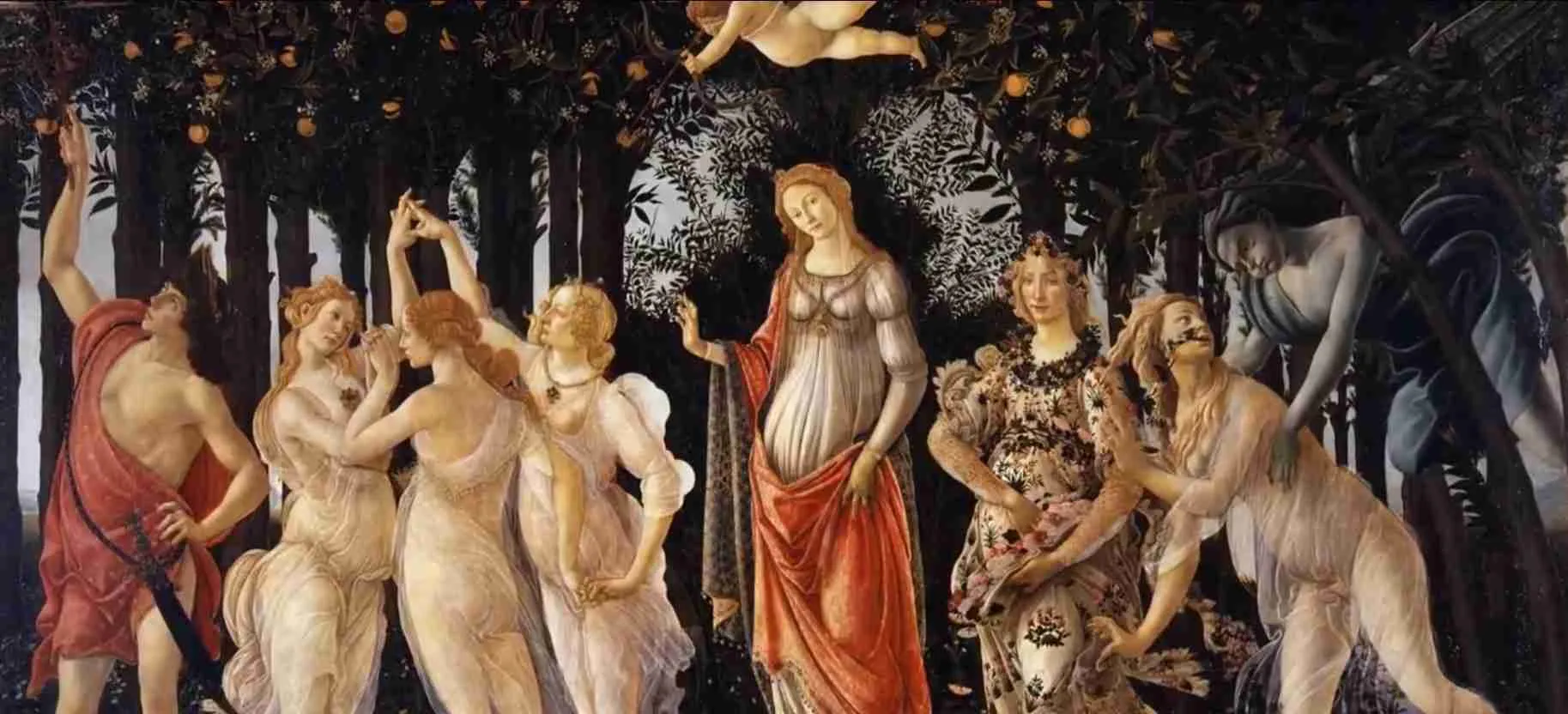
Primavera presents nine figures arranged in a garden setting, creating Renaissance painting’s most complex and enduringly mysterious allegorical composition. The painting measures 202 × 314 centimeters, making it even larger than the Birth of Venus and one of the early Renaissance’s most ambitious mythological works. The figures stand against a dark orange grove background, their arrangement creating multiple interconnected narratives that scholars continue debating centuries after the painting’s creation. No single interpretation has achieved universal acceptance, testifying to the sophistication and deliberate ambiguity Botticelli built into this masterpiece.
Reading from right to left, the painting begins with Zephyrus, the west wind, pursuing the nymph Chloris through the grove. His blue-gray skin and windswept hair identify him as a supernatural force, while his aggressive pursuit of Chloris creates the composition’s most dramatic moment. Chloris looks back in alarm as Zephyrus grasps her, flowers beginning to emerge from her mouth—a visual representation of her transformation into Flora, the goddess of flowers, who stands immediately to her left. Flora, wearing a gown covered with flowers and scattering more blossoms from gathered fabric, gazes directly at the viewer, creating the painting’s only moment of direct engagement with the audience.
At the composition’s center stands Venus, positioned slightly to the right of the painting’s actual midpoint. She raises her right hand in a gesture of blessing or welcome, presiding over the garden scene as its guiding spirit. Unlike the nude Venus of the Birth of Venus, here the goddess wears contemporary Florentine dress, though her elaborate costume and regal bearing distinguish her from ordinary mortals. Above Venus hovers Cupid, blindfolded and drawing his bow, aiming an arrow at one of the Three Graces who dance to Venus’s left. The Graces, dressed in translucent gowns that reveal their forms while maintaining modesty, hold hands in a circular dance, their graceful movement embodying harmony and beauty.
On the far left stands Mercury, identified by his winged sandals and caduceus (staff with entwined serpents). He reaches upward with his caduceus to dispel clouds from the garden, performing his traditional role as divine messenger and guardian. His red cloak and elaborate costume establish him as the composition’s masculine counterpart to Venus, framing the central scene between these two powerful presiding figures. The relationship between Mercury and the Graces remains ambiguous—scholars debate whether Cupid’s arrow aims at the Grace nearest Mercury, suggesting romantic connection, or whether Mercury deliberately ignores the Graces, focused instead on his celestial duties.
The botanical detail throughout Primavera demonstrates Botticelli’s extraordinary technical skill and reflects contemporary scientific interest in natural history. Scholars have identified approximately 500 individual plant species rendered with sufficient accuracy for botanical identification, including over 190 different flower types. The orange grove background features fruit-laden trees suggesting the garden of the Hesperides from classical mythology. The ground carpet of flowers includes species blooming at different seasons, suggesting this garden exists outside normal temporal progression—a perpetual spring where all flowers bloom simultaneously, reinforcing the painting’s allegorical rather than naturalistic intention.
The composition’s complexity extends to its spatial organization. Unlike the Birth of Venus’s clear left-to-right movement, Primavera creates multiple focal points and reading paths. The right-hand narrative of Zephyrus, Chloris, and Flora proceeds from right to left, establishing one directional flow. Venus at center commands attention as the composition’s vertical axis and hierarchical superior. The Three Graces create circular motion through their dance. Mercury’s upward reach establishes vertical movement opposing the generally horizontal arrangement. These multiple directional forces create visual richness while preventing any single reading from dominating, contributing to the painting’s enduring fascination.
Interpretations of Primavera’s meaning have proliferated since the 19th-century rediscovery of the painting. The traditional reading identifies the work as an allegory of spring’s arrival, with Zephyrus’s pursuit of Chloris and her transformation into Flora representing the west wind bringing spring, while the Three Graces and Venus embody spring’s beauty and fertility. However, more complex interpretations draw on Neoplatonic philosophy, suggesting the painting presents the soul’s journey through different types of love—from base physical desire (Zephyrus’s assault) through earthly love (Venus) to celestial contemplation (Mercury dispelling clouds to reveal divine realms).
Recent scholarship emphasizes the painting’s connection to Medici marriage celebrations, specifically the wedding of Lorenzo di Pierfrancesco de’ Medici in 1482. This interpretation suggests Primavera functioned as sophisticated wedding imagery, celebrating marriage through classical mythology while embedding messages about appropriate love, fertility, and virtue. The garden setting evokes the traditional hortus conclusus (enclosed garden) symbolizing virginity, while the transformation of Chloris into Flora could represent the bride’s transformation through marriage. Venus presiding over the scene would thus govern married love, while Mercury’s presence adds masculine authority and divine blessing.
The technical execution reveals Botticelli’s mature mastery of tempera painting on canvas. The dark background throws the luminous figures forward, creating dramatic visual impact while allowing intricate detail in costumes and botanical elements to register clearly. The linear quality characteristic of Botticelli’s style reaches its apex in Primavera, where flowing contours define form more powerfully than shading or modeling. The translucent drapery of the Graces demonstrates extraordinary technical sophistication, revealing bodies beneath while maintaining linear clarity that prevents the composition from becoming visually chaotic despite its complexity.
Like the Birth of Venus, Primavera hung in Lorenzo di Pierfrancesco de’ Medici’s villa at Castello. Contemporary inventories describe the painting’s placement over a lettuccio (a type of daybed or settee), suggesting it served both decorative and contemplative functions. Viewers reclining on the furniture below would gaze upward at the painting during conversations about philosophy, poetry, or classical learning. The painting’s dense symbolism and multiple interpretive possibilities made it ideal for extended discussion, displaying the patron’s sophistication while providing inexhaustible material for educated debate and refined conversation.
Botticelli’s Distinctive Linear Style
Botticelli’s artistic identity centers on his revolutionary use of line as the primary means of creating form, space, and expression. While contemporary artists like Leonardo da Vinci emphasized sfumato (soft atmospheric effects) and chiaroscuro (dramatic light-dark contrasts) to model three-dimensional form, Botticelli deliberately prioritized linear contour, creating figures defined more by their flowing outlines than by sculptural mass. This choice represents conscious artistic decision rather than technical limitation—Botticelli certainly possessed the skill to create more naturalistic modeling but chose instead to develop a distinctive linear vocabulary that suited his artistic purposes more effectively than pure naturalism.
The flowing quality of Botticelli’s line creates movement and grace that seem to defy gravity and physical constraint. His figures, particularly female figures, possess elongated proportions—long necks, slender bodies, tapering fingers—that enhance their ethereal quality while departing from strictly naturalistic anatomy. Hair cascades in rhythmic waves that echo drapery folds, which in turn echo landscape contours, creating visual harmonies that unify compositions through repeated linear motifs. This integration of line across different compositional elements generates decorative coherence while maintaining clarity of individual forms.
Botticelli’s drapery demonstrates the expressive potential of linear technique. Rather than hanging according to gravity and body structure, Botticelli’s fabric flows in seemingly windswept patterns that enhance movement and emotional expression. The transparent veils of the Three Graces in Primavera simultaneously reveal and conceal their bodies, their folds creating rhythmic patterns independent of strict anatomical logic. The Hora’s flower-decorated mantle in the Birth of Venus billows dramatically despite relatively calm atmospheric conditions, its movement expressing the figure’s eager rush toward Venus rather than responding purely to physical forces.
This prioritization of line over three-dimensional modeling connects Botticelli to earlier Gothic and International Gothic traditions while distinguishing him from the scientific naturalism increasingly dominant in Renaissance Florence. Artists like Masaccio, Donatello, and later Leonardo pursued ever-greater anatomical accuracy, mathematical perspective, and naturalistic lighting. Botticelli absorbed these innovations—his perspective construction and anatomical knowledge demonstrate technical competence—but subordinated them to linear grace and decorative harmony. This choice made his mature work seem conservative to some contemporaries but created distinctive beauty that continues attracting admiration five centuries later.
The emotional effect of Botticelli’s linear style tends toward contemplative melancholy rather than dramatic intensity. His figures rarely display strong emotions; instead, they convey subtle, ineffable feeling through gentle gestures, slightly tilted heads, and serene, inward-focused expressions. This emotional restraint suits the Neoplatonic content of his mythological paintings, where figures represent philosophical abstractions rather than psychologically complex individuals. The linearity itself contributes to this effect—by reducing naturalistic detail and emphasizing flowing contours, Botticelli distances his figures from everyday reality, positioning them in an idealized realm where physical laws yield to aesthetic and spiritual principles.
Color in Botticelli’s paintings harmonizes with rather than competing against his linear structure. He employs a relatively limited palette dominated by pale pinks, blues, greens, and golden tones, creating overall chromatic unity that allows linear patterns to dominate visual attention. This approach differs markedly from Venetian colorism, which would soon develop emphasis on rich, varied color as painting’s primary expressive element. Botticelli’s color serves line, clarifying compositional structure and enhancing decorative effect while rarely calling attention to itself through dramatic contrasts or unexpected combinations.
The late 19th-century revival of interest in Botticelli owed much to appreciation for exactly these linear qualities. Pre-Raphaelite painters and Aesthetic Movement critics, rebelling against academic realism and industrial materialism, found in Botticelli’s work an alternative vision emphasizing beauty, decoration, and spiritual refinement over literal representation. Walter Pater’s influential essay on Botticelli helped establish the artist’s modern reputation, celebrating the linear grace and subtle emotion that earlier critics had dismissed as primitive or mannered. This appreciation continues shaping how contemporary viewers encounter Botticelli’s work, valuing qualities that Renaissance viewers might have considered limitations.
Neoplatonic Philosophy in Botticelli’s Mythological Paintings
Understanding Neoplatonic philosophy proves essential for grasping the intellectual content and cultural significance of Botticelli’s mythological masterpieces. Neoplatonism, the sophisticated philosophical system developed by Plotinus in the 3rd century CE and revived by Marsilio Ficino in 15th-century Florence, posits a hierarchical universe where all existence emanates from a transcendent One or Good, descending through levels of decreasing perfection until reaching base matter. This system provided Renaissance intellectuals with a framework for reconciling Platonic philosophy with Christian theology, allowing classical learning to inform rather than contradict religious faith.
The central Neoplatonic concept relevant to Botticelli’s paintings involves the nature and function of beauty. According to Neoplatonic doctrine, beauty represents a divine quality that emanates from God and manifests at every level of existence. Physical beauty, rather than being mere sensory pleasure or deceptive appearance, actually participates in divine beauty and can serve as a ladder allowing souls to ascend toward spiritual contemplation. When properly understood, encountering beautiful objects should inspire the soul to move beyond immediate sensory pleasure toward contemplation of the eternal beauty from which all particular beauties derive their attractiveness.
This philosophical framework transformed how educated Renaissance viewers understood mythological imagery and artistic beauty. Venus, for example, represented not merely the pagan goddess of physical love but embodied the principle by which divine beauty manifests in the material world. Her two traditional aspects—Celestial Venus and Earthly Venus—corresponded to different modes of love: Celestial Venus represented the soul’s love for divine beauty and wisdom, while Earthly Venus represented procreative love necessary for material existence. Both aspects were legitimate and necessary, though Celestial Venus occupied higher rank in the ontological hierarchy.
The Birth of Venus can be read as an allegory of divine beauty’s manifestation in the physical world. Venus emerging from the sea represents the generation of beauty from primordial matter, her journey toward shore symbolizes beauty’s entrance into the realm of material existence, and the Hora’s preparation to clothe her suggests beauty’s incorporation into the ordered structures of nature and civilization. The entire scene thus presents philosophical ideas about beauty’s origin and function rather than merely depicting a mythological narrative. Viewers educated in Neoplatonic thought would recognize these meanings while also appreciating the painting’s sensory beauty—creating exactly the synthesis of physical pleasure and intellectual contemplation that Neoplatonic aesthetics prescribed.
Primavera’s complexity allows even more elaborate Neoplatonic interpretation. The sequence from Zephyrus’s violent desire for Chloris through her transformation into Flora, Venus’s presiding governance, the Graces’ harmonious dance, and Mercury’s celestial focus creates a progression from base physical desire upward through increasingly refined types of love toward spiritual contemplation. This reading positions the painting as a philosophical lesson about love’s proper ordering, with Venus at center representing the balance point between earthly and celestial attractions. The garden setting reinforces this interpretation, representing the soul’s middle position between material existence (Zephyrus’s pursuit) and divine contemplation (Mercury’s heavenly gaze).
The pedagogical function of such paintings in Medici intellectual culture deserves emphasis. These works were not created for purely aesthetic enjoyment but served as visual philosophy, providing material for extended discussion and contemplation among educated viewers. Gathering in Lorenzo di Pierfrancesco’s villa, guests would use paintings as starting points for conversations about love, beauty, virtue, and the soul’s journey toward divine union. The paintings’ complex symbolism and multiple interpretive possibilities made them ideal for this purpose, displaying the patron’s learning while providing inexhaustible content for refined discourse.
The relationship between Neoplatonic content and Christian faith requires careful understanding. Renaissance Neoplatonists did not view classical philosophy as replacing Christian revelation but as complementing and illuminating it. Ficino argued that Plato had anticipated Christian truths through natural reason, making Platonic philosophy a legitimate preparation for Christianity. This syncretist approach allowed Medici intellectuals to pursue classical learning enthusiastically while maintaining Christian orthodoxy. Mythological paintings participated in this synthesis, using pagan imagery to express philosophical truths understood as compatible with Christian teaching when properly interpreted.
The decline of Neoplatonism in later Renaissance thought affected how Botticelli’s paintings were understood and valued. As emphasis shifted from philosophical allegory toward more direct naturalism and emotional expression, Botticelli’s mythological works seemed increasingly obscure and old-fashioned. Without the interpretive framework provided by Neoplatonic philosophy, later viewers struggled to grasp the paintings’ intellectual content, often reducing them to mere decorative beauty or mythological narrative. Only the 19th-century revival of interest in Renaissance culture, accompanied by scholarly recovery of Neoplatonic texts and contexts, enabled modern viewers to appreciate the sophisticated philosophical content that original audiences would have recognized immediately.
Other Botticelli Masterpieces at the Uffizi
While the Birth of Venus and Primavera represent Botticelli’s most celebrated achievements, the Uffizi’s comprehensive collection allows visitors to trace his entire artistic development through numerous other masterpieces spanning his career. The Adoration of the Magi (1475-1476) demonstrates Botticelli’s early maturity and his relationship with the Medici family through the inclusion of family member portraits among the crowd of worshippers. Cosimo de’ Medici appears as the oldest Magus kneeling before the Christ child, while other Medici figures populate the composition, transforming a religious scene into sophisticated political statement and family commemoration.
The Madonna of the Magnificat (c. 1481) showcases Botticelli’s ability to create complex circular compositions with numerous figures arranged within a tondo (round) format. The Virgin Mary writes the opening lines of the Magnificat in a book while the Christ child offers her a pomegranate, surrounded by angels in an intimate devotional scene. The technical challenge of organizing multiple figures convincingly within circular format demonstrates Botticelli’s compositional sophistication, while the tender emotional quality exemplifies his ability to create deeply moving religious imagery alongside his mythological works.
The Annunciation (1489-1490) represents Botticelli’s late period, showing stylistic evolution toward increased austerity and spiritual intensity. The architectural setting demonstrates sophisticated perspective construction, while the Virgin’s recoiling gesture and the angel’s reverent approach convey dramatic emotional intensity unusual in Botticelli’s typically serene works. This painting reflects the changing cultural atmosphere of Florence in the 1490s, when Savonarola’s apocalyptic preaching created conditions hostile to the classical revival and mythological subjects that had characterized the previous decade.
The Cestello Annunciation (1489-1490) offers comparison with the earlier Annunciation, demonstrating how Botticelli explored different solutions to the same subject. The architectural space differs dramatically, creating more compressed, intimate setting, while the figures’ gestures and expressions convey different emotional qualities. Examining multiple treatments of identical subjects allows visitors to appreciate Botticelli’s artistic process and his willingness to rethink composition rather than merely repeating successful formulas.
Several portraits demonstrate Botticelli’s skill in capturing individual character and social status. The Portrait of a Young Man (c. 1480-1485) shows Botticelli’s ability to create psychologically penetrating characterization through minimal means—the sitter’s direct gaze and slightly apprehensive expression create immediate human connection across five centuries. The technical execution, with careful attention to costume detail and subtle modeling of facial features, demonstrates skills usually overshadowed by discussion of Botticelli’s mythological masterpieces but essential to his workshop’s commercial success.
The Pallas and the Centaur (c. 1482) provides interesting comparison to Primavera and the Birth of Venus, presenting another mythological subject with complex allegorical content. Pallas Athena grasps a centaur’s hair, asserting reason’s control over bestial passion in a composition that may reference specific contemporary political events while maintaining timeless philosophical meaning. The painting’s technical execution and symbolic complexity demonstrate that Botticelli’s mythological achievement extended beyond his two most celebrated works to encompass broader exploration of classical subjects and Neoplatonic themes.
Religious works from throughout Botticelli’s career allow visitors to understand that mythological painting represented expansion rather than replacement of traditional subjects. The San Barnaba Altarpiece (1488), the Madonna Enthroned with Saints (1484-1486), and numerous smaller devotional panels demonstrate Botticelli’s continued commitment to religious painting and his ability to innovate within traditional formats. These works served different functions than mythological paintings—addressing prayer and devotion rather than intellectual discussion—but employed similar technical means and artistic vocabulary adapted to their specific purposes.
Late works like the Mystic Nativity (1501) and the Mystic Crucifixion demonstrate Botticelli’s evolution toward increasingly spiritual, even visionary imagery in his final years. These paintings abandon the classical balance and harmonious beauty of his mature period in favor of intense emotional expression and deliberately archaic compositional strategies. The Mystic Nativity includes a Greek inscription indicating Botticelli believed he was living in apocalyptic times, providing rare direct evidence of the artist’s mental and spiritual state in Florence’s turbulent political and religious environment of the early 16th century.
Navigating the Uffizi’s Botticelli Rooms
The Uffizi Gallery positions its Botticelli collection in Rooms 10-14 on the museum’s second floor, creating one of the world’s most significant concentrations of works by a single Renaissance artist. The museum’s overall organization follows chronological progression through art history, placing Botticelli at the culmination of the early Renaissance section immediately before rooms dedicated to High Renaissance masters. This arrangement demonstrates Botticelli’s pivotal role in Renaissance artistic development while allowing visitors to understand his work within broader historical context and stylistic evolution.
After ascending the Uffizi’s monumental staircase and proceeding through the entrance gallery, visitors progress through rooms dedicated to medieval and early Renaissance painting. This chronological approach allows appreciation of innovations that made Botticelli’s achievement possible—Giotto’s breakthrough toward naturalistic space and human emotion, Masaccio’s revolutionary understanding of light and perspective, Fra Filippo Lippi’s graceful figures and complex compositions. Understanding these precedents enhances recognition of Botticelli’s distinctive contributions and his synthesis of earlier innovations into a unique artistic vision.
The Botticelli rooms themselves arrange works to allow comparison across the artist’s career while highlighting the Birth of Venus and Primavera as centerpieces. The two mythological masterpieces hang in positions allowing viewing from multiple distances—visitors can appreciate overall composition from across the room before approaching for detailed examination of botanical elements, facial expressions, and technical execution. The museum’s carefully regulated lighting protects these five-century-old tempera works while ensuring optimal visibility of Botticelli’s subtle color harmonies and intricate linear patterns.
The concentration of Botticelli’s work in adjacent rooms creates opportunities for comparative study impossible elsewhere. Visitors can trace stylistic evolution from early religious works through mythological masterpieces to late mystical paintings, observing how Botticelli’s technical approach and thematic interests shifted across four decades. The presence of multiple Annunciations, several Adoration of the Magi treatments, and numerous Madonna compositions allows recognition of how Botticelli reworked similar subjects throughout his career, developing increasingly personal and sophisticated interpretations of traditional themes.
Crowd management considerations affect the Botticelli rooms significantly, as these paintings attract more visitors than any other section of the Uffizi except Michelangelo’s Doni Tondo and Leonardo’s Annunciation. Peak visiting hours typically see dense crowds gathered around the Birth of Venus and Primavera, making detailed viewing challenging. Strategic timing—arriving when the museum opens at 8:15 AM or visiting during late afternoon hours—reduces crowding considerably. The museum’s gradual reopening of the Vasari Corridor and expansion of gallery space has somewhat alleviated pressure on the main Botticelli rooms, though these masterpieces will always attract substantial attention.
The architectural setting of the Uffizi Gallery itself contributes to the viewing experience. Designed by Giorgio Vasari in the 16th century as administrative offices for the Medici grand dukes, the building’s long corridors and succession of rooms create gradual revelation of artworks rather than overwhelming immediate display. The windows overlooking the Arno River and Ponte Vecchio provide natural light and visual relief between intense engagement with paintings. This architecture shapes how visitors experience Botticelli’s work, creating rhythm of approach, concentrated viewing, and pause that affects emotional and intellectual response.
Visitors seeking deeper engagement with Botticelli’s paintings can supplement gallery viewing with the Uffizi’s audio guides, which provide detailed information about major works including extended commentary on the Birth of Venus and Primavera. These guides offer historical context, symbolic interpretation, and technical analysis that enhances understanding while allowing self-paced exploration. Alternatively, numerous private tour companies offer guided visits focused specifically on Botticelli and Renaissance painting, providing expert interpretation and answering questions impossible in audio format.
The museum’s bookshop offers extensive resources for continued study, including scholarly monographs on Botticelli, catalogs of the Uffizi’s Renaissance collection, and reproductions ranging from postcards to high-quality prints. These materials allow visitors to extend engagement beyond the museum visit itself, studying details and interpretations at leisure. Digital resources have expanded access dramatically—the Uffizi’s website provides high-resolution images of major works along with curatorial commentary, enabling virtual study before or after physical visits.
Planning Your Visit to the Uffizi
The Uffizi Gallery opens Tuesday through Sunday from 8:15 AM to 6:30 PM, with last admission at 5:30 PM and visitors asked to proceed toward exits at 6:30 PM. The museum closes Mondays, December 25, and January 1. These hours allow approximately two to three hours for thorough visits, sufficient time to see the Botticelli masterpieces along with other Renaissance highlights without feeling rushed. Visitors particularly interested in Botticelli should budget 45-60 minutes minimum for concentrated engagement with the Birth of Venus, Primavera, and other works in Rooms 10-14.
Ticket prices operate on a tiered system managed through the official ticketing service at tickets.uffizi.it. Full-price tickets cost €25 when purchased at the ticket office on the day of visit. Advance online reservations include booking fees beyond the base admission price. Reduced-price tickets at €2 are available for EU citizens aged 18-25, while free admission applies to visitors under 18, teachers accompanying school groups, and other specific categories detailed on the museum’s official website. Early morning tickets for entry between 8:15-8:55 AM cost €23, while afternoon tickets for entry after 4:00 PM cost €20 (available starting January 2026). Check the official Uffizi website for current rates as pricing may vary.
Advance reservations prove essential during peak tourist season (April-October) and highly recommended year-round, as the Uffizi limits daily visitors for conservation and safety reasons. Saturday and public holiday visits require reservations at least one day in advance. Tickets can be purchased through the official website, by calling the reservation center (toll-free within Italy: 800-615-615; from abroad: +39-055-035-4135, Monday-Sunday 8:00 AM-7:00 PM), or at the museum’s ticket offices during regular hours. Online booking allows selection of specific entry times, reducing waiting even during busy periods.
The museum offers three separate entrances serving different visitor categories. Door 1 on the left side accommodates tour groups, school groups, and visitors with special reservations including Firenze Card holders. Door 2 serves as the main entrance for purchasing tickets on-site, though this entrance typically experiences the longest queues. Door 3, located across Piazza degli Uffizi, serves visitors with online reservations—these visitors should arrive 10-15 minutes before their scheduled time to collect tickets and pass through security. Understanding which entrance to use prevents confusion and wasted time upon arrival.
The Uffizi Gallery provides various visitor services enhancing the museum experience. Audio guides available for €6 offer commentary in Italian, English, French, Spanish, German, Polish, Russian, and Japanese, with content covering permanent collection highlights including extensive treatment of Botticelli’s major works. The audio guide desk appears near the cloakroom before ascending to gallery floors, and delivery service continues until 5:00 PM. Wheelchairs are available on first-come, first-served basis upon request at entry—advance reservation is not possible, but visitors with disabilities can proceed to the front of entrance lines upon presenting appropriate documentation.
The museum prohibits large backpacks, suitcases, and similar bulky items, which must be checked at the cloakroom located near the entrance. This policy applies strictly for conservation and security reasons—visitors attempting entry with prohibited items will be directed to storage facilities. Photography is permitted throughout the museum without flash, tripods, or selfie sticks. Personal photos for non-commercial use require no special permission, though commercial photography requires advance authorization obtained by contacting museum administration directly through their official website.
The Uffizi’s location in central Florence makes access straightforward from anywhere in the historic center. The museum stands at Piazzale degli Uffizi 6, immediately adjacent to Palazzo Vecchio and the Piazza della Signoria. Visitors arriving by train at Santa Maria Novella station can walk approximately 18 minutes through Florence’s historic center, though the route involves some navigation through the medieval street pattern. Bus line C1 stops at Galleria Degli Uffizi, providing direct access within 2-minute walk. Visitors driving should park at nearby facilities like Garage Tintori or Garage Palazzo Vecchio, as the historic center maintains limited traffic zones prohibiting most vehicle access.
The museum features a café-terrace on the second floor offering panoramic views over Florence along with refreshments and light meals. This provides welcome break opportunity during extended visits, particularly when viewing the comprehensive collection requires three or more hours. The exit-level bookshop and gift shop offer extensive selections of art books, gallery-inspired merchandise, and specialized art history publications. These facilities allow visitors to rest, refresh, and acquire resources without leaving the museum complex.
Botticelli’s Influence and Legacy
Botticelli’s immediate influence during his lifetime proved substantial but geographically limited, affecting primarily artists working in Florence and other Tuscan centers during the late 15th century. His workshop trained numerous assistants who carried forward his technical approaches and compositional strategies, while contemporary artists admired his graceful figures and sophisticated narrative construction. However, the High Renaissance achievements of Leonardo, Michelangelo, and Raphael soon eclipsed Botticelli’s linear elegance, as younger artists pursued more dramatic naturalism, monumental scale, and emotional intensity than Botticelli’s refined lyricism could match.
The rapid shift in artistic taste that occurred in the early 16th century proved devastating to Botticelli’s posthumous reputation. Giorgio Vasari’s influential “Lives of the Artists” (1550) treated Botticelli respectfully but positioned him as a minor figure compared to High Renaissance giants. Vasari’s assessment shaped critical opinion for centuries, relegating Botticelli to historical footnotes rather than celebrated masters. The Birth of Venus and Primavera hung in relative obscurity, known primarily to specialists and visitors with particular interest in early Renaissance painting. This neglect resulted partly from changing artistic values—Baroque and academic traditions emphasized qualities absent from Botticelli’s work—and partly from the paintings’ complex allegorical content becoming incomprehensible without knowledge of Neoplatonic philosophy.
The 19th-century rediscovery of Botticelli transformed his reputation permanently and dramatically. Pre-Raphaelite painters, rebelling against academic conventions and industrial materialism, found in Botticelli’s linear grace and spiritual refinement an alternative vision of beauty opposed to their era’s dominant values. Edward Burne-Jones, Dante Gabriel Rossetti, and other Pre-Raphaelites consciously emulated Botticelli’s elongated figures, flowing drapery, and decorative patterns. Walter Pater’s influential essay on Botticelli (1870) articulated sophisticated appreciation for exactly those qualities earlier critics had dismissed, celebrating the artist’s subtle emotion and refined sensibility.
This 19th-century revival established the Birth of Venus and Primavera as iconic images recognized globally, a status they have maintained and strengthened ever since. The paintings became symbols of Renaissance achievement, appearing in countless reproductions and adaptations. Their imagery permeated popular culture through advertising, fashion, and design, making Venus’s shell-borne figure one of Western art’s most universally recognized images. This popularization created interesting tension—the paintings’ complex philosophical content became largely forgotten while their visual beauty achieved mass circulation divorced from original meaning.
Art Nouveau designers found particular inspiration in Botticelli’s flowing linear patterns and integration of natural forms with human figures. Alphonse Mucha, Aubrey Beardsley, and other Art Nouveau artists adapted Botticelli’s decorative approach to create posters, book illustrations, and applied art that translated Renaissance techniques into modern contexts. This influence extended Botticelli’s impact far beyond fine art painting into graphic design, illustration, and commercial art, demonstrating how historical styles could inspire contemporary creativity across different media and purposes.
Scholarly study in the 20th century recovered the paintings’ original contexts and meanings, enabling more historically informed appreciation while complicating romantic interpretations. Research into Neoplatonic philosophy, Medici patronage patterns, and Renaissance cultural history revealed the sophisticated intellectual content embedded in Botticelli’s mythological works. This scholarship demonstrated that the paintings functioned not as mere decoration but as visual philosophy, participating in serious intellectual discourse within Medici cultural circles. Modern viewers thus encounter the works with richer understanding of their original purposes and meanings, though the paintings’ sheer visual beauty continues generating powerful responses independent of scholarly interpretation.
Contemporary artists continue engaging with Botticelli’s imagery and approaches, demonstrating the ongoing vitality of his influence. Artists as diverse as Andy Warhol, who created silkscreen variations of the Birth of Venus, and Kehinde Wiley, whose work references Renaissance painting traditions while addressing contemporary identity politics, demonstrate Botticelli’s continued relevance to artistic practice. These contemporary engagements suggest that Botticelli’s paintings transcend their specific historical moment, offering visual and conceptual resources applicable to ongoing artistic exploration and cultural commentary.
The tension between high art status and popular recognition continues shaping how audiences encounter Botticelli’s work. The paintings’ ubiquity through reproduction and adaptation creates familiarity that can either enhance or impede direct engagement with the originals. Some visitors approach the Birth of Venus and Primavera with such strong preconceptions from reproductions that seeing the actual paintings proves disappointing or confirms expectations so perfectly that fresh observation becomes difficult. However, careful viewing reveals subtleties invisible in reproductions—the delicate brushwork, the complex color harmonies, the precise linear patterns—that reward direct encounter and demonstrate why these works maintain their power across five centuries.
The Technical Restoration of Botticelli’s Masterpieces
The Birth of Venus and Primavera have undergone multiple restoration campaigns over their five-century existence, each responding to accumulated dirt, previous restoration interventions, and structural issues affecting the canvas supports. Modern conservation science approaches these invaluable works with extreme caution, employing non-invasive analysis techniques before any physical intervention and prioritizing reversibility of treatments to allow future conservators to refine methods as scientific understanding advances. The Uffizi’s conservation department maintains continuous monitoring of these masterpieces, tracking environmental conditions and structural stability to prevent deterioration before crisis intervention becomes necessary.
The most significant restoration of the Birth of Venus occurred in the 1980s, involving careful removal of darkened varnish layers that had accumulated over centuries and obscured Botticelli’s original delicate color harmonies. Conservators employed meticulous techniques to dissolve aged varnish without damaging the fragile tempera paint layer beneath, revealing colors substantially lighter and more luminous than visitors had seen for generations. The cleaning revealed Botticelli’s sophisticated color orchestration, particularly in the subtle variations of flesh tones and the pale atmospheric background that earlier varnish layers had yellowed and darkened significantly.
Technical analysis conducted during restoration campaigns has revealed important information about Botticelli’s working methods and materials. Infrared reflectography shows extensive underdrawing beneath the painted surface, demonstrating that Botticelli planned compositions carefully through detailed preliminary drawing rather than working spontaneously. Analysis of pigments confirms he employed the finest available materials, including expensive ultramarine blue made from ground lapis lazuli, sophisticated color mixtures creating subtle intermediate tones, and gold leaf highlights adding precious materiality to divine subjects.
The canvas supports of both paintings present ongoing conservation challenges. Unlike panel paintings that remain relatively stable unless affected by extreme environmental fluctuations, canvas responds more dynamically to temperature and humidity changes, expanding and contracting in ways that stress the inflexible tempera paint layer. Over centuries, these movements create networks of fine cracks (craquelure) throughout the paint surface, which while not immediately threatening the paintings’ survival, require monitoring to prevent crack expansion that could lead to paint loss. Modern climate control in museum galleries helps minimize such fluctuations, but the paintings’ age means some structural instability remains inevitable.
Previous restoration interventions, some dating to the 18th and 19th centuries, created problems that modern conservators must address carefully. Earlier restorers employed materials and techniques now understood as harmful, including oil-based overpaint to conceal damage, strong solvents that removed original paint along with dirt, and structural reinforcements that created stress on original canvas. Removing these problematic earlier interventions without causing additional damage requires extreme skill and patience, as distinguishing between original and later paint layers becomes difficult when both have aged for centuries.
The conservation philosophy guiding current treatment emphasizes minimal intervention, reversibility, and distinguishability of conservation work from original. Modern conservators resist the earlier practice of making paintings appear “new” through extensive overpaint and varnish. Instead, they stabilize existing condition, remove only clearly harmful materials, and accept that five-century-old paintings will show their age through minor losses and surface irregularities. This approach preserves maximum original material while ensuring paintings remain stable for future generations, though it means contemporary viewers see these works as aged objects rather than as they appeared when newly created.
Technological advances continue improving conservation capabilities and understanding. Digital imaging techniques allow non-invasive examination of paintings’ internal structure, revealing details about Botticelli’s layering techniques, compositional changes during execution, and structural condition of support and ground layers. This information guides conservation planning and deepens scholarly understanding of artistic process. Future developments in materials science may enable more effective stabilization treatments, though the fundamental conservation challenge—maintaining five-century-old tempera paintings in stable condition indefinitely—remains technically demanding regardless of available technology.
The public controversy occasionally surrounding restoration demonstrates the emotional investment audiences have in these iconic images. When the Birth of Venus cleaning revealed lighter, more delicate colors than familiar from darkened pre-restoration state, some critics argued that conservators had damaged the painting by removing too much original material. Such debates reflect legitimate tension between scientific conservation objectives and public expectations shaped by familiarity with aged, darkened appearance. However, scientific analysis consistently supports conservators’ claims that cleaning revealed Botticelli’s original intention rather than damaging it, though debate about appropriate extent of cleaning continues within conservation profession itself.
Comparing Botticelli with Contemporary Artists
Examining Botticelli alongside his contemporaries illuminates his distinctive artistic choices and reveals the diverse approaches coexisting in late 15th-century Florence. Leonardo da Vinci, approximately ten years younger than Botticelli, pursued naturalistic observation and scientific investigation with revolutionary intensity, studying anatomy, light, and atmospheric effects to create unprecedented realism. Leonardo’s paintings employ sfumato technique and subtle tonal gradations that make Botticelli’s crisp linear contours appear deliberately stylized by comparison. Yet both artists achieved excellence through different means, demonstrating that Renaissance art encompassed multiple valid approaches rather than progressing toward single correct methodology.
Domenico Ghirlandaio, Botticelli’s near contemporary, created narrative paintings characterized by meticulous detail, contemporary costume, and extensive portrait inclusion that documented Florentine society with almost photographic specificity. Ghirlandaio’s frescoes in Santa Maria Novella demonstrate technical virtuosity in perspective, architectural rendering, and figure grouping that rivals Botticelli’s achievement while pursuing different priorities. Where Botticelli prioritized grace and philosophical content, Ghirlandaio emphasized documentary accuracy and social documentation, creating works that function as historical records of Florentine life and fashion.
Perugino, the leading Umbrian painter of the period and Raphael’s master, developed serene, harmonious compositions characterized by gentle landscapes, balanced arrangements, and spiritual tranquility. His approach shares Botticelli’s emphasis on graceful figures and refined beauty while differing in spatial construction and emotional tone. Perugino’s paintings employ deeper, more convincing space than Botticelli typically created, positioning figures in believable landscapes rather than against relatively flat backgrounds. The comparison reveals Botticelli’s deliberate choice of decorative flatness over naturalistic depth, reflecting different artistic priorities and intended functions.
Luca Signorelli pursued dynamic figure poses, dramatic foreshortening, and powerful physical presence that contrasts sharply with Botticelli’s ethereal elegance. Signorelli’s figures possess sculptural mass and athletic energy entirely different from Botticelli’s elongated, weightless forms. His Last Judgment frescoes in Orvieto Cathedral demonstrate muscular vigor and spatial complexity representing different Renaissance priorities—emphasis on human body’s physical power rather than spiritual refinement, dramatic action rather than contemplative stasis. These differences demonstrate Renaissance art’s diversity rather than unified progression toward single stylistic goal.
Filippino Lippi, son of Botticelli’s master Fra Filippo Lippi, represents the generation immediately following Botticelli and demonstrates how younger artists built upon his achievements while developing personal approaches. Filippino’s paintings show clear influence from Botticelli in graceful figures and linear elegance, yet incorporate greater spatial complexity and antiquarian detail reflecting changing intellectual interests. His work suggests how Botticelli’s students and followers adapted his style to evolving tastes, maintaining core qualities while adjusting to new demands.
Andrea Mantegna in Mantua developed archaeological precision and classical reference more systematic than any Florentine contemporary, creating paintings that reconstructed ancient Rome with scholarly accuracy. His figures demonstrate knowledge of classical sculpture that influenced numerous Italian artists including Botticelli, though Mantegna pursued archaeological correctness rather than graceful adaptation. Comparing Botticelli’s classicism to Mantegna’s reveals different approaches to ancient revival—Mantegna attempted accurate reconstruction while Botticelli freely adapted classical motifs to serve contemporary philosophical and aesthetic purposes.
Giovanni Bellini and Venetian painters developed color and atmosphere into primary expressive means, creating effects impossible in Florentine linear tradition. Bellini’s paintings employ rich, varied color and subtle atmospheric gradations that make Botticelli’s relatively limited palette and crisp contours appear austere by comparison. This contrast illuminates fundamental difference between Florentine and Venetian artistic cultures—Florence emphasized drawing, intellectual content, and structural clarity, while Venice prioritized color, sensory pleasure, and atmospheric effect. Both approaches achieved greatness through different means, demonstrating Renaissance art’s regional diversity.
Frequently Asked Questions
Can you take photographs of the Birth of Venus and Primavera at the Uffizi?
Photography is permitted throughout the Uffizi Gallery for personal, non-commercial use, including photographs of the Birth of Venus and Primavera. However, flash photography, tripods, and selfie sticks are strictly prohibited to protect the paintings and avoid disturbing other visitors. Visitors should be respectful of others viewing the artworks when taking photographs, avoiding blocking sight lines or creating disruption. Commercial photography requires advance permission obtained by contacting museum administration through the official Uffizi website, and such requests typically involve special access outside regular visiting hours.
How long should I spend viewing the Botticelli rooms?
Visitors seriously interested in Botticelli’s work should budget 45-60 minutes minimum for the Botticelli rooms, though art enthusiasts could easily spend two hours engaging deeply with the complete collection. The Birth of Venus and Primavera deserve 15-20 minutes each for careful examination of details, symbolism, and technical execution. Additional time allows appreciation of other masterpieces including the Adoration of the Magi, various Annunciations, and portraits that demonstrate Botticelli’s range beyond his celebrated mythological works. The overall Uffizi visit typically requires 2-3 hours to see major highlights across the collection without feeling rushed.
What was Botticelli’s relationship with the Medici family?
Botticelli maintained close professional relationship with the Medici family throughout his mature career, receiving numerous important commissions that established his reputation and provided financial security. He created works for Lorenzo the Magnificent, including the famous Adoration of the Magi featuring Medici family portraits, and for Lorenzo di Pierfrancesco de’ Medici, who commissioned both the Birth of Venus and Primavera for his villa at Castello. The Medici patronage gave Botticelli access to humanist intellectual circles where he encountered Neoplatonic philosophy informing his mythological paintings. This relationship proved mutually beneficial—the Medici gained beautiful works displaying their cultural sophistication, while Botticelli received generous payment and prestigious commissions enhancing his artistic standing.
Why are the Birth of Venus and Primavera painted on canvas rather than wood panels?
Canvas supports were relatively unusual for important paintings in 15th-century Florence, where wood panels dominated. Botticelli’s choice of canvas for these large mythological works likely reflected their intended function as villa decorations rather than church altarpieces or devotional images. Canvas offered advantages for this purpose—it was lighter than wood panels of equivalent size, making transport and installation easier, and it could be produced in larger dimensions than readily available wooden planks. The villa setting also meant the paintings would not face the environmental extremes affecting church interiors, making canvas’s relative fragility less concerning. Additionally, canvas allowed the large scale necessary for these ambitious compositions without the structural complications of joining multiple wood panels.
What happened to Botticelli’s reputation after his death?
Botticelli’s reputation declined precipitously after his death in 1510, as High Renaissance achievements of Leonardo, Michelangelo, and Raphael made his linear style appear old-fashioned and primitive to changing tastes. Giorgio Vasari’s influential “Lives of the Artists” treated him respectfully but positioned him as a minor figure compared to Renaissance giants, an assessment that dominated critical opinion for three centuries. His major works hung in relative obscurity, known primarily to specialists rather than celebrated as masterpieces. Only in the late 19th century did Pre-Raphaelite painters and Aesthetic Movement critics rediscover Botticelli, championing qualities earlier viewers had dismissed and establishing the modern appreciation that transformed him into one of history’s most beloved artists.
What is the best time of day to visit the Uffizi to see Botticelli’s paintings with fewer crowds?
The optimal times for viewing the Botticelli rooms with reduced crowding are immediately when the museum opens at 8:15 AM or during late afternoon hours approaching closing time. Early morning visits allow contemplative viewing before tour groups arrive, though advance ticket purchase proves essential as early slots fill quickly during peak season. Late afternoon visits, particularly after 4:00 PM, see diminished crowds as many visitors have already departed, though this allows less time for comprehensive museum exploration. Visiting during off-season months (November-March, excluding Christmas and New Year periods) reduces overall crowding regardless of time, making even midday visits relatively comfortable.
Are there any other museums with major Botticelli paintings besides the Uffizi?
While the Uffizi preserves the world’s most comprehensive Botticelli collection, several other museums hold significant works. The Louvre in Paris owns Madonna and Child with Angels and several other paintings demonstrating Botticelli’s devotional work. The National Gallery in London houses Venus and Mars, Mystic Nativity, and Portrait of a Young Man, offering important examples of his mythological and religious painting. The Sistine Chapel in the Vatican preserves frescoes Botticelli created during his 1481-1482 Roman sojourn, including Scenes from the Life of Moses and the Punishment of Korah, demonstrating his narrative skill at monumental scale. The Städel Museum in Frankfurt and various American collections including the Metropolitan Museum of Art also hold significant Botticelli works, though none approaches the Uffizi’s comprehensive representation of his career.
Did Botticelli paint the Birth of Venus and Primavera at the same time?
Scholarly consensus dates both paintings to the early-to-mid 1480s, likely 1482-1485, suggesting they were created within relatively close temporal proximity if not simultaneously. They were commissioned by the same patron, Lorenzo di Pierfrancesco de’ Medici, for the same villa at Castello, and they share stylistic characteristics, large canvas format, and mythological subject matter indicating they formed part of a coordinated decorative program. However, precise dating remains uncertain due to lack of contemporary documentation, and some scholars argue for slightly different dates based on stylistic analysis. Whether executed simultaneously or sequentially within a few years, both paintings represent Botticelli’s mature mastery during the height of his creative powers and closest engagement with Medici humanist circles.
What does the shell symbolize in the Birth of Venus?
The giant scallop shell supporting Venus as she emerges from the sea functions on multiple symbolic levels. Most immediately, it references the classical myth of Venus’s birth from sea foam, with the shell serving as her divine vessel for crossing from sea to shore. The shell’s association with pilgrimage—particularly the Santiago de Compostela pilgrimage where scallop shells served as pilgrims’ badges—adds Christian symbolism to the pagan imagery, suggesting spiritual journey and transformation. In Neoplatonic interpretation, the shell represents the material vehicle carrying divine beauty from transcendent realms into physical manifestation, creating symbolic parallel between the shell’s role and the painting itself as container for philosophical truth. The shell’s mathematical perfection, with its regular ribs radiating from a central point, also embodies classical ideals of harmony and proportion central to Renaissance aesthetics.
Why does Botticelli’s Venus look sad or melancholic?
The subtle melancholy in Venus’s expression reflects Botticelli’s distinctive approach to depicting divine beauty and spiritual refinement rather than earthly happiness or sensual pleasure. This emotional quality appears throughout Botticelli’s mature work, particularly in female figures, creating signature mood of gentle pensiveness distinct from the more robust emotional expression common in Renaissance painting. Art historians interpret this melancholy variously—as reflection of Neoplatonic philosophy emphasizing the soul’s exile in material existence, as deliberate contrast with more joyful surrounding figures to emphasize Venus’s spiritual significance, or as Botticelli’s personal artistic vision of how divinity manifests in human form. Walter Pater’s influential 19th-century essay particularly emphasized this quality, describing Botticelli’s figures as bearing “the weariness of the world” and elevating this melancholic beauty as the artist’s supreme achievement.