Grand Palace & Wat Pho Guide: Bangkok’s Must-See Temples
Bangkok’s Grand Palace and adjacent Wat Pho temple complex represent Thailand’s most significant royal and religious landmarks, combining 18th-century Rattanakosin architectural mastery with living Buddhist traditions across a combined area exceeding 550,000 square meters in the historic heart of Bangkok. The Grand Palace’s Emerald Buddha and Wat Pho’s 46-meter Reclining Buddha anchor experiences blending sacred spirituality, Thai artistic achievement, royal history, and traditional medicine within walking distance of each other along the Chao Phraya River.
Key Takeaways for Grand Palace and Wat Pho
- Grand Palace Complex Scope: The Grand Palace encompasses over 100 buildings constructed across 218,400 square meters beginning in 1782 under King Rama I, serving as royal residence and administrative center for 150 years until 1925 when the royal family relocated to Dusit Palace while maintaining the Grand Palace for state ceremonies and coronations.
- Emerald Buddha Significance: Wat Phra Kaew (Temple of the Emerald Buddha) within Grand Palace grounds houses Thailand’s most sacred Buddha image, a 66-centimeter jade figure dating to 15th-century Lanna Kingdom, with seasonal costume changes performed exclusively by the King or Crown Prince reflecting summer, rainy, and cool season transitions.
- Reclining Buddha Dimensions: Wat Pho’s iconic Reclining Buddha stretches 46 meters long and rises 15 meters high, depicting Buddha’s entry into Nirvana with mother-of-pearl inlay covering the soles displaying 108 auspicious characteristics distinguishing Buddha from ordinary beings according to Buddhist scripture.
- Traditional Medicine Legacy: Wat Pho established Thailand’s first public university during the 19th century, specializing in traditional Thai medicine, massage therapy, and herbal remedies, with the temple continuing to operate Thailand’s most prestigious traditional massage school training practitioners in ancient healing techniques refined across centuries.
- Entrance Fee Structure: Grand Palace admission costs ฿500 per person including Wat Phra Kaew and Queen Sirikit Museum of Textiles, with children under 120 centimeters entering free, while Wat Pho charges ฿300 per person with identical height-based child exemptions and free entry for Thai nationals at both sites.
- Combined Visit Logistics: The two temple complexes sit 400 meters apart enabling efficient same-day combination visits requiring 4-5 hours total (2-3 hours Grand Palace, 1.5-2 hours Wat Pho), with morning Grand Palace visits avoiding peak afternoon crowds followed by lunch breaks before Wat Pho afternoon exploration when tour groups diminish.
People Also Ask About Grand Palace and Wat Pho
What Is the Difference Between the Grand Palace and Wat Pho?
The Grand Palace functions primarily as a former royal residence and current ceremonial venue combining palace buildings, government halls, and Wat Phra Kaew temple housing the Emerald Buddha, representing Thailand’s political and royal authority consolidated in architectural form. Wat Pho operates exclusively as an active Buddhist temple and monastery complex focusing on religious worship, traditional medicine education, and cultural preservation without royal residential functions. The Grand Palace entrance fee at ฿500 substantially exceeds Wat Pho’s ฿300 charge reflecting the palace’s larger scale, government maintenance costs, and inclusion of multiple museums beyond pure temple areas. Architecturally, the Grand Palace demonstrates European neo-classical influences alongside traditional Thai design through buildings like Chakri Maha Prasat with Italian Renaissance elements, while Wat Pho maintains strictly traditional Rattanakosin-period Thai Buddhist architecture in its prangs, chedis, and viharns. Visitor experiences differ fundamentally, with Grand Palace emphasizing royal grandeur, ceremonial spaces, and sacred Buddha veneration in Wat Phra Kaew’s jeweled setting, whereas Wat Pho centers on spiritual contemplation around the Reclining Buddha, massage therapy participation, and exploration of extensive stone inscriptions documenting traditional medicine knowledge.
Can You Visit Both the Grand Palace and Wat Pho in One Day?
Visiting both complexes in a single day proves entirely feasible and represents standard tourist practice given their 400-meter separation requiring merely 5-minute walks between entrance gates. Morning Grand Palace visits beginning at 08:30 opening time provide 2-3 hours exploring the complex before midday heat peaks and afternoon tour group arrivals, positioning visitors to exit around 11:30-12:30 for lunch at nearby riverside restaurants. Afternoon Wat Pho visits from 13:30-15:30 capitalize on reduced crowd levels as morning tour groups depart while avoiding late afternoon 16:00-18:00 Thai worshipper peaks when locals visit for evening prayers. The combined visit requires 4-5 hours of actual site exploration plus 1 hour for lunch breaks and inter-site walking, creating comfortable full morning-to-mid-afternoon itineraries completing by 15:30-16:00 leaving evening hours free for additional Bangkok activities. However, attempting both sites sacrifices the depth possible through dedicated single-site days enabling leisurely exploration, extended photography sessions, meditation participation, and thorough museum exhibit reading that rushed combination visits necessarily compress.
What Should You Wear to the Grand Palace and Wat Pho?
Both sites enforce strict dress codes requiring shoulders covered by sleeved shirts (sleeveless tank tops prohibited), legs covered to ankles by long pants or ankle-length skirts (shorts, capri pants, and leggings forbidden), and non-revealing clothing avoiding see-through fabrics, ripped jeans, or form-fitting athletic wear. Grand Palace security implements particularly rigorous enforcement refusing entry to improperly dressed visitors regardless of protest, though rental clothing booths at the entrance provide temporary coverings for ฿200 deposit-secured loans enabling immediate access for those arriving unprepared. Wat Pho enforces identical standards with marginally more flexible interpretation occasionally permitting covered knees rather than full ankle-length coverage, though relying on relaxed enforcement creates entry refusal risks better avoided through proper advance preparation. Footwear must be easily removable as temple building entry requires barefoot passage, making slip-on shoes or sandals preferable to laced boots necessitating time-consuming removal and replacement at each structure. Lightweight natural fabrics in light colors provide optimal comfort given tropical heat and extensive outdoor walking across sun-exposed courtyards, while avoiding black fabrics that absorb heat creating unnecessary discomfort during multi-hour exploration.
Why Is the Emerald Buddha Important to Thai Culture?
The Emerald Buddha (Phra Kaew Morakot) represents Thailand’s palladium embodying national sovereignty, Buddhist legitimacy, and royal authority through its continuous association with ruling monarchs across six centuries and multiple Southeast Asian kingdoms. Historical records trace the statue’s movement from 15th-century Chiang Rai discovery through Lampang, Chiang Mai, Luang Prabang, Vientiane, and Thonburi before King Rama I enshrined it in newly constructed Bangkok’s Wat Phra Kaew in 1784, with each kingdom possessing the image claiming enhanced legitimacy and divine favor. The Buddha’s jade composition distinguishes it from typical bronze or stone Buddha images, with the green stone symbolizing enlightenment and spiritual power in Buddhist and Hindu traditions, though recent scientific analysis suggests green jadeite rather than emerald despite the persistent “Emerald Buddha” nomenclature. Seasonal costume ceremonies occurring three times annually demonstrate the living sacred relationship between monarchy and Buddhism, as the King or Crown Prince personally changes the Buddha’s gold garments from summer (hot season), rainy season, to winter (cool season) configurations in elaborate rituals broadcast nationally and attended by senior monks, government officials, and royal family members. Thai cultural identity integrates monarchy and Buddhism as twin pillars of national character, with the Emerald Buddha physically manifesting this fusion through its simultaneous status as supreme religious object and royal possession, making its veneration expressions of both Buddhist devotion and monarchial loyalty indistinguishable in Thai consciousness.
Extended multi-day tours – 5+ days
Featured Bangkok Multi-Day Tour Packages
4 days
4 Day Bangkok City Break including Amphawa Floating Market & Erawan National Park
- ✓ Comprehensive Bangkok tour
- ✓ Expert local guides included
- ✓ All accommodation arranged
- ✓ Transportation provided
1 days
Small Group: Damnoen Floating market & Train market
- ✓ Comprehensive Bangkok tour
- ✓ Expert local guides included
- ✓ All accommodation arranged
- ✓ Transportation provided

3 days
Central Thailand Highlights in a Loop 3 Days, Private Tour
- ✓ Comprehensive Bangkok tour
- ✓ Expert local guides included
- ✓ All accommodation arranged
- ✓ Transportation provided
4 days
Bangkok Basics, City Break, Small Group Tour
- ✓ Comprehensive Bangkok tour
- ✓ Expert local guides included
- ✓ All accommodation arranged
- ✓ Transportation provided
Multi-day tour packages powered by TourRadar. Prices and availability subject to change.
Grand Palace Historical Significance and Construction
King Rama I founded Bangkok as Siam’s new capital in 1782 after the Burmese destruction of Ayutthaya in 1767 forced capital relocation downstream to Thonburi, with the Grand Palace construction beginning immediately as the new kingdom’s ceremonial and administrative center. The chosen location on Rattanakosin Island between the Chao Phraya River and newly excavated canals provided defensive water barriers while positioning the palace at the geographic and symbolic heart of the emerging capital. Initial construction consumed two years utilizing corvée labor drafting thousands of workers relocating from Thonburi and provincial areas, with artisans importing Ayutthaya architectural traditions into new Rattanakosin-style buildings blending inherited Siamese aesthetics with contemporary innovations.
The palace complex originally encompassed the entire northern section of Rattanakosin Island, though subsequent expansions reduced overall grounds as surrounding land accommodated growing government ministry buildings and residential developments. The layout follows traditional Thai palace organization dividing space into Outer Court (government offices, royal guards quarters), Middle Court (royal residences, ceremonial halls), and Inner Court (royal family private quarters, concubine residences), with the sacred Wat Phra Kaew temple occupying the northeastern corner separate from residential and administrative zones. This spatial hierarchy reinforced social order through architectural form, with access restrictions limiting movement between courts according to rank, gender, and role within palace society.
Successive Chakri dynasty monarchs expanded and modified the complex across 150 years of residential use, with major construction campaigns under King Rama III (1824-1851) who renovated Wat Phra Kaew extensively, King Rama IV (1851-1868) who introduced Western architectural elements, and King Rama V (1868-1910) whose Chakri Maha Prasat throne hall synthesized Thai and European styles in iconic hybrid form. The 1925 relocation of royal residence to Dusit Palace transformed the Grand Palace from living royal household to ceremonial venue, though it retains constitutional significance as coronation location and state function setting maintaining continuous political relevance despite residential abandonment.
The complex survived World War II bombing raids and subsequent modernization pressures destroying much of historic Bangkok’s traditional architecture, with palace preservation receiving priority funding and professional conservation attention ensuring structural integrity and aesthetic authenticity. UNESCO consideration for World Heritage designation never materialized despite obvious historical and architectural significance, partly due to the complex’s ongoing governmental use preventing the public access and management commitments World Heritage status typically demands. Nevertheless, the Grand Palace achieves de facto international landmark status through tourism numbers, academic attention, and symbolic power as Thailand’s defining architectural monument representing national identity to global audiences.
Exploring Wat Phra Kaew: Temple of the Emerald Buddha
Wat Phra Kaew occupies 94,500 square meters within the Grand Palace’s northeastern quarter, functioning as Thailand’s most sacred Buddhist temple despite lacking residential monks given its exclusive royal chapel status. Construction began simultaneously with Grand Palace development in 1782, with King Rama I commissioning the temple specifically to house the Emerald Buddha transferred from Thonburi’s Wat Arun where it resided during the brief Thonburi period capital (1767-1782). The architectural composition follows traditional Thai Buddhist temple organization centered on the ubosot (ordination hall) containing the principal Buddha image, surrounded by auxiliary structures including mondop (library pavilion), prangs (Khmer-style reliquary towers), and chedis (stupas) creating hierarchical sacred spaces radiating outward from the Emerald Buddha’s central position.
The Emerald Buddha sits elevated on a 11-meter golden altar within the ubosot’s innermost chamber, visible to visitors standing in the hall’s public area but approachable only by monks and royal family members during ceremonies. The 66-centimeter seated Buddha carved from single jade block depicts meditation posture with hands resting in lap, representing the moment of enlightenment under the Bodhi tree. The three seasonal costumes changed by the King during summer (April-July), rainy (August-November), and cool (December-March) periods consist of elaborate gold garments with different configurations of crowns, armlets, and shoulder decorations reflecting seasonal characteristics in symbolic form. The costume change ceremonies attract large crowds of Thai devotees who consider witnessing the ritual particularly auspicious, with the ceremony broadcast nationally and representing major calendar events in Thai Buddhist observance.
The temple compound surrounding the ubosot features remarkable architectural and artistic achievements including the Ramakien murals covering 178 wall panels narrating Thailand’s version of the Hindu Ramayana epic in vivid detail. The murals, originally painted during Rama I’s reign and restored multiple times across two centuries, demonstrate traditional Thai painting techniques and narrative conventions essential to understanding Thai cultural mythology and aesthetic traditions. The covered galleries enclosing the temple courtyard protect the murals from weather exposure while creating shaded walkways enabling leisurely viewing even during midday heat.
Phra Mondop (library pavilion) houses Buddhist scriptures in ornate cabinets, though visitor entry remains prohibited preserving the sacred texts from environmental exposure and unauthorized access. The structure’s elaborate mother-of-pearl inlay work, intricate wood carvings, and gilded decorations exemplify Thai craftsmanship at its highest level, with artisans employing techniques passed through master-apprentice lineages across generations. Prasat Phra Thep Bidon (Royal Pantheon) adjacent to the mondop contains life-size statues of Chakri dynasty monarchs in royal regalia, opening once annually on Chakri Memorial Day (April 6) when Thai citizens pay respects to deceased kings, maintaining living connections between contemporary Thailand and historical monarchy.
Grand Palace Architectural Masterpieces
Chakri Maha Prasat throne hall dominates the Grand Palace skyline as the complex’s largest structure, commissioned by King Rama V in 1882 celebrating the Chakri dynasty centennial. British architect John Clunish designed the building synthesizing Italian Renaissance palace architecture with traditional Thai temple roofs, creating architectural hybridity symbolizing Rama V’s modernization programs balancing Western advancement adoption with Thai cultural preservation. The three-winged structure serves ceremonial functions including state banquets, royal receptions, and diplomatic credential presentations, with the central wing containing the throne room where monarchs receive official visitors in formal audiences. The upper floor houses golden urns containing ashes of Chakri dynasty monarchs, creating sacred memorial space within otherwise governmental building functions.
Dusit Maha Prasat throne hall represents pure Thai architectural tradition predating Western influences, constructed by King Rama I in 1789 as the palace’s primary ceremonial venue. The cruciform floor plan topped by four-tiered Thai roof demonstrates classical Rattanakosin-period design principles, with the interior containing the Phra Ratcha Banlang Pradap Muk throne where monarchs lie in state during funeral ceremonies. The hall’s name translates as “heavenly dwelling,” reflecting Buddhist cosmological concepts locating divine and earthly realms in vertical hierarchy. Modern royal funerals continue using Dusit Maha Prasat for lying-in-state periods before cremation at Sanam Luang ceremonial ground adjacent to the Grand Palace, maintaining traditional protocols across centuries of practice.
Phra Thinang Amarin Winichai served as the primary audience hall where kings conducted daily governance attending to ministers, receiving petitions, and rendering judgments in public court sessions demonstrating royal accessibility to subjects. The open pavilion design with minimal walls facilitated air circulation during tropical heat while enabling large assemblies to witness royal proceedings, reinforcing monarchial transparency and justice accessibility as governance ideals. The throne platform elevation positions the king above assembled courtiers and petitioners, literally enacting hierarchical relationships through spatial arrangements making social order physically manifest in architectural form.
The Queen Sirikit Museum of Textiles occupies restored palace buildings near the Grand Palace entrance, displaying royal Thai silk traditions, ceremonial costumes, and historical textiles from the permanent palace collection. The museum opened in 2003 showcasing Queen Sirikit’s lifelong patronage of Thai silk industry revival and traditional weaving technique preservation, with exhibits demonstrating regional fabric styles, royal costume protocols, and ceremonial cloth significance in Thai Buddhist and monarchial contexts. The museum admission includes with Grand Palace entrance tickets, though many visitors overlook the facility rushing toward Emerald Buddha and throne hall highlights, missing valuable insights into Thai material culture and textile artistry.
Wat Pho: Thailand’s Oldest Public University
Wat Phra Chetuphon Wimonmangkalaram Rajwaramahawihan, universally abbreviated as Wat Pho, claims foundation predating Bangkok’s 1782 establishment, with archaeological evidence suggesting 16th-century Ayutthaya-period temple existence on the current site. King Rama I extensively renovated the ancient temple between 1788-1801 as part of new capital development, transforming the modest Ayutthaya ruins into grand royal temple complex serving as southern counterpoint to Wat Phra Kaew’s northern position within the palace quarter. King Rama III (1824-1851) conducted even more ambitious renovations between 1832-1848, essentially rebuilding the entire complex in configurations recognizable today, adding the Reclining Buddha, stone inscriptions documenting traditional knowledge, and educational facilities establishing the temple as Thailand’s first public university.
The educational mission distinguished Wat Pho from purely devotional temples, with King Rama III commissioning scholars to inscribe knowledge across 1,360 stone tablets covering subjects including traditional Thai medicine, massage therapy, herbal pharmacology, Buddhist cosmology, literature, and astrology. The inscriptions embedded throughout the temple complex transformed sacred space into educational environment, enabling commoners lacking literacy access to verbally transmitted knowledge to study written texts explaining medical treatments, medicinal plant applications, and therapeutic techniques previously restricted to elite scholarly circles. This democratization of knowledge represented progressive educational philosophy unusual in 19th-century Southeast Asia, where literacy remained limited and specialized knowledge transmission typically occurred through exclusive master-apprentice relationships rather than public inscription for universal access.
Traditional Thai medicine instruction centered on four core subjects: herbal medicine using plant-based remedies derived from Thai pharmacological traditions; massage therapy employing pressure point manipulation and body alignment techniques; midwifery addressing pregnancy, childbirth, and postpartum care; and medical astrology determining auspicious treatment timing and constitutional diagnosis through birth chart analysis. The temple established formal education programs training students in these disciplines, with graduates receiving certification recognized throughout Thai society as credentials qualifying practitioners for professional medical practice. The schools operated continuously across the 19th and early 20th centuries until Western biomedicine introduction gradually displaced traditional healing modalities in mainstream Thai healthcare, though Wat Pho maintained its traditional medicine programs even as enrollment declined during Western medicine ascendancy.
The modern Wat Pho Thai Traditional Medical and Massage School revived declining traditional medicine education during the 1950s-1960s, responding to growing international interest in alternative medicine and Thai cultural heritage preservation movements. The school currently trains thousands of students annually in traditional Thai massage techniques, offering courses ranging from basic 30-hour introductions to comprehensive 200-hour professional certification programs. International students comprise significant portions of enrollments, drawn by authentic training at the technique’s origin site and certificates carrying cultural authority impossible to replicate in Western massage schools teaching Thai techniques second-hand. The school operates alongside the temple’s functioning monastery, creating unusual integration of religious practice, medical education, and tourist visitation within single complex boundaries.
The Reclining Buddha and Wat Pho Architectural Highlights
The Reclining Buddha constructed during King Rama III’s 1832-1848 renovation campaign stretches 46 meters long and rises 15 meters high, depicting Buddha’s entry into Nirvana (final death ending rebirth cycles) in traditional reclining posture showing right arm supporting the head with left arm extended along the body. The brick core supports gold leaf covering requiring continuous maintenance given Bangkok’s humidity and pollution causing deterioration demanding regular restoration. The serene facial expression conveys enlightened detachment from worldly concerns, representing Buddhism’s ultimate spiritual achievement transcending suffering through attachments’ complete cessation.
The soles of the Buddha’s feet feature mother-of-pearl inlay depicting 108 auspicious characteristics (lakshana) distinguishing Buddha from ordinary beings according to Theravada Buddhist scripture. The intricate designs covering the 3-meter-high by 4.5-meter-wide soles required skilled artisans working hundreds of hours cutting mother-of-pearl shell fragments into precise shapes and embedding them in decorative patterns. The characteristics include both physical marks (long fingers, wheel marks on feet, golden skin tone) and supernatural abilities (omniscience, walking on water, flying), collectively signifying Buddha’s perfected nature qualifying him to teach ultimate truth. Traditional practice involves purchasing 108 coins at the viharn entrance and dropping them individually into bronze bowls lining the wall while making merit and prayers, with the coin clinking sounds creating meditative atmospheric accompaniment to the Buddha image contemplation.
Phra Ubosot (ordination hall) stands as Wat Pho’s principal religious structure, surrounded by 152 boundary stones defining sacred space separating temple grounds from secular realm. The hall contains the presiding Buddha image seated on a two-tier pedestal, with ashes of King Rama I enshrined in the base connecting temple sanctity to royal authority. The hall’s external walls feature Chinese-style stone guardian figures and intricate ceramic decorations demonstrating Chinese artistic influence in Thai religious architecture, reflecting the substantial Chinese merchant and artisan populations contributing to Bangkok’s 18th-19th century development. Morning and evening chanting ceremonies occur in the ubosot, with resident monks performing Buddhist liturgy in Pali language continuing unbroken monastic traditions across centuries of practice.
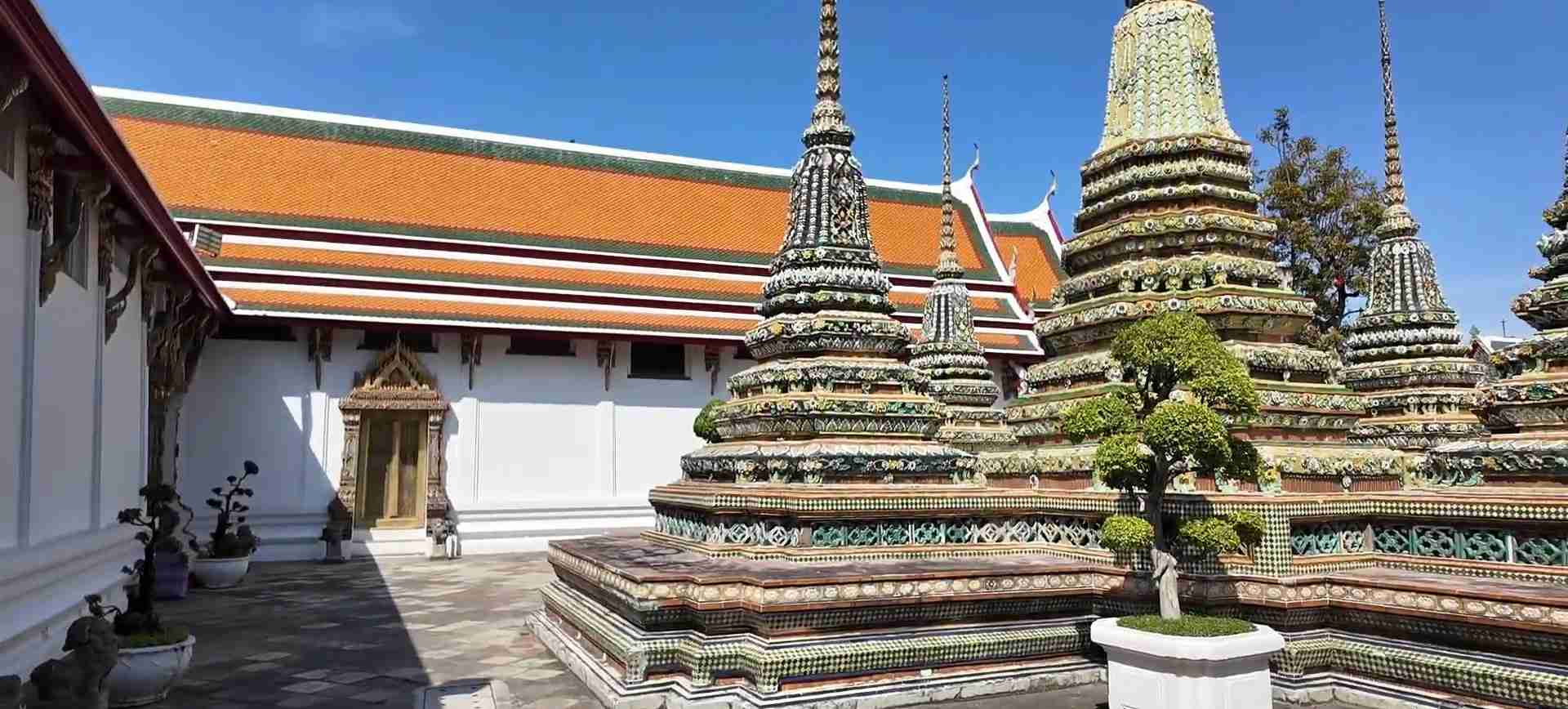
Phra Maha Chedi Si Rajakarn comprises four towering chedis (stupas) memorializing the first four Chakri dynasty monarchs, with each structure reaching approximately 42 meters high and covered in colorful ceramic tiles creating distinctive visual markers visible across the temple grounds. The chedis represent traditional Thai memorial architecture adapting Indian stupa forms to Southeast Asian aesthetic preferences, with bell-shaped profiles topped by ornamental spires symbolizing Buddha’s enlightenment spreading upward toward heavens. The vibrant tile work in green, blue, orange, and yellow creates jewel-like surfaces catching sunlight and creating chromatic brilliance across temple courtyards, demonstrating ceramic craftsmanship traditions refined through centuries of temple decoration practice.
Practical Information: Entrance Fees and Opening Hours
Grand Palace entrance costs ฿500 per person including access to Wat Phra Kaew, Queen Sirikit Museum of Textiles, and grounds exploration, with tickets also valid for Vimanmek Mansion and Royal Carriage Museum visits within 7 days of Grand Palace entry. Children under 120 centimeters height enter free without ticket purchase, while Thai nationals receive complimentary admission upon presenting Thai identification cards. Ticket offices operate 08:30-15:30 daily, with complex closure at 16:30 requiring exit by that time though actual temple and building access typically ends earlier around 15:45-16:00. The complex rarely closes for tourists, though occasional royal ceremonies or state functions necessitate temporary or partial closures announced on official websites and entrance signage.
Audio guide rental costs ฿200 providing 2-hour narrated tours in multiple languages explaining complex history, architectural features, and Buddhist symbolism visitors typically miss through self-guided exploration. The audio guides utilize smartphone apps requiring device compatibility and stable battery levels, with rental desks providing backup devices for visitors lacking suitable phones. Organized group tours through licensed tour operators cost ฿800-1,500 per person for 2-3 hour guided experiences, with private tours ranging ฿2,500-4,000 for personalized attention and flexible pacing accommodating photography interests and specific questions. The tour guide expertise substantially enhances visitor understanding and experience, making the expense worthwhile for history enthusiasts and first-time visitors seeking comprehensive introductions.
Wat Pho entrance fees total ฿300 per person with identical free admission for children under 120 centimeters and Thai nationals upon identification presentation. The ticket includes complimentary drinking water coupon redeemable at designated stations throughout the complex, providing modest refreshment during tropical heat exposure. Operating hours run 08:00-18:30 daily with more generous time windows than Grand Palace’s earlier closure, enabling late afternoon visits during cooler temperatures and reduced crowd periods. The temple remains active religious site hosting morning and evening chanting ceremonies, merit-making activities, and occasional Buddhist festivals creating authentic spiritual atmosphere beyond tourist venue functions.
Traditional Thai massage services at Wat Pho’s massage pavilions cost ฿260-420 for 30-60 minute sessions, with foot massage specializations available at similar rates. The pavilions operate separate from temple exploration, positioned in covered outdoor areas with curtained treatment stations providing basic privacy while maintaining communal atmosphere. Booking directly at pavilion reception desks suffices for most periods, though peak afternoon hours sometimes create waiting periods as all massage therapists reach capacity. The massage quality varies by individual practitioner skill levels despite school training, with some therapists delivering exceptional treatments and others providing adequate but unremarkable experiences, making the massage lottery outcome dependent rather than guaranteed excellence.
Dress Code Requirements and Enforcement
Both Grand Palace and Wat Pho enforce strict dress codes requiring clothing covering shoulders with sleeved shirts (no tank tops or sleeveless garments), legs covered to ankles with long pants or ankle-length skirts (no shorts, capris, or leggings), and modest clothing avoiding transparent fabrics, ripped jeans, or form-fitting athletic wear. Security guards stationed at entrance gates inspect visitors’ attire before permitting entry, with improperly dressed visitors directed to rental booths or refused access depending on violation severity and available corrective options. Grand Palace enforcement proves particularly rigorous given the site’s royal significance and national landmark status, while Wat Pho occasionally demonstrates marginally flexible interpretation permitting knee-coverage rather than full ankle-length in some circumstances, though visitors should not rely on lenient treatment risking entry refusal.
Clothing rental booths at both sites provide temporary covering options including long pants, long-sleeved shirts, and full-length sarongs for ฿200 deposit-secured loans returned upon clothing return. The rental clothes range from well-maintained to slightly worn depending on individual item age and usage frequency, though cleanliness meets basic standards preventing hygiene concerns. The deposit return system requires keeping rental receipt safe, as lost receipts create complications recovering deposits and may result in forfeiture. Visitors planning Grand Palace and Wat Pho combination visits should bring appropriate clothing eliminating rental needs and deposit complications, with lightweight long pants and breathable long-sleeve shirts packed in day bags enabling quick changes if wearing shorts for other Bangkok activities.
Footwear removal requirements apply when entering temple buildings at both complexes, with shoes left on exterior racks or carried in provided plastic bags depending on specific building protocols. The continuous on-off shoe rotation makes slip-on sandals or loafers far more practical than laced shoes requiring extensive tying and untying at each structure. Wearing socks provides comfort when walking barefoot across potentially hot stone or tile floors exposed to afternoon sun, though most buildings maintain cool interior temperatures making barefoot walking comfortable. Some visitors bring antibacterial wipes for foot cleaning after barefoot temple building exploration, though this practice reflects Western hygiene anxieties rather than Thai cultural norms accepting temple floor cleanliness as maintained by regular sweeping and washing.
The cultural sensitivity behind dress codes reflects Thai Buddhist concepts of proper temple behavior demonstrating respect for sacred spaces and Buddha images through modest presentation. Revealing clothing signifies disrespect in Thai cultural contexts regardless of Western norms accepting casual or beach-appropriate attire in religious settings. International visitors sometimes resist dress code enforcement interpreting requirements as excessive or unreasonable, missing the cultural logic prioritizing sacred space purity over individual expression preferences. Understanding dress codes as expressions of Thai religious values rather than arbitrary tourist restrictions helps visitors approach compliance respectfully rather than resentfully, recognizing their guest status in Thai sacred sites requiring adaptation to local norms rather than expecting accommodation to foreign preferences.
Transportation and Access to Grand Palace and Wat Pho
The Chao Phraya Express Boat provides scenic river transport to both temples, with Tha Tien (N8) pier serving both sites via 5-minute walks to respective entrance gates. The express boats operate multiple routes distinguished by flag colors (orange flag tourist boats, no flag local services) with varying stop patterns and pricing structures. Tourist boats at ฿50 per journey enable unlimited same-day boarding with day pass purchases, while local no-flag boats cost ฿10-20 per trip with pay-on-board conductors. The Tha Tien pier experiences heavy traffic during morning and midday hours when tour groups arrive, though individual travelers navigate crowds more easily than large organized groups requiring coordination.
Sanam Chai MRT station on the Blue Line sits approximately 400 meters from Grand Palace entrance, providing air-conditioned underground transit from various Bangkok locations including Sukhumvit Road accommodations and Silom business district hotels. The 5-10 minute walk from station exit to Grand Palace proceeds along busy roadways requiring attention to traffic when crossing streets lacking pedestrian signals, though the route remains straightforward following clear signage. MRT service operates 06:00-midnight daily with trains every 5-10 minutes during peak hours and 10-15 minutes during off-peak periods, creating reliable scheduled transportation eliminating taxi traffic uncertainties.
Taxis from central Bangkok locations including Sukhumvit and Silom cost ฿80-150 depending on traffic conditions and exact departure points, with journey times ranging 20-45 minutes based on congestion severity. Insisting on meter usage prevents overcharging, though some drivers refuse meters for Grand Palace trips preferring fixed-rate negotiations potentially inflating costs. Ride-hailing apps including Grab and Bolt provide transparent pricing and driver accountability, making them preferable to street taxis for visitors uncomfortable with meter negotiation dynamics. Return taxis from Grand Palace warrant caution, as drivers congregating near entrance gates specifically target tourists with inflated fixed rates sometimes reaching ฿500-800 for journeys legitimately costing ฿100-150 on meters. Walking 300-500 meters to major roads enables hailing passing taxis more willing to use meters rather than entrance-area tourist-targeting drivers.
Tuk-tuks offer iconic Thai transport experiences though rarely provide better value than metered taxis, with Grand Palace trips typically costing ฿200-300 after negotiation compared to ฿100-150 taxi meter fares for identical routes. The negotiation requirement creates potential for misunderstanding and conflict when quoted prices exceed visitor expectations or drivers demand more money upon arrival claiming original quotes applied per person rather than total vehicle rate. Tuk-tuks provide no air conditioning in Bangkok’s heat and expose passengers to vehicle exhaust creating less comfortable experiences than air-conditioned taxis or underground trains, making them novelty transportation choices rather than practical efficiency solutions. However, the open-air perspective and photogenic vehicle appearance appeal to visitors prioritizing authentic Thai experiences over comfort maximization.
Photography Guidelines and Restrictions
Photography throughout Grand Palace grounds proceeds freely in outdoor areas and courtyards, with restrictions applying only inside specific buildings including Wat Phra Kaew’s ubosot where Emerald Buddha photography remains strictly prohibited. Security guards enforce no-photography rules in restricted areas, requiring violators to delete images and occasionally confiscating phones for verification ensuring deletion compliance. The photography restrictions reflect sacred image reverence, with Thai Buddhist traditions considering casual Buddha photography potentially disrespectful even when photographers intend no offense. Visitor cooperation with restrictions demonstrates cultural sensitivity respecting Thai Buddhist values rather than asserting perceived photography rights in foreign religious contexts.
Wat Pho permits photography throughout the complex including the Reclining Buddha hall, with no restrictions beyond basic respect requirements avoiding intrusive behavior disturbing worshippers or disruptive conduct blocking other visitors’ views and access. The generous photography permissions enable comprehensive documentation of temple architecture, Buddha images, and decorative details without constant rule navigation or security confrontations. However, visitors should maintain awareness of ongoing religious activities, avoiding photograph taking during active ceremonies or positioning themselves blocking worshippers’ access to shrine areas. The distinction between tourist site and active temple requires photographers balancing documentation interests with respect for Buddhist practitioners using the temple for spiritual purposes beyond tourist photo opportunities.
Professional photography using tripods, lighting equipment, or models requires advance permission at both sites, with commercial photography fees and permit requirements varying by intended usage scope. Wedding photography proves particularly popular at both locations given dramatic architectural backdrops, though session timing coordination and fee payments must occur through official channels rather than unauthorized commercial photography attempts risking security intervention. The distinction between casual tourist photography using phones or handheld cameras and professional photography using specialized equipment governs permission requirements, with amateur photography exempt from permits while professional work requires formal authorization and compensation.
Social media posting raises no restrictions beyond standard photography rules, with visitors free to share images on Instagram, Facebook, or other platforms without permission requirements beyond initial photography authorization. However, respectful image framing and captioning demonstrates cultural sensitivity, avoiding irreverent or mocking commentary inappropriate for sacred sites regardless of legal permissions. The global reach of social media images makes thoughtful representation particularly important, as disrespectful images circulating internationally can generate controversy affecting Thai perceptions of foreign visitors and potentially motivating stricter photography restrictions applied to all visitors due to individual misbehavior.
Guided Tours vs Independent Exploration
Licensed tour guides provide historical context, architectural interpretation, and cultural explanation substantially deepening visitor understanding beyond self-guided exploration relying on limited signage and personal background knowledge. The complex architectural symbolism, Buddhist iconography, and Thai historical references embedded throughout both sites remain largely inaccessible without expert explanation, as temple architecture deliberately communicates meaning through forms, orientations, decorative elements, and spatial relationships visitors cannot decode without specialized knowledge. Tour guides identify significant details visitors typically overlook, explain royal ceremonial functions of various buildings, and relate architectural elements to broader Thai cultural values and historical developments creating coherent narratives from otherwise disconnected visual impressions.
Group tours organized through hotel concierges or booking platforms cost ฿800-1,500 per person for 2-3 hour experiences combining Grand Palace and Wat Pho in single itineraries. These tours aggregate individual travelers into groups of 10-20 people following single guide, creating efficient information delivery though sometimes limiting personalized attention and flexible pacing. The social dynamics of group tours appeal to solo travelers seeking temporary companions and shared experiences, while frustrating independent-minded visitors chafing at rigid schedules and group coordination requirements. Tour quality varies substantially by individual guide expertise and personality, with exceptional guides delivering engaging narratives enriching experiences while mediocre guides provide rote information recitation lacking passion or deep knowledge.
Private tours at ฿2,500-4,000 per group (1-4 people) enable personalized pacing, specialized focus on particular interests, and flexible scheduling accommodating photography priorities or specific question exploration impossible in large group contexts. The substantial per-person cost premium makes private tours economical only for couples or small groups splitting expenses, though the enhanced experience quality often justifies costs for visitors prioritizing education over budget minimization. Private guides typically demonstrate higher expertise and engagement than group tour guides, reflecting the premium market positioning and client expectations demanding superior service delivery.
Independent exploration suits budget-conscious travelers comfortable with self-directed learning, visitors making repeat trips enabling progressive discovery across multiple visits, and those preferring solitary contemplation to guided instruction. The admission costs consume budget allocations without additional tour expenses, enabling longer exploration times or additional site visits funded through tour cost savings. However, independent visitors miss contextual information transforming architectural viewing into cultural understanding, typically spending less time at sites given limited engagement depth when surface aesthetics exhaust visual interest without deeper meaning access. The audio guide rental at ฿200 provides middle-ground option combining independent flexibility with expert narration, though smartphone app interfaces and audio-only information delivery limit effectiveness compared to live guides responding to questions and adapting explanations to visible confusion or interest signals.
Nearby Attractions and Combined Itineraries
Wat Arun (Temple of Dawn) sits directly across the Chao Phraya River from Wat Pho, accessible via ฿5 cross-river ferry operating continuously during daylight hours from Tha Tien pier. The iconic Khmer-style prang rising 82 meters creates Bangkok’s most recognizable riverside silhouette, with steep stairs enabling climbs to upper terraces providing dramatic river and city views. The temple entrance costs ฿50, with exploration requiring 45-60 minutes including prang ascent and grounds walking. Combined Grand Palace, Wat Pho, and Wat Arun itineraries represent classic Bangkok temple circuits completing in 5-6 hours including lunch breaks and ferry crossings, though the intensive temple concentration sometimes creates aesthetic fatigue as architectural similarities blur into undifferentiated impressions.
The amulet market near Wat Pho along Maharat Road provides glimpses into Thai Buddhist material culture through market stalls selling protective amulets, Buddha images, monk portraits, and ritual objects. Thai Buddhists purchase amulets for protection from accidents, illness, bad fortune, or to enhance luck in business, love, or examinations, creating thriving market trade in mass-produced and rare antique examples. Browsing the market reveals Thai religious practice’s material dimensions beyond temple architecture and meditation, showing how Buddhism integrates into daily life through protective object use and merit-making purchases. However, the market caters primarily to Thai buyers rather than tourists, with limited English communication and assumptions of religious knowledge making serious purchasing challenging for visitors lacking Thai language and cultural literacy.
Museum Siam interactive history museum sits 800 meters from Grand Palace, presenting Thai history and cultural identity through modern multimedia exhibits employing touch screens, video installations, and participatory displays. The museum admission costs ฿200 for foreigners (฿100 for Thai nationals), with operating hours 10:00-18:00 Tuesday-Sunday and Monday closures. The 2-3 hour museum visit complements temple exploration by explaining historical contexts and cultural concepts referenced in architectural symbolism and religious practices visitors encounter at Grand Palace and Wat Pho. The air-conditioned museum provides welcome heat relief during midday periods, making it strategically valuable in full-day itineraries requiring periodic indoor cooling breaks between outdoor temple exploration.
Sanam Luang (Royal Field) ceremonial ground adjacent to Grand Palace hosts major royal events including coronations, royal cremations, and Royal Ploughing Ceremony agricultural rituals. The open field provides rare public green space in dense Bangkok, with locals flying kites during windy season (February-April) and exercising during cooler morning and evening hours. The field’s ceremonial significance means regular access remains unrestricted except during actual royal events requiring security cordons and public exclusion. Walking across Sanam Luang after Grand Palace visits provides atmospheric immersion in royal Bangkok beyond formal tourist sites, though the field lacks specific attractions beyond open space and kite-flying observation.
Frequently Asked Questions About Grand Palace and Wat Pho
How Long Should You Spend at the Grand Palace and Wat Pho?
Grand Palace exploration requires 2-3 hours for comprehensive coverage including Wat Phra Kaew, throne halls, museums, and grounds walking, though visitors focusing solely on Emerald Buddha and exterior architecture complete visits in 1.5 hours rushing between highlights. Wat Pho demands 1.5-2 hours allowing adequate time for Reclining Buddha viewing, grounds exploration, chedi photography, and optional traditional massage sessions extending visits by additional 30-60 minutes. Combined itineraries allocating 4-5 hours including lunch breaks and walking between sites provide comfortable pacing avoiding rushing while preventing exhaustion from excessive temple concentration. However, deep architectural appreciation, extensive photography, meditation participation, or scholarly interest can easily consume entire days at single sites, making time allocation highly dependent on individual interests and engagement depth preferences.
Are Grand Palace and Wat Pho Wheelchair Accessible?
Both complexes present significant accessibility challenges for wheelchair users given historic architecture predating disability accommodation requirements, with uneven pavements, stairs accessing elevated platforms, and narrow doorways creating obstacles limiting full site access. Grand Palace provides wheelchair rentals at entrance gates and maintains some paved pathways enabling partial grounds exploration, though Wat Phra Kaew’s elevated ubosot and various throne halls remain inaccessible to wheelchair users. Wat Pho offers slightly better accessibility given more ground-level structures and ramped approaches to some buildings, though the Reclining Buddha hall’s stairs and raised shrine areas prevent wheelchair access to optimal viewing positions. Visitors with mobility limitations should contact sites in advance regarding specific accessibility features and assistance availability, setting realistic expectations about limited access rather than assuming comprehensive facility access.
Can You Bring Bags and Backpacks Inside?
Both sites permit small bags and backpacks under typical tourist day pack sizes, with security screening at entrance gates checking bag contents for prohibited items including weapons, alcohol, or disrespectful materials. Large backpacks, luggage, or bulky bags require checking at left-luggage facilities near entrance gates, with modest fees (฿20-50) charged for storage services. Valuable items including wallets, phones, and cameras should remain in personal possession rather than checked luggage given standard security concerns about unattended belongings. The bag policies balance security requirements against practical visitor needs, recognizing most tourists carry day packs with water bottles, cameras, and personal items throughout Bangkok exploration.
Are There Restaurants or Food Options Inside the Complexes?
Grand Palace grounds contain minimal food service limited to basic beverage vendors and small snack carts, with proper meals requiring exit to surrounding area restaurants along Maharat Road and riverfront establishments. The limited on-site food reflects royal compound heritage maintaining traditional restrictions against commercial food service within palace boundaries, requiring visitors to plan lunch breaks outside complex walls. Wat Pho provides slightly more extensive options including small cafeterias serving Thai dishes at modest prices (฿60-100 per meal), though quality remains basic institutional food rather than restaurant-caliber dining. Both sites permit bringing outside food and water bottles, enabling visitors to pack snacks and drinks from convenience stores reducing food expense and ensuring preferred dietary options availability.
What Items Are Prohibited Inside the Temples?
Prohibited items include weapons of any type, alcohol, recreational drugs, cigarettes (smoking banned throughout both complexes), pets, drones, professional video equipment without permits, and any materials deemed disrespectful to monarchy or Buddhism. Security screening at entrance gates checks bags for contraband, with violators required to check prohibited items, return them to hotels, or forfeit entry depending on item type and policy interpretation. The prohibitions reflect sacred site status requiring atmosphere maintenance free from disturbances compromising spiritual sanctity and visitor experience quality, with particularly strict enforcement regarding monarchy-related items given Thai lèse-majesté laws criminalizing royal family disrespect.
Can Non-Buddhists Visit the Temples?
Both sites welcome visitors of all faiths or no religious affiliation, functioning as tourist attractions and cultural heritage sites beyond purely religious roles. However, respectful behavior remains mandatory regardless of personal beliefs, with dress codes, photography restrictions, and conduct expectations applying equally to Buddhists and non-Buddhists. The temples remain active religious sites hosting worship and ceremonies, requiring all visitors to maintain quiet voices, avoid disruptive behavior, and demonstrate respect for Buddhist practitioners using spaces for spiritual purposes. Non-Buddhist visitors should view themselves as respectful guests in sacred spaces rather than entitled tourists in secular attractions, recognizing the sites’ primary religious functions transcend tourism economics and international visitor access.
Is It Better to Visit Morning or Afternoon?
Morning Grand Palace visits beginning at 08:30 opening time provide optimal experiences avoiding peak 10:00-14:00 tour group crowds while capitalizing on cooler temperatures before midday heat intensity. Afternoon Wat Pho visits after 15:00 offer reduced congestion as morning tour groups depart while avoiding late afternoon Thai worshipper increases around 17:00-18:00. This morning Grand Palace, afternoon Wat Pho sequence creates natural combination itinerary flow with midday lunch breaks between sites preventing continuous temple exposure potentially causing architectural fatigue. However, photography enthusiasts might reverse timing prioritizing specific lighting conditions, while crowd-averse visitors might accept afternoon heat discomfort in exchange for substantial crowd reduction during late afternoon periods approaching closing times.
Are Audio Guides Available in Multiple Languages?
Grand Palace audio guides offer narration in English, Chinese (Mandarin), Japanese, Korean, French, German, Spanish, and Thai through smartphone apps requiring compatible devices and stable batteries. The multilingual options accommodate major international visitor demographics, though less common languages lack official audio guide support requiring visitors to rely on English versions or arrange private guides speaking specific languages. Wat Pho provides more limited audio guide options focused primarily on English and Chinese reflecting visitor composition patterns, though the temple’s simpler narrative structure reduces audio guide dependency compared to Grand Palace’s complex architectural and historical layers requiring extensive explanation for full appreciation.
What Happens During Royal Ceremonies or Closures?
Royal ceremonies occasionally require Grand Palace full or partial closures preventing tourist access, with advance notice typically posted on official websites and hotel concierge information though last-minute closures sometimes occur for emergency royal events. The closures cause visitor frustration and itinerary disruption, though they reflect the Grand Palace’s primary function as working royal ceremonial venue rather than tourist attraction, with visitor access representing secondary rather than primary facility purpose. Wat Pho rarely closes for ceremonies given its separate institutional identity independent of direct royal scheduling, though major Buddhist holidays create increased worshipper crowds reducing comfortable tourist exploration opportunities. Checking official websites or calling sites directly before visits prevents wasted trips to unexpectedly closed complexes, particularly important for visitors with limited Bangkok time precluding rescheduling options.
Can You Get Traditional Thai Massage at Wat Pho?
Wat Pho operates traditional Thai massage pavilions staffed by school-trained practitioners offering 30-minute (฿260), 60-minute (฿420), and foot massage (฿280 for 45 minutes) sessions utilizing authentic techniques taught in the temple’s traditional medicine programs. The pavilions occupy open-air covered areas with curtained treatment stations providing basic privacy while maintaining group atmosphere typical of traditional Thai massage contexts. Booking occurs at pavilion reception desks with minimal waiting during off-peak hours, though afternoon periods sometimes create queues requiring 15-30 minute waits for available therapists. The massage quality varies by individual practitioner skills despite standardized school training, with exceptional therapists delivering therapeutic experiences justifying modest costs while adequate but unremarkable practitioners provide satisfactory but unmemorable treatments.