Grand Master’s Palace Valletta: Knights of St. John Headquarters Guide
The Grand Master’s Palace stands as Malta’s most significant symbol of political power, serving continuously as a seat of government for over 450 years from its construction in the 1570s to the present day. Built by the Knights of St. John as their headquarters following the Great Siege of Malta, this imposing fortress-palace in the heart of Valletta embodies centuries of Mediterranean history, from the golden age of the military religious Order through British colonial rule to modern Maltese independence.
Key Takeaways About Grand Master’s Palace
- Continuous Political Center: The palace has functioned as Malta’s primary seat of government since 1571, serving as headquarters for the Knights’ Grand Masters, British Governors, and now the President of Malta, making it one of Europe’s longest continuously occupied government buildings.
- Architectural Evolution: What began as two modest buildings merged by architect Girolamo Cassar evolved through successive expansions into a massive complex occupying an entire city block, blending austere Mannerist exteriors with opulent Baroque interiors added over two centuries of Knight rule.
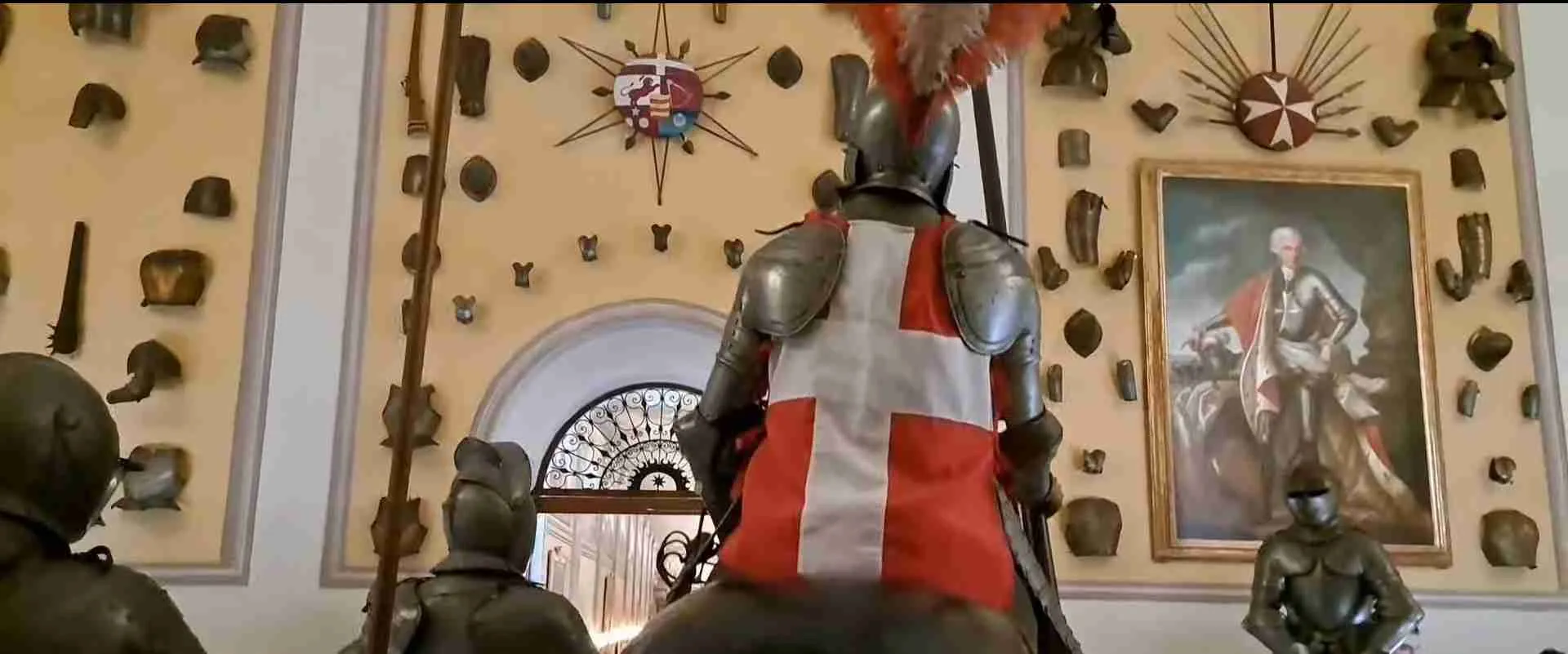
- World-Class Armoury: The Palace Armoury houses one of the world’s finest collections of 16th and 17th-century arms and armor, with over 5,000 pieces including suits worn by Grand Masters, weapons captured from Ottoman forces during the Great Siege, and ceremonial armor representing the military might of the Order.
- State Rooms Splendor: The State Rooms showcase extraordinary artistic treasures including Matteo Perez d’Aleccio’s frescoes depicting the Great Siege, French Gobelins tapestries in the Tapestry Chamber, elaborate ceiling paintings throughout the corridors, and portraits of every Grand Master who ruled Malta.
- Living Government Building: Unlike most palace museums, significant portions remain active government offices for the President of Malta, with State Rooms occasionally closed for official functions, ceremonial changing of the guard ceremonies occurring every hour, and ongoing restoration revealing previously hidden chambers.
- Strategic Foundation Building: Constructed as one of Valletta’s first structures immediately after the city’s foundation in 1566, the palace’s location and design reflected the Knights’ dual priorities of defensive strength and administrative efficiency, establishing the architectural standard for the new fortress capital.
People Also Ask About Grand Master’s Palace Valletta
What Was the Role of the Grand Master’s Palace for the Knights of St. John?
The Grand Master’s Palace served as the absolute center of power for the Knights of St. John from 1571 until their expulsion in 1798, functioning simultaneously as the Grand Master’s official residence, the Order’s administrative headquarters, the venue for the Grand Council meetings that determined policy, the diplomatic reception center for ambassadors and visiting dignitaries, and the symbolic representation of the Order’s temporal authority in the Mediterranean. The Grand Master, elected for life by his fellow knights, wielded near-sovereign power over Malta from within these walls, commanding the Order’s military forces, conducting diplomacy with European powers and the Ottoman Empire, administering justice, and managing the vast economic resources that made the Knights one of the wealthiest organizations in Europe. The palace’s State Rooms hosted elaborate ceremonies marking significant moments in the Order’s calendar, its Council Chamber witnessed strategic decisions affecting Mediterranean politics, and its corridors bustled with knights from eight different langues (national divisions) conducting the daily business of governing their island fortress. The building’s evolution reflected the Order’s transformation from warrior monks to sophisticated statesmen, with successive Grand Masters commissioning ever more elaborate decorations that proclaimed both their personal prestige and the Order’s collective power.
How Does the Palace Architecture Reflect the Knights’ Values and Period?
The palace architecture embodies the fundamental duality of the Knights Hospitaller as both a military religious order and sophisticated European rulers, visible in the stark contrast between the fortress-like exterior and palatial interior spaces. The original design by Girolamo Cassar featured deliberately austere limestone facades with minimal ornamentation, small windows for defensive purposes, and massive walls capable of withstanding artillery bombardment, reflecting the immediate post-siege context when military threats remained paramount and the vow of poverty still held theoretical importance. However, successive modifications particularly during the 17th and 18th centuries transformed the interiors into displays of breathtaking opulence, with elaborate frescoed ceilings depicting biblical scenes and Order history, damask-covered walls in crimson and gold, intricate marble floor inlays, ornate Baroque portals added under Grand Master Pinto in the 1740s, and the distinctive Maltese enclosed wooden balconies that became architectural signatures. This architectural evolution mirrors the Knights’ own journey from crusading warriors to cultured aristocrats who commissioned works from Europe’s finest artists while maintaining military readiness. The two internal courtyards, Neptune’s Courtyard with its misidentified statue of Admiral Andrea Doria and Prince Alfred’s Courtyard, provide serene spaces that contrast with the building’s fortress character, while the famous corridor lined with suits of armor and portraits of Grand Masters creates a powerful visual narrative of the Order’s continuity and martial heritage.
What Treasures and Artworks Can Visitors See Inside the Palace?
The palace contains an extraordinary concentration of artistic and historical treasures spanning four centuries, with the State Rooms alone housing paintings, tapestries, frescoes, furniture, and decorative arts that rival major European palaces. The most famous artistic cycle comprises Matteo Perez d’Aleccio’s massive frescoes in the Throne Room depicting key episodes from the Great Siege of 1565, executed between 1576 and 1581 while memories remained vivid, providing both historical documentation and propaganda celebrating the Knights’ heroic resistance. The Tapestry Chamber displays a complete set of French Gobelins tapestries known as Les Tentures des Indes, gifted to the Order and depicting exotic scenes from the Americas and Asia with remarkable detail and vibrant colors preserved over centuries. Throughout the corridors and State Rooms hang portraits of every Grand Master from Jean Parisot de Valette onward, creating a visual dynasty that documents changing fashions and artistic styles across two centuries, alongside depictions of significant battles, religious scenes, and allegories of the virtues. The Ambassador’s Room features elaborate ceiling frescoes and crimson damask wall coverings that create an atmosphere of diplomatic splendor, while the Council Chamber preserves the space where the Order’s governing body made decisions affecting Mediterranean history. The Palace Armoury separately contains over 5,000 pieces including complete suits of armor belonging to Grand Masters such as Jean Parisot de Valette and Alof de Wignacourt, weapons captured from Ottoman forces, ornate ceremonial arms, and functional military equipment ranging from swords and pikes to early firearms, all displayed in patterns along walls that create striking visual effects while documenting the evolution of military technology.
How Did the Palace Function After the Knights’ Departure?
Following Napoleon’s expulsion of the Knights in 1798, the palace underwent its most dramatic functional transformation, first becoming the Palais National during the brief French occupation when Revolutionary forces stripped some religious imagery and renamed spaces to reflect Republican ideology, then transitioning to the Governor’s Palace in 1800 when Malta became a British protectorate and eventually crown colony. British governors adapted the building to colonial administrative needs while generally respecting its historical character, making structural modifications including enlarging the dining room, adding staff quarters, modernizing certain amenities, and incorporating British governmental symbols alongside the Knights’ heritage. The palace suffered significant damage during World War II aerial bombardment of Valletta between 1940 and 1943, requiring extensive restoration work particularly to State Rooms and the roof structure, with some areas rebuilt rather than merely repaired. Malta’s journey toward self-governance brought new roles as the Tapestry Hall became the meeting place for Malta’s first constitutional parliament in 1921, and the former Armoury was later converted to house the House of Representatives from 1976 until 2015 when parliament relocated to the purpose-built Parliament House designed by Renzo Piano. Since independence in 1964, the palace has served as the official seat of the President of Malta, with State Rooms used for ceremonial occasions including state banquets, credential presentations from foreign ambassadors, national award ceremonies, and official receptions. Heritage Malta assumed management of the museum portions, undertaking major restoration projects costing over €28 million that have revealed previously hidden chambers, restored original decorative schemes, improved accessibility, and expanded the areas open to public visitation while maintaining the building’s function as a working government facility.
Extended multi-day tours – 5+ days
Featured Malta Multi-Day Tour Packages
3 days
Malta 3-Day Discovery Tour
- ✓ Comprehensive Malta experience
- ✓ Expert local guides included
- ✓ All accommodation included
- ✓ Transportation provided

5 days
Malta 5-Day Highlights Experience
- ✓ Comprehensive Malta experience
- ✓ Expert local guides included
- ✓ All accommodation included
- ✓ Transportation provided
7 days
Malta 7-Day Cultural Journey
- ✓ Comprehensive Malta experience
- ✓ Expert local guides included
- ✓ All accommodation included
- ✓ Transportation provided
10 days
Malta 10-Day Complete Adventure
- ✓ Comprehensive Malta experience
- ✓ Expert local guides included
- ✓ All accommodation included
- ✓ Transportation provided
Multi-day tour packages powered by TourRadar. Prices and availability subject to change.
Introduction: Malta’s Theater of Power and History
The Grand Master’s Palace dominates St. George’s Square in Valletta’s heart, its austere limestone facade stretching across an entire city block, revealing little of the opulent interiors and layered history contained within its fortress-like walls. For visitors walking the grid-pattern streets of this UNESCO World Heritage city, the palace represents both an architectural anchor and a narrative key to understanding Malta’s extraordinary past.
Unlike the defensive austerity suggested by its exterior, the palace interior unfolds as a succession of increasingly elaborate spaces where European baroque splendor meets Mediterranean intensity. Corridors stretch seemingly endless beneath frescoed ceilings, their walls lined with suits of armor standing eternal guard and portraits of Grand Masters whose gazes follow visitors through centuries. State Rooms open one after another, each competing in magnificence, while the Palace Armoury presents one of the world’s most impressive collections of historical weaponry in a display that manages to be simultaneously beautiful and menacing.
The palace’s significance extends far beyond its architectural and artistic merits. This building witnessed and shaped Mediterranean history across nearly five centuries, serving as command center during the Knights’ golden age when Malta functioned as Christianity’s forward bastion against Ottoman expansion, as colonial administrative headquarters during British rule, and as the birthplace of modern Maltese democracy. The Grand Masters who governed from these rooms commanded navies, negotiated with emperors, dispensed justice, and accumulated the wealth and artworks that transformed a military order into one of Europe’s most sophisticated political entities.
Understanding the palace requires grasping the unique nature of the Knights Hospitaller themselves. Founded in Jerusalem before the First Crusade as a hospital order caring for pilgrims, the Knights of St. John evolved into a military religious order that combined monastic vows with aristocratic privilege and martial prowess. After losing Rhodes to Ottoman forces in 1522, Holy Roman Emperor Charles V granted them Malta in 1530, where they established a Mediterranean naval power that lasted until Napoleon’s invasion in 1798. The palace embodies this complex identity—warrior monks who commissioned baroque masterpieces, aristocrats who took vows of poverty yet lived surrounded by gold and silk, defenders of Christendom who accumulated vast wealth through piracy and trade.
The building’s architectural evolution tells the story of the Order’s transformation. Girolamo Cassar’s original austere design reflected the immediate post-siege militarization and the Order’s monastic origins. Successive Grand Masters, however, increasingly embraced their role as European princes, commissioning ever more elaborate decorations that proclaimed their prestige. The contrast between the fortress exterior and palatial interior spaces captures the Knights’ dual nature perfectly—ready for war but living in splendor.
For modern visitors, the palace offers multiple layers of engagement. Art enthusiasts find world-class collections spanning Renaissance, Mannerist, and Baroque periods. History lovers walk corridors where Grand Masters plotted strategy during Mediterranean conflicts. Architecture students study the evolution from defensive necessity to decorative confidence. Those interested in governance observe a building that has continuously housed government for over 450 years, adapting to Knights, colonial administrators, and modern democratic institutions while maintaining its essential character.
The palace also provides crucial context for understanding Valletta itself. The city was conceived as a fortress first and capital second, built rapidly after the Great Siege of 1565 demonstrated Malta’s strategic vulnerability. The palace, begun in 1571 just five years after the city’s foundation, established both the architectural vocabulary and symbolic importance that would characterize this unique urban creation. Every major building in Valletta relates back to the palace in some way—the auberges housed the knights who attended Grand Council meetings here, St. John’s Co-Cathedral provided the spiritual counterpoint to temporal power, the fortifications defended the government housed within these walls.
Recent restoration efforts have revealed aspects of the palace previously hidden even from scholars. Conservation work has uncovered original decorative schemes beneath later modifications, discovered sealed chambers, revealed the sophistication of structural engineering that allowed continuous expansion without compromising the building’s integrity, and documented construction techniques that mixed local limestone with imported materials. These discoveries continue to refine understanding of how the palace was built, modified, and maintained across centuries of continuous occupation.
The palace’s current dual role as working government building and public museum creates unique dynamics. While Heritage Malta manages the visitor experience professionally, scheduling tours and maintaining facilities, the reality of presidential functions means State Rooms occasionally close without advance notice. Guards change every hour with ceremonial precision, tourists photograph armor displays meters from offices where Malta’s President conducts official business, and restoration work proceeds around functioning government operations. This living quality distinguishes the palace from purely museum spaces—history here remains active rather than merely preserved.
Visiting the palace requires understanding what can and cannot be accessed. The State Rooms and Palace Armoury constitute the public museum areas, covering extensive but not complete portions of the building. Presidential offices, working spaces for administrative staff, and certain chambers undergoing restoration remain off-limits. The experience thus balances comprehensive access with ongoing governmental function, providing enough to occupy several hours while leaving aspects mysterious.
Origins and Construction: Building the Knights’ Headquarters
The Grand Master’s Palace emerged from urgent necessity rather than leisurely planning, constructed during the frantic decade following the Great Siege of 1565 when Valletta transformed from barren peninsula into fortified capital. Understanding the palace’s origins requires examining both the immediate post-siege context and the complex site history that shaped its unusual configuration.
When Jean Parisot de Valette, hero of the Great Siege, laid Valletta’s foundation stone in March 1566, the original plans placed the Grand Master’s palace on high ground in the southern part of the new city, approximately where Auberge de Castille now stands. This elevated position offered commanding views and symbolic prominence befitting the Order’s leader. However, military engineers argued this exposed location made the Grand Master vulnerable to enemy artillery fire, exactly the vulnerability that had nearly cost Malta during the siege when Ottoman guns had devastated St. Elmo and Birgu. The decision was made to relocate the palace to a more protected position on what would become St. George’s Square, sacrificing dramatic elevation for defensive prudence.
The chosen site in 1570 was already partially occupied. A house belonging to Eustachio del Monte, nephew of Grand Master Pierre del Monte who had succeeded de Valette, stood on part of the location. This substantial residence, built in 1569, had been constructed to high standards with quality materials. Adjacent to it, the Auberge d’Italie was being completed around 1571 to house knights of the Italian langue. Both buildings were designed by Girolamo Cassar, the Maltese architect who would define Valletta’s appearance through his work on St. John’s Co-Cathedral, multiple auberges, and other major structures. Rather than demolish these recent constructions, the decision was made to incorporate them into a larger palace complex, explaining the unusual two-courtyard configuration and different levels that characterize the building today.
Grand Master Pierre del Monte moved the Order’s headquarters from Birgu to the still-incomplete palace in 1571, initially residing in his nephew’s house while expansion proceeded. The merging of the existing structures into a unified palace complex proceeded rapidly under Cassar’s direction, driven by the need to establish governmental functions in the new capital. Cassar’s architectural language drew from the military engineering principles that governed Valletta’s entire design—massive load-bearing walls, minimal window openings, flat roofs suitable for cannon placement if needed, and austere facades that prioritized defensive strength over decorative elaboration.
The original palace design reflected both practical necessities and the Knights’ residual connection to their monastic origins. External walls measured over two meters thick in places, providing both structural support and protection against artillery. Windows were small and positioned high, admitting light while minimizing vulnerability. The main entrance was relatively modest, lacking the grand portals that would be added in the 18th century. Interior spaces, while functional and well-proportioned, initially featured limited decoration—whitewashed walls, simple ceiling beams, practical floor tiles rather than elaborate marbles. This austerity aligned with the vows of poverty theoretically binding the Knights, even as the Order’s collective wealth grew immense.
Construction proceeded in phases dictated by available resources and evolving needs. The core residential and administrative spaces came first, providing the Grand Master with suitable quarters and rooms for conducting the Order’s business. The Council Chamber, where the Grand Council of senior knights met to determine policy, received early attention as the governance nerve center. Spaces for archives, treasury, and secretariat followed. The palace gradually expanded to absorb adjacent properties, pushing outward until it occupied the entire block bounded by Merchant Street, St. Paul Street, St. Lucia Street, and St. George’s Square.
The two internal courtyards, Neptune’s Courtyard and Prince Alfred’s Courtyard, developed at different levels due to the site’s topography and the incorporation of pre-existing structures. Neptune’s Courtyard, named for the statue (actually depicting Admiral Andrea Doria) at its center, became the formal heart of the palace. The broad staircase ascending from this courtyard features unusually shallow steps, traditionally explained as accommodation for knights ascending in heavy armor, though the design likely reflected standard Italian Renaissance palace architecture rather than purely military considerations. Prince Alfred’s Courtyard, named during the British period after Queen Victoria’s son who visited Malta, developed as a more utilitarian service space.
By the time of Grand Master Jean de la Cassière (1572-1581), the palace had achieved its basic footprint and functional organization, though decoration remained relatively modest. The building served its essential purposes of housing the Grand Master, providing meeting spaces for governance, accommodating administrative staff, and symbolically representing the Order’s authority. Subsequent expansion would add elaboration rather than fundamental restructuring, with each Grand Master contributing to the complex’s evolution.
The palace’s rapid construction reflected the urgency pervading Valletta’s entire development. The Great Siege had demonstrated Malta’s vulnerability without proper fortifications. The Knights needed their new capital operational quickly, with the Grand Master’s headquarters established early to demonstrate governmental continuity and attract knights to relocate from Birgu. Construction quality remained high despite speed—the building has stood for over 450 years with its essential structure intact, surviving earthquakes, bombardment, and continuous heavy use.
Financing the palace construction came from the Order’s collective resources, augmented by contributions from individual Grand Masters. The Knights had become wealthy through maritime activities, land holdings in Europe, and gifts from Catholic monarchs seeking the Order’s favor. Grand Masters were typically wealthy aristocrats who could afford to invest personally in projects enhancing their office’s prestige. This combination of institutional and personal wealth would enable the continuous embellishment that transformed the austere original into the baroque splendor visible today.
The Grand Masters: Power and Prestige in the Magistral Palace
The Grand Master of the Knights of St. John wielded authority unique in European politics—elected for life by his peers, he commanded near-sovereign power over Malta while technically remaining head of a religious order subject to papal authority and bound by monastic vows including poverty, chastity, and obedience. This paradox between theoretical humility and actual magnificence shaped the palace’s evolution as Grand Masters balanced their spiritual obligations against their role as European princes.
The position of Grand Master combined multiple functions that would typically be divided among different officials in conventional states. He served as head of state in diplomatic relations, military commander of the Order’s formidable navy and garrison, supreme judge in legal matters, administrator of extensive economic resources, and religious superior of a monastic community. This concentration of authority meant the palace functioned simultaneously as executive mansion, military headquarters, court of law, diplomatic center, and administrative complex. The Grand Master’s daily routine reflected this multiplicity, moving between religious observances, military planning, diplomatic receptions, judicial hearings, and administrative consultations.
Portraits lining the palace corridors document the succession of 29 Grand Masters who ruled Malta from the palazzo’s establishment until Napoleon’s invasion. These paintings reveal not only changing artistic styles across two centuries but also the evolution of the Grand Masters’ self-presentation. Early portraits maintain relative simplicity, depicting Grand Masters in the Order’s black habit with the eight-pointed cross. Later portraits increasingly emphasize temporal magnificence—elaborate armor, rich robes, symbols of sovereignty including scepters and crowns, backgrounds featuring naval battles or architectural projects. This visual progression mirrors the Order’s transformation from crusading warriors to sophisticated statesmen.
Grand Masters came exclusively from European nobility, elected by knights meeting in the conventual church. Electoral politics could be complex, with the eight langues (national divisions of the Order) maneuvering to advance their candidates. The voting knights sought leaders who combined military competence, administrative ability, diplomatic skill, and personal wealth to contribute to the Order’s projects. Once elected, a Grand Master wielded his authority until death, though the Order’s constitution provided theoretical mechanisms for deposition that were rarely invoked.
Notable Grand Masters who shaped the palace and Order during the Maltese period include Jean Parisot de Valette (1557-1568), hero of the Great Siege who founded Valletta but died before the palace’s completion; Pierre del Monte (1568-1572), who established the headquarters here; Jean de la Cassière (1572-1581), who commissioned the Council Chamber and Throne Room; Alof de Wignacourt (1601-1622), whose aggressive expansion of fortifications and patronage of artists including Caravaggio marked a golden age; and António Manoel de Vilhena (1722-1736), who founded Manoel Theatre and promoted cultural activities.
Grand Master Manuel Pinto de Fonseca (1741-1773) left perhaps the most visible mark on the palace’s appearance. His thirty-two-year reign allowed ambitious projects including the baroque portals that still grace the main facade, extensive interior redecoration, the four-faced clock with its bronze Turkish slave figures striking the hours, and numerous artistic commissions. Pinto embodied both the Order’s military traditions—he improved fortifications and expanded the navy—and its evolved sophistication as patron of arts and architecture. His personal wealth, derived from Portuguese noble estates, funded projects that enhanced both the Order’s prestige and his own legacy.
The Grand Master’s official lifestyle within the palace balanced religious observance with princely display. Daily schedules typically began with morning prayers and mass, followed by meetings with department heads managing the Order’s military, naval, judicial, and economic functions. Afternoons might involve receiving ambassadors from European powers, presiding over the Grand Council on designated days, hearing judicial appeals, or reviewing architectural and fortification projects. Evenings often featured formal dinners with visiting dignitaries or senior knights, sometimes accompanied by musical entertainment in rooms designed to impress.
The palace State Rooms served as stage sets for ceremonies reinforcing the Grand Master’s authority and the Order’s identity. The Throne Room hosted formal receptions where ambassadors presented credentials, treaties were signed, and the Grand Master received homage from newly arrived knights. The Council Chamber witnessed debates over policy, with the Grand Master presiding over discussions that could grow heated when different langues advocated conflicting positions. The Ambassador’s Room provided intimate settings for confidential diplomatic negotiations. Even the corridors, with their armor displays and portraits, proclaimed continuity and martial heritage to everyone entering the palace.
The Grand Master’s residential quarters occupied separate areas from the public State Rooms, providing private spaces away from the constant activity of government. These included personal bedchambers, private chapels for devotions, studies for contemplation and correspondence, and reception rooms for informal meetings. The separation between public and private spaces reflected Italian palazzo conventions that the Knights adopted, creating zones appropriate for different levels of formality and access.
Grand Masters’ personal collecting significantly enriched the palace’s artistic holdings. They commissioned portraits, religious paintings, and historical scenes from leading artists. They acquired tapestries, furniture, and decorative arts. They accumulated weapons and armor, both functional military equipment and ceremonial pieces. They gathered books and manuscripts for libraries. These collections served multiple purposes—personal enjoyment, demonstration of cultural sophistication to visitors, investment of wealth in tangible assets, and enhancement of the Order’s institutional prestige. Successive Grand Masters inherited these collections and added to them, gradually transforming the palace into a repository of artistic treasures.
The relationship between Grand Masters and the knights they governed involved complex dynamics. While the Grand Master’s authority was extensive, he ruled with rather than over the senior knights who formed the Grand Council. Major decisions required council approval, and Grand Masters who ignored this collective governance risked conflicts that could paralyze administration. Successful Grand Masters built consensus, managed the rivalries between langues, balanced military and diplomatic priorities, and maintained the Order’s wealth and territories through sound administration. The palace thus functioned as much as a collaborative governing center as a throne of absolute power.
Succession crises occasionally roiled the palace, particularly when elderly Grand Masters died unexpectedly or when electoral politics divided the knights along national lines. The period between one Grand Master’s death and his successor’s election could involve intense maneuvering, with different factions advocating their candidates. The palace witnessed these political dramas, which typically concluded peacefully through the electoral process but occasionally involved tensions that affected the Order’s functioning.
The last Grand Master to rule from the Valletta palace, Ferdinand von Hompesch zu Bolheim (1797-1798), faced the catastrophic challenge of Napoleon’s invasion. His brief sixteen-month tenure ended with the capitulation that terminated the Knights’ rule of Malta, though the Order itself survived and continues today as a sovereign entity based in Rome. Hompesch’s failure to mount effective resistance against French forces remains controversial—some historians view him as a realist recognizing the impossibility of defense, others as a weak leader who abandoned the heritage his predecessors built. The palace became the Palais National under French Revolutionary occupation, beginning its transformation from Magistral Palace to governmental complex serving various regimes.
State Rooms: Baroque Splendor and Political Theater
The State Rooms of the Grand Master’s Palace represent the pinnacle of baroque artistic achievement in Malta, transforming functional governmental spaces into overwhelming displays of wealth, power, and cultural sophistication. These interconnected chambers, accessed via the famous frescoed corridor encircling Neptune’s Courtyard, served as the public face of the Order, where Grand Masters received dignitaries, hosted ceremonies, and demonstrated the Knights’ place among Europe’s elite powers.
The approach to the State Rooms establishes the visitor experience through architectural anticipation. The shallow-stepped staircase ascending from Neptune’s Courtyard creates a gradual, stately ascent that allows armor and anticipation to build. Upon reaching the piano nobile, the upper story housing the State Rooms, visitors enter the spectacular corridor that immediately announces the artistic treasures ahead. The ceiling frescoes employ trompe l’oeil techniques creating illusory architectural features that make the flat surface appear three-dimensional with columns, arches, and receding perspectives. Along the walls, suits of armor stand in formation like eternal guardians, their polished surfaces catching light from windows overlooking the courtyards. Between the armor, lunettes (half-circular paintings) depict Malta’s landscapes, harbors, and naval battles, providing visual narratives of the island’s geography and military history. The portraits of Grand Masters create a visual dynasty, each positioned to gaze down on visitors with authority derived from unbroken succession.
The Throne Room, also called the Hall of St. Michael and St. George after the British order founded here in 1818, dominates the State Rooms in both size and historical significance. Grand Master Jean de la Cassière commissioned this chamber in the late 1570s as the primary reception space where the Order’s leader would receive ambassadors, preside over ceremonies, and demonstrate the Knights’ sovereignty. The room’s current appearance results from multiple decorative campaigns, with the most famous artistic element being Matteo Perez d’Aleccio’s fresco cycle depicting the Great Siege of 1565.
Perez d’Aleccio’s frescoes cover the upper walls in a continuous narrative of twelve panels, each representing key moments from the siege that defined the Knights’ identity and justified their presence in Malta. Executed between 1576 and 1581, just fifteen years after the events depicted, these images combine documentary accuracy with propagandistic celebration. The artist consulted with veterans who had fought in the siege, ensuring details of fortifications, ship designs, troop formations, and battle locations matched reality. Yet the compositions emphasize Christian heroism and divine favor, showing Grand Master Jean de Valette in impossibly heroic postures, Knights performing superhuman feats, and heavenly intervention in crucial moments. The panels depict the initial Ottoman fleet arrival, the assault on Fort St. Elmo, the attack on Senglea, the cavalry sortie that broke the siege, and the final retreat of Ottoman forces. This visual narrative served multiple purposes—preserving memory of the Order’s greatest triumph, legitimizing continued rule of Malta, impressing visitors with the Knights’ martial prowess, and providing a sacred history that reinforced corporate identity.
The Throne Room ceiling features elaborate paintings added during later periods, with baroque decorative schemes overwhelming the viewer with their density and complexity. Gilded details catch light from the large windows, creating shimmer that animates the space. The throne itself, positioned beneath a canopy on a raised dais, established the Grand Master’s physical and symbolic centrality during ceremonies. Visiting ambassadors, newly invested knights, and other dignitaries would approach this throne following elaborate protocol, performing gestures of respect that reinforced hierarchy while the Grand Master remained seated in sovereign dignity. During the British period, governors adapted the room for colonial purposes, using it for investiture ceremonies of the Order of St. Michael and St. George and official receptions. Modern Malta employs the Throne Room for presidential ceremonies, state dinners, and diplomatic events, maintaining its function as the nation’s most formal space.
The Tapestry Chamber presents a completely different aesthetic, dominated by the extraordinary set of French Gobelins tapestries known as Les Tentures des Indes. These fourteen tapestries, woven at the royal Gobelins manufactory in Paris between 1687 and 1730, depict exotic scenes from the Americas, Africa, and Asia based on earlier Dutch designs. The tapestries show elaborate hunting scenes, processions of elephants and camels, encounters between Europeans and indigenous peoples, and lush tropical landscapes filled with flora and fauna rendered in remarkable detail. The colors remain vivid despite centuries, with blues, reds, golds, and greens creating a visual richness enhanced by the tapestries’ technical sophistication—weavers employed thousands of threads per square inch to achieve effects approaching painting in their subtlety.
The tapestries arrived in Malta through diplomatic gift-giving networks that connected European courts. Grand Master Ramón Despuig received some pieces directly from French sources, while others entered the collection through purchases and other acquisitions. Their presence in the palace demonstrated the Order’s connections to major European powers and its participation in the elite culture of collecting and display. The Tapestry Chamber served for dining and receptions where the exotic imagery provided conversation topics while showcasing the Grand Master’s refined taste. The room’s current installation preserves this function, with the tapestries displayed on walls in their original configuration, creating an immersive environment that transports viewers to the imagined tropics European artists constructed from travelers’ accounts and their own fantasies.
The State Dining Room evolved to accommodate the increasingly elaborate ceremonial meals that marked the Knights’ calendar and diplomatic schedule. The long table could seat dozens for formal banquets where protocol dictated seating arrangements reflecting complex hierarchies among langues, ranks within the Order, and visiting dignitaries. The room’s decoration includes ceiling paintings depicting allegorical scenes of virtue, abundance, and power, complemented by gilded stucco work that frames the painted panels. Sideboards displayed gold and silver plate during dinners, adding material wealth to the visual splendor. The dining rituals themselves combined religious elements—meals began with prayers, included readings from religious texts, and observed fasting rules on appropriate days—with secular magnificence in the quality and quantity of food, wines from the Order’s vineyards, and elaborate service procedures.
The Ambassador’s Room, also known as the Red Room for its crimson damask wall coverings, provided a more intimate setting for diplomatic negotiations. The smaller scale allowed confidential discussions while the rich decoration—frescoed ceiling depicting historical episodes from the Order’s past, ornate furniture including gilded chairs and tables, portraits of Grand Masters and religious paintings on the walls—maintained appropriate grandeur. Ambassadors from European powers, Ottoman envoys during periods of truce, and representatives from Italian states all conducted business in this room, where the Grand Master or his deputies would negotiate treaties, discuss military cooperation, resolve disputes, and maintain the complex web of relationships that sustained the Order’s position.
The Pages’ Room takes its name from the young nobles who served Grand Masters as attendants, receiving education and training while performing ceremonial duties. This space showcases more ceiling frescoes and houses additional paintings from the palace collection. During the Knights’ period, pages would have waited here between assignments, creating a buffer zone between the Grand Master’s private quarters and the public State Rooms. The British adapted the room for administrative purposes, and current usage varies depending on presidential needs and museum requirements.
Lesser-known but equally remarkable spaces include the Council Chamber, where the Grand Council of senior knights met to determine policy and advise the Grand Master. This room’s more austere decoration reflected its serious governmental function, though quality remained high with painted ceilings depicting Justice and Wisdom as presiding virtues. The Chamber witnessed debates over war and peace, allocation of the Order’s resources, admission of new knights, judicial appeals, and all major decisions affecting Malta’s governance. Minutes of these meetings, preserved in the Order’s archives, document the often contentious discussions as different langues advocated competing priorities and individual knights advanced various proposals.
Recent restoration efforts have revealed previously hidden or inaccessible areas including the Uccelliera (aviary), a small painted room whose walls depict dozens of bird species in a natural history catalogue that demonstrates both artistic skill and scientific interest. This recently rediscovered chamber, possibly used as a private study or retreat, shows that even relatively minor spaces received elaborate decoration. Conservators working through the palace continue discovering original decorative schemes beneath later modifications, sealed doorways leading to forgotten rooms, and structural details revealing construction techniques.
The State Rooms’ artistic program served propaganda purposes alongside aesthetic ones. Every decorative choice reinforced messages about the Knights’ identity, legitimacy, and power. Military scenes celebrated martial prowess. Religious imagery emphasized sacred mission. Portraits of Grand Masters proclaimed legitimate succession. Allegorical figures represented virtues the Order claimed. The overwhelming baroque elaboration itself constituted an argument—an organization commanding such wealth and commissioning such art clearly deserved its position among European powers. Visitors, whether ambassadors negotiating treaties or humble petitioners seeking favor, could not miss these messages embodied in every painted surface and gilded detail.
The Palace Armoury: Military Heritage and Medieval Arsenal
The Palace Armoury houses one of the world’s most comprehensive collections of 16th and 17th-century arms and armor, with over 5,000 pieces documenting the Knights’ military capabilities and the evolution of warfare during the age of gunpowder’s gradual displacement of traditional medieval weapons. This extraordinary arsenal, displayed in specially designed chambers that emphasize both aesthetic impact and historical significance, preserves tangible evidence of the Knights Hospitaller’s dual identity as religious order and military force.
The Armoury originated in practical necessity rather than collecting ambition. The Knights maintained Malta as a forward base for operations against Ottoman forces and Barbary corsairs, requiring substantial military stores. Every knight was expected to bring his personal armor and weapons when joining the convent in Malta, creating an accumulation of equipment that grew with the Order’s size. Additionally, the Order purchased and commissioned arms in bulk for its garrison troops, galley crews, and reserve forces. Captured weapons from naval victories added exotic pieces including Ottoman scimitars, Turkish composite bows, and North African firearms. Grand Masters commissioned ceremonial armor for themselves and presentation pieces for diplomatic gifts, adding elaborate parade armor to functional military equipment.
The collection’s arrangement in the palace evolved over centuries. Originally, functional weapons were stored in ground-floor magazines near the palace’s defensive bastions, ready for distribution during emergencies. Display armor decorated the State Rooms’ corridors and chambers, serving decorative and symbolic purposes while remaining theoretically available for use. During the 18th century, as the Ottoman threat receded and the collection’s historical rather than immediate military value became apparent, the Knights began organizing the Armoury as a formal display. The British, recognizing the collection’s significance, opened it to public viewing in the 19th century, making it Malta’s first museum and one of Europe’s early public armories.
The most prestigious pieces include parade armor belonging to famous Grand Masters. Jean Parisot de Valette’s armor, worn during the Great Siege, combines defensive functionality with decorative etching depicting Christian symbols and the Order’s eight-pointed cross. The metal shows marks from combat use, providing tangible connection to the siege that defined the Knights’ identity. Alof de Wignacourt’s armor represents early 17th-century craftsmanship at its peak, with elaborate surface decoration including gilding, etching, and embossing creating patterns across every surface. This armor appears in Caravaggio’s famous portrait of Wignacourt painted during the artist’s Malta period, allowing viewers to see the same pieces depicted in a masterpiece hanging elsewhere in the palace.
Complete suits of armor document the evolution from full plate typical of the early 16th century to the lighter partial armor necessitated by firearms’ increasing effectiveness. Early suits cover the entire body with articulated plates protecting limbs, torso, and head while allowing reasonable mobility. Helmets evolved from closed forms that completely enclosed the head to open burgonet and morion styles offering better vision and hearing at the cost of protection. By the mid-17th century, armor increasingly consisted of breastplates and helmets protecting vital areas while abandoning limb defenses that restricted movement without providing adequate protection against musket balls.
The sword collection spans multiple centuries and cultural traditions. Medieval broadswords with cruciform hilts represent the Knights’ crusading heritage. Renaissance rapiers with elaborate swept hilts demonstrate the transition toward more technically sophisticated fencing styles. Heavy two-handed swords display the formidable cutting weapons used by infantry. Curved sabers and scimitars captured from Ottoman forces contrast with European straight blades, illustrating different martial cultures’ approaches to sword design. Ceremonial swords with jeweled hilts and etched blades served diplomatic and symbolic purposes, too valuable for combat but perfect for presentations and ritual occasions.
Polearms fill entire sections of the display, their varieties reflecting specialized functions. Pikes, the dominant infantry weapon from the 15th through 17th centuries, stretch up to five meters in length, forming the backbone of the densely packed formations that dominated battlefields before bayonets made every musketeer also a pikeman. Halberds combine axe blades with spear points, serving both as weapons and symbols of rank for sergeants and officers. Partisans with their elaborate side blades functioned primarily as ceremonial weapons carried by guards. The sheer quantity of polearms—hundreds of examples—demonstrates the scale of forces the Knights maintained.
Firearms document the technological revolution that gradually transformed warfare. Early examples include matchlock arquebuses and muskets, primitive by modern standards but revolutionary in their time for allowing common soldiers to kill armored knights at range. Wheel-lock pistols with their complex spring-loaded mechanisms show attempts to create more reliable ignition systems less vulnerable to weather. Flintlock weapons, perfected by the 17th century, represent the mature gunpowder weapon that would dominate until percussion caps arrived in the 19th century. Ottoman firearms in the collection illustrate the technological parity between Christian and Islamic forces—Turkish muskets matched European examples in quality and sometimes surpassed them in decoration.
Naval weapons constitute a significant category given the Knights’ focus on Mediterranean galley warfare. Swivel guns mounted on ship rails, boarding axes designed for close combat on crowded decks, grappling hooks for pulling enemy vessels alongside, and the distinctive galley prow ram all relate to the specialized requirements of naval combat. The Knights’ galleys, rowing vessels supplemented by lateen sails, required weapons suitable for their tactical approach of closing rapidly with enemy vessels to board them, making hand-to-hand combat weapons as important as firearms.
Artillery pieces, including bronze cannon of various calibers, demonstrate the Knights’ sophisticated approach to both offensive and defensive gunnery. These guns served multiple purposes—arming galleys for naval actions, defending fortifications including those around the palace itself, and providing mobile field artillery for land operations. The technical quality of bronze casting, with decorative elements including the Order’s symbols, Grand Masters’ coats of arms, and dedicatory inscriptions, shows that even functional military equipment received artistic attention.
Shields in the collection range from medieval designs anticipating sword and lance attacks to specialized types developed for gunpowder weapons. Large pavises provided mobile cover for crossbowmen and arquebusiers. Smaller bucklers suited dueling and personal defense. Target shields from various cultures including Ottoman, North African, and Persian examples show the global scope of the Knights’ military encounters. Some shields bear battle damage—dents from sword strikes, bullet holes from firearms—providing evidence of their use in actual combat rather than merely ceremonial display.
The display arrangement, modernized during successive restoration campaigns, presents the weapons in patterns along walls that create striking visual effects. Radiating arrangements of swords, geometric patterns of pikes, and symmetrical layouts of shields transform functional military equipment into decorative compositions that reveal the aesthetic potential inherent in well-crafted weapons. This dual purpose—historical documentation and visual impact—makes the Armoury simultaneously a serious scholarly resource and a spectacular museum experience.
Conservation challenges facing the Armoury include the natural degradation of metal through oxidation, previous restoration attempts using techniques now considered inappropriate, and damage from Malta’s humid maritime climate. Modern conservators work continuously to stabilize pieces, remove harmful corrosion while preserving surface evidence of manufacturing techniques and historical use, and improve climate control to prevent further deterioration. Some pieces have been disassembled for cleaning and conservation of internal components, revealing construction details invisible when complete.
The Armoury’s significance extends beyond Malta to broader military history. Few collections preserve such comprehensive documentation of pre-modern warfare from a single institutional source across multiple centuries. The pieces came together through the Knights’ continuous military activities rather than later antiquarian collecting, providing authentic military equipment actually used by the forces it was intended to equip. Scholars studying armor construction techniques, weapons evolution, military organization, and the material culture of early modern warfare rely on collections like this to ground their research in physical evidence rather than purely textual sources.
Art and Decoration: Renaissance and Baroque Masterworks
Beyond the famous frescoes and tapestries highlighted in State Rooms descriptions, the Grand Master’s Palace contains extensive additional artistic holdings that document European art history from the Renaissance through the Baroque period. These works, accumulated through Grand Master patronage, diplomatic gifts, and institutional collecting, transform the palace into an art museum integrated with its governmental and historical functions.
Portrait painting dominates the collection numerically, with images of every Grand Master who ruled Malta creating a visual dynasty that spans over two centuries. These portraits follow evolving artistic conventions across different periods and schools. Early examples maintain relatively austere presentation with Grand Masters depicted in the Order’s black habit against plain backgrounds, emphasizing religious identity over temporal magnificence. As baroque aesthetic values gained influence, portraits grew more elaborate with Grand Masters shown in armor, surrounded by symbols of authority including batons of command, ships representing naval power, fortifications indicating defensive achievements, and allegorical figures embodying virtues. The Grand Masters’ faces reveal artistic attempts to capture personality—some appear stern warriors, others scholarly administrators, still others avuncular figures projecting benevolence.
Several portraits merit particular attention for artistic quality or historical significance. The portrait of Grand Master Alof de Wignacourt by Caravaggio, though the painting itself hangs in the Louvre having left Malta during complex historical circumstances, is known from descriptions and copies showing Wignacourt in his elaborate parade armor with a page holding his helmet. This collaboration between one of Europe’s greatest artists and a powerful Grand Master symbolizes the intersection of artistic genius and political power characteristic of the baroque age. Other portraits by leading artists of their times document the Knights’ patronage of talent from across Catholic Europe.
Religious paintings fulfill both devotional and decorative functions. Images of the Order’s patron saints—John the Baptist, whose beheaded head appears in numerous depictions, and the Virgin Mary in various manifestations—reinforce the Knights’ spiritual mission. Crucifixion scenes, depictions of the Passion, and martyr saints remind viewers of sacrifice and faith. Some religious works possess particular significance for the Order, including paintings showing Saint John the Baptist presenting the eight-pointed cross to kneeling knights, visually encoding the Order’s identity in religious iconography. The quality ranges from workshop productions to masterpieces by recognized artists, reflecting both the quantity needed to furnish a palace and the desire for pieces worthy of the Order’s prestige.
Historical and battle scenes provide narrative content celebrating the Knights’ achievements. Beyond the Great Siege cycle in the Throne Room, other paintings depict naval victories against Ottoman fleets, successful raids on North African ports, and defensive triumphs during various conflicts. These works served propaganda purposes, reminding viewers of military effectiveness while justifying the Order’s control of Malta and continued relevance in European politics. The artistic treatment varies from relatively simple narrative scenes prioritizing clear storytelling to complex multi-figure compositions demonstrating baroque dramatic sensibility and technical sophistication.
Allegorical paintings common in baroque decoration appear throughout palace ceilings and walls. Personifications of virtues—Justice with her scales, Wisdom with her book, Fortitude with her column, Temperance with her mixing vessel—provide moral lessons while demonstrating artists’ abilities to render abstract concepts in physical form. These allegories typically employ female figures in classical drapery, following conventions established during the Renaissance and elaborated in baroque art. The placement of specific virtues in particular rooms often related to those spaces’ functions—Justice in judicial chambers, Wisdom in council rooms, Military Valor in spaces related to defense.
Ceiling frescoes throughout the palace represent major artistic undertakings requiring specialized skills. Fresco painting, applying pigments to wet plaster so colors bond with the wall surface as it dries, demands both technical mastery and confidence since corrections are difficult once the plaster dries. The painted ceilings create illusionistic architectural features using trompe l’oeil techniques—columns appear to support vaults, coffered ceilings seem to recede upward, balustrades appear to surround openings to the sky. Figures positioned on these painted architectural elements achieve dramatic foreshortening effects as artists calculated how images would appear from viewers standing on the floor below. The overall result transforms flat ceilings into apparently three-dimensional spaces populated by figures engaged in various activities.
The lunettes—half-circular paintings positioned above doors and windows throughout the palace—constitute a fascinating sub-collection documenting Malta’s topography and naval history. These paintings show Valletta’s harbors from various viewpoints, fortifications and bastions protecting the city, views of other Maltese towns and coastlines, and naval battles occurring in Maltese waters. They provide historical documentation of how Malta appeared before subsequent development altered harbors and expanded cities, making them valuable to historians and archaeologists reconstructing past landscapes. Artistically, the lunettes demonstrate specialized skill in depicting maritime scenes with accurate rendering of ships, water, and atmospheric effects.
Decorative arts complement the paintings in furnishing the palace. Furniture ranges from simple wooden pieces used in service areas to elaborate baroque confections with gilded surfaces and intricate carving used in State Rooms. Some furniture pieces display marquetry work with inlaid wood forming geometric or figural patterns. Others feature painted decoration on wooden surfaces. The furniture collection documents evolving styles across the period of Knights’ rule, though identifying original pieces versus later additions or British-era furniture requires scholarly analysis complicated by centuries of use and multiple refurnishing campaigns.
Clocks and scientific instruments reflect both practical timekeeping needs and interest in mechanical ingenuity characteristic of the baroque period. The famous four-faced clock on the palace exterior, created by Maltese clockmaker Gaetano Vella in 1745, features bronze figures of Turkish slaves striking bells to mark hours—a symbolic subjugation of former enemies to timekeeping service. The clock displays hour, date, month, and lunar phase on its four faces, demonstrating sophisticated mechanical engineering. Interior clocks of various designs show the evolution of timekeeping technology and the importance of accurate time in coordinating military and governmental activities.
Restoration and conservation of the artistic holdings presents ongoing challenges. Paintings accumulate dirt, grime, and discolored varnish over centuries, obscuring original colors and details. Previous restoration attempts sometimes employed techniques now recognized as harmful, including harsh cleanings that removed original paint layers or overpaintings that altered compositions. Modern conservation approaches emphasize minimal intervention, stabilizing works to prevent further deterioration while removing only materials proven harmful. Advanced imaging techniques including infrared reflectography and x-radiography reveal underdrawings, compositional changes, and structural details invisible to normal viewing, providing insights into artistic processes and helping guide conservation decisions.
The integration of art with architecture distinguishes the palace from typical museums where works hang isolated on neutral walls. Here paintings occupy positions in specific architectural contexts—over doorways, within decorative schemes coordinating with stucco work and ceiling frescoes, as parts of larger programs conveying specific messages. Understanding these works requires considering their intended viewing contexts and relationships to surrounding elements rather than evaluating them as isolated aesthetic objects. This integration makes the palace both more challenging to study—individual works cannot be easily removed for examination—and more rewarding as an intact historical environment.
British Period and Modern Government: Continuity and Change
The palace’s transition from headquarters of a religious military order to colonial administrative center and eventually the seat of independent Malta’s government demonstrates remarkable architectural and institutional adaptability. While ownership and political systems changed dramatically, the building’s function as center of governmental power remained constant across over two centuries of transformation.
Napoleon’s conquest of Malta in June 1798 terminated the Knights’ rule with shocking speed. Grand Master von Hompesch surrendered without significant resistance, and French forces occupied the island within days. The palace became the Palais National, reflecting Revolutionary rejection of monarchical and religious authority. French administrators systematically stripped religious imagery considered incompatible with Revolutionary principles, melted down precious metals to fund military operations, and attempted to reorganize Malta according to Revolutionary political models. However, the French occupation lasted only two years before a Maltese uprising and British naval blockade forced French surrender in September 1800.
British acquisition of Malta, initially as a protectorate and from 1814 officially as a crown colony following the Treaty of Paris, meant the palace transitioned to housing British colonial governors. The first governors maintained much of the existing structure while adapting spaces to British administrative needs. The palace became Government House or the Governor’s Palace, terms used interchangeably throughout the colonial period. British governors possessed authority far exceeding that of typical colonial administrators because Malta’s strategic importance as a Mediterranean naval base gave it special status within the empire.
Architectural modifications during the British period balanced preservation of historical character with modernization requirements. Major changes included enlargement of the state dining room to accommodate larger official dinners reflecting British diplomatic and social customs, addition of staff quarters and office spaces for the growing colonial bureaucracy, installation of more efficient heating systems for British governors unaccustomed to Malta’s mild but sometimes damp winters, modernization of kitchens and service areas to meet British expectations, and addition of bathrooms with modern plumbing as technology advanced.
The British generally respected the palace’s artistic heritage, though some changes reflected changing tastes and political messaging. The Throne Room was renamed the Hall of St. Michael and St. George after the order of chivalry founded in Malta and the Ionian Islands in 1818, with ceremonies for investiture and decoration taking place here. British portraits joined those of the Grand Masters, creating visual continuity between different eras of rule. Some State Rooms were adapted for British ceremonial requirements while maintaining their baroque splendor, demonstrating that the spaces’ inherent magnificence suited different political systems.
Malta’s constitutional evolution toward self-governance occurred partially within the palace. The grant of a constitution in 1921 established Malta’s first parliament, which initially met in the palace’s Tapestry Hall. This represented Malta’s entrance into democratic governance after centuries of rule by appointed leaders, whether Grand Masters or colonial governors. The parliament meeting in the same spaces where Grand Masters had conducted autocratic administration symbolically linked Malta’s democratic present to its historical past. When this initial constitution was suspended in 1933 due to political conflicts, the palace reverted to purely administrative functions until a new constitution restored self-government.
World War II devastated Valletta and damaged the palace significantly. Malta’s strategic position between Sicily and North Africa made it crucial to controlling Mediterranean supply routes, leading to intense aerial bombardment by Axis forces attempting to neutralize the island as a base for Allied operations. Between 1940 and 1943, Malta endured thousands of bombing raids, with Valletta particularly targeted as the administrative and military headquarters. The palace suffered multiple hits, with bombs damaging the roof structure, destroying sections of the State Rooms, shattering windows, and threatening the entire complex with potential collapse. Much of the artistic collection was evacuated to safer locations during the war, preserving paintings and movable artifacts from destruction.
Post-war restoration required extensive work to repair structural damage, rebuild destroyed sections, restore damaged State Rooms to their pre-war appearance, and generally return the palace to functional condition. This restoration faced the challenge of distinguishing between bomb damage and deterioration from other causes accumulated over centuries, deciding whether to recreate destroyed decorations exactly or adopt modern approaches, and funding massive conservation projects in the difficult economic circumstances of post-war reconstruction. British authorities, recognizing the palace’s historical importance, allocated resources for proper restoration rather than merely functional repairs.
Malta’s independence in September 1964 transformed the palace from colonial administrative center to the seat of an independent nation’s government. The British governor departed, replaced by a Maltese Governor-General representing Queen Elizabeth II as Malta initially maintained Commonwealth membership with the Queen as head of state. When Malta became a republic in 1974, the Governor-General was replaced by a President, and the palace became the Office of the President of Malta. This presidential role differs significantly from the executive leadership in presidential republics—Malta’s President serves ceremonial and constitutional functions while the Prime Minister and Cabinet exercise executive power. The palace thus continues hosting government activity while much day-to-day political work occurs elsewhere.
The House of Representatives’ presence in the palace from 1976 until 2015 brought legislative activity to the complex where executive authority had traditionally dominated. Parliament initially met in the former Armoury, later in adapted spaces within the palace. The close proximity of presidential ceremonial functions and parliamentary legislative work created occasional conflicts over space use and scheduling. The 2015 completion of Renzo Piano’s new Parliament House on the site of the old opera house finally separated these functions, allowing the palace to focus on presidential activities and museum operations.
Heritage Malta’s management of the palace museum portions since the organization’s founding represents professionalization of conservation and public access. Heritage Malta operates as an arms-length government agency responsible for Malta’s major heritage sites and museums, bringing specialized expertise in conservation, curation, interpretation, and visitor management. Under their stewardship, the palace has seen major restoration campaigns, improved visitor facilities, enhanced educational programs, and better integration with Valletta’s broader heritage tourism offerings.
The ongoing restoration project, costing over €28 million across multiple phases, represents the most comprehensive conservation effort in the palace’s history. Work has included structural stabilization preventing further deterioration, restoration of decorative schemes throughout the State Rooms, conservation of paintings and frescoes using modern techniques, climate control improvements protecting artworks from humidity and temperature fluctuations, accessibility enhancements for visitors with mobility challenges, discovery and opening of previously inaccessible spaces including the Uccelliera, and archaeological investigation of foundation structures revealing construction techniques.
The palace’s dual function as working government building and public museum creates unique management challenges. Presidential functions take precedence, meaning museum areas may close without advance notice for state occasions. Security requirements for protecting government officials necessitate controlled access and screening procedures. Restoration work must be scheduled around governmental activities rather than purely based on conservation priorities. Visitor flow must be managed to avoid disruption of official business occurring in adjacent spaces. These complications distinguish the palace from purely museum sites where visitor experience can be optimized without governmental constraints.
Current presidential use of the palace includes swearing-in ceremonies for new governments following elections, credential presentations from foreign ambassadors taking up postings in Malta, state dinners for visiting heads of state and government, award ceremonies recognizing Maltese citizens’ achievements, hosting of official delegations, and various ceremonial occasions in the national calendar. These events maintain the palace’s relevance as a living government building rather than merely a historical monument, ensuring continuity with its centuries-long function as Malta’s center of power.
Visiting the Palace: Practical Information and Experience
The Grand Master’s Palace welcomes visitors daily, offering access to the State Rooms and Palace Armoury that constitute the museum portions of this working government building. Planning a visit requires understanding operational realities, ticket procedures, tour options, and what to expect from this unique combination of palace museum and functioning presidential office.
The palace entrance for visitors is located on St. George’s Square, the open plaza fronting the palace’s main facade. This square functions as Valletta’s civic heart, hosting outdoor events and providing an open space where residents and tourists gather. The entrance itself consists of a baroque portal added during the 18th century, far more elaborate than Girolamo Cassar’s original austere design. Guards in ceremonial uniform stand at attention, changing every hour in a ceremony that attracts photographers and curious onlookers. The changing of the guard, while less elaborate than similar ceremonies at Buckingham Palace or other major European sites, maintains tradition and adds living military presence to the historical ambiance.
Opening hours typically run from 10:00 AM to 6:00 PM daily, with last admission at 5:30 PM allowing sufficient time to tour the spaces before closing. However, these hours should be verified before visiting through the Heritage Malta website or visitor information center, as they can vary seasonally and may be affected by special circumstances. The palace occasionally closes entirely or restricts access to certain areas when State Rooms are needed for presidential functions—official state visits, government swearing-in ceremonies, diplomatic receptions, and national occasions take precedence over public access. Such closures sometimes occur with limited advance notice, creating occasional disappointment for travelers who have specifically planned to visit.
Admission costs €12 for adults, with concessions available for seniors, students, and children (check official site for current rates as pricing adjusts periodically). This ticket provides access to both the State Rooms and the Palace Armoury, which together constitute several hours of potential viewing for those interested in detailed examination. Heritage Malta members receive free admission as part of their membership benefits, making annual membership cost-effective for residents or extended visitors planning multiple heritage site visits across Malta and Gozo. Tickets can be purchased at the entrance or in advance through the Heritage Malta website, with advance purchase recommended during peak tourist seasons to avoid potential queuing.
Guided tours offer enhanced understanding of the palace’s complex history and artistic treasures. Tours conducted by knowledgeable guides provide historical context, point out details easily missed during independent viewing, and answer questions about specific aspects of the palace. Tours typically run at scheduled times throughout the day, with both English and other language options depending on guide availability and visitor demand. Tour duration averages 60-90 minutes, covering the major State Rooms and Armoury highlights while allowing time for questions. Private tours can be arranged for groups, providing more flexibility in scheduling and content focus tailored to specific interests.
Audio guides present an alternative for visitors preferring self-paced exploration while still receiving interpretive information. Available in multiple languages including English, French, German, Italian, Spanish, and Russian, the audio guides provide room-by-room commentary keyed to numbered stations throughout the palace. The audio guide is included in the admission ticket price, making it an excellent value for those who want narration without joining a scheduled group tour. The audio content typically runs 60-90 minutes if listened to completely, though visitors can selectively choose sections of most interest.
The visit route follows a logical progression through the palace. After entering through security screening similar to that at other major heritage sites and government buildings, visitors ascend the shallow-stepped staircase to the piano nobile. The famous frescoed corridor provides the first major impression, with its illusionistic ceiling paintings and armor displays setting the tone for the opulence ahead. The route then proceeds through the State Rooms in sequence—specific order may vary depending on which areas are accessible and restoration work schedules, but typically includes the Throne Room, Tapestry Chamber, State Dining Room, Ambassador’s Room, and other spaces. The Palace Armoury occupies separate chambers that can be visited before or after the State Rooms depending on visitor preference.
Photography policies generally permit personal photography without flash in most areas, allowing visitors to document their experience and capture the artistic treasures, though specific restrictions may apply to certain spaces or during special circumstances. Tripods and other professional equipment typically require advance permission. Videography may face additional restrictions. Current photography rules should be confirmed at entrance, as policies can change based on conservation concerns or special circumstances.
The visit duration depends heavily on individual interest and pace. A quick walk-through hitting major highlights requires minimum 60-90 minutes. A thorough visit examining details, reading interpretive materials, and absorbing the artistic and historical richness easily extends to 2-3 hours. Enthusiasts interested in detailed study of specific aspects—the Armoury collection, the artistic treasures, the architectural details—could spend half a day or more. First-time visitors should allocate at least 90-120 minutes to avoid feeling rushed through such significant spaces.
Accessibility considerations have improved through recent restoration work, though the palace’s historic character creates inherent limitations. Elevators provide access to the piano nobile for visitors unable to use stairs, and routes through the State Rooms generally accommodate wheelchairs and mobility aids, though some areas remain challenging due to doorway widths and floor level changes. Specific accessibility information should be confirmed with Heritage Malta before visiting to ensure the site can accommodate individual needs.
Facilities within the palace include restrooms, a gift shop selling Heritage Malta publications, reproduction artworks, and souvenirs related to the Knights and Maltese heritage, and sometimes a small refreshment area depending on current arrangements. The gift shop offers the official palace guidebook, which provides more detailed information than can be absorbed during a single visit and serves as a valuable reference for understanding the complex history and art collections.
Combining a palace visit with other Valletta attractions creates an efficient day of heritage tourism. St. John’s Co-Cathedral, the Knights’ conventual church, stands just blocks away and merits equal time allocation for its extraordinary baroque interior and Caravaggio masterpiece “The Beheading of St. John.” The Upper Barrakka Gardens provide panoramic harbor views and daily noon cannon firing. The National Museum of Archaeology, housed in the former Auberge de Provence, displays Malta’s prehistoric artifacts including finds from the megalithic temples. Fort St. Elmo, site of the famous siege battle, houses the National War Museum. These sites together provide comprehensive understanding of Maltese history from prehistory through World War II.
Seasonal considerations affect the visit experience. Summer months (June-September) see peak tourist crowds, making early morning arrival advisable to avoid congestion in the State Rooms. The combination of crowds and Malta’s summer heat can make the visit less comfortable. Spring (April-May) and autumn (October-November) offer pleasant weather with smaller crowds, creating ideal visiting conditions. Winter (December-March) sees the fewest tourists and mild temperatures, though some days may be too cool for comfort in the unheated stone palace. Special events, holidays, and cruise ship arrivals can temporarily increase crowds regardless of season.
Dress codes do not impose strict requirements as they might at active religious sites, though visitors should dress respectfully given the palace’s status as a government building and heritage site. Comfortable walking shoes are advisable given the extensive marble floors and time spent standing. Visitors should be prepared for variable temperatures within the palace—the thick stone walls maintain relatively cool conditions even in summer, while winter visits can feel chilly in unheated spaces.
Special access considerations include scheduled presidential events that restrict access as previously mentioned, restoration work that may close specific rooms for conservation projects, occasional special exhibitions that temporarily alter the normal display arrangement or add supplementary content, and public holidays that may affect opening hours or create closure days. Checking current status before visiting avoids disappointment and wasted travel time.
The Palace in Context: Valletta and the Knights’ Legacy
The Grand Master’s Palace cannot be fully understood in isolation but must be viewed as the centerpiece of Valletta’s comprehensive urban design, the physical manifestation of the Knights’ nearly three-century presence in Malta, and a key element in the Mediterranean’s complex political and military history during the age of Ottoman-Christian conflict.
Valletta’s creation as a planned fortress city following the Great Siege of 1565 represented an extraordinary urban achievement. Pope Pius V sent the military engineer Francesco Laparelli to design a city that could never be captured through the tactics that had nearly succeeded during the siege. Laparelli conceived a grid-plan city on the Sciberras Peninsula, with massive bastioned walls protecting the landward approach and harbors on either side providing naval access. Every street ran straight, allowing defenders to fire down their length and preventing attackers from finding covered approaches. Buildings were constructed from local limestone to uniform height regulations, creating disciplined architectural harmony. The Grand Master’s Palace, positioned near the city’s geographic center, became the anchor around which governmental, religious, and military structures organized themselves.
The palace’s relationship to St. John’s Co-Cathedral, just blocks away, illustrates the dual pillars of the Knights’ identity. The palace represented temporal power—governance, military command, diplomacy, and administration. The cathedral embodied spiritual authority—religious devotion, corporate worship, burial of Grand Masters and notable knights, and display of religious art and relics. Knights moved between these two poles throughout their careers, attending mass at the cathedral before conducting governmental business at the palace, participating in religious ceremonies that reinforced corporate identity before engaging in secular administration. This spatial separation between sacred and political functions, while they remained institutionally unified in the Order, reflects the tension inherent in a religious organization that wielded sovereign power.
The auberges of the eight langues (national divisions of the Order) scattered through Valletta relate to the palace as noble residences relate to a royal court. Knights resided in their national auberges—Auberge d’Aragon for Spanish knights, Auberge de Castille for Castilian knights, Auberge de France for French knights, and so on through the eight divisions. These auberges provided accommodation, dining halls where knights ate together, and meeting spaces for conducting langue business. The bailiff commanding each langue maintained apartments at his auberge and attended the Grand Master at the palace when summoned for Grand Council meetings or other governmental duties. This network of noble residences surrounding the central palace created an aristocratic urban fabric unique to Valletta.
The palace’s military context extended beyond its own defensive features to encompass Valletta’s comprehensive fortifications. While the palace itself could withstand assault, its true security derived from the city walls, bastions, and outlying forts that made Valletta nearly impregnable. Fort St. Elmo guarding the harbor entrance, Fort St. Angelo across the water in Birgu, and the massive land walls studded with bastions and artillery positions created defense in depth that would discourage any attacker. The Grand Master could conduct business in the palace confident that military engineering had eliminated the vulnerability that had nearly cost Malta during the Great Siege.
The Knights’ economic system supported the palace’s magnificence through diverse revenue sources. The Order retained extensive landholdings throughout Catholic Europe, with commanderies (estates) in France, Spain, Italy, Germany, and other regions providing rents and agricultural income. Naval activities against Ottoman shipping and Barbary corsairs yielded captured cargoes and ransom for prisoners. European monarchs made gifts to maintain favor with a military order that provided useful naval power in the Mediterranean. Individual knights came from wealthy noble families and contributed personal resources. The Grand Common Treasury accumulated these revenues and allocated them to defense, administration, construction projects including the palace’s ongoing embellishment, and the charitable healthcare activities that had founded the Order centuries earlier in Jerusalem.
The palace’s role in Malta’s broader historical narrative connects different periods that might otherwise seem disconnected. The building provides physical continuity from the Knights’ arrival in 1530 through the Great Siege of 1565, the subsequent golden age of the 17th century, decline in the 18th century, French invasion in 1798, British colonial period from 1800-1964, and modern independent Malta from 1964 onward. While governments, languages, and political systems changed dramatically, the palace remained the center of power, adapting to new purposes while maintaining its essential character. Few buildings anywhere can claim such continuous governmental function across five centuries of profound change.
The Knights’ departure in 1798, though traumatic at the time, ultimately preserved their architectural and artistic legacy in Malta. Had the Order continued ruling into the 19th and 20th centuries, modernization pressures might have led to more radical alterations of the palace and other heritage buildings. Instead, the Knights’ era became frozen in time, with subsequent rulers—French, British, and eventually independent Malta—recognizing the heritage value and generally preserving the buildings and artworks inherited from the Order. The palace thus survives as an extraordinarily complete example of a baroque palace complex, with its State Rooms, art collections, and architectural features largely intact despite centuries of continuous use.
Malta’s World Heritage inscription by UNESCO in 1980 recognized Valletta’s exceptional universal value, with the Grand Master’s Palace prominently featured as the city’s most significant governmental building. The inscription cited Valletta as “one of the most concentrated historic areas in the world” and praised its baroque architecture, military engineering, and unified urban design. UNESCO’s recognition brought international attention to Maltese heritage and strengthened conservation efforts, though it also imposed responsibilities to maintain heritage standards that sometimes conflict with modern development pressures.
The palace’s influence extends beyond Malta into the Knights’ broader history. The Order of St. John, founded in Jerusalem, ruled Rhodes before Malta, and continues today as the Sovereign Military Order of Malta based in Rome with diplomatic relations with numerous countries. The Grand Master’s Palace in Valletta represents the Order’s period of greatest temporal power, when they ruled a sovereign territory, commanded substantial military forces, and participated in European politics as independent actors. The palace embodies this historical peak, making it significant not just to Malta but to understanding a unique institution in European history.
Modern Malta’s relationship to its Knights heritage involves complex negotiations between pride in a remarkable past and the reality that the Knights were foreign rulers who governed Malta for their own purposes rather than for Maltese benefit. The palace symbolizes this ambivalence—magnificent architecture and art worthy of preservation, but also reminder of a period when Maltese had little voice in their own governance. This tension appears in heritage interpretation that celebrates artistic achievement while acknowledging historical power imbalances, and in continuing debates over how much emphasis Malta’s tourism promotion should place on the Knights versus other aspects of Maltese identity including prehistoric temples, medieval history, British colonial heritage, and modern independence.
Conservation and Future: Preserving Heritage for Coming Generations
The Grand Master’s Palace faces ongoing conservation challenges typical of historic buildings subjected to continuous use for over 450 years while exposed to Malta’s Mediterranean climate, requiring sophisticated approaches that balance preservation of irreplaceable heritage with maintaining functionality as a working government building and accommodating millions of visitors.
Climate factors pose persistent threats to both the stone structure and the artistic contents. Malta’s maritime location subjects the palace to salt-laden air that accelerates limestone erosion and corrodes metal components. Humidity fluctuations between seasons cause expansion and contraction cycles that stress materials and create cracks allowing water penetration. Summer heat absorbed by the massive limestone walls radiates into interior spaces, affecting temperature-sensitive artworks. Winter rain driven by prevailing winds finds any weakness in roofs, walls, and window seals, leading to water infiltration that damages frescoes, promotes biological growth including mold and algae, and weakens structural elements over time.
The building’s continuous occupation creates conservation complications absent from sites that can be entirely closed for restoration. Presidential functions must continue uninterrupted, limiting when and where conservation work can proceed. Visitor traffic—hundreds daily during peak seasons—causes wear on marble floors, introduces environmental contaminants, affects humidity through respiration, and occasionally leads to accidental damage despite careful supervision. Government staff working in the building create similar impacts through daily use. Balancing public access and governmental function against conservation needs requires sophisticated scheduling and constant vigilance.
Recent major restoration campaigns have addressed decades of deferred maintenance and revealed previously unknown aspects of the palace. The multi-phase project beginning in the early 2000s with Heritage Malta’s establishment has included comprehensive structural assessment using modern engineering analysis to identify stress points and weaknesses, installation of monitoring systems tracking temperature, humidity, structural movement, and other variables affecting conservation, roof restoration preventing water infiltration that threatened entire sections, consolidation of failing plaster and stucco work using compatible historical materials and techniques, and conservation of individual artistic elements from massive frescoes to delicate ceiling paintings.
The discovery and opening of the Uccelliera exemplifies how restoration reveals hidden treasures. This small room, whose walls depict dozens of bird species in precise detail, remained sealed for decades behind later structural modifications. Conservation work discovered the space, recognized its artistic significance, and integrated it into the visitor route. Similar discoveries—sealed doorways, hidden decorative schemes beneath later paint layers, structural details revealing construction techniques—continue as work proceeds, each adding to understanding of how the palace evolved.
Painting conservation employs sophisticated modern techniques while respecting historical integrity. Conservators first conduct detailed analysis including examination under different light wavelengths revealing underdrawings and compositional changes, x-radiography showing structural elements and previous restorations, and paint sample analysis identifying pigments and binding media. Cleaning removes centuries of accumulated dirt, grime, and discolored varnish using carefully selected solvents that dissolve contaminants without damaging original paint. Previous inappropriate restorations must sometimes be reversed, removing overpaint that altered original compositions. Stabilization addresses flaking paint, failing support structures, and tears in canvas supports. Finally, conservative inpainting fills losses using reversible materials distinguishable under close examination from original work.
Fresco conservation presents distinct challenges because the paint is integrated with the plaster surface rather than applied on top of a ground layer. Water damage causes salts to crystallize beneath fresco surfaces, pushing paint away from plaster. Conservators must remove destructive salts through controlled processes, reattach detached paint areas, and seal restored sections against further moisture penetration. The ceiling frescoes throughout the palace required extensive consolidation work, with conservators working from scaffolding to access surfaces high above floor level.
The Palace Armoury’s metal artifacts require specialized conservation addressing both active corrosion and historical restoration attempts that sometimes cause more harm than good. Previous treatments included applications of protective coatings that trap moisture underneath accelerating corrosion, aggressive mechanical cleaning removing original surface details, and inappropriate storage in environments promoting deterioration. Modern conservation reverses harmful treatments where possible, stabilizes active corrosion through controlled chemical processes, implements appropriate storage with climate control and proper support systems, and documents each piece’s condition to track any future changes.
Digital documentation creates permanent records of the palace’s current condition while enabling research and virtual access. High-resolution photography captures details of artworks, architectural elements, and decorative features. 3D scanning produces precise measurements and digital models useful for structural analysis and virtual reconstruction. These digital assets serve multiple purposes—baseline documentation against which future condition can be compared, research material for scholars unable to visit, content for virtual tours expanding access beyond physical visitors, and educational resources for schools and universities. The digital archive thus extends the palace’s reach while protecting the physical heritage from excessive handling and access.
Climate control improvements balance conservation needs against the reality of a historic building never designed for modern environmental systems. Complete climate control throughout the palace would require installation of equipment and ductwork incompatible with heritage preservation. Instead, conservators focus climate control on most vulnerable areas—storage spaces for particularly sensitive artworks, display cases for fragile artifacts, and key rooms housing major artistic treasures. These interventions employ discrete modern technology that minimally impacts the building’s appearance while significantly improving preservation conditions.
Visitor management strategies protect heritage while maintaining access. Traffic flow design directs visitors through routes minimizing wear on most vulnerable floor sections and limiting time in rooms with fragile decorations. Capacity limits prevent overcrowding that would stress both the building and visitor experience. Barrier systems keep visitors at appropriate distances from delicate artworks and furnishings while maintaining sightlines for viewing. Educational signage encourages respectful behavior and helps visitors understand conservation needs. Security systems detect and prevent prohibited activities including unauthorized photography with flash, touching of surfaces, and attempts to access restricted areas.
Long-term planning anticipates future challenges including climate change effects on Malta potentially increasing humidity extremes and storm intensity, aging of conservation work completed decades ago requiring renewal, evolving understanding of conservation best practices suggesting different approaches, and balancing preservation against pressures for increased access and building adaptation. Heritage Malta develops comprehensive conservation management plans establishing priorities, budgets, and timelines for ongoing work extending decades into the future.
Funding conservation work requires multiple sources beyond government allocations. Heritage Malta generates revenue through admission fees, gift shop sales, and special event rentals at heritage sites. European Union structural funds have co-financed major restoration projects including significant palace work. International conservation organizations provide technical assistance and sometimes financial support. Private donations from individuals and foundations interested in heritage preservation contribute to specific projects. This diversified funding model provides relative stability while creating challenges in coordinating different funders’ requirements and timelines.
Training the next generation of conservation professionals ensures continuity of expertise needed for ongoing palace preservation. Heritage Malta collaborates with international institutions on professional development programs, supports university research projects addressing specific conservation challenges, and provides internship opportunities for emerging conservators. This investment in human capital proves as crucial as funding for physical work, since sophisticated conservation requires highly trained specialists whose expertise cannot be easily replaced.
The palace’s future as both heritage site and working government building depends on continued commitment from all stakeholders—government officials who must balance operational needs against preservation requirements, Heritage Malta professionals implementing conservation programs, visitors whose respectful behavior minimizes impact, and Maltese citizens who support preservation of their extraordinary heritage. The Grand Master’s Palace, having survived nearly five centuries of political upheaval, warfare, neglect, and continuous use, can endure for centuries more with proper stewardship, passing to future generations the remarkable legacy of the Knights of St. John and Malta’s unique history as Mediterranean crossroads.
Frequently Asked Questions
When Is the Best Time to Visit the Grand Master’s Palace?
Early morning arrival, particularly on weekdays during off-peak seasons (October-March), provides the optimal visiting experience with smaller crowds allowing unhurried examination of State Rooms and Armoury displays, though visitors should verify operational hours and potential closure days for presidential functions through the Heritage Malta website before planning their visit. Spring months (April-May) offer pleasant weather without peak summer crowds or the occasional winter closures that can affect accessibility. Visitors should allocate at least 90-120 minutes for a thorough visit, arriving when the palace opens at 10:00 AM to maximize time before tour groups and cruise ship passengers arrive mid-morning. Avoid visiting during state occasions or national holidays when portions may close without advance notice, and check whether scheduled restoration work limits access to specific areas you particularly want to see.
What Cannot Be Missed During a Palace Visit?
The Throne Room with Matteo Perez d’Aleccio’s Great Siege frescoes represents the absolute priority, depicting the 1565 siege that defined the Knights’ identity through twelve panels of remarkable historical and artistic significance executed while veterans’ memories remained fresh. The Tapestry Chamber’s French Gobelins tapestries depicting exotic scenes from the Americas and Asia constitute one of Europe’s finest tapestry collections, while the frescoed corridor connecting State Rooms establishes the palace’s artistic character through illusionistic ceiling paintings and armor displays creating an unforgettable first impression. The Palace Armoury demands substantial time for its world-class collection of over 5,000 pieces including Grand Masters’ parade armor, weapons captured from Ottoman forces during the siege, and comprehensive displays documenting the evolution of military equipment across two centuries. Visitors interested in the Knights’ history should seek out the portraits of Grand Masters lining corridors and rooms, creating a visual dynasty that documents the Order’s succession, while those focused on artistic quality should examine ceiling frescoes throughout the State Rooms demonstrating baroque painters’ virtuosity in creating illusionistic architectural spaces populated by figures achieving dramatic foreshortening effects.
Can You Visit the Entire Palace or Only Certain Sections?
Public access is deliberately limited to the State Rooms and Palace Armoury that constitute the museum portions managed by Heritage Malta, while significant sections remain off-limits as working spaces for the President of Malta’s office, administrative staff conducting governmental business, and areas undergoing restoration or conservation work. The accessible State Rooms include the Throne Room, Tapestry Chamber, State Dining Room, Ambassador’s Room, Pages’ Room, and the connecting frescoed corridor, along with recently opened spaces like the Uccelliera revealed through restoration projects, while the Palace Armoury occupies separate chambers displaying the weapons collection. Even the public areas occasionally close when State Rooms are needed for presidential functions including state visits, swearing-in ceremonies for new governments, diplomatic credential presentations, and official receptions that take precedence over visitor access, sometimes with limited advance notice that can disappoint travelers who planned their visit specifically to see the palace. The dual function as working government building and public museum creates this inherent access limitation distinguishing the palace from purely museum sites where comprehensive visitor access can be optimized without governmental constraints, though the accessible portions provide extensive and spectacular displays easily occupying several hours for those interested in detailed examination.
What Is the Historical Significance of the Knights of St. John in Malta?
The Knights of St. John, also called the Knights Hospitaller or Knights of Malta, governed the Maltese islands as a sovereign state from 1530 until their expulsion by Napoleon in 1798, transforming a relatively insignificant backwater into a major Mediterranean power center and leaving architectural, cultural, and artistic legacies that define Malta’s identity today. The Order arrived in Malta after losing Rhodes to Ottoman forces in 1522, accepting the island as a fief from Holy Roman Emperor Charles V in exchange for the symbolic annual rent of a falcon, and initially viewed Malta as inferior to Rhodes with its smaller size and limited resources. The Great Siege of 1565, when the Knights with Maltese support successfully defended against an overwhelming Ottoman invasion, elevated Malta to legendary status as Christianity’s forward bastion against Islamic expansion and justified the construction of Valletta as a purpose-built fortress capital that would never be captured. During their nearly three-century rule, the Knights established Malta as a naval power disrupting Ottoman and North African shipping, accumulated vast wealth through maritime activities and European landholdings, commissioned the baroque architectural masterpieces including the Grand Master’s Palace and St. John’s Co-Cathedral that make Valletta a UNESCO World Heritage site, and created a sophisticated European outpost that attracted artists, architects, and intellectuals including Caravaggio during his refuge here. The Knights’ eventual decline stemmed from changed Mediterranean politics that made their anti-Ottoman mission less relevant, internal decay of military discipline and monastic discipline, financial difficulties despite continued wealth, and inability to adapt their medieval organizational structure to Enlightenment-era realities, culminating in their surprisingly rapid capitulation to Napoleon’s forces in 1798.
How Does the Palace Reflect Baroque Architectural and Artistic Styles?
The Grand Master’s Palace embodies baroque aesthetic principles through its evolution from austere 16th-century military architecture to increasingly elaborate 17th and 18th-century decorative schemes that transformed functional governmental spaces into overwhelming displays of wealth, power, and artistic sophistication characteristic of the baroque age. Baroque architectural features include the elaborate portals added to the main facade under Grand Master Pinto in the 1740s, replacing Girolamo Cassar’s plain entrances with dramatically sculpted limestone compositions featuring columns, pediments, and sculptural elements that proclaim importance while maintaining structural solidity. Interior baroque elements pervade the State Rooms through ceiling frescoes creating illusionistic architectural spaces that dissolve solid surfaces into apparently three-dimensional vaults, coffered ceilings, and openings to the sky using trompe l’oeil techniques perfected by baroque painters. Damask wall coverings in rich crimson and gold, extensive use of gilding on stucco work and furniture, elaborate marble floor inlays creating geometric patterns, and the overall density of decoration with every surface receiving artistic attention demonstrate baroque horror vacui—the fear of empty space that led artists to cover all available surfaces with ornament. The artistic programs throughout State Rooms reflect baroque narrative and allegorical tendencies through historical scenes depicting the Order’s triumphs, allegorical figures representing virtues in elaborate compositions, and dramatic religious paintings emphasizing emotional intensity and theatrical lighting effects characteristic of Counter-Reformation art. The Palace Armoury, though displaying functional military equipment, achieves baroque visual effects through pattern arrangements of weapons along walls creating decorative compositions that transform instruments of war into aesthetic objects, demonstrating the baroque ability to find beauty in unexpected subjects through formal arrangement and sophisticated display techniques.
What Role Does the Palace Play in Modern Malta’s Government?
The Grand Master’s Palace currently serves as the Office of the President of Malta, the head of state in Malta’s parliamentary republic system, housing presidential offices, ceremonial chambers for state functions, and supporting administrative staff while portions remain open to public visitation as a museum managed by Heritage Malta. Malta’s President holds a largely ceremonial and constitutional role similar to presidents in other parliamentary republics, appointing the Prime Minister following elections, signing legislation into law, representing Malta in diplomatic contexts, hosting visiting heads of state, and performing various constitutional duties that keep government functioning within proper legal frameworks, while executive power resides with the Prime Minister and Cabinet who conduct day-to-day governance from other locations. The palace hosts state occasions including swearing-in ceremonies for new governments following elections, presentation of credentials by foreign ambassadors taking up postings in Malta, state dinners honoring visiting dignitaries, award ceremonies recognizing Maltese citizens’ achievements in various fields, and official receptions marking national holidays and significant occasions. This active governmental function distinguishes the palace from purely museum sites, creating scheduling complexities when presidential needs conflict with public access and requiring security measures appropriate for protecting government officials conducting official business. The parliamentary component that briefly occupied palace spaces moved to the purpose-built Parliament House designed by Renzo Piano in 2015, separating legislative from presidential functions and allowing the palace to focus on its ceremonial role and heritage presentation. The palace thus maintains its traditional function as Malta’s center of state power while sharing its historical and artistic treasures with the public, embodying continuity from the Knights’ era through British colonial administration to modern independence in a manner few buildings anywhere can match.
Are There Connections Between the Palace and Caravaggio’s Time in Malta?
The notorious Italian Baroque master Caravaggio spent approximately fifteen months in Malta during 1607-1608 under Grand Master Alof de Wignacourt’s patronage, painting several masterpieces that originally hung in the palace or other Knights’ buildings and leaving artistic influences that shaped Maltese painting for generations, though his violent behavior and subsequent escape from imprisonment cut short what might have been extended residence. Caravaggio arrived in Malta fleeing murder charges in Rome, seeking the protection and income that service to the wealthy Order could provide while hoping the Grand Master might intervene with papal authorities on his behalf. Wignacourt commissioned Caravaggio to paint his portrait, resulting in the magnificent image of the Grand Master in his elaborate parade armor accompanied by a page, with the armor itself now displayed in the Palace Armoury allowing visitors to see the actual pieces depicted in the painting. More significantly, Caravaggio painted “The Beheading of St. John the Baptist” for St. John’s Co-Cathedral, the enormous altarpiece that remains Malta’s most famous artwork and demonstrates the artist’s mature dramatic style with its stark chiaroscuro lighting and psychological intensity. The grateful Grand Master invested Caravaggio as a Knight of Magistral Grace, the only honor bestowed by the Order on the painter during this period, though this elevation lasted merely months before Caravaggio’s involvement in a violent altercation led to imprisonment in the Fort St. Angelo dungeon. His dramatic escape from prison—details remain unclear though legend speaks of ropes lowered at night—resulted in expulsion from the Order and flight to Sicily, ending his Maltese sojourn. The palace connection remains strong through the Wignacourt portrait originally residing here, through Caravaggio’s presence at court events and ceremonies during his brief period of favor, and through the broader artistic influence his dramatic painting style had on subsequent artists working in Malta who absorbed and transmitted his techniques.
How Did World War II Affect the Palace?
Malta’s strategic position controlling Mediterranean sea lanes made it crucial to both Axis and Allied strategies during World War II, resulting in one of the war’s most intensive aerial bombardment campaigns that severely damaged Valletta including the Grand Master’s Palace between 1940 and 1943. The Axis powers, particularly Italy and Germany, conducted thousands of bombing raids attempting to neutralize Malta as a base for Allied forces disrupting supply routes to North Africa, with Valletta’s concentration of governmental, military, and port facilities making it a primary target. The palace suffered multiple direct hits from bombs and sustained collateral damage from near misses, with explosions destroying portions of the roof structure threatening the entire complex with potential collapse, damaging State Rooms and requiring extensive post-war restoration, shattering windows throughout the building exposing interiors to weather, and threatening priceless artistic treasures including paintings, tapestries, and frescoes with destruction. Fortunately, many movable artworks had been evacuated to safer locations as the bombardment intensified, protecting paintings and other portable pieces from the destruction that engulfed fixed architectural elements, though some artworks were lost or damaged despite these precautions. The palace’s massive limestone construction provided inherent protection—the thick walls and vaulted ceilings that had been designed to resist 16th-century artillery proved surprisingly effective against 20th-century high explosives, preventing total destruction though not avoiding serious damage. Post-war restoration required extensive work to rebuild destroyed sections, repair structural damage throughout the complex, restore damaged State Rooms to their pre-war appearance often using documentation and photographs to guide reconstruction of lost decorative elements, and generally return the palace to functional condition for resumption of governmental activities. This restoration work, conducted during Malta’s difficult post-war economic recovery, demonstrated British commitment to preserving the palace’s heritage value rather than merely achieving basic functional repairs, though full restoration of some damaged elements required decades.
What Other Sites in Valletta Relate to the Grand Master’s Palace?
Understanding the Grand Master’s Palace requires visiting related Valletta sites that together tell the comprehensive story of the Knights’ rule and Malta’s historical development, beginning with St. John’s Co-Cathedral just blocks away, which served as the Order’s conventual church featuring baroque decoration even more elaborate than the palace, Caravaggio’s “Beheading of St. John the Baptist,” inlaid marble floor tombstones of hundreds of knights, and artistic treasures rivaling the palace’s collection. The various auberges scattered through Valletta housed knights of different national langues and demonstrate the organization’s structure, with Auberge de Castille (now the Prime Minister’s office) being the grandest and most photographed, Auberge de Provence housing the National Museum of Archaeology with prehistoric artifacts, and other auberges serving various governmental and cultural functions. Fort St. Elmo at Valletta’s tip, scene of the famous 1565 siege battle where Ottoman forces suffered their first defeat, now contains the National War Museum documenting Malta’s military history from the Knights through World War II, while Fort St. Angelo across Grand Harbour in Birgu served as the Knights’ headquarters before Valletta’s construction and offers different perspectives on the Order’s fortifications and naval base. The Upper Barrakka Gardens provide panoramic harbor views from terraced gardens occupying former bastion positions, with the Saluting Battery’s daily noon cannon firing maintaining military traditions, while the Lower Barrakka Gardens offer quieter contemplation spaces. The National Museum of Fine Arts in Admiralty House displays additional paintings and decorative arts from the Knights’ period through later eras. The fortification walls and bastions encircling Valletta demonstrate the military engineering that made the city nearly impregnable and justified the Grand Masters’ confidence in conducting governance from the centrally located palace. Walking Valletta’s grid-pattern streets reveals the comprehensive urban planning that coordinated individual buildings like the palace into a unified fortress city, while modern additions like Renzo Piano’s Parliament House and City Gate show contemporary architecture engaging with historical context.
How Can Visitors Learn More About the Knights of St. John Beyond the Palace Visit?
Serious students of the Knights’ history should combine physical visits to Maltese sites with scholarly resources including the National Library of Malta in Valletta which holds extensive archives documenting the Order’s rule including Grand Council minutes, financial records, correspondence, and administrative documents, though accessing research materials requires advance arrangement and appropriate credentials. The Order of St. John itself continues today as the Sovereign Military Order of Malta based in Rome, maintaining historical archives and museums documenting their Jerusalem, Rhodes, and Malta periods, with their website providing historical resources and scholarly publications. Academic books on the Knights include detailed studies of their military operations, religious functions, political role in Mediterranean affairs, artistic patronage, and eventual decline, with works by historians Ernle Bradford, H.J.A. Sire, and others providing comprehensive narratives accessible to general readers while maintaining scholarly standards. Museums beyond Malta hold Knights-related collections including armor and weapons in major European collections, paintings by artists who worked for the Order, and diplomatic correspondence in various national archives documenting relations between the Knights and European powers. Walking tours of Valletta led by knowledgeable guides provide historical context connecting various sites and explaining the urban planning that made Valletta such an innovative fortress city, with some specialized tours focusing specifically on Knights-related history. The three historic cities across Grand Harbour from Valletta—Birgu (Vittoriosa), Senglea, and Cospicua—preserve earlier fortifications and buildings from before Valletta’s construction, including the Inquisitor’s Palace in Birgu and fortifications that witnessed the Great Siege. Documentary films and historical reconstructions increasingly employ computer graphics to visualize how Knights-era Malta appeared, helping modern viewers understand the fortifications, naval operations, and daily life in ways difficult to grasp from ruins and restored buildings alone. Heritage Malta, managing numerous sites beyond the Grand Master’s Palace, offers combination tickets and memberships providing access to their full network of museums and heritage sites, allowing deep exploration of different aspects of Maltese history across multiple visits.