
Free Things to Do in Seville 2027: Plazas, Parks & Viewpoints
Seville rewards travelers who keep their wallets in their pockets. The capital of Andalusia packs centuries of Moorish architecture, sun-drenched public squares, riverside promenades, and lush urban parks into a walkable city center — and a remarkable share of those experiences carries no admission fee at all. Whether you are planning a full budget trip or simply want to experience the city the way locals live it, this guide maps every major free experience available to visitors in 2027, from legendary plazas and botanical parks to sweeping Guadalquivir River viewpoints and the atmospheric neighborhoods that define Seville’s character.
Key Takeaways
- Plaza de España is completely free to enter year-round and widely considered one of the most spectacular public squares in Europe — no ticket, no booking required.
- María Luisa Park, Seville’s primary urban green space covering over 340 acres, is free every day — a formal botanical garden of fountains, duck ponds, palm avenues, and wild parakeets.
- The General Archive of the Indies, one of Seville’s three UNESCO World Heritage buildings, is free to visit Tuesday through Saturday (and Sunday mornings) throughout the year.
- Seville Cathedral — the largest Gothic church in the world — opens free to all visitors every Sunday (except public holidays) from 16:30 to 18:00, including the Giralda tower climb; advance online booking is required.
- The Real Alcázar and the Torre del Oro both offer free entry on Monday afternoons; the Seville Fine Arts Museum is free for EU citizens on all regular opening days.
- The Santa Cruz district, Triana, El Arenal, and the Macarena district are entirely free to explore on foot and together constitute some of the finest neighborhood walking in Spain.
People Also Ask About Free Things in Seville 2027
What are the best free things to do in Seville in 2027?
The best free experiences in Seville in 2027 start with Plaza de España, the extraordinary semicircular square built for the 1929 Ibero-American Exposition, and María Luisa Park, the vast free botanical garden that begins immediately to its south. The General Archive of the Indies — a Renaissance landmark holding 500 years of colonial documentary history — is free Tuesday through Saturday. The Santa Cruz district, Seville’s medieval Jewish quarter, rewards hours of unhurried free wandering through whitewashed alleys and orange-blossom courtyards. The Guadalquivir River’s eastern bank offers a continuous free promenade from the Triana Bridge south to the park, passing the Torre del Oro and the Bullring of the Royal Maestranza. Free walking tours depart daily from Plaza Nueva, covering the historic core in roughly two hours on a tip basis. The Triana neighborhood across the river is equally free — its market, ceramics studios, the San Jorge Castle Museum (in the market basement), and the riverfront street of Calle Betis together fill a full free half-day. Strategic Monday and Sunday timing unlocks the Real Alcázar, the Torre del Oro, and Seville Cathedral at no cost.
Is Plaza de España free to visit in 2027?
Yes — Plaza de España is completely free to enter at any time, with no admission fee and no booking requirement. The square is a permanently open public space. Built for the 1929 Ibero-American Exposition, it takes the form of a semicircular building roughly 200 meters in diameter, with a curved canal crossed by four ornamental bridges, a broad central flagstone plaza, and a continuous colonnade of gallery archways. The most closely examined feature is the series of 48 ceramic-tiled alcoves lining the inner wall — one for each Spanish province — depicting regional coats of arms, maps, and historical scenes, all produced in Seville’s Triana ceramics workshops. Walking the full perimeter, crossing the bridges, and examining the province alcoves takes 45 minutes to an hour and costs nothing. Hiring a rowboat on the canal is a small paid activity; everything else in the square is free. María Luisa Park begins immediately adjacent to the south, making a natural free continuation of the same visit.
Which parks in Seville are free to visit in 2027?
Seville’s main parks and gardens are all free to enter. María Luisa Park is the centerpiece — over 340 acres of formal gardens, shaded paths, duck ponds, and fountains open daily at no charge. Murillo Gardens, running along the eastern wall of the Real Alcázar, are free and provide one of the best shaded free walks in the historic center. Cristina Gardens near the Torre del Oro are free and compact — a useful green resting point on the riverside promenade. Alamillo Park on La Cartuja island, developed for Expo ’92, is entirely free and offers open grasslands, river views, and an excellent cycling path network. Smaller neighborhood gardens — the Santa Cruz district’s enclosed squares, the gardens tucked behind the Alcázar wall, and the planted medians of the Alameda de Hércules — are all permanently free public spaces.
Can I visit Seville Cathedral for free in 2027?
Yes. Seville Cathedral — the Cathedral of Saint Mary of the See, recognized as the largest Gothic church in the world — offers free public access every Sunday (except public holidays) from 16:30 to 18:00. This free window includes the Giralda tower climb. Prior online booking via the cathedral’s official website (catedraldesevilla.es) is required even for the free slot, as capacity is capped and the Sunday visit is popular. On other days and times, general admission was €13 online (€14 at the box office) as of early 2025; verify current pricing on the official website before your 2027 visit, as rates may have changed. The cathedral’s exterior — the full length of the building, the Orange Tree Courtyard (Patio de los Naranjos), and close-up views of the Giralda — can be admired from the surrounding streets and plaza at any hour entirely free of charge.
Extended multi-day tours – 5+ days
Featured Seville Multi-Day Tour Packages
6 days
6 Days in Seville : with Day Trips to Ronda, Córdoba & Alhambra
- ✓ Comprehensive Seville tour
- ✓ Expert local guides included
- ✓ All accommodation arranged
- ✓ Transportation provided
3 days
3-Day Cordoba, Seville & Costa del Sol from Madrid
- ✓ Comprehensive Seville tour
- ✓ Expert local guides included
- ✓ All accommodation arranged
- ✓ Transportation provided

3 days
The Best of Madrid and Sevilla in 3 days from Barcelona
- ✓ Comprehensive Seville tour
- ✓ Expert local guides included
- ✓ All accommodation arranged
- ✓ Transportation provided

5 days
Spain: Seville and the Huelva Coast
- ✓ Booking needs min. 2 travelers
Multi-day tour packages powered by TourRadar. Prices and availability subject to change.
Why Seville Offers So Many Exceptional Free Experiences in 2027
Few European cities match Seville’s ratio of spectacular free public space to total urban area. The city’s generosity with free access stems from several converging factors: a deep tradition of outdoor civic life inherited from its Moorish and Roman periods, the legacy of the 1929 Ibero-American Exposition — which left behind monumental public spaces designed for mass gathering — and a climate that moves daily life outdoors for most of the year, creating a culture of free promenading and street performance that is genuinely embedded in how Sevillians use their city.
The 1929 Exposition was particularly transformative. The city invested in María Luisa Park and the Plaza de España complex specifically to welcome hundreds of thousands of international visitors. Those spaces were built as public gifts, and they remain so today: no entry gate, no ticket, no reservation required. The same ethos shaped the Alameda de Hércules, the wide tree-lined promenade in the northern old city, which has served as a free civic gathering place since the late 16th century, when it was created on an area that had previously flooded seasonally.
Seville’s UNESCO World Heritage status — the historic city center was inscribed in 1987, encompassing Seville Cathedral, the Real Alcázar, and the General Archive of the Indies — has also worked in visitors’ favor. The city’s major public institutions are subject to regional Andalusian cultural policy, which mandates free or reduced-price entry at state-managed museums for EU citizens. That policy, combined with the cathedral chapter’s tradition of free Sunday access, means Seville’s most significant heritage buildings can be experienced without paying on specific days and times.
For 2027 visitors, the strategic logic is clear: by timing two days around the Monday and Sunday free windows, a traveler can visit the cathedral with the Giralda, the Real Alcázar gardens and palace rooms, and the Torre del Oro museum at no cost while filling remaining hours with the city’s permanently free attractions. This guide covers both the unconditionally free and the strategically free — everything from the 340-acre park Sevillians walk every morning to the monastery-turned-archive that holds five centuries of American colonial history.
Seville’s Magnificent Free Plazas 2027
Plaza de España: Europe’s Most Spectacular Free Public Square
Plaza de España is free, vast, and extraordinary. Built as the centerpiece pavilion for the 1929 Ibero-American Exposition, it takes the form of a semicircular building roughly 200 meters in diameter, framing a broad flagstone plaza with a central fountain, a curved canal crossed by four ornamental bridges, and a continuous colonnade of gallery archways. There is no entrance fee and no booking requirement. Walk through and photograph freely.
The feature most visitors spend the longest examining is the series of 48 ceramic-tiled alcoves lining the inner wall of the building’s ground floor, one for each Spanish province. Each alcove presents the province’s coat of arms in hand-painted azulejo tilework, flanked by a map of the province and a painted scene depicting a significant regional historical moment. These alcoves — all produced in Triana’s ceramics workshops — are free to examine as closely as you like and reward slow inspection. Most visitors spend 45 minutes to an hour walking the full perimeter.
The plaza extends south into María Luisa Park without a boundary, making it natural to combine both in a single free morning. At sunrise in spring or autumn, with the orange facade catching the early light and the fountain sound carrying across empty flagstones, the square is strikingly quiet. By midday in peak season it fills quickly with tour groups. Evening — particularly around sunset in autumn — brings local families and university students who sit along the canal walls in a scene that feels genuinely Sevillian rather than tourist-oriented. At any time of day, the experience is free.
Plaza del Salvador: The Neighborhood Living Room
Plaza del Salvador occupies the site of the main congregational mosque of Moorish Seville, and the Church of the Divine Savior that anchors it incorporates — in its courtyard and lower structure — surviving columns and elements of that earlier building. The plaza functions today as one of central Seville’s primary outdoor social hubs: bars set out seating on the flagstones, locals stop here between errands in the pedestrian shopping streets, and at night the square fills with a cross-section of Sevillian daily life that no organized tour replicates. Entry to the square costs nothing.
The Church of the Divine Savior itself charges an entrance fee on most days, though it periodically offers free access under specific schedules — confirm current terms on the official website. The square around it is permanently free. On Thursdays, the nearby streets toward the Alameda de Hércules host the El Jueves flea market on Calle Feria, adding an informal market atmosphere to the neighborhood that costs nothing to walk through.
Plaza de la Encarnación and the Metropol Parasol Ground Level
Plaza de la Encarnación sits at the junction between central Seville’s pedestrian shopping zone and the Macarena district to the north. It is dominated by the Metropol Parasol, the wooden lattice structure designed by German architect Jürgen Mayer and completed in 2011 — nicknamed locally “Las Setas” (The Mushrooms) for the shape of its six large parasols. The ground-level plaza, the covered market beneath the wooden canopy (Mercado de la Encarnación), and the shaded event spaces around it are all free to enter and explore.
The Metropol Parasol also contains the Antiquarium, an archaeological museum in the basement preserving Roman and Moorish ruins uncovered during the structure’s construction; verify the current admission terms on the Seville city website, as free windows may apply. The elevated walkway — the rooftop panorama promenade — requires a separate ticket, priced at €16 as of 2025 (verify current pricing at the box office). The structure itself, the covered market, and the ground-level plaza are free to enter at any hour, making this a worthwhile stop on any free walk through central Seville.
Alameda de Hércules: Seville’s Oldest Free Promenade
The Alameda de Hércules is a wide, tree-lined promenade in the northern old city, traditionally dated to the late 16th century, making it one of the earliest formal urban promenades in Europe. It is anchored at its southern end by two reused Roman columns topped with statues of Hercules and Julius Caesar — free to view from street level. The Alameda functions today as a relaxed, bohemian neighborhood square: outdoor café chairs line both sides, street performers occasionally set up in the evenings, and on Sunday mornings a small antiques and book market appears along its edge. All of this is free to walk through and enjoy.
The neighborhood surrounding the Alameda de Hércules — the parallel streets to the east and west, the alley network toward the Macarena district — contains some of Seville’s best independent shops, tapas bars, and older architectural facades, all free to explore. This area feels significantly less tourist-concentrated than the Cathedral quarter and is one of the better free ways to experience Seville at a local rhythm.
Plaza Nueva and the City Hall Facade
Plaza Nueva is Seville’s civic center and the daily departure point for the city’s free walking tours. The square is flanked by the Seville City Hall (Ayuntamiento de Sevilla), a Renaissance building whose Plateresque facade facing the square is decorated with a density of carved stone ornamentation that rewards close inspection from the free public space in front of it. The plaza functions as the natural orientation point before heading south into El Arenal or east into the Santa Cruz district. It connects via the wide pedestrian street of Calle Tetuán to the shopping streets of Sierpes and Cuna, creating a free walk through the commercial heart of the old city.
Free Parks and Gardens in Seville 2027
María Luisa Park: Seville’s Free Urban Oasis
María Luisa Park is Seville’s largest and most celebrated public green space, entirely free to enter at any time of day. Covering more than 340 acres on the south side of the historic center, the park was donated to the city by María Luisa de Orleans in 1893 and redesigned by French landscape architect Jean-Claude Nicolas Forestier for the 1929 Ibero-American Exposition. It combines formal gardens, shaded gravel paths, ornamental ponds, fountains, and wilder wooded sections in a landscape that draws morning runners, family picnickers, and leisurely afternoon strollers alike.
The park’s most photographed features are entirely free: the Fountain of the Lions, the Glorieta de Bécquer (a monument to Seville-born Romantic-era poet Gustavo Adolfo Bécquer, surrounded by ceramic-tiled benches), the duck ponds, and the long palm-shaded avenues. The park is also home to a substantial population of rose-ringed parakeets, highly visible particularly in the mornings. Two museums within the park grounds — the Seville Archaeological Museum and the Museum of Popular Arts and Customs — occupy pavilions built for the 1929 Exposition; both are free for EU citizens and charge a small fee for non-EU visitors (verify current rates on the Junta de Andalucía’s official museum website).
In practical terms, María Luisa Park works best as an early morning or late afternoon visit. The park has limited shade in its central sections, and midday in summer is extremely hot. The shaded canal walks and tree-tunneled paths in the northern section of the park remain manageable throughout the day. The park connects seamlessly to Plaza de España at its northern boundary, making a combined two-hour walk of both spaces — the complete free experience of Seville’s 1929 Exposition legacy — one of the finest free mornings available anywhere in Spain.
Murillo Gardens: The Alcázar’s Free Outer Gardens
The Murillo Gardens run along the eastern wall of the Real Alcázar, named after the Seville-born Baroque painter Bartolomé Esteban Murillo. The gardens are entirely free to enter and provide one of the better shaded free walks in the historic center. A long avenue of magnolia trees shades a central promenade, and the orange-tree plantings visible above the Alcázar wall offer a tantalizing glimpse of the paid palace gardens inside. The Murillo Gardens themselves — with their palm canopy, central obelisk fountain, and quiet benches — are rewarding on their own. They border the southern edge of the Santa Cruz district and serve as a natural free endpoint to any walk through the old Jewish quarter.
Cristina Gardens: The Riverside Green Space Near the Torre del Oro
Cristina Gardens occupy a compact but pleasant site between the Torre del Oro and the Bullring of the Royal Maestranza. They are free to enter and provide the most useful green resting point along the western end of the Guadalquivir riverside promenade. Magnolias, palms, and banana trees create a modest canopy around a central fountain, and the gardens are consistently quieter than the adjacent riverside walkway. They work well as a midway stopping point during the full free riverside walk from the Triana Bridge south to the park.
Alamillo Park: The Expo Legacy Free Park on La Cartuja
Alamillo Park occupies the northern section of La Cartuja island, separated from the historic center by an arm of the Guadalquivir. The park was developed for Expo ’92 — Seville’s 1992 World Exposition — and retained large areas of open grassland framed by the river on two sides. It is entirely free and represents the city’s best option for open landscape, river views, and cycling paths away from the density of the historic center. The Alamillo Bridge — a cable-stayed structure by architect Santiago Calatrava, built for Expo ’92 — connects the island to the Macarena district and is free to cross on foot and by bike; it is also a notable piece of infrastructure that many visitors photograph from the island side. A network of free cycling paths runs through and around the park, making Alamillo a natural destination for the city’s bike share riders.
Best Free Viewpoints in Seville 2027
Seville is a flat city — a fact that shapes how and where its free views are found. The historic center sits just a few meters above sea level, with the Guadalquivir River to its west. Most panoramic perspectives are therefore riverfront or street-level perspectives rather than elevated overlooks. The two elevated options — the Giralda and the Metropol Parasol rooftop — carry admission fees. The river and its bridges, however, offer genuinely spectacular free visual experiences at ground level, and several specific spots deliver the widest available views at no cost.
Triana Bridge: The Classic Free River View
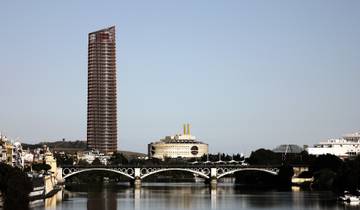
The Triana Bridge (Puente de Isabel II), Seville’s oldest surviving bridge over the Guadalquivir and the primary pedestrian crossing between the historic center and the Triana neighborhood, is entirely free to cross. Walking to the midpoint of the bridge and looking south delivers a direct river-level view of the Torre del Oro framed against the city skyline — a composition that appears on nearly every postcard of Seville and requires no ticket or queuing to experience. Morning light from the east illuminates the historic center’s skyline behind the bridge; afternoon golden light on the Torre del Oro is best viewed from the western end. The bridge is busy at most hours; early morning is quieter and photographically cleaner.
The Guadalquivir Riverside Promenade
The riverside promenade along the Guadalquivir’s eastern bank — running south from the Triana Bridge toward the far end of María Luisa Park — is entirely free and provides the most sustained single free walk in Seville. The route passes the Bullring of the Royal Maestranza (free to view from outside; small fee for the museum inside), the Torre del Oro (free exterior view at any time; free to enter on Mondays; small admission on other days), the riverside gardens, and a series of boat docking points and café terraces. The view west across the river toward Triana’s rooftops and the hills of the Aljarafe plateau beyond is continuous and free for the full length of the walk.
The section from the Triana Bridge to the Torre del Oro — approximately 800 meters — is the most visually concentrated. At river level looking south from just north of the Torre del Oro, the tower and the bridge create a layered composition with the water in the foreground. At the hour before sunset, with the west-facing tower facade catching orange light, this stretch is consistently one of the most memorable free stretches in the city.
Puente del Cristo de la Expiración: A Quieter Free River Perspective
The Puente del Cristo de la Expiración, built as part of the Expo ’92 infrastructure and connecting La Cartuja island to the Macarena district, is free to cross on foot and by bike. The bridge’s midpoint provides a northward view of the Guadalquivir that is largely free of the tourist concentration found at the Triana Bridge. The Alamillo Bridge by Calatrava appears at a useful angle from this crossing, and the western riverbank here is quieter and more residential — offering a local-Seville perspective without commercial interruption. This bridge is the natural crossing for anyone combining the Macarena district with Alamillo Park in a single free half-day.
Calle Betis and the Triana Riverfront
Calle Betis, the street running along the western bank of the Guadalquivir through the Triana neighborhood, offers the best free view of the Seville historic center from the opposite bank. Standing on the Triana side and looking east, the skyline encompasses the Giralda, the domes and facades of the historic center, the Triana Bridge, and the Torre del Oro — all at a single glance from street level. The view at dusk, when the historic center receives its evening illumination and the Giralda catches the last direct light, is particularly sharp. Calle Betis is free to walk along its full length, and its outdoor terrace bars supply ambient atmosphere even if you choose not to order anything.
Free Historic Neighborhoods to Explore in Seville 2027
Seville’s historic neighborhoods are, collectively, its most rewarding free resource. The historic center is compact enough that the major districts described here can be covered in a two-day free walking program with no admission costs. Each neighborhood has a distinct historical character — Jewish quarter, ceramics-and-flamenco enclave, commercial riverside district, working-class devotional neighborhood — and each rewards unhurried exploration on foot.
The Santa Cruz District: The Old Jewish Quarter
The Santa Cruz district, Seville’s medieval Jewish quarter, is entirely free to explore. The neighborhood is defined by its narrow whitewashed alleyways, wrought-iron balconies with potted plants, interior courtyards occasionally glimpsed through open doorways, and the persistent fragrance of orange blossom from the bitter-orange trees planted throughout. The district was established as a Jewish quarter during the period of Moorish rule and remained so until the 1490s; subsequent centuries of rebuilding gave it its current labyrinthine layout.
The best free approach to the Santa Cruz district is to enter from Plaza del Triunfo — the large square between the cathedral and the Real Alcázar — and allow the alleys to dictate direction. Plaza de Santa Cruz, at the center of the neighborhood, contains an iron cross (Cruz de la Cerrajería) that serves as a landmark. Plaza de Doña Elvira, a smaller square with a tiled fountain and orange trees, is frequently quieter and more atmospheric. The eastern boundary of the district opens onto the Murillo Gardens, creating a natural free circuit: enter from Plaza del Triunfo, wander the alleys, exit to the Murillo Gardens, and return along the east face of the Alcázar wall.
The magic of the Santa Cruz district is found in its least-trafficked hours. Early morning before 9:00 AM in spring and autumn, the alleys are quiet and lit by filtered eastern light. The neighborhood fills quickly between 10 AM and 1 PM and again from 4 PM onward; early risers get a meaningfully different experience at no additional cost.
Triana: Flamenco, Ceramics, and the River’s West Bank
Triana, on the western bank of the Guadalquivir, is one of Seville’s most historically significant and characterful neighborhoods and is entirely free to explore. The neighborhood is associated with the development of Seville’s flamenco culture — it was home to several of the most influential flamenco family dynasties — with the city’s ceramics craft tradition (the azulejo tilework visible throughout Seville was largely produced in Triana workshops), and with the city’s working-class and Romani heritage.
The central free Triana walk runs from the western end of the Triana Bridge south along Calle Betis, then inland through Calle Alfarería (Pottery Street) and its continuation, where multiple ceramics studios display and sell their work — free to browse. The studio displays provide direct visual context for the azulejo tilework seen throughout Seville: the same blue-and-white and polychrome patterns, the same hand-applied decoration. The San Jorge Castle Museum under the Triana Market (see Free Heritage Sites section below) is a short walk from Calle Alfarería, and the full Triana circuit — bridge crossing, Calle Betis riverfront view, ceramics street, market, castle museum — takes three to four hours at a comfortable pace and costs nothing.
El Arenal: From the Cathedral to the River
El Arenal is the historic commercial district between Seville Cathedral and the Guadalquivir, named for the sandy riverbank where goods arriving from the Americas were historically unloaded. It is entirely free to walk through. The district is compact — roughly a ten-minute walk from the cathedral steps to the riverfront — with several free external landmark stops. The Bullring of the Royal Maestranza (Plaza de Toros de la Real Maestranza de Caballería), one of the oldest functioning bullrings in Spain with construction spanning much of the 18th century, presents an ornate Baroque exterior along the Paseo de Cristóbal Colón that is free to admire from the street. A short walk south brings the Torre del Oro and the beginning of the free riverside promenade. El Arenal connects the historic core to the river in under ten minutes on foot and serves as the natural link between the Cathedral-Alcázar complex and the waterfront.
The Macarena District: Devotional and Authentic Seville
The Macarena district, north of the historic center, is working-class Seville at its most authentic and is entirely free to explore on foot. The neighborhood is named for the Macarena Basilica — which houses the Virgen de la Macarena, the highly venerated devotional image at the center of Seville’s Holy Week processions. The basilica is free to enter and provides immediate immersion into the devotional culture that shapes Seville’s deepest civic identity. The treasury room adjacent to the main chapel contains Holy Week processional robes and crown jewelry; entry terms for this inner section may vary, so check on arrival.
The Macarena district also preserves the best-surviving section of Seville’s medieval city walls: a free-to-walk stretch of Almohad defensive architecture along the Avenida de la Macarena, dated to the 12th–13th centuries, including surviving towers and the Macarena Gate (Puerta de la Macarena). This wall section is one of the most atmospheric free heritage walks in the city and draws far fewer visitors than the Santa Cruz district. The neighborhood’s market streets, independent food shops, and local bar culture make the Macarena district a worthwhile free half-day outside the standard tourist circuit.
Free Heritage Sites and Museums in Seville 2027
General Archive of the Indies: Free UNESCO Heritage Building
The General Archive of the Indies (Archivo General de Indias) is one of the three buildings in Seville’s UNESCO World Heritage designation — alongside the cathedral and the Real Alcázar — and is entirely free to visit throughout the year. The building, designed in the late 16th century as a merchants’ exchange and later repurposed to house the Spanish colonial documentary archive, is a Renaissance landmark in its own right. Its central courtyard, double-height stone staircase, and galleried upper floor with barrel-vaulted ceilings are worth the visit for the architecture alone.
The archive is open free of charge Tuesday through Saturday from 9:30 to 17:00 (last entry 16:30) and on Sundays and public holidays from 10:00 to 14:00. Closed on Mondays. Accessible display cases in the main public gallery exhibit original maps, documents from the major colonial expeditions, and letters bearing the signatures of historical figures from the period of Spanish exploration and administration in the Americas. The visit takes 30 to 60 minutes and dovetails naturally with the free exterior walk of the adjacent cathedral and Real Alcázar, all grouped around Plaza del Triunfo.
Seville Fine Arts Museum: Free for EU Visitors
The Seville Fine Arts Museum (Museo de Bellas Artes de Sevilla), housed in a 17th-century former convent on Plaza del Museo, holds one of Spain’s most significant painting collections, widely regarded as second only to the Prado in Madrid. The collection centers on Seville’s Golden Age Baroque painters — particularly Bartolomé Esteban Murillo, Francisco de Zurbarán, and Juan de Valdés Leal — and includes early works by Diego Velázquez, who was born in Seville. Entry is free for EU citizens. Non-EU visitors pay a modest fee (€1.50 as of 2025 — verify current rates on the Junta de Andalucía’s official website). The museum is open Tuesday through Saturday and Sunday mornings; confirm current hours on the official website. On Sunday mornings, a small antiques and art market is sometimes held in the plaza outside, combining with the museum visit for an easy free morning in the neighborhood.
San Jorge Castle Museum in Triana: Free Spanish Inquisition History
The San Jorge Castle Museum in Triana is free to enter and preserves the underground ruins of the castle that served as the Seville headquarters of the Spanish Inquisition from the late 15th century until 1785. The museum explains the history of the Inquisition in Seville and the role of this specific site, using surviving archaeological remains of the castle’s foundations and chambers as exhibit space. The entrance is located inside the Triana Market building on the Guadalquivir riverbank — a detail that surprises many visitors, as the approach through the market’s fish stalls gives no indication of what lies beneath. The visit takes 30 to 45 minutes and is one of the more unusual and uncrowded free historical experiences in the city.
Seville Cathedral and the Giralda — Free Sunday Access
Seville Cathedral — the Cathedral of Saint Mary of the See — is free to visit every Sunday (except public holidays) from 16:30 to 18:00, including access to the Giralda tower climb. Advance online booking through the cathedral’s official website is required even for this free slot, as capacity is limited. The interior encompasses the Christopher Columbus tomb, one of the largest Gothic main altarpieces in the world, the royal chapels, the treasury rooms, and the Giralda — a 98-meter tower that began as the minaret of the mosque that preceded the cathedral on the same site, completed with its bell tower addition in the 16th century. Standard admission is €13 online (€14 at the box office) as of early 2025; verify current rates on catedraldesevilla.es before your 2027 visit.
Real Alcázar — Free Monday Access
The Real Alcázar is among the finest examples of Mudéjar palace architecture in the world and remains an active royal residence when the Spanish royal family visits Seville. Monday afternoons offer free entry: 16:00 to 17:00 in winter (October through March) and 18:00 to 19:00 in summer (April through September). This one-hour window provides access to the main Mudéjar palace rooms — including the Maidens’ Courtyard (Patio de las Doncellas), the Hall of the Ambassadors (Salón de los Embajadores), and the formal garden terraces visible through the palace exits. Arriving 10 to 15 minutes before the designated free hour is advisable. Verify current free hours and any booking requirements on the Real Alcázar’s official website before your 2027 visit, as the summer-to-winter schedule can shift slightly between years.
Torre del Oro — Free Monday Access
The Torre del Oro, the 13th-century Almohad watchtower on the Guadalquivir, is free to enter every Monday. On other days it charges a small admission fee — recent visitor accounts suggest approximately €3, though verify the current rate on the city’s official website. The interior houses a maritime museum covering Seville’s historical role as the gateway to the Spanish Americas, with exhibits including navigational charts, models of Columbus’s ships, and artifacts from the era of exploration. The climb to the tower’s circular upper level delivers views over the Guadalquivir and the southern edge of the historic city. The visit takes 30 to 45 minutes. The tower’s exterior — photogenic from the riverbank promenade and from the Triana Bridge midpoint — is free to view at any hour.
Free Cultural Experiences in Seville 2027
Spontaneous Street Flamenco
Flamenco in Seville is a living tradition rather than a performed art for tourists, and some of its most authentic expressions are entirely free. The Santa Cruz district streets, the Alameda de Hércules on weekend evenings, and Triana’s Calle Betis are the areas most likely to host spontaneous busking performances, street duets, or informal gatherings where flamenco singing and palmas (rhythmic handclapping) emerge from a social moment. These are genuinely unpredictable — they cannot be scheduled or guaranteed — but their spontaneity distinguishes them from the ticketed tablao shows that begin at €30 or more per person. The free walking tours departing from Plaza Nueva include a brief introduction to flamenco history and can point participants toward current likely venues.
The most concentrated free flamenco experience available in Seville comes during Semana Santa (Holy Week), when saetas — improvised devotional flamenco laments — are sung spontaneously from balconies and street corners as processional floats pass below. Witnessing a saeta in person costs nothing and is one of the most distinctive free cultural experiences in Andalusia.
The Royal Tobacco Factory Courtyard: Free Architecture and History
The Royal Tobacco Factory (Real Fábrica de Tabacos), now the main building of the University of Seville, is one of the largest 18th-century civil buildings in Spain and the building associated with the fictional setting of Bizet’s opera Carmen — the factory employed thousands of female cigar-rollers (cigarreras) historically, and the character of Carmen is placed here. The building’s exterior and its large interior courtyard are free to enter during university operating hours, which generally follow the academic calendar. The scale of the building — its surrounding moat, guard towers, and the formal courtyard’s layout — is striking. The building sits a short walk south of Plaza de España and María Luisa Park, making it a natural free continuation of any visit to the 1929 Exposition area.
Seville’s Ceramic Tile Heritage: A Free Citywide Visual Tour
Azulejo tilework — hand-painted ceramic tiles produced in Triana’s workshops since at least the 15th century — is woven throughout Seville’s public spaces as a form of permanent, free visual art. The 48 province alcoves at Plaza de España are the most concentrated single example. But the city’s streets provide a continuous free museum of tilework: Triana’s house facades, the Santa Cruz district’s street-corner shrine tiles, the decorative panels on public buildings throughout the historic center, and the tiled benches in María Luisa Park collectively constitute a public art collection of genuine quality. Walking a tilework-focused route through Triana and the Santa Cruz district — using a free walking map from any city tourist office — takes two to three hours and costs nothing.
Free Walking Tours of the Historic Center
Tip-based free walking tours of Seville’s historic center depart daily from Plaza Nueva, typically at 10:00 AM with additional departure times throughout the day. These tours cover the major exterior landmarks — the cathedral, the Real Alcázar walls, the General Archive of the Indies, the Torre del Oro, the Bullring of the Royal Maestranza, the Royal Tobacco Factory, and Plaza de España — in a circuit of approximately two hours. Tours run in English and Spanish (and sometimes in French and German) and operate on a tip basis, with €5 to €10 per person considered appropriate. Advance booking via the tour operator’s website is recommended for the morning tours in spring, as they fill quickly. No admission tickets are required, since the tours focus entirely on exteriors and public spaces.
Free Market Experiences in Seville 2027
Triana Market: Seville’s Most Atmospheric Free Indoor Market
The Triana Market, occupying a purpose-built market hall on the Guadalquivir riverbank in Triana, is free to enter and browse at any time during its operating hours. The main trading floor carries fresh fish, meat, produce, and local cheeses from Andalusia. The real asset of the Triana Market, beyond its own produce stalls, is its position above the San Jorge Castle Museum — the free entrance to the castle museum is accessible from inside the market building — so a single visit can combine both the market experience and the underground historical site.
El Jueves: Seville’s Thursday Flea Market on Calle Feria
El Jueves (“The Thursday”) is Seville’s traditional weekly flea market, held every Thursday morning on Calle Feria in the old city north of the Cathedral. The market’s name refers to its day, and it has operated on Thursday mornings for several centuries, making it one of the longest-running open-air markets in Spain. Stalls sell a mixture of antiques, vintage clothing, books, second-hand tools, small collectibles, and general household goods. Entry is free; browsing is expected to be unhurried. The market begins around 9:00 AM and winds down by early afternoon. Calle Feria and the streets toward the Alameda de Hércules are within easy walking distance of the Macarena Basilica, making a combined free morning of the market and the Macarena district straightforward.
Plaza del Museo Art Market: Free Sunday Mornings
On Sunday mornings, the plaza in front of the Seville Fine Arts Museum hosts a small open-air art and antiques market, with local artists and dealers displaying paintings, prints, ceramics, and collectibles on the flagstones. The market is free to browse and pairs naturally with the museum itself — which is open on Sunday mornings and free for EU citizens. The combination of the outdoor market and the indoor painting collection (Murillo, Zurbarán, Velázquez) makes this one of the better free Sunday morning itineraries in the city for visitors interested in art.
Free Festivals and Events in Seville 2027
Semana Santa 2027: Holy Week Processions
Semana Santa (Holy Week) is Seville’s defining annual event and the most spectacular free public experience in the city on an absolute scale. In 2027, Holy Week falls in late March or early April — verify exact dates before travel, as they shift annually with the ecclesiastical calendar. During the week, more than 60 brotherhoods (hermandades) carry their processional floats (pasos) through the streets on designated routes that are public, free, and viewable from the sidewalk. The processions run from early afternoon through the small hours of the morning on most days of the week, with the Madrugá processions in the early hours of Good Friday drawing the largest free street crowds.
The free strategy for Semana Santa is to position yourself on the route of a specific procession — the Seville tourist board publishes the full route map each year on their official website — and arrive at your chosen viewing spot at least an hour before the expected passage. Grandstand seating along the Carrera Oficial (the officially marked procession route through the city center) is ticketed and sells out months in advance. The vast majority of the routes, however, pass through open streets where viewing is free, albeit requiring extended standing. Saetas — spontaneous flamenco laments sung from balconies as a float passes — can be heard for free at any point along any procession route where the moment and the crowd align.
Feria de Abril 2027: The Free Street-Side Experience
Seville’s Feria de Abril (April Fair) takes place two weeks after Easter on the fairgrounds (Real de la Feria) on the south side of the city. The fair’s casetas — private decorated canvas tents operated by families, companies, or neighborhood associations — are mostly by invitation or affiliation. However, the streets between the casetas are open to the public at no cost; the illuminated fairground at night is free to walk through; and the horse parades (paseo de caballos) through the main paths are free to watch from the roadside. The visual spectacle of the street-side fair — participants in traditional flamenco costume (traje de flamenca) moving through the fairground on foot and on horseback, live music audible from the street, the thousands of colored paper lanterns overhead — is one of Seville’s most vivid free experiences. Arrive in the late afternoon or evening for the most atmospheric free version of the fair.
Corpus Christi and Summer Open-Air Events
Corpus Christi, which falls in late May or early June, brings a procession through the historic center along streets decorated with aromatic herbs and seasonal flowers. The preparation of the herbal and flower carpet the night before is itself worth seeing free; the procession itself passes through public streets at no charge. Through the summer months, Seville hosts a program of free outdoor events including concerts in public squares, open-air cinema screenings in the Alameda de Hércules, and cultural performances in the riverside parks. The city’s official tourism website (visitasevilla.es) publishes a current program; check it in advance to identify free events aligned with your specific 2027 travel dates.
Planning Your Free Days in Seville 2027: Two Sample Itineraries
Day One: The Historic Core on Foot
Begin at 8:30 AM at Plaza de España to see the semicircular colonnade in morning light before crowds arrive. Walk south briefly into María Luisa Park — the Glorieta de Bécquer and the duck ponds are the recommended stops — before returning north to the Cathedral quarter. The cathedral exterior walk, the close-up view of the Giralda, and the visit to the General Archive of the Indies (opens 9:30) take approximately 90 minutes at no cost. If this is a Sunday, book the 16:30 free cathedral entry slot in advance and arrange the afternoon accordingly. After the Cathedral area, enter the Santa Cruz district via Plaza del Triunfo, spending an hour to 90 minutes in the alleys before exiting to the Murillo Gardens. Walk south through the gardens and cross to El Arenal, following the riverside promenade north past the Torre del Oro (free exterior view) to the Triana Bridge. Cross the bridge into Triana and walk Calle Betis for the east-bank view of the historic center at dusk. This itinerary covers roughly 8 to 10 kilometers of walking and costs nothing in admission fees.
Day Two: The River, Triana, and the Macarena Free Monday Option
Begin at the Triana Market (typically opens from around 8:00 AM on weekday mornings) and visit the free San Jorge Castle Museum in the basement. Walk Calle Alfarería for the ceramics studios (free to browse), then south along Calle Betis for the riverfront view. Cross the Triana Bridge back into the historic center and walk north through El Arenal to the Alameda de Hércules, allowing an hour to explore the neighborhood. If traveling on a Monday, the afternoon unlocks the best free combination in Seville: the Torre del Oro free entry begins when the museum opens, and the Real Alcázar’s free Monday hour (16:00 in winter, 18:00 in summer) fills the late afternoon. Conclude with the Macarena district walk — the medieval city walls, the Macarena Basilica (free), and if the day is a Thursday, the El Jueves market on Calle Feria. This is a full free day at a comfortable pace, spending nothing on admission.
Practical Tips for Getting the Most from Free Seville 2027
When to Visit Each Free Attraction
Seville’s free outdoor attractions are at their best in early morning and late afternoon, particularly in spring (March through May) and autumn (September through November). Summer (June through August) brings extreme heat — midday temperatures regularly exceed 38°C, and walking paved plazas in full sun between 11 AM and 5 PM is physically demanding. The city adjusts: locals take a genuine midday pause, and effective free outdoor exploration in summer runs before 10 AM and after 6 PM. The riverside promenade in the early evening in summer is especially pleasant, as a breeze off the water moderates the heat. For the free Sunday cathedral slot (16:30), book online at least a few days in advance in spring, as it fills. For the Monday Alcázar and Torre del Oro free hours, plan to arrive 10 to 15 minutes early.
Getting Around Seville for Free or Cheaply in 2027
The historic center is compact enough that nearly all attractions in this guide can be reached on foot from any central accommodation. Plaza de España, María Luisa Park, the Cathedral, the General Archive of the Indies, the Santa Cruz district, the Guadalquivir promenade, and the Triana Bridge are all within a 25-minute walk of each other at a relaxed pace. The Macarena district adds approximately 15 minutes walking north from the Cathedral; Alamillo Park requires a 20-minute bike ride or bus from the historic center.
Seville’s city bike share scheme (SEVICI) offers a modest daily rate for unlimited 30-minute rental periods, making it cost-effective for covering distances between the historic center, Triana, and Alamillo Park. Seville has an extensive segregated cycling network, making cycling safe and pleasant. The city bus network (TUSSAM) serves all districts at low per-ride fares; verify current routes and prices on the TUSSAM official website. The city’s single metro line is useful for reaching the La Cartuja area but not essential for historic-center navigation.
Staying Cool and Hydrated at Free Outdoor Spots in Summer 2027
Seville in summer is one of the hottest cities in continental Europe, and free outdoor exploration requires preparation. The city’s ornamental fountains are not drinking fountains — carry water if exploring during daytime heat. Free shaded spaces worth identifying in advance include: the colonnaded walkways at Plaza de España (the inner arcade remains shaded through midday); the tree tunnels in María Luisa Park’s northern section; the Murillo Gardens’ magnolia avenue; the interior of the General Archive of the Indies (air-conditioned during opening hours, free to enter); and the covered Metropol Parasol plaza at La Encarnación. The north face of the cathedral, along the Orange Tree Courtyard (Patio de los Naranjos) wall, provides useful midday shade at no charge and is worth knowing as a free midday rest point.
Combining Free and Paid Highlights in 2027
For visitors who plan to pay admission to one or two of Seville’s major sites, the free context surrounding those paid experiences matters as much as the interior. Visiting the Real Alcázar (paid on most days, free on Monday afternoons) is significantly richer if preceded by a free walk through the Santa Cruz district and the Murillo Gardens, which frame the palace from the east and south. Visiting Seville Cathedral (paid on most days, free Sunday 16:30–18:00) pairs naturally with the free General Archive of the Indies visit immediately next door, since both buildings share the Plaza del Triunfo grouping. The Metropol Parasol rooftop (€16 as of 2025) is worth considering at sunset for the panoramic view — but the ground-level plaza and market visit is free and fully satisfying on its own as an introduction to the structure.
The single most efficient money-saving strategy for 2027 is a Sunday–Monday combination: the cathedral and Giralda go free Sunday from 16:30, and the Real Alcázar, the Torre del Oro, and a free cycling morning in Alamillo Park fill the Monday. The permanently free attractions — Plaza de España, María Luisa Park, the General Archive of the Indies, the Santa Cruz district, Triana, the Macarena district, and the riverside promenade — then fill all remaining days with no admission cost at all.
Frequently Asked Questions About Free Things to Do in Seville
Is it genuinely possible to spend a full day in Seville without any admission fees?
Yes, easily. A full day built around Plaza de España, María Luisa Park, the General Archive of the Indies (Tuesday through Saturday, no charge), the Santa Cruz district, the Guadalquivir riverside promenade, and Triana involves no admission fees whatsoever and fills 10 to 12 hours of active exploration. Seville’s permanently free outdoor spaces are not inferior alternatives to the paid attractions — they are simply different in character and, in the case of the plaza and the park, architecturally extraordinary in their own right.
Are there free options for the Seville Cathedral and Giralda in 2027?
Yes. Seville Cathedral offers free public access every Sunday (except public holidays) from 16:30 to 18:00, including the Giralda tower climb. Prior online booking through the cathedral’s official website (catedraldesevilla.es) is required even for the free slot. On other days, admission is €13 online (€14 at the box office) as of early 2025 — verify current rates before your visit. The full cathedral exterior, the Orange Tree Courtyard (Patio de los Naranjos), and close-up street-level views of the Giralda are free at any hour.
Is the Real Alcázar free at any point in 2027?
The Real Alcázar offers free entry on Monday afternoons: 16:00 to 17:00 during winter (October through March) and 18:00 to 19:00 during summer (April through September). The one-hour free window provides access to the main Mudéjar palace rooms and the outer gardens. For a complete visit, the paid admission allows unrestricted time. Verify the current schedule on the Real Alcázar’s official website before traveling, as the summer-to-winter schedule transition timing can shift between years.
What free evening options does Seville offer in 2027?
Seville’s free evening culture is genuinely excellent. The Guadalquivir riverside promenade is lively at dusk and after dark throughout the year, and the Torre del Oro is photogenic from the river path at night. Calle Betis in Triana fills with locals in the evenings, and the eastward view across the illuminated river to the historic center’s skyline is sharp. The Alameda de Hércules hosts free outdoor events and ambient street life until late. The Santa Cruz district at night — emptied of day-trippers and lit by warm lantern light — delivers a different and quieter version of the neighborhood. The Metropol Parasol ground-level plaza is illuminated at night, providing a free architectural spectacle without climbing to the paid rooftop promenade.
Are María Luisa Park and Plaza de España permanently free in 2027?
Yes. Both are permanently free and open public spaces. Plaza de España has no admission gate and is accessible at all hours. María Luisa Park is a public park open daily (gate closure times in the evening may vary by season — check locally for current evening closure). Neither space charges for any of their permanently installed features, including the province alcoves at Plaza de España and all the park’s paths, fountains, and gardens.
Is the Torre del Oro free on Mondays in 2027?
The Torre del Oro is free to enter every Monday. On other days, a small admission fee applies — approximately €3 based on recent visitor reports, though verify the current rate on the official city website before visiting. The tower’s exterior is free to view and photograph from the riverside promenade at any time. The Monday free window typically runs during the tower’s standard morning opening hours; check the Seville city tourism portal (visitasevilla.es) for current opening times.
Is the Triana neighborhood worth visiting for free?
Triana is one of the most rewarding free neighborhoods in Seville. Entirely free to explore, it offers the San Jorge Castle Museum (free, inside the Triana Market), Calle Alfarería’s ceramics workshops (free to browse), the Triana Market itself (free to enter), and the Calle Betis riverfront view of the historic center (free). Together, these constitute a half-day of substantive, cost-free engagement with some of the most historically layered parts of the city. Triana’s character — as a lived neighborhood with a genuine local identity distinct from the tourist-centered Santa Cruz district — makes the free experience feel authentically Sevillian.
Are the free walking tours of Seville good in 2027?
The tip-based free walking tours departing from Plaza Nueva are a worthwhile two hours for first-time visitors who want to orient themselves in the historic center. The guides are typically knowledgeable about the city’s history and direct participants to free experiences they might not find independently. The tours cover exterior sites only (no paid admissions required) and are consistently well-regarded by participants. A tip of €5 to €10 per person is considered appropriate. Advance booking via the tour operator’s website is recommended for spring morning tours. Tours run daily in English and Spanish.
What free options exist for families with children in Seville in 2027?
Families have excellent free options. María Luisa Park is the primary recommendation for children of most ages: duck ponds, wide flat paths, a resident wild parakeet population, and the expansive open spaces provide a full free morning. Plaza de España’s ornamental canal and the province tile alcoves engage children effectively. The Guadalquivir riverside promenade is stroller-friendly. The Triana Market and Calle Alfarería ceramics street are engaging free browsing for older children. Free walking tours are generally less suitable for young children (two hours of structured walking), but the route can be replicated independently at a child’s pace.
How should I plan around the Monday and Sunday free windows for maximum value in 2027?
The optimal structure is a Sunday–Monday arrival window. Book the Sunday 16:30 cathedral slot online before traveling, since capacity is limited and spring slots fill in advance. On Monday, plan the Torre del Oro visit during standard morning opening hours (free), then use the afternoon for the Real Alcázar free hour (16:00 in winter, 18:00 in summer). The remainder of Monday before and after the Alcázar free hour is easily filled with the permanently free riverside promenade, the Murillo Gardens, and a walk to the Metropol Parasol ground level. By combining Sunday and Monday this way, the three major paid highlights of Seville — the cathedral, the Alcázar, and the Torre del Oro — become free, and all other days can be devoted to the permanently free city.