Floating Markets Day Trip from Bangkok 2026: Damnoen Saduak & Maeklong Railway
Experience two of Thailand’s most iconic markets in a single unforgettable day trip combining the vibrant canal commerce of Damnoen Saduak Floating Market with the extraordinary spectacle of vendors clearing their stalls as trains pass through Maeklong Railway Market. This comprehensive 2026 planning guide provides verified pricing, precise train schedules, transportation strategies, and timing optimization to maximize your market experience while minimizing crowds and costs.
Key Takeaways: Essential Planning Points for 2026
- Train Schedule Precision Required: Maeklong Railway Market experiences train arrivals at exactly 8:30 AM, 11:10 AM, 2:30 PM, and 5:40 PM daily, with departures at 6:20 AM, 9:00 AM, 11:30 AM, and 3:30 PM—arriving 20-30 minutes before scheduled times ensures optimal viewing positions and photography opportunities
- Optimal Market Timing Strategy 2026: Damnoen Saduak operates most authentically 7:00-9:00 AM before tour buses arrive, while combining the 8:30 AM Maeklong train arrival with early floating market access creates the perfect morning itinerary
- Transportation Cost Range 2026: Budget options start at 700-900 THB for organized group tours including hotel pickup, boat rides, and both markets, while private taxi arrangements cost 1,500-2,000 THB one-way or 2,500-4,000 THB for full-day round-trip service
- Boat Experience Investment: Damnoen Saduak boat rides range 400-2,000 THB depending on type and duration—traditional row boats cost 400 THB per boat (up to 6 passengers) for one hour, while motorized long-tail boats charge 600-800 THB, with both markets offering free entrance for walking exploration
- Both Markets Accessible Without Fees: Neither Damnoen Saduak nor Maeklong Railway Market charges entrance fees, though boat experiences at the floating market enhance canal exploration and vendor interaction significantly
- Distance and Proximity 2026: Maeklong Railway Market sits 70-80 km southwest of Bangkok (90-minute drive), while Damnoen Saduak lies 100 km from the capital (90 minutes) but only 15-20 minutes from Maeklong, making the combination geographically logical and time-efficient
People Also Ask About Bangkok Floating Markets 2026
How Much Does a Floating Market Day Trip Cost in 2026?
Floating market day trips from Bangkok cost 700-1,500 THB ($20-42) for organized group tours including hotel pickup, air-conditioned transportation, and boat rides at Damnoen Saduak. Check official tour operator websites for current rates as seasonal pricing may vary. Budget travelers using public transportation spend 330-500 THB total for bus fares plus 400-600 THB for boat experiences, creating total costs of 730-1,100 THB. Private taxi or Grab services charge 1,500-2,000 THB one-way or 2,500-4,000 THB for round-trip day hire accommodating 1-4 passengers, making shared costs economical for groups.
Food and shopping expenses add 300-800 THB depending on dining choices and souvenir purchases. Boat noodle soup costs 40-60 THB, fresh fruit smoothies 50-80 THB, and grilled seafood 100-200 THB per portion. Most vendors accept cash only with limited change for large bills, so bringing denominations of 20, 50, and 100 THB notes facilitates transactions and price negotiations.
What Time Should I Visit Maeklong Railway Market to See the Train in 2026?
Trains arrive at Maeklong Railway Market at 8:30 AM, 11:10 AM, 2:30 PM, and 5:40 PM daily throughout 2026. Arrive 20-30 minutes before your target train time to explore the market, secure optimal viewing positions along the tracks, and witness the complete transformation as vendors retract their awnings and pull produce away from the rails. The 8:30 AM arrival attracts fewer tourists than the 11:10 AM train, offering better photography opportunities and more authentic market atmosphere.
Train departures occur at 6:20 AM, 9:00 AM, 11:30 AM, and 3:30 PM, providing eight daily opportunities to witness the market-train spectacle. The 9:00 AM departure works perfectly for visitors who witnessed the 8:30 AM arrival, allowing 30 minutes to explore the market between train events. Position yourself near the station end of the market where awning retraction begins, or walk 200-300 meters toward the far end for authentic local atmosphere with fewer tourists concentrated around departure points.
Can I Visit Both Damnoen Saduak and Maeklong Railway Market in One Day Trip 2026?
Visiting both Damnoen Saduak Floating Market and Maeklong Railway Market in a single day trip from Bangkok works perfectly due to their proximity—the markets sit only 15-20 minutes apart by road. Organized tours routinely combine both destinations in half-day morning itineraries departing Bangkok 6:30-7:00 AM, visiting Maeklong Railway Market for the 8:30 AM train arrival, then continuing to Damnoen Saduak for 9:30-11:30 AM floating market exploration before returning to Bangkok by early afternoon.
Independent travelers using private transportation achieve the same combination by departing Bangkok 6:00-6:30 AM to reach Maeklong by 8:00 AM, witnessing both the 8:30 AM train arrival and 9:00 AM departure, then driving to Damnoen Saduak by 9:30 AM for optimal floating market hours. This timing captures both markets during their most authentic periods before peak tourist crowds arrive mid-morning, maximizing photography opportunities and genuine vendor interactions while avoiding afternoon heat and reduced market activity.
Is Damnoen Saduak Floating Market Worth Visiting in 2026 or Too Touristy?
Damnoen Saduak remains Thailand’s most photographed and recognized floating market due to its extensive canal network where vendors sell directly from traditional wooden boats—a visual spectacle unavailable at land-based markets. Early morning visits before 9:00 AM provide authentic experiences as local vendors arrive with fresh produce, the canal system operates at full capacity with dozens of boats navigating narrow waterways, and tourists remain minimal compared to 10:00 AM-12:00 PM peak hours when tour buses dominate.
The market serves both tourist and commercial functions with vendors selling souvenirs alongside fresh vegetables, fruits, and cooked foods that local residents purchase daily. Walking the elevated walkways surrounding the canals costs nothing and allows market observation without boat rides, while hired boats provide intimate canal access and vendor interaction opportunities. Tourist-focused aspects concentrate near the main pier and bridge areas, while walking 10-15 minutes toward outer canal sections reveals more authentic local commerce with fewer souvenir vendors and more food-focused boats serving Thai customers.
Extended multi-day tours – 5+ days
Featured Bangkok Multi-Day Tour Packages

3 days
Bangkok 3-Day Discovery Tour
- ✓ Comprehensive Bangkok experience
- ✓ Expert local guides included
- ✓ All accommodation included
- ✓ Transportation provided

5 days
Bangkok 5-Day Highlights Experience
- ✓ Comprehensive Bangkok experience
- ✓ Expert local guides included
- ✓ All accommodation included
- ✓ Transportation provided

7 days
Bangkok 7-Day Cultural Journey
- ✓ Comprehensive Bangkok experience
- ✓ Expert local guides included
- ✓ All accommodation included
- ✓ Transportation provided
10 days
Bangkok 10-Day Complete Adventure
- ✓ Comprehensive Bangkok experience
- ✓ Expert local guides included
- ✓ All accommodation included
- ✓ Transportation provided
Multi-day tour packages powered by TourRadar. Prices and availability subject to change.
Introduction: Planning Your 2026 Bangkok Markets Adventure
Bangkok’s southwestern provinces contain two of Thailand’s most extraordinary market experiences within 90 minutes of the capital and 20 minutes of each other, creating perfect conditions for memorable day trip combinations. Maeklong Railway Market operates as a fully functional fresh produce market built directly atop active railway tracks where trains pass through eight times daily, forcing vendors to execute a choreographed retraction of awnings and goods in under two minutes before resuming commerce seconds after each train passes. This remarkable adaptation to modern transportation infrastructure while maintaining traditional market operations has made Maeklong one of Thailand’s most photographed attractions, with the spectacle drawing visitors worldwide who marvel at the casual precision vendors display as multi-ton trains squeeze past their vegetables and seafood with mere inches of clearance.
Damnoen Saduak Floating Market represents Thailand’s most extensive traditional water market where commerce occurs on wooden boats navigating narrow canals rather than stationary stalls. Dating to the 1860s when King Rama IV commissioned the Damnoen Saduak Canal to connect the Tha Chin and Mae Klong rivers for agricultural transportation, the market evolved naturally as farmers used boats to sell produce to canal-side communities. Modern Damnoen Saduak maintains this boat-based commerce tradition with vendors selling fresh fruits, vegetables, prepared foods, and souvenirs directly from traditional long-tail boats and smaller paddle boats, creating the quintessential floating market imagery that defines Thai water commerce heritage.
Combining both markets in a single day trip maximizes travel efficiency while providing dramatically different market experiences—Maeklong’s train-market collision spectacle contrasts with Damnoen Saduak’s tranquil canal navigation, together offering comprehensive exposure to Thai market culture. The 15-20 minute driving distance between markets allows visitors to witness Maeklong’s 8:30 AM train arrival, observe the 9:00 AM departure, then reach Damnoen Saduak by 9:30 AM for optimal floating market hours before tour bus crowds arrive. This strategic timing ensures both markets appear at their most authentic and photogenic moments while avoiding peak tourist congestion that diminishes experience quality.
Successfully executing this combination requires understanding train schedules, market operating hours, transportation options, boat pricing structures, and crowd patterns that vary throughout the day. Tour operators simplify logistics by handling transportation and timing coordination, though independent travelers gain flexibility in pacing, photography time, and market exploration depth. This guide provides verified 2026 information on all aspects of planning and executing this iconic Bangkok day trip, from early morning departures through transportation choices, market navigation strategies, food recommendations, and timing optimization that transforms a simple market visit into a masterfully orchestrated cultural experience.
Understanding the Markets: Maeklong Railway and Damnoen Saduak in 2026
Maeklong Railway Market Character and Operations
Maeklong Railway Market extends approximately 300 meters along active railway tracks in Samut Songkhram province, functioning primarily as a legitimate fresh produce market serving local residents rather than a tourist attraction that happens to include a market. Vendors arrange vegetables, fruits, seafood, meats, dried goods, and household items on tables and tarps positioned directly on the railway tracks and immediately adjacent areas, with overhead awnings providing shade that vendors must retract when trains approach. The market operates daily 6:00 AM-5:30 PM regardless of train schedules, maintaining consistent commerce throughout the day as local shoppers purchase ingredients for meals, restaurants source supplies, and vendors restock goods between train passages.
Train arrivals trigger a warning bell or siren approximately 3-5 minutes before each approach, signaling vendors to begin their practiced routine of folding back awnings attached to market buildings via pulley systems, pulling baskets and crates away from track edges, and repositioning tables to create the narrow corridor required for train passage. This transformation occurs with remarkable speed and casual efficiency as vendors continue serving customers, wrapping purchases, and making change even while moving their displays. The actual train passage lasts approximately 30-45 seconds as the locomotive and passenger cars squeeze through the market at walking speed (approximately 30 km/hour), with train sides passing within 10-15 centimeters of market goods and shoppers pressed against building walls to avoid contact.
Immediately after the train clears, vendors reverse the process with equal speed, unfurling awnings back over the tracks, repositioning tables and goods to their original placements, and resuming normal market operations within 60-90 seconds of the train’s departure. This entire cycle from warning signal through train passage to full market restoration takes approximately 5-7 minutes total, after which the market appears exactly as it did before the train arrived, with no indication that a train just passed through except for vendor smiles at tourist amazement.
Damnoen Saduak Floating Market Layout and Commerce Structure
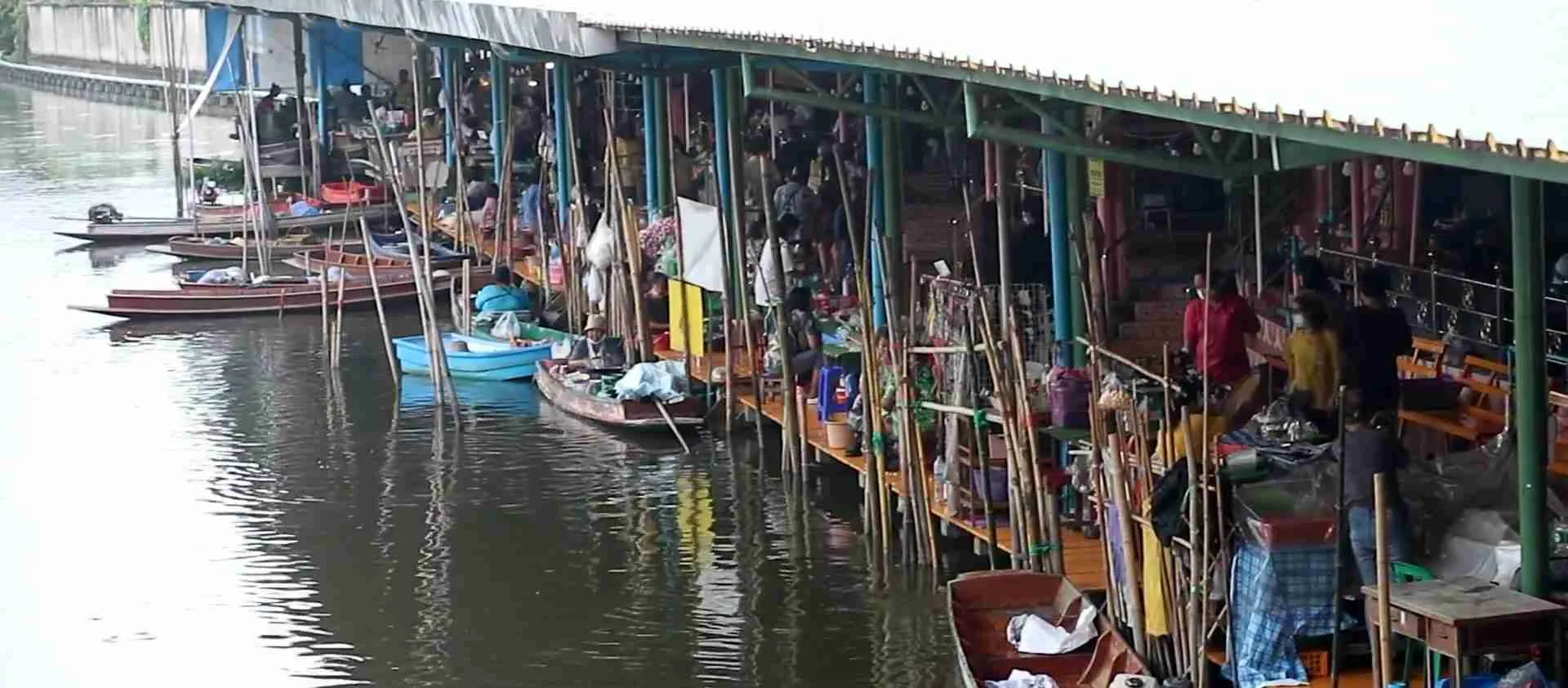
Damnoen Saduak Floating Market operates across an extensive network of interconnected canals covering approximately 2-3 square kilometers in Ratchaburi province, with three main canal sections defining the market geography. Khlong Ton Khem represents the most tourist-oriented section near the main pier and bridge where most tour buses arrive, featuring dense boat traffic, numerous souvenir vendors, and the iconic scenes of colorful boats laden with fruits, vegetables, and handicrafts that appear in Thailand tourism photography. Khlong Hak and Khlong Madame extend from the main section into more residential areas where local commerce dominates, with fewer souvenir boats and more authentic food vendors serving Thai customers seeking fresh ingredients and prepared meals.
Vendors operate from various boat types reflecting traditional canal commerce adaptation—large wooden supply boats carry bulk vegetables and fruits that vendors sell to smaller retail boats and canal-side homes, paddle boats propelled by seated women using short oars navigate narrow canal sections selling individual fruits and snacks directly to tourists in other boats, and motorized long-tail boats transport groups of tourists through the canal system. Stationary vendors occupy positions along elevated wooden walkways lining the canals, operating shops and food stalls in converted houses and purpose-built market structures where tourists can walk freely without hiring boats.
The market follows natural rhythms tied to agricultural supply and tourist patterns, with peak activity 7:00-11:00 AM when fresh produce arrives from nearby farms and tourist boats navigate the canals at highest density. By noon many boat vendors depart, leaving primarily stationary shops and restaurants operating through afternoon hours until official closing around 2:00-3:00 PM. Weekend operation includes slightly more vendors and extended hours compared to weekdays, though the market functions daily year-round with consistent character across all seasons.
Train Schedule 2026: Maeklong Railway Market Complete Timetable
Maeklong Railway operates trains eight times daily passing through the market in both arrival and departure directions. Train arrivals from Ban Laem Station approaching Maeklong Station occur at 8:30 AM, 11:10 AM, 2:30 PM, and 5:40 PM. Train departures from Maeklong Station heading toward Ban Laem occur at 6:20 AM, 9:00 AM, 11:30 AM, and 3:30 PM. These schedules remain consistent throughout 2026 barring special circumstances like maintenance or public holidays, though the State Railway of Thailand may adjust times with minimal notice.
The 8:30 AM arrival represents the optimal timing for visitors prioritizing authentic market atmosphere with minimal tourist crowds. Most organized tours target the 11:10 AM arrival, creating concentrated tourist presence during that period, while the 8:30 AM slot attracts independent travelers and photographers seeking better access to prime viewing positions along the tracks. The 9:00 AM departure following the 8:30 AM arrival allows visitors to experience both market-clearing transformations within 30 minutes, providing comprehensive understanding of the market’s train-accommodation routine while vendors execute the process twice in rapid succession.
Evening train arrivals at 2:30 PM and 5:40 PM coincide with reduced market activity as many vendors complete sales and depart by mid-afternoon, though the spectacle of train passage remains identical regardless of time. The 5:40 PM arrival occurs as daylight fades during winter months (November-February), creating dramatic lighting conditions for photography but requiring visitors to arrive earlier for market exploration since vendor numbers decrease significantly after 3:00 PM.
Strategic Train Viewing Positions and Photography Considerations 2026
Optimal viewing positions balance photographic opportunities with safety and vendor respect. The area immediately adjacent to Maeklong Station platform provides elevated views of the entire market transformation as the train approaches from the north, allowing wide-angle photography capturing the full spectacle of vendors retracting awnings in choreographed sequence. However, this position attracts the highest tourist concentration, particularly during the 11:10 AM arrival, potentially limiting movement and creating crowd-focused rather than market-focused imagery.
Walking 100-150 meters north along the tracks toward the market’s far end reduces tourist density dramatically while providing intimate ground-level perspectives of vendors working mere centimeters from passing train cars. This position captures vendor facial expressions, hand movements as they pull goods away from tracks, and the remarkably casual nature of the entire process as vendors chat with neighbors and serve customers even while executing the retraction routine. Photographers at this location can capture both the approaching train and vendor reactions in single frames, creating more compelling narratives than elevated overview shots.
The market’s southern section near the bridge and residential areas shows fewer awning retractions since stalls occupy only one track side, but offers opportunities to photograph the train from front-on angles as it approaches and rear perspectives as it departs. Food vendors concentrate in this area with seating providing comfortable vantage points for the 30-minute gap between arrival and departure trains, allowing visitors to enjoy boat noodles or Thai iced tea while awaiting the second train passage.
Transportation Options Bangkok to Markets 2026: Complete Cost Analysis
Transportation represents the second-largest expense category for floating market day trips after food and shopping, with options ranging from budget public transit requiring 3-4 hours each way to premium private vehicles completing round trips in half that time. Understanding true costs including time value, convenience factors, and combination possibilities helps travelers select optimal transportation matching their priorities and budgets.
Organized Group Tours 2026 (Most Cost-Effective)
Group tours offered by established operators cost 700-1,500 THB per person for half-day itineraries combining both Maeklong Railway Market and Damnoen Saduak Floating Market. This pricing includes hotel pickup from central Bangkok areas (Khaosan, Silom, Sukhumvit, Pratunam), round-trip air-conditioned transportation, English-speaking guide services, boat rides at Damnoen Saduak (typically motorized long-tail boats), and coordination ensuring arrival at Maeklong precisely timed for train passages. Tours departing 6:30-7:00 AM return to Bangkok by 1:00-2:00 PM, creating efficient half-day experiences that preserve afternoons for other activities.
Premium tour options priced 1,200-2,000 THB include additional elements like Thai lunch at local restaurants, visits to coconut sugar farms or other cultural sites, smaller group sizes (maximum 8-12 passengers versus 20-30 for budget tours), or extended time at markets for deeper exploration. Private group tours accommodating specific parties cost 2,500-5,000 THB total depending on group size and inclusions, becoming cost-effective for 3-4 travelers when compared to individual tour tickets.
Tour advantages extend beyond cost savings to include guaranteed train timing coordination, local guide knowledge explaining market operations and Thai culture, elimination of navigation stress in unfamiliar areas, and social experiences with other travelers. Disadvantages include fixed schedules limiting flexibility, brief market stays designed for photography and overview rather than deep exploration, and potential tour bus crowds at peak times if multiple operators arrive simultaneously.
Private Taxi or Grab Services 2026 (Maximum Flexibility)
Hiring private taxis or booking Grab rides for round-trip floating market transportation costs 2,500-4,000 THB for full-day service accommodating 1-4 passengers. Drivers typically charge fixed day rates rather than metered fares for destinations outside Bangkok, with rates varying by vehicle type (standard sedan versus larger SUV or van), driver experience level, and negotiation skill. Agreeing on comprehensive rates before departure prevents disputes, with clear communication covering pickup time, specific destinations (both markets), waiting time allowances, and return timing to Bangkok.
One-way taxi or Grab services cost 1,000-1,500 THB from central Bangkok to either market, though arranging return transportation from rural market locations proves challenging without pre-arranged pickup times. Most drivers prefer round-trip arrangements ensuring guaranteed return fares rather than dropping passengers with uncertain return booking possibilities. Splitting costs among 3-4 travelers reduces per-person expenses to 625-1,000 THB, comparing favorably with tour prices while offering superior flexibility.
Private transportation advantages include customizable departure times for optimal market hours, unlimited exploration time at each location without tour group constraints, freedom to add stops like coconut farms or temples, and comfortable private space for families or groups. Disadvantages include total cost exceeding tour prices for solo travelers or couples, navigation responsibility for drivers unfamiliar with precise market locations, and absence of guided cultural interpretation provided by tour operators.
Public Transportation 2026 (Maximum Budget, Maximum Complexity)
Public transportation from Bangkok to Damnoen Saduak costs 80-150 THB via bus services from Southern Bus Terminal (Sai Tai Mai), with minivans departing approximately every 40 minutes from 6:00 AM through mid-afternoon. Travel time extends 2-2.5 hours depending on traffic conditions and number of passenger pickups along the route. Return minivans operate on similar schedules with final departures around 3:00-4:00 PM, requiring careful timing to avoid being stranded at the market overnight.
Reaching Maeklong Railway Market by public train creates one of Thailand’s most complex but authentic transportation experiences. Trains depart from Wongwian Yai Station (accessible via BTS Skytrain to Wongwian Yai station, then 10-15 minute walk) following the Mae Klong railway line to Mahachai Station, requiring ferry crossing of the Tha Chin River to Ban Laem Station where second train section continues to Maeklong. Total journey time spans 2.5-3 hours with combined train tickets costing approximately 20-25 THB total, representing Bangkok’s cheapest long-distance transportation but requiring multiple connections, precise timing to catch continuing trains, and tolerance for non-air-conditioned third-class carriages.
Public transportation suits budget-conscious travelers willing to invest time for cost savings and authentic local travel experiences. However, combining both markets via public transit in a single day proves nearly impossible due to limited connecting services between Damnoen Saduak and Maeklong requiring additional taxis or motorcycle taxi arrangements. Most budget travelers prioritize one market via public transport or use tours despite higher costs due to combination convenience.
Timing Strategy 2026: Maximizing Market Experience Quality
Successful floating market visits depend more on arrival timing than any other single factor, with experience quality varying dramatically between 7:00 AM and 11:00 AM despite identical vendor offerings. Understanding crowd patterns, vendor energy levels, lighting conditions, and heat progression allows strategic scheduling that transforms potentially mediocre visits into exceptional cultural experiences.
Optimal Two-Market Combination Schedule 2026
The perfect two-market itinerary departs Bangkok 6:00-6:30 AM to reach Maeklong Railway Market by 7:45-8:00 AM, allowing 30 minutes of market exploration before the 8:30 AM train arrival. This timing provides opportunities to observe normal market operations, photograph vendor setups, sample breakfast foods like boat noodles or rice porridge, and secure optimal viewing positions along the tracks before tourist crowds assemble. Witnessing the 8:30 AM arrival demonstrates the full market transformation, while remaining until the 9:00 AM departure 30 minutes later shows the complete cycle of track clearing, train passage, and market restoration occurring twice in rapid succession.
Departing Maeklong at 9:15 AM places visitors at Damnoen Saduak Floating Market by 9:30-9:45 AM, capturing peak morning activity when maximum vendors operate and tourists remain moderate compared to 10:30 AM-12:00 PM congestion. Two hours of floating market exploration (9:45-11:45 AM) allows boat hire through main canals, walking exploration of elevated walkways, food sampling from multiple vendors, and souvenir shopping without rushed pacing. Departing by noon returns travelers to Bangkok by 1:30-2:00 PM, preserving afternoons for additional activities like temple visits, shopping, or rest.
This schedule works identically whether using organized tours, private transportation, or determined independent travelers, with departure time from Bangkok representing the critical variable determining overall experience quality. Tours departing 7:00-7:30 AM arrive at Maeklong for 11:10 AM trains, encountering maximum tourist crowds and heat while missing optimal floating market hours as vendors decrease after noon.
Single Market Deep Dive Alternative Schedules 2026
Travelers prioritizing deep exploration of one market over superficial visits to both gain richer cultural understanding and less rushed experiences. Dedicating full mornings to Damnoen Saduak allows arrival by 7:00 AM when vendors set up boats and local customers dominate the canals, providing authentic market atmosphere largely absent once tour buses arrive. Early arrivals can hire boats for 7:30-8:30 AM canal exploration during golden hour lighting, enjoy breakfast from boat vendors selling freshly grilled meats and sticky rice, then spend 9:00-11:00 AM walking peripheral canals where tourist presence remains minimal and traditional commerce continues.
Focusing exclusively on Maeklong Railway Market permits witnessing multiple train passages while thoroughly exploring the surrounding town area. Arriving for the 6:20 AM departure shows the market at its most active with local shoppers, followed by the 8:30 AM arrival attracting moderate tourists, then the 9:00 AM departure demonstrating how quickly vendors reset operations. The three-hour gap until the 11:10 AM arrival allows walking to Wat Phet Samuth Woravihan temple 15 minutes from the market, sampling extensive food vendor options, and observing daily life in this small provincial town where tourism represents recent addition rather than economic foundation.
Boat Experiences at Damnoen Saduak 2026: Types, Costs, and Value Analysis
Boat hire represents the defining Damnoen Saduak experience, transforming elevated walkway observation into intimate canal immersion where vendors approach your boat selling fruits, smoothies, and souvenirs. Understanding boat types, pricing structures, and rental logistics ensures appropriate investments matching desired experiences while avoiding overpriced tourist traps near market entrances.
Boat Types and Pricing Structure 2026
Traditional row boats paddled by seated operators using short oars cost 400 THB per boat accommodating up to 6 passengers for one-hour canal circuits. These boats move slowly through narrow canals, creating authentic experiences and excellent photography conditions as the quiet propulsion allows hearing vendor calls and water sounds. Paddlers navigate expertly through congested waterways, stopping alongside vendor boats for passenger purchases and explaining market operations in basic English or Thai. The one-hour duration covers approximately 2-3 kilometers of canal exploration, visiting main tourist sections plus extended loops into residential areas where authentic local commerce continues.
Motorized long-tail boats equipped with automotive engines mounted on long propeller shafts cost 600-800 THB per boat for similar one-hour routes. These boats travel faster, covering more canal distance and accessing outer sections beyond row boat ranges, though engine noise diminishes atmospheric quality and limits vendor interaction during movement. Tour groups typically use motorized boats for time efficiency, while independent travelers seeking contemplative experiences favor row boats despite slower speeds and slightly higher per-passenger costs when traveling solo or as couples.
Private boat charters offering extended two-hour explorations, specialized photography routes, or early morning departures before standard operating hours cost 1,500-2,000 THB negotiated directly with boat operators. These premium experiences suit photographers requiring specific lighting conditions, families with young children needing flexible timing, or travelers seeking maximum cultural immersion through extended periods on the canals observing vendor routines and residential life along the waterways.
Boat Hire Logistics and Negotiation Strategies 2026
Boat operators congregate at designated piers near the main market entrance bridge where tour buses arrive, with additional smaller piers scattered along canal-side walkways throughout the market area. Main pier operators often quote inflated prices of 1,000-1,500 THB for standard one-hour trips targeting newly arrived tourists unfamiliar with local rates. Walking 5-10 minutes into the market along elevated walkways reveals alternative piers where operators quote standard rates of 400-600 THB without negotiation.
Effective price negotiation begins with clear communication about desired boat type (row versus motorized), passenger count, and route preferences (main canals only versus extended loops including residential areas). Stating budget ranges based on standard pricing (400-600 THB) establishes informed negotiation positions, while walking away from overpriced offers consistently produces callbacks with reduced rates. Arriving early (7:00-8:00 AM) or during weekday periods when boat demand stays lower improves negotiating leverage as operators prefer accepting standard rates over waiting uncertain hours for premium-paying customers.
Shared boat arrangements where operators combine solo travelers or couples into single boats reduce per-person costs to 100-150 THB for one-hour trips. However, shared arrangements limit route flexibility and stop duration for vendor interactions, as boat captains balance competing passenger interests regarding photography time, shopping stops, and exploration depth. Solo travelers and couples willing to pay full boat rates gain superior experiences through complete route control and unlimited vendor interaction time.
Food Experiences 2026: What to Eat at Both Markets
Market food represents authentic Thai culinary culture at its most accessible and affordable, with vendors offering specialties rarely found in urban restaurants. Understanding signature dishes, quality indicators, pricing, and food safety considerations transforms market visits from primarily visual experiences into comprehensive sensory immersion.
Maeklong Railway Market Food Specialties 2026
Maeklong’s position as functional local market creates food vendor concentration serving market workers, shoppers, and residents rather than tourists. Boat noodle soup (kuay tiew ruea) sold at numerous stalls along the railway tracks costs 40-60 THB per bowl, featuring thin rice noodles in rich beef or pork broth garnished with meatballs, bean sprouts, and fresh herbs. Vendors traditionally serve these soups in small bowls encouraging customers to order multiple servings, a custom originating from canal vendors selling from boats where small portions prevented spillage during water transport.
Fresh seafood dominates market offerings given Samut Songkhram’s coastal proximity, with vendors grilling squid, prawns, and fish over charcoal braziers positioned directly beside railway tracks. Grilled squid (pla muk yang) costs 80-120 THB for medium-sized portions, while grilled river prawns reach 150-250 THB depending on size. Vendors prepare seafood to order with sweet chili sauce, creating aromatic smoke that mingles with market smells of fresh produce and tropical heat.
Thai desserts including coconut pancakes (khanom krok) filled with sweet corn or taro cost 20-40 THB for sets of 6-8 pieces, mango sticky rice (khao niao mamuang) priced 60-100 THB depending on mango season and quality, and Thai custard in pumpkin (sangkaya fak thong) at 50-80 THB per portion appear throughout the market at dedicated dessert vendors operating from permanent stalls. These sweets provide excellent mid-morning snacks between train passages while exploring the market’s 300-meter length.
Damnoen Saduak Floating Market Culinary Highlights 2026
Boat noodle vendors operate from moored boats along main canals, serving the same small-portion soup tradition as Maeklong but in iconic floating settings where customers eat seated in their hired boats alongside the vendor’s cooking boat. Prices remain consistent at 40-60 THB per bowl, with most tourists ordering 2-3 bowls creating 120-180 THB meals while experiencing quintessential floating market dining.
Fresh tropical fruits sold from laden boats represent Damnoen Saduak’s most photogenic food offerings, with vendors displaying pyramids of mangoes, dragon fruit, rambutans, mangosteens, and seasonal specialties. Prices range 40-100 THB for prepared fruit portions served on sticks or in bags, with vendors peeling and cutting fruits to order. Smoothies blended on boats using manual ice shavers cost 50-80 THB, though quality varies significantly as some vendors use excessive ice diluting fruit flavors to reduce costs.
Pad Thai prepared on boat-mounted woks represents Thailand’s most internationally recognized dish, with floating market versions priced 60-100 THB per plate depending on protein additions (shrimp versus chicken versus tofu). Quality ranges from excellent to mediocre, with visual inspection of vendor preparation techniques and ingredient freshness guiding selection. Vendors cooking to order rather than from pre-prepared batches generally deliver superior results despite slightly longer wait times.
Grilled sticky rice wrapped in banana leaves (khao lam) stuffed with coconut milk and black beans costs 30-50 THB per stick, creating portable snacks for boat rides. Coconut ice cream served in coconut shell halves topped with peanuts, sticky rice, and sweet corn costs 60-80 THB, providing refreshing breaks from Thailand’s tropical heat while showcasing traditional dessert presentations favored for their Instagram appeal and authentic vessel usage.
Budget Planning 2026: Complete Daily Cost Breakdown
Understanding total expenditure requirements for floating market day trips enables appropriate budget allocation and prevents unexpected costs reducing experience quality through excessive economizing. Breaking costs into transportation, experiences (boat rides), food, and shopping categories provides clear frameworks for different traveler budget levels.
Budget Traveler Daily Costs 2026
Transportation via organized group tour 900 THB, boat ride (shared arrangement or row boat split among 4-6 people) 100 THB, lunch including boat noodles, fresh fruit, and Thai iced tea 200 THB, snacks and drinks throughout the day 150 THB, minimal souvenir purchases 200 THB. Total day cost: 1,550 THB per person (excluding Bangkok accommodation).
This budget level provides complete market experiences including boat rides at Damnoen Saduak, optimal train timing at Maeklong, adequate food sampling, and modest souvenir purchases without significant sacrifice in experience quality. Budget travelers achieve these costs through tour bookings rather than private transportation, boat cost sharing with other travelers, food vendor selection focusing on local pricing rather than tourist-premium stalls, and strategic souvenir negotiation or limiting purchases to 1-2 meaningful items rather than impulse buying.
Mid-Range Traveler Daily Costs 2026
Transportation via private taxi split between 3-4 travelers 750-1,000 THB per person, private row boat (not shared, 1-4 passengers) 400 THB total (100-400 THB per person depending on group size), lunch including boat noodles, seafood, fruit, desserts 350 THB, beverages and snacks 200 THB, moderate souvenir shopping 400 THB. Total day cost: 1,900-2,350 THB per person (excluding Bangkok accommodation).
Mid-range budgets permit private boat experiences without sharing, flexible timing through private transportation, comprehensive food sampling including grilled seafood and multiple desserts, and comfortable souvenir shopping selecting 3-5 items without price constraints. This spending level represents optimal balance between experience quality and cost control, accessing all major market elements without budget anxiety while avoiding unnecessary premium services that marginally improve experiences at substantial cost increases.
Luxury Traveler Daily Costs 2026
Transportation via private car or premium tour 2,000-3,000 THB per person (or entire private vehicle cost for group), private motorized boat with extended two-hour route 600-1,000 THB total, comprehensive food sampling including multiple vendors and premium seafood 600-800 THB, unlimited beverage and snack purchases 300 THB, extensive souvenir shopping without price consideration 1,000-2,000 THB. Total day cost: 4,500-7,100 THB per person (excluding Bangkok accommodation).
Luxury budgets enable private tour arrangements with personal guides, premium boat experiences with professional photography assistance, unlimited food sampling including restaurant meals at market-adjacent establishments rather than street vendors, and souvenir purchases focused on quality handicrafts, silk items, or artwork without negotiation or budget constraints. This spending level proves unnecessary for complete market experiences but provides maximum comfort, flexibility, and acquisition opportunities for travelers prioritizing convenience and choice over cost optimization.
Photography Strategies 2026: Capturing Market Essence
Floating markets and the railway market spectacle create extraordinary photography opportunities combining vibrant colors, cultural authenticity, dynamic action, and unique Thai market traditions. Technical preparation, ethical considerations, and strategic positioning transform casual snapshots into compelling visual narratives documenting these remarkable commercial environments.
Essential Equipment and Camera Settings 2026
Wide-angle lenses (16-35mm equivalent) capture the scale of Damnoen Saduak’s canal systems and the full spectacle of Maeklong’s market transformation as trains approach, while medium telephoto lenses (70-200mm) isolate vendor portraits, detail shots of fresh produce, and intimate moments between vendors and customers. Bringing both focal length ranges through zoom lenses or lens changes maximizes photographic versatility across different market scenarios.
Early morning market visits occur during golden hour lighting conditions (7:00-9:00 AM) creating warm, directional illumination ideal for photography. However, canal positions surrounded by buildings or dense awning coverage require higher ISO settings (800-1,600) to maintain fast shutter speeds preventing motion blur from boat movement and vendor activity. Later morning periods (9:00 AM-noon) produce harsh overhead lighting creating strong shadows and blown highlights, challenging exposure management but offering dramatic contrast for black-and-white photography or stylized color processing.
Fast shutter speeds (1/500 second or faster) freeze action during the Maeklong train passage as vendors retract awnings and pull goods from track edges, while slightly slower speeds (1/125-1/250) introduce motion blur to train cars creating dynamic energy in images. Continuous autofocus modes track moving subjects including passing trains and navigating boats, while single-point focus works better for static vendor portraits and detail photography of arranged produce.
Ethical Photography Practices and Vendor Respect 2026
Market vendors work in public commercial spaces where photography occurs constantly, though ethical practices distinguish respectful documentation from invasive tourism behavior. Requesting permission before photographing individual vendors, particularly for close-up portraits, demonstrates respect while often leading to more natural, relaxed expressions compared to surreptitious candid shooting. Many vendors appreciate attention and readily pose, especially if photographers make small purchases supporting their businesses.
Avoiding photographs that depict vendors in unflattering circumstances, capture only poverty or difficult working conditions, or reduce human subjects to exotic curiosities maintains dignity while documenting authentic market life. Balanced portfolios including vendor portraits alongside produce displays, architectural details, and market atmosphere provide comprehensive narratives without exploitative focus on individuals.
Boat-based photography at Damnoen Saduak requires coordination with boat operators who understand photography needs including slow navigation for stable shots, positioning alongside vendor boats for optimal angles, and pausing in scenic locations. Communicating photography priorities before boat hire ensures operators provide appropriate pacing rather than rushing through canals as they do for non-photographer passengers.
Weather Considerations 2026: Seasonal Planning
Thailand’s tropical climate creates three distinct seasons affecting floating market experiences through temperature, rainfall, tourist crowds, and vendor activity levels. Understanding seasonal patterns enables strategic visit timing matching weather preferences with crowd tolerance and photographic priorities.
Cool Season 2026 (November-February): Peak Tourist Period
Cool season temperatures ranging 25-32°C (77-90°F) with minimal rainfall create ideal touring conditions explaining November-February designation as Thailand’s peak tourist season. Markets experience maximum tourist presence during these months, with tour buses arriving in highest concentrations 9:00-11:00 AM at both Damnoen Saduak and Maeklong. Early morning arrivals (7:00-8:00 AM) remain essential for avoiding crowds as even cool season mornings attract determined photographers and early-rising tour groups.
Lower temperatures reduce heat stress during market walking and boat rides, though “cool” represents relative term in tropical contexts as midday temperatures still reach 30-32°C requiring sun protection, hydration, and heat management strategies. Morning hours provide most comfortable conditions as temperatures climb throughout the day, with afternoon market visits during cool season still experiencing significant warmth despite being cooler than other seasons.
Hot Season 2026 (March-May): Lower Crowds, Intense Heat
Hot season temperatures reaching 35-40°C (95-104°F) with high humidity create challenging touring conditions reducing tourist numbers significantly compared to cool season. Markets maintain regular operations with similar vendor presence, though some vendors reduce hours during peak afternoon heat. Visitors tolerating heat gain advantages through reduced crowds, better photography access without competing tourists, and enhanced negotiating positions as vendors prefer completing sales even at reduced margins rather than enduring heat without income.
Heat management becomes critical with early morning departures from Bangkok (6:00-6:30 AM) essential for completing market visits before temperatures peak 11:00 AM-2:00 PM. Bringing electrolyte drinks, wearing wide-brimmed hats, using high-SPF sunscreen reapplied every 2 hours, and taking frequent shade breaks prevents heat exhaustion. Boat rides provide cooling effects through air movement and canal spray, making hot season floating market experiences more tolerable than market walking.
Rainy Season 2026 (June-October): Unpredictable Conditions
Monsoon season brings daily rain probability though typically as afternoon thunderstorms rather than all-day precipitation. Morning market visits (7:00-11:00 AM) frequently avoid rain completely as storms develop through atmospheric heating accumulating into late afternoon downpours. Markets operate normally during rain with vendors covering goods and continuing commerce, though boat rides become less pleasant during active rainfall and photography challenges increase through low light and water on lenses.
Tourist numbers drop significantly during rainy season creating excellent crowd-free experiences for visitors willing to accept weather unpredictability. Bringing compact umbrellas, waterproof camera protection, and accepting potential schedule disruptions allows flexible touring that capitalizes on dry periods while retreating to covered areas or cafe stops during rain. Some visitors prefer rainy season’s dramatic skies, lush vegetation, and authentic market atmosphere unfiltered by tourist masses, accepting occasional rain as reasonable tradeoff for enhanced cultural authenticity.
Safety and Scam Awareness 2026: Protecting Your Experience
While both markets operate safely with minimal serious crime, tourist-targeting scams concentrate around transportation, boat hiring, and pricing transparency. Understanding common schemes and protective strategies prevents financial losses and frustration while maintaining positive market experiences.
Common Transportation Scams and Avoidance Strategies
Taxi drivers approaching tourists at Bangkok hotels or tourist areas offering suspiciously cheap rates for floating market transportation (500-800 THB round-trip versus legitimate 2,500-4,000 THB rates) represent Bangkok’s most reported market scam. These drivers transport passengers to areas 1-2 km from actual market entrances, insisting visitors must purchase expensive boat tickets (1,500-2,000 THB) to “access” markets via canal transfer. Actual markets have free walking entrance with boat rides optional, making this mandatory boat requirement entirely fraudulent.
After accepting inflated boat charges, scam victims discover boats deliver them to small, artificial “markets” set up specifically for this fraud featuring overpriced goods and aggressive vendors. These fake markets bear no resemblance to authentic Damnoen Saduak or Maeklong locations, though scam operators claim they represent the “real” markets. Compounding problems, original taxi drivers typically disappear once depositing victims, forcing independent return arrangements at additional cost.
Protecting against this scam requires using only reputable tour operators booked through established companies, ride-hailing apps like Grab showing transparent pricing, or private drivers recommended by hotels. Extremely low transportation quotes signal probable scams regardless of driver assurances. Legitimate tours clearly specify both market visits in itineraries, while fraudulent schemes often mention only “floating market” without details about which market.
Boat Pricing Transparency and Fair Rates 2026
Boat operators near main tourist piers at Damnoen Saduak frequently quote inflated rates of 1,500-2,000 THB claiming these represent standard or mandatory fees. Walking 5-10 minutes into the market reveals numerous alternative boat rental locations charging actual standard rates of 400-600 THB for identical one-hour routes. Operators emphasizing “must take boat to see market” or claiming walking access is prohibited signal probable overcharging as markets feature extensive elevated walkways permitting complete free walking exploration.
Legitimate boat operators clearly explain boat types (row versus motorized), route options (main canals versus extended loops), and passenger capacity, providing itemized pricing matching described services. Vague pricing or operators avoiding specific cost discussions until after boarding suggest scam attempts. Confirming exact total costs, passenger count, and duration before boarding prevents post-ride dispute and unexpected charges.
Shopping Price Gouging and Vendor Interactions
Souvenir pricing at tourist-oriented markets typically starts at 2-3x reasonable rates with expectations of negotiation reducing costs by 30-50%. However, some vendors targeting obviously wealthy tourists or large tour groups quote prices 5-10x fair value, hoping unfamiliarity with Thai pricing norms yields occasional acceptances. Comparing identical items across multiple vendors reveals pricing ranges, with dramatic variations (a silk scarf quoted at 800 THB by one vendor and 200 THB by another) indicating tourist price inflation rather than quality differences.
Effective negotiation begins by stating budgets based on observed pricing patterns (“I’ve seen these for 200-300 THB elsewhere”), walking away from excessive quotes to signal shopping knowledge, and maintaining friendly but firm positions. Vendors dropping prices dramatically (50%+ reductions) when customers walk away confirm original quotes represented opportunistic inflation rather than legitimate valuations. Purchasing after reasonable negotiation creates fair exchanges supporting vendor livelihoods while avoiding exploitation of tourist unfamiliarity.
Practical Logistics 2026: Essential Planning Details
What to Bring for Optimal Market Experiences
Cash in small denominations (20, 50, 100 THB notes) represents the single most important item as markets operate almost exclusively on cash transactions with limited change for large bills. Bringing 1,000-2,000 THB in appropriate denominations facilitates food purchases, boat rental payments, and souvenir negotiations without change-related transaction delays. ATMs near markets charge international withdrawal fees of 220 THB plus home bank foreign transaction fees, making pre-market cash acquisition in Bangkok more economical.
Sun protection including wide-brimmed hats, high-SPF sunscreen (50+), and sunglasses prevents overexposure during hours of outdoor market walking and boat rides. Thailand’s tropical sun intensity year-round creates sunburn risk within 30 minutes for unprotected skin, while cumulative exposure across 4-6 hour market visits produces significant burns without adequate protection. Reusable water bottles reduce plastic waste while ensuring hydration access as bottled water costs 15-25 THB from market vendors versus 10 THB at convenience stores.
Comfortable walking shoes with good traction navigate wet market floors, uneven elevated walkways, and occasional puddles without slipping hazards. Many market areas require removing shoes before entering certain shops or temples, making easily removable footwear practical. Bringing small backpacks rather than shoulder bags or purses distributes weight better during extended walking while freeing hands for photography, food carrying, and balance while navigating boat entrances.
Language Basics and Communication Strategies
Learning essential Thai phrases improves vendor interactions and demonstrates cultural respect beyond typical tourist behaviors. “Sawasdee kha/khap” (hello, with kha for women and khap for men), “khop khun kha/khap” (thank you), “tao rai kha/khap” (how much?), and “lot dai mai kha/khap” (can you reduce the price?) cover basic market transactions. Vendors appreciate language efforts even with imperfect pronunciation, often responding with patience and assistance helping tourists complete communications.
English proficiency varies widely among market vendors, with souvenir sellers and tourist-area food vendors maintaining functional English while produce vendors and outer market areas primarily speaking Thai. Visual communication through pointing, calculator number displays for prices, and written numbers bridges language gaps effectively. Tour guides provide translation assistance though groups moving quickly through markets limit extended vendor conversations requiring deeper language skills.
Frequently Asked Questions About Floating Markets Day Trip 2026
Do I Need to Book Floating Market Tours in Advance or Can I Arrange on Arrival?
Booking floating market tours 1-3 days in advance ensures availability for specific departure times and guarantees hotel pickup coordination, particularly during peak tourist season (November-February) when popular tour operators sell out morning departures. Many tour companies accept same-day bookings if availability remains, though optimal 6:30-7:00 AM departure slots fill first leaving only later, less desirable times. Online booking platforms often provide 5-10% discounts compared to in-person hotel concierge bookings, while also displaying customer reviews indicating tour quality and operator reliability.
Independent travelers using private taxis can arrange transportation morning-of through hotel concierge services or ride-hailing apps, though agreeing on full-day rates requires negotiation time potentially delaying departures past optimal early morning windows. Pre-arranging private drivers the evening before departure ensures prompt morning pickups without delays, particularly important for targeting specific Maeklong train times requiring precise arrival coordination.
Are Floating Markets Suitable for Young Children and Families in 2026?
Both markets accommodate families with young children though require supervision and age-appropriate planning. Maeklong Railway Market presents safety considerations as toddlers and young children must stay away from railway tracks during train passages, requiring firm parental control preventing wandering near track edges where passing trains create hazards. The train spectacle fascinates children of all ages, though very young children may find train noise and crowd energy overwhelming rather than exciting.
Damnoen Saduak boat rides thrill school-age children enjoying canal navigation and vendor interactions, though require lifejacket use for non-swimmers and constant parental supervision preventing leaning over boat edges or standing during movement. Most boat operators provide basic lifejackets though quality varies—bringing personal flotation devices for young children ensures proper fit and safety standards. Extended boat rides (1-2 hours) may exceed young children’s attention spans, with 30-45 minute abbreviated routes providing sufficient floating market experience without restless behavior developing.
Markets provide numerous food options appealing to children including fresh fruit, coconut ice cream, and grilled meats, though unfamiliar Thai flavors and spice levels require careful selection avoiding dishes potentially overwhelming to Western children’s palates. Bringing familiar snacks provides backup options if children reject market foods. Public restrooms exist at both markets though cleanliness and Western-style fixtures vary—arriving after home hotel bathroom visits prevents urgent needs arising at inopportune moments.
Can I Use Credit Cards at the Markets or Do I Need Cash Only?
Cash represents the exclusive payment method at both Damnoen Saduak and Maeklong Railway Market, with 99% of vendors lacking credit card processing capabilities. Even larger souvenir shops accepting tour bus groups operate cash-only basis, while boat operators, food vendors, and market stalls universally require Thai baht cash for all transactions. No ATMs exist within Damnoen Saduak market itself, though small convenience stores outside main market areas occasionally have machines charging 220 THB foreign card fees. Maeklong town contains several ATMs near the railway station, though relying on market-area cash withdrawal creates risk of machine malfunction or cash depletion from other tourist use.
Bringing sufficient cash from Bangkok eliminates withdrawal fee expenses and ensures transaction capability throughout market visits. Recommended amounts range 1,500-3,000 THB covering boat rides (400-800 THB), food purchases (300-600 THB), beverages and snacks (200-400 THB), and shopping (500-1,500 THB) with reserve margin for unexpected opportunities or price variations.
How Much Shopping Time Should I Allocate at Each Market in 2026?
Damnoen Saduak requires minimum 90 minutes for meaningful exploration including 60-minute boat ride and 30 minutes walking elevated walkways browsing shops, though serious shoppers or photography enthusiasts benefit from 2-3 hours permitting extended boat routes, multiple canal sections, and thorough vendor comparison before purchases. The market’s extensive layout means rushing through produces superficial experiences missing authentic vendor interactions and lesser-known canal areas where local commerce predominates over tourist stalls.
Maeklong Railway Market needs 60-90 minutes between train passages allowing market walking, food sampling, and observation of normal operations before train excitement. Visitors arriving for single train passages (just arrival or just departure) manage complete experiences in 60 minutes including 20-30 minutes pre-train exploration, train spectacle observation, and 15-20 minutes post-train vendor interaction and photography. Those witnessing both arrival and departure at the same visit gain comprehensive understanding of market-train dynamics across the 30-minute interval separating the two events, extending total time to 90 minutes.
What Happens to the Markets During Heavy Rain?
Both markets continue operating during rain with vendors covering goods using plastic sheeting and tarps, though customer activity decreases as tourists and locals avoid rain shopping when possible. Damnoen Saduak boat operators continue offering rides during moderate rain, providing umbrellas or rain covers for passengers, though heavy downpours may temporarily halt service until intensity decreases. The canal water level rises during extended rain affecting boat navigation through narrow passages and creating muddier walkway conditions along elevated sections.
Maeklong Railway Market functions identically during rain as dry conditions, with trains maintaining regular schedules regardless of weather. Vendor awning retraction becomes more dramatic as tarps protecting goods from rain must also retract, requiring vendor coordination managing both rain protection and train passage clearance simultaneously. Photography challenges increase during rain through camera protection needs, low light requiring higher ISO settings, and water droplets on lenses affecting image clarity.
Monsoon season visitors (June-October) should monitor morning weather patterns, with clear early mornings often remaining dry through 11:00 AM-noon before afternoon storm development. Completing market visits during morning hours maximizes dry touring time while returning to Bangkok before afternoon thunderstorms create transportation delays on highways between markets and the capital.
Are There Vegetarian or Halal Food Options at Both Markets?
Vegetarian food options exist at both markets though require communication given standard Thai dishes often incorporating fish sauce, shrimp paste, or other animal products in preparation even when appearing plant-based. Fresh fruit represents guaranteed vegetarian option available extensively across both markets, while vegetable vendors at Maeklong sell raw ingredients suitable for vegetarian diets. Pad Thai and certain noodle dishes can be prepared vegetarian when vendors understand specific requirements—learning the Thai phrase “gin jay” (vegetarian) or “mai sai nam pla” (no fish sauce) helps communicate dietary needs though success varies based on vendor English comprehension.
Halal food availability remains limited at both markets as vendors predominantly serve Thai Buddhist or Chinese communities without specific halal certification. Travelers requiring strict halal observance face challenges finding verified halal vendors, though fresh fruits, vegetables, and obviously plant-based dishes offer safe options. Bangkok halal restaurants located near common hotel areas provide pre-market breakfast alternatives before early departures, ensuring dietary compliance while still permitting market exploration and cultural experience without food consumption concerns.
Can Mobility-Impaired Travelers Access the Markets?
Maeklong Railway Market operates on ground level alongside railway tracks permitting wheelchair access and mobility device use through main market sections near the station. However, uneven pavement, vendor stalls occupying walkway portions, and ground-level obstacles including produce displays create navigation challenges requiring assistance. The market’s 300-meter length remains manageable for limited-mobility visitors able to walk short distances with rest breaks, though completely wheelchair-bound travelers find certain areas inaccessible without significant effort.
Damnoen Saduak presents greater accessibility challenges as elevated wooden walkways featuring stairs and narrow passages predominate. Boat access requires climbing down from walkways into boats via steep steps without handrails, potentially impossible for mobility-impaired travelers without strong assistance. Some ground-level areas near main piers permit limited market observation, though the quintessential floating market experience of canal boat rides remains largely inaccessible to wheelchair users or those unable to navigate boat entrance challenges.
Travelers with mobility limitations should realistically assess capabilities before market visits, potentially prioritizing Maeklong Railway Market’s ground-level accessibility over Damnoen Saduak’s challenging terrain. Organized tours rarely accommodate special accessibility needs, making private transportation arrangements with drivers briefed on assistance requirements more suitable for mobility-impaired travelers ensuring appropriate pacing and physical support.
What Security Measures Should I Take Regarding Personal Belongings?
Both markets experience minimal violent crime though petty theft targeting distracted tourists occurs occasionally, particularly pickpocketing during crowded boat boarding, dense walkway navigation, or train passage excitement when tourist attention focuses entirely on photography rather than belongings. Wearing cross-body bags positioned in front of body rather than behind prevents slash-and-grab theft while maintaining easy access for purchases and camera equipment. Valuables including passports, extra credit cards, and large cash sums should remain in hotel safes rather than traveling to markets where they serve no function but create loss risks.
Separating daily-use cash (1,500-2,000 THB) across multiple pockets distributes theft risk while preventing complete monetary loss if one pocket experiences pickpocketing. Phone security during boat rides requires wrist straps or secured pockets as water drops from hand-held devices occur frequently during canal navigation and vendor interactions. Many tourists experience phone water damage from boat rides, representing more common financial loss than theft.
How Do Prices at Floating Markets Compare to Bangkok Shops?
Souvenir and handicraft pricing at tourist-oriented floating market areas typically exceeds equivalent Bangkok shop prices by 20-50% due to vendor overhead including boat maintenance, limited selling hours, and tourist captive market dynamics. Items like elephant pants, silk scarves, carved wood products, and paintings quoted 400-800 THB at Damnoen Saduak appear in Bangkok’s Chatuchak Weekend Market or MBK Center for 200-400 THB after negotiation. However, the purchasing context differs significantly—buying souvenirs during active market exploration as part of integrated cultural experience holds value beyond simple price comparison versus dedicated Bangkok shopping trips.
Fresh produce and prepared food pricing at both markets remains comparable to Bangkok street food or fresh markets, with boat noodles (40-60 THB), fresh fruits (40-80 THB), and grilled foods (80-200 THB) matching capital city rates. Some items, particularly seafood at Maeklong given proximity to fishing communities, cost less than Bangkok equivalents due to reduced transportation and distribution expenses. Food purchasing at markets represents fair value when considering freshness, authentic preparation, and experiential components rather than purely monetary efficiency.
Are the Markets Open on Thai Public Holidays in 2026?
Both Damnoen Saduak and Maeklong Railway Market operate year-round including Thai public holidays, though vendor numbers may decrease slightly during major holidays like Songkran (Thai New Year, April 13-15) or Chinese New Year (late January-early February varying by lunar calendar) when some vendors travel to home provinces for family celebrations. Train schedules at Maeklong Railway Market maintain regular timing throughout all holidays as the railway serves local transportation needs independent of tourism patterns.
Major Thai holidays including New Year (January 1), Songkran (April 13-15), and King’s Birthday (July 28) create increased domestic tourism with Thai families visiting markets alongside international tourists, potentially increasing crowds compared to regular weekdays. However, the impact remains less pronounced than international peak season (November-February) when foreign tourism dominates. Markets welcome all visitors regardless of holiday status, though confirming tour operator schedules during major holidays prevents booking conflicts if some companies reduce operations during certain celebration periods.