Etruscan Coast and Hinterland Driving Itinerary 2026: A Crowd-Free Archaeological Route from Rome
Fewer than 50 kilometres from Rome’s ring road, a UNESCO-inscribed city of the dead stretches across a tuff plateau with no admission queue at opening time and almost no tour groups before mid-morning. This guide maps a single-day self-drive loop — Banditaccia Necropolis, the satellite plateau of Monte Abatone, the hilltop Cerite National Museum, and the volcanic crater of Lake Bracciano — with specific arrival windows, verified 2026 ticket costs, and the unpaved access lane to Cerveteri’s least-visited Etruscan tombs.
Key Takeaways
- The Banditaccia Necropolis and Cerite National Museum share a single PACT combined ticket priced at €13 per adult in 2026, valid for thirty days from issue; both sites are closed on Mondays and free to all visitors on the first Sunday of each month.
- Tour buses reliably fill Banditaccia’s parking area by 10:30 on busy spring and autumn weekends; arriving at the 09:00 opening and completing your necropolis walk before 11:30 keeps the most celebrated tombs essentially to yourself.
- Monte Abatone, Cerveteri’s second and virtually unvisited Etruscan necropolis, is reached via an unpaved lane south-east of town with roadside parking; the Campana Tumulus and the Torlonia Tomb are accessible on foot with no admission charge and no ticket booth.
- Budget travellers covering the Banditaccia–Bracciano loop spend approximately €40–50 per person including driving costs, the PACT combined ticket, and a picnic lunch; mid-range travellers adding a restaurant lunch and entry to Odescalchi Castle in Bracciano spend approximately €65–85 per person.
- The A12 motorway provides fast, direct access from Rome to the Cerveteri–Ladispoli exit; check autostrade.it before departure, as this interchange is subject to periodic maintenance closures requiring a diversion to the Torrimpietra exit.
- The full loop — Banditaccia, Monte Abatone detour, Cerite National Museum, and Lake Bracciano — fits comfortably within a day that begins with a 07:00–07:30 Rome departure and returns to the city by early evening.
People Also Ask About the Etruscan Driving Route 2026
How long does this Etruscan driving itinerary from Rome take in 2026?
Allow a full day of roughly eleven to twelve hours from Rome departure to return. A 07:00–07:30 start from central Rome via the A12 motorway places you at Banditaccia Necropolis by 08:30–08:45, in time to walk the perimeter of the outer tumuli while waiting for the 09:00 opening. Plan two to two-and-a-half hours inside the enclosed zone, followed by an optional forty-five-minute detour to the Monte Abatone plateau south-east of Cerveteri. Lunch in Cerveteri town and an hour at the Cerite National Museum take you to roughly 14:30, leaving ample time for the thirty-five-kilometre drive to Bracciano and a late-afternoon visit to the lakeside and Odescalchi Castle. Return driving from Bracciano to Rome takes approximately forty-five minutes to one hour depending on which route you use, with an estimated arrival back in central Rome by 18:30–19:00. Total driving across the loop is approximately 140–150 kilometres.
How much does the Cerveteri–Bracciano day trip cost per person in 2026?
Budget travellers sharing a car between two people spend approximately €40–50 per person for the full day, covering the A12 toll and fuel, the PACT combined ticket (€13, which covers both Banditaccia Necropolis and the Cerite National Museum), town parking, and a picnic lunch assembled from a Cerveteri alimentari or bakery. Mid-range travellers who add a sit-down restaurant lunch in Cerveteri or Bracciano and entry to Odescalchi Castle (€10 per adult) spend approximately €65–85 per person. On the first Sunday of the month, the PACT sites are free to all visitors, reducing costs across both tiers by €13 per person. A small surcharge of €2 currently applies to visit the temporary exhibition on the upper floor of the Cerite National Museum; this is included in the above figures at the mid-range tier. Verify current PACT pricing at pact.cultura.gov.it before travel, as rates are reviewed periodically.
When is the best time to arrive at Banditaccia Necropolis to avoid tour groups in 2026?
Arrive at exactly 09:00, the official opening time, and aim to be inside the Enclosed Zone (Zona del Recinto) — the most visited part of the site — within the first fifteen minutes of entering. Tour operators running day trips from Rome almost universally arrive between 10:30 and 11:30, meaning the first ninety minutes after opening belong to independent travellers. The Tomb of the Reliefs, which requires a separate timed window booked at the site ticket office, is most easily secured at the morning desk before 09:30. Spring (April to early June) and autumn (mid-September to November) weekdays offer the best combination of cool temperatures and low visitor numbers. Avoid July and August entirely if crowd-free exploration is the priority: summer heat makes the open-air paths uncomfortable between 11:00 and 16:00, and the coastal day-trip traffic from Rome peaks on summer weekends. Winter (December to February) delivers almost empty pathways but shorter opening windows in the afternoon.
Do I need to book PACT tickets in advance for the Cerveteri sites in 2026?
No advance booking is required for general admission to either Banditaccia Necropolis or the Cerite National Museum in 2026. Tickets for the combined PACT site pass (€13) are purchased on arrival at the Banditaccia ticket office or online via museiitaliani.it. The one exception is the Tomb of the Reliefs, an individual hypogeum requiring a separately managed access slot due to its fragile decorative stucco interior; these slots are allocated at the ticket desk on the day, so arriving at opening and requesting access immediately is the recommended approach rather than pre-booking. The PACT pass is valid for thirty days from issue, meaning you can buy it on an early trip and return for the Cerite National Museum on a separate day. Odescalchi Castle in Bracciano also does not require advance booking for individual visitors; tickets are purchased at the castle entrance, via Giulio Volpi 12.
Extended multi-day tours – 5+ days
Featured Lazio Marche Abruzzo Multi-Day Tour Packages

3 days
Lazio Marche Abruzzo 3-Day Discovery Tour
- ✓ Comprehensive Lazio Marche Abruzzo experience
- ✓ Expert local guides included
- ✓ All accommodation included
- ✓ Transportation provided

5 days
Lazio Marche Abruzzo 5-Day Highlights Experience
- ✓ Comprehensive Lazio Marche Abruzzo experience
- ✓ Expert local guides included
- ✓ All accommodation included
- ✓ Transportation provided

7 days
Lazio Marche Abruzzo 7-Day Cultural Journey
- ✓ Comprehensive Lazio Marche Abruzzo experience
- ✓ Expert local guides included
- ✓ All accommodation included
- ✓ Transportation provided

10 days
Lazio Marche Abruzzo 10-Day Complete Adventure
- ✓ Comprehensive Lazio Marche Abruzzo experience
- ✓ Expert local guides included
- ✓ All accommodation included
- ✓ Transportation provided
Multi-day tour packages powered by TourRadar. Prices and availability subject to change.
Why This Route Earns Its Place on the 2026 Etruscan Road Trip Map
The Tyrrhenian coast northwest of Rome contains some of the densest concentrations of Etruscan heritage anywhere in Italy, yet most visitors encounter it only as a detour from a Roman holiday — a single-morning bus trip to Cerveteri followed by a return to the city by lunchtime. That structure misses the layering that makes this territory genuinely rewarding: the contrast between the organised Banditaccia circuit with its orientation panels and multimedia-equipped tombs, and the untamed plateau of Monte Abatone where the same civilisation left monuments that still sit in open countryside with virtually no visitor infrastructure; the dialogue between the tombs and the objects that came out of them, which only makes full sense when you see the Cerite National Museum after the necropolis rather than before or instead of it; and the transition from Etruscan coast to volcanic hinterland that the drive inland to Lake Bracciano delivers as a palate cleanser and a geographic context for understanding why this terrain was so densely settled in antiquity.
This is also a route that rewards the self-drive format specifically. Public transport from Rome to Cerveteri involves a train to Ladispoli or Marina di Cerveteri followed by a bus or taxi to the necropolis, and no viable public connection links Cerveteri to Bracciano without returning first to Rome. A car eliminates these constraints and adds three practical advantages: the ability to reach Banditaccia at exactly 09:00 before tour buses, access to the Monte Abatone lane that is unreachable on foot from Cerveteri centre in any reasonable time, and the flexibility to adjust the Bracciano stop from a lakeside walk to a full castle visit depending on energy and time of day.
For travellers who have already seen the Roman Forum and the Vatican, this route provides a fundamentally different kind of encounter with antiquity: an open-air site where you walk on the same tuff roads as the Etruscan burial parties who used them between the ninth and second centuries BC, in a landscape — rolling hills, scrub oak, glimpses of the sea to the west — that is recognisably continuous with the ancient world in a way that no enclosed museum interior can replicate.
The Etruscan Heartland in 2026: Understanding Caere, Banditaccia, and the Landscape
The city that became modern Cerveteri was ancient Caere, and by the seventh and sixth centuries BC it was among the wealthiest and most politically influential of the Etruscan city-states. Its power rested on a combination of favourable geography — a tuff hilltop commanding both the coast and the inland routes — and access to metal ore deposits in the Tolfa hills to the north, which fuelled the metalworking trade that generated the extraordinary grave goods found across its necropolises. The international reach of Caere’s élite is legible in the archaeology: imported Greek painted pottery, Near Eastern gold and ivory objects, and Phoenician glasswork appear across the seventh-century tumuli, evidence of exchange networks that extended across the Mediterranean.
The relationship between Caere and Rome was notably close by ancient standards. Ancient sources record that when Gallic forces sacked Rome in the early fourth century BC, the Vestal Virgins and the city’s sacred objects were given refuge at Caere — a tradition that reflects the special status the city enjoyed in Rome’s early history. That proximity proved a double-edged arrangement: by the late fourth and third centuries BC, Caere had been progressively absorbed into the Roman political system, becoming one of the first Etruscan cities to accept Roman civic arrangements. The necropolises continued in use well into the Hellenistic period, but the great phase of monumental tomb construction — the tumuli, the dice-shaped dado tombs, the carved-room hypogea — essentially closes out by the third century BC, leaving the site as a multi-century archive of a civilisation in transition.
What makes Banditaccia uniquely important within that archive is structural rather than decorative. Unlike the painted tombs of Tarquinia, where the UNESCO inscription honours fresco cycles of extraordinary quality, Cerveteri’s reputation rests on architecture: the tombs are designed as houses for the dead, with carved rooms, wooden-beam ceiling reproductions in tuff, columned vestibules, and furnished interiors. Walking through a seventh-century tumulus at Banditaccia — through a low dromos corridor into a central room with lateral sleeping chambers carved to receive the body — is as close as the modern world gets to standing inside an Etruscan domestic interior. The rooms were built and arranged on the assumption that the dead would use them: beds have headrests and footrests, thrones have armrests, kitchen shelving is carved into the walls. The funerary ideology encoded in this architecture holds that death is a continuation of social life, not a rupture from it, and that legibility is one of the most striking qualities the visitor encounters at the site.
The wider Cerveteri necropolis system extends far beyond the Banditaccia enclosure. Monte Abatone, the plateau southeast of town, represents a roughly contemporary phase of use, with its own tumuli and hypogea that remain largely unexcavated or only partially exposed; the Campana Tumulus and the Torlonia Tomb there are of a scale comparable to the grandest Banditaccia monuments. The Pian del Sorbo and Monte Tosto areas contain additional burial zones. Understanding this spread — that the visible Banditaccia circuit is the curated, accessible fraction of a necropolis complex that covered several square kilometres and served a city of tens of thousands — helps to calibrate the scale of what the route passes through and past.
The tuff geology underpinning all of this is itself significant and worth noticing as you drive. The entire plateau on which the necropolises sit is formed from compressed volcanic ash, solidified into a pale yellowish-brown stone that is simultaneously durable and easily worked. The Etruscans exploited this combination to carve entire rooms from the natural rock, and the same material defines the agricultural landscape through which the route passes. The vie cave — deeply incised roadways cut into tuff bedrock — visible in fragments throughout northern Lazio are a parallel Etruscan intervention on this stone, and the Monte Abatone lane shares some of their character: an unpaved route through a landscape that has not fundamentally changed in two millennia.
Self-Drive Navigation: Connecting Banditaccia, Lake Bracciano, and Cerite Museum in One Day
The Bracciano–Cerveteri loop runs in a logical arc that avoids backtracking and keeps driving time proportionate to site time. The sequence that works best for crowd management runs as follows: from Rome northwestward on the A12 to Banditaccia at opening, then a short detour southeast of Cerveteri to Monte Abatone, then back into Cerveteri town for lunch and the Cerite National Museum, then east and inland through the Tolfa foothills to Lake Bracciano, and finally south to Rome via the Via Cassia or the Via Braccianese connecting back to the ring road. No section of this route requires retracing the same road, and the two archaeological anchors in Cerveteri are separated by a town-centre lunch that doubles as a restorative break between extended outdoor walking and a shorter museum visit.
The estimated driving times between stages are: Rome to Banditaccia parking approximately fifty minutes to one hour via A12; Banditaccia to Monte Abatone via Via di San Paolo approximately fifteen minutes; Monte Abatone back to Cerveteri town centre approximately ten minutes; Cerveteri town to Lake Bracciano approximately thirty-five to forty-five minutes through the hinterland roads; Bracciano to Rome via the Via Braccianese to the GRA approximately fifty minutes to one hour. Allow additional time on summer weekends and on Saturday afternoons when the A12 carries heavy returning beach traffic.
Optimizing Site Access Times to Avoid Large Tour Bus Groups
The operative principle for crowd management on this route is simple: Banditaccia first, everything else second. The necropolis is the stop most heavily targeted by tour operators, and the window between 09:00 and 10:30 is structurally protected by the logistics of organised group travel. A bus that picks up passengers in central Rome at 09:00 — the earliest practical time for group departures — arrives at Banditaccia no earlier than 10:00 and typically closer to 10:30. By that time, an independent driver who departed Rome at 07:00–07:30 has already completed the most photogenic and atmospheric section of the site.
The PACT-managed Banditaccia site opens at 09:00 Tuesday through Sunday throughout the main visitor season, which runs from late March through mid-October 2026. Last entry is at 18:30. The morning window from 09:00 to 11:00 is consistently the quietest period, and the specific tombs most heavily visited by guided groups — the Tomb of the Reliefs, the Tumulus of the Painted Lions (Tumulo dei Leoni Dipinti), and the Tomb of the Shields and Chairs (Tomba degli Scudi e delle Sedie) — are most accessible in those first two hours. Plan your route through the site to visit the Enclosed Zone first: go directly to the Tomb of the Reliefs request desk upon entering, then move through the Enclosed Zone while that visit is arranged.
A practical time-of-day note applies specifically to the Tomb of the Reliefs. This is the most architecturally and decoratively ambitious tomb in the whole complex — a late fourth-century BC hypogeum whose walls are entirely covered in carved stucco reliefs depicting everyday Etruscan objects, from weapons and kitchen implements to musical instruments and gaming pieces — and access is managed separately from general site entry, with a PACT ranger accompanying small groups inside. Availability is allocated at the ticket desk on the day. Arriving at opening and going directly to the desk to request a slot is the recommended strategy; on busy summer weekends, slots can fill by mid-morning.
The Cerite National Museum, housed in Palazzo Ruspoli in Cerveteri’s medieval town centre, operates on a different visitor pattern. Because it is integrated into the combined ticket with the necropolis and sits within the town rather than at a dedicated parking area, it draws a more diffuse crowd throughout the afternoon. Visiting it after lunch — from roughly 13:30 to 14:30 — places you there during the period when morning-arrivals at the necropolis are still completing their visit and tour buses are beginning their return to Rome. The museum’s two-level display reads more fluently after time inside the tombs: the objects — bucchero pottery, domestic items, votive deposits — make immediate contextual sense when you have seen the rooms they came from.
At Odescalchi Castle in Bracciano, the crowd pattern is different again. The castle is most visited on weekend afternoons and on days when tour groups from Civitavecchia cruise ships include Bracciano in their excursion programme. Arriving at Lake Bracciano between 15:00 and 15:30 on weekdays, or before 14:00 on weekends, typically places you ahead of the post-lunch wave. The lakeside promenade and the exterior of the castle can be experienced without paying admission; the interior visit is worthwhile for travellers with energy and time, and closes at 18:00 Monday through Friday and 19:00 on weekends, giving the afternoon window comfortable margin.
Combined Archaeological Passes and Off-Grid Parking Spots near Monte Abatone
The PACT combined ticket is the core financial instrument for this itinerary. Priced at €13 per adult in 2026, it covers both Banditaccia Necropolis and the Cerite National Museum (Museo Archeologico Nazionale Cerite) in Cerveteri, and the ticket remains valid for thirty days from date of issue. This means that on a second Cerveteri visit, or when time allows only one site in a day, you are not obliged to visit both in a single outing. The full circuit pass — at €21 per adult, valid for four months — additionally covers the Tarquinia necropolis and museum, making it worth considering for visitors who plan to extend the route north on a subsequent day.
Reduced admission of €2 per person applies for EU citizens aged 18–25. Children under 18 enter all PACT sites free. The first Sunday of every month is universally free for all visitors under the Italian Ministry of Culture’s Domenica al Museo programme. A €2 surcharge currently applies to the temporary exhibition on the upper level of the Cerite National Museum; this is added on top of the combined ticket price. Always verify current ticket conditions at pact.cultura.gov.it before travel, as pricing is reviewed periodically and the temporary exhibition will eventually close.
Banditaccia’s main parking area — Piazzale Mario Moretti, named after the archaeologist who directed the influential 1960s excavation campaigns that brought much of the visible circuit to its current state — is free and open to cars and campervans. It sits directly adjacent to the ticket office at the site entrance on Via della Necropoli. The lot has sufficient capacity for individual visitors arriving by car, though it fills rapidly once coach groups begin arriving from mid-morning. Arriving before 09:00 and waiting for the opening is straightforward: the outer tumuli area surrounding the entrance can be viewed without a ticket, giving early arrivals something to observe while the site opens.
Monte Abatone requires a fundamentally different parking approach, and this is where the “off-grid” designation earns its meaning. The Monte Abatone Necropolis sits on a tuffaceous plateau southeast of Cerveteri town — the opposite direction from Banditaccia, which is northwest. It is not managed by the PACT and has no formal visitor infrastructure: no ticket office, no paved car park, no signage comparable to the Banditaccia circuit. What it does have are two of the most architecturally significant monuments in the entire Cerveteri necropolis system, accessible on foot with minimal preparation.
The access route begins on Via di San Paolo on the eastern edge of Cerveteri, approximately one kilometre from the municipal football stadium. Turn onto Via del Sepolcro, an unpaved lane that branches left from Via di San Paolo. A standard passenger car navigates this track comfortably in dry conditions; avoid it after sustained rainfall, when the surface can become muddy. Park on the widened verge near the agricultural property shortly into the lane — do not block the farm access gates. From this roadside parking point, a walk of roughly four hundred metres along the track brings you to the gate on the left marking the entrance to the Campana Tumulus (Tumulo Campana), the largest surviving tumulus on the Monte Abatone plateau, signed with a modest marker. The gate is typically passable on foot. Beyond it, the Torlonia Tomb complex — named after the Torlonia family whose acquisition of the Duke of Ceri estate in the nineteenth century led to the earliest formal investigation of the site — involves a dromos corridor descending several metres to a tomb entrance that, depending on current conservation conditions, may or may not be accessible to view. Check the exterior, walk the path around the tumulus, and appreciate the scale of these monuments in their undeveloped agricultural setting: you are almost certainly alone.
The intellectual value of the Monte Abatone detour lies precisely in its contrast with Banditaccia. The managed site has orientation panels, path markers, lighting in accessible tombs, and a bookshop; Monte Abatone has a farm track and a gate. Both belong to the same necropolis system and the same civilisation. Experiencing one after the other makes the scale and the selectivity of archaeological preservation impossible to ignore.
A12 Highway Logistics and Road Access in 2026
The A12 Roma–Civitavecchia motorway is the primary approach corridor from Rome to the Cerveteri area, and understanding its characteristics before departure prevents the most common navigational confusion. The motorway runs northwest from Rome, branching from the A91 Roma–Fiumicino near the Leonardo da Vinci Airport interchange, and follows the Tyrrhenian coast towards Civitavecchia. The exit for Cerveteri and Ladispoli is signed as “Cerveteri–Ladispoli” and is the third exit from the Rome end of the toll-paying section, after Torrimpietra. The total distance from the Rome GRA (Grande Raccordo Anulare, the ring road) to the Cerveteri–Ladispoli exit is approximately 36 kilometres, and the journey takes thirty to forty minutes in normal conditions, extending to fifty to sixty minutes during morning peak hours or summer weekend morning traffic heading for the coast.
The toll structure on the A12 between Rome and Cerveteri is a flat-rate open system rather than a distance-proportional system. A Class A vehicle (standard passenger car) pays approximately €4.60–5.00 per passage at the main barriers, and this figure applies in both directions. Budget approximately €9–10 per car for the round-trip toll, or €4.50–5.00 per person when two people are sharing. If you hold a Telepass electronic toll transponder, the toll is deducted automatically; otherwise, the barriers accept cash and card. Note the particular feature of the A12 toll geography: the section between Santa Severa–Santa Marinella and Cerveteri–Ladispoli can be traversed without charge in both directions because it lies between barrier positions, but entering and exiting within that internal section does not eliminate the toll on the wider journey from Rome.
The Cerveteri–Ladispoli exit is subject to periodic maintenance closures, particularly for barrier and signage works. Autostrade per l’Italia has closed this interchange for periods of days or weeks at a time in recent years. When it is closed, the recommended diversion is either the Torrimpietra exit (one exit earlier, to the southeast) or the Santa Severa–Santa Marinella exit (one exit further northwest). From Torrimpietra, follow the SP4 and local roads north to Cerveteri, adding approximately fifteen minutes. Check autostrade.it or the Autostrade app the evening before departure.
From the Cerveteri–Ladispoli exit, the drive to Banditaccia involves approximately eight kilometres of local roads. From the exit tollgate, follow signs for Cerveteri via Via Settevene Palo (the SP1a), driving inland and uphill through olive groves and small rural properties. The road passes through the lower outskirts of Cerveteri before reaching the town’s historic walls. For Banditaccia, do not enter the historic centre: before the town gate, a junction signed for the necropolis sends you left onto Via della Necropoli, a two-lane road that descends slightly through open countryside for approximately two kilometres to the necropolis parking area at Piazzale Mario Moretti. The entire drive from the motorway exit to parking is straightforward and well signed in normal conditions.
The return leg from Bracciano to Rome offers two practical options. The faster route in moderate traffic follows the Via Braccianese (SS493) south from Bracciano towards the Rome GRA, entering the ring road in the northwest quadrant and then navigating to central Rome via the Corso Francia or whichever central exit suits your accommodation. The scenic alternative follows the Via Cassia (SS2), a historic consular road that runs south through the Ager Veientanus, passing the Veio archaeological area and the town of La Storta before meeting Rome’s northern suburbs. Both routes take approximately fifty minutes to one hour from Bracciano town to central Rome in off-peak conditions; add thirty to sixty minutes on summer evenings when returning beach and day-trip traffic converges on the ring road.
Admission Costs, Combined Passes, and Day Trip Budget in 2026
The pricing structure for the Cerveteri archaeological sites is managed by the PACT — Parco Archeologico di Cerveteri e Tarquinia — a special-status institute under the Italian Ministry of Culture. The core ticket for this itinerary is the PACT “Cumulativo di sito” (combined site ticket), which covers both the Banditaccia Necropolis and the Cerite National Museum for a single city. In 2026 this ticket is priced at €13 per adult and is valid for thirty days from the date of issue. A reduced rate of €2 is deducted for EU citizens aged 18–25; children under 18 enter free of charge. A temporary exhibition currently showing on the upper level of the Cerite National Museum carries an additional €2 surcharge above the combined ticket price.
Visitors who plan to include Tarquinia — approximately sixty kilometres north of Cerveteri — on a separate day trip may find the full “Circuito PACT” pass more economical. Priced at €21 per adult and valid for four months, it covers all four managed sites: Banditaccia Necropolis, Cerite National Museum, the Tarquinia Necropolis (Necropolis of the Monterozzi), and the National Archaeological Museum of Tarquinia. For a single Cerveteri day trip, the combined site ticket at €13 is the right choice.
Free entry operates on the first Sunday of each month under the national Domenica al Museo programme, with no booking required and no restrictions. On these Sundays, the temporary exhibition remains subject to its €2 surcharge for those who wish to see it. Annual PACT subscriptions are available at €30 per person, covering unlimited access to all four sites for twelve months — worth considering for Rome-based visitors likely to make multiple Etruscan excursions.
At Odescalchi Castle in Bracciano, admission is €10 for adults, €9 reduced, and €8 for children aged 6 to 12; children under 6 enter free. Tickets are purchased at the castle entrance on Via Giulio Volpi and require no advance booking for individual visitors. The castle offers a free guided tour on Sundays and public holidays, included in the entrance price. Verify current pricing at odescalchi.it before travel, as the castle is privately managed and rates may vary.
The full-day budget per person, based on two travellers sharing a car and completing the Banditaccia Necropolis, Monte Abatone, Cerite National Museum, and Bracciano leg, breaks down as follows. Driving costs — A12 tolls and fuel for approximately 140–150 kilometres — run approximately €14–16 per person. Town parking in Cerveteri and Bracciano adds €2–4 per person; the Banditaccia and Monte Abatone parking areas are free. The PACT combined ticket accounts for €13 per person. Budget travellers packing a picnic lunch from a Cerveteri alimentari or the town’s Thursday morning market spend approximately €8–12 per person on food; mid-range travellers sitting down to a full restaurant lunch in Cerveteri or on the Bracciano lakefront spend €22–32 per person. On the most economical version of the route — PACT admission, picnic lunch, lakeside stroll in Bracciano with no castle admission — the total falls in the range of €40–50 per person. Adding a restaurant lunch and entry to Odescalchi Castle brings the range to approximately €65–85 per person. On the first Sunday of the month, the free PACT entry reduces both figures by €13.
Banditaccia Necropolis in Depth: What to See in 2026
The PACT-managed visitor circuit at Banditaccia covers approximately twenty hectares of the total necropolis complex, representing a curated fraction of the burial grounds that originally extended across a much larger plateau. Within that twenty hectares, the circuit is divided into zones that correspond roughly to the chronological and social evolution of Etruscan funerary practice from the ninth century BC through to the Hellenistic period.
Immediately upon entering the paid zone, the visitor encounters the Zone of the Great Tumuli (Zona dei Grandi Tumuli), the sector to the right of the main road and the most visually spectacular part of the site. This area concentrates the great mounded tumuli of the seventh and sixth centuries BC — the Orientalising period when Cerveteri’s wealth was at its height and its ruling families commissioned tombs of a scale designed to signal dynastic permanence. Each tumulus consists of a circular earthen mound raised over a rock-cut chamber, with a stone kerbing ring at the base. Several tumuli in this sector contain multiple tomb chambers belonging to successive family generations. The Tomb of the Painted Animals (Tomba degli Animali Dipinti) is among the oldest surviving examples here, noted for its carved funeral beds and vestibule decoration. The Tomb of the Painted Lions (Tomba dei Leoni Dipinti), named for the relief decoration on its entrance wall, is another of the major orientalising-period monuments, while the Tomb of the Shields and Chairs (Tomba degli Scudi e delle Sedie) is valued for its detailed interior recreation of a sixth-century BC aristocratic room, complete with carved chair thrones and plate-legged beds.
The Enclosed Zone (Zona del Recinto), covering approximately ten hectares in the centre of the circuit, is the largest and densest concentration of tombs in the site, with over two thousand burial grounds recorded across this area. It includes the chronologically later tomb types that developed as the tumulus gave way to the dado tomb — a cubic form distributed along perpendicular streets in a planned layout that genuinely resembles an urban grid when viewed from the path system above. The PACT has installed multimedia equipment in eight selected tombs within this zone, with audiovisual animations that reconstruct the original decorated interiors; look for the plaques indicating these stops.
The Tomb of the Reliefs (Tomba dei Rilievi) merits its special access arrangements. Dating to the late fourth century BC and attributed by inscription to the Matuna family, it is the most elaborately decorated tomb in the entire site: a single large chamber whose walls, pillars, and ceiling are entirely covered in stucco reliefs painted to simulate the three-dimensional presence of objects and furnishings. Weapons, helmets, and shields hang from the walls; ropes, fans, and gaming boards appear on the pillars; the reclining figures of the deceased occupy their beds in permanent repose. The effect is of a room arrested mid-use, with every household object permanently in place. The visual density is extraordinary, and the condition — considering the tomb has been open to visits since the nineteenth century — is remarkably good. Book your access slot at the ticket desk upon arrival, as this visit represents the experiential high point of the entire Banditaccia circuit.
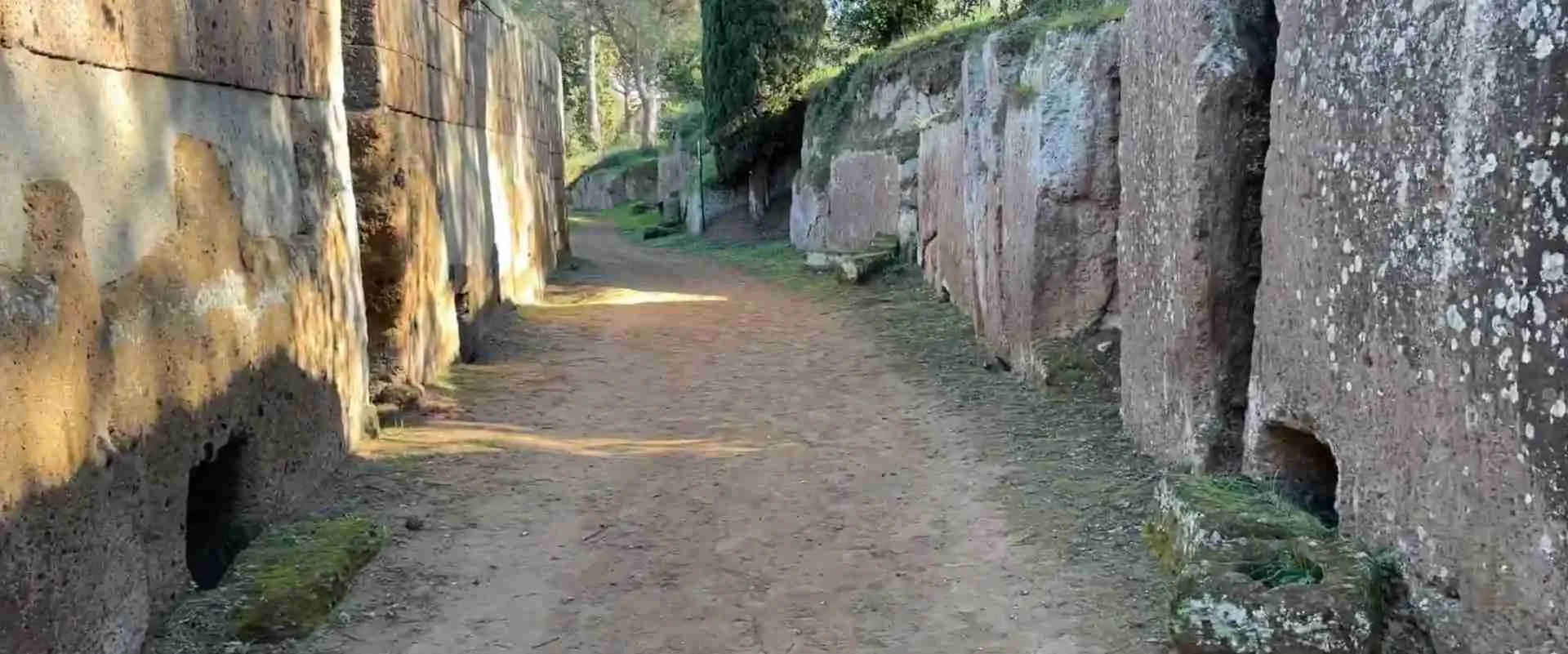
The third zone, around the Area of the Pond and Via degli Inferi (Road of the Underworld), takes its evocative name from the main processional axis of the site, a road cut entirely into the tuff rock with chamber openings in its walls. This area was developed in the 1960s excavation campaigns led by Mario Moretti, which brought approximately five hundred additional tombs to light. The tombs in this section are structurally simpler — single-chamber hypogea intended for less affluent households — but the experience of walking the Via degli Inferi itself, between tuff walls and through the ambient sounds of the surrounding vegetation, is the strongest sensory experience the route offers.
Practical site notes for 2026: carry water and wear sun protection in summer, as the paths are substantially open-air with limited shade. Comfortable shoes are necessary for the uneven tuff surfaces, and sandals without ankle support are inadvisable on the stepped descents into individual tombs. A free downloadable audio guide is available through the PACT website and the museiitaliani platform. The bookshop, refreshment area, and toilets are located at the main entrance building. Do not attempt to enter any tomb not marked as open for public access; several of the visible outer monuments are closed for conservation reasons and uneven access presents real risks. The site may temporarily close or restrict outdoor areas during adverse weather; call 06 9940001 to confirm access on days with heavy rain or wind alerts.
Cerite National Museum in 2026: Reading the Finds After the Tombs
The Cerite National Museum — Museo Archeologico Nazionale Cerite — occupies the Ruspoli Castle (Palazzo Ruspoli), a medieval fortification whose bulk sits at the edge of Cerveteri’s historic centre overlooking the town’s main piazza. The castle’s exterior presence is one of the more striking things about Cerveteri’s townscape, and the approach through the medieval streets from any parking area on the eastern side of the centre involves a short walk past local bars and shops that offers a welcome contrast to the archaeological focus of the morning.
The museum’s collection is organised across two levels and focuses on material drawn from the Cerveteri necropolises, primarily the Banditaccia and Monte Abatone areas. This is a crucial point for setting expectations: much of the most spectacular material from the Cerveteri area excavations over the centuries has been dispersed to other institutions, including the National Etruscan Museum at Villa Giulia in Rome and the Vatican’s Gregorian Etruscan Museum, as the principal repositories of major Etruscan finds. The local museum’s role is different — it provides contextual, site-specific interpretation of the Cerveteri necropolises as a system, with displays organised around the typology of burial, the chronological arc of the city’s funerary culture, and the specific tomb assemblages that document everyday Etruscan life.
Among the material on display, the bucchero pottery — the distinctive black-burnished ware that characterises Etruscan ceramic production of the seventh through fifth centuries BC — is particularly well represented. Bucchero vessels from the Cerveteri tombs demonstrate the range of form and function, from small domestic cups to elaborate decorated pitchers with relief ornament. Alongside these, domestic objects, votive deposits, and items from the Hellenistic-period tombs of the third and second centuries BC round out the collection. An ongoing temporary exhibition currently occupying the upper level — “Veder greco in Etruria: Le idrie di Cerveteri” (Seeing Greek in Etruria: The Hydria Vessels of Cerveteri), with a €2 admission surcharge — focuses on imported Greek hydriai found in the Cerveteri necropolises, placing them within the long-documented pattern of Etruscan demand for Attic painted pottery.
Visiting the museum after a morning in the tombs rather than before them is strongly recommended. The objects in the display cases take on a different character when you have already walked through the rooms they came from: a set of miniature vessels that were placed on a tomb shelf reads differently when you have seen the carved shelf in position inside a sixth-century tumulus. Allow approximately one hour for the museum, including the temporary exhibition. The combined PACT ticket covers the standard collection; present your ticket stub from the morning necropolis visit or purchase the combined ticket fresh at the museum entrance if you arrive by a different route.
Lake Bracciano and Odescalchi Castle in 2026: The Route’s Second Anchor
The drive from Cerveteri to Bracciano moves through a landscape that shifts noticeably as the coastal plain gives way to the Tolfa hills and then drops into the volcanic basin of the lake. Lake Bracciano is a crater lake — formed in the caldera of an extinct volcano — with a near-circular shoreline and strikingly clear water that has historically served as a freshwater source for Rome. The drive into Bracciano town, which sits on the northern rim of the lake at considerable elevation above the water, provides a panoramic reveal of the lake surface and the hills of the opposite shore that rewards the approach from the western side.
Odescalchi Castle commands the ridge at the top of Bracciano’s medieval centre, visible from several kilometres away on the approach road. The castle was built by the Orsini family in the second half of the fifteenth century — the construction belongs to a period of intense fortification-building across the Lazio region as local baronial families consolidated their territories — and passed to the Odescalchi family in the seventeenth century. It has remained under continuous private management and is today administered by the Odescalchi Foundation, which oversees visits, events, and a significant programme of private functions including weddings. The 2006 Cruise–Holmes ceremony that brought international press attention to the castle is the fact most frequently cited by travel guides, but the actual substance of a visit is more varied: frescoed halls, one of the most complete private armouries in central Italy, period furniture, and — from the exterior terrace and the hanging gardens — views over the lake that justify the admission price independently of the interior collection.
Admission in 2026 is €10 per adult (€9 reduced, €8 for children 6–12, free under 6). The castle opens at 10:00 Monday through Sunday and closes at 18:00 Monday through Friday, 19:00 on weekends. Free guided tours are included in the admission price on Sundays and public holidays. Tickets at the gate on Via Giulio Volpi 12; no advance booking required for individual visitors. Verify current hours and any special closure dates at odescalchi.it before travel; the castle occasionally closes earlier for private events, and a notice was posted for specific date closures in the current season.
For travellers who have used substantial energy at Banditaccia and prefer a less structured afternoon, the lakeside option is entirely valid. The walking promenade along the Bracciano lakeshore — accessible from the road below the castle — provides a quiet counterpoint to the morning’s archaeological intensity. Several lakeside restaurants serve local lake fish (particularly tench and perch from Lake Bracciano waters) alongside standard Italian menus. The town of Trevignano Romano on the eastern shore, reached by continuing around the lake for approximately twenty-five kilometres, offers a picturesque alternative to Bracciano town if the route permits an extension: its waterfront piazza sits directly at lake level with an unusual visual intimacy between the town and the water. This extension adds approximately forty minutes to the return journey to Rome.
Seasonal Timing and Weather Strategies for 2026
April and May represent the optimal window for this route. The Banditaccia site is in its full summer hours (09:00–19:30 from late March 2026 onward), temperatures are comfortable for extended outdoor walking — the site involves roughly four to five kilometres of footpath — and the tourist season has not reached the compression of June and July. Wildflowers on the tuff plateau are in bloom through April, and the interplay of vegetation with the ancient stonework is at its most visually rich. School groups from Rome are active in April but tend to cluster on weekday mornings; weekday afternoons in April are reliably quiet.
June maintains good conditions through the middle of the month, but the final weeks of June bring the first sustained heat and the beginning of weekend beach traffic on the A12, which can significantly extend the Rome-to-Cerveteri driving time. If visiting in June, depart Rome no later than 07:00 to clear the A12 before the coastal rush.
July and August present significant challenges for this specific itinerary. The Banditaccia circuit is almost entirely open-air, and temperatures in the enclosed tuff zone can reach uncomfortable levels by 10:00 on summer mornings. The paths through the Via degli Inferi area are partially shaded, but the Great Tumuli zone and the Enclosed Zone are exposed. Visitors committed to July–August visits should arrive strictly at 09:00, complete the circuit before 11:30, and plan the Cerite National Museum visit immediately after as a cool interior refuge before the midday heat. The A12 on August weekends is subject to the heaviest traffic of the year; consider using the SS1 Aurelia coastal road as an alternative, accepting a somewhat longer journey time in exchange for less stop-and-go congestion.
September and October are frequently cited as the best months for Etruscan site visits in Lazio: the heat has broken, the summer crowds have dispersed, and the autumn light on the tuff plateau has a quality particularly suited to photography. The PACT sites maintain their extended hours through mid-October 2026 (closing at 19:30), then shift to an earlier closing window in the second half of October. The Bracciano lake area takes on a more local, less tourist-oriented character in September, with good restaurant quality and shorter queues at the castle.
November through March offers a peaceful but more demanding experience. The outdoor segments of Banditaccia are exposed to rain and wind, and the site closes in adverse weather. Winter opening hours are shorter — the PACT schedule reverts to a 09:00–17:00 window in the off-peak period, with last entry at 16:00. The advantage is near-total solitude: a November or February morning at Banditaccia can deliver an experience of genuine isolation within the Via degli Inferi that is impossible to replicate in the main season.
Money-Saving Strategies and Free Entry Options in 2026
The most significant single saving available on this route is the first-Sunday-of-the-month free entry programme. On these Sundays, admission to Banditaccia Necropolis and the Cerite National Museum is entirely free for all visitors, with no booking, no registration, and no restrictions. The saving amounts to €13 per adult — equivalent to the PACT combined ticket price. The €2 temporary exhibition surcharge applies even on free Sundays. Scheduling the route for a first Sunday of the month reduces the budget-tier day cost from €40–50 per person to approximately €25–35 per person, making it one of the most cost-effective UNESCO site days available within an hour of Rome.
The PACT combined ticket structure itself is already optimised compared to purchasing single-site tickets, since the combined price of €13 represents a meaningful saving over what two separate admissions would cost and provides the flexibility of a thirty-day window. If you purchase the combined ticket at Banditaccia but run short of time for the museum, you have a full month to return. The €21 circuit pass covering all four PACT sites is worth calculating against your planned itinerary: if Tarquinia is on the agenda for a later date, it delivers a substantial per-site saving.
Fuel costs on the loop are fixed by the route length, but the toll can be partially avoided. The A12 section between the Santa Severa–Santa Marinella exit and the Cerveteri–Ladispoli exit is toll-free in both directions because it lies between barrier positions. Drivers approaching from the Civitavecchia direction rather than Rome pay no toll for this internal segment. For most Rome-based visitors, the full Rome-to-Cerveteri toll applies, but it is worth being aware that returning via the SS1 Aurelia coastal road (a non-tolled national road) avoids the return A12 toll entirely at the cost of additional travel time — typically fifteen to twenty minutes more than the motorway in light traffic.
The Monte Abatone detour is entirely free. No admission is charged, and the roadside parking along Via del Sepolcro costs nothing. The Campana Tumulus and Torlonia Tomb are accessible in the open countryside without any infrastructure costs. This makes the Monte Abatone detour — forty-five minutes including driving and walking time — one of the highest-value additions possible to the route in terms of archaeological experience per euro spent.
Regarding food, Cerveteri town’s Thursday morning market and the alimentari shops along the main street below the castle offer picnic supplies at local prices. Several cafes and bars in the historic centre serve filled rolls (panini) and local cheese at well below tourist prices. For a restaurant lunch, the trattorie in the streets around Piazza Santa Maria — the square fronting the Ruspoli Castle — are oriented primarily at local clientele and tend to offer better value than the restaurants near the necropolis parking area.
Frequently Asked Questions About the Etruscan Coast Driving Itinerary 2026
Is a car essential for this itinerary, or can I use public transport from Rome in 2026?
A car is strongly recommended. While Cerveteri is reachable by public transport — train from Roma Termini or Roma Ostiense to Ladispoli or Marina di Cerveteri, followed by a local bus or taxi to the necropolis — the connections between Cerveteri and Bracciano require returning to Rome and starting again, making the combined loop impractical without a vehicle. The Monte Abatone detour is only accessible by car or on foot over a distance impractical to walk from Cerveteri centre in a time-limited day. Car hire from Rome for a single day costs approximately €40–70 depending on vehicle category and booking lead time, which when shared between two people adds approximately €20–35 per person — worthwhile given the freedom of movement the vehicle provides.
Is the Banditaccia Necropolis accessible for visitors with reduced mobility in 2026?
Partially. The main entrance area and a section of the outer circuit are navigable on relatively flat ground, but much of the Banditaccia visit involves uneven tuff surfaces, descents into individual tomb chambers via steps without handrails, and paths with unpredictable surface conditions. The PACT has published a formal accessibility plan (Piano per l’Eliminazione delle Barriere Architettoniche, available at pact.cultura.gov.it) outlining which sections can be accessed by visitors with mobility impairments. Contact the site in advance at 06 9940001 to discuss individual needs. The Cerite National Museum in Palazzo Ruspoli is partially accessible via lift, though the historic structure creates some limitations. Odescalchi Castle in Bracciano has accessibility constraints inherent in a fifteenth-century fortress; contact the castle in advance at the details on odescalchi.it.
What is the Tomb of the Reliefs, and is it worth the extra effort to access it in 2026?
The Tomb of the Reliefs (Tomba dei Rilievi) is widely considered the single most important individual monument in the Banditaccia Necropolis. It dates to the late fourth century BC and is distinguished by walls, pillars, and ceiling entirely covered in painted stucco reliefs depicting everyday Etruscan objects — household implements, weapons, games, and furnishings — creating the visual effect of a room permanently stocked and occupied. Access is managed separately from general site admission because the delicate stucco surfaces require controlled visitor numbers; a PACT ranger accompanies small groups inside and explains the iconographic programme. The visit lasts approximately twenty to thirty minutes. To access it, go directly to the ticket desk upon entering the site and request a slot; slots on busy mornings can fill by 10:30. There is no additional charge above the standard combined ticket. It is unambiguously the most memorable thirty minutes available at the entire site.
What time does the Banditaccia Necropolis open in 2026, and are there seasonal variations?
The Banditaccia Necropolis opens at 09:00 Tuesday through Sunday throughout the primary season, which runs from late March through mid-October 2026. Last entry is at 18:30, with the site open until 19:30. From mid-October through late March, the site operates shortened hours; check pact.cultura.gov.it for the exact winter timetable. The site is closed on Mondays, on Christmas Day, and on New Year’s Day. The museums (including the Cerite National Museum) maintain year-round hours of 09:00–19:30 with last entry at 18:30, also closed Mondays. Both sites are free to all visitors on the first Sunday of each month under the Domenica al Museo programme. In the event of adverse weather — particularly strong winds or heavy rain — the open-air necropolis areas may be temporarily closed for safety; call 06 9940001 on the day if conditions are uncertain.
How far is Monte Abatone from the Banditaccia Necropolis, and how long does the detour take in 2026?
Monte Abatone sits southeast of Cerveteri town, essentially on the opposite side of the urban centre from the Banditaccia Necropolis, which is northwest. The driving distance from the Banditaccia parking area to the start of the Via del Sepolcro access lane for Monte Abatone is approximately four to five kilometres, taking ten to fifteen minutes through Cerveteri town or on the ring road around it. From the roadside parking point on Via del Sepolcro, the walk to the Campana Tumulus gate is approximately four hundred metres on an unpaved track, taking five to eight minutes. Allow forty-five minutes total for the detour including driving, walking, and time at the monument. Return towards Cerveteri town for lunch, positioning yourself for the afternoon museum visit with a natural midday break built into the sequence.
What are the best tombs to prioritise if time at Banditaccia is limited to ninety minutes in 2026?
If you have only ninety minutes inside the site, prioritise in this sequence: first, request a Tomb of the Reliefs access slot at the ticket desk immediately upon entering; second, walk directly into the Enclosed Zone to experience the dado-tomb streets and the scale of the planned burial grid; third, return to the Zone of the Great Tumuli to enter one of the open tumuli chambers and appreciate the carved-room interior. This sequence hits the three main experiential registers of Banditaccia — the exceptional individual monument, the urban planning of the cemetery city, and the domestic interior logic of the tumulus — in ninety minutes. If the Tomb of the Reliefs slot is unavailable on your arrival, substitute it with the Tomb of the Shields and Chairs and the Giuseppe Moretti Tumulus in the Great Tumuli zone.
Can I swim in Lake Bracciano during a visit in 2026?
Swimming is permitted at Lake Bracciano and the lake is popular with Romans throughout summer for exactly this reason. The shoreline below Bracciano town has accessible entry points, and the town of Anguillara Sabazia on the southern shore and Trevignano Romano on the eastern shore have more developed bathing areas with beaches and facilities. The lake water is clean by Italian lake standards and has historically been used as a freshwater source. If you are building the itinerary in late June, July, or August, a late-afternoon swim at Lake Bracciano after the Cerveteri visit provides a practical solution to the heat of the day and adds a pleasurable recreational dimension to what is otherwise an intellectually intensive excursion. Carry a swimming kit in the car from Rome; there is no equipment hire at the Bracciano lakeside.
Are there facilities inside the Banditaccia Necropolis — toilets, food, water — in 2026?
The Banditaccia site has toilets and a small refreshment area near the main entrance building, with indoor and outdoor seating available for a break during the visit. A bookshop selling guides and maps of the site, including the official PACT map of the recommended walking circuits, is also at the entrance. A drinking water fountain is located near the entrance plaza. There are no food or water facilities within the walking circuit itself, so carry water for the walk — particularly important from late May through September. The refreshment area is a practical stop immediately before or after the visit rather than during it. Picnic consumption within the archaeological zone itself is not permitted; a picnic area near the parking lot is the designated outdoor eating space.
Is the Odescalchi Castle in Bracciano worth visiting as part of a one-day Etruscan itinerary, or is it too different in character to fit?
The castle and the Etruscan sites operate on entirely different historical registers — fifteenth-century Renaissance fortification versus pre-Roman funerary archaeology — and this contrast is, for many visitors, precisely what makes the afternoon leg of the itinerary work as a day-long experience rather than a single-focus excursion. After several hours in an environment of ancient rock-cut chambers and burial goods, the Renaissance rooms of Odescalchi Castle — their frescoes depicting dynastic propaganda rather than afterlife preparation, their armoury oriented towards real-world military conflict rather than symbolic equipment — provide a conceptual counterpoint that is both visually distinct and intellectually productive. Travellers who find themselves satiated after the Cerveteri sites, or who are visiting with children who need a physical change of scene, are well served by the lakeside promenade and exterior views of the castle even without paying the interior admission. Budget approximately one hour for the castle interior and thirty minutes for the lakeside walk and town.
What should I know about the A12 motorway before driving to Cerveteri in 2026?
The A12 Roma–Civitavecchia is a well-maintained motorway operating a fixed-rate toll system. For the Rome-to-Cerveteri segment, budget €4.60–5.00 per direction per car — approximately €9–10 round trip for a standard passenger vehicle. The Cerveteri–Ladispoli exit has been subject to maintenance closures at various points, during which the recommended alternate exit is Torrimpietra (earlier) or Santa Severa–Santa Marinella (later). Check autostrade.it the evening before travel for any closure notices. The A12 carries heavy weekend beach traffic in summer, concentrated between 08:00–10:00 on Saturday and Sunday mornings outbound and 17:00–20:00 on Saturday and Sunday evenings returning. A 07:00 departure from Rome comfortably avoids the outbound peak. The toll can be paid at the barrier by card, cash, or electronic transponder (Telepass, UnipolMove, or equivalent). If you plan to drive from Rome regularly, an electronic transponder device avoids queuing at payment booths and is available through Italian banks and insurance companies.