Dürnstein Medieval Village Guide: Wachau Valley Historic Gem
Key Takeaways
- Dürnstein represents one of Austria’s most perfectly preserved medieval villages, with fortifications, architecture, and urban layout dating to the 12th-15th centuries
- The village gained historical fame as the imprisonment site of England’s King Richard I (Richard the Lionheart) in 1192-1193, creating legendary associations that persist in European cultural memory
- The Augustinian monastery church features Austria’s finest baroque tower, completed in 1733 with distinctive blue-and-white coloring visible throughout the Wachau Valley
- Medieval fortifications including defensive walls, towers, and the clifftop castle ruins create atmospheric settings while documenting medieval military architecture
- The village’s position along the Danube River and within terraced vineyards exemplifies the harmonious cultural landscape that earned UNESCO World Heritage recognition
- Dürnstein’s car-free historic center, pedestrian-only streets, and preserved building fabric offer authentic experiences of medieval urban life adapted to contemporary tourism
Introduction: Austria’s Most Picturesque Medieval Village
Dürnstein emerges from the Danube River’s north bank like a vision of medieval Central Europe, its blue-and-white church tower rising above ancient defensive walls, vine-covered slopes, and the river’s silvery expanse. This small village of fewer than 1,000 residents captures the essence of Wachau Valley’s cultural landscape, where centuries of human settlement, viticulture, and architectural development have created exceptional beauty and historical continuity. The village’s compact size—approximately 500 meters along the riverbank—concentrates remarkable density of historical architecture, legendary associations, and cultural significance within easily walkable dimensions.
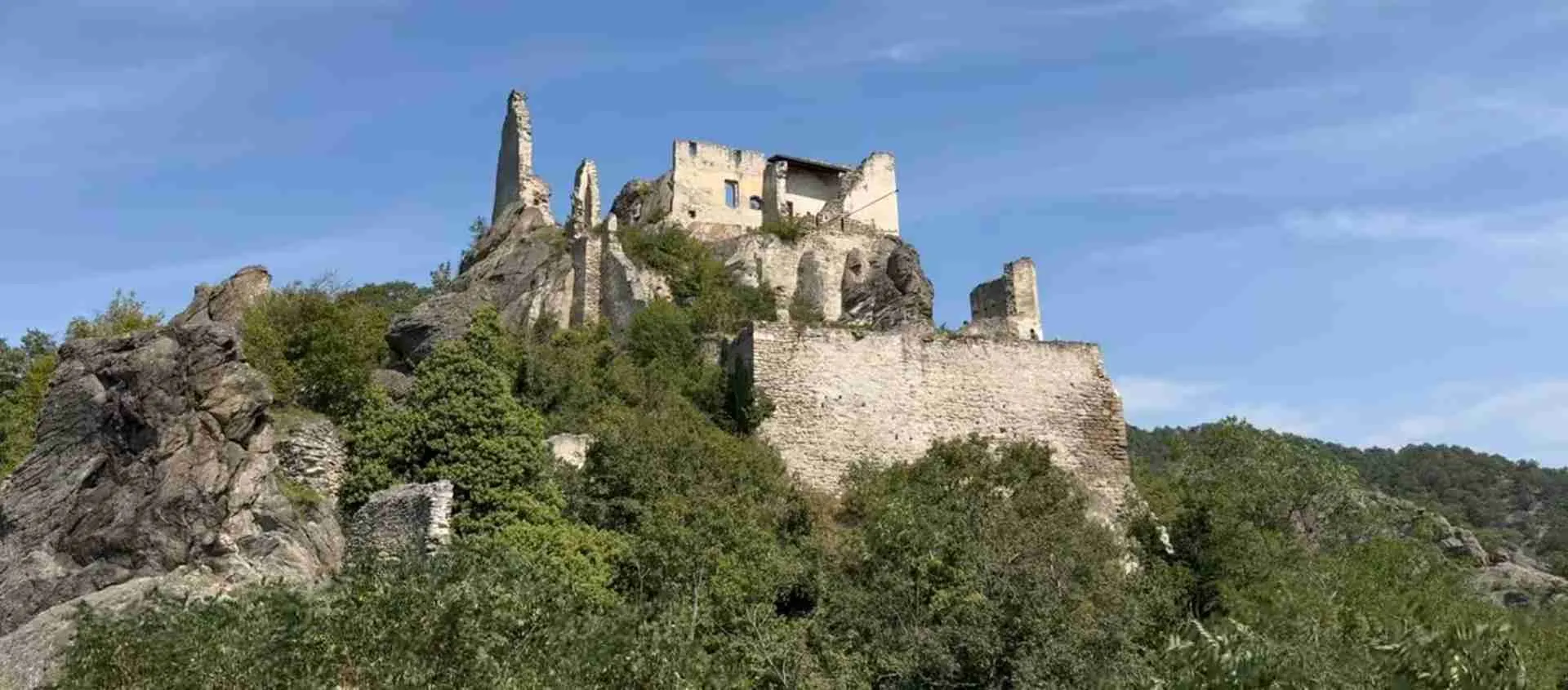
The settlement’s origins extend to Roman times, though the visible village character dates primarily to the medieval period when Dürnstein functioned as fortified market town controlling Danube River trade routes. Massive defensive walls still encircle the historic center, their towers and gates creating dramatic entry points while preserving the medieval urban form. The clifftop castle ruins dominate the landscape above the village, their romantic silhouette against the sky marking the site where England’s King Richard I endured imprisonment during the winter of 1192-1193, an episode that entered European legend and continues shaping Dürnstein’s cultural identity.
The Augustinian monastery and its spectacular baroque church anchor the village’s architectural ensemble, combining medieval foundations with 18th-century baroque renovation that created one of Austria’s most beautiful religious buildings. The church tower’s distinctive blue-and-white coloring provides visual landmark visible for kilometers along the Danube, guiding travelers and creating iconic image synonymous with the Wachau region. The monastery complex includes cloisters, residential buildings, and terraced gardens that demonstrate centuries of architectural development while maintaining harmonious relationships between different historical periods.
Dürnstein’s inclusion within the Wachau Cultural Landscape UNESCO World Heritage Site recognizes both the village’s individual merits and its representative character within the broader region. The settlement exemplifies patterns repeated throughout the Wachau—strategic riverside locations, terraced viticulture, defensive architecture, religious institutions, and preserved historical fabric—while achieving particular concentration and aesthetic appeal. Contemporary Dürnstein balances heritage preservation with tourism development, welcoming visitors who arrive by river cruise, cycling path, or automobile to experience medieval atmosphere, baroque splendor, renowned local wines, and the exceptional natural beauty that surrounds this remarkable village.
People Also Ask About Dürnstein Medieval Village
What makes Dürnstein historically significant?
Dürnstein’s historical significance stems primarily from its role imprisoning England’s King Richard I during winter 1192-1193, an event that entered European legend and shaped the village’s cultural identity across eight centuries. Richard, returning from the Third Crusade, traveled through Austrian territory disguised as a merchant but was recognized and captured near Vienna by Duke Leopold V of Austria. The duke held Richard at Dürnstein Castle, demanding ransom and seeking revenge for perceived insults during the crusade campaign. The imprisonment lasted approximately two months before Richard’s transfer to Trifels Castle in Germany, where Emperor Henry VI continued holding him until England paid the enormous ransom of 150,000 marks silver—equivalent to several years of English crown revenue.
The episode generated legendary embellishments, including the famous story of the faithful minstrel Blondel wandering Europe searching for his king by singing their shared song until Richard responded from Dürnstein’s tower. While historians consider this tale fictional, it demonstrates the imprisonment’s romantic appeal and its resonance in medieval culture. The ransom payment had significant consequences for England, requiring heavy taxation and financial strain, while Austria used portions of the funds to establish Vienna’s city walls and mint new coinage. The incident strained relations between England and the Holy Roman Empire for years, affecting European diplomatic alignments.
Beyond the Richard legend, Dürnstein functioned as important trading post and defensive stronghold controlling Danube navigation through the narrow Wachau Valley. The village received market privileges in medieval times, enabling commerce that sustained the community while justifying the defensive fortifications whose remains still define the townscape. The Augustinian monastery, founded in 1410, established Dürnstein as religious and cultural center, with the monks’ viticulture and agricultural expertise contributing to regional wine culture. The village’s strategic position made it contested territory during various conflicts including the Ottoman threat period and Napoleonic Wars, with fortifications repeatedly tested though never successfully breached by assault. This multi-layered historical significance—legendary associations, strategic importance, religious culture, and economic functions—creates complex heritage that rewards deep exploration beyond the surface appeal of picturesque medieval architecture.
How did Dürnstein develop its distinctive architectural character?
Dürnstein’s architectural character results from centuries of continuous development within medieval urban framework, with defensive walls establishing boundaries that constrained expansion while creating unified visual ensemble. The village’s layout follows the riverside topography, with a single main street running parallel to the Danube connecting the eastern and western gates. Buildings line this street in dense formation, their gables facing the thoroughfare while backs descend the slope toward the river or rise toward the hillside. This linear arrangement maximizes defensive efficiency while adapting to steep terrain that limits alternative layouts.
The medieval defensive walls, constructed primarily during the 13th-15th centuries, employed local stone and followed natural defensive lines around the settlement’s perimeter. Towers at strategic intervals provided observation points and strong points for resistance, while gates controlled access and allowed taxation of goods entering the market town. These fortifications remain substantially intact, distinguishing Dürnstein from many Austrian towns where defensive works were demolished during peaceful periods to enable expansion. The walls’ preservation resulted partly from the village’s limited growth—the population never exceeded levels requiring expansion beyond medieval boundaries—and partly from 19th-century romantic appreciation of medieval architecture that discouraged destruction of picturesque ruins.
Individual buildings within the walls display centuries of architectural evolution, with medieval structures receiving baroque facades, Renaissance additions, and various modifications while maintaining essential medieval character. The typical Dürnstein house features three or four stories with steep roofs, ground-floor arcades or shop fronts, residential floors above, and attic storage spaces. The use of local stone, plaster finishes in cream and pastel colors, wooden shutters, and ceramic tile roofing creates visual harmony despite variations in age and detail. Wine cellars beneath many buildings extend into the hillside, providing storage for the viticulture that sustained Dürnstein economically for centuries.
The Augustinian monastery complex represents the village’s most elaborate architectural ensemble, combining medieval foundations with spectacular baroque renovation during the 1720s-1730s. Architect Josef Munggenast and brothers Matthias and Jakob Steinl transformed the monastery church into baroque masterpiece, adding the distinctive tower whose blue-and-white coloring became Dürnstein’s visual symbol. The church’s interior features ceiling frescoes by Johann Schmidt and elaborate stucco work that creates immersive baroque environment contrasting dramatically with the building’s austere medieval exterior walls. This layering of architectural periods—medieval foundation, baroque elaboration, modern conservation—characterizes Dürnstein’s approach to heritage, respecting historical development while maintaining aesthetic coherence.
What role does viticulture play in Dürnstein’s culture?
Viticulture has shaped Dürnstein’s economy, landscape, and cultural identity for over a thousand years, with wine production sustaining the community while creating the terraced vineyards that define the visual character of the surrounding hillsides. The steep slopes above the village receive excellent sun exposure, while the Danube River moderates temperatures and provides reflective heat that benefits grape ripening. These favorable conditions combine with skilled viticulture traditions to produce exceptional wines, particularly white wines from Grüner Veltliner and Riesling grapes that represent Wachau Valley’s premier offerings.
The medieval period established viticulture as primary economic activity, with the Augustinian monastery developing extensive vineyard holdings and refining cultivation techniques. The monks’ long-term planning horizons enabled investments in terracing, soil improvement, and vine selection that elevated wine quality while shaping the landscape into the meticulously maintained vineyards visible today. The terraces prevent erosion on steep slopes while maximizing planting area and improving drainage, representing centuries of accumulated agricultural engineering adapted to challenging terrain. Dry-stone retaining walls support the terraces, their construction requiring skilled craftsmanship and continuous maintenance that connects contemporary vintners to historical practices.
Contemporary Dürnstein hosts multiple renowned wine producers whose cellars occupy historic buildings within the village walls and extend into the hillside through elaborate tunnel systems carved from living rock. These cellars provide ideal storage conditions—consistent cool temperatures, appropriate humidity, minimal vibration—allowing wines to mature properly while connecting modern wine making to centuries-old infrastructure. Several producers offer tastings, cellar tours, and direct sales, creating tourism experiences that introduce visitors to Wachau wine culture while supporting the economic viability of traditional viticulture.
The annual wine cycle structures village life, with spring pruning, summer cultivation, autumn harvest, and winter cellar work creating rhythms that affect the entire community. The harvest period in September-October brings particular intensity, with workers filling the narrow streets, tractors hauling grapes, and the sweet aroma of fermenting must permeating the atmosphere. Wine festivals celebrate the harvest, creating occasions for community gathering and visitor participation in traditions extending back centuries. The cultural significance of viticulture transcends economics, representing identity, heritage, and connection to landscape that defines what it means to be from Dürnstein and the Wachau Valley.
Why is the monastery church tower blue and white?
The Augustinian monastery church tower’s distinctive blue-and-white coloring dates to its baroque renovation during the 1720s-1730s, when architect Josef Munggenast redesigned the tower incorporating this striking color scheme. The choice reflects baroque aesthetic preferences for visual drama and symbolic content, with the blue representing the Virgin Mary (to whom the church is dedicated) and the heavenly realm, while white symbolizes purity and divine light. This Marian color association follows broader Catholic tradition linking Mary with blue vestments, azure skies, and celestial associations in religious art and architecture.
The architectural effect creates powerful visual contrast, with the blue ceramic tiles and white architectural details producing combination visible for great distances along the Danube Valley. The tower functions as landmark guiding river navigation and territorial orientation, while its distinctive appearance creates memorable image that enhances Dürnstein’s recognizability and tourist appeal. The color treatment extends across the tower’s full height, covering the baroque onion dome with blue ceramic tiles that catch changing light throughout the day, creating varied visual effects from brilliant sapphire in direct sun to subtle azure in overcast conditions.
Technical considerations influenced the color choice, as ceramic tile construction provides weather protection while enabling the decorative surface. The tiles resist moisture infiltration, protect underlying structure from weathering, and maintain color intensity across decades with minimal fading. The white elements employ painted plaster on architectural details including pilasters, cornices, window surrounds, and decorative moldings that articulate the tower’s form while creating rhythmic patterns enhancing visual interest. The combination of durable colored tiles and regularly maintained painted elements requires ongoing conservation attention, though the fundamental color scheme remains unchanged since the 18th century.
The tower’s appearance has become so closely identified with Dürnstein that it appears in virtually all promotional materials, tourism imagery, and visual representations of the village and Wachau region. Photographers particularly prize the tower as subject, with its blue-and-white coloring creating striking contrast against green vineyards, autumn foliage, blue skies, or dramatic cloud formations. The tower exemplifies how distinctive architectural choices—originally motivated by religious symbolism and baroque aesthetics—can become defining cultural symbols that shape identity and recognition across centuries, transforming religious architecture into broader cultural landmarks transcending their original sacred functions.
Extended multi-day tours – 5+ days
Featured Wachau Multi-Day Tour Packages
6 days
6 Day Vienna, Salzburg, Budapest, Bratislava, and the Danube Valley
- ✓ Comprehensive Wachau tour
- ✓ Expert local guides included
- ✓ All accommodation arranged
- ✓ Transportation provided

6 days
Danube Christmas Dream 2027
- ✓ Booking needs min. 2 travelers
5 days
Danube Cycle Path – Linz-Vienna 5 Days
- ✓ Comprehensive Wachau tour
- ✓ Expert local guides included
- ✓ All accommodation arranged
- ✓ Transportation provided

5 days
Danube Cycle Path – Through the Wachau (5 Days)
- ✓ Comprehensive Wachau tour
- ✓ Expert local guides included
- ✓ All accommodation arranged
- ✓ Transportation provided
Multi-day tour packages powered by TourRadar. Prices and availability subject to change.
Medieval Castle Ruins: Richard the Lionheart’s Prison
The ruined castle crowning the cliff above Dürnstein represents the village’s most dramatic architectural element and the site of its most famous historical episode. The fortress occupies a naturally defensive position approximately 200 meters above the Danube, commanding views up and down the river while perching on rock formations that made assault extremely difficult. Archaeological evidence indicates fortification on this site since Roman times, though the visible ruins date primarily to the 12th-15th centuries when the castle served as stronghold for various Austrian noble families allied with the regional dukes.
The castle’s imprisonment of King Richard I during winter 1192-1193 created legendary associations that have shaped European cultural memory and Dürnstein’s identity for eight centuries. Richard, returning from the Third Crusade, attempted traveling through Central Europe disguised as a merchant but was recognized and captured near Vienna. Duke Leopold V of Austria, seeking revenge for insults during the crusade and motivated by financial opportunity, held Richard at Dürnstein before transferring him to imperial custody. The imprisonment lasted approximately two months in harsh winter conditions, with Richard confined to tower rooms while ransom negotiations proceeded through diplomatic channels.
The romantic legend of the minstrel Blondel searching for his imprisoned king by singing their shared song beneath castle windows across Europe emerged during later medieval period, embellishing the historical facts with poetic elements that enhanced the story’s appeal. While historians dismiss Blondel as fictional invention, the tale demonstrates how the imprisonment captured imagination and became vehicle for exploring themes of loyalty, perseverance, and the power of music and poetry. Contemporary visitors climbing to the ruins often recall this legend, experiencing the castle’s atmosphere while contemplating the historical Richard’s actual circumstances and the cultural meanings generated by his imprisonment.
The castle’s military architecture demonstrates typical medieval defensive design, with concentric walls, towers at strategic points, residential quarters protected behind multiple defensive lines, and cisterns ensuring water supply during siege. The main keep occupied the highest point, providing final refuge and strongest defensive position. The outer walls followed terrain contours, incorporating natural rock formations into the defensive system while minimizing vulnerable approaches. Gates featured defensive sophistication including portcullises, murder holes for dropping objects on attackers, and arrangements forcing besiegers to expose vulnerable sides when attempting entry.
The fortress declined during the 16th century as changing military technology—particularly gunpowder artillery—reduced the value of medieval fortifications while increasing maintenance costs. The castle suffered damage during the Thirty Years War and subsequent conflicts, with portions deliberately demolished to prevent use by hostile forces. By the 18th century, the structure stood abandoned and ruinous, its stones sometimes quarried for construction in the village below. Romantic movement appreciation for medieval ruins reversed this trajectory, with conservation efforts beginning in the 19th century to stabilize remaining structures and prevent further collapse.
Contemporary visitors access the castle ruins via hiking trail ascending through vineyards from the village, a moderately strenuous climb requiring 20-30 minutes. The path offers spectacular views across the Danube Valley, with perspective constantly changing as elevation increases. The ruins themselves provide atmospheric exploration, with partially collapsed walls, empty window openings framing landscape views, and preserved architectural details documenting medieval construction techniques. Information panels explain the castle’s history and architectural features while addressing the Richard imprisonment episode and its legendary elaborations. The castle’s romantic appearance against the sky, particularly at sunset or when illuminated for special occasions, creates powerful visual spectacle that enhances Dürnstein’s picturesque appeal while connecting visitors to medieval history and legendary narratives.
The Augustinian Monastery and Baroque Church
The Augustinian monastery complex dominates Dürnstein’s architectural ensemble, its baroque church and distinctive blue-and-white tower creating the village’s most recognizable image. The monastery’s foundation in 1410 by the Kuenring family established Dürnstein as religious center, with Augustinian canons regular following the Rule of Saint Augustine and pursuing contemplative life combined with pastoral ministry to surrounding communities. The monastery accumulated extensive land holdings and vineyard properties, developing viticultural expertise while sustaining the community economically and shaping regional wine culture.
The original medieval monastery buildings served the community for three centuries before Provost Hieronymus Übelbacher initiated comprehensive baroque renovation during the 1720s-1730s. The ambitious project transformed the church’s medieval interior into spectacular baroque sacred space while adding the famous tower whose blue-and-white coloring became Dürnstein’s visual symbol. Architect Josef Munggenast, who worked on Melk Abbey and other major Austrian baroque projects, designed the renovation in collaboration with the Steinl brothers who handled construction execution.
The church interior exemplifies Austrian baroque aesthetic, combining architectural drama, elaborate stucco work, ceiling frescoes, and coordinated decorative program that creates immersive environment engaging all senses. The nave features Johann Schmidt’s ceiling frescoes depicting scenes from the life of the Virgin Mary, to whom the church is dedicated. The paintings employ illusionistic perspective creating impression of architectural elements extending upward toward celestial space, a technique characteristic of baroque religious art designed to dissolve boundaries between earthly and heavenly realms. The stucco work frames the frescoes while adding three-dimensional decorative elements—angels, garlands, architectural details—that enhance spatial complexity and visual richness.
The high altar represents masterwork of baroque religious art, featuring monumental construction with twisted columns, sculptural elements, gilded details, and central altarpiece painting. The altar’s design creates theatrical focal point drawing attention toward the tabernacle and sacred elements while demonstrating the period’s integration of architecture, sculpture, and painting into unified artistic statements. Side altars dedicated to various saints provide additional devotional spaces while contributing to the overall decorative program through coordinated artistic treatments.
The monastery’s dissolution during Joseph II’s reforms in 1788 ended nearly four centuries of Augustinian presence, with the community dispersed and properties secularized. The church continued serving as parish church, preserving its baroque splendor for religious functions while avoiding the deterioration that affected many dissolved monastery complexes. The remaining monastery buildings received various secular uses over subsequent decades, with portions converted to residential and commercial purposes while maintaining essential architectural character.
Contemporary Dürnstein benefits from the monastery church’s continued religious function and its preservation as cultural monument. The church welcomes visitors outside service times, allowing appreciation of the baroque interior’s artistic achievements while maintaining appropriate reverence for the sacred space. Concerts utilizing the church’s exceptional acoustics attract musicians and audiences, creating cultural programming that activates the space beyond purely religious uses. The monastery complex’s integration into village fabric—with some buildings converted to hotel and restaurant use while maintaining architectural integrity—demonstrates successful heritage adaptation that preserves historical substance while enabling contemporary economic sustainability. The complex represents Dürnstein’s transition from active religious community to heritage destination, balancing preservation imperatives with practical requirements of tourism-dependent local economy.
Medieval Fortifications and Town Walls
Dürnstein’s defensive walls represent remarkably complete examples of medieval fortification, encircling the historic village core with stone ramparts, towers, and gates that have survived largely intact since their 13th-15th century construction. The walls’ preservation distinguishes Dürnstein from many Austrian towns where defensive works were demolished during peaceful eras to enable expansion or repurpose valuable urban land. The fortifications’ survival results from multiple factors including the village’s limited growth beyond medieval boundaries, 19th-century romantic appreciation of medieval architecture, and 20th-century recognition of heritage value justifying conservation investment.
The defensive system follows the natural topography, with walls ascending the hillside north of the village and descending to the Danube’s edge on the south, creating roughly oval enclosure approximately 500 meters long and 200 meters wide at maximum extent. The walls average 8-10 meters height with thickness of 1.5-2 meters, providing substantial obstacle to assault while creating protected space for defenders. Construction employed local stone—limestone and granite from nearby quarries—set in mortar with rubble core construction typical of medieval military architecture. The exterior faces received more careful stonework than interior surfaces, presenting formidable appearance to potential attackers while economizing effort and materials on protected sides.
Towers interrupt the walls at strategic intervals, providing elevated positions for observation and flanking fire along the wall faces. These round or semi-circular towers project beyond the wall line, allowing defenders to shoot along the walls’ exterior while providing strong points for concentrated resistance if attackers breached wall sections. The towers vary in size and architectural detail, reflecting construction across different periods and varying strategic importance of different defensive sectors. Some towers retain timber floor structures and roof coverings, while others stand as open shells documenting medieval construction while creating atmospheric ruins.
The eastern and western gates control access to the village, their medieval structures modified across centuries while maintaining defensive character and limiting vehicle access to the historic core. The gates feature thick arched passageways with evidence of portcullis grooves, showing the original defensive arrangements. Upper floors provided chambers for gate guards and storage of defensive equipment, while the gate structures supported portions of the wall walk allowing movement along the fortifications’ length. Contemporary preservation maintains the gates’ architectural integrity while adapting them to modern circulation requirements, with the historic core designated car-free zone accessible only by foot traffic except for resident and service vehicle access.
The wall walk—the protected pathway along the fortifications’ top—remains accessible in certain sections, providing visitors with elevated perspectives across the village rooftops toward the Danube and surrounding landscape. Walking these sections creates direct connection to medieval defensive practices while offering exceptional photography opportunities. The views reveal Dürnstein’s compact urban form, the relationship between defensive works and topography, and the integration of fortifications into the broader cultural landscape. Information panels explain defensive functions and architectural details, helping visitors understand medieval military architecture beyond purely aesthetic appreciation.
Conservation of the fortifications requires continuous attention, as weathering, vegetation growth, structural settlement, and visitor impact threaten the centuries-old structures. Specialized masonry work addresses deteriorating stonework, employing traditional materials and techniques appropriate to historical fabric. Vegetation management prevents root systems from damaging wall construction while maintaining the picturesque appearance of ivy and plants growing on the ancient stones. Visitor access provisions balance heritage experience goals with preservation requirements, restricting access to fragile sections while enabling exploration of stable areas. The fortifications’ preservation represents significant community investment justified by heritage value, tourism appeal, and cultural identity benefits. The walls define Dürnstein’s essential character, creating the enclosed medieval townscape that distinguishes the village within the Wachau region and provides the atmospheric setting that attracts visitors from around the world.
Historic Center Architecture and Urban Character
Dürnstein’s historic center demonstrates medieval urban planning principles adapted to riverside topography, with architecture and street patterns creating unified ensemble despite individual buildings’ varied ages and functions. The main street—Hauptstrasse—runs parallel to the Danube through the village center, connecting the eastern and western gates while providing the primary circulation route and commercial spine. Buildings line this street in continuous formation, their facades presenting varied architectural details while maintaining overall harmony through consistent scale, materials, and traditional construction methods.
The typical Dürnstein townhouse displays characteristics common throughout the Wachau region, adapted to the specific constraints of the fortified village’s compact site. Buildings rise three or four stories, with ground floors featuring arched openings leading to interior courtyards, wine cellars, or commercial spaces. Upper floors provided residential accommodation, with rooms arranged around central staircases and modest windows reflecting both defensive considerations and pre-modern lighting limitations. Attics beneath steeply pitched roofs served storage functions while allowing room for servants or seasonal workers during harvest periods when additional labor swelled the village population.
Architectural details reveal centuries of modification and adaptation, with medieval structures receiving baroque facades, Renaissance doorways, and various modern interventions while maintaining essential character. The use of painted plaster in cream, yellow, and pastel tones creates visual variety while preserving overall harmony. Decorative elements including carved stone doorframes, wrought iron window grilles, painted house signs, and ceramic roof tiles add individual character while following traditional forms and motifs. The cumulative effect creates rich architectural texture rewarding detailed observation while maintaining coherent streetscape appearance.
Wine cellars beneath many buildings extend into the hillside through networks of tunnels and vaults carved from living rock or constructed with stone barrel vaults. These cellars provide ideal wine storage conditions with consistent cool temperatures, appropriate humidity, and protection from temperature fluctuations. The extensive underground works represent centuries of excavation and construction, creating hidden architectural landscape beneath the visible village. Several wine producers offer cellar tours, revealing this subterranean dimension while explaining traditional wine making and storage practices continuing today.
The car-free designation of the historic center since the late 20th century has preserved medieval street character while creating pleasant pedestrian environment. The narrow lanes, restricted to foot traffic with limited exceptions for residents and services, maintain authentic scale and atmosphere impossible in automobile-dominated spaces. Visitors experience the medieval town’s intimate dimensions, discovering architectural details, courtyard views, and spatial relationships that vehicle traffic would obscure or destroy. The pedestrian policy requires compromises from residents regarding convenience and access, balanced by benefits of enhanced quality of life, increased property values through tourism appeal, and preservation of heritage character that defines Dürnstein’s identity and economic foundation.
Contemporary building uses balance residential, commercial, and tourism functions within the historic fabric. Several buildings operate as small hotels and guesthouses, adapting historic structures to accommodate visitors while maintaining architectural authenticity. Restaurants, wine taverns, shops, and galleries occupy ground floors along the main street, creating commercial vitality that sustains the village economically while serving both residents and tourists. Private residences continue occupying portions of historic buildings, maintaining authentic community character and preventing the village from becoming purely tourist-oriented museum settlement. This functional diversity creates the living historic environment that distinguishes Dürnstein from mere architectural preservation projects, demonstrating successful heritage adaptation that sustains both cultural values and economic viability.
The Danube River and Landscape Setting
Dürnstein’s position along the Danube River provides both practical foundation for the settlement’s historical development and aesthetic setting that enhances its picturesque appeal. The river has functioned as transportation artery, economic resource, defensive moat, and symbolic presence shaping village identity for over a millennium. The Danube’s course through the narrow Wachau Valley creates dramatic landscape where steep hillsides rise directly from the water’s edge, concentrating cultural development on limited riverside terrain while creating the intimate scale and dramatic topography that characterize the region.
The river’s historical role as trade route made Dürnstein valuable strategic location, with the narrow valley sections creating natural control points where fortifications could monitor and tax passing commerce. Medieval river traffic carried goods, travelers, and cultural influences connecting Central European regions, with Dürnstein serving as waypoint where merchants stopped for provisions, accommodation, or to wait for favorable navigation conditions. The village’s market privileges enabled economic benefits from this trade while justifying the defensive investments protecting commercial activities. Contemporary river cruise tourism continues this tradition of Danube travel, with thousands of passengers passing Dürnstein annually aboard ships navigating between Vienna and western Austrian or German destinations.
The riverfront creates transitional zone between village and water, with buildings descending to the shore and limited space for docks, walkways, and access to the river. Historical flood events occasionally inundated lower portions of the village, requiring defensive measures and influencing construction practices. Contemporary flood management employs engineering solutions that protect the village while maintaining visual relationships with the river. The riverside promenade provides pleasant walking route with views across the water toward the south bank’s vineyards and villages, creating recreational amenity for residents and visitors while connecting Dürnstein to the regional Danube cycling path that attracts active tourists exploring the valley by bicycle.
The hillsides rising above the village display the terraced vineyards that define Wachau landscape character and represent centuries of viticultural development. The steep slopes receive excellent sun exposure, with southern and southwestern orientations maximizing growing season warmth and light. The Danube River moderates temperatures, reducing frost risk and providing reflected light and heat that benefit grape ripening. These favorable natural conditions combine with sophisticated cultivation techniques—terracing, soil management, vine selection, harvest timing—to produce wines that represent some of Austria’s finest offerings and sustain Dürnstein’s contemporary economy as effectively as historic river trade sustained medieval prosperity.
The surrounding landscape provides dramatic seasonal changes that vary Dürnstein’s character throughout the year. Spring brings blossoming fruit trees, emerging vine growth, and fresh green colors across the hillsides. Summer displays fully developed vineyards and warm Mediterranean-like conditions attracting visitors seeking outdoor recreation and river activities. Autumn transforms the landscape with vineyard foliage turning yellow and gold, harvest activities animating the slopes, and comfortable temperatures creating ideal conditions for hiking and cultural exploration. Winter reduces tourist numbers while creating austere beauty with bare vines, possible snow cover, and dramatic light conditions enhancing the village’s romantic medieval character. These seasonal variations create different visitor experiences while maintaining the essential landscape relationships between river, village, vineyards, and surrounding hills that define Dürnstein’s distinctive setting within the Wachau Cultural Landscape.
Wine Culture and Viticulture Heritage
Wine production has sustained Dürnstein economically and shaped its cultural identity for over a thousand years, with contemporary viticulture continuing traditions established during the medieval period while incorporating modern wine making techniques and quality standards. The village hosts multiple renowned wine producers whose estates combine historical architecture, traditional cellars, and contemporary wine making facilities, creating operations that honor heritage while pursuing excellence in wine production and tourism services.
The Wachau region’s wine classification system—Steinfeder, Federspiel, and Smaragd—categorizes wines according to must weight and alcohol content, providing clear quality signals to consumers while encouraging producers to optimize grape cultivation for their terroir. Steinfeder represents lighter wines from early harvests, Federspiel indicates medium-bodied wines with balanced alcohol, and Smaragd designates powerful wines from fully ripe grapes requiring optimal growing conditions. Dürnstein’s premier vineyard sites, with their steep slopes, stony soils, and favorable microclimates, produce exceptional Smaragd wines that command premium prices and demonstrate the region’s viticultural potential.
Grüner Veltliner, Austria’s signature white grape variety, thrives in Dürnstein’s vineyards, producing wines ranging from fresh and peppery to complex and age-worthy depending on specific site characteristics and wine making approaches. The variety’s versatility allows expression of terroir differences, with wines from different vineyard parcels displaying distinctive characters reflecting soil composition, elevation, exposure, and microclimate. Riesling, the other premier Wachau variety, excels in the steepest, stoniest sites where the variety’s late ripening benefits from extended growing season and concentrated sun exposure. Dürnstein Rieslings demonstrate the variety’s potential for elegance, complexity, and longevity, with properly stored bottles developing for decades.
Traditional wine making practices persist alongside modern techniques, with producers balancing innovation and heritage according to their philosophical approaches and market positioning. Some estates emphasize organic or biodynamic viticulture, pursuing environmentally sustainable practices while creating marketing differentiation. Others focus on single-vineyard bottlings that express specific terroir, or experimental wine making exploring alternative aging vessels, fermentation approaches, and blend compositions. This diversity creates dynamic wine culture where tradition provides foundation while contemporary creativity drives evolution and quality improvements.
The wine cellars extending beneath Dürnstein’s buildings and into the hillside represent crucial infrastructure enabling quality wine production and storage. The constant cool temperatures, high humidity, and absence of vibration create ideal maturation conditions, with wines developing complexity and refinement impossible in temperature-fluctuating above-ground storage. The cellars’ architectural interest—stone barrel vaults, carved rock chambers, ancient wooden casks—adds cultural dimension to technical utility, creating atmospheric spaces that connect contemporary wine making to centuries of tradition. Many producers offer cellar tours combining technical education about wine production with aesthetic appreciation of the historical spaces, creating memorable visitor experiences that deepen understanding of wine culture beyond simple tasting.
Wine tourism generates significant economic benefits for Dürnstein, with visitors seeking authentic Wachau wine experiences patronizing tasting rooms, purchasing bottles directly from producers, and dining in restaurants emphasizing food and wine pairings. The village’s concentration of quality producers within easily walkable area creates ideal conditions for wine tourism, allowing visitors to compare different estates’ approaches while experiencing the historic setting. Wine festivals during harvest season celebrate the year’s vintage, creating community occasions that welcome visitor participation while maintaining authentic character as local cultural events rather than manufactured tourist attractions. This integration of wine culture into daily life and visitor experience distinguishes Dürnstein from purely tourism-oriented destinations, maintaining the authenticity that sophisticated wine enthusiasts value while providing accessible entry points for casual visitors discovering Wachau wines for the first time.
UNESCO World Heritage Cultural Landscape
Dürnstein’s inclusion within the Wachau Cultural Landscape UNESCO World Heritage Site, designated in 2000, recognizes both the village’s individual merits and its representative character within the broader region. The Wachau designation acknowledges an 18-kilometer stretch of the Danube Valley between Melk and Krems, celebrating the outstanding harmony between natural landscape and human cultural activity across millennia. Dürnstein exemplifies the patterns repeated throughout the Wachau—riverside settlements, terraced viticulture, defensive architecture, religious institutions, preserved historical fabric—while achieving particular concentration and aesthetic appeal that make it iconic representation of the region’s character.
The UNESCO criteria emphasize the cultural landscape concept, recognizing not merely individual monuments but the integrated relationship between human settlement patterns and natural environment. The Wachau demonstrates exceptional continuity of land use, with viticulture dating to Roman times and medieval settlement patterns persisting in contemporary village forms. The terraced vineyards represent centuries of agricultural engineering adapting cultivation to steep terrain while creating distinctive landscape aesthetics. The architectural heritage spans multiple periods—Roman, medieval, baroque, modern—creating layered cultural expression within unified landscape framework.
Dürnstein contributes multiple elements to this cultural landscape significance. The medieval fortifications demonstrate defensive architecture adapted to Danube Valley topography, with castle and town walls creating integrated defensive system controlling river navigation. The monastery complex exemplifies religious institutions’ role in regional development, with Augustinian viticulture expertise and cultural patronage shaping wine culture and artistic traditions. The preserved medieval town demonstrates urban planning principles and traditional architecture maintaining authentic character despite tourism pressures. The surrounding terraced vineyards illustrate sustainable agricultural practices continuing across centuries while producing wines that sustain contemporary economy as effectively as historic trade sustained medieval prosperity.
The UNESCO designation brings both benefits and responsibilities, raising international profile and tourism appeal while requiring heritage preservation commitments and management strategies balancing multiple stakeholders’ interests. Dürnstein benefits from enhanced recognition as world-class heritage destination, with the UNESCO designation providing marketing advantage and justifying preservation investments. The village must balance tourism development with preservation imperatives, managing visitor numbers and commercial pressures that could compromise the authentic character earning World Heritage status. This requires ongoing attention to building preservation, land use planning, transportation management, and cultural programming that maintains heritage values while enabling economic sustainability.
Regional cooperation among Wachau municipalities addresses shared challenges and opportunities resulting from UNESCO designation, with coordinated heritage management, tourism marketing, and preservation standards ensuring consistent approach across the cultural landscape. Dürnstein participates in these collaborative efforts while maintaining its distinctive identity and pursuing local priorities within broader regional frameworks. The balance between local autonomy and regional coordination reflects the cultural landscape concept itself, recognizing that individual communities contribute to broader patterns while retaining unique characters that collectively create the diversity within unity characterizing the Wachau Valley. The UNESCO recognition affirms this approach, celebrating both the overall cultural landscape and the specific places like Dürnstein that exemplify its exceptional significance.
Photography and Artistic Inspiration
Dürnstein provides exceptional subject matter for photographers, painters, and artists across media, offering combinations of medieval architecture, baroque splendor, natural landscape, and atmospheric lighting conditions that create endless compositional possibilities. The village’s compact dimensions allow comprehensive photographic coverage within reasonable timeframes, while the varied architectural elements, landscape features, and seasonal changes encourage repeated visits across different conditions to capture the location’s multiple facets.
The classic Dürnstein photograph features the blue-and-white church tower rising above medieval rooftops with the Danube River and vine-covered hillsides in the background, creating iconic image instantly recognizable as representing the Wachau region. This composition works effectively from multiple vantage points—the opposite riverbank provides distance enabling full village panorama, elevated positions along the surrounding hillsides create dramatic perspectives showing the settlement’s riverside position, and closer viewpoints emphasize architectural details while maintaining landscape context. Early morning light from the east illuminates the church tower and village facades beautifully, while late afternoon sun creates warm tones enhancing the romantic medieval character.
The castle ruins crowning the cliff provide additional photographic opportunities, with the romantic silhouette against the sky creating powerful visual element particularly effective at sunset or when dramatically lit by storm light. The climb to the ruins offers changing perspectives, with the village appearing smaller and more integrated into the broader landscape as elevation increases. Wide-angle perspectives from the castle site capture sweeping views across the Danube Valley, while telephoto compressions emphasize the river’s silvery expanse and the layered hillsides receding into atmospheric distance.
Interior photography in the monastery church presents the usual baroque challenges—complex lighting from windows creating strong contrasts, ornate surfaces requiring careful exposure to preserve detail, and ceiling frescoes demanding wide-angle lenses and strategic positioning to capture illusionistic architectural elements and painted compositions in proper relationship. The church’s relatively compact dimensions compared to major baroque cathedrals somewhat simplify composition, though the decorative richness and vertical emphasis still require technical skill and artistic sensitivity to represent effectively.
Street photography opportunities abound in the car-free historic center, where narrow lanes, architectural details, courtyard glimpses, and seasonal decorations create intimate scenes impossible in automobile-dominated environments. The human scale and authentic character enable photography capturing daily life in a living historic village rather than merely documenting architectural monuments. Wine harvest periods offer particularly rich subject matter, with workers, equipment, and activities animating the streets and vineyards while providing narrative content beyond static architectural views.
Seasonal variations create dramatically different photographic moods and opportunities. Spring’s blossoming fruit trees and fresh green vineyards create delicate colors and renewal themes. Summer’s intense light and fully developed vegetation provide lush Mediterranean-influenced aesthetics. Autumn’s golden vineyard foliage and harvest activities generate warm tones and temporal narratives about agricultural cycles. Winter’s austere beauty, with bare vines, possible snow, and dramatic light, emphasizes the village’s medieval character and creates atmospheric conditions particularly effective for romantic, contemplative imagery. These seasonal changes justify repeated photographic visits, with each season revealing different aspects of Dürnstein’s character while maintaining the essential relationships between architecture, landscape, and cultural traditions that define this exceptional place.
Practical Visitor Information
Dürnstein welcomes visitors year-round, with the car-free historic center accessible via foot traffic from parking areas at the village edges. The compact dimensions allow comprehensive exploration within 2-3 hours, though wine enthusiasts, photography devotees, and those seeking relaxed experiences often extend visits to half-day or full-day engagements. The village’s integration into regional tourism infrastructure makes it accessible via multiple transportation modes while maintaining intimate character distinguishing it from larger, more commercialized destinations.
The monastery church opens daily to visitors outside religious service times, welcoming guests to appreciate the baroque interior’s artistic achievements while maintaining appropriate reverence for the sacred space. The church requests modest dress and respectful behavior, with photography permitted though flash prohibited to protect artwork. The church sometimes hosts concerts utilizing its exceptional acoustics, creating opportunities to experience the baroque space through musical performance appropriate to its artistic character and spiritual purpose.
Wine tasting opportunities exist at multiple producer cellars within the village, with some requiring advance appointments while others welcome walk-in visitors during business hours. The tasting experiences vary from brief sampling sessions to comprehensive tours including cellar visits, vineyard walks, and detailed wine education. Prices reflect the quality focus and small production scales characteristic of premium Wachau estates, with serious wine enthusiasts finding value in direct access to winemakers and ability to purchase wines sometimes unavailable through normal commercial channels. Less experienced visitors receive welcoming introductions to Wachau wine culture, with knowledgeable staff providing context and education appropriate to varied interest levels.
Restaurants and wine taverns offer dining options from casual to refined, with emphasis on regional cuisine utilizing local ingredients including Wachau apricots, Danube fish, game from surrounding forests, and vegetables from market gardens. Wine lists feature local producers, creating food and wine pairing opportunities showcasing the region’s viticultural achievements. Outdoor seating during warm months provides pleasant atmosphere while enabling observation of street life and architectural surroundings. Reservations prove advisable for popular establishments, particularly during peak seasons and weekends when demand exceeds capacity.
Accommodation options include small hotels and guesthouses within historic buildings, offering overnight stays that enable evening and early morning experiences when day-tripping crowds disperse. The accommodations maintain authentic character through preservation of architectural features while providing modern comfort standards. Staying overnight allows attendance at evening concerts, leisurely dining, morning walks before tourist arrivals, and deeper immersion in village atmosphere beyond brief visits focused solely on major monuments. The limited accommodation capacity means advance booking becomes essential during peak seasons, with visitors appreciating authentic historic settings willing to plan ahead to secure desired dates.
The hiking trail to the castle ruins begins near the village center, ascending through vineyards with increasing elevation and expanding views. The moderately strenuous climb requires 20-30 minutes, with proper footwear recommended for occasionally steep or uneven sections. The ruins themselves allow free exploration, with information panels explaining historical and architectural significance. The panoramic views reward the climbing effort, providing perspectives across the Danube Valley impossible from village level while creating connections to the medieval past when the fortress functioned as active defensive installation controlling the river passage.
Regional cycling paths connect Dürnstein to other Wachau destinations, with the Danube cycling route providing car-free travel along the river linking villages, vineyards, and cultural sites throughout the valley. Bicycle rental services operate in larger towns including Krems and Melk, enabling active exploration appropriate to the region’s modest distances and relatively gentle terrain outside the steep vineyard slopes. The combination of cycling paths, river cruise options, regional buses, and automobile access creates transportation flexibility allowing visitors to combine Dürnstein with other Wachau attractions according to interests, time availability, and mobility preferences.
Frequently Asked Questions
How long was King Richard I imprisoned at Dürnstein?
King Richard I, known as Richard the Lionheart, was held at Dürnstein Castle for approximately two months during winter 1192-1193, from late December until late February or early March when he was transferred to Trifels Castle in Germany. The imprisonment represented only one stage of Richard’s captivity, which extended over a year total before England paid the substantial ransom securing his release. Duke Leopold V of Austria captured Richard in December 1192 near Vienna, held him at Dürnstein, then transferred custody to Emperor Henry VI who imprisoned Richard at various locations until the ransom payment in February 1194. The Dürnstein period, though relatively brief within the overall imprisonment, gained legendary status through its dramatic clifftop castle setting and subsequent romantic elaborations including the Blondel minstrel story.
Can you visit Dürnstein’s wine cellars?
Several Dürnstein wine producers offer cellar tours and tastings, providing access to the remarkable underground spaces carved into the hillside beneath the village. These experiences vary from brief tasting room visits to comprehensive tours exploring the extensive tunnel networks, explaining traditional and contemporary wine making practices, and offering opportunities to taste wines directly from barrel alongside finished bottled products. Some producers welcome walk-in visitors during business hours, while others require advance appointments to ensure appropriate staffing and personalized attention. The tours reveal the cellars’ architectural interest—stone barrel vaults, carved rock chambers, ancient wooden casks—while educating visitors about wine production, terroir concepts, and the specific characteristics of Wachau viticulture. These experiences provide authentic engagement with regional wine culture beyond simple commodity purchasing, creating memorable interactions that deepen appreciation for the craftsmanship and heritage sustaining Dürnstein’s contemporary economy.
Is Dürnstein accessible by public transportation?
Dürnstein connects to regional public transportation through bus service linking the village to Krems, the Wachau Valley’s largest town with railway connections to Vienna and other Austrian cities. Bus schedules coordinate with train arrivals and departures, enabling day trips from Vienna or connections to broader Austrian rail network. The bus journey from Krems takes approximately 20-30 minutes, following the scenic Danube Valley route with views across the river and vineyards. The bus stop in Dürnstein locates within short walking distance of the historic center, though the car-free designation means final access occurs on foot regardless of arrival method. Regional public transportation reduces compared to major urban areas, requiring consultation of schedules and planning around bus frequencies that may offer limited service on weekends and holidays. Many visitors combine public transport with cycling, taking buses one direction while cycling the return along the Danube path, or using buses to access hiking trails and vineyard areas less conveniently reached by bicycle.
What is the best time to visit Dürnstein?
Dürnstein rewards visits throughout the year, with each season offering distinct experiences and aesthetic appeal. Spring brings blossoming fruit trees, emerging vine growth, and moderate temperatures creating pleasant conditions for outdoor exploration with fewer crowds than summer peak season. Summer offers warmest weather and longest daylight hours, though increased visitor numbers require patience during busy periods and advance reservations for dining and accommodations. The surrounding landscape shows greatest beauty during autumn, when vineyard foliage turns golden and harvest activities animate the village, creating spectacular color combinations with the baroque architecture while comfortable temperatures favor hiking and cultural exploration. Winter provides the most intimate experiences with minimal crowds, though shorter daylight limits exploration time and some tourism services reduce operations. The wine harvest period in September-October represents particularly special time to visit, with active viticulture observable throughout the village and surrounding vineyards, though this timing coincides with increased tourist interest requiring advance planning for services and accommodations.
How difficult is the hike to Dürnstein castle ruins?
The hiking trail ascending to Dürnstein’s castle ruins presents moderately strenuous challenge requiring 20-30 minutes for most visitors in reasonable physical condition. The path climbs approximately 200 meters vertical elevation through terraced vineyards, with sections featuring steep grades and uneven footing requiring attention and appropriate footwear. The trail surface alternates between packed earth, stone steps, and occasional rough rocky sections, with conditions varying seasonally depending on weather and maintenance. The effort proves manageable for active adults and older children, though very young children, elderly visitors with mobility limitations, and those with cardiovascular or joint issues should carefully consider their capabilities before attempting the climb. The ascent rewards effort with progressively expanding views across the Danube Valley, culminating in panoramic perspectives from the castle ruins that justify the physical exertion. Descending requires care on steep sections where loose footing creates slip risks, particularly in wet conditions. Visitors should allow adequate time for both ascent and descent, bring water, and avoid the hike during extreme heat or poor weather when conditions become uncomfortable or potentially hazardous.
Are there guided tours of Dürnstein available?
Dürnstein offers various guided tour options ranging from village walking tours explaining architectural and historical highlights to specialized wine tours focusing on viticulture and tasting experiences. Local guides provide walking tours covering the monastery church, medieval fortifications, historic architecture, and cultural context, with commentary available in multiple languages depending on guide expertise and group composition. Some tours combine Dürnstein with other Wachau destinations, traveling by bus or boat to visit multiple villages, wine estates, and cultural sites in comprehensive regional experiences. Wine-focused tours typically include visits to multiple producer cellars with tastings and education about Wachau viticulture, terroir concepts, and specific wine characteristics. Many visitors arriving via Danube river cruises receive guided village tours as included excursions, with ships docking briefly to enable passenger exploration before continuing along the river. Individual travelers can arrange private guide services for personalized experiences addressing specific interests, or join scheduled group tours offered by regional tourism organizations. The compact village dimensions make self-guided exploration entirely feasible using maps, guidebooks, and information panels, though guided tours provide expert interpretation and access to spaces or experiences not available independently.
What restaurants in Dürnstein serve traditional Austrian food?
Multiple restaurants and wine taverns in Dürnstein serve traditional Austrian and regional Wachau cuisine, emphasizing local ingredients, seasonal preparation methods, and wine pairings showcasing local viticulture. Traditional offerings include Wachau apricot specialties—both savory preparations and desserts utilizing this signature regional product—Danube fish prepared according to local recipes, game from surrounding forests, seasonal vegetables, and classic Austrian dishes adapted to Wachau ingredients and traditions. Wine taverns (Heurigen) provide casual dining atmosphere with emphasis on local wines served with simple but authentic food, creating convivial settings for experiencing regional culinary culture. More formal restaurants offer refined preparations elevating traditional dishes through contemporary techniques while maintaining essential flavors and cultural connections. Outdoor seating during warm months enables dining with views of medieval architecture and Danube landscape, enhancing the experience beyond purely culinary dimensions. Reservations prove advisable for popular establishments, particularly during peak tourism seasons and weekends when demand exceeds capacity. Most menus indicate regional and seasonal dishes, helping visitors identify authentic Wachau specialties versus generic Austrian or international offerings available anywhere.
Can you swim in the Danube at Dürnstein?
Swimming in the Danube near Dürnstein faces practical challenges including strong currents, commercial river traffic including large cruise ships and cargo vessels, limited beach access, and water quality considerations. The river’s primary function as commercial navigation waterway makes recreational swimming uncommon and potentially hazardous, with boat traffic creating safety risks and wave action from passing ships affecting conditions even when no vessels are immediately visible. The steep riverbanks at Dürnstein provide limited suitable access points for water entry, with the developed riverfront prioritizing docks, walkways, and commercial facilities over recreational beach areas. Regional outdoor swimming facilities exist at designated locations with appropriate safety infrastructure, lifeguard supervision during operating hours, and water quality monitoring, though these locate at some distance from Dürnstein itself. Visitors seeking swimming opportunities during Wachau visits should identify these designated facilities rather than attempting informal Danube access, ensuring safe and pleasant experiences appropriate to their recreational interests while respecting the river’s commercial functions and natural hazards.
How does Dürnstein preserve its medieval character?
Dürnstein maintains its medieval character through comprehensive heritage protection combining regulatory measures, preservation standards, community commitment, and economic incentives that favor conservation over development pressures. The historic center receives heritage protection designation imposing restrictions on architectural modifications, requiring approval for exterior changes, and mandating preservation-appropriate materials and techniques for maintenance work. The car-free policy eliminates vehicle traffic’s physical and visual impacts, maintaining medieval street dimensions and pedestrian-oriented character impossible in automobile-dominated environments. Building owners receive technical guidance and sometimes financial assistance for proper maintenance using traditional materials and methods, encouraging preservation while addressing the higher costs compared to standard modern construction approaches.
The UNESCO World Heritage designation raises preservation standards and provides international recognition that enhances tourism appeal while creating accountability for heritage management. Regular monitoring ensures compliance with conservation commitments, while designation criteria establish frameworks for evaluating proposed changes against World Heritage values. The economic benefits of heritage tourism create incentives for preservation, as Dürnstein’s medieval character directly generates the visitor appeal sustaining local businesses, property values, and community prosperity. This alignment of economic interest with preservation goals encourages private investment in building maintenance and adaptive reuse that respects historical fabric.
Community identity and cultural pride motivate preservation beyond purely regulatory or economic considerations, with residents recognizing their historic environment’s exceptional significance and accepting constraints on personal convenience to maintain collective heritage. Multi-generational family ownership of historic properties creates long-term perspectives favoring careful stewardship over short-term profit maximization. Local knowledge of traditional construction techniques, passed through family and community networks, enables appropriate maintenance work that preserves authentic character rather than imposing inappropriate modern interventions. This combination of regulation, economic incentive, and cultural commitment creates comprehensive preservation approach that maintains Dürnstein’s medieval character while accommodating contemporary life and evolving tourism pressures.
What role did Dürnstein play in Austrian history?
Beyond the famous Richard the Lionheart imprisonment, Dürnstein played modest but consistent roles in Austrian history as fortified market town, Augustinian monastery seat, viticultural center, and Danube navigation control point. The settlement’s strategic position in the narrow Wachau Valley section gave it military significance during various conflicts, with fortifications repeatedly tested though rarely successfully breached. The village experienced the broader historical currents affecting Austrian territories—medieval feudal politics, Reformation and Counter-Reformation religious conflicts, Ottoman threat periods, Napoleonic Wars, nationalist movements, world wars, and post-1945 recovery. Dürnstein’s scale limited its direct influence on major historical events, though its preservation of architectural and cultural heritage provides valuable evidence for understanding broader Austrian historical patterns and regional development processes. The village’s contemporary significance stems less from political or military history than from its exceptional preservation of medieval character and its representative role within the Wachau Cultural Landscape, demonstrating sustainable cultural traditions and harmonious landscape integration that offer insights relevant to contemporary heritage management and rural development challenges.