
Delphi UNESCO World Heritage Guide: Oracle of Ancient Greece
Delphi stands as ancient Greece’s most sacred oracle site, where the Pythia priestess channeled Apollo’s divine wisdom to shape political decisions, military campaigns, and colonial foundations across the Mediterranean world. Inscribed on the UNESCO World Heritage List in 1987 under criteria (i), (ii), (iii), (iv), and (vi), this pan-Hellenic sanctuary preserved between the Phaidriades cliffs of Mount Parnassus represents the pinnacle of Greek religious architecture, the omphalos marking earth’s mythological center, and a unique testimony to the civilization that defined Western culture.
Key Takeaways: Delphi Archaeological Heritage
- UNESCO inscribed Delphi in 1987 recognizing its masterpiece architectural achievement, profound influence on Greek civilization, and unique testimony to ancient religious practices spanning twelve centuries
- The Oracle of Apollo at Delphi influenced critical political decisions throughout the Greek world from the 8th century BC through the 4th century AD, making it the religious and symbolic center of Hellenic unity
- The site preserves extraordinary architectural monuments including the Temple of Apollo, the enigmatic Tholos of Athena Pronaia with its circular design, a 5,000-seat theatre, and a monumental stadium hosting the Pythian Games
- French Archaeological School excavations from 1892 to 1903 uncovered the sanctuary after relocating the medieval village of Kastri, revealing structures, sculptures, and inscriptions documenting ancient Greek history
- Delphi’s location between the towering Phaidriades Rocks creates a dramatic sacred landscape where natural beauty harmonizes with human architectural achievement to produce unparalleled spiritual atmosphere
- The Archaeological Museum of Delphi houses masterpieces including the bronze Charioteer statue, the Sphinx of Naxos, sculptural friezes from treasuries, and the original omphalos stone marking earth’s mythological center
People Also Ask About Delphi UNESCO Site
Why was Delphi so important in ancient Greece?
Delphi functioned as ancient Greece’s preeminent religious center and political oracle, where city-states sought divine guidance from Apollo’s priestess the Pythia before undertaking major decisions including warfare, colonization, legislation, and diplomatic alliances. The sanctuary’s pan-Hellenic status meant no single city-state controlled it, making Delphi neutral ground where all Greeks gathered for religious festivals, athletic competitions, and consultation with the oracle whose pronouncements carried absolute authority. The site housed immense wealth from votive offerings, treasuries built by competing city-states displaying their power, and artistic masterpieces commissioned by victorious generals and grateful cities. Delphi’s influence extended beyond religion into politics, economics, and culture—colonies founded throughout the Mediterranean required Delphic oracle approval, the Amphictyonic League governing the sanctuary mediated inter-state conflicts, and four Sacred Wars fought over control demonstrate the site’s strategic importance. The concept of the omphalos positioning Delphi as earth’s center elevated the sanctuary to cosmic significance, where heaven and earth connected through Apollo’s prophetic voice speaking fundamental truths about human existence, divine will, and cosmic order.
What is the Tholos of Delphi and what was its purpose?
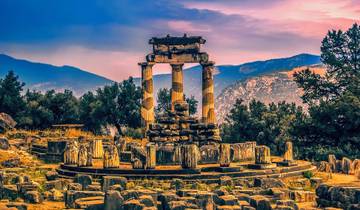
The Tholos represents ancient Greek architecture’s most mysterious and visually striking monument, a circular marble building constructed around 380-360 BC at the Sanctuary of Athena Pronaia by architect Theodorus of Phocaea who documented its construction in writings now lost. The structure featured twenty Doric columns surrounding a 14.76-meter diameter base supporting a decorated frieze with triglyphs and metopes depicting Centauromachy and Amazonomachy battle scenes, while the interior cella wall contained ten Corinthian half-columns creating refined architectural elegance. The building stood 13.5 meters tall at its center with a conical roof, constructed from white Pentelic marble from Mount Penteli contrasting with dark Eleusinian limestone flooring, creating dramatic polychromatic effects enhanced by painted architectural elements. Despite its elaborate decoration and prominent positioning as the first monument pilgrims encountered approaching from eastern routes, the Tholos’ actual function remains unknown—scholars propose theories including cult worship of Earth Mother Gaia predating Apollo’s sanctuary, ritual space for reenacting Apollo’s slaying of Python the serpent, treasury displaying votive offerings, or purely symbolic monument celebrating architectural achievement and mathematical harmony through circular geometry. Only three reconstructed Doric columns survive today from earthquake damage and stone reuse through subsequent centuries, yet these fragmentary remains constitute Delphi’s most photographed monument and symbolize the site’s enduring mystery and beauty.
How did the Oracle of Delphi deliver prophecies?
The Oracle consultation process combined religious ritual, theatrical spectacle, and ecstatic divination centered on the Pythia, Apollo’s high priestess selected from Delphian women who entered trance states to channel divine pronouncements. Supplicants seeking oracles underwent purification rituals at Castalia Spring before ascending the Sacred Way lined with treasuries and monuments to reach the Temple of Apollo where priests collected consultation fees and determined question eligibility. The Pythia descended into the temple’s adyton, the inner sanctum closed to ordinary visitors, where she sat upon a tripod positioned above a chasm reportedly emitting vapors inducing prophetic trance states—modern geological surveys confirm ethylene gas emissions from limestone faults beneath the temple potentially creating euphoric dissociative effects. While in trance, the Pythia uttered Apollo’s responses to questions, speaking in first person as the god’s voice, delivering pronouncements the temple priests then interpreted and formulated into coherent prophecies. Ancient sources describe the Pythia chewing laurel leaves sacred to Apollo, burning these leaves and barley meal creating aromatic smoke, and the ritual occurring only on the seventh day of certain months maintaining exclusivity and religious solemnity. Prophecies gained fame for cryptic ambiguity allowing multiple interpretations—King Croesus of Lydia receiving the famous response that attacking Persia would destroy a great empire, which indeed occurred when his own kingdom fell. This interpretive flexibility alongside documented accurate predictions established Delphi’s authority while protecting priestly reputation regardless of outcomes, creating self-reinforcing belief in divine guidance that sustained the oracle’s influence for over a thousand years.
What happened to Delphi after the ancient Greek period?
Delphi’s religious and political influence declined progressively under Roman rule beginning 191 BC when Roman generals plundered sanctuary treasuries and curtailed oracle consultations, though emperors including Nero and Constantine the Great transported artistic treasures to Rome and Constantinople spreading Delphic cultural influence throughout the empire. The sanctuary continued functioning through the Roman period with modifications including stadium renovations adding stone seating and architectural restorations maintaining pilgrimage activity, though reduced political significance diminished the oracle’s once-commanding authority over Greek affairs. Emperor Theodosius I issued decrees in 393 AD closing all pagan sanctuaries across the empire as Christianity became state religion, definitively ending Delphi’s religious function after approximately twelve centuries of continuous oracle operation. The site faced progressive abandonment and depredation as local populations removed stone for building materials, earthquakes damaged standing structures, and soil deposits from Mount Parnassus slopes gradually buried monuments under meters of accumulated debris. Medieval occupation saw the village of Kastri established directly atop ancient ruins, with residents constructing houses using ancient architectural fragments and maintaining no knowledge of the sanctuary’s glorious past beneath their settlement. The “Great Excavation” beginning 1892 required relocating Kastri’s entire population to the new village of Delphi, allowing French Archaeological School archaeologists under Théophile Homolle to remove vast accumulations of soil revealing sanctuary remains. Systematic excavations continuing through the twentieth century uncovered temple foundations, treasuries, theatrical structures, thousands of inscriptions, and artistic masterpieces now displayed in the Archaeological Museum establishing Delphi as Greece’s second most important archaeological site after the Acropolis of Athens. UNESCO World Heritage inscription in 1987 recognized Delphi’s outstanding universal value, ensuring international protection and conservation of monuments representing foundational Western civilization heritage.
Extended multi-day tours – 5+ days
Featured Delphi Multi-Day Tour Packages
3 days
Prehistoric Tour of Greece – 3 days
- ✓ Comprehensive Delphi tour
- ✓ Expert local guides included
- ✓ All accommodation arranged
- ✓ Transportation provided
3 days
Mycenae, Olympia & Delphi: 3-Day Private Tour with Local Tastings
- ✓ Comprehensive Delphi tour
- ✓ Expert local guides included
- ✓ All accommodation arranged
- ✓ Transportation provided
2 days
Delphi Two Days Tour from Athens
- ✓ Comprehensive Delphi tour
- ✓ Expert local guides included
- ✓ All accommodation arranged
- ✓ Transportation provided
2 days
2 Days Delphi Tour
- ✓ Comprehensive Delphi tour
- ✓ Expert local guides included
- ✓ All accommodation arranged
- ✓ Transportation provided
Multi-day tour packages powered by TourRadar. Prices and availability subject to change.
Introduction: Delphi’s Sacred Landscape and Historical Significance
Delphi occupies a dramatic natural amphitheater carved into the southern slopes of Mount Parnassus in the region of Phocis, Central Greece, where two massive limestone cliffs known as the Phaidriades (“Shining Rocks”) frame a terraced sanctuary cascading down mountainside toward the Pleistos River valley stretching to the Gulf of Corinth. This extraordinary topography created what ancient Greeks perceived as a liminal space where earth, mountain, and sky converged in manifestations of divine presence, making geographical setting inseparable from religious significance.
The site’s evolution from Mycenaean settlement around 1500-1100 BC through Bronze Age cult practices honoring earth goddess Gaia demonstrates religious continuity spanning millennia. Archaeological excavations uncovered Mycenaean cemetery remains and votive offerings including approximately two hundred clay figurines of a deity with outstretched arms, suggesting organized worship predating classical sanctuary development by centuries. This deep chronological layering illustrates how Delphi’s sacred character transcended specific cults, with successive religious traditions recognizing the location’s inherent spiritual power.
Apollo’s cult establishment during the 8th century BC transformed local sanctuary into pan-Hellenic religious center as mythological narratives explaining divine succession gained currency. The foundational myth describing Apollo’s slaying of Python, the serpent guardian of earth’s ancient oracle, symbolized celestial Olympian deities supplanting chthonic earth powers in Greek religious consciousness. This mythological framework positioned Delphi as the site where cosmic order established itself, where chaos surrendered to harmony, and where divine justice manifested through prophetic truth.
The concept of the omphalos—the “navel of the world”—elevated Delphi to cosmological centrality in Greek geographical and philosophical imagination. According to myth, Zeus released two eagles from opposite ends of the universe, their meeting point above Delphi marking earth’s exact center. The physical omphalos stone housed in Apollo’s temple represented this cosmic axis, the point where divine and mortal realms intersected, making Delphi the communication channel between gods and humanity. This symbolic geography influenced ancient Greek worldview profoundly, positioning their civilization’s spiritual center as literally earth’s geographical center.
Delphi’s pan-Hellenic status distinguished it from city-state controlled sanctuaries, making it neutral religious territory where all Greeks regardless of political allegiance could worship and consult the oracle. The Amphictyonic League, an ancient association of twelve Greek tribes, governed sanctuary operations, controlled finances, appointed priests and officials, and mediated disputes preventing any single power from monopolizing access to divine wisdom. This collective governance reinforced Delphi’s role unifying fractious Greek city-states through shared religious identity transcending political divisions.
The sanctuary’s influence reached its zenith during the 6th and 5th centuries BC when oracle consultations directed colonization throughout the Mediterranean, guided military campaigns including Persian War strategies, validated political reforms in Athens and Sparta, and sanctioned social institutions from slavery to inheritance laws. No major Greek political decision proceeded without Delphic consultation, making the oracle effectively a supreme judicial and legislative authority whose pronouncements carried divine mandate beyond human contestation.
UNESCO World Heritage Inscription and Outstanding Universal Value
UNESCO inscribed the Archaeological Site of Delphi on the World Heritage List in 1987, recognizing the property’s outstanding universal value through inscription under criteria (i), (ii), (iii), (iv), and (vi)—an exceptional designation acknowledging multiple dimensions of significance rarely achieved by single sites. The inscription represents international recognition that Delphi transcends Greek national heritage to constitute foundational cultural patrimony belonging to all humanity.
Criterion (i) acknowledges Delphi as a masterpiece of human creative genius through its extraordinary architectural and artistic achievement harmonizing built monuments with dramatic natural landscape. The sanctuary’s layout demonstrates exceptional urban planning as architects positioned temples, treasuries, theatres, and athletic facilities following terrain contours while creating processional routes building anticipation as pilgrims ascended toward the Temple of Apollo. The modular arrangement of terraces, retaining walls, and monument platforms created visual rhythm and spatial hierarchy expressing both physical journey from profane to sacred space and spiritual elevation from earthly concerns toward divine communion. This design sophistication representing conscious aesthetic choices rather than haphazard development establishes Delphi as deliberate artistic creation rivaling any planned city or ceremonial complex from antiquity.
Criterion (ii) recognizes Delphi’s profound influence on subsequent architectural and artistic development throughout the ancient world and beyond. The sanctuary became a prototype for religious complexes, with treasuries, theaturies, and oracle chambers imitated from Bactria following Alexander the Great’s conquests to Roman provincial sanctuaries adapting Greek religious architecture. The Tholos circular design influenced Roman temple architecture, Renaissance circular churches, and neoclassical monuments celebrating mathematical harmony through geometric perfection. Even Roman emperors’ plundering of Delphic sculptures for display in Rome and Constantinople paradoxically extended the site’s artistic influence, as these masterpieces became models for later sculptors studying classical forms. The sanctuary’s fusion of architecture, sculpture, inscriptions, and natural landscape established comprehensive design principles for sacred space that resonated across cultures and millennia.
Criterion (iii) emphasizes Delphi’s unique testimony to ancient Greek religion and civilization at their cultural apex. The archaeological remains preserve extraordinary evidence of religious practices, political decision-making processes, artistic patronage, athletic competitions, and social organization across twelve centuries of continuous occupation. Inscriptions numbering in thousands document everything from slave emancipation decrees to building accounts to victory dedications, providing unparalleled historical record of ancient Greek life. The Oracle’s role in Greek political history makes Delphi essential for understanding how religious authority shaped governmental systems, military campaigns, colonial expansion, and inter-state diplomacy throughout the classical period. The four Sacred Wars fought over sanctuary control demonstrate how religious and political power intertwined, making Delphi focal point of conflicts defining Greek history.
Criterion (iv) identifies Delphi as an outstanding example of architectural ensemble illustrating significant stages of human history. The sanctuary preserves structures spanning from Archaic through Hellenistic to Roman periods, documenting architectural evolution as Greek building techniques advanced from porous limestone temples to marble masterpieces employing sophisticated engineering. The progression from simple rectangular treasuries to elaborately decorated Ionic and Corinthian examples shows artistic development reflecting economic prosperity and competitive city-state rivalry. The stadium and theatre demonstrate how religious sanctuaries incorporated athletic and cultural competitions, integrating physical excellence and artistic performance with spiritual devotion in characteristically Greek synthesis. These monuments collectively illustrate how ancient Greeks conceived sacred space as comprehensive cultural experience rather than narrow religious practice.
Criterion (vi) acknowledges Delphi’s association with ideas, beliefs, and events of outstanding universal significance. The oracle’s pronouncements influenced events from colonization of Sicily and southern Italy to Persian War outcomes to Alexander the Great’s Asian campaigns, making Delphi instrumental in historical developments shaping Western civilization. The sanctuary embodied Greek concepts of cosmic order, divine justice, human wisdom’s limits, and the possibility of communication between mortal and immortal realms. Philosophical maxims inscribed at the temple entrance—”Know Thyself” and “Nothing in Excess”—became foundational ethical principles guiding Greek thought and influencing subsequent Western philosophy. The Pythian Games held at Delphi every four years celebrated artistic and athletic excellence in competitions rivaling Olympic Games, promoting cultural values emphasizing balanced development of body, mind, and spirit that remain influential ideals.
The property’s authenticity meets UNESCO standards through conservative restoration practices respecting original materials, forms, and designs. Interventions primarily involve repositioning ancient architectural fragments to original locations and stabilizing standing structures using predominantly authentic materials, maintaining visual integrity and archaeological accuracy. The landscape setting preserves authentic character allowing modern visitors approaching along the Sacred Way from the Roman Market to the Stadium to experience similar emotional and spiritual responses ancient pilgrims felt, maintaining continuity of sacred geography across millennia.
The Temple of Apollo: Sanctuary Heart and Oracle Chamber
The Temple of Apollo dominates Delphi’s sacred precinct as the architectural and spiritual nucleus where the Oracle delivered divine pronouncements that shaped Greek civilization. The visible ruins date to the fourth temple constructed at the site, built 330 BC by Corinthian architect Spintharus along with Xenodoros and Agathon after the previous temple’s destruction by earthquake in 373 BC. This reconstruction maintained traditional Doric peripteral design with six columns on the façade and fifteen along each side, creating imposing proportions appropriate for housing antiquity’s most authoritative oracle.
The temple’s construction history illustrates Delphi’s pan-Hellenic significance through financing mechanisms requiring contributions from Greek city-states collectively. When the Archaic temple burned around 548 BC, reconstruction funding came through contributions organized under auspices of the wealthy Alcmaeonidae family of Athens, demonstrating how major Greek powers competed for influence through sanctuary patronage. The earthquake necessitating fourth temple construction in 373 BC prompted renewed fundraising appeals across the Greek world, with cities contributing despite ongoing political conflicts because Delphic oracle authority transcended partisan interests.
Architectural elements conveyed religious symbolism through design choices reflecting cosmic order and divine presence. The temple followed canonical Doric proportions with column height to lower diameter ratios, intercolumniation spacing, and entablature dimensions conforming to mathematical harmonies Greeks believed expressed universal order. The eastern façade received sunrise illumination during equinoxes, connecting temple orientation to celestial mechanics and seasonal cycles governing agricultural rhythms essential to Greek economy and religious calendar. The rising ground elevating the temple above surrounding structures created visual dominance emphasizing Apollo’s supremacy within the divine hierarchy.
The temple’s cella interior housed the cult statue of Apollo along with the omphalos stone marking earth’s mythological center—a marble sculpture carved with network pattern representing cosmic web connecting all existence. Pilgrims entering the cella encountered this sacred object before any oracle consultation, establishing psychological framework where divine wisdom emanated from cosmic center point. The vestibule bore famous Delphic maxims inscribed by the seven wise men of ancient Greece, including “Know Thyself” and “Nothing in Excess,” providing ethical guidance framing oracle-seeking as philosophical self-examination rather than mere fortune-telling.
The adyton, the temple’s innermost chamber closed to ordinary visitors, contained the prophetic apparatus where the Pythia delivered oracles. This restricted space likely featured the sacred tripod upon which the priestess sat while in trance, positioned above the chasm where vapors reportedly rose inducing prophetic states. Modern geological surveys confirm the temple sits atop fault lines where limestone and shale layers meet, creating conditions for hydrocarbon gas emissions including ethylene that could produce euphoric dissociative effects ancient sources attributed to divine possession. Whether genuine geological phenomena or religious theatrics, the adyton’s mystery and exclusivity enhanced oracle authority by limiting access to divine communication to sanctioned priestly intermediaries.
Temple decoration reflected Delphi’s accumulation of artistic wealth through votive offerings. Victory monuments, bronze statues, gold and silver objects, and precious vessels filled the interior creating visual spectacle demonstrating collective Greek prosperity and piety. The earthquake destruction and subsequent temple rebuildings actually preserved artistic chronology as damaged objects entered storerooms rather than complete destruction, eventually becoming archaeological museum displays documenting artistic evolution across centuries.
The Sacred Way: Processional Route and Treasury Display
The Sacred Way constitutes Delphi’s primary processional route ascending from the sanctuary entrance through treasuries and votive monuments toward the Temple of Apollo, creating carefully orchestrated spatial sequence building religious anticipation through architectural revelation. This paved pathway following zigzag course up terraced slopes allowed gradual approach rather than direct sightlines to the temple, forcing pilgrims to experience intermediate monuments while ascending toward ultimate divine encounter. The journey’s structure paralleled spiritual progression from mundane concerns toward sacred wisdom, making physical movement metaphor for psychological transformation.
Treasuries lining both sides of the Sacred Way represented individual Greek city-states’ competitive dedication to Apollo through architectural monuments housing votive offerings and displaying artistic prowess. These small temple-like buildings constructed in various architectural orders—Doric, Ionic, and occasionally Aeolic—created diverse visual environment while maintaining functional similarity as secure storage for precious dedications. The Treasury of the Athenians, reconstructed completely allowing modern visitors to appreciate original appearance, exemplifies Doric treasury design with two columns in antis supporting pedimental roof decorated with sculpted metopes depicting Theseus’ labors and Heracles’ exploits.
The Siphnian Treasury, though surviving only through fragmentary remains now displayed in the Archaeological Museum, represents the pinnacle of Archaic Greek architectural sculpture. Constructed entirely of marble around 530 BC—the first treasury achieving this expensive distinction—it combined three marble types from Siphnos, Naxos, and Paros creating polychromatic effect enhanced by painted decoration in blue, red, gold, and green. The sculptural program included pedimental compositions showing Zeus preventing Heracles from stealing the Delphic tripod, continuous friezes depicting Trojan War scenes and Gigantomachy battles between gods and giants, and caryatid columns supporting the porch roof—female figures replacing conventional columns in innovative architectural solution copied by later buildings including the Erechtheion on Athens’ Acropolis.
Votive monuments punctuated the Sacred Way with larger dedications celebrating military victories, athletic triumphs, or expressing gratitude for oracle guidance. Bronze and marble statues of gods, heroes, victorious generals, and champion athletes created gallery effect as pilgrims walked past generations of commemorative art. The Stoa of the Athenians, a columned portico constructed in the 5th century BC, displayed captured enemy weapons and ship prows from naval victories, transforming military success into religious offering while asserting Athenian power through prominent sanctuary positioning. These monuments transformed Delphi into living museum where Greek history materialized through artistic representation, making sanctuary visits educational experiences teaching political relationships, military achievements, and cultural values through monumental displays.
Inscriptions throughout the Sacred Way provided textual counterpoint to visual monuments, recording building accounts, dedicatory formulas, manumission decrees freeing slaves, political agreements between city-states, and athletic victory lists. The Polygonal Wall supporting the Temple of Apollo terrace alone contains over 800 inscriptions dating from the 6th through 1st centuries BC, creating palimpsest text revealing how sacred space functioned as public archive where legal documents, historical records, and religious dedications achieved permanent commemoration through stone inscription. These inscriptions provide invaluable historical evidence about ancient Greek language evolution, political institutions, social structures, and religious practices documented nowhere else.
The Tholos of Athena Pronaia: Architectural Mystery and Mathematical Harmony
The Sanctuary of Athena Pronaia occupies a terrace approximately one kilometer southeast of the main Apollo sanctuary, positioned as the first sacred precinct encountered by pilgrims approaching Delphi from eastern routes through Boeotia and Attica. The sanctuary name derives from “Pronaia” meaning “before the temple,” referring to its position before reaching Apollo’s sanctuary, though archaeological evidence suggests earlier dedication to earth goddess Gaia before Athena worship became dominant. This sanctuary complex included multiple temples to Athena constructed successively after earthquake destructions, several treasuries, altars to various deities, and the extraordinary Tholos that became Delphi’s most iconic monument.
The Tholos represents ancient Greek architecture’s most enigmatic achievement—a circular marble building of exceptional craftsmanship and elaborate decoration whose actual function remains unknown despite extensive archaeological investigation and scholarly debate. Constructed around 380-360 BC by architect Theodorus of Phocaea who documented the building in a now-lost treatise mentioned by Roman architect Vitruvius, the Tholos combined cutting-edge architectural innovation with traditional religious symbolism in ways suggesting multiple possible purposes from cult worship to commemorative monument to purely aesthetic demonstration of mathematical harmony.
The building’s structure employed sophisticated engineering and lavish materials. Twenty Doric columns arranged in precise circular formation supported an exterior frieze decorated with triglyphs and metopes carved with relief sculptures depicting Centauromachy (battle between Lapiths and Centaurs) and Amazonomachy (Greeks fighting Amazons)—mythological themes common in Greek religious architecture symbolizing civilization’s triumph over barbarism. The colonnade enclosed a circular cella wall 8.6 meters in diameter, creating an ambulatory space allowing circumambulation around the central chamber. Inside the cella, ten Corinthian half-columns attached to the concave wall surface provided interior decoration—an early use of Corinthian order that would become dominant in Hellenistic and Roman architecture.
Material selection demonstrated exceptional expenditure and aesthetic sophistication. The core structure utilized white Pentelic marble from Mount Penteli near Athens—the same stone used for the Parthenon—creating luminous appearance enhanced by Greek sunlight. The floor combined white marble in the central area with dark Eleusinian limestone toward the circumference, creating dramatic color contrast emphasizing geometric patterns. The conical roof employed marble tiles in layered arrangement creating complex visual rhythm, while painted architectural elements in blue, red, and gold enhanced polychromatic effect that would have been far more vibrant in antiquity than weathered stone suggests today.
The sculptural decoration extended to the roof with terracotta acroteria (decorative elements at roof corners and apex) and elaborate gutters featuring lion head waterspouts—functional elements transformed into artistic expressions. The metope reliefs, now fragmentary and displayed in the Archaeological Museum, show remarkable sculptural quality with figures in vigorous action poses demonstrating advanced understanding of human anatomy and movement. The craftsmanship investment in decorating a relatively small building indicates extraordinary religious or political significance beyond mere functional requirements.
Scholars propose various theories about the Tholos’ purpose without reaching consensus. Religious interpretations suggest it housed cult worship of Mother Earth Gaia whose worship predated Athena at this location, making circular form symbolize cosmic wholeness or earth’s roundness. The proximity to an open circular area called the Halos—literally “threshing floor”—where eight-yearly rituals reenacted Apollo’s slaying of Python suggests possible connection between these sites. Alternative theories propose the Tholos served as treasury displaying particularly valuable votive offerings, memorial monument commemorating specific historical event now forgotten, or purely symbolic structure celebrating mathematical perfection and architectural innovation without practical religious function. The building’s elaborate decoration and prominent positioning suggest it held significance beyond simple utility, making continued mystery frustrating yet intriguing.
Only three reconstructed Doric columns survive from the original twenty, with restoration completed in early 20th century using original fragments recovered during excavation. These standing columns, along with the circular base platform and foundation remains, constitute Delphi’s most photographed monument despite representing mere fraction of original structure. The Tholos photogenic quality derives from its unusual circular form contrasting with rectangular temples throughout the sanctuary, dramatic positioning on terraced landscape with Mount Parnassus rising behind, and the evocative fragmentary state suggesting former grandeur while inviting imaginative reconstruction of complete building’s appearance.
Theatre and Stadium: Athletic and Cultural Competitions
The Theatre of Delphi, constructed in the 4th century BC and remodeled several times during Hellenistic and Roman periods, occupies a commanding position on the mountainside above the Temple of Apollo, providing seated spectators spectacular views encompassing the entire sanctuary below and the Pleistos valley extending to distant Gulf of Corinth. This integration of natural landscape with built architecture exemplifies characteristically Greek approach to theatre design where topographical features determined building placement and enhanced dramatic experience through panoramic vistas connecting theatrical performance with cosmic setting.
The theatre follows standard Greek design with cavea (seating area) carved into natural hillside in horseshoe configuration facing stage building, eliminating construction need for extensive supporting structures while exploiting natural acoustics allowing performers’ voices to carry clearly to uppermost rows. Thirty-five rows of limestone benches quarried from Mount Parnassus accommodated approximately 5,000 spectators organized by social status with privileged seating locations marked by inscribed names of magistrates and benefactors. The seating capacity roughly equaled Delphi’s pilgrim population during major festivals, making the theatre adequately sized for community gatherings without excessive monumentality.
The theatre hosted diverse performances during religious festivals honoring Apollo, including dramatic presentations of tragedies and comedies, musical competitions featuring lyre and aulos (double-reed instrument) performances, and poetry recitations celebrating gods and heroes. The Pythian Games held every four years included theatrical contests alongside athletic competitions, with victors receiving laurel wreaths and achieving fame rivaling Olympic champions. These cultural competitions reflected Greek values integrating artistic excellence with religious devotion and physical prowess, making Delphi venue for comprehensive display of human achievement honoring divine inspiration of creativity.
Roman period modifications added decorative elements including proscenium elaboration and seating improvements enhancing comfort and visual splendor, though these changes sometimes compromised original acoustic properties designed for Greek performance styles. Inscriptions document restoration funding from wealthy patrons whose beneficence maintained facilities across generations, demonstrating how elite patronage sustained public monuments serving collective religious and cultural purposes.
The Stadium occupies Delphi’s highest accessible point, requiring steep climb beyond the theatre along ancient pathways to reach the athletic facility where Pythian Games track and field events occurred. Constructed in the 3rd century BC and substantially renovated during Roman period through benefaction of Herodes Atticus—the wealthy Athenian sponsor who funded numerous Greek monuments—the stadium accommodated 6,500 to 7,000 spectators on earthen embankments later supplemented with stone seating the Roman renovations provided.
The track measures 177.35 meters in length with curved ends allowing runners to reverse direction during multi-lap races, following standard Greek stadium dimensions based on traditional measurement units. Stone starting blocks survive at the western end with grooves where runners positioned their feet before race commencement, preserving tangible connection to athletic competitions from over two millennia ago. The vaulted entrance tunnel on the southeast corner provided dramatic ceremonial entry for athletes and officials, architectural feature added during Roman period enhancing theatrical staging of competitions.
Athletic events included foot races at various distances, long jump, discus and javelin throwing, wrestling, and pentathlon combining five disciplines. The Pythian Games originally emphasized musical and artistic competitions more than Olympic Games but gradually incorporated full athletic program rivaling other pan-Hellenic festivals. Victory at Delphi carried enormous prestige as religious sanction accompanied athletic achievement, with winners receiving not only laurel wreaths but also oracle consultations and privileged status within their home cities. Statue dedications along the Sacred Way commemorated athletic victors alongside military commanders, indicating equivalent honor granted physical excellence and battlefield success.
The stadium’s elevated position above the sanctuary proper symbolically separated athletic space from religious core, though processions connected the venues during festival celebrations. This spatial organization reflected Greek religious complexity where physical competitions honored gods through human excellence while maintaining conceptual distinction between sacred and secular activities. The journey from theatre to stadium required pilgrims to ascend beyond the temple precinct, suggesting athletic achievements represented ultimate human striving approaching yet never reaching divine perfection embodied in the sanctuary below.
The Archaeological Museum of Delphi: Preserving Artistic Treasures
The Archaeological Museum of Delphi houses one of Greece’s most important collections of ancient art, displaying masterpieces excavated from the sanctuary that span twelve centuries from Archaic through Roman periods. The museum’s collection arrangement follows chronological and thematic organization allowing visitors to trace artistic evolution while understanding objects within their original sanctuary context. The galleries preserve not merely beautiful artifacts but crucial historical documents revealing political relationships, religious practices, artistic patronage, and technical innovations that defined ancient Greek civilization.
The Charioteer of Delphi represents the museum’s most famous treasure and one of ancient Greek art’s finest surviving bronze sculptures. Created around 478 or 474 BC to commemorate chariot race victory during Pythian Games, the life-size statue preserves extraordinary realism in facial features, naturalistic rendering of fabric folds in the driver’s long chiton, and subtle anatomical details including individually modeled toes visible beneath the garment. The statue originally formed part of larger sculptural group including chariot, horses, and groom that earthquake toppled and buried, protecting the charioteer from melting for metal reuse while other bronze sculptures disappeared. The statue’s survival provides rare evidence of classical bronze sculpture technique since most ancient bronzes were melted down in subsequent centuries for weapons or coinage.
The technical achievement demonstrates lost-wax casting mastery allowing hollow bronze construction with varying wall thickness, realistic glass and stone inlaid eyes creating lifelike gaze, and surface finishing achieving smooth skin textures contrasting with detailed hair rendering. The charioteer’s serene expression, formal posture, and simple gesture holding reins embody classical ideals of sophrosyne (self-control) and arete (excellence) that defined Greek aristocratic values. The dedication inscription identifies the commissioning patron as either Polyzalos, tyrant of Gela in Sicily, or his brother Hieron, demonstrating how western Greek colonies competed for prestige through sanctuary dedications rivaling mainland city-states.
The Sphinx of Naxos, a marble sculpture created around 560 BC and originally mounted atop a 10-meter column near the Temple of Apollo, exemplifies Archaic period monumentality and island marble-working expertise. The hybrid creature combining woman’s head, bird’s wings and body, and lion’s haunches represented riddle-keeper and divine guardian familiar from mythology. Naxian marble sculptors exploited their island’s fine-grained white marble quarries to create intricate wing feather carving and detailed facial features showing characteristic Archaic smile. The sphinx functioned as votive offering from the wealthy island of Naxos asserting its power and piety through expensive dedication positioned prominently within the sanctuary, making it among the first monuments pilgrims encountered ascending the Sacred Way.
The twin statues of Kleobis and Biton, Archaic kouros figures created around 600-580 BC, illustrate early monumental stone sculpture development in Greece. Standing over 2 meters tall with characteristic rigid frontal stance, clenched fists, and advanced left foot, these statues represented either the mythological brothers who pulled their mother’s chariot to Hera’s temple or simply ideal aristocratic youths embodying physical perfection. The dedication inscription identifies the sculptor as “[Poly]medes of Argos,” providing rare evidence about Archaic artist identity when most sculpture remained anonymous. The statues demonstrate early Greek sculptors’ struggles representing human anatomy with stiff proportions, schematic musculature, and geometric hair patterns contrasting sharply with later classical naturalism, making them valuable documents of artistic evolution.
The Siphnian Treasury frieze fragments preserve the finest surviving Archaic relief sculpture with remarkable detail in battle scenes showing Greeks fighting Trojans and gods combating giants. The north frieze Gigantomachy depicts Olympian gods in furious combat rendered with sophisticated overlapping figures creating depth, dramatic action poses, and individualized divine attributes like Athena’s aegis and Apollo’s lyre. The sculptural sophistication combined with traces of original painted decoration in blue, red, and gold reveals how Greek temples and treasuries presented polychromatic visual spectacle far removed from the white marble aesthetic modern viewers associate with classical art.
The original omphalos stone, though likely a Roman copy of earlier Archaic prototype, preserves the carved network pattern Greeks believed represented cosmic web connecting all existence. This modest-sized marble object held extraordinary symbolic importance as the physical marker of earth’s center, making its museum display anticlimactic compared to religious significance the object possessed when housed in Apollo’s temple. The copy’s survival demonstrates continuous religious tradition maintaining sacred objects across centuries through periodic replacement when originals deteriorated.
Extensive inscription collections document everything from building accounts itemizing construction costs for temples and treasuries, to proxeny decrees granting foreigners honorary citizenship rights, to slave manumission texts recording freedom purchases, to athletic victory lists commemorating Pythian Games champions. These inscriptions provide invaluable historical evidence about ancient Greek language dialects, political institutions, economic systems, and social practices impossible to reconstruct from literary sources alone. The museum’s epigraphic displays allow visitors to read actual ancient texts rather than merely admiring artistic objects, connecting directly with Greek individuals whose names, deeds, and concerns preserve through stone permanence.
Delphi’s Mythological Foundations and Religious Symbolism
Greek mythology explaining Delphi’s establishment as Apollo’s sanctuary preserves religious transformation from chthonic earth worship to Olympian celestial cults while providing narrative framework interpreting natural landscape features as divine manifestations. The foundational myth describes Apollo’s journey from his birthplace on Delos seeking a location to establish his oracle, selecting Delphi for its natural beauty and strategic position. Upon arrival, Apollo encountered Python, a monstrous serpent offspring of earth goddess Gaia guarding the site’s ancient oracle. Apollo slew Python with arrows, claiming Delphi as his sanctuary and establishing the Pythian Games to commemorate his victory over chaos and darkness.
This mythological narrative encoded religious transition from Bronze Age earth goddess worship, evidenced archaeologically through Mycenaean figurines found beneath classical structures, to Iron Age Olympian deity dominance reflecting social changes in Greek civilization. Python represented old religious order tied to earth, female divinity, darkness, and prophetic dreams rising from underground realms, while Apollo embodied new order emphasizing sky, male divinity, light, and rational prophecy delivered through controlled trance states. The myth validated new religious hierarchy while acknowledging continuity with earlier traditions, making Apollo’s victory assimilation rather than complete destruction of previous cults.
The sanctuary name Delphi derives from the Greek word “delphys” meaning womb, connecting site geography to feminine generative power and earth’s creative forces. Alternative etymology links the name to “delphis” meaning dolphin, referencing the myth where Apollo transformed into dolphin to guide Cretan priests to establish his sanctuary. This etymological ambiguity characteristic of ancient religious sites suggests multiple overlapping meanings, with womb imagery emphasizing prophetic powers emerging from earth while dolphin reference celebrated Apollo’s arrival establishing new cult practice.
The omphalos myth establishing Delphi as earth’s center demonstrates how Greeks conceived their world’s geography with religious sanctuary as focal point radiating cultural influence outward. Zeus releasing two eagles from universe’s opposite ends, their meeting point above Delphi marking cosmic center, positioned Greek religious identity at creation’s axis rather than geographical or political periphery. This mythological centrality justified Delphi’s pan-Hellenic status transcending city-state particularism by locating universal truth at sanctuary protecting collective Greek identity against Persian invasions and internal conflicts threatening cultural unity.
Natural landscape features integrated into mythological explanations included the Castalian Spring flowing from Phaedriades cliffs, where pilgrims performed purification rituals before oracle consultations. The spring’s sacred character derived from association with the nymph Castalia who drowned herself fleeing Apollo’s pursuit, her transformed essence providing prophetic waters inspiring poets and cleansing suppliants. The Pleistos River valley below the sanctuary represented fertile abundance under Apollo’s protection, agricultural productivity linking religious devotion to material prosperity.
The Pythia priestess title derived from Python the slain serpent, indicating how new religious order incorporated rather than entirely rejected earlier traditions. The priestess maintained connection to earth’s prophetic powers while channeling Apollo’s celestial wisdom, making oracle delivery synthesis of chthonic and Olympian elements. This religious complexity allowed Delphi to appeal across Greek religious spectrum from conservative adherents maintaining earth worship to progressives emphasizing Olympian rationalism, broadening sanctuary’s constituency and reinforcing pan-Hellenic inclusivity.
The Oracle in Ancient Political and Social Life
The Delphic Oracle functioned as ancient Greece’s supreme religious authority whose pronouncements influenced political decisions, military campaigns, colonial foundations, and social institutions across Mediterranean civilization. City-states consulted the oracle before undertaking major initiatives including warfare, constitutional reforms, public building projects, and diplomatic alliances, treating divine guidance as essential prerequisite for legitimate governance. This oracle authority derived from accumulated prestige reinforcing itself through centuries of documented consultations where divine wisdom appeared validated by subsequent events.
Colonial expansion throughout the Mediterranean and Black Sea regions required oracle consultation establishing religious legitimacy for settlement ventures. Greeks founding new cities sought Delphic approval regarding location selection, leadership designation, and ritual procedures maintaining divine favor in unfamiliar territories distant from traditional cult centers. The oracle effectively regulated colonization by sanctioning some ventures while discouraging others, preventing overcrowding in desirable regions while directing settlers toward underdeveloped areas serving broader Greek strategic interests. This regulatory function made Delphi instrumental in Hellenistic world creation as oracle-approved colonies maintained religious and cultural ties to Greek heartland.
Military consultations seeking divine approval for warfare or guidance regarding strategy demonstrate oracle’s political influence extending beyond religious sphere into state policy formation. Famous consultations include Spartan requests before Persian Wars receiving encouragement to resist despite overwhelming Persian numerical superiority, Athenian inquiries about naval strategy receiving cryptic response about “wooden walls” interpreted as advocating fleet expansion leading to Salamis victory, and numerous petitions from cities contemplating alliances or territorial disputes seeking divine mediation transcending partisan interests.
Constitutional reforms and legal innovations required oracle validation establishing divine sanction for political changes risking social disruption. Lycurgus’ Spartan constitution creation, Athenian democracy development under Cleisthenes, and various cities’ tyranny establishments all involved oracle consultations legitimating radical governmental experiments through prophetic approval. This divine endorsement provided political cover for controversial reforms by attributing authority to Apollo rather than human legislators vulnerable to factional opposition.
Social institutions including slavery, inheritance laws, marriage regulations, and religious festival calendars received oracle guidance establishing normative practices across disparate city-states. Questions about property disputes, family inheritance conflicts, and religious pollution requiring purification rituals filled daily oracle consultation schedules alongside major political inquiries. This broad consultation scope made Delphi relevant to all social classes from peasants resolving family disputes to aristocrats planning dynastic marriages to cities determining public policy.
The oracle’s interpretive ambiguity became legendary through famous consultations where cryptic responses allowed multiple interpretations. King Croesus of Lydia consulting whether to attack Persia received response that crossing the Halys River would destroy a great empire—an accurate prophecy since his own Lydian empire fell to Persian conquest. This strategic ambiguity protected priestly reputation regardless of outcomes while forcing supplicants to interpret prophecies through their own reasoning rather than expecting explicit divine commands. The interpretive flexibility actually enhanced oracle authority by demonstrating divine wisdom transcending simple predictive statements to offer profound truths requiring contemplation for full understanding.
French Archaeological Excavations and Modern Conservation
Systematic archaeological investigation of Delphi began with pioneering work by German archaeologists in the 1860s conducting preliminary surveys, but comprehensive excavation required relocating the medieval village of Kastri built directly atop ancient ruins. The village’s presence prevented archaeological access to sanctuary remains buried under meters of accumulated soil, houses constructed using ancient architectural fragments, and modern settlement occupation obscuring the site’s historical significance. An 1870 earthquake damaging Kastri provided opportunity for Greek government negotiations with residents about relocation, though actual agreement took two decades of difficult discussions balancing archaeological interests against villagers’ property rights and community attachments.
The “Great Excavation” officially commenced in autumn 1892 under direction of Théophile Homolle and the French Archaeological School (École française d’Athènes), which secured excavation rights through agreements with the Greek government. The French School, established 1846 as France’s premier archaeological research institute in Greece, brought systematic methodology, adequate funding, and trained archaeologists capable of managing extensive excavation requiring massive earth removal. The project’s scale necessitated relocating Kastri’s entire population to a completely new village constructed nearby and named Delphi, with the Greek government providing new houses and infrastructure compensating displaced residents.
Excavation work removed vast quantities of soil accumulated through centuries of erosion from Mount Parnassus slopes, earthquake debris, and deposits from ancient sanctuary abandonment and medieval occupation. Workers installed temporary railway systems transporting excavated material, employed hundreds of laborers for manual excavation work, and systematically documented discoveries through photography, detailed notes, and architectural drawings. The excavation revealed the Sanctuary of Apollo with its temples, treasuries, Sacred Way monuments, theatre, and stadium along with the Sanctuary of Athena Pronaia including the Tholos, gymnasium complex, and Castalian Spring facilities.
The excavations uncovered thousands of objects including bronze and marble sculptures, architectural fragments, pottery, jewelry, weapons, tools, and most importantly, inscriptions numbering in thousands providing invaluable historical documentation. Major discoveries like the bronze Charioteer statue, Siphnian Treasury friezes, and numerous votive offerings revealed artistic achievement and religious practices otherwise unknown from literary sources. Building accounts inscribed on stone documented construction costs and techniques, dedication inscriptions identified donors and occasions for monuments, and manumission records preserved social history of slavery and freedom in ancient Greece.
Publication of excavation results began immediately through the ongoing series “Fouilles de Delphes” (Excavations at Delphi) produced by the French School, with volumes documenting architecture, sculpture, inscriptions, minor objects, and topography appearing across subsequent decades. These scholarly publications made Delphic discoveries accessible to international research communities while establishing professional standards for archaeological documentation and material analysis. The comprehensive publication program continues today with new volumes appearing as ongoing excavations and research generate additional findings.
Conservation work throughout the 20th and 21st centuries addressed structural stabilization of excavated monuments, restoration of damaged architectural elements, and protective measures preventing further deterioration. The Tholos reconstruction erecting three Doric columns using original fragments demonstrated how partial restoration could suggest original appearance without complete rebuilding that would compromise authenticity. Similar conservative restoration approaches governed work on treasuries, retaining walls, and other structures where anastylosis (repositioning fallen architectural members to original locations) occurred using authentic materials identified through careful study.
The Archaeological Museum of Delphi, constructed in stages beginning 1903 and expanded several times culminating in major 1999 renovation creating current exhibition spaces, provides climate-controlled environment protecting fragile objects while allowing public access to the sanctuary’s artistic treasures. Museum displays organize objects chronologically and contextually, explaining their original locations and functions within the sanctuary while presenting them as aesthetic masterpieces worthy of contemplation independent of archaeological context.
Modern conservation challenges include managing tourist impacts from hundreds of thousands of annual visitors whose foot traffic erodes ancient pathways, monitoring structural stability as earthquakes continue affecting the seismically active region, controlling vegetation growth that damages masonry through root penetration, and addressing atmospheric pollution and acid rain degrading marble surfaces. The Greek Archaeological Service and international conservation specialists employ advanced monitoring technologies, reversible intervention techniques, and sustainable tourism management strategies balancing preservation requirements with public access expectations.
Delphi’s Landscape and Natural Setting
Delphi’s dramatic landscape setting proved inseparable from its religious significance as natural topography created sacred atmosphere where divine presence manifested through geological formations, water sources, and vegetation patterns Greeks interpreted as supernatural signs. The site occupies a natural amphitheater carved into Mount Parnassus’ southern slopes between two massive limestone cliffs—the Phaidriades (“Shining Rocks”)—whose vertical faces rise hundreds of meters creating imposing natural monuments flanking the sanctuary. These cliffs reflect sunrise and sunset light creating luminous effects ancient Greeks believed represented divine radiance, making “shining” designation both descriptive and symbolically meaningful.
Mount Parnassus itself held sacred status as home to Apollo and the Muses—goddesses inspiring poetry, music, and artistic creativity. The mountain’s 2,457-meter elevation made it central Greece’s most prominent peak visible from distant locations including the Gulf of Corinth and Boeotian plains, establishing visual dominance reflecting spiritual importance. Ancient pilgrims approaching Delphi across Phocian landscapes saw Parnassus dominating the horizon, building anticipation for sanctuary arrival while creating psychological preparation for religious experience through visual progression from ordinary terrain toward sacred mountain.
The Pleistos River valley stretching from Delphi southward to the Gulf of Corinth provided visual counterpoint to vertical cliff drama, with olive groves and agricultural terraces creating verdant contrast against barren rock faces. This valley represented fertility and prosperity under Apollo’s protection, agricultural abundance demonstrating divine favor rewarding proper religious observance. The visual juxtaposition between harsh mountain environment and productive valley illustrated Greek religious concepts opposing raw nature requiring divine mediation to achieve civilized cultivation producing human sustenance.
Water sources held particular sacred significance with the Castalian Spring flowing from the Phaidriades cliffs between the main sanctuary and Athena Pronaia precinct. This natural spring provided pure water for ritual purifications pilgrims performed before oracle consultations, with the spring itself considered sacred to the Muses and capable of inspiring poetic creativity. The spring’s constant flow year-round despite surrounding limestone aridity suggested supernatural water source confirming divine presence, making ritual bathing both practical cleansing and symbolic purification preparing supplicants for divine communion.
Geological features including fault lines, fissures, and cave formations received religious interpretations as passages between surface world and chthonic depths where earth powers resided. The chasm beneath Apollo’s temple where prophetic vapors supposedly emerged represented direct connection to underground realms, making oracle delivery literally communication from depths rising to surface consciousness through Pythia’s mediation. Modern geological surveys confirming hydrocarbon gas emissions from limestone-shale fault intersections validate ancient observations about site-specific atmospheric conditions, though scientific explanations differ from Greek supernatural attributions.
Vegetation patterns including laurel groves sacred to Apollo, cypress trees associated with death and mourning, and olive cultivation representing Athena’s agricultural gifts created botanical symbolism reinforcing religious narratives. Laurel leaves the Pythia reportedly chewed inducing prophetic trance grew wild throughout the sanctuary, making the plant’s abundance seem divine provision for oracle operations. These botanical features integrated natural history with mythology, making landscape itself seem designed for religious purposes rather than accidental topography requiring human interpretation.
Seasonal transformations affected sanctuary experience as winter snow blanketing Mount Parnassus created austere atmosphere contrasting with spring wildflower blooms covering hillsides in color, summer heat intensifying dramatic landscape contrasts, and autumn mists rising from the valley creating mysterious atmospheric effects. These cyclical changes reinforced Greek religious concepts about time’s circular nature, seasonal rituals aligning with agricultural cycles, and nature’s rhythms reflecting cosmic order Apollo’s worship maintained. The landscape’s dynamic character prevented static experience, making each pilgrimage season-specific and temporally unique while maintaining essential geographical permanence.
Cultural Influence and Modern Significance
Delphi’s influence on Western civilization extends far beyond ancient Greek religious practices to encompass philosophical traditions, political thought, literary themes, and artistic inspiration spanning millennia from classical antiquity through Renaissance humanism to contemporary culture. The sanctuary’s legacy operates simultaneously as historical site preserving actual ancient remains, symbolic location representing Greek civilization’s spiritual center, and continuing cultural reference point informing modern understanding of prophecy, wisdom, and humanity’s relationship with transcendent truth.
Ancient literary sources preserve Delphic oracle consultations in works by Herodotus documenting Persian War period prophecies, Thucydides analyzing oracle’s political influence during Peloponnesian War, Plutarch serving as Delphic priest while composing philosophical dialogues exploring oracle meanings, and Pausanias providing detailed 2nd century AD sanctuary description invaluable for modern archaeological interpretation. These texts established Delphi as literary setting where divine wisdom intersected human ambition, creating narrative framework subsequent Western literature inherited when portraying prophetic revelation, moral dilemmas, and existential questions about fate versus free will.
Philosophical traditions engaged Delphi’s famous maxims “Know Thyself” and “Nothing in Excess” as foundational ethical principles worthy of Socratic examination. Plato’s dialogues reference Delphic wisdom as authoritative source for moral truth, with Socrates claiming the oracle’s pronouncement about his unmatched wisdom as catalyst for philosophical inquiry. The maxims’ deceptive simplicity belied profound implications about self-examination’s necessity for ethical living and moderation’s virtue avoiding extremism’s dangers—concepts shaping subsequent Western moral philosophy from Aristotelian ethics through Stoicism to modern humanistic psychology.
Renaissance humanism rediscovered classical Delphi through Greek literary sources, making the sanctuary symbol of ancient wisdom modern Europeans sought to reclaim. Delphic maxims appeared in Renaissance art, architecture, and literature as markers of classical learning, while humanist philosophers interpreted oracle traditions as rational wisdom cloaked in religious language rather than genuine supernatural phenomena. This rationalist interpretation paradoxically enhanced Delphi’s cultural prestige by making it compatible with Enlightenment values while preserving mystique attractive to Romantic sensibilities celebrating irrational sublime experiences.
Modern literary and artistic works continuously reference Delphi as symbol of prophetic insight, mysterious wisdom, and connection between human and divine realms. Poetry from Yeats to modern Greek poets employs Delphic imagery exploring themes of fate, knowledge, and cultural memory. Novels use oracle consultations as plot devices revealing character psychology and moral dilemmas. Visual artists depict sanctuary ruins as emblems of vanished glory, temporal passage, and cultural continuity across civilizations. These creative appropriations demonstrate Delphi’s ongoing symbolic vitality independent of archaeological remains’ material fragility.
Tourism to Delphi generates substantial economic benefits for modern Greece while creating challenges balancing preservation needs with public access expectations. Hundreds of thousands of annual visitors experience the sanctuary’s dramatic setting and archaeological remains, making Delphi among Greece’s most visited heritage sites after the Acropolis. This tourism supports local economies through hospitality services while funding conservation work through admission fees, creating symbiotic relationship between heritage preservation and economic development. However, visitor impacts including pathway erosion, microclimate alterations from human presence, and management costs for facilities and security require ongoing investment and careful planning.
Educational programs sponsored by Greek archaeological authorities and international organizations use Delphi as teaching resource for ancient Greek civilization, classical archaeology methods, heritage conservation principles, and cultural tourism management. The site functions as outdoor classroom where students directly experience archaeological remains rather than studying reconstructions or representations, making abstract historical knowledge tangible through physical encounter with past material culture. Virtual reality applications and digital reconstructions now supplement physical visits, allowing global audiences to experience Delphi virtually while protecting fragile remains from excessive tourist traffic.
Frequently Asked Questions: Delphi World Heritage Site
What made Delphi the center of the ancient world?
Greeks considered Delphi earth’s center based on mythology describing Zeus releasing two eagles from universe’s opposite ends whose meeting point above Delphi marked the omphalos or cosmic navel. This mythological geography positioned Greek civilization’s spiritual sanctuary as literally the world’s central point, making it focal location where divine and mortal realms intersected through the Oracle of Apollo. The physical omphalos stone displayed in Apollo’s temple represented this cosmic centrality, symbolizing Delphi as the communication axis between heaven and earth where human questions received divine answers. Beyond mythological symbolism, Delphi functioned as pan-Hellenic sanctuary controlled by no single city-state, making it neutral religious territory where all Greeks regardless of political allegiance could worship collectively. This inclusive status created cultural centrality as the sanctuary represented Greek identity transcending local particularisms, making Delphi the symbolic heart of Hellenistic civilization unifying fractious city-states through shared religious devotion. The Oracle’s influence over colonization, warfare, legislation, and diplomacy gave Delphi practical centrality in Greek political life as decisions made at the sanctuary affected Greek expansion throughout the Mediterranean. The site’s dramatic natural setting between towering cliffs on Mount Parnassus created geographical centrality as the sanctuary occupied visually commanding position visible from distant approaches, making physical journey to Delphi seem movement toward civilization’s sacred center rather than merely another regional cult site.
How long did the Oracle of Delphi operate?
The Oracle of Apollo at Delphi operated continuously for approximately twelve centuries from the 8th century BC when organized prophetic consultation procedures developed, through peak influence during the 6th and 5th centuries BC, continuing through Hellenistic and Roman periods despite declining political authority, until Emperor Theodosius I ordered all pagan sanctuaries closed in 393 AD as Christianity became the Roman Empire’s state religion. Archaeological evidence suggests earlier religious activity at the site including Mycenaean period worship from 1500-1100 BC dedicated to earth goddess Gaia, indicating sacred site continuity predating Apollo’s cult establishment by several centuries. The oracle’s documented history begins around 800-700 BC when Greek cities started consulting Delphi systematically regarding colonization ventures, with the sanctuary’s reputation and influence growing rapidly as successful consultations validated prophetic authority. The peak period spanning the 6th through 4th centuries BC saw Delphi function as Greece’s supreme religious and political authority with consultations influencing major historical events from Persian War resistance to Alexander the Great’s Asian campaigns. Roman conquest in 191 BC initiated gradual decline as emperors plundered sanctuary treasuries and curtailed oracle independence, though consultations continued at reduced frequency through the Imperial period. The final documented oracle consultation occurred around 362 AD when Emperor Julian the Apostate, attempting to revive paganism against Christian advance, received response acknowledging Apollo’s shrine had fallen silent. The Theodosian decrees closing all pagan sanctuaries three decades later definitively ended oracle operations after over a millennium of continuous prophetic activity that shaped Greek and broader Mediterranean civilization profoundly.
What architectural styles appear in Delphi’s monuments?
Delphi preserves a comprehensive architectural evolution spanning Archaic, Classical, Hellenistic, and Roman periods showcasing Doric, Ionic, and Corinthian orders alongside innovative circular designs unique to the sanctuary. The dominant Doric order appears in the Temple of Apollo with its sturdy columns, triglyphs and metopes frieze, and austere aesthetic reflecting masculine power and divine authority appropriate for the supreme oracle. The Treasury of the Athenians exemplifies Archaic Doric with two columns in antis supporting a decorated pediment, demonstrating early monumentality when city-states competed through architectural dedications. The Siphnian Treasury introduced Ionic order to Delphi around 530 BC with its elaborate decoration, caryatid porch columns replacing conventional supports, and continuous sculptural friezes representing the most refined Archaic artistic achievement before Classical period naturalism developed. The Tholos of Athena Pronaia combined exterior Doric colonnade with interior Corinthian half-columns, creating sophisticated architectural composition demonstrating Greek mastery of multiple orders within single building and pioneering Corinthian order use that later periods would embrace extensively. The theatre follows typical Greek design carved into natural hillside with limestone seating arranged in horseshoe configuration, modified during Roman period with elaborate proscenium decoration showing how later occupiers adapted rather than replaced earlier structures. The stadium preserves Hellenistic athletic facility design with its elongated oval track and embankment seating, substantially renovated by Roman benefactor Herodes Atticus who added stone seating, vaulted entrance tunnel, and decorative elements reflecting Imperial period architectural taste. Roman modifications throughout the sanctuary introduced brick construction techniques, concrete vaulting, decorative marble veneers, and monumental inscriptions in Latin alongside Greek, documenting cultural synthesis as Roman power absorbed yet transformed Greek architectural traditions. This architectural diversity makes Delphi exceptional among ancient sites for preserving multiple building types spanning eight centuries of continuous development without complete destruction and rebuilding that eliminated earlier phases at other sanctuaries.
Why did the French excavate Delphi instead of Greek archaeologists?
The French Archaeological School (École française d’Athènes) secured excavation rights at Delphi through diplomatic negotiations between the French and Greek governments in the late 19th century when Greece lacked financial resources and trained archaeologists to undertake massive excavation requiring removal of the medieval village of Kastri and subsequent systematic investigation of buried sanctuary remains. France established archaeological presence in Greece through the École française founded 1846, making it Europe’s oldest foreign archaeological institute with expertise in Greek sites and established relationships with Greek authorities. The Great Excavation beginning 1892 required substantial funding beyond Greek government capacity during a period of national financial difficulty following independence struggles, military conflicts, and economic instability characterizing 19th century Greek state formation. France agreed to finance village relocation costs, excavation expenses, and publication of results while allowing excavated objects to remain in Greece rather than being exported to French museums—terms Greek authorities found acceptable given limited alternatives for revealing the sanctuary buried beneath Kastri. The agreement reflected common 19th century practice where European powers funded archaeological work in Mediterranean countries in exchange for excavation monopolies, though Delphi arrangement proved more favorable to Greece than contemporaneous agreements allowing artifact export. French scholars brought systematic excavation methodology including stratigraphic recording, architectural documentation, epigraphic study, and comprehensive publication standards that established professional archaeological practices Greece subsequently adopted for its own archaeological service. The French School continues involvement at Delphi today maintaining excavation rights, conducting ongoing research, publishing Fouilles de Delphes series, and collaborating with Greek archaeological authorities managing the World Heritage site. This long-term institutional continuity created archaeological expertise concentration at Delphi unmatched at most ancient sites, though modern sensibilities regarding cultural patrimony make such foreign excavation monopolies controversial compared to 19th century international norms.
How does Delphi compare to other Greek oracle sites?
Delphi vastly surpassed all other ancient Greek oracle sites in prestige, political influence, architectural monumentality, and pan-Hellenic significance, though several oracles including Dodona, Olympia, and Didyma maintained regional importance and specialized consultation types. The Oracle of Zeus at Dodona in northwestern Greece represented Greece’s oldest oracle site with origins possibly predating Delphi, where priests interpreted divine messages through rustling oak leaves sacred to Zeus and dove flights, but Dodona’s remote location limited accessibility and its influence remained primarily regional rather than pan-Hellenic. The Oracle of Zeus at Olympia functioned secondarily to the site’s primary role hosting Olympic Games, with oracle consultations occurring through burnt sacrifice divination rather than prophetic priestess utterances, making Olympia’s religious authority derive more from athletic festival prestige than oracular wisdom. Didyma’s Apollo sanctuary near Miletus in Asia Minor operated oracle procedures similar to Delphi including prophetic priestess delivering pronouncements, but political instability in Ionia from Persian and later Seleucid control prevented Didyma from achieving Delphi’s political centrality in Greek affairs. The Oracle of Trophonius at Lebadeia offered unique consultation method where supplicants descended into underground cave experiencing terrifying visions interpreted as divine revelation, creating mystery cult atmosphere attracting those seeking ecstatic religious experiences but lacking authority for major political decisions. Delphi’s preeminence derived from multiple reinforcing factors including strategic central Greek location accessible from all regions, pan-Hellenic governance through the Amphictyonic League preventing single city-state domination, accumulated artistic and monetary wealth creating visual spectacle affirming divine favor, the Pythian Games rivaling Olympics in prestige, and most importantly the oracle’s documented consultation history where pronouncements appeared validated by subsequent events. The sanctuary’s comprehensive religious facilities combining oracle consultation, athletic competitions, theatrical performances, and votive offerings created total pilgrimage experience unmatched at specialized sites offering only single religious function. Delphi effectively monopolized supreme oracle authority making it the reference standard against which other oracle sites were measured and found lesser, though regional oracles maintained local importance for consultations not warranting expensive Delphi journeys.
What happened to Delphi’s artistic treasures?
Delphi’s enormous accumulation of artistic treasures including bronze and marble statues, gold and silver objects, precious vessels, and decorated weapons suffered systematic plundering across centuries from Roman emperors, Christian destruction of pagan monuments, medieval stone robbing for building materials, and natural disasters burying or destroying monuments before modern excavations recovered surviving fragments. Roman generals beginning with Sulla in 86 BC confiscated sanctuary treasures as war booty, while emperors Nero and Constantine the Great transported hundreds of statues to Rome and Constantinople decorating imperial cities with looted Greek masterpieces that ironically spread Delphic artistic influence throughout the Mediterranean world. The Christian emperor Theodosius’ 393 AD closure of pagan sanctuaries initiated deliberate destruction of religious objects considered idolatrous, with cult statues smashed, precious metal objects melted for raw materials, and temples defaced removing offensive pagan imagery. The sanctuary’s gradual abandonment through late antiquity and medieval periods saw local populations removing architectural stones for construction projects, with ancient columns, inscribed blocks, and sculptural fragments incorporated into village houses built atop the buried sanctuary. Major earthquakes periodically toppled standing structures, with the 373 BC tremor destroying the Archaic Apollo temple and subsequent seismic events damaging the Classical temple, treasuries, and civic buildings throughout antiquity. Bronze statues faced particular vulnerability as their metal value led to systematic melting for weapons, tools, or coinage, explaining why the bronze Charioteer survived only through fortuitous earthquake burial protecting it from later metal recycling. The French Great Excavation beginning 1892 recovered thousands of sculptural fragments, inscriptions, architectural elements, pottery, jewelry, and tools documenting twelve centuries of sanctuary activity, with major pieces including the Charioteer, Sphinx of Naxos, Siphnian Treasury friezes, and twin kouros statues now displayed in the Archaeological Museum of Delphi. These surviving pieces represent fraction of the sanctuary’s original artistic wealth, with literary sources describing thousands of statues lining the Sacred Way and precious objects filling treasury buildings now reduced to scattered fragments requiring archaeological reconstruction for modern appreciation. The museum collection’s exceptional quality despite representing survival remnants suggests how extraordinary the complete artistic assemblage must have appeared in antiquity when Delphi functioned as what was effectively the world’s greatest outdoor art gallery displaying masterpieces from across the Greek world.
How did earthquakes affect Delphi throughout history?
Earthquakes profoundly shaped Delphi’s architectural history through repeated destructions necessitating temple reconstructions, damaged monuments requiring repairs, and fortuitous burials preserving artistic treasures from later plundering or metal recycling. Greece’s position along active tectonic plate boundaries makes seismic activity common, with the Delphi region experiencing major earthquakes approximately every few centuries supplemented by minor tremors causing cumulative structural damage. The most historically significant earthquake occurred in 373 BC destroying the Archaic Apollo temple constructed around 510 BC, forcing Greek city-states to contribute funds for the Classical temple whose ruins survive today, with reconstruction completed around 330 BC using Doric design maintaining traditional architectural forms while incorporating updated engineering techniques. Earlier earthquakes possibly destroyed prehistoric structures and the first stone temple built in the 7th century BC, though archaeological evidence for these early destructions remains fragmentary compared to well-documented Classical period events. The 373 BC earthquake gained legendary status through ancient sources describing how the tremor occurred during Persian attack on Delphi, with rockfalls from the Phaidriades cliffs crushing invading forces interpreted as Apollo defending his sanctuary through seismic intervention—whether historical event or pious fiction, the story demonstrates how Greeks incorporated natural disasters into religious narratives. Earthquakes toppled monuments along the Sacred Way including statue dedications and treasury buildings, with some structures like the Siphnian Treasury suffering damage requiring architectural modifications or complete abandonment when city-states declined to fund repairs. The Tholos of Athena Pronaia experienced severe earthquake damage with only three of twenty original columns surviving to modern times, though whether single catastrophic event or cumulative damage from multiple tremors destroyed the building remains unclear. Paradoxically, earthquake destruction sometimes preserved artistic treasures by burying them under protective soil layers preventing later stone robbing or metal melting—the bronze Charioteer survived precisely because earthquake burial around 373 BC protected the statue from being melted for raw material like thousands of other bronze dedications lost to later recycling. Modern conservation work addresses ongoing seismic risk through structural monitoring, selective reinforcement of vulnerable elements using reversible techniques, and emergency preparedness planning should major earthquakes threaten the World Heritage site. The seismic threat continues today making earthquake engineering considerations essential for conservation planning, though modern structural analysis and materials science provide intervention capabilities unavailable to ancient builders who could only rebuild after disasters rather than prevent collapse through proactive reinforcement.
Why is the Tholos considered Delphi’s most important monument?
The Tholos achieves iconic status through its unusual circular design contrasting rectangular temples dominating the sanctuary, extraordinary craftsmanship combining multiple marble types with elaborate sculptural decoration, photogenic fragmentary state with three reconstructed columns suggesting former grandeur, and enduring mystery regarding its actual function that continues fascinating scholars and visitors. Architecturally, the Tholos represents ancient Greek building innovation as circular structures remained relatively rare compared to rectangular temples, with the design requiring sophisticated geometry for planning the twenty-column peristyle positioned at exactly equal spacing around the circular cella wall while maintaining proper Doric proportions throughout. The building combined white Pentelic marble from Attica with dark Eleusinian limestone creating dramatic color contrasts, employed both Doric exterior columns and Corinthian interior half-columns demonstrating mastery of multiple orders, and featured extensively carved decorative elements including relief metopes depicting Centauromachy and Amazonomachy battles executed at exceptional artistic quality. The architect Theodorus of Phocaea documented the building’s construction in a treatise mentioned by Vitruvius though now lost, suggesting contemporary recognition of the Tholos as architectural achievement worthy of theoretical study rather than merely functional religious structure. The building’s unknown purpose adds mystique as scholars propose theories ranging from earth goddess cult worship to ritual reenactment space to treasury to purely symbolic monument celebrating mathematical harmony, yet definitive evidence supporting any single interpretation remains elusive. Modern visitors find the Tholos visually arresting through its dramatic positioning on terraced landscape with Mount Parnassus rising behind, the elegant proportions of the three surviving columns against sky, and the building’s aesthetic appeal independent of functional understanding—beautiful architecture transcends utilitarian purposes to achieve artistic status appreciated for formal qualities alone. The Tholos appears prominently in Delphi tourism marketing as the site’s most recognizable structure despite the Temple of Apollo’s greater historical importance, demonstrating how visual appeal and photographic qualities influence monument selection for representing archaeological sites to contemporary audiences. The three columns have become synonymous with Delphi in popular imagination much as the Parthenon represents Athens, making the Tholos function symbolically as the sanctuary’s ambassador to modern world despite its peripheral location southeast of the main Apollo precinct. This symbolic prominence illustrates how heritage sites develop iconic monuments through processes combining architectural distinction, preservation circumstances, aesthetic appeal, and mysterious qualities inviting imaginative engagement rather than straightforward historical importance measured by ancient religious function or political influence.
How did Delphi influence Greek colonization?
The Delphic Oracle played instrumental role in Greek colonization throughout the Mediterranean and Black Sea regions from the 8th through 6th centuries BC by providing religious legitimation for colonial ventures, advising on settlement locations, designating colonial leadership, and maintaining spiritual connections between distant colonies and Greek homeland. City-states contemplating establishing new settlements in Sicily, southern Italy, North Africa, or the Black Sea coast consulted the oracle seeking divine approval before committing substantial resources and population to risky overseas ventures in unfamiliar territories. Oracle responses provided more than simple yes/no answers, often including specific guidance about geographic locations favorable for settlement, appropriate founding rituals establishing divine protection, leadership selection from among competing candidates, and timing considerations aligning departure with religious calendars and sailing seasons. The oracle effectively regulated colonization by encouraging ventures serving broader Greek strategic interests while discouraging settlements likely to fail or create dangerous overcrowding in already occupied regions, functioning as coordinating authority preventing haphazard expansion that could waste resources or provoke conflicts with indigenous populations or rival colonizers. Successful colonies maintained ongoing relationships with Delphi through dedications thanking Apollo for settlement success, consultation during colonial crises, and participation in Pythian Games alongside mainland cities, creating cultural networks binding far-flung settlements to Greek religious and political identity. The oracle’s colonization role made Delphi instrumental in Greek civilization’s geographic expansion transforming the Mediterranean into “Greek lake” with colonies from Spain to the Caucasus all sharing religious traditions, political institutions, and cultural practices derived from consultation processes coordinating settlement activities. Specific examples include Syracuse in Sicily founded around 734 BC following oracle consultation, Cyrene in North Africa established 631 BC after Delphic guidance about Libya’s agricultural potential, and numerous Black Sea colonies founded based on prophetic advice about fertile regions and safe harbors. The oracle’s influence extended beyond initial colonization to ongoing colonial administration as settlements consulted Delphi about constitutional structures, legal reforms, and diplomatic relationships with neighboring peoples, making the sanctuary continuously relevant throughout colonial development rather than merely initial establishment. This colonization coordination represented one of Delphi’s most significant historical impacts as oracle guidance shaped demographic patterns, economic networks, and political relationships throughout the ancient Mediterranean world, with effects persisting through Roman Imperial period when Greek cultural dominance across the region derived partly from earlier colonial expansion the oracle had facilitated and legitimated through divine authority.
What conservation challenges does Delphi face today?
Delphi confronts multiple conservation challenges including visitor impact from mass tourism eroding pathways and altering site microclimate, ongoing seismic activity threatening structural stability in tectonically active region, atmospheric pollution and acid rain degrading marble surfaces, vegetation growth damaging masonry through root penetration and moisture retention, insufficient funding for comprehensive conservation despite UNESCO World Heritage status, and balancing public access expectations with preservation requirements limiting visitor numbers and activities. Annual visitation exceeding several hundred thousand tourists creates cumulative damage through foot traffic wearing ancient stone pathways originally designed for much smaller pilgrim numbers, touching fragile architectural elements and sculptures causing surface degradation, and human presence altering humidity and temperature conditions within roofed structures like treasuries potentially accelerating deterioration. The site’s mountainous location exposes monuments to harsh environmental conditions including temperature extremes between summer heat and winter freezing causing thermal expansion and contraction stressing stone, intense solar radiation breaking down surface layers, and heavy seasonal rainfall penetrating porous limestone promoting freeze-thaw cycles fragmenting rock. Air pollution from automobile exhaust along the modern road bisecting the sanctuary, industrial emissions carried from distant sources by prevailing winds, and atmospheric acids from fossil fuel combustion react with marble surfaces forming destructive gypsum crusts that disfigure sculpture and erode architectural details. Wild vegetation including trees, shrubs, and plants colonizing monument crevices appears picturesque but damages structures as roots penetrate joints forcing blocks apart, organic acids from decaying plant matter attack stone surfaces, and moisture retention in vegetated areas accelerates biological colonization by lichens, mosses, and microorganisms whose metabolic processes degrade stone. Conservation funding limitations prevent implementing comprehensive monitoring systems, conducting regular preventative maintenance, training adequate specialist staff, and undertaking major restoration projects requiring expensive materials and expertise, forcing prioritization of interventions addressing immediate threats while deferring less urgent but important conservation work. Tourism management tensions arise as heritage authorities recognize visitor revenue funds conservation while excessive tourism causes damage requiring restriction strategies like visitor number caps, timed entry tickets, pathway routing limiting access to fragile areas, and seasonal closures during vulnerable periods—measures potentially reducing tourism income needed for conservation creating circular dilemma. The Greek economic crisis during the 2010s severely reduced heritage budgets forcing staff reductions, maintenance deferrals, and project cancellations affecting Delphi alongside other archaeological sites, though international partnerships and EU funding programs partially offset national budget limitations. Climate change projections suggest increasing temperatures, changing precipitation patterns, and intensifying extreme weather events will exacerbate existing conservation challenges while introducing new threats including wildfire risk from prolonged droughts, flash flooding from concentrated rainfall events, and pest species expansion into previously unsuitable elevation zones. Addressing these interconnected challenges requires integrated conservation strategies combining scientific monitoring, sustainable tourism management, adequate long-term funding, international collaboration, public education promoting heritage value, and adaptive management responding to evolving threats while maintaining authentic monument character and outstanding universal value justifying UNESCO World Heritage inscription.