Day Trips from Izmir 2026: Ephesus, Pergamon & Şirince
Izmir anchors Turkey’s Aegean coast as the ideal base for exploring three distinct UNESCO World Heritage sites and cultural destinations within 90 minutes, combining Ephesus’s spectacular Roman ruins with Pergamon’s hillside acropolis and Şirince’s traditional wine village atmosphere, all accessible through frequent trains, buses, and organized tours. This cosmopolitan port city of 4.4 million residents offers modern amenities, international airport connections, and affordable accommodation while positioning travelers strategically between ancient cities that defined classical civilization, medieval healing centers that pioneered medical practices, and Ottoman-Greek villages preserving architectural heritage and artisanal wine production across picturesque Aegean countryside.
Key Takeaways for Planning Izmir Day Trips 2026
- Strategic Transport Hub 2026: Izmir’s Basmane Train Station provides hourly TCDD trains to Selçuk (90 minutes, 100 TRY/€2) for Ephesus access, while intercity buses from İzmir Otogar reach Bergama (90 minutes) for Pergamon, making both UNESCO sites achievable as independent day trips without rental cars or expensive tours
- Combined Entrance Costs Ephesus 2026: Ephesus Archaeological Site charges €40 entrance with Terrace Houses requiring additional €15, totaling €55 for comprehensive Roman city exploration, while €65 combo tickets include Selçuk’s Basilica of St. John and Archaeological Museum, representing better value than separate purchases
- Pergamon Multi-Site Pricing 2026: Acropolis entrance costs €15, Asklepion healing center €13, Red Basilica €3, and Bergama Museum €3, totaling €34 for all sites, with the Museum Pass Turkey (€165, 15 days) covering all locations plus Ephesus making it economical for travelers visiting 6+ Turkish archaeological destinations
- Optimal Day Trip Sequencing: Ephesus-Şirince combination maximizes value with both destinations accessible from Selçuk base (Ephesus 3 kilometers, Şirince 8 kilometers), allowing morning archaeological exploration (08:30-13:00) followed by afternoon wine village lunch and wandering (14:00-18:00) before evening Izmir returns
- Peak Season Timing Strategies 2026: Summer months (June-September) bring intense heat (35-40°C) and cruise ship crowds to Ephesus requiring 08:00 arrivals for tolerable conditions, while spring (April-May) and autumn (September-October) deliver comfortable temperatures (20-28°C) with 40-60% fewer visitors enabling relaxed exploration
- Budget Day Trip Economics: Independent travel using trains and dolmuş minibuses costs €8-15 daily (transport €4-6, entrance fees €3-55) versus organized group tours (€40-80 per person) including transport, guide, and lunch but following rigid schedules limiting individual exploration time and site selection flexibility
People Also Ask About Izmir Day Trips 2026
What is the best day trip from Izmir in 2026?
Ephesus represents Izmir’s premier day trip destination, combining UNESCO World Heritage status with exceptional preservation as one of the Mediterranean’s most complete Roman cities, featuring the Library of Celsus, Great Theater seating 25,000 spectators, elaborate Terrace Houses displaying aristocratic lifestyles, and Temple of Hadrian showcasing imperial architecture, all accessible via 90-minute train from Izmir Basmane to Selçuk (100 TRY/€2) followed by 10-minute dolmuş or 3-kilometer walk to archaeological site (€40 entrance). The site’s fame attracts substantial crowds, particularly May-October when cruise ships disgorge thousands daily creating congested pathways and photo queues, though early morning arrivals (08:00-08:30) before tour bus arrivals enable relatively solitary experiences among colonnaded streets and marble monuments. Combined Ephesus-Şirince itineraries maximize regional value, pairing morning archaeological exploration with afternoon traditional wine village atmosphere, local cuisine, and Greek-Ottoman architecture just 8 kilometers from Selçuk creating comprehensive cultural experiences within single-day frameworks.
How much does a day trip to Ephesus cost from Izmir in 2026?
Independent Ephesus day trips from Izmir cost €50-70 per person including roundtrip train Izmir-Selçuk (200 TRY/€4), Selçuk-Ephesus dolmuş transport (80 TRY/€2 roundtrip), Ephesus entrance (€40), optional Terrace Houses (€15), lunch at Selçuk restaurants (150-300 TRY/€4-8), and snacks/drinks (100-200 TRY/€2-5). Organized group tours from Izmir range €40-60 for basic packages (transport, guide, Ephesus entrance) to €70-90 for premium offerings (Terrace Houses, House of Virgin Mary, lunch, Basilica of St. John), with convenience of hotel pickup, expert narration, and simplified logistics balancing against restricted schedules and limited individual exploration time. Private tours cost €150-250 for 1-4 passengers offering maximum flexibility in timing, site selection, and pacing though representing 3-5x the expense of independent travel. The Museum Pass Turkey (€165, 15 days valid) covers Ephesus, Terrace Houses, nearby sites, and 300+ Turkish museums/ruins proving economical for travelers visiting Istanbul, Cappadocia, or other regions during same trip, breaking even after 4-5 major site entrances.
Can you visit both Ephesus and Pergamon in one day from Izmir in 2026?
Visiting both Ephesus and Pergamon in one day from Izmir proves theoretically possible but practically exhausting, requiring 5:30-6:00 departure for Selçuk (90-minute train), abbreviated Ephesus exploration (09:00-12:00, missing depth and Terrace Houses), rushed return to Izmir (13:00), bus to Bergama (14:30 departure, 90 minutes), condensed Pergamon Acropolis visit (16:30-18:00, skipping Asklepion and Red Basilica), and late Izmir return (20:30-21:00) totaling 15-16 hours with minimal actual archaeological engagement. The superior approach dedicates separate days to each site, allowing morning Ephesus visit (08:00-14:00) with Terrace Houses, lunch, and afternoon Şirince addition (15:00-18:00), then subsequent day for comprehensive Pergamon exploration (09:00-17:00) covering Acropolis, Asklepion, Red Basilica, and Bergama Museum without time pressure or fatigue compromising appreciation. Travelers with only one day available should prioritize Ephesus given its superior preservation, fame, and accessibility, while those with 2-3 days in Izmir region achieve comfortable pacing enabling both UNESCO sites plus Şirince, Çeşme beaches, or other attractions.
Do you need a tour guide for Ephesus in 2026?
Tour guides significantly enhance Ephesus appreciation by explaining the site’s evolution from Greek Artemis cult center through Roman provincial capital to Byzantine pilgrimage destination, identifying which ruins represent different periods across 3,000 years, and connecting architectural remains to historical events, religious practices, and daily life details invisible without contextual knowledge. Professional guides (hired at entrance gates for 600-1,000 TRY/€15-25 per group, 2-hour tours) reveal stories behind Library of Celsus construction honoring a Roman senator, explain Great Theater’s role hosting gladiator games and St. Paul’s preaching, and interpret Terrace Houses’ elaborate mosaics and frescoes demonstrating Roman aristocratic wealth. Independent visitors relying solely on information panels grasp basic chronology and major monuments but miss scholarly debates over Temple of Artemis destruction, subtleties in urban planning reflecting social hierarchies, and connections between Ephesus and broader Roman Empire dynamics. Budget travelers successfully navigate Ephesus independently using downloaded audio guides, purchased guidebooks from Selçuk shops (200-400 TRY/€5-10), or pre-reading about Roman urbanism and Anatolian history, though experiential depth remains shallower than expert interpretation provides, particularly for first-time visitors to classical archaeological sites.
Extended multi-day tours – 5+ days
Featured Izmir Multi-Day Tour Packages
3 days
Izmir 3-Day Discovery Tour
- ✓ Comprehensive Izmir experience
- ✓ Expert local guides included
- ✓ All accommodation included
- ✓ Transportation provided
5 days
Izmir 5-Day Highlights Experience
- ✓ Comprehensive Izmir experience
- ✓ Expert local guides included
- ✓ All accommodation included
- ✓ Transportation provided
7 days
Izmir 7-Day Cultural Journey
- ✓ Comprehensive Izmir experience
- ✓ Expert local guides included
- ✓ All accommodation included
- ✓ Transportation provided
10 days
Izmir 10-Day Complete Adventure
- ✓ Comprehensive Izmir experience
- ✓ Expert local guides included
- ✓ All accommodation included
- ✓ Transportation provided
Multi-day tour packages powered by TourRadar. Prices and availability subject to change.
Understanding Izmir as Your 2026 Aegean Base
Izmir ranks as Turkey’s third-largest metropolis with 4.4 million residents distributed across 30 districts encircling a vast bay opening to the Aegean Sea. The city combines modern commercial importance as the nation’s primary western port with historical significance dating to Greek founding as Smyrna circa 3000 BCE, surviving through Roman prosperity, Byzantine Christianity, Seljuk control, and Ottoman expansion before emerging as contemporary Turkey’s most liberal and cosmopolitan urban center. This cultural character manifests in waterfront promenades lined with cafés and restaurants, vibrant nightlife districts, progressive social attitudes compared to conservative interior Anatolia, and economic dynamism attracting international business and tourism.
The central Konak district concentrates tourist infrastructure including waterfront hotels, Ottoman clock tower landmark, Kemeraltı bazaar’s covered markets, and transportation hubs connecting regional destinations. Alsancak neighborhood north along the bay provides upscale dining, bars, and boutique accommodations popular with younger travelers and business visitors. The expansive coastline stretches 50+ kilometers offering urban beaches, marinas, and seaside suburbs creating Mediterranean resort atmosphere within metropolitan framework. This diversity enables travelers to balance intensive archaeological day trips with relaxing evening seaside dining, cultural events, and urban exploration missing from smaller tourism-dependent towns like Selçuk or Bergama.
Adnan Menderes Airport serves as Turkey’s fifth-busiest with international connections across Europe, Middle East, and seasonal charter flights from Russia and Scandinavia. The airport sits 18 kilometers south of Konak connected by IZBAN commuter trains (45 minutes, 25 TRY), HAVAS shuttle buses (45 minutes, 450 TRY/€9), and taxis (25 minutes, 350-500 TRY/€8-12) providing convenient access regardless of arrival times or luggage requirements. Domestic flights from Istanbul (1 hour, multiple daily departures) offer faster connections than 9-hour intercity buses for travelers prioritizing time over economy.
Accommodation spans budget hostels (200-400 TRY/€5-10 dormitory beds), mid-range hotels (800-1,500 TRY/€20-35 double rooms), and international chains (2,000-4,000 TRY/€45-90 per night) concentrated in Konak, Alsancak, and Karşıyaka districts. Strategic positioning near Basmane Train Station or Otogar bus terminal simplifies morning departures for day trips, while waterfront locations in Alsancak and Kordon provide evening ambiance and dining options after returning from archaeological expeditions. Peak summer season (July-August) sees rates increase 30-50% with advance booking essential, whereas off-season (November-March) delivers significant discounts though cooler temperatures (10-18°C) and occasional rain affect beach enjoyment.
Transportation from Izmir to Day Trip Destinations 2026
Basmane Train Station operates as Izmir’s primary rail hub located in Konak district within walking distance of central hotels or accessible via metro, tram, and bus networks. Turkish State Railways (TCDD) runs frequent service to Selçuk (gateway for Ephesus and Şirince) with departures every 2-4 hours from early morning (06:00) through evening (21:00), covering 80 kilometers in 90-110 minutes depending on route via Airport station or direct alignment. Train tickets cost 100 TRY (€2-3) for standard class with comfortable seating, air conditioning, WiFi, and scenic countryside views, available for purchase at station windows or TCDD mobile app/website requiring no advance booking except holiday periods.
The IZBAN commuter rail system integrates with intercity trains providing metro-like service connecting Izmir districts, airport, and suburbs, though Selçuk-bound passengers specifically need TCDD intercity trains rather than local IZBAN services terminating before Selçuk. Station signage in Turkish and English clarifies different platforms for each service type. Passengers should bring passports as ticket purchases sometimes require identity verification, though this requirement varies between ticket agents. The scenic journey traverses agricultural plains, olive groves, and small villages providing glimpses of rural Aegean life contrasting with Izmir’s urban intensity.
İzmir Otogar (main bus terminal) in Bornova district northeast of city center connects to Konak via metro (Bornova-Evka 3 Line) or bus services requiring 30-45 minutes depending on traffic. Multiple bus companies operate Izmir-Bergama routes with departures every 30-60 minutes throughout the day, covering 100 kilometers in 90-120 minutes and charging 150-250 TRY (€3-6) for comfortable coaches featuring reclining seats, air conditioning, and occasional beverage service. The route traverses northern Aegean countryside through agricultural regions and small towns before reaching Bergama’s bus terminal adjacent to downtown core and within walking distance to Asklepion, Red Basilica, and dolmuş connections for Acropolis cable car.
Rental cars provide maximum flexibility for multi-destination itineraries combining Ephesus, Şirince, and nearby attractions like Priene, Miletus, Didyma, or Çeşme beaches impossible via public transport in single days. Daily rates range 600-1,200 TRY (€14-28) for economy vehicles with international companies (Avis, Europcar, Budget) at airport and downtown locations. The well-maintained highway system enables comfortable driving, with Izmir-Selçuk route (D550/E87) requiring 60-75 minutes and Izmir-Bergama route (E87 north) taking 90 minutes under normal traffic. Parking at archaeological sites typically costs 30-80 TRY with designated lots near entrances. GPS navigation essential given Turkish road signage primarily in Turkish alphabet, though major routes feature dual language signs for tourist destinations.
Ephesus Archaeological Site Comprehensive Guide 2026
Ephesus Archaeological Site opens 08:30-19:00 April-October and 08:00-17:30 November-March, with €40 adult entrance fees collected at two gates (Upper Gate near Magnesia entrance and Lower Gate toward Kusadasi road). Check the official Ministry of Culture website for current rates as pricing may vary seasonally. The Museum Pass Turkey (€165, 15 days) grants access without separate ticket purchase. Children under 8 enter free with passport verification. Visitors should allocate minimum 3-4 hours for meaningful exploration, though archaeological enthusiasts and photographers frequently spend 5-6 hours examining details across the 2-kilometer main route plus side paths to theater upper levels, residential quarters, and peripheral excavations.
The site layout follows ancient Marble Street (Curetes Street) descending from Upper Gate past monumental buildings, temples, fountains, and civic structures before reaching Lower Gate near harbor ruins, enabling downhill walking reducing physical exertion in exposed conditions with minimal shade. Most independent visitors enter Upper Gate (accessible by car or taxi from Selçuk, avoiding uphill walking from Lower Gate) then proceed gradually downward through chronological and architectural highlights, exiting Lower Gate where dolmuş minibuses collect passengers for Selçuk returns. Organized tours typically reverse this route, starting Lower Gate and walking uphill to waiting buses at Upper Gate, creating more strenuous physical requirements particularly during summer heat.
The Library of Celsus dominates visitor photography as Ephesus’s most recognizable monument, with elaborate two-story façade featuring Corinthian columns and niches housing statues representing Wisdom, Knowledge, Intelligence, and Virtue. Built 110-135 CE to honor Roman Senator Tiberius Julius Celsus Polemaeanus (whose sarcophagus remains in crypt beneath the reading room), the library once housed 12,000 scrolls ranking third in ancient world behind Alexandria and Pergamon. The façade’s preservation resulted from collapse during 3rd century earthquake filling the interior space with protective debris, with 1970s restoration reconstructing columns and architectural elements from original fragments. Early morning light (08:30-10:00) illuminates the façade optimally for photography, while midday harsh overhead sun creates unflattering shadows and extreme contrast.
The Great Theater carved into Mount Pion’s slope accommodated 25,000 spectators across three seating tiers reaching 30 meters high, making it among the largest ancient theaters surviving from Roman period. Originally constructed during Hellenistic era and expanded under Emperor Trajan (98-117 CE), the theater hosted gladiatorial combat, theatrical performances, political assemblies, and religious ceremonies including St. Paul’s controversial preaching provoking the famous riot described in Acts 19 when silversmiths fearing economic damage from Christianity converting Artemis worshippers incited crowds against early Christian evangelization. Visitors can climb to upper seating tiers accessing panoramic views across excavation site toward former harbor (now silted agricultural plain 8 kilometers from current coast), though steep stairs and lack of handrails create safety considerations particularly for elderly or mobility-impaired travelers.
The Terrace Houses (Slope Houses) occupy hillside residential quarter where Ephesus’s wealthiest citizens constructed elaborate multi-story dwellings featuring underfloor heating, internal fountains, private baths, and spectacular frescoes and mosaics demonstrating Roman luxury lifestyle. Entrance requires separate €15 fee beyond main site admission, though the enclosed climate-controlled structure protecting archaeological remains from weathering and the exceptional artistic preservation justify additional expense for visitors interested in daily life details beyond public monuments. The six excavated residential units display evolving decorative schemes from Republican austerity through Imperial ostentation, with guides or audio explanations essential for understanding architectural innovations, social status indicators reflected in artistic programs, and conservation techniques preserving fragile 2,000-year-old paintings.
The Temple of Hadrian showcases ornate Corinthian façade with arched entrance topped by Tyche (goddess of fortune) relief, built 118 CE honoring Emperor Hadrian’s visit and later restored following earthquake damage. The temple’s compact scale compared to massive civic buildings enabled complete restoration demonstrating original architectural refinement with elaborate decorative carving including mythological scenes and imperial imagery. Adjacent structures include Scholastica Baths (elaborate public bathing complex), Fountain of Trajan (monumental water display honoring emperor), and Curetes Street’s colonnaded commercial thoroughfare lined with shops, workshops, and public latrines revealing urban infrastructure supporting 200,000+ peak population.
The Odeon (Bouleuterion) near Upper Gate provided 1,400-seat covered theater for municipal council meetings, musical performances, and elite gatherings distinct from the massive public theater. Prytaneion (city hall) foundations mark administrative center where eternal flame honoring goddess Hestia burned continuously and city officials conducted civic business. The State Agora’s colonnaded courtyard hosted commercial activity and religious ceremonies, with Temple of Isis foundations demonstrating Egyptian religious influences penetrating Roman Anatolia through trade networks and cultural exchange characterizing cosmopolitan port cities’ syncretic spiritual practices.
Selçuk Town Base and Additional Attractions 2026
Selçuk town (population 35,000) functions as essential Ephesus gateway positioned 3 kilometers from archaeological site with comprehensive tourism infrastructure including hotels, restaurants, dolmuş terminal, train station, and secondary attractions meriting exploration beyond primary Ephesus focus. The compact town center enables easy walking between accommodations, transportation hubs, and local sites, with most hotels offering Ephesus shuttle services or walking route guidance for budget-conscious travelers avoiding dolmuş/taxi expenses. Overnight stays in Selçuk rather than returning nightly to Izmir reduce travel fatigue enabling dawn Ephesus arrivals before crowd descents or evening archaeological site ambiance when soft light enhances photography.
The Basilica of St. John crowns Ayasuluk Hill overlooking Selçuk town center where Byzantine Emperor Justinian (527-565 CE) constructed monumental church over St. John the Apostle’s believed tomb, creating pilgrimage destination rivaling Jerusalem and Rome in Christian devotional geography. The extensive ruins preserve foundation outlines demonstrating original cross-in-square plan spanning 130×40 meters with six massive domes, marble columns, elaborate mosaics, and fortification walls reflecting both religious and defensive functions. Entrance costs €3 (included in €65 Ephesus combo ticket), with climbing rewards providing elevated views across Selçuk toward Ephesus, Aegean coast, and surrounding agricultural landscapes. The adjacent Ayasuluk Fortress (İsa Bey neighborhood castle) features Seljuk and Byzantine construction periods visible in varied masonry techniques.
The Temple of Artemis ruins preserve minimal standing remains from one of Seven Wonders of Ancient World, with single reconstructed column marking location where massive sanctuary once dominated Ephesus sacred precinct. The temple measured 115×55 meters with 127 columns reaching 18 meters height, surpassing Parthenon scale and featuring extraordinary decorative programs including relief-carved column drums now displayed in British Museum. Multiple construction phases beginning 8th century BCE concluded with marble temple completed 550 BCE before arson destruction 356 BCE (allegedly by Herostratus seeking fame) and subsequent rebuilding. Early Christian authorities destroyed the pagan sanctuary during late Roman period, with subsequent quarrying removing marble for Byzantine construction projects. The modest ruins (free access, visible from roadside) disappoint visitors expecting dramatic monuments, though historical significance and reconstructed column providing scale reference merit brief 15-30 minute visits particularly when combined with walking routes between Selçuk center and Ephesus.
İsa Bey Mosque (1375 CE) represents exceptional Anatolian beylik architecture from transitional period before Ottoman consolidation, featuring asymmetric courtyard plan, elaborate stone carving, and Persian-influenced decorative programs combining Seljuk traditions with developing Ottoman aesthetics. The mosque remains active place of worship with free entry outside prayer times, requiring modest dress (shoulders and knees covered) and shoe removal. The spacious courtyard provides peaceful respite from tourist intensity at nearby Ephesus, while architectural details reward careful observation including stalactite muqarnas capitals, calligraphic inscriptions, and geometric tilework patterns.
Ephesus Archaeological Museum in Selçuk town center displays artifacts excavated from ancient city including statues, sarcophagi, coins, jewelry, and domestic objects providing material culture context complementing on-site architectural remains. The Artemis Hall showcases multiple representations of the many-breasted Ephesian Artemis cult statue (actually representing fertility symbols rather than breasts according to recent scholarship), demonstrating the goddess’s unique Anatolian interpretation differing from Greek Olympic traditions. Additional galleries cover gladiator equipment, medical instruments, theater masks, and religious paraphernalia revealing daily life aspects invisible at archaeological site ruins. Entrance costs €3 (included in €65 combo ticket), with 60-90 minute visits sufficient for general interest tourists.
Şirince Village Wine and Architecture Experience 2026
Şirince village perches on hillside 8 kilometers east of Selçuk, preserving exceptional late Ottoman Greek architecture in 600-resident agricultural community now partially transformed into boutique tourism destination featuring wine production, traditional restaurants, artisanal shops, and atmospheric guesthouse accommodations. The village occupies dramatic topography with stone houses terracing up slopes overlooking olive groves, fruit orchards, and vineyard plantations producing the fruit wines and table grapes underlying Şirince’s contemporary fame. This setting creates photogenic streetscapes particularly in soft morning light (08:00-10:00) or golden evening hours (17:00-19:00) when tour bus crowds depart returning tranquility enabling relaxed wandering through narrow lanes and architectural appreciation.
Dolmuş minibuses operate Selçuk-Şirince route with departures every 20-30 minutes from 07:30-21:30 from Selçuk bus station (15-minute walk from train station or 5 TRY taxi), charging 100 TRY (€2) for 20-minute journey climbing winding mountain roads through rural countryside. Return services maintain similar frequency until 21:30 enabling evening dining visits, though last bus timing necessitates verification avoiding stranded situations requiring expensive taxi returns (700 TRY/€16). Organized tours from Selçuk or Izmir combine Ephesus and Şirince in single-day itineraries, providing convenient transport but limiting village time to rushed 60-90 minute lunch stops insufficient for wine tasting, architectural exploration, and atmospheric immersion meriting 3-4 hour independent visits.
The village architecture reflects 1923 population exchange when Greek Orthodox residents departed for Greece while Muslim refugees from Greek Macedonia settled Şirince, preserving existing stone houses rather than demolishing and rebuilding, creating unusual architectural continuity rarely surviving demographic upheavals. The two-story structures feature stone ground floors historically used for wine storage, olive oil production, and livestock with upper residential spaces accessed by external staircases and featuring projecting bay windows (cumba) maximizing interior light while maintaining exterior street privacy. Original Greek construction techniques including lime mortar, wooden ceiling joinery, and stone corbelling remain visible, while contemporary restoration projects adapt historic shells for boutique hotels and restaurants combining modern amenities with traditional aesthetics.
Wine production represents Şirince’s primary contemporary economic activity and tourist attraction, with family-run wineries lining main street offering free tastings encouraging purchases of distinctive fruit wines produced from local peaches, apples, blackberries, strawberries, and pomegranates alongside traditional grape varieties. The fruit wine tradition derives from Ottoman-era Christian production techniques preserved by Muslim settlers who continued viticultural practices despite Islamic alcohol prohibitions, creating unique regional specialty found nowhere else in Turkey. Prices range 150-400 TRY (€3-9) per 750ml bottle depending on variety and producer, with sampling multiple wineries revealing quality variations and identifying preferred styles before purchases. Popular producers include Artemis Wine House, Şirince Şarapçılık, and family operations in converted historic cellars where proprietors explain production methods, fruit sourcing, and fermentation periods averaging 6-12 months.
St. John the Baptist Church occupies village center courtyard accessed through arched entrance, representing 19th century Greek Orthodox construction now undergoing Turkish Ministry of Culture restoration following decades of abandonment and deterioration. The building retains original stone walls, arched windows, and bell tower though interior fittings were removed during population exchange or subsequently vandalized. The courtyard features decorative fountain and shaded seating where cafés serve Turkish coffee, fresh-squeezed fruit juices, and traditional desserts including Turkish delight, baklava, and seasonal fruit preserves. Entrance free with informal dress code respecting religious site origins despite current non-worship status.
Local restaurants specialize in traditional Aegean cuisine emphasizing seasonal vegetables, olive oil preparations, herb-flavored dishes, and wood-fired flatbreads. Gözleme (stuffed savory pancakes) represents quintessential Turkish specialty, with Şirince versions featuring spinach-cheese, minced meat, potato, or sweet options filled with honey and walnuts, prepared fresh on circular griddles by women working in front dining areas creating performative cooking experiences. Multi-course meals cost 400-800 TRY (€9-18) per person including appetizer mezze platters, main courses, desserts, and unlimited bread, with terrace seating providing valley views enhancing dining atmosphere. Peak lunch periods (12:30-14:00) see all restaurants filled requiring waits or advance reservations, while early lunches (11:30) or later timing (14:30) ensure immediate seating.
Pergamon (Bergama) UNESCO Sites Comprehensive Guide 2026
Pergamon Archaeological Sites encompass four distinct locations spread across modern Bergama town requiring full-day visits for comprehensive exploration covering Acropolis dramatic hilltop ruins, Asklepion ancient healing sanctuary, Red Basilica monumental Roman temple complex, and Bergama Archaeological Museum housing excavated artifacts. Combined entrance fees total €34 (Acropolis €15, Asklepion €13, Red Basilica €3, Museum €3), with Museum Pass Turkey covering all locations. The geographic dispersion necessitates taxi transport between sites (30-50 TRY per trip) or walking 2-3 kilometers on roads lacking sidewalks, making organized tours or rental cars more practical than public transport despite budget advantages.
The Acropolis crowns hill 335 meters above Bergama town center, accessible via winding 6-kilometer road (20-minute drive, free parking at summit) or Bergama cable car (teleferik) operating from lower station near town (3-minute ride, 500 TRY one-way/800 TRY roundtrip representing excessive tourist pricing versus 150 TRY taxi alternative). Site hours mirror Ephesus timing (08:30-19:00 summer, 08:00-17:30 winter) with €15 entrance collected at upper gate. Visitors require 2-3 hours minimum exploring extensive Upper Acropolis monuments and optional Lower Acropolis residential quarters accessible via steep ancient street descending mountainside through terraced neighborhoods, gymnasia, and market areas rarely visited by tour groups who concentrate exclusively on upper zones.
The Temple of Trajan (Traianeum) dominates Acropolis summit as Pergamon’s most photographed monument, with partially reconstructed white marble Corinthian columns rising dramatically against sky. Built 114-117 CE and expanded under Emperor Hadrian, the temple honored imperial cult within sacred precinct measuring 68×58 meters on artificial terrace requiring massive foundation vaults supporting marble podium. Modern restoration employed anastylosis technique using original fragments wherever possible while replacing missing elements with new marble, creating somewhat artificial appearance criticized by archaeological purists but providing visitors with three-dimensional understanding impossible from scattered foundation stones. The platform provides extraordinary views across Bergama town and Bakırçay River valley toward distant Aegean coast.
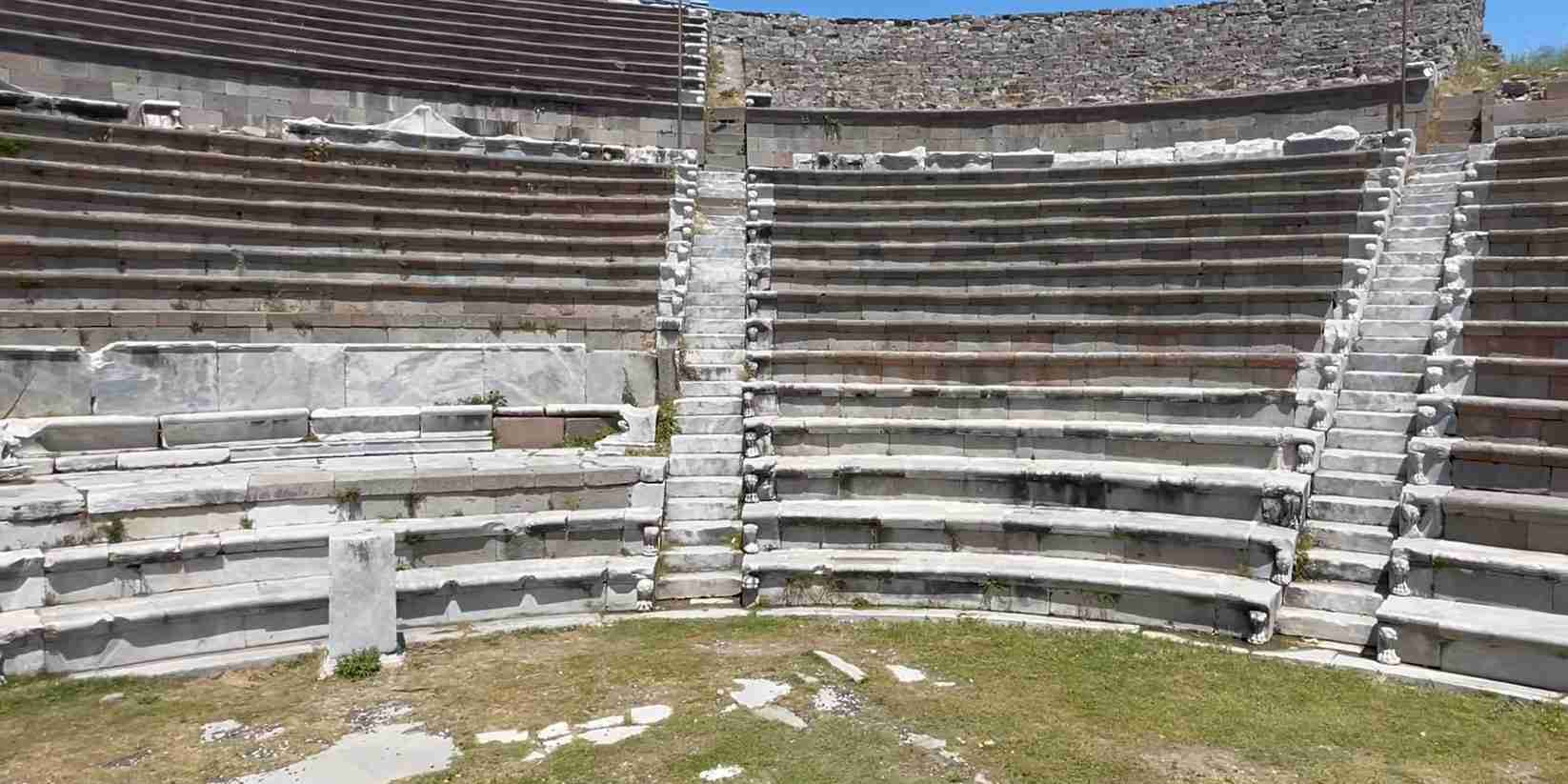
The Theater represents ancient world’s steepest performance space, with 78-row seating carved directly into mountainside accommodating 10,000 spectators at near-vertical incline creating vertiginous impression when climbing to upper tiers. Hellenistic construction (3rd century BCE) exploited natural topography rather than artificial supporting structures, with removable wooden stage buildings erected for performances then dismantled preserving unobstructed valley views visible from all seating positions. Modern safety concerns prevent climbing above lower seating sections during crowded periods, though early morning or late afternoon visits enable accessing upper rows providing perspective on extraordinary engineering and panoramic coastal vistas.
The Great Altar of Zeus foundations preserve outline of massive monument whose elaborate marble frieze depicting Gigantomachy (battle between Olympian gods and Giants) now resides in Berlin’s Pergamon Museum following 1878-1886 German excavations under Carl Humann. The altar measured 36×34 meters with 6-meter-high sculptural frieze representing Hellenistic artistic achievement rivaling Parthenon reliefs, though controversial removal to Germany creates ongoing source of Turkish resentment and international cultural property debates. The on-site foundations and information panels explain original appearance while acknowledging absent artworks, enabling visitors understanding broader geopolitical dimensions of archaeological heritage management.
The Asklepion healing sanctuary 3 kilometers west of town center operated as ancient world’s foremost medical treatment complex, dedicated to Asclepius (god of healing) and pioneering therapeutic techniques including dream interpretation, sacred spring baths, herbal remedies, theater performances for psychological treatment, and early surgical procedures. Entrance costs €13 with 90-minute minimum visits exploring Sacred Way processional approach, treatment complex buildings, underground tunnel where priests whispered healing instructions interpreted as divine voices, library demonstrating medical knowledge accumulation, and theater hosting therapeutic performances. The site’s significance extended across Roman Empire attracting emperors, philosophers, and wealthy patients seeking cures unavailable elsewhere, with physician Galen (129-216 CE) beginning career at Pergamon Asklepion before becoming Rome’s most influential medical authority whose writings dominated Western medicine through medieval period.
The Red Basilica (Kızıl Avlu) occupies Bergama town center as massive Roman temple complex later converted to Byzantine church, representing one of Asia Minor’s largest surviving Roman buildings. Constructed 2nd century CE dedicated to Egyptian gods Serapis and Isis, the brick structure measured 60 meters wide creating imposing profile still dominating modern streetscape. Byzantine conversion added Christian architectural elements visible in apsidal additions and interior modifications, while later Islamic period saw partial conversion to mosque creating religious architectural palimpsest. Entrance costs €3 with 30-45 minute visits examining foundations, wall sections, and reconstructed portions while noting contrasting construction periods and religious functions reflecting Bergama’s multi-millennial urban continuity.
Sample Izmir Day Trip Itineraries 2026
The Ephesus Classic itinerary suits first-time visitors prioritizing Turkey’s most famous archaeological site. Depart Izmir Basmane 07:00 train to Selçuk (arrive 08:30), immediate taxi/dolmuş to Ephesus Upper Gate (09:00), comprehensive site exploration including Terrace Houses (09:00-13:30), return Selçuk for late lunch (14:00-15:30), visit Basilica of St. John and Ephesus Museum (16:00-17:30), evening train to Izmir (18:30 departure, 20:00 arrival). Total cost per person: train 200 TRY (€4), dolmuş 80 TRY (€2), Ephesus €40, Terrace Houses €15, Basilica/Museum €6, lunch 250 TRY (€6), totaling €73 experiencing world-class UNESCO site with excellent preservation and comprehensive facilities.
The Ephesus-Şirince Combination maximizes regional diversity pairing Roman archaeology with Ottoman village culture. Depart Izmir 06:30 train to Selçuk (arrive 08:00), taxi Ephesus Upper Gate (08:30), archaeological site exploration skipping Terrace Houses for time efficiency (08:30-12:00), return Selçuk for dolmuş to Şirince (12:30 arrival), wine village lunch and tastings (13:00-15:00), architectural wandering and shopping (15:00-17:00), return Selçuk dolmuş (17:30), evening train Izmir (18:30-20:00). Total cost: train 200 TRY (€4), transport 280 TRY (€6), Ephesus €40, Şirince lunch/wine 600 TRY (€14), totaling €64 creating balanced cultural experience complementing antiquities with living traditions.
The Pergamon Comprehensive approach dedicates full day to UNESCO multi-site complex. Depart Izmir Otogar 08:00 bus to Bergama (arrive 09:30), taxi to Acropolis summit (10:00), thorough exploration including Lower City descent (10:00-13:00), taxi to Asklepion (13:30), healing sanctuary tour (13:30-15:00), walk to Red Basilica and town center (15:30), late lunch at local restaurant (16:00-17:00), Bergama Museum visit (17:30-18:30), return bus to Izmir (19:00 departure, 20:30 arrival). Total cost: bus 400 TRY (€9), taxis 300 TRY (€7), all-site entrances €34, lunch 300 TRY (€7), totaling €57 providing complete Pergamon experience impossible on abbreviated tours concentrating solely on Acropolis.
The Two-Day Archaeological Deep Dive suits serious heritage enthusiasts. Day one follows Ephesus-Şirince combination above with overnight Selçuk accommodation (budget hotel 800 TRY/€18), enabling early morning Ephesus photography session (07:00-09:00) before crowds and optimal light, plus evening Şirince atmosphere after day-tripper departures. Day two covers Pergamon comprehensive itinerary returning Izmir evening. Total two-day cost: trains/buses 600 TRY (€14), local transport 500 TRY (€11), accommodation 800 TRY (€18), entrance fees €89, meals 1,200 TRY (€27), totaling approximately €170 per person achieving thorough engagement with both UNESCO sites plus village culture without time pressure or exhaustion compromising experiences.
Practical Planning for Izmir Day Trips 2026
Weather considerations critically impact day trip enjoyment and safety given archaeological sites’ exposed conditions with minimal shade. Summer months (June-September) bring intense heat regularly exceeding 35-40°C creating exhausting walking conditions, dehydration risks, and sunburn dangers requiring 08:00 departures reaching sites by 09:00 before temperature peaks, extensive sun protection (SPF 50 sunscreen, wide-brim hats, long-sleeve UV-blocking shirts), and carrying 2-3 liters water per person for 3-4 hour visits. Spring (April-May) and autumn (September-October) provide optimal conditions with comfortable temperatures (20-28°C), reduced precipitation compared to winter months, spring wildflowers or autumn golden light enhancing photography, and 40-60% fewer visitors enabling relaxed exploration without constant crowd navigation.
Winter visits (November-March) offer solitude and significantly reduced accommodation costs (30-50% below summer rates) though cooler temperatures (10-18°C) require layered clothing, intermittent rainfall necessitates waterproof gear and flexible scheduling, and reduced daylight hours (sunset 17:00-17:30) compress afternoon activity windows. Some attractions maintain reduced hours November-March (closing 17:30 versus 19:00 summer) requiring earlier starts or abbreviated itineraries. The shoulder seasons of late April-May and September-early October strike optimal balance between weather comfort, crowd levels, and operating hours.
Packing essentials for archaeological day trips include comfortable walking shoes with good tread navigating uneven ancient pavements, marble surfaces, and hillside paths where loose stones and erosion create trip hazards particularly at Pergamon’s steep theater and Ephesus’s upper gate approaches. Daypack capacity for water bottles, snacks, sun protection, purchased souvenirs, and layers accommodating morning cool and afternoon heat proves essential. Camera or smartphone captures photography opportunities though backup batteries or portable chargers maintain power through full-day shooting. Small denomination Turkish Lira cash covers dolmuş fares, small purchases, and tipping where card payment unavailable, while major entrance fees accept both cash and credit cards.
Food and water availability varies by site. Ephesus provides limited cafeterias at entrance gates serving overpriced sandwiches, snacks, and drinks (200% markup over town prices), making packed lunches economical alternatives eaten at designated picnic areas with shaded seating. Selçuk offers numerous restaurants, cafés, and supermarkets where prepared meals, fresh bread, cheese, fruit, and bottled water cost 50-75% less than site concessions. Pergamon sites similarly feature entrance cafeterias plus Bergama town center restaurants where traditional Turkish meals cost 250-400 TRY (€6-9) per person. Şirince’s restaurant culture makes bringing food unnecessary given village specialization in local cuisine and atmospheric dining forming integral village experience components.
Organized Tours Versus Independent Travel 2026
Organized day tours from Izmir range €40-90 per person depending on itinerary comprehensiveness, group size, and included elements. Basic Ephesus tours (€40-50) provide hotel pickup, bus transport, English-speaking guide, site entrance, and return to Izmir within 6-7 hours total, concentrating on main Ephesus monuments while skipping Terrace Houses and secondary Selçuk attractions. Comprehensive packages (€70-90) add Terrace Houses, House of Virgin Mary, Basilica of St. John, Şirince village, and restaurant lunch, extending to 8-9 hours with multiple stops creating fuller but more rushed experiences.
Tour advantages include convenience of hotel pickup eliminating navigation challenges and transport coordination, expert guides explaining historical contexts and answering questions impossible from information panels alone, group discounts on entrance fees sometimes included in package pricing, and social interaction with fellow travelers sharing interests and experiences. Disadvantages involve rigid schedules limiting individual exploration time, obligatory shopping stops at carpet factories or leather workshops generating guide commissions, large group sizes (20-40 passengers) creating crowd management issues particularly at narrow pathways and prime photo locations, and inability to adjust timing based on personal interests or energy levels.
Independent travel costs €30-75 daily depending on site selection and meal choices, requiring more planning and navigation effort but enabling complete schedule control, selection of specific attractions matching interests while skipping less appealing elements, flexible pacing allowing lingering at favorite monuments or rapid movement through less interesting areas, and opportunities for spontaneous discoveries like unmarked ruins, local restaurants, or scenic viewpoints absent from tour itineraries. The approach suits comfortable travelers with basic map-reading abilities, reasonable Turkish language facility (or translation apps), and tolerance for occasional confusion navigating unfamiliar bus stations and payment systems.
Private tours represent premium option charging €150-300 for 1-4 passengers, providing personalized itineraries, flexible timing, direct hotel-to-site transport, and guide attention impossible in large groups. The costs become economical when 3-4 travelers split expenses, matching or beating group tour per-person rates while retaining all flexibility advantages. Families with children, elderly travelers requiring frequent rest stops, photography enthusiasts needing extended shooting time, or visitors with specific academic interests benefit particularly from private arrangements accommodating special requirements impossible in fixed-schedule group contexts.
Multi-Day Aegean Itineraries from Izmir Base 2026
Three-day Izmir regional exploration balances archaeological intensity with relaxation and diversity. Day one covers Ephesus-Şirince combination as described above, day two dedicates to Pergamon comprehensive itinerary, day three explores Çeşme peninsula beaches and resort atmosphere 90 kilometers west of Izmir accessible via intercity buses or rental cars. This pacing allows morning Ephesus arrival capturing optimal light and temperatures, full Pergamon engagement including all four sites rather than abbreviated single-monument focus, and recuperative beach relaxation following two intensive archaeological days. Three nights Izmir accommodation enables evening waterfront dining, nightlife exploration, and urban cultural activities (museums, Ottoman bazaars, historic neighborhoods) impossible when rushing between destinations.
Five-day Aegean circuit adds southern destinations accessible from Izmir-Selçuk corridor. Days 1-2 follow above Ephesus-Pergamon schedule, day three covers Priene-Miletus-Didyma ancient site triangle south of Selçuk (best accessed by rental car or organized tour), day four explores Bodrum peninsula with castle, underwater archaeology museum, and resort amenities, day five returns Izmir via coastal route stopping at scenic villages and beaches. This comprehensive approach samples Aegean Turkey’s archaeological wealth beyond primary UNESCO sites while incorporating coastal recreation, traditional culture, and geographic diversity creating balanced experiences beyond concentrated monument tourism.
Week-long explorations enable adding Pamukkale calcium terraces and Hierapolis ruins (3-hour journey from Izmir, accessible via train to Denizli or direct buses), Cappadocia multi-day excursion (8-hour bus journey or 1-hour flight from Izmir), or extended Aegean coast coverage including Assos, Ayvalık, and northern beaches approaching Çanakkale and Troy. The expanded timeframe permits slower pacing reducing archaeological fatigue, incorporates rest days preventing burnout from consecutive intensive site visits, and allows pursuing personal interests whether photography workshops, Turkish cooking classes, traditional craft demonstrations, or simply extended café sitting absorbing local atmosphere impossible when rushing through checklist itineraries.
Frequently Asked Questions About Izmir Day Trips 2026
How many days do you need in Izmir for day trips in 2026?
Minimum two nights in Izmir enables single full day trip to either Ephesus or Pergamon plus arrival/departure day activities exploring Izmir city attractions including Kemeraltı bazaar, Konak waterfront, Kadifekale castle, and Alsancak nightlife district. Three nights accommodate two full-day trips covering both primary UNESCO sites (Ephesus day one, Pergamon day two) with evenings returning to Izmir base for dining and relaxation. Four-five nights enable adding Şirince overnight stay, Çeşme beach excursion, or Priene-Miletus-Didyma southern circuit while maintaining comfortable pacing preventing archaeological exhaustion. Week-long stays incorporate Pamukkale extension or multi-day Cappadocia addition while preserving Izmir as Mediterranean resort base with evening seaside dining and urban amenities balancing intensive heritage tourism. Independent travelers moving between destinations may allocate only 1-2 Izmir nights using city purely as transportation hub before continuing to Selçuk, Bodrum, or other Aegean locations, though this approach sacrifices Turkey’s most cosmopolitan and liberal urban center offering cultural experiences distinct from tourism-dependent smaller towns.
Can you visit House of Virgin Mary from Izmir in 2026?
House of Virgin Mary (Meryemana) sits 9 kilometers from Ephesus on Bülbüldağı mountain, believed by Catholic tradition as Virgin Mary’s final residence where St. John brought her after Jesus’s crucifixion, achieving pilgrimage destination status following 19th century German nun’s visions describing location before archaeological confirmation of ancient dwelling foundations. The modest stone chapel and spring attract 1-2 million annual pilgrims and tourists, particularly August 15 Assumption Day when special services commemorate Mary’s ascent to heaven. Entrance costs €10 separate from Ephesus admission, with dolmuş services from Selçuk (150 TRY roundtrip) or taxis (400 TRY roundtrip including 30-minute waiting time) providing access along winding mountain roads requiring 25-minute drives. Most organized Ephesus tours from Izmir include Virgin Mary House as standard itinerary component, enabling single-day visits covering both attractions. Independent travelers can combine Virgin Mary House with morning Ephesus visit by taking early taxi to House (08:30 arrival before crowds), then continuing downhill to Ephesus Upper Gate (09:30), though this sequence requires negotiating taxi driver arrangements or accepting higher costs versus standard Selçuk-based transport options.
Is Ephesus crowded in 2026?
Ephesus experiences severe overcrowding May-October when cruise ships docking at Kuşadası port (30 kilometers southwest) discharge 5,000-10,000 passengers daily for 4-hour shore excursions, creating congested pathways particularly 10:00-14:00 at primary monuments including Library of Celsus, Great Theater, and Terrace Houses where 100+ person crowds simultaneously occupy spaces designed for 20-30 visitor capacity. Peak summer months (July-August) combine cruise passengers with independent tourists and domestic Turkish visitors creating maximum density approaching theme park levels compromising photographic opportunities, information panel readability, and quiet contemplation archaeologists and heritage enthusiasts seek from ancient sites. Strategic timing mitigates crowds substantially: arriving 08:00-08:30 at Upper Gate before cruise buses reach site enables 90-120 minutes relatively solitary exploration among major monuments before tour groups ascend from Lower Gate around 10:30, while late afternoon visits after 16:00 when cruise ships require passenger returns capture softening light and diminishing crowds though reduced time before 19:00 closing limits comprehensive exploration. November-March off-season delivers minimal visitors enabling entire days with only 50-100 total people across massive 2-kilometer site, though weather trade-offs and reduced service hours affect comfort and accessibility. Spring (April-May) and autumn (September-October) shoulder seasons balance moderate crowds (30-40% below summer peaks) with favorable weather and full operating hours creating optimal conditions for quality experiences.
What should you wear to Ephesus in 2026?
Ephesus requires comfortable walking shoes with good ankle support and non-slip soles navigating 2+ kilometers of uneven ancient marble pavements, stone stairs, and unpaved paths where polished surfaces become slippery particularly after rain and loose gravel creates trip hazards. Avoid sandals, flip-flops, or fashion footwear lacking tread and stability. Clothing should balance sun protection with heat management: light-colored loose-fitting long-sleeve shirts and full-length pants in breathable fabrics (cotton, linen, technical moisture-wicking materials) protect from intense UV exposure while allowing air circulation reducing heat stress. Wide-brim sun hats shade face and neck more effectively than baseball caps leaving ears and neck exposed to burning. Sunglasses with UV protection reduce glare from white marble surfaces creating eye strain without protection. Modest dress (shoulders and knees covered) shows respect at archaeological sites with religious significance though no formal dress codes exist unlike active mosques. Layering enables adapting to temperature changes between cool morning departures from Izmir, midday heat at archaeological sites, and potentially cooler evening returns. Summer visits necessitate sun protection as priority with lightweight long coverage, while spring/autumn require versatile layers accommodating 15-25°C temperature ranges, and winter demands warm jackets, rain gear, and potentially thermal underlayers for 10-15°C conditions.
Are there restaurants near Ephesus in 2026?
Ephesus archaeological site features small cafeterias at Upper and Lower Gates serving basic sandwiches, snacks, tea, coffee, and soft drinks at inflated tourist prices (100-200 TRY/€2-5 for items costing 50-100 TRY in Selçuk town), adequate for light refreshment but insufficient for substantial meals. Selçuk town center (3 kilometers from site, 10-minute dolmuş ride) provides numerous restaurants, cafés, and local eateries where traditional Turkish cuisine costs 250-500 TRY (€6-12) per person for complete meals including appetizers, mains, and desserts. Popular options include kebab restaurants near bus station, pide flatbread specialists, fish restaurants despite inland location serving daily Aegean catches, and international menus targeting tourist preferences. Traditional Turkish breakfast spreads (serpme kahvaltı) featuring cheese varieties, olives, tomatoes, cucumbers, honey, jams, eggs, and unlimited tea cost 200-350 TRY (€5-8) providing substantial morning energy for archaeological exploration. Many visitors pack picnic lunches from Selçuk supermarkets or hotels, eating at designated areas near Ephesus gates with shaded tables enabling budget savings and flexible timing versus restaurant service delays during peak lunch periods. The sophisticated Şirince village dining (20 minutes from Selçuk) offers superior atmosphere and local specialties worth incorporating into Ephesus day trip itineraries for travelers prioritizing culinary experiences alongside archaeological tourism.
Can you swim near Ephesus in 2026?
Kuşadası resort town 20 kilometers southwest of Selçuk offers multiple beaches enabling day trip combinations of morning Ephesus archaeology with afternoon Mediterranean swimming, though public transport connections require careful timing and extend total travel durations significantly. Ladies Beach (Kadınlar Plajı) provides free public access with restaurants, changing facilities, and water sports rentals along sandy shore popular with domestic tourists and locals. Long Beach (Uzun Plaj) extends several kilometers south with resort hotels, beach clubs charging entrance fees (100-300 TRY/€2-7) including sun loungers and umbrellas, and water clarity superior to crowded town beaches. Dolmuş minibuses connect Selçuk and Kuşadası every 20-30 minutes (150 TRY, 25-minute journey) enabling logistical feasibility, though full-day itineraries combining Ephesus morning visit (08:30-13:00), Kuşadası beach afternoon (14:00-18:00), and evening Izmir returns (20:00+) create exhausting 12-hour schedules with minimal relaxation time given constant transport coordination. Travelers prioritizing beach recreation should consider multi-day stays splitting Ephesus day and separate beach day, or visiting Çeşme peninsula west of Izmir offering superior beach quality and resort atmosphere within direct bus connections from Izmir avoiding Selçuk-Kuşadası complications. Pamucak Beach 8 kilometers west of Selçuk provides closer swimming alternative though limited facilities and strong currents create safety concerns versus developed Kuşadası and Çeşme resort beaches.
What is the best tour from Izmir to Ephesus in 2026?
Quality Ephesus tours from Izmir distinguish themselves through small group sizes (maximum 15 passengers versus 40+ budget operators), licensed English-speaking guides with archaeology or history degrees providing informed interpretation beyond memorized scripts, inclusive pricing covering all entrance fees and lunch eliminating hidden costs, and flexible itineraries accommodating Terrace Houses, Virgin Mary House, and Şirince additions based on group interests. Recommended operators include Ephesus Breeze, Best Ephesus Tours, and The Other Tour (all earning consistent 5-star TripAdvisor reviews through professional service and knowledgeable guides), charging €70-90 for comprehensive full-day experiences (08:00 hotel pickup, 18:00-19:00 returns) including transport, guide, Ephesus and Terrace Houses entrance, Virgin Mary House visit, traditional Turkish lunch, and Şirince wine village exploration. Budget alternatives (€40-50) skip premium elements like Terrace Houses and Şirince, accommodate larger groups reducing guide effectiveness, and include obligatory shopping stops at carpet factories where high-pressure sales tactics annoy many Western tourists though commission structures sustain low tour pricing. Private tours (€150-300 for 1-4 passengers) deliver maximum value for couples or small groups seeking personalized itineraries, flexible timing enabling photography opportunities or extended time at favorite locations, and direct hotel-to-site transport eliminating time wasted collecting multiple passengers from different hotels. Booking through reputable platforms (GetYourGuide, Viator, TripAdvisor Experiences) provides payment protection and verified reviews guiding selection, while direct bookings with established local operators sometimes deliver discounts eliminating platform commission percentages.
How far is Pamukkale from Izmir in 2026?
Pamukkale calcium travertine terraces and Hierapolis ancient ruins sit 240 kilometers east of Izmir near Denizli city, requiring 3-3.5 hours travel via intercity buses departing İzmir Otogar every 30-60 minutes (350-500 TRY/€8-12) or TCDD trains from Basmane Station (3 daily departures, 3 hours, 150-250 TRY/€3-6) continuing to Denizli. From Denizli, dolmuş minibuses connect to Pamukkale village (20 kilometers, 25 minutes, 50 TRY) depositing passengers near site entrance. Day trips from Izmir prove theoretically possible requiring 05:30-06:00 departures, abbreviated 3-4 hour Pamukkale visits (10:00-14:00), and 19:00-20:00 Izmir returns totaling 14-15 hours with minimal actual destination time, creating exhausting schedules most travelers reject in favor of overnight Pamukkale stays enabling sunset terrace photography, morning site visits before heat and crowds, and relaxed pacing appreciating one of Turkey’s most photographed natural wonders. Organized day tours from Izmir cost €80-120 including roundtrip bus transport, site entrance, guide, and lunch, though long driving hours (6-7 hours total) dominate itineraries leaving limited terraces and ruins exploration time. Travelers with restricted Izmir timeframes should prioritize nearby UNESCO sites Ephesus and Pergamon over distant Pamukkale better accessed from alternative bases including Selçuk (3-hour connection) or incorporated into multi-destination itineraries traversing Turkey’s interior regions.
Is Bergama worth visiting from Izmir in 2026?
Bergama (ancient Pergamon) merits visits from archaeology enthusiasts, UNESCO heritage completists, and travelers seeking alternatives to overcrowded Ephesus, offering dramatic hillside Acropolis with Temple of Trajan reconstruction and vertigo-inducing theater, fascinating Asklepion demonstrating ancient medical practices millennia before modern medicine, Red Basilica representing massive Roman temple-church conversion, and quality archaeological museum displaying artifacts absent from on-site ruins. The multi-site complexity and geographic dispersion (requiring taxis between locations) creates logistical challenges absent from compact Ephesus, while relatively modest on-site preservation compared to Ephesus’s spectacular Library of Celsus and theater creates less immediately impressive visual impact for casual tourists prioritizing Instagram-worthy photography over scholarly archaeological significance. However, Pergamon’s UNESCO designation acknowledges its pivotal role in Hellenistic civilization as major library center rivaling Alexandria, innovative medical advances through Asklepion treatments, and architectural achievements influencing Roman Imperial building programs. The dramatically steep theater setting and panoramic valley views from Acropolis summit reward the challenging cable car ride or winding road ascent, while significantly fewer visitors compared to Ephesus enable contemplative experiences impossible amid Ephesus’s summer cruise ship crowds. Budget 6-8 hours total from Izmir including transport, site visits, and meals, making Bergama feasible full-day excursion for travelers already visiting Ephesus during multi-day Izmir stays seeking archaeological diversity and deeper engagement with Aegean classical heritage beyond single-destination tourist concentration.