Corvin Castle Hunedoara Romania: Gothic Fortress Complete Visitor Guide
Rising from an industrial landscape in Hunedoara, Transylvania, Corvin Castle stands as one of Europe’s largest and most magnificently preserved Gothic-Renaissance fortresses. Built in the 15th century by military hero John Hunyadi and expanded by his son, King Matthias Corvinus of Hungary, this fairytale castle combines soaring Gothic towers, defensive innovations, and Renaissance elegance across over 7,000 square meters. Whether you’re drawn by its architectural mastery, its connections to Vlad the Impaler legends, or its role as a pivotal stronghold against Ottoman expansion, Corvin Castle delivers an immersive journey into medieval Transylvanian power and artistry.
Key Takeaways About Corvin Castle
- Architectural Masterpiece: Corvin Castle represents one of Europe’s finest examples of Gothic-Renaissance military architecture, featuring over 50 rooms, multiple defensive towers, a Knights’ Hall with soaring vaulted ceilings, and architectural innovations that were centuries ahead of their time in Transylvania.
- Hunyadi Dynasty Legacy: Built beginning in 1440 by John Hunyadi (Ioan de Hunedoara), Transylvania’s voivode and military commander who famously halted Ottoman expansion at Belgrade, the castle was transformed from fortress to royal residence by his son Matthias Corvinus, who reigned as King of Hungary from 1458 to 1490.
- Scale and Preservation: Spanning 7,000 square meters with 42 chambers, multiple courtyards, a chapel, and towers connected by a 30-meter suspended corridor, the castle underwent extensive 20th-century restoration that preserved its medieval character while making it safely accessible to modern visitors.
- Practical Visitor Information: The castle opens Tuesday through Sunday from 9 AM to 8 PM and Monday from noon to 8 PM, with adult admission at 50 RON ($11) and reduced rates for students and seniors. Check the official website for current rates as pricing may vary. Visitors explore independently without mandatory guided tours, allowing flexible pacing through the extensive interior.
- Gothic and Renaissance Elements: The fortress showcases the transition from Gothic military architecture (pointed arches, defensive towers, thick walls) to Renaissance elegance (decorative frescoes, geometric symmetry, sculptural details), reflecting the different construction phases under John Hunyadi and Matthias Corvinus.
- Vlad the Impaler Connection: Local legend claims Vlad III (Vlad the Impaler), the historical inspiration for Bram Stoker’s Dracula, was imprisoned in Corvin Castle’s dungeons by John Hunyadi, though historical evidence remains inconclusive, with some sources indicating his imprisonment occurred in Visegrád, Hungary instead.
People Also Ask About Corvin Castle
What makes Corvin Castle architecturally significant in Europe?
Corvin Castle ranks among Europe’s most architecturally significant medieval fortresses due to its unique blend of late Gothic and early Renaissance elements combined with military innovations rarely seen in 15th-century Transylvanian architecture. The castle features double-wall fortification systems, both rectangular and circular defensive towers, and the remarkable “Nje Boisia” tower connected to the main structure by a 30-meter elevated corridor supported by massive stone pillars. This suspended walkway allowed rapid troop movement while providing an additional defensive barrier. The castle’s architectural vocabulary includes soaring Gothic pointed arches, ribbed vaulting in the Knights’ Hall, geometric Renaissance window designs introduced during Matthias Corvinus’s expansion, and decorative sculptural elements inspired by Italian artisans. The Buzdugan Tower showcases geometric exterior motifs while serving purely defensive functions with multiple firing positions. The seamless integration of these diverse architectural styles within a single fortress demonstrates the evolution of European castle design during the transition from medieval to Renaissance periods, making Corvin Castle a living textbook of 15th and 16th-century fortification and palatial architecture.
Who was John Hunyadi and why did he build Corvin Castle?
John Hunyadi (Ioan de Hunedoara in Romanian, Hunyadi János in Hungarian) served as Voivode of Transylvania and Regent-Governor of the Kingdom of Hungary, earning legendary status for his military campaigns against Ottoman expansion in the mid-15th century. Born around 1406-1407, Hunyadi received the Hunedoara estate from King Sigismund of Hungary in 1409 after his father’s loyal service. When Hunyadi began construction on Corvin Castle in 1440, he transformed an existing 11th-century royal fortification that had fallen into disrepair into a powerful stronghold that would serve both military and administrative functions. His most famous victory occurred in 1456 at the Siege of Belgrade, where his forces successfully defended the city against Mehmed II’s Ottoman army, effectively halting Ottoman expansion into Central Europe for decades. This military success established the Hunyadi family’s prominence and provided resources for the castle’s continued expansion. Hunyadi used Corvin Castle as his primary residence and administrative center, gradually transforming it from a purely defensive structure into a luxurious home befitting his status. The fortress’s location in Hunedoara offered strategic control over important Transylvanian routes while the region’s iron ore deposits supported weapons manufacturing. Hunyadi died in 1456 during a plague outbreak following the Belgrade victory, but his legacy continued through his son Matthias Corvinus, who would become one of Hungary’s greatest medieval kings.
How long does it take to visit Corvin Castle and what can you see inside?
A thorough visit to Corvin Castle requires 2-3 hours to properly explore the castle’s extensive interior spaces, multiple levels, courtyards, and towers, though visitors with limited time can complete a basic walkthrough in 90 minutes. Upon crossing the iconic wooden drawbridge spanning the deep moat, visitors enter through the gatehouse into the main courtyard, where the castle’s full architectural splendor becomes apparent. The self-guided route leads through the Knights’ Hall (Sala Cavalerilor), the castle’s most impressive interior space featuring soaring Gothic vaulted ceilings, medieval weapons displays, and period furniture. The Diet Hall served as the castle’s council chamber where important administrative decisions were made. The castle chapel preserves Gothic architectural elements and provides insight into the religious life of medieval nobility. Visitors can explore the Capistrano Tower, Drummers’ Tower, and Deserted Tower, which served as prisons during different periods, with exhibitions showing medieval detention conditions. The Buzdugan Tower, built solely for defensive purposes, offers views of the castle’s fortification system. The Matthias Wing showcases Renaissance additions including the Golden Room (likely King Matthias’s bedchamber) and the Ladies’ Chamber, where archaeological finds including bronze jewelry and sewing needles illustrate daily domestic life. Multiple staircases—some quite steep and narrow—connect the various levels, requiring reasonable mobility. The castle’s over 50 rooms contain period furniture, medieval armor collections, weapons displays, and interpretive information in Romanian, Hungarian, and English. Photography is permitted throughout the castle for a small additional fee.
What is the legend of the Corvinus raven and how does it relate to the castle’s name?
The Corvinus family coat of arms features a raven (corvus in Latin) holding a golden ring in its beak, and this symbol appears throughout Corvin Castle carved in stone above gateways and painted in various halls. According to legend, John Hunyadi was the illegitimate son of King Sigismund of Luxembourg and a beautiful noblewoman named Elisabeta from the Hațeg region. To protect the child and his mother while providing proof of royal lineage, King Sigismund gave them a golden ring as a token of recognition. During a childhood picnic, a raven swooped down and stole the golden ring from young John. Rather than crying over the loss, the boy grabbed a bow and shot the bird down with remarkable precision, retrieving the ring from the fallen raven. Impressed by both the child’s skill and the raven’s boldness, King Sigismund decreed that the raven holding the ring would become the family symbol. When John’s son Matthias became King of Hungary, he adopted the Latinized surname “Corvinus” (from corvus, meaning raven), and the family thereafter became known as the Corvinus dynasty. This heraldic symbol distinguished the family throughout Europe and gave the castle its enduring name. Visitors can see the raven emblem carved in stone at multiple locations throughout the fortress, serving as a constant reminder of the family’s legendary royal bloodline and the skill that supposedly characterized its founder. Whether historically accurate or apocryphal, the legend became inseparable from the castle’s identity and contributed to the mystique surrounding one of Hungary’s most powerful medieval dynasties.
Extended multi-day tours – 5+ days
Featured Transylvania Multi-Day Tour Packages
8 days
Classic Romania Tour (small group)
- ✓ Comprehensive Transylvania tour
- ✓ Expert local guides included
- ✓ All accommodation arranged
- ✓ Transportation provided
4 days
4-Day Transylvania Small Group Tour: Corvin Castle, Dracula's Castle & Transfagarasan
- ✓ Comprehensive Transylvania tour
- ✓ Expert local guides included
- ✓ All accommodation arranged
- ✓ Transportation provided

5 days
Transylvanian Long Weekend
- ✓ Comprehensive Transylvania tour
- ✓ Expert local guides included
- ✓ All accommodation arranged
- ✓ Transportation provided
8 days
Hiking in South Transylvania
- ✓ Comprehensive Transylvania tour
- ✓ Expert local guides included
- ✓ All accommodation arranged
- ✓ Transportation provided
Multi-day tour packages powered by TourRadar. Prices and availability subject to change.
Introduction to Corvin Castle: Transylvania’s Gothic Masterpiece
Corvin Castle stands as an architectural anomaly—a fairytale fortress rising from the industrial cityscape of Hunedoara in western Transylvania. While Romania’s castles typically claim mountain perches or forested hillsides, Corvin emerges from an urban setting dominated by steel mills and Soviet-era apartment blocks, yet its medieval grandeur remains utterly undiminished. The moment visitors cross the wooden drawbridge spanning the Zlaști River moat, they leave the 21st century behind and enter one of Europe’s most authentically preserved Gothic-Renaissance strongholds.
The castle’s impressive scale becomes immediately apparent. Seven thousand square meters of fortifications, residential wings, towers, and courtyards sprawl across a rocky outcrop above the river. Unlike many European castles reduced to romantic ruins or over-restored to theme-park artificiality, Corvin maintains a careful balance—extensively renovated to ensure structural safety and visitor access while preserving the medieval character of its original construction phases. The towers rise to imposing heights, their stone walls thick enough to withstand artillery bombardment, their narrow windows designed for archers and firearms rather than aesthetic pleasure. Yet among these military features, Renaissance elegance emerges: geometric decorative motifs on the Buzdugan Tower, vaulted ceilings in the Knights’ Hall that showcase masterful Gothic stonework, and frescoed chambers that reflect the Italian artistic influences King Matthias Corvinus brought to his Transylvanian stronghold.
The castle’s history intertwines with some of medieval Europe’s most pivotal events. Built by John Hunyadi, the military commander who halted Ottoman expansion at the Siege of Belgrade in 1456, Corvin Castle represented both defensive necessity and dynastic ambition. When Hunyadi’s son Matthias Corvinus ascended to Hungary’s throne, he transformed his father’s fortress into a Renaissance palace befitting a king whose court rivaled those of Western Europe in cultural sophistication. The castle witnessed over four centuries of continuous habitation and modification, changing hands among Hungarian noble families, serving as administrative center and prison, surviving sieges and fires, and ultimately requiring massive 20th-century restoration after lightning struck in 1854 and destroyed most wooden elements.
Today, Corvin Castle functions as a museum welcoming hundreds of thousands of visitors annually. Its reputation has grown significantly in recent decades, drawing tourists from across Europe and beyond. The castle’s distinctive silhouette—all pointed turrets, stone bridges, and Gothic spires—has become iconic in travel photography. It has served as a filming location for various productions and earned recognition as one of Romania’s “Seven Wonders.” Despite its fame, Corvin Castle maintains an authentic medieval atmosphere that distinguishes it from more commercialized European castle attractions. There are no costumed performers or jousting shows, no gift shops filling every corner. Instead, visitors encounter stone-and-mortar reality: steep staircases worn smooth by centuries of footsteps, dungeons that actually served as prisons, a chapel where nobles once worshipped, and halls where medieval administrative decisions shaped Transylvanian history.
This guide provides comprehensive information for planning your visit to Corvin Castle. Whether you’re an architecture enthusiast drawn to Gothic vaulting and Renaissance proportions, a history buff interested in the Hunyadi dynasty’s role in European politics, or simply a traveler seeking Romania’s most spectacular castle experience, you’ll find detailed information on the castle’s history, architectural features, visitor practicalities, and connections to broader Transylvanian heritage. The castle rewards both quick visits and extended exploration, and understanding its historical context and architectural significance enhances appreciation of what you’re seeing within these medieval walls.
Historical Background: The Hunyadi Dynasty and Ottoman Resistance
Corvin Castle’s history begins not with John Hunyadi but with much earlier fortifications on the same rocky outcrop above the Zlaști River. Archaeological evidence indicates Roman presence in the Hunedoara area, likely a castra (military camp) that controlled local iron ore resources and strategic routes through Transylvania. By the 11th century, a royal Hungarian fortification occupied the site, though by the early 15th century this structure had fallen into destitution.
The castle’s transformation began in 1409 when King Sigismund of Hungary granted the Hunedoara estate to Voyk Hunyadi, a court knight who had participated in the 1395 invasion of Wallachia. After Voyk’s death, the property passed to his eldest son John Hunyadi (born circa 1406-1407), who would become one of medieval Europe’s most celebrated military commanders. By 1440, John Hunyadi had risen to serve as Voivode of Transylvania, effectively the region’s military governor and one of the most powerful nobles in the Kingdom of Hungary.
Recognizing that the old fortification inadequately served either defensive or residential needs, John Hunyadi ordered construction of an entirely new castle beginning around 1440-1446. The initial construction phase created a Gothic fortress with thick stone walls, defensive towers, and a deep moat fed by the Zlaști River. The fortress’s primary functions were military—a stronghold controlling the surrounding region and a prison for captured enemies. Turkish prisoners performed much of the backbreaking construction work, and legend holds that three Turkish prisoners who dug the castle well were condemned to death despite promises of freedom upon completion, leading them to curse the well.
John Hunyadi’s military career reached its zenith in 1456 at the Siege of Belgrade. When Mehmed II, the Ottoman sultan who had conquered Constantinople three years earlier, laid siege to Belgrade with an army estimated at 60,000-100,000 troops, Hunyadi commanded the Christian defense. Through brilliant military tactics and fierce determination, Hunyadi’s forces lifted the siege, killing approximately 24,000 Ottoman soldiers and forcing Mehmed II to withdraw. This victory effectively halted Ottoman expansion into Central Europe for decades and established John Hunyadi as Christendom’s defender. Pope Callixtus III ordered church bells rung at noon across Europe to commemorate the victory, a tradition that continues in many European churches today.
Tragically, Hunyadi died just weeks after his greatest victory, succumbing to plague during the epidemic that swept through both armies after the siege. His death in August 1456 halted Corvin Castle’s construction. Political intrigue followed—his eldest son Ladislaus was executed in 1457 after accusations of treason, while his younger son Matthias was imprisoned. However, through a combination of military success, political maneuvering, and popular support, Matthias gained his freedom and was elected King of Hungary in January 1458 at just 14 years of age, making him one of Europe’s youngest monarchs.
Matthias Corvinus (the Latinized surname adopted from the family’s raven crest) ruled Hungary from 1458 until his death in 1490, becoming known as Matthias the Just for his legal reforms and as one of the Renaissance’s great patrons. Under Matthias, Corvin Castle underwent its most significant expansion from 1458 to 1480. The young king transformed his father’s fortress into a luxurious royal residence befitting his status. Renaissance architectural elements softened the severe Gothic military features: geometric window designs, decorative sculptures with floral motifs and natural inspirations, symmetrical proportions in new halls, and frescoes showing noble life rather than religious themes. Matthias brought Italian artisans to Hunedoara, reflecting his appreciation for Renaissance art that he also expressed in his legendary library, the Bibliotheca Corviniana, one of Europe’s finest Renaissance book collections.
The Knights’ Hall and Diet Hall were expanded and beautified to serve both ceremonial and administrative functions. The Matthias Wing added luxurious residential chambers including what historians believe was the king’s own bedchamber, decorated with such opulence that it became known as the Golden Room (though the original gold leaf has long since disappeared). The Ladies’ Chamber provided quarters for noblewomen, and archaeological excavations there have uncovered bronze jewelry, sewing needles, and other artifacts illuminating daily domestic life alongside the castle’s military purpose.
After Matthias Corvinus died in 1490, the castle passed to his illegitimate son John Corvinus, who held it until his death in 1504 without male heirs. This marked the end of the Hunyadi-Corvinus dynasty’s direct ownership. The castle subsequently changed hands among various Hungarian noble families over the following centuries. Gabriel Bethlen, Prince of Transylvania, controlled the castle during two periods in the early 17th century (1605 and 1613-1629) and commissioned significant modifications including alterations to the Council Hall and chapel.
The castle’s condition deteriorated over subsequent centuries. On April 13, 1854, disaster struck when lightning ignited a fire that destroyed most of the castle’s wooden elements—roofs, beams, staircases, ceilings, and doors. Only the 500-year-old dungeon door survived. For a decade the castle stood abandoned and exposed to the elements. Beginning in 1864, a 40-year restoration process commenced, eventually extending into multiple 20th-century restoration campaigns. These restorations have been controversial among purists—each successive restoration team applied contemporary aesthetic preferences and historical interpretations, meaning the castle as seen today represents multiple restoration philosophies layered upon medieval foundations. Nevertheless, these efforts preserved Corvin Castle when many comparable European fortresses were lost to neglect or war damage.
Architectural Features: Gothic Foundations and Renaissance Flourishes
Corvin Castle’s architectural significance derives from its synthesis of late medieval Gothic military engineering with early Renaissance palatial elegance. The castle serves as a physical timeline of 15th and 16th-century architectural evolution, with each construction phase adding layers that modern visitors can distinguish.
The castle’s footprint covers over 7,000 square meters across an irregular plan that adapted to the rocky terrain. The structure contains 42 chambers ranging from grand ceremonial halls to small defensive positions, connected by staircases, corridors, and the distinctive elevated walkway linking the main castle to the Nje Boisia tower. Multiple courtyards provide both defensive depth and functional space for daily castle activities. The outer walls follow double-wall construction principles, creating a defensive barrier that could withstand prolonged siege. These thick stone walls, in some locations exceeding two meters thick, were built to resist both scaling attempts and the impact weapons of the period.
Defensive Towers and Military Architecture
The castle’s defensive system centers on multiple towers, each serving specific military functions while contributing to the fortress’s imposing silhouette. The tower system represents sophisticated 15th-century military engineering adapted to Transylvanian defensive needs.
The Nje Boisia Tower stands as the castle’s most distinctive defensive structure. Its name, roughly translated from Serbian as “Don’t Be Afraid,” came from Serbian mercenaries who formed part of the castle garrison. This five-level tower was constructed exclusively for military purposes, with numerous firing openings positioned at various heights and angles allowing defenders to repel attackers from multiple vantage points. The tower’s most remarkable feature is its connection to the main castle body through a 30-meter elevated corridor supported by massive stone pillars. This suspended walkway served both defensive and practical purposes: it allowed rapid troop movement without exposing soldiers to ground-level attacks, created an additional barrier attackers would need to breach, and provided commanding positions from which defenders could rain arrows or fire upon anyone attempting to assault the tower. The engineering achievement represented by this corridor, built in an era without modern construction equipment, demonstrates the sophisticated architectural capabilities John Hunyadi commanded.
The Capistrano Tower, named after Giovanni da Capistrano, a Franciscan friar who fought alongside John Hunyadi at the Siege of Belgrade, served dual military and detention purposes. Like several towers at Corvin Castle, it functioned as a prison, housing both war prisoners and common criminals in its lower levels. The tower’s thick walls and minimal exterior openings prevented escape while the height made rescue attempts virtually impossible. Medieval graffiti scratched into the tower’s stone walls by long-ago prisoners provides haunting testimony to the harsh conditions of 15th-century incarceration.
The Drummers’ Tower and Deserted Tower also served primarily as prisons during different periods of the castle’s occupation. The Deserted Tower earned its ominous name from the isolation imposed on its prisoners. These towers demonstrate the castle’s role not merely as a noble residence but as an instrument of authority requiring secure detention facilities. Medieval justice often meant imprisonment preceding execution, ransom, or political negotiation, and a great fortress required accommodation for prisoners of various statuses.
The Buzdugan Tower, named after a type of mace (buzdugan), represents purely defensive architecture. Its exterior features geometric decorative motifs—an unusual combination of military function and aesthetic consideration. The tower’s design included large rectangular openings specifically sized to accommodate larger weapons including early firearms, reflecting the evolving nature of siege warfare during the 15th century as gunpowder weapons began supplementing traditional bows and crossbows. The geometric decorations demonstrate that even in purely military structures, Renaissance aesthetic principles were beginning to influence Transylvanian architecture.
The Knights’ Hall: Gothic Grandeur
The Knights’ Hall (Sala Cavalerilor) represents Corvin Castle’s most impressive interior space and finest example of Gothic architectural achievement. This vast ceremonial chamber features soaring vaulted ceilings supported by columns with elaborately carved capitals. The Gothic ribbed vaulting creates a sense of vertical space that emphasizes both height and lightness despite the massive stone construction. The hall served as the castle’s primary reception space where John Hunyadi and later Matthias Corvinus received important guests, held court, and conducted diplomatic negotiations.
The hall’s scale impressed visitors with the Hunyadi family’s power and wealth. During John Hunyadi’s era, the hall would have been furnished with tables for feasting, displayed weapons and armor symbolizing military prowess, and decorated with banners and heraldic symbols. Medieval halls served multiple purposes—they were not merely ceremonial spaces but the castle’s social and administrative center where daily business was conducted. Today, the Knights’ Hall contains displays of medieval weapons, armor, and period furniture that help visitors envision the space in active use. The hall’s acoustic properties, a side effect of the vaulted ceiling design, would have amplified music and speeches, enhancing the dramatic effect of ceremonial occasions.
The Diet Hall and Council Room
The Diet Hall served as the castle’s administrative center where Transylvania’s political elite gathered for councils and decision-making. During John Hunyadi’s tenure as Voivode, this hall witnessed discussions of military strategy, resource allocation, and governance decisions affecting all of Transylvania. When Matthias Corvinus became king, the hall’s importance grew as Corvin Castle served as an important royal residence and administrative center for royal business in Transylvania.
Architecturally, the Diet Hall showcases the transition from Gothic to Renaissance design principles. While earlier construction featured the pointed arches and vertical emphasis typical of Gothic architecture, later modifications introduced Renaissance elements including symmetrical column arrangements, geometric proportions in arch design, and decorative elements inspired by classical antiquity. The 17th-century modifications commissioned by Gabriel Bethlen further altered the hall’s appearance, adding baroque touches to the Gothic-Renaissance foundation.
The Chapel: Sacred Space
The castle chapel preserves Gothic architectural elements in a relatively intact form. Medieval castles required consecrated space for daily religious observance—nobility attended Mass regularly, and the castle’s chaplain would have conducted services for the household. The chapel’s Gothic vaulting, narrow windows designed to admit limited but dramatic light, and stone altar area reflect 15th-century religious architecture principles. The chapel served not merely as religious space but as a venue for important ceremonies including weddings, baptisms, and memorial services for deceased family members.
The chapel’s preservation allows modern visitors to experience the atmospheric quality of medieval sacred space. Unlike many castle chapels later converted to secular uses or heavily redecorated in baroque styles, Corvin’s chapel maintains much of its original Gothic character. The stone construction, austere decoration, and architectural focus on vertical lines drawing the eye upward reflect Gothic religious sensibility that emphasized transcendence and spiritual elevation.
The Matthias Wing: Renaissance Transformation
The Matthias Wing represents the most obvious Renaissance addition to Corvin Castle. Built during King Matthias Corvinus’s reign, this section introduced architectural elements that sharply contrasted with the fortress’s Gothic military severity. The wing features an open loggia with frescoes unique in Transylvania, depicting secular scenes from noble life rather than religious themes. These frescoes reflected Renaissance humanist philosophy that celebrated earthly life and human achievement alongside traditional religious subjects.
The upper floor of the Matthias Wing contains the Golden Room, believed to be King Matthias’s personal bedchamber. While the original gold leaf decoration that gave the room its name has vanished over the centuries, the chamber’s commanding position offers spectacular views across the valley. The room’s windows, larger and more regularly shaped than those in the Gothic sections, allowed more natural light—a Renaissance preference for brightness contrasting with Gothic architecture’s controlled illumination. The Golden Room’s decoration would have proclaimed the king’s wealth and taste, incorporating the finest textiles, furniture, and artistic works available in 15th-century Europe.
Adjacent to the royal quarters, the Ladies’ Chamber provided residential space for noblewomen of the court. Archaeological investigations in this chamber have yielded bronze jewelry, sewing needles, spindle whorls, and other artifacts associated with women’s work and adornment. These finds illuminate the domestic dimension of castle life that existed alongside military and political functions. Noble women managed household affairs, supervised servants, raised children, and engaged in textile work, all within spaces like the Ladies’ Chamber.
Bridge and Moat: Iconic Entry
Corvin Castle’s most photographed feature is its wooden drawbridge spanning the deep moat above the Zlaști River. The bridge, supported by four massive stone pillars rising from the riverbed, provides the only pedestrian access to the castle gatehouse. The bridge’s dramatic appearance—a wooden walkway suspended above a considerable drop with the castle’s towers and buttresses rising beyond—has made it iconic in castle photography.
The moat served critical defensive purposes. By creating a water barrier around the castle’s perimeter, it prevented easy approach, undermined siege engines attempting to get close to the walls, and provided early warning as attackers would be exposed while crossing. The depth of Corvin Castle’s moat (the river flows far below the bridge level) made scaling or filling it exceptionally difficult. Medieval siege warfare often centered on breaching or undermining walls, and the moat made such efforts nearly impossible without first draining or crossing the water obstacle.
The drawbridge mechanism, while modernized for contemporary safety standards, represents medieval engineering principles. Authentic drawbridges could be raised using chains and counterweights, sealing the gatehouse and leaving attackers no means of entry. While today’s bridge remains fixed for visitor access, the defensive gatehouse beyond still shows the slots where a portcullis (heavy iron grate) would drop to seal the entrance, and murder holes in the ceiling through which defenders could pour boiling oil or shoot arrows down upon anyone who breached the outer gate.
Interior Spaces: Exploring Room by Room
Visitors to Corvin Castle explore the fortress independently without mandatory guided tours, allowing flexible pacing and extended time in areas of particular interest. The castle route winds through multiple floors connected by steep stone staircases, some narrow and worn smooth by centuries of footsteps. Those with mobility challenges should be aware that the castle’s medieval construction includes many steps, uneven surfaces, and low doorways.
Ground Level and Main Courtyard
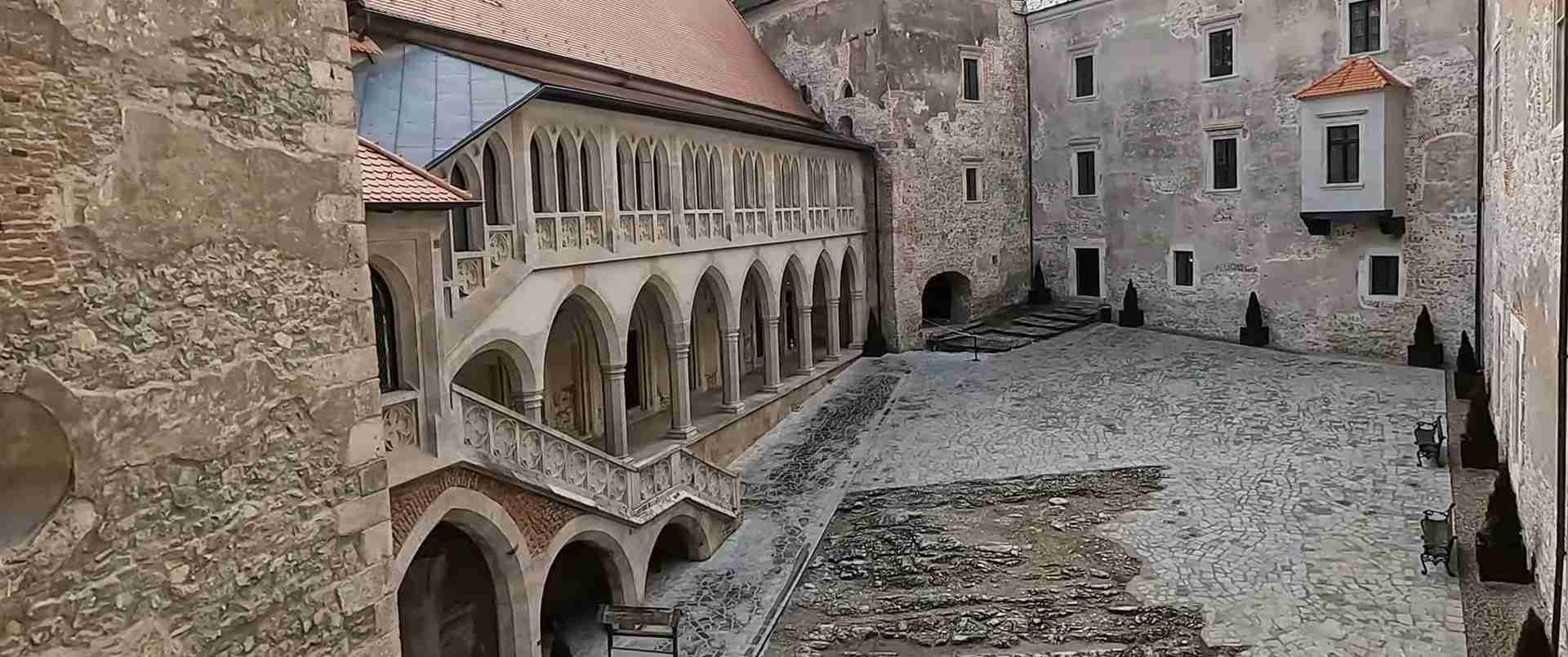
After crossing the drawbridge and passing through the gatehouse, visitors emerge into the main courtyard, where the castle’s full architectural complexity becomes visible. The courtyard reveals the multiple construction phases layered across centuries: Gothic towers rising to impressive heights, Renaissance windows with geometric symmetry, baroque modifications adding decorative flourishes, and 19th and 20th-century restoration work. The courtyard space served practical daily functions in the castle’s active period—military drills and exercises, marketplace activities, craftsmen’s workshops, stables for horses, and gathering space for the castle’s large household of nobles, soldiers, servants, and administrators.
From the courtyard, various doorways lead into the castle’s interior. Interpretive signs in Romanian, Hungarian, and English guide visitors through the recommended route, though the layout allows for exploration in different sequences. The ground floor contains several exhibition rooms displaying medieval weapons, armor, and military equipment. These collections include swords, maces, polearms, crossbows, and armor pieces representing different periods and origins. Some artifacts date from the castle’s active military period, while others have been acquired from various sources to illustrate medieval warfare more generally.
The Dungeons and Prison Towers
Several of Corvin Castle’s towers served as prisons during its centuries as an active fortress. The dungeons beneath the Knights’ Hall and within the Capistrano Tower, Drummers’ Tower, and Deserted Tower offer sobering glimpses into medieval detention conditions. Stone cells with minimal light, no heating, and basic sanitation facilities held both prisoners of war and common criminals. The castle’s role as an administrative center required secure detention facilities, and these towers provided isolation and security.
The prison exhibitions include period shackles, chains, and interpretive displays explaining medieval justice systems. Graffiti scratched into stone walls by past prisoners provides authentic historical evidence—desperate markings counting days, prayers to saints, or simple expressions of misery and hope. The legend of the three Turkish prisoners who dug the castle well and were then executed despite promises of freedom adds a tragic dimension to understanding these spaces.
The dungeons’ atmospheric quality—dim lighting, cold stone, claustrophobic spaces—creates an emotional impact distinct from the castle’s grander halls. Visitors often find these spaces most memorable precisely because they contrast so sharply with the Knights’ Hall’s soaring ceilings and the Golden Room’s luxury. The dungeons remind us that medieval castles were instruments of power exercised through both magnificence and coercion.
Upper Levels and Residential Quarters
Steep stone staircases lead to the castle’s upper levels where residential and administrative chambers occupied prime positions with better light, air circulation, and views. These chambers contain period furniture including beds, tables, chairs, and storage chests that help visitors envision daily life in a functioning castle. Medieval furniture was substantially different from modern expectations—heavier, less comfortable by contemporary standards, often serving multiple functions. Chests provided both storage and seating. Beds were smaller than modern ones (people slept in more upright positions) and featured heavy curtains for warmth and privacy.
The Ladies’ Chamber and adjacent rooms show the domestic side of castle life. Noble women’s lives, though constrained by medieval gender expectations, included significant responsibilities: household management, supervising servants and food preparation, raising and educating children, textile production (spinning, weaving, embroidery), and participating in the castle’s social and religious life. The archaeological finds from the Ladies’ Chamber—jewelry, needles, spindle whorls—provide tangible connections to women whose names rarely appear in historical chronicles.
The residential quarters also contained private chapels, studies for reading and correspondence (increasingly important as literacy spread among nobility during the Renaissance), and chambers for receiving personal visitors. These spaces reveal the castle as a living environment, not merely a military installation. Hundreds of people—noble family members, knights and soldiers, clergymen, administrators, craftsmen, servants—lived within Corvin Castle during its active periods, creating a complex social world within the fortification walls.
The Keep and Final Defensive Position
The keep represents the castle’s final defensive position—the last stronghold where defenders would retreat if outer walls were breached. This tower remained virtually unchanged from John Hunyadi’s original construction, preserving authentic 15th-century military architecture. The keep’s design prioritized defense over comfort: thick walls, minimal windows, secure access from higher levels, and stockpiled supplies allowing defenders to hold out during extended siege. The keep’s existence reflects the reality that medieval castles sometimes fell after prolonged siege, and the final defensive position had to be prepared to function as a fortress-within-the-fortress.
The Vlad the Impaler Connection: Legend and History
Corvin Castle’s association with Vlad III, known as Vlad the Impaler or Vlad Dracula, represents one of its most frequently mentioned attractions, though the historical evidence for this connection remains ambiguous and contested. The popular narrative claims that John Hunyadi imprisoned Vlad at Corvin Castle, though historical records provide conflicting information about Vlad’s actual whereabouts during the relevant periods.
Historical Context of Vlad’s Captivity
Vlad III ruled Wallachia (a Romanian principality south of Transylvania) during turbulent periods in the mid-15th century, caught between Ottoman pressure from the south and Hungarian interests from the north and west. His father, Vlad II Dracul, had been inducted into the Order of the Dragon (Dracul meaning “dragon” in Romanian), and Vlad III inherited the epithet, becoming Dracula (“son of the dragon”). His reputation for extreme brutality, particularly his preferred execution method of impalement, earned him the additional name Vlad Țepeș (the Impaler).
The connection to John Hunyadi and Corvin Castle allegedly dates to 1462. Some historical accounts suggest that Vlad, after conducting raids into Transylvania against Ottoman-supporting merchants, was captured by John Hunyadi and briefly detained at Corvin Castle before being transferred to King Matthias Corvinus. Matthias imprisoned Vlad for approximately 12 years, though most sources place this imprisonment in Visegrád, Hungary, not at Corvin Castle.
The confusion arises from incomplete medieval records and later romanticization of Vlad’s story following Bram Stoker’s 1897 novel “Dracula.” Stoker loosely based his vampire Count Dracula on the historical Vlad III, incorporating elements of Transylvanian Gothic atmosphere. This literary connection later fed back into Romanian tourism, with various sites claiming Vlad associations whether historically substantiated or not.
Evaluating the Evidence
Historical evidence for Vlad’s imprisonment at Corvin Castle remains weak. No contemporary documents definitively place him in Hunedoara. The more reliable historical record indicates his lengthy imprisonment occurred at Visegrád under King Matthias’s direct custody. However, it’s plausible that Vlad might have been briefly held at Corvin Castle during transfer from Wallachia to Visegrád, or during periods when Matthias Corvinus resided at the castle while conducting Transylvanian administrative business.
The castle’s dungeon exhibitions discuss the Vlad connection while noting its ambiguous status. The association has become part of Corvin Castle’s tourist appeal, particularly for visitors interested in the Dracula mythos. Whether or not Vlad actually occupied the dungeons, the castle’s atmospheric quality—shadowy passages, forbidding towers, cold stone chambers—certainly fits the Gothic horror aesthetic that Stoker’s novel popularized.
Corvin Castle in Popular Culture
The Vlad association contributed to Corvin Castle’s appearances in various films, television series, and video games. The “Underworld” film series, which centers on vampires and werewolves, borrowed the Corvin name for its fictional vampire lineage. The castle appeared in the BBC’s “Most Haunted Live!” series, emphasizing its Gothic and potentially supernatural associations. Video games including “Age of Empires II” featured the castle, and it served as inspiration for the film “Dragonheart: Battle of the Heartfire.”
These popular culture connections, while historically tangential, have raised Corvin Castle’s international profile. The castle satisfies what audiences expect from a Transylvanian Gothic fortress: imposing stone walls, dark dungeons, medieval weaponry, and an atmosphere that easily accommodates supernatural narratives. Whether these associations enhance or detract from appreciation of the castle’s genuine historical significance depends on individual perspective, but they undeniably contribute to the castle’s fame and visitor numbers.
Practical Visitor Information: Planning Your Visit
Location and Access
Corvin Castle is located at Curtea Corvineștilor 1-3 in Hunedoara, a city in western Transylvania. Hunedoara itself is primarily an industrial city that developed around iron and steel production, with the castle representing its major tourist attraction. The castle stands approximately 12 miles south of Deva, 50 miles west of Alba Iulia, 80 miles west of Sibiu, and 105 miles east of Timișoara. From Romania’s capital Bucharest, Hunedoara is approximately 250 miles northwest, requiring a 5-6 hour drive or lengthy train journey.
Transportation Options to Hunedoara
Visitors have several transportation options depending on their starting point. By car, Hunedoara is accessible via national roads connecting to major Transylvanian cities. The drive from Cluj-Napoca (a common entry point for international visitors) takes approximately 2.5 hours via DN1 and E79. From Brașov, another popular tourist base, the drive requires about 4 hours via DN73A and A1. Parking near the castle can be limited during peak summer months, with street parking available in surrounding neighborhoods.
Train service connects Hunedoara to Romania’s rail network. Direct trains run from Bucharest to Deva, a major railway junction 12 miles from Hunedoara. From Deva, travelers can take a local train to Hunedoara station (approximately 30 minutes), though train frequency is limited. Alternatively, regular minibuses and vans connect Deva to Hunedoara, departing from Deva’s bus station near the train station. These minibuses cost approximately 13 RON ($3) per person and run every 15-20 minutes during daytime hours, providing convenient transportation for travelers without cars.
From Hunedoara’s train or bus station, the castle lies approximately 1.5 kilometers southwest. While walkable in 15-20 minutes, the route passes through urban areas without particular scenic appeal. Local buses run from the stations to the city center, from which the castle is a short walk. Taxis are available at both stations for visitors preferring direct transport to the castle.
Many visitors combine Corvin Castle with other nearby attractions as part of multi-day Transylvania itineraries. Popular combinations include the fortified churches of southern Transylvania, the city of Sibiu with its German heritage architecture, the Retezat Mountains National Park south of Hunedoara, and Alba Iulia’s impressive star fortress. Several tour operators based in Cluj-Napoca, Sibiu, and other cities offer day trips to Corvin Castle, sometimes combined with Alba Iulia’s citadel.
Opening Hours and Admission
Corvin Castle maintains year-round operation with consistent hours that differ only between Monday and the rest of the week. Tuesday through Sunday, the castle opens at 9:00 AM and remains open until 8:00 PM. Monday features reduced hours, opening at noon and closing at 8:00 PM. Last entry occurs 45 minutes before closing time, giving late-afternoon visitors sufficient time for their visit before staff begin closing procedures. The castle opens every day with no annual closure periods, allowing visits even during winter months when many Romanian tourist sites reduce operations.
Adult admission costs 50 RON (approximately $11) and grants access to all publicly accessible areas of the castle. Check the official website for current rates as pricing may vary. Students with valid academic identification cards stamped for the current year pay reduced admission of 12 RON ($3). College students with appropriate student transportation cards also qualify for this reduced rate. Pensioners presenting official pension documentation pay 25 RON ($5). Groups of 20 or more persons can arrange group rates by contacting the castle administration in advance.
Photography is permitted throughout the castle, though some visitors report that a small additional fee of 5 RON ($1) applies for photography rights. Visitors should bring cash as card payment capability may be limited. Tickets can be purchased at the booth located before the drawbridge, and online purchase options are available through various tourism platforms, though these typically include service fees of approximately 10 percent.
Peak Times and Crowd Management
Corvin Castle has gained significant popularity in recent years, leading to substantial crowds during summer months, particularly July and August when Romanian school holidays coincide with international summer travel. Weekends see heavier visitation than weekdays throughout the year. The most crowded times typically occur between 10:00 AM and 4:00 PM during summer weekends.
Visitors seeking a more contemplative experience should consider weekday mornings, arriving when the castle opens at 9:00 AM. Early morning visits offer better photography opportunities on the iconic drawbridge without crowds obscuring the view. The bridge serves as the primary photo location, and capturing images without other tourists requires either very early or very late visits. Shoulder season months (April-May and September-October) provide a balance of reasonable weather and smaller crowds compared to peak summer. Winter visits offer the castle under snow, creating particularly dramatic photographic opportunities, though weather can make travel more challenging.
The castle’s self-guided format means visitor flow is less controlled than at sites with mandatory guided tours. During busy periods, congestion occurs particularly on staircases connecting different levels and in popular rooms like the Knights’ Hall. The narrow medieval staircases can accommodate only single-file traffic in some locations, creating bottlenecks. Patient navigation and willingness to wait for photo opportunities become important during crowded periods.
Facilities and Accessibility
Corvin Castle’s medieval construction creates accessibility challenges for visitors with mobility limitations. The castle features numerous staircases, uneven stone floors, narrow passages, and elevation changes that are fundamental to its historical architecture and cannot be modified without destroying the structure’s authenticity. No elevators or ramps exist within the castle. Visitors who have difficulty with stairs or require mobility assistance should carefully consider whether the castle visit will be feasible, though the ground level and main courtyard are accessible without extensive stair climbing.
The castle explicitly notes that the architecture of stairs and access routes can be dangerous for children, elderly visitors, and people with locomotor difficulties. Parents should closely supervise children, as medieval staircases lack modern safety railings in some areas, and the moat below the drawbridge represents a serious fall hazard. The castle’s stone surfaces become slippery when wet, requiring cautious movement during or after rain.
Restroom facilities are available on site. A small area outside the moat features several shops selling souvenirs, traditional Romanian crafts, and refreshments. These vendors offer Hungarian and Romanian food specialties, including traditional pastries and grilled sausages. However, no restaurant or substantial dining facilities exist at the castle itself, so visitors planning extended stays should eat before arrival or pack snacks.
Pets are not permitted inside the castle, though service animals should be accommodated with advance notification. The outdoor areas surrounding the castle allow for brief pet walks before or after the castle visit.
Recommended Visit Duration
A thorough exploration of Corvin Castle requires 2-3 hours for visitors interested in reading interpretive information, photographing different areas, and absorbing the atmosphere. This duration allows time for the Knights’ Hall, Diet Hall, chapel, multiple towers, prison areas, residential quarters, and courtyard exploration without feeling rushed. Visitors with particular interest in medieval architecture or Renaissance art may prefer even longer visits to examine architectural details carefully.
For travelers with limited time or part of guided tours with fixed schedules, a more abbreviated visit of 90 minutes allows coverage of the major highlights: main courtyard, Knights’ Hall, one or two towers, chapel, and residential quarters. This compressed timeline requires selective focus and limits extended photography or contemplation.
Photography enthusiasts should budget extra time, particularly if seeking specific lighting conditions or waiting for crowd-free compositions. The castle’s dramatically changing appearance throughout the day as sunlight shifts across stone walls and towers rewards photographers willing to spend extended time on location.
Seasonal Considerations: When to Visit Corvin Castle
Spring Season: April Through May
Spring represents an excellent shoulder season for visiting Corvin Castle, offering moderate weather and reduced crowds compared to summer. April and May bring warming temperatures, typically ranging from 10-20°C (50-68°F), though weather can be variable with occasional rain showers. The surrounding landscape comes alive with spring greenery, and the castle’s stone walls look particularly striking against fresh foliage.
Visitor numbers remain manageable during spring weekdays, allowing more leisurely exploration. Romanian school holidays fall later in the year, so May avoids the domestic tourism surge. International tourism is building but has not reached summer peaks. Photography benefits from spring’s softer light and longer days compared to winter. Ticket prices follow standard rates as seasonal pricing applies primarily during peak summer months.
Summer Season: June Through August
Summer is Corvin Castle’s busiest period, bringing warm weather, long daylight hours, and substantial crowds. Temperatures range from 20-30°C (68-86°F), occasionally higher during heat waves. The warm, dry conditions make the visit physically comfortable, though the castle’s stone construction and limited ventilation means interior spaces can retain heat. Crowding peaks during July and August when Romanian schools are closed and European summer vacation season is at its height.
Summer visits require patience with crowds, particularly at prime photo spots like the drawbridge and in confined interior spaces. The extended opening hours (until 8:00 PM) help distribute visitors across more hours, and late afternoon or early evening visits can be less crowded than midday. The long summer daylight means the castle remains well-lit until late evening, supporting photography even near closing time. Summer weather permits comfortable extended visits and exploration of the castle’s exterior and surrounding area.
Autumn Season: September Through October
Autumn provides another excellent shoulder season, often considered the ideal time to visit. September and October feature comfortable temperatures (15-25°C in September, 10-18°C in October), stable weather, and reduced crowds as schools resume and summer vacation season ends. Fall foliage adds color to the surrounding landscape, and the castle appears particularly photogenic against autumn colors.
September still sees reasonable visitor numbers, particularly early in the month, but substantially less than peak summer. October brings lighter crowds and noticeably fewer tourists, providing opportunities for more contemplative visits. Photography benefits from autumn’s golden light quality. Weather remains generally favorable, though October can bring increased rain probability. The castle’s stone construction takes on different atmospheric qualities under autumn’s more dramatic sky conditions.
Winter Season: November Through March
Winter transforms Corvin Castle into a scene from Gothic fantasy when snow covers the towers and courtyard. The castle’s dramatic silhouette appears even more striking against white landscapes, and the medieval atmosphere intensifies in cold, crisp air. Temperatures range from -5 to 10°C (23-50°F), with colder periods bringing significant snowfall. The castle’s stone construction and minimal heating means interior temperatures remain cold, requiring warm clothing.
Winter brings the year’s lightest crowds, with weekdays potentially seeing very few visitors. This solitude enhances the castle’s atmospheric quality and allows unhurried exploration without competing for photo positions. However, winter weather creates challenges: icy conditions make the drawbridge and stone staircases treacherous, requiring extreme caution. Snow and ice may temporarily close certain towers or areas for safety. Shorter daylight hours mean less flexibility in timing visits. The castle’s atmospheric quality during winter, particularly under snow, rewards visitors willing to accept weather challenges and cold temperatures.
Nearby Attractions: Combining Corvin Castle with Regional Sites
Deva Fortress
Just 12 miles north of Hunedoara, the city of Deva features its own impressive fortress perched atop a volcanic hill. Deva Citadel’s ruins occupy a dramatic position 230 meters above the surrounding plain, accessible via an inclined elevator that climbs the steep slope. While less architecturally complete than Corvin Castle, Deva Fortress offers panoramic views across the Mureș River valley and represents a different style of fortification. The citadel dates to the 13th century and played important roles in various military conflicts over subsequent centuries. The inclined elevator operates limited hours (until 6:00 PM) with return tickets costing 20 RON ($4). Many visitors combine Corvin Castle with Deva Fortress in a single day, staying overnight in Deva which offers more accommodation options than Hunedoara.
Alba Iulia Citadel
About 50 miles east of Hunedoara, Alba Iulia contains one of Romania’s most impressive star fortresses. The Alba Carolina Citadel, built by Austrian engineers in the 18th century in distinctive Vauban style, represents military architecture from a later era than Corvin Castle. The seven-pointed star fort with massive earthwork bastions could be explored on foot along its complete perimeter walls. Alba Iulia holds profound significance in Romanian national history as the site where the Great Union was proclaimed in 1918, uniting Transylvania with the Romanian Kingdom. The citadel contains the Roman Catholic cathedral where Hungarian kings were crowned, Orthodox cathedrals, museums, and reconstructed barracks now serving as cultural venues. Alba Iulia makes an excellent combination with Corvin Castle for visitors interested in comparing fortification styles across different centuries.
Retezat Mountains National Park
Approximately 33 miles south of Hunedoara, Retezat Mountains National Park offers alpine scenery, glacial lakes, and hiking opportunities contrasting with the castle’s historical attractions. The Retezat massif includes several peaks exceeding 2,500 meters, with Peleaga reaching 2,509 meters. The park features over 80 glacial lakes, with Lake Bucura being Romania’s largest glacial lake. Hiking trails range from day walks to multi-day alpine routes requiring mountaineering experience. The park harbors diverse wildlife including chamois, marmots, and golden eagles. Visitors combining Corvin Castle with Retezat National Park experience both cultural heritage and natural beauty within a compact geographic area.
The Romanian Carpathian Mountain Villages
The countryside surrounding Hunedoara contains traditional Romanian villages where older architectural styles and ways of life persist. Villages in the Hațeg region south of Hunedoara feature traditional wooden houses, shepherding culture, and folk art traditions. The region’s isolation and economic challenges have ironically preserved cultural elements lost in more developed areas. Visitors interested in ethnographic tourism can explore these villages, though such visits work best with Romanian language skills or guided tours as English-speaking resources are limited.
Accommodation Options Near Corvin Castle
Hunedoara City Accommodations
Hunedoara offers limited but adequate accommodation options convenient for Corvin Castle visits. Vila HD, an aparthotel-style property, provides self-catering units with kitchens, useful for travelers preferring to prepare their own meals given limited restaurant options in Hunedoara. Vila Corviniana, a 4-star property located extremely close to the castle, features medieval-themed decoration creating atmospheric accommodations that complement the castle visit. The property offers free parking and positions guests within walking distance of the castle. Several smaller guesthouses and pensiuni (Romanian bed-and-breakfast style accommodations) operate in Hunedoara, typically offering basic but clean rooms at budget-friendly rates. Booking in advance becomes important during summer months as capacity is limited.
Deva as Alternative Base
Many visitors prefer staying in Deva, 12 miles north, which offers more accommodation options ranging from budget to mid-range hotels. Deva’s larger size means more restaurant choices and evening activities beyond what Hunedoara provides. The regular minibus service between Deva and Hunedoara makes this practical—travelers can easily reach Corvin Castle from Deva accommodations. Deva hotels include both Romanian chains and independent properties, with better availability and often more modern facilities than Hunedoara’s limited stock.
Rural Accommodations and Agrotourism
The countryside around Hunedoara features traditional agrotourism accommodations where visitors stay in rural family homes, experiencing Romanian village hospitality and home-cooked traditional meals. These properties offer immersion in rural life but require rental cars for convenient access and generally lack the amenities of conventional hotels. Agrotourism works best for travelers interested in cultural experience beyond conventional sightseeing and comfortable with rustic accommodation conditions.
Cultural Context: Understanding Transylvanian Medieval Heritage
Transylvania’s Complex History
Understanding Corvin Castle requires context about Transylvania’s position at the intersection of multiple empires and cultures. Transylvania was inhabited by Dacians before Roman conquest in 106 CE. After Roman withdrawal, various peoples including Goths, Huns, Avars, and Slavs passed through the region. By the medieval period, Transylvania formed part of the Kingdom of Hungary, ruled from Buda (present-day Budapest). Hungarian kings encouraged colonization by German settlers (known as Saxons) and granted them significant autonomy, particularly in cities like Brașov, Sibiu, and Sighișoara. Romanian-speaking populations formed the peasant and pastoral base.
This created Transylvania’s characteristic multi-ethnic society: Hungarian nobility and administrative class, German merchant and craftsman communities, and Romanian agricultural populations, with smaller Armenian, Jewish, and Romani communities. Transylvania’s voivode (Hunyadi’s title) functioned as the Hungarian king’s representative, commanding military forces and administering the region. The Ottoman Empire’s expansion into the Balkans in the 14th-15th centuries made Transylvania a frontier zone requiring strong fortifications like Corvin Castle. After the Ottoman victory at Mohács in 1526 destroyed Hungarian military power, Transylvania became an autonomous principality under Ottoman suzerainty, maintaining its distinct character until eventual incorporation into the Habsburg Empire in the late 17th century.
The Role of Fortifications
Transylvania’s medieval landscape was studded with fortifications reflecting constant military threats. Besides princely castles like Corvin, the region featured fortified churches (particularly in Saxon communities where churches served as village refuges), smaller noble castles, and town fortifications. These defensive structures responded to threats from Ottoman armies, Wallachian and Moldavian incursions, internal conflicts among noble families, and peasant uprisings. Corvin Castle represents the upper end of this fortification spectrum—a princely stronghold with both military and administrative functions, unlike the more modest fortified manor houses of lesser nobility or the communal fortified churches of Saxon villages.
Renaissance Humanism in Transylvania
Matthias Corvinus’s cultural patronage brought Renaissance humanism to Hungary and Transylvania decades before it penetrated much of Central and Eastern Europe. His famous library, the Bibliotheca Corviniana, collected classical texts, contemporary philosophical works, and scientific treatises, making Buda one of Europe’s intellectual centers. Matthias recruited Italian scholars, artists, and architects, introducing Renaissance artistic styles that influenced architecture at Corvin Castle and other properties. This cultural flowering came relatively early to Transylvania compared to regions farther east and north, though the Ottoman conquest of central Hungary after 1526 disrupted these developments.
Conservation and Restoration: Preserving Medieval Heritage
19th Century Restoration Campaigns
After the devastating 1854 fire destroyed most of Corvin Castle’s wooden elements, the fortress stood exposed to weather for a decade. The restoration process beginning in 1864 continued for approximately 40 years, representing the first major effort to preserve the castle. This 19th-century restoration occurred during the Romantic era when medieval heritage gained new appreciation across Europe. Restoration philosophy of that period often involved significant reconstruction going beyond mere preservation, attempting to return buildings to an imagined ideal medieval state. Some of what visitors see at Corvin Castle reflects 19th-century romantic interpretations of medieval architecture rather than strict historical accuracy.
20th Century Interventions
Multiple restoration campaigns occurred during the 20th century, each applying the preservation philosophy and aesthetic preferences of its era. Mid-20th-century work occurred during Romania’s communist period, when historical monuments gained attention as symbols of national heritage. Post-communist restoration since 1989 has continued, with Romania’s European Union membership since 2007 providing access to EU structural funds for heritage preservation. These successive restoration phases have been controversial—purist architectural historians argue that the castle represents multiple restoration aesthetics layered upon medieval foundations rather than an authentic 15th-century structure. However, without these interventions, the castle would likely have deteriorated beyond recovery like many comparable European fortifications.
Current Preservation Challenges
Corvin Castle faces ongoing preservation challenges common to medieval stone structures. Water infiltration, freeze-thaw cycles, vegetation growth in masonry joints, air pollution, and visitor wear all require continuous monitoring and maintenance. The castle’s active use as a tourist attraction creates tension between access and preservation—visitor foot traffic erodes stone staircases, touching damages wall surfaces, and climate control requirements conflict with the building’s historic fabric. Romanian authorities balance tourism revenue (necessary to fund preservation) against conservation imperatives requiring controlled access and environmental conditions. The castle occasionally closes specific towers or areas for restoration work, temporarily limiting visitor access but ensuring long-term structural integrity.
Photography Tips: Capturing Corvin Castle
Best Exterior Vantage Points
The castle’s most iconic view comes from the drawbridge looking toward the gatehouse with towers rising behind. This composition requires early morning or late afternoon visits to avoid crowd interference. The bridge perspective works particularly well when photographed from the plaza before crossing, capturing the full height of the towers with the bridge leading the eye into the composition. Side approaches from streets to the north and south offer different perspectives showing the castle’s scale and position above the moat.
Longer-lens photography from elevated positions in Hunedoara’s surrounding neighborhoods can capture the castle against its urban-industrial context—a more unusual composition than typical castle photography but one that honestly represents Corvin’s reality. Winter snow transforms the castle’s appearance dramatically, creating high-contrast compositions of white-covered towers against gray sky.
Interior Photography Challenges and Opportunities
Interior photography faces challenges from limited natural light, mixed lighting sources, and crowds in confined spaces. The Knights’ Hall’s soaring vaulted ceilings and architectural details reward wide-angle photography, though low light requires either high ISO settings, long exposures on tripods (if permitted), or careful use of window light. The castle’s narrow windows create dramatic lighting effects when shafts of sunlight penetrate dark stone interiors—these can be leveraged for atmospheric images though they create challenging exposure situations requiring careful metering.
Detail photography of architectural elements—carved capitals, Gothic arches, decorative stonework, medieval weapons and armor—works well throughout the castle. Prison areas offer particularly atmospheric subjects, with iron chains, rough stone cells, and dim lighting creating evocative images. The elevated corridor to the Nje Boisia Tower provides unusual perspective opportunities looking down toward the courtyard and across to other towers.
Seasonal Light Considerations
Summer’s intense midday sunlight creates harsh shadows on the castle’s stone surfaces, making early morning or late afternoon preferable for exterior photography. Spring and autumn’s lower sun angle and softer light quality generally improve exterior photography throughout the day. Winter’s short daylight hours limit photography windows, but winter light’s cool color temperature and dramatic cloud conditions can produce striking images. The castle’s gray stone appears variously warm or cool depending on light angle and quality—morning light tends warmer, late afternoon cooler, overcast conditions most neutral.
Frequently Asked Questions About Visiting Corvin Castle
Is Corvin Castle Worth Visiting Compared to Other Romanian Castles?
Corvin Castle stands as Romania’s most architecturally impressive medieval fortress, distinct from other castles that receive more international attention. Unlike Bran Castle, which gained fame through Dracula mythology despite modest architectural significance and only tenuous connections to Vlad III, Corvin Castle represents genuine medieval military and palatial architecture on a grand scale. Its Gothic-Renaissance synthesis, extensive preservation, and authentic medieval atmosphere surpass Bran in both architectural and historical significance. Peleș Castle, while stunning, dates to the 19th century and represents a different era and purpose entirely. For visitors interested in authentic medieval architecture rather than mythological associations or 19th-century royal residences, Corvin Castle delivers an unmatched experience in Romania.
Can You Visit Corvin Castle Without a Car?
Visitors can reach Corvin Castle using public transportation, though travel times are significantly longer than driving. Train service connects major Romanian cities to Deva, from which regular minibuses run to Hunedoara. The minibus journey from Deva to Hunedoara costs about 13 RON ($3) and takes 45 minutes. From Hunedoara’s bus or train station, the castle is walkable in 15-20 minutes or accessible via local bus or taxi. Several tour operators offer day trips to Corvin Castle from Cluj-Napoca, Sibiu, and other tourist centers, combining transport with optional guided commentary. These tours typically include Alba Iulia or other regional attractions. While public transport is feasible, travelers with cars enjoy much greater flexibility for exploring the surrounding region and managing their own schedules.
How Does Corvin Castle Compare to Western European Castles?
Corvin Castle matches or exceeds many Western European castles in architectural significance, scale, and preservation quality. Its combination of late Gothic military architecture and Renaissance palatial elements represents sophisticated 15th-century design rarely preserved so completely. While more famous castles in France, Germany, or Britain receive greater visitor numbers and international recognition, this often reflects historical-political factors and tourism infrastructure rather than superior architectural merit. Corvin Castle’s relative obscurity to international audiences stems largely from Romania’s position outside Western Europe’s core tourist circuits rather than any deficiency in the castle itself. Architecture and history enthusiasts familiar with both Western European and Eastern European castles often rate Corvin among Europe’s finest medieval fortresses.
Is Photography Permitted Inside Corvin Castle?
Photography is permitted throughout Corvin Castle, though some sources indicate a small additional fee of 5 RON ($1) for photography rights. Policies may vary, so visitors should check at the ticket office. Professional photography with extensive equipment or commercial photography would likely require special permission and fees. Standard tourist photography with cameras or smartphones proceeds without restriction. Flash photography, while not explicitly prohibited, should be used considerately as it disturbs other visitors in confined spaces. Tripods face no prohibition mentioned in available sources, though they would be impractical in crowded conditions and on narrow staircases. The castle’s dramatic architecture and atmospheric interiors provide excellent photographic subjects for visitors at all skill levels.
Are There Guided Tours Available at Corvin Castle?
Corvin Castle operates primarily on a self-guided basis, allowing visitors to explore independently at their own pace without mandatory guided tours. This format provides flexibility but means less structured information delivery than guided tours would provide. An audio guide application is available for purchase (8 RON) providing self-guided tour commentary for smartphone users, though this requires downloading the app and purchasing an access code at the ticket office. The castle contains interpretive signs in Romanian, Hungarian, and English providing basic information about different spaces. Group tour operators bringing organized groups to the castle typically provide their own guides who accompany the group through the castle. Independent travelers desiring guided experience would need to pre-arrange private guides through tour operators in Cluj-Napoca, Sibiu, or other cities before arrival.
What Should I Wear and Bring When Visiting Corvin Castle?
Comfortable walking shoes with good traction are essential for navigating Corvin Castle’s uneven stone floors, steep staircases, and potentially slippery surfaces. Heels, sandals, or smooth-soled shoes create safety hazards on worn medieval stone steps. Weather-appropriate clothing depends on season—summer visits require sun protection and light clothing, while spring and autumn bring changeable weather requiring layered clothing. Winter visits demand warm coats, hats, and gloves as the castle’s stone construction and minimal heating mean interior temperatures remain cold. Visitors should carry water and snacks as no substantial food service exists within the castle. A camera or smartphone captures the castle’s photogenic features. A small flashlight or phone flashlight helps in darker dungeon areas. Hand sanitizer and tissues prove useful as facilities are basic. Visitors carrying bags should keep them secured and manageable on narrow staircases.
Can Children Visit Corvin Castle Safely?
Children can visit Corvin Castle but require close supervision due to the medieval architecture’s inherent hazards. The castle’s steep staircases, uneven surfaces, low railings in some areas, and deep moat below the drawbridge create fall risks. The castle explicitly warns that its architecture can be dangerous for children. Parents must maintain constant supervision, particularly near the moat, on staircases, and in tower areas. Very young children would struggle with the extensive stair climbing required to see the full castle. The castle’s atmospheric dungeons, weapons displays, and medieval setting appeal to many older children and teenagers interested in history or fantasy literature. Educational value is significant for children learning about medieval history, but safety considerations must take priority. Families should honestly assess their children’s ability to navigate challenging terrain and follow safety instructions before deciding whether the visit is appropriate.
What Nearby Services Are Available for Visitors?
A small commercial area near the castle entrance features souvenir shops selling Romanian and Hungarian crafts, postcards, books about the castle, and traditional items. Small food vendors offer snacks, pastries, grilled sausages, and beverages—useful for quick refreshments but not substantial meals. For restaurants, visitors must go into Hunedoara’s center, approximately 1.5 kilometers from the castle. The city offers Romanian restaurants, pizzerias, and local cafes. Supermarkets in Hunedoara allow purchasing supplies for self-catering. Banking services, pharmacies, and other urban amenities are available in Hunedoara’s commercial center. Deva, 12 miles away, provides fuller services including larger shopping centers, more restaurant options, and better accommodation variety. Visitors staying overnight in the area should plan meal arrangements as dining options near the castle are limited.
Is Corvin Castle Accessible for Visitors with Disabilities?
Corvin Castle presents significant accessibility challenges for visitors with mobility limitations. The medieval construction features numerous staircases connecting different levels, narrow passages, uneven stone floors, and elevation changes fundamental to the castle’s design that cannot be modified without destroying historical authenticity. No elevators, ramps, or alternative accessible routes exist. Visitors using wheelchairs or walkers would find most of the castle inaccessible. Those who can manage some stair climbing but have limited mobility might access the main courtyard and ground-level areas, though this represents only a fraction of the castle’s spaces. The castle explicitly notes that the architecture can be dangerous for people with locomotor difficulties. Visitors with disabilities should carefully evaluate their capabilities against the castle’s physical demands before planning a visit. While regrettable from an accessibility standpoint, the reality is that authentic medieval architecture inherently challenges modern accessibility standards.
How Much Time Should I Allocate for Nearby Deva Fortress?
Deva Fortress requires substantially less time than Corvin Castle due to its ruined state and smaller scale. The inclined elevator ride from the base to the fortress takes about 3-5 minutes. At the summit, visitors can walk the preserved walls and explore the limited ruins in 30-45 minutes. The primary attractions are the panoramic views across the Mureș valley and the atmospheric ruined structures. Photography enthusiasts might spend longer capturing different perspectives. A total visit including elevator wait times, the ascent and descent, and time at the ruins typically requires 60-90 minutes. Combined with Corvin Castle’s 2-3 hour visit, travelers can comfortably see both sites in a single day while allowing time for meals and travel between Hunedoara and Deva. The earlier Deva opening time (9:00 AM for its inclined elevator) versus Corvin Castle’s Monday noon opening might influence scheduling on Mondays specifically.