Colmar Sacred Circuit 2027 in Alsace: Self-Guided Route to Saint-Martin, Saint-Matthieu & Dominican Church Without the Crowds
Colmar packs three of Alsace’s most important medieval churches into a loop of about 1.6 kilometers, yet most visitors drift past them on the way to Little Venice and the Christmas markets. Saint-Martin, Saint-Matthieu and the Dominican Church each follow their own opening rhythm, and the quiet hours are easy to miss. Here is how to walk the circuit in 2027, which doors open when, and where to go for stillness.
Key Takeaways
- Saint-Martin Collegiate Church is free to enter. The most recent published schedule shows Monday to Saturday 8 AM to 6:45 PM and Sunday 10 AM to 7 PM, except during services, so arrive early to see the nave before the day groups.
- The Dominican Church charges €2 for adults (check the Colmar tourist office for current rates) and is free with the Colmar City Pass. It opens only in listed months, and Wednesday is afternoon only.
- Saint-Matthieu Church is a working Protestant church. Its volunteer-staffed visiting slots are short, so the best way inside is a concert at the Colmar Easter Festival or the Colmar International Festival.
- The core circuit covers about 1.6 kilometers and takes roughly 20 minutes of walking between stops. Adding the Unterlinden Museum (€14 for adults, closed Tuesdays) lengthens the loop to about 2.2 kilometers.
- Weekday mornings, shoulder-season dates and the hour before closing are the calmest windows. Avoid weekends from late November to late December, when the Christmas markets fill the old town.
People Also Ask About the Colmar Sacred Circuit 2027
How long does the Colmar sacred circuit take in 2027?
Plan on three to four hours for the three churches and the Hospitaller site on Rue Saint-Jean, and a full day if you add the Unterlinden Museum. The walking itself covers about 1.6 kilometers, roughly 20 minutes in total. The remaining time goes to the interiors, where Saint-Martin alone rewards 45 to 60 minutes. A half-day version that skips the museum works well when the Dominican Church is open in the afternoon.
Is it free to visit the churches of Colmar in 2027?
Saint-Martin and Saint-Matthieu carry no ticket price in the sources reviewed, while the Dominican Church charges adults €2 and youths aged 12 to 18 €1. The Colmar City Pass covers the Dominican Church entry. Concerts inside Saint-Matthieu are separately ticketed through the festivals. The Unterlinden Museum, the optional fifth stop, costs €14 for adults and offers reduced rates for young visitors and seniors.
When is the best time to visit Colmar’s churches without crowds in 2027?
Weekday mornings from the 8 AM opening at Saint-Martin give the quietest interiors, and March or September visits avoid both summer coach traffic and the Christmas market surge. The Dominican Church is open from 5 to 31 March and from 24 July to 30 December in the current listing, which makes March and late summer the practical windows for the full circuit. Weekends between late November and late December are the busiest period of the year.
Can you hear the organs in Colmar’s churches in 2027?
Yes, but through concerts rather than a daily recital schedule. Saint-Matthieu holds a Silbermann organ from the early eighteenth century and hosts evening concerts at the Colmar International Festival, held from 5 to 14 July in 2026, and at the Colmar Easter Festival. Saint-Martin has a case built by Johann Andreas Silbermann in 1755 and a modern instrument inside it. Dates for 2027 festivals should be confirmed with the Colmar tourist office once announced.
Extended multi-day tours – 5+ days
Featured Alsace Lorraine Multi-Day Tour Packages

3 days
Alsace Lorraine 3-Day Discovery Tour
- ✓ Comprehensive Alsace Lorraine experience
- ✓ Expert local guides included
- ✓ All accommodation included
- ✓ Transportation provided

5 days
Alsace Lorraine 5-Day Highlights Experience
- ✓ Comprehensive Alsace Lorraine experience
- ✓ Expert local guides included
- ✓ All accommodation included
- ✓ Transportation provided
7 days
Alsace Lorraine 7-Day Cultural Journey
- ✓ Comprehensive Alsace Lorraine experience
- ✓ Expert local guides included
- ✓ All accommodation included
- ✓ Transportation provided
10 days
Alsace Lorraine 10-Day Complete Adventure
- ✓ Comprehensive Alsace Lorraine experience
- ✓ Expert local guides included
- ✓ All accommodation included
- ✓ Transportation provided
Multi-day tour packages powered by TourRadar. Prices and availability subject to change.
What Is the Colmar Sacred Circuit and Why Walk It in 2027?
The Colmar sacred circuit is a self-guided walking loop that connects the three great churches of the old town, with the Hospitaller precinct on Rue Saint-Jean as a historical waypoint and the Unterlinden Museum as an optional extension. It is not an official trail with signposts. It is a route assembled from opening hours, short distances and the logic of the medieval city, designed so that each church is visited when its door is actually open.
Colmar’s religious buildings tell a layered story. Saint-Martin began as a collegiate church, a church served by a chapter of canons, and grew into the largest Gothic building in the city. Saint-Matthieu began as a Franciscan church in the late thirteenth century and became a Protestant church after the Reformation reached Colmar in 1575. The Dominican Church, begun in the 1280s, spent part of the nineteenth century as a grain hall and now houses the best-known painting in Alsace. Seen in sequence, the three buildings explain how a free imperial city passed from medieval Catholic devotion through the Reformation and into French administration.
The year 2027 matters for planning for two practical reasons. First, opening hours for several of these sites shift between seasons and from year to year, and the most recent published schedules date from 2025 and 2026. Second, Easter falls on March 28, 2027, which places the Colmar Easter Festival in late March and early April, right when the Dominican Church reopens for its spring window. A circuit built around these dates avoids the closed doors that frustrate many visitors.
This guide uses English names for the monuments: Saint-Martin Collegiate Church, Saint-Matthieu Church, the Dominican Church, the Unterlinden Museum and Cathedral Square (Place de la Cathédrale on local signs). Street names such as Rue Saint-Jean and Grand’Rue stay in French because that is what the signs show.
Colmar’s Churches in Historical Context: What the 2027 Circuit Reveals
The three churches on the circuit make more sense when read against Colmar’s political history, because the buildings record the town’s shifts between imperial, Protestant and French authority. Colmar was a free imperial city, and it is commonly listed as a member of the Décapole, the league of ten Alsatian imperial towns, which is one reason a mid-sized town could support a church on the scale of Saint-Martin.
From Imperial City to French Rule
The seventeenth century brought French control to Alsace, and Colmar came under the French crown in the 1670s. Later centuries moved the region between France and Germany more than once, and the archives and architecture of the old town reflect both cultures. Visitors notice the effect in small ways: bilingual street history, Germanic timber-framed houses beside French civic buildings and church furnishings that mix Rhenish and Burgundian traditions. The circuit does not require deep historical knowledge, but a few dates help orient each stop.
Mendicant Orders in a Trading Town
Franciscans and Dominicans were the two great mendicant orders of the thirteenth century, and both settled in Colmar within a few decades of each other. Their churches share a family resemblance: wide, simple naves for preaching, tall choirs and few chapels. At Saint-Matthieu and the Dominican Church this resemblance is visible in the long proportions and the clean wall surfaces. Seeing the two buildings in one day makes the similarities and the later divergence clear, since one became a Protestant church and the other a protected museum-like space with a Catholic heritage.
Art and Artists Linked to Colmar
Martin Schongauer, the painter and engraver behind the Madonna of the Rose Bush, is closely associated with Colmar. Dürer is documented as traveling to Colmar in 1492, only to learn that Schongauer had died the previous year, which is a frequently told episode in the art history of the Upper Rhine. Colmar is also the birthplace of the sculptor Frédéric Auguste Bartholdi, creator of the Statue of Liberty, whose house is a museum in the old town and can be added to a longer day. These connections explain why the town holds such an unusual concentration of art within a small area.
Reading a Church as a Document
A practical technique for the circuit is to read each building as a set of layers. At each stop, identify the oldest visible part, then the later additions, then the nineteenth- and twentieth-century repairs. At Saint-Martin the layers are the Gothic choir, the unfinished west front and the roof. At Saint-Matthieu they are the mendicant plan and the Protestant fittings. At the Dominican Church they are the medieval choir, the secular storage period and the modern museum use. This habit turns a quick walk into a coherent lesson in how a European town used and reused its sacred buildings across eight centuries.
Why a Self-Guided Circuit Works Better Than a Single-Stop Visit
Many visitors tick off Saint-Martin and move on. A circuit changes the experience in three ways. It spreads visitors across opening windows, so no single door is a bottleneck. It lets the traveler compare Gothic cathedral-scale ambition with mendicant simplicity within a few hours. And it pulls the walk away from the busiest shopping lanes toward quieter streets near Rue Saint-Jean and Dominican Square, where the old town feels residential rather than commercial.
Master Plan for Colmar’s Historic Core: Opening Hours, Entry Protocols & Crowd Patterns
The master plan is simple: start at Saint-Martin when it opens at 8 AM, reach the Dominican Church during its listed hours, treat Saint-Matthieu as an exterior and concert stop unless its volunteer slot coincides with your visit, and finish at the Unterlinden Museum or a café near Cathedral Square. The table-style summary below keeps every published hour in one place, and each figure comes from the Colmar tourist office or the Colmar City Pass listings available in October 2026.
Opening Hours and Entry Rules for Each Stop, 2027 Planning Reference
- Saint-Martin Collegiate Church (Cathedral Square): Monday to Saturday 8 AM to 6:45 PM, Sunday 10 AM to 7 PM, except during church services. Free entry. The published schedule covers 2025, so confirm 2027 hours before travel.
- Saint-Matthieu Church (Grand’Rue): August 1 to September 30, Tuesday, Thursday and Saturday 3 PM to 5 PM, except during worship and concerts and depending on volunteer availability. Outside that window the church opens for services and concerts.
- Dominican Church (Dominican Square): open from March 5 to 31 and from July 24 to December 30 in the City Pass listing. Tuesday, Thursday and Sunday 10 AM to 1 PM and 3 PM to 6 PM; Wednesday 3 PM to 6 PM; Friday and Saturday 10 AM to 6 PM. Adults €2, youths aged 12 to 18 €1, free with the Colmar City Pass.
- Hospitaller precinct (Rue Saint-Jean): a private school occupies the site, so there are no public hours. Visitors view the street frontage only.
- Unterlinden Museum (Unterlinden Square): Wednesday to Monday 9 AM to 6 PM, last entry 5:30 PM, closed Tuesdays. Adults €14.
Two cautions apply. The Dominican Church listing shows a seasonal pattern that has moved before: a 2025 exhibition schedule shows the church open from July 1, while the City Pass listing shows July 24 as the start of the second season. The rule for 2027 is to confirm the opening months with the tourist office before building the day around the Madonna of the Rose Bush. Saint-Matthieu’s visiting slot is also dependent on volunteers, which means a closed door on a listed afternoon is possible.
Entry Protocols: Services, Silence and Photography
All three churches are places of worship or heritage sites with active congregations or concert programs, and entry is organized around that. At Saint-Martin, the published hours carry the phrase “except during church services,” so Sunday mornings are best treated as worship time and visited quietly or skipped. Saint-Matthieu is closed to sightseeing during worship and concerts. The Dominican Church is a ticketed visit with a small admission fee collected on site.
Basic conventions apply everywhere: lower your voice, keep bags small, avoid walking through a service, and ask before photographing people at prayer. Photography rules differ by site and by exhibition, so follow the posted signs. Large backpacks and tripods draw attention in a church of this size, and the stone floors carry sound.
Group visits follow a separate path. The Colmar tourist office lists private guided tours in English, German and Italian, including a one-hour tour of the Dominican Church for €136 per group of up to 25 people, with admission tickets paid separately on the day. A three-hour tour combining the old town, Little Venice and the Dominican Church is listed at €238. Both rates are published by the tourist office and apply to the tour, not per person.
Crowd Patterns Across the Year in Colmar’s Old Town
Crowds in Colmar follow the tourist calendar more than the day of the week. The heaviest period is the Christmas market season, which ran from November 23 to December 29 in 2026. Several market guides describe weekends in this period as very busy, and recommend weekday mornings for photography and quieter streets. Because the markets occupy squares in the old town, the walking routes between the churches fill with browsers and stall queues, even when the church interiors remain calm.
Outside December, summer brings the second peak, with day trippers and coach groups concentrated around Little Venice and the Unterlinden Museum rather than the churches themselves. Saint-Martin sits close to the main shopping streets and receives more passing visitors than the other two stops, so the 8 AM opening and the hour before closing give the most space. The Dominican Church is smaller and quieter than Saint-Martin and is more likely to be limited by opening hours than by crowds.
A practical pattern for 2027: March for the Easter festival season and the Dominican Church’s spring window, late August and September for warm light and open doors, and early December weekdays only if the Christmas markets are the main reason for the trip. Avoid planning the circuit on the Saturday or Sunday of a Christmas market weekend, and avoid Tuesday for the museum extension.
Timing Your Visit: Organ Concert Schedules and Optimal Natural Lighting Hours
For concerts, the evening schedules at Saint-Matthieu are the reliable fixed points: festival concerts there start at 8:30 PM. For light, the best interiors are morning and early afternoon in spring and summer, while winter days are short and favor midday visits. No recurring daily organ recital series appeared in the sources reviewed, so organ listening in 2027 depends on festival programs and parish announcements.
Which Concert Series Use the Churches, and What Do the 2026 Dates Suggest for 2027?
Three recurring series put music inside the circuit’s buildings. The Colmar Easter Festival ran from March 28 to April 6 in 2026 with 17 concerts at four heritage venues, including Saint-Matthieu and the Unterlinden Museum, and marked twenty years of artistic direction by cellist Marc Coppey. The Colmar International Festival, founded in 1979, ran from July 5 to 14 in 2026 with 22 concerts in three series and four venues; the symphonic evening concerts at 8:30 PM took place at Saint-Matthieu, and the closing family concert was held there on July 14 at 5 PM. The Fête de la Musique on June 21, 2026 filled the old town with free concerts from 6 PM, with performances at Saint-Matthieu and on the square in front of the Dominican Church.
For 2027, the listings reviewed in October 2026 state that the Easter Festival and Fête de la Musique dates for 2027 were not yet announced. Easter Sunday is March 28, 2027, so the Easter Festival should fall around the end of March and the start of April; the national Fête de la Musique date is June 21, a Monday in 2027. The July festival followed a ten-day pattern in 2026 and typically occupies the same early-to-mid July slot, but the dates and programs should be confirmed on the festival website. Concert tickets are sold separately from church visits, and a concert is the most reliable way to see Saint-Matthieu’s interior.
Organs deserve a separate note. Saint-Martin holds a grand organ case built in 1755 by Johann Andreas Silbermann, the Strasbourg organ builder; French Wikipedia reports that the instrument inside was replaced in 1979 by the Swiss firm Felsberg, while a choir organ was added in 1975 by Curt Schwenkedel and a small positive organ with four stops arrived in 2018. Saint-Matthieu houses a Silbermann organ from the early 1730s, dated 1731 in some sources and 1732 in others and attributed to Andreas Silbermann, with the case and the instrumental part both classified as historic objects. The organ gallery carries oil panels dated 1708 to 1709. Anyone planning a trip around organ music should write to the parish or the tourist office, because public demonstrations are not listed in the main schedules.
Natural Lighting Hours for Photography in the Three Churches
Light changes the character of these buildings. Medieval churches are typically oriented with the choir at the east end, so the tall choir windows of Saint-Martin and the Dominican Church catch morning light, while the south transept portal of Saint-Martin, attributed in local heritage accounts to a mason named Humbert (an attribution not confirmed here), receives sun in the late morning and afternoon. The Dominican Church has a lofty choir lit by large windows, with fourteenth-century stained glass depicting scenes from the life of Christ, and its interior is described as austere but luminous. A bright morning and the opening slot suit stained glass best.
Astronomical sunrise and sunset times for Colmar in 2027 set the outer limits: around March 20 the sun rises near 6:35 AM and sets near 6:40 PM; around June 21 sunrise is near 5:30 AM and sunset near 9:30 PM; around September 23 sunrise is near 7:15 AM and sunset near 7:30 PM; and around December 21 the sun rises near 8:15 AM and sets near 4:40 PM. Those times do not change opening hours, but they explain why a winter circuit must be compressed into the middle of the day, and why a summer circuit can include a long evening walk after the churches close.
For exterior photography, Saint-Martin’s tower, topped by a bulbous lantern that replaced a roof that, by local account, was lost to a fire in the sixteenth century, reads best in clear late-afternoon light from Cathedral Square. Interiors do not require special equipment, and the quiet hours at opening time leave the nave free of passing groups.
Walking the Sacred Perimeter: Connecting Saint-Martin with the Cloister of St. John
The sacred perimeter runs from Saint-Martin to Saint-Matthieu, down to the Hospitaller precinct on Rue Saint-Jean, then back north to the Dominican Church and optionally the Unterlinden Museum. The total is about 1.6 kilometers for the core loop and 2.2 kilometers with the museum, which translates to roughly 20 and 28 minutes of walking at an easy pace. An interactive route map accompanies this guide and shows the stops in order.
A note on the name in the heading. The sources reviewed for this guide do not list a visitable cloister named for Saint John in Colmar’s old town. What does exist is the former Hospitaller commandery on Rue Saint-Jean, founded by the Order of the Hospital of Saint John of Jerusalem, whose chapel survives inside a private school. The cloister you can actually walk is the Dominican one, attached to the Dominican Church, and the Unterlinden Museum has its own medieval cloister. This guide therefore uses the Saint John site as a historical waypoint and treats the Dominican cloister as the cloister stop on the route.
Stop 1: Saint-Martin Collegiate Church, Cathedral Square
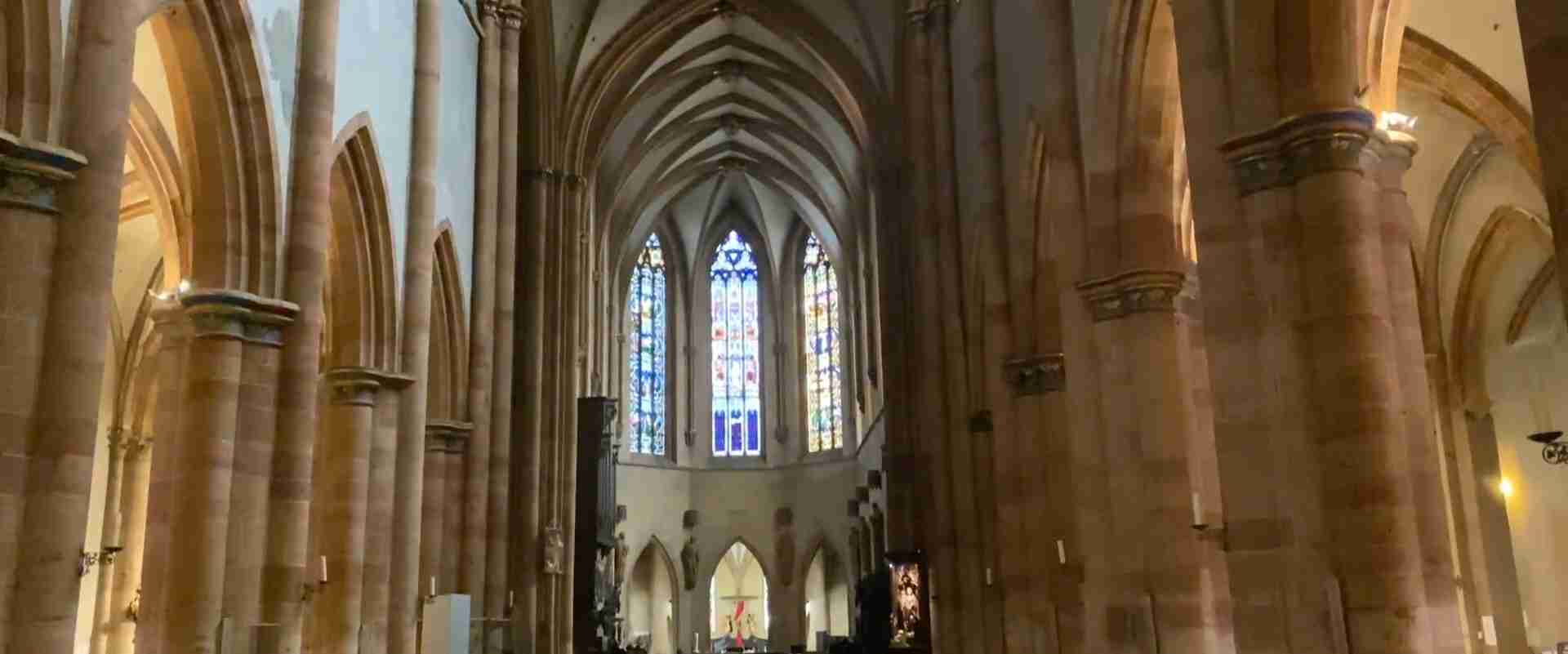
Begin at Cathedral Square at 8 AM. Saint-Martin is the largest church in Colmar and one of the largest Gothic churches in the Haut-Rhin department. Walk the exterior first: note the colored beaver-tail roof tiles, the asymmetry created by a north tower that was planned but never built, and the south tower with its distinctive lantern. Then enter and spend 45 to 60 minutes inside. Detailed observations appear in the Saint-Martin section of this guide.
Stop 2: Saint-Matthieu Church, Grand’Rue
From Cathedral Square, walk about 330 meters, roughly four minutes, to the Franciscan church on Grand’Rue. Even when closed, the exterior and the long narrow choir windows repay a short stop. If the visiting slot coincides with your day, go in; if not, check the concert calendar. The tourist office lists the address as 9 Grand’Rue, while other listings show number 3, so look for the church rather than the house number.
Stop 3: The Hospitaller Precinct on Rue Saint-Jean
From Saint-Matthieu, walk about 450 meters, roughly six minutes, south to Rue Saint-Jean. The commandery here is the nearest thing to a “Saint John” monument in the old town. The street frontage and courtyard walls preserve a few original elements, and the chapel inside the school grounds is not open to the public. Stand on the street, read the context in the dedicated section below, and continue.
Stop 4: The Dominican Church and Cloister
From Rue Saint-Jean, walk about 650 meters, roughly eight minutes, north to Dominican Square. This is the longest leg of the loop. The Dominican Church holds Martin Schongauer’s Madonna of the Rose Bush, painted in 1473, and the cloister next to it is among the oldest parts of the complex. Arrive when the church is open, and allow 30 to 45 minutes.
Stop 5 (Optional): The Unterlinden Museum
The museum is about 300 meters from the Dominican Church, roughly four minutes on foot. It occupies a thirteenth-century Dominican convent and holds the Isenheim Altarpiece by Matthias Grünewald and Niclaus of Haguenau, completed between 1512 and 1516. From the museum, the walk back to Cathedral Square is about 500 meters, or six minutes; from the Dominican Church directly it is about 200 meters, or three minutes.
Distances and Walking Times Between Stops
- Saint-Martin to Saint-Matthieu: about 330 meters, 4 minutes
- Saint-Matthieu to Rue Saint-Jean: about 450 meters, 6 minutes
- Rue Saint-Jean to the Dominican Church: about 650 meters, 8 minutes
- Dominican Church to the Unterlinden Museum: about 300 meters, 4 minutes
- Dominican Church back to Cathedral Square: about 200 meters, 3 minutes
The figures are estimates based on street geometry and an easy walking pace, and actual routes depend on which lanes are open. The loop is flat and short, which makes it easy to split across a morning and an afternoon when the Dominican Church opens at 3 PM on Wednesdays.
Accessibility and Pedestrian Zones: Efficient Routes from Place de la Cathédrale
The historic core is largely a pedestrian environment with cobblestone surfaces, and all stops lie within a short walk of Cathedral Square. For visitors using wheelchairs, strollers or walkers, the main issue is the paving rather than the distance: the old-town cobblestones are uneven, and routes along smoother streets add a few minutes.
The tourist office marks Saint-Matthieu with accessibility labels for motor, mental and visual disability, and the Unterlinden Museum is listed as suitable for wheelchair users. The Dominican Church listing indicates access on foot, access by bike and stroller access, as well as guide dogs. Visitors with specific mobility needs should confirm the situation at each door, especially for historic entrances with steps.
Arriving by train, the station lies about one to 1.5 kilometers from the churches according to the tourist office, a walk of 15 to 20 minutes. Driving into the center is not advised during busy weekends, and street parking next to Saint-Martin is limited; park outside the pedestrian area and walk in. During the Christmas market period in 2026, a weekend park-and-ride service ran from the exhibition center for €3 with a free shuttle to the center, and a similar arrangement is plausible for 2027 but should be confirmed.
Efficient Routes from Cathedral Square for Different Visitors
- Short route, 90 minutes: Saint-Martin interior, Dominican Church if open, and a final look at the Saint-Matthieu exterior.
- Standard route, three to four hours: the full core loop with all five stops, including the Rue Saint-Jean frontage.
- Full-day route: the core loop in the morning, the Unterlinden Museum after lunch, and a quiet evening concert at Saint-Matthieu during festival dates.
- Reduced-mobility route: Saint-Martin and the Dominican Church only, using the shortest connection of about 200 meters.
What to See Inside Saint-Martin Collegiate Church on the 2027 Circuit
Saint-Martin rewards a slow, structured visit of 45 to 60 minutes: start with the exterior from Cathedral Square, enter through the west or south side, walk the nave toward the choir, then circle back along the aisles. The church is free to enter, and the 8 AM weekday opening gives the emptiest interior of the day.
A Short History of Saint-Martin: From Romanesque Foundation to Gothic Landmark
Saint-Martin stands on the site of an earlier Romanesque church, and the surviving documentation places the start of the present building in the thirteenth century, with the Gothic choir following in the fourteenth. Local heritage accounts generally name the master mason Wilhelm of Marburg in connection with the choir, but the attribution rests on later tradition and secondary summaries rather than a surviving contract, so it is safest to read it as probable rather than proven. The building was never completed to its original plan: a second tower was intended on the north side and the church still shows a single tower, which gives the west front its distinctive asymmetry.
The church was called a collegiate church because it was served by a college of canons rather than a single parish priest. Colmar itself was a free imperial city of the Holy Roman Empire until the seventeenth century, and the size of its principal church reflects the wealth of the town’s merchants and wine growers. The Reformation reached Colmar in the sixteenth century, and the town’s religious life divided between Catholic and Protestant communities, a split that explains why Saint-Martin stayed Catholic while the former Franciscan church became Protestant.
The tower roof was damaged by fire in the sixteenth century, and the present lantern-style roof replaced it. A short visual rule helps identify the church from any angle: look for the single large tower with its green-glazed cap, the steep roof covered in colored tiles, and the long Gothic choir behind. The colored-tile pattern is typical of Alsatian and Burgundian roofs and is one of the most photographed details on the square.
Exterior Details Worth Ten Minutes Before You Enter
- The west front and tower: note the asymmetry created by the missing north tower and compare the proportions of the portal with the tower above.
- The south portal: the sculpted doorway is the main decorative feature of the exterior. Check the tympanum iconography and the carvers’ attribution against the church’s own guide; the workshop name sometimes cited locally is not confirmed here.
- The roof: the patterned tiles can be read from Cathedral Square and from the narrow lane on the south side.
- The surrounding square: Cathedral Square connects the church to the old Customs House and the main shopping streets, so the same space doubles as the circuit’s starting point.
Interior Highlights: Nave, Choir, Organs and Stained Glass
The interior is long and tall, and the choir is the most elegant part. Look up first: the vault lines draw the eye toward the east end. The organ case built in 1755 by Johann Andreas Silbermann is the most important musical object in the church, and the instrument inside it was replaced in the late twentieth century, according to the French encyclopedic sources reviewed. A smaller choir organ and a small positive organ complete the musical equipment.
Stained glass is mixed in date. Some windows are medieval, others later restorations, and the quality of light changes sharply between morning and afternoon. If you can only afford one visit, choose the morning, when light enters from the east through the choir windows. For anyone interested in liturgical furnishings, side chapels and altars show the church’s later Baroque and nineteenth-century additions.
Interior etiquette is straightforward. Stay out of the chancel during services, keep conversation low, and avoid flash photography. Because the hours explicitly exclude service times, Sunday morning visits are limited in practice, and the Sunday opening listed from 10 AM does not guarantee free movement through the church before the late morning.
Visiting Saint-Martin Without the Crowds
The quietest hours are the first hour after the 8 AM opening on weekdays and the last hour before closing at 6:45 PM. Midday is busiest because the church sits on the line between the main shopping streets and the museum district. In the Christmas market season, the square itself becomes crowded, but the interior is still calmer than the lanes outside, making it a useful shelter on a cold day.
Saint-Matthieu Church: Franciscan Origins and Concert Venue on the 2027 Route
Saint-Matthieu is the circuit’s shortest stop in terms of public opening hours and its most musical one. The church opens for sightseeing on a limited summer schedule, but it is a primary concert venue for the Easter and July festivals, which means a ticket for an evening concert is the most dependable way to see the interior.
From Franciscan Church to Protestant Church
The church began as the church of a Franciscan convent in the late Middle Ages. After the Reformation reached Colmar, the building passed to the Protestant community, and it has served Lutheran worship since. This history explains both the plain, sober interior and the long, narrow nave typical of mendicant churches, which were designed for preaching rather than for processions.
The exterior is modest compared with Saint-Martin: a long roofline, tall narrow windows and a slender spirelet. The street setting on Grand’Rue is intimate, and the church is easy to miss if you walk quickly between the shops. Look for the entrance set back from the street rather than a monumental façade.
The Silbermann Organ and Why It Matters for Concert-Goers
The church houses an eighteenth-century organ attributed to Andreas Silbermann, the Strasbourg family of organ builders who built or rebuilt many instruments across Alsace. Sources disagree on the date of the instrument, giving 1731 in some listings and 1732 in others, and the exact attribution between family members is not settled in every reference. A reader planning a visit around the organ should treat the maker as the Silbermann workshop and the date as the early 1730s. The case and the instrumental part are both protected as historic objects, according to the French heritage listings reviewed.
For listeners, the interest lies in the combination of a historic instrument and a small, resonant room. Concerts here are intimate, and tickets at festival time can sell out in advance, so book as soon as the program is published.
How to See Inside Saint-Matthieu in 2027
- Summer visiting slots: the most recent listing shows Tuesday, Thursday and Saturday from 3 PM to 5 PM between August 1 and September 30, subject to volunteer availability and excluding worship and concerts.
- Festival concerts: the Colmar Easter Festival in late March and early April, and the Colmar International Festival in July, both used Saint-Matthieu in 2026.
- Fête de la Musique: free concerts on June 21 in the old town, with a 2026 program that included performances at this church.
- Services: Sunday worship is open to anyone who wishes to attend respectfully, though it is not a sightseeing visit.
The Dominican Church in Colmar: Schongauer’s Madonna and the Cloister in 2027
The Dominican Church is the circuit’s artistic climax. Its single great attraction is the Madonna of the Rose Bush, painted by Martin Schongauer in 1473, displayed in a Gothic choir that was designed for preaching friars and later served as a grain store. The visit takes 30 to 45 minutes and costs €2 for adults in the listing reviewed.
History: Dominican Friars, Secularization and Return
The Dominican order arrived in Colmar in the thirteenth century, and sources differ on the exact year, with both 1260 and 1278 appearing in reference works. The church was built in stages from the 1280s. Its plan is that of a mendicant preaching church: a wide nave without elaborate side chapels and a tall choir that floods the interior with light. After the French Revolution, the convent was secularized and the church was used for storage; in the nineteenth century it served as a grain hall before being restored for worship and exhibition.
The current use is as a protected historic building that shelters one of the best-known paintings of the Upper Rhine. Because the building is a museum-like space, the visit is ticketed and has fixed seasonal openings, which makes planning more important here than at the other two churches.
The Madonna of the Rose Bush: What to Look For
Painted on wood, the Madonna shows the Virgin seated in front of a rose hedge with the Child on her lap, with angels holding a crown above her head and birds in the foliage. The painting is considered the masterpiece of Martin Schongauer, a Colmar-born painter and engraver whose prints circulated across Europe and influenced Albrecht Dürer. The work is dated 1473 on the basis of an inscription, and it was moved to the church in the nineteenth century.
Plan to spend at least ten minutes in front of it. Details reward close looking: the sharp rendering of the rose petals, the delicacy of the angels’ wings and the gilded background. Photography rules are posted at the entrance, and visitors are often asked to refrain from flash.
Stained Glass and Architecture of the Choir
The choir windows contain fourteenth-century stained glass showing scenes from the life of Christ, according to the tourist office and heritage descriptions. The tall, slender window openings and the height of the choir give the church an airy, vertical feel that contrasts with the broader proportions of Saint-Martin. The nave is plain, and the visual weight is concentrated at the east end.
The Dominican Cloister and Why It Stands In for the Cloister of St. John
Next to the church, the Dominican cloister survives as one of the oldest parts of the complex. A cloister is a covered walkway around a courtyard, and in a convent it linked the church, the chapter house and the dormitories. Walking a cloister reproduces the circulation of the friars. Because the Hospitaller site on Rue Saint-Jean has no public cloister, the Dominican cloister is the practical choice for the “cloister” stop of the circuit. Access conditions can vary with exhibitions and events, so confirm the day’s arrangement at the ticket desk.
The Hospitaller Precinct on Rue Saint-Jean: A Historical Waypoint on the 2027 Circuit
The Rue Saint-Jean stop is a historical pause rather than an interior visit. The former commandery of the Order of Saint John of Jerusalem occupied this area, and its chapel survives within a private school campus, so the experience is limited to the street and a short reading of the site’s story.
Who Were the Hospitallers in Colmar?
The Order of the Hospital of Saint John of Jerusalem, later known as the Knights of Malta, ran hospitals and commanderies across medieval Europe. In Alsace they held properties in several towns, and the Colmar house formed part of that network. The name of the street preserves the memory of the order, and school buildings now occupy the site. Because the chapel is not open to the public, the best use of this stop is to read the façade, note the change of scale from the surrounding houses and consider how a charitable religious order fitted into a trading city.
What You Can and Cannot See
- Visible from the street: the frontage and the line of the enclosing walls.
- Not open to visitors: the chapel and courtyard, which belong to a school.
- Respect for the site: keep a distance from the entrance during school hours and avoid photographing pupils.
The unusual name in the locked heading, “Cloister of St. John”, therefore refers to a site that visitors can read but not enter. If your circuit is built around interiors, replace this stop with an extra half hour in the Dominican cloister or the Unterlinden courtyard.
Unterlinden Museum: The Optional Fifth Stop on the Colmar Route in 2027
The Unterlinden Museum occupies a former Dominican convent and adds roughly 600 meters to the loop. It is the best choice for rainy weather or for visitors who want a major collection alongside the churches. Admission for adults is €14 in the listing reviewed, and the museum is closed on Tuesdays.
The Isenheim Altarpiece
The museum’s best-known work is the Isenheim Altarpiece, painted between 1512 and 1516 by Matthias Grünewald with sculpture by Niclaus of Haguenau. Created for a hospital monastery of the Antonite order at Isenheim, the polyptych presents the Crucifixion in unusually harrowing detail, a choice often linked to the hospital’s care for patients with skin diseases. The interpretation of that link is scholarly rather than certain, so present it as a widely repeated explanation, not a proven fact.
The Medieval Cloister
The museum’s cloister is a quiet courtyard that stands in for the St. John cloister on days when the Dominican Church is closed. Combining the Unterlinden cloister with the Saint-Martin interior gives a satisfying half-day plan that avoids the Dominican Church’s seasonal gaps.
Colmar Sacred Circuit Costs 2027: Tickets, City Pass and Guided Tours
The church circuit is inexpensive: a visitor who enters the Dominican Church pays €2 as an adult, Saint-Martin is free, and the optional Unterlinden Museum adds €14, so the full five-stop circuit costs about €15 to €20 per adult in admissions. Prices below come from the Colmar tourist office and City Pass listings available in October 2026 (check official sites for current 2027 rates).
Admission Prices by Stop
- Saint-Martin Collegiate Church: free
- Saint-Matthieu Church: no sightseeing ticket listed; concerts are ticketed separately
- Dominican Church: adults €2, ages 12 to 18 €1, free with the Colmar City Pass
- Hospitaller precinct, Rue Saint-Jean: exterior only, free
- Unterlinden Museum: adults €14
Adding the church and museum admissions, a visitor pays €16 for the Dominican Church and the Unterlinden Museum together, and the circuit with Saint-Martin and the exteriors stays at the same €16 because the other stops are free. With the City Pass covering the Dominican Church, the museum ticket is the only admission to buy.
Private Guided Tours
The tourist office lists private tours in English, German and Italian. A one-hour tour of the Dominican Church costs €136 for a group of up to 25 people, with admission paid separately on the day, and a three-hour tour combining the old town, Little Venice and the Dominican Church costs €238 per group. For a small group of four people, the one-hour tour works out to €34 each before admissions, and for a group of ten it falls to about €14 each. The tourist office posts the booking conditions, which should be reviewed before payment.
Where the Money Goes: Food and Lodging Around the Circuit
Meals and lodging are not part of this circuit’s fixed costs, and prices fluctuate sharply with the season. Lodging in Colmar rises during the Christmas market period and the July festival, so book the nights that match your chosen church-opening windows well in advance and compare current rates on booking platforms. Lunch in the old town is easy to find within a few minutes of every stop on the circuit.
Best Time to Walk the Colmar Sacred Circuit in 2027: Season by Season
The best months for the full circuit are March and September, followed by late October and early July for concert-focused visits. The right month depends on whether the Dominican Church is in its open window, whether Saint-Matthieu has concerts, and whether the Christmas markets fill the streets.
Spring 2027: Easter Festival and the Dominican Church’s March Window
Easter Sunday falls on March 28, 2027. Based on the 2026 pattern, the Colmar Easter Festival should occupy the days around Easter, with concerts in heritage venues including Saint-Matthieu. The Dominican Church’s published opening begins on March 5 and runs through March 31, so a trip in the second half of March combines the festival atmosphere with an open Madonna of the Rose Bush. The 2027 festival dates are unannounced in the sources reviewed, so wait for the official program before booking trains.
Summer 2027: Long Days and the International Festival
June brings the Fête de la Musique on June 21, and early July the International Festival, which in 2026 ran from July 5 to 14. The Dominican Church reopens for its second window on July 24 in the City Pass listing, so early July visitors may find it closed, and late July to August visitors do not have that problem. Saint-Matthieu’s summer visiting slots begin on August 1. If your priority is interiors, choose August; if it is music, choose early July and accept that the Dominican Church may be closed.
Autumn 2027: Quiet Interiors and Soft Light
September and October combine open doors, shorter queues and mild temperatures. September is the best single month for the full five-stop circuit because the Saint-Matthieu summer slots run through September 30 and the Dominican Church is open all month.
Winter 2027: Christmas Markets and Short Days
The Christmas markets in 2026 ran from November 23 to December 29, and most market guides describe weekends in the season as very crowded. The churches remain open, the Dominican Church operates through December 30 in the listing reviewed, and the interiors provide warm refuge from the cold. Weekday mornings are the only realistic choice for a quiet circuit in this season. Daylight is short, with sunset around 4:40 PM near the winter solstice, so start at 8 AM at Saint-Martin and plan the Dominican Church before 3 PM.
Month-by-Month Summary for the Circuit
- March: Dominican Church open from March 5; Easter Festival expected around the end of the month; mild but changeable weather.
- April to June: Dominican Church closed in the listing reviewed; Saint-Martin open; Fête de la Musique on June 21.
- July: International Festival expected early to mid July; Dominican Church reopens July 24.
- August to September: all stops available; Saint-Matthieu summer slots from August 1 to September 30.
- October to November: Dominican Church and Saint-Martin open; Christmas markets begin in late November.
- December: Christmas markets; Dominican Church open through December 30; heavy weekend crowds.
Colmar Sacred Circuit Itineraries 2027: Half-Day, Full-Day and Evening Concert Options
Three ready-made itineraries cover most visitors: a 90-minute essentials route, a standard four-hour circuit and a full-day route with the museum and an evening concert. Walking distances stay under 2.2 kilometers in every version.
Itinerary 1: The 90-Minute Essentials Route
- 8:00 AM: Saint-Martin interior and exterior (45 minutes).
- 8:55 AM: Walk to the Dominican Church if it is open at your date (about 5 minutes via Cathedral Square), or to Saint-Matthieu (about 4 minutes) for the exterior.
- 9:15 AM: Dominican Church visit if open from 10 AM, or coffee near the square.
Itinerary 2: The Standard Four-Hour Circuit
- 8:30 AM: Saint-Martin, interior first, then the exterior details.
- 9:45 AM: Saint-Matthieu, exterior or interior if a visiting slot applies.
- 10:15 AM: Hospitaller precinct on Rue Saint-Jean, a 10-minute pause.
- 10:45 AM: Dominican Church and cloister, arriving after the 10 AM opening on Tuesdays, Thursdays, Fridays, Saturdays and Sundays (30 to 45 minutes).
- 12:00 PM: Lunch near Dominican Square.
Itinerary 3: The Full Day with Museum and Concert
- 8:00 AM: Saint-Martin.
- 9:30 AM: Saint-Matthieu exterior and Rue Saint-Jean waypoint.
- 10:30 AM: Dominican Church and cloister.
- 12:30 PM: Lunch.
- 2:00 PM: Unterlinden Museum, allowing two hours for the Isenheim Altarpiece and the cloister.
- 4:30 PM: Rest or café stop.
- 8:30 PM: Evening concert at Saint-Matthieu if your dates match a festival program.
On Wednesdays the Dominican Church opens only in the afternoon, so reverse the order: museum in the morning, Dominican Church from 3 PM. On Tuesdays the Unterlinden Museum is closed, so swap the museum for a longer walk along the canals.
Getting to the Colmar Old Town and Moving Between the Churches in 2027
Colmar is reachable by train from Strasbourg, Mulhouse and Basel, and the station is about 1 to 1.5 kilometers from the churches, a walk of 15 to 20 minutes. The historic core is compact enough that no local transport is needed between the sites.
From the Station to Cathedral Square
Walk from the station along the main avenue into the pedestrian area, or take a taxi for the first leg if you carry luggage. The route enters the old town near the Dominican Church area, so a Dominican-first itinerary is a natural alternative when you arrive after 10 AM.
By Car
Driving into the center is discouraged during peak periods. Use a car park outside the pedestrian zone, and in the Christmas market season consider the weekend park-and-ride that operated in 2026 for €3 with a free shuttle, confirming whether a similar service runs in 2027.
Luggage and Rest Stops
Small day bags are best for church visits. Carry a layer for the interiors, which stay cool even in summer, and a water bottle for the cobbled walk.
Photography and Etiquette Along the Colmar Sacred Circuit 2027
Good photographs depend on timing rather than equipment: morning light for the choir windows, late afternoon for the exterior of Saint-Martin, and the early hours for empty streets around Grand’Rue.
- Saint-Martin: interior in the morning, tower from the square in late afternoon.
- Saint-Matthieu: exteriors in any light; interior only during permitted visits or concerts, where photography may be restricted.
- Dominican Church: follow the posted rules for the painting; avoid flash.
- Rue Saint-Jean: do not photograph pupils or private property beyond the street frontage.
Respect the active use of the buildings. Silence phones, step aside during services and keep tripods out of the aisles.
Common Mistakes to Avoid on the Colmar Sacred Circuit in 2027
- Arriving at the Dominican Church in April, May or June without checking the opening months.
- Planning a Sunday-morning interior visit at Saint-Martin during services.
- Expecting to enter the Hospitaller chapel on Rue Saint-Jean.
- Scheduling the Unterlinden Museum on a Tuesday.
- Visiting on a Christmas market weekend and expecting quiet streets.
- Assuming Saint-Matthieu will be open without checking the summer slots or the concert program.
Interactive Colmar Sacred Circuit Route Map 2027
An interactive map accompanies this guide and shows each stop in walking order, from Saint-Martin through Saint-Matthieu and Rue Saint-Jean to the Dominican Church and the Unterlinden Museum.
Frequently Asked Questions About the Colmar Sacred Circuit 2027
How many churches are on the Colmar sacred circuit?
The circuit includes three principal churches: Saint-Martin, Saint-Matthieu and the Dominican Church. Two additions extend it: the Hospitaller precinct on Rue Saint-Jean, visible only from the street, and the Unterlinden Museum, which occupies a former Dominican convent. The core loop covers about 1.6 kilometers and the extended loop about 2.2 kilometers.
Is there a Cloister of St. John that visitors can enter in Colmar?
No public cloister of Saint John appeared in the sources reviewed. The former Hospitaller commandery on Rue Saint-Jean lies inside a private school, and its chapel is not open to visitors. Visitors who want a cloister can walk the Dominican cloister next to the Dominican Church or the cloister of the Unterlinden Museum, subject to opening conditions.
What are the Saint-Martin opening hours for 2027?
The most recent published schedule shows Monday to Saturday 8 AM to 6:45 PM and Sunday 10 AM to 7 PM, excluding church services. The schedule reviewed covers 2025, so confirm the 2027 hours with the church or the tourist office before travelling. Entry is free.
When is the Dominican Church open?
The City Pass listing shows the church open from March 5 to 31 and from July 24 to December 30. During open periods, Tuesday, Thursday and Sunday hours are 10 AM to 1 PM and 3 PM to 6 PM, Wednesday is 3 PM to 6 PM, and Friday and Saturday are 10 AM to 6 PM. Adults pay €2 and the church is free with the Colmar City Pass. Confirm the 2027 calendar before building a trip around it.
Can I see inside Saint-Matthieu Church?
Yes, through limited summer visiting slots or a concert. The listing reviewed shows Tuesday, Thursday and Saturday from 3 PM to 5 PM between August 1 and September 30, depending on volunteers and excluding worship and concerts. Festival concerts in March, April and July offer the other main chance to enter.
Where can I hear an organ in Colmar?
Organ music is mostly heard through festival and parish concerts. Saint-Martin has an organ case dating to 1755 and Saint-Matthieu has a Silbermann organ from the early 1730s. Dates for 2027 concerts are announced by the festivals and the tourist office, so check their programs.
How much does the Colmar sacred circuit cost?
Admissions total about €16 per adult for the Dominican Church (€2) and the Unterlinden Museum (€14), while Saint-Martin and the exterior stops are free. The Colmar City Pass covers the Dominican Church. Concert tickets and private tours cost extra.
Is the circuit accessible for wheelchair users and families with strollers?
Distances are short, but old-town cobblestones are uneven. The tourist office lists accessibility labels for Saint-Matthieu, stroller access for the Dominican Church and wheelchair suitability for the Unterlinden Museum. Confirm entrance conditions on the day.
What is the best day to avoid crowds in Colmar?
A weekday morning outside the Christmas market period is the quietest choice. Saint-Martin opens at 8 AM, and the Unterlinden Museum is closed on Tuesdays. Avoid weekends from late November to late December.
How long should I allow for the full circuit?
Allow three to four hours for the five church and waypoint stops, or a full day with the Unterlinden Museum and a lunch break. The walking portion takes roughly 20 minutes in the core loop and 28 minutes in the extended loop.