
Chichen Itza Travel Guide 2026: Ultimate Planning Resource
Key Takeaways
- Entry costs $32-36 per adult combining federal archaeological fee (533 pesos) and Yucatan state fee (90 pesos) with online booking available through official channels
- Arrive at 8 AM opening time for the best experience with minimal crowds, optimal photography light, and comfortable temperatures before midday heat
- Plan 3-4 hours minimum for comprehensive exploration of El Castillo, Great Ball Court, Temple of Warriors, Sacred Cenote, and secondary structures
- Visit November-April 2026 for ideal weather conditions with temperatures 22-28°C (72-82°F), low rainfall, and comfortable humidity levels
- Base in Valladolid (45km away) for better value accommodation ($45-90 per night), authentic culture, excellent restaurants, and easy colectivo access ($2.50 each way)
- Budget $100-150 per person for a complete day trip from Cancun including entrance, transport, meals, and guide services in 2026
Your Essential Chichen Itza Planning Guide for 2026
Chichen Itza ranks among the world’s most remarkable archaeological sites, showcasing Maya civilization’s architectural genius, astronomical knowledge, and cultural sophistication. This UNESCO World Heritage Site and New Seven Wonders of the World destination attracts over 2.6 million visitors annually who come to witness El Castillo pyramid, explore ancient temples, and connect with Mesoamerican history spanning over 1,000 years.
Located in Mexico’s Yucatan Peninsula, Chichen Itza served as one of the most important Maya cities between 600-1200 CE, functioning as political capital, ceremonial center, and astronomical observatory. The site’s name translates to “at the mouth of the well of the Itza,” referencing the Sacred Cenote where ceremonial offerings and human sacrifices occurred. Today, the archaeological zone preserves dozens of restored structures demonstrating Maya achievements in mathematics, astronomy, engineering, and artistic expression.
Planning a 2026 Chichen Itza visit requires understanding practical logistics, optimal timing strategies, budget considerations, and site exploration priorities. This comprehensive guide provides everything you need to organize an exceptional archaeological experience, from entrance procedures and transportation options to accommodation recommendations and detailed structure descriptions. Whether visiting independently or joining organized tours, proper planning ensures you maximize your time at this extraordinary site.
The 740-acre archaeological zone contains numerous structures ranging from the iconic stepped pyramid to ball courts, temples, observatories, and ceremonial platforms. Strategic approach allows you to experience the site’s highlights while discovering lesser-known treasures often overlooked by rushed tour groups. This guide balances practical planning information with cultural context, helping you appreciate both the ancient significance and contemporary visiting experience of one of humanity’s great architectural accomplishments.
People Also Ask About Chichen Itza 2026
What is Chichen Itza and why is it famous in 2026?
Chichen Itza represents one of the most significant Maya archaeological sites in Mexico, renowned for El Castillo pyramid demonstrating advanced astronomical and mathematical knowledge. The stepped pyramid contains 365 steps (matching solar calendar days), precise cardinal alignments, and the famous serpent shadow phenomenon appearing during equinoxes. The site earned UNESCO World Heritage designation in 1988 and New Seven Wonders of the World recognition in 2007, cementing its status as essential cultural heritage.
The ancient city flourished between 600-1200 CE as a major political, economic, and ceremonial center controlling large portions of the northern Yucatan Peninsula. Architectural achievements include the largest ancient ball court in Mesoamerica (168m x 70m), El Caracol astronomical observatory tracking Venus cycles, and Temple of Warriors with 200 carved columns depicting Maya warriors and deities. These structures demonstrate sophisticated engineering, mathematical precision, and artistic accomplishment rivaling any ancient civilization worldwide.
Modern fame derives from the site’s accessibility from Cancun tourism infrastructure (195km away), exceptional preservation quality, and dramatic visual impact creating perfect conditions for tourism development. The equinox serpent shadow phenomenon draws massive crowds twice yearly when sunlight creates the illusion of Kukulkan (feathered serpent deity) descending the pyramid’s northern staircase, demonstrating Maya astronomical expertise and architectural symbolism.
How much does it cost to visit Chichen Itza in 2026?
Entrance to Chichen Itza costs 623 Mexican pesos (approximately $32-36 USD) per adult in 2026, combining the federal INAH archaeological site fee of 533 pesos and the Yucatan state fee of 90 pesos. Check the official INAH website (www.inah.gob.mx) for current rates as pricing may vary. Children under 13 enter free on Sundays when accompanied by adults, while students with valid international credentials receive 30-50% discounts throughout the week.
Total day trip costs from Cancun range $100-150 per person including entrance fees, transportation ($25-40 for shared shuttles, $180-220 for private transfers), lunch ($12-20), guide services ($25-35), and incidental expenses for water, snacks, and souvenirs. Independent travelers visiting from Valladolid reduce costs to $60-80 per person by utilizing colectivo vans ($2.50 each way), budget accommodation ($45-65 per night), and local restaurants ($8-15 per meal).
Organized tours from Cancun cost $65-95 per person including round-trip transportation, entrance fees, and guide services, though actual site time reduces to 1.5-2 hours due to transportation duration and mandatory shopping stops. Premium tours ($95-145) add cenote swimming, buffet lunch, and Valladolid visits but further decrease archaeological zone exploration time. Budget-conscious travelers achieve better value through independent planning with greater flexibility and extended site access.
What is the best time to visit Chichen Itza in 2026?
The optimal visiting period for Chichen Itza in 2026 runs November through April during the dry season when temperatures average 22-28°C (72-82°F), rainfall remains minimal (30-50mm monthly), and humidity stays below 70%. Within this window, November-February offers the most comfortable conditions with cooler mornings sometimes requiring light jackets for early arrivals, while March-April brings warmer temperatures (28-32°C/82-90°F) but excellent weather reliability and decreased post-Easter crowds.
Daily timing proves equally critical as seasonal selection. Arrive at the 8:00 AM opening to experience the site with virtually no crowds (50-100 visitors vs. 3,000+ by 11:00 AM), optimal photography lighting, and comfortable temperatures before tropical heat intensifies. The 8:00-10:00 AM window provides the best conditions for photographing El Castillo with dramatic directional shadows, plus peaceful exploration of Temple of Warriors, Great Ball Court, and Sacred Cenote before tour bus arrivals.
Special event dates include spring equinox (March 20-21) and autumn equinox (September 22-23) when the serpent shadow phenomenon draws maximum crowds with advance booking requirements and premium pricing. Regular visiting days offer more relaxed experiences with better access to all structures and superior photography opportunities without thousands of spectators competing for ideal positions. May-October wet season features afternoon thunderstorms and high humidity but dramatically reduced tourist numbers and 30-50% lower accommodation costs for budget-conscious travelers.
How do I get to Chichen Itza from Cancun in 2026?
Multiple transportation options connect Cancun to Chichen Itza across the 195km (120 miles) distance requiring 2.5-3 hours travel time each direction. ADO bus services depart Cancun Airport terminal at 8:45 AM and 9:45 AM daily, arriving Chichen Itza between 12:30-1:30 PM after stops in Playa del Carmen and Valladolid. Return buses depart at 4:30 PM and 5:30 PM, reaching Cancun between 8:00-9:00 PM. Round-trip tickets cost 1,000 pesos ($50-53), available through www.ado.com.mx or terminal ticket counters.
Rental cars provide maximum flexibility with drive times of 2.5-3 hours via Highway 180D toll road (cuota) costing approximately 450 pesos ($23-25) in highway tolls but saving 30-40 minutes compared to the free Highway 180 route. Rental rates range $35-55 daily for compact cars and $60-85 for SUVs, plus mandatory insurance coverage at $15-25 daily. Early departures (6:00-6:30 AM) from Cancun enable 8:00 AM site arrivals maximizing optimal morning conditions.
Organized tours ($65-95 per person) include round-trip transportation, entrance fees, and guide services with hotel pickups between 7:00-8:00 AM and returns at 6:00-7:00 PM. Tours allocate 1.5-2.5 hours for site exploration, significantly less than independent travel permits. Private transfers ($180-220 for up to 6 passengers) offer customized timing and duration without group constraints, working best for families or small groups wanting flexibility without driving responsibilities.
Extended multi-day tours – 5+ days
Featured Chichen Itza Multi-Day Tour Packages

3 days
Chichen Itza 3-Day Discovery Tour
- ✓ Comprehensive Chichen Itza experience
- ✓ Expert local guides included
- ✓ All accommodation included
- ✓ Transportation provided

5 days
Chichen Itza 5-Day Highlights Experience
- ✓ Comprehensive Chichen Itza experience
- ✓ Expert local guides included
- ✓ All accommodation included
- ✓ Transportation provided
7 days
Chichen Itza 7-Day Cultural Journey
- ✓ Comprehensive Chichen Itza experience
- ✓ Expert local guides included
- ✓ All accommodation included
- ✓ Transportation provided
10 days
Chichen Itza 10-Day Complete Adventure
- ✓ Comprehensive Chichen Itza experience
- ✓ Expert local guides included
- ✓ All accommodation included
- ✓ Transportation provided
Multi-day tour packages powered by TourRadar. Prices and availability subject to change.
Essential Planning Information for 2026
Current Entrance Fees and Ticketing
Chichen Itza operates under a dual-fee structure combining federal and state charges. The federal INAH (Instituto Nacional de Antropología e Historia) fee costs 533 pesos ($27-31 USD) covering archaeological site access, while the Yucatan state fee adds 90 pesos ($5 USD) for total entrance cost of 623 pesos or approximately $32-36 per adult in 2026. Check www.inah.gob.mx for current official rates as pricing may vary. Payment accepts cash (Mexican pesos or US dollars at less favorable exchange rates) and credit cards at ticket counters, with online advance purchase available through official channels eliminating queue time during peak hours.
Free admission days include Sundays for Mexican nationals and legal residents (FM2/FM3 document holders), plus national holidays: February 5 (Constitution Day), March 21 (Benito Juarez Birthday), September 16 (Independence Day), and November 20 (Revolution Day). International visitors pay standard rates on these dates but encounter significantly larger crowds with reduced parking availability and longer wait times at entrance gates.
Children under 13 enter free on Sundays when accompanied by adults, while students with valid international student identity cards (ISIC) receive 30-50% discounts throughout the week. Teachers with recognized educational institution credentials qualify for reduced rates under INAH educational access programs. Seniors over 60 receive discounted admission though international senior cards receive inconsistent recognition; bring passport showing age for consideration.
Parking costs 80-100 pesos ($4-5) for standard vehicles and 150-200 pesos ($8-10) for vans and buses at the main visitor complex. Additional on-site services include locker rentals (50 pesos/$2.50 small, 80 pesos/$4 large), wheelchair rentals (100 pesos/$5 deposit-refunded), guide services ($25-35 per person group tours, $80-120 private tours), and audio guide rentals (125 pesos/$6-7 in 8 languages).
Operating Hours and Site Access
Chichen Itza opens daily at 8:00 AM and closes at 5:00 PM throughout 2026, with last entry permitted at 4:00 PM allowing one hour for final exploration before evacuation. The site closes only on December 25 (Christmas Day) and January 1 (New Year’s Day), operating on all other days including Mexican holidays though expect larger crowds during national celebrations.
Arriving at opening time (8:00 AM) provides transformative advantages including virtually empty monuments for 60-90 minutes, optimal morning light for photography, cooler temperatures (22-25°C/72-77°F) for comfortable exploration, and parking availability near the main entrance. Early arrivals number 50-100 visitors compared to 3,000+ present by 11:00 AM during peak season, creating dramatically different experiential conditions.
Tour bus arrivals peak between 10:00 AM and 2:00 PM when organized excursions from Cancun, Playa del Carmen, and cruise ships converge simultaneously. The Great Plaza becomes congested with thousands of visitors during these hours, making photography challenging and movement between structures slow. Independent travelers gain substantial advantages through early timing or late afternoon visits (after 3:00 PM) when tour buses depart and crowds disperse significantly.
Evening light-and-sound shows (Noches de Kukulkan) operate seasonally with Spanish language presentations at 7:00 PM and English presentations at 8:00 PM, requiring separate admission tickets ($25-30) available at the visitor complex or through official websites. Shows last approximately 45 minutes featuring monument illumination and historical narration, though dates and availability vary throughout the year requiring advance confirmation before planning evening visits.
What to See at Chichen Itza: Complete Structure Guide 2026
El Castillo (Temple of Kukulkan)
El Castillo stands as Chichen Itza’s most iconic structure, a 24-meter (79-foot) stepped pyramid demonstrating extraordinary astronomical and mathematical precision. The pyramid contains exactly 365 steps (91 steps per side × 4 sides + 1 top platform step) matching solar calendar days, with 52 panels on each facade representing the 52-year Maya calendar cycle. Each of the nine terraces divides into two sections creating 18 segments matching the 18-month Maya sacred calendar (Haab).
The northern staircase features serpent head sculptures at its base, with the famous equinox phenomenon creating shadow patterns resembling Kukulkan (feathered serpent deity) descending the pyramid during spring and autumn equinoxes. This astronomical alignment demonstrates Maya understanding of solar movements and intentional architectural design incorporating celestial knowledge into ceremonial structures. The pyramid sits precisely aligned to cardinal directions with staircases facing north, south, east, and west.
Interior pyramid chambers discovered in the 1930s reveal an earlier construction phase with a red jaguar throne inlaid with jade eyes and a chac-mool sculpture, though these areas closed to public access for preservation. The acoustic phenomenon at the pyramid’s base creates echoes resembling the quetzal bird’s call when visitors clap, demonstrating intentional sound engineering incorporated into sacred architecture. Climbing the pyramid became prohibited in 2006 after tourist accidents, though viewing from the Great Plaza provides excellent photographic perspectives and architectural appreciation.
Great Ball Court (Juego de Pelota)
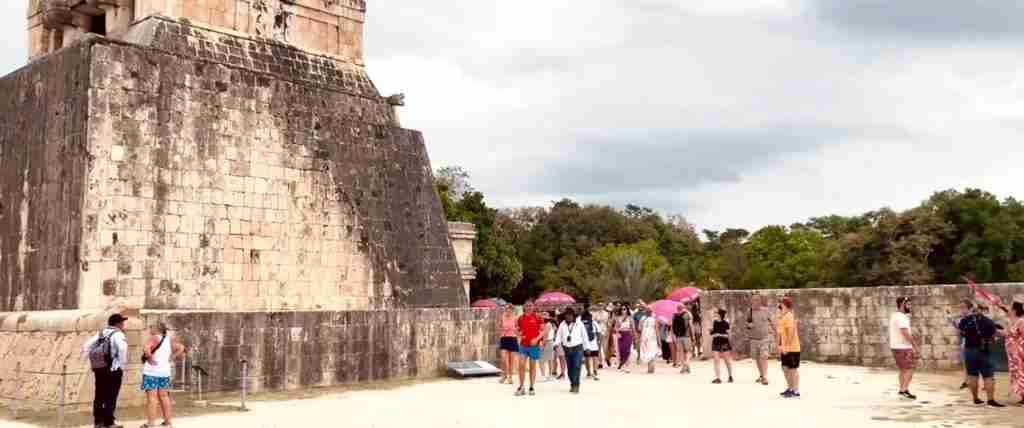
The Great Ball Court measures 168 meters long by 70 meters wide (551 × 230 feet), making it the largest ancient ball court in Mesoamerica and seven times larger than a modern football field. Parallel walls rise 8 meters (26 feet) high with stone rings mounted 6 meters (20 feet) above the playing surface, creating extremely challenging targets for the rubber ball game combining sport, ritual, and political significance in Maya culture.
Carved panels along the court walls depict ball game scenes including player decapitation, illustrating the game’s connection to human sacrifice and cosmic symbolism. The panels show two teams of seven players each, with the captain of the losing (or possibly winning) team being sacrificed to the gods. These carvings demonstrate the game’s importance extending far beyond athletic competition into religious ceremony, political power displays, and cosmological reenactment.
Remarkable acoustic properties allow whispers at one end of the court to be heard clearly 150 meters away at the opposite end, while conversations in the center carry to all corners. This acoustic engineering likely served ceremonial functions, enabling priests or rulers to address assembled crowds without modern amplification. The Temple of the Bearded Man at the north end and South Temple frame the court, providing elevated platforms for rulers and nobility observing games below.
Temple of Warriors and Group of a Thousand Columns
The Temple of Warriors rises 40 meters wide on a four-tiered pyramid platform, with a broad staircase flanked by feathered serpent balustrades leading to the summit temple. The structure takes its name from the rows of carved columns depicting Maya warriors in full battle regalia, demonstrating militaristic themes and warrior culture prevalent during Chichen Itza’s later political period under Toltec influence from central Mexico.
A chac-mool sculpture reclines at the temple summit, the reclining figure holding a plate on its stomach believed to receive hearts from human sacrifice ceremonies. This sculpture type appears throughout Chichen Itza and other Maya sites, representing messengers to the gods or possibly sacrificial victims themselves. The temple interior features murals though these remain closed to public access, with exterior columns and carved panels providing the primary visitor experience.
The adjacent Group of a Thousand Columns extends south from the Temple of Warriors, creating a massive colonnade originally supporting a now-vanished roof structure. Archaeological evidence suggests this area functioned as a covered marketplace or administrative center where economic activities, political gatherings, and social interactions occurred. The columns feature carved reliefs depicting warriors, priests, and deities, with subtle variations in carving styles suggesting multiple construction phases or artisan groups.
Sacred Cenote (Cenote Sagrado)
The Sacred Cenote sits 300 meters north of El Castillo, connected by a ceremonial causeway (sacbe) used for pilgrimage processions. This natural limestone sinkhole measures 60 meters (197 feet) in diameter with vertical walls dropping 27 meters (89 feet) to water surface, creating an impressive natural cathedral-like space. The cenote served as primary water source and sacred portal to Xibalba (Maya underworld), where offerings and human sacrifices honored the rain god Chaac during drought periods.
Early 20th-century dredging operations recovered thousands of artifacts including jade jewelry, gold objects, copal incense, ceramics, and human skeletal remains from sacrifice victims. These discoveries confirmed Spanish colonial accounts describing human sacrifice ceremonies at the cenote, though modern archaeology recognizes the complex religious meanings beyond simple “barbaric practices” stereotypes. The offerings demonstrate Chichen Itza’s importance as pilgrimage destination, with objects arriving from across Mesoamerica including regions far beyond Maya territory.
Swimming and diving in the Sacred Cenote remains prohibited due to cultural significance and ongoing archaeological research. The site functions as interpretive space allowing visitors to imagine ancient ceremonies while respecting its sacred status to contemporary Maya communities. Nearby Cenote Xtoloc within the archaeological zone also remains off-limits, though commercial cenotes outside the site (Cenote Ik Kil 3km away, Cenote Yokdzonot 5km away) offer swimming experiences in similar geological formations.
El Caracol (The Observatory)
El Caracol (The Snail, named for its interior spiral staircase) represents one of the most sophisticated astronomical observatories in ancient Mesoamerica. The circular tower rises on a rectangular platform with window alignments tracking Venus cycles, solar equinoxes, and other celestial events critical to Maya calendar systems and agricultural planning. The unusual round architecture stands in stark contrast to typical rectangular Maya structures, suggesting specialized astronomical function.
Window apertures align precisely with Venus extreme positions during its 584-day synodic cycle, demonstrating Maya astronomical observations rivaling contemporary European and Middle Eastern civilizations. Venus held tremendous importance in Maya cosmology, associated with warfare timing, ritual calendar events, and divine kingship. The observatory’s builders incorporated mathematical precision allowing priest-astronomers to predict celestial events years in advance, supporting agricultural decisions and ceremonial scheduling.
The structure shows multiple construction phases with different architectural styles, indicating centuries of astronomical observations and building modifications. Modern archaeoastronomers continue studying El Caracol’s alignments, discovering new astronomical correlations and refinements to understanding Maya scientific achievements. The observatory sits in the southern section of the archaeological zone, often less crowded than northern structures, providing peaceful observation opportunities and excellent photography during morning and late afternoon light.
Las Monjas Complex (The Nunnery)
Las Monjas (The Nunnery, a Spanish colonial name unrelated to actual function) represents the largest palace complex at Chichen Itza, suggesting elite residential and administrative purposes. The main building measures 60 × 30 meters (197 × 98 feet) with multiple rooms, interior courtyards, and elaborate facade decorations featuring Puuc architectural style common in the Yucatan region. Intricate stone mosaics create geometric patterns, deity masks, and symbolic imagery covering exterior walls.
The adjacent Church (La Iglesia) showcases exceptional decorative elements including elaborate roof combs, lattice work, and Chaac rain god masks protruding from corners. This smaller structure demonstrates Puuc architectural mastery with precisely cut stones fitting together without mortar, creating complex decorative programs celebrating Maya cosmology and royal power. The craftsmanship rivals anything produced in ancient Mexico, with preservation quality allowing detailed examination of original surface treatments.
The Annex (Anexo de las Monjas) extends east from the main building, featuring later Toltec-influenced architectural elements mixed with earlier Puuc styles. This architectural evolution visible in a single complex demonstrates Chichen Itza’s long occupation history and changing political relationships as Maya and central Mexican cultures interacted through trade, warfare, and cultural exchange. The complex receives less tourist traffic than northern monuments, offering quieter exploration opportunities for visitors interested in architectural details and decorative programs.
Planning Your Chichen Itza 2026 Visit
Recommended Visit Duration and Itinerary
A comprehensive self-guided Chichen Itza visit requires 3-4 hours minimum for major structures, photography, and museum exploration. Rushed visitors completing highlight tours in 90 minutes miss significant secondary structures and architectural details rewarding closer examination. Photography enthusiasts and archaeological enthusiasts often spend 5-6 hours examining carved panels, astronomical alignments, and decorative elements throughout the extensive 740-acre site.
Optimal exploration sequence begins at El Castillo for sunrise or early morning photography before crowds arrive, then proceeds to Temple of Warriors and Group of a Thousand Columns during optimal morning light. Mid-morning exploration continues with Great Ball Court (examining acoustic properties and carved panels), Sacred Cenote walk via ceremonial causeway, and Platform of Venus showing detailed carved elements. This northern zone concentration maximizes efficiency before tour group arrivals around 10:00-11:00 AM.
Secondary structure exploration benefits from strategic timing during peak crowd hours when major monuments become congested. El Caracol observatory, Las Monjas complex, and southern group structures receive fewer visitors throughout the day, providing peaceful examination opportunities and excellent photography without crowds. These areas demonstrate architectural evolution and decorative sophistication often overlooked by rushed itineraries focusing exclusively on El Castillo and Temple of Warriors.
Museum visits work best during midday heat peaks (11:30 AM-1:00 PM) when air-conditioned spaces provide comfortable refuge while outdoor exploration becomes uncomfortable. The site museum displays recovered artifacts, scale models explaining site development, and interpretive panels deepening understanding of morning observations. This timing strategy maximizes outdoor exploration during optimal conditions while utilizing indoor facilities during least comfortable periods.
What to Bring for Your 2026 Visit
Essential items for Chichen Itza visits include comprehensive sun protection, adequate hydration supplies, comfortable walking equipment, and practical accessories optimized for tropical archaeological exploration. The Yucatan climate features intense solar radiation year-round with limited shade throughout the archaeological zone, requiring thorough preparation for 3-4 hour exposures.
Sun protection essentials include wide-brimmed hats providing face and neck coverage, reef-safe sunscreen with minimum SPF 50 (protecting nearby cenote ecosystems), polarized UV400 sunglasses, and lightweight long-sleeve shirts in moisture-wicking fabrics. Reapply sunscreen every 90 minutes as tropical sun intensity degrades protection rapidly despite high-SPF formulations. Sunburn on archaeological visits can ruin subsequent vacation days, making prevention critical to overall trip enjoyment.
Hydration requirements average 2-3 liters per person for 3-4 hour visits depending on temperature, exertion level, and individual metabolism. Water bottles sell on-site for $2-3 per liter but cost 30-50% less purchased beforehand from Valladolid supermarkets or hotel minimarts. Electrolyte supplements or sports drinks help replace minerals lost through perspiration in tropical humidity. Dehydration symptoms include headache, dizziness, and reduced energy; prevention through consistent water consumption beats treatment after symptoms develop.
Comfortable broken-in walking shoes with ankle support and good tread prevent slips on smooth limestone pathways and ancient stairs. Avoid new shoes causing blisters or sandals providing inadequate support for 3-4 hours on uneven surfaces. Small backpacks enable hands-free carrying of water, snacks, cameras, sunscreen, and personal items without shoulder strain. Cash in small peso denominations pays for on-site services, vendor purchases, and tips while avoiding change-making difficulties with large bills.
Additional recommended items include insect repellent (20-30% DEET) for mosquito protection particularly near Sacred Cenote and forested areas, portable phone chargers for extended photography sessions, lightweight rain jackets during wet season (May-October), healthy snacks (nuts, fruit, energy bars) maintaining energy levels, and personal medications including pain relievers and any prescription requirements. Toilet paper and hand sanitizer supplement sometimes-limited restroom supplies during peak hours.
Transportation Guide: Getting to Chichen Itza 2026
From Cancun and Riviera Maya
Cancun sits 195km (120 miles) east of Chichen Itza requiring 2.5-3 hours drive time via Highway 180D toll road or 3-3.5 hours via free Highway 180. The toll route costs approximately 450 pesos ($23-25) in highway charges but provides faster travel, better road conditions, and reduced stress compared to the free route through multiple small towns with speed bumps and local traffic.
ADO first-class bus services provide comfortable transportation from Cancun Airport and downtown terminals. Departures at 8:45 AM and 9:45 AM reach Chichen Itza between 12:30-1:30 PM after stops in Playa del Carmen and Valladolid. Return buses depart Chichen Itza at 4:30 PM and 5:30 PM arriving Cancun between 8:00-9:00 PM. Round-trip tickets cost 1,000 pesos ($50-53) available through www.ado.com.mx with advance online booking recommended during high season when seats sell out.
Rental cars from Cancun Airport range $35-55 daily for compact vehicles and $60-85 for SUVs accommodating families with gear. Mandatory insurance coverage adds $15-25 daily for comprehensive protection recommended given road conditions and liability concerns. Early morning departures (6:00-6:30 AM) enable 8:00-8:30 AM site arrivals maximizing optimal conditions before crowds and heat intensify. Rental cars allow flexible timing, route variations including cenote stops, and Valladolid colonial town exploration impossible with organized tours.
Organized tours from Cancun hotels cost $65-95 per person including round-trip transportation, entrance fees, and English-speaking guide services. Hotel pickups occur between 7:00-8:00 AM with returns at 6:00-7:00 PM creating 11-12 hour day trips. Tours allocate 1.5-2.5 hours for site exploration, significantly constraining photography and detailed examination compared to independent travel. Most tours include mandatory souvenir shopping stops benefiting tour company commissions rather than visitor interests.
From Valladolid and Local Options
Valladolid offers superior accommodation value, cultural authenticity, and strategic positioning 45km (28 miles) from Chichen Itza. This colonial city provides quality hotels at $45-90 per night (mid-range), excellent restaurants serving authentic Yucatecan cuisine at $8-15 per meal, beautiful cenotes within city limits, and genuine local culture unavailable in resort areas. Basing in Valladolid reduces travel time, eliminates long commutes, and supports local economies rather than distant corporate tourism operators.
Colectivo vans depart Valladolid’s ADO terminal every 30-45 minutes from 6:00 AM through 5:00 PM, reaching Chichen Itza in 45 minutes for 35-40 pesos ($2-2.50) per person. Return colectivos run until 6:00 PM coordinating with site closing times. This option provides maximum budget efficiency and flexibility, allowing early departures for 8:00 AM arrivals and extended site stays impossible with organized tour timing constraints.
Taxis from Valladolid cost 400-500 pesos ($20-25) one-way or 800-900 pesos ($40-45) round-trip with driver waiting 3-4 hours during site visit. This option works for small groups (3-4 people) splitting costs approaching colectivo prices per person while gaining door-to-door service and flexible timing. Negotiate rates before departure and confirm waiting time expectations avoiding misunderstandings at pickup.
Bicycle rental in Valladolid ($5-8 per day) enables budget-conscious adventurous travelers to cycle the 45km route to Chichen Itza, though tropical heat, traffic conditions, and physical demands make this option suitable only for experienced cyclists in excellent condition. The route follows Highway 180 with narrow shoulders and truck traffic creating safety concerns. Most cyclists prefer renting bikes for Valladolid cenote exploration (Cenote Zaci 1km from center, Cenote Suytun 8km) rather than the challenging Chichen Itza route.
Where to Stay Near Chichen Itza 2026
Piste Village Options
Piste village sits 2km from Chichen Itza entrance, offering maximum proximity convenience with 5-10 minute drives enabling early arrivals, sunset returns, and evening light shows without long commutes. Accommodation ranges from basic budget hotels ($40-60 per night) providing clean rooms and essential amenities to mid-range properties with pools, restaurants, and air conditioning ($80-120), and luxury hacienda-style resorts ($200-350) offering colonial architecture, extensive grounds, and elevated service standards.
Budget options include Hotel Dolores Alba ($45-55), Hotel Chichen Itza ($50-65), and Pirámide Inn ($40-60) providing functional accommodations with ceiling fans or basic air conditioning, private bathrooms, and simple breakfast options. These properties serve primarily as sleeping bases for travelers prioritizing budget over amenities, with clean conditions suitable for one-night stays bracketing archaeological visits.
Mid-range hotels like Hotel Okaan ($80-100), Villas Arqueológicas Chichen Itza ($90-120), and Hotel Chichen Itza ($95-130) offer swimming pools, on-site restaurants, air-conditioned rooms, WiFi access, and pleasant grounds creating comfortable bases for extended stays. These properties balance cost and comfort, providing recovery space after hot archaeological exploration without luxury pricing.
Luxury options including Hacienda Chichen Resort ($200-350), Mayaland Hotel & Bungalows ($180-280), and The Lodge at Chichen Itza ($220-320) provide exceptional settings with colonial architecture, lush gardens, gourmet dining, cultural programming, and proximity to entrance gates. Hacienda Chichen sits on archaeological zone boundaries offering exclusive access, private guide services, and atmospheric settings unavailable in standard hotels. These properties suit travelers seeking exceptional experiences and willing to invest accordingly.
Valladolid Accommodation Advantages
Valladolid offers substantially better value-to-quality ratios than Piste while adding only 45 minutes travel time via colectivo vans. The colonial city provides authentic cultural experiences, superior dining diversity, beautiful cenotes, and charming accommodations at prices 30-40% below equivalent Cancun properties. Multi-night stays enable leisurely archaeological exploration, colonial architecture appreciation, cenote swimming, and genuine Yucatan cultural immersion impossible in single-destination tourism.
Budget travelers find excellent hostel options including Hostel La Candelaria ($15-20 dormitory, $45-55 private room), Casa Tía Micha ($18-24 dormitory, $50-65 private room), and Hostal Zamná ($15-22 dormitory, $48-60 private room) offering social atmospheres, shared kitchens, organized activities, and prime centro historico locations. Private rooms in these hostels match budget hotel quality at lower prices with added social opportunities and traveler information networks.
Mid-range hotels including Hotel Casa Quetzal ($65-85), Hotel El Mesón del Marqués ($80-110), and Casa San Roque ($90-120) provide colonial architecture, central locations, swimming pools, excellent restaurants, and comfortable air-conditioned rooms creating ideal bases for multi-day Yucatan explorations. These properties balance authentic character with modern amenities, supporting independent travel requiring reliable comfort after daily adventures.
Boutique properties like Casa Hamaca ($110-150), Hotel Tunich Beh ($120-170), and Quinta Real Boutique Hotel ($140-190) offer exceptional design, personalized service, rooftop pools, gourmet breakfast, and cultural programming in restored colonial buildings. These accommodations create memorable stays beyond simple sleeping functions, with architectural beauty and service quality rivaling much more expensive Cancun resort properties.
Budget Planning for Your 2026 Chichen Itza Visit
Cost Breakdown by Travel Style
Budget independent travel from Valladolid enables comprehensive Chichen Itza experiences for $60-80 per person daily including accommodation, meals, entrance, and transportation. This approach prioritizes value over luxury, utilizing colectivo vans, hostel accommodations, local restaurants, and self-guided exploration. Budget travelers sacrifice air-conditioned transport and upscale amenities while maintaining excellent archaeological access and cultural authenticity.
Daily budget breakdown includes Valladolid hostel accommodation $15-25 (dormitory) or $45-65 (private room), breakfast at local cafés $3-5, colectivo round-trip to Chichen Itza $5, entrance fee $32-36, lunch at Piste or packed food $8-12, dinner in Valladolid $10-15, snacks and water $5-8. Total: $78-166 depending on accommodation choice and meal selections, with additional cenote visits ($3-8) and cultural activities optional depending on interests and remaining budget.
Mid-range travelers basing in Valladolid spend $120-180 per person daily including quality hotel accommodation ($60-90), improved dining options ($25-40 total daily meals), possible guide services ($25-35 shared group tour), and comfortable transportation with flexibility for additional activities. This level provides excellent comfort-to-value ratios, supporting sustainable local businesses while maintaining budget consciousness without severe restrictions.
Organized tour participants from Cancun pay $65-95 per person for day trips including transportation, entrance, and guide services, plus Cancun accommodation ($150-250 per night), meals beyond tour inclusions ($40-60 daily), and additional activities. Total daily costs reach $200-350 per person with reduced site time and cultural immersion compared to independent approaches. This option suits travelers prioritizing convenience and beach resort stays over archaeological depth and budget efficiency.
Money-Saving Strategies
Visiting during wet season (May-October) reduces accommodation costs 30-50% below high-season rates while maintaining excellent archaeological experiences. Morning visits (8:00-11:00 AM) avoid afternoon thunderstorms arriving predictably between 2:00-5:00 PM. Budget-conscious travelers accept minor weather trade-offs gaining substantial savings reallocated toward extended stays, additional destinations, or improved meal quality.
Purchasing water, snacks, and picnic supplies from Valladolid supermarkets (Bodega Aurrera, Chedraui) before Chichen Itza visits saves $8-12 per person compared to on-site vendor pricing. A 1.5-liter water bottle costs 10-12 pesos ($0.50-0.60) in town versus 35-40 pesos ($2) at archaeological zone vendors. Packing coolers with sandwiches, fruits, and beverages eliminates expensive on-site dining ($18-25 per person) with superior food quality and dietary control.
Free Sunday admission for Mexican residents and legal residents with FM2/FM3 documentation saves the $32-36 entrance fee, though Sunday visits involve significantly larger crowds. Long-term travelers and digital nomads with temporary residency status leverage this benefit, timing visits for optimal weather and accepting increased visitor numbers as reasonable trade-off for substantial savings.
Combining Chichen Itza with free or low-cost nearby attractions maximizes daily value. Valladolid cenotes (Cenote Zaci $3, Cenote Suytun $5) provide refreshing swimming, the colonial centro historico offers free architectural exploration, and local markets deliver authentic cultural experiences without admission charges. Multi-day itineraries spread fixed costs (transportation, accommodation) across multiple experiences improving overall value versus expensive single-day excursions.
Sample Chichen Itza Itineraries for 2026
One-Day Independent Visit from Valladolid
6:30 AM: Wake in Valladolid accommodation. Light breakfast at hotel or local panadería (bakery) – coffee and pan dulce $3-5 per person provides authentic morning meal experience near main plaza.
7:15 AM: Walk to ADO terminal for colectivo van to Chichen Itza. Vans depart when full, typically 7:30-7:45 AM with 45-minute journey arriving perfectly timed for 8:00-8:30 AM site opening.
8:00-8:15 AM: Purchase entrance tickets at counter (or use pre-purchased online tickets) and enter archaeological zone immediately. Proceed directly to El Castillo before tour groups arrive.
8:15-9:45 AM: Explore core monuments during optimal morning light and minimal crowds. El Castillo pyramid from multiple angles, Temple of Warriors and colonnade photography, Platform of Venus carved details. Focus on peaceful observation and quality photography impossible later.
9:45-11:00 AM: Visit Great Ball Court examining acoustic properties and carved panels, walk ceremonial causeway to Sacred Cenote, explore Platform of Eagles and Jaguars and Skull Platform while crowds concentrate at main pyramid.
11:00 AM-12:15 PM: Southern complex exploration including El Caracol observatory, Las Monjas palace complex, Church building, and Akab Dzib before midday heat peaks. These quieter areas reward detailed examination with superior decorative elements.
12:15-1:00 PM: Museum visit during peak heat providing air-conditioned refuge while reviewing artifacts, scale models, and interpretive panels deepening morning observations.
1:00-1:45 PM: Final photography opportunities at favorite structures, souvenir shopping if desired, restroom break before departure.
2:00 PM: Board return colectivo to Valladolid from parking area. Arrive Valladolid approximately 2:45 PM.
3:00-4:30 PM: Late lunch at traditional Yucatecan restaurant. Cochinita pibil, sopa de lima, or poc chuc with agua fresca costs $8-12 per person at authentic establishments around main plaza.
5:00-7:00 PM: Afternoon cenote swimming at Cenote Suytun ($5 entrance) or Cenote Zaci ($3 entrance) providing refreshing recovery from hot archaeological exploration and unique underground photography.
Evening: Valladolid centro historico stroll, artisan market browsing, cultural events in main plaza (often free evening performances), dinner at local restaurant $10-15 per person.
Daily Cost Summary: Colectivo round-trip $5, Chichen Itza entrance $32-36, breakfast $3-5, lunch $8-12, cenote entrance $3-5, dinner $10-15, snacks and water $5-8. Total day cost: $66-86 per person (excluding Valladolid accommodation $45-90 per night mid-range).
Two-Day Comprehensive Experience
Day 1 – Chichen Itza Focus:
Morning: Early colectivo departure from Valladolid arriving Chichen Itza 8:00 AM. Comprehensive 4-hour exploration covering all major structures, secondary complexes, and museum. Extended photography sessions at El Castillo, Temple of Warriors, Great Ball Court during optimal light conditions.
Afternoon: Lunch at visitor complex or Piste village restaurant ($12-18). Optional afternoon return to site for different lighting perspectives or evening light-and-sound show (seasonal, check schedule, additional $25-30 ticket). Return Valladolid late afternoon or evening.
Evening: Relaxed dinner in Valladolid, evening plaza stroll, early night preparing for next day activities.
Day 1 Costs: Entrance $32-36, colectivo $5, breakfast $5, lunch $12-18, dinner $12-18, snacks $8, optional light show $25-30. Total: $99-140 per person (excluding accommodation).
Day 2 – Cenote Circuit and Valladolid Culture:
Morning: Cenote Ik Kil visit (3km from Chichen Itza, $12 entrance) or Cenote Yokdzonot ($8 entrance) for swimming and photography in spectacular natural settings. Transportation via taxi from Valladolid or rental bicycle for adventurous travelers.
Midday: Return to Valladolid for authentic lunch, visit Cenote Zaci within city ($3 entrance), explore Convent of San Bernardino, artisan markets, and colonial architecture throughout centro historico.
Afternoon: Cooking class learning traditional Yucatecan cuisine ($35-50 per person), textile workshop, or relaxed exploration of local neighborhoods and markets.
Evening: Sunset viewing from San Gervasio church, final dinner featuring regional specialties, cultural performance in main plaza if scheduled.
Day 2 Costs: Cenote Ik Kil entrance $12, cenote Zaci $3, lunch $12-15, cooking class $35-50 (optional), dinner $15-20, transportation $10-15. Total: $87-115 per person (excluding accommodation).
Two-Day Total: $186-255 per person excluding accommodation ($90-180 for two nights mid-range Valladolid hotels). Complete experience: $276-435 per person providing comprehensive archaeological immersion, natural swimming, cultural activities, and authentic Yucatan experiences impossible in rushed single-day excursions.
Cultural Context and Historical Significance
Maya Civilization Achievement
Chichen Itza represents the pinnacle of Maya civilization achievement in architecture, astronomy, mathematics, and urban planning. The site developed over centuries beginning around 600 CE, reaching its peak influence between 900-1200 CE when it controlled large portions of the northern Yucatan Peninsula through political alliances, military power, and economic dominance. The city’s strategic location near cenotes providing year-round water enabled population growth and cultural development in the semi-arid Yucatan environment.
Architectural innovations at Chichen Itza influenced construction throughout Mesoamerica, with building techniques, decorative programs, and astronomical alignments copied at sites across Mexico and Central America. The fusion of Maya architectural traditions with Toltec influences from central Mexico created unique hybrid styles visible in structures like El Castillo and Temple of Warriors. This cultural synthesis demonstrates the sophisticated political and economic networks connecting distant Mesoamerican regions through trade, warfare, and cultural exchange.
Mathematical and astronomical achievements evident in Chichen Itza’s structures demonstrate Maya intellectual sophistication rivaling contemporary European, Middle Eastern, and Asian civilizations. The precisely calculated calendar systems, astronomical observations, and architectural alignments required generations of systematic observations and mathematical calculations preserved through hieroglyphic writing and architectural encoding. Modern scholars continue discovering new astronomical correlations and mathematical relationships in site orientations and building dimensions.
Contemporary Significance
Chichen Itza’s 1988 UNESCO World Heritage designation and 2007 New Seven Wonders of the World recognition established the site’s importance in global cultural heritage consciousness. The archaeological zone attracts over 2.6 million visitors annually, making it Mexico’s second-most-visited archaeological site after Teotihuacan and generating substantial economic benefits for Yucatan communities through tourism employment, artisan sales, and service industries.
Contemporary Maya communities maintain spiritual and cultural connections to Chichen Itza despite centuries since the site’s political abandonment around 1200 CE. Annual equinox celebrations draw thousands of visitors including Maya spiritual practitioners performing ceremonies honoring ancestors and traditional deities. These living connections demonstrate Chichen Itza’s ongoing cultural significance extending beyond archaeological interest into contemporary indigenous identity and spiritual practice.
Conservation challenges include balancing tourism accessibility with preservation needs, managing visitor impacts on ancient structures, and protecting the site from environmental threats including vegetation growth, water erosion, and climate change effects. INAH maintains ongoing preservation programs, implements visitor management strategies, and conducts archaeological research revealing new insights into Maya civilization while protecting the site for future generations.
Frequently Asked Questions About Chichen Itza 2026
Is Chichen Itza open every day in 2026?
Chichen Itza operates daily throughout 2026 except December 25 (Christmas Day) and January 1 (New Year’s Day). The site opens at 8:00 AM and closes at 5:00 PM with last entry at 4:00 PM, maintaining consistent hours year-round. Mexican national holidays see larger crowds but don’t affect opening hours except the two annual closure dates.
Can you still climb El Castillo pyramid in 2026?
Climbing El Castillo and all other structures at Chichen Itza remains prohibited since 2006 when authorities closed pyramid access due to safety concerns and preservation needs. A tourist death from a fall combined with cumulative damage from millions of climbers led to permanent restrictions. Viewing and photographing from the Great Plaza provides excellent perspectives without physical access.
How crowded is Chichen Itza in 2026?
Crowd levels vary dramatically by arrival time and season. Early arrivals (8:00-9:00 AM) experience relatively empty conditions with 50-100 visitors, while peak hours (10:00 AM-2:00 PM) see 3,000+ visitors simultaneously during high season (December-April). Wet season months (May-October) feature 40-50% fewer daily visitors though afternoon thunderstorms become common. Timing proves more important than seasonal selection for crowd management.
What is the serpent shadow phenomenon at Chichen Itza?
During spring equinox (March 20-21) and autumn equinox (September 22-23), afternoon sun creates shadow patterns on El Castillo’s northern staircase resembling a serpent descending from the pyramid summit. This optical effect demonstrates Maya astronomical knowledge and intentional architectural design incorporating solar movements into ceremonial structures. Equinox dates attract enormous crowds requiring advance planning and acceptance of congested conditions.
Are there bathrooms at Chichen Itza?
Clean restroom facilities operate at the main entrance plaza and near the Sacred Cenote within the archaeological zone. Facilities include flush toilets, running water, and basic supplies though queues develop during peak hours (10:00 AM-2:00 PM). Bring personal toilet paper and hand sanitizer as supplies sometimes run low during busy periods. All facilities include with entrance admission at no additional charge.
Can I bring food and water into Chichen Itza?
Personal food and beverages receive admission without restrictions, though security inspects backpacks at entrance gates. Bringing adequate water (2-3 liters per person) and snacks proves essential given limited shade, tropical heat, and inflated vendor prices inside the zone. Small coolers carry into the site though large containers require locker storage. Glass bottles and alcohol remain prohibited.
Is Chichen Itza worth visiting if I’ve seen other Maya ruins?
Chichen Itza offers unique value even for travelers familiar with other Maya sites including Tikal, Palenque, Copan, or Uxmal. The site demonstrates distinctive architectural styles blending Maya and Toltec influences, exceptional preservation quality allowing detailed examination, astronomical sophistication visible in multiple structures, and the largest ancient ball court in Mesoamerica. El Castillo’s mathematical precision and equinox phenomenon appear nowhere else at this scale and sophistication.
What other sites should I combine with Chichen Itza in 2026?
Nearby attractions complementing Chichen Itza include Ek Balam (40km north, $8 entrance) featuring climbable pyramid and exceptional stucco sculptures, Cenote Ik Kil (3km, $12) for swimming in spectacular natural settings, Valladolid colonial architecture and cenotes (45km), Coba archaeological site (100km, $5) with tallest climbable pyramid in Yucatan, and Uxmal (180km) showcasing pure Puuc architectural style. Multi-day itineraries enable comprehensive Yucatan cultural exploration beyond single-site tourism.
Do I need a guide or can I explore Chichen Itza independently in 2026?
Both approaches offer value depending on interests and priorities. Professional guides ($25-35 per person group tours, $80-120 private) provide historical context, astronomical explanations, and architectural insights unavailable through self-guided exploration. However, guides typically rush through site coverage in 1.5-2 hours limiting photography and independent discovery. Many visitors combine a guided introduction tour with subsequent independent exploration maximizing both knowledge acquisition and personal exploration time.
What should I wear to Chichen Itza in 2026?
Comfortable, broken-in walking shoes with good tread, lightweight moisture-wicking clothing, wide-brimmed hat, and sunglasses create optimal comfort for 3-4 hour visits. Avoid new shoes causing blisters, dark colors absorbing heat, tight clothing restricting movement, and sandals providing inadequate support on uneven limestone surfaces. Light long-sleeve shirts and long pants offer sun protection while remaining cool in tropical conditions. Modest dress shows respect for sacred cultural sites though no specific clothing restrictions apply.
Final Thoughts on Your Chichen Itza 2026 Visit
Chichen Itza represents more than an archaeological site – it embodies Maya civilization’s extraordinary achievements in architecture, astronomy, mathematics, and urban planning. Standing before El Castillo pyramid or walking through the Great Ball Court connects modern travelers with ancestors who created one of humanity’s great cultural accomplishments, demonstrating sophistication and knowledge rivaling any ancient civilization worldwide.
Strategic planning transforms rushed tourist obligations into profound cultural experiences. Early arrival timing, appropriate preparation, reasonable budget allocation, and cultural sensitivity create memorable encounters with ancient heritage while supporting contemporary communities maintaining connections to ancestral sites. The difference between excellent and mediocre Chichen Itza visits depends primarily on timing decisions and realistic expectations rather than expensive tour packages or luxury accommodations.
Your 2026 Chichen Itza adventure provides the foundation for broader Yucatan exploration including colonial cities, natural cenotes, Caribbean beaches, and authentic cultural experiences. Approaching the region with curiosity, flexibility, and cultural openness creates transformative travel extending beyond archaeological checklists into genuine connection with place, people, and history. Every visitor leaves Chichen Itza with unique perspectives shaped by personal interests, timing choices, and cultural engagement levels.
The ancient Maya builders encoded astronomical knowledge, mathematical precision, and cosmological symbolism into Chichen Itza’s structures, creating architecture that continues revealing secrets through modern research. Your visit participates in this ongoing discovery process, experiencing firsthand the achievements that established Maya civilization among history’s most sophisticated cultures. May your journey to Chichen Itza inspire wonder, deepen cultural understanding, and create memories lasting far beyond your 2026 visit.