Caravaggio’s Masterpieces in Rome: Complete Guide to Locations & Viewing
Rome preserves the world’s largest concentration of Caravaggio paintings—approximately twenty-five authenticated works spanning the artist’s revolutionary Roman period from 1592 to 1606, when he transformed baroque art through dramatic chiaroscuro technique and unflinching realism that shocked contemporary viewers by depicting saints with dirty feet and biblical scenes populated by street models. This guide identifies every publicly accessible Caravaggio location in Rome, from free church masterpieces viewable within their original commissioned settings to museum collections requiring advance booking, providing practical viewing information enabling art lovers to experience the complete Roman Caravaggio without missing hidden treasures scattered across churches and galleries beyond typical tourist circuits.
Key Takeaways: Viewing Caravaggio in Rome
- Six major Caravaggio works viewable free in three churches: San Luigi dei Francesi houses the complete St. Matthew cycle (three paintings), Santa Maria del Popolo contains two Cerasi Chapel masterpieces (Crucifixion of St. Peter, Conversion of St. Paul), and Sant’Agostino displays Madonna di Loreto—all accessible without admission fees during church visiting hours, preserving original commissioned contexts impossible to replicate in museum settings.
- Galleria Borghese contains Rome’s largest Caravaggio collection: Six authenticated works including Young Sick Bacchus (possible self-portrait), David with the Head of Goliath, Madonna and Child with St. Anne, St. Jerome Writing, John the Baptist, and Boy with a Basket of Fruit require advance timed-entry booking (€16 entry plus €2 mandatory reservation fee) with tickets often selling out weeks ahead during peak visiting seasons.
- Strategic church visiting maximizes free viewing opportunities: The three major Caravaggio churches (San Luigi dei Francesi, Santa Maria del Popolo, Sant’Agostino) cluster within 15-minute walking radius in historic center enabling single afternoon circuit covering six masterpieces without admission costs, though church operating hours (typically closed 12:30-3:30 PM daily) require morning or late afternoon timing.
- Lighting systems enhance but complicate church viewing: Coin-operated illumination systems (€1-2 coins activating 3-5 minute lighting cycles) transform darkened chapels revealing Caravaggio’s dramatic light effects, though limited lighting duration demands quick observation and photography while coins provide revenue supporting church maintenance—carry €2 in coins when visiting churches specifically for Caravaggio viewing.
- Museum collections complement church masterpieces: Beyond Galleria Borghese’s six works, Vatican Museums preserve The Entombment of Christ, Palazzo Barberini houses Judith Beheading Holofernes and Narcissus, while Capitoline Museums display St. John the Baptist—collectively representing Caravaggio’s stylistic evolution from early realism through mature dramatic compositions requiring museum admission for complete artistic understanding.
- Original commissioned settings provide contextual understanding: Church paintings remain in chapels Caravaggio designed works for specifically, enabling viewers to experience intended spatial relationships, lighting conditions, and theological programs lost when paintings hang decontextualized on museum walls—the St. Matthew cycle’s three paintings functioning as unified narrative cycle only comprehensible viewing all three simultaneously in Contarelli Chapel’s architectural framework.
People Also Ask About Caravaggio in Rome
Where can I see Caravaggio paintings for free in Rome?
Three churches in Rome’s historic center provide free access to six major Caravaggio masterpieces during standard visiting hours: San Luigi dei Francesi near Piazza Navona houses the complete St. Matthew cycle (The Calling of St. Matthew, The Martyrdom of St. Matthew, St. Matthew and the Angel) in the Contarelli Chapel; Santa Maria del Popolo at Piazza del Popolo contains The Crucifixion of St. Peter and The Conversion of St. Paul in the Cerasi Chapel; Sant’Agostino near Piazza Navona displays Madonna di Loreto (also called Pilgrim’s Madonna). These church locations preserve Caravaggio’s works in their original commissioned settings where the artist intended them to be viewed, though coin-operated lighting systems require €1-2 coins for temporary illumination revealing details otherwise obscured in darkened chapels. Church visiting hours typically run 9:30 AM-12:30 PM and 3:30 PM-6:30 PM daily with variations, requiring morning or late afternoon visits avoiding midday closures.
How many Caravaggio paintings are in Rome?
Rome contains approximately twenty-five to twenty-six authenticated Caravaggio paintings publicly accessible across churches, museums, and galleries—the world’s largest concentration of the artist’s works reflecting his productive Roman period from 1592 when he arrived penniless from Milan through 1606 when he fled the city after killing Ranuccio Tomassoni in a brawl. This total includes six works at Galleria Borghese (Rome’s largest Caravaggio collection), the St. Matthew cycle’s three paintings at San Luigi dei Francesi, two works at Santa Maria del Popolo, single paintings at Sant’Agostino and Vatican Museums, multiple works at Palazzo Barberini and Capitoline Museums, plus additional paintings at Galleria Doria Pamphilj, Palazzo Corsini, and the recently authenticated work at Chiesa di Santa Maria della Concezione dei Cappuccini. The exact count varies slightly depending on attribution debates surrounding contested works, though the core twenty-five works maintain universal scholarly acceptance.
What is Caravaggio’s most famous painting in Rome?
The Calling of St. Matthew (1599-1600) at San Luigi dei Francesi represents Caravaggio’s most celebrated Roman work and the painting that established his revolutionary reputation when unveiled in 1600—the masterpiece depicting Christ’s finger beckoning Matthew from a tavern table surrounded by tax collectors, with divine light slicing dramatically through darkness illuminating the moment of spiritual transformation. This painting’s innovative use of contemporary Roman street figures as biblical characters, theatrical chiaroscuro creating spotlight effects, and psychological intensity marking the exact instant of religious conversion shocked and captivated viewers simultaneously. The work forms the centerpiece of the St. Matthew cycle’s three paintings in the Contarelli Chapel, where Caravaggio’s first major public commission launched his career as Rome’s most controversial and influential baroque painter. However, The Crucifixion of St. Peter at Santa Maria del Popolo and David with the Head of Goliath at Galleria Borghese rival The Calling’s fame among art historians and Caravaggio scholars.
Do I need to book tickets to see Caravaggio in Rome?
Advance booking proves mandatory only for Galleria Borghese (€16 admission plus €2 reservation fee, timed-entry slots selling out weeks ahead) which houses Rome’s largest Caravaggio collection of six works, while other museum locations like Vatican Museums, Palazzo Barberini, and Capitoline Museums accept walk-up visitors during standard operating hours though advance tickets reduce queue times. The six major Caravaggio church paintings (San Luigi dei Francesi’s three works, Santa Maria del Popolo’s two works, Sant’Agostino’s single painting) require no tickets or reservations—churches maintain free admission during visiting hours typically 9:30 AM-12:30 PM and 3:30 PM-6:30 PM with midday closures. However, church visits demand carrying €1-2 coins for lighting systems illuminating paintings positioned in deliberately darkened chapels, as timed lighting activations (3-5 minutes per coin) represent the only method for properly viewing details otherwise invisible in chapel shadows designed to dramatize Caravaggio’s chiaroscuro effects.
Extended multi-day tours – 5+ days
Featured Rome Multi-Day Tour Packages
5 days
The Ultimate Rome Food & Cultural Small-Group Tour Package – 5 Days
- ✓ Comprehensive Rome tour
- ✓ Expert local guides included
- ✓ All accommodation arranged
- ✓ Transportation provided
3 days
3-Day Pompeii, Capri & Sorrento Mini Tour
- ✓ Comprehensive Rome tour
- ✓ Expert local guides included
- ✓ All accommodation arranged
- ✓ Transportation provided
3 days
Advent in Rome: Markets, Churches & Tiramisu
- ✓ Booking needs min. 2 travelers
5 days
Ciao Italia: 5 Days, 2 Cities, Infinite Wonders
- ✓ Comprehensive Rome tour
- ✓ Expert local guides included
- ✓ All accommodation arranged
- ✓ Transportation provided
Multi-day tour packages powered by TourRadar. Prices and availability subject to change.
Introduction: Understanding Caravaggio’s Revolutionary Impact on Rome
Michelangelo Merisi da Caravaggio arrived in Rome around 1592 as an unknown twenty-one-year-old painter fleeing legal troubles in Milan, possessing extraordinary talent but no connections, money, or patrons in a city dominated by mannerist aesthetics favoring idealized beauty over raw reality. Within eight years, he transformed baroque painting through revolutionary naturalism depicting biblical scenes with unprecedented realism—saints bearing callused workmen’s feet, Madonnas modeled by Roman prostitutes, divine interventions occurring in grimy taverns populated by street characters rather than ethereal heavenly realms. This radical approach scandalized church officials commissioning altarpieces while captivating Romans who recognized their own faces and streets in religious narratives previously reserved for impossibly beautiful idealized figures.
The chiaroscuro technique Caravaggio perfected—violent contrasts between illuminated figures and surrounding darkness creating theatrical spotlight effects—became his signature innovation influencing generations of “Caravaggisti” followers throughout Europe. Rather than gradually modeling forms through subtle tonal transitions as Renaissance masters taught, Caravaggio positioned models in darkened studios illuminating them with single focused light sources creating dramatic shadows and brilliant highlights that transferred directly to canvas. This method produced paintings functioning like stage productions where divine light literally breaks through darkness revealing spiritual truths, with compositional choices directing viewer attention through controlled illumination rather than traditional perspective techniques.
Rome’s twenty-five Caravaggio works span his complete artistic evolution from early genre paintings like Boy with a Basket of Fruit (1593) showing technical mastery attracting Cardinal del Monte’s patronage, through revolutionary public commissions establishing his reputation (the St. Matthew cycle 1599-1602), to late masterpieces created while fleeing murder charges (David with the Head of Goliath 1609-1610). This concentration exists because Rome served as Caravaggio’s primary residence and workplace during his most productive years before killing Ranuccio Tomassoni in 1606 forced permanent exile. The artist died mysteriously in 1610 at age thirty-eight attempting to return to Rome with papal pardon, leaving an extraordinary body of work that redefined baroque painting.
Experiencing Caravaggio’s Roman works requires understanding the distinction between church paintings viewable in original commissioned settings versus museum collections displaying works removed from intended contexts. Church masterpieces—particularly the St. Matthew cycle at San Luigi dei Francesi and Cerasi Chapel paintings at Santa Maria del Popolo—function as integrated theological programs where multiple paintings interact spatially and thematically within architectural frameworks Caravaggio designed compositions for specifically. Museum works, while equally magnificent, lose these contextual relationships, though Galleria Borghese’s six-painting collection provides comprehensive overview spanning early through late periods impossible to achieve viewing scattered individual works.
San Luigi dei Francesi: The St. Matthew Cycle
The Church of San Luigi dei Francesi (St. Louis of the French) located near Piazza Navona contains Caravaggio’s most celebrated achievement—the complete St. Matthew cycle comprising three monumental paintings in the Contarelli Chapel that established his reputation as Rome’s revolutionary baroque master when unveiled between 1599 and 1602. The Calling of St. Matthew (1599-1600), The Martyrdom of St. Matthew (1600-1601), and St. Matthew and the Angel (1602) function as unified narrative cycle depicting the apostle’s spiritual journey from Christ’s initial summons through gospel composition to martyrdom, with each painting occupying designated chapel wall creating immersive environment surrounding viewers within Matthew’s story.
The Calling of St. Matthew depicts Christ entering a Roman tavern where tax collector Matthew sits counting money surrounded by colleagues and street figures—the moment when Christ’s pointing finger (mirroring Michelangelo’s Creation of Adam gesture) beckons Matthew to apostleship. Divine light streams diagonally from upper right following Christ’s gesture, illuminating Matthew’s surprised face and the coins scattered across the table representing worldly wealth he must abandon. Caravaggio’s innovation shows biblical event occurring in contemporary Rome with figures wearing 16th-century clothing rather than historical robes, creating immediacy suggesting Christ’s call reaches across time directly addressing viewers. The painting’s left side remains shadowed showing figures absorbed in money-counting oblivious to Christ’s presence, while illuminated right side depicts those recognizing the divine summons—compositional choice emphasizing spiritual blindness versus enlightenment.
The Martyrdom of St. Matthew portrays the apostle’s violent death ordered by an Ethiopian king angered by Matthew’s Christian teachings—the executioner raising sword above Matthew collapsed at altar steps while witnesses flee in terror except for a single boy (possibly Caravaggio’s self-portrait) who remains witnessing the martyrdom. The composition’s dynamic diagonal energy from lower left (Matthew) to upper right (angel extending martyr’s palm) creates violent movement contrasting with The Calling’s more stable horizontal arrangement. Caravaggio places the executioner nearly nude displaying muscular anatomy with dramatic light revealing every tensed muscle preparing for the killing blow, while Matthew’s aged body shows vulnerability and resignation rather than heroic resistance. The painting’s brutal realism shocked contemporary viewers expecting idealized martyrdom scenes, though Cardinal Contarelli’s commissioners ultimately accepted the work despite controversy.
St. Matthew and the Angel shows the apostle writing his gospel guided by divine inspiration—an angel descending to whisper sacred words while Matthew transcribes with intense concentration. This painting replaced Caravaggio’s first version rejected by Contarelli Chapel officials for depicting Matthew as illiterate peasant with the angel physically guiding his hand across pages, an interpretation considered insufficiently dignified for an apostle and gospel author. The second version (the surviving work visible today) elevates Matthew’s status showing him as learned scribe receiving inspiration rather than dictation, though Caravaggio retained characteristic realism in Matthew’s weathered face, bare feet, and crossed legs suggesting casual informality rather than formal scholarly pose. The angel floats ethereally in golden light contrasting with Matthew’s earthbound humanity, creating theological dialogue between divine and human realms.
Viewing the St. Matthew cycle requires understanding the chapel’s architectural integration where the three paintings function as coordinated ensemble rather than independent works. The Calling and The Martyrdom face each other on lateral walls flanking the altar, creating dialogue between Matthew’s spiritual awakening (left wall) and ultimate sacrifice (right wall), while St. Matthew and the Angel hangs behind the altar completing the narrative arc from calling through inspiration to death. Visitors standing in the chapel’s small space experience simultaneous viewing of all three scenes, with Caravaggio’s dramatic lighting effects creating unified illumination scheme linking the paintings despite depicting different moments across Matthew’s life.
Practical viewing considerations: San Luigi dei Francesi maintains free admission during visiting hours typically 9:30 AM-12:45 PM and 2:30 PM-6:30 PM Monday-Saturday, with limited Sunday hours 11:30 AM-12:45 PM. The Contarelli Chapel positions to the left of the main nave’s altar, marked by signage directing Caravaggio pilgrims. Coin-operated lighting (€1 coins) activates for approximately three minutes, though multiple coins enable extended viewing—the lighting system represents essential element of proper viewing since the chapel’s deliberate darkness without illumination renders paintings nearly invisible, mirroring Caravaggio’s original chiaroscuro intentions. Photography is generally permitted without flash, though guards enforce silence and prohibit tripods or professional equipment. Morning visits (10-11 AM) avoid crowds, while late afternoon (5-6 PM) provides quieter viewing with dramatic natural light entering through church windows complementing the paintings’ artificial illumination effects.
Santa Maria del Popolo: Cerasi Chapel Masterpieces
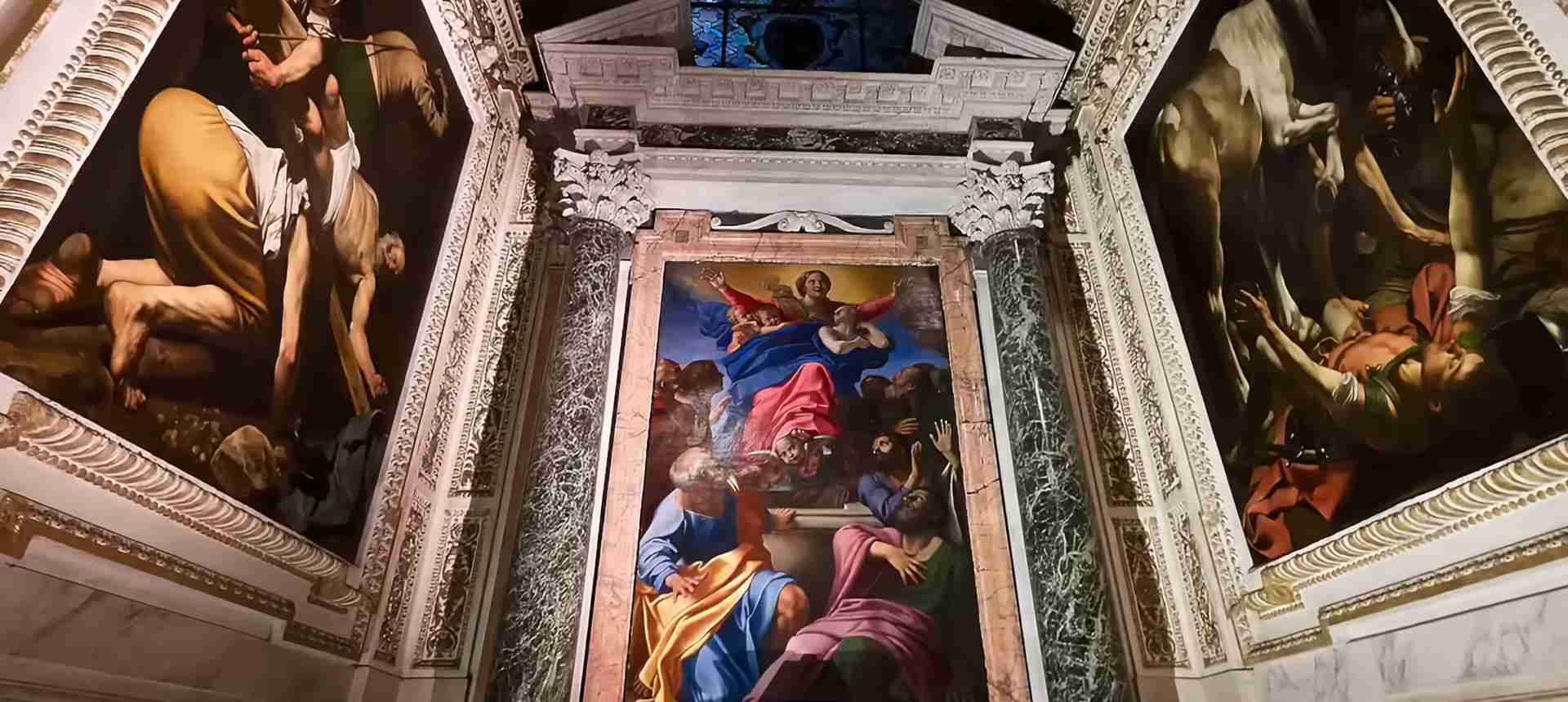
The Basilica of Santa Maria del Popolo facing Piazza del Popolo houses two Caravaggio masterpieces in the Cerasi Chapel—The Crucifixion of St. Peter (1600-1601) and The Conversion of St. Paul (1600-1601)—commissioned by papal treasurer Tiberio Cerasi specifically to complement Annibale Carracci’s altarpiece creating integrated baroque ensemble. These paintings represent Caravaggio’s mature style immediately following the St. Matthew cycle’s success, demonstrating intensified dramatic realism and compositional innovation that defined his revolutionary approach to religious narrative painting.
The Crucifixion of St. Peter depicts the apostle’s martyrdom with shocking immediacy—three executioners straining to raise the massive cross bearing Peter who requested inverted crucifixion considering himself unworthy of dying as Christ died. Caravaggio shows the physical labor of crucifixion with unprecedented realism: the executioner in foreground bends under the cross’s weight revealing dirty foot sole and tensed leg muscles, while Peter’s aged muscular body twists viewing the nail piercing his hand with expression mixing pain, resignation, and spiritual transcendence. The painting’s stark darkness broken only by focused light on Peter’s body and the executioners’ straining forms creates claustrophobic intensity forcing viewers into uncomfortable proximity with brutal violence. Rocky cliff background alludes to Peter’s name meaning “rock” upon which Christ built his church, theological symbolism grounding the painting’s raw physicality.
The Conversion of St. Paul portrays Saul’s dramatic transformation on the Damascus road when divine light struck him blind, converting Rome’s greatest Christian persecutor into Christianity’s most influential apostle Paul. Caravaggio’s radical compositional choice places Saul (future Paul) sprawled on ground with arms raised in surrender, illuminated by invisible divine light source while his massive horse dominates the composition’s upper half—the horse’s hindquarters and legs occupying more canvas than the conversion’s human protagonist. Contemporary critics attacked this unusual emphasis on animal anatomy over human drama, though Caravaggio’s innovation lies precisely in reducing religious ecstasy to vulnerable human collapse, with Saul’s closed eyes and passive posture suggesting spiritual blindness and total submission to overwhelming divine force. The stable hand calming the startled horse shows no awareness of the miraculous event occurring at his feet, emphasizing that divine intervention operates on spiritual plane invisible to those lacking faith.
The Cerasi Chapel’s spatial arrangement positions the two paintings facing each other on lateral walls flanking Annibale Carracci’s Assumption of the Virgin altarpiece, creating theological dialogue between Peter’s martyrdom (left wall) and Paul’s conversion (right wall)—the two apostles who established Christianity in Rome through different paths (Peter’s faith journey from Christ’s calling, Paul’s dramatic divine intervention). Viewers standing before the altar experience both paintings simultaneously, with Caravaggio’s characteristic darkness and focused illumination contrasting dramatically with Carracci’s lighter, more idealized altarpiece style representing competing baroque approaches in single chapel space.
Viewing these paintings requires careful attention to Caravaggio’s revolutionary perspective choices forcing viewers into participant roles rather than distant observers. The Crucifixion of St. Peter’s low viewpoint places viewers at ground level among executioners rather than elevated perspective allowing emotional distance, while The Conversion of St. Paul’s extreme foreshortening positions viewers dangerously close to the horse’s hooves and Saul’s prostrate form. These compositional strategies eliminate protective barrier between sacred narrative and contemporary viewer, fulfilling Counter-Reformation goals of making religious subjects emotionally immediate and spiritually transformative rather than aesthetically remote.
Practical information: Santa Maria del Popolo maintains free admission during visiting hours typically 7:30 AM-12:30 PM and 4:00 PM-7:00 PM Monday-Saturday, with Sunday hours 7:30 AM-1:30 PM and 4:30 PM-7:30 PM. The Cerasi Chapel sits to the left of the main altar in a prominent position ensuring easy location. Coin-operated lighting (€1 coins) illuminates both paintings simultaneously for approximately five minutes, though the chapel’s deeper darkness compared to San Luigi dei Francesi makes lighting especially crucial for viewing detail. The church’s position on Piazza del Popolo makes it easily accessible via Metro Line A (Flaminio station), with the piazza’s famous twin churches and Egyptian obelisk providing architectural context before entering to view Caravaggio’s works. Morning visits (8-10 AM) offer quietest viewing, while evening hours (5-7 PM) attract more visitors but provide beautiful natural light filtering through the church creating atmospheric viewing conditions.
Sant’Agostino: Madonna di Loreto
The Church of Sant’Agostino near Piazza Navona preserves Caravaggio’s Madonna di Loreto (also known as Pilgrim’s Madonna, 1604-1606), a revolutionary altarpiece depicting the Virgin Mary and Christ child appearing to two humble pilgrims whose dirty bare feet thrust prominently into foreground shocked contemporary viewers expecting idealized sacred imagery. This painting represents Caravaggio’s mature period when his increasingly controversial realism tested ecclesiastical tolerance, with the work’s acceptance by Sant’Agostino officials demonstrating his established reputation could overcome initial scandals his naturalistic approach provoked.
The Madonna di Loreto shows the Virgin standing in doorway holding the Christ child while two elderly pilgrims kneel before her—the male pilgrim’s bald head and female pilgrim’s wrinkled face and weathered hands depicting working-class Romans rather than idealized devotional types. Caravaggio’s most controversial choice places their bare feet prominently in the painting’s lower foreground, with visible dirt on soles emphasizing their poverty and the long pilgrimage undertaken to reach this sacred site. The Virgin herself appears as young Roman woman wearing simple dress rather than celestial robes, her relaxed contrapposto pose and bare foot visible beneath hem suggesting casual informality rather than hieratic distance. Only faint halos barely visible around Mary’s and Jesus’s heads indicate divine nature—otherwise the scene depicts ordinary mother and child receiving poor visitors at their door.
This radical humanization of sacred subjects fulfilled Counter-Reformation goals of making religious imagery accessible to common people who could see themselves reflected in biblical narratives, though conservative critics attacked the painting’s vulgarity and lack of decorum. The model Caravaggio used for the Virgin—widely rumored to be Maddalena Antonietti (known as “Lena”), a courtesan with whom he had tempestuous relationship—added scandal to theological controversy. However, the painting’s emotional authenticity and the pilgrims’ profound devotional expressions transcended contemporary criticisms, with the work remaining in Sant’Agostino while other controversial Caravaggio altarpieces faced rejection or removal.
The painting’s compositional structure creates intimate encounter between divine and human realms through architectural framing—the doorway where Mary stands suggests transition point between earthly and heavenly spheres, with darkness surrounding the figures except for focused light illuminating the Virgin, child, and pilgrims. This theatrical lighting typical of Caravaggio’s mature work creates supernatural atmosphere despite the figures’ naturalistic rendering, suggesting divine presence manifest through ordinary people in everyday settings rather than requiring idealized beauty or celestial spectacle.
Theological interpretation centers on the pilgrimage tradition to Loreto where according to legend angels transported the Virgin Mary’s house from Nazareth, making Loreto Italy’s most important Marian pilgrimage site. Caravaggio’s painting commemorates pilgrims’ devotion while democratizing access to divine grace—the Virgin appears to humble poor as readily as to wealthy, with their authentic faith rather than social status enabling the miraculous vision. The elderly pilgrims’ weathered faces and bodies testify to hard lives and long journeys undertaken for spiritual fulfillment, creating powerful Counter-Reformation message that Catholic faith serves all believers regardless of earthly condition.
Viewing the Madonna di Loreto: Sant’Agostino maintains free admission during visiting hours typically 7:30 AM-12:00 PM and 4:00 PM-7:30 PM daily, with the Caravaggio painting located in the Cavalletti Chapel (first chapel on the left entering the church). Coin-operated lighting (€1 coins) illuminates the painting for several minutes, essential for viewing details in the deliberately darkened chapel. The church’s central location near Piazza Navona makes it convenient to combine with visits to San Luigi dei Francesi (5-minute walk) creating efficient free Caravaggio circuit. The painting hangs in original commissioned location where Caravaggio intended it to be viewed, providing contextual understanding impossible in museum settings. Photography is generally permitted without flash, though respectful silence maintains the church’s sacred atmosphere during services and private prayer times.
Galleria Borghese: Rome’s Largest Caravaggio Collection
Galleria Borghese in Villa Borghese park houses Rome’s most comprehensive Caravaggio collection—six authenticated paintings spanning the artist’s complete career from early works painted shortly after arriving in Rome through late masterpieces created during his final fugitive years. The collection assembled by Cardinal Scipione Borghese, Caravaggio’s most important patron and protector, provides unparalleled opportunity to trace the artist’s stylistic evolution from technical brilliance attracting initial patronage through revolutionary naturalism that transformed baroque painting, all viewable within the intimate palace setting preserving aristocratic collecting context where these works originally functioned as private treasures rather than public altarpieces.
Young Sick Bacchus (1593-1594) represents Caravaggio’s earliest known self-portrait and one of his first Roman works, depicting himself as the god Bacchus with yellowish complexion suggesting illness (possibly malaria contracted shortly after arriving in Rome). The painting demonstrates technical mastery attracting Cardinal del Monte’s attention—meticulous rendering of fruit basket’s individual grapes, peaches, and vine leaves, transparent glass wine carafe revealing light refraction, and the sitter’s detailed features including fingernails showing dirt from grape handling. The work’s self-referential nature (artist depicting himself as wine god) suggests autobiographical meditation on artistic creation’s relationship to intoxication and inspiration, themes Caravaggio explored throughout his career. The painting’s small scale and intimate character indicate private devotional or study piece rather than public commission, typical of early works before major church commissions established his reputation.
Boy with a Basket of Fruit (1593-1595) shows similar technical virtuosity in genre painting style popular among Roman collectors—a young boy (possibly studio assistant or street model) presenting basket overflowing with summer fruit painted with botanical precision. Each fruit displays individualized character: ripe peaches with fuzzy skin texture, figs showing ripeness through splitting skin, grapes with transparent bloom, apples and pears at various stages of maturity. Caravaggio includes naturalistically decaying leaves and fruit past prime ripeness, rejecting idealized perfection for truthful observation characteristic of his revolutionary approach. The painting’s plain dark background and strong directional lighting demonstrate early mastery of chiaroscuro technique that would define his mature religious works, though applied here to secular subject matter establishing his credentials among aristocratic patrons before attempting controversial religious commissions.
St. Jerome Writing (c. 1605) depicts the scholar-saint translating the Bible into Latin (the Vulgate) surrounded by books, skull symbolizing mortality, and cardinal’s red drape despite Jerome living centuries before the cardinalate office existed. Caravaggio portrays Jerome as aged scholar with balding head, wrinkled face, and weathered hands, concentrating intensely on the manuscript before him while holding quill mid-stroke. The painting’s dramatic chiaroscuro shows Caravaggio’s mature technique fully developed—Jerome’s illuminated head and hands emerge from surrounding darkness creating focused attention on intellectual labor, while the skull positioned prominently in foreground reminds viewers of death’s inevitability making Jerome’s scholarly work urgent spiritual task rather than mere academic exercise. The painting’s meditative quiet contrasts with Caravaggio’s violent martyrdom scenes, demonstrating range beyond dramatic action to contemplative subjects requiring psychological rather than physical intensity.
Madonna and Child with St. Anne (1605) continues Caravaggio’s controversial approach to Marian imagery, depicting the Virgin as young peasant woman holding the Christ child who tramples a serpent (symbolizing sin and Satan) while elderly St. Anne observes—the painting rejected by Vatican officials for Palafrenieri Chapel commission due to excessive naturalism, particularly Mary’s bare neck and exposed ankle considered too sensual for devotional painting. Caravaggio modeled the Virgin on Maddalena Antonietti (Lena), the same courtesan who sat for Madonna di Loreto at Sant’Agostino, adding to the scandal since contemporary viewers recognized the model’s identity. Cardinal Scipione Borghese purchased the rejected painting for his private collection, demonstrating how controversial works church officials rejected became prized possessions among aristocratic collectors appreciating Caravaggio’s naturalism precisely because it challenged conventional piety.
David with the Head of Goliath (1609-1610) represents one of Caravaggio’s final works, painted during exile after fleeing Rome for killing Ranuccio Tomassoni. The painting shows young David holding the severed head of the giant Goliath, with Caravaggio depicting himself as Goliath’s decapitated head—a shocking self-portrait suggesting guilt, mortality awareness, and possible penitential offering seeking papal pardon enabling return to Rome. David’s expression mixes compassion and horror viewing the severed head, while Goliath’s features show death’s transformation of living flesh. The painting’s dark background and restricted palette (mostly browns and blacks with flesh tones) create somber mood contrasting with earlier works’ richer colors, reflecting Caravaggio’s deteriorating circumstances during final fugitive years. The work functions as complex meditation on sin, violence, guilt, and redemption, themes dominating Caravaggio’s final period when his own criminal violence haunted his artistic production.
St. John the Baptist (c. 1610) shows the saint as adolescent boy reclining in rocky landscape with ram, interpreting the traditional desert ascetic as sensual youth with ambiguous expression and provocative pose. The painting’s eroticism shocked contemporary viewers expecting pious devotional imagery, though Caravaggio’s psychological complexity prevents simple categorization as merely scandalous—John’s melancholic expression and isolated wilderness setting suggest spiritual struggle rather than celebratory sensuality. The work demonstrates Caravaggio’s late style’s psychological intensity, with figures conveying complex emotional states through posture and expression requiring sustained contemplative viewing to appreciate fully. This painting represents the Galleria Borghese collection’s latest work chronologically, providing conclusion to the artistic journey beginning with Young Sick Bacchus created seventeen years earlier.
Viewing the Galleria Borghese collection: The museum requires mandatory advance booking with timed two-hour entry slots limiting capacity to 360 visitors per timeslot, creating intimate viewing conditions rare in major museums. Tickets cost €16 admission plus €2 booking fee, available through the official website releasing tickets 10 days in advance though popular slots sell out quickly requiring booking weeks or months ahead during peak seasons. The museum operates Tuesday-Sunday 9 AM-7 PM with final entry 5 PM, closed Mondays. The six Caravaggio paintings scatter across ground floor galleries requiring complete museum circuit to view all works, though clearly marked room numbers and gallery maps provided at entrance facilitate locating specific paintings. The two-hour time limit proves sufficient for thorough Caravaggio viewing plus appreciation of Bernini sculptures and other Renaissance masterworks forming the collection, though visitors focusing exclusively on Caravaggio can view all six works within 45-60 minutes. Photography is permitted without flash or tripods, enabling personal documentation of this exceptional collection.
Vatican Museums: The Entombment of Christ
The Vatican Museums’ Pinacoteca (Vatican Picture Gallery) preserves The Entombment of Christ (1603-1604), Caravaggio’s most monumental and universally praised work receiving rare contemporary approval from critics who normally attacked his naturalistic excesses. Originally commissioned for the Vittrice Chapel in Santa Maria in Vallicella church (Chiesa Nuova), Napoleon’s troops seized the painting in 1797 transporting it to Paris, with the work returning to Rome in 1816 but installed in Vatican Museums rather than original church location where a copy now hangs.
The painting depicts Christ’s body being lowered into his tomb by Nicodemus and St. John following the crucifixion, with the Virgin Mary, Mary Magdalene, and Mary of Cleophas mourning the dead Christ. Caravaggio’s compositional innovation arranges six life-size figures in compressed space creating frieze-like horizontal composition unusual for vertically oriented altarpieces, with the diagonal descent from upper left (Mary of Cleophas raising arms toward heaven) through Christ’s body to lower right (the tomb’s stone edge projecting illusionistically beyond the picture plane into viewer space) creating dynamic movement despite the scene’s somber stillness. The painting’s emotional restraint contrasts with Caravaggio’s typically violent dramatic scenes—the mourners’ grief expresses through quiet gestures and downcast faces rather than theatrical displays, while Christ’s pale dead body shows death’s physical reality without gratuitous emphasis on crucifixion wounds.
The work’s extraordinary technical accomplishment won praise from Caravaggio’s harshest critics, with contemporary art biographer Giovanni Baglione (normally hostile toward Caravaggio) acknowledging the painting’s exceptional quality. The lifelike rendering of Christ’s pale corpse contrasting with living figures’ warm flesh tones, the complex foreshortening of multiple overlapping bodies, the drapery’s convincing weight and texture, and the psychological intensity of individualized grief expressions demonstrate Caravaggio’s complete mastery of naturalistic painting’s technical challenges. The stone slab’s illusionistic projection into viewer space—appearing to extend beyond the picture plane where viewers could theoretically rest objects—shows Caravaggio’s interest in breaking barriers between painted fiction and viewer reality, engaging viewers as participants rather than distant observers.
Theological interpretation focuses on the painting’s Eucharistic symbolism: Christ’s body positioned on stone slab resembles priest elevating the consecrated host at Mass, with the tomb’s edge functioning as altar where Christ’s sacrifice becomes perpetually present through sacramental mystery. Mary Magdalene’s tears falling toward the stone slab suggest baptismal waters of spiritual rebirth, while Mary of Cleophas’s raised arms echo priests’ gestures during Mass’s consecration. These liturgical allusions made the painting particularly appropriate for chapel altarpiece where it would hang above actual altar where Mass was celebrated, creating visual and theological connection between painted representation and sacramental re-presentation of Christ’s sacrifice.
The painting’s removal from original church context and installation in Vatican Museums allows appreciation of technical virtuosity while losing the architectural and liturgical framework Caravaggio designed the composition for specifically. The altarpiece’s unusual horizontal emphasis makes sense viewing it in the Vittrice Chapel’s narrow width where vertical compositions would appear cramped, while the stone slab’s illusionistic projection originally aligned with the chapel’s actual altar below creating spatial continuity between painted and real architecture. Museum presentation enables close examination impossible in darkened chapel settings, though the contextual loss means modern viewers experience the painting as isolated masterpiece rather than integrated element of baroque chapel ensemble.
Viewing The Entombment: The painting hangs in the Vatican Museums’ Pinacoteca (Room VIII) requiring standard Vatican Museums admission (€20 plus €5 online booking fee equals €25 total with advance purchase, included in all Vatican Museums tickets). The Pinacoteca occupies a separate building within the Vatican Museums complex accessed after walking through main sculpture galleries and Sistine Chapel route, meaning visitors completing typical Vatican Museums tours encounter the painting near their route’s conclusion. The painting’s large scale (dimensions 300 cm × 203 cm) and prominent Room VIII position ensure easy location once reaching the Pinacoteca section. Vatican Museums operate Monday-Saturday 9 AM-6 PM (last entry 4 PM) with extensive holiday closures, requiring careful scheduling. Advanced booking eliminates ticket purchase queues (potentially 1-3 hours during peak season) though all visitors undergo security screening regardless of ticket type. The complete Vatican Museums circuit requires 2.5-4 hours with Pinacoteca representing final section, so visitors specifically seeking The Entombment should plan museum timing accordingly or arrange specialized Pinacoteca-focused visits bypassing the main galleries and Sistine Chapel if solely interested in paintings collection.
Palazzo Barberini: Judith and Narcissus
Palazzo Barberini, housing the Galleria Nazionale d’Arte Antica (National Gallery of Ancient Art), preserves two significant Caravaggio works demonstrating his range across violent biblical narrative (Judith Beheading Holofernes, 1598-1599) and mythological psychological study (Narcissus, 1597-1599). The palazzo’s magnificent baroque architecture and frescoed ceilings by Pietro da Cortona create impressive setting for viewing these works alongside extensive Renaissance and baroque painting collections, with the Caravaggio paintings representing highlights of the gallery’s holdings.
Judith Beheading Holofernes depicts the moment when Jewish widow Judith decapitates Assyrian general Holofernes to save her people from siege, with Caravaggio portraying the beheading with shocking physical realism—blood spurting from the partially severed neck, Judith’s determined expression showing revulsion mixed with resolve, Holofernes’s face contorted in death agony, and elderly maidservant waiting with bag to carry the head back to Jewish camp. The painting’s graphic violence shocked contemporary viewers even in an era accustomed to martyrdom scenes, with Caravaggio’s unflinching depiction of decapitation’s physical reality exceeding conventional artistic decorum. The work demonstrates his characteristic dramatic lighting with figures emerging from darkness, strong diagonals creating dynamic movement, and psychological complexity showing Judith as reluctant hero forced into violent action rather than triumphant warrior celebrating victory.
The painting’s gender dynamics provoked contemporary controversy—depicting female heroism through violent masculine action challenged conventional gender roles, while Holofernes’s vulnerable position (half-naked in bed, killed through feminine deception rather than martial combat) subverted typical power relationships between male aggressor and female victim. Some scholars interpret the work as reflecting Caravaggio’s complicated relationships with women, particularly since contemporary sources suggest Caravaggio used courtesan models for Judith’s figure. However, Counter-Reformation theology emphasized Judith as Old Testament type prefiguring Virgin Mary’s victory over Satan, making the painting acceptable despite its violence through theological interpretation legitimizing the brutal imagery.
Narcissus shows the mythological hunter who fell in love with his own reflection and died gazing at his image in pool, with Caravaggio depicting the moment of self-recognition creating circular composition formed by Narcissus’s body curving toward his reflection in water. The painting’s innovative compositional structure creates visual metaphor for narcissism’s self-enclosed nature—Narcissus and his reflection form complete circle excluding external world, with the figure’s absorption in his image suggesting psychological isolation rather than simply visual infatuation. The work’s subdued palette dominated by browns and blacks with flesh tones creates somber mood appropriate to the tragic myth, while Caravaggio’s characteristic chiaroscuro illuminates Narcissus’s body against dark background suggesting spotlight effect focusing attention on the doomed youth.
The painting demonstrates Caravaggio’s interest in mythological subjects during his early Roman period when he sought patronage by demonstrating versatility across religious, mythological, and genre painting categories. The psychological complexity showing Narcissus’s mixture of fascination and melancholy rather than simple vanity reveals Caravaggio’s ability to invest classical subjects with emotional depth transcending conventional mythological illustration. The work’s small scale and intimate character suggest private cabinet painting for sophisticated collector rather than public display, typical of mythological works functioning as intellectual exercises demonstrating learned classical knowledge alongside technical artistic skill.
Viewing Palazzo Barberini’s Caravaggio works: The museum operates Tuesday-Sunday 10 AM-7 PM (closed Mondays) with tickets available online or at entrance (€12 admission, €15 during special exhibitions). The palazzo occupies two floors with paintings galleries requiring circuit through multiple rooms, though clear signage and room numbering facilitate locating specific works. Judith Beheading Holofernes and Narcissus hang in separate galleries requiring complete tour to view both paintings, combined viewing time approximately 20-30 minutes for focused Caravaggio study though the museum’s extensive collections merit additional time. The palazzo’s central location near Piazza Barberini metro station (Line A) makes it easily accessible from other major Rome attractions, though its position outside typical Vatican-Colosseum tourist circuit means fewer crowds than Rome’s most famous museums. Photography is permitted without flash or tripods, enabling personal documentation while protecting artwork from damaging light exposure. The museum provides modest crowds compared to Vatican Museums or Galleria Borghese, offering more contemplative viewing conditions ideal for appreciating Caravaggio’s technical details and psychological nuances.
Capitoline Museums: St. John the Baptist
The Capitoline Museums (Musei Capitolini) atop Capitoline Hill preserve Caravaggio’s St. John the Baptist (1602), an early treatment of this subject showing the desert ascetic as playful adolescent in composition art historians recognize as consciously referencing Michelangelo’s Sistine Chapel nudes—Caravaggio paying homage to Rome’s greatest artistic genius while simultaneously demonstrating his own revolutionary naturalistic approach. This painting differs significantly from the later St. John at Galleria Borghese, representing Caravaggio’s evolving interpretation of the saint’s character from youthful energy to mature melancholy across the eight years separating the two works.
The painting depicts St. John as naked youth embracing a ram in rocky wilderness setting, with the saint’s licentious smile and provocative pose creating erotic undertones shocking to contemporary viewers expecting pious devotional imagery. Caravaggio’s model appears to be street youth rather than idealized classical figure, with realistic anatomy, tousled hair, and direct gaze engaging viewers intimately rather than maintaining hieratic distance typical of religious art. The ram’s inclusion references John’s role as “Lamb of God” prophet announcing Christ’s sacrificial mission, though the animal’s realistic rendering and the saint’s casual embrace create more pastoral genre scene than explicitly religious iconography.
The compositional reference to Michelangelo’s Sistine Chapel ignudi (nude figures) demonstrates Caravaggio’s sophisticated engagement with Renaissance artistic tradition while subverting its idealizing tendencies. Where Michelangelo depicted perfected human forms representing divine creation’s beauty, Caravaggio shows actual Roman youth complete with physical imperfections and contemporary street character, arguing implicitly that sacred truth reveals through nature’s reality rather than artistic idealization. This dialectic between Renaissance idealism and baroque naturalism defined Caravaggio’s revolutionary impact, with works like this St. John demonstrating technical mastery equal to Renaissance masters while rejecting their aesthetic premises.
The painting’s red drapery provides characteristic Caravaggio visual signature appearing in multiple St. John paintings across his career, creating chromatic accent against predominantly brown and ochre palette while symbolizing martyrdom foreshadowing the saint’s eventual beheading. The drapery’s rich folds and texture demonstrate Caravaggio’s exceptional ability to render textile qualities convincingly, technical skill establishing his credentials among collectors while the figure’s naturalism provoked controversy among church officials commissioning devotional works. This tension between technical excellence and controversial subject treatment characterized Caravaggio’s entire career, with aristocratic collectors like Cardinal del Monte championing works church officials rejected or found scandalous.
Viewing the Capitoline Museums’ St. John: The museums occupy two palaces flanking Piazza del Campidoglio atop Capitoline Hill, connected by underground tunnel gallery. Standard admission (€16) includes access to both palaces plus temporary exhibitions, with tickets available online or at entrance though advance purchase recommended during peak season. The museums operate Tuesday-Sunday 9:30 AM-7:30 PM (closed Mondays) with last entry one hour before closing. The Caravaggio painting hangs in the Pinacoteca (picture gallery) section of Palazzo dei Conservatori requiring navigation through sculpture galleries and temporary exhibition spaces before reaching painting rooms. The museum’s comprehensive ancient Roman sculpture collection makes it worth visiting beyond the single Caravaggio, though focused visitors can locate the St. John within 20-30 minutes of entry. The hilltop location provides spectacular views across Roman Forum and city, with Michelangelo-designed piazza creating magnificent architectural context for museum visit. Photography is permitted without flash in most galleries including the Pinacoteca, though staff enforce rules strictly protecting artworks from light damage.
Additional Caravaggio Locations in Rome
Beyond the major churches and museums detailed above, several additional Roman locations preserve authenticated Caravaggio works or recently discovered paintings requiring specialized visits for completist Caravaggio pilgrims seeking comprehensive encounter with the artist’s Roman oeuvre. These locations range from accessible museums with standard visiting hours to private palaces requiring advance tour arrangements, collectively adding six to eight works to the approximately eighteen paintings detailed in previous sections.
Galleria Doria Pamphilj, a privately owned palace-museum near Via del Corso, houses three Caravaggio works including Rest on the Flight into Egypt (1597), Mary Magdalene in Ecstasy (c. 1606), and St. John the Baptist (another version, c. 1610). The museum operates as commercial enterprise charging admission (€14) while maintaining aristocratic atmosphere with paintings displayed in densely hung arrangements typical of 17th-century collecting rather than modern museum spacing. Operating hours run Monday, Wednesday-Sunday 9 AM-7 PM (closed Tuesdays) with audio guide included in admission explaining the Doria Pamphilj family history and collection highlights. The Caravaggio works scatter across multiple galleries requiring complete museum circuit, though clearly marked room numbers facilitate navigation.
Palazzo Corsini in Trastevere, part of Galleria Nazionale d’Arte Antica (same institution as Palazzo Barberini), preserves another St. John the Baptist version showing the saint seated against dark background with red drapery, painted during Caravaggio’s late period. Museum admission (€12 or combined ticket with Palazzo Barberini €16) grants access Tuesday-Sunday 10 AM-7 PM (closed Mondays), with the palazzo’s across-river location meaning fewer crowds than central Rome museums. The building’s magnificent baroque architecture and Trastevere neighborhood’s atmospheric streets make the visit worthwhile beyond the single Caravaggio, though serious Caravaggio scholars consider this St. John essential for understanding the artist’s evolving treatment of this frequently painted subject.
Chiesa di Santa Maria della Concezione dei Cappuccini on Via Veneto houses a recently authenticated Caravaggio painting, The Meditation of St. Francis (1605), displayed as part of the church’s museum highlighting Capuchin artistic and cultural heritage. Museum admission (€10) includes access to famous bone crypts decorated with Capuchin skeletal remains arranged in elaborate patterns, with the Caravaggio painting representing additional artistic highlight beyond the crypts’ macabre fascination. Operating hours run daily 9 AM-7 PM (last entry 6:30 PM) with the painting’s authentication in recent years making it significant discovery adding to Rome’s Caravaggio inventory.
Casino Boncompagni Ludovisi contains Caravaggio’s only ceiling fresco, Jupiter, Neptune and Pluto (c. 1597), painted in oil directly on plaster ceiling showing the three gods associated with air, water, and earth. The casino operates as private property requiring advance tour booking through specialized operators (approximately €12-15 per person), with limited visiting hours typically Wednesday, Saturday, Sunday mornings by reservation only. The fresco’s rarity as Caravaggio’s sole surviving architectural painting makes it essential viewing for scholars and dedicated enthusiasts, though the specialized access requirements prevent casual visits. The work’s alchemical symbolism and mythological subject matter demonstrate Caravaggio’s early period versatility before specializing in religious subjects, while the technical challenge of ceiling painting shows his willingness to attempt formats typically assigned to fresco specialists like his contemporary Annibale Carracci.
Planning Your Caravaggio Pilgrimage: Practical Strategies
Experiencing Rome’s complete Caravaggio collection requires strategic planning balancing free church access, advance museum bookings, geographic clustering, and stamina management across multiple days given the works’ distribution throughout the city. A comprehensive Caravaggio visit demands minimum three to four days allowing proper viewing time at each location without exhausting marathon sessions rushing between sites, though focused visitors prioritizing major works can achieve satisfactory overview within two days by concentrating on the six church paintings and Galleria Borghese collection.
The optimal strategy dedicates Day 1 to the free church circuit covering San Luigi dei Francesi, Santa Maria del Popolo, and Sant’Agostino—all located within 15-minute walking radius in historic center enabling single afternoon or morning session. Begin at San Luigi dei Francesi (opening 9:30 AM avoiding crowds), spend 30-45 minutes with the St. Matthew cycle using multiple coin illuminations for thorough viewing, walk 10 minutes to Sant’Agostino for Madonna di Loreto (15-20 minutes viewing), then proceed to Santa Maria del Popolo at Piazza del Popolo (20-minute walk) for the Cerasi Chapel paintings (30-40 minutes viewing). This circuit requires 2-3 hours total including walking time, accomplished comfortably before churches close for midday break (12:30 PM) or during afternoon reopening (3:30-6:30 PM). Carry €5-10 in €1 coins for lighting systems across all three churches.
Day 2 focuses on Galleria Borghese requiring advance booking weeks or months ahead during peak season, with two-hour timed entry slots enabling thorough viewing of the six Caravaggio paintings plus Bernini sculptures and Renaissance masterworks forming the exceptional collection. Book earliest available slot (9 AM) when crowds remain minimal and morning light enters gallery windows beautifully, or late afternoon slot (5 PM) providing quieter viewing though reduced natural illumination. The museum’s Villa Borghese park location enables combining the visit with park strolling, Pincio Terrace views, or nearby attractions like the Bioparco (Rome’s zoo), though the two-hour viewing limit leaves limited time for additional activities if fully appreciating the Borghese collection.
Day 3 addresses Vatican Museums for The Entombment of Christ, requiring separate Vatican admission and navigation through extensive museum complex to reach the Pinacoteca where the painting hangs. Book earliest available Vatican slot (9 AM) completing the main galleries, Sistine Chapel, and Pinacoteca circuit by early afternoon (typical visit 3-4 hours), then proceed to Palazzo Barberini (20-minute walk or metro) for Judith Beheading Holofernes and Narcissus during afternoon hours. This combination efficiently covers three Caravaggio works in single day while experiencing two of Rome’s great museum collections, though the extended museum time demands significant stamina and art appreciation endurance.
Day 4 completes remaining museums: Capitoline Museums for St. John the Baptist combined with ancient sculpture collection and Forum views (2-3 hours), then Palazzo Corsini across river in Trastevere for another St. John version (1 hour), potentially adding Galleria Doria Pamphilj if energy permits (2 hours). This day proves less intensive than previous museum marathon days, allowing leisurely pacing and spontaneous detours to additional Trastevere attractions or Capitoline Hill archaeological sites. Specialized locations like Casino Boncompagni Ludovisi and Chiesa dei Cappuccini require separate scheduling based on their limited access hours, added to comprehensive itinerary for completist scholars seeking every authenticated Caravaggio in Rome.
Geographic clustering enables efficient routing: the historic center church circuit (San Luigi, Sant’Agostino, Santa Maria del Popolo) forms natural single-session group; Villa Borghese area concentrates Galleria Borghese with nearby Villa Medici and gardens; Capitoline Museums pair logically with Roman Forum and Imperial Fora archaeological sites; Vatican Museums combine naturally with Castel Sant’Angelo and St. Peter’s Basilica; Palazzo Barberini near Piazza Barberini connects efficiently with Via Veneto attractions; Trastevere locations (Palazzo Corsini, potentially others) integrate with neighborhood dining and evening exploration. Planning daily routes around these geographic clusters minimizes backtracking while enabling auxiliary sightseeing contextualizing the Caravaggio viewing experience.
Seasonal considerations affect both crowd levels and viewing conditions: summer (June-August) brings maximum tourism creating long museum queues and sold-out Galleria Borghese tickets requiring booking months ahead, though extended daylight hours enable efficient daily schedules. Spring and fall shoulder seasons (April-May, September-October) provide ideal balance between manageable crowds and comfortable weather, with Galleria Borghese tickets booking 4-6 weeks ahead typically sufficient. Winter (November-March excluding Christmas/New Year) offers minimal crowds and immediate Galleria Borghese availability, though reduced daylight hours (sunset 4:30-5:30 PM) compress sightseeing windows and church natural lighting suffers from weak winter sun. First Sundays each month grant free Vatican and Capitoline Museums admission though crowds triple normal volumes negating the cost savings through reduced viewing quality.
Understanding Caravaggio’s Revolutionary Technique
Caravaggio’s lasting influence on Western art stems from technical innovations that fundamentally altered how painters approached naturalism, light, and compositional drama. His revolutionary chiaroscuro technique—violent contrasts between illuminated figures and surrounding darkness—created theatrical spotlight effects that directed viewer attention while investing scenes with supernatural atmosphere despite rigorously naturalistic rendering. This approach differed radically from Renaissance modeling using subtle tonal gradations building form through continuous value transitions, instead positioning single focused light sources in darkened studios creating harsh shadows and brilliant highlights transferring directly to canvas without idealization.
The naturalistic observation underlying all Caravaggio’s works rejected academic training emphasizing idealized beauty derived from classical sculpture and Renaissance masters’ perfected forms. Caravaggio painted directly from live models—often street people, laborers, and courtesans rather than professional models maintaining conventional beauty standards—refusing to “improve” nature through artistic intervention. This radical empiricism meant biblical figures appeared as contemporary Romans complete with weathered faces, callused hands, and dirty feet rather than ethereal beings transcending physical reality. The approach scandalized church officials expecting devotional decorum while fulfilling Counter-Reformation goals of making religious subjects emotionally immediate and spiritually accessible to common believers who could recognize themselves in sacred narratives.
Compositional innovations including extreme foreshortening, dramatic diagonal arrangements, and unconventional viewpoints forced viewers into participant roles rather than distant observers. The Crucifixion of St. Peter’s low angle places viewers at ground level among executioners, The Calling of St. Matthew’s finger pointing simultaneously at Matthew and toward viewers implicates them in Christ’s summons, David with the Head of Goliath’s frontal presentation of the severed head confronts viewers with violence’s brutal reality without protective aesthetic distance. These compositional strategies eliminated barriers between painted fiction and viewer reality, fulfilling baroque art’s theatrical goals of engaging viewers emotionally and spiritually rather than offering contemplative aesthetic appreciation of technical virtuosity.
The psychological intensity pervading Caravaggio’s religious works transformed traditional iconographic formulas into psychologically complex human dramas. Rather than depicting saints in conventional hieratic poses demonstrating their sanctity through external attributes (halos, robes, symbolic objects), Caravaggio showed spiritual transformation through facial expressions, body language, and psychological gestures revealing internal states. Matthew’s stunned recognition in The Calling, Peter’s mingled pain and transcendence during crucifixion, Paul’s total surrender collapsing under divine intervention—these psychological moments create narrative drama through character psychology rather than external action alone. This emphasis on internal emotional states rather than external iconographic symbols required viewers to engage empathetically with painted figures as psychologically complex individuals rather than remote sacred types.
Technical execution demonstrates Caravaggio’s exceptional observational skills and painting fluency. X-ray analysis reveals he typically worked without preliminary drawings, composing directly on canvas through successive adjustments and refinements visible in pentimenti (artist’s changes) showing repositioned figures and altered compositions. This spontaneous approach enabled capturing immediate visual impressions and psychological gestures impossible through laborious preliminary study drawings that Renaissance training emphasized. The technique required absolute confidence in observational accuracy and painting skill, with mistakes irreversible without completely repainting passages—risk Caravaggio accepted in pursuit of naturalistic immediacy and psychological authenticity transcending calculated academic perfection.
The influence extending from Caravaggio’s innovations created international movement of “Caravaggisti” followers adopting his chiaroscuro technique, naturalistic observation, and dramatic compositions across Europe. Major artists including Artemisia Gentileschi, Orazio Gentileschi, Bartolomeo Manfredi in Italy, Georges de La Tour and Valentin de Boulogne in France, José de Ribera in Spain, and numerous northern European painters spread Caravaggio’s revolution transforming baroque painting throughout Catholic Europe. This influence persisted despite his personal reputation’s posthumous deterioration as moralists condemned his violent criminal behavior and controversial lifestyle, with the paintings’ visual and emotional power transcending biographical scandals to reshape Western art’s fundamental approaches to naturalism and dramatic narrative.
Frequently Asked Questions About Caravaggio in Rome
What is the best order to visit Caravaggio sites in Rome?
Begin with the free church circuit (San Luigi dei Francesi, Santa Maria del Popolo, Sant’Agostino) accomplishing all three in single morning or afternoon session taking 2-3 hours total including walking between locations, maximizing initial Caravaggio exposure while requiring no advance bookings or admission fees. This introduction establishes understanding of Caravaggio’s revolutionary church commissions and chiaroscuro technique before proceeding to museum collections. Next, visit Galleria Borghese (requiring weeks-ahead advance booking) providing comprehensive overview of six works spanning early through late periods, with the collection’s chronological range enabling appreciation of stylistic evolution impossible viewing scattered individual works. Subsequently add Vatican Museums for The Entombment of Christ combined with typical Vatican sightseeing, Palazzo Barberini for Judith and Narcissus, and Capitoline Museums for St. John the Baptist as schedule and interest permit. This progression moves from free accessible works through progressively specialized museum collections, building Caravaggio knowledge systematically while accommodating varying commitment levels from casual appreciation through scholarly completism.
Are there guided Caravaggio tours in Rome?
Multiple tour operators offer specialized Caravaggio walking tours focusing on the three major churches (San Luigi dei Francesi, Santa Maria del Popolo, Sant’Agostino) typically lasting 2-3 hours costing €40-80 per person with licensed art historian guides providing historical context, technical analysis, and biographical information enriching viewing beyond self-guided church visits. These tours prove particularly valuable for first-time Caravaggio viewers wanting expert interpretation of the paintings’ revolutionary innovations and Counter-Reformation theological contexts, though experienced art lovers comfortable with independent viewing find the church’s free access sufficient without guided mediation. Museum-focused tours combining Galleria Borghese or Palazzo Barberini Caravaggio works with broader collection highlights typically cost €60-100 per person including skip-the-line admission, worthwhile when Galleria Borghese tickets sell out enabling guaranteed access through tour operator allocations. Private tours offering customized Caravaggio itineraries accommodating specific interests and flexible scheduling run €200-400 for half-day experiences, appropriate for serious enthusiasts or small groups seeking intensive focused study without general tour constraints.
Can I photograph Caravaggio paintings in Rome?
Photography policies vary by location: churches generally permit non-flash photography of Caravaggio paintings though some explicitly prohibit photography requiring discrete observation, while museums universally allow non-flash photography without tripods or professional equipment protecting artworks from light damage while enabling personal documentation. San Luigi dei Francesi, Santa Maria del Popolo, and Sant’Agostino historically permitted photography though enforcement varies with individual guards sometimes requesting no photography during services or private prayer times—respectfully comply with staff instructions maintaining sacred atmosphere. Galleria Borghese, Vatican Museums, Palazzo Barberini, and Capitoline Museums all allow non-flash photography with clear signage and staff enforcement preventing flash usage and tripod setups. The coin-operated lighting systems in churches create challenging photography conditions with timed illumination requiring quick shooting during the 3-5 minute lighting cycles, though experienced photographers using appropriate ISO settings can achieve decent results within these constraints. Professional photography or commercial usage universally requires advance permission and potential fees, with casual tourist photography universally accepted under non-flash restrictions.
Why do Caravaggio paintings look so dark?
Caravaggio’s revolutionary chiaroscuro technique deliberately created violent contrasts between illuminated figures and surrounding darkness, positioning single focused light sources illuminating subjects against black or very dark backgrounds creating theatrical spotlight effects directing viewer attention while investing scenes with supernatural atmosphere despite rigorously naturalistic rendering. This approach reflected both artistic choice and working method: Caravaggio painted in darkened studios using controlled artificial light sources (candles, oil lamps) positioned to create specific shadow patterns and highlight effects, then transferred these exact lighting conditions to canvas without modification. The technique differs fundamentally from Renaissance modeling using subtle tonal gradations building form through continuous value transitions, instead employing harsh directional lighting creating dramatic shadows and brilliant highlights. Additionally, centuries of dirt accumulation, darkened varnish layers, and environmental exposure have further obscured original colors making paintings appear even darker than Caravaggio initially intended, though recent restorations of works like the St. Matthew cycle have revealed brighter original palettes beneath accumulated grime while maintaining the characteristic chiaroscuro contrasts defining his revolutionary style.
What makes Caravaggio’s style revolutionary?
Caravaggio revolutionized Western painting through three interconnected innovations: radical naturalism depicting biblical subjects as contemporary street figures rather than idealized types, dramatic chiaroscuro creating theatrical lighting effects through violent light-dark contrasts, and psychological intensity investing religious scenes with emotional immediacy rather than remote devotional decorum. The naturalistic approach shocked contemporaries by portraying saints with dirty feet, madonnas modeled by prostitutes, and biblical events occurring in Roman taverns among recognizable contemporary types rather than perfected classical figures inhabiting ethereal heavenly realms. This democratization of sacred imagery fulfilled Counter-Reformation goals of making religion emotionally accessible to common believers while scandalizing conservative church officials expecting traditional devotional aesthetics. The chiaroscuro technique transformed compositional drama from Renaissance spatial perspective and balanced arrangements to baroque theatrical illumination directing viewer attention through controlled light rather than architectural framing. Psychological complexity showed spiritual transformation through facial expressions and body language revealing internal emotional states rather than external iconographic symbols, requiring viewers to engage empathetically with painted figures as psychologically complex individuals experiencing genuine human emotions during sacred moments. These innovations collectively created baroque painting’s characteristic emotional immediacy and dramatic intensity influencing European art for centuries.
Why were some Caravaggio paintings rejected by churches?
Church officials rejected several Caravaggio altarpieces for excessive naturalism violating devotional decorum: Madonna dei Palafrenieri (now at Galleria Borghese) showing Virgin with bare neck and ankle considered too sensual, Death of the Virgin (now in Louvre, originally painted for Santa Maria della Scala) depicting the Virgin as dead peasant woman with swollen body supposedly modeled on drowned prostitute, St. Matthew and the Angel’s first version (destroyed in World War II) showing Matthew as illiterate peasant with angel physically guiding his writing hand considered insufficiently dignified. These rejections reflected conflict between Caravaggio’s commitment to naturalistic observation showing sacred figures as real humans subject to physical reality versus church expectations of idealized beauty and spiritual transcendence appropriate for devotional contemplation. The Counter-Reformation’s emphasis on emotionally engaging imagery theoretically supported Caravaggio’s approach making religious subjects accessible through recognizable contemporary types, though conservative officials found his unflinching realism crossed boundaries from appropriate naturalism into scandalous vulgarity. Rejected paintings typically found alternative buyers among aristocratic collectors who prized Caravaggio’s naturalism precisely because it challenged conventional piety, with Cardinal Scipione Borghese purchasing multiple rejected works for his private collection demonstrating how controversial pieces churches refused became highly valued possessions among sophisticated patrons appreciating artistic innovation over devotional orthodoxy.
How long does it take to see all Caravaggio paintings in Rome?
Viewing all publicly accessible Caravaggio paintings in Rome requires minimum three to four full days allowing proper viewing time at each location without exhausting marathon sessions, though focused visitors prioritizing major works can achieve satisfactory overview within two days concentrating on the six free church paintings and Galleria Borghese collection. The three-church circuit (San Luigi dei Francesi, Santa Maria del Popolo, Sant’Agostino) requires 2-3 hours including walking time and thorough viewing with multiple lighting activations at each location. Galleria Borghese’s mandatory two-hour timed entry slot proves sufficient for viewing six Caravaggio works plus Bernini sculptures and broader collection highlights. Vatican Museums require 3-4 hours completing the standard circuit reaching the Pinacoteca where The Entombment hangs. Palazzo Barberini and Capitoline Museums each demand 1.5-2 hours for Caravaggio viewing plus broader collection appreciation. Additional specialized locations (Galleria Doria Pamphilj, Palazzo Corsini, Chiesa dei Cappuccini, Casino Boncompagni Ludovisi) add another 4-6 hours cumulatively. This totals approximately 15-20 hours actual viewing and museum time, plus transportation between locations, breaks, and auxiliary sightseeing, realistically spreading across three to four days maintaining reasonable daily schedules avoiding exhaustive cultural marathons producing diminishing appreciation returns through overstimulation.
What should I know about church visiting etiquette?
Churches demand respectful behavior acknowledging their sacred function beyond tourist attractions: dress modestly covering shoulders and knees (carry lightweight scarves for improvised shoulder covering), maintain silence or quiet conversation voices respecting worshippers and sacred atmosphere, refrain from eating or drinking inside churches, and comply immediately with staff instructions regarding photography restrictions or areas closed during services. Many churches including those housing Caravaggio paintings remain active worship spaces conducting daily Masses and prayer times when tourist viewing becomes inappropriate—if Mass occurs during your visit, either wait outside until completion or enter silently sitting in rear pews avoiding disturbance then viewing paintings after service concludes. The coin-operated lighting systems require €1-2 coins inserted in boxes near chapel entrances activating illumination for timed periods (typically 3-5 minutes), though carrying multiple coins enables extended viewing through sequential activations—this system generates revenue supporting church maintenance while controlling electricity costs for powerful lighting systems. Churches typically close midday (12:30-3:30 PM) requiring morning or afternoon visits, with winter hours sometimes reducing afternoon reopening or eliminating it entirely. Sunday visiting proves challenging as Masses occur throughout morning and early afternoon limiting tourist access, making weekdays preferable for uninterrupted Caravaggio viewing. Donation boxes near entrances welcome contributions supporting church maintenance and preservation work, with €1-2 donations appropriate for extended viewing visits even though formal admission remains free.
Are there any Caravaggio paintings outside Rome in Italy?
Significant Caravaggio collections exist throughout Italy beyond Rome: Naples preserves approximately ten works including The Seven Works of Mercy at Pio Monte della Misericordia, Flagellation of Christ at Capodimonte Museum, and works at Museo di Capodimonte from the artist’s Neapolitan exile period 1606-1607 and 1609-1610. Malta holds The Beheading of St. John the Baptist in St. John’s Co-Cathedral Valletta, Caravaggio’s largest painting created during his brief Knights of Malta membership before expulsion for violent conduct. Sicily contains multiple works from his final fugitive period including Burial of St. Lucy in Syracuse, Resurrection of Lazarus and Adoration of the Shepherds in Messina. Milan’s Pinacoteca Ambrosiana houses Basket of Fruit, while Florence’s Uffizi Gallery displays Medusa and Bacchus. Numerous other Italian churches and museums preserve single Caravaggio works scattered across the country, with international holdings in Paris (Louvre), London (National Gallery), Vienna (Kunsthistorisches Museum), and other major European collections demonstrating the artist’s paintings’ dispersal through centuries of collecting, selling, and looting. However, Rome’s concentration of approximately twenty-five works representing one-third of Caravaggio’s sixty to eighty total surviving authenticated paintings makes it the essential destination for comprehensive Caravaggio study impossible to replicate elsewhere.
How has modern technology revealed new information about Caravaggio’s paintings?
X-radiography, infrared reflectography, and other modern imaging technologies have revolutionized understanding of Caravaggio’s working methods by revealing underdrawings, compositional changes, and painting techniques invisible to naked eye observation. X-rays show Caravaggio typically worked without preliminary drawings, composing directly on canvas through successive adjustments visible as pentimenti (artist’s changes) where repositioned figures or altered compositions appear beneath final paint layers—technique requiring exceptional confidence and observational accuracy since mistakes proved difficult correcting without complete repainting. Infrared imaging reveals carbon-based underdrawings Caravaggio occasionally used for complex compositions, though far less extensively than Renaissance masters whose elaborate preparatory drawings preceded painting execution. These investigations demonstrate Caravaggio’s spontaneous approach capturing immediate visual impressions rather than laboriously calculated academic methods, explaining both his extraordinary naturalistic freshness and occasional anatomical inaccuracies where hasty execution produced imperfect results. Technical analysis also reveals original colors hidden beneath darkened varnish layers and dirt accumulation, with recent restorations guided by scientific imaging revealing brighter palettes than the murky darkness viewers had associated with Caravaggio for centuries. Additionally, examination of paint handling and brushwork characteristics enables authentication of disputed attributions and detection of copies or forgeries plaguing Caravaggio scholarship given the enormous monetary values authentic works command at auction.