
Bosnia and Herzegovina Travel Guide 2026: Ultimate Planning Resource
Bosnia and Herzegovina emerges as one of Europe’s most compelling yet underexplored destinations, where Ottoman-era bridges arch over emerald rivers, medieval tombstones dot mountain valleys, and cities still bear both the scars and resilience of recent history. This 2026 guide provides everything needed to plan a journey through a country where five UNESCO World Heritage Sites, dramatic natural landscapes, and extraordinary cultural depth await travelers willing to venture beyond the mainstream European circuit.
Key Takeaways for Bosnia and Herzegovina 2026
- No Visa Required: US, EU, UK, and Canadian citizens enter visa-free for up to 90 days with passport valid three months beyond intended stay, making Bosnia and Herzegovina one of the most accessible Balkan destinations for Western travelers.
- Budget-Friendly Destination: Daily costs range BAM 70-140 ($37-70) for budget travelers, BAM 190-320 ($95-160) for mid-range comfort, and BAM 420-690 ($210-345) for luxury experiences, with Bosnia consistently ranking among Europe’s most affordable countries for quality travel.
- Five UNESCO World Heritage Sites: Visit the reconstructed Mostar Bridge, medieval stećci tombstones, Višegrad’s Ottoman bridge, primeval beech forests, and the recently inscribed Vjetrenica Cave system across culturally and naturally diverse locations.
- Diverse Regional Experiences 2026: Sarajevo offers urban history and café culture, Mostar showcases Ottoman heritage, Republika Srpska provides mountain adventures, and Herzegovina delivers Mediterranean-influenced landscapes within compact distances perfect for week-long explorations.
- Year-Round Travel Seasons: Summer (June-August) brings warmth ideal for river activities and mountain hiking, winter (December-March) offers skiing at affordable Jahorina and Bjelašnica resorts, while spring and autumn provide optimal conditions for cultural touring with fewer crowds.
- Essential Travel Preparation: Local currency BAM (Convertible Mark) operates at approximately 2 BAM to $1, cash remains essential outside major cities, and basic Bosnian phrases enhance experiences despite widespread English in tourist areas.
People Also Ask About Bosnia and Herzegovina Travel 2026
How much does Bosnia and Herzegovina cost per day in 2026?
Daily costs in Bosnia and Herzegovina range BAM 70-140 ($37-70) per person for budget travelers staying in hostels and eating local food, BAM 190-320 ($95-160) for mid-range visitors in comfortable hotels with restaurant meals, and BAM 420-690 ($210-345) for luxury experiences including upscale accommodation and premium dining. These rates assume two people sharing accommodation and represent one of Europe’s best value destinations.
Is Bosnia and Herzegovina safe for tourists in 2026?
Bosnia and Herzegovina maintains excellent safety for tourists in 2026, with Sarajevo, Mostar, and other major destinations experiencing crime rates significantly lower than most Western European cities. Standard precautions apply: avoid isolated areas after dark, watch belongings in crowded tourist zones, and remain aware of remaining minefields clearly marked with warning signs in rural areas, particularly off established trails. Political stability has strengthened considerably since the 1990s conflict.
What is the best time to visit Bosnia and Herzegovina in 2026?
Late spring (May-June) and early autumn (September-October) offer optimal conditions for Bosnia and Herzegovina in 2026, combining pleasant 18-25°C temperatures with lower accommodation prices and fewer crowds than peak summer months. Summer (July-August) suits river activities and mountain hiking despite higher tourist concentrations, while winter (December-March) attracts skiers to affordable Jahorina and Bjelašnica resorts near Sarajevo with reliable snow conditions.
Do I need a visa for Bosnia and Herzegovina in 2026?
Citizens of the United States, European Union member states, United Kingdom, Canada, Australia, and numerous other countries do not require a visa for tourist visits up to 90 days in Bosnia and Herzegovina. Travelers need only a passport valid at least three months beyond their intended departure date. Holders of valid Schengen visas or US visas may also enter for stays up to 30 days without obtaining a separate Bosnian visa.
Extended multi-day tours – 5+ days
Featured Bosnia Multi-Day Tour Packages

3 days
Bosnia 3-Day Discovery Tour
- ✓ Comprehensive Bosnia experience
- ✓ Expert local guides included
- ✓ All accommodation included
- ✓ Transportation provided
5 days
Bosnia 5-Day Highlights Experience
- ✓ Comprehensive Bosnia experience
- ✓ Expert local guides included
- ✓ All accommodation included
- ✓ Transportation provided

7 days
Bosnia 7-Day Cultural Journey
- ✓ Comprehensive Bosnia experience
- ✓ Expert local guides included
- ✓ All accommodation included
- ✓ Transportation provided

10 days
Bosnia 10-Day Complete Adventure
- ✓ Comprehensive Bosnia experience
- ✓ Expert local guides included
- ✓ All accommodation included
- ✓ Transportation provided
Multi-day tour packages powered by TourRadar. Prices and availability subject to change.
Introduction: Discovering Bosnia and Herzegovina in 2026
Bosnia and Herzegovina occupies a distinctive position in European travel, combining the architectural grandeur of Ottoman and Austro-Hungarian empires with natural landscapes ranging from karst mountains to primeval forests. The country’s 51,209 square kilometers encompass dramatic geographical diversity: northern plains give way to central Dinaric highlands, while the narrow southern corridor reaches the Adriatic coast at Neum. This compact nation rewards travelers with experiences compressed into manageable distances, where a single day can transition from Sarajevo’s urban energy to mountain villages seemingly untouched by modernity.
The Federation of Bosnia and Herzegovina and Republika Srpska comprise the country’s two political entities, a structure born from the 1995 Dayton Agreement that ended the devastating 1992-1995 war. While this complexity occasionally manifests in bureaucratic peculiarities, travelers encounter a warm welcome throughout both entities. Tourism infrastructure has matured considerably over the past decade, with Sarajevo and Mostar offering international-standard hotels and restaurants, while maintaining authentic character that mass tourism has yet to dilute.
Five UNESCO World Heritage Sites anchor cultural explorations: Mostar’s reconstructed Old Bridge symbolizes reconciliation, Višegrad’s 16th-century bridge inspired Nobel Prize-winning literature, medieval stećci tombstones represent unique funerary art, ancient beech forests preserve primeval ecosystems, and Vjetrenica Cave reveals underground geological wonders. Beyond these headline attractions, Bosnia rewards curiosity with layers of depth. Sarajevo’s compact center transitions from Ottoman Baščaršija to Austro-Hungarian boulevards within minutes of walking. Herzegovina’s Mediterranean climate nurtures vineyards producing distinctive Žilavka and Blatina wines. Mountain ranges shelter traditional lifestyles where shepherds still practice transhumance, moving flocks between seasonal pastures according to centuries-old patterns.
The 1990s conflict remains unavoidable context for understanding contemporary Bosnia. Sarajevo’s Siege Museum and Mostar’s reconstruction project confront this history directly, while yellow warning signs marking landmine zones in rural areas provide sobering reminders. Yet the dominant narrative travelers encounter involves resilience, reconstruction, and remarkable hospitality. Bosnians display genuine enthusiasm for sharing their country’s stories, whether coffee shop owners explaining Sarajevo’s café culture, Mostar bridge divers demonstrating their 450-year tradition, or mountain guides revealing pristine trails unknown to international hiking circuits.
Bosnia and Herzegovina’s tourism appeal lies precisely in what it lacks: overdevelopment, inflated prices, and tourist-oriented inauthenticity plague neighboring Croatia’s Dalmatian coast, while Bosnia offers comparable beauty, richer historical layers, and genuine local interactions at one-third the cost. The country’s moment as a major European destination approaches but has not yet arrived, creating a temporary sweet spot where infrastructure supports comfortable travel while maintaining the sense of discovery that characterizes authentic exploration.
Entry Requirements and Visa Information 2026
Bosnia and Herzegovina implements a liberal visa policy for most Western travelers, reflecting the country’s commitment to tourism development and its status as a European Union candidate state. Citizens of the United States, all European Union member countries, United Kingdom, Canada, Australia, New Zealand, Japan, South Korea, and numerous other nations enter Bosnia and Herzegovina without obtaining a visa for tourist stays up to 90 days within any 180-day period. This policy aligns closely with Schengen Area standards, simplifying travel planning for most international visitors.
The only requirement involves carrying a passport valid at least three months beyond the intended departure date from Bosnia. Immigration officers at Sarajevo International Airport, land border crossings with Croatia, Serbia, and Montenegro, or the small coastal entry point at Neum conduct straightforward entry procedures involving passport stamps and occasionally brief questions about accommodation plans. Unlike Schengen Area entries, Bosnia does not require proof of onward travel, accommodation bookings, or travel insurance, though maintaining these documents remains advisable.
Travelers holding valid Schengen Area visas or United States visas in their passports may enter Bosnia and Herzegovina for stays up to 30 days without obtaining a separate Bosnian visa. This substitute visa provision applies regardless of citizenship, provided the Schengen or US visa remains valid during the intended Bosnia stay. However, this provision does not extend to holders of Kosovo passports due to specific bilateral restrictions.
Citizens of Russia and Ukraine enjoy extended stay privileges: Russian citizens may remain 30 days within 60 days from first entry, while Ukrainian citizens receive identical treatment. Several Middle Eastern and Gulf countries including Turkey, Kuwait, Oman, Qatar, and the United Arab Emirates also benefit from visa-free access for periods ranging from 30 to 90 days. Conversely, travelers from many Asian and African nations require visas obtained from Bosnian embassies or consulates before arrival, as Bosnia does not currently operate visa-on-arrival programs for these nationalities.
Border crossings into Bosnia generally proceed smoothly from Croatia (the most common entry point for international visitors), Serbia, and Montenegro. Vehicle insurance verification occurs at land borders, where drivers must show valid Green Card insurance covering Bosnia. The European Union’s planned ETIAS (European Travel Information and Authorization System) will eventually extend to Bosnia and Herzegovina as the country progresses toward EU membership, though no firm implementation date exists for 2026.
Understanding Bosnia and Herzegovina Geography and Regions 2026
Bosnia and Herzegovina’s geography defies simple categorization, combining Mediterranean, Alpine, and Continental influences within borders stretching just 280 kilometers north to south and 200 kilometers east to west. The country divides into four distinct geographical zones, each offering unique landscapes and cultural characteristics. The Pannonian Plain occupies northern Bosnia, extending from the Sava River border with Croatia into gentle hills covered with oak forests and agricultural lands. This zone includes Banja Luka, Republika Srpska’s administrative center, where European architecture dominates streets laid out during Habsburg administration.
Central Bosnia encompasses the Dinaric mountain ranges rising to 2,386 meters at Maglić peak on the Montenegrin border. These limestone mountains experience Alpine climate patterns with heavy winter snowfall supporting skiing at Jahorina and Bjelašnica resorts that hosted 1984 Winter Olympic events. Deep river valleys carved by the Bosna, Vrbas, Neretva, and Drina rivers create dramatic gorges separating mountain massifs. Medieval fortress towns cling to valley sides, their strategic positions reflecting centuries of territorial struggles between Ottoman, Venetian, and Habsburg powers.
Herzegovina occupies the southern third of the country, its name derived from “herceg” (duke) Stefan Vukčić Kosača who ruled this region in the 15th century. Herzegovina experiences Mediterranean climate influences creating distinctly warmer, drier conditions than northern Bosnia. Limestone karst landscape dominates, with underground rivers emerging as powerful springs at locations like Blagaj and Vrelo Bosne. Herzegovina produces wines, pomegranates, and tobacco impossible to cultivate in Bosnia’s colder climate zones.
The Adriatic corridor represents Bosnia’s narrow claim to maritime access, a 20-kilometer coastline at Neum interrupting Croatia’s Dalmatian shoreline. This anomaly resulted from 17th-century Ottoman diplomacy, creating a buffer separating Venetian-controlled Dubrovnik Republic from Venetian Dalmatia. Modern Neum serves primarily as a beach resort for Bosnian residents, though dramatic coastal mountains rising directly from the Adriatic rival anything along the Croatian coast.
The country’s political division into Federation of Bosnia and Herzegovina and Republika Srpska overlays these geographical zones, creating administrative complexity but rarely affecting tourism experiences. The Federation controls roughly 51% of territory including Sarajevo, Mostar, and most mountainous areas, while Republika Srpska administers 49% including Banja Luka and much of eastern Bosnia. Both entities maintain separate tourism promotion agencies, though inter-entity travel involves no border controls or documentation requirements for foreign visitors.
Best Time to Visit Bosnia and Herzegovina 2026
Bosnia and Herzegovina’s diverse geography creates varied optimal visiting periods depending on intended activities and regional destinations. Late spring (May through mid-June) and early autumn (September through October) emerge as ideal windows for cultural touring and outdoor exploration, combining comfortable temperatures, reduced tourist crowds, and lower accommodation prices than peak summer months. May brings wildflower blooms transforming mountain meadows into natural gardens, while September’s grape harvests invite wine tourism throughout Herzegovina’s vineyards.
Summer (July-August) delivers peak tourist season concentrated in Sarajevo, Mostar, and Herzegovina’s natural attractions. Temperatures reach 30-35°C in lowland areas, creating perfect conditions for river activities including rafting on the Neretva, Tara, and Una rivers. Mountain trails at higher elevations provide respite from lowland heat, with the Prenj, Čvrsnica, and Bjelašnica ranges offering superb hiking through beech and pine forests. Accommodation prices increase 30-40% during July-August compared to shoulder seasons, particularly in Mostar where advance booking becomes essential.
Autumn (September-October) ranks among Bosnia’s most rewarding periods, especially for photographers seeking dramatic light and fall colors transforming mixed deciduous forests. September maintains warm 20-25°C temperatures suitable for all activities, while October introduces crisper mountain air and spectacular foliage. Tourist numbers decline sharply after mid-September as European summer holidays conclude, creating opportunities for tranquil experiences at major sites. Herzegovina’s wine harvest season invites participation in grape picking and traditional wine-making processes at family vineyards around Mostar, Čitluk, and Trebinje.
Winter (December-March) splits into two distinct tourism patterns. Ski resorts at Jahorina (40 kilometers from Sarajevo) and Bjelašnica (25 kilometers from Sarajevo) operate December through March with reliable snow conditions and lift ticket prices one-third of Alpine resort rates. January-February brings coldest temperatures with Sarajevo averaging -1°C and mountain areas reaching -10°C. Winter cultural touring remains viable in cities, though some rural attractions close November through March. Sarajevo’s winter atmosphere combines Christmas markets, heavy snowfall transforming Ottoman and Habsburg architecture, and cozy kafana (traditional tavern) culture around wood stoves.
Spring (March-April) represents transition from winter to summer tourist seasons. March remains cold with lingering snow in mountains, while April brings rapid warming and green-up throughout lowlands. Easter (April in 2026) marks the beginning of domestic tourism season as Bosnians take advantage of long weekends for mountain excursions. Accommodation prices remain low through April, and major sites operate uncrowded. However, spring weather proves unpredictable with sudden cold snaps or early heat waves affecting travel plans.
Currency, Money, and Payment Methods 2026
Bosnia and Herzegovina’s official currency, the Convertible Mark (abbreviated BAM, locally called “konvertibilna marka”), maintains a fixed exchange rate of approximately 2 BAM to 1 US dollar and 1.95583 BAM to 1 euro. This peg to the euro provides exchange rate stability for travelers and businesses alike. Currency denominations include coins of 5, 10, 20, and 50 feninga (100 feninga equal 1 BAM) plus 1, 2, and 5 BAM, along with banknotes of 10, 20, 50, 100, and 200 BAM featuring bridges from across the country.
Cash remains essential for Bosnia and Herzegovina travel despite increasing card acceptance in urban areas. Numerous situations require physical BAM: local buses accept cash only, small restaurants and cafés outside major cities lack card terminals, market vendors deal exclusively in cash, and entrance fees at many cultural sites and museums accept only local currency. Travelers should maintain BAM 200-400 ($100-200) in cash at all times, more when visiting rural areas where ATMs may be scarce.
ATM networks operate extensively throughout Sarajevo, Mostar, Banja Luka, and other cities, with Raiffeisen Bank, UniCredit Bank, and Sparkasse Bank machines offering English-language interfaces. Daily withdrawal limits typically range BAM 500-1,000 ($250-500), though individual bank policies vary. Foreign transaction fees charged by home banks average 1-3% of withdrawal amounts, making large withdrawals more economical than multiple small transactions. ATMs occasionally run dry during peak summer weekends in popular tourist towns, particularly Mostar, making backup cash supplies prudent.
Credit and debit cards (Visa and Mastercard widely accepted, American Express less common) work reliably at hotels, established restaurants, larger shops, and car rental agencies in major cities. Contactless payment technology has spread rapidly since 2020, with terminals accepting tap payments up to BAM 60 ($30) without PIN entry. However, card acceptance drops dramatically outside urban areas. Small family-run guesthouses, rural restaurants, local guides, and market vendors typically accept cash only. Notify card issuers about Bosnia travel to prevent fraud holds that block transactions.
Currency exchange offices (mjenjačnica) operate throughout cities and tourist areas, offering competitive rates with minimal commissions. Major hotels exchange currency at less favorable rates but provide convenience. Exchange rates vary slightly between providers, though differences rarely exceed 2-3%. Euros exchange easily everywhere, US dollars find ready acceptance in exchange offices, while British pounds exchange less favorably. Never exchange money with informal street traders, as counterfeit notes circulate despite being rare overall.
Budget your daily cash needs carefully, as running short in rural areas can disrupt plans. Small denomination notes (BAM 10, 20) prove most useful for everyday transactions. Many vendors cannot break BAM 100 or 200 notes, particularly early in the business day. Tipping culture in Bosnia involves rounding up bills at casual restaurants or leaving 10% at upscale establishments, with tip jars common at coffee shops and bars.
Daily Budget Breakdown Bosnia and Herzegovina 2026
Bosnia and Herzegovina ranks among Europe’s most economical destinations, with daily costs significantly below Western European and even many Eastern European countries. Understanding realistic budget ranges for different travel styles enables accurate planning and avoids financial surprises.
Budget Travel: BAM 70-140 ($37-70) Per Person Daily
Budget travelers staying in hostel dormitories and eating predominantly local food can explore Bosnia and Herzegovina on BAM 70-140 ($37-70) per person daily. This tier assumes two people sharing accommodation costs when applicable and prioritizes experiences over comfort.
Accommodation forms the foundation of budget travel costs. Hostel dormitory beds in Sarajevo, Mostar, and Banja Luka cost BAM 24-40 ($12-20) nightly, with newer hostels offering modern facilities including individual reading lights, power outlets, and lockers. Private rooms in budget guesthouses or simple pensions range BAM 50-80 ($25-40) per room, effectively BAM 25-40 ($12-20) per person when shared. Smaller towns offer even lower rates, with family-run guesthouses charging BAM 30-60 ($15-30) per room including breakfast.
Meals represent significant savings for budget travelers willing to eat like locals. Traditional Bosnian burek (meat or cheese filled phyllo pastry) costs BAM 3-5 ($1.50-2.50) at neighborhood bakeries, providing substantial breakfast or lunch. Ćevapi (grilled meat sausages) with bread and onions, Bosnia’s national dish, costs BAM 6-10 ($3-5) at casual restaurants. A complete three-course meal at non-tourist local restaurants runs BAM 15-25 ($7-12) including drinks. Coffee culture integral to Bosnian life costs BAM 2-4 ($1-2) for Bosnian coffee at traditional cafés. Total daily meal costs: BAM 30-50 ($15-25) eating a mix of bakery items, street food, and occasional restaurant meals.
Transportation within cities costs minimal amounts. Sarajevo’s tram and bus system charges BAM 1.60 ($0.80) per ride or BAM 12 ($6) for unlimited day passes. Mostar requires primarily walking, as the compact Old Town covers less than one square kilometer. Inter-city travel via bus networks remains affordable: Sarajevo to Mostar costs BAM 30-40 ($15-20) for the 2.5-hour journey, while Sarajevo to Banja Luka runs BAM 35-45 ($17-22). Budget BAM 10-20 ($5-10) daily for local transport and occasional longer journeys.
Attraction costs vary widely from free (walking Mostar’s Old Bridge, exploring Sarajevo’s Baščaršija) to modest fees. Major museums charge BAM 6-12 ($3-6) entry, while climbing mosque minarets for panoramic views costs BAM 5-8 ($2-4). Free walking tours operate on tip-basis in Sarajevo and Mostar, with BAM 20-40 ($10-20) tips considered appropriate. Many natural attractions including waterfalls, hiking trails, and mountain viewpoints charge no entrance fees. Daily attraction budgets: BAM 10-30 ($5-15).
Alcohol and nightlife add moderate costs for those partaking. Local beers at neighborhood bars cost BAM 3-5 ($1.50-2.50), while cocktails at trendy Sarajevo lounges run BAM 10-16 ($5-8). Domestic wines purchased at supermarkets cost BAM 8-20 ($4-10) per bottle, considerably less than restaurant prices.
Mid-Range Comfort: BAM 190-320 ($95-160) Per Person Daily
Mid-range travelers seeking comfortable hotels, varied dining experiences, and guided activities should budget BAM 190-320 ($95-160) per person daily assuming two sharing accommodation. This tier provides quality experiences without luxury premiums, representing optimal value for most visitors.
Accommodation in comfortable three-star hotels or upscale guesthouses costs BAM 100-200 ($50-100) per room nightly, effectively BAM 50-100 ($25-50) per person for couples. These properties offer private bathrooms, air conditioning, breakfast buffets, and central locations within walking distance of major attractions. Sarajevo’s Austria & Bosna, Mostar’s Boutique Hotel Kriva Ćuprija, and Banja Luka’s Bosna Hotel exemplify this category, combining character with modern amenities. Breakfast typically includes Bosnian specialties alongside standard continental options, saving BAM 15-20 ($7-10) versus dining out.
Restaurant meals at mid-range establishments emphasizing quality ingredients and presentation cost BAM 25-40 ($12-20) for main courses with sides. Lunch at popular restaurants with English menus and tourist-friendly service averages BAM 40-60 ($20-30) including appetizers and drinks. Dinner at highly-rated establishments featuring modern interpretations of traditional Bosnian cuisine runs BAM 60-100 ($30-50) per person including wine. Coffee at stylish cafés overlooking scenic areas costs BAM 4-8 ($2-4). Total daily dining: BAM 70-100 ($35-50) enjoying mix of lunch and dinner at quality restaurants.
Transportation flexibility increases with mid-range budgets. Taxis within cities cost BAM 10-20 ($5-10) for typical cross-town trips, useful for reaching hilltop attractions or carrying luggage. Car rentals average BAM 60-100 ($30-50) daily for compact vehicles including basic insurance, enabling independent exploration of Herzegovina’s scattered attractions. Organized day tours from Sarajevo to Mostar, Srebrenica, or Herzegovina cost BAM 80-140 ($40-70) per person including transportation and guide services. Budget BAM 30-50 ($15-25) daily for mixed transport options.
Attraction costs expand to include guided experiences and special access. Sarajevo’s Tunnel Museum tour with war veteran guide costs BAM 40 ($20). Guided rafting trips on the Tara River run BAM 100-140 ($50-70) for full-day adventures. Wine tours in Herzegovina including vineyard visits, tastings, and lunch cost BAM 100-160 ($50-80). Museum entries, mosque visits, and observation decks total BAM 40-70 ($20-35) daily when visiting multiple sites with paid admission.
Mid-range travelers typically allocate budget for comfortable experiences avoiding the most basic options while maintaining reasonable spending discipline. This tier matches most international visitors’ expectations, combining authentic local experiences with amenities ensuring pleasant stays.
Luxury Experiences: BAM 420-690 ($210-345) Per Person Daily
Luxury travelers prioritizing exceptional accommodation, premium dining, private guides, and exclusive experiences should budget BAM 420-690 ($210-345) per person daily for two sharing top-tier hotels. Bosnia and Herzegovina offers limited but growing luxury options, with prices remaining far below equivalent Western European experiences.
Five-star accommodation centers on Sarajevo’s Hotel Europe and Hotel Hills Congress & Thermal Spa Resort, Mostar’s Mepas Hotel, and Herzegovina’s boutique properties converted from Ottoman-era buildings. Rates range BAM 280-500 ($140-250) per room nightly, providing BAM 140-250 ($70-125) per person for couples. These properties feature spa facilities, fine dining restaurants, concierge services, and historically significant locations. Some boutique hotels in restored caravanserais or Habsburg-era villas offer unparalleled character despite having fewer rooms than chain hotels.
Dining at Bosnia’s finest restaurants emphasizes locally-sourced ingredients and refined presentations. Tasting menus at Sarajevo’s Park Princeva cost BAM 100-160 ($50-80) per person before wine pairings. Herzegovina’s premium restaurants specializing in wine-matched regional cuisine charge BAM 80-140 ($40-70) for multi-course meals. Breakfast at luxury hotels, usually included in room rates, features extensive buffets with Bosnian specialties. Lunch at upscale cafés with Baščaršija views runs BAM 40-80 ($20-40). Total daily dining: BAM 140-200 ($70-100) at premium establishments.
Private transportation eliminates waiting and scheduling constraints. Hiring drivers for full-day tours costs BAM 200-300 ($100-150) including vehicle, fuel, and driver-guide services. This enables flexible itineraries visiting remote monasteries, mountain villages, or multiple Herzegovina towns in customized sequences. Private rafting guides, hiking experts, and photography tour leaders charge BAM 200-400 ($100-200) for full-day specialized services. Daily transport: BAM 60-100 ($30-50) for mix of private drivers and premium services.
Luxury experiences extend beyond standard attraction entries. Private after-hours access to museums, exclusive wine cellar tastings at premium Herzegovina wineries, helicopter flights over mountain landscapes, and private cooking classes with renowned chefs cost BAM 200-400 ($100-200) per experience. Many luxury travelers engage cultural experts or historians as personal guides at BAM 150-250 ($75-125) per day, gaining insights impossible to obtain through standard tours. Daily attraction and experience costs: BAM 80-140 ($40-70) before special premium activities.
Luxury travel in Bosnia and Herzegovina paradoxically combines genuine exclusivity with remarkable value compared to Western Europe. The same budget securing mediocre mid-range experiences in Paris or London accesses Bosnia’s finest hotels, private guides, and exceptional dining, all while supporting a developing tourism economy hungry for high-quality visitors.
Accommodation Guide Bosnia and Herzegovina 2026
Bosnia and Herzegovina’s accommodation landscape spans from bare-bones hostels to meticulously restored Ottoman mansions functioning as boutique hotels. Understanding options across price tiers and regional variations enables selecting lodging matching budget and experience expectations.
Sarajevo Accommodation 2026
Sarajevo offers Bosnia’s widest accommodation selection, with over 200 properties ranging from backpacker hostels to international hotel chains. The compact city center concentrates most options within walking distance of Baščaršija, though some excellent properties occupy hillside locations providing panoramic views at the cost of uphill walks.
Budget accommodations cluster around Baščaršija and the pedestrian Ferhadija Street. Hostel Hitch charges BAM 24-32 ($12-16) for dormitory beds in 6-8 bed rooms with modern bathrooms and social common areas. Franz Ferdinand Hostel, occupying a renovated Austro-Hungarian building near Latin Bridge, offers similar rates with additional character. Backpacker-oriented hostels typically include breakfast, free WiFi, shared kitchens, and evening social events facilitating traveler connections. Budget guesthouses like Pansion Stari Grad provide private rooms with shared bathrooms for BAM 60-80 ($30-40), ideal for couples seeking privacy without hotel costs.
Mid-range hotels balance location, comfort, and character. Hotel Michele, a family-run property near Sarajevo City Hall, charges BAM 120-180 ($60-90) for double rooms with air conditioning, private bathrooms, and breakfast buffets featuring Bosnian pastries alongside standard continental items. Boutique Hotel Old Town occupies a restored Ottoman-era house with just eight rooms priced BAM 140-200 ($70-100), combining period details including carved wooden ceilings with modern bathrooms. Location proves crucial in this tier, with central properties commanding premiums justified by eliminating taxi costs and enabling easy evening strolls.
Luxury properties emphasize historical significance and full-service amenities. Hotel Europe, an 1882 grand hotel facing the Miljacka River and City Hall, represents Sarajevo’s premium lodging with rooms starting BAM 300 ($150) and suites reaching BAM 600 ($300) nightly. Original Secession-style interiors, award-winning restaurants, and legendary service justify rates remaining below comparable Western European grand hotels. Hotel Hills Congress & Thermal Spa Resort in Ilidža suburb offers modern luxury centered on thermal spring facilities, with rooms BAM 280-400 ($140-200) including spa access.
Mostar Accommodation 2026
Mostar’s accommodation focuses heavily on properties within or immediately surrounding the Old Town, maximizing atmospheric appeal but often in buildings lacking modern construction standards. Noise from evening crowds, calls to prayer, and narrow pedestrian streets affects many central properties.
Budget options include Hostel Nina near the Old Bridge with dormitory beds BAM 28-36 ($14-18) and private rooms BAM 70-90 ($35-45). The property’s rooftop terrace overlooks Stari Most, creating ideal evening gathering spaces. Traditional guesthouses in the Muslibegović House style offer authentic experiences in historic homes, though basic amenities mean shared bathrooms and minimal soundproofing at BAM 60-100 ($30-50) per room.
Mid-range properties cluster along the Neretva River banks. Hotel Bristol occupies a renovated building offering 47 modern rooms at BAM 140-220 ($70-110) with river views, air conditioning essential for summer months, and breakfast served on terraces overlooking the Old Bridge. Boutique Hotel Kriva Ćuprija provides intimate accommodation in a restored Ottoman house with just six rooms starting BAM 160 ($80), where personalized service and period details create memorable stays despite compact room sizes.
Luxury accommodation options remain limited in Mostar proper. Mepas Hotel, a modern property two kilometers from Old Town, offers five-star facilities including pools, spa services, and multiple restaurants at BAM 300-450 ($150-225) per room. Some travelers preferring luxury bases themselves in nearby Blagaj or Čitluk, where boutique properties converted from stone houses provide upscale facilities in quieter settings, then day-trip into Mostar.
Herzegovina Accommodation Options 2026
Herzegovina’s accommodation scene emphasizes small-scale properties reflecting the region’s rural, wine-focused character. Family-run guesthouses, agrotourism estates, and boutique hotels converted from stone farmhouses dominate, offering experiences impossible to find in cities.
Wine tourism has driven accommodation development around Čitluk, Ljubuški, and Trebinje, where vineyard estates offer rooms BAM 80-160 ($40-80) including wine tastings and traditional Herzegovina meals featuring local lamb, cheese, and vegetables. These properties function as working farms, exposing guests to grape harvest activities (August-September) and wine-making processes. Basic amenities reflect rural settings, though genuine hospitality and home-cooked meals compensate for absent luxury touches.
Blagaj’s clifftop location overlooking the Buna River spring supports several restored stone houses functioning as boutique guesthouses. Villa Velagić offers rooms BAM 120-180 ($60-90) in traditional architecture with modern bathrooms, positioned to capture morning light on the Dervish Tekke. These properties excel for travelers prioritizing location and character over standardized hotel amenities.
Trebinje, Herzegovina’s largest city, provides conventional hotel options including Hotel Platani at BAM 100-160 ($50-80) for comfortable modern rooms, and Hotel Leotar overlooking the city from hillside positions at BAM 140-200 ($70-100). These properties serve as bases for exploring eastern Herzegovina and Montenegrin border areas.
Booking Strategies and Timing 2026
Advance booking proves essential for July-August visits to Sarajevo and Mostar, when quality mid-range and luxury properties fill three-four weeks ahead. Budget hostels maintain better availability, though best options still book early. Shoulder seasons (May-June, September-October) permit more flexible booking, with excellent properties often available one week in advance. Winter (December-March) sees lowest occupancy outside ski resort areas, enabling last-minute booking though some properties close November-March.
Direct hotel bookings via property websites often secure better rates than booking platforms, particularly for independent hotels and guesthouses. Many smaller properties lack inventory management systems that restrict online bookings while holding rooms for walk-ins and direct inquiries. Email or WhatsApp contact (widely used in Bosnia) often reveals availability invisible on booking sites. However, established platforms provide payment security and English-language customer service valuable for travelers uncomfortable with direct communication.
Accommodation pricing remains negotiable outside peak seasons, particularly for multi-night stays. Properties accustomed to one-two night Sarajevo-Mostar circuit bookings often reduce rates 15-25% for week-long stays, especially when requested directly. Many family-run guesthouses prefer cash payments, offering 10% discounts versus credit card transactions that incur processing fees.
Food and Dining in Bosnia and Herzegovina 2026
Bosnian cuisine reflects centuries of cultural convergence, combining Ottoman slow-cooking techniques, Austro-Hungarian pastries, Mediterranean vegetables, and Slavic meat-centered traditions. This fusion creates distinctive dishes found nowhere else, supported by dining cultures ranging from smoky grills serving ćevapi to elegant restaurants reinterpreting traditional recipes with contemporary presentations.
Essential Bosnian Dishes and Where to Find Them 2026
Ćevapi dominates Bosnian street food culture, consisting of small grilled beef and lamb sausages served in warm somun (flatbread) with chopped onions, kajmak (dairy spread similar to clotted cream), and ajvar (roasted red pepper relish). Quality ćevapi requires proper charcoal grilling, meat ground fresh daily with optimal fat content, and proper seasoning. Sarajevo’s Ćevabdžinica Željo, an institution since 1979, serves ćevapi for BAM 8-12 ($4-6) per portion with drink. Mostar’s Tima-Irma rivals Sarajevo’s famous spots, while smaller towns throughout Bosnia compete based on local reputations spanning generations.
Burek represents Bosnia’s breakfast staple, consisting of thin phyllo dough layered with ground meat (burek proper), cheese (sirnica), spinach (zeljanica), or potatoes (krompiruša). Proper burek comes rolled in spiral form, baked until golden, and served in wedges. Bakeries open early, with fresh burek available 6-10 AM. Prices range BAM 2.50-4 ($1.25-2) per slice at neighborhood bakeries, increasing slightly at tourist-oriented venues. Sarajevo’s Sač near Baščaršija offers traditional preparation in wood-fired ovens, while Mostar’s numerous bakeries maintain equal quality at lower prices.
Bosanski lonac (Bosnian pot) exemplifies slow-cooked Ottoman influence, combining layers of meat (beef, lamb, veal) with vegetables (cabbage, potatoes, carrots, peppers) cooked for hours in earthenware pots. This winter specialty requires advance ordering at traditional restaurants, with portions BAM 18-28 ($9-14) providing substantial meals. Sarajevo’s Park Princeva prepares refined versions at BAM 35-45 ($17-22), while rural konobas (taverns) serve robust family-style preparations.
Klepe resembles tortellini, consisting of meat-filled pasta pockets served in yogurt sauce with garlic. This dish requires patient hand-formation, making it restaurant-exclusive rather than street food. Expect to pay BAM 14-22 ($7-11) at casual restaurants, BAM 28-35 ($14-17) at upscale establishments. Mostar’s traditional restaurants excel at klepe, though preparation quality varies dramatically between venues.
Begova čorba (Bey’s soup) represents Ottoman court cuisine, a thick soup combining chicken, okra, and vegetables thickened with roux and finished with cream. Properly prepared begova čorba requires hours of simmering to achieve signature smoothness. Restaurants charge BAM 8-14 ($4-7) per bowl, with Sarajevo’s Hodžić maintaining traditional recipes unchanged since the 1950s.
Dining Budget Expectations 2026
Budget travelers eating primarily street food and simple restaurants spend BAM 30-50 ($15-25) daily. Breakfast burek or savory pastry at neighborhood bakeries costs BAM 3-5 ($1.50-2.50), lunch ćevapi or pljeskavica (grilled meat patty) at casual restaurants runs BAM 10-16 ($5-8), and dinner at non-tourist local spots with full meals including sides and drinks totals BAM 15-25 ($7-12). Bosnian coffee at traditional kafanas costs BAM 2-4 ($1-2), while supermarket provisions for picnic lunches dramatically reduce costs.
Mid-range dining allocates BAM 70-100 ($35-50) daily for quality restaurant meals. Lunch at popular establishments with English menus and tourist-friendly locations costs BAM 35-55 ($17-27) for appetizers, main courses, and drinks. Dinner at highly-rated restaurants featuring modern interpretations of traditional dishes runs BAM 45-80 ($22-40) per person before wine. Coffee and pastries at stylish cafés overlooking scenic areas add BAM 10-18 ($5-9) daily. This tier enables sampling Bosnia’s best restaurants without exclusively choosing top-rated venues.
Luxury dining emphasizes fine dining restaurants, wine-pairing menus, and exclusive experiences at BAM 140-200 ($70-100) daily. Sarajevo’s finest restaurants including Park Princeva and Kibe Mahala offer tasting menus BAM 80-140 ($40-70) showcasing seasonal ingredients and contemporary techniques. Herzegovina’s premium restaurants pairing regional wines with lamb, trout, and locally-sourced produce charge BAM 60-100 ($30-50) for multi-course meals. Luxury budgets accommodate spontaneous additions including afternoon wine tastings, premium coffee experiences, and upscale hotel dining without financial stress.
Drinking Culture and Costs 2026
Coffee defines Bosnian social culture, with preparation rituals reflecting Ottoman traditions. Bosnian coffee (bosanska kafa) arrives in džezva (long-handled copper pot) accompanied by rahat lokum (Turkish delight) and cold water. Proper consumption involves patience, as coffee requires settling before pouring, and drinking spans extended conversations rather than rushed caffeine delivery. Traditional kafanas charge BAM 2-4 ($1-2), trendy cafés with river or mountain views increase prices to BAM 5-8 ($2.50-4).
Beer culture centers on domestic brands including Sarajevsko, Preminger, and Tuzla, with half-liter draughts costing BAM 3-5 ($1.50-2.50) at neighborhood bars, BAM 6-10 ($3-5) at tourist-oriented venues. International brands command slight premiums. Craft brewing has emerged in Sarajevo and Mostar over the past decade, with microbreweries charging BAM 8-12 ($4-6) for specialty beers. Beer gardens flourish in summer, with riverside locations in Mostar and Sarajevo’s Vilsonovo Šetalište providing perfect evening venues.
Wine production in Herzegovina creates distinctive varieties unknown outside the region. Žilavka (white) and Blatina (red) represent indigenous grapes producing wines combining Mediterranean and Continental characteristics. Restaurant wine lists emphasize local producers, with bottles ranging BAM 30-80 ($15-40) at mid-range establishments, BAM 80-200 ($40-100) at fine dining venues. Herzegovina’s wineries offer tastings BAM 20-40 ($10-20) per person, often including vineyard tours and traditional snacks. Supermarket wine purchases reduce costs dramatically, with quality bottles available BAM 15-40 ($7-20).
Rakija (fruit brandy) concludes many meals, with plum (šljivovica) and grape (loza) varieties most common. Home distillation remains widespread despite being officially regulated, creating informal economies where restaurant owners pour house rakija from unmarked bottles. Commercial rakija costs BAM 3-6 ($1.50-3) per shot, though many establishments offer complimentary digestifs.
Transportation Within Bosnia and Herzegovina 2026
Bosnia and Herzegovina’s transportation infrastructure combines improving road networks with budget-oriented bus services and limited but functional rail connections. Understanding transportation options across different regions enables efficient travel planning while managing costs effectively.
Inter-City Bus Networks 2026
Bus travel represents the primary long-distance transportation method for locals and budget travelers throughout Bosnia and Herzegovina. Extensive networks connect all significant towns, with particularly frequent service linking Sarajevo, Mostar, Banja Luka, and Tuzla. Bus stations (autobuska stanica) in major cities operate modern facilities with electronic departure boards, though smaller towns maintain more basic terminals.
Sarajevo to Mostar buses depart every 1-2 hours throughout the day, with the 129-kilometer journey taking 2.5-3 hours depending on route and traffic. Fares range BAM 30-40 ($15-20) for standard coaches with air conditioning and moderate comfort. Multiple operators including Autoprevoz and Centrotrans compete on this route, maintaining similar schedules and prices. Booking advance tickets proves unnecessary except during Bajram religious holidays, though arriving 30 minutes before departure ensures seat selection.
Sarajevo to Banja Luka covers 212 kilometers in 3.5-4 hours via the M5 highway, costing BAM 35-45 ($17-22). This route traverses stunning mountain scenery including Travnik and Jajce, making it one of Bosnia’s most scenic bus journeys. Service frequency decreases to 4-6 departures daily, requiring slight schedule coordination.
Herzegovina destinations including Trebinje, Stolac, and Čapljina connect via Mostar hub, with frequencies depending on season and day of week. Mostar to Trebinje requires 2.5 hours and costs BAM 20-28 ($10-14). These routes serve primarily local populations, meaning departure times often inconvenient for tourists preferring midday arrivals.
International bus connections operate to Croatia (Split, Dubrovnik, Zagreb), Serbia (Belgrade), and Montenegro (Podgorica, Kotor), with some routes requiring border control stops adding 30-60 minutes to journey times. Sarajevo to Dubrovnik takes 5-6 hours and costs BAM 60-80 ($30-40), offering coastal access without car rental expenses.
Comfort levels vary considerably between operators and specific vehicles. Modern coaches feature air conditioning, reclining seats, onboard toilets, and WiFi (though connectivity proves unreliable in mountain areas). Older buses lack these amenities, particularly on secondary routes. Luggage storage in underfloor compartments operates smoothly, though confirming space availability for large bags at ticket counters prevents boarding complications.
Train Services 2026
Bosnia and Herzegovina’s railway network remains limited compared to bus services, though several routes offer scenic alternatives for travelers prioritizing atmosphere over speed. The Sarajevo-Mostar line operates daily services covering 121 kilometers in approximately 2.5 hours, costing BAM 18-25 ($9-12) depending on train type. This route follows the Neretva River valley through dramatic mountain scenery, crossing numerous tunnels and bridges constructed during Habsburg period.
The Sarajevo-Banja Luka line resumed limited service in recent years after war-related disruptions, though schedules remain inconvenient with just one daily departure requiring 5-6 hours for the journey buses complete in 4 hours. Train enthusiasts appreciate this route’s historical significance and mountain vistas, though practical travelers prefer faster bus options.
Train travel appeals primarily for atmospheric qualities rather than efficiency. Old rolling stock, basic seating, and frequent stops create experiences evoking earlier eras of Balkan travel. First-class compartments cost 30-40% more than second class for marginal comfort improvements. Advance booking proves unnecessary except July-August when domestic travelers fill trains during vacation periods.
Car Rental and Self-Drive Options 2026
Renting a car provides maximum flexibility for exploring Bosnia and Herzegovina’s scattered attractions, particularly Herzegovina’s wine routes, mountain monasteries, and remote natural areas poorly served by public transportation. Major international rental companies including Europcar, Budget, and Sixt operate at Sarajevo Airport and city center locations, while local agencies often offer better rates.
Rental costs average BAM 60-100 ($30-50) daily for compact vehicles including basic insurance and unlimited mileage. Manual transmissions dominate fleets, with automatic vehicles commanding BAM 20-30 ($10-15) daily premiums and requiring advance reservation. Credit cards with sufficient limits prove necessary for security deposits ranging BAM 500-1,000 ($250-500), typically pre-authorized rather than charged. Minimum rental age varies by company from 21-23 years, with young driver surcharges applying to those under 25.
Bosnia and Herzegovina accepts foreign driving licenses including US state licenses, though International Driving Permits provide additional documentation reducing complications if stopped by police. Vehicle insurance included in rental agreements covers Bosnia, though some policies restrict travel to Republika Srpska or crossing into neighboring countries. Confirm coverage details before departing, particularly for Croatia day trips from Herzegovina.
Road conditions vary dramatically across Bosnia. Main highways linking Sarajevo to Mostar and Banja Luka maintain good asphalt and clear signage, though mountain passes narrow considerably with switchbacks requiring careful navigation. Secondary roads accessing rural attractions range from well-maintained to severely potholed, with some requiring four-wheel-drive during wet weather. GPS reliability proves inconsistent in mountain areas, making paper maps or offline mapping applications essential backups.
Parking in city centers operates via paid zones requiring tickets from machines or mobile apps, costing BAM 1-2 ($0.50-1) per hour. Hotels typically offer parking for BAM 10-15 ($5-7) daily. Rural and natural areas provide free parking except at heavily-visited waterfalls and UNESCO sites charging nominal BAM 2-5 ($1-2) fees.
Fuel costs approximately BAM 2.50 ($1.25) per liter for diesel, BAM 2.70 ($1.35) for petrol. Fuel stations operate along major highways and in towns, though remote mountain areas may have gaps of 50-80 kilometers between stations. Refuel opportunistically when traveling to isolated areas.
Taxis and Ride-Hailing Services 2026
Taxis operate in all Bosnian cities using metered fares, though price gouging targeting tourists remains common despite official regulations. Standard rates begin at BAM 2-3 ($1-1.50) with per-kilometer charges of BAM 1.50-2 ($0.75-1). Typical cross-town trips in Sarajevo cost BAM 10-15 ($5-7), while airport transfers run BAM 30-40 ($15-20) to city center hotels.
Requesting taxis via hotel reception reduces tourist-pricing risks, as hotels maintain relationships with reliable drivers. Street-hailed taxis occasionally lack working meters or “forget” to activate them, necessitating fare negotiation before departure. Confirming approximate costs before boarding prevents disputes and ensures reasonable pricing.
Ride-hailing services including regional platforms have limited penetration in Bosnia compared to Western Europe. Bolt operates in Sarajevo with pricing typically 15-25% below traditional taxis and transparent app-based fare calculation. Coverage remains sparse outside Sarajevo, reverting to traditional taxis in most locations.
Walking and City Navigation 2026
Sarajevo and Mostar’s compact historic centers favor pedestrian exploration, with major attractions concentrated within one square kilometer. Sarajevo’s primary tourist zone stretches from Baščaršija through pedestrian Ferhadija Street to Austro-Hungarian districts, entirely walkable in 30 minutes. However, Sarajevo’s hills create challenging climbs to certain attractions including Yellow Bastion viewpoint, requiring fitness or taxi assistance.
Mostar’s Old Town occupies even smaller space, with Stari Most, main bazaar, and Ottoman-era mosques accessible via 10-15 minute walks from any central hotel. Cobblestone streets prove slippery when wet and challenging for those with mobility limitations. The modern west bank requires crossing the river via Stari Most or alternative bridges.
Pedestrian infrastructure varies considerably. Main streets in city centers provide sidewalks, though narrowness often forces walking in roadways. Rural towns lack sidewalks entirely, requiring roadside walking with attention to vehicular traffic. Crosswalks exist but receive inconsistent driver respect, necessitating defensive crossing strategies.
Sarajevo: The European Jerusalem 2026
Sarajevo occupies a mountain valley where East meets West in architecture, cuisine, and daily life rhythms reflecting centuries of cultural convergence. The city’s 275,000 residents navigate spaces where Ottoman mosques, Catholic cathedrals, Orthodox churches, and synagogues stand within minutes of each other, earning Sarajevo its nickname “European Jerusalem.” Recent history dominates tourist consciousness, with the 1992-1995 siege creating landscapes of memory alongside Ottoman and Habsburg heritage. Understanding Sarajevo requires balancing these temporal layers, neither fixating exclusively on war history nor ignoring the resilience defining contemporary city identity.
Baščaršija and the Ottoman Quarter 2026
Baščaršija, Sarajevo’s historic heart, functions as a living museum of Ottoman urban design where craft workshops still produce copper goods, produce markets overflow with seasonal vegetables, and countless cafés serve Bosnian coffee according to centuries-old rituals. The district’s name derives from “baš” (main) and “čarşı” (market), reflecting its original function as Sarajevo’s commercial center established in the 15th century.
Sebilj, the wooden fountain at Pigeon Square’s center, represents Baščaršija’s visual symbol despite being a 1913 reconstruction of an earlier fountain. Pigeons swarm the square perpetually, fed by visitors despite local regulations, creating perpetual motion against the backdrop of craft shops selling everything from hand-hammered copper trays to wool socks. The fountain area serves as the natural meeting point where walking tours begin, street performers entertain, and tourists orient themselves within the Ottoman quarter.
Gazi Husrev-beg Mosque dominates Baščaršija’s skyline, its 45-meter minaret visible throughout the old town. Built between 1530-1532 by Ottoman governor Gazi Husrev-beg, the mosque represents finest Ottoman sacred architecture in Bosnia with intricate stone carving, calligraphic inscriptions, and spacious prayer hall accommodating over 5,000 worshippers. Entry costs BAM 5 ($2.50) with modest dress required (scarves provided for women), while climbing the minaret adds BAM 3 ($1.50) for panoramic views over Sarajevo’s red-tiled roofs. The adjacent clock tower maintains lunar calendar time, creating a one-hour offset from standard time peculiar to this single mechanism.
Coppersmith Street (Kazandžiluk) preserves traditional metal-working crafts with shops displaying hand-hammered coffee sets, serving trays, and decorative items. Artisans demonstrate techniques unchanged for centuries, though the proportion of imports from Turkey disguised as local production has increased in recent years. Genuine locally-produced items cost more but support authentic craftsmanship—shop owners demonstrate production processes to prove authenticity.
Morića Han, a 16th-century caravanserai, functions as a café-restaurant-gallery complex preserving the courtyard-style merchant inn structure. Ground floor shops once housed traveling traders’ goods, while upper galleries provided sleeping quarters. Today, the courtyard café serves excellent Bosnian coffee in atmospheric surroundings, though prices run slightly higher (BAM 4-6/$2-3) than neighborhood alternatives reflecting tourist location.
Austro-Hungarian Architectural Legacy 2026
Sarajevo’s transformation under Habsburg rule (1878-1918) introduced grand European architectural styles creating dramatic contrast with Ottoman quarters. Walking from Baščaršija toward Latin Bridge, Ottoman wood-and-stone structures abruptly transition to Secession and neo-Moorish buildings reflecting Vienna’s architectural influences adapted to Balkan context.
Sarajevo City Hall (Vijećnica), an 1896 pseudo-Moorish masterpiece, represents the Habsburg period’s most dramatic achievement. Destroyed by deliberate shelling during the 1992-1995 siege, careful reconstruction completed in 2014 restored the building’s striped facade, tiled interiors, and central courtyard under a spectacular stained-glass ceiling. Entry costs BAM 8 ($4) for exhibitions explaining both the building’s construction and its destruction during the siege. The library formerly housed here lost over 2 million books in the 1992 fire, making this site particularly poignant for understanding cultural destruction during the recent conflict.
Latin Bridge achieved historical significance when Gavrilo Princip assassinated Archduke Franz Ferdinand here on June 28, 1914, triggering World War I. The bridge itself appears unremarkable, a simple stone structure spanning the narrow Miljacka River. However, the Museum of the Assassination on the bridge’s corner provides detailed context about the assassination, the Young Bosnia movement, and subsequent global conflict. Entry costs BAM 5 ($2.50). Interpretive signage at the actual assassination site creates controversial narratives, with competing Serbian and Bosnian nationalist perspectives reflected in different museum presentations over the years.
Ferhadija Street, Sarajevo’s main pedestrian thoroughfare, exemplifies Habsburg urban planning with wide sidewalks, continuous building facades, and ground-floor retail creating classic European shopping boulevard atmosphere. The street connects Baščaršija to modern Sarajevo, lined with cafés, clothing shops, bookstores, and the distinctive Eternal Flame memorial commemorating World War II liberation. This zone buzzes with Sarajevo’s contemporary life—teenagers socializing, business people grabbing coffee between meetings, elderly residents taking evening walks.
Siege of Sarajevo Sites and War Tourism 2026
The 1992-1995 siege of Sarajevo—longest siege of a capital city in modern warfare—created landscapes of memory scattered throughout the city. Engaging this history requires balance between respectful commemoration and avoiding war tourism’s more exploitative elements. Several sites provide authentic educational experiences without glorifying violence.
Sarajevo Tunnel (Tunel Spasa—Tunnel of Hope) represents the siege’s most important survival infrastructure. Located at Sarajevo Airport’s edge in the Butmir neighborhood, this 800-meter tunnel connected besieged city to Bosnian-government-controlled territory, enabling food, weapons, and humanitarian supplies to flow underground while Serbian forces controlled the airport. Today, a 25-meter segment remains accessible as a museum, with displays explaining construction, usage, and personal stories from citizens who passed through. Entry costs BAM 15 ($7). The site lies 6 kilometers from city center, requiring taxi BAM 25-30 ($12-15) or joining organized tours BAM 40-60 ($20-30) combining tunnel with other siege sites.
Gallery 11/07/95 commemorates the Srebrenica genocide through powerful photography, video testimony, and chronological explanation of events leading to July 1995 massacre. The gallery name references the genocide’s date, providing context often missing from Western coverage. Admission costs BAM 10 ($5), with photography prohibited throughout to maintain contemplative atmosphere. This represents Sarajevo’s most professionally-curated genocide memorial, essential for understanding Bosnia’s recent history beyond superficial war tourism.
War Childhood Museum focuses on civilian children’s experiences during the siege through personal objects, written testimonies, and interactive displays. A child’s teddy bear, school notebooks from siege years, and recorded memories create intimate perspectives on survival and resilience. Entry costs BAM 10 ($5), with English translations throughout. The museum avoids gratuitous graphic content while conveying emotional realities, making it appropriate for mature teenagers accompanying parents.
Olympic bobsled track on Trebević Mountain has become an informal memorial and street art site. Built for 1984 Winter Olympics, the concrete track suffered damage during the siege when Serbian forces used Trebević as artillery position shelling the city below. Today, graffiti covers the decaying track while the mountain provides stunning city views. Reaching the track requires either hiking 90 minutes from the cable car station or arranging taxi to mountain road access points. The site operates as informal attraction with no entry fees or official facilities.
Jewish Heritage and Synagogues 2026
Sarajevo’s Jewish community dates to 1565 when Sephardic Jews expelled from Spain found refuge in Ottoman territory. The community thrived until World War II, when Nazi occupation eliminated 85% of Sarajevo’s 12,000 Jews. Today, a community of approximately 700 maintains four synagogues, though only Ashkenazi Synagogue operates regular services.
Sarajevo Jewish Museum occupies a 16th-century Sephardic temple on the Miljacka River’s bank, displaying ritual objects, Torah scrolls, and documentation of Jewish life across five centuries. Exhibits explain both Ladino-speaking Sephardic and Yiddish-speaking Ashkenazi communities that maintained separate identities until World War II destruction forced unified community. Entry costs BAM 5 ($2.50). The museum’s small scale belies the richness of materials, particularly documents explaining Sarajevo’s role in World War II rescue operations when local Muslims hid Jewish neighbors from Nazi authorities.
Mostar and the Herzegovina Region 2026
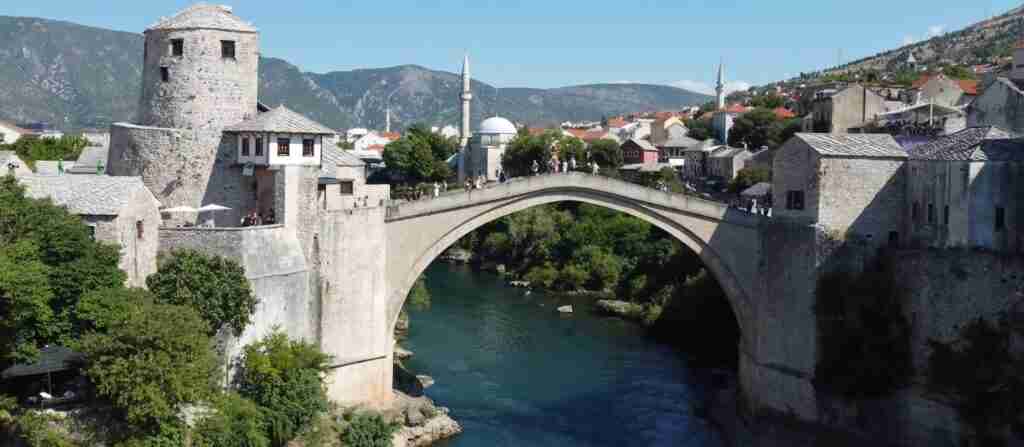
Mostar’s destiny intertwines with its bridge, the graceful Ottoman-era arch destroyed in 1993 and reconstructed by 2004 to symbolize reconciliation between the city’s divided communities. Beyond this single iconic structure, Mostar functions as Herzegovina’s urban anchor, where Mediterranean climate meets Dinaric mountain ranges and where Turkish coffee culture persists stronger than anywhere else in Bosnia. The city’s 113,000 residents occupy both banks of the jade Neretva River, though tourism concentrates on the east bank’s Ottoman Old Town where narrow cobbled streets climb hillsides lined with stone houses converted to cafés, shops, and restaurants.
Stari Most: The Old Bridge 2026
Stari Most spans 29 meters across the Neretva at 24 meters height, its single stone arch rising in graceful parabola connecting the city’s historic quarters. Commissioned by Ottoman Sultan Suleiman the Magnificent and designed by architect Mimar Hayruddin (student of legendary Mimar Sinan), the bridge’s original construction between 1557-1566 represented engineering achievements that remained mysterious until reconstruction required understanding the binding techniques holding stones without mortar. UNESCO World Heritage designation in 2005 recognizes both the reconstructed bridge and surrounding Old Town’s cultural significance.
The bridge’s deliberate destruction by Croatian forces on November 9, 1993, became one of the Bosnian War’s most symbolic moments, representing cultural annihilation beyond military objectives. International outcry eventually led to reconstruction using original stones recovered from the Neretva riverbed, traditional construction methods learned from Ottoman documents, and financial support from multiple nations. Today’s bridge appears identical to its predecessor, though subtle differences exist in stone arrangement and modern safety additions including discretely-placed monitoring equipment.
Walking across Stari Most remains free and forms the central Mostar experience, though summer crowds require patience as tourists pause for photographs blocking the narrow span. The bridge’s smooth limestone surface becomes slippery when wet, with a 30-degree incline creating modest challenges for those with mobility limitations. Early morning (before 8 AM) or evening (after 7 PM) visits avoid peak crowds while providing optimal light for photography.
Bridge diving represents a 450-year tradition where young men leap from the 24-meter arch into frigid Neretva waters below. The Mostar Bridge Diving Club maintains this practice, with members performing jumps throughout summer days after collecting sufficient donations from assembled crowds—typically requiring BAM 200-400 ($100-200) in the collection basket before divers commit. The annual diving competition in late July formalizes this tradition, attracting competitors from across the region. Tourists occasionally request to jump themselves—this requires BAM 50 ($25) club membership, proving swimming ability, and accepting significant injury risks.
The Old Bridge Museum, housed in medieval towers flanking the bridge’s east bank, provides historical context through exhibits explaining original construction techniques, wartime destruction, and reconstruction process. Entry costs BAM 5 ($2.50) including access to the tower observation deck overlooking both bridge and river. Displays include architectural drawings, photographs documenting destruction and rebuilding, and fragments from the original bridge not incorporated into reconstruction.
Kujundžiluk Bazaar and Ottoman Architecture 2026
Kujundžiluk (Coppersmiths Street) represents Mostar’s primary tourist zone, where 16th and 17th-century stone houses converted to shops and cafés line cobbled streets climbing steeply from the bridge. The bazaar’s name references historical craftsmen producing metalwork, though contemporary shops sell predominantly tourist-oriented souvenirs including jewelry, textiles, and decorative items sourced increasingly from Turkey and China rather than local production.
Authentic craft workshops persist among tourist shops. Several metalwork studios demonstrate traditional hand-hammering techniques creating copper coffee sets and serving trays. These genuine artisan shops charge higher prices than import retailers but support actual craft traditions—look for workshops where active production occurs rather than merely retail display. Leather goods including bags, belts, and sandals represent another traditional craft maintaining authentic presence despite tourist-market pressures.
Koski Mehmed Pasha Mosque, positioned immediately adjacent to Stari Most on the east bank, dates to 1618 and exemplifies Ottoman sacred architecture with single dome, portico, and slender minaret rising 35 meters. Entry costs BAM 6 ($3) with dress code enforcement requiring covered shoulders and legs. Climbing the minaret (additional BAM 4/$2) provides Mostar’s finest panoramic views, capturing the bridge, river, Old Town, and surrounding mountains from an elevated perspective impossible to achieve elsewhere. The narrow spiral staircase requires moderate fitness and becomes congested when multiple visitors ascend simultaneously.
Traditional Bosnian houses lining Kujundžiluk’s side streets maintain Ottoman-era residential architecture featuring stone first floors supporting timber upper stories with enclosed balconies (divanhana) projecting over narrow streets. Several converted to museums showcase traditional interior arrangements with low seating platforms, carved wooden ceilings, and separate harem quarters. Muslibegović House operates as both museum and guesthouse, with entry BAM 8 ($4) for non-staying visitors interested in seeing preserved interiors.
East-West Division and Post-War Dynamics 2026
Mostar’s wartime division into predominantly-Bosniak east bank and predominantly-Croat west bank persists despite superficial reunification. The Neretva effectively functions as ethnic boundary, with separate school systems, political parties, and municipal services maintained by each community. Visitors typically concentrate on the east bank’s Ottoman heritage, though the west bank contains interesting Austro-Hungarian architecture, Croatian-language Catholic churches, and restaurants serving Dalmatian-influenced cuisine distinct from east bank Ottoman traditions.
The Boulevard, Mostar’s main thoroughfare running parallel to the Neretva, formed the wartime front line where east bank Bosniak and west bank Croat forces exchanged fire across what became known as Sniper Alley. Several buildings maintain bullet-scarred facades as informal memorials, while the street itself has transformed into a bustling commercial corridor where both communities shop in apparent normalcy. However, segregated schools mean young people rarely interact across ethnic lines, perpetuating divisions despite economic cooperation in the tourism sector.
Blagaj Tekke and Buna River Spring 2026
Blagaj village, 12 kilometers southeast of Mostar, centers on the dramatic Buna River spring emerging from a cliff cave in massive volume. The 600-year-old Dervish Tekke (monastery) occupies an impossibly picturesque position at the spring’s edge, white stone structure contrasting against gray karst limestone cliff and turquoise water below. This tekke represents one of the Balkans’ finest examples of Sufi architectural heritage, though it functions today primarily as museum and tourist attraction rather than active religious site.
Entry to the tekke costs BAM 5 ($2.50), providing access to meditation cells, prayer hall, and balconies overlooking the spring. The site’s spiritual atmosphere persists despite tourism impacts, with tranquility most accessible during early morning hours before tour buses arrive. Wooden platforms extending over the spring support several restaurants serving fresh trout caught from spring-fed channels, with meals costing BAM 25-40 ($12-20) per person. These restaurants excel for atmospheric lunches rather than exceptional cuisine.
Swimming in the Buna River below the tekke provides refreshing summer activity, though water temperatures remain cool (15-17°C/59-63°F) year-round due to the spring’s underground origins. Free swimming areas exist downstream from the restaurants, with locals preferring these spots to tourist-oriented tek areas immediately at the spring.
Reaching Blagaj from Mostar requires either rental car (15 minutes via well-marked roads), taxi (BAM 30-40/$15-20 round trip with waiting time), or organized tour. No reliable public bus service operates this route, making independent travel challenging without private transportation.
Kravice Waterfalls Natural Area 2026
Kravice Waterfalls, located 40 kilometers south of Mostar near Čitluk, create a 25-meter-high tufa cascade spreading 120 meters wide across the Trebižat River. The amphitheater-shaped falls form natural swimming pools at their base, creating Bosnia’s most popular summer swimming destination. The site attracts significant crowds July-August weekends when Mostar’s heat drives both tourists and locals to cool waters.
Entry costs BAM 15 ($7) per person from June through September, free during winter months when facilities close. Basic infrastructure includes changing rooms, restrooms, and café serving simple meals. Swimming conditions prove excellent for confident swimmers, though currents near the waterfall’s base require caution. Ropes assist entry and exit from water areas. Tufa rock formations create some sharp surfaces requiring careful foot placement.
Optimal visiting times fall on weekday mornings before crowds arrive. Weekends and particularly August afternoons see thousands of visitors creating crowded conditions reducing the site’s natural appeal. Early morning light provides excellent photography conditions, while afternoon visits can feel overwhelmed by visitor numbers and noise.
Reaching Kravice requires private transportation, as no public buses serve the site. Rental cars provide flexibility to combine Kravice with other Herzegovina attractions including Počitelj, Blagaj, and Čitluk’s wineries. Taxi day trips from Mostar cost approximately BAM 80-120 ($40-60) including driving time and waiting while visitors enjoy the falls. Many travelers join organized tours combining multiple Herzegovina sites into full-day itineraries.
Višegrad and Eastern Bosnia 2026
Višegrad occupies the Drina River valley where Bosnia meets the Serbian border, 195 kilometers east of Sarajevo via winding mountain roads. The town’s 10,000 residents live among landscapes that inspired Ivo Andrić’s Nobel Prize-winning novel “The Bridge over the Drina,” where the magnificent 16th-century Mehmed Paša Sokolović Bridge forms both UNESCO World Heritage Site and contested memory site. Višegrad rewards travelers seeking authentic small-town Bosnia away from tourist crowds, though recent history complicates visits for those aware of wartime atrocities that occurred here.
Mehmed Paša Sokolović Bridge 2026
The Mehmed Paša Sokolović Bridge spans the Drina River in eleven graceful stone arches rising to 15.4 meters above water level, its 179.5-meter length representing Ottoman civil engineering at its finest. Commissioned by Grand Vizier Mehmed Paša Sokolović and designed by Mimar Sinan (master architect of Istanbul’s greatest mosques) in 1571, the bridge functioned for centuries as vital link connecting Ottoman territories across the Drina. UNESCO inscription in 2007 recognizes both architectural merit and cultural significance immortalized in Andrić’s novel.
Walking across the bridge remains free, with the structure supporting normal vehicular traffic alongside pedestrians. The bridge’s most distinctive feature involves a central sofa (elevated platform) providing space for social gathering and river observation—this sofa appears in Andrić’s novel as the stage where four centuries of Višegrad history unfolds through chapters describing different periods. Today, tourists photograph from the sofa while locals gather here maintaining centuries-old tradition of bridge as community space.
The bridge survived the 1992-1995 war intact, though the town suffered severely with mass atrocities including the massacre of Bosniak civilians. This creates ethical complexity for visitors aware of recent history, as the town today projects an atmosphere of normality while mass graves were exhumed from the Drina’s banks within the past three decades. Tourism promotion emphasizing the bridge’s beauty without acknowledging wartime events frustrates genocide survivors and human rights advocates.
Andrićgrad, a 2014 construction by Serbian filmmaker Emir Kusturica, creates a pastiche “ethno-town” celebrating Serbian culture through reconstructed historical architecture around a central square. The complex contains hotels, restaurants, cultural center, and cinema arranged to evoke various periods of Serbian/Bosnian history. Critics view Andrićgrad as historical revisionism minimizing Muslim heritage and glorifying Serbian nationalism, while supporters claim it honors Andrić’s legacy (Andrić identified as Yugoslav rather than Serbian despite Serbian ethnic background). Entry remains free, though visiting requires engaging these contested narratives.
Stećci Medieval Tombstones: UNESCO Transnational Heritage 2026
Stećci represent unique medieval funerary art, monolithic tombstones carved between the 12th-16th centuries scattered across Bosnia, Herzegovina, Croatia, Serbia, and Montenegro. These limestone markers range from simple rectangular blocks to elaborately decorated monuments featuring crosses, crescents, hunting scenes, and geometric patterns reflecting the region’s religious and cultural complexity. UNESCO designated 28 necropolises containing 4,000+ stećci as World Heritage Sites in 2016, with 20 sites located in Bosnia and Herzegovina including the most significant concentrations.
Radimlja Necropolis Near Stolac 2026
Radimlja, located 3 kilometers west of Stolac in Herzegovina, contains Bosnia’s most impressive stećci collection with 133 tombstones arranged across a hillside overlooking agricultural valleys. The site dates to the 15th-16th centuries when local nobility commissioned elaborate markers combining Christian, Ottoman, and indigenous Bosnian symbols. Several tombstones feature intricate relief carvings depicting knights on horseback, hunting scenes with dogs pursuing deer, and stylized crosses suggesting Catholic influence despite the Bosnian Church’s independence from Rome.
Site access remains open with no entrance fees, though a small visitor center operates summer months providing context about stećci artistry and medieval Bosnian culture. Interpretive signs in English, German, and Bosnian explain various carving styles and symbols. The hillside setting provides dramatic photography opportunities, particularly during late afternoon light when low sun angles emphasize relief carving details.
Reaching Radimlja requires private transportation, as the site lies outside Stolac’s pedestrian center. Visitors combining Mostar, Počitelj, and Stolac day trips can easily add Radimlja with minimal detour. The site receives relatively few visitors despite UNESCO status, creating peaceful contemplative atmosphere for those interested in medieval history beyond more famous attractions.
Understanding Stećci Symbolism 2026
Stećci engravings reveal complex religious landscape of medieval Bosnia, where Catholic, Orthodox, and the independent Bosnian Church coexisted alongside growing Ottoman Islamic influence. Crosses, crescents, suns, and stars appear on neighboring tombstones, suggesting religious tolerance or at least coexistence unusual for medieval Europe. Hunting scenes and warrior depictions reflect feudal nobility’s martial identity, while inscriptions occasionally provide death dates enabling chronological mapping of local dynasties.
The Bosnian Church, sometimes called Bogomil Church due to suspected connections to Bulgarian Bogomil heresy, commissioned many stećci. This church rejected Catholic and Orthodox hierarchies while maintaining Christian theology, creating distinctive identity that disappeared following Ottoman conquest as adherents converted primarily to Islam. Stećci represent the Bosnian Church’s most visible legacy, though interpretation remains contested among historians debating the church’s actual theological positions versus later mythologization.
Natural Heritage: Sutjeska National Park and Primeval Forests 2026
Sutjeska National Park, established 1962 as Bosnia’s first national park, protects 175 square kilometers of Dinaric mountain wilderness in southeastern Bosnia near the Montenegrin border. The park encompasses Maglić peak (2,386 meters—Bosnia’s highest), the Perućica primeval forest, and the Skakavac waterfall, creating diverse landscapes ranging from beech forest valleys to bare limestone peaks.
Perućica Primeval Forest: Ancient and Primeval Beech Forests Heritage Site 2026
Perućica represents one of Europe’s last true primeval forests, 1,434 hectares of beech-spruce-fir forest never subjected to commercial logging. Trees reach 50 meters height and over 300 years age, with fallen giants decomposing across forest floors creating habitat complexity impossible in managed forests. UNESCO designated Perućica as part of the transnational “Ancient and Primeval Beech Forests of the Carpathians and Other Regions of Europe” serial property recognizing these forests as remnants of post-glacial forest expansion 12,000 years ago.
Access to Perućica requires obtaining permits at the Tjentište Visitor Center, with entry limited to 50 visitors daily to minimize impact. Guided walks cost BAM 30 ($15) per person for three-hour interpretive hikes explaining forest ecology, flora identification, and conservation importance. The trail network remains relatively easy, with moderate elevation gain and well-maintained paths, though muddy conditions after rain require proper footwear.
The forest’s primeval character becomes immediately apparent through unusual features absent from managed forests: standing dead trees supporting woodpecker populations, massive fallen trunks creating nurse logs for new growth, and ground layers free of human-maintained trails beyond designated paths. Ecologists study Perućica as a reference ecosystem revealing how undisturbed European forests function without human intervention.
Hiking and Mountain Activities 2026
Sutjeska National Park offers numerous hiking trails ranging from easy valley walks to challenging peak ascents. The most popular route climbs Maglić, Bosnia’s highest peak, requiring 5-6 hours round trip from the Lokva Trailhead with 1,200 meters elevation gain. The summit straddles the Bosnia-Montenegro border, providing panoramic views across Dinaric ranges. This hike demands proper equipment including boots, layers for temperature changes, and navigation tools as trail marking proves inconsistent above tree line.
Skakavac waterfall, a 75-meter cascade dropping from forest cliffs, attracts visitors seeking dramatic natural features accessible via moderate 90-minute hikes from Tjentište. Spring snowmelt (April-May) provides maximum water volume, while late summer reduces flow to modest streams. The waterfall trail passes through mixed forest gradually ascending to viewpoints overlooking the cascade—the best perspective requires scrambling off-trail to cliff edges where caution prevents accidents.
Park infrastructure remains basic, with limited signage, no maintained facilities beyond the visitor center, and cell phone coverage spotty throughout remote valleys. Visitors should carry water, snacks, and first aid supplies as emergency services respond slowly to remote locations. Local guides hired through Tjentište provide valuable safety margins and ecological interpretation for BAM 50-80 ($25-40) per day depending on group size and itinerary complexity.
Skiing and Winter Sports 2026
Bosnia and Herzegovina hosted the 1984 Winter Olympics at mountains surrounding Sarajevo, creating skiing infrastructure that suffered damage during the 1992-1995 war but has since been substantially rehabilitated. Contemporary Bosnian ski resorts offer affordable alternatives to Alpine destinations while maintaining respectable vertical drops and modern lift systems.
Jahorina Ski Resort 2026
Jahorina, located 28 kilometers southeast of Sarajevo, represents Bosnia’s most developed winter resort with 20 kilometers of marked runs served by nine lifts reaching 1,916-meter summit elevations. The resort occupies south-facing slopes providing excellent sun exposure and reliable snow December-March with average base depth 1-2 meters at peak season. Lift tickets cost BAM 45 ($22) daily for adults, BAM 35 ($17) for youth, with multi-day passes reducing per-day costs. Rental equipment (skis, boots, poles) costs approximately BAM 30 ($15) daily for standard gear, BAM 50 ($25) for premium equipment.
Terrain ranges from gentle beginner slopes to challenging black runs, though expert skiers may find limited options compared to major Alpine resorts. The most interesting skiing follows red runs traversing wooded sections and open bowls on the mountain’s upper reaches. Snowboarders are fully accommodated with terrain parks and half-pipes maintained by resort staff.
Accommodation on Jahorina ranges from basic apartments (BAM 50-80/$25-40 per person nightly) to Hotel Lavina’s four-star facilities (BAM 180-260/$90-130 per room). Mid-week visits outside January-February holidays find uncrowded slopes and discounted accommodation rates. Weekend warriors from Sarajevo create Saturday-Sunday crowds requiring patience at lifts and in parking areas.
Bjelašnica Ski Resort 2026
Bjelašnica, 25 kilometers southwest of Sarajevo, served as the 1984 Olympic men’s downhill venue with steeper, more challenging terrain than Jahorina. Six lifts serve 8 kilometers of marked runs, with maximum vertical drop approaching 1,000 meters from 2,067-meter summit. Lift tickets cost BAM 40 ($20) daily, slightly cheaper than Jahorina reflecting smaller scale operations.
Snow conditions typically exceed Jahorina due to higher elevations and north-facing aspects holding powder longer. However, lift infrastructure remains more dated with slower chair lifts and occasional mechanical issues disrupting service. Expert skiers prefer Bjelašnica for its steeper pitches and more challenging terrain, while beginners find Jahorina’s gentler slopes more forgiving.
Off-piste skiing and snowboarding attract advanced skiers to Bjelašnica’s unmarked terrain, though avalanche risks require proper knowledge and equipment. Hiring guides familiar with local snow conditions proves essential for safely accessing backcountry areas—contact Sarajevo mountaineering clubs for guide recommendations rather than attempting independent exploration.
Bosnia and Herzegovina UNESCO World Heritage Sites 2026
Bosnia and Herzegovina protects five UNESCO World Heritage Sites spanning cultural and natural heritage categories, each representing different aspects of the country’s complex history and remarkable biodiversity. These sites anchor cultural touring while providing frameworks for understanding Bosnia’s place at the intersection of Ottoman, Habsburg, and South Slavic influences.
Complete UNESCO Site Overview 2026
The Old Bridge Area of the Old City of Mostar (inscribed 2005) represents outstanding Ottoman urban design and symbolic post-war reconstruction, with the rebuilt Stari Most functioning as both architectural masterpiece and reconciliation monument. This property encompasses the bridge itself, surrounding mahallas (traditional neighborhoods), and associated religious and commercial structures creating integrated cultural landscape.
Mehmed Paša Sokolović Bridge in Višegrad (inscribed 2007) exemplifies Ottoman civil engineering excellence through Mimar Sinan’s design, while also serving as the central character in Ivo Andrić’s Nobel Prize-winning novel that elevated the bridge to literary fame. The inscription recognizes both physical structure and cultural significance transmitted through literature.
Stećci Medieval Tombstone Graveyards (inscribed 2016) comprise a transnational serial property shared with Croatia, Serbia, and Montenegro, recognizing these unique funerary monuments as exceptional testimony to medieval Balkan culture. Of 28 component sites, 20 lie within Bosnia and Herzegovina, with Radimlja near Stolac representing the most significant concentration.
Ancient and Primeval Beech Forests of the Carpathians and Other Regions of Europe (inscribed 2007, extended multiple times) includes Bosnia’s Perućica primeval forest within Sutjeska National Park as part of a vast transnational property recognizing post-glacial beech forest expansion across Europe. This natural heritage site protects irreplaceable ecological reference systems.
Vjetrenica Cave (inscribed 2024) represents the newest addition to Bosnia’s UNESCO list, recognizing this 7-kilometer cave system for its extraordinary biodiversity including endemic troglobitic species and unique geological formations. Located near the Croatian border in Herzegovina, Vjetrenica contains prehistoric artifacts suggesting human use dating back 10,000 years.
Wine Tourism in Herzegovina 2026
Herzegovina’s Mediterranean climate and limestone karst soils create ideal conditions for viticulture, with wine production dating to Roman and Illyrian times. Indigenous grape varieties including white Žilavka and red Blatina produce distinctive wines unavailable outside the region, creating opportunities for wine tourism experiences combining vineyard visits, tastings, and traditional Herzegovina meals.
Žilavka and Blatina: Indigenous Varieties 2026
Žilavka, Herzegovina’s signature white grape, produces wines ranging from crisp, mineral-driven styles to richer, barrel-aged expressions. The name derives from “žila” (vein), referencing the grape’s prominent vascular structure. Žilavka grows best in limestone soils around Mostar, Čitluk, and Ljubuški, developing high acid levels that provide aging potential unusual for white wines from warm climates. Quality producers including Tvrdoš Monastery Winery and Vinarija Nuić create complex Žilavka displaying citrus, stone fruit, and distinctive herbal notes.
Blatina, the primary red variety, produces deeply-colored wines with moderate tannins and bright acidity. The grape’s name references “blato” (mud), likely referencing growing locations in valley floors. Blatina wines show red fruit flavors (cherry, raspberry) alongside herbal complexity, drinking well young but also developing secondary characteristics with 5-10 years bottle age. Smaller producers around Stolac and Trebinje maintain old-vine Blatina vineyards producing concentrated wines unavailable from larger commercial operations.
Winery Visits and Tastings 2026
Herzegovina’s wine route encompasses dozens of family-run wineries and larger commercial operations open for tastings and sales. Most wineries require advance contact for visits, as small-scale producers lack tasting room infrastructure for walk-in visitors. Email or phone arrangements typically suffice, with many winemakers personally conducting tours and tastings rather than employing dedicated staff.
Tvrdoš Monastery, located 5 kilometers south of Trebinje, operates Eastern Orthodox monastery and working winery producing Vranac (red) and Žilavka using traditional methods including qvevri-style amphora fermentation. Monastery tours cost BAM 5 ($2.50) including church and wine cellars, while tastings add BAM 20-30 ($10-15) for five wines accompanied by cheese and olives. The monastery setting provides atmospheric context for understanding wine’s religious and cultural significance in Herzegovina.
Vinarija Nuić near Čitluk represents modern commercial winemaking with professional tasting facilities and English-speaking staff. Visits cost BAM 15-25 ($7-12) per person for tastings including 4-6 wines with explanations of varieties, vinification methods, and food pairing suggestions. The winery offers excellent value for quality-conscious travelers seeking professionally-made wines rather than rustic farm productions.
Harvest season (late August-September) invites participation in grape picking and crushing activities at some smaller estates, creating authentic experiences unavailable during other seasons. Arrangements require advance coordination and willingness to work several hours assisting in harvest activities, typically rewarded with traditional meals and generous wine consumption at day’s end.
Practical Travel Tips Bosnia and Herzegovina 2026
Language and Communication 2026
Bosnian, Serbian, and Croatian function as mutually intelligible languages using Latin and Cyrillic scripts throughout Bosnia and Herzegovina. These languages share grammar, pronunciation, and 95%+ vocabulary despite political assertions of distinctiveness driven by nationalist agendas. Travelers need not differentiate between these “languages,” as any competent speaker understands all variants regardless of regional or ethnic identification.
English penetrates widely in tourism sectors, with most hotel staff, restaurant servers in tourist areas, and younger generations speaking functional to fluent English. Sarajevo and Mostar operate predominantly English-friendly, reducing language barriers to minimal inconveniences. However, English proficiency drops sharply in rural areas, small towns, and among older generations, necessitating basic Bosnian phrases or translation apps for these contexts.
German functions as a second foreign language, particularly among older generations with Habsburg Austria connections or gastarbeiter (guest worker) experience in Germany during Yugoslav period. Italian penetrates coastal areas due to Adriatic proximity and historical Venetian influences. Russian finds limited use despite Slavic language family connections, as English has supplanted Russian as the preferred foreign language among younger Bosnians.
Essential phrases: “Dobar dan” (good day—formal greeting), “Hvala” (thank you), “Molim” (please), “Koliko košta?” (how much does it cost?), “Račun, molim” (check, please—used at restaurants). Learning these basics demonstrates respect and facilitates positive interactions, though gestures and translation apps cover most situations when language fails.
Cellular and Internet Connectivity 2026
Bosnia and Herzegovina operates three major mobile networks: BH Telecom (state-owned Federation entity), M:Tel (Republika Srpska entity), and HT Mostar (Croatian-backed operator). SIM cards purchased at airports, telecommunications shops, or kiosks cost BAM 10-20 ($5-10) including initial credit. Prepaid data packages offer excellent value: BAM 15-25 ($7-12) typically provides 10-20 GB valid for 30 days, sufficient for navigation, translation apps, and social media usage.
4G LTE coverage extends throughout cities and main highways, though mountain valleys experience gaps reducing connections to 3G or complete signal loss. Border areas sometimes connect to neighboring countries’ networks (Croatia, Serbia, Montenegro), potentially triggering roaming charges if not properly configured. Data speeds prove adequate for standard smartphone usage including streaming music and video calls, though remote locations may struggle with basic connectivity.
WiFi availability reaches saturation in hotels, restaurants, cafés, and tourist attractions, with most establishments offering free access requiring passwords obtained from staff. Connection quality varies from excellent fiber-optic speeds at modern hotels to frustratingly slow DSL connections at budget accommodations. Sarajevo and Mostar maintain public WiFi zones in central squares and pedestrian areas, though security concerns make these networks suitable only for non-sensitive browsing.
Safety and Security Considerations 2026
Bosnia and Herzegovina maintains low crime rates targeting tourists, with Sarajevo and Mostar experiencing significantly less pickpocketing, theft, and violent crime than most Western European cities. Standard precautions apply: watch belongings in crowded areas, avoid isolated areas after dark, secure valuables in hotel safes, and maintain awareness of surroundings. Street crime targeting tourists remains rare enough that incidents generate local news coverage.
Landmines persist in rural and forested areas, particularly near former front lines in central Bosnia and eastern regions. However, mined areas receive extensive marking with clearly visible warning signs featuring skull-crossbones symbols and red “STOP” text in multiple languages. Staying on established roads, trails, and cultivated areas eliminates mine risks effectively. Never explore abandoned buildings or venture off marked paths in rural areas without local guidance confirming safety. De-mining efforts have cleared millions of mines since 1995, though an estimated 80,000 mines and unexploded ordnance remain in marked contaminated areas.
Political demonstrations occur occasionally in Sarajevo and Banja Luka, typically related to economic grievances or ethnic tensions. These events rarely affect tourists, though avoiding demonstration areas during protests prevents any involvement in confrontations between protesters and police. Ethnic tensions simmer but rarely manifest as violence in contemporary Bosnia, though anniversary dates of war events sometimes spark commemorations that temporarily heighten tensions.
Traffic safety represents the most significant risk for visitors, with aggressive driving, poor road conditions, and limited enforcement creating hazardous situations. Drivers often exceed speed limits, overtake on blind curves, and disregard right-of-way rules. Pedestrians should exercise extreme caution when crossing streets, as drivers rarely yield at marked crosswalks unless traffic signals force stopping. Rental car drivers should adopt defensive driving strategies, avoiding aggressive maneuvers that local drivers employ routinely.
Tipping Customs and Service Charges 2026
Tipping culture in Bosnia remains less formalized than in North America, with expectations varying by venue type and service level. Casual restaurants expect rounding up bills to the nearest convenient denomination—a BAM 47 bill becomes BAM 50, representing roughly 6% tip considered appropriate. Upscale restaurants warrant 10-15% tips for good service, though some establishments include service charges on bills requiring verification before tipping additionally.
Cafés and bars expect minimal tips, with rounding up drink costs sufficient acknowledgment for standard service. Taxi drivers receive rounded-up fares or BAM 2-3 additions on longer trips. Hotel porters handling luggage appreciate BAM 5-10 depending on bag quantity and service quality. Tour guides leading day tours receive BAM 20-40 per person for full-day services, with group size influencing appropriate amounts.
Service quality varies considerably across Bosnia, from genuinely warm hospitality at family-run establishments to indifferent service at larger hotels and tourist-oriented restaurants. Tipping should reflect actual service received rather than automatic percentages, with exceptional service rewarded generously and poor service receiving minimal acknowledgment.
Electrical Standards and Adapters 2026
Bosnia and Herzegovina uses European standard 230V/50Hz electrical systems with Type C and Type F plugs (European standard two-pin round plugs). North American travelers require voltage converters for devices not rated for 230V alongside plug adapters, while UK visitors need only plug adapters. Universal travel adapters available at airports and electronics stores cost BAM 20-40 ($10-20), though purchasing adapters before arrival saves costs.
Most modern hotels provide electrical outlets at bedsides and desks sufficient for charging phones, cameras, and laptops simultaneously. However, budget accommodations and older properties sometimes offer limited outlets requiring rotation of device charging or power strips brought from home. USB charging ports remain rare even in newer hotels, necessitating traditional plug adapters rather than assuming USB availability.
Frequently Asked Questions About Bosnia and Herzegovina 2026
How many days do I need for Bosnia and Herzegovina?
One week provides sufficient time for Bosnia and Herzegovina’s highlights, including 2-3 days in Sarajevo exploring Ottoman and Austro-Hungarian heritage plus siege history sites, 2 days in Mostar visiting Stari Most and Herzegovina day trips to Blagaj and Kravice Falls, 1 day for the journey between cities with stops at sites like Konjic or Jablanica, and 1-2 days for additional destinations such as Višegrad, Travnik, or Banja Luka depending on interests. Two weeks enables deeper exploration including mountain activities, wine tourism in Herzegovina, and visits to all five UNESCO World Heritage Sites without rushed itineraries.
What is the best month to visit Bosnia and Herzegovina?
September emerges as the optimal single month for Bosnia and Herzegovina travel, combining warm but not oppressive temperatures averaging 18-24°C, reduced tourist crowds compared to July-August peak season, lower accommodation prices dropping 25-35% from summer rates, and autumn light providing excellent photography conditions. May ranks second, offering spring wildflowers, comfortable temperatures, and minimal crowds, though occasional rain interrupts outdoor plans more frequently than September. Winter (January-February) suits skiing enthusiasts, while summer (July-August) works best for those prioritizing river activities and warm weather despite higher costs and crowding.
Can I drink tap water in Bosnia and Herzegovina?
Tap water throughout Bosnia and Herzegovina meets European safety standards and remains safe to drink in cities including Sarajevo, Mostar, and Banja Luka. The country’s abundant mountain springs provide high-quality water sources requiring minimal treatment. However, taste varies by location, with some areas experiencing mineral content creating unpalatable flavors despite being safe. Rural areas occasionally have water quality issues, particularly in villages with older infrastructure. When uncertain, bottled water costs minimal amounts (BAM 1-2/$0.50-1 per 1.5 liter bottle) and eliminates any concerns. Natural springs throughout mountains provide safe drinking water often superior to treated municipal supplies.
Is Bosnia and Herzegovina expensive for tourists?
Bosnia and Herzegovina ranks among Europe’s most affordable destinations for quality tourism experiences. Daily costs for budget travelers average BAM 70-140 ($37-70) per person, mid-range comfort requires BAM 190-320 ($95-160), and luxury experiences cost BAM 420-690 ($210-345)—all rates including accommodation, meals, transport, and attractions. These prices remain 40-60% below comparable Western European destinations, while exceeding Balkan neighbors like Albania and North Macedonia by 20-30% but offering superior infrastructure and accessibility. Sarajevo and Mostar represent the country’s most expensive areas, while rural Herzegovina and Republika Srpska provide even better value.
What should I not miss in Sarajevo?
Sarajevo’s essential experiences include walking Baščaršija’s Ottoman quarter while sampling Bosnian coffee at traditional kafanas, visiting the Sarajevo Tunnel Museum to understand siege survival strategies, exploring the Austro-Hungarian architectural legacy along Ferhadija Street and City Hall, ascending to Yellow Bastion for panoramic city views at sunset, and examining the complex religious heritage visible in mosques, churches, and synagogues within walking distance. Beyond headline attractions, experiencing Sarajevo’s café culture—where locals spend hours over single coffees discussing politics and philosophy—provides insights into contemporary Bosnian identity that museums cannot convey.
How do I get from Sarajevo to Mostar?
Buses connecting Sarajevo and Mostar depart every 1-2 hours throughout the day from Sarajevo’s main bus station, with the 129-kilometer journey requiring 2.5-3 hours and costing BAM 30-40 ($15-20). Multiple operators including Autoprevoz and Centrotrans maintain similar schedules and prices, with advance booking unnecessary except during religious holidays. Trains operate daily but take similar time while offering fewer departure options, making buses more practical for most travelers. Rental cars provide flexibility for stops at Konjic, Jablanica, or Blagaj along the route, with driving time approximately 2 hours on good roads. Organized day tours from Sarajevo to Mostar cost BAM 80-140 ($40-70) including transport and guide services, though these rush the experience compared to staying overnight in Mostar.
What currency should I bring to Bosnia?
Bring US dollars or euros for exchange into Bosnian Convertible Marks (BAM) upon arrival, as these currencies exchange easily at favorable rates throughout Bosnia. ATMs provide the most convenient method for obtaining BAM, with machines at Sarajevo Airport and throughout cities offering competitive exchange rates. Credit cards work at hotels, established restaurants, and shops in tourist areas, but cash remains essential for buses, small restaurants, markets, and rural areas. Maintain BAM 200-400 ($100-200) in cash at all times, more when traveling to remote regions. The fixed exchange rate of approximately 2 BAM to $1 simplifies mental calculations, making budgeting straightforward.
Are there still landmines in Bosnia?
Landmines persist in rural and forested areas, particularly near former front lines, with an estimated 80,000 mines and unexploded ordnance remaining from the 1992-1995 conflict despite extensive de-mining efforts. However, mined areas receive comprehensive marking with clearly visible warning signs featuring red “STOP” text and skull-crossbones symbols in multiple languages. Tourists avoiding marked areas face negligible risk—staying on established roads, maintained hiking trails, and cultivated agricultural lands provides complete safety. Never explore abandoned buildings, venture off trails in rural areas, or ignore warning signs. The areas tourists visit including Sarajevo, Mostar, national parks with marked trails, and UNESCO sites pose zero mine risk when sensible precautions apply.
Can I visit Bosnia and Herzegovina in winter?
Winter visits to Bosnia and Herzegovina suit two distinct traveler profiles: skiing enthusiasts targeting Jahorina and Bjelašnica resorts operating December-March with lift tickets costing one-third of Alpine resort prices, and cultural tourists exploring Sarajevo and Mostar without summer crowds while accepting cold weather averaging -1 to 5°C and potential snow. Winter cultural touring remains fully viable in cities where museums, restaurants, and hotels operate normally, though some rural attractions close November-March. Accommodation prices drop to annual lows outside ski resorts, creating exceptional value for flexible travelers. However, mountain roads can become impassable during heavy snowfall, and some inter-city bus services reduce frequencies.
What is the food like in Bosnia?
Bosnian cuisine combines Ottoman slow-cooking traditions, Austro-Hungarian pastries, and Balkan meat-centered preferences into distinctive dishes found nowhere else. Ćevapi (grilled meat sausages in flatbread) represents the national dish served throughout the country at prices ranging BAM 6-12 ($3-6). Burek (phyllo dough filled with meat, cheese, or spinach) provides breakfast staples costing BAM 3-5 ($1.50-2.50). Traditional stews including bosanski lonac showcase layers of meat and vegetables cooked for hours in earthenware. Coffee culture rivals anything in Italy, with Bosnian coffee served in elaborate rituals encouraging extended social interaction. Herzegovina produces distinctive wines from indigenous grape varieties, while rakija (fruit brandy) concludes many meals. Vegetarian options remain limited outside Sarajevo’s international restaurants, as meat dominates traditional cuisine.