
Best Time to Visit Lake District: Seasonal Planning Guide
The Lake District in Cumbria is England’s largest national park and its only UNESCO World Heritage cultural landscape, inscribed in 2017 in recognition of the millennia of farming and stewardship that shaped its stone-walled valleys and open fells. Each season looks dramatically different: spring brings wildflower verges and newborn lambs; summer stretches daylight past nine in the evening; autumn turns the bracken copper and birchwoods gold; winter strips everything back to rock, water, and silence. This guide examines what each season genuinely offers and which months align best with your priorities.
Key Takeaways
- Late September to mid-October offers the broadest combination of advantages: autumnal colour peaks, summer crowds disperse, the weather remains reasonable, and most businesses stay open — making it the period most experienced visitors return to year after year.
- June delivers the best balance of long daylight hours, mild temperatures, and accommodation availability before peak-season prices take hold.
- July and August are the busiest and most expensive months; popular trails, villages, and car parks become genuinely congested, and accommodation should be booked months in advance.
- January and February are the quietest months of all, rewarding those who seek solitude and dramatic winter scenery, though many seasonal businesses close and high-fell routes require winter mountaineering skills.
- Rainfall is significant in every month of the year; waterproof clothing, rather than optimism, is the reliable strategy regardless of season.
- School holiday weeks and bank holiday weekends drive sharp spikes in visitor numbers regardless of season — building plans around them, rather than into them, makes a material difference to the experience.
People Also Ask About the Lake District
What is the best month to visit the Lake District?
September is widely regarded as the best single month to visit the Lake District. The school summer holidays end around the first week of September, rapidly deflating visitor numbers, while the weather retains much of summer’s stability — long stretches of settled, dry days are common, and temperatures remain comfortable for walking. Daylight still reaches well past seven in the evening through mid-September. The bracken on the high fells begins its slow turn from green to amber, and the rowan trees heavy with red berries add colour to otherwise austere skylines. Car parks that were gridlocked in August find spaces again, and accommodation rates drop noticeably. For those with flexibility, the window from the last week of August to mid-October is the period most experienced Lake District visitors return to consistently.
How much rainfall should visitors expect in the Lake District?
The Lake District is one of the wettest regions in England, and visitors should prepare for rain in every season. Rainfall is distributed across the year without a genuine dry period, though April and June tend to be drier than average in many valleys, and November is often the wettest month. The western fells receive significantly more rain than the eastern valleys: Seathwaite in Borrowdale is frequently cited as one of the wettest inhabited places in England, recording around 3,000 millimetres or more annually in many years — several times the national average. Central areas such as Ambleside and Windermere typically receive somewhere between 1,500 and 2,000 millimetres per year. The practical implication is consistent across all seasons: waterproofs on every visit, regardless of the forecast, and boots appropriate for boggy ground. Rain does not preclude a rewarding visit; the waterfalls, the mists, and the reflective surfaces of the lakes are often at their most dramatic in wet conditions.
When is the Lake District least crowded?
January and February are the quietest months, delivering a level of solitude on the fells and in the villages that is simply impossible to replicate in summer. Many smaller tea rooms, boat hire operations, and seasonal attractions close or reduce their hours significantly during this period. The roads and car parks are largely empty, and it is possible to stand at the summit of a popular fell such as Catbells or Loughrigg Fell without passing another soul. Midweek visits in October, November, and early December are also substantially quieter than summer equivalents, without the business closures that characterise deep winter. If crowd avoidance is the primary goal but some amenity is still desired, late October on a midweek stay represents the most productive compromise.
Is the Lake District worth visiting in winter?
Yes — winter delivers experiences that summer cannot. When frost rimes the grass on the high fells and the lower slopes catch early light unobstructed by leaf canopy, the Lake District achieves a spare, elemental beauty that many walkers consider its finest. Snow on the high fells — most reliably in January and February — transforms routes such as Helvellyn and Blencathra into genuine mountain objectives requiring ice axes and crampons for safe completion, while low-level routes remain accessible and are particularly beautiful under a light covering of snow. The caveats are practical: shorter days mean anything beyond a short low-level walk needs careful timing, some accommodation and many cafés close through January, and fell conditions can deteriorate rapidly. Winter in the Lake District rewards preparation and punishes complacency — but for those who arrive equipped and informed, it is one of England’s genuinely unmissable seasonal experiences.
Extended multi-day tours – 5+ days
Featured Uk Lake District Multi-Day Tour Packages
3 days
Uk Lake District 3-Day Discovery Tour
- ✓ Comprehensive Uk Lake District experience
- ✓ Expert local guides included
- ✓ All accommodation included
- ✓ Transportation provided

5 days
Uk Lake District 5-Day Highlights Experience
- ✓ Comprehensive Uk Lake District experience
- ✓ Expert local guides included
- ✓ All accommodation included
- ✓ Transportation provided

7 days
Uk Lake District 7-Day Cultural Journey
- ✓ Comprehensive Uk Lake District experience
- ✓ Expert local guides included
- ✓ All accommodation included
- ✓ Transportation provided
10 days
Uk Lake District 10-Day Complete Adventure
- ✓ Comprehensive Uk Lake District experience
- ✓ Expert local guides included
- ✓ All accommodation included
- ✓ Transportation provided
Multi-day tour packages powered by TourRadar. Prices and availability subject to change.
The Lake District’s Climate: Setting Realistic Expectations
The Lake District’s weather is shaped by its position on the western edge of England, directly in the path of Atlantic weather systems that funnel moisture across the Irish Sea and deposit it against the first significant upland barrier they encounter. This geography produces a climate that is cool and wet by English standards in every season, with wide variation between western and eastern locations even within the national park. Understanding this pattern — rather than fighting it — is the foundation of a well-planned visit.
The fells themselves create microclimates. A bright, sunny day in Kendal to the south-east can coincide with low cloud and drizzle on Scafell Pike twenty kilometres to the north-west. Summit temperatures are significantly lower than valley temperatures at any time of year: a rough working figure is approximately 1°C of cooling per 100 metres of ascent, which means a pleasant 15°C afternoon in Windermere town corresponds to around 5°C at the summit of Scafell Pike. Wind amplifies this chill considerably, and on exposed ridges the effective temperature can fall well below the air temperature even in summer. High fell walks should always be planned with additional layers in the rucksack regardless of the valley forecast.
The lake surfaces moderate temperatures to some degree, keeping winters milder and summers cooler than inland areas at comparable latitudes. This contributes to the lush, green character of the valleys even in late autumn, and to the occasional remarkable clarity of light that follows a storm front — the kind of shining, washed-out quality that drew J. M. W. Turner and generations of painters and photographers to the region since the late eighteenth century.
Sunrise and sunset times swing dramatically through the year at this latitude, around 54°N. In June, daylight extends from approximately 4:30 in the morning to past 21:30, giving walkers more than seventeen hours of usable light. By December, the window shrinks to under eight hours, with dusk falling before four in the afternoon. Any walk with significant elevation gain or distance should be planned with sunset firmly in mind, particularly between October and March.
The prevailing wind direction is from the south-west, which means that valleys open to the south-west — Borrowdale, Wasdale, Eskdale — receive the brunt of incoming weather. Valleys oriented east to west, such as Patterdale (Ullswater) and the eastern approaches to the fells via Shap, sit in a degree of rain shadow and can experience notably better conditions on days when the western valleys are sodden. This asymmetry is worth building into route planning when flexibility exists.
Spring in the Lake District
Spring unfolds in stages across the Lake District, arriving first in the sheltered southern valleys and rippling northward and upward through April and into May. It is a season of significant, sometimes underestimated rewards — particularly for those who visit in its earlier weeks, when the fells have shed winter’s grey-brown palette without yet attracting summer’s visitor volumes.
March and Early April — Quiet Fells and the First Wildflowers
March is a transitional month that can behave like winter or early summer depending on the year. The fell vegetation is still short and brown from winter die-back, making sight lines long and route-finding straightforward across open moorland. Daffodils — intimately associated with the Lake District through Wordsworth’s celebrated lyric composed after he and his sister Dorothy witnessed a mass flowering near Ullswater in 1802 — begin appearing along roadsides and valley floors from mid-March, with early-blooming varieties occasionally appearing in sheltered spots before the month is out. The wild daffodil, smaller and paler than garden cultivars, tends to peak across the region in late March to mid-April.
Visitor numbers in March are low enough that spontaneous visits to popular destinations remain feasible without pre-booked parking. The Langdale valleys, Borrowdale, and the Coniston area are noticeably quiet, and accommodation is available at rates well below peak-season pricing. The trade-off is unpredictable weather: March brings everything from frost and snow showers to sun-warmed afternoons, sometimes within the same day. Layered clothing and waterproofs are the baseline rather than an optional extra.
Easter falls in March or April and creates a sharp, brief spike in visitor numbers. The period from Good Friday to Easter Monday sees the Lake District absorb an influx that rivals early summer — popular car parks fill quickly, and accommodation books out months in advance for the Easter weekend. Those who wish to visit at Easter should plan with the same lead time as a summer visit.
Late April and May — The Peak of Spring
Late April and May represent the most reliably rewarding weeks of spring. Temperatures climb towards a typical daytime high of 13–17°C in the valleys, the days lengthen dramatically, and the landscape undergoes its most vivid transformation of the year. Bluebells carpet the woodland floors beneath the oaks along the shores of Coniston Water and in Grizedale Forest, typically peaking around the last week of April to mid-May depending on the year. Hawthorn blossom whitens the hedgerows, and the fells above the intake walls take on the first fresh green of new grass growth.
Lambing continues through April and into early May, adding both charm and practical obligation: dogs must be kept on leads across all farmland during this period without exception, and several valley paths are temporarily diverted to prevent disturbance to livestock. Fell farms throughout the national park predominantly run Herdwick sheep — the hardy, grey-faced breed central to the Lake District’s UNESCO cultural landscape designation — and encounters with newborn lambs are common on lower paths.
The Keswick Mountain Festival, held annually in May, draws climbers, fell runners, and outdoor enthusiasts to the northern Lake District for a programme of talks, film screenings, guided walks, and equipment demonstrations. It typically runs over a long weekend and provides a useful anchor for a May visit to the northern park. Confirm current dates before travel, as the schedule is subject to annual variation.
May bank holiday weekends create visitor surges comparable to those at Easter. Outside those specific weekends, the rest of May is moderately busy but comfortably manageable, and represents one of the better windows of the year for first-time visitors who want decent weather, accessible trail conditions, and the relative freedom of movement that disappears in July and August.
One practical note for May: midges become active in sheltered, damp areas on warm evenings from late April onwards, though they are far less problematic than in the Scottish Highlands. Insect repellent is worth adding to the kit from May onwards for anyone camping or spending extended time near woodland at dusk.
Summer in the Lake District
Summer is the Lake District’s most popular and most demanding season. The combination of school holidays, long days, and accessible weather for non-specialist visitors produces visitor numbers that test infrastructure and patience in equal measure. It is also, at its best, the time when the lakes are warmest for swimming, the high fells are at their most accessible, and the evenings stretch long enough for after-dinner walks that remain lit until past nine o’clock.
June — Long Days Before the Rush
June is the month that seasoned Lake District visitors most frequently nominate as the ideal time to visit. The summer solstice falls in the third week of June, bringing the longest days of the year; at this latitude, true darkness barely arrives before midnight around the solstice. School term continues through most of the month in England — keeping visitor numbers, aside from the late-May half-term bulge, at a level that is busy but navigable rather than overwhelming.
Weather in June is generally mild and produces some of the drier, more settled spells of the year — though this is relative rather than absolute in the Lake District. Fell conditions are good: paths are drained of winter wet, the vegetation is at its greenest and most lush, and the upland paths that were boggy in April are now firm. The lakes reach their best temperature for open-water swimming — still cold by any but Nordic standards, but refreshing rather than punishing. Coniston Water, the more sheltered bays of Windermere, and Ullswater are popular open-water swimming locations; participants should observe safe practice guidelines and be aware of motorboat traffic lanes on the busier lakes.
Accommodation in June is noticeably cheaper than in July or August, and availability is considerably better. Booking four to six weeks in advance is generally sufficient for most destinations outside specific bank holidays, though Grasmere, Hawkshead, and the central fells book faster than outlying areas. June is the last month in which a degree of spontaneity remains practical for the Lake District.
July and August — Peak Season
July and August are undeniably the most visited months. English school summer holidays run from mid-July to early September, and the Lake District receives the full weight of domestic tourism during this window. Popular destinations — Windermere town, Bowness-on-Windermere, Ambleside, Grasmere, and Keswick — become genuinely congested, particularly on weekends and bank holiday weekends. Car parks at Tarn Hows, Aira Force, and the Langdale valley regularly reach capacity before 9 a.m. on busy summer weekends, and queues form at popular attractions including Hill Top in Near Sawrey, Beatrix Potter’s former farmhouse and now a National Trust property.
The practical reality of peak summer requires acceptance rather than resistance. Accommodation should be booked months in advance; popular properties in Grasmere, Coniston, and the central valleys fill from January onwards for summer weekends. Car parks require either very early arrival (before 8 a.m. on busy days), late arrival accepting shorter afternoon light, or use of the park-and-ride services operating from several gateway towns during peak periods. The Lakeside and Haverthwaite Railway, the various lake steamer services on Windermere, Ullswater, and Coniston Water, and the local bus network all provide valuable alternatives to the car and are often quicker than driving during congested periods.
The rewards of summer are real and not to be dismissed. Temperatures reach their annual peak — typically 18–22°C in the valleys, occasionally higher during extended warm spells — and extended daylight means that walks of genuine length are achievable after an early dinner. The fells above 600 metres are at their most accessible for those without specialist skills: no winter equipment is needed, paths are dry, and longer daylight hours assist navigation. Swimming in the lakes is at its most tolerable, and the full range of seasonal businesses — boat hire, visitor centres, tea rooms, seasonal transport services — are open and operating at full capacity.
The Grasmere Lakeland Sports and Show, typically held during the August Bank Holiday period on the last Thursday in August, is one of the oldest traditional sports events in England. Hound trailing, fell racing, Cumberland and Westmorland wrestling, and sheepdog trials are among the disciplines contested. It is one of the events most worth planning around for those visiting at Bank Holiday time; confirm the precise date before travel as the schedule is subject to change from year to year.
Autumn in the Lake District
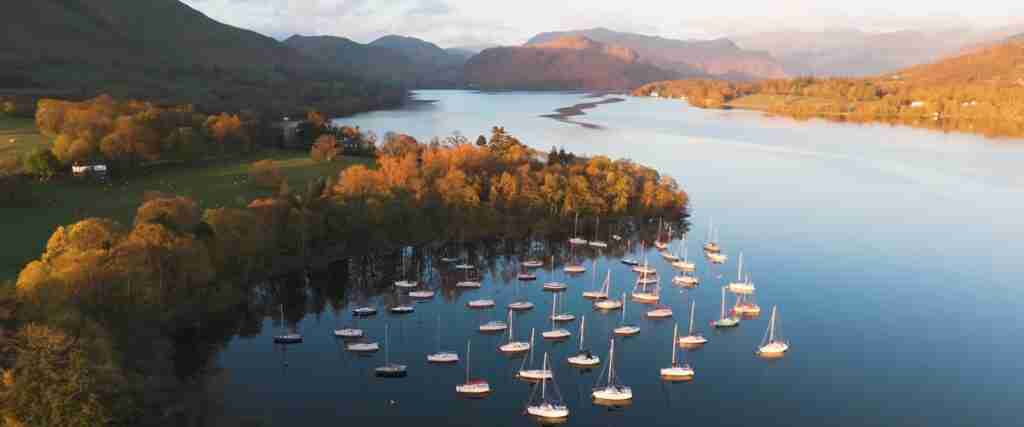
Autumn is the Lake District’s most photogenic season and, for many repeat visitors, its finest. The departure of summer crowds coincides with a landscape transformation that builds through September and reaches its peak in mid-October, producing a colour palette — copper bracken, yellow birch, red rowan, amber oak — that turns the valleys into something resembling illuminated stained glass in low autumn light.
September — The Season’s Finest Window
September is the month most recommended by experienced Lake District visitors and fell-walking guides. The school holidays end in the first week of the month, and the effect on popular destinations is immediate and dramatic: Bowness-on-Windermere, Ambleside, and Grasmere exhale, car parks recover space, and securing accommodation becomes a fortnight’s task rather than a months-long exercise. Weather through September is typically stable — meteorological data consistently places it among the drier months on average — and settled high-pressure periods are common, though a warm, dry September should not be taken as guaranteed.
The fells in September carry the last of summer’s green above the bracken line, while the bracken itself begins turning and the rowan berries redden. Blackberries ripen along the lower paths and stone walls, and the evenings, though shortening, remain light until past eight o’clock through most of the month. All businesses remain open. Walking conditions are excellent on the high fells — the ground is firm, paths are clear, and the longer sight lines of a lower sun angle make navigation easier and photography more rewarding than at any point in summer.
September is also the month when the Lake District’s agricultural calendar produces its most visible activity: Herdwick sheep gather on the open fells for the late summer gathering, and several traditional sheep shows take place across the national park. These events, attended primarily by farming families and communities, offer a genuine glimpse of the working cultural landscape that the UNESCO designation specifically recognised when it described the continuity of traditional farming as central to the site’s Outstanding Universal Value.
October and November — Colour, Mist, and Quiet
October brings the peak of autumnal colour, typically in the second or third week of the month depending on the year’s preceding conditions. The oakwoods along the shores of Coniston Water, in the Duddon Valley, and around the shores of Ullswater are particularly notable for their autumn display. The Aira Force gorge, accessible from a National Trust car park on the Ullswater shore, produces an especially vivid display in its mixed woodland, and the short walk into the gorge and up to the waterfall is one of the most rewarding October outings in the national park. Tarn Hows, surrounded largely by conifers, burns with unexpected autumn warmth when the larches turn gold in October.
The half-term school holiday, typically falling in the last week of October, produces a brief and sharp increase in family visitors. This is one of the most popular half-term destinations in England, and accommodation in the most popular villages needs booking several weeks ahead for that specific period. Outside the half-term window, mid-October is considerably quieter than September and the landscape is more dramatically coloured.
November sees visitor numbers continue to fall as weather becomes less reliable and many seasonal businesses close or reduce their hours. It is consistently the wettest month in many parts of the national park, and low-lying mist can persist in the valleys for days at a time. This is not to say November is unrewarding — on clear days, the stripped-back landscape and the low winter sun produce photographic conditions that no summer light can match — but the risk of a wet and dark visit is at its highest, and preparation must reflect that. The Kendal Mountain Festival, held annually in late November in Kendal just south of the park boundary, serves as a gathering point for mountain film, photography, and exploration writing enthusiasts, and can anchor a late-autumn visit around high-quality indoor cultural programming.
Winter in the Lake District
Winter in the Lake District is a minority pursuit, and that is precisely its appeal. From December through February, and in many areas well into March, the national park returns largely to its own communities, its farms, and a small population of visitors who understand what they are seeking and how to seek it safely.
December — Festive Character and Variable Conditions
December divides into two distinct phases. The pre-Christmas weeks see a modest revival of visitors drawn by festive events and markets in Keswick, Ambleside, and Windermere. Accommodation in the first two weeks of December can be quieter and better priced than the autumn. Christmas week itself, from roughly the 23rd to the 27th, sees significant hotel occupancy, as the Lake District is a popular destination for family Christmas breaks. New Year similarly attracts visitors to the towns and hotels around the lakes.
Walking conditions in December vary considerably: dry, frosty days produce excellent visibility and firm underfoot conditions, while wet spells — common in December — bring waterlogged paths, swollen becks, and reduced visibility on the high fells. Sunset falls before four o’clock throughout the month, and serious fell walking requires careful planning with an early start. A head torch is essential kit for any walk that might run even slightly beyond the intended time.
January and February — Solitude and Winter Beauty
January and February are the quietest months of the year. Many smaller businesses — independent tea rooms, seasonal boat hire operators, some youth hostels — close entirely or reduce to weekend-only opening. The major National Trust properties operate reduced winter hours, and some mountain passes can be closed or impassable following heavy snow: Kirkstone Pass on the A592, the Hardknott and Wrynose Passes in Eskdale, and the Honister Pass through Borrowdale close periodically in severe winter weather. Checking road conditions before travel between December and February is strongly advisable.
The fell walking in winter rewards experience and preparation proportional to ambition. Low-level routes — circuits of Grasmere and Rydal Water, the shores of Derwentwater, the western shore of Coniston Water from Torver, and the Tarn Hows loop — are manageable for well-equipped walkers on most winter days and are extraordinarily beautiful under snow or frost. Medium-level routes require attention to ice: paths that drain slowly across high moorland can be treacherous where an overnight freeze has glazed the surface. High fell routes — Helvellyn via Striding Edge, any approach to the Scafell massif, Blencathra’s Sharp Edge — become serious winter mountaineering objectives following snowfall, requiring ice axes, crampons, and the knowledge to use them correctly. These are not routes for the unprepared at any time of year; in winter they require a step-change in skill and equipment.
The compensation for all of this is the landscape itself. A clear winter’s day in the Lake District, with new snow on the fells above the 600-metre line, frost crystallising the dead bracken, and a hard blue sky overhead, produces a visual intensity that is impossible to replicate in summer. The lakes are at their most mirror-still on calm winter mornings, reflecting the snow-capped ridges with a precision that summer haze never allows. Accommodation rates are at their lowest — in many cases substantially below summer equivalents — and those who do visit find a region that feels genuinely, and quietly, their own.
Rainfall, Sunshine, and Weather Patterns Across the Year
The Lake District’s relationship with rainfall requires honest treatment rather than reassurance. No month of the year can be reliably described as dry, and the idea of a summer dry season does not hold in Cumbria the way it might in southern England. That said, the distribution of rainfall is not uniform, and understanding its shape across the year informs planning in useful ways.
April and June tend to record lower rainfall than surrounding months in many parts of the national park, though this is a statistical tendency rather than a guarantee. November is generally the wettest month by rainfall total across much of the Lake District, followed closely by December and October. The wettest areas are consistently the western fells and valleys — particularly Borrowdale, Wasdale, and Ennerdale — which sit directly in the path of moisture-laden Atlantic fronts. The eastern valleys and the limestone country around Shap and Kentmere are considerably drier, sometimes receiving less than half the rainfall recorded at Seathwaite in Borrowdale. This makes the eastern approaches to the national park — the Eden Valley, Ullswater, High Street, and the Kentmere fells — a reliable first choice when western routes are cloud-bound.
Sunshine hours follow a more predictable seasonal pattern. June and July receive the greatest number of hours of sunshine annually, with some days during high-pressure systems delivering more than twelve hours of bright, usable light. December and January are the darkest months, combining short day length with the highest proportion of overcast days.
Temperature ranges are moderate by European standards but vary significantly with altitude. Valley temperatures in July and August typically range from around 11°C at night to 20–22°C in the afternoon, occasionally exceeding 25°C during extended warm spells. January and February nights in the valleys fall to around 1–3°C, with frost on many mornings. The fells above 700 metres experience significantly lower temperatures in every season, and wind speeds on exposed ridges and summits can be severe in winter and autumn.
The Mountain Weather Information Service (MWIS) provides detailed fell-specific forecasts for the Lake District, taking into account wind, temperature, visibility, and precipitation at altitude rather than in the valley. Checking the MWIS forecast is regarded by experienced fell walkers as an essential preparatory step for any route above low level, and it is available free of charge online. The relevant national park authority and local mountain rescue teams also publish seasonal condition advisories that are worth consulting before winter visits to the high fells.
Best Season for Walking and Fell-Walking
Walking is the primary activity for most Lake District visitors, and the timing of a walking trip shapes the experience profoundly. The Lake District’s 214 Wainwright fells — catalogued in Alfred Wainwright’s seven-volume A Pictorial Guide to the Lakeland Fells, published between 1955 and 1966 — provide a lifetime’s worth of objectives at every level, from the gentle grassy rounds near Grasmere to the demanding ridges of the high central massif.
For those seeking the best all-round conditions across the widest range of objectives, late May through June and September through early October represent the optimal windows. Paths are in good condition, waymarks are visible, and daylight hours are generous. The risk of dangerous conditions on the high fells is at its lowest during these periods, though it never disappears entirely — the weather can deteriorate at any time of year, and the high fells can be cold, wet, and cloud-bound in the middle of July just as readily as in October.
Summer (July–August) is the busiest period for popular routes, and the most frequented trails — the ascent of Scafell Pike from Wasdale Head or Borrowdale, the Catbells ridge above Derwentwater, and the Striding Edge approach to Helvellyn — are genuinely crowded on weekends. This affects both the experience and, on narrow sections such as Striding Edge, safety: groups moving at different speeds on exposed, rocky ridges require patience and awareness. Those who walk early or choose midweek dates encounter far less company, and many of the less-celebrated Wainwrights see only a fraction of the footfall that the headline summits attract. The fells of the western and northern park — Yewbarrow, Caw Fell, Middle Fell, the Caldbeck fells — are excellent in summer and rarely busy.
Autumn walking from mid-September through October is, for many experienced visitors, the finest walking of the year. The bracken has turned but not yet collapsed, the paths are quiet, and the light at this latitude in October — long, low, and golden — illuminates the fells from angles that summer overhead sun never produces. The views from Helvellyn, High Street, and the Coniston group carry exceptional clarity on settled autumn days when the atmosphere has been washed clean by recent rainfall.
Winter walking requires a clear understanding of the distinction between low-level routes, which are generally accessible and beautiful year-round with appropriate footwear, and high-level routes, which require progressively more winter experience and equipment as conditions deteriorate. Several fell rescue teams in the Lake District — among the busiest volunteer mountain rescue organisations in England — respond to incidents year-round, with a significant proportion involving inadequate preparation for winter conditions. Checking the MWIS forecast and the mountain rescue teams’ publicly available condition advisories before winter visits to the high fells is strongly recommended.
Spring is underrated as a walking season. The fells are quiet, the paths improving as winter wet drains away, and the longer daylight of late April and May makes planning more comfortable. The main caveat for spring walking is ground conditions on the high fell: some exposed paths remain boggy well into April, and gaiters are a sensible addition to the kit for any route traversing wet moorland. Dogs must be kept on leads at all times during the lambing season on farmland and open fell alike.
Best Season for Families Visiting the Lake District
Families with children have the most practicable range of choices in the Lake District, which caters well for young visitors throughout much of the year. Since most families are constrained to school holidays, the relevant windows are Easter, the May bank holiday, summer, and the October half-term — each with distinct characteristics.
Summer (July–August) is the most visited family period and offers the fullest range of activities: lake steamer services on Windermere, Ullswater, and Coniston Water operate at their full schedule; boat hire is available at multiple lakeside points; the Lakeside and Haverthwaite Railway runs its complete timetable; Hill Top in Near Sawrey opens with full seasonal hours; and the Ravenglass and Eskdale Railway, a narrow-gauge line that runs through one of the Lake District’s quietest valleys, operates daily. The trade-offs are congestion and the need for very early booking on all accommodation and popular activities.
Easter and the October half-term are increasingly popular family alternatives. Both offer good activity availability without the same density of summer visitors. October half-term coincides with the peak of autumnal colour, and children who enjoy conker-hunting, blackberry-picking (by now past their best, but the experience remains appealing), and fallen-leaf spectacle find the Lake District in late October excellent. Easter, when it falls in late March or April, brings the lamb-watching opportunities that genuinely enthral younger children; the sight of Herdwick lambs on the fell paths near Grasmere or in the Langdale valleys is one of the more reliable low-key delights the Lake District provides at this time of year.
The most important adjustment for family visitors in any season is a realistic appraisal of distances and terrain. What reads as a short walk on a map can involve rough ground, steep gradients, and unreliable underfoot conditions that are challenging for younger or less experienced walkers. Low-level circuits — around Tarn Hows, along the western shore of Coniston Water from Torver, around Grasmere village and the lakeside path, or along the Keswick Railway Path — deliver genuine Lake District scenery without the demands of fell walking, and are achievable for children of most ages. These routes tend to be well-signed and well-maintained, though waterproof footwear remains advisable regardless of conditions.
Best Season for Wildlife and Nature
The Lake District’s nature calendar offers distinct rewards in every season, and the best time to visit for wildlife depends on what you most want to see.
Spring (April–May) is the richest season for birds. Pied flycatchers and redstarts — summer visitors from sub-Saharan Africa — arrive to nest in the sessile oak woods from late April, and their calls can be heard in Grizedale Forest, around the shores of Esthwaite Water, and in various woodland sites across the national park. Ospreys, which returned to nest at Bassenthwaite Lake in 2001 after an absence from England spanning more than 150 years, now breed at multiple sites across the Lake District following the success of the Lake District Osprey Project. The birds typically arrive in April and depart by early September; viewing arrangements at established sites have varied in recent years, so it is worth checking current access information with the national park before a specific osprey-watching visit. Red squirrels — absent from most of England but present in small populations in the Lake District, particularly in conifer plantations in the north and west of the park — are year-round residents but most visible at established feeding stations and on cold winter mornings when tree canopy is absent.
Summer brings the highest activity of upland birds, including ring ouzels on the open fell and peregrine falcons at several traditional nest sites on the crags. The lakes support breeding great crested grebes, and the quieter shores of Esthwaite Water and Bassenthwaite Lake in early summer produce close-range sightings of waterbirds that the busier shorelines do not allow.
Autumn is the season for the red deer rut. Red deer are present on the higher and more remote fells of the Lake District, particularly in the northern and western parts of the park, though in smaller numbers than in the Scottish Highlands. The rut begins from mid-September, and the sound of stags bellowing can carry remarkably far in still air. Rutting activity typically peaks in October. Autumn is also the best time to observe the remarkable diversity of fungi in the oak and birch woods — October produces an extraordinary range of species, and guided foraging walks are offered by a number of local operators throughout the month.
Winter offers the unusual spectacle of short-eared owls hunting low over upland moorland in the early afternoon light of short winter days — a sight almost impossible to observe in summer when the vegetation is high and the days long. The stripped-back vegetation of winter also makes it easier to spot red squirrels at their feeding stations, and the combination of reduced foliage and the greater patience that winter solitude encourages makes it an underrated wildlife season for those willing to visit in cold conditions.
Best Season for Photography in the Lake District
The Lake District is one of the most photographed landscapes in England, and the interaction of mountains, lakes, and constantly changing Atlantic weather produces remarkable photographic opportunities in every season. The variables of light, colour, mist, and reflection are at their most compelling in autumn and winter, though each season has its distinctive strengths.
Autumn (September–November) is the season most photographers target. The low autumn sun — rising late and setting early at this latitude — stays near the horizon for extended periods of golden hour both morning and evening, producing the kind of long, warm light that overhead summer sun cannot replicate. The combination of coloured foliage, clear water reflections in settled conditions, and the possibility of valley mist lingering after dawn makes the Lake District in October one of the most visually rewarding landscapes in the country. Dawn shoots at Rydal Water, Derwentwater, and the southern shore of Ullswater near Glenridding regularly produce the conditions that define the Lake District’s visual identity: mirror-still water, mist threading through the woodland, and the first horizontal light catching the fell ridges amber above the shadow line.
Winter, when frost transforms familiar paths and snow on the high fells creates a clarity that summer haze does not allow, is the second great photographic season. The stripped-back landscape reveals structures — drystone walls, farmsteads, the lines of the Wainwright ridge routes — that summer vegetation conceals. Sunrise in winter occurs at a manageable hour for the dawn photographer: around 8 a.m. in December and January, compared with the 4:30 a.m. of midsummer, which demands a commitment that not every photographer can sustain.
Spring offers wildflower carpets, bluebell woodland, and the vivid green of new vegetation — a palette very different from autumn but equally distinctive. Summer’s long evenings permit photography well past nine o’clock, including dramatic sunset sequences on clear days from the fell summits. The challenge in summer is the overhead light of the middle hours, which flattens the contoured fell landscapes and produces the least interesting conditions of the day; working at the very beginning and very end of the day is the standard approach for serious summer photography in upland landscapes.
The Lake District’s most celebrated viewpoints — Surprise View above Derwentwater, the Tarn Hows panorama, the Ashness Bridge foreground above Keswick, and Castlerigg Stone Circle at dawn — are well enough documented to be starting points rather than final destinations. The less-visited corners of Wasdale, the Duddon Valley, and the lower fells above Shap provide photographic material of equal quality with the significant additional advantage of not already existing in many thousands of identical versions online.
Events and Festivals Through the Year
The Lake District’s events calendar is concentrated in the spring-to-autumn window, reflecting the tourism season and the agricultural calendar. The following events are established fixtures, though dates should be confirmed before travel as schedules are subject to annual variation.
In May, the Keswick Mountain Festival brings together climbers, fell runners, adventure photographers, and outdoor enthusiasts for a programme of guided walks, film screenings, talks, and equipment exhibitions. It typically runs over a long weekend and is held in and around Keswick, making it a useful anchor for a May visit to the northern Lake District.
July sees the Ambleside Rushbearing, an ancient ecclesiastical custom in which local children carry rushes in procession to St Mary’s Church, maintaining a tradition rooted in the era before stone floors replaced rush-covered earth in Cumbrian churches. The procession is one of the most distinctively local events in the Lake District’s calendar, attended primarily by residents and those who specifically seek it out rather than by general tourism crowds.
August is the most event-dense month. The Grasmere Lakeland Sports and Show, typically held on the Thursday of the August Bank Holiday weekend, is one of the oldest traditional sports meetings in England and includes fell racing, Cumberland and Westmorland wrestling, hound trailing, and sheepdog trials. Cartmel Races, held over three meetings typically in May, June, and August, draw large crowds to the small village in the Cartmel valley just south of the national park boundary and create a notably festive atmosphere in the surrounding area. Various agricultural shows — including Lowther Show, Westmorland County Show (held in Crooklands), and others — run through August and into early September, showcasing the farming traditions that underpin the cultural landscape.
September features the traditional Herdwick sheep shows at several locations across the national park, attended primarily by farming families and offering an authentic glimpse of the working fell farm calendar. These events, modest in scale but deep in local significance, represent the living continuation of practices that predate the national park designation by centuries.
November brings the Kendal Mountain Festival, a multi-day celebration of mountain films, photography, exploration literature, and adventure writing held in Kendal, just south of the park. It is one of the major events in the international mountain culture calendar and draws speakers and attendees from across the world, providing a high-quality cultural programme that can anchor a late-autumn visit for those who find the outdoor season winding down.
Avoiding Peak Season Crowds
Managing the Lake District’s crowds is not principally a matter of finding secret spots — most genuinely quiet places require only a modest walk from the road — but of timing, logistics, and willingness to depart from the default itinerary that most visitors follow.
The default itinerary concentrates on a handful of honeypot destinations: Bowness-on-Windermere, Ambleside, Grasmere village, Tarn Hows, Aira Force, Scafell Pike, and Catbells. These are popular for good reason — they offer genuine experiences and are logistically straightforward — but they absorb a disproportionate share of the national park’s millions of annual visitors. Any willingness to move beyond this list immediately opens up large areas of the park that see a fraction of the footfall.
Timing within the day matters enormously in summer. Arriving at popular car parks before 8:30 a.m. or after 4 p.m. on peak summer weekends makes a considerable difference to the experience. The midweek versus weekend distinction also applies within summer: Tuesday and Wednesday in peak season are meaningfully quieter than Saturday and Sunday. The park’s seasonal park-and-ride services, available from gateway towns during the busiest periods, provide a practical alternative to competitive car park hunting and are worth using as a first option rather than a last resort.
Choosing less-visited areas distributes the benefit without sacrificing quality. The Duddon Valley, Eskdale, the fells above Shap, the northern fells around Caldbeck, and the Newlands Valley west of Keswick all receive a fraction of the visitors that the central Lake District absorbs, and their scenery is no less dramatic. The western approach to the mountains — via Wasdale and Ennerdale — is particularly underused relative to its quality, partly because the approach roads are narrow and the distance from motorway junctions is greater. The small villages of Boot in Eskdale, Buttermere, and Troutbeck see far fewer visitors than their proximity to outstanding walking might justify.
Staying in smaller villages rather than the headline destinations has a similar deflating effect on the crowd experience. Accommodation in Coniston, Torver, Patterdale, Threlkeld, or Hesket Newmarket places visitors within reach of excellent walking while removing them from the congestion centred on Windermere and Bowness. Self-catering and camping options are more readily available in these areas and reduce the booking lead time that the larger, more popular accommodation clusters demand.
What to Pack by Season
Packing for the Lake District requires an honest assessment of likely conditions rather than optimistic preparation for the best-case forecast. The following applies in every season but with variations in emphasis.
The universal items — required year-round regardless of forecast — are: a fully waterproof jacket and overtrousers (not water-resistant or shower-proof: fully waterproof), walking boots with ankle support and appropriate waterproofing for boggy ground, a warm mid-layer fleece or insulating jacket, and a map and compass (or GPS device with downloaded offline maps) for any route beyond well-signed low-level paths. These are the baseline for fell walking in this landscape, not optional extras to be jettisoned if the morning looks bright.
In spring (March–May), add an additional warm layer for the transition between cold mornings and warmer afternoons; insect repellent from late April onwards; and sunscreen for the increasingly strong late-April and May sunshine. Gaiters are useful in early spring when paths at higher levels remain boggy after winter. A brimmed hat for warmth is useful in March; a sun hat becomes relevant by May on clear days.
In summer (June–August), the risk of insufficient warm clothing persists despite the season: above 600 metres, temperatures drop noticeably even in July, and afternoon thunderstorms can develop on warm, humid days with little warning. Sunscreen and sun protection are more frequently needed in summer than in other seasons. A head torch is always worth carrying in case a walk runs later than planned.
In autumn (September–November), pack for rapidly changing conditions: what begins as a mild October morning can become a cold, wet, and windy afternoon, particularly if the route involves significant elevation gain. Trekking poles are particularly useful in autumn, when wet leaves on paths and mud near becks create slippery conditions that poles stabilise effectively. By November, warm waterproof gloves and a thermal hat should be standard.
In winter (December–February), kit for high fell routes should include crampons and ice axe if any route above 500 metres is planned following frost or snowfall, a balaclava or warm hat covering the ears, thermal base layers, and contingency food and an emergency bivvy bag for any serious fell day. For low-level walking, the standard waterproof and warm layers suffice, supplemented by a good hat, waterproof gloves, and warm socks. In all cases, carrying a fully charged mobile phone with the OS Maps app (offline maps downloaded) is strongly advisable, along with the number of the local mountain rescue team saved in the contacts.
Planning Around School Holidays and Bank Holidays
The Lake District’s visitor calendar is more sensitive to the English school holiday schedule than to any other single factor. Understanding when schools are out — and planning either to coincide with holidays (accepting the crowds and higher costs) or to avoid them (gaining access and value) — is the single most important variable in Lake District trip planning for most domestic visitors.
The critical pinch points are as follows. The spring half-term, typically the last week of May and first days of June, produces a brief surge. Easter, which spans two weeks in England and typically falls in late March or early April, is extremely popular with families and sells accommodation quickly across all price ranges. The main summer holidays — spanning roughly six weeks from mid-July to early September — represent peak season in its entirety. October half-term, usually the last week of October, creates a concentrated family surge that is especially popular because it coincides with autumnal colour. The Christmas and New Year period sees hotel occupancy high around key dates, even as the Lake District’s quietest weeks of the year immediately follow in January.
Bank holiday weekends — particularly the August Bank Holiday, the May bank holiday, and Easter — generate some of the highest single-day visitor counts of the year. The August Bank Holiday weekend coincides with the Grasmere Lakeland Sports, adding a specific destination draw on top of the general holiday volume.
For visitors without the school holiday constraint — those travelling outside term-time windows, visitors from countries with differently structured academic calendars, or retirees — the opportunities are substantial. The months of May (excluding bank holidays), June (excluding the late-May half-term), September, and the first half of October offer the most favourable combination of visitor volume, weather, and infrastructure availability. These are the windows that experienced independent travellers to the Lake District consistently recommend, and they are not accidental choices: they represent the months when the landscape is at its best and the infrastructure is functioning without being overwhelmed.
Frequently Asked Questions
How far in advance should I book accommodation for a summer Lake District visit?
For July and August stays, particularly in Grasmere, Hawkshead, Coniston, and Keswick, booking three to six months in advance is strongly advisable for mid-range and self-catering accommodation. Popular holiday cottages in prime locations are often booked a year or more in advance by returning visitors who rebook on departure. For budget accommodation — campsites and bunkhouses — earlier booking is still recommended, though last-minute availability is more common than in hotels. Bank holiday weekends in any summer month sell out faster than standard weekends and should be treated with the same lead time as the peak school-holiday weeks.
Can I visit the Lake District by public transport?
Yes — the Lake District is more accessible by public transport than many rural national parks, though less so than urban destinations. The main rail gateway is Oxenholme Lake District station on the West Coast Main Line, with a branch line serving Windermere town. Regular services also stop at Penrith, giving access to the northern and eastern park via connecting buses. The Stagecoach 555 bus between Keswick and Lancaster, stopping at Ambleside, Grasmere, and Windermere, is the principal intra-park service. Summer open-top services including the Ullswater Rambler and the Buttermere Rambler are particularly useful for walkers planning linear fell routes. Lake steamer services on Windermere, Ullswater, and Coniston Water function as de facto public transport connections and operate year-round with reduced winter timetables. Travelling without a car is practical for the main destinations and many popular fell routes; for remoter valleys such as Wasdale, Eskdale, and the Duddon, a car or bicycle is considerably more convenient.
Is wild camping permitted in the Lake District?
Wild camping is permissible on open fell above the intake walls in the Lake District — unlike most of England, where land access law does not permit it outside specific designated access land — and has a long tradition in the national park. The relevant obligations are well-established: camp above the intake wall marking the boundary of enclosed farmland, use no open fire on the open fell (the national park guidance discourages open fires on the open fell and prohibits them during dry conditions), camp for no more than two or three nights in one location, and take all litter away without exception. Popular summit camping locations — around Angle Tarn, the Crinkle Crags ridge, High Street, and the Helvellyn plateau — are well-known and generally managed responsibly by their users. The best seasons for wild camping are May through September, when overnight temperatures are tolerable without specialist equipment. Winter bivouacking above 600 metres is a serious undertaking requiring full mountaineering kit and a thorough weather assessment.
What is the most accessible high fell for a first-time visitor?
Catbells, on the western shore of Derwentwater above Keswick, is widely considered the most accessible of the higher-profile Wainwright fells. Its ascent from the Hawse End car park involves a climb of around 300 metres over approximately two kilometres, with a well-maintained path and no exposed scrambling on the main route. The views across Derwentwater to Skiddaw and the northern fells are among the most celebrated in the national park. For families with older children, the Catbells circuit from Hawse End is a manageable half-day walk. Silver Howe above Grasmere, Loughrigg Fell above Ambleside, and Wansfell Pike from Ambleside town are similarly accessible alternatives. In every case, walking boots or trail shoes with ankle support and grip are recommended over casual footwear, regardless of how benign the weather appears from the valley.
When do the bluebells flower in the Lake District?
Bluebells typically reach their peak in the Lake District between the third week of April and the second week of May, with timing varying by location and the warmth of the preceding weeks. The oak and mixed woodland around the shores of Coniston Water, the Grizedale Forest paths near Hawkshead, Claife Heights above Windermere’s western shore, and the ancient woodland near Rydal are all noted bluebell locations. Woodland at lower elevation — particularly south-facing sites near the lakeshores — typically flowers a week or two before higher or more northerly sites. Ramsons (wild garlic) often flowers at the same time as bluebells in damp woodland areas, creating simultaneous displays of white and blue across the woodland floor.
Are the Lake District fells accessible to wheelchair users and those with limited mobility?
A small number of accessible routes exist, though the terrain makes wheelchair access difficult beyond surfaced paths. The National Trust has developed accessible sections along Coniston Water’s shoreline, and Tarn Hows has a partially accessible loop around the tarn. The shores of Derwentwater near Keswick include surfaced sections navigable with wheelchairs in dry conditions. The Windermere lake shore path at Brockhole, the national park visitor centre, is largely flat and surfaced. For the great majority of fell walking — even lower and more popular routes — rough terrain, stiles, ladder stiles, and unmaintained surfaces present significant barriers for those with limited mobility. The national park authority maintains current information on accessible routes and facilities on its official website, and this should be consulted before planning a specific visit.
Does the Lake District become difficult to navigate in winter weather?
Major roads — the A591 between Windermere and Keswick, the A66 across Cumbria — remain open in most winter conditions, though they can close briefly following heavy snowfall. The high mountain passes are a different matter: Kirkstone Pass (A592), the Hardknott and Wrynose Passes in Eskdale, and the Honister Pass (B5289) close periodically when snow and ice make them unnavigable. Some closures last only hours; others persist for days during significant snowfall events. Checking road conditions before travel between December and February is advisable, and winter tyres or snow chains are prudent on any visit that might coincide with forecast snowfall on high-pass routes. Local radio stations and the relevant highway authority road condition information lines provide current updates.
What is the difference between a lake, a water, a mere, and a tarn in the Lake District?
The terms are informal regional distinctions rather than precise ecological categories. Only one body of water in the Lake District carries the word “lake” in its official name: Bassenthwaite Lake, to the north of Keswick. The others carry the suffixes “Water” (as in Coniston Water, Esthwaite Water, and Rydal Water) or “Mere” (as in Windermere, where the “-mere” suffix itself means “lake” in Old English, making “Lake Windermere” a tautology — a common and understandable one). “Tarn” derives from the Old Norse word for a small mountain lake and refers specifically to upland bodies of water formed in glacially scooped hollows. There are hundreds of tarns in the Lake District, from the celebrated Styhead Tarn and Angle Tarn to innumerable smaller pools on the open fell that appear only on detailed maps. Understanding these terms is useful for reading guidebooks and maps, and it tends to delight visitors who encounter it for the first time.
What did the Lake District’s UNESCO World Heritage inscription in 2017 recognise?
The Lake District was inscribed on the UNESCO World Heritage List on 9 July 2017 as a cultural landscape, a designation that recognises not only the natural scenery but the millennia of human activity that created it. The inscription specifically identifies the farmed landscape of stone-walled valley floors, the Herdwick sheep farming tradition, the distinctive pattern of farmsteads and field systems, and the influence of Romantic-era poets, painters, and naturalists — most prominently William Wordsworth — in shaping how this landscape came to be valued and ultimately protected. The UNESCO designation covers the entire national park area and is managed through the Lake District National Park Partnership, a consortium of 25 organisations including the Lake District National Park Authority and the National Trust. It does not change public access rights but strengthens the planning and policy framework governing development and land management within the boundary.
Which areas of the Lake District are quietest even in peak summer?
Several valleys and areas remain significantly quieter than the honeypot destinations throughout summer. Wasdale, accessible only via narrow roads from the west or south, sees a fraction of the visitors that the Windermere corridor absorbs, yet contains England’s highest mountain (Scafell Pike), its deepest lake (Wast Water), and, reputedly, its smallest church (St Olaf’s, Wasdale Head). Eskdale, approached from the west via the Ravenglass and Eskdale Railway or by road, is relatively quiet throughout summer and offers excellent walking without the crowds. The northern fells around Caldbeck, Hesket Newmarket, and the area known as the Back o’ Skiddaw are gentle, green, and almost entirely free of tourist infrastructure. Newlands Valley, a short drive west of Keswick, delivers the classic Lake District valley landscape at dramatically lower visitor density than its proximity to Keswick might suggest. The Duddon Valley, running between the Coniston and Scafell fells, is consistently one of the least-visited of the major valleys and one of the most beautiful at any time of year.