Belgrade Day Trips 2026: Novi Sad, Sremski Karlovci & Smederevo
Three of Serbia’s most rewarding destinations lie within 90 minutes of Belgrade, each offering a completely different experience: the baroque grandeur and vibrant energy of Novi Sad, the wine-soaked lanes and Habsburg elegance of Sremski Karlovci, and the medieval fortress walls of Smederevo rising above the Danube. This guide covers everything you need to plan each day trip in 2026 — transport options, costs, what to see, and how to combine destinations for maximum impact.
Key Takeaways for Belgrade Day Trips 2026
- Exceptional value: All three destinations are reachable by public bus or train for $6–12 per person round trip. Belgrade’s city public transport has been free since January 2025, eliminating any cost to reach the Belgrade bus or train station from your hotel.
- Novi Sad is the flagship day trip: Serbia’s second city combines a free fortress, a walkable historic centre, and the unique atmosphere of Vojvodina’s multi-ethnic culture. The Soko high-speed train covers the 90 km in just 36 minutes for around $6 each way.
- Sremski Karlovci pairs perfectly with Novi Sad: Only 8 km south of Novi Sad, this baroque wine town makes a natural half-day addition — see both on a single DIY trip or a guided day tour.
- Smederevo suits history enthusiasts: Europe’s largest lowland medieval fortress stands 10 minutes’ walk from the bus station. The outer park is free; inner fortress entry costs around 250 RSD ($2). Budget $30–40 per person for the full day including transport and lunch.
- DIY day-trippers spend $30–42 per person for a full day at Smederevo (transport, entry, food) or $55–80 per person for an independent Novi Sad and Sremski Karlovci day. Guided tours covering Novi Sad and Sremski Karlovci together cost $50–80 per person in a shared group and include hotel pickup, wine tasting, and a professional English-speaking guide.
- Best seasons: April through June and September through October offer the ideal combination of mild weather, manageable crowds, and full attraction access. July brings the EXIT Festival to Petrovaradin Fortress — spectacular but busy and expensive for accommodation.
People Also Ask About Belgrade Day Trips 2026
How do I get from Belgrade to Novi Sad in 2026?
The fastest option is the Soko high-speed train operated by Srbija Voz, which covers the route in approximately 36 minutes for around 661 RSD ($6–7) for a standard adult ticket. Slower but equally popular, the hourly Srbija Voz regional trains take 57 minutes and cost 370–550 RSD ($4–6). Buses depart from Belgrade’s main bus station every 30–60 minutes, take 1h 20m–1h 30m, and cost 700–1,000 RSD ($7–10). By car the drive takes about one hour via the E75 motorway. Book the Soko train at srbijavoz.rs; bus tickets are purchased at the Belgrade bus station (Autobuska Stanica, Novi Beograd) on the day of travel.
Is Sremski Karlovci worth visiting as a day trip from Belgrade in 2026?
Sremski Karlovci is best visited as a half-day addition to a Novi Sad day trip rather than a standalone destination. The baroque town centre, the Cathedral of St Nicholas, the Peace Chapel, and three or four excellent wine cellars offering Bermet wine tastings can be covered in two to three hours. The most economical approach is to travel to Novi Sad first by train, then take a short taxi or local bus to Sremski Karlovci (around 15 minutes, 500–800 RSD/$5–8 by taxi), before returning to Novi Sad and onward to Belgrade. Alternatively, shared guided tours from Belgrade combine both stops in an 8-hour day for $50–80 per person.
How much does a day trip to Smederevo Fortress cost from Belgrade in 2026?
A DIY day trip to Smederevo costs $25–40 per person. The bus from Belgrade’s Lasta bus station runs every 30 minutes, takes 1h 15m, and costs approximately 680 RSD ($7) each way — budget $14 for the return journey. Entry to Smederevo Fortress itself is structured in two tiers: the outer park and courtyard are free, while the inner fortified town (the Small Town) charges around 250 RSD ($2–3) for access to the walls and best Danube viewpoints. Add a traditional Serbian lunch in town at $8–15 and you have a richly rewarding day for very little money.
Can I combine Novi Sad and Smederevo in a single day trip from Belgrade in 2026?
Combining both in a single day is possible but demanding and not recommended unless you hire a car or book a private tour. Novi Sad is 90 km north of Belgrade; Smederevo is 50 km east — they sit in opposite directions. Doing both by public transport would require returning to Belgrade between visits, consuming most of the day in transit. A far better approach is to dedicate one full day to Novi Sad and Sremski Karlovci (north), and a separate half-day or full day to Smederevo (east). If your itinerary is tight, Smederevo works as a half-day trip given its proximity: buses run frequently and the fortress is a 10-minute walk from the bus station.
Extended multi-day tours – 5+ days
Featured Belgrade Multi-Day Tour Packages
3 days
Belgrade 3-Day Discovery Tour
- ✓ Comprehensive Belgrade experience
- ✓ Expert local guides included
- ✓ All accommodation included
- ✓ Transportation provided
5 days
Belgrade 5-Day Highlights Experience
- ✓ Comprehensive Belgrade experience
- ✓ Expert local guides included
- ✓ All accommodation included
- ✓ Transportation provided
7 days
Belgrade 7-Day Cultural Journey
- ✓ Comprehensive Belgrade experience
- ✓ Expert local guides included
- ✓ All accommodation included
- ✓ Transportation provided
10 days
Belgrade 10-Day Complete Adventure
- ✓ Comprehensive Belgrade experience
- ✓ Expert local guides included
- ✓ All accommodation included
- ✓ Transportation provided
Multi-day tour packages powered by TourRadar. Prices and availability subject to change.
Introduction: Why These Three Destinations Define Day-Trip Serbia in 2026
Belgrade sits at the geographical heart of a region exceptionally generous to day-trippers. Within a 100 km radius, travellers encounter layered millennia of history: Roman legions, Byzantine monks, Ottoman sultans, and Habsburg engineers all left their marks on the Danube basin that Belgrade commands. The three destinations covered in this guide represent the most accessible, most rewarding, and most distinctly different expressions of that history.
Novi Sad — Serbia’s second city and the cultural capital of the autonomous province of Vojvodina — pulses with a confidence and cosmopolitanism that surprises many first-time visitors. Its compact historic centre, crowned by the vast Petrovaradin Fortress on the opposite bank of the Danube, offers everything a day trip should: iconic landmarks, excellent food, easy walkability, and the sense that you have genuinely arrived somewhere with its own distinct identity. Queen Maria Theresa proclaimed it a free royal city in 1748, and the title fits: Novi Sad still feels free-spirited, creative, and welcoming in a way that larger cities rarely manage.
Sremski Karlovci, just eight kilometres south of Novi Sad along the Danube’s right bank, operates at an entirely different pace. Its baroque town square, framed by the Cathedral of St Nicholas, the Grammar School, and the peculiar Four Lions Fountain, feels like a stage set for an 18th-century diplomatic drama — which is precisely what it was. The 1699 Peace of Karlovci, which ended the Great Turkish War and reshaped European borders, was signed here. Today the town is better known for Bermet, the aromatic fortified wine produced only in this region, and for the cellars where visitors can taste it straight from the barrel in centuries-old stone vaults.
Smederevo offers something rawer and more melancholy. The fortress that Despot Đurađ Branković ordered built in 1428 — desperately, urgently, knowing the Ottomans were coming — is Europe’s largest lowland medieval fortress. Its triangular inner town and 25 towers once sheltered the last capital of medieval Serbia before it fell to Sultan Mehmed II in 1459. Walking its walls above the Danube, the weight of that history is palpable. The surrounding town is unpretentious and largely untouched by tourism, giving Smederevo a kind of authenticity that has become increasingly rare in the Balkans.
What unites all three is exceptional accessibility and extraordinary value. With Belgrade’s public transport free since January 2025, the cost of getting to the bus or train station is zero. Interregional buses and trains are among the cheapest in Europe. The towns themselves — wine tastings, fortress ramparts, baroque squares — deliver experiences that cost a fraction of comparable attractions in Western Europe. This guide gives you everything needed to make the most of each destination, whether travelling independently or on an organised tour.
Day Trip to Novi Sad from Belgrade 2026: Complete Planning Guide
Getting to Novi Sad from Belgrade in 2026
Novi Sad sits 90 km north of Belgrade via the E75 motorway, making it one of the most straightforward day trips in the Balkans. Four transport options serve this route in 2026.
The Soko high-speed train (operated by Srbija Voz) is the standout option for speed and comfort. It covers the route in approximately 36 minutes — barely long enough to drink a coffee — and costs 661 RSD (approximately $6–7) for a standard adult ticket. Trains depart from Beograd Centar station and arrive at Novi Sad’s main railway station, which sits conveniently close to the city centre. Check the current timetable at srbijavoz.rs; the Soko typically runs multiple times daily.
The regional Srbija Voz train is slower at 57 minutes but costs only 370–420 RSD ($4–5) in second class, making it the cheapest mechanised option on the route. Trains run approximately hourly. Buy tickets at the station window — Serbian Railways does not currently offer e-tickets for domestic routes.
The bus is the most popular option by volume, with 20+ daily departures from Belgrade’s main bus station (Autobuska Stanica, Novi Beograd). Operators including Severtrans, Lasta, and Niš Ekspres run hourly or better, with the journey taking 1h 20m–1h 30m. Tickets cost 700–1,000 RSD ($7–10) and are purchased at the station. The Novi Sad bus station is well located near the city centre.
Driving takes about one hour in normal traffic via the E75. Parking in central Novi Sad uses the SMS parking system; budget 120–200 RSD per hour depending on zone. For a day trip, the train is almost always preferable to driving.
Since Belgrade’s city and suburban public transport became free in January 2025, reaching Belgrade’s bus or train station from any central hotel costs nothing — take any bus, tram, or trolleybus to the relevant station.
What to See in Novi Sad: Top Attractions for a Day Trip in 2026
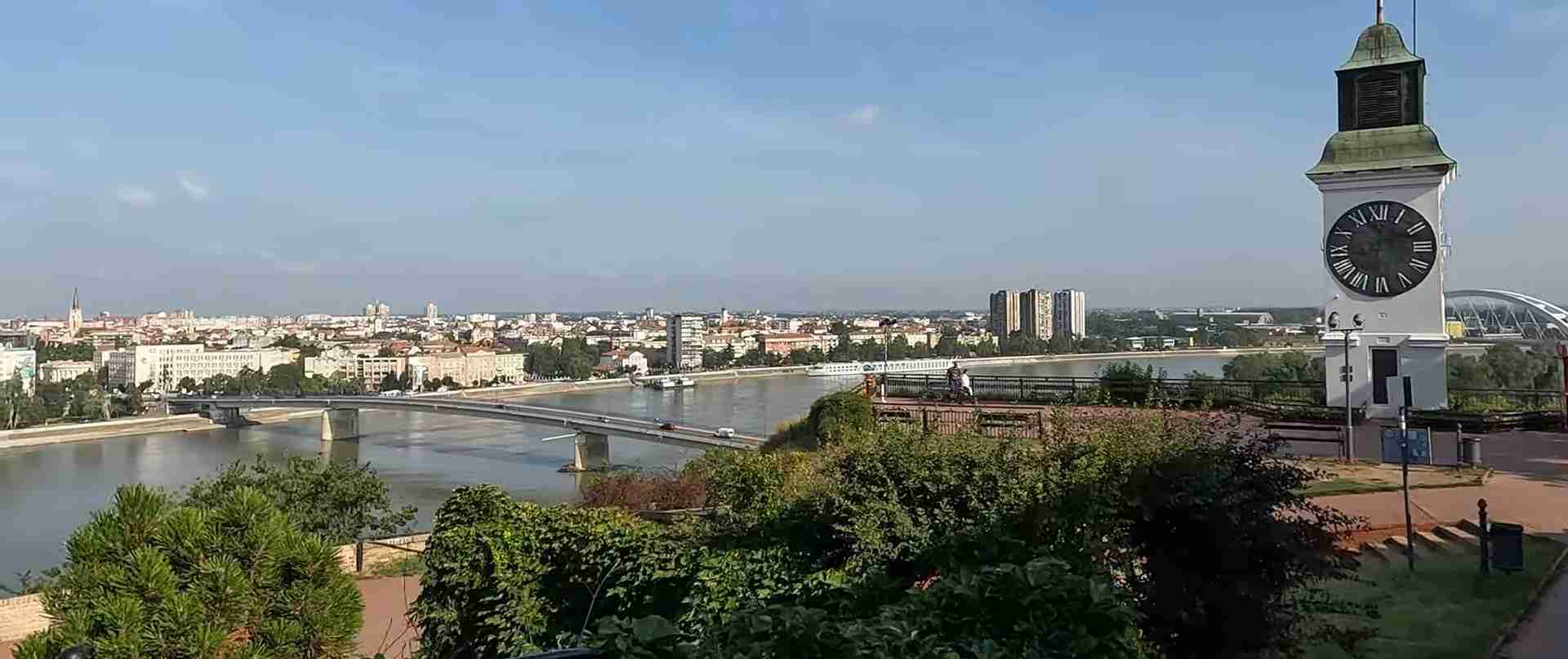
Petrovaradin Fortress is the defining image of Novi Sad and the essential stop on any visit. Perched on a rocky promontory on the right (south) bank of the Danube — the side opposite the city centre — it earned the nickname “Gibraltar on the Danube” from the Austrian Empire, which spent decades in the early 18th century transforming an older Ottoman fortification into one of the most sophisticated defensive structures in Europe. Construction began in earnest in 1692 under Charles Eugène de Croÿ and continued for over half a century.
Entry to the main fortress grounds is free, and the ramparts offer some of the finest panoramic views in Serbia — the Danube, the city skyline, the plains of Vojvodina stretching north, and the gentle ridge of Fruška Gora to the southwest. The fortress also contains the distinctive Clock Tower, whose hour and minute hands are famously reversed (the larger hand shows hours) so that fishermen on the river could read the time from a distance. Within the fortress walls, artists, craftspeople, and restaurateurs have occupied former military barracks and officers’ quarters, giving the complex a bohemian energy. The City Museum of Novi Sad occupies several rooms and charges a small admission; guided tours of the underground tunnel network, an extraordinary 16-kilometre labyrinth bored through the rock, operate with separate tickets. Every July, the EXIT Music Festival transforms the fortress into one of Europe’s best-attended outdoor stages.
Petrovaradin sits across the Varadin Bridge from the city centre — a flat 15–20 minute walk from Liberty Square, or a 5-minute taxi ride (500–700 RSD/$5–7). The walk across the bridge at dusk, with the fortress silhouetted against the sky, is one of the great free visual experiences in Serbia.
Liberty Square (Trg Slobode) is the heart of Novi Sad’s historic centre — a handsome baroque square dominated by the Roman Catholic Mary’s Church (Crkva Imena Marijinog), which dates to 1895, and the Town Hall, built in 1895 in an eclectic Romanesque-Renaissance style. The square functions as the city’s living room: cafés spill onto the pavements, market stalls appear during festivals, and the fountain at the centre provides a focal point for the city’s relaxed street life. Novi Sad’s pedestrian street, Zmaj Jovina, runs south from the square and is lined with 19th-century architecture, independent shops, and excellent kafanas (traditional Serbian taverns).
Museum of Vojvodina on Dunavska Street occupies two connected 19th-century palaces and offers a comprehensive survey of the region’s history from prehistoric times through the 20th century. The collection includes archaeological finds from the Bronze Age, artefacts from the Roman period at Aquincum and Sirmium, and extensive material on Vojvodina’s remarkable ethnic and cultural diversity — over 25 nationalities have historically called the province home. The museum charges a modest entrance fee (check the current rate at muzejvojvodine.org.rs). Closed Mondays.
The Synagogue on Jevrejska Street is one of the finest examples of art nouveau architecture in Serbia. Built in 1909 for the city’s once-substantial Jewish community, it now serves as a concert hall. Its exterior, featuring Moorish decorative elements and a distinctive blue dome, is freely visible; interior visits are possible during performances and occasional guided tours.
Dunavska Street and the old town grid between the Danube and Liberty Square preserve much of Novi Sad’s 18th and 19th-century streetscape. A leisurely 45-minute walk through these blocks — ducking into courtyards, noting the layers of Austrian, Serbian, and Central European architectural influence — reveals why Novi Sad’s old town has been described as one of the most intact Baroque town centres in the former Yugoslav space.
Where to Eat in Novi Sad: Restaurants and Dining Costs in 2026
Novi Sad’s dining scene rewards visitors who explore beyond the main tourist drag. Prices are significantly lower than Belgrade and dramatically lower than Western European capitals.
For a traditional Serbian lunch, the area around the old town and Dunavska Street offers numerous kafanas where a full meal — soup, grilled meats (ćevapi, pljeskavica, roštilj), salad, and a beer or domestic soft drink — costs 1,200–2,000 RSD ($12–20) per person. Vojvodina’s culinary tradition reflects its Central European heritage: expect heartier, richer flavours than in southern Serbia, with excellent paprika-based stews, freshwater fish from the Danube, and goulash influenced by the Hungarian community.
Budget-conscious travellers can eat extremely well at the city market near Zmaj Jovina — burek (flaky pastry filled with cheese or meat) from a pekara (bakery) costs 100–200 RSD ($1–2) per piece and makes a perfect fast breakfast or mid-morning snack. A pljeskavica sandwich from a street-facing grill runs 250–400 RSD ($2.50–4).
Mid-range sit-down restaurants in the pedestrian zone charge 500–900 RSD ($5–9) for main courses and 250–400 RSD ($2.50–4) for a large domestic beer. A full three-course lunch with drinks at a well-regarded restaurant — the kind of experience that costs €40–50 per person in Central Europe — runs 2,000–3,000 RSD ($20–30) per person in Novi Sad.
Day Trip Costs: Novi Sad from Belgrade in 2026
Independent travellers spending a full day in Novi Sad should budget as follows (per person, transport included, based on 2026 pricing):
- Transport: Return bus or regional train, 700–1,100 RSD ($7–11). Return Soko high-speed train, approximately 1,322 RSD ($12–14).
- Petrovaradin Fortress grounds: Free
- City Museum or tunnel tour: 300–600 RSD ($3–6) for optional paid attractions
- Lunch at a mid-range restaurant: 1,200–2,000 RSD ($12–20)
- Coffee and snacks: 400–700 RSD ($4–7)
- Optional taxi Petrovaradin and back: 1,000–1,400 RSD ($10–14)
A budget-conscious traveller taking the regional train, visiting only the free fortress grounds, and eating simply can do the full day for approximately $25–35 per person. A traveller taking the Soko, visiting the museum, hiring a taxi to Petrovaradin, and enjoying a proper sit-down lunch will spend $45–65 per person. Check srbijavoz.rs for current train fares and timetables.
Day Trip to Sremski Karlovci from Belgrade 2026: Wine, Baroque Architecture & the Danube
Getting to Sremski Karlovci from Belgrade in 2026
Sremski Karlovci lies 80 km north of Belgrade and 8 km south of Novi Sad on the right bank of the Danube. The most practical approach for independent travellers is to treat Sremski Karlovci as a half-day extension of a Novi Sad day trip rather than a standalone destination — the two towns are easily combined in a single day.
From Belgrade, take the bus or train to Novi Sad (see above), then travel south to Sremski Karlovci by taxi (15–20 minutes, approximately 800–1,200 RSD/$8–12), local bus (infrequent; check schedules locally), or rideshare. Some buses from Belgrade to Novi Sad pass through or near Sremski Karlovci — ask at the Belgrade bus station about direct services, as a handful of routes stop in the town.
Organised day tours from Belgrade are an excellent and popular alternative for Sremski Karlovci, since the town’s wine cellars and baroque sights are easier to navigate with a guide who has pre-arranged winery access. Victor Tours, one of Belgrade’s most reputable operators, runs a shared 8-hour day trip departing at 9:30 that covers Krušedol Monastery, Sremski Karlovci (wine tasting included), Petrovaradin Fortress, and Novi Sad for approximately $50–80 per person (check current prices at victortours.com; the tour cost about $80 per person based on recent reviews). Hotel pickup from central Belgrade is included. GetYourGuide and Viator also list comparable tours from multiple operators starting around €50 per person.
For those who want a deeper wine focus, dedicated wine tours concentrating on Sremski Karlovci and the Fruška Gora wine region run by specialist operators cost €90–135 per person for groups of two, with pricing per person decreasing for larger groups. These full-day programmes include three winery visits, lunch, and transport.
What to See in Sremski Karlovci 2026
The Main Square (Trg Branka Radičevića) is the architectural centrepiece of Sremski Karlovci and one of the most harmonious baroque squares in Serbia. Four buildings define its corners: the Cathedral of St Nicholas (Saborna crkva Svetog Nikole), an Orthodox church consecrated in 1762 that contains a remarkable iconostasis; the Grammar School (Karlovačka Gimnazija), the oldest Serbian secondary school, founded in 1791 and housed in a yellow neoclassical building that trained generations of Serbian intellectuals; the Town Hall, built in 1808; and the former Greek-Catholic bishop’s residence. At the centre of the square stands the Four Lions Fountain (Česma četiri lava), a Baroque drinking fountain dating to 1799 whose four bronze lions are perhaps the most photographed objects in the town.
The Peace Chapel (Kapela mira), a small round building a short walk from the main square, marks the location where the 1699 Peace of Karlovci was negotiated — the treaty that ended the Great Turkish War, expelled the Ottomans from Hungary, and established the Habsburg Empire as the dominant power in Central Europe. The chapel is modest in scale but enormous in symbolic significance; it stands as a physical marker of one of the decisive moments in European political history.
Wine cellars and Bermet tastings are the primary reason many visitors make the trip to Sremski Karlovci, and rightly so. Bermet is a fortified, aromatic wine produced only in the Sremski Karlovci microclimate — its production is protected as a geographical indication, and it cannot legally be called Bermet if produced anywhere else. The wine is made from Italian Riesling or Pinot Noir grapes macerated with a blend of botanical ingredients including wormwood, herbs, and citrus peel in a recipe that dates to the 18th century. Its distinctive sweet-bitter character made it fashionable across 19th-century Europe; bottles were reportedly found in the wreckage of the Titanic.
The most visitor-friendly cellars cluster around and just off the main square. Zivanović Wine Cellar (also housing a museum of beekeeping) and Kiš Winery are among the most-visited; Podrum Brežanin and Vinum are also frequently recommended. Most cellars operate tastings by appointment or on a walk-in basis for small groups; budget 300–500 RSD ($3–5) per person for a tasting of several wines including Bermet. Some cellars also sell bottles to take home — a bottle of quality Bermet costs approximately 1,000–2,500 RSD ($10–25) depending on producer and vintage. Book tastings in advance during peak season (May–October) as the best cellars fill up quickly.
Fruška Gora viewing points above the town offer a perspective on Vojvodina’s geography that the flat plains do not otherwise allow — the vine-covered slopes of Fruška Gora National Park descend almost to the Danube here, with the river gleaming below and the Hungarian plain extending to the north. The short hike up through the vineyards takes 20–30 minutes and rewards with views that contextualise the region’s winemaking history.
Krušedol Monastery, located on the slopes of Fruška Gora approximately 10 km west of Sremski Karlovci, is one of the most significant Orthodox monasteries in Serbia. Founded around 1509 by Đorđe Branković (later canonised as Saint Maksim), it served as the mausoleum of the Branković dynasty and contains the remains of several Serbian patriarchs. The monastery church features 16th-century Byzantine frescoes of considerable quality and a carved iconostasis from the 18th century. Guided tours from Belgrade that include Sremski Karlovci almost always stop at Krušedol; independent visitors can reach it by taxi or private transport from Sremski Karlovci.
Day Trip Costs: Sremski Karlovci from Belgrade in 2026
The costs depend significantly on whether you travel independently or book a guided tour:
- Independent (bus/train to Novi Sad + taxi to Sremski Karlovci): Transport total approximately $18–28 return; wine tasting $3–5; lunch $10–18; total approximately $35–55 per person for the combined Novi Sad–Sremski Karlovci day.
- Guided shared tour (Victor Tours or equivalent): $50–80 per person including hotel pickup, transport, guide, wine tasting at one cellar, and full day covering both Sremski Karlovci and Novi Sad with Petrovaradin Fortress. Lunch is typically at the traveller’s own expense ($12–20 extra).
- Dedicated wine tour (multiple cellars, full day): €90–135 per person for groups of two, decreasing with larger groups, including transport from Belgrade, three winery visits, and lunch.
Day Trip to Smederevo Fortress from Belgrade 2026: Medieval Serbia on the Danube
Getting to Smederevo from Belgrade in 2026
Smederevo is 50 km east of Belgrade — the closest of the three day-trip destinations covered in this guide. The bus is the only practical public transport option, and it is excellent.
Lasta buses depart from Belgrade’s Lasta bus station approximately every 30 minutes throughout the day, from around 06:30 to 22:30. The journey takes 1h–1h 15m depending on route (some services travel via the scenic Danube ridge road through Grocka; others use the faster highway). The one-way ticket costs approximately 680 RSD ($7), and the return trip costs the same. The Smederevo bus station is located directly opposite the fortress — from the bus doors to the fortress entrance is a 5–10 minute walk.
There is no direct train service to Smederevo from Belgrade; the railway serves other destinations on the Belgrade–Niš line.
Driving takes approximately 50–55 minutes via the E75 and the Smederevo road. Free parking is available along the railway tracks near the fortress, though it fills up on weekends. The SMS parking system may require a Serbian phone subscription; some visitors report difficulty using it as foreign visitors.
Rideshare (BlaBlaCar or Serbian equivalents) offers an inexpensive alternative for independent travellers who prefer not to take the bus — costs are comparable to the bus or slightly lower.
Smederevo Fortress: What to See in 2026
Smederevo Fortress (Smederevska Tvrđava) is not simply a well-preserved medieval fortification — it is the physical embodiment of a historical tragedy. Despot Đurađ Branković began construction in 1428 at the confluence of the Jezava and Danube rivers, drawing on stone from the Roman ruins at Viminacium and Margum. He completed the inner triangular fort (the Small Town, with six towers including the Donjon) in just two years, then spent the following decades constructing the massive outer walls and 20 towers of the Large Town along the Danube bank. The fortress became the seat of Serbian secular and ecclesiastical authority as the medieval Serbian state contracted under Ottoman pressure.
In 1439 the Ottomans captured it for the first time. Branković recovered it in 1444 through the Buda Peace. The definitive Ottoman conquest came in 1459, two years before Branković’s death — Smederevo fell to Sultan Mehmed II, and with it the last vestiges of independent medieval Serbia. The fortress passed through Austrian hands from 1717 to 1739, during which time the church inside the walls was briefly used as a Catholic place of worship before the Ottomans retook it. In 1941, an explosion in a German ammunition depot within the fortress walls killed approximately 2,500 people and caused catastrophic damage to the Large Town section — visible scars remain today.
The outer park and courtyard of the Large Town are freely accessible at all times. The scale is immediately striking: the walls stretch for 1.5 km around the perimeter, reaching heights of 10–20 metres, with the Danube forming a natural moat on the northern side. The courtyard has been transformed into a pleasant park with benches and shaded paths, used daily by local residents for walking and relaxation.
The Small Town (inner fortress) is the more historically intact and visually dramatic section. It is accessed through a separate entrance from the outer park, with an admission fee of approximately 250 RSD ($2–3) for adults (children under 7 free; check current prices at the ticket office). The Small Town includes the Donjon Tower — the tallest surviving structure — with a red-brick inscription recording the fortress’s construction under Despot Branković; the remnants of the palace and residential complex; and the excavated foundations of the medieval church, which went through multiple transformations as Serbian, Ottoman, and Austrian powers alternated control. Climbing to the top of the accessible towers provides commanding views of the Danube and the surrounding plain.
One-hour guided tours of the fortress can be arranged through the Smederevo Tourist Office for approximately 1,000 RSD ($10) per tour group — excellent value if you want historical context in English. Book in advance by contacting the tourist office directly.
Museum Smederevo, located in the town centre a short walk from the fortress, covers the cultural and artistic history of the Smederevo region from antiquity to the modern period. The museum houses paintings by regional Serbian artists, historical artefacts, and a scale model of the fortress as it appeared in the medieval period. Admission is approximately 130 RSD ($1–2). The museum does not have English-speaking staff on a regular basis, but exhibits are informative and the scale model alone is worth the modest entry fee.
Day Trip Costs: Smederevo from Belgrade in 2026
Smederevo is the most budget-friendly of the three day trips in this guide:
- Bus (return): approximately 1,360 RSD ($14)
- Outer fortress: Free
- Inner Small Town admission: approximately 250 RSD ($2–3)
- Museum Smederevo (optional): approximately 130 RSD ($1–2)
- Traditional lunch in town: 1,000–1,800 RSD ($10–18)
- Coffee and snacks: 300–500 RSD ($3–5)
A full day at Smederevo including transport, the inner fortress, the museum, and a good lunch costs approximately $30–42 per person. The outer park and Danube views are free and alone justify the bus fare. Guided day tours from Belgrade covering Smederevo alongside other Danube fortress destinations (including Ram and Golubac) run for approximately $65–90 per person for a 12-hour programme, check availability at local tour operators including Victor Tours.
Combining Destinations: Multi-Stop Day Trips from Belgrade 2026
The Vojvodina Day: Novi Sad + Sremski Karlovci 2026
This is the most popular and most logistically natural combination. With the Soko high-speed train putting Novi Sad just 36 minutes from Belgrade, you can depart at 8:30–9:00, be in Novi Sad by 9:15, take a taxi south to Sremski Karlovci for a wine tasting and baroque walking tour by 10:30, return to Novi Sad by 13:00 for lunch and an afternoon at Petrovaradin Fortress, and be back on the train to Belgrade by 18:00–19:00. This itinerary is demanding but entirely achievable and delivers two of Serbia’s most distinctive experiences in a single day.
Alternatively, the Victor Tours shared day trip covers exactly this combination in a guided format with hotel pickup, departing at 9:30 and returning by 17:00–17:30, for approximately $50–80 per person. The tour adds Krušedol Monastery to the itinerary, which independent travellers without a car would otherwise miss.
Estimated costs, independent DIY Vojvodina Day:
- Return Soko train Belgrade–Novi Sad: $13–14
- Taxis Novi Sad↔Sremski Karlovci: $18–25 (two rides)
- Wine tasting Sremski Karlovci: $3–5
- Petrovaradin optional paid attractions: $3–6
- Lunch in Novi Sad: $12–20
- Coffees and snacks: $5–8
- Total per person: approximately $55–80
Estimated costs, Victor Tours shared guided tour:
- Tour price (includes transport, guide, Krušedol entry, wine tasting): $50–80
- Lunch in Novi Sad (own expense): $12–20
- Total per person: approximately $65–100
The Danube Fortress Day: Smederevo + Golubac 2026
For travellers with a deep interest in medieval Balkan history, the east-flowing Danube offers a second compelling combination: Smederevo Fortress and Golubac Fortress, connected by the scenic Danube road and contextualised by the Roman archaeological site at Viminacium.
This combination is only practical by car or guided private/small-group tour — the public transport connections between Smederevo, Golubac, and Viminacium are too infrequent and time-consuming for a single day trip. Specialist tour operators including Victor Tours offer full-day Danube fortress programmes for approximately $65–90 per person in a shared group, departing at 8:00 AM and returning after 12 hours. Private versions of the tour cost more but allow complete flexibility over timing.
Golubac Fortress, 120 km east of Belgrade at the entrance to the Iron Gates gorge, is arguably the most dramatically sited medieval fortress in Serbia — eleven towers stacked against a cliff face above the narrowing Danube, with the gorge walls rising steeply on both sides. Unlike Smederevo, Golubac was never definitively conquered by any army; it was surrendered through negotiation or abandoned. A modern visitor centre and reconstructed section opened in recent years make it more accessible than previously. Entry costs approximately 600 RSD ($6).
The Half-Day Option: Smederevo as a Quick Escape from Belgrade 2026
Smederevo’s proximity makes it unique among the day trips in this guide: it can be done comfortably as a half-day outing, leaving mornings or afternoons free for Belgrade. Depart Belgrade at 10:00, arrive Smederevo 11:15, spend two to three hours at the fortress and town, have lunch, and be back in Belgrade by 15:30–16:00. The total cost for this compact outing — bus return, inner fortress, lunch, and coffee — runs $25–35 per person, making it one of the best-value historical experiences in the wider Balkans.
Guided Tours vs. Independent Travel for Belgrade Day Trips 2026
When to Book a Guided Tour from Belgrade in 2026
Guided tours make the most sense for three specific scenarios. First, if you want to visit Sremski Karlovci without a car — the town’s wine cellars, which are the primary reason to visit, require advance booking and are best navigated with a guide who has pre-arranged access and can provide context. Second, if you want to include Krušedol Monastery, which is inaccessible by public transport from Sremski Karlovci. Third, if you are a solo traveller or pair of travellers who want professional historical commentary and the social element of a small group without the cost of a private tour.
The tours are genuinely good value. A shared guided day trip covering Sremski Karlovci and Novi Sad for $50–80 includes hotel pickup, all transport, a wine tasting, an English-speaking guide, Petrovaradin Fortress, and free time in Novi Sad. For the price of a museum entry ticket in many Western European capitals, you get a full guided day in northern Serbia.
Recommended operators for Belgrade day trips in 2026:
- Victor Tours (victortours.com) — the most frequently recommended operator on TripAdvisor and GetYourGuide for northern Serbia day trips; small groups of maximum 15 people; certified English-speaking guides; hotel pickup included within 5 km of Republic Square.
- GetYourGuide (getyourguide.com) — aggregates multiple operators including Victor Tours; useful for comparison and booking flexibility with free cancellation up to 24 hours before departure.
- Viator (viator.com) — similar aggregation with 686+ reviews for northern Serbia tours from Belgrade; useful if you prefer a platform-mediated booking with buyer protection.
When to Travel Independently to Novi Sad and Smederevo in 2026
Independent travel makes most sense for Novi Sad (when not combining with Sremski Karlovci wine cellars) and Smederevo. Both are straightforward by public transport, free or low-cost to enter, and easily navigated without a guide. The Soko train to Novi Sad in particular is an exceptional piece of public infrastructure — fast, clean, cheap, and scenic. Smederevo’s fortress is large and historically rich enough to reward independent exploration with just a good guidebook or downloaded audio content.
The practical advantage of independent travel is flexibility: you leave when you want, spend as long as you like, and eat where you choose rather than on a tour schedule. For Novi Sad, this is particularly valuable because the city rewards spontaneous exploration — ducking into a kafana for rakija and conversation, wandering the fortress ramparts at your own pace, or lingering over a three-course lunch without a departure time looming.
Practical Planning Tips for Belgrade Day Trips in 2026
When to Go: Seasonal Planning for Day Trips from Belgrade 2026
The optimal window for day trips from Belgrade runs from April through June and September through October. Spring (April–May) brings mild temperatures, flowering landscapes along the Danube, and the Serbian wine season entering full swing in the Sremski Karlovci cellars. Early autumn (September–October) offers harvest season in Vojvodina, lower crowds than summer, and reliably comfortable walking temperatures.
July and August are the hottest months — temperatures regularly reach 33–38°C in the Pannonian plain — making outdoor fortress exploration uncomfortable in the middle of the day. July brings the EXIT Festival to Petrovaradin Fortress (typically the second week of July), which creates enormous demand for accommodation in Novi Sad and significantly increases prices across the city. Visiting Novi Sad during EXIT requires advance hotel booking months ahead; visiting as a day trip from Belgrade during festival week is possible but the city is intensely crowded.
November through March sees shorter days, some attractions operating reduced hours, and fewer guided tours operating (check availability before booking). The fortresses remain impressive in winter, and crowds are minimal, but the Sremski Karlovci wine cellars may have reduced tasting availability outside the main season.
What to Bring and Wear for Fortress Day Trips in 2026
All three destinations involve walking on uneven stone surfaces, often on slopes. Comfortable walking shoes with good grip are essential — this applies particularly to the ramparts at Petrovaradin and the towers at Smederevo, where the stone can be worn smooth and irregular. Sandals or thin-soled shoes are not adequate for fortress exploration.
In summer, sunscreen and a hat are important — the fortress ramparts and open walls at Smederevo offer little shade. A refillable water bottle is useful; tap water in Serbia is safe to drink, and public fountains (česme) appear throughout Novi Sad’s city centre.
Photography at all three sites is unrestricted in the general areas. The City Museum at Petrovaradin and Smederevo’s inner fortress may have specific rules about photography inside display areas — check on arrival.
Currency and Payments on Day Trips from Belgrade 2026
Serbia uses the Serbian dinar (RSD). Cash remains important for day trips: the Belgrade bus station sells tickets cash only or via domestic card; Smederevo’s fortress ticket office is cash only; the Sremski Karlovci wine cellars typically prefer cash for small tasting payments. ATMs (bankomati) are widely available in Novi Sad’s city centre; in Smederevo, use the ATMs at the bus station or town centre before visiting the fortress.
The approximate exchange rate in 2026 is 100 RSD to $1 USD. Useful reference amounts: 700 RSD ≈ $7 (bus fare); 250 RSD ≈ $2.50 (Smederevo inner fortress); 500 RSD ≈ $5 (wine tasting); 2,000 RSD ≈ $20 (sit-down lunch for one with drink).
Major credit cards (Visa, Mastercard) are accepted at restaurants and hotels in Novi Sad. In Sremski Karlovci and Smederevo, cash is the safer assumption for most transactions. Contactless payments are accepted at an increasing number of businesses in Novi Sad but not reliably at fortress ticket offices or small town establishments.
Language and Communication on Day Trips 2026
Serbian is the official language throughout all three destinations. In Novi Sad, English is widely spoken in restaurants, tourist sites, and hotels, reflecting the city’s cosmopolitan character and student population. In Sremski Karlovci and Smederevo, English is less prevalent — most people in tourist roles will understand basic requests, but complex communication in English requires patience. The Smederevo Tourist Office staff speaks Serbian primarily; for guided tours in English, book through a Belgrade operator in advance.
Basic Serbian phrases that ease day-trip logistics: hvala (thank you), molim (please / you’re welcome), koliko košta? (how much does it cost?), jedan/dva karte (one/two tickets), račun, molim (the bill, please). Serbian uses the Cyrillic script on official signage but also uses Latin script widely; the bus and train stations display arrivals and departures in both alphabets.
Sample Itineraries for Belgrade Day Trips 2026
One-Day Itinerary: Novi Sad + Sremski Karlovci (Independent) 2026
- 08:30 — Depart Belgrade Centar on the Soko high-speed train
- 09:06 — Arrive Novi Sad. Take a taxi or rideshare south to Sremski Karlovci (15–20 minutes, 800–1,200 RSD)
- 09:30–12:00 — Sremski Karlovci: Main Square, Peace Chapel, Cathedral of St Nicholas, wine tasting at Zivanović or Kiš cellar (book in advance)
- 12:15 — Taxi back to Novi Sad (800–1,200 RSD)
- 13:00–14:30 — Lunch in Novi Sad city centre near Zmaj Jovina pedestrian street
- 14:30–16:30 — Walk to Petrovaradin Fortress via Varadin Bridge; explore ramparts, Clock Tower, artists’ studios; optional City Museum or tunnel tour
- 17:00 — Return to Novi Sad train station; depart on Soko or regional train to Belgrade
- 17:36–18:30 — Arrive Belgrade
Estimated per-person cost: $50–80 including all transport, wine tasting, and lunch. Individual items: return Soko train $13–14, taxis $18–25, wine tasting $3–5, lunch $12–20, optional fortress attractions $3–6, coffees/snacks $5–8.
One-Day Itinerary: Smederevo Half-Day or Full Day 2026
- 09:30 — Depart Belgrade Lasta bus station (Autobuska Stanica) for Smederevo
- 10:45 — Arrive Smederevo. Walk 10 minutes to the fortress
- 11:00–13:00 — Free exploration of outer park and Danube riverfront; purchase ticket (250 RSD) for the Small Town inner fortress; climb the Donjon Tower; see the red-brick Branković inscription and church foundations
- 13:15 — Traditional lunch in Smederevo town centre (1,000–1,800 RSD)
- 14:30 — Optional: Museum Smederevo (130 RSD), 45 minutes
- 15:30 — Return bus to Belgrade from Smederevo bus station
- 16:45 — Back in Belgrade
Estimated per-person cost: $30–42 including bus return ($14), inner fortress ($2–3), museum optional ($1–2), lunch ($10–18), and snacks/coffee ($3–5).
Two-Day Itinerary: All Three Destinations 2026
Day 1 (Vojvodina): Full-day guided tour with Victor Tours covering Krušedol Monastery, Sremski Karlovci wine tasting, Petrovaradin Fortress, and Novi Sad. Tour price $50–80 plus lunch approximately $12–18. Total Day 1: $65–100 per person.
Day 2 (Smederevo): Morning departure at 9:30 by bus; fortress and museum visit; traditional lunch; return by 16:00. Total Day 2: $30–42 per person.
Both days combined: approximately $95–140 per person — a comprehensive survey of Serbian cultural heritage within an hour of Belgrade, at a fraction of the cost of comparable experiences anywhere in Western Europe.
Frequently Asked Questions About Belgrade Day Trips 2026
How far is Novi Sad from Belgrade?
Novi Sad is approximately 90 km north of Belgrade by road. The Soko high-speed train covers the distance in 36 minutes; regional trains take 57 minutes; buses take 1h 20m–1h 30m. By car, the E75 motorway takes about one hour in normal traffic.
Is public transport in Belgrade still free in 2026?
Belgrade’s city and suburban public transport — buses, trams, trolleybuses, and the BG Train urban railway — became free for all passengers on January 1, 2025, and this policy continues in 2026. The two paid exceptions are the A1 airport minibus (approximately 399 RSD/$4) and the express E-minibus lines (approximately 200 RSD/$2 per ride). All other city services are free, meaning you can reach the Belgrade bus or train station from any central hotel at zero cost.
Do I need to book train tickets to Novi Sad in advance?
For the regional Srbija Voz trains, tickets are purchased at the station on the day — Serbian Railways does not currently offer e-tickets for domestic routes. For the Soko high-speed train, some online booking is available at srbijavoz.rs, but tickets are also available at station windows. During summer weekends and festival periods (particularly EXIT Festival in July), early purchase is advisable as trains can sell out. On most weekday and autumn/spring travel, turning up at the station and buying a ticket is perfectly straightforward.
Is Smederevo Fortress free to visit?
The outer park of Smederevo Fortress, which covers the Large Town courtyard and the Danube riverfront walls, is freely accessible at all times. The inner fortified section known as the Small Town — which contains the Donjon Tower, the palace remains, and the best viewpoints over the Danube — charges approximately 250 RSD ($2–3) for adult admission. Children under 7 enter free. The bus station is located directly opposite the fortress, a 5–10 minute walk away.
What is Bermet wine and where can I taste it in 2026?
Bermet is a unique fortified aromatic wine produced exclusively in the Sremski Karlovci microclimate — the only place in the world where production is authorised under the protected geographical indication. It is made from Italian Riesling or Pinot Noir grapes macerated with wormwood, herbs, and citrus botanicals in a recipe dating to the 18th century. The wine has a sweet-bitter, complex character that is unlike any other wine in the Balkans. The best place to taste it is at a wine cellar in Sremski Karlovci itself: Zivanović (which also has a beekeeping museum), Kiš, or Podrum Brežanin are among the most visited. Book tastings in advance during April–October. Entry and tasting typically costs 300–500 RSD ($3–5) per person for several wines.
Can I visit all three destinations in a single day?
Visiting Novi Sad, Sremski Karlovci, and Smederevo in a single day is not recommended. Novi Sad and Sremski Karlovci are north of Belgrade; Smederevo is east — they sit in opposite directions and combining all three requires returning to Belgrade in between, consuming most of the day in transit. The Vojvodina combination (Novi Sad + Sremski Karlovci in one day) and Smederevo (either half-day or full day separately) are the logical pairings.
Are day trips from Belgrade safe in 2026?
Novi Sad, Sremski Karlovci, and Smederevo are all safe destinations for tourists in 2026. Serbia has a low violent crime rate compared to most of Western Europe, and tourist areas are well-maintained. The usual precautions apply — keep valuables secure, be aware of your surroundings in crowded areas, and use official taxis or rideshare apps (Car:Go is the dominant local rideshare service in Serbia) rather than unmarked vehicles. Fortress ramparts can be uneven underfoot; wear appropriate footwear.
What is the EXIT Festival and how does it affect day trips to Novi Sad?
EXIT is one of Europe’s most acclaimed outdoor music festivals, held annually at Petrovaradin Fortress in Novi Sad, typically during the second week of July. It draws 200,000+ visitors over four days and features internationally recognised headliners across multiple stages on the fortress grounds. For day-trippers, EXIT week means Novi Sad is extremely busy, hotel prices across the city surge dramatically, and the fortress itself is transformed into a festival site with limited daytime access. Day trips during EXIT are possible but expect crowds, higher restaurant prices, and a very different atmosphere. If the festival is not your intention, avoid the second week of July.
Can I take a day trip from Belgrade without speaking Serbian?
Novid Sad is very English-friendly — restaurants, hotels, tourist sites, and most young people speak English well. Sremski Karlovci is manageable with basic English; the wine cellars most visited by tourists have enough English for the tasting experience. Smederevo requires the least English of the three — the fortress ticket office and town businesses function in Serbian — but navigation is simple (the fortress is visible from the bus station), prices are marked, and pointing and smiling will get you through most transactions. For Smederevo with English commentary, book a guided tour from Belgrade.
What is the best time of day to arrive at Petrovaradin Fortress?
Morning arrivals (10:00–11:30) and late afternoon (16:00–18:00) offer the best light for photography and the coolest temperatures in summer. The fortress grounds are open 24 hours and the views at dusk — when Novi Sad’s city lights reflect in the Danube below — are particularly striking. Midday in July and August sees intense heat on the exposed ramparts. If visiting during EXIT Festival week, access to the upper fortress may be restricted during overnight festival hours.
Are there restaurants inside Petrovaradin Fortress?
Several restaurants, cafés, and bars operate within the fortress walls, primarily near the Officers’ Pavilion and the terrace overlooking the Danube. These tend to be mid-range to upscale in price relative to Novi Sad generally — a meal at the fortress terrace costs 1,500–3,000 RSD ($15–30) per person. The views are exceptional and the setting is unique, making it worth the modest premium for a special lunch or dinner. More affordable eating is available in the city centre below the fortress, reached by a 15-minute walk across the Varadin Bridge.