
Amalfi Coast Guide: Positano, Amalfi & Ravello
The Amalfi Coast stretches 50 kilometers along the southern edge of Italy’s Sorrentine Peninsula, where the Lattari Mountains plunge dramatically into the sapphire Tyrrhenian Sea. This UNESCO World Heritage Site since 1997 exemplifies the Mediterranean cultural landscape through its vertical architecture, terraced lemon groves, and historic towns clinging to cliffs, with Positano, Amalfi, and Ravello forming the triumvirate of destinations that define this extraordinary coastline.
Key Takeaways: Essential Facts About the Amalfi Coast
- The Amalfi Coast received UNESCO World Heritage designation in 1997 as an outstanding example of Mediterranean cultural landscape, encompassing 11,231 hectares across 15 municipalities including Positano, Amalfi, Ravello, Atrani, and Vietri sul Mare
- The historic Maritime Republic of Amalfi dominated Mediterranean trade from the 9th to 12th centuries, establishing the first maritime code (Tavole Amalfitane) and maintaining commercial connections from Spain to Egypt before Pisa’s conquest in 1137 ended this golden age
- Positano cascades vertically down cliffsides in pastel-colored terraces, creating the coast’s most photographed vista where boutique hotels, artisan shops, and pebble beaches stack above each other in architectural layers accessible primarily by steep staircases
- Ravello perches 365 meters above sea level atop the mountains, offering panoramic views from Villa Rufolo’s gardens and Villa Cimbrone’s Terrace of Infinity while hosting an internationally renowned classical music festival in its medieval cathedral square
- Terraced agriculture carved into steep mountainsides produces the coast’s famous sfusato amalfitano lemons, cultivated in stone-walled gardens that demonstrate centuries of intelligent landscape adaptation and serve as the foundation for limoncello liqueur production
- The Amalfi Drive (Strada Statale 163) provides the only land route connecting coastal towns across 40 kilometers, winding through tunnels and hairpin turns along cliffs where buses and cars navigate the narrow roadway above hundred-meter drops to the sea below
People Also Ask About the Amalfi Coast
Why is the Amalfi Coast a UNESCO World Heritage Site?
UNESCO inscribed the Amalfi Coast as a World Heritage Site in 1997 based on its status as an extraordinary example of Mediterranean cultural landscape where human settlement harmoniously adapted to extreme topography over centuries. The designation recognizes how inhabitants intelligently transformed the region’s dramatic vertical terrain through terraced agriculture, architectural innovation, and sustainable resource use that created exceptional cultural and natural scenic values. The terracing system, constructed from the 11th century onward using drystone walls, enabled cultivation of citrus groves, vineyards, and olive orchards on slopes too steep for conventional farming. The coastal towns’ vertical architecture, with narrow streets and steep stairs reminiscent of eastern souks, represents unique adaptation to limited buildable land. The historic Duchy of Amalfi’s artistic and architectural legacy, including the Romanesque Cathedral with its Moorish-influenced Cloister of Paradise, demonstrates the region’s cultural significance during the Maritime Republic era. The designation encompasses 15 municipalities including major towns Positano, Amalfi, and Ravello, along with mountain villages and agricultural zones that collectively illustrate the complete cultural landscape from sea level to mountain peaks.
What is the difference between Positano, Amalfi, and Ravello?
Positano functions as the coast’s glamorous seaside resort, cascading vertically down cliffsides in colorful terraces with boutique hotels, high-end shopping, and pebble beaches creating a sophisticated Mediterranean atmosphere favored by international celebrities since the 1950s. Amalfi serves as the historic capital and namesake of the coast, featuring the magnificent Duomo di Sant’Andrea with its Arab-Norman architecture, the medieval Arsenale shipyard, and working fishing harbor that maintains connections to the town’s maritime republic heritage. Ravello occupies an elevated mountain position 365 meters above the sea, offering panoramic coastal views from historic villas including Villa Rufolo and Villa Cimbrone rather than beach access, while hosting classical music performances in elegant garden settings. Positano emphasizes luxury resort amenities, beach culture, and upscale shopping along vertical pedestrian paths. Amalfi provides historical architecture, cultural institutions, and the largest town center with practical services and transportation connections. Ravello delivers artistic heritage, tranquil gardens, spectacular viewpoints, and cultural events in a quieter mountain village atmosphere removed from coastal crowds.
How was the Amalfi Coast formed geologically?
The Amalfi Coast’s dramatic topography resulted from the Lattari Mountains’ formation through tectonic uplift and subsequent erosion by water and weather over millions of years. The Lattari range extends from the Picentini Mountains westward to the Tyrrhenian Sea, creating a natural barrier between the Gulf of Naples and Gulf of Salerno. Limestone bedrock dominates the geology, shaped by karst processes where water dissolves rock to create caves, sinkholes, and the characteristic jagged cliffs. The mountains’ southern slopes drop precipitously to the sea, creating the vertical terrain that defines the coastline’s appearance and influenced human settlement patterns. Paleolithic and Mesolithic archaeological remains discovered at Positano demonstrate human presence dating to prehistoric times, though intensive settlement began during the Roman period when the region became a favored location for patrician villas. The steep gradients ranging from sea level to mountain peaks within short horizontal distances create diverse microclimates and vegetation zones, from Mediterranean macchia at lower elevations to forest coverage on upper slopes.
What does “Costiera Amalfitana” mean in English?
Costiera Amalfitana translates directly to “Amalfi Coast” in English, with “costiera” meaning coast or coastline and “Amalfitana” being the adjectival form of Amalfi. The term specifically identifies the stretch of coastline taking its name from the historic town of Amalfi, which served as capital of the medieval Maritime Republic that controlled the region from the 9th through 12th centuries. The designation encompasses not only the immediate coastal areas but also the mountain villages, agricultural terraces, and inland zones that form the complete cultural landscape. Alternative Italian names include “Costa d’Amalfi” (Coast of Amalfi) and “Divina Costiera” (Divine Coast), the latter nickname reflecting the region’s extraordinary beauty and its appeal to visitors seeking paradise-like Mediterranean landscapes. The official UNESCO World Heritage designation uses “Costiera Amalfitana” to identify the protected cultural landscape spanning 11,231 hectares across 15 municipalities.
Extended multi-day tours – 5+ days
Featured Amalfi Multi-Day Tour Packages

3 days
Amalfi 3-Day Discovery Tour
- ✓ Comprehensive Amalfi experience
- ✓ Expert local guides included
- ✓ All accommodation included
- ✓ Transportation provided

5 days
Amalfi 5-Day Highlights Experience
- ✓ Comprehensive Amalfi experience
- ✓ Expert local guides included
- ✓ All accommodation included
- ✓ Transportation provided
7 days
Amalfi 7-Day Cultural Journey
- ✓ Comprehensive Amalfi experience
- ✓ Expert local guides included
- ✓ All accommodation included
- ✓ Transportation provided
10 days
Amalfi 10-Day Complete Adventure
- ✓ Comprehensive Amalfi experience
- ✓ Expert local guides included
- ✓ All accommodation included
- ✓ Transportation provided
Multi-day tour packages powered by TourRadar. Prices and availability subject to change.
Introduction: Understanding the Amalfi Coast’s Cultural Landscape
The Amalfi Coast occupies a unique position in Mediterranean geography and history, where extreme vertical topography shaped both natural environment and human settlement patterns over millennia. The Lattari Mountains’ dramatic plunge into the Tyrrhenian Sea created a coastline of cliffs, coves, and minimal flat land that demanded creative architectural and agricultural solutions from inhabitants. This geographical constraint transformed into cultural opportunity, producing distinctive townscapes where buildings stack vertically on cliff faces, connected by steep staircases and narrow passages that accommodate foot traffic but exclude vehicles from historic centers.
The region’s intensive settlement began during the Roman era when patrician families constructed seaside villas to escape summer heat in Naples and Rome. Archaeological remains at Positano, Minori, and other locations demonstrate Roman appreciation for the coast’s microclimate, protected harbors, and scenic beauty. However, the region’s true transformation occurred during the Early Middle Ages when Amalfi emerged as an independent Maritime Republic in 839 CE. For three centuries, Amalfi’s merchants dominated Mediterranean trade, establishing commercial connections from Islamic Spain through Egypt and the Assyrian-Palestinian coast to Byzantium and the Romano-Germanic West.
The Maritime Republic’s wealth funded construction of magnificent architectural monuments including the Duomo di Sant’Andrea in Amalfi, with its distinctive Arab-Norman style reflecting trade connections with Islamic civilizations. The Arsenale shipyard, where craftsmen built merchant vessels and warships, demonstrates the maritime infrastructure that supported Amalfi’s commercial empire. The Tavole Amalfitane, a maritime code compiled in Amalfi and adopted throughout the Mediterranean, established standardized commercial laws that facilitated international trade. This golden age ended abruptly in 1137 when the Republic of Pisa sacked Amalfi, beginning a decline that continued under Spanish control.
The centuries following Amalfi’s fall as a maritime power saw the coast’s economy shift entirely to agriculture and fishing. The terracing system, constructed laboriously using drystone walls, transformed steep slopes into cultivable land for citrus groves, vineyards, and olive orchards. This agricultural adaptation created the distinctive landscape of horizontal green terraces ascending mountain faces, sustained by irrigation systems channeling mountain springs to thirsty crops. The sfusato amalfitano lemon, cultivated in these terraced gardens, became the coast’s signature agricultural product and remains central to regional economy through limoncello production.
The 20th century brought tourism as the coast’s dominant industry, particularly after American novelist John Steinbeck and other writers publicized the region’s beauty in the 1950s. Hollywood celebrities discovered Positano during this “Dolce Vita” era, establishing the town’s reputation as a sophisticated Mediterranean resort. The challenge of balancing tourism development with landscape preservation led to UNESCO World Heritage designation in 1997, recognizing the coast as a cultural landscape requiring protection. Contemporary Amalfi Coast faces ongoing tensions between tourism’s economic benefits and the pressures large visitor numbers place on infrastructure, environment, and traditional ways of life in small historic towns never designed for modern tourism scale.
Positano: Vertical Village of Pastel Elegance
Positano cascades down an almost vertical cliff face in terraces of pastel-painted houses, creating the Amalfi Coast’s most iconic and photographed vista. The town’s layout follows the mountainside’s natural contours, with buildings stacked in horizontal layers connected by steep staircase streets called “scalinate” that serve as the primary pedestrian circulation. The absence of flat land within the historic center eliminated possibility for conventional street grids, resulting in the three-dimensional architecture where rooftops of lower buildings form courtyards or terraces for structures above.
The town divides into upper Positano centered around Chiesa di Santa Maria Assunta with its majolica-tiled dome visible throughout the town, and lower Positano descending to Spiaggia Grande, the main beach. The church houses a Byzantine icon of the Black Madonna, reputedly rescued from pirates by local fishermen and credited with protecting the town. The icon’s feast day in August brings religious processions through steep streets decorated with lights and flowers. The church’s distinctive dome, covered in yellow and green majolica tiles, serves as a visual anchor visible from sea approaches and surrounding hillsides.
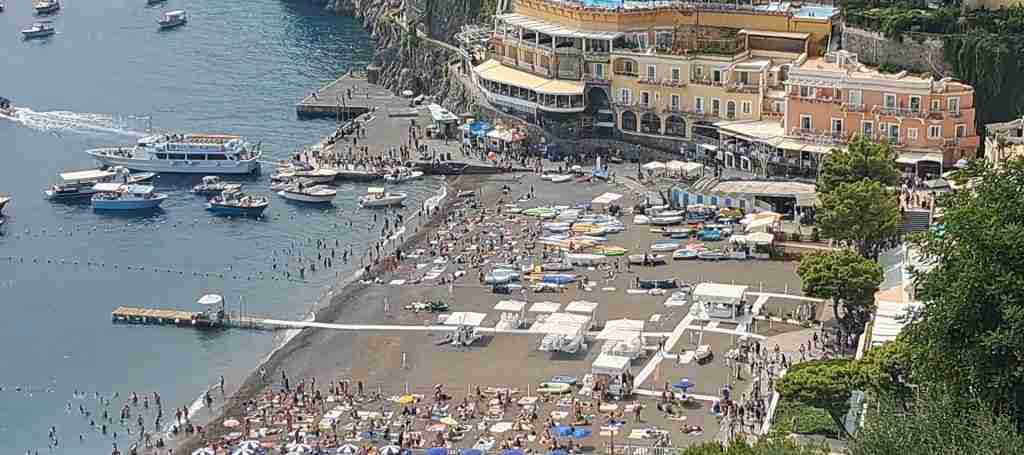
Positano’s beaches, while limited in size by the steep topography, provide the town’s raison d’être as a seaside resort. Spiaggia Grande, the larger public beach, features dark pebbles rather than sand and accommodates rows of paid beach establishments (stabilimenti) offering umbrellas, loungers, and restaurant service alongside a narrower free public section. Fornillo Beach, reached by a clifftop path west of town center, offers a quieter alternative with similar pebble composition and mix of paid and free access. The beaches’ pebbles reflect the coast’s limestone geology, polished smooth by constant wave action.
The town’s commercial character emphasizes luxury retail, particularly fashion boutiques selling Positano-style resort wear characterized by flowing linen garments, bright colors, and relaxed Mediterranean aesthetics. Artisan sandal makers craft custom leather footwear measured to individual feet, continuing centuries-old traditions. Ceramic shops display hand-painted majolica in traditional Amalfi Coast patterns featuring lemons, maritime motifs, and geometric designs. These commercial activities occupy ground floors of historic buildings along pedestrian lanes, creating a shopping experience integrated into the architectural fabric rather than segregated in modern retail zones.
Accommodation in Positano ranges from luxury five-star hotels occupying clifftop positions with private beach access and panoramic terraces, to family-run pensioni in converted historic houses within the pedestrian center. The vertical topography means most hotels require climbing significant stairs from parking areas or bus stops, a physical reality that influences visitor experiences. Properties with sea views command premium prices, while those facing the mountain or located in upper Positano offer more moderate rates. The limited building sites and strict preservation regulations restrict new hotel construction, maintaining the historic architectural character while constraining accommodation supply relative to visitor demand.
Amalfi: Heart of the Maritime Republic
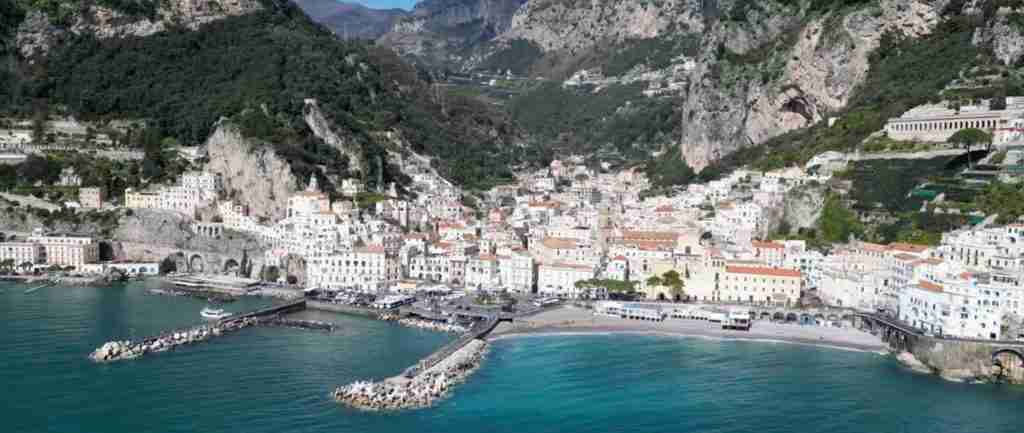
Amalfi occupies the central position both geographically and historically on the coast, serving as the medieval Maritime Republic’s capital and giving its name to the entire coastline. The town spreads horizontally along the narrow valley where the Canneto River meets the sea, providing more flat buildable land than Positano or other clifftop towns. This relatively accessible terrain enabled Amalfi to develop as a functioning urban center rather than purely vertical village, with a main street (Via Lorenzo d’Amalfi) running parallel to the beach and perpendicular side streets ascending into the valley.
The Duomo di Sant’Andrea dominates the town center from its position atop a monumental staircase in Piazza del Duomo. The cathedral’s façade showcases Arab-Norman architecture with striped stone patterns, pointed arches, and elaborate bronze doors cast in Constantinople in 1066. The adjacent Cloister of Paradise (Chiostro del Paradiso), constructed in the 13th century as a cemetery for Amalfi’s nobility, features interlacing pointed arches supported by slender paired columns, creating a distinctive Moorish-influenced space that demonstrates the Maritime Republic’s cultural exchange with Islamic civilizations. The crypt beneath the main altar houses the relics of Saint Andrew, brought to Amalfi from Constantinople and attracting pilgrim visits throughout the Middle Ages.
The Arsenale, located near the waterfront, preserves two stone-vaulted halls that represent approximately half of the medieval shipyard complex where Amalfi’s merchant fleet was constructed and maintained. The pointed barrel vaults spring from stone walls, creating atmospheric spaces that now house the Museo della Bussola, displaying navigation instruments including early compasses. Local tradition credits Amalfitan Flavio Gioia with improving the maritime compass, though this attribution lacks definitive historical documentation. The Arsenale also displays the Tavole Amalfitane, the maritime code that regulated Mediterranean commerce during the Maritime Republic era and continued in use for centuries after Amalfi’s political decline.
The Ferriere Valley extends inland from Amalfi into the mountains, following the Canneto River to ruins of paper mills that operated from the 13th century through the early 20th century. The valley’s abundant water power enabled Amalfi’s famous bambagina paper production, a thick handmade paper used for legal documents, private correspondence, and official acts. The tradition continues in a few remaining workshops producing paper using historical methods, though industrial production has long since ceased. The valley trail provides access to waterfalls and remains of stone channels that directed water to the mills’ machinery.
Amalfi’s harbor accommodates ferries connecting to other coastal towns, Salerno, and Capri island, making it a transportation hub for visitors traveling without cars. The Amalfi Drive (SS163) passes through town, with buses stopping in the main square providing connections to Sorrento, Salerno, and intermediate destinations. This accessibility makes Amalfi practical as a base for exploring the coast, offering more services and amenities than smaller towns while maintaining historic character and architectural significance. The marina hosts fishing boats alongside tourist vessels, preserving maritime traditions that connect contemporary Amalfi to its historic identity as a seafaring power.
Ravello: Mountain Refuge with Panoramic Views
Ravello occupies a mountain ledge 365 meters above sea level, reached by winding roads climbing from Amalfi or Atrani through switchbacks and tunnels carved through rock. The town’s elevated position trades beach access for spectacular panoramic views spanning the Gulf of Salerno, with visitor sightlines extending across the coastline from Capo d’Orso to Paestum on clear days. This geographic isolation from the coast below created Ravello’s character as a retreat focused on cultural pursuits, gardens, and contemplation rather than seaside resort activities.
Villa Rufolo, dating to the 11th century, served as residence for the wealthy Rufolo family, Amalfi merchants who built the complex during the Maritime Republic’s prosperous era. The villa’s gardens descend in terraces planted with Mediterranean and exotic species, framed by Moorish-influenced architecture including pointed arches and geometric tile patterns. Richard Wagner visited Villa Rufolo in 1880 and credited the gardens with inspiring Klingsor’s magic garden in his opera Parsifal. This association led to establishment of the Ravello Festival, an annual classical music event held in the villa’s gardens with orchestras performing against the backdrop of sea and mountain panoramas. The garden’s Terrace of Honor provides the primary viewpoint, where visitors photograph the dramatic coastal vista framed by umbrella pines and flowering plants.
Villa Cimbrone occupies the eastern edge of Ravello’s mountain plateau, its gardens extending along the clifftop to the famous Terrace of Infinity (Terrazza dell’Infinito). The villa itself operates as a luxury hotel, though the extensive gardens remain open for day visitors. The Terrace of Infinity features a balustrade lined with marble busts looking out over the void where cliffs drop hundreds of meters to the sea below. The viewpoint’s dramatic position and carefully framed sightlines create arguably the coast’s most spectacular panorama, frequently cited as one of the world’s most beautiful views. The gardens incorporate classical statuary, grottoes, temples, and diverse plantings arranged in Romantic landscape style rather than formal Italian garden geometry.
The Duomo di Ravello, dedicated to San Pantaleone, fronts the town’s main square (Piazza del Vescovato) with a distinctive bell tower and bronze doors from 1179 featuring 54 panels depicting saints and biblical scenes. The interior houses a remarkable pulpit supported by six twisted columns resting on lion sculptures, decorated with intricate mosaic work incorporating green serpentine and multicolored glass tesserae. The pulpit, dated 1272 and signed by Niccolò di Bartolomeo da Foggia, exemplifies the artistic quality that wealthy Amalfi merchant families commissioned for religious institutions. The cathedral’s annual miracle occurs on the feast of San Pantaleone (July 27) when the saint’s liquefied blood, kept in a reliquary, supposedly returns to liquid state, an event attracting local pilgrims and maintaining medieval devotional traditions.
Ravello’s compact historic center concentrates around Piazza del Vescovato and the adjacent Villa Rufolo entrance, with narrow pedestrian streets extending outward lined by hotels, restaurants, and artisan shops. The absence of beach access and relative difficulty of access compared to coastal towns creates a quieter atmosphere with fewer day visitors and a greater proportion of overnight guests. The town attracts visitors seeking cultural experiences, garden appreciation, and panoramic views rather than swimming and sunbathing, creating a distinct visitor demographic compared to Positano or Amalfi. The elevation provides cooler temperatures than coastal towns during summer months, offering refuge from beach-level heat while maintaining Mediterranean climate and vegetation.
Historic Maritime Republic of Amalfi
The Duchy of Amalfi emerged as an independent maritime power in 839 CE after the region gained autonomy from Byzantine and Lombard control, developing through the 9th, 10th, and 11th centuries into one of the Mediterranean’s dominant commercial forces. Amalfi’s merchants established trading posts and commercial relationships throughout the Mediterranean basin, operating simultaneously in Islamic Spain, Egypt, the Levantine coast, Byzantium, and Christian Europe at a time when religious and political divisions impeded most east-west commerce. This unique position enabled Amalfi to serve as intermediary, moving spices, textiles, precious metals, and manufactured goods between civilizations while accumulating enormous wealth.
The Maritime Republic’s commercial success rested on Amalfi’s fleet of merchant vessels, built in the Arsenale shipyard and crewed by experienced sailors familiar with Mediterranean navigation routes. The town’s protected harbor provided shelter for ships while the surrounding mountains offered defense against land-based attacks. The population developed specialized expertise in shipbuilding, navigation, commercial law, and international trade that passed through generations. Amalfi maintained diplomatic relations with Byzantine emperors, Islamic caliphs, and European monarchs, negotiating commercial privileges and safe passage for its merchants in ports throughout the known world.
The Tavole Amalfitane (Amalfi Tables), compiled during this period, established the first comprehensive maritime code governing commercial navigation in the Mediterranean. The code specified regulations for ship ownership, cargo division, sailors’ rights, responsibilities during storms, and resolution of commercial disputes. Other Mediterranean ports adopted these regulations, giving Amalfi influence over maritime commerce that extended beyond its direct trading activities. The code remained in force for centuries after Amalfi’s political decline, demonstrating the practical value of the legal framework Amalfi’s merchants developed.
The Maritime Republic introduced numerous innovations to European commerce, including importing paper manufacturing techniques from the Islamic world and establishing the first paper mills in Europe. The Amalfitans also contributed to navigation technology, though historical claims attributing compass invention to specific individuals lack definitive documentation. Amalfi’s merchants established fondachi (trading posts) in major Mediterranean ports, creating a commercial network that facilitated information exchange, credit arrangements, and coordinated trading activities across vast distances.
The Republic of Pisa’s attack and sacking of Amalfi in 1137 marked the beginning of irreversible decline. Pisa’s larger fleet and military power overwhelmed Amalfi’s defenses, destroying much of the town and eliminating its ability to compete with the expanding maritime powers of Genoa, Venice, and Pisa. Spanish conquest followed, incorporating Amalfi into the Kingdom of Naples and ending any remaining political autonomy. The formerly prosperous trading center gradually transformed into a provincial town dependent on fishing and agriculture, its magnificent architecture and artistic heritage the only remaining evidence of its former glory. This dramatic fall from Mediterranean superpower to backwater fishing village created the economic conditions that preserved historic buildings and prevented modernization that might have destroyed architectural heritage before 20th-century tourism brought new prosperity.
Terraced Agriculture and Lemon Cultivation
The terracing system covering the Amalfi Coast’s steep slopes represents centuries of agricultural labor transforming nearly vertical mountainsides into productive farmland. Construction began during the 11th century when Amalfi’s maritime wealth enabled investment in long-term infrastructure projects requiring immense stone wall construction. Farmers built drystone retaining walls following the natural contours of the hillsides, filling behind the walls with soil to create horizontal planting surfaces. This technique prevented erosion on steep gradients while providing level ground for trees and vines that would otherwise slide downhill.
The terraces require constant maintenance as weather, earthquakes, and plant roots gradually destabilize the drystone walls. Farmers must periodically rebuild collapsed sections and clear vegetation that undermines wall integrity. The agricultural labor intensiveness, combined with difficulty accessing terraces by vehicle, contributed to agricultural abandonment during the 20th century as younger generations pursued less physically demanding urban employment. Contemporary efforts to preserve the terraces as cultural landscape face challenges recruiting workers willing to perform the demanding maintenance labor that sustained the system for centuries.
The sfusato amalfitano lemon dominates terrace cultivation, a variety specifically adapted to the Amalfi Coast’s microclimate and grown under traditional pergola system where chestnut poles support netting that protects developing fruit from wind and excessive sun. The lemons grow larger than standard varieties, with thick, aromatic peel containing high concentrations of essential oils used in limoncello production. The fruit’s shape, more elongated than common spherical lemons, gives the variety its “sfusato” (spindle-shaped) designation. These lemons achieved Protected Geographical Indication (PGI) status from the European Union, legally protecting the name and guaranteeing origin.
Limoncello production utilizes the lemon peels’ essential oils, macerated in alcohol to extract aromatic compounds and flavor before adding sugar syrup. Artisanal producers maintain small-scale production using traditional methods and family recipes, though industrial operations now dominate commercial limoncello manufacturing. The liqueur, served ice-cold as a digestif after meals, became a symbol of Amalfi Coast culture and major export product carrying the region’s identity to international markets. Visitors purchase limoncello as quintessential Amalfi Coast souvenir, supporting local economy while spreading awareness of the region’s agricultural traditions.
Beyond lemons, the terraces support olive groves producing olive oil for local consumption, vineyards creating regional wines, and vegetable gardens supplying coastal towns with produce. The vertical farming system creates diverse microclimates at different elevations, enabling cultivation of crops requiring specific temperature and sun exposure conditions. This agricultural biodiversity supports traditional Mediterranean diet and maintains landscape diversity that contributes to the region’s visual appeal. The terraces also provide crucial environmental services including slope stabilization, water retention, and habitat for native plant and animal species adapted to the cultural landscape.
Architecture and Urban Design of Coastal Towns
Amalfi Coast architecture evolved in response to extreme topographic constraints where buildable flat land exists only in narrow valleys and small coastal plains. The vertical development of towns like Positano and Praiano creates three-dimensional urbanism where buildings stack in horizontal layers connected by steep staircases and narrow passages. This architectural approach maximizes use of scarce land while adapting to natural contours rather than imposing geometric regularity. The resulting townscapes feature irregular building forms, varied roof heights, and organic circulation patterns that create picturesque compositions but challenge modern accessibility and infrastructure requirements.
Building materials reflect local geology and traditional construction techniques, with stone masonry walls covered by plaster painted in pastel colors including white, yellow, pink, and salmon. The majolica-tiled domes crowning churches provide distinctive visual punctuation, their glazed ceramic surfaces resistant to coastal weather while displaying decorative patterns in yellow, green, and blue. Barrel vaults and cross vaults spanning interior spaces eliminate need for timber roof structures, though many buildings use traditional wooden beams supporting terra cotta tile roofs. The architecture’s Mediterranean character emerges from these material choices and construction methods adapted to climate and available resources.
The narrow streets and alleys characterizing historic town centers accommodate pedestrian and small-vehicle traffic, though many passages remain too steep or narrow for motor vehicles. The absence of vehicular access in pedestrian zones preserved medieval street patterns that would have been widened or demolished in towns permitting automobile circulation through historic centers. This pedestrianization, initially a result of topographic constraints rather than planning policy, now constitutes a valued characteristic protecting town character from traffic impacts while creating challenges for goods delivery and emergency vehicle access.
Defensive architecture including watchtowers scattered along the coastline recalls the centuries when Turkish pirate raids threatened coastal settlements. These stone towers, often cylindrical or square in plan, occupy strategic promontories providing sightlines along the coast to detect approaching vessels. Guards lit warning fires signaling danger to inland populations who would retreat to fortified positions until the threat passed. Many towers deteriorated into ruins, though restoration efforts converted some into museums, residences, or restaurants offering dramatic coastal views from their elevated positions.
Contemporary architecture on the Amalfi Coast operates under strict preservation regulations limiting new construction and requiring designs compatible with historic character. The UNESCO World Heritage designation and Italian cultural landscape protection laws impose rigorous review processes for building permits, renovation projects, and infrastructure improvements. These regulations successfully maintained visual coherence and architectural integrity while creating frustrations for property owners seeking modern amenities or building modifications. The tension between preservation and development continues shaping the coast’s built environment as communities balance heritage protection with contemporary needs.
Natural Features: Beaches, Caves, and Mountains
The Amalfi Coast’s beaches, while celebrated in tourism marketing, remain relatively small and often pebbly rather than sandy due to the dramatic topography that provides little space for beach formation between cliffs and sea. The largest beaches concentrate in towns with river valleys including Amalfi, Maiori, and Minori where sediment deposition created broader coastal plains. Positano’s Spiaggia Grande and Fornillo, Praiano’s Marina di Praia, and other smaller coves offer swimming access though limited sand or pebble surfaces constrain capacity relative to visitor demand during peak summer season.
Most Amalfi Coast beaches divide between paid stabilimenti (beach establishments) occupying majority of the waterfront with rows of umbrellas and loungers rented by the day, and smaller free public sections where visitors spread towels on available pebbles or sand. The stabilimento system, standard throughout Italy, provides organized beach services including restaurants, bars, showers, and changing facilities while maximizing commercial use of limited beach space. Visitors accustomed to expansive free beach access in other countries sometimes find the pay-to-use system and crowded conditions surprising compared to expectations created by scenic photographs showing empty beaches.
Sea caves punctuate the coastline where wave action and karst processes dissolved limestone bedrock, creating atmospheric grottoes accessible by boat. The Grotta dello Smeraldo (Emerald Grotto) near Conca dei Marini ranks as the most famous, its interior illuminated by underwater sunlight filtering through submerged openings and reflecting off white sand bottom to create an ethereal green glow. Guided boat tours navigate the cavern, which contains stalactites, stalagmites, and an underwater nativity scene installed for underwater viewing. The Furore Fjord, a narrow cleft where a stream cuts through coastal cliffs, creates a dramatic natural feature with a small beach accessible by steep stairs.
The Lattari Mountains forming the coast’s dramatic backdrop rise to 1,444 meters at Monte Sant’Angelo a Tre Pizzi, the range’s highest peak. The mountains create diverse hiking opportunities including the famous Sentiero degli Dei (Path of the Gods), a high-altitude trail connecting Agerola to Positano with spectacular coastal views. The path traverses ridgelines and valleys at elevations where Mediterranean macchia gives way to mixed forests, passing abandoned terraces and mountain shepherds’ shelters. The mountains’ karst geology creates numerous caves, sinkholes, and underground streams that occasionally emerge as springs feeding the coastal towns’ water supplies and historic paper mills.
The Mediterranean macchia covering lower mountain slopes consists of aromatic shrubs including myrtle, rosemary, lentisk, and rockrose adapted to dry conditions and frequent fires. Higher elevations support forests of holm oak, downy oak, and chestnut that historically provided timber for shipbuilding, fuel, and construction. The diverse plant communities harbor wildlife including foxes, weasels, numerous bird species, and the threatened Italian wall lizard. The combination of terrestrial and marine ecosystems within the UNESCO site creates biodiversity hotspot status, though visitor pressure and development threaten sensitive habitat areas.
Transportation: The Amalfi Drive and Alternatives
The Amalfi Drive (Strada Statale 163) provides the only continuous road connecting coastal towns, winding 40 kilometers from Vietri sul Mare to Positano along cliffsides where the route negotiates hairpin turns, tunnels, and sections barely wide enough for two buses to pass. The road’s construction in the 19th century opened the coast to wheeled transportation, replacing the sea routes and mountain footpaths that previously connected towns. The dramatic engineering required to carve the roadway through cliffs and maintain it against landslides and weather damage creates ongoing maintenance challenges and occasional closures for emergency repairs.
Driving the Amalfi Drive demands concentration and nerve, particularly for visitors unaccustomed to narrow mountain roads where tour buses and delivery trucks navigate turns with centimeters of clearance while opposing traffic waits in strategic pullouts. The road prohibits parking along most of its length, requiring use of paid parking lots in towns where spaces fill quickly during peak season. Many visitors choose to experience the road as bus passengers rather than drivers, using the SITA Sud public buses that connect coastal towns on regular schedules. The bus journey provides scenic views without driving stress, though summer crowding means passengers often stand in aisles during busy periods.
Ferry services operate seasonally connecting Amalfi, Positano, Salerno, and Capri, providing sea-based transportation that avoids road traffic while offering spectacular coastal views from the water. The ferries accommodate foot passengers only, making them practical for visitors without cars moving between coastal destinations. Journey times vary with sea conditions, and services suspend during rough weather when safe harbor entry becomes impossible. The ferries historically served as primary transportation before road construction, and contemporary services maintain this maritime tradition while serving tourism needs.
The train network serving the Amalfi Coast stops at Vietri sul Mare and Salerno on the eastern end and Sorrento on the western end, requiring bus transfers to reach interior coastal towns. The Circumvesuviana railway connects Sorrento to Naples, providing access from Campania’s capital city, while the national rail network serves Salerno with frequent connections to Naples and Rome. Travelers arriving by train typically transfer to SITA Sud buses for final destinations, a journey requiring attention to schedules and connections. The absence of direct rail service to Positano, Amalfi, and Ravello results from topographic constraints that make railway construction prohibitively expensive through the mountainous coastal terrain.
Organized tours from Naples, Sorrento, and Salerno transport visitors to Amalfi Coast highlights, handling driving and parking logistics while providing commentary on passing sights. These tours accommodate day visitors who want to experience the coast without navigating transportation independently, though the fixed itineraries and limited stop durations constrain the experience compared to self-directed travel. Private drivers and boat charters provide customized alternatives for visitors seeking flexibility with professional navigation of challenging roads or sea conditions.
Local Culture, Crafts, and Traditions
Ceramic production, particularly majolica pottery, represents the Amalfi Coast’s most distinctive artisan tradition, with Vietri sul Mare serving as the center for brightly colored hand-painted ceramics. The craft traces origins to medieval Islamic influences when Arab artisans working in Sicily introduced tin-glazed earthenware techniques to southern Italy. Contemporary Vietri ceramics feature characteristic bright colors, particularly yellows, blues, and greens, decorated with patterns incorporating lemons, fish, geometric designs, and scenes of coastal life. Artisan workshops maintain traditional hand-painting techniques producing tiles, plates, vases, and decorative objects sold throughout the coast and exported internationally.
Paper production in Amalfi, though reduced from its medieval peak when numerous mills operated in the Ferriere Valley, continues on small scale at museums and artisan workshops preserving traditional bambagina manufacturing. The handmade paper production process involves beating cotton and linen rags into pulp, forming sheets on screens, pressing to remove excess water, and drying on wooden frames. The thick, creamy paper absorbs ink without bleeding and develops patina with age, qualities that made it valuable for legal documents and archival records. Contemporary production serves artistic and specialty markets rather than commercial purposes, maintaining the craft as cultural heritage rather than economic driver.
Religious festivals mark the calendar throughout coastal towns, combining Catholic devotion with community celebration and maintaining traditions that structure social life across generations. The feast of Sant’Andrea (June 27 and November 30) in Amalfi brings processions carrying the saint’s statue through town streets to the harbor, followed by fireworks and outdoor celebrations. Positano’s feast of the Assumption (August 15) features the legendary reenactment of Saracen pirate raids, with townspeople in period costume dramatizing historical threats. These festivals maintain community identity and intergenerational connection while providing spectacle for visitors who witness living traditions rather than staged performances.
Fishing traditions, though diminished from the era when fishing provided primary livelihood for coastal communities, persist in harbors where small boats still work daily catches. The anchovies from Cetara hold particular renown, preserved in salt and used to produce colatura di alici, an amber liquid similar to ancient Roman garum created by fermenting anchovies and collecting the drained liquid. This pungent, intensely flavored condiment appears in pasta dishes and other preparations, representing the continuation of ancient preservation techniques adapted to local fish species. The annual anchovy festival in Cetara celebrates this tradition through tastings, cooking demonstrations, and community gatherings.
The tradition of outdoor living, expressed through terraces, balconies, and seaside promenades where residents gather during evening hours, reflects Mediterranean climate and social culture. The evening passeggiata (stroll) brings townspeople outdoors to socialize, see and be seen, and participate in community life beyond private domestic spaces. Cafes and bars with outdoor seating facilitate this public social life, providing venues for extended conversations over coffee or aperitifs. This cultural pattern, shared across Mediterranean regions, contrasts with northern European and North American emphasis on private interior spaces and scheduled social engagements.
Cuisine and Culinary Traditions
Amalfi Coast cuisine emphasizes seafood, lemon-based preparations, and vegetables grown in terraced gardens, creating a distinctly coastal Mediterranean menu that differs from inland Campanian cooking. Fresh fish including sea bass, bream, and red mullet appear grilled with lemon and herbs, baked in salt crust, or prepared “all’acqua pazza” (in crazy water) with tomatoes, garlic, and white wine. Anchovies from Cetara serve both fresh and preserved, appearing in pasta dishes and as flavoring in various preparations. The abundant seafood reflects the coast’s maritime heritage and the daily catches that continue supplying local restaurants.
Scialatielli, a thick, ribbon-like fresh pasta particular to the Amalfi Coast, provides the foundation for signature pasta dishes including scialatielli ai frutti di mare (with mixed seafood). The pasta’s short length and rough texture, created by hand-rolling dough and cutting into irregular strips, allows sauce to adhere effectively. Spaghetti al limone showcases the coast’s famous lemons in a simple preparation combining pasta with lemon zest, olive oil, Parmigiano-Reggiano, and sometimes cream, creating bright, acidic flavors that cut through olive oil’s richness. Pasta dishes incorporating local vegetables including eggplant, zucchini, and tomatoes reflect the terraced gardens’ production.
Mozzarella and ricotta from nearby Sorrento Peninsula and Salerno plains feature prominently, appearing in caprese salad, pasta fillings, and desserts including the local pastiera, a ricotta-wheat pie traditionally prepared for Easter. The dairy products’ freshness and quality reflect short supply chains connecting coastal restaurants to nearby producers. Buffalo mozzarella from the Paestum plains south of Salerno appears on menus as a premium option, its richer flavor and creamier texture distinguishing it from cow’s milk mozzarella.
Lemon features in both savory and sweet preparations beyond limoncello, including delizia al limone, a sponge cake soaked in limoncello and covered with lemon cream, and lemon granita served as palate cleanser between courses. The sfusato amalfitano lemon’s aromatic peel and balanced acidity make it superior for culinary use compared to standard varieties. Restaurants serve lemon slices with grilled fish, incorporate zest into pasta dishes, and offer lemon-infused desserts that showcase the fruit’s versatility. The omnipresence of lemon in local cuisine reflects both agricultural abundance and cultural identity.
Pastry traditions include sfogliatella, the shell-shaped layered pastry filled with sweet ricotta and candied fruit, though this originated in Naples rather than the Amalfi Coast specifically. Local variations incorporate lemon into fillings and glazes, adapting the pastry to regional ingredients. Almond-based sweets reflect historical Arab influence and the almond cultivation in terraced gardens. The tradition of serving coffee with a lemon peel twisted to release essential oils into the cup demonstrates lemon’s integration even into beverage service beyond its use as food ingredient.
Best Times to Visit and Seasonal Considerations
The Mediterranean climate creates distinct seasonal patterns that significantly affect visitor experiences, with hot, dry summers contrasting sharply with mild, wet winters. Peak tourism season extends from June through September when warm temperatures, minimal rainfall, and long daylight hours create ideal beach conditions but also bring maximum crowds, highest accommodation prices, and traffic congestion on the Amalfi Drive. Summer temperatures regularly exceed 30°C (86°F), particularly in July and August, with high humidity near the coast though mountain elevations including Ravello provide slightly cooler refuge.
Shoulder seasons of late April through May and September through October offer temperate weather, fewer crowds, and lower prices while maintaining generally good conditions for sightseeing and outdoor activities. Spring brings wildflowers blooming across hillsides and terraces, gardens at villas in full display, and mild temperatures suitable for hiking. Autumn provides still-warm sea temperatures for swimming extending into October, harvest activities in vineyards and lemon groves, and clearer light for photography compared to summer haze. These periods represent optimal compromise between favorable weather and manageable visitor numbers.
Winter, from November through March, brings cooler temperatures, increased rainfall, and reduced tourist services as many hotels, restaurants, and attractions close for the season. Winter temperatures rarely drop below 5°C (41°F) even overnight, with daytime highs often reaching 15°C (59°F), making the climate mild compared to northern European or North American winters. The coast’s beauty persists through winter despite gray skies and rain, offering opportunities for visitors seeking authentic experiences in uncrowded towns where local life continues without tourism’s distorting influence. However, reduced ferry schedules, potential road closures during storms, and limited accommodation and dining options constrain winter travel.
Religious and cultural festivals concentrate during summer months when outdoor celebrations benefit from reliable weather, though some important events occur during shoulder seasons including Easter week celebrations and autumn harvest festivals. The Ravello Festival runs from March through November with peak programming during summer, offering classical music performances in Villa Rufolo’s gardens. Amalfi’s historic regatta occurs in June, recreating medieval maritime traditions with period costumes and decorated boats. Planning visits around specific festivals requires advance accommodation booking as rooms sell out quickly for popular events.
Weather variability even within peak season means visitors should prepare for occasional rain, particularly during May and early June when spring rains taper off. The coastal topography creates microclimates where conditions can vary significantly between seaside towns and mountain villages like Ravello, between sunny and shaded slopes, and between sheltered coves and exposed headlands. Checking forecasts and packing layered clothing allows adaptation to changing conditions across different areas and elevations. The coast’s beauty persists across seasons, with different periods offering distinct advantages depending on visitor priorities regarding weather, crowds, prices, and cultural events.
Frequently Asked Questions About the Amalfi Coast
How many towns make up the Amalfi Coast?
The UNESCO World Heritage Site designation encompasses 15 municipalities including Amalfi, Atrani, Cetara, Conca dei Marini, Furore, Maiori, Minori, Positano, Praiano, Ravello, Scala, Tramonti, and Vietri sul Mare, along with portions of Cava de’ Tirreni and Sant’Egidio del Monte Albino. This number varies slightly depending on whether sources count only coastal towns or include mountain villages and which administrative boundaries they apply. The historic Maritime Republic of Amalfi controlled territory closely corresponding to the current UNESCO site boundaries. The three most famous towns, Positano, Amalfi, and Ravello, represent only a portion of the protected cultural landscape that includes smaller villages and extensive agricultural terraces between the Gulf of Salerno and mountain peaks. Visitors focusing exclusively on the “big three” miss the character of quieter villages including Atrani, often cited as one of Italy’s most beautiful small towns, and Cetara with its fishing traditions.
Can you swim in the sea at the Amalfi Coast?
Swimming is possible at beaches throughout the Amalfi Coast from approximately May through October, with water temperatures ranging from 18°C (64°F) in early season to 26°C (79°F) in August. The beaches primarily feature pebbles rather than sand, with some locations having larger stones that make water entry uncomfortable without beach shoes. Most beaches divide between paid stabilimenti offering umbrella and lounger rentals with restaurant service, and smaller free public sections where space remains limited during peak summer months. The sea generally remains calm near shore, though occasional storms create strong currents and high waves that make swimming dangerous. Water clarity exceeds many Mediterranean locations due to limited river runoff and protected marine areas, making snorkeling rewarding at rocky coves and headlands. Beaches in Positano, Amalfi, Maiori, and Minori provide the largest swimming areas, while smaller coves accessible by boat or long stairs offer more secluded options for visitors willing to hike or pay for boat transport.
Is the Amalfi Coast suitable for visitors with mobility limitations?
The Amalfi Coast’s extreme vertical topography creates significant accessibility challenges for visitors with mobility limitations, wheelchair users, and those unable to manage extensive stairs. Positano and many other coastal towns feature hundreds of stairs as the primary pedestrian circulation, with limited or no elevator access to reach various levels. Many hotels, restaurants, and attractions occupy buildings without modern accessibility features, often requiring stair climbing from parking areas or bus stops. Ravello’s elevated position requires driving or taking buses up winding mountain roads, though the town center remains relatively flat once reached. Amalfi provides the most accessible coastal town due to its valley location with more flat terrain along the waterfront and main streets, though accessing the cathedral requires climbing monumental stairs unless using the alternative entrance from the Cloister of Paradise. Visitors with mobility concerns should research specific accommodations carefully, contact hotels directly about accessibility features, and consider limiting visits to more accessible areas rather than attempting comprehensive coastal exploration. Organized tours with accessible vehicles and drivers familiar with accessibility issues provide practical options for experiencing coastal views while minimizing physical demands.
What is the best way to travel between Amalfi Coast towns?
Public buses operated by SITA Sud provide the most economical transportation between coastal towns, running regular schedules along the Amalfi Drive from Sorrento through Positano, Amalfi, and Salerno. Buses accommodate standing passengers during peak periods though seats fill quickly, requiring strategic boarding at major terminals rather than intermediate stops. Ferry services operating seasonally from April through October connect Amalfi and Positano with Salerno, Sorrento, and Capri, offering scenic water travel that avoids road traffic while providing spectacular coastal views. The ferries cost more than buses but deliver more comfortable journeys with fresh air and guaranteed seating. Private drivers or taxis provide flexible alternatives allowing customized itineraries and door-to-door service, though costs significantly exceed public transportation. Organized tour buses handle transportation logistics while providing commentary, suitable for day visitors from Naples or Sorrento. Personal vehicles allow independent exploration but require navigating narrow, winding roads and competing for limited parking in towns where spaces fill early during peak season. The optimal choice depends on budget, flexibility requirements, comfort priorities, and tolerance for crowded conditions on public transportation during summer months.
Are there hiking trails on the Amalfi Coast?
Numerous hiking trails traverse the Amalfi Coast’s mountains and connect coastal towns through historic footpaths that preceded road construction. The Sentiero degli Dei (Path of the Gods) ranks as the most famous, running approximately 8 kilometers from Agerola to Positano along mountain ridges at elevations offering spectacular coastal panoramas. The trail’s moderate difficulty suits reasonably fit hikers comfortable with some steep sections and uneven terrain, requiring 3-4 hours to complete. The Valle delle Ferriere trail near Amalfi follows the Canneto River valley to paper mill ruins and waterfalls through forest environment, providing easier hiking on relatively gentle gradients. Hundreds of kilometers of ancient mule tracks, agricultural paths, and connecting trails between villages create extensive hiking opportunities ranging from easy valley walks to challenging mountain traverses requiring navigation skills and proper equipment. The trails pass through diverse environments including Mediterranean macchia, forests, terraced agricultural zones, and abandoned mountain settlements, offering perspectives on the cultural landscape unavailable from roads or towns. Summer heat makes hiking uncomfortable during midday hours, with early morning or late afternoon timing recommended. Spring and autumn provide optimal hiking conditions with moderate temperatures, blooming wildflowers or autumn colors, and reduced tourist traffic on popular trails.
What souvenirs are typical of the Amalfi Coast?
Limoncello represents the quintessential Amalfi Coast souvenir, available in artisan versions from small producers using traditional recipes alongside mass-produced commercial brands. Quality limoncello uses the sfusato amalfitano lemon, though verifying origin requires attention to labels and Protected Geographical Indication certification. Ceramic pottery from Vietri sul Mare, particularly hand-painted majolica featuring characteristic bright colors and traditional patterns, provides decorative souvenirs ranging from small tiles to large serving pieces. Lemon-scented soaps, perfumes, and cosmetics capitalize on the coast’s lemon cultivation, though many products use generic lemon essence rather than actual sfusato amalfitano. Handmade paper from Amalfi’s remaining workshops, produced using traditional techniques, serves as a special souvenir for those appreciating artisan crafts and historical preservation. Preserved anchovies and colatura di alici from Cetara appeal to food enthusiasts willing to transport fish products, while packaged dried pasta including scialatielli provides easier transport. Artisan sandals made in Positano and other coastal towns offer custom-fitted leather footwear as wearable souvenirs, though sizing and break-in periods require consideration. Avoiding mass-produced imports labeled as local products requires attention to origins and willingness to pay premium prices for genuine artisan production.
How does the Amalfi Coast compare to Cinque Terre?
The Amalfi Coast and Cinque Terre share characteristics as dramatic coastal landscapes where colorful villages cling to steep terrain above the Mediterranean Sea, though significant differences distinguish the two UNESCO World Heritage Sites. The Amalfi Coast offers more sophisticated infrastructure, luxury accommodation options, and established tourism amenities compared to Cinque Terre’s more rustic, village-focused character. Amalfi Coast towns feature grand hotels, upscale shopping, and fine dining alongside historic architecture including cathedrals and villas, while Cinque Terre’s five villages maintain simpler, more egalitarian character with hiking trails rather than beaches as the primary attraction. The Amalfi Coast’s accessibility via the Amalfi Drive contrasts with Cinque Terre’s car-free villages connected by train and footpaths, creating different visitor experiences regarding transportation and development patterns. The Amalfi Coast’s Mediterranean climate provides warmer, drier conditions compared to Cinque Terre’s Ligurian location, affecting seasonal visitation patterns and swimming season length. Both destinations struggle with overtourism during peak season, though the Amalfi Coast’s greater geographic extent and multiple towns distribute visitor pressure more broadly than Cinque Terre’s concentration in five small villages. Visitors seeking luxury, cultural institutions, and sophisticated amenities prefer the Amalfi Coast, while those prioritizing hiking, village authenticity, and less developed settings often choose Cinque Terre.
What is the history of Villa Cimbrone in Ravello?
Villa Cimbrone traces origins to the 11th century when the structure served as aristocratic residence, though the current gardens and many architectural features result from extensive renovations undertaken by British Lord Grimthorpe in the early 20th century. Grimthorpe purchased the deteriorated villa in 1904 and spent decades transforming it through additions including the Terrace of Infinity with its marble busts, temple structures, grottos, and extensive plantings combining Mediterranean and exotic species. The renovation created the Romantic English landscape garden aesthetic that distinguishes Villa Cimbrone from traditional Italian formal gardens, incorporating classical statuary, architectural follies, and carefully composed viewpoints. Lord Grimthorpe collaborated with local craftsmen and gardeners to realize his vision while preserving medieval architectural elements including cloisters and the entrance tower. The villa hosted notable guests including Greta Garbo, D.H. Lawrence, and other cultural figures drawn to Ravello’s artistic reputation and the villa’s spectacular setting. The property operated as a private residence until conversion to a luxury hotel in the late 20th century, though the gardens remain open to day visitors who pay admission to access the grounds and Terrace of Infinity. The villa exemplifies how wealthy foreigners, particularly British and Americans during the 19th and early 20th centuries, discovered the Amalfi Coast and invested in restoration projects that preserved architectural heritage while adapting historic properties to contemporary uses.
Why is Atrani significant despite being one of the smallest towns?
Atrani, despite occupying only 0.12 square kilometers and maintaining a population under 1,000 residents, holds historical significance as the town where the Doges of Amalfi were elected and crowned during the Maritime Republic era. The Church of San Salvatore de’ Bireto served as the ceremonial location for investiture of the Doges, maintaining this political and religious function throughout the Republic’s existence. Atrani’s compact size, squeezed into a narrow valley between mountains and sea immediately east of Amalfi, preserved its medieval character more completely than larger towns where modern development affected urban fabric. The town features a small beach, a central piazza dominated by the church with its majolica-tiled dome, and steep alleys climbing the hillsides in patterns largely unchanged since medieval times. Atrani’s designation as one of “I Borghi più belli d’Italia” (The Most Beautiful Villages of Italy) recognizes this authentic preservation of historic character. The town’s location, practically adjoining Amalfi but maintaining separate identity, makes it easily accessible for visitors staying in Amalfi while offering a quieter, more residential atmosphere away from major tourist crowds. Atrani demonstrates how the smallest coastal settlements maintain importance in the region’s history and cultural identity while providing living examples of traditional urbanism and architecture that larger towns partially lost to development pressures.
What makes the Amalfi Coast’s landscape a “cultural landscape”?
UNESCO designated the Amalfi Coast as a “cultural landscape” rather than purely natural or architectural heritage, recognizing that the region’s character emerges from centuries of interaction between human activity and natural environment. The terracing system transforming steep mountainsides into agricultural land represents the most visible expression of this cultural landscape, demonstrating how inhabitants adapted to extreme topography through intelligent land use that created new productive capacity while preventing erosion and maintaining ecological balance. The vertical architecture of coastal towns evolved specifically in response to limited flat land, creating distinctive urban forms that would not exist without topographic constraints. The traditional agricultural practices, including lemon cultivation under protective netting and olive production on terraced slopes, shaped the landscape’s visual character and biodiversity patterns. The cultural landscape designation recognizes that the Amalfi Coast’s value derives not from pristine wilderness but from the harmonious relationship between human communities and their environment developed over more than a millennium. The landscape continues evolving through contemporary land use decisions, heritage preservation efforts, and tourism development, requiring active management to maintain the characteristics that merited UNESCO protection. The concept of cultural landscape emphasizes the coast’s living, working character rather than treating it as a static museum, though balancing change with preservation creates ongoing challenges for communities managing heritage protection alongside economic development needs.