Alternative Castelli Romani Road Trip Guide 2026: Escaping Rome’s Crowds via Ancient Volcanic Ridges
The seventeen hilltowns of the Castelli Romani sit just 25–35 kilometres from central Rome on the ancient rim of the Colli Albani volcanic complex, yet most visitors never make it past the standard tourist trail. This guide maps a counter-clockwise self-drive circuit along secondary ridgeline roads — above all the Via dei Laghi — that bypasses the congestion of the main Appia Nuova corridor and delivers panoramic crater-lake views, Baroque piazzas, and serious wine country with far less competition for parking and restaurant tables.
Key Takeaways
- The Via dei Laghi (SP217), branching from the Via Appia just past Rome’s ring road near Ciampino airport, is the key artery: it runs south through the Castelli Romani past Lake Albano and Lake Nemi before ending at Velletri, offering a scenic, low-traffic alternative to the busier SS7 Via Appia corridor.
- Budget travelers doing the circuit as a day trip from Rome typically spend €50–90 per person (car share, fuel, parking, food, local wine at a bar); mid-range travelers who add a Pontifical Villas entry and a cantina booking spend €115–175 per person; luxury day-trippers with a private guide and premium wine experience spend €215–345 per person.
- The Museum of Roman Ships (Museo delle Navi Romane) at Nemi — the circuit’s headline archaeological site — is closed for PNRR renovation works until 31 August 2026; plan accordingly, and verify the reopening date at cultura.gov.it before booking flights around a museum visit.
- Both Ariccia and Castel Gandolfo operate electronic ZTL (limited traffic zone) gates in their historic centres; tourists must park outside these perimeters in designated car parks and walk in — navigating before 10:00 or after 18:00 significantly reduces the risk of an active gate.
- Avoid Sundays between April and September: the hills empty of Rome’s week-day workers only to fill immediately with Roman day-trippers, compressing every parking lot, every porchetta stand, and every lakeside viewing terrace into a single gridlocked afternoon.
People Also Ask About Castelli Romani Road Trip 2026
How long does the full Castelli Romani self-drive circuit take from Rome in 2026?
A complete loop — Castel Gandolfo, Ariccia, Genzano, Lake Nemi, Rocca di Papa, and Frascati — covers approximately 90–110 kilometres of driving and takes six to eight hours in total, including stops. The driving time alone for the circuit (not counting Rome itself) is roughly two to two and a half hours given the narrow ridgeline roads and speed limits of 50–70 km/h on most provincial roads. From Rome’s ring road (the GRA), exit 23 toward Ciampino and the Via Appia is where most itineraries begin; from there, Lake Albano is reachable in around 20 minutes, and the far end of the circuit near Lake Nemi in 35–40 minutes. From a central Rome hotel, add 20–30 minutes of city driving depending on departure time. A 7:30 departure from Rome allows the whole circuit to be completed comfortably with a long lunch before returning by 18:00, while a 9:00 start still fits if you skip two or three towns.
What does a self-drive Castelli Romani day trip cost per person in 2026?
Budget travelers sharing an economy rental car, eating porchetta sandwiches, and using free viewpoints spend approximately €50–90 per person for the day (car share, fuel, parking, food, and a local wine at a bar). Mid-range travelers who add the Pontifical Villas ticket at Castel Gandolfo and a cantina tasting in Frascati spend €115–175 per person. Luxury travelers opting for a private guided visit and a full Frascati winery experience spend €215–345 per person. None of these totals includes the Museum of Roman Ships admission, which is €5 per adult when open; the museum is closed for PNRR renovation through August 31, 2026 (verify at cultura.gov.it). If staying overnight in the Castelli Romani area rather than returning to Rome, budget accommodation adds roughly €30–40 per person per night (two sharing), bringing budget overnight totals to €80–130 per person per day.
When is the best time to avoid crowds on the Castelli Romani circuit in 2026?
Weekday mornings between October and March offer the quietest conditions: car parks are largely empty, restaurant service is attentive, and the fog that sometimes drapes the craters adds an atmospheric quality unavailable in summer. April through June weekday mornings are the next-best option — the hills are green from spring rains, the wisteria is flowering across villa walls, and early temperatures allow comfortable walking before 12:00. Summer weekday mornings (July–August) are tolerable if you depart Rome by 7:30 and tackle Castel Gandolfo before 10:00, after which heat and traffic both intensify rapidly. The one timing to avoid unequivocally: Sunday between April and September, when Roman families pack the ridgetop towns from mid-morning onward and parking becomes a multi-hour problem at the most popular stops.
Is the Pontifical Villas visit at Castel Gandolfo worth booking in advance in 2026?
Yes — advance booking through the Vatican’s official villepontificie.va portal is strongly recommended. The Apostolic Palace operates on timed entry slots (first entry 8:30, last entry 13:00 on weekdays, 16:00 on Saturdays), and weekend slots particularly in spring and autumn sell out several days ahead. Self-guided visits to the Apostolic Palace with audio guide run approximately €16–17 per adult; guided tours and combined garden-and-palace packages start from €24, rising to €35 or more for larger group experiences. Since 2025 Pope Leo XIV has resumed the tradition of using the Castel Gandolfo complex as a summer residence — staying in Villa Barberini, separate from the museum wing — which means access to parts of the Villa Barberini gardens may be restricted during papal stays. The Apostolic Palace museum remains open throughout these periods. For 2026 visit dates, always check the official villa calendar before booking.
Extended multi-day tours – 5+ days
Featured Lazio Marche Abruzzo Multi-Day Tour Packages

3 days
Lazio Marche Abruzzo 3-Day Discovery Tour
- ✓ Comprehensive Lazio Marche Abruzzo experience
- ✓ Expert local guides included
- ✓ All accommodation included
- ✓ Transportation provided

5 days
Lazio Marche Abruzzo 5-Day Highlights Experience
- ✓ Comprehensive Lazio Marche Abruzzo experience
- ✓ Expert local guides included
- ✓ All accommodation included
- ✓ Transportation provided
7 days
Lazio Marche Abruzzo 7-Day Cultural Journey
- ✓ Comprehensive Lazio Marche Abruzzo experience
- ✓ Expert local guides included
- ✓ All accommodation included
- ✓ Transportation provided

10 days
Lazio Marche Abruzzo 10-Day Complete Adventure
- ✓ Comprehensive Lazio Marche Abruzzo experience
- ✓ Expert local guides included
- ✓ All accommodation included
- ✓ Transportation provided
Multi-day tour packages powered by TourRadar. Prices and availability subject to change.
Why the Castelli Romani Alternative Route Works Better Than Standard Day Trips in 2026
Rome’s standard day-trip hierarchy has not changed much in decades: the Appian Way for archaeology, Tivoli for villas and fountains, Pompeii or Ostia for Roman town life. The Castelli Romani sit in an odd mid-category — close enough to feel familiar, not exotic enough to generate the marketing push of Pompeii, but consistently excellent for the combination of volcanic landscape, small-scale Baroque architecture, and food-and-wine culture that characterises the best of Lazio.
What changes the calculus in 2026 is routing. Most guides still point visitors toward the SS7 Via Appia, the ancient consular road that climbs steadily from the Roman suburbs to Castel Gandolfo and then Ariccia. It is historically significant and visually rewarding, but it is also the most direct road and therefore the most used. On summer weekends it functions as a long, slow car park between the GRA and Ariccia. The alternative is to turn onto the Via dei Laghi immediately after the GRA exit, following a route that runs closer to the eastern rim of the Alban crater, passes within sight of both volcanic lakes, and enters the hilltowns from their less-trafficked sides.
The Colli Albani is what geologists classify as a quiescent volcanic district — an ancient caldera system that last showed significant eruptive activity many thousands of years ago, though hydrothermal activity and minor seismic events suggest the system is not entirely inert. What this history has left on the surface is a landscape of dramatic relief: the two crater lakes of Nemi and Albano sitting in circular depressions cut 150–200 metres below the surrounding ridges, the town of Rocca di Papa balanced on the flank of Monte Cavo (the highest point of the Alban Hills at 956 metres), and the peperino stone that gives the whole area its distinctive grey-brown building material. Peperino — a leucitite tuff of volcanic origin — gives the towns their characteristic colour and the agricultural soils their exceptional mineral content, which is precisely what makes Frascati wines distinctive. The volcanic minerality of the soils appears in both the architecture and the glass, making the geology a thread that runs through every aspect of the circuit.
The alternative routing on the Via dei Laghi keeps that geological narrative at the fore. The road was inaugurated in 1936 specifically to link Rome with the lakeside resort towns, and its original purpose — pleasure driving — is still legible in its curves and viewpoints. It skirts Lake Albano’s eastern rim, passes below the Monte Cavo ridgeline, and runs near Lake Nemi’s northern shore before continuing to Velletri. Branching off this spine to reach individual towns means shorter intrusions into the ZTL-protected centres and a faster return to clear roads, compared to the tangled approaches of the Via Appia corridor.
For 2026 there is one more practical reason to approach the Castelli Romani differently: the Museum of Roman Ships (Museo delle Navi Romane) at Nemi, the archaeological heavyweight of the circuit, is closed for major PNRR renovation work until 31 August 2026. This means the single site most likely to anchor a day-trip itinerary is unavailable for the majority of the 2026 planning season. The alternative approach reframes the circuit away from that anchor and distributes interest across the combination of Castel Gandolfo’s Apostolic Palace, Ariccia’s Baroque ensemble, and Frascati’s wine estates — all of which remain fully open — while treating Nemi itself as a village visit focused on the crater-lake viewpoint, the Nemi Rose Garden, and the excellent local strawberry produce rather than the museum interior.
Travellers who specifically want the Museum of Roman Ships should plan their Castelli Romani visit for September 2026 or later, when the museum is expected to reopen. The PNRR renovation is a significant structural upgrade; the museum when it reopens will be substantially improved. In the meantime, the circuit without the museum still justifies a full day from Rome — and with the museum added in autumn 2026, it justifies two.
Driving Route and Parking Logistics: From Rome Center to Lake Nemi in 35 Minutes
The 35-minute benchmark from the title deserves a precise context. Leaving Rome at the GRA exit 23 — the Via Appia direction toward Ciampino — and immediately turning onto the Via dei Laghi, a driver in early-morning, pre-rush conditions (before 8:00 on a weekday) covers the 25–30 kilometres to the Lake Nemi area in approximately 35 minutes. From a hotel in central Rome, the same journey takes 45–65 minutes in typical mid-morning conditions. The time gap is not a minor footnote: it determines whether you arrive at Castel Gandolfo before or after the first large tour groups, whether you find a parking space in Ariccia in under ten minutes or thirty, and whether the cantinas in Frascati have room for you at the opening hour.
From the GRA, exit 23 connects to the Via Appia Nuova (SS7) in the direction of Ciampino airport. Watch for the Via dei Laghi turn-off shortly after the airport perimeter. On GPS navigation, input SR217 Via dei Laghi or the Lake Albano viewpoint as a first waypoint; the junction is well-signed for Castel Gandolfo. The road climbs steadily from Ciampino elevation (90m) to the crater rim (400–500m) over about 10 kilometres, with viewpoints toward Lake Albano opening on the right side of the road as you gain altitude.
A recommended counter-clockwise circuit from the GRA proceeds: Via dei Laghi → Castel Gandolfo (with short detour into town for Apostolic Palace and lake views) → continue south on Via dei Laghi → short deviation west on SP126 toward Ariccia → rejoin SS7/Via Appia → Genzano di Roma → Nemi (SP26b deviation down into the crater) → Monte Cavo ridge via SP217 → Rocca di Papa → descend SP68 toward Grottaferrata → Via Tuscolana for Frascati → return to Rome via the Via Tuscolana or A1 motorway exit at Frascati.
This route uses the Via dei Laghi as its spine for the first half and the Frascati approach roads for the return, avoiding most of the SS7 bottleneck entirely. The total driving distance inside the circuit (excluding Rome approaches) is 80–95 kilometres depending on diversions. Road quality is generally good on the main provincial roads; some lanes approaching Nemi town from the SP26b are narrow and require careful oncoming traffic management. A compact car is strongly preferable to anything larger; a campervan or minibus will find several of the tighter bends difficult.
Navigating ZTL Zones in Ariccia and Castel Gandolfo During Peak Hours
Both Ariccia and Castel Gandolfo operate electronic ZTL systems with retractable bollards and camera gates in their historic centres, and both have issued fines to foreign rental cars whose drivers missed the signage. Understanding how these zones work in 2026 is not optional — a single ZTL fine typically runs €80–160 and arrives as a penalty notice forwarded by the car hire company weeks after the trip, often augmented by an administrative surcharge.
At Castel Gandolfo, the ZTL protects the central piazza and the approaches to the Apostolic Palace entry. The Pontifical Villas ticketing office itself is accessible by car via the dedicated visitor approach on Via Carlo Rosselli (SP71b), which is outside the ZTL; your booking confirmation from villepontificie.va will include this address. Visitors to the historic piazza and lake viewpoint should park in the designated car parks on the outskirts — the main options are along Via delle Molette and near the Piazza Gramsci area — and walk five to ten minutes into the centre. Paid parking in Castel Gandolfo town costs approximately €1.50–2 per hour; a two-hour stop rarely costs more than €4 per car. Always verify current ZTL operating hours directly with the Comune di Castel Gandolfo (comune.castelgandolfo.rm.it) before your visit, as hours can be adjusted seasonally or for special events, including during papal stays.
At Ariccia the ZTL covers the main Corso Garibaldi, Piazza Mazzini, Piazza della Repubblica, and Via del Parco — essentially the entire Baroque piazza ensemble that makes Ariccia worth visiting at all. The good news is that Ariccia’s external car parks are both well-signposted and free in several locations: the Belvedere car park on the south side of the viaduct is the largest and most practical, offering a five-minute walk across the viaduct deck into the piazza. The Belvedere also provides the most photogenic angle on the Ariccia Viaduct itself. Delivery vehicles are permitted in Ariccia’s ZTL only during specific windows (historically 06:00–07:45 and 14:30–16:00, per the original activation ordinance, though current hours should be verified at comune.ariccia.rm.it). Tourists have no authorisation to enter the ZTL by car regardless of hour, so parking outside and walking is the only compliant approach. During peak hours — roughly 10:00–14:00 on summer weekends — even the external Belvedere car park can fill; arriving before 10:00 eliminates this risk entirely.
Nemi also operates a ZTL on its access road into the village, which sits on a tight spur above the lake. The recommended approach is to park at the wider area near the SP26b junction before the final descent, at the large car park signposted for the Museum of Roman Ships (about 300 metres from the museum building, 500 metres from the village centre). The walk down is steep; the walk back up should be factored into timing, particularly in summer heat.
Frascati’s ZTL covers its central piazza and Via Battisti; park at the Piazza del Mercato car park or the Via Enrico Fermi lot on the northern outskirts and walk ten minutes into the centre. Frascati is the easiest of the four main towns to navigate by car because its external car parks are larger and the ZTL boundaries are clearly marked at every entrance road.
Combining Archaeological Site Entry Tickets with Local Peperino Vineyard Access
The Castelli Romani circuit offers a genuinely rare combination: one of Italy’s most historically significant collections of archaeological finds (the Museum of Roman Ships at Nemi, now temporarily closed), a Papal monument of European significance (the Apostolic Palace at Castel Gandolfo), and the closest working wine estates to Rome, all within a 90-kilometre loop. The key is sequencing them efficiently so that paid museum or palace entries are grouped into the morning energy window and vineyard visits, which tend to be more relaxed in pace and lower in cost, fill the afternoon.
In 2026, with the Museum of Roman Ships closed, the sole paid archaeological-heritage entry on the circuit is the Pontifical Villas at Castel Gandolfo. Book the earliest available slot — 8:30 is the opening time on weekdays — so the visit is complete by 10:00–10:30. This leaves the entire morning and afternoon for the open-air sites, town centres, and vineyards. Castel Gandolfo’s Apostolic Palace self-guided visit takes around 75–90 minutes; adding the separate Barberini Gardens tour (reserve simultaneously at villepontificie.va) extends the time to 2.5–3 hours total.
For vineyard access, the peperino volcanic soils of the Frascati DOC and the broader Castelli Romani DOC produce wines that benefit specifically from the minerals and drainage characteristics of the leucitite tuff substrate. The word “peperino” in local usage refers both to the stone (a grey, spotted building material used throughout the towns) and, by extension, to the soil type that sits atop it. Vineyards in this peperino zone extend from Frascati east toward Monte Porzio Catone and south toward Grottaferrata, most of them within 10 kilometres of the Via dei Laghi.
Access models vary by producer. Several of Frascati’s smaller cantine welcome walk-in visits for an informal tasting at the cellar door — a pour of two or three wines with local cheeses for €8–15 per person, no booking required. The better-known estates require advance booking and offer structured experiences ranging from a single-variety tasting at €35 per person to a full winery tour with food pairing at €55–84. Booking online at the winery’s own website or via Winedering avoids tour-operator markups. For the self-drive circuit, a good practical sequence is: early Castel Gandolfo visit → Ariccia lunch (porchetta) → Nemi village viewpoint → Frascati cantina (14:00–16:30 slot, well in advance of the driver’s 17:00 cut-off for wine consumption) → Frascati town centre and return to Rome.
The Museum of Roman Ships site is worth visiting even while closed, if only to understand its context. The building sits on the Via Diana at the lake’s edge, with views across Lake Nemi’s almost perfectly circular surface — the crater’s geometry is unmistakable from this point. When the museum reopens in September 2026, standard admission will be €5 for adults and €2 for EU citizens aged 18–25; EU citizens under 18 enter free. The museum is free on the first Sunday of each month. Book via the Musei Italiani app (available on iOS and Android) once the site confirms its reopening; groups and school visits require pre-booking year-round.
The Castelli Romani Towns in 2026: A Self-Drive Circuit of Volcanic Hilltops
The Castelli Romani — literally “Roman Castles,” a reference to the fortified feudal estates that once dominated the hills — comprises thirteen municipalities in the Metropolitan City of Rome that have agreed to coordinate tourism promotion under a shared identity. Not all thirteen demand the same time investment on a day circuit. This section maps each town to a function within the itinerary, so drivers can calibrate their stops against available time.
Castel Gandolfo anchors the first half of any counter-clockwise circuit. It offers the only major paid attraction on the northern arc of the loop (the Apostolic Palace), the best lake-overlook piazza, the Vatican Observatory (Specola Vaticana), and lakeside dining options along the Via Spiaggia del Lago at the crater bottom. Allow three to four hours minimum if combining palace and gardens; one to one and a half hours for a town stroll and viewpoint only.
Albano Laziale sits on the Via Appia south of Castel Gandolfo and is worth a 45-minute stop for its Roman archaeological remains — the walls of the Castra Albana legionary camp and the tomb structure known locally as the Tomb of the Horatii and Curiatii (an attribution that archaeologists treat as traditional rather than documented). Albano’s Wednesday and Saturday market gives it a working-town energy distinct from the tourist villages around it.
Ariccia is the Baroque centrepiece of the southern arc. Its famous piazza ensemble, its porchetta tradition, and the Ariccia Viaduct make it the most photographically productive single stop on the circuit. Allow 90–120 minutes.
Genzano di Roma is known primarily for the Infiorata, a spectacular flower carpet laid on the central street each June — spectacularly beautiful if you visit at the right time, but the town remains pleasant throughout the year for its views toward Lake Nemi and its relaxed pace compared to Ariccia. Allow 30–45 minutes.
Nemi deserves 60–90 minutes including the walk down from the upper car park: the lake panorama from the village terrace, the local strawberry jam and liqueur shops, and the Nemi Rose Garden (a public rose park on the crater rim, free of charge) are all enjoyable independently of the museum closure.
Rocca di Papa sits high on the Monte Cavo flank at around 680 metres and has a tangibly different microclimate from the lakeside towns, noticeably cooler in summer. Its narrow medieval lanes and the views from its upper piazza toward the sea on clear days make it the most rewarding “hidden” stop on the circuit. Allow 45–60 minutes.
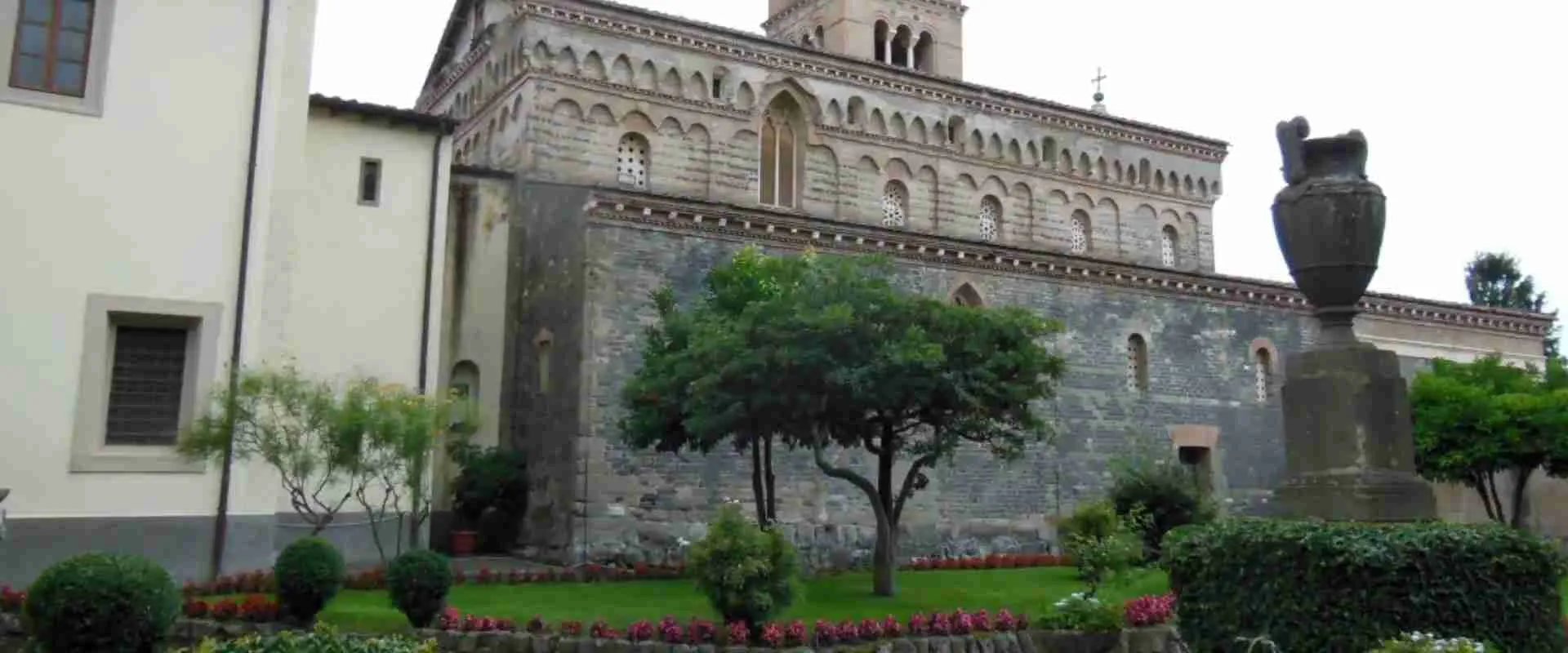
Grottaferrata is home to Grottaferrata Abbey (Abbazia di San Nilo), a Greek-Byzantine monastery founded around 1004 by Saint Nilus of Rossano. It remains an active monastery following the Greek-Catholic rite and contains an 11th-century portico and a church with notable Byzantine-influenced frescoes. Visits to the church are free; the museum within the abbey complex charges a small admission. Allow 45–60 minutes. Grottaferrata is well-placed as a transition stop between the southern arc (Nemi, Ariccia) and Frascati on the return leg.
Frascati anchors the return. As the largest and best-connected Castelli Romani town — a direct regional train from Rome Termini takes about 35 minutes — it functions as the wine capital of the circuit and is where most cantina visits are scheduled. Allow 90–120 minutes for wine tasting and a walk through the town centre; add another 30 minutes if visiting Villa Aldobrandini gardens (the historic Renaissance villa on the hillside above the town centre, with a belvedere terrace offering panoramic views toward Rome).
Castel Gandolfo 2026: Pontifical Villas, Lake Albano, and the Vatican Observatory
Castel Gandolfo’s identity has been shaped by its role as the papal summer residence for nearly four centuries. The first pope to take up residence at the castle was Urban VIII Barberini, who spent his first summer there in 1626 after commissioning Carlo Maderno — one of the principal architects of St. Peter’s Basilica — to adapt the existing structure into a proper papal palace. The Barberini Gardens (Giardini Barberini), which form the larger of the two garden areas within the Pontifical Villas complex, were later attributed to Gian Lorenzo Bernini, who completed them in 1635 as part of a broader programme of works for the Chigi family’s patron Alexander VII. The gardens and palace together now cover 55 hectares, encompassing Roman ruins from the time of Emperor Domitian’s imperial villa, Baroque fountains, and kitchen gardens still in productive use.
In October 2016 the Apostolic Palace opened to the public as a museum for the first time. Pope Francis, who chose not to use Castel Gandolfo as a personal summer retreat, donated the palace’s interior to public access. In June 2025 a communiqué from the Pontifical Household announced that Pope Leo XIV had decided to resume the tradition of a summer stay at Castel Gandolfo, taking up residence in Villa Barberini (the separate residential wing) from July 2025. The Apostolic Palace itself remains a museum, open on the standard schedule; only the Villa Barberini residential area has restricted public access during the Pope’s stays. For 2026 visitors, the practical implication is that the museum visit is unaffected, but guided tours of the Villa Barberini gardens may be unavailable on specific dates if Leo XIV is in residence. Check the official calendar at villepontificie.va before finalising dates.
The Vatican Observatory (Specola Vaticana) occupies the Barberini towers within the Pontifical Villas complex. One of the oldest continuously operating observatories in the world, it was established in its present Castel Gandolfo location in 1935 when Rome’s light pollution made astronomical observation difficult from the Vatican itself. The observatory’s visitor centre opened to guided tours in recent years through a collaboration with the Vatican Museums, covering historical telescopes, meteorite samples, and astronomical art. Tours last approximately 60 minutes and can be booked in combination with the Apostolic Palace and Barberini Gardens. Once-monthly evening visits near the first quarter of the moon include observation through the Carte du Ciel refractor of 1891. This is a genuinely unusual attraction for the circuit — not heavily marketed but consistently praised in visitor reviews.
Below the Apostolic Palace and the town sits Lake Albano, a nearly circular crater lake about 3.5 kilometres in diameter. Its shoreline at the crater bottom — reached by a steep road from Castel Gandolfo or from the Albano Laziale side — supports a handful of swimming lidos and restaurants. The Via Spiaggia del Lago runs along the eastern shore; this is a good location for a lakeside lunch or for the boat hire that some operators offer on the lake in summer. The lake’s water clarity and its near-perfect circularity give it an uncanny quality, and the high crater walls — rising 200 metres above the water level — trap a microclimate noticeably warmer in winter and cooler in summer than the surrounding hills.
Parking for Castel Gandolfo town: the Via delle Molette lot on the south side of the town and the Piazza Gramsci area to the north both provide access without crossing ZTL boundaries. From either, the central piazza and the Apostolic Palace entrance are five to eight minutes on foot. For the lakeside Via Spiaggia del Lago, park at the designated lot near the lake bottom and walk along the shore; avoid driving on the narrow descent road during peak summer hours, when oncoming traffic at passing points can cause 15–20 minute delays.
Lake Nemi and the Museum of Roman Ships 2026: Planning Around the PNRR Closure
The Museum of Roman Ships (Museo delle Navi Romane) at Nemi is one of the most singular archaeological museums in Italy, and its current closure for PNRR-funded structural renovation is the single most important operational fact for any Castelli Romani itinerary planned during 2026. The official Ministry of Culture (MiC) website at cultura.gov.it confirmed on 30 June 2026 that the museum is closed for extraordinary works until 31 August 2026. Visitors arriving before 1 September 2026 will find the building closed. Verify the reopening status directly at cultura.gov.it or via the Musei Italiani app before including the museum in your planning.
What the museum houses, and what the renovation is improving: the building was constructed between 1933 and 1939 specifically to shelter two enormous Roman pleasure barges recovered from the floor of Lake Nemi between 1929 and 1931. The ships belonged to Emperor Caligula, who reigned from 37 to 41 AD; they measured approximately 71 by 20 metres and 73 by 24 metres respectively, making them among the largest wooden watercraft ever recovered from the ancient world. Both ships were destroyed by fire in 1944 — the exact cause is disputed between wartime accounts attributing the fire to German forces and others to Allied actions — and the museum since its 1988 definitive reopening has displayed surviving original hardware alongside reconstructions. Original material on view includes bronze hull fittings, two anchors, lead pipe sections, a pump mechanism, and a section of the ancient paved road (clivus Virbii) that once connected Ariccia to the sanctuary of Diana at the lake’s edge. The PNRR renovation is expected to substantially improve the display infrastructure, climate control, and the integration of the sanctuary of Diana section into the exhibition circuit.
When the museum reopens, standard admission is €5 for adults and €2 for EU citizens aged 18–25. EU citizens under 18 and several professional categories enter free. The museum is free on the first Sunday of each month, as well as on 25 April, 2 June, and 4 November. Regular hours are 9:00 to 19:00 with the museum closed on Mondays, 1 January, and 25 December. Booking through the Musei Italiani app is available from 1 November and is recommended for groups of more than six.
For 2026 visitors coming to Nemi before September, the experience at Lake Nemi shifts from museum-centred to landscape-centred, which is in many ways an equally valid reason to be here. The village of Nemi perches on the crater rim 150 metres above the lake surface. Its terrace — the panoramic belvedere at the southern end of the village — offers the most dramatic view of the crater lake available from any road-accessible point in the Castelli Romani. The lake is almost perfectly circular and appears from above as a disc of dark blue or grey depending on the light. Local shops sell strawberry preserves, strawberry liqueur, and fresh strawberries seasonally; Nemi is known across Lazio for the fragola di Nemi, a small, intensely flavoured strawberry cultivated on the crater slopes.
The Nemi Rose Garden sits on the rim above the museum building and is free to enter. It contains an unusually varied collection of rose varieties set against the backdrop of the lake, at its peak in late May to mid-June. The garden is maintained by the municipality and is one of the least-publicised pleasant stops on the entire circuit. Below the car park on the Via Diana, the archaeological footprint of the ancient sanctuary of Diana Nemorensis — the most important cult site in the Alban Hills during the Roman period — is marked by fenced excavation areas around the museum building itself. You can view the perimeter of the excavations from outside even with the museum closed.
Ariccia 2026: Porchetta Capital, the Chigi Palace, and the Great Viaduct
Ariccia divides into two distinct experiences that most visitors conflate: the town centre on the plateau, and the valley viewpoints accessible from the roads below. Both are essential, and both are best approached on foot from the external car parks rather than by attempting to drive into the ZTL-protected historic centre.
The town centre is dominated by the Baroque ensemble of the central piazza — one of the most architecturally coherent urban compositions in Lazio. The Chigi Palace (Palazzo Chigi), which occupies the northern face of the piazza, was redesigned in the 1660s for the Chigi family under the influence of Gian Lorenzo Bernini, whose involvement in the broader piazza project — including the flanking curved wings and the circular church of Santa Maria Assunta across the square — is well-attested in the art-historical literature. The ensemble was commissioned by the Chigi family during the papacy of Alexander VII Chigi (1655–1667), making Ariccia’s transformation roughly contemporaneous with the construction of the colonnade of St. Peter’s Square in Rome. The result is an urban composition that feels deliberately theatrical: the oval church set directly opposite the palace, connected by arcing Baroque wings that create a stage-set piazza elevated on the plateau edge with the valley falling away below.
Ariccia’s porchetta is a protected geographical indication (IGP) — Porchetta di Ariccia IGP — and the tradition of whole-roasted, herb-seasoned pork served in bread rolls from dedicated fraschette (informal wine-and-food stops) has been practiced here for centuries. This is not a tourist fabrication: Ariccia’s porchetta was supplying Rome’s taverns before most of the Baroque buildings around it existed. A standard porchetta roll (panino con la porchetta) from one of the town’s fraschette costs €3–5 and constitutes the best budget lunch on the entire circuit. The fraschette also serve local wine by the carafe (typically Castelli Romani DOC white at €5–8 per carafe) and simple side dishes. They are typically open from midday to mid-afternoon; on weekdays in autumn and winter, several close early or are by appointment.
The Ariccia Viaduct (Ponte Monumentale) spanning the valley north of the piazza is a 19th-century engineering landmark built under Pope Pius IX. It stands approximately 58 metres above the valley floor and stretches roughly 315 metres across — figures drawn from multiple guidebook references that should be taken as approximate rather than precisely verified. The viaduct deck is walkable and gives the best elevated view of the crater valley that is freely accessible on the circuit. The Belvedere car park on the valley’s south side also provides views looking back up at the viaduct from below; this angle shows the full height of the arch structure and is popular with photographers. Note that a modern highway viaduct runs parallel a few hundred metres to the east; the Ponte Monumentale is the older, narrower, pedestrian-accessible structure.
On a practical note, Ariccia on summer weekends becomes genuinely difficult to navigate. The fraschette fill to capacity, the car parks overflow onto verges, and the ZTL cameras catch a steady stream of misinformed visitors who assume the electronic gates are ornamental. Weekday visits between 10:00 and 14:00 in spring or autumn are the ideal window — quiet enough that you can actually hear your footsteps on the Baroque paving stones.
Frascati and the Tusculan Hills 2026: Wine Estates and Hilltop Villa Gardens
Frascati is the most accessible Castelli Romani town from Rome — the regional train from Termini takes about 35 minutes — and for this reason it is both the busiest and the most commercially developed for tourism. Its reputation as a wine destination is genuine and long-established. The Frascati DOC and Frascati Superiore DOCG designations cover white wines produced predominantly from Malvasia and Trebbiano grapes grown on volcanic soils between 200 and 600 metres above sea level. The volcanic character of the terrain — the same leucitite peperino tuff that underlies the whole Alban Hills region — gives the wines a mineral salinity and aromatic brightness that distinguishes them from white wines of other central Italian zones. Frascati was historically known as the wine of the papal court and the wine of the Villa period, when Renaissance and Baroque nobility built retreats on the Tusculan hills and sourced their table wines from the surrounding estates.
The wine tourism infrastructure in Frascati in 2026 ranges from informal to quite polished. At the informal end are the traditional frascette — sometimes described as the precursors of Rome’s osterie — where local producers sell their wine by the carafe alongside simple foods, without appointment, often in rustic underground cellars built into the volcanic rock. This was the original meaning of the term “fraschetta” (a branch of laurel hanging above the door was the sign that wine was available). These survive, though in reduced number, and a glass of unbottled house white costs €2–4. At the polished end are structured winery experiences booking two weeks in advance, combining a vineyard walk, cellar visit, and tasting of three to five wines with local cheeses and salumi for €35–55 per person.
For 2026 self-drivers, the cantina booking process works best when done directly through the winery’s own website rather than through aggregator platforms, which typically add a 15–25 per cent service charge. Major Frascati producers with consistent visitor programmes include estates along the Via dei Laghi itself and on the Via Tuscolana approach road. Many require 48-hour advance booking minimum; a small number accept same-day bookings on weekdays outside peak season.
Above the town, Villa Aldobrandini is a late-Renaissance villa built at the end of the 16th century for the Aldobrandini family. Its terraced gardens are occasionally open to guided visits in the morning; access arrangements have historically required advance booking through the municipality. The belvedere above the villa offers the circuit’s best views toward central Rome — on a clear autumn morning, the dome of St. Peter’s is visible roughly 25 kilometres to the northwest. The villa interior is not open to the public. For current garden opening hours and booking procedures, check with the Frascati tourist office (visitfrascati.it) before arriving.
Grottaferrata, positioned between Frascati and the Via dei Laghi, is a 15-minute drive from Frascati town centre and makes an easy addition to the return leg. Grottaferrata Abbey was founded around 1004 by Saint Nilus of Rossano, a Calabrian monk of Greek origin who sought to establish a place of monastic practice following the Greek-Catholic rite in the Lazio hills. The abbey is still active; its church contains 11th-century stonework and Byzantine-influenced frescoes. Visits to the church interior are free during opening hours; the abbey’s small museum charges a minimal admission fee. The distinctive feature of Grottaferrata Abbey for the road-trip visitor is its setting: the monastery is encircled by 15th-century defensive walls commissioned by Cardinal Giuliano della Rovere (later Pope Julius II), giving it the appearance of a fortified castle from a distance — an appearance that gave the Castelli Romani their collective name.
Genzano di Roma, Albano Laziale, and Rocca di Papa 2026: Completing the Volcanic Circuit
The southern arc of the Castelli Romani circuit — the towns between Ariccia and the Monte Cavo ridge — tends to be covered more quickly than the Castel Gandolfo and Frascati zones, partly because it lacks a single major museum-grade attraction and partly because it is the stretch where traffic on the SS7 Via Appia tends to be heaviest. Using the Via dei Laghi rather than the Via Appia to re-enter this arc from the Nemi side reverses this problem and presents these towns from their quieter approaches.
Genzano di Roma sits immediately northwest of Lake Nemi and is best known nationally for the Infiorata, an elaborate flower petal carpet laid along the Via Italo Belardi each Corpus Christi Sunday in June. The Infiorata is a serious event — designs are prepared weeks in advance, cover hundreds of square metres, and draw visitors from across Lazio on the display day and the following morning before the petals are dispersed. Outside June, Genzano is a quiet town with a good weekly market, a creditable selection of local restaurants, and a belvedere terrace looking back across the crater to Nemi’s perched village on the opposite rim. The visual geometry of seeing Nemi from Genzano — the two towns facing each other across the circular void of the lake — captures the volcanic landscape more precisely than any single view from either side alone.
Albano Laziale is the largest municipality on the southern arc and the most historically layered. The town sits on the site of the Castra Albana, a legionary fortress established in the early 3rd century AD. Roman remains visible above ground or in the town’s civic museum include sections of the original camp wall, a 2nd-century cistern system, and the tomb structure near the Via Appia that local tradition names the Tomb of the Horatii and Curiatii, though the attribution is conventional rather than documentarily confirmed. For road-trip visitors who are not specifically chasing Roman ruins, Albano’s main attraction is its market energy and its lack of tourist infrastructure — it is a real working-class town rather than a heritage destination, and that quality can feel like relief on a circuit otherwise dominated by carefully curated hilltop piazzas.
Rocca di Papa occupies a steep spur on the Monte Cavo ridge at 680 metres and looks and feels different from the lakeside towns. The street plan is genuinely medieval — not a later reordering of medieval patterns but a surviving one, with alleys wide enough for one person and staircase lanes connecting the layers of the hillside settlement. The views from the upper piazza on a clear day extend to the Tyrrhenian Sea and, in the other direction, to the Apennines. From Rocca di Papa, a rough track and then a paved road climb to the Monte Cavo summit at 956 metres, where an aerial antenna forest occupies the site of the ancient Temple of Jupiter Latiaris — the focal sanctuary of the Latin League, annually honoured by the Feriae Latinae festival during the Republic. The summit is accessible by car in 15 minutes from Rocca di Papa; the Via Sacra, a section of well-preserved ancient Roman road, provides a walking route of 3–4 kilometres through chestnut and oak woodland from the crater rim to the summit. The Via Sacra junction point on the Via dei Laghi — accessible from a left turn at the roundabout near the Ristorante dei Laghi — gives a panoramic point from which both Lake Nemi and Lake Albano are visible simultaneously. This double-lake panorama is the defining image of the Alban Hills from above, and it is achievable as a 20-minute detour from the main circuit road.
Budget Planning for the Castelli Romani Road Trip 2026
All costs below are per person, calculated on the basis of two people sharing one rental car, and represent a full day circuit from Rome returning the same evening. Hotel and accommodation costs are treated separately in the overnight extension section. No arithmetic formulas appear in this section — all ranges have been pre-calculated and rounded to the nearest €5.
Budget day trip: €50–90 per person. Car rental share €22–36, fuel share €7–10, parking share €3–6, porchetta lunch and local snacks €10–18, local bar wine €6–10, coffees and incidentals €4–8. This tier uses free attractions only — lake viewpoints, village walking, the Nemi Rose Garden, public spaces around the Chigi Palace — and skips all paid museum or palace entries. It is perfectly viable for the 2026 season given that the Museum of Roman Ships remains closed; the free components of the circuit have sufficient depth to fill a day. Budget travelers who arrive at the GRA before 8:30 and depart the hills by 17:00 will find this tier entirely comfortable.
Mid-range day trip: €115–175 per person. Car rental share €25–40, fuel share €8–11, parking share €4–7, Pontifical Villas entry at Castel Gandolfo €16–25 (self-guided to guided), lunch at a local trattoria €20–32, a cantina visit and tasting in Frascati €35–50, coffees and snacks €6–12. This tier is the most popular for independent travellers who want a genuine engagement with both the heritage and the wine culture of the hills, and it represents the circuit at its full value for money. The Frascati cantina visit is the largest single cost after the car and should be booked at least a week in advance to secure the preferred time slot.
Luxury day trip: €215–345 per person. Premium car rental share €50–80, fuel share €12–14, parking share €6–9, guided Pontifical Villas experience €30–55, upscale trattoria lunch €45–70, premium Frascati winery experience with full food pairing €55–84, aperitivo and incidentals €18–35. This tier suits travellers combining the Castelli Romani with a private guide booked from Rome, a full-programme cantina visit with a sommelière, or a dinner reservation at one of the area’s more acclaimed restaurants before returning to the city.
Overnight extension: The circuit is manageable as a day trip from Rome but also supports an overnight stay, particularly if combining with a morning visit to the Museum of Roman Ships after it reopens in September 2026. Budget accommodation in the Castelli Romani — B&Bs and simple hotels in Frascati, Genzano, or Albano Laziale — averages €55–80 per room per night for a standard double, or €30–40 per person for two sharing. Mid-range hotels run €100–140 per room, or €50–70 per person sharing. Agriturismo estates in the wine country around Frascati and Monte Porzio Catone offer the most characterful settings and typically range €200–300 per room, or €100–150 per person sharing. Adding accommodation to the day-trip costs gives total overnight daily ranges of €80–130 (budget), €165–245 (mid-range), and €315–495 (luxury), per person per day.
Museum of Roman Ships admission note: when the museum reopens from September 2026, standard adult admission is €5 full price, €2 reduced for EU citizens 18–25. Add this cost to the relevant tier above for post-August visits. The museum is free on the first Sunday of each month — if the timing works, this is the easiest way to add the museum without affecting the budget tier calculation.
Train alternative to car hire: Frascati is reachable from Rome Termini in 35–40 minutes on the FL4 regional line at approximately €2 per single journey. Castel Gandolfo is reachable from Termini on the Albano Laziale line in a similar time. However, these two stations are 12 kilometres apart by road, and no convenient public transport connects the full circuit. Visitors arriving by train can efficiently cover Frascati or Castel Gandolfo as individual destinations but not the complete loop. The car hire cost is justified by the access it provides to Ariccia, Nemi, Rocca di Papa, and Genzano that would otherwise require multiple taxi journeys.
Seasonal Crowding Patterns 2026: When to Drive Which Towns
The Castelli Romani is used by Romans as a weekend escape, a summer cool-down zone, and a wine-country outing — all three functions produce distinct crowding patterns that visitors can exploit or avoid depending on their priorities.
The fundamental rule for 2026: avoid Sunday visits between Easter (April 20, 2026) and the end of September. On a Sunday in this window, every ridgetop car park near a lake view fills before noon, every porchetta fraschetta has a queue by 12:30, and the narrow roads of Nemi and Rocca di Papa back up behind coaches and day-tripper convoys that have nowhere to overtake. The same locations on a Tuesday or Wednesday morning in the same months are tranquil. This is not an exaggeration for effect — the difference in experience between a Sunday in August and a Wednesday in October at the same locations is comparable to the difference between visiting the Trevi Fountain at noon in August versus 7:00 in January.
October and November are the optimal months for the full circuit. The harvest is in, the cantine are selling new wine, the chestnut sellers have set up on the ridgeline roads, and the autumn light on the crater lakes — lower in the sky and more golden — is exceptional. Temperatures are mild (15–22°C in October, 10–17°C in November), parking is straightforward, and restaurants are fully staffed. The Museum of Roman Ships, if open by September as planned, will still be in a post-reopening novelty period through late 2026 — book ahead for October visits.
Spring (March to May) offers the second-best window. The hills are green, wild flowers line the Via dei Laghi, and temperatures are comfortable for walking. The main crowding event in this window is the Infiorata at Genzano in June: if you are visiting specifically for the flower carpet, book accommodation in the area two to three months in advance and arrive Friday afternoon before the Sunday display. If you are not visiting for the Infiorata, avoid Genzano on Corpus Christi weekend and rearrange the circuit order to skip it entirely that day.
Summer (June to August) is viable on weekdays, provided you leave Rome early. The Via dei Laghi at 7:30 in July is cool and nearly empty; by 11:00 the sun is high and the lakeside car parks are filling. Plan a Castel Gandolfo and Nemi morning start (7:30–12:00), a shaded lunch in Ariccia (12:30–14:30), and a Frascati wine visit in the late afternoon (16:00–18:00) when cantina temperatures are dropping. Avoid Castel Gandolfo’s lakeside road in July-August after 14:00 — the beach-goers descending to the Via Spiaggia del Lago make the crater-bottom road effectively one-way in practice.
Winter (December to February) is under-appreciated for this circuit. The hills are largely uncrowded, accommodation is cheaper, the autumn wine is now bottled and available for tasting, and the peperino-stone architecture looks its best under flat winter light. Some smaller restaurants and fraschette operate reduced hours or close Monday-Tuesday, so planning a Thursday or Friday visit in winter is safer. Rocca di Papa occasionally receives a light snowfall in January or February, which transforms the medieval alleys into something genuinely unusual for central Italy.
Self-Drive Logistics 2026: Car Hire, GPS, and Road Conditions in the Alban Hills
Car hire for a Castelli Romani circuit is best collected at Rome Termini, Leonardo da Vinci airport (Fiumicino), or Ciampino airport. The Ciampino option is particularly logical for the circuit: the airport sits at the foot of the Via dei Laghi access point, so a car collected at Ciampino can be on the Via dei Laghi within 10 minutes. Economy class cars — a FIAT Panda, Volkswagen Polo, or equivalent — are the right tool. The roads through Nemi’s descent to the lake, the upper lanes of Rocca di Papa, and several of the car-park access roads at Ariccia have width constraints that make larger vehicles uncomfortable. Minivans and SUVs are manageable on the main provincial roads but create difficulties at tighter points. Campervans are not recommended for the tighter stops on the circuit.
Car hire rates for a one-day rental (economy class, including CDW and unlimited mileage) typically range from €45 to €80 for the car in total, depending on the booking platform and lead time. Book seven to ten days in advance for the best rates; same-day rentals at the airport can run 40–60 per cent more. Major international companies (Hertz, Avis, Enterprise) and Italian operators (Maggiore, Locauto) all have counters at Fiumicino and Termini; Ciampino has fewer options but does have coverage from the larger companies. Always inspect the car carefully at collection and photograph any existing damage before departing.
GPS navigation: all major mapping applications (Google Maps, Apple Maps, HERE) handle the Castelli Romani roads accurately as of 2026, though updates for the narrow deviation roads above Nemi can lag. The most reliable approach is to set individual waypoints — Castel Gandolfo Apostolic Palace, then Ariccia Belvedere car park, then Genzano, then Nemi Museum of Roman Ships, then Rocca di Papa, then Frascati — rather than programming a single multi-stop route, which can produce unexpected routing through the ZTL zones.
Road conditions on the main SP217 Via dei Laghi and on the SS7 Via Appia are generally good, with resurfacing work on sections of the Via dei Laghi occurring intermittently under PNRR infrastructure programmes. Secondary roads — the SP26b descent to Nemi, the Via Scalette up to Monte Cavo, the approach roads to Rocca di Papa from the Via dei Laghi — can have sections of broken asphalt or narrow passing points that require speed adjustment. The hairpin bends on the Nemi descent are steep (15–20 per cent gradient in places) and require manual downshift in an automatic; test the brakes gently at the top of the descent before committing to the full slope.
Fuel: petrol and diesel service stations are available in Ciampino, Albano Laziale, and Frascati but are sparse on the Via dei Laghi itself. Fill the tank before entering the circuit at Ciampino. A 100-kilometre circuit on an economy car at average combined consumption uses 5–8 litres depending on the number of hill climbs; at current Italian fuel prices of approximately €1.75–1.90 per litre for unleaded, budget €9–15 for fuel for the full day.
Electric vehicles: the Castelli Romani has public charging points in Frascati (Piazza del Mercato area) and in Albano Laziale, but coverage is patchy on the Via dei Laghi route. If driving an electric vehicle, confirm charging availability in advance and plan the circuit with a charging stop in Frascati built into the afternoon schedule. The elevation changes on the circuit — up to 500 metres of climb between the lake bases and the Monte Cavo approaches — affect range more than flat-road driving would suggest.
Money-Saving Strategies for the Castelli Romani 2026
The first and most impactful saving on this circuit in 2026 is already built into the calendar: the Museum of Roman Ships is closed, eliminating what would otherwise be the main entry cost of the circuit. The remaining paid attraction — the Pontifical Villas at Castel Gandolfo — has a free equivalent in the town’s public piazza and lake-overlook terrace, which are accessible without a ticket and provide a creditable introduction to the complex’s setting. Book the Apostolic Palace only if the interior interests you genuinely; do not book it as a default.
Second: book the Frascati cantina visit directly with the producer rather than through a tour operator or aggregator. Direct bookings typically save €8–20 per person compared to platform-listed prices, which incorporate service fees. Most producers have an English-language booking page on their own website. Where direct booking is not available, Winedering.com lists prices across multiple Frascati producers with transparent commission structures.
Third: eat porchetta, not restaurant. Ariccia’s fraschette serve the best value food on the circuit — a large porchetta roll and a quarter litre of local white wine costs €7–10 per person, compared to €20–35 for a comparable-quality trattoria lunch. Many fraschette also offer simple pasta or bruschetta at similarly low prices. The saved lunch money can be redirected toward a better wine tasting.
Fourth: use the first-Sunday-of-the-month free museum access once the Museum of Roman Ships reopens. September 2026’s first Sunday falls on September 6 — early enough in the post-reopening period that the museum will likely still have the novelty factor without the extended queue that builds later. September weather in the Alban Hills (average 22–26°C, lower crowd numbers than August) makes this a strong planning target.
Fifth: train to Frascati for a wine-only day. If the objective is purely a Frascati cantina experience without the full circuit, the regional train from Termini is a dramatically cheaper and simpler alternative to car hire — approximately €2 each way, 35–40 minutes, and no parking challenge. The circuit towns to the south (Ariccia, Nemi, Rocca di Papa) are not reachable by train, so this trade-off depends on priorities.
Sixth: avoid the toll roads on the approach to and from the Castelli Romani. The A1/A24 motorway network from Rome adds €1.50–3 per journey. The Via Appia (SS7) and Via Tuscolana (SS215) are toll-free and, outside rush hours, comparable in journey time.
Frequently Asked Questions About the Castelli Romani Road Trip 2026
Is the Museum of Roman Ships at Nemi open in 2026?
No — the Museum of Roman Ships (Museo delle Navi Romane) at Nemi is closed for PNRR-funded structural renovation until 31 August 2026, according to the official Ministry of Culture website (cultura.gov.it, updated 30 June 2026). Visitors planning a 2026 trip primarily around the museum should target September 2026 or later, when the site is expected to reopen substantially upgraded. For real-time status confirmation, check cultura.gov.it or the Musei Italiani app before booking travel. When open, standard adult admission is €5 full price, €2 reduced for EU citizens 18–25, and free on the first Sunday of each month.
Can I drive the full Castelli Romani circuit without getting a ZTL fine?
Yes, but it requires parking outside the historic centres and walking in at every ZTL-protected town. Castel Gandolfo, Ariccia, Nemi, and Frascati all operate electronic ZTL systems with camera gates. In Ariccia, use the Belvedere car park below the viaduct and walk across the viaduct deck into the piazza (five minutes). In Castel Gandolfo, use the Via delle Molette or Piazza Gramsci car parks and walk into the centre (five to eight minutes). In Nemi, use the Via Diana car park near the museum building (five to eight minutes from the village). In Frascati, use the Piazza del Mercato area parking (ten minutes to the centre). Current ZTL operating hours vary by season and may change; verify with each town’s municipal website before your visit, as ZTL fines typically run €80–160 after the hire car company forwards the penalty notice.
How do I book the Pontifical Villas at Castel Gandolfo in 2026?
Book through the official Vatican website at villepontificie.va, which lists the Apostolic Palace visit, the Barberini Gardens (Vatican Observatory) tour, and combined packages. Advance booking is mandatory — walk-in admission to the timed entry slots is not available. The Apostolic Palace visit (self-guided, multilingual audio guide included) runs approximately €16–17 for adults. Combined Apostolic Palace and gardens options start from around €24. Book at least five to seven days ahead for weekday visits and three to four weeks ahead for prime weekend slots in spring and autumn. The Pontifical Villas complex is closed on Sundays from October to March (except for special events) and access to Villa Barberini gardens may be restricted on specific dates when Pope Leo XIV is in residence; the official calendar on villepontificie.va is updated regularly.
What is the Via dei Laghi and why does the 2026 guide prioritise it?
The Via dei Laghi (SP217) is a provincial road inaugurated in 1936 that branches from the Via Appia just past the GRA ring road near Ciampino airport and runs approximately 30 kilometres south through the Castelli Romani to Velletri, passing close to Lake Albano and Lake Nemi along the way. It is prioritised over the Via Appia corridor (SS7) for this circuit because it carries significantly less traffic outside peak hours, passes closer to the volcanic crater lakes for scenic value, and approaches Castel Gandolfo, Nemi, and Rocca di Papa from angles that allow faster exits once you are ready to move on. The Via Appia still serves Ariccia and Albano Laziale directly, and these towns are easiest to reach via a short detour off the Via dei Laghi or via the Via Appia from the Albano junction.
How do I avoid crowds at Nemi during peak season in 2026?
Arrive at the Via Diana car park before 9:30 on any day other than Sunday. The narrow descent road into Nemi village fills from mid-morning on Saturdays and Sundays between April and September, and the village’s single through-lane road becomes effectively one-way behind tour coaches. On a weekday morning in April, May, June, September, or October, the crater-lake terrace at Nemi is quiet enough to hear birdsong. When the Museum of Roman Ships reopens post-September 2026, the queue for the museum itself will require a separate early-morning booking through the Musei Italiani app, since the site has limited visitor capacity and no real queuing infrastructure. Timed entry slots for the museum will likely fill on weekends within days of availability opening.
Is the Castelli Romani circuit suitable for first-time visitors to Lazio?
Yes, and in some respects it is more accessible for first-timers than Rome’s own historic centre. The towns are small enough to navigate on foot without maps once you are parked, the ZTL zones are well-signposted, and the region does not require knowledge of ancient Rome to be visually and gastronomically rewarding. The Pontifical Villas at Castel Gandolfo and the Museum of Roman Ships provide structured historical context if desired, but the circuit works equally well as a landscape-and-food experience that requires no prior knowledge. English is spoken at most of the tourism-facing cantinas and at the Pontifical Villas ticketing office; in the fraschette and local trattorie, Italian is helpful but a menu point and a gesture work adequately. The one thing first-timers should be warned about clearly: the ZTL systems are not a tourist attraction — the cameras are real and the fines will arrive.
What is porchetta and where are the best places to eat it in 2026?
Porchetta is a whole pig, boned, seasoned with rosemary, garlic, fennel, and black pepper, roasted slowly over wood, and sold in thick slices in bread rolls (panino con porchetta). Ariccia’s version — Porchetta di Ariccia IGP — is a protected Italian geographical indication, meaning producers must follow specific regional production rules. The best places to eat it are the fraschette in Ariccia itself, which serve the freshly sliced product from large whole roasts kept warm on the counter, typically for €3–5 per roll. Along the Via dei Laghi, several roadside vans also sell porchetta sandwiches with a view of Lake Albano — a useful lunch option if you are driving between Castel Gandolfo and Ariccia around midday. Frascati’s market days (Wednesday and Saturday) also feature porchetta vendors, though Ariccia’s fraschette are the more authentic setting.
Are the Frascati wine estates accessible without a car in 2026?
The Frascati train station is served by direct regional trains from Rome Termini (FL4 line, approximately every 30 minutes, about 35 minutes journey time, roughly €2 per single). From the Frascati station, several cantinas offering structured visits are within 2–4 kilometres — reachable by taxi (approximately €8–12) or on foot for those willing to walk uphill. The Frascati cantinas that offer collection from the station at no extra charge typically advertise this on their booking pages; filter for “transfer included” when searching winery experiences on Winedering or TripAdvisor. The informal frascette in Frascati town centre are walkable from the station via the Via Enrico Battisti climb into the historic centre. For the full circuit including Ariccia, Nemi, and Castel Gandolfo, a car is necessary; Frascati-only visits by train are a practical budget alternative.
What happens on Monte Cavo and is it worth the detour in 2026?
Monte Cavo at 956 metres is the highest point of the Alban Hills and carries a double layer of historical significance. In Roman times, the summit held the Temple of Jupiter Latiaris, the sacred focal point of the Latin League’s annual Feriae Latinae festival — a sanctuary attended by communities from across Lazio. The summit today is dominated by telecommunications infrastructure, which makes the view from the very top less photogenic than expected. The real reward is the Via Sacra, the ancient Roman paved road that climbs through chestnut and oak woodland from the crater-rim junction on the Via dei Laghi to near the summit — a 3–4 kilometre walk each way through genuinely well-preserved Roman road surface, with a panoramic clearing called the Occhialone that overlooks both Lake Nemi and Lake Albano simultaneously. Allow 90 minutes for the round-trip walk on the Via Sacra. The detour is worth it for active visitors who do not need to be back in Rome before 19:00; skip it if the primary purpose is the cantina visit in Frascati.
How much does parking cost across the Castelli Romani circuit in 2026?
Parking costs vary significantly by town and car park type. Castel Gandolfo’s Via delle Molette pay-and-display runs approximately €1.50–2 per hour; a two-hour stop costs around €3–4. Ariccia’s Belvedere car park on the south side of the viaduct is free or operates a minimal flat fee (verify current status locally, as policies change). Nemi’s Via Diana car park is free during the period when the museum is closed; when the museum reopens, a small parking charge may be reintroduced for peak periods. Frascati’s Piazza del Mercato car park charges approximately €1–1.50 per hour. In Rocca di Papa and Genzano, street parking in the outer town areas is typically free with a time disc (disco orario required, available at petrol stations and tabacchi). On the assumption of roughly six hours of total parking across the day at the main stops, budget €5–10 per car for the circuit, or €3–5 per person for two sharing.