
Akrotiri Archaeological Site: Minoan Pompeii of the Aegean
Akrotiri represents one of the Mediterranean’s most significant Bronze Age archaeological discoveries — a sophisticated Minoan port city frozen in time by catastrophic volcanic eruption around 1600 BCE, preserving multi-story buildings, advanced infrastructure, and extraordinary frescoes that illuminate Aegean civilization at its apex. The settlement’s exceptional preservation rivals and arguably surpasses Pompeii’s Roman remains, with intact building facades rising three stories, sophisticated drainage systems revealing urban planning centuries ahead of contemporary societies, and vibrant wall paintings depicting daily life, religious ceremonies, and maritime activities that survived 3,600 years beneath protective volcanic ash layers. Housed within a modern bioclimatic shelter spanning 9,000 square meters, the excavated portion represents merely 3-4% of the estimated settlement area, with elevated walkways enabling visitors to observe this Bronze Age metropolis from above while descending stairways provide close encounters with architectural details, storage vessels, and living spaces that reveal remarkable technological and cultural sophistication predating classical Greek civilization by over a millennium.
Key Takeaways About Akrotiri Archaeological Site
- Volcanic preservation created unparalleled Bronze Age documentation: The Theran eruption buried Akrotiri under volcanic ash and pumice layers reaching 60 meters depth, protecting building structures, wall frescoes, pottery, furniture, and organic materials from weathering and human disturbance that destroyed comparable settlements elsewhere across the Mediterranean.
- Advanced urban infrastructure reveals sophisticated engineering: Multi-story buildings reaching three floors incorporate stone foundations supporting mudbrick upper levels, sophisticated drainage systems channeling wastewater through ceramic pipe networks, and storage facilities suggesting centralized resource management within hierarchical social structures.
- Wall frescoes provide unprecedented cultural insights: Vivid paintings depicting maritime processions, religious ceremonies, boxing matches, and nature scenes reveal Minoan artistic traditions, religious practices, social hierarchies, and trading connections extending from Crete to Egypt and the Levant through iconographic parallels and imported materials.
- Complete absence of human remains and valuables indicates evacuation: Unlike Pompeii’s tragic human casualties, Akrotiri excavations discovered no skeletons and minimal precious metal objects, suggesting residents received warning signals enabling organized departure carrying portable wealth before the catastrophic eruption’s final phase.
- Bioclimatic shelter protection enables year-round visiting: The modern protective structure completed in 2012 features adjustable roof sections regulating temperature and humidity while providing weather-independent access, with elevated walkways offering aerial perspectives and ground-level passages enabling intimate architectural observation impossible at exposed archaeological sites.
- Ongoing excavation continues revealing settlement complexity: Systematic archaeological investigation beginning in 1967 under Spyridon Marinatos exposed approximately 12,000 square meters from an estimated 200,000 square meter total settlement, with future excavations promising additional residential quarters, public buildings, and cultural artifacts expanding understanding of Bronze Age Aegean civilization.
People Also Ask About Akrotiri Archaeological Site
Why is Akrotiri called the Minoan Pompeii?
Akrotiri earns the designation “Minoan Pompeii” through its preservation by volcanic catastrophe paralleling the Italian city’s fate, though the Bronze Age settlement’s remains often surpass Pompeii’s quality due to protective ash burial preventing structural collapse and preserving organic materials typically lost at archaeological sites. The Theran volcanic eruption around 1600 BCE buried Akrotiri under ash and pumice layers reaching 60 meters depth, sealing buildings, frescoes, pottery, and wooden furniture in oxygen-deprived conditions that prevented decay, oxidation, and deterioration that destroys comparable evidence elsewhere. Unlike Pompeii where volcanic pyroclastic flows incinerated wooden structures and organic contents leaving only building shells, Akrotiri’s gentler ash accumulation preserved complete room assemblages including furniture arrangements, storage vessel contents, and wall painting pigments retaining original brilliance after millennia underground.
The comparison proves somewhat misleading as Akrotiri predates Pompeii by approximately 1,700 years and represents fundamentally different cultural contexts — Bronze Age Minoan civilization versus Imperial Roman society — though both settlements share catastrophic volcanic destruction creating archaeological time capsules. Akrotiri’s superior preservation stems from the settlement’s complete burial before weathering, looting, or reoccupation could damage structures, while Pompeii suffered partial exposure enabling ancient salvage, medieval stone quarrying, and early excavation damage before modern archaeological standards developed. The absence of human remains at Akrotiri indicates successful evacuation distinguishing it from Pompeii’s tragic casualties, suggesting Theran eruption warning signals enabled organized departure while Vesuvius struck with insufficient notice for Pompeiian escape. This evacuation paradoxically enhanced archaeological value — residents departing peacefully left intact room arrangements, stored provisions, and architectural features undisturbed, whereas Pompeii’s panic flight scattered contents and damaged structures during desperate escape attempts.
What can visitors see at Akrotiri Archaeological Site?
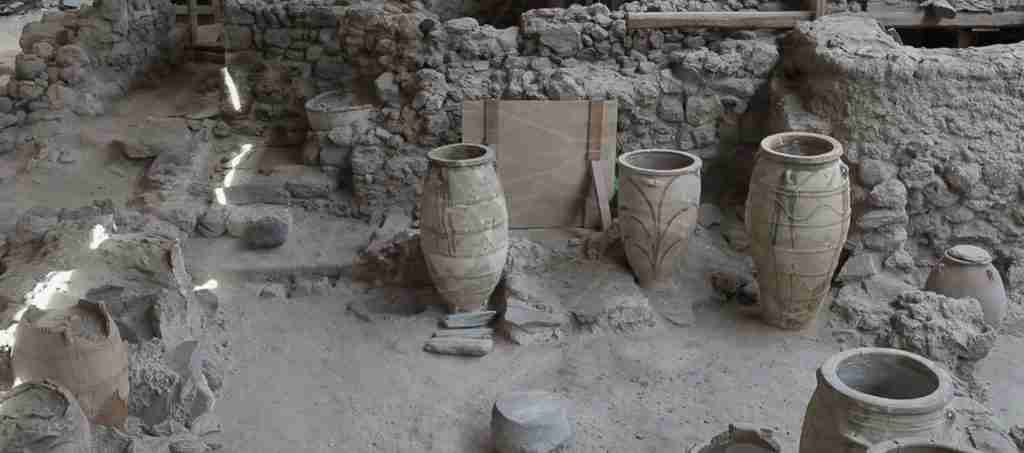
Visitors observe an excavated Bronze Age city sector comprising multi-story residential buildings, narrow paved streets, sophisticated drainage infrastructure, storage magazines containing massive ceramic vessels (pithoi), and remnant wall frescoes demonstrating advanced artistic traditions through elevated walkways and ground-level passages within the protective bioclimatic shelter. The walking route spans approximately 1 kilometer through the excavated area, with raised platforms providing aerial perspectives revealing urban planning patterns, building clusters, and architectural relationships impossible to comprehend from ground level, while descending stairways enable close observation of construction techniques, decorative elements, and functional features including windows, doorways, storage niches, and drainage channels.
Architectural highlights include the Xeste 3 building complex featuring elaborate fresco programs suggesting ritual or administrative functions, multi-room residential structures demonstrating wealth stratification through size and decoration quality, and the West House containing the famous fresco fragments now displayed in Athens’ National Archaeological Museum. Visible infrastructure elements encompass the sophisticated drainage system with ceramic pipe networks channeling wastewater from upper floors through building walls into street-level collection channels, stone-paved alleys barely 1.5 meters wide separating building blocks, and storage areas containing enormous pithoi vessels reaching 2 meters height that held grain, wine, oil, and water supplies. Information panels throughout the site explain architectural features, construction techniques, and cultural context, while video displays present three-dimensional reconstructions visualizing complete buildings with intact upper floors, decorated interiors, and populated streets bringing the Bronze Age settlement to life.
How long does visiting Akrotiri Archaeological Site take?
Comprehensive site visits require 60-90 minutes enabling thorough observation of excavated structures, reading information panels explaining architectural features and cultural context, watching video presentations reconstructing Bronze Age life, and absorbing the atmospheric experience of walking through streets last used 3,600 years ago. Visitors moving efficiently through the elevated walkways without extensive information panel reading or video viewing can complete the circuit in 45 minutes, though this abbreviated approach sacrifices understanding depth and misses subtle architectural details, spatial relationships, and cultural insights that transform superficial observation into meaningful engagement with Bronze Age civilization. Extended visits exceeding 90 minutes suit archaeology enthusiasts, photographers seeking varied perspectives, and visitors combining site exploration with audio guide narration or guidebook study providing comprehensive historical, archaeological, and cultural background.
The site’s indoor bioclimatic shelter protection enables comfortable visiting regardless of external weather conditions, making Akrotiri valuable during summer midday heat when exposed archaeological sites prove uncomfortable, or winter rain when outdoor exploration becomes unpleasant. The shelter’s climate control maintains moderate temperatures year-round — cooling during summer months when exterior conditions reach 35°C, warming during winter when ambient temperatures drop to 10-15°C — creating consistent comfortable conditions for leisurely observation impossible at weather-exposed sites. Visitors should allocate additional time before or after site exploration for the entrance museum displays featuring site history, excavation methodology, and selected artifact reproductions, plus potential stops at the Museum of Prehistoric Thera in Fira (20-minute drive) housing original fresco masterpieces and ceramic assemblages removed from Akrotiri for conservation and display in climate-controlled museum environments.
Is Akrotiri the lost city of Atlantis?
Akrotiri’s catastrophic destruction and sophisticated Bronze Age culture inspire Atlantis speculation connecting Plato’s philosophical allegory to historical Theran eruption events, though scholarly consensus maintains the dialogues represent literary invention rather than historical documentation of specific Mediterranean civilizations. Plato’s Timaeus and Critias dialogues (written circa 360 BCE) describe Atlantis as a powerful maritime empire destroyed by earthquakes and floods “in a single day and night,” vanishing beneath ocean waters — parallels to Theran eruption’s catastrophic timeline and Akrotiri’s submergence beneath volcanic debris prove superficially compelling though chronologically problematic. Plato situated Atlantis 9,000 years before Solon’s Egyptian visit (circa 600 BCE), placing the mythical civilization around 9600 BCE during Mesolithic period predating Bronze Age urban development by millennia, while Theran eruption occurred approximately 1600 BCE, representing 1,200-year discrepancy with Platonic chronology.
The Atlantis connection reflects modern fascination with lost civilizations rather than ancient Greek philosophical intent — Plato employed Atlantis as fictional setting for exploring political philosophy, ideal governance, and moral decline rather than preserving historical records of actual societies. Archaeological evidence demonstrates Akrotiri belonged to Minoan civilization centered on Crete, maintaining extensive trade networks with mainland Greece, Egypt, Cyprus, and the Levant rather than representing isolated island empire as Platonic Atlantis descriptions suggest. The Theran eruption’s devastating impact on Minoan civilization — triggering tsunamis damaging Cretan coastal settlements, disrupting trade networks, and potentially contributing to Minoan decline — creates legitimate historical catastrophe worthy of study without requiring mythological embellishment. Scholars generally interpret Atlantis as Platonic literary creation synthesizing various cultural influences, geographical knowledge, and philosophical concepts rather than encoding specific historical events, with Akrotiri’s excavation providing valuable Bronze Age insights independent of spurious Atlantis associations distracting from legitimate archaeological significance.
Extended multi-day tours – 5+ days
Featured Santorini Multi-Day Tour Packages
3 days
Santorini 3-Day Discovery Tour
- ✓ Comprehensive Santorini experience
- ✓ Expert local guides included
- ✓ All accommodation included
- ✓ Transportation provided
5 days
Santorini 5-Day Highlights Experience
- ✓ Comprehensive Santorini experience
- ✓ Expert local guides included
- ✓ All accommodation included
- ✓ Transportation provided
7 days
Santorini 7-Day Cultural Journey
- ✓ Comprehensive Santorini experience
- ✓ Expert local guides included
- ✓ All accommodation included
- ✓ Transportation provided
10 days
Santorini 10-Day Complete Adventure
- ✓ Comprehensive Santorini experience
- ✓ Expert local guides included
- ✓ All accommodation included
- ✓ Transportation provided
Multi-day tour packages powered by TourRadar. Prices and availability subject to change.
Introduction to Akrotiri Archaeological Site
Akrotiri Archaeological Site preserves the most extensively excavated Bronze Age settlement in the Aegean region, offering unparalleled insights into Minoan civilization at its cultural apex before catastrophic volcanic destruction froze the flourishing port city in time. The settlement occupied strategic positioning on Thera island’s southern coast controlling maritime trade routes between Crete, mainland Greece, and eastern Mediterranean civilizations, with excavated remains revealing sophisticated urban planning, advanced architecture, vibrant artistic traditions, and complex social organization characteristic of developed Bronze Age societies. Modern visitors encounter this ancient world through climate-controlled protective shelter enabling intimate observation of multi-story buildings, narrow paved streets, elaborate drainage systems, and decorative wall paintings that survived millennia beneath volcanic burial only to emerge through systematic archaeological investigation beginning in the late 1960s.
The settlement’s original name remains unknown — “Akrotiri” derives from the modern village occupying the peninsula where Bronze Age ruins lie buried, with ancient inhabitants presumably using Minoan Linear A script designations archaeologists cannot yet decipher. Historical significance extends beyond individual settlement importance to illuminate broader Bronze Age Aegean civilization through exceptionally preserved material culture, architectural evidence, and artistic production demonstrating cultural connections spanning from Egypt to Anatolia. The catastrophic eruption paradoxically created archaeology’s gain through culture’s loss — the same volcanic forces destroying thriving Bronze Age community preserved physical evidence enabling modern reconstruction of daily life, religious practices, economic activities, and artistic achievements otherwise lost to time’s erosive forces that eliminated comparable contemporary settlements.
Archaeological investigation at Akrotiri represents ongoing process rather than completed documentation, with excavated portions comprising approximately 3-4% of estimated total settlement area based on geophysical surveys and test trenches revealing building remains extending far beyond currently exposed sectors. Future excavation promises additional residential quarters, potential public buildings including temples or administrative centers, cemetery areas yielding burial practices and demographic data, and expanded material culture assemblages refining understanding of Bronze Age society, economy, and cultural practices. The site’s archaeological value transcends local Greek significance to contribute fundamental knowledge about Mediterranean Bronze Age civilization, Minoan cultural achievements, volcanic catastrophe impacts on human societies, and preservation conditions enabling exceptional archaeological documentation unmatched at most Bronze Age sites across Europe and the Near East.
Historical Development and Bronze Age Context
Akrotiri’s settlement history extends from Neolithic occupation around 4500 BCE through Bronze Age florescence culminating in volcanic destruction circa 1600 BCE, with archaeological evidence documenting continuous habitation and cultural development across three millennia. Early occupation phases reveal simple agricultural communities living in stone and mudbrick structures, practicing farming and fishing subsistence strategies characteristic of Neolithic Aegean settlements. The transition to Bronze Age material culture around 3000 BCE brought metallurgical innovations, ceramic technological advances, architectural elaboration, and developing trade connections that transformed Akrotiri from self-sufficient village into regionally integrated commercial center participating in Mediterranean-wide exchange networks.
Settlement Growth and Urban Development
Bronze Age Akrotiri experienced dramatic urban expansion during the Middle and Late Bronze Age periods (2000-1600 BCE), with archaeological evidence documenting population growth, architectural sophistication, and economic complexity reflecting the settlement’s integration into Minoan civilization’s trading sphere. Early Bronze Age structures reveal relatively simple rectangular buildings organized without apparent urban planning, while Middle Bronze Age construction introduced multi-room complexes, sophisticated foundation techniques, and coordinated building orientations suggesting centralized authority directing settlement layout. Late Bronze Age development brought the architectural and cultural florescence preserved by volcanic burial — multi-story buildings reaching three levels, elaborate fresco decoration, imported luxury goods, and standardized ceramic production indicating craft specialization and social stratification.
The settlement’s urban plan demonstrates sophisticated organization with buildings arranged in compact blocks separated by narrow streets barely wide enough for pack animal passage, suggesting pedestrian-focused transportation unlike later Greek and Roman cities accommodating wheeled vehicles. Ground-floor spaces primarily served storage and workshop functions, with massive ceramic pithoi vessels lining walls holding grain, olive oil, wine, and water provisions, while craft activities including textile production, ceramic manufacture, and possibly metallurgy occupied specialized work areas. Upper floors contained residential quarters with plastered walls supporting fresco paintings, built-in furniture including beds and benches, and window openings providing natural light and ventilation — architectural amenities demonstrating considerable comfort standards and domestic sophistication for Bronze Age context.
Population estimates for Late Bronze Age Akrotiri range from 1,500 to 3,000 inhabitants based on excavated building density, though complete settlement extent remains unknown pending future excavation. The discovered sector suggests mixed residential character with wealthy households displaying elaborate fresco decoration alongside more modest dwellings lacking painted walls, indicating social hierarchy within apparently unified urban fabric lacking the separate elite quarters characteristic of some Bronze Age settlements. The absence of obvious fortification walls distinguishes Akrotiri from contemporary mainland Greek settlements surrounded by massive defensive circuits, suggesting either island isolation provided sufficient protection, or Minoan thalassocracy (sea power) deterred hostile forces making urban fortifications unnecessary.
Economic Activities and Trade Networks
Akrotiri functioned as significant Bronze Age port city controlling maritime commerce between Crete, Cycladic islands, mainland Greece, and eastern Mediterranean civilizations based on imported materials, artistic influences, and harbor infrastructure evidence. Excavated buildings contained imported luxury goods including Egyptian scarabs, Syrian cylinder seals, obsidian from Melos island, copper from Cyprus, and tin from unknown sources (possibly Afghanistan or Cornwall) demonstrating extensive trade connections spanning thousands of kilometers. Storage facilities holding massive provisions suggest economic surplus production and commodity exchange rather than pure subsistence agriculture, with wine and olive oil likely serving as export products traded for metals, luxury goods, and other commodities unobtainable locally.
Maritime trade formed Akrotiri’s economic foundation evidenced through ship imagery appearing in fresco paintings, anchor stones recovered from excavations, and strategic coastal positioning controlling Aegean sea routes. The famous Ship Procession fresco depicts elaborate vessels with paddlers, steersmen, and decorated prows suggesting ceremonial or military flotillas, while architectural evidence indicates harbor installations though volcanic landscape transformation prevents direct identification of ancient port facilities. Pottery assemblages include Minoan-style vessels manufactured locally alongside imported Cretan products, Cycladic island wares, and occasional mainland Greek ceramics demonstrating multi-regional commercial relationships and cultural exchange networks integrating Akrotiri into broader Bronze Age Mediterranean economy.
Craft specialization evidence includes dedicated workshop spaces for textile production (indicated by loom weights), ceramic manufacture (suggested by standardized vessel forms), and possibly metallurgy (though limited direct evidence survives). The sophisticated fresco paintings demonstrate specialized artist training and patron support enabling full-time artistic production rather than part-time craft activities, suggesting economic prosperity sufficient to sustain non-agricultural specialists. Storage capacity far exceeding individual household consumption needs implies centralized resource accumulation, possibly through tribute, taxation, or controlled trade monopolies characteristic of Bronze Age palatial economies documented at Minoan Crete and mainland Greek Mycenaean centers.
The Catastrophic Theran Eruption
The volcanic eruption destroying Akrotiri ranks among history’s most powerful explosive events, with geological evidence indicating Volcanic Explosivity Index (VEI) rating of 6-7 placing it comparable to Krakatoa’s 1883 eruption and substantially larger than Vesuvius’s 79 CE Pompeii destruction. The catastrophic sequence began with precursor earthquakes damaging buildings and likely prompting initial evacuations, followed by phreatomagmatic explosions as seawater contacted rising magma, then massive Plinian eruption columns reaching stratospheric heights depositing thick pumice layers, concluding with pyroclastic flows and caldera collapse creating the present submerged volcanic crater.
Eruption Sequence and Settlement Burial
Geological stratigraphy reveals multi-phase eruption sequence spanning days to possibly weeks, with initial ash falls accumulating gradually enabling building entry for salvage operations evidenced by disturbed storage areas and portable valuable removal before final catastrophic phases. Early eruption phases deposited fine ash layers penetrating buildings through windows and roof openings, followed by pumice falls building 30-60 meter accumulations crushing roof structures and filling streets with volcanic debris. The settlement’s burial occurred primarily through airfall deposits rather than pyroclastic flows, explaining superior preservation — buildings collapsed progressively under accumulating weight rather than explosive destruction, with walls often remaining standing to upper-floor heights sealed within protective volcanic matrix.
The absence of human remains throughout excavated areas indicates successful evacuation distinguishing Akrotiri from Pompeii’s tragic casualties, suggesting precursor earthquakes and initial eruption phases provided sufficient warning for organized departure. Portable valuables including precious metal objects, weapons, and jewelry are conspicuously absent from excavated buildings, indicating residents removed transportable wealth before fleeing though abandoned household equipment, ceramic vessels, furniture, and wall paintings deemed too cumbersome for emergency evacuation. Some scholars propose residents initially sheltered elsewhere on Thera anticipating eruption cessation enabling return, or escaped via boats to nearby islands including Crete 110 kilometers south, though no historical records document Akrotiri refugees arriving at Minoan centers.
The eruption’s broader impacts extended far beyond Akrotiri’s local destruction to affect Mediterranean climate, agriculture, and civilizations across the eastern Mediterranean region. Volcanic ash deposits appear in archaeological layers across Crete, Rhodes, southwestern Turkey, and eastern Mediterranean coastal sites, documenting airfall distribution patterns. Tsunamis generated by caldera collapse likely devastated Cretan north coast settlements including major Minoan centers, potentially contributing to palatial civilization’s eventual decline though exact causal relationships remain debated among scholars. Ice core evidence from Greenland shows volcanic sulfate deposition spikes potentially correlating with Theran eruption, suggesting stratospheric aerosol injection affected Northern Hemisphere climate though precise chronological correlation remains uncertain due to independent dating method limitations.
Dating the Eruption Event
The Theran eruption’s precise date remains archaeologically controversial despite numerous scientific dating attempts, with radiocarbon analysis suggesting dates around 1600 BCE while traditional archaeological chronology based on pottery correlations with Egypt and the Near East favors dates around 1500 BCE. Radiocarbon dates from short-lived organic materials (olive branches, seeds) buried by eruption consistently indicate mid-17th century BCE timing (approximately 1613 BCE with statistical uncertainties), while dendrochronological analysis of growth anomalies in European and North American tree-ring sequences identifies possible volcanic eruption signals around 1628 BCE. These scientific dates conflict with archaeological chronology linking Late Bronze Age Aegean pottery styles with precisely dated Egyptian contexts suggesting later 16th century BCE eruption timing.
The dating controversy affects broader Mediterranean Bronze Age chronology and historical interpretations, with century-scale uncertainty preventing precise correlation between Theran eruption and documented historical events in Egyptian, Hittite, and Levantine texts. Some scholars propose radiocarbon dates require recalibration or contamination affected samples producing erroneously old ages, while others argue archaeological chronology relies on flawed Egyptian synchronisms and pottery style dating proves less precise than assumed. Recent scholarship increasingly accepts radiocarbon evidence favoring earlier 17th century BCE dating while acknowledging chronological uncertainties and ongoing research refinements. The debate demonstrates archaeological science’s evolving nature and chronological frameworks’ provisional character subject to revision as new evidence and dating method improvements emerge.
Architectural Features and Urban Infrastructure
Akrotiri’s excavated architecture demonstrates sophisticated engineering, advanced construction techniques, and comfort amenities rivaling contemporary Bronze Age settlements across the Mediterranean while predating classical Greek architectural achievements by over a millennium. Buildings rise multiple stories using stone foundations supporting mudbrick superstructures, with timber framing reinforcing walls and floors enabling three-story heights exceptional for Bronze Age construction. The consistent building quality across excavated sectors suggests standardized construction methods, professional builder specialists, and possibly regulatory building codes controlling urban development — evidence of centralized authority and social organization complexity matching architectural sophistication.
Multi-Story Building Construction
Bronze Age architects achieved remarkable vertical construction reaching three full stories through innovative structural systems combining materials and engineering techniques that distributed loads, resisted seismic forces, and supported habitable upper floors. Ground floors utilized carefully dressed volcanic stone blocks set in clay mortar forming robust foundations and lower walls capable of bearing upper-level loads, with wall thicknesses reaching 1 meter at ground level tapering to 60-80 centimeters at upper stories reducing total building weight while maintaining structural integrity. Mudbrick construction formed upper walls using sun-dried clay blocks reinforced with organic materials (straw, reeds) providing lightweight building material suitable for upper-level construction where excessive weight would stress lower supports.
Timber framing incorporated horizontal beams and vertical posts creating load-bearing frameworks within mudbrick walls, with visible timber impressions preserved in ash documenting sophisticated carpentry including mortise-and-tenon joints, diagonal bracing, and carefully dimensioned structural members. Floor construction employed timber beams spanning between walls supporting reed matting or wooden plank surfaces covered with clay and plaster, creating habitable upper levels while permitting some structural flexibility beneficial for earthquake resistance in seismically active Aegean region. Windows piercing upper-floor walls provided natural light and ventilation, with preserved openings maintaining wooden frames and possibly shutters though organic materials perished leaving only ash impressions documenting original construction details.
Interior features included built-in furniture fashioned from mudbrick and plaster including benches, beds, shelving, and storage niches integrated into wall construction rather than free-standing furnishings, maximizing limited interior space while providing permanent household equipment. Staircases connecting floors survive in several buildings, constructed from stone or timber with preserved examples demonstrating careful planning enabling vertical circulation within narrow building footprints. Upper floors contained principal living quarters with plastered walls supporting fresco paintings, window access providing light and air, and functional layouts separating sleeping, working, and storage spaces suggesting domestic organization and privacy concepts predating later Classical Greek architectural developments.
Drainage and Sanitation Systems
Akrotiri’s sophisticated drainage infrastructure rivals contemporary Bronze Age settlements while surpassing many later classical Greek and Roman cities, with comprehensive networks channeling wastewater from upper floors through building walls into street-level collection systems directing sewage away from residential areas. Individual buildings incorporated vertical drainage shafts within wall construction connecting upper-floor spaces (possibly toilet facilities though direct evidence remains limited) with ground-level discharge points, employing ceramic pipe sections fitted together creating sealed conduits preventing contamination seepage into adjacent spaces. The systematic drainage planning suggests centralized urban authority regulating waste management and public health concerns rather than individual household solutions operating without coordination.
Street-level channels ran along alley edges collecting building discharges and rainfall runoff, with stone-lined trenches directing flows toward settlement periphery and eventual discharge into surrounding landscape or sea. The drainage system’s complexity indicates awareness of sanitation principles and disease prevention through waste removal, representing advanced public health understanding for Bronze Age context where many contemporary societies lacked comparable infrastructure. Some buildings preserve evidence for bathtub facilities with drainage connections suggesting bathing amenities unusual for the period, though debate continues whether these installations served hygienic or ritual functions (religious purification ceremonies) documented in Minoan culture.
The drainage networks demonstrate engineering expertise in hydraulics, gradients, and flow management ensuring effective waste removal without system failures or backflow problems. Ceramic pipe manufacturing required standardized production creating interchangeable components maintaining consistent diameters enabling tight joints preventing leakage, suggesting specialized craft production and quality control procedures. The infrastructure’s survival after millennia demonstrates construction quality and durable materials selection, with ceramic pipes proving more resistant to decay and damage than organic materials used in other Bronze Age drainage systems that leave minimal archaeological traces.
Fresco Art and Cultural Expression
Akrotiri’s wall paintings represent Bronze Age Aegean art’s finest surviving examples, with vibrant frescoes depicting natural scenes, human activities, religious ceremonies, and abstract patterns demonstrating sophisticated artistic traditions, complex iconography, and cultural values that illuminate Minoan civilization beyond material culture alone. The paintings employed true fresco technique applying mineral pigments to wet lime plaster, enabling chemical bonding creating permanent colors that survived volcanic burial with remarkable chromatic integrity. Artistic subjects encompass human figures engaged in ritual activities, maritime scenes showing ships and harbors, landscape depictions featuring plants and animals, and geometric decorative patterns demonstrating aesthetic sophistication and naturalistic observation skills.
Major Fresco Programs and Artistic Themes
The most famous fresco programs include the Ship Procession (Miniature Frieze) depicting elaborate maritime flotilla traveling between coastal settlements, the Boxing Boys showing athletic youths wearing single gloves engaged in sporting contest, and the Spring Fresco featuring swallows flying among blooming lilies creating naturalistic nature scene celebrating seasonal renewal. These paintings originally decorated upper-floor rooms in prestigious buildings including the West House and Xeste 3 complex, with fresco locations suggesting ritual or ceremonial functions for decorated spaces rather than purely residential purposes. The Ship Procession particularly demonstrates narrative complexity showing multiple vessels with detailed crew, passengers, and architectural backgrounds suggesting specific ceremonial event or mythological subject though precise interpretation remains debated.
Female figures appear prominently in Akrotiri frescoes, depicted wearing elaborate costumes with exposed breasts, ornate hairstyles, and jewelry suggesting high social status or religious roles rather than everyday domestic contexts. The famous “Saffron Gatherers” fresco shows woman or goddess collecting crocus flowers possibly for saffron production or religious offerings, while other scenes depict females in processions, ritual gestures, and architectural settings suggesting religious ceremonies or status displays. Male figures appear less frequently than female imagery, shown in athletic contexts (boxing, possible bull-leaping), maritime activities (ship crews), or ritual participation demonstrating gender differentiation in Bronze Age artistic representation and possibly social roles.
Animal and nature imagery demonstrates acute observation and artistic skill in rendering swallows, monkeys, antelopes, dolphins, and various botanical specimens with naturalistic detail and dynamic composition. The Spring Fresco’s swallows appear in mid-flight with accurate wing positions and aerodynamic postures demonstrating artist familiarity with avian behavior and aesthetic appreciation for natural world. Monkey imagery showing blue-colored primates creates interpretive puzzles — monkeys were not native to Aegean region, suggesting either imported exotic animals as status symbols, artistic motifs borrowed from Egyptian art where monkeys appear frequently, or symbolic/mythological subjects rather than naturalistic depictions. Plant imagery includes lilies, crocuses, papyrus, and various flowering species rendered with botanical accuracy suggesting gardens or wild landscapes familiar to ancient artists and audiences.
Artistic Techniques and Cultural Significance
Fresco technique required considerable skill and speed working on wet plaster before setting prevented pigment absorption, with artists planning compositions carefully and executing painting rapidly within limited working windows. Mineral pigments derived from local and imported sources provided color palette including red and yellow ochres (iron oxides), blue (Egyptian blue copper silicate), black (charcoal or manganese), and white (lime plaster base), with some pigments requiring specialized knowledge suggesting professional artist training and possibly imported materials indicating trade connections. Multi-figure compositions demonstrate sophisticated spatial arrangement, overlapping forms suggesting depth, and varied scale indicating hierarchical relationships or distant perspectives showing artistic conventions for representing three-dimensional space on two-dimensional surfaces.
The fresco programs’ cultural significance extends beyond aesthetic appreciation to provide insights into Bronze Age religion, social structure, economic activities, and worldview impossible to reconstruct from architecture and portable artifacts alone. Maritime imagery documents ship construction, naval technology, and seafaring practices central to Minoan civilization’s economic prosperity and cultural identity. Religious scenes suggest goddess worship, nature veneration, and ceremonial practices paralleling Minoan Crete while displaying local variations. Athletic depictions demonstrate sport and competition values within Bronze Age society, possibly connected to religious festivals or social status displays documented in later Greek culture but originating in Bronze Age traditions.
Most spectacular fresco examples were removed from Akrotiri during excavation for conservation in climate-controlled museum environments, with originals now displayed at Athens National Archaeological Museum and the Museum of Prehistoric Thera in Fira. This conservation strategy protects irreplaceable artworks from environmental degradation, vandalism, and earthquake damage while enabling detailed study, public display, and educational programming impossible at archaeological site context. The removed frescoes’ absence from original architectural settings creates interpretive challenges — modern visitors observe blank walls where vibrant paintings originally appeared, requiring imaginative reconstruction or reproductions to envision complete decorated interiors. Future digital technologies including virtual reality may enable visitors to experience fully decorated spaces through augmented reality overlays restoring lost visual contexts while preserving original artworks in protective museum environments.
Material Culture and Daily Life
Archaeological artifacts recovered from Akrotiri buildings illuminate Bronze Age daily life through preserved household equipment, ceramic vessels, stone tools, textile production implements, and food remains documenting domestic activities, craft production, dietary practices, and material culture reflecting social status differentiation. The settlement’s catastrophic burial preserved in situ artifact assemblages showing original placement patterns rather than disturbed secondary deposits, enabling reconstruction of room functions, activity areas, and household organization impossible at most archaeological sites where artifacts appear mixed through post-depositional processes. Storage areas containing massive pithoi vessels preserve carbonized organic remains including grain, pulses, and olive pits documenting agricultural production and dietary staples supplementing faunal evidence from animal bones.
Ceramic Production and Vessel Forms
Pottery assemblages demonstrate sophisticated ceramic technology with wheel-thrown vessels displaying thin walls, refined shapes, and elaborate painted decoration characteristic of Late Bronze Age Aegean traditions. Vessel forms include storage jars (pithoi and amphorae), cooking pots, serving dishes, drinking cups, pouring vessels (jugs and rhyta), and specialized forms suggesting diverse functional requirements and social dining practices. Decoration employs painted designs in dark pigment on light clay backgrounds creating geometric patterns, floral motifs, marine imagery (octopi, dolphins, fish), and abstract compositions demonstrating artistic skill and aesthetic conventions shared across Minoan cultural sphere while displaying local variations.
Storage vessels reached impressive dimensions with some pithoi standing 2 meters tall and holding 1,000+ liter capacities, requiring specialized manufacturing techniques and firing facilities capable of achieving high temperatures in large kilns. The massive vessels’ fixed positioning in building ground floors suggests permanent installation during construction rather than portable containers, with capacity calculations indicating household provisions for extended periods or surplus production for trade. Fine tableware includes delicate cups barely 2 millimeters thick demonstrating potter virtuosity and luxury dining customs where vessel quality signaled social status and cultural refinement. Imported pottery from Crete, other Cycladic islands, and occasionally mainland Greece documents trade connections and consumption of foreign products by Akrotiri residents.
Ceramic production evidence remains limited at Akrotiri despite abundant pottery finds, with no confirmed kiln structures identified in excavated areas though such facilities likely existed in unexcavated sectors or settlement periphery where fire hazards could be managed away from dense residential zones. The standardized vessel forms and consistent decoration styles suggest specialized potter workshops supplying community needs rather than household-level production, indicating craft specialization and market exchange economy. Some vessel forms including elaborate rhyta (ritual pouring vessels shaped as animal heads) suggest ceremonial functions beyond utilitarian domestic use, connecting pottery production to religious practices and social display contexts.
Food Production and Dietary Evidence
Archaeobotanical remains preserved through carbonization document agricultural crops including barley, wheat, lentils, peas, grapes, olives, and figs forming dietary staples supplemented by gathered wild plants and imported exotics. Storage contexts preserve quantities suggesting surplus production beyond immediate consumption needs, with some pithoi containing over 100 kilograms of carbonized barley indicating substantial household reserves or centralized food storage systems. Wine and olive oil production evidence appears through specialized storage vessels, processing equipment including olive presses, and consumption patterns suggesting these commodities formed economic surplus products traded across Mediterranean networks in exchange for metals, luxury goods, and other unobtainable resources.
Faunal assemblages include sheep, goats, pigs, and cattle bones documenting meat consumption and secondary product utilization (milk, wool, leather), with age profiles suggesting managed breeding and selective slaughter optimizing productivity. Marine resources contributed significantly to diet evidenced through fish bones, shellfish remains, and octopus residues reflecting coastal settlement positioning and maritime orientation. The relatively high meat consumption compared to contemporary agricultural societies suggests economic prosperity enabling regular animal protein intake rather than rare feast occasions characteristic of subsistence farming communities. Imported foodstuffs including possible spices and exotic fruits suggested by vessel residues document luxury consumption and long-distance trade networks connecting Akrotiri to eastern Mediterranean and possibly African sources.
Food preparation areas include stone grinding implements for grain processing, cooking facilities with ceramic braziers and portable hearths, and storage/preparation spaces separated from dining areas suggesting domestic organization and labor division. The absence of large communal cooking facilities or bakeries suggests household-level food production rather than centralized provisioning characteristic of some Bronze Age palatial centers, though unexcavated sectors may preserve such installations. Dietary evidence demonstrates mixed agricultural-maritime subsistence combining crop cultivation, animal husbandry, fishing, and trade integration creating diverse food sources buffering communities against environmental fluctuations and crop failures that threatened pure agricultural societies.
Archaeological Excavation History
Systematic archaeological investigation at Akrotiri began in 1967 under Greek archaeologist Spyridon Marinatos, following initial discoveries in the 1860s during industrial pumice quarrying operations that exposed ancient wall remains without triggering scientific excavation. Marinatos theorized that Bronze Age Aegean civilization’s collapse connected to catastrophic Theran eruption impacts, with Akrotiri excavation intended to document volcanic destruction and illuminate broader historical processes. The excavations revealed far more extensive and better-preserved settlement remains than anticipated, with multi-story buildings, elaborate frescoes, and intact urban sectors transforming understanding of Bronze Age Aegean civilization and establishing Akrotiri among Mediterranean archaeology’s most significant discoveries.
Excavation Methodology and Discoveries
Early excavation employed conventional archaeological techniques removing volcanic overburden to expose building remains, with careful stratigraphic observation documenting ash and pumice deposition sequences informing eruption chronology reconstruction. The exceptional preservation quality demanded innovative conservation approaches protecting fragile mudbrick walls, plaster surfaces, and fresco paintings from environmental exposure, humidity fluctuations, and structural instability following millennia burial. Excavators developed protective sheltering covering exposed areas preventing rain damage and excessive sunlight exposure, with temporary roofs gradually expanding as excavation proceeded until permanent bioclimatic shelter construction began in the early 2000s.
Major discoveries include the West House with its famous fresco programs (Ship Procession, Fishermen, Landscape), Xeste 3 building complex containing elaborate multi-room fresco cycles suggesting ritual functions, and numerous residential buildings displaying varied architectural complexity and decoration quality illuminating social stratification. Artifacts include thousands of ceramic vessels, bronze tools and weapons, stone implements, textile production equipment, and carbonized organic materials providing unprecedented Bronze Age material culture assemblages. The complete absence of human remains throughout excavated sectors confirmed evacuation hypothesis while creating interpretive challenges — without burial evidence, population demographics, health status, and physical anthropology remain unknown unlike Pompeii where skeletal materials provide biological data supplementing architectural and artifactual information.
Marinatos directed excavations until his accidental death at the site in 1974, with work continuing under Christos Doumas who led investigations for following decades expanding excavated areas and refining interpretations. The excavations proceeded carefully given preservation quality and structural fragility, with annual field seasons exposing limited areas through painstaking removal of volcanic deposits, documentation of revealed features, and conservation interventions stabilizing exposed remains. This deliberate pace contrasts with earlier archaeological practices prioritizing rapid exposure and artifact recovery without comparable documentation or conservation standards, reflecting evolving archaeological methodology emphasizing preservation, context recording, and long-term site stewardship over quick results and museum collection building.
The Bioclimatic Shelter and Modern Site Protection
The current protective structure covering excavated remains represents engineering achievement paralleling archaeological significance, with the bioclimatic shelter completed in 2012 after decades of planning and construction challenges. The shelter spans 9,000 square meters supported by massive concrete pillars positioned to avoid archaeological remains, with adjustable roof sections regulating interior climate through natural ventilation and solar shading minimizing mechanical climate control requirements. The design enables year-round public access regardless of weather conditions while protecting fragile ancient remains from rain, wind, temperature extremes, and ultraviolet radiation that would rapidly deteriorate exposed mudbrick walls and surface finishes.
Interior walkway systems include elevated platforms providing aerial perspectives revealing urban planning patterns and spatial relationships, plus ground-level passages enabling close observation of architectural details, construction techniques, and decorative elements. Information panels positioned throughout explain excavation history, architectural features, cultural context, and artifact finds helping visitors understand observed remains and Bronze Age civilization beyond physical structures alone. Video displays present three-dimensional reconstructions visualizing complete buildings with intact upper floors, painted walls, and furnished interiors bringing preserved ruins to life through digital restoration showing original appearances impossible to imagine from weathered remains.
The shelter’s construction encountered numerous challenges including structural engineering supporting massive roof without disturbing archaeological deposits, earthquake-resistant design meeting seismic safety codes, and budgetary constraints delaying completion through funding limitations and economic crises. Previous temporary shelters collapsed in 2005 killing one visitor and injuring others, necessitating improved engineering and safety standards in permanent structure design. The completed shelter enables sustainable site management balancing preservation requirements, public access, educational programming, and ongoing excavation needs — a model for protecting and presenting significant archaeological sites worldwide facing similar challenges reconciling conservation with visitor experience.
Visiting Akrotiri Archaeological Site
Akrotiri Archaeological Site occupies Santorini’s southwestern peninsula approximately 12 kilometers from Fira near the modern village sharing the settlement’s name, with access via private vehicle, public bus, or organized tours from major resort areas. The site operates year-round with seasonal hour variations and entrance fees supporting conservation, excavation, and maintenance programs. Visitor facilities include parking areas, ticket offices, restroom facilities, small museum displays, and gift shop offering archaeological publications, site guides, and reproduction artifacts. The modern shelter’s climate control enables comfortable visiting regardless of external weather conditions, making Akrotiri valuable summer refuge from midday heat or winter alternative when rain prevents outdoor archaeological site exploration.
Practical Visiting Information
Entrance fees vary by visitor category with standard adult tickets, reduced rates for seniors and students with documentation, free admission for children and EU citizens under 25 years, and special pricing for combined tickets including multiple archaeological sites and museums across Santorini. Free admission days occur on specific national holidays and monthly throughout winter season, detailed on Greek Ministry of Culture ticketing websites and local tourism information resources. Audio guides available for rental or download supplement information panels and video displays, providing detailed narration explaining excavation history, architectural features, artifact discoveries, and Bronze Age cultural context enriching visitor understanding beyond self-guided observation.
Photography policies permit personal photography without flash or tripods interfering with other visitors or creating safety hazards on elevated walkways, though commercial photography and video recording require special permission. The indoor shelter eliminates harsh midday lighting challenges affecting outdoor archaeological photography while climate-controlled environment protects sensitive camera equipment from dust, humidity, and temperature extremes. Visitors should allocate 60-90 minutes for thorough site exploration including information panel reading, video viewing, and multiple perspectives from different walkway levels, though shorter 45-minute visits prove sufficient for overview appreciation without comprehensive detail examination.
Accessibility features include wheelchair-accessible walkways, elevator access between levels, designated viewing areas, and adapted restroom facilities enabling visitors with mobility limitations to experience most excavated areas. The elevated walkway design incidentally benefits accessibility by placing observation platforms at consistent heights without requiring stair negotiation throughout primary viewing circuits, though some ground-level passages remain inaccessible to wheelchairs. Site staff can provide assistance and information about accessible routes, viewing positions, and facility locations ensuring inclusive visiting experiences for diverse visitor abilities.
Complementary Sites and Museum Visits
The Museum of Prehistoric Thera in Fira displays original fresco masterpieces removed from Akrotiri for conservation alongside ceramic assemblages, stone vessels, bronze tools, and other artifacts providing comprehensive material culture overview impossible at archaeological site where most spectacular finds reside in museum collections. Combined tickets enable economical multiple-site visiting including Akrotiri, the Museum of Prehistoric Thera, Ancient Thera mountaintop settlement, Archaeological Museum of Thera, and Byzantine Collection creating comprehensive Santorini archaeological itinerary spanning Cycladic prehistory through medieval periods. Visitors particularly interested in frescoes should prioritize museum visit viewing original paintings with full color intensity, fine detail preservation, and contextual information impossible to appreciate from blank archaeological site walls where originals once appeared.
Nearby attractions within Akrotiri area include Red Beach featuring distinctive iron-rich volcanic cliffs and matching sand accessible via short hike from parking area, Akrotiri lighthouse occupying the island’s southwestern tip with sunset viewing opportunities, and modern Akrotiri village preserving traditional Cycladic architecture and local character distinct from tourist-oriented caldera settlements. Combining archaeological site visiting with beach time, scenic drives, and village exploration creates diverse daily programs balancing cultural education with leisure activities and natural landscape appreciation characteristic of well-rounded Santorini experiences.
Akrotiri’s Contribution to Archaeological Science
Akrotiri’s scientific significance extends beyond individual site importance to advance archaeological methodology, Bronze Age chronology, volcanic catastrophe studies, and preservation science through exceptional documentation opportunities and multidisciplinary research applications. The settlement’s intact architectural remains enable building reconstruction, engineering analysis, and comparative architectural studies illuminating Bronze Age construction technology and urban planning principles. Fresco preservation provides art historical data documenting Minoan painting traditions, iconographic conventions, and artistic influences connecting Aegean civilizations with Egyptian, Levantine, and Anatolian cultures through stylistic parallels and imported motifs.
Interdisciplinary Research Applications
Volcanic eruption studies utilize Akrotiri’s stratigraphic sequences documenting eruption phases, ash deposition patterns, and pyroclastic flow dynamics improving volcanological understanding of explosive eruption mechanisms and hazard assessment for modern volcanic regions. The settlement’s burial provides natural experiment in preservation conditions enabling taphonomic research examining how archaeological materials survive specific depositional environments, informing conservation strategies and site management practices worldwide. Radiocarbon dating applications using short-lived organic materials establish absolute chronology anchoring Mediterranean Bronze Age timeline, though dating controversies demonstrate scientific method limitations and chronological framework complexity requiring multiple independent dating techniques and careful interpretation.
Archaeobotanical research analyzing carbonized plant remains reconstructs Bronze Age agriculture, dietary practices, environmental conditions, and economic strategies providing data impossible to obtain from architectural remains alone. Ceramic studies examine pottery production technology, stylistic evolution, trade patterns, and social meanings of vessel forms contributing to broader understanding of Bronze Age economies and cultural practices. Fresco pigment analysis identifies mineral sources, manufacturing techniques, and artistic procedures illuminating technological knowledge and resource procurement networks while informing modern conservation requiring chemical understanding of ancient materials for appropriate treatment development.
The multidisciplinary research enabled by Akrotiri’s exceptional preservation demonstrates archaeology’s evolution from artifact-focused collecting toward comprehensive cultural reconstruction integrating architectural, environmental, economic, social, and ideological dimensions. Modern archaeological science employs geological analysis, chemical characterization, biological identification, and digital documentation techniques unimaginable during initial 1960s excavations, with ongoing research continually refining interpretations as new methods and theoretical frameworks develop. Akrotiri serves as archaeological laboratory where methodological innovations test capabilities and limitations, with findings applicable to Bronze Age studies worldwide and broader archaeological practice beyond Aegean regional specialization.
Frequently Asked Questions About Akrotiri Archaeological Site
Can I take photographs inside Akrotiri Archaeological Site?
Personal photography is permitted throughout the site without flash or tripod equipment that might disturb other visitors or create safety hazards on elevated walkways, enabling documentation and memory preservation through digital images. The indoor shelter’s controlled lighting provides consistent illumination eliminating harsh shadows and overexposure challenges affecting outdoor archaeological photography, though relatively low light levels may require higher ISO settings or slower shutter speeds depending on camera capabilities. Visitors should respect photography restrictions in areas with delicate conservation concerns or where flash photography might damage light-sensitive materials, following posted signage and staff instructions. Commercial photography, professional video recording, and drone operation require special permits obtained through Greek Ministry of Culture administrative processes well in advance of planned visits, with fees supporting site conservation and research programs while regulating potentially disruptive activities affecting visitor experience and archaeological preservation.
Are guided tours available at Akrotiri Archaeological Site?
Professional archaeological guides offer tours providing historical context, architectural explanation, and cultural interpretation enhancing visitor understanding beyond self-guided exploration using information panels and video displays, with tours bookable through local agencies, online platforms, or occasionally arranged directly at site entrance. Private guided tours serve individual parties or small groups enabling customized pacing, focused interests, and detailed question-answering impossible in larger group contexts, while shared group tours offer economical alternatives with professional narration though less flexibility accommodating individual preferences. Audio guides available for rental at entrance provide self-paced professional narration alternative to human guides, with multilingual options serving international visitors and detailed content surpassing information panel brevity while enabling independent exploration freedom. Combining guided introduction with subsequent independent observation often proves optimal — professional explanation establishes framework understanding during initial circuit, followed by unguided return exploration enabling photography, reflection, and personal interest focus without group schedule constraints.
How does Akrotiri compare to Pompeii in preservation quality?
Akrotiri often surpasses Pompeii’s preservation quality despite being 1,700 years older, with gentler volcanic burial through airfall ash accumulation rather than destructive pyroclastic flows enabling better structural survival, organic material preservation, and fresco color retention impossible under Vesuvius’s violent eruption dynamics. Multi-story buildings at Akrotiri remain standing to upper-floor heights with intact walls, preserved windows, and architectural details, while Pompeii’s structures typically survive only to ground-floor levels with upper stories destroyed by pyroclastic flow impacts and roof collapse under ash accumulation weight. Wooden architectural elements including beams, furniture, doors, and shutters survive as carbonized remains or ash impressions at Akrotiri documenting original construction details, whereas Pompeii’s organic materials incinerated leaving hollow spaces archaeologists fill with plaster casts recreating lost forms but not preserving actual ancient materials.
The crucial difference lies in evacuation success — Akrotiri residents fled carrying portable valuables leaving intact building arrangements and undisturbed storage contexts, while Pompeii casualties created tragic archaeological record with human remains, abandoned possessions, and disrupted contexts reflecting panic flight. This paradoxically makes Akrotiri superior for reconstructing normal daily life through undisturbed household assemblages, though Pompeii provides biological data and human tragedy dimensions absent from evacuated Bronze Age settlement. Akrotiri’s modern protective shelter ensures stable conservation conditions preventing further deterioration, while Pompeii’s partial outdoor exposure subjects ruins to ongoing weathering, vegetation damage, and conservation challenges despite extensive restoration programs. Both sites represent invaluable archaeological resources with different preservation strengths — Pompeii excels in extent, human dimensions, and Roman civilization documentation, while Akrotiri surpasses in structural preservation, organic material survival, and Bronze Age cultural illumination.
What happened to Akrotiri’s inhabitants after the eruption?
The complete absence of human remains and portable valuables indicates successful evacuation before catastrophic eruption phases, though no historical records document refugee arrival at potential destination sites including Crete, other Cycladic islands, or mainland Greek settlements. Precursor earthquakes and initial eruption warning signals likely prompted organized departure with residents removing transportable wealth including precious metal objects, weapons, jewelry, and possibly religious artifacts deemed too valuable or sacred to abandon. Archaeological evidence from disturbed storage areas suggests some residents briefly returned during eruption pauses attempting salvage operations before final catastrophic phases made return impossible, indicating initial evacuation may have been temporary shelter expectation rather than permanent abandonment recognition.
Several scenarios explain population dispersal without creating detectable archaeological signatures at receiving communities — refugees may have integrated into existing settlements without creating distinct material culture traces, settled in areas lacking systematic archaeological investigation, or suffered mortality during evacuation through shipwreck, disease, or other causes preventing successful relocation establishment. Some scholars propose Cretan integration given close Minoan cultural connections, though identifying specific Akrotiri refugees among general Minoan populations proves impossible without distinctive artifacts or written records documenting immigration. Alternative theories suggest establishment of new Cycladic island settlements subsequently destroyed, abandoned, or buried preventing archaeological discovery, or dispersal across multiple communities in small numbers creating invisible archaeological traces.
The absence of reoccupation attempts after eruption indicates either complete settlement loss knowledge, continued volcanic hazards deterring return, or societal disruption preventing organized rebuilding efforts. The thick volcanic deposits transforming island topography would have made settlement location identification challenging, while toxic volcanic gases, continued seismic instability, or tsunami risks may have rendered the area uninhabitable for generations. The Theran eruption’s broader impacts on Minoan civilization including tsunami damage to Cretan centers, trade network disruption, and possible climate effects may have prevented the stable conditions necessary for organized reestablishment of destroyed communities. Akrotiri remained buried and largely forgotten until modern archaeological discovery, its inhabitants’ ultimate fate joining countless disappeared Bronze Age populations leaving no historical record beyond material remains documenting their once-flourishing civilization.
Can visitors see the famous frescoes at Akrotiri?
The most spectacular fresco masterpieces were removed from Akrotiri during excavation for conservation in climate-controlled museum environments, with originals now displayed at Athens National Archaeological Museum and the Museum of Prehistoric Thera in Fira rather than remaining in situ at the archaeological site. This conservation strategy protects irreplaceable artworks from humidity fluctuations, temperature extremes, earthquake damage, and environmental deterioration that would occur in semi-outdoor archaeological contexts despite protective sheltering. Visitors to Akrotiri observe blank plastered walls where elaborate paintings originally appeared, with some areas preserving minor fresco fragments too fragmentary or faded for removal but insufficient to convey original painted decoration’s scale and brilliance.
Information panels and video displays throughout the site show fresco reproductions contextualizing removed originals within architectural settings, enabling visitors to understand original appearances and spatial relationships though missing the impact of viewing actual ancient paintings in situ. The Museum of Prehistoric Thera in Fira houses the most important Akrotiri frescoes including portions of the Spring Fresco, Boxing Boys, and Antelope compositions, displayed with detailed labels explaining iconography, artistic techniques, and cultural significance. Athens National Archaeological Museum preserves additional major works including the complete Miniature Frieze (Ship Procession) and substantial portions of other fresco programs, requiring mainland Greek travel for comprehensive fresco viewing though justifying the effort for seriously interested visitors.
The separation between archaeological context and museum display creates interpretive challenges requiring mental reconstruction imagining decorated rooms based on fragmentary evidence and photographic documentation — modern visitors cannot experience complete decorated interiors as Bronze Age inhabitants knew them, though digital technologies including virtual reality applications may eventually enable augmented experiences overlaying digital fresco reproductions onto blank archaeological walls through mobile devices or headset displays. This technological approach could restore visual contexts while maintaining physical separation between fragile originals in protective museum storage and public archaeological site access, creating optimal balance between preservation requirements and experiential education enabling fuller appreciation of Akrotiri’s cultural achievements.
How much of Akrotiri has been excavated?
Systematic excavation since 1967 exposed approximately 12,000 square meters from an estimated 200,000 square meter total settlement extent based on geophysical surveys and test trenches identifying subsurface building remains, meaning current excavations reveal only 3-4% of the complete Bronze Age city. The deliberately measured excavation pace reflects preservation quality demanding careful exposure, documentation, conservation, and protective sheltering before proceeding to additional areas — rapid excavation would sacrifice documentation quality, damage fragile remains, and create conservation backlogs overwhelming available resources and expertise. Ongoing work concentrates on conserving exposed areas, analyzing recovered materials, refining interpretations, and planning future excavation strategies rather than maximizing exposure speed prioritized in earlier archaeological practice.
Unexcavated sectors likely contain residential quarters, potential public buildings including temples or administrative centers, craft workshop areas, cemetery zones yielding burial practices and skeletal biological data, and perimeter fortifications if they existed illuminating settlement organization and defensive strategies. The excavated area’s character suggests mixed residential neighborhood rather than ceremonial center or elite quarter, meaning most significant public architecture and monumental constructions may await discovery in unexcavated sectors. Future excavations promise substantial additions to current knowledge though likely requiring decades given conservation demands, funding limitations, and methodological thoroughness ensuring optimal documentation and preservation standards.
The incomplete excavation paradoxically benefits both archaeology and visitors — unexcavated areas preserve future research opportunities as archaeological methods, scientific techniques, and theoretical frameworks continue evolving, while limited excavation extent maintains manageability for visitor experience, conservation resources, and interpretive programming without overwhelming audiences through excessive complexity. The current site scale enables comprehensive viewing within reasonable time frames, coherent interpretation explaining observed features, and focused conservation attention maintaining high preservation standards impossible if multiplied across complete settlement exposure. Archaeological science increasingly recognizes value in preserving unexcavated portions for future investigation rather than exhaustive exposure satisfying contemporary curiosity while destroying irreplaceable context through inadequate documentation or inferior preservation methods eventually surpassed by advancing capabilities.
What makes Akrotiri scientifically important beyond local Greek history?
Akrotiri provides unparalleled Bronze Age urban documentation illuminating Mediterranean civilization development, early urbanism, pre-classical artistic traditions, and cultural connections spanning from Egypt to Mesopotamia through exceptionally preserved architectural, artistic, and material culture evidence unavailable at most contemporary sites. The settlement demonstrates sophisticated engineering, advanced infrastructure, complex social organization, and refined aesthetic traditions predating classical Greek civilization by over a millennium, challenging earlier assumptions about Bronze Age cultural achievements and technological capabilities. Fresco preservation documenting artistic styles, iconographic conventions, and cultural practices enables art historical analysis and cross-cultural comparison identifying influences, trade connections, and shared religious or mythological themes across Mediterranean Bronze Age civilizations.
The volcanic preservation creates natural laboratory for studying catastrophic eruption impacts on human societies, archaeological site formation processes, and preservation conditions enabling exceptional material survival informing conservation science and site management worldwide. The dating controversies surrounding Theran eruption demonstrate archaeological chronology’s complexity and scientific method limitations, stimulating methodological refinement and theoretical debate advancing chronological frameworks’ precision across Mediterranean Bronze Age scholarship. Multidisciplinary research applications span volcanology, climate science, architectural engineering, art history, ceramic technology, archaeobotany, and conservation science, making Akrotiri data relevant far beyond Aegean archaeology into broader scientific domains.
The site’s exceptional preservation enables hypothetical questions impossible at typical archaeological sites — what would Bronze Age urban life have looked like, felt like, sounded like beyond fragmentary walls and pottery sherds surviving elsewhere? Akrotiri provides the fullest possible answer through preserved buildings, decorated rooms, stored provisions, and household equipment documenting daily existence with completeness approaching ethnographic observation rather than fragmentary archaeological inference. This unique documentation value makes Akrotiri globally significant cultural heritage contributing fundamental knowledge about human civilization development, urban society evolution, and cultural achievement possibilities in pre-literate societies lacking written historical records yet demonstrating remarkable sophistication challenging simplistic narratives of linear progress from primitive origins to classical civilization.
Is Akrotiri wheelchair accessible?
The archaeological site features wheelchair-accessible walkways, elevator access between levels, adapted restroom facilities, and designated viewing areas enabling visitors with mobility limitations to experience most excavated sectors independently or with assistance. The modern bioclimatic shelter’s elevated walkway design incidentally benefits accessibility by eliminating stairs throughout primary viewing circuits, with ramped approaches and elevator vertical transport enabling wheelchair users to reach upper observation platforms providing aerial settlement perspectives. Some ground-level passages descending to building interiors remain inaccessible to wheelchairs due to stairway requirements, though alternative viewpoints from elevated walkways provide comparable though different perspectives of architectural features and details.
Site staff can provide information about accessible routes, elevator locations, viewing positions offering optimal perspectives without mobility barriers, and assistance navigating the facility for visitors requiring support. The indoor climate-controlled environment eliminates terrain challenges affecting outdoor archaeological sites where uneven ground, steep grades, and unpaved paths create accessibility obstacles even with formal wheelchair accommodation attempts. Visitors with specific accessibility concerns or requirements should contact site administration in advance enabling preparation, staff briefing, and any special arrangement coordination ensuring optimal visiting experiences without unexpected limitations or barriers.
Accessibility features extend beyond physical infrastructure to include visual information presentation through large clear signage, video displays positioned at wheelchair-accessible heights, and information panel placement enabling reading from seated positions. Audio guide availability provides narrative information accessible to visitors unable to easily read printed materials, while potential future tactile models or 3D printed architectural reproductions could serve vision-impaired visitors creating inclusive interpretive programming. The site’s accessibility standards reflect contemporary museum practice and legal requirements under Greek and European disability rights frameworks, creating welcoming environments enabling diverse visitors to engage with cultural heritage regardless of physical capabilities or limitations.
Can I visit Akrotiri on a rainy day?
The indoor bioclimatic shelter covering all excavated areas enables comfortable visiting regardless of weather conditions, making Akrotiri valuable rainy day alternative when outdoor activities become unpleasant and exposed archaeological sites prove inaccessible or uncomfortable. The shelter’s climate control maintains moderate temperatures year-round independent of external conditions — cooling during summer heat, warming during winter chill — creating consistent comfortable environment for leisurely observation impossible at weather-exposed sites. Visitors remain completely dry throughout site exploration with no exposure to rain, wind, or temperature extremes that affect outdoor archaeological visiting comfort and photography quality.
Rainy weather actually enhances certain visiting aspects — reduced tourist numbers create less crowded conditions enabling unobstructed viewpoints and photography without human interference, while atmospheric lighting through translucent shelter panels creates interesting illumination effects different from bright sunny conditions. The combination of archaeological exploration with climate-protected environment makes Akrotiri particularly suitable for families with children, elderly visitors, or anyone preferring weather-independent activities during variable spring or autumn seasons when Santorini experiences occasional rainfall periods. Photography proves easier without harsh midday sunlight challenges or excessive shadows affecting outdoor shooting, though relatively low interior light levels may require tripod stability or higher ISO sensitivity depending on equipment capabilities.
The shelter’s weather protection extends site visiting season enabling year-round tourism rather than summer-only accessibility characterizing some outdoor archaeological sites closing or reducing hours during winter months. This year-round accessibility benefits shoulder season and off-season visitors seeking cultural activities during periods when beach recreation or outdoor exploration proves limited by weather conditions. The indoor environment also protects sensitive photographic equipment from rain exposure, humidity, and temperature extremes while eliminating dust contamination affecting outdoor archaeological photography — considerations particularly relevant for serious photographers using professional cameras and lenses vulnerable to environmental damage.
What nearby attractions combine well with Akrotiri visiting?
Red Beach located 1 kilometer from the archaeological site features distinctive iron-rich volcanic cliffs in rust-red coloration creating dramatic geological scenery complementing cultural heritage visiting with natural landscape appreciation, accessible via short 10-minute hike from parking area. Akrotiri Lighthouse occupying the island’s southwestern tip provides sunset viewing opportunities, maritime heritage significance dating to 1892, and dramatic cliff perspectives across the Aegean Sea, reachable via scenic coastal drive extending archaeological site visiting into comprehensive southern Santorini exploration. The modern village of Akrotiri preserves traditional Cycladic architecture, medieval Venetian castle ruins (La Ponta), local tavernas serving authentic cuisine, and community character distinct from tourist-oriented caldera settlements, offering cultural immersion complementing archaeological education.
Santo Wines winery positioned on caldera cliffs several kilometers north combines wine tasting experiences featuring Santorini’s distinctive Assyrtiko and Vinsanto varieties with spectacular caldera panoramas, making logical continuation from morning archaeological visiting to afternoon culinary tourism. The Museum of Prehistoric Thera in Fira displays original Akrotiri frescoes and artifacts removed for conservation, creating essential complement to archaeological site visiting by presenting spectacular painted masterpieces and ceramic assemblages in climate-controlled museum context with detailed interpretive materials. Combined visiting strategies might include morning Akrotiri exploration, midday Red Beach swimming or beachside lunch, afternoon winery visit or museum tour, and evening return to accommodation creating diverse daily programming balancing culture, nature, and leisure activities.
Ancient Thera archaeological site occupying Mesa Vouno mountain summit provides contrasting later Greek-Roman settlement evidence documenting post-eruption reoccupation and classical period urbanism absent from Bronze Age Akrotiri, with combined ticket options enabling economical multiple-site visiting. Pyrgos village offering elevated island perspectives, medieval architecture, traditional character, and Profitis Ilias monastery summit access creates inland alternative to coastal Akrotiri positioning, demonstrating Santorini’s settlement diversity beyond caldera rim concentration. These complementary attractions enable multi-day archaeological tourism itineraries exploring Santorini’s complete cultural heritage from Bronze Age origins through Byzantine period without repetitive single-period focus, appealing to seriously interested visitors seeking comprehensive historical understanding rather than superficial touristic sampling.