Abbey of Saint Gall: Complete UNESCO World Heritage Guide
The Abbey of Saint Gall stands as one of Europe’s most significant Carolingian monasteries, preserving twelve centuries of continuous intellectual and architectural achievement in the heart of northeastern Switzerland. Recognized as a UNESCO World Heritage Site since 1983, this remarkable complex houses one of the world’s oldest monastic libraries alongside a magnificent Baroque cathedral, creating an extraordinary repository of European cultural heritage. Whether you approach as a scholar drawn to medieval manuscripts, an architecture enthusiast captivated by Rococo splendor, or a curious traveler seeking to understand the foundations of Western learning, the Abbey of Saint Gall offers profound insights into the spiritual and intellectual currents that shaped European civilization.
Key Takeaways About the Abbey of Saint Gall
- Carolingian Monastery Excellence: The Abbey represents the quintessential example of a great Carolingian monastery, functioning as one of Europe’s preeminent cultural and intellectual centers from the 8th century until its secularization in 1805, a remarkable span of over a thousand years of continuous monastic tradition.
- Architectural Evolution: While the abbey’s Carolingian foundations date to the 8th century, the current Baroque ensemble was constructed between 1755 and 1768, creating a harmonious synthesis of medieval heritage and late Baroque architectural magnificence that demonstrates the site’s continuous development across twelve centuries.
- Legendary Library Collections: The Abbey Library contains approximately 170,000 volumes including 2,100 medieval manuscripts dating from the 8th to 15th centuries and 1,650 incunabula, making it one of the world’s most important repositories of early medieval knowledge and the largest collection of Irish manuscripts outside Ireland.
- The Plan of Saint Gall: Among the library’s treasures, the 9th-century Plan of Saint Gall stands as the only surviving Carolingian architectural drawing on parchment, providing an invaluable window into medieval monastic planning and representing one of the most significant documents in architectural history.
- Rococo Library Hall Splendor: The current library hall, designed by architect Peter Thumb and constructed 1758-1767, exemplifies late Rococo elegance with its ornate ceiling frescoes, walnut bookcases adorned with cherubs and capitals, and the famous Greek inscription “healing place for the soul” above its entrance.
- Living Heritage Complex: Rather than serving as a static museum, the abbey precinct remains functionally active, housing the Cathedral of Saint Gallen (seat of the Catholic diocese), cantonal government offices, and the operational library, demonstrating how UNESCO World Heritage designation can coexist with contemporary civic and religious purposes.
People Also Ask About the Abbey of Saint Gall
Why is the Abbey of Saint Gall a UNESCO World Heritage Site?
The Abbey of Saint Gall achieved UNESCO World Heritage designation in 1983 because it represents a perfect example of a great Carolingian monastery and served as one of Europe’s most important cultural centers from the 8th century until its secularization in 1805. The site demonstrates exceptional significance through multiple criteria: its influence on monastic architecture following the Council of Aix-la-Chapelle, evidenced by the famous 9th-century Plan of Saint Gall; its role as a typical Benedictine monastery center of art and knowledge with rich library and scriptorium; and its preservation of 1,200 years of monastic architectural development. The abbey’s library holds inestimable cultural values including Irish manuscripts from the 7th and 8th centuries, illuminated manuscripts of the Saint Gall School from the 9th and 11th centuries, and documents concerning the origins of Alemannic Switzerland. The architectural complex retains all necessary elements to express its Outstanding Universal Value, combining medieval foundations with magnificent Baroque structures built 1755-1768, creating a unique ensemble that reflects continuous religious, cultural, and public function across twelve centuries.
What makes the Abbey Library of Saint Gall so important?
The Abbey Library of Saint Gall stands among the world’s most significant monastic libraries due to its unparalleled collection of early medieval manuscripts and its continuous operation since the 8th century. The library contains approximately 170,000 volumes, including 2,100 manuscripts dating from the 8th through 15th centuries and 1,650 incunabula (books printed before 1500), representing the largest incunabula collection worldwide. Beyond sheer quantity, the collection’s quality distinguishes it: the library preserves the world’s largest repository of Irish manuscripts outside Ireland, illuminated masterpieces from the Saint Gall School demonstrating Carolingian and Ottonian artistic achievement, and the unique 9th-century Plan of Saint Gall, the only surviving Carolingian architectural drawing. The current library hall, constructed 1758-1767 in late Rococo style by architect Peter Thumb, provides a stunning architectural setting for these treasures. Monks began copying manuscripts on parchment as early as 760, and by the late 9th century had accumulated approximately 300 volumes. The library survived a devastating fire in 937 that destroyed much of the abbey, preserving continuity of the collection across more than twelve centuries of continuous scholarly activity.
When was the Abbey of Saint Gall founded and by whom?
The Abbey of Saint Gall traces its origins to approximately 612 when Gallus, an Irish monk and companion of Saint Columbanus, established a hermitage in the wilderness between Lake Constance and Mount Säntis in what is now northeastern Switzerland. Gallus lived as a hermit until his death around 640, and his cell became a pilgrimage site. The formal monastery was founded in 719 by Saint Othmar (also spelled Otmar), who was entrusted by the Frankish ruler Charles Martel with organizing a proper Benedictine community around Gallus’s relics and hermitage. Waltraf, a local judge and landowner, facilitated this transition by conveying the hermitage property to Charles Martel and requesting that Othmar receive administrative authority. Charles Martel and subsequently his son Pepin the Short provided financial support, privileges, and letters of protection that enabled Othmar to establish a formal monastery following the Rule of Saint Benedict. Under Othmar’s leadership as first abbot (719-759), the Saint Gall School was founded, the original hermit cell was expanded with buildings in Carolingian style, and the monastery grew rapidly as Alemannic noblemen entered monastic life, establishing the foundation for what would become one of medieval Europe’s greatest centers of learning and culture.
What can visitors see at the Abbey of Saint Gall today?
Visitors to the Abbey of Saint Gall can explore three main exhibition spaces included with admission: the spectacular Rococo library hall with its two-level collection of rare books and manuscripts, the vaulted cellar featuring exhibitions on the abbey’s history and manuscript collection with interactive touchscreens in multiple languages, and the exhibition space displaying rotating exhibitions and the famous Plan of Saint Gall. The library hall itself represents the visit’s centerpiece, where visitors don protective slippers to walk across the precious inlaid wooden floor while viewing ornate walnut bookcases rising to the frescoed ceiling, cabinets containing displayed manuscripts, the 2,700-year-old Egyptian mummy Shepenese, and historical globes including a replica of the 16th-century cosmographical globe by Tilemann Stella. The Cathedral of Saint Gallen, built concurrently with the library hall 1755-1768, offers free access to visitors wishing to experience the Baroque architectural ensemble, featuring twin towers reaching 68 meters, elaborate confessionals by Franz Joseph Anton Feuchtmayer and Anton Dirr, and coordinated Rococo decoration by Peter Thumb. The surrounding monastery precinct allows exploration of the abbey district’s architectural ensemble, including remnants of the 16th-century monastery wall, the Karlstor (Charles Gate) built in 1570, and the monastery garden. Digital access to over 900 manuscripts is available through the e-codices virtual library project, extending the abbey’s treasures to global audiences beyond physical visits.
Extended multi-day tours – 5+ days
Featured Switzerland Multi-Day Tour Packages

3 days
Switzerland 3-Day Discovery Tour
- ✓ Comprehensive Switzerland experience
- ✓ Expert local guides included
- ✓ All accommodation included
- ✓ Transportation provided

5 days
Switzerland 5-Day Highlights Experience
- ✓ Comprehensive Switzerland experience
- ✓ Expert local guides included
- ✓ All accommodation included
- ✓ Transportation provided

7 days
Switzerland 7-Day Cultural Journey
- ✓ Comprehensive Switzerland experience
- ✓ Expert local guides included
- ✓ All accommodation included
- ✓ Transportation provided
10 days
Switzerland 10-Day Complete Adventure
- ✓ Comprehensive Switzerland experience
- ✓ Expert local guides included
- ✓ All accommodation included
- ✓ Transportation provided
Multi-day tour packages powered by TourRadar. Prices and availability subject to change.
Introduction: Understanding the Abbey of Saint Gall’s Historical Significance
The Abbey of Saint Gall embodies an extraordinary confluence of spiritual devotion, intellectual achievement, and architectural evolution spanning twelve continuous centuries. From its humble origins as an Irish hermit’s cell in the 7th century through its flowering as a Carolingian cultural powerhouse to its Baroque reconstruction and eventual transformation into civic and religious institutions, the abbey’s history parallels and illuminates the broader development of Western European civilization. The monastery’s designation as a UNESCO World Heritage Site in 1983 recognized not merely its architectural beauty or manuscript collections in isolation, but rather the remarkable integrity with which the complex preserves evidence of continuous cultural and religious activity from the early medieval period through modern times.
What distinguishes the Abbey of Saint Gall from countless other medieval monasteries is the exceptional preservation of both material heritage and documentary records spanning its entire history. While many monasteries suffered destruction through warfare, reformation, or neglect, Saint Gall maintained continuous operation for over a millennium, accumulating an unparalleled archive of manuscripts, documents, and architectural developments that serve as primary sources for understanding monastic life, medieval learning, and Carolingian civilization. The library’s manuscript collection represents not merely books stored for preservation, but rather the working tools and products of an active scriptorium that functioned as one of Europe’s preeminent centers for copying, illuminating, and creating texts during the crucial centuries when much of classical and early Christian learning was transmitted to medieval Europe.
The abbey’s architectural evolution demonstrates another dimension of its significance. The original Carolingian monastery, extensively documented through the famous 9th-century Plan of Saint Gall, represented an ideal conception of Benedictine monastic organization that influenced monastery design throughout medieval Europe. Though the Carolingian structures were largely replaced during the dramatic Baroque reconstruction of 1755-1768, the architectural ensemble that emerged created a masterpiece of late Baroque design while maintaining spatial relationships and functional arrangements rooted in the monastery’s Carolingian heritage. This synthesis of medieval tradition and 18th-century aesthetics distinguishes the abbey from purely medieval sites frozen in time or Baroque complexes lacking historical depth.
The abbey’s transition from active monastery to secular institutions following its dissolution in 1805 created an unusual arrangement that contributes to its contemporary significance. The former abbey church became the Cathedral of Saint Gallen, seat of the Catholic diocese established in 1823, ensuring continued religious use of the space. The conventual buildings were adapted to house the government and administration of the newly created Canton of Saint Gallen, transforming monastic cells and halls into offices for democratic governance. The library, rather than being dispersed or relegated to museum status, maintained its scholarly function while opening to public visitation. This creative reuse preserved the architectural ensemble’s integrity while adapting it to modern civic needs, demonstrating how historical heritage can remain functionally alive rather than existing solely as preserved artifact.
Understanding the Abbey of Saint Gall requires appreciation of multiple overlapping narratives: the spiritual story of Benedictine monasticism from its Carolingian flowering through Counter-Reformation renewal; the intellectual history of medieval learning preserved in manuscripts and library traditions; the architectural evolution from early medieval construction through Baroque transformation; the political dimension of the abbey’s status as an independent principality within the Holy Roman Empire; and the cultural continuity that connects medieval scribal traditions to contemporary scholarly access through digitization projects. Each of these narratives enriches appreciation of the site’s Outstanding Universal Value and its designation as UNESCO World Heritage.
The Hermitage of Saint Gallus: Origins and Early Development
The Abbey of Saint Gall’s foundation narrative begins not with institutional planning but with the spiritual journey of an Irish peregrinus, a wandering monk seeking isolation for contemplative prayer. Around 612, Gallus (also known as Gall), a disciple and companion of the famous Irish missionary Columbanus, separated from his teacher’s group during their travels through Alemannic territory in what is now Switzerland. According to tradition, Gallus and a deacon named Hiltibod settled in the wilderness area between Lake Constance and Mount Säntis, an isolated region of forests and streams far from established settlements. The location offered the solitude that Irish monastic spirituality valued, providing opportunity for prayer, fasting, and communion with God through immersion in wild nature.
Gallus established his hermitage beside a stream, constructing a simple cell and chapel where he could pursue the ascetic life. The traditional account describes him catching fish from the stream and living in harmony with the forest’s wildlife, embodying the Celtic Christian ideal of the holy hermit whose sanctity manifests through relationship with creation. Though Gallus lived in isolation, his reputation for holiness attracted occasional visitors seeking spiritual counsel or healing. He reputedly performed miracles, cast out demons, and demonstrated wisdom that drew seekers to his remote dwelling. The hermitage represented a distinctly Irish form of monasticism emphasizing individual asceticism and wandering missionary activity rather than the communal, stable monasticism that would later characterize the Benedictine tradition.
Gallus died around 640, and his hermitage became a pilgrimage site as local people venerated him as a holy man. His cell and the small oratory he had established were maintained by a series of hermits who continued the tradition of prayer at the site. For nearly eighty years, the location remained essentially what Gallus had created: a simple hermit’s dwelling attracting pilgrims and supporting one or a few individuals pursuing contemplative life. This extended period as a hermitage rather than monastery distinguishes Saint Gall from many other monastic foundations and emphasizes the site’s roots in Irish peregrination spirituality rather than Roman or Frankish institutional monasticism.
The transformation from hermitage to organized monastery occurred through the intervention of secular authorities recognizing the site’s potential as a focus for Christianization and Frankish political consolidation in Alemannic territory. Waltraf, a local Alemannic nobleman serving as judge in Thurgau, recognized that the alms and pilgrimage offerings accumulating at Gallus’s tomb could support a more substantial religious institution. Rather than attempting to organize such an institution himself, Waltraf approached Charles Martel, the Frankish mayor of the palace who effectively ruled the Frankish kingdoms, and proposed transferring ownership of the hermitage property to Frankish authority. In exchange, Waltraf requested that Charles appoint a capable administrator to establish a proper monastery.
Charles Martel accepted Waltraf’s proposal and selected Othmar (also spelled Otmar), an Alemannic priest serving as pastor in the nearby area, to organize the new monastery. Charles provided financial resources for construction and granted privileges that established the monastery’s legal foundation. This partnership between local Alemannic initiative (Waltraf’s vision and Othmar’s execution) and Frankish imperial patronage (Charles Martel’s authorization and funding) shaped the monastery’s early character, positioning it as both a local religious center serving Alemannic Christianity and an instrument of Frankish political and religious authority in the region.
Othmar formally founded the monastery in 719, exactly a century after the Benedictine Rule had been established by Benedict of Nursia. The new foundation represented a significant departure from the hermitage tradition Gallus had embodied. Where Gallus pursued individual asceticism in isolation, Othmar organized a communal monastery following the Rule of Saint Benedict, which prescribed detailed regulations for monastic life including communal prayer, manual labor, intellectual work, and hierarchical governance under an abbot. The transition from Irish hermitage spirituality to Benedictine cenobitic (communal) monasticism reflected broader trends in early medieval Christianity as the Roman pattern of organized, rule-based monasticism gradually supplanted the more individualistic Celtic traditions.
Carolingian Flowering: The Abbey Under the Ottonians
The period from the abbey’s foundation in 719 through the 10th century marked its emergence as a major center of Carolingian culture and learning. Othmar’s abbacy (719-759) established the institutional foundations that enabled this flowering. He adopted the Benedictine Rule, replacing whatever informal practices had governed the hermitage, and recruited monks from various regions to form the community. The register of monastic professions at the end of Othmar’s abbacy records 53 names, indicating significant growth from the hermitage’s single occupant. Many Alemannic noblemen entered the monastery, bringing with them education, connections, and sometimes land donations that expanded the abbey’s economic base.
Under Othmar’s leadership, construction transformed the site from hermit’s cell to proper monastery. He adopted Carolingian architectural styles for the building projects, creating structures that reflected contemporary Frankish rather than local Alemannic building traditions. This architectural choice signaled the monastery’s integration into the Carolingian cultural sphere and its alignment with Frankish imperial authority. The monastery’s economic position strengthened through land donations (Stiftungen) that established extensive holdings throughout Thurgau, Zürichgau, and other regions of Alemannia extending as far as the Neckar River. This landed wealth provided the economic foundation necessary for the abbey’s later cultural achievements.
The abbacy of Waldo of Reichenau (740-814) marked the beginning of the library’s development as manuscripts were systematically copied and collected. The practice of manuscript copying transformed monasteries from consumers of texts produced elsewhere into producers of the written culture that preserved and transmitted classical and Christian learning. Anglo-Saxon and Irish monks came to Saint Gall specifically to participate in manuscript production, bringing their distinctive scripts, illumination styles, and textual traditions. The convergence of Irish, Anglo-Saxon, and continental Frankish influences created a cosmopolitan intellectual environment that enriched the monastery’s cultural output.
The abbey reached its first golden age under Abbot Gozbert (816-837), whose abbacy coincided with the height of Carolingian cultural renewal under Charlemagne and Louis the Pious. Gozbert undertook major building expansion, creating a substantially larger monastic complex suited to the abbey’s growing community and increasing prominence. Around 820, he received from the Abbot of Reichenau the famous Plan of Saint Gall, an idealized architectural drawing showing the complete layout for a Benedictine monastery. While Gozbert did not construct his new buildings in exact conformity to this plan, the document itself demonstrates the intellectual and practical exchange among major Carolingian monasteries and provides unparalleled documentation of monastic architectural thinking.
The Plan of Saint Gall, preserved in the abbey library, represents the only surviving Carolingian architectural drawing on parchment worldwide. The document contains 341 inscriptions identifying various buildings and spaces, creating a comprehensive vision of ideal monastic organization according to Benedictine principles. The plan shows the church at the center with the cloister and monastic buildings arranged around it, plus separate structures for various practical functions: a school for oblates, a guest house for noble visitors, an infirmary, workshops, agricultural buildings, and housing for servants and workers. This elaborate organization reflects the Benedictine monastery’s role not merely as a place of prayer but as a complete, largely self-sufficient community managing diverse activities under religious governance.
During the 9th century, the Saint Gall scriptorium emerged as one of Europe’s preeminent centers for manuscript production. The library’s collection of illuminated manuscripts from this period demonstrates the high artistic and intellectual standards maintained by the monastic scribes. The scriptorium produced both liturgical books for the monastery’s own use and copies of classical and patristic texts that preserved ancient learning for medieval Europe. The distinctive Saint Gall School of illumination developed recognizable artistic characteristics, and its manuscripts became prized possessions sought by other religious institutions.
The abbey’s growing prestige attracted royal and imperial attention. Abbot Solomon (890-919) exemplified the high status achieved by Saint Gall’s leadership: he simultaneously served as abbot of eleven other monasteries and as Bishop of Constance, demonstrating how monastic and secular ecclesiastical authority intersected in the Carolingian system. This accumulation of positions concentrated enormous religious and political power in individual abbots while also creating potential conflicts of interest and management challenges when abbots’ attention was divided among multiple responsibilities.
The abbey’s political status evolved during the Carolingian period into that of an imperial abbey directly subject to royal authority rather than subordinate to local bishops or nobles. This Reichsunmittelbarkeit (imperial immediacy) provided protection against local interference while creating direct obligations to the emperor. The abbey gradually accumulated the rights and privileges that would eventually constitute it as an independent principality within the Holy Roman Empire, a unique political status that persisted until the abbey’s dissolution in 1805.
Medieval Development: The Abbey Principality
Between the 9th and 13th centuries, the Abbey of Saint Gall evolved from a Carolingian monastery with imperial protection into an independent ecclesiastical principality, a transformation that profoundly shaped its subsequent history. The abbey-princes (Fürstäbte) who governed this territory wielded both spiritual authority as abbots of a major Benedictine monastery and temporal power as sovereign rulers within the Holy Roman Empire. This dual role created a complex political entity where monastic discipline, territorial administration, diplomatic relations with neighboring powers, and management of agricultural and commercial enterprises all fell under abbatial oversight.
The transformation into a principality occurred gradually through accumulation of rights, privileges, and territories. Imperial grants conveyed judicial authority, minting rights, market privileges, and other sovereign powers traditionally reserved to secular rulers. The abbey’s extensive landholdings, initially acquired through pious donations, expanded through purchase, inheritance, and strategic marriages of properties into the abbey’s control. By the high Middle Ages, the Abbey of Saint Gall controlled substantial territory in northeastern Switzerland and southern Germany, with dependencies, parishes, and economic interests extending far beyond the immediate monastery precinct.
The political and economic responsibilities of governing a principality increasingly competed with the abbey’s spiritual and intellectual mission. Abbots spent considerable time on diplomacy, warfare, legal administration, and economic management rather than solely on prayer, scholarship, and monastic discipline. This tension between spiritual calling and temporal power characterized all ecclesiastical principalities but particularly affected major monasteries like Saint Gall where the Benedictine ideal of contemplative withdrawal from worldly concerns conflicted with the practical demands of territorial governance.
The high medieval period saw the abbey’s artistic and intellectual significance diminish somewhat from its Carolingian peak, though the library continued to grow and the monastery remained an important religious institution. The scriptorium maintained manuscript production, but the emergence of cathedral schools and early universities provided alternative centers of learning that reduced monasteries’ monopoly on education and scholarship. The abbey’s political involvement in regional conflicts and imperial politics sometimes overshadowed its cultural contributions during this period.
One significant medieval development was Abbot Ulrich Rösch’s (1463-1491) acquisition of the County of Toggenburg in the late 15th century, substantially expanding the abbey’s territorial holdings. In 1487, Rösch built a monastery at Rorschach on Lake Constance, creating an important economic center for the abbey’s activities. These expansions demonstrated continued institutional vitality but also reflected the abbey’s increasingly secular orientation as a territorial power rather than purely spiritual community.
The late medieval period brought new challenges as the city of Saint Gallen, which had developed in the abbey’s shadow, grew in economic power and political independence. Until 1457, the townspeople had been serfs of the abbey, subordinate to abbatial authority. As the town prospered through textile production and trade, its citizens acquired freedoms and privileges that reduced the abbey’s control. The relationship between abbey and city became increasingly complex, sometimes cooperative but often contentious, as the city’s merchant class pursued interests that conflicted with abbatial prerogatives.
The Protestant Reformation posed an existential threat to Catholic monasteries throughout German-speaking Europe. The abbey narrowly survived the Reformation’s initial impact, though many monasteries in neighboring territories were secularized or converted to Protestant institutions. Abbot Franz von Gaisberg (1504-1529) governed during the crucial years when Reformation ideas spread through Switzerland. His successor Kilian Germann (1529-1530) was specifically elected to prevent Reformation influence from entering the abbey. The abbey’s survival as a Catholic institution required constant vigilance and adaptation as the religious landscape of Switzerland fragmented into Catholic and Reformed territories.
In 1566, construction of a wall separating the monastery from the increasingly Reformed city of Saint Gallen physically manifested the religious division. The Karlstor (Charles Gate), built in 1570, served as the abbey’s separate entrance, allowing monks to enter and exit without passing through the city. This architectural segregation symbolized the abbey’s embattled position, maintaining Catholic observance within its walls while surrounded by Protestant territory and a Reformed city population.
Crisis and Renewal: From Reformation to Baroque Reconstruction
The 17th and early 18th centuries brought both crisis and eventual renewal to the Abbey of Saint Gall, culminating in the dramatic Baroque reconstruction that created the architectural ensemble visitors see today. The abbey survived the Reformation’s immediate impact but remained vulnerable to the religious and political conflicts that plagued Switzerland and the Holy Roman Empire during this period. The Thirty Years’ War (1618-1648), though not fought directly on Swiss territory, created regional instability that affected the abbey’s security and prosperity.
The Toggenburg War of 1712, also known as the Second War of Villmergen, brought direct violence to the abbey. Swiss Protestant forces pillaged the monastery, seizing many books and manuscripts that were taken to Zürich and Bern. This looting represented a catastrophic loss for the library, dispersing portions of its medieval collection to rival institutions. The pillaging also humiliated the abbey, demonstrating its military weakness and forcing it to request protection from the townspeople of Saint Gallen—the same townspeople who had been the abbey’s serfs just 250 years earlier. This reversal illustrated how thoroughly the balance of power had shifted from monastery to city.
Despite these setbacks, the abbey remained the largest religious city-state in Switzerland after 1712, governing over 77,000 inhabitants across its territories. This demographic and economic base provided resources for recovery, though the abbey’s political position remained precarious, dependent on complex alliances with Catholic Swiss cantons and the Habsburg Empire for protection against Protestant neighbors.
The Counter-Reformation revitalized Catholic religious life across Europe, and the abbey participated in this renewal. Abbot Pius Reher (1630-1654) established a printing press at the monastery, enabling production and dissemination of Catholic theological works, educational materials, and liturgical books. The printing press represented technological modernization and intellectual engagement with Reformation controversies, allowing the abbey to participate in the theological debates of the era through published works.
The decision to demolish most medieval structures and construct an entirely new Baroque complex was both bold and controversial. This dramatic rebuilding, undertaken from 1755 to 1768, replaced the Carolingian and medieval buildings with structures reflecting contemporary architectural fashion and Counter-Reformation religious aesthetics. The architect Peter Thumb (1681-1766), from Vorarlberg in western Austria, designed the cathedral and library hall in late Baroque Rococo style, creating spaces of theatrical magnificence intended to inspire awe and devotion.
The Baroque reconstruction was undertaken by Johann Michael Beer von Bildstein, and the project transformed the abbey precinct into a unified architectural statement. The new cathedral, with twin towers rising 68 meters, dominated the urban landscape and asserted the abbey’s continued prominence despite the challenges of the preceding centuries. The Rococo ornamentation, elaborate ceiling frescoes, ornate confessionals, and richly decorated spaces embodied Counter-Reformation theology, which emphasized the beauty of worship, the glory of God manifest in artistic splendor, and the Church’s role in mediating divine grace through sacramental and aesthetic experience.
The library hall received particular attention in the reconstruction. Designed by Peter Thumb and built 1758-1767, the hall created a space specifically conceived to house and display the manuscript collection in a setting worthy of its contents. The Rococo interior features walnut bookcases adorned with cherubs, elaborate capitals, and stucco work; a magnificent ceiling fresco depicting the Council of Nicaea and representing theology’s relation to the arts and sciences; and the famous Greek inscription above the entrance reading “Ψυχῆς Ἰατρεῖον” (psychēs iatreion)—”healing place for the soul”—borrowed from an inscription at the Library of Ramesses II and emphasizing the library’s role in spiritual and intellectual nourishment.
The floor of the library hall features intricate inlaid woodwork that has required careful preservation—hence the requirement that contemporary visitors wear protective slippers. The two-level bookcases accommodate the collection while the hall’s proportions and ornamentation create an atmosphere of scholarly grandeur. The library represents the Baroque ideal of the cabinet of curiosities elevated to architectural scale, combining books, manuscripts, scientific instruments (globes and orreries), natural specimens (including the Egyptian mummy Shepenese), and artistic decoration into a comprehensive representation of human knowledge.
The Baroque reconstruction’s timing proved fortuitous, as the abbey would be secularized just 37 years after the library hall’s completion. Had the medieval structures survived to 1805, they might have been demolished or radically altered during secularization. Instead, the magnificent new Baroque complex provided structures suitable for adaptive reuse as cathedral and government buildings, arguably facilitating the architectural ensemble’s preservation into the modern era.
Secularization and Transformation: From Abbey to Civic Institutions
The French Revolutionary and Napoleonic periods brought dramatic political changes to Switzerland that culminated in the Abbey of Saint Gall’s dissolution in 1805. The revolutionary principle of secularization—transferring church property to state control—was applied throughout territories under French influence, ending the independent existence of ecclesiastical principalities that had been fundamental to the Holy Roman Empire’s political structure. The Abbey of Saint Gall, having survived the Reformation and the religious wars of the 17th century, could not withstand the revolutionary reorganization of European political geography.
The formal secularization occurred in the context of broader Swiss political transformation. The Helvetic Republic, established under French sponsorship in 1798, abolished the old Confederation’s decentralized structure and the special privileges of aristocratic and ecclesiastical entities. When the Helvetic Republic collapsed in 1803, Napoleon imposed the Act of Mediation, which created the Canton of Saint Gallen from former abbey territories and other lands. The new canton required governmental buildings and administrative infrastructure, and the former abbey complex provided ready-made structures suitable for these purposes.
The monks of Saint Gall were dispersed to other monasteries or secularized, ending over a thousand years of continuous monastic community on the site. The abbey’s extensive landholdings were transferred to the canton, providing the new government with substantial assets. The former abbey church was initially unused, creating uncertainty about the baroque cathedral’s future. In 1823, the establishment of the Diocese of Saint Gallen (originally a joint diocese with Chur) resolved this question: the former abbey church became the Cathedral of Saint Gallen, seat of the new bishop, ensuring continued religious use of the space and preservation of its baroque splendor.
The library faced particular questions during secularization. Libraries from dissolved monasteries often were dispersed, sold to collectors, or absorbed into university collections. The Abbey Library’s fate was more fortunate: it was maintained as a unit and continued to operate as a research library while gradually opening to public visitation. This outcome preserved not only the books and manuscripts as objects but also their context within the baroque library hall, maintaining the ensemble’s integrity. The library’s administration was structured to balance scholarly access, conservation requirements, and its growing role as a heritage attraction.
The adaptation of conventual buildings to house cantonal government created the unusual situation where civil servants work in former monastic spaces, democratic deliberation occurs in rooms once used for religious purposes, and the day-to-day business of secular governance proceeds within walls built for spiritual contemplation. This adaptive reuse, while pragmatic, created a living heritage site where historical buildings serve contemporary functions rather than existing solely as preserved artifacts. The government buildings are not generally open for tourism, but their continued use ensures ongoing maintenance and prevents the abandonment that has destroyed many former monastic complexes.
The 19th century brought further changes to the abbey precinct’s surroundings. New buildings were constructed on the square north of the cathedral, including the former arsenal, the Children’s and Guardian Angels’ Chapel, and a Catholic school. These additions reflected the growing city’s needs while respecting the architectural character of the abbey ensemble. The precinct evolved into the civic and spiritual heart of the city of Saint Gallen, with the cathedral serving as the focal point for Catholic religious life and the library emerging as a cultural treasure attracting scholars and tourists.
Throughout the 19th and 20th centuries, conservation efforts worked to preserve the baroque structures and the library’s collections. The recognition of the abbey’s historical significance grew as scholarly interest in Carolingian culture and medieval manuscripts increased. Conservation science was applied to stabilize deteriorating manuscripts, and climate control systems were installed in the library to preserve the collection. These technical interventions balanced preservation needs against the library’s continued use as a research facility and visitor attraction.
UNESCO World Heritage Designation and Recognition
The Abbey of Saint Gall’s inscription on the UNESCO World Heritage List in 1983 represented formal international recognition of what scholars had long understood: this site preserves exceptional evidence of Carolingian monastic culture and represents continuous religious, cultural, and intellectual activity spanning twelve centuries. The designation process required demonstrating that the abbey met UNESCO’s criteria for Outstanding Universal Value, a rigorous standard requiring significance to all humanity rather than merely local or national importance.
The abbey’s inscription was justified under multiple UNESCO criteria. Criterion II recognizes properties that “exhibit an important interchange of human values, over a span of time or within a cultural area of the world, on developments in architecture or technology, monumental arts, town-planning or landscape design.” The Abbey of Saint Gall met this criterion through the influence exerted by Abbot Gozbert’s 9th-century building campaigns on monastic architectural development following the Council of Aix-la-Chapelle, as demonstrated by the Plan of Saint Gall, which comprises architectural drawings with 341 inscriptions on parchment representing the ideal layout for a Benedictine abbey and influenced monastery design throughout medieval Europe.
Criterion IV recognizes properties that are “an outstanding example of a type of building, architectural or technological ensemble or landscape which illustrates a significant stage in human history.” The abbey met this criterion as a typical example of a large Benedictine monastery serving as a center of art and knowledge, with its rich library and scriptorium. The successive restructurings of the conventual space across more than twelve centuries attest to ongoing religious and cultural function, demonstrating architectural development spanning from the Carolingian period through Baroque reconstruction to modern adaptive reuse.
The property inscribed as a UNESCO World Heritage Site comprises the entire monastic ensemble including the cathedral, library, abbey archives, and surrounding structures representing over 1,200 years of architectural development. This comprehensive designation ensures protection not merely of individual buildings but of the entire historical ensemble, recognizing that the abbey’s significance emerges from the totality of its preserved heritage rather than from any single element. The inscription process identified key attributes contributing to Outstanding Universal Value: the Plan of Saint Gall as the only surviving Carolingian architectural drawing; the manuscript collection including Irish codices from the 7th and 8th centuries and Saint Gall School illuminated manuscripts; the baroque architectural ensemble created 1755-1768; and the continuity of religious, cultural, and civic use from the 8th century to the present.
The 1983 inscription occurred simultaneously with two other Swiss sites: the Convent of Saint John at Müstair and the Old Town of Bern, creating a cohort of initial Swiss World Heritage Sites. This simultaneous inscription reflected Switzerland’s cultural heritage strategy and demonstrated the diversity of heritage requiring protection, from Carolingian monastery (Saint Gall) to medieval urban fabric (Bern) to early medieval conventual complex (Müstair).
UNESCO World Heritage designation brought both opportunities and responsibilities. The international recognition enhanced the abbey’s profile as a heritage attraction, increasing tourism and scholarly attention. However, designation also imposed conservation obligations and monitoring requirements. The Swiss federal government, Canton of Saint Gallen, and city of Saint Gallen share responsibility for protecting the site through federal, cantonal, and communal laws. These multilevel legal protections ensure that proposed changes to the complex undergo rigorous review to prevent damage to heritage values.
In 2017, the Abbey of Saint Gall received additional recognition when the “Documentary Heritage of the Former Abbey of Saint Gall in the Abbey Archives and the Abbey Library” was inscribed in UNESCO’s Memory of the World Register. This separate designation specifically honored the manuscript collections and archival materials, recognizing their exceptional significance for understanding European intellectual and cultural history. The Memory of the World inscription brought focused attention to conservation of the manuscripts themselves rather than merely the building housing them, emphasizing the content as equally valuable as the container.
The UNESCO designations have influenced how the abbey is interpreted and presented to visitors. Educational materials emphasize the site’s Outstanding Universal Value and its significance for all humanity rather than presenting it solely as Swiss national heritage. International conservation standards guide preservation work, and periodic reporting to UNESCO documents conservation activities and any threats to the site. This international framework provides additional protection against inappropriate development while connecting the abbey to the global network of World Heritage Sites and facilitating exchange of conservation expertise.
The Abbey Library: Architecture and Collections
The Abbey Library of Saint Gall represents the confluence of architectural magnificence and intellectual treasure, creating an experience where the beauty of the space enhances appreciation of its contents while the significance of the collections justifies the splendor of their housing. The current library hall, constructed 1758-1767, replaced earlier library spaces and was specifically designed by Peter Thumb to provide appropriate accommodation for the growing manuscript and book collection while creating an architectural statement worthy of one of Europe’s greatest monastic libraries.
The library hall’s architectural design exemplifies late Baroque Rococo style at its most refined. The rectangular space measures approximately 48 meters in length, creating a dramatic vista when viewed from either end. Two levels of walnut bookcases line the long walls, their surfaces carved and decorated with cherubs, cartouches, capitals, and elaborate moldings. The bookcases were built as architectural elements integrated with the room’s design rather than as furniture added to a pre-existing space, creating visual unity between collection and container. The books themselves, with their leather bindings in various colors, contribute to the decorative effect, transforming the library into a gesamtkunstwerk—a total work of art where architecture, decoration, and contents create a harmonious whole.
The ceiling fresco, painted by Josef Wannenmacher, depicts the Council of Nicaea surrounded by personifications representing the relationship between theology and human knowledge. The composition situates theological truth at the center while showing its connection to the arts, sciences, and practical wisdom, embodying the Enlightenment-era conception of faith and reason as complementary rather than contradictory. The fresco’s bright colors and dynamic composition draw the eye upward, creating the vertical emphasis characteristic of Baroque sacred architecture while celebrating intellectual rather than purely devotional themes.
The famous inscription above the entrance door reads “ΨΥΧΗΣ ΙΑΤΡΕΙΟΝ” (psychēs iatreion), translating as “healing place for the soul.” This Greek phrase was borrowed from an inscription above the Library of Ramesses II in ancient Egypt, creating a direct connection between the Abbey Library and one of antiquity’s legendary repositories of knowledge. The inscription expresses the Baroque conception of learning as therapeutic, the library as a pharmacy dispensing remedies for spiritual and intellectual ailments through the wisdom preserved in books. This therapeutic metaphor positioned reading and scholarship as forms of care for the soul, aligning intellectual pursuits with the monastery’s spiritual mission.
The wooden floor features intricate inlaid work that has required careful preservation. The floor’s fragility necessitates that contemporary visitors wear protective slippers (provided at the entrance) that distribute weight and prevent damage from street shoes. This requirement, while practical, also creates a ritual dimension to library entry, marking the transition from ordinary space to sacred ground and encouraging visitors to proceed with appropriate reverence for the space and its contents.
The library collection has grown continuously since its foundation in the 8th century, accumulating approximately 170,000 volumes. The collection’s particular strength lies in its medieval manuscripts: 2,100 manuscripts dating from the 8th through 15th centuries represent one of the world’s most important collections of early medieval texts. These manuscripts include works in Latin, Greek, Old High German, and other languages, covering theology, philosophy, classical literature, natural science, medicine, law, and history. The breadth of subjects reflects the medieval monastery’s role as a comprehensive center of learning rather than an institution focused solely on religious texts.
Among the manuscript treasures, the Irish codices stand out as the largest collection of Irish manuscripts outside Ireland itself. Irish monks played a crucial role in early medieval learning, preserving classical texts and developing distinctive manuscript illumination styles. The Saint Gall collection preserves this Irish heritage, including biblical manuscripts, grammatical texts, and liturgical books brought by Irish peregrini or copied by Irish scribes working at the monastery. These manuscripts demonstrate the cultural interchange between Irish Christianity and continental monasticism during the crucial centuries when Ireland served as a refuge for learning during the early Middle Ages.
The illuminated manuscripts produced by the Saint Gall scriptorium itself represent another collection highlight. The distinctive Saint Gall School of illumination flourished during the 9th and 10th centuries, creating manuscripts with characteristic decorative elements, figural styles, and color palettes. The Folchart Psalter (9th century) exemplifies the school’s achievements, combining textual accuracy with visual splendor. These manuscripts were created not merely as books but as offerings to God, with the beauty of illumination considered a form of prayer and devotion.
The collection includes 1,650 incunabula—books printed before 1500—representing the largest such collection in the world. These early printed books document the revolutionary transition from manuscript culture to print culture, preserving examples of early typography, illustration techniques, and book design. The incunabula collection bridges the medieval manuscript tradition and modern book production, illustrating how printing technology transformed access to texts while initially imitating manuscript aesthetics.
The famous Plan of Saint Gall, housed in the library, represents the collection’s single most significant document from an architectural history perspective. This 9th-century parchment drawing shows the ideal layout for a Benedictine monastery with 341 inscriptions identifying specific buildings and spaces. The plan includes the church at the center, surrounded by the cloister, dormitories, refectory, chapter house, and other monastic buildings, plus separate structures for workshops, agricultural facilities, guest houses, an infirmary, a novitiate, and housing for servants. The comprehensive nature of the plan demonstrates the Benedictine monastery’s conception as a complete, largely self-sufficient community organized to support the spiritual lives of monks while managing extensive practical operations. The plan’s survival as the only Carolingian architectural drawing on parchment makes it an irreplaceable source for understanding medieval architectural thinking and monastic organization.
Beyond manuscripts and incunabula, the library displays various curiosities and scientific instruments that reflect the Baroque fascination with collecting and categorizing knowledge. The Egyptian mummy Shepenese, approximately 2,700 years old, sits in a corner of the library hall, an exotic import that demonstrates the library’s role as cabinet of curiosities as well as repository of texts. Historical globes, including a replica of Tilemann Stella’s 16th-century cosmographical globe showing both terrestrial geography and celestial constellations, represent geographical and astronomical knowledge. These objects situate the book collection within broader Enlightenment-era projects of comprehensive knowledge gathering and systematic organization of information about the natural world and human culture.
The library has adapted to contemporary needs while maintaining its historical character. Climate control systems preserve the collection from deterioration caused by temperature fluctuations and humidity. Security measures protect valuable manuscripts from theft or vandalism. Digital initiatives, particularly the Codices Electronici Sangallenses project (now expanded as e-codices), have created digital surrogates of over 900 manuscripts, making these treasures accessible to scholars worldwide without requiring physical handling of fragile originals. This digitization work represents a 21st-century continuation of the scriptorium tradition: where medieval monks copied texts to preserve and disseminate them, contemporary librarians create digital copies serving similar preservation and access functions using modern technology.
The Cathedral of Saint Gallen
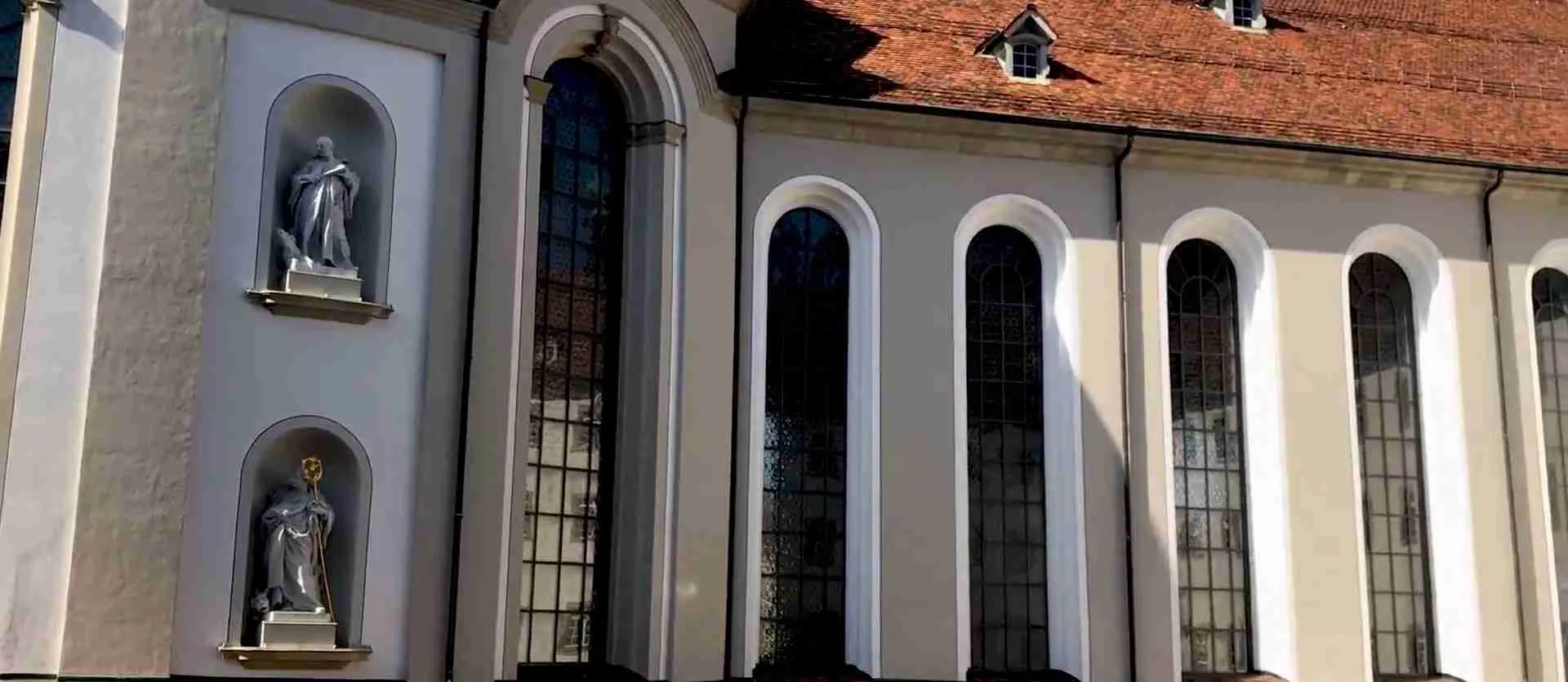
The Cathedral of Saint Gallen, occupying the site of the abbey church, represents the architectural and spiritual centerpiece of the UNESCO World Heritage ensemble. The current structure, built simultaneously with the library hall from 1755 to 1768, replaced earlier Carolingian and medieval churches on the same site, creating a Baroque masterpiece that serves simultaneously as the diocesan cathedral and as a monument to the abbey’s historical significance. The cathedral’s twin towers, reaching 68 meters into the sky, dominate the city’s skyline and establish the abbey precinct’s visual prominence from great distances.
Peter Thumb designed the cathedral in late Baroque style with Rococo ornamentation, creating spatial drama and decorative richness characteristic of Counter-Reformation Catholic architecture. The floor plan follows traditional Christian basilica form with a nave, side aisles, transepts, and choir, but the proportions and ornamentation transform this familiar layout into theatrical sacred space. The interior creates an overwhelming visual impression through the combination of architectural scale, sculptural decoration, painted surfaces, and carefully orchestrated light entering through large windows.
The Rococo confessionals represent particular artistic achievements within the cathedral’s ensemble. Designed by Franz Joseph Anton Feuchtmayer and Anton Dirr, these confessionals transform functional liturgical furniture into sculptural masterpieces. Elaborate carving depicts religious scenes and symbols, while the flowing Rococo forms create dynamic, almost organic structures that seem to grow from the floor. The confessionals exemplify the Baroque approach to church furnishing as art form, where every element contributes to the overall aesthetic and theological experience.
The late Baroque pulpits by Anton Dirr demonstrate similar artistic ambition. The pulpit served as the preaching station where the priest delivered homilies, requiring both acoustic functionality and symbolic significance as the place from which divine word was proclaimed. The Rococo ornamentation adorning the pulpit establishes its importance while the elevated position provides practical sight lines for the congregation. The integration of functional requirement and artistic expression characterizes Baroque church furnishing at its finest.
The cathedral’s conversion to diocesan use in 1823 ensured its preservation and continued liturgical function following the abbey’s secularization. As the seat of the Bishop of Saint Gallen, the cathedral hosts regular worship services, ordinations, confirmations, and other diocesan ceremonies that maintain its living religious character. This continued use distinguishes the cathedral from purely museum spaces and connects contemporary Catholic worship to the centuries of monastic liturgy that preceded secularization. Visitors attending Mass experience the cathedral as it was intended to be used rather than merely as architectural monument, though the space accommodates both religious participation and heritage appreciation.
The cathedral offers free admission to visitors outside of service times, allowing heritage tourists to experience the Baroque architecture without the admission fee required for the library and exhibition spaces. This open access policy recognizes the cathedral’s dual character as both active church and UNESCO World Heritage component, balancing religious and cultural heritage functions. Visitors are expected to maintain appropriate decorum and refrain from disturbing worship if services are occurring, but the cathedral welcomes tourists interested in its architecture and history.
The coordination between cathedral and library architectural programs creates visual harmony across the abbey precinct. Both structures employ similar Rococo decorative vocabularies, color palettes, and spatial strategies, ensuring that visitors moving from cathedral to library experience architectural consistency rather than jarring stylistic shifts. This coordination reflects the unified vision of Peter Thumb and the patronage of a single building campaign rather than piecemeal construction over time. The result is an ensemble where individual buildings complement rather than compete, creating a unified baroque precinct.
The Abbey Archives and Documentary Heritage
The Abbey Archives of Saint Gall preserve an extraordinary documentary record spanning the monastery’s entire history from its Carolingian foundation through secularization and beyond. While less visually spectacular than the library’s illuminated manuscripts, the archival holdings provide irreplaceable evidence for understanding medieval political, economic, social, and religious history. The archives’ inscription in UNESCO’s Memory of the World Register in 2017 alongside the library manuscripts recognized the exceptional significance of these documentary materials for global heritage.
The archival collection includes thousands of charters, deeds, and legal documents recording property transactions, privileges granted by emperors and popes, legal disputes, and administrative records. These documents illuminate the abbey’s role as a major landowner and political power, documenting how the monastery accumulated properties, managed agricultural estates, collected revenues, and exercised jurisdiction over territories and populations. Many documents bear the seals of emperors, kings, popes, and other authorities, creating a visual and material record of power relationships and legal authority in medieval Europe.
Charter collections from the early medieval period are particularly valuable because relatively few documentary sources from this era survive. The Abbey Archives preserve charters from the 8th and 9th centuries that document property transactions and legal arrangements from the Carolingian period, providing primary sources for understanding economic and social organization during a period when written documentation was relatively rare. These early charters employ Latin formulae and legal concepts that scholars of medieval law study to trace the evolution of legal thought and practice.
The archives contain extensive documentation of the abbey’s role in Christianizing and organizing Alemannic Switzerland. Records of parish foundations, church dedications, and appointment of clergy demonstrate how the monastery extended religious infrastructure into surrounding territories. Documents recording conversion of pagan shrines into Christian churches preserve evidence of the transition from Germanic paganism to Christianity, a process often difficult to document because victor cultures rarely preserve detailed records of defeated belief systems. The abbey’s archival materials provide unusually rich documentation of this crucial cultural transformation.
Administrative records illuminate the practical operation of a major medieval monastery and ecclesiastical principality. Account books record revenues and expenditures, documenting the monastery’s economic activities from agriculture to manufacturing to lending. Personnel records track monks’ entries into the community, their assignments to various positions, and their careers within the monastery. Correspondence with other monasteries, bishops, secular rulers, and the papacy reveals the abbey’s participation in broader ecclesiastical and political networks spanning medieval Christendom.
The archives also preserve the abbey’s institutional memory of internal governance. Records of abbatial elections, disciplinary proceedings, and chapter meetings document how Benedictine communities actually operated rather than merely how the Rule prescribed they should operate. These materials reveal tensions between ideal and practice, showing how monks negotiated conflicts, managed resources, adapted to changing circumstances, and maintained community across generations. For scholars of monasticism, these records provide invaluable evidence for understanding lived monastic experience beyond normative descriptions in rules and customs.
Musical manuscripts preserved in both the library and archives hold particular significance for music history. Saint Gall was a major center for developing musical notation, and the manuscripts preserve some of the earliest examples of Western neumatic notation—the precursor to modern musical notation. The Codex Saint Gall manuscripts demonstrate how medieval musicians began to develop systems for recording musical information in written form, enabling transmission of melodies across time and space rather than relying solely on oral tradition and memory. For musicologists, these manuscripts provide crucial evidence for understanding the development of musical literacy and the evolution of liturgical chant.
The archives’ materials extend beyond the monastery’s secularization in 1805, documenting the transition to cantonal institutions and the adaptation of former abbey properties to new uses. These later materials provide evidence for heritage studies and institutional history, showing how sacred spaces and objects were repurposed for secular functions while maintaining cultural significance. The continuous archival record spanning foundation to present creates exceptional documentation of institutional evolution and cultural continuity rare in European heritage.
Access to archival materials balances scholarly research needs against conservation requirements. Rare and fragile documents require careful handling and controlled environmental conditions to prevent deterioration. The archives operate a research room where qualified scholars can examine original documents under supervision, with digital surrogates increasingly available for materials at risk from handling. The digitization projects that have made many manuscripts available online are gradually extending to archival materials, though the sheer volume of documents makes complete digitization a long-term project requiring sustained resources.
Visiting the Abbey of Saint Gall: Practical Information
The Abbey of Saint Gall welcomes visitors throughout the year, offering access to the library, exhibition spaces, and cathedral while preserving these active heritage sites. Understanding the abbey’s visitor infrastructure, regulations, and interpretive resources enhances the experience while ensuring appropriate respect for both the historical significance and contemporary functions of the complex. The abbey remains a living site serving religious and civic purposes rather than a static museum, and visitors participate in spaces still used for worship, scholarship, and government administration.
The combined admission ticket provides access to three separate exhibition areas: the Rococo library hall, the vaulted cellar exhibition, and the exhibition space. Adult admission costs CHF 18 ($22) as of recent pricing, with reduced rates of CHF 12 ($15) for students and free admission for children under 16 when accompanied by adults. Check the official website for current rates as pricing may vary. The Swiss Travel Pass, Swiss Museum Pass, and several regional discount cards provide free admission, making the abbey accessible to pass holders without additional expense. Audio guides available for CHF 5 provide detailed information about the library, vaulted cellar, cathedral, and abbey district in multiple languages including German, English, French, and Italian.
Opening hours operate daily from 10:00 AM to 5:00 PM throughout the year, with last admission 15 minutes before closing. The library and exhibition spaces close for several periods annually, typically including three weeks in November/December for maintenance, Christmas and New Year holidays, and occasional dates for special events. The official website maintains a current calendar of closures, and visitors planning trips should verify opening status before traveling. From Monday through Friday, guided tours can arrange early morning entry at 9:00 AM before regular public hours by contacting the abbey in advance, offering a more exclusive experience with fewer crowds for those interested in extended study of the collections.
Upon arrival at the abbey precinct, signs direct visitors to the library entrance located in a building that also houses a boys’ school—a detail that surprises some visitors expecting a purely museum setting. The entrance area requires checking bags and backpacks in free lockers, as bags are not permitted in the exhibition spaces. This security measure protects the collections while accommodating visitors’ need to store belongings during their visit. Small personal items may be carried, but anything larger than a small purse must be stored.
The most distinctive visitor requirement involves the protective slippers that must be worn in the Rococo library hall. These large felt slippers slip over street shoes and protect the precious inlaid wooden floor from damage. The slipper requirement creates a memorable ritual aspect to library entry while serving genuine conservation purposes. Visitors should wear shoes that can accommodate the oversized slippers comfortably; very large or bulky footwear may present challenges, and individuals with mobility issues should be aware that the slippers alter one’s gait and may affect balance.
Photography policies have evolved in recent years. Photography is now permitted in the exhibition spaces for private, non-commercial purposes without flash, tripod, or selfie stick. This represents a significant change from earlier policies that prohibited all photography in the library hall. Visitors should still exercise courtesy and avoid flash photography, which can disturb other visitors and potentially damage sensitive materials. Professional photography and filming require advance permission. The cathedral permits photography during non-service times with similar restrictions against flash and commercial use.
The library hall itself operates with capacity limits to prevent overcrowding that would damage the fragile floor and diminish visitor experience. During peak tourist season (summer months and holiday periods), visitors may encounter brief waits if the hall has reached capacity. The relatively modest size of the Rococo hall—smaller than photographs often suggest—means that even moderate numbers of visitors can make the space feel crowded. Visiting early in the day or during shoulder seasons (April-May, September-October) often provides a less congested experience.
The vaulted cellar exhibition, located in the basement of the library building, presents historical context about the abbey, the library’s development, and the manuscript collection. Interactive touchscreens provide information in multiple languages, with simplified versions for children available in German. The exhibition includes historical artifacts, explanatory panels, and digital interfaces that complement the visual experience of the library hall with scholarly context. The cellar exhibition helps visitors understand what they are seeing in the library hall and provides deeper appreciation of the manuscripts’ significance.
The separate exhibition space, housed in another abbey building, presents rotating exhibitions related to the abbey’s history, the manuscript collections, and related cultural themes. The specific content varies depending on when you visit, but exhibitions consistently maintain high scholarly and interpretive standards. The famous Plan of Saint Gall is typically displayed here (though occasionally moved for conservation or special exhibitions), offering opportunity to examine this crucial architectural document in detail.
The Cathedral of Saint Gallen offers free admission and can be visited independently of the paid exhibition spaces. The cathedral maintains hours for visitor access outside of Mass times, allowing tourist visits while preserving the space’s primary function as an active church. Visitors should maintain respectful behavior appropriate to sacred space, speaking quietly, refraining from eating or drinking, and avoiding the sanctuary area during services. The cathedral’s Mass schedule is posted at the entrance and available on the diocesan website; attending a service provides opportunity to experience the space as it was intended to be used.
Guided tours are available in multiple languages for groups of 10-25 people. A 50-minute tour covering one module (library, vaulted cellar, or exhibition hall) costs CHF 140 for the group plus individual entrance fees. A 90-minute tour covering two modules costs CHF 190 for the group plus entrance fees. Tours can be customized to group interests and provide expert interpretation beyond what audio guides offer. School groups receive special arrangements, and educational programs are available for student visits. Groups must register at least two weeks in advance.
Accessibility provisions include wheelchair access to all exhibition spaces via elevators and ramps. An in-house wheelchair is available for loan. The Pro Infirmis website provides detailed accessibility information for visitors with various mobility challenges. The protective slippers worn in the library hall may present challenges for some visitors with balance or gait issues; staff can provide assistance and accommodations as needed.
The abbey precinct includes additional features beyond the paid exhibition spaces. The monastery garden, located between the library entrance and government buildings, provides a pleasant space for contemplation and rest. The Karlstor (Charles Gate), built in 1570, remains visible as historical artifact marking the boundary between monastery and city. Remnants of the 16th-century monastery wall along Zeughausgasse demonstrate the physical separation constructed during the Reformation period. Walking through the abbey district reveals bay windows, historic facades, and architectural details reflecting the precinct’s evolution from medieval monastery through Baroque reconstruction to contemporary civic use.
Combining an abbey visit with exploration of Saint Gallen’s broader attractions creates a fuller experience. The city’s old town features 111 bay windows on historic buildings, each uniquely decorated and reflecting 16th-18th century urban architecture. The City Lounge by artist Pipilotti Rist transforms a plaza into an outdoor living room with bright red foam covering, creating contemporary art intervention amid historical fabric. The Natural History Museum presents regional flora and fauna including Switzerland’s largest three-dimensional relief map. The Saint Gallen Art Museum houses paintings and sculptures from Late Middle Ages to present. These attractions complement the abbey visit by providing context for the city’s development from monastic dependency to prosperous textile center to contemporary cultural destination.
The Abbey’s Influence on European Monastic Culture
The Abbey of Saint Gall’s significance extends beyond its own achievements to its broader influence on European monastic culture and intellectual life. As one of the preeminent Carolingian monasteries, Saint Gall participated in and shaped the cultural renewal that historians call the Carolingian Renaissance, leaving imprints on monastic architecture, manuscript production, liturgical development, and educational practice that resonated throughout medieval Europe.
The Plan of Saint Gall’s influence on monastic architecture exemplifies this broader impact. While the plan was created as an idealized conception rather than a construction blueprint, it articulated principles of monastic organization that influenced actual monastery design for centuries. The plan’s comprehensive vision of the monastery as a complete community—combining prayer, work, study, hospitality, medical care, agricultural production, and craft manufacture—established expectations for what a major Benedictine abbey should encompass. Monasteries built or rebuilt in subsequent centuries referenced the plan’s organizational logic even when their specific layouts differed from its details.
The Saint Gall scriptorium’s contributions to manuscript culture influenced book production practices across Europe. Techniques developed at Saint Gall for manuscript preparation, script styles, illumination methods, and book binding were transmitted through traveling monks, borrowed manuscripts, and direct copying of Saint Gall exemplars. The distinctive Saint Gall School illumination style became recognizable across manuscript collections, and other scriptoria adapted elements of its aesthetic vocabulary. The intellectual networks connecting Saint Gall to other major monasteries—Reichenau, Fulda, Corbie, Tours—facilitated exchange of texts, artistic techniques, and scholarly ideas that enriched medieval learning beyond any single institution’s achievements.
Saint Gall’s role in music history particularly demonstrates how monastic cultural production influenced broader European traditions. The development of neumatic notation at Saint Gall contributed foundational innovations to Western musical literacy. The abbey’s liturgical practices and musical compositions spread through the Benedictine network, influencing how monasteries throughout Europe conducted divine office and celebrated Mass. The Codex Saint Gall manuscripts preserve crucial evidence for the transition from purely oral musical transmission to written notation, documenting innovations that made possible the complex polyphonic music of later medieval and Renaissance periods.
The abbey’s educational influence extended through the Saint Gall School, which trained oblates (children dedicated to monastic life by their families) and educated the sons of nobility. Students educated at Saint Gall carried its learning to positions in other monasteries, cathedral chapters, and royal courts, disseminating the intellectual culture cultivated in the abbey throughout the Carolingian Empire and its successor states. The curriculum combined religious instruction with classical education in grammar, rhetoric, dialectic, arithmetic, geometry, astronomy, and music—the trivium and quadrivium that constituted medieval liberal arts education. This synthesis of Christian and classical learning shaped medieval educational ideals.
Saint Gall’s theological and intellectual production contributed to broader European thought. Manuscripts copied at Saint Gall preserved classical texts that might otherwise have been lost; the abbey’s copies sometimes represent the only surviving witnesses to works by ancient authors. Theological commentaries, philosophical treatises, and historical chronicles produced at Saint Gall circulated in manuscript networks, entering into broader scholarly conversations. While Saint Gall did not produce individual scholars of the stature of a Bede or Alcuin, its sustained institutional contribution to preserving, copying, and transmitting knowledge made it an essential node in medieval Europe’s intellectual infrastructure.
The abbey’s political role as an ecclesiastical principality influenced ideas about the relationship between spiritual authority and temporal power. The abbey-prince who combined monastic leadership with sovereign governance embodied the medieval Christian conception of integrated religious and political authority. The abbey’s diplomatic relations, military conflicts, and administrative innovations contributed to the development of political institutions in the Holy Roman Empire and Swiss Confederation. The abbey’s eventual dissolution and transformation into cantonal institutions influenced debates about secularization and the proper relationship between church and state in modern constitutional orders.
Conservation Challenges and Digital Initiatives
Preserving the Abbey of Saint Gall for future generations presents ongoing conservation challenges requiring scientific expertise, substantial financial resources, and coordination among multiple stakeholders. The site’s designation as UNESCO World Heritage brings international attention and support while imposing obligations to maintain the property’s Outstanding Universal Value through appropriate conservation practices. The challenges divide into categories addressing architectural conservation, manuscript preservation, climate control, tourism management, and digital access.
Architectural conservation addresses the Baroque structures’ physical deterioration from age, weather exposure, pollution, and use. Stone facades weather and erode, requiring periodic cleaning and repair using techniques compatible with original materials and construction methods. The Rococo interior decoration—stucco work, painted surfaces, gilding, carved wood—is fragile and requires specialized restoration when damaged. The ornate ceiling frescoes face particular challenges from humidity, temperature fluctuations, and pollutants that can cause paint deterioration. Conservation interventions must balance stabilizing deterioration against the principle of minimal intervention that preserves maximum original material.
The library’s inlaid wooden floor represents a particular conservation challenge. The floor receives constant stress from visitor foot traffic despite the protective slippers, and the wood responds to humidity changes by expanding and contracting, potentially causing cracks or loosening of inlay. Conservation monitoring tracks the floor’s condition through regular inspection, photographic documentation, and measurement of environmental conditions. When damage occurs, restoration requires specialized woodworking skills to match historical techniques and materials. The protective slipper requirement, while inconvenient for visitors, provides essential protection that extends the floor’s lifespan.
Manuscript conservation addresses the aging of parchment, paper, inks, and binding materials. Parchment (animal skin) and paper are organic materials subject to deterioration from acids, humidity, light exposure, biological agents (insects, mold), and physical handling. Inks can fade or corrode the parchment they sit on. Bindings loosen as adhesives fail and leather deteriorates. Conservation treatments stabilize deteriorating manuscripts through deacidification, consolidation of flaking inks, mending tears, and rebinding when necessary. These interventions require expert judgment to balance preservation against altering historical materials.
Climate control systems maintain stable temperature and humidity within ranges that minimize manuscript deterioration while accommodating the baroque structure’s architectural requirements. The ideal climate for manuscript preservation differs from comfortable conditions for human visitors, creating competing demands. The library hall’s large windows admit natural light that enhances the architectural experience but exposes manuscripts to damaging radiation. UV filtering and careful rotation of displayed materials balance these concerns. The monitoring systems track environmental conditions continuously, alerting staff to fluctuations that might threaten collections.
Tourism management balances making the site accessible to visitors against protecting fragile heritage from wear and damage. The capacity limits in the library hall prevent overcrowding that would accelerate floor deterioration while ensuring visitors can appreciate the space without unpleasant crowding. The bag storage requirement reduces accident risk from visitors accidentally bumping display cases or manuscripts with backpacks. The photography policy that permits personal photography but prohibits flash and professional equipment manages visitor desires to document their experience while protecting light-sensitive materials.
Digital initiatives represent the most significant recent development in making the abbey’s collections accessible while reducing handling of originals. The Codices Electronici Sangallenses project, begun in the early 2000s, has digitized over 900 manuscripts from the abbey library, creating high-resolution images of each page that scholars can access online. This digital access dramatically expands the scholarly community that can study these manuscripts, previously limited to researchers who could travel to Saint Gallen and receive permission to handle originals. The project later expanded as e-codices to include manuscripts from other Swiss libraries, creating a comprehensive digital infrastructure for Swiss manuscript heritage.
Digitization serves both access and preservation functions. Digital surrogates allow researchers to examine manuscripts in detail without handling fragile originals, reducing wear from repeated consultation of frequently studied works. The digital images also serve as preservation backup: if a manuscript were destroyed by fire, flood, or other catastrophe, the digital copy would preserve its contents. The high-resolution images capture details sometimes invisible to naked eye examination, enabling new forms of scholarship through digital image manipulation and analysis.
The digitization process itself presents challenges. Photographing manuscripts without damaging bindings requires specialized equipment and techniques. Color accuracy is crucial for art historical analysis of illuminations, requiring calibrated imaging systems. Metadata creation—describing each manuscript’s contents, date, provenance, and physical characteristics—demands expert knowledge and substantial labor. Making digital collections accessible requires robust web infrastructure and long-term commitment to maintaining access as technology evolves. The financial costs of digitization and digital preservation represent ongoing budget requirements competing with building maintenance and collection conservation for limited resources.
Future conservation priorities include expanding digital access to archival materials beyond manuscripts, upgrading climate control systems as technology improves, continuing restoration of architectural elements showing deterioration, and developing sustainable funding models to support ongoing conservation. The abbey’s status as both UNESCO World Heritage Site and functioning civic and religious complex creates unique challenges: conservation must accommodate continued use for worship, government administration, and scholarship rather than treating the site as a static museum. This requirement to balance heritage preservation with contemporary function distinguishes the abbey from purely archaeological sites and tests conservators’ ability to protect the past while enabling the present.
Frequently Asked Questions About the Abbey of Saint Gall
How long does it take to visit the Abbey of Saint Gall?
A thorough visit to the Abbey of Saint Gall typically requires two to three hours to properly experience the library hall, vaulted cellar exhibition, exhibition space, and cathedral without feeling rushed. The Rococo library hall deserves at least 30-45 minutes to appreciate the architectural details, examine the displayed manuscripts in cases, view the ceiling frescoes, and absorb the overall atmosphere of this extraordinary space. The vaulted cellar exhibition, with its interactive displays and historical context, warrants another 30-45 minutes for visitors interested in understanding the abbey’s development and the significance of the manuscript collections. The separate exhibition space containing the Plan of Saint Gall and rotating exhibitions typically requires 20-30 minutes. The cathedral can be explored in 15-20 minutes for architectural appreciation, though attending a Mass extends the visit considerably. Visitors particularly interested in manuscripts, Baroque architecture, or medieval history often spend longer, while those with more general tourist interest may complete the visit in 90 minutes. Audio guide usage extends visit duration but substantially enriches the experience through expert commentary. Combining the abbey visit with exploration of Saint Gallen’s old town, museums, and other attractions creates a full-day itinerary, with the abbey representing the centerpiece of cultural tourism in the city.
Can you take photos inside the Abbey Library of Saint Gall?
Photography is permitted inside the Abbey Library of Saint Gall for purely private, non-commercial purposes, representing a significant policy change from earlier restrictions that prohibited all photography in the library hall. Current regulations allow visitors to photograph the Rococo hall, displayed manuscripts, and architectural details without flash, tripod, or selfie stick. Flash photography damages light-sensitive materials and disturbs other visitors, while tripods and selfie sticks create obstruction hazards in the relatively confined space. The photography permission applies to personal cameras and smartphones; professional photography equipment and filming for commercial purposes require advance permission from abbey administration and typically involve fees. Similar photography policies apply in the vaulted cellar exhibition and exhibition space, allowing documentation for personal memory while protecting collections and maintaining appropriate atmosphere. The cathedral permits photography during non-service times with the same restrictions against flash and commercial use; during religious services, visitors should refrain from photography out of respect for worshippers. Visitors should remember that while photography is permitted, courtesy toward other visitors and reverence for the historic and sacred character of these spaces remain important considerations. Some manuscript cases may have specific restrictions noted; staff will provide guidance if questions arise about particular materials.
What is the famous Plan of Saint Gall and why is it important?
The Plan of Saint Gall is a 9th-century architectural drawing on parchment showing the ideal layout for a Benedictine monastery, created around 820 and preserved in the Abbey Library as one of the world’s most significant documents in architectural history. The plan represents the only surviving Carolingian architectural drawing on parchment worldwide, providing unparalleled evidence for medieval architectural thinking and monastic organization during a period when such documents were rarely created and almost never preserved. The drawing, measuring approximately 112 by 77 centimeters, depicts a comprehensive monastic complex with 341 inscriptions in Latin identifying specific buildings and spaces, creating a labeled architectural vision of unprecedented detail for its era. The plan shows the church occupying the center with the cloister and monastic buildings arranged around it, plus separate structures for the abbey school, guest houses for different social classes, an infirmary, workshops for various crafts, agricultural buildings, brewery, bakery, gardens for vegetables and medicinal herbs, and housing for workers and servants. This comprehensive layout demonstrates the Benedictine conception of the monastery as a complete, largely self-sufficient community organized to support monastic life while managing extensive practical operations. The plan was likely created at the Abbey of Reichenau and sent to Abbot Gozbert of Saint Gall during the abbey’s major building campaign, possibly as inspiration or guidance rather than as a construction blueprint. Gozbert’s actual buildings differed from the plan’s details, suggesting it functioned as an idealized model expressing monastic architectural principles rather than as a literal design to be executed. The plan’s influence on subsequent monastery design throughout medieval Europe establishes it as a foundational document in Western architectural history, while its detailed labels and comprehensive organization provide invaluable evidence for understanding how medieval people conceived and organized monastic space and function.
Why is there an Egyptian mummy in the Abbey Library?
The Egyptian mummy Shepenese displayed in the Abbey Library represents the Baroque era’s fascination with collecting exotic artifacts and organizing comprehensive cabinets of curiosities that combined books, natural specimens, scientific instruments, and cultural artifacts from distant civilizations. The mummy, approximately 2,700 years old, arrived at Saint Gall during the 18th century when European aristocrats and institutions competed to acquire Egyptian antiquities as prestigious additions to their collections. Baroque collectors viewed such artifacts not merely as curiosities but as components of systematic attempts to gather and categorize all forms of knowledge—natural history, human culture, scientific instruments, and books—creating encyclopedic collections that physically embodied the Enlightenment ideal of comprehensive learning. The library’s combination of medieval manuscripts with Baroque-era curiosities like the mummy and historical globes reflects this collecting philosophy, transforming the library from purely a repository of texts into a broader cabinet of knowledge representing multiple domains of human inquiry and achievement. Shepenese occupies a corner of the Rococo library hall, where her presence surprises many visitors expecting only books and manuscripts, creating an encounter with the unexpected that mirrors the experience of historical visitors to Baroque cabinets of curiosities. Recent discussions have addressed the ethical questions surrounding European possession of Egyptian human remains, with some advocates arguing for Shepenese’s repatriation to Egypt, reflecting contemporary reconsideration of how European institutions acquired and continue to hold artifacts from other cultures. For the present, Shepenese remains at Saint Gall as both a significant artifact in her own right—providing evidence about ancient Egyptian funerary practices and mummification techniques—and as a historical artifact representing 18th-century European collecting practices and intellectual culture. Modern interpretation of her presence addresses both the scientific information she provides and the ethical and historical questions her presence raises about cultural heritage, museum collections, and the legacy of European acquisition of artifacts from colonized or dominated regions.
Is the Abbey of Saint Gall the oldest library in the world?
The Abbey Library of Saint Gall ranks among the world’s oldest continuously operating libraries but is not definitively the single oldest, as several monastic and institutional libraries can claim ancient foundations with varying definitions of continuous operation. The library’s foundation dates to the 8th century when Saint Othmar established the monastery in 719, making it over 1,300 years old as an institution. However, determining “oldest library” requires clarifying whether priority goes to foundation date, continuous operation on the same site, uninterrupted institutional existence, or survival of original collections. The Library of Saint Catherine’s Monastery on Mount Sinai, Egypt, claims foundation in the 6th century and preserves manuscripts from that era in continuous monastic custody, potentially giving it chronological priority. The Vatican Library traces institutional history to papal collections from the early Christian period, though its formal organization as a library dates to the 15th century. Several ancient universities and cathedral libraries also claim medieval or earlier foundations. What distinguishes the Abbey Library of Saint Gall is the exceptional combination of continuous operation since the 8th century, preservation of manuscripts from its earliest centuries, maintenance of institutional identity through secularization and political upheavals, and retention of its original baroque library hall as the display space. The library’s 170,000 volumes include materials spanning its entire history, from 8th-century manuscripts through medieval additions to modern acquisitions, creating a collection that documents continuous intellectual activity across thirteen centuries. The 2,100 medieval manuscripts, including texts from the library’s earliest centuries, demonstrate that the institution has preserved not merely the building and organizational continuity but also substantial portions of its original collections. For practical purposes, the Abbey Library should be considered one of the world’s oldest libraries rather than claiming singular primacy, acknowledging that multiple institutions worldwide preserve ancient library traditions with different but equally legitimate claims to great age and historical continuity.
What language are the manuscripts in the Abbey Library written in?
The manuscripts in the Abbey Library of Saint Gall are written predominantly in Latin, reflecting the universal scholarly language of medieval Western Christianity, with important collections also in Greek, Old High German, and various other languages representing the cosmopolitan nature of medieval learning. Latin served as the international language of the medieval church, scholarship, law, and administration, enabling communication across the linguistic diversity of medieval Europe; consequently, the vast majority of religious texts, classical works, philosophical treatises, legal documents, and administrative records were composed or copied in Latin regardless of the scribe’s native language. The Irish manuscripts that constitute the abbey’s largest collection of texts from a single cultural tradition employ insular Latin—Latin written by Irish scribes with distinctive orthographic and grammatical features reflecting Irish linguistic influence. Greek manuscripts, while less numerous than Latin works, represent an important component of the collection; medieval Western monasteries rarely possessed extensive Greek literacy, making Saint Gall’s Greek holdings particularly significant for preserving access to patristic texts and classical works in their original language rather than solely in Latin translation. Old High German manuscripts hold special linguistic and cultural significance as early examples of writing in Germanic vernacular languages; these texts document the transition from purely oral Germanic languages to written literary traditions and preserve some of the earliest examples of German poetry, religious texts adapted for Germanic speakers, and glosses (marginal notes) explaining Latin texts in the vernacular. The Codex Sangallensis, containing some of the earliest examples of written German, demonstrates how monks used both Latin and vernacular languages in their scholarly and pastoral work. Additional manuscripts represent other medieval languages including Old French, Provençal, Italian vernaculars, and occasionally other languages encountered through the monastery’s far-reaching intellectual networks. The multilingual character of the manuscript collection reflects the medieval monastery’s role as a crossroads of cultures and languages, where Irish monks worked alongside Germanic locals and Italian scholars, all communicating through shared Latin while preserving their vernacular traditions in writing. This linguistic diversity makes the collection valuable not only for textual contents but also for the study of language history, scribal practices, and cultural interchange in medieval Europe.
Can you attend Mass at the Cathedral of Saint Gallen?
Visitors are welcome to attend Mass at the Cathedral of Saint Gallen, which functions as the active seat of the Catholic Diocese of Saint Gallen and hosts regular liturgical services throughout the week. The cathedral’s Mass schedule includes daily services and multiple weekend Masses, with specific times posted at the cathedral entrance, published in parish bulletins, and available on the diocesan website. Sunday Masses typically occur at multiple times to accommodate different parish communities and preferences, while weekday Masses offer opportunities for visitors whose travel schedules allow midweek attendance. Attending Mass provides opportunity to experience the Baroque cathedral as it was intended to be used rather than merely as architectural monument, witnessing how the space’s design elements—the elaborate altar, confessionals, pulpit, and acoustics—function in liturgical context. The cathedral’s music program features organ music and choral performances during major Masses, particularly on Sundays and feast days, adding musical dimension to the architectural and spiritual experience. Visitors should observe appropriate behavior for Catholic worship: arriving before Mass begins, silencing mobile phones, dressing modestly, refraining from photography during the service, and following the congregation’s lead regarding standing, sitting, and kneeling. Non-Catholic visitors are welcome to attend but should be aware that receiving communion is reserved for Catholics in good standing with the Church; visitors are invited to remain seated during communion or to approach for a blessing with arms crossed over chest. Major feast days—Christmas, Easter, Pentecost, and the feast of the abbey’s patron saint—feature particularly solemn liturgies with enhanced music and larger congregations, offering exceptional experiences for visitors interested in Catholic liturgical tradition. The cathedral also hosts ordinations, confirmations, weddings, and funerals, though these ceremonies are generally not open to general public attendance without invitation. Visitors wishing to attend Mass should verify current schedules, as service times may vary seasonally or during special diocesan events, and should plan to arrive at least 10-15 minutes early to find seating and settle in before the liturgy begins.
What is the connection between the Abbey of Saint Gall and Switzerland?
The Abbey of Saint Gall played a foundational role in the Christianization and political organization of northeastern Switzerland, with the monastery’s thousand-year history intimately connected to the development of Swiss identity, territorial organization, and cultural heritage. The abbey’s establishment in 719 occurred during the Frankish Empire’s expansion into Alemannic territories that would eventually become part of Switzerland, with the monastery serving as an instrument of both religious conversion and political consolidation. The abbey’s extensive landholdings and ecclesiastical jurisdiction spread Christianity throughout regions that lacked organized religious infrastructure, establishing parishes, building churches, and appointing clergy across what is now northeastern Switzerland. Documents preserved in the abbey archives provide primary sources for understanding the early medieval settlement, economy, and social organization of Alemannic Switzerland, making the abbey’s documentary heritage essential to Swiss historiography. The abbey’s status as an independent ecclesiastical principality within the Holy Roman Empire positioned it as a unique political entity that participated in the complex relationships among the Swiss Confederation, the Empire, and various European powers. The city of Saint Gallen, which developed from a settlement serving the monastery’s economic and social needs, eventually gained independence from abbatial control and joined the Swiss Confederation in 1454, creating an unusual situation where a city belonged to the Confederation while the abbey governing its surroundings remained an independent imperial territory. This political complexity contributed to Switzerland’s distinctive federal structure where diverse political entities coexisted within loose confederal frameworks. The abbey’s survival through the Reformation as a Catholic enclave within increasingly Protestant Switzerland reflected the religious divisions that shaped early modern Swiss history and continue to influence cantonal identities and cultural patterns. The abbey’s secularization in 1805 and transformation into the Canton of Saint Gallen represented a key moment in the transition from the Old Swiss Confederation to the modern federal state, as the new canton absorbed the abbey’s territories and integrated them into the constitutional framework established during the Napoleonic period. The abbey’s architectural and manuscript heritage became symbols of Swiss cultural identity, with the library’s recognition as the oldest in Switzerland and one of the most important medieval manuscript collections worldwide contributing to Swiss cultural prestige. The abbey’s UNESCO World Heritage designation alongside the Convent of Saint John at Müstair and the Old Town of Bern established these sites as representing Switzerland’s outstanding cultural contributions to world heritage, connecting local Swiss identity to global cultural significance.
What makes the Rococo library hall architecturally significant?
The Rococo library hall of Saint Gall represents one of the finest examples of late Baroque library architecture in Europe, combining functional requirements for book storage and scholarly study with theatrical architectural expression that transforms a utilitarian space into a comprehensive artwork celebrating knowledge and learning. The hall’s significance emerges from multiple architectural and artistic achievements working in harmony. The spatial organization creates a dramatic axial composition approximately 48 meters long, with the proportions and perspectives carefully calculated to produce maximum visual impact when viewed from either end while maintaining human scale and functional usability for library purposes. The two-level walnut bookcases lining the long walls were designed and constructed as integrated architectural elements rather than movable furniture, with their surfaces carved and decorated with cherubs, cartouches, capitals, and elaborate moldings that transform functional book storage into sculptural art. The unified design vocabulary coordinating the bookcases, ceiling decoration, and architectural details creates a gesamtkunstwerk where every element contributes to the overall aesthetic and intellectual program. The ceiling fresco by Josef Wannenmacher depicts the Council of Nicaea surrounded by personifications representing theology’s relationship to human knowledge, creating an iconographic program that situates the library’s earthly learning within divine truth while celebrating the harmony between faith and reason characteristic of Enlightenment-era Catholic thought. The famous Greek inscription “Ψυχῆς Ἰατρεῖον” (healing place for the soul) above the entrance articulates the Baroque conception of the library as therapeutic space where books provide remedies for spiritual and intellectual ailments, connecting the Abbey Library to ancient libraries from Ramesses II to Alexandria and positioning it within a timeless tradition of learning as medicine for the soul. The inlaid wooden floor creates a precious surface requiring protection, transforming the simple act of walking through the library into a ritual experience marked by donning protective slippers and proceeding with heightened awareness of the space’s fragility and value. The coordination between the library hall and the adjacent cathedral, both designed by Peter Thumb during the same building campaign, creates architectural unity across the entire abbey precinct, with the library’s celebration of learning complementing the cathedral’s celebration of worship in parallel expressions of late Baroque Rococo aesthetics. The hall successfully balances competing functional requirements: adequate natural light for reading through large windows; protection of light-sensitive manuscripts from excessive radiation through strategic placement and rotation of materials; climate conditions suitable for manuscript preservation while remaining tolerable for human occupancy; storage capacity for the growing collection while maintaining architectural coherence; and accessibility for scholarly research while preserving security against theft or damage. The library hall’s continued function as an active research library rather than purely museum space demonstrates how historical architecture can accommodate modern use through sensitive adaptation, with the integration of climate control, security systems, and visitor infrastructure accomplished without compromising the hall’s historical character.
How did the Abbey of Saint Gall survive the Reformation?
The Abbey of Saint Gall’s survival through the Protestant Reformation represents a complex negotiation of religious, political, and military factors that preserved the Catholic monastery in a region where many similar institutions were secularized or converted to Protestant use. The abbey’s survival resulted from strategic leadership, political alliances, military protection, and the particular dynamics of the Swiss Reformation, which differed from Reformation movements in other regions. The Reformation reached Switzerland in the 1520s through the preaching of Huldrych Zwingli in Zürich and later John Calvin in Geneva, rapidly gaining adherents in urban areas including the city of Saint Gallen. The abbey’s relationship with the city became increasingly strained as the city’s citizens embraced Reformed theology while the monastery maintained Catholic observance. Abbot Franz von Gaisberg (1504-1529) governed during these crucial initial years, attempting to maintain the abbey’s Catholic identity while avoiding direct confrontation with Reformed authorities. His successor Kilian Germann was elected specifically to prevent Reformation ideas from penetrating the monastery, reflecting the monks’ determination to preserve Catholic tradition. The construction of a wall in 1566 separating the monastery from the city physically manifested the religious division, creating a Catholic enclave within Protestant surroundings. This architectural barrier allowed the abbey to maintain its distinct religious identity while conducting necessary economic and social interactions with the city. The abbey’s status as an independent imperial territory directly subject to the Holy Roman Emperor provided crucial protection, as the Emperor remained Catholic and supported Catholic institutions against Protestant encroachment. This imperial connection gave the abbey access to military protection and diplomatic support unavailable to monasteries subject to local Protestant authorities. The Swiss Confederation’s principle of territorial sovereignty in religious matters—cuius regio, eius religio (whose realm, his religion)—meant that territories could maintain their traditional religion if their ruler wished, and the prince-abbot’s sovereignty over abbey lands allowed him to maintain Catholicism in his territories despite surrounding Protestant regions. The abbey cultivated alliances with Catholic Swiss cantons and with Habsburg Austria, creating a network of Catholic powers that could provide military support if Protestant forces threatened the monastery directly. The Toggenburg War of 1712, when Protestant Swiss forces pillaged the abbey, demonstrated the vulnerability of this arrangement but also its resilience: despite the pillaging and humiliation, the abbey survived and eventually recovered. The Counter-Reformation revitalized Catholic religious life and provided ideological and practical support for Catholic institutions maintaining their identity in Protestant-dominated regions. The abbey participated in this Catholic renewal through theological education, publication activities, and liturgical reforms that strengthened Catholic observance. The political complexity of the Swiss Confederation, where Catholic and Protestant cantons coexisted in tense equilibrium, created a system where neither side could completely dominate the other, allowing Catholic enclaves like the abbey to survive within mixed religious geography. The abbey’s economic importance and extensive landholdings gave it resources to maintain military defenses, pay for political protection, and weather economic pressure from Protestant neighbors. The final survival through to secularization in 1805 meant the abbey lasted long enough that the religious divisions of the Reformation era had evolved into a stable arrangement where Catholic and Protestant territories accepted each other’s existence, transforming what had been existential religious conflict into managed political coexistence.