Colmar Travel Guide 2027: Alsace Wine Route Planning Resource
Colmar fits half-timbered lanes, a celebrated medieval altarpiece and a canal-side quarter into one walkable old town, and the vineyard villages of the Alsace Wine Route begin barely 7 kilometers (4 miles) from its center. Timing, transport, lodging, daily costs and day-by-day routes from one day to a full week are mapped out below for travelers arriving in 2027.
Key Takeaways
- Three nights is the sweet spot: one day for Colmar’s old town and museums, one for the nearest Wine Route villages, and one for Haut-Koenigsbourg Castle or a train day trip to Strasbourg.
- Mid-range travelers spend about €175-285 per person daily (two sharing a mid-range hotel); budget travelers need €90-145 and luxury visitors €360-605.
- The most reliable windows are May-June and September-early October; Christmas markets are expected to run from late November through December, and 2027 dates should be confirmed on the official Colmar tourism site.
- Eguisheim lies about 7 km from Colmar, Kaysersberg about 13 km, Riquewihr about 14 km, Ribeauvillé about 17 km and Haut-Koenigsbourg about 25 km, so a car or bicycle gives the most freedom.
- Strasbourg is roughly 30-40 minutes by regional train, and Paris is about three hours by high-speed rail, which makes Colmar easy to reach without a car.
People Also Ask About Colmar and the Alsace Wine Route 2027
How many days do you need in Colmar and the Wine Route in 2027?
Three days covers Colmar and the best-known Wine Route villages without rushing. Day one suits the old town, the Unterlinden Museum and the canal quarter known as Little Venice. Day two fits Eguisheim, Kaysersberg and Riquewihr with a tasting or two. Day three adds Haut-Koenigsbourg Castle or Ribeauvillé. A single day only allows Colmar itself, while five to seven days leave room for Strasbourg, Mulhouse, the Vosges mountain roads and slow vineyard walking.
How much does a day in Colmar cost in 2027?
A mid-range day in Colmar costs about €175-285 per person in 2027, assuming two people share a mid-range hotel room. Budget travelers manage on €90-145 per person daily, and luxury travelers spend €360-605. These ranges include accommodation, three meals, local transport and attractions. Hotel prices are the largest swing factor, particularly during the Christmas markets, when rooms in the old town sell out months ahead.
What is the best time to visit Colmar and the Wine Route in 2027?
May, June, September and early October are the best months for Colmar and the Wine Route in 2027. Spring brings green vineyards and mild weather, while September and October bring the grape harvest and golden vine leaves. Late November through December delivers the Christmas markets and the heaviest crowds. July and August are hot and busy, and January and February are quiet, cold and inexpensive.
How do you get from Colmar to the Wine Route villages in 2027?
A rental car, a bicycle or a guided minibus tour are the three most practical ways to reach the Wine Route villages from Colmar in 2027. Villages such as Eguisheim and Turckheim sit within 7-8 km of Colmar, and Kaysersberg, Riquewihr and Ribeauvillé lie 13-17 km away. Regional buses connect the larger villages on weekdays with thinner service on weekends, so check current timetables before planning a car-free day.
Extended multi-day tours – 5+ days
Featured Alsace Lorraine Multi-Day Tour Packages
3 days
Alsace Lorraine 3-Day Discovery Tour
- ✓ Comprehensive Alsace Lorraine experience
- ✓ Expert local guides included
- ✓ All accommodation included
- ✓ Transportation provided

5 days
Alsace Lorraine 5-Day Highlights Experience
- ✓ Comprehensive Alsace Lorraine experience
- ✓ Expert local guides included
- ✓ All accommodation included
- ✓ Transportation provided

7 days
Alsace Lorraine 7-Day Cultural Journey
- ✓ Comprehensive Alsace Lorraine experience
- ✓ Expert local guides included
- ✓ All accommodation included
- ✓ Transportation provided
10 days
Alsace Lorraine 10-Day Complete Adventure
- ✓ Comprehensive Alsace Lorraine experience
- ✓ Expert local guides included
- ✓ All accommodation included
- ✓ Transportation provided
Multi-day tour packages powered by TourRadar. Prices and availability subject to change.
Why Plan a Colmar and Alsace Wine Route Trip in 2027?
Colmar and the Alsace Wine Route reward planning because the region is small, popular and highly seasonal. The old town is compact enough to cross on foot in about twenty minutes, and the vineyard villages cluster along the foot of the Vosges mountains within a narrow strip a short drive away. That geography makes a base in Colmar efficient: most excursions take less than half an hour each way.
Colmar is the prefecture of the Haut-Rhin department in the Grand Est region of eastern France and has roughly 70,000 inhabitants. It lies on the plain between the Rhine and the Vosges, with the German border about 20 minutes away by car at Neuf-Brisach. Neither Colmar nor the Wine Route villages are inscribed as World Heritage; the nearest inscribed sites are the Vauban fortifications at Neuf-Brisach and the Grande-Île of Strasbourg, both within day-trip range.
The appeal rests on a few concentrated assets. Colmar’s old town preserves timber-framed houses from the 15th through 17th centuries, the Unterlinden Museum holds the Isenheim Altarpiece, and the quarter beside the Lauch River offers the postcard views behind the city’s reputation. A few kilometers away, the Wine Route strings together fortified villages, family wine cellars and hillside vineyards producing mostly white wines from Riesling, Gewurztraminer, Pinot Gris and other grapes.
Planning matters for three reasons. First, accommodation inside the old town is limited and prices swing with the calendar. Second, the Christmas markets and August wine events fill hotels across the whole district. Third, public transport between villages is serviceable but not frequent, so choosing between car, bicycle, bus and tour changes how many villages fit into a day. The sections below work through each decision in order, then price the options for 2027.
The prices throughout are indicative figures for 2027 expressed in euros. They are built from currently published 2026 rates and typical seasonal patterns, so confirm tickets and opening hours on official sites before booking. Distances are approximate road distances.
How Many Days Do You Need in Colmar and the Wine Route in 2027?
Three days is the efficient answer for a first visit in 2027, although one-day, two-day, five-day and seven-day plans each work for different travelers. The decision depends on whether Colmar is a stop on a longer French or German itinerary, or the main destination of the trip.
Is One Day in Colmar Enough?
One day covers Colmar’s old town but not the vineyards. A well-planned day includes the Unterlinden Museum in the morning, a walk through the pedestrian streets past the House of the Heads and Saint Martin’s Collegiate Church, lunch in an Alsatian tavern, and an afternoon in Little Venice with a boat ride on the Lauch. Travelers arriving by train from Strasbourg or Basel can do this as a day trip, but they will miss the early-morning and evening light that empties the center of tour groups.
Is Two Days Enough for Colmar Plus the Nearest Villages?
Two days works if the first day is devoted to Colmar and the second to a loop through Eguisheim, Kaysersberg and Riquewihr. This pairing delivers the highest density of photogenic villages for the least driving, about 35 km in total for the round trip from Colmar. It leaves out Haut-Koenigsbourg Castle and any day trip.
Is Three Days the Best Length for Colmar and the Wine Route?
Three days is the best balance for most visitors. It allows a full Colmar day, a relaxed village day with a tasting lunch, and a third day for either Haut-Koenigsbourg Castle with Ribeauvillé or a train excursion to Strasbourg. Hotels are usually cheaper per night on weekdays than weekends outside the Christmas season, so a Sunday-to-Wednesday stay can reduce the total.
What Does a Five-Day or Seven-Day Stay Add?
Five days adds Strasbourg and a slower pace, while seven days adds Mulhouse’s museums, a drive on the Vosges ridge road, a cycling day in the vineyards and a day across the Rhine in Freiburg. A week works best for wine enthusiasts who want to visit several producers by appointment, hikers who want to walk between villages, and travelers using Colmar as a base for Alsace as a whole. Sample itineraries for one, three and five days appear later in this guide.
What Is the Best Time to Visit Colmar and the Wine Route in 2027?
May-June and September-early October are the best periods for combining good weather, open cellars and manageable crowds, while late November through December is the best period for Christmas atmosphere. Colmar sits in the rain shadow of the Vosges and is widely cited as one of the driest cities in France, so rain is less likely than in most of the country, though summer thunderstorms and cold winter fog do occur.
What Are Colmar and the Wine Route Like in Spring 2027?
Spring from April to early June brings blossoming flower boxes on the half-timbered houses, new green growth in the vineyards and comfortable walking temperatures. Crowds are moderate except on Easter weekend and around the French public holidays in May. Most cellars are open for tastings, and hotel prices sit below summer levels. Pack a light waterproof layer for showers.
What Are Colmar and the Wine Route Like in Summer 2027?
Summer is warm to hot, with long daylight hours and the busiest tourist flows in July and August. Colmar’s annual Wine Fair is traditionally held in early to mid-August; the 2027 dates are not yet published, so confirm them with the official Colmar events calendar. Air-conditioned hotel rooms are not universal in old buildings, so verify before booking. Early starts avoid both crowds and midday heat.
Is Autumn the Best Season for the Alsace Wine Route in 2027?
Autumn is arguably the most rewarding season for wine-focused travelers. Grape harvesting generally runs from September into October, depending on the vintage, and vineyard slopes turn yellow and red in October. Cellars are busy with harvest work, so reserve tastings in advance. The Minstrels’ Festival in Ribeauvillé has traditionally been held on the first Sunday of September, but confirm the 2027 date before building a trip around it.
What Is Winter in Colmar Like in 2027, Including the Christmas Markets?
Winter is cold, often foggy and the most atmospheric time in the old town. Colmar’s Christmas markets are expected to open in late November and run through the end of December, following the pattern of recent years, but official 2027 dates should be confirmed before booking. Expect crowds on weekends, higher hotel rates and early sellouts. January and February are the quietest months, with the lowest hotel prices and some producers and restaurants on reduced hours or closed for short breaks.
Which Months Should You Avoid or Choose by Priority?
- Best overall weather and value: May, June, September
- Best for harvest atmosphere: late September through October
- Best for Christmas markets: late November through December, weekdays rather than weekends
- Lowest prices and fewest crowds: January and February, with limited hours at some venues
- Busiest and hottest: July and August
How to Get to Colmar in 2027: Train, Plane and Car
Colmar is reached most easily by train through Strasbourg or Basel, with Paris roughly three hours away by high-speed service. The nearest international airports are EuroAirport Basel-Mulhouse-Freiburg to the south and Strasbourg to the north, and a car gives access to the rest of the Wine Route.
How Do You Reach Colmar by Train in 2027?
Direct high-speed trains run between Paris and Colmar, with a journey time of about three hours. Regional TER trains connect Colmar with Strasbourg in roughly 30-40 minutes, with Mulhouse in about 25 minutes, and with Basel in roughly one hour to ninety minutes depending on the connection. Colmar’s railway station sits about 1.2 km from the old town, a 15-20 minute walk or a short bus or taxi ride. Rail fares are set by the operator and vary with advance purchase, so check the official booking site for the date you plan to travel.
Which Airport Should You Use for Colmar in 2027?
EuroAirport Basel-Mulhouse-Freiburg is about 70 km south of Colmar and typically offers the broadest selection of flights for European travelers. From the airport, a bus connects to the nearby railway stations, and trains continue to Colmar via Mulhouse. Strasbourg Airport is also practical because it has a rail link toward Strasbourg’s main station, followed by the regional train south. Plan roughly 1.5 to 2 hours door to door from either airport by public transport.
How Do You Drive to Colmar in 2027?
Colmar lies on the A35 motorway, which runs north-south along the Rhine plain. Strasbourg is about 70 km north, Mulhouse about 40 km south, Basel about 70 km south and Freiburg im Breisgau in Germany about 50 km east across the Rhine. The A35 is generally toll-free along this stretch, while motorway routes toward Paris and the Swiss border can carry tolls, so confirm with a route planner. Foreign drivers should carry the standard documents: license, passport or ID, and rental or insurance papers.
Can You Reach Colmar by Bus or from Germany in 2027?
Long-distance coaches and cross-border buses serve Colmar from Strasbourg, Basel and German cities, with service levels that change by year. Travelers from Freiburg usually find it simplest to take a regional train or bus connection toward Colmar via Breisach or Neuf-Brisach and then continue, though the crossing can take longer than driving. Check the current schedule at the time of booking, since cross-border timetables are revised each December.
How to Get Around Colmar and the Wine Route in 2027
A rental car or an electric bicycle gives the most flexibility on the Wine Route, a guided minibus tour removes the driving-after-tasting problem, and regional buses suit travelers with time and a flexible schedule. Within Colmar itself, walking is the default because the old town is pedestrian-friendly and compact.
Is a Rental Car Worth It for the Alsace Wine Route in 2027?
A rental car is the best choice for visitors who want to cover three or more villages in a day or visit Haut-Koenigsbourg Castle, which sits on a hilltop reached by a winding road. Indicative rental rates for compact cars run about €45-75 per day in 2027, plus fuel and parking. The main constraint is alcohol: French law sets a low blood-alcohol limit for drivers, so a designated driver, spitting at tastings or alternating days with cycling is the sensible approach.
Parking in Colmar’s old town is restricted. Large car parks on the edge of the center, including the Rapp car park, are the practical option, and the tariff has been reported at roughly €3 per hour after a free first hour; confirm the current rate on site. Many hotels offer parking for an additional nightly fee, and the old town’s pedestrian streets are closed to most vehicles. In villages such as Riquewihr and Eguisheim, park at the signposted lots outside the walls and walk in.
If a day trip to Strasbourg is planned, take the train instead of driving. Strasbourg operates a low-emission zone that can require a Crit’Air windshield sticker for some vehicles, and city parking is expensive.
Can You Use Buses on the Wine Route in 2027?
Regional Fluo buses link Colmar with Kaysersberg, Riquewihr and Ribeauvillé, and Colmar’s urban bus network serves nearby communes, but frequencies drop sharply in the evening and on Sundays. Fares are modest compared with taxis, and a single ride to a nearby village usually costs a few euros. Because timetables change each year, check the Fluo Grand Est website and the Colmar network site for the 2027 schedule before committing to a car-free plan. Allow extra time for connections, and avoid scheduling a late return by bus.
Is Cycling the Wine Route a Good Option in 2027?
Cycling is one of the best ways to see the vineyards because the terrain at the foot of the Vosges is gently rolling and the villages are only 4-8 km apart. A signposted vineyard cycle route and many local lanes link the villages, and bike rental shops in Colmar offer standard and electric models. Indicative rental prices run about €15-25 per day for a standard bike and €30-45 for an electric bike. Electric bikes are worth the upgrade for the climb toward Kaysersberg and Riquewihr and for the heat of July and August.
A realistic day for an average rider is Colmar to Eguisheim, Turckheim and Kaysersberg, about 35 km round trip with stops. Riders who add Riquewihr and Ribeauvillé should plan about 50-55 km. Bring a lock, sun protection and water, because the vineyard paths have little shade.
Are Guided Wine Tours Worth It in 2027?
Guided minibus wine tours cost roughly €50-90 per person for a half day and more for a full day with a meal. They remove the logistics of driving, include visits to producers that may otherwise require appointments, and usually add commentary on the Alsace grape varieties. Small-group tours suit solo travelers and couples, while private drivers make sense for groups of four or more. Book at least a few days ahead in peak season.
How Do You Get Around Inside Colmar in 2027?
Walking covers nearly everything. The old town can be crossed on foot in about twenty minutes, and the main museums, Little Venice and the Covered Market sit within a 10-minute radius of each other. A small tourist train circles the main sights for travelers who prefer to sit, and taxis wait near the railway station. Hotels outside the pedestrian zone are typically 10-20 minutes on foot from the sights.
Where to Stay in Colmar in 2027: Neighborhoods and Hotel Prices
The old town is the best base for first-time visitors, Little Venice is the most atmospheric but pricier, the Krutenau district offers good restaurants with slightly lower rates, and the area around the railway station is best for budget and rail-based trips. Wine Route villages work as quieter bases for travelers with a car or bicycle.
Indicative nightly room rates for 2027 outside peak events are €75-110 for budget hotels and guesthouses, €150-215 for mid-range hotels, and €285-400 for luxury properties. These are per room rates, so a couple sharing a room pays half per person. During Christmas market weekends, rates in the old town can rise well above these ranges, and the best rooms sell out many months in advance.
Should You Stay in Colmar’s Old Town in 2027?
The old town is the strongest choice for travelers who want to walk to the Unterlinden Museum, restaurants and the Christmas markets without a car. Historic buildings often have small rooms, steep stairs and no elevator, so check accessibility before booking. Quiet side streets are better than rooms facing busy squares on weekend nights.
Is Little Venice Worth the Premium in 2027?
Little Venice (Petite Venise) is the canal-side quarter along the Lauch, with colorful half-timbered houses and flower-lined balconies. Rooms with canal views carry a premium and are popular for couples. Daytime crowds are heavy, but evenings are calm. Cobbled streets can be noisy with rolling luggage, so a hotel with a pedestrian-friendly approach is useful.
What Is the Krutenau District Like for Visitors?
The Krutenau district lies on the southeastern edge of the old town, between the center and the Lauch, and has a village-like feel with small restaurants, bars and a quieter residential rhythm. It is a good choice for repeat visitors and for dinner-focused trips, and it is usually a five-to-ten-minute walk from the main sights.
Is It Better to Stay Near the Railway Station?
Hotels near the railway station suit budget travelers and rail-based itineraries because rooms are typically cheaper and trains to Strasbourg, Mulhouse and Basel are close. The walk to the old town takes 15-20 minutes through modern streets with less charm. Chain and business hotels dominate this area, and some include parking.
Should You Stay in a Wine Route Village Instead?
Staying in Eguisheim, Kaysersberg or Riquewihr offers calm evenings once day-trippers leave, and many bed-and-breakfast guesthouses and winegrower cottages offer rooms with vineyard views. Buses back to Colmar are limited at night, so a car or bicycle is practically required. Small village properties have fewer rooms and book out first in summer and autumn.
What Types of Accommodation Does Colmar Offer?
- Budget hotels and hostels: basic rooms near the station and on the edges of the old town.
- Mid-range hotels: the largest category, with many family-run properties in historic buildings.
- Luxury hotels: boutique and five-star properties in restored heritage buildings, often with spas.
- Bed-and-breakfast guesthouses: common in villages and good value for couples.
- Self-catering apartments and cottages: useful for families and stays of five nights or longer.
A nightly local tourist tax is added to most stays and is typically collected by the property at checkout. The rate depends on the accommodation category, so confirm the amount with your host.
What to See in Colmar in 2027: Museums, Churches and Historic Houses
Colmar’s essential sights are the Unterlinden Museum with the Isenheim Altarpiece, the half-timbered House of the Heads, Saint Martin’s Collegiate Church, the Dominican Church and the Little Venice quarter. Most of these can be visited on foot in a single full day, with museum admission the main cost.
What Is the Isenheim Altarpiece and Why Visit the Unterlinden Museum in 2027?
The Unterlinden Museum, housed in a former Dominican convent beside a 2015 extension designed by the architects Herzog & de Meuron, is Colmar’s main cultural draw. Its centerpiece is the Isenheim Altarpiece, a multi-paneled religious work painted by Matthias Grünewald with sculpture by Nikolaus of Haguenau, completed between 1512 and 1516 for a monastic hospital in Isenheim. The collection also includes medieval and Renaissance art, archaeological finds, and 20th-century works by artists such as Monet and Picasso.
Admission is €14 according to the official 2026 information (check the museum’s official site for current rates). Allow two to three hours. Arrive at opening time to see the altarpiece before tour groups, and note that the museum is traditionally closed one day a week, so confirm the current schedule.
What Is Special About the House of the Heads?
The House of the Heads, dating to 1609, is one of Colmar’s most photographed Renaissance buildings, with a façade decorated with more than one hundred carved faces and masks. It now operates as a hotel and restaurant, so visitors mostly admire the exterior from the street at no cost. The nearby Pfister House, built in 1537, is a private residence noted for its painted façade and wooden gallery.
Is Saint Martin’s Collegiate Church Worth Visiting?
Saint Martin’s Collegiate Church is the largest medieval church in the old town, begun in the 13th century and completed over the following centuries in the Gothic style. Its tower and glazed-tile roof dominate the skyline, and the interior is open to visitors without an admission fee outside special events. Allow thirty minutes.
Why See the Dominican Church and the Virgin of the Rose Bush?
The Dominican Church houses Martin Schongauer’s painting known as the Virgin of the Rose Bush, dated 1473, one of the best-known Late Gothic paintings in Alsace. The church also has notable stained glass. A modest admission fee applies at the time of writing, and the visit takes about twenty minutes.
What Is Little Venice and Is the Boat Ride Worth It?
Little Venice is the former fishermen’s and tanners’ quarter along the Lauch, today the most photographed part of Colmar. A short flat-bottomed boat ride along the canal costs about €7-9 depending on season and operator, and lasts roughly half an hour with commentary in several languages. The boats operate in the warmer months and during the Christmas markets, with reduced service in deep winter. Photographers should visit at early morning or sunset to avoid crowds.
What Is Inside the Bartholdi Museum?
The Bartholdi Museum occupies the house where Frédéric Auguste Bartholdi, creator of the Statue of Liberty, was born in 1834. Models, drawings and personal items illustrate his career. Admission is about €7 (confirm on the official site). A twelve-meter replica of the Statue of Liberty, erected in 2004, stands at a roundabout on the northern approach to Colmar and is a quick photo stop for drivers.
Is the Toy Museum Good for Families?
The Toy Museum, housed in a former cinema, displays several thousand toys, trains and games from the 19th and 20th centuries. Admission is about €8 for adults, with reduced prices for children, and a visit takes around ninety minutes. Opening days and hours vary by season, so check the museum website before planning a rainy-day visit.
What Should You See at the Covered Market and the Customs House?
The Covered Market, built in 1865 beside the Lauch, sells regional cheese, charcuterie, bread, pastries and produce, and several stalls serve quick lunches. The Customs House, dating to 1480, is the oldest public building in the old town and stands on a central pedestrian street. Both are free to enter or view from outside. The market is usually closed on certain weekdays, so verify hours.
What Is a Suggested Walking Route Through Colmar’s Old Town?
- Start at the Unterlinden Museum for opening time.
- Walk to the House of the Heads and the Pfister House.
- Continue to Saint Martin’s Collegiate Church and the Customs House.
- Pass the Covered Market and enter the Little Venice quarter for a boat ride.
- Finish at the Dominican Church and end the day with a drink in the Krutenau district.
The Alsace Wine Route in 2027: What It Is and How It Works
The Alsace Wine Route is a signposted road of roughly 170 km (about 105 miles) running along the eastern foothills of the Vosges from north of Strasbourg to Thann near Mulhouse. It was created in 1953 and links dozens of villages, with sources giving a village count anywhere from roughly 70 to 120 depending on how the route is defined.
What Grape Varieties Define Alsace Wine?
Alsace is best known for white wines, and its labels are typically named after the grape variety. The principal varieties are Riesling, Gewurztraminer, Pinot Gris, Muscat, Sylvaner and Pinot Blanc, while Pinot Noir is the main red grape. Riesling is dry and mineral, Gewurztraminer is aromatic and often slightly sweeter, and Pinot Gris is rich and full. Alsace also produces Crémant d’Alsace, a traditional-method sparkling wine.
What Does Grand Cru Mean in Alsace?
Grand Cru denotes wines from specific named vineyard sites with a regulated appellation, and Alsace has 51 such sites. Grand Cru wines must meet stricter rules on grape variety and yield. Many producers sell Grand Cru bottlings at higher prices, and tasting them side by side with regional wines is one of the most useful ways to learn the differences between soils and sites.
How Do Wine Tastings Work on the Wine Route in 2027?
Many family cellars offer tastings, some free with purchase and others charging a small fee that is often credited toward bottles bought. Indicative tasting fees run about €10-20 per person for a flight of several wines. Small producers often work by appointment or have lunch-hour closures, so call or book ahead in high season. Tasting etiquette is simple: greet the host, ask what is available, spit if driving, and buy a bottle or two as a courtesy.
Can You Ship Wine Home from Alsace?
Many producers will arrange shipping within the European Union, and some will ship internationally. Shipping to the United States involves import rules and duties that vary by state, so ask the producer about shipping options before buying cases. Travelers flying home can carry bottles in checked baggage, subject to airline and customs limits.
Best Wine Route Villages Near Colmar in 2027
Eguisheim, Turckheim, Kaysersberg, Riquewihr and Ribeauvillé are the five best-known villages within 17 km of Colmar, and together they cover walled medieval lanes, vineyard walks, castle ruins and the densest concentration of tasting rooms. Each is small enough to explore in one to three hours.
Why Visit Eguisheim in 2027?
Eguisheim lies about 7 km south of Colmar and is known for its circular street plan, in which concentric lanes of half-timbered houses wrap around a central castle. Pope Leo IX, born Bruno of Eguisheim-Dagsbourg, was born in the area around the year 1002 according to historical accounts. Vineyard trails begin right at the edge of the village, and the Grand Cru slopes above are walkable in thirty to sixty minutes. The village is compact, so one to two hours is enough, with an additional hour for a tasting. Parking is outside the village center, and walking in from the signposted lots takes five minutes.
What Is Turckheim Known For?
Turckheim, about 8 km west of Colmar, is a smaller, quieter walled village known for its three surviving town gates and a night watchman who leads an evening walk through the lanes in season. The tradition runs on a seasonal evening schedule, so check the local tourist office for 2027 times. The Battle of Turckheim in January 1675, fought between French forces under Turenne and imperial troops, is a local historical reference. Turckheim has a calmer atmosphere than Riquewihr and works as an easy first village for first-time visitors.
Why Is Kaysersberg a Favorite Stop in 2027?
Kaysersberg, about 13 km northwest of Colmar, is dominated by the ruins of a hillside castle and crossed by a fortified bridge dating to 1514 over the Weiss River. Albert Schweitzer, the physician, theologian and Nobel Peace Prize laureate, was born here in 1875, and the house where he was born is a small museum. The Church of the Holy Cross holds notable early 16th-century religious art. The main street is lined with wine shops, bakeries and decorated houses. A climb to the castle ruins takes about twenty minutes and gives a view across the vineyards.
Is Riquewihr Worth the Crowds in 2027?
Riquewihr, about 14 km north of Colmar, is the most visited village on the Wine Route and the best preserved, with an almost unchanged medieval street plan inside its walls. For centuries it was linked to the dukes of Württemberg, a heritage visible in its architecture. Highlights include the Dolder tower, a 13th-century gate tower (dated 1291) that houses a small local history museum, and the Thieves’ Tower, a former prison. The village is full of wine cellars, many operated by well-known families, so tasting opportunities are abundant. Visit early or late in the day, because the main street fills with tour groups from mid-morning.
What Does Ribeauvillé Offer in 2027?
Ribeauvillé, about 17 km north of Colmar, is a larger town with a long main street, a clock tower, fountains and three ruined castles on the slope above, known as the Saint-Ulrich, Girsberg and Haut-Ribeaupierre castles. A marked trail leads up to the castles in one to two hours round trip, and the first castle can be reached in about forty minutes. The town is traditionally associated with a Minstrels’ Festival in early September and has several wine producers within walking distance of the center.
What Other Villages Are Worth Adding?
- Hunawihr: a small village with a fortified church shared historically by two denominations and a nearby wildlife park known for stork reintroduction; seasonal hours apply.
- Kientzheim and Sigolsheim: quieter villages near Kaysersberg with Grand Cru vineyards and less traffic.
- Bergheim: a walled village north of Ribeauvillé with a less tourist-heavy atmosphere.
- Mittelwihr and Beblenheim: low-key wine villages between Riquewihr and Ribeauvillé.
- Ammerschwihr: a village rebuilt after heavy damage in 1944, with vineyard access.
- Dambach-la-Ville: a larger walled town farther north with a strong wine identity and fewer visitors.
What Is a Realistic Pace for Visiting Villages in a Day?
Plan three villages per day with a tasting and a proper lunch, or four villages if you only walk through and skip tastings. The villages sit within 5-8 km of each other, so driving is brief, but parking, walking and tasting add up. Trying to visit all five main villages in a single day usually results in rushed stops and no time to enjoy the vineyards.
Haut-Koenigsbourg and Other Castles to Visit in 2027
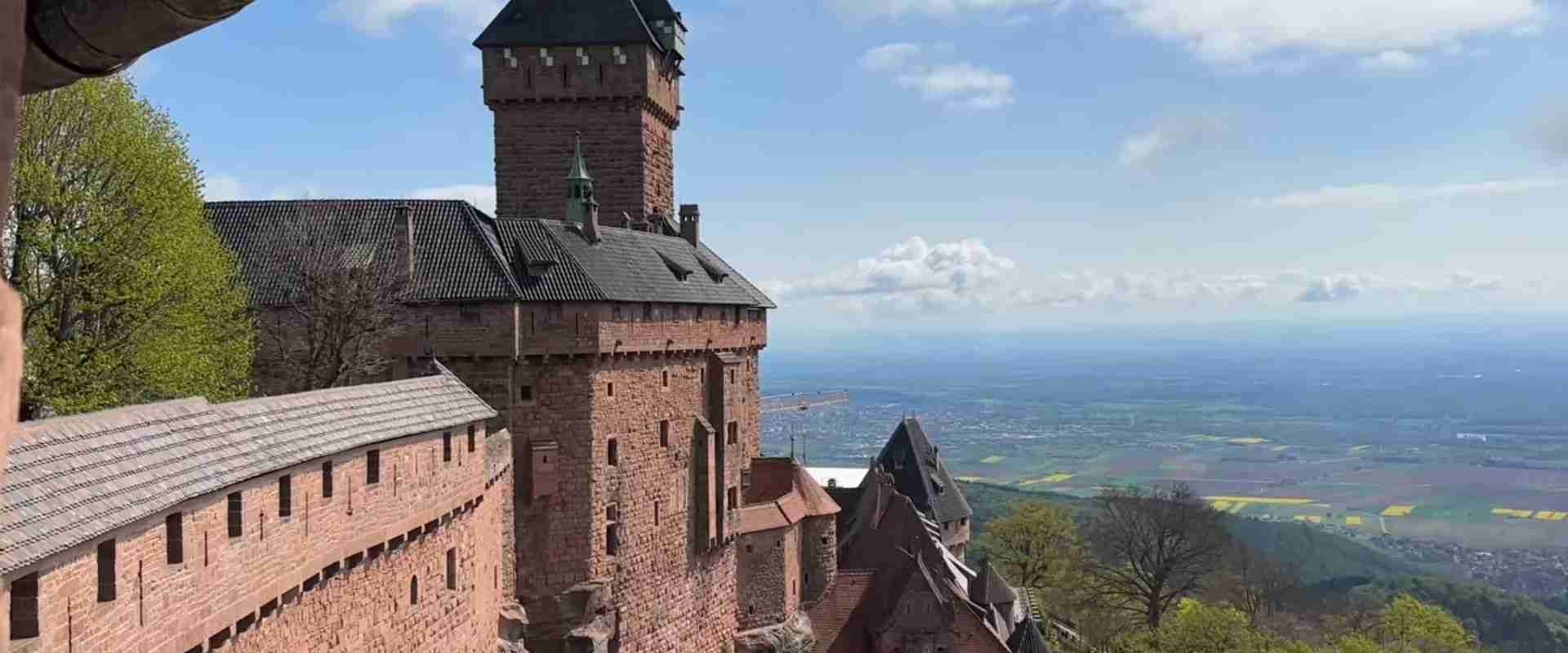
Haut-Koenigsbourg Castle is the largest and most dramatic castle in the region, roughly 25 km from Colmar by road, and works best as a half-day or morning visit before a village stop in Ribeauvillé or Riquewihr.
Why Visit Haut-Koenigsbourg Castle in 2027?
Haut-Koenigsbourg stands on a ridge at about 755 meters above the Rhine plain, with views toward the Vosges and across the plain toward the Black Forest. The castle dates to the 12th century, and after centuries of conflict and decay it was restored between 1900 and 1908 under the German Emperor Wilhelm II, with the architect Bodo Ebhardt directing the work. The restoration remains debated by historians for its imaginative reconstructions, a point worth knowing when judging the interiors. The castle includes a keep, courtyards, a great hall, furnished rooms and a bastion with cannon.
Adult admission has been about €10-13 in recent years (confirm on the castle’s official website for 2027), and the castle is open most of the year with reduced winter hours. Allow two to three hours, plus parking in the lot below the castle. The approach road is narrow and busy on summer weekends, so arrive at opening time.
Which Smaller Castles Are Worth a Hike?
The three castle ruins above Ribeauvillé offer a free hike and views over the vineyards. The Hohlandsbourg castle near Colmar is a restored fortress with exhibits and events, reachable by car or a longer walk from the village of Wintzenheim. The ruins above Kaysersberg and Eguisheim’s Three Castles viewpoint around Husseren-les-Châteaux provide shorter walks. Bring sturdy shoes, as paths can be steep or slippery.
Best Day Trips from Colmar in 2027
Strasbourg, Mulhouse, Basel, Freiburg and Neuf-Brisach are the best day trips from Colmar in 2027, all reachable by train or car within about an hour. Strasbourg is the strongest choice for a first visit, and nature and family attractions fill gaps on rainy days.
Is Strasbourg a Good Day Trip from Colmar in 2027?
Strasbourg is the best day trip, reached by regional train in roughly 30-40 minutes. The historic center, the Grande-Île, is inscribed as a UNESCO World Heritage site, and highlights include Notre-Dame Cathedral with its astronomical clock, the Petite France quarter and the covered bridges area. Plan about six to eight hours, with canal boat tours and museums as optional additions. Strasbourg’s Christmas market is among the oldest in Europe according to local tradition and attracts very large crowds in December.
Is Mulhouse Worth a Visit?
Mulhouse, about 25 minutes south by train, is known for large industrial-heritage museums, including a national automobile museum with a famous collection of vintage cars and a railway museum with historic locomotives. These suit families and enthusiasts, especially on cold or rainy days. Plan three to five hours for one museum, and check each museum’s 2027 hours and ticket prices.
Can You Visit Basel or Freiburg from Colmar?
Basel is about an hour to ninety minutes by train and offers art museums and a compact old town, though Swiss prices are much higher than in France. Freiburg im Breisgau, across the Rhine in Germany, is about 50 km east and offers a Gothic cathedral, a lively university atmosphere and access to the Black Forest. Bring a passport or ID card, as border checks can occur.
What Is Neuf-Brisach Like?
Neuf-Brisach, about 18 km east of Colmar, is a star-shaped fortified town designed by the military engineer Vauban in the late 17th century and part of the UNESCO-inscribed Fortifications of Vauban group, added in 2008. A visit takes one to two hours to walk the ramparts and grid-plan streets, and it fits well with a drive to the Rhine.
Which Nature and Family Attractions Are Near Colmar?
- Grand Ballon and the Crest Road: the Vosges ridge road reaches the Grand Ballon, the highest peak in the Vosges at 1,424 meters; sections can close in winter snow.
- Alsace Open-Air Museum at Ungersheim: a village of relocated historic buildings south of Colmar, popular with families.
- Kintzheim eagle and monkey parks: wildlife attractions near Haut-Koenigsbourg, with seasonal hours.
- Munster Valley: the home of Munster cheese, with farm-inns that serve regional dishes in the hills.
- Sélestat: a town north of Colmar known for its Renaissance humanist library and compact old center.
What to Eat and Drink in Colmar and Alsace in 2027
Alsatian cuisine combines French technique with Germanic ingredients, and a typical meal in Colmar features onion-and-bacon flatbread, a sauerkraut platter with sausages and pork, or a baked meat-and-potato casserole, paired with local white wine or beer. Traditional Alsatian wine taverns and brasseries serve these dishes at fair prices.
Which Alsatian Dishes Should You Try?
- Alsatian onion-and-bacon flatbread (tarte flambée): a thin crispy flatbread topped with cream, onions and bacon; usually €12-16.
- Sauerkraut platter: fermented cabbage served with several sausages and cuts of pork; usually €18-26.
- Baked meat-and-potato casserole: a slow-cooked dish of marinated meats and potatoes in white wine, baked in an earthenware pot; usually €20-28.
- Munster cheese: a washed-rind cow’s milk cheese with a strong aroma, often served with potatoes and cumin.
- Egg noodles and local sausages: hearty side dishes found at traditional taverns.
- Alsatian yeast cake: a ring-shaped cake baked in a fluted mold, sold in bakeries.
- Christmas butter cookies: small shaped biscuits sold in markets in December.
Prices above are indicative restaurant ranges for 2027. Many restaurants offer a fixed-price lunch menu on weekdays at a lower price than dinner, which is the best-value option for mid-range travelers.
Where Should You Eat in Colmar?
Traditional Alsatian wine taverns in the old town and the Krutenau district serve regional dishes in wood-paneled rooms and are the classic choice for dinner. The Covered Market is best for casual lunches and picnic supplies. Fine-dining restaurants cluster around the old town, and several hold Michelin recognition, though ratings change yearly so check current listings. Restaurants fill quickly on weekends and in December, so reserve dinner a few days ahead.
What Are the Dining Customs in Alsace?
Lunch is served roughly from noon to 2 PM and dinner from about 7 PM, and many kitchens close between services. Service is included in French menu prices, so tipping is optional, and rounding up or leaving a few euros for good service is common. Some restaurants close on Sunday evening or Monday, so confirm before walking over. Tap water is free on request.
What Should You Drink Besides Wine?
Alsace also produces beer, with a brewing tradition linked to Strasbourg, and fruit brandies distilled from cherries, plums and pears. Non-alcoholic choices include locally pressed apple juice and grape juice. Cafés serve coffee in the French style, and a coffee at the counter costs less than at a table.
Alsace Wine Route Itinerary and Driving or Cycling Plan 2027
The core loop from Colmar to Haut-Koenigsbourg covers about 40 km one way through six stops and about 65 km including the return, with individual legs of 5-8 km. It can be driven in a day with limited stops, but two days gives a more relaxed pace.
What Is the Best Route Order for the Wine Route Villages?
Start in Colmar, then follow this order, using approximate road distances: Eguisheim (about 7 km from Colmar), Turckheim (about 8 km farther), Kaysersberg (about 7 km), Riquewihr (about 5 km), Ribeauvillé (about 5 km) and Haut-Koenigsbourg Castle (about 8 km). The route moves north and ends at the castle, from which Colmar is about 25 km back by road. An interactive map of these stops accompanies this guide.
How Should You Split the Route Over Two Days?
Day one can cover Eguisheim, Turckheim and Kaysersberg with a tasting and lunch, and day two can cover Riquewihr, Ribeauvillé and the castle. Cyclists can follow the same sequence with electric bikes and overnight in Kaysersberg or Riquewihr to shorten the return ride. Keep bookings flexible in case of weather.
What Are the Rules for Drinking and Driving in France?
French law sets a low legal blood-alcohol limit for drivers, and checks are common on rural roads. The safest approach is to taste modestly and spit, assign a designated driver, or use a guided tour. Cyclists are also subject to rules against riding under the influence, and electric bikes make steeper sections less tiring after a long lunch.
How Much Does a Trip to Colmar and the Wine Route Cost in 2027?
A day in Colmar costs about €175-285 per person at mid-range level in 2027, €90-145 on a budget and €360-605 at the luxury end, with every figure assuming two people share a hotel room. The ranges below include accommodation, three meals, local transport and attractions, and they are indicative figures built from current 2026 rates and seasonal patterns.
What Does a Budget Day in Colmar Cost in 2027?
Budget travelers need €90-145 per person daily (two sharing a budget hotel). Hotel €40-55 per person, breakfast €5-8, lunch €12-18, dinner €20-30, local transport €5-15, attractions €10-20. Total approximately €90-145 per person daily. Three days cost approximately €270-435 per person, and seven days approximately €630-1,015 per person.
What Does a Mid-Range Day in Colmar Cost in 2027?
Mid-range travelers spend €175-285 per person daily (two sharing a mid-range hotel). Hotel €75-110 per person, breakfast €10-18, lunch €20-30, dinner €35-55, local transport €10-30, attractions €25-45. Total approximately €175-285 per person daily. Three days cost approximately €525-855 per person, and seven days approximately €1,225-1,995 per person.
What Does a Luxury Day in Colmar Cost in 2027?
Luxury visitors invest €360-605 per person daily (two sharing a luxury hotel). Hotel €145-200 per person, breakfast €20-30, lunch €35-55, dinner €70-120, local transport and private drivers €30-60, attractions and private tastings €60-140. Total approximately €360-605 per person daily. Three days cost approximately €1,080-1,815 per person, and seven days approximately €2,520-4,235 per person.
What Does a Solo Trip to Colmar Cost in 2027?
Solo travelers pay the full room rate because there is no sharing. Mid-range solo travelers spend approximately €250-395 per person daily, and budget solo travelers approximately €125-200 per person daily. Single occupancy is the biggest cost difference, so solo travelers save most by choosing small guesthouses, hostels or hotels with single rooms.
What Do Individual Costs Look Like at a Glance?
- Unterlinden Museum: €14 (confirm on the museum’s official site)
- Bartholdi Museum: about €7
- Toy Museum: about €8
- Little Venice boat ride: €7-9
- Haut-Koenigsbourg Castle: about €10-13
- Wine tasting: €10-20 per person
- Guided half-day wine tour: €50-90 per person
- Rental car: €45-75 per day
- Standard or electric bike rental: €15-25 or €30-45 per day
- Onion-and-bacon flatbread: €12-16
- Sauerkraut platter: €18-26
Ticket prices can change each year, so check the official site of each attraction before booking.
Sample Colmar and Wine Route Itineraries for 2027 With Costs
One-day, three-day and five-day itineraries are priced below per person with two sharing a room. Line items use specific prices, and totals are rounded to the nearest €5.
What Does a One-Day Budget Itinerary in Colmar Cost in 2027?
This day covers the old town, the Unterlinden Museum and Little Venice on foot.
- Hotel share: €45
- Breakfast at a bakery: €6
- Unterlinden Museum: €14
- Lunch of onion-and-bacon flatbread: €14
- Dinner at a tavern: €25
- Local bus or train fare: €8
The day totals approximately €110 per person, within the budget range of €90-145.
What Does a Three-Day Mid-Range Itinerary Cost in 2027?
Day one, Colmar old town. Hotel share €90, breakfast €14, Unterlinden Museum €14, boat ride €9, Bartholdi Museum €7, lunch €25, dinner €45, coffee and wine €10. The day totals approximately €215 per person.
Day two, guided Wine Route tour. Hotel share €90, breakfast €14, guided minibus tour €70, lunch €28, tasting €15, dinner €40. The day totals approximately €255 per person.
Day three, Haut-Koenigsbourg and Riquewihr by car. Hotel share €90, breakfast €14, castle admission €12, parking and fuel share €18, lunch €26, tasting €12, dinner €42. The day totals approximately €215 per person.
The three-day itinerary totals approximately €685 per person, within the mid-range three-day budget of €525-855.
What Does a Five-Day Mid-Range Itinerary Cost in 2027?
The first three days follow the itinerary above. Day four adds Strasbourg by train, and day five is a bus trip to Ribeauvillé.
Day four, Strasbourg day trip. Hotel share €90, breakfast €14, regional train return €30, sights €25, lunch €25, dinner €45. The day totals approximately €230 per person.
Day five, Ribeauvillé by bus. Hotel share €90, breakfast €14, bus return €8, lunch €25, tasting €12, dinner €42. The day totals approximately €190 per person.
The five-day itinerary totals approximately €1,105 per person, within the mid-range five-day budget of approximately €875-1,425 per person.
Seasonal Price Variations in Colmar for 2027
Hotel prices are the main seasonal variable in Colmar. Rates peak during the Christmas markets, in August, and on harvest weekends in late September and October, and they fall in January and February.
How Much Do Hotel Prices Change by Season?
Weekends in December are the most expensive and the hardest to book, and rooms in the old town often sell out months in advance. Summer and harvest weekends are also high. The shoulder months of April, May, June and early September offer the best balance of availability and price, and weekdays in January and February are cheapest. The mid-range room rate of €150-215 quoted earlier is a baseline for typical dates outside peak events.
Do Attraction and Restaurant Prices Change With the Season?
Attraction admission is usually stable throughout the year, but restaurants and tavern menus may add seasonal specialties in autumn and winter. Wine tasting fees do not usually change by season, though some producers close for short periods in winter. The Little Venice boat ride and tourist train operate on reduced schedules in deep winter.
Hidden Costs and Fees to Expect in Colmar in 2027
Hidden costs in Colmar are modest, but they add up if overlooked. The most common are the nightly tourist tax, parking, tasting fees, shipping wine and low-emission or toll costs on longer drives.
- Tourist tax: added per person per night, collected by the hotel at checkout.
- Parking: hotel parking and public car parks are charged by the hour or night; confirm rates locally.
- Tasting fees: some cellars charge a fee that is credited if you buy wine.
- Wine shipping: international shipping and customs charges can exceed the cost of a few bottles.
- Rental car extras: one-way drop-off fees, additional drivers and insurance upgrades.
- Tolls and city restrictions: motorways to Paris carry tolls, and Strasbourg’s low-emission zone may require a sticker.
- Cash and card use: cards are widely accepted, though small producers may prefer cards above a minimum or cash for small purchases.
Money-Saving Tips for Colmar and the Wine Route in 2027
The biggest savings come from choosing shoulder-season dates, midweek stays, fixed-price lunch menus and village guesthouses outside the old town. These choices can reduce a mid-range trip toward the lower end of the €175-285 daily range.
- Travel in shoulder months: April-May and September offer better rates than December and August.
- Eat the main meal at lunch: weekday fixed-price menus cost less than dinner.
- Use the Covered Market: picnic supplies are cheaper than sit-down lunches.
- Book trains early: advance fares are usually cheaper than same-day tickets.
- Share a car or tour: splitting a rental or private driver among four people reduces the per-person cost.
- Buy wine at the cellar: producers’ prices are often lower than shop prices, and tasting fees can be credited.
- Stay outside the center: hotels near the railway station or in the Krutenau district can be cheaper than central rooms.
- Walk the old town: exploring on foot avoids transport costs.
Colmar for Different Travelers in 2027: Couples, Families, Solo and Seniors
Colmar suits most traveler types because it is compact, safe and varied, but each group benefits from different choices on lodging, pace and activities.
Is Colmar Good for Couples?
Couples benefit from a canal-view room in Little Venice, an evening walk after the day-trippers leave, a private tasting and a dinner at a traditional tavern. Two sharing a room halves the hotel cost, as reflected in all ranges in this guide.
Is Colmar Good for Families with Children?
Children enjoy the boat ride, the tourist train, the Toy Museum, the Alsace Open-Air Museum and the nearby eagle and monkey parks. Cobbled streets are difficult for strollers, so a baby carrier or compact stroller is more practical. Family-friendly restaurants offer children’s menus, and apartments with kitchens help on stays longer than three nights.
Is Colmar Safe and Easy for Solo Travelers?
Colmar is a small, generally calm city, and solo travelers can walk the old town comfortably in the evening. The main cost difference is paying the full room rate, as shown in the solo budget ranges. Joining a small-group wine tour is a practical way to visit cellars without driving.
Is Colmar Accessible for Seniors and Travelers With Limited Mobility?
Cobblestones, uneven pavements and narrow historic buildings can challenge visitors with limited mobility. The modern extension of the Unterlinden Museum and larger hotels are more likely to offer step-free access, but confirm directly. A taxi or the tourist train reduces walking, and a rental car allows access to village lots near the walls.
What Should Wine Enthusiasts Do Differently in 2027?
Wine enthusiasts should book appointments with small producers, schedule tastings in the morning when palates are fresh, and visit Grand Cru sites on foot. Plan no more than three tastings per day, and carry water. A week-long stay allows time for both well-known estates and small family cellars.
Practical Tips for Visiting Colmar in 2027
Colmar uses the euro, tap water is safe to drink, the emergency number is 112, and the city runs on a typical French rhythm of midday lunch breaks and quiet Sundays. Preparation for these customs makes a trip smoother.
- Language: French is the official language, Alsatian dialect is spoken locally, and English is widely understood in tourist businesses. A simple “bonjour” opens every shop interaction.
- Opening hours: many shops close on Sunday, and some museums close one weekday, so verify before building a tight schedule.
- Electricity: 230 volts with European two-pin plugs.
- Weather and packing: bring layers, comfortable walking shoes for cobblestones, a light rain jacket, and warm clothing for December.
- Money: cards are widely accepted, and ATMs are common in the center.
- Booking: reserve hotels, popular restaurants and tasting appointments ahead in peak seasons.
- Safety: petty theft is uncommon but possible in crowded places, so keep valuables close.
Frequently Asked Questions About Colmar and the Alsace Wine Route 2027
Is Colmar worth visiting in 2027?
Yes, Colmar is worth visiting in 2027 for its well-preserved old town, the Isenheim Altarpiece, the Little Venice quarter and its location at the heart of the Alsace Wine Route. Three days gives time for the town and the nearby villages. The Christmas markets add a strong winter reason to visit, though they bring crowds and higher hotel prices.
Should you stay in Colmar or Strasbourg for the Wine Route in 2027?
Colmar is the better base for the Wine Route because the best-known villages lie within 7-17 km of it, whereas Strasbourg is about 70 km north of Colmar. Strasbourg is better as a separate stop for its cathedral and larger city atmosphere. Many travelers combine both by staying in Colmar and taking a day trip to Strasbourg by train in roughly 30-40 minutes.
How much should you budget for three days in Colmar in 2027?
A three-day trip costs approximately €525-855 per person at mid-range level, €270-435 on a budget and €1,080-1,815 at the luxury level in 2027, assuming two people share a hotel room. These figures include accommodation, meals, local transport and attractions but exclude flights and long-distance trains.
Do you need a car for the Alsace Wine Route in 2027?
A car is not required, but it provides the most flexibility, particularly for Haut-Koenigsbourg Castle and for visiting several villages in one day. Alternatives include electric bicycles, guided minibus tours costing roughly €50-90 per person for a half day, and regional buses to the larger villages with limited service on Sundays. If you plan to taste wine, a bicycle or tour reduces drink-driving risk.
When do the Colmar Christmas markets run in 2027?
The 2027 dates have not been confirmed, but Colmar’s Christmas markets have recently opened in late November and run through the end of December, and the 2027 season is expected to follow that pattern. Check the official Colmar tourism site for confirmed dates, and book hotels early because December weekends sell out months ahead.
Which Wine Route village is best to visit in 2027?
Riquewihr is the best-preserved and busiest village, Eguisheim has the most distinctive circular layout, Kaysersberg combines a fortified bridge with the Albert Schweitzer birthplace, and Ribeauvillé offers castle hikes. For a first visit, Eguisheim and Kaysersberg are the best pair, since they balance beauty with manageable crowds.
Is Colmar suitable for families with children in 2027?
Colmar is suitable for families. Children enjoy the boat ride along the Lauch, the Toy Museum, the tourist train and nearby wildlife parks. Cobblestones make strollers awkward, so bring a carrier or a sturdy lightweight stroller. Expect child-friendly menus at many restaurants and plan indoor activities for rainy or cold days.
Can you visit Colmar as a day trip from Strasbourg or Basel in 2027?
Yes, Colmar is a feasible day trip from Strasbourg, roughly 30-40 minutes by regional train, and from Basel, roughly an hour to ninety minutes by train. A day trip covers the old town and Little Venice but not the Wine Route villages, which are better with an overnight stay. Early train arrivals help avoid peak crowds.
Is Colmar expensive in 2027 compared with other French destinations?
Colmar is generally moderately priced for a popular tourist town, with mid-range travelers spending approximately €175-285 per person daily in 2027. Costs rise sharply during the Christmas markets and in August, and fall in winter. Eating the main meal at lunch, staying midweek and using the Covered Market for picnics are the most effective ways to keep costs down.
What should you pack for a trip to Colmar in 2027?
Pack comfortable walking shoes with good grip for cobblestones, layers for variable weather, a light rain jacket, sun protection for summer vineyard walks and warm clothing, gloves and a hat for December. Bring a card and some cash, a power adapter for European two-pin sockets, and a reusable water bottle.
Sources: