
7 Days in the Peloponnese: A 2026 Off-The-Beaten-Path Itinerary for History and Architecture Lovers
The Peloponnese is the most archaeologically dense peninsula in Europe, holding five UNESCO World Heritage Sites and centuries of layered civilisation within a single road-trip loop. This seven-day itinerary moves beyond the standard Athens day-trip circuit to reach Byzantine ghost towns, Neolithic cave systems, Venetian sea fortresses, and Bronze Age palace ruins that most visitors to Greece never see. Plan the route carefully, pick up a rental car, and the rewards are extraordinary.
Key Takeaways
- Five UNESCO Sites in One Region: The Peloponnese holds Bassae (1986), Epidaurus (1988), Ancient Olympia (1989), Mystras (1989), and Mycenae & Tiryns (1999) — this itinerary visits all five plus outstanding non-UNESCO sites including Monemvasia, Methoni, and the Mani Peninsula.
- Rental Car is Non-Negotiable: A car is the only way to reach Mystras, the Mani tower villages, Nestor’s Palace, and Methoni. Public buses serve main towns only. Book a compact car through Athens Airport (ATH) for the full seven days.
- New 2025 Site Pricing — No More Discounts: Greece standardised admission across all state-managed archaeological sites from April 2025. The five major Peloponnese UNESCO sites each cost €20 per adult, year-round, with no seasonal reductions. EU citizens under 25 and non-EU children under 18 enter free.
- Budget Travelers Spend €85-130 Per Person Daily (two sharing a guesthouse), covering accommodation, meals, car share, and site admissions. Mid-range comfort runs €135-205 per person daily. Luxury visitors staying in boutique castle hotels invest €220-370 per person daily.
- A Full Week Costs €595-910 (Budget), €945-1,435 (Mid-Range), or €1,540-2,590 (Luxury) per person for seven days, all-inclusive from rental car pickup to final overnight before departure.
- Best Travel Windows in 2026: Late April through May offers full site hours (open from 8 AM), temperatures of 18–26°C, and spring wildflowers across the hillsides. September through mid-October delivers the same temperatures after summer heat passes, thinner crowds, and occasional Epidaurus Festival performances running into early autumn.
People Also Ask About the Peloponnese Itinerary in 2026
How much does a 7-day Peloponnese road trip cost per person in 2026?
Mid-range travelers sharing a hotel spend €135-205 per person daily (two sharing), totalling approximately €945-1,435 for the week including car rental, accommodation, meals, and site admissions. Budget travelers keeping to guesthouses and simple tavernas spend €85-130 per person daily, approximately €595-910 for seven days. Luxury visitors staying in boutique castle hotels in Nafplio and Monemvasia spend €220-370 per person daily, approximately €1,540-2,590 for the week. All figures assume two people sharing a rental car and accommodation throughout.
Do I need a rental car for this Peloponnese itinerary in 2026?
A rental car is essential for this specific itinerary. Sites like Mystras (5 km outside Sparta), Diros Caves, Nestor’s Palace, Methoni fortress, and the Mani tower villages have no reliable public transport connections. KTEL buses reach Nafplio, Sparta, Kalamata, Pylos, and Olympia town but run infrequently and leave the UNESCO sites and coastal routes inaccessible without a vehicle. Book a compact car at Athens Airport (ATH) and return it at ATH or Patras at the end of the route. Economy cars cost €35-55 per day; compact SUVs suited to rougher Mani roads run €55-80 per day.
When is the best time to visit the Peloponnese in 2026?
Late April through May is the optimal window: full summer opening hours activate on 1 April, temperatures sit at 18–26°C, spring wildflowers cover the hillsides, and visitor numbers remain manageable. September through mid-October is equally strong — the Mani and Monemvasia are quieter, temperatures match May, and the Epidaurus Festival sometimes extends into early September. July and August are fully viable but see temperatures above 38°C at exposed sites like Mycenae and Olympia, making late-morning visits uncomfortable. Winter (November–March) keeps sites open with reduced hours (8:30 AM–3:30 PM) and no seasonal discounts under the 2025 pricing reform.
How many UNESCO World Heritage Sites does the Peloponnese have in 2026?
The Peloponnese contains five UNESCO World Heritage Sites: the Temple of Apollo Epicurius at Bassae (inscribed 1986), the Sanctuary of Asclepius at Epidaurus (1988), Ancient Olympia (1989), Mystras (1989), and the joint Archaeological Sites of Mycenae and Tiryns (1999). This seven-day itinerary visits all five within the route, with Bassae added as an optional half-day extension on Day 7 en route to Ancient Olympia.
Extended multi-day tours – 5+ days
Featured Peloponnese Islands Multi-Day Tour Packages
3 days
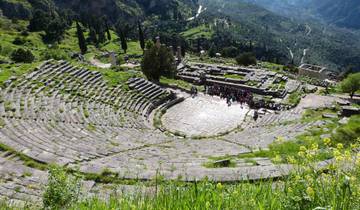
Epidaurus, Mycenae, Olympia and Delphi Three Days Tour from Athens
- ✓ Comprehensive Peloponnese Islands tour
- ✓ Expert local guides included
- ✓ All accommodation arranged
- ✓ Transportation provided
5 days
Athens, Delphi & Greek Islands By Cruise – 5 Days
- ✓ Comprehensive Peloponnese Islands tour
- ✓ Expert local guides included
- ✓ All accommodation arranged
- ✓ Transportation provided
5 days
Discovery of Athens, Argolis & Delphi – 5 Days
- ✓ Comprehensive Peloponnese Islands tour
- ✓ Expert local guides included
- ✓ All accommodation arranged
- ✓ Transportation provided
8 days
Paradisial Peloponnese | Semi-Private 8-Day Guided Tour
- ✓ Comprehensive Peloponnese Islands tour
- ✓ Expert local guides included
- ✓ All accommodation arranged
- ✓ Transportation provided
Multi-day tour packages powered by TourRadar. Prices and availability subject to change.
Introduction: The Peloponnese as a Complete World
Most visitors to Greece see the Peloponnese as a day trip from Athens — a morning at Mycenae, an afternoon at Nafplio, and back on the motorway before sunset. Those who stay longer discover something entirely different: a peninsula with the historical range of an entire country compressed into a driving loop of roughly 600 kilometres. Within that loop, the Bronze Age world of Mycenae and Tiryns gives way to the classical perfection of Epidaurus and Olympia, which gives way to Byzantine magnificence at Mystras, which gives way to the feudal otherworldliness of Monemvasia, which gives way to the fierce medieval landscape of the Mani, and finally to the Venetian military engineering at Methoni. Nowhere else in the Mediterranean does this sequence of civilisations pile so visibly on top of each other.
The off-the-beaten-path framing of this itinerary does not mean avoiding famous sites. Mycenae and Olympia are famous for excellent reasons. It means approaching the region as a whole — sleeping in the places, eating where locals eat, driving roads that tour buses never take — rather than ticking attractions from an organised coach seat. It means spending an evening inside the medieval rock of Monemvasia after the day-trippers have left, walking the deep-grass ruins of Mystras in relative silence, and reaching the Mani tower village of Vathia as afternoon light turns the limestone a deep copper. These are experiences that require a rental car, a willingness to drive mountain roads, and a minimum of seven days. This itinerary provides the structure; the Peloponnese provides everything else.
Why the Peloponnese Rewards Off-the-Beaten-Path Travelers
The Peloponnese carries an unusual advantage for independent travelers: its most extraordinary sites are genuinely spread out, meaning that reaching them requires engagement with the landscape rather than a sprint between ticket offices. The journey from Epidaurus to Monemvasia takes two and a half hours of driving through citrus groves, olive terraces, and the spectacular cliffs of the eastern Laconian coast. The road into the Deep Mani drops through a landscape that feels geologically ancient — grey limestone karst, sparse phrygana scrub, and the unmistakable silhouettes of medieval tower houses rising from deserted villages. These drives are part of the itinerary, not empty intervals between it.
The region also rewards architectural curiosity across a broader span of history than almost anywhere in Europe. The Cyclopean masonry of Tiryns — walls so massive that ancient Greeks believed only giants could have built them — sits in a flat agricultural landscape that feels barely aware of the astonishing structure rising from its midst. The fresco-covered Byzantine churches inside the Mystras complex represent the last flowering of Byzantine art before the Ottoman conquest, painted by artists who knew the empire was ending. The Venetian sea tower at Methoni stands alone in shallow water, connected to the main fortress by a stone bridge, and has no architectural parallel in Greece. This is not a region of one period or one aesthetic — it is the full sequence.
Planning Your Peloponnese Road Trip in 2026
The itinerary follows a clockwise loop from Athens: south to Nafplio and the Argolid UNESCO cluster, then southeast to Monemvasia, southwest through Sparta and Mystras into the Mani, northwest through Pylos and Messenia, and north to Ancient Olympia before returning to Athens or catching the Patras ferry. The total driving distance is approximately 650 kilometres across seven days, averaging under 100 kilometres per day with short focused excursions from each base.
Rental Car Logistics in 2026
Pick up the rental car at Athens International Airport (Eleftherios Venizelos) on Day 1 and return it at the same location on Day 8, or at Patras for travelers continuing by ferry to Italy. Economy cars (Fiat Panda class) cost €35-55 per day from major operators including Europcar, Hertz, and Budget; compact SUVs suited to unpaved Mani tracks cost €55-80 per day. Book in advance for late April through October as summer availability tightens sharply. The one-way surcharge for Athens pickup and Patras return is typically €40-70 — worth confirming at booking. Fuel across the itinerary totals approximately €165-220 for a compact car driving the full 650-kilometre loop, averaging €20-28 per day.
Navigation and Road Conditions in 2026
Google Maps and offline apps (Maps.me, OsmAnd) navigate all major routes reliably. The Mani Peninsula has several unpaved tracks around Vathia and Cape Tenaro that a standard compact handles with care; approaching from paved roads is straightforward. The Arcadian mountain road to Bassae (Day 7 optional extension) is narrow and winding but fully paved. Petrol stations are plentiful in main towns; fill the tank before entering the Deep Mani as stations are sparse below Areopoli.
Best Season and Crowds in 2026
April 1 marks the switch to full summer hours at all state archaeological sites. Late April and May bring temperatures of 18–26°C, full opening hours, and manageable visitor numbers at every site including Mycenae and Olympia. Peak summer (July–August) concentrates visitor pressure at the most famous sites and pushes midday temperatures above 38°C at exposed ruins — visit sites before 10 AM or after 4 PM if traveling in summer. September drops back to May-like conditions and empties the hotel car parks considerably. The Epidaurus Festival, held on Friday and Saturday evenings through the summer, schedules ancient Greek drama performances inside the ancient theatre — booking months in advance for July and August performances is essential.
Peloponnese Archaeological Site Tickets and Booking in 2026
Greece introduced standardised, year-round entrance fees across all state-managed archaeological sites and museums from 1 April 2025, abolishing the previous seasonal discount structure. The new pricing applies uniformly regardless of season. All tickets purchase through the official portal at hhticket.gr or at site ticket offices on the day.
Standard Adult Admission Prices for This Itinerary in 2026
- Ancient Corinth (site + museum combined): €20
- Palamidi Fortress, Nafplio: €20
- Mycenae (archaeological site + museum combined): €20
- Tiryns: €10
- Epidaurus (Sanctuary of Asclepius + theatre): €20
- Mystras (Byzantine city + museum): €20
- Diros Caves (Vlychada Cave, boat tour): €12 (privately managed, separate pricing from Ministry of Culture sites)
- Nestor’s Palace, Pylos: standard Ministry of Culture admission — confirm current category at hhticket.gr
- Ancient Olympia (site + Archaeological Museum + Museum of Olympic Games): €20
- Temple of Apollo Epicurius, Bassae (optional Day 7 extension): standard Ministry of Culture admission
Bookings, Free Admission Days, and Concessions in 2026
Ancient Olympia’s Archaeological Museum operates timed entry slots — book a specific date and time at hhticket.gr before arriving. The archaeological site and Museum of Olympic Games operate open entry on the ticket date. EU citizens aged 25 and under and non-EU citizens aged 18 and under enter all state-managed sites free on presentation of a valid ID or passport at the ticket booth. Several cultural calendar dates each year offer free admission to all visitors regardless of nationality; check the Ministry of Culture calendar at the start of your trip as these dates vary annually. Multi-site combination passes across different locations were discontinued in April 2025; purchase individual tickets for each site.
Budget the following for seven days of admissions across the full itinerary: Ancient Corinth €20, Palamidi €20, Mycenae €20, Tiryns €10, Epidaurus €20, Mystras €20, Diros Caves €12, Nestor’s Palace ~€10-20, Ancient Olympia €20. Total admissions budget: approximately €152-162 per adult for the complete route, averaging €22-23 per person per day.
Day 1 in the Peloponnese 2026: Athens to Nafplio via Ancient Corinth
Day 1 covers 140 kilometres from Athens Airport to Nafplio with two stops that establish the historical range of what follows. Pick up the rental car at ATH and join the A8 motorway southwest toward Corinth. The drive takes just over an hour to the Corinth Canal.
The Corinth Canal (Free)
Pull into the viewpoint car park above the canal for a 20-minute stop. The Corinth Canal opened in 1893 after more than 2,000 years of engineering ambitions stretching back to Periander of Corinth in the 7th century BCE and later Julius Caesar, Caligula, and Nero. It is 6.3 kilometres long, 23 metres wide, and cut 80 metres through solid limestone. Standing on the bridge above the narrow slot with container ships passing at eye level is one of the most quietly dramatic perspectives in Greece. Entry is free; the car park is clearly signed from the motorway.
Ancient Corinth and Acrocorinth (€20)
Drive 5 kilometres south to Ancient Corinth (€20). Corinth was one of the largest and wealthiest cities of the ancient world, controlling trade between the Aegean and Adriatic seas. The seven surviving columns of the Temple of Apollo (c. 550 BCE) stand well above the surrounding ruins and are among the oldest Doric columns visible anywhere in Greece. The Roman agora, gymnasium, and Peirene Fountain give a vivid sense of how the city functioned under Roman rule — Paul the Apostle preached here and addressed the Corinthians in letters that survive as New Testament scripture. The on-site Archaeological Museum houses outstanding bronzes and the distinctive terracotta roof tiles that gave Corinthian architecture its name. Allow two hours.
After Ancient Corinth, drive 4 kilometres to the base of Acrocorinth — the enormous limestone rock crowned with a medieval fortress that looms over the coastal plain. The fortress is free to enter (check current status at the site entrance) and the 20-minute walk up through three successive gateways reveals successive layers of Byzantine, Frankish, Venetian, and Ottoman construction. The view from the summit takes in the Saronic Gulf to the east and the Gulf of Corinth to the west simultaneously. Allow one hour including the walk up.
Drive to Nafplio and First Evening
From Acrocorinth, rejoin the motorway and drive 50 kilometres southeast to Nafplio (45 minutes). Nafplio was the first capital of modern independent Greece from 1828 to 1834 and remains the most beautiful small town in the country by most measures. Park at the edge of the old town — no cars penetrate the pedestrian historic centre — and walk to Syntagma Square for the evening. The Venetian buildings, arched passages, and harbour promenade repay an hour of exploration. Dinner in Nafplio offers the best taverna quality of anywhere on the route: try the old town streets around the Catholic church for reliable fish and mezze restaurants. The Bourtzi — a small Venetian fortress on an island in the harbour — illuminates at night and is visible from the waterfront promenade.
Day 1 driving distance: approximately 140 km (Athens Airport to Nafplio with Corinth stops). Overnight: Nafplio (base for Days 1-3).
Day 2 in the Peloponnese 2026: Mycenae, Tiryns, and Nafplio’s Fortress Heights
Day 2 is among the most concentrated in the itinerary: two UNESCO World Heritage Sites and a Venetian fortress, all within 35 kilometres of Nafplio. Start with Mycenae immediately after opening to beat tour buses from Athens that begin arriving by 9:30 AM.
Mycenae (€20, UNESCO World Heritage Site)
Mycenae sits 30 kilometres north of Nafplio on a dramatic hillside between two rocky peaks. The site operated as the dominant power of the Bronze Age Aegean from approximately 1600 to 1100 BCE — the civilisation that produced the Trojan War tradition, the legends of Agamemnon and Clytemnestra, and the palace bureaucratic system recorded in Linear B script. The Lion Gate (c. 1250 BCE) is the oldest monumental sculpture in Europe: two lionesses carved in limestone face each other above a relieving triangle with a collective composure that feels entirely contemporary. Walk through the gate into the citadel toward the royal grave circles where Heinrich Schliemann excavated gold death masks in 1876, now in the National Archaeological Museum in Athens. The walls — up to 7 metres thick and built from stones weighing several tons — are the defining visual fact of the site.
The Treasury of Atreus, a 200-metre walk downhill from the main citadel entrance, is not to be missed. This tholos tomb (c. 1250 BCE) consists of a dromos passage leading into a corbelled beehive chamber 14.5 metres high — an architectural achievement of astonishing precision for the 13th century BCE. The combined site and museum ticket at €20 covers both the citadel and the on-site archaeological museum. Allow three hours total.
Tiryns (€10, UNESCO World Heritage Site)
Drive 15 kilometres south from Mycenae to Tiryns (€10), set in the agricultural flatland just north of Nafplio. Tiryns is the less-visited sibling of Mycenae but architecturally more legible in some respects: the lower citadel’s Cyclopean galleries, carved into the massive defensive walls, survive intact and visitors walk through them in a way that delivers an immediate physical sense of Bronze Age scale. The walls are in places 17 metres thick — enough to contain vaulted chambers and passageways within the masonry itself. Ancient Greek tradition held Tiryns as the birthplace of Heracles. Allow 90 minutes.
Palamidi Fortress, Nafplio (€20)
Return to Nafplio for lunch, then climb Palamidi Fortress (€20) in the late afternoon when the light is best and the heat has eased. The fortress sits 216 metres above the town on a sheer rock plateau and is reached either by 999 steps from the old town or by car via a winding road to the upper entrance. Built by the Venetians between 1711 and 1714, it was considered impregnable — the Ottomans took it in 1715 by siege rather than assault. Eight separate bastions spread across the summit connected by internal passages. The view from the far bastion looks directly down onto the Argolid plain, Nafplio harbour, and the blue sweep of the Argolic Gulf. Allow 90 minutes. The descent by the 999 steps rewards those with steady knees.
Day 2 driving distance: approximately 55 km. Overnight: Nafplio.
Day 3 in the Peloponnese 2026: Epidaurus and the Drive South to Monemvasia
Day 3 begins at Epidaurus and ends at the extraordinary medieval rock of Monemvasia, with two and a half hours of coastal driving between them. Leave Nafplio by 8 AM to reach Epidaurus at opening and complete the visit before midday.
Epidaurus — Sanctuary of Asclepius (€20, UNESCO World Heritage Site)
Epidaurus (€20) is 30 kilometres east of Nafplio along a road that cuts through the mountains to the coast. The sanctuary was the most celebrated healing centre of the ancient world — a complex of temples, treatment buildings, a stadium, and a gymnasium spread across a forested valley dedicated to Asclepius, the god of medicine. Patients came from across the Mediterranean world, performed ritual purification, slept in the sanctuary seeking healing dreams, and were treated by a medical community whose pharmacological and surgical knowledge was advanced by any standard of the period. The sanctuary’s archaeology is fascinating and often underappreciated; most visitors come specifically for the theatre.
The theatre of Epidaurus (c. 340 BCE, attributed to Polykleitos the Younger) seats approximately 14,000 and is the best-preserved ancient theatre in the world. Its acoustic properties are famous: a coin dropped at the centre of the orchestra is clearly audible from the uppermost row, 60 metres away and 23 metres above. This is not a myth or an exaggeration — test it on arrival before tour groups fill the seats. The mathematical precision of the cavea (the seating bowl), aligned to take advantage of natural hillside gradient while maximising acoustic reflection from the orchestra stone, represents a design achievement that modern theatre architects still study. Allow three hours for the full site and museum.
Drive to Monemvasia
From Epidaurus, drive south for approximately two and a half hours to Monemvasia. The route passes through Nafplio (good opportunity for a quick lunch) and then follows the eastern Laconian coast — a dramatically beautiful drive of limestone cliffs, small fishing harbours, and deep blue water with almost no tourist infrastructure. The final approach to Monemvasia reveals the rock suddenly: a massive limestone outcrop rising 100 metres from the sea, connected to the mainland by a single narrow causeway. Park on the mainland side (inside the rock, no cars are permitted) and walk through the fortified gateway into the lower town.
First Evening in Monemvasia
Monemvasia was separated from the mainland by an earthquake in 375 CE. It became one of the most important Byzantine commercial centres of the medieval Mediterranean, producing and exporting a fortified wine (Malmsey/Malvasia) that appears in Shakespeare and was drunk across Europe. The lower town contains Byzantine and Venetian buildings in various states of romantic ruin interspersed with functioning hotels, restaurants, and churches. The upper town — reached by a steep cobbled path — is uninhabited and contains the ruined palace of the Byzantine Despots of the Morea and the church of Agia Sophia, perched at the cliff edge. The best light for the upper town is early morning. Spend the first evening walking the lower town’s single main lane and eating at one of the tavernas that face the sea wall.
Day 3 driving distance: approximately 175 km (including the Nafplio lunch stop). Overnight: Monemvasia (two nights ideally, but one night works).
Day 4 in the Peloponnese 2026: Mystras and the Last Capital of Byzantium
Day 4 crosses the Laconian interior from Monemvasia to Mystras, two of the most distinctive medieval sites in all of Greece separated by a 110-kilometre drive through the Sparta valley. Visit Mystras in late morning to afternoon when tour buses from Athens have gone.
Morning: Monemvasia Upper Town
Rise before 8 AM and walk up to the upper town before the day-trippers arrive from the mainland. The church of Agia Sophia stands at the western edge of the upper plateau, its apse cantilevered over the cliff face and its interior still showing traces of 13th-century fresco work. The ruined palace of the Despots stretches across the hillside above it — a substantial multi-wing building whose scale surprises visitors expecting a modest provincial residence. The view from the upper town battlements takes in the Myrtoön Sea and, on clear days, the outline of Crete on the southern horizon. Return to the lower town for breakfast before checking out.
Drive to Sparta and Mystras
Drive northwest from Monemvasia to Sparta (approximately 110 km, 1 hour 40 minutes) through the Eurotas River valley. Ancient Sparta left almost no visible monumental architecture — the Spartans built in wood and brick rather than marble, and their aesthetic was the soldier, not the monument. The modern town has a colossal statue of Leonidas near the main avenue and a worthwhile Archaeological Museum (admission €4–6) with Lakonian bronzes and the famous archaic bronze figurines. Allow 45 minutes before driving 5 kilometres uphill to Mystras.
Mystras — Byzantine Ghost City (€20, UNESCO World Heritage Site)
Mystras (€20) is one of the most moving sites in the itinerary — a Byzantine city abandoned in the mid-19th century and preserved in a state of spectacular, inhabited ruin on the lower slopes of the Taygetos mountain range. Founded in 1249 by Frankish prince Guillaume II de Villehardouin, it passed to the Byzantine Despotate of the Morea in 1261 and grew into the last flourishing centre of Byzantine culture, surviving more than a decade after Constantinople fell to the Ottomans in 1453. The philosopher Gemistos Plethon, one of the catalysts of the Italian Renaissance, taught here.
The site divides into a lower town, an upper town, and a kastro (castle) summit, connected by steep cobbled paths. The churches are the extraordinary feature: Agios Demetrios (the cathedral), the Pantanassa, the Brontocheion, and the Peribleptos all contain Byzantine frescoes of the highest quality, painted in the 13th, 14th, and 15th centuries by artists who understood they were working at the edge of a collapsing world. The Pantanassa is still occupied by a small community of nuns and is the best-preserved church on the site. Arrive at opening and allow three to four hours; the full circuit from lower town to kastro summit and back is strenuous but essential for architectural completeness. Wear sturdy shoes — the paths are cobbled and steep.
Overnight: Gythio or Areopoli
After Mystras, drive 50 kilometres south to Gythio (40 minutes), a small port town with good accommodation options, or directly to Areopoli (75 kilometres, one hour) if you want to be positioned deep in the Mani for an early Day 5 start. Gythio has the better restaurant selection; Areopoli puts you closer to the Diros Caves for the morning queue.
Day 4 driving distance: approximately 165 km. Overnight: Gythio or Areopoli.
Day 5 in the Peloponnese 2026: The Deep Mani — Tower Villages and Diros Caves
Day 5 enters the Mesa Mani — the Deep Mani — the most architecturally distinctive landscape in Greece. The Mani Peninsula was never fully controlled by any outside power for extended periods, and its inhabitants developed a culture of fortified independence expressed in medieval tower houses built by rival clans across every village. The towers remain, many abandoned, rising from limestone hillsides with a severity unlike anything else in the Mediterranean.
Diros Caves (€12)
Drive south from Gythio or Areopoli to Pyrgos Dirou (approximately 45 minutes from Gythio) and arrive as early as possible — ticket sales begin at 9 AM but queues form by 8:30 AM in summer. The Diros Caves (€12 per adult) are one of the most unusual attractions in Greece: a Neolithic-era cave system partially flooded by an underground river, toured by small flat-bottomed boat through illuminated chambers hung with stalactites and stalagmites. The boat tour covers 1,300 metres of the cave system over approximately 25 minutes, followed by a 300-metre walk on foot to the exit. The cave temperature holds at a constant 14°C regardless of outside conditions — bring a light layer in summer. The neighbouring Alepotrypa Cave, which served as a settlement and burial site for Neolithic communities, houses a small museum of finds from the excavations.
Vathia and the Tower Village Landscape
Continue south from Diros through progressively more dramatic terrain to Vathia, the most photogenic of the Mani tower villages. Vathia sits on a rocky spur above the coast with thirty-odd medieval towers clustered so tightly that they appear to form a single fortified mass — the visual embodiment of Mani clan warfare. The village is largely abandoned; a small number of towers have been converted to guesthouses. Walk the stone lanes for an hour and photograph from the road above for the definitive view. Continue south to Cape Tenaro (Matapan) — the southernmost point of mainland Europe. The 20-minute walk from the car park to the cape passes the ruins of a Sanctuary of Poseidon and reaches a blue-painted lighthouse above the confluence of the Ionian and Aegean seas. The walk back inland up through the limestone scrub has no parallel on this itinerary for raw landscape drama.
Afternoon: Outer Mani and Kardamyli
Drive back north through the Deep Mani and into the Outer Mani (Exo Mani) — greener, more wooded, and centred on the beautiful small town of Kardamyli on Stoupa Bay. Kardamyli was the home of travel writer Patrick Leigh Fermor for more than forty years; his house and library are being restored as a cultural centre. The town has excellent tavernas and a pebble beach. Overnight here or at Stoupa (4 kilometres south) for a gentler end to a long day.
Day 5 driving distance: approximately 130 km (loop through Deep Mani and return to Kardamyli). Overnight: Kardamyli or Stoupa.
Day 6 in the Peloponnese 2026: Pylos, Nestor’s Palace, and Venetian Methoni
Day 6 crosses the Messenia region — a rich agricultural coast that was the bread basket of the Byzantine Despotate and, before that, of Mycenaean civilisation. Three sites anchor the day: the Bronze Age palace of Nestor, the harbour fortress of Pylos, and the Venetian sea castle at Methoni. The day ends with a long drive north to Olympia for an overnight in Olympia village.
Kalamata to Pylos
From Kardamyli or Stoupa, drive northwest past Kalamata (the regional capital, worth a brief stop for its castle and market) and continue 55 kilometres to Pylos on the shores of Navarino Bay. Pylos is the site of the Battle of Navarino (1827), in which a combined British, French, and Russian fleet destroyed the Ottoman-Egyptian navy and effectively secured Greek independence — one of the decisive naval engagements of the 19th century. The Niokastro fortress (check current opening hours and admission) occupies the southern headland and offers sweeping views across the perfectly circular natural harbour. Voidokilia Beach, visible from the fortress ramparts, is one of the most beautiful and least crowded beaches in Greece — a horseshoe of white sand backed by sand dunes and a Mycenaean tholos tomb. Walk down for an hour.
Nestor’s Palace
Drive 7 kilometres north of Pylos to the Palace of Nestor — the best-preserved Mycenaean palace in Greece, built c. 1300 BCE and destroyed by fire c. 1180 BCE. Where Mycenae and Tiryns impress through defensive architecture, Nestor’s Palace reveals the domestic and administrative life of the Bronze Age elite: the ruins preserve floor plans of a throne room, guard rooms, oil storage magazines, a bathroom with terracotta tub, and archive rooms where hundreds of Linear B clay tablets were baked hard by the destruction fire and subsequently excavated — the primary evidence for the bureaucratic organisation of the late Mycenaean world. The on-site museum (opened 2016) displays the tablets, fresco fragments, and finds from the palace with excellent English interpretation. Admission at standard Ministry of Culture rates; allow two hours.
Methoni Fortress (Free or Minimal Admission)
Drive 12 kilometres south of Pylos to Methoni, one of the most dramatically beautiful fortress ruins in Europe. The Venetian castle occupies an entire headland, its massive walls running straight to the sea on three sides with an octagonal Ottoman tower (the Bourtzi) standing alone in shallow water connected by a stone bridge. Venice held Methoni from 1209 as one of the “eyes of the Republic,” controlling the sea route from Venice to the Levant. The Ottomans took it in 1500, Venice briefly regained it in 1686 after a campaign by Francesco Morosini, and it reverted to Ottoman control until Greek independence. Walk the full circuit of the walls and descend to the sea tower — the combination of Turkish fortification detail inside a Venetian shell is architecturally unique in Greece. Allow 90 minutes.
Drive to Olympia
From Methoni, drive north on the E55 and then E65 motorway (or via the scenic coastal road through Kyparissia) to Olympia village — approximately 120 kilometres and two to two and a half hours. Arrive in time for dinner at one of the village tavernas and an early night ahead of the final UNESCO site.
Day 6 driving distance: approximately 170 km (Kardamyli to Olympia via Pylos and Methoni). Overnight: Olympia village.
Day 7 in the Peloponnese 2026: Ancient Olympia and the Journey’s Crown
Day 7 centres on Ancient Olympia — the most complete large-scale sacred site in the Greek world and the origin of the Olympic tradition that ran for more than a millennium before its suppression. Book the Archaeological Museum time slot in advance at hhticket.gr; the archaeological site and Museum of Olympic Games operate on open entry within the ticket date.
Ancient Olympia — Site and Museums (€20, UNESCO World Heritage Site)
Ancient Olympia (€20, covering all three components) was not a city but a sanctuary — the Altis, or sacred grove of Zeus, containing temples, treasuries, athletic facilities, and administrative buildings accumulated over eight centuries of Greek religious and athletic life. The first Olympic Games took place here in 776 BCE by traditional reckoning, and the games continued without interruption until their suppression by the Christian emperor Theodosius I in 393 CE. Theodosius II later ordered the destruction of the temples.
The Temple of Zeus (c. 457 BCE) was the largest Doric temple ever built in mainland Greece and housed one of the Seven Wonders of the Ancient World: the chryselephantine statue of Zeus by Pheidias, 12 metres high and constructed of gold and ivory over a wooden frame. The statue is gone, but the scale of its former home is still staggering — fallen column drums lie exactly where the earthquake of the 6th century CE dropped them, creating one of the most visually powerful ruin landscapes in the itinerary. The Temple of Hera (c. 600 BCE) is older and better preserved. The Stadium — entered through a stone-vaulted tunnel — retains its ancient running track and the stone starting and finishing lines. Standing in the stadium with the surrounding embankments empty is the most affecting moment of the itinerary for many visitors.
The Archaeological Museum of Ancient Olympia is among the great museums of Greece. The eastern pediment sculptures from the Temple of Zeus — depicting the chariot race between Pelops and Oenomaus — and the western pediment sculptures of the Lapiths versus the Centaurs represent the apex of early classical Greek sculpture. The Nike of Paionios, a marble winged victory that originally stood on a tall triangular column in the Altis, is displayed at its full height. Allow three hours for the full site, museum, and Museum of Olympic Games combined.
Optional Extension: Temple of Apollo Epicurius at Bassae (€20, UNESCO World Heritage Site)
Bassae (€20) is 50 kilometres south of Olympia on a mountain road through the Arcadian highlands, passing through the village of Andritsena. The temple (c. 420 BCE, attributed to Iktinos, architect of the Parthenon) sits at 1,131 metres elevation on a rocky Arcadian ridge and has been covered by a large protective tent since the 1980s due to conservation concerns — an unusual visual experience but one that preserves some of the most sophisticated architectural detail in Greek temple design, including the earliest known use of the Corinthian capital. Allow one hour for the visit plus two hours of mountain driving round-trip from Olympia. Add this extension for a full day at Olympia with an afternoon departure, or save it for travelers spending an extra night.
Departure: Return to Athens or Patras
From Olympia, Athens Airport is 3.5 hours northeast via the E65 and A8 motorways. Patras for the Adriatic ferry route is 1.5 hours northwest. Travellers extending into Delphi on the way home should plan the E65 north, cross the Rio–Antirio bridge (toll), and continue to Delphi (45 minutes from the bridge) for a final morning visit before Athens.
Day 7 driving distance: approximately 90-120 km to Athens Airport or Patras. Overnight: Departure, or Olympia for early Bassae visit next morning.
Peloponnese Budget Breakdown 2026
All costs below are per person, per day, assuming two people sharing a rental car and hotel accommodation throughout. Room rates are divided by two before appearing in any per-person calculation. Attraction costs are averaged across all seven days, including driving days with no major sites.
Budget Tier: Guesthouses and Simple Tavernas
Budget guesthouses and pensions across the Peloponnese (Nafplio, Sparta area, Kardamyli, Olympia village) run €50-80 per room per night. Per person sharing: €25-40. Simple taverna meals — souvlaki lunch, grilled fish or moussaka dinner — cost €21-35 per person daily. Rental car (economy class shared between two): €28-42 per person daily including fuel. Site admissions averaged across all seven days: €10-15 per person daily (some days have no paid sites; others have one or two at €10-20 each).
Budget daily total: accommodation €25-40, meals €21-35, transport €28-42, attractions €10-15. Total approximately €85-130 per person daily. A complete seven-day trip at this tier costs approximately €595-910 per person.
Mid-Range Tier: Boutique Hotels and Taverna Dining
Mid-range hotels and boutique guesthouses in Nafplio old town, Monemvasia lower city, and Kardamyli run €90-160 per room per night, including boutique properties in historic buildings. Per person sharing: €45-80. Sit-down taverna meals with mezze starters and a carafe of local wine — the standard of comfortable dining in the Peloponnese — cost €40-58 per person daily. Rental car (compact class) shared between two: €34-47 per person daily including fuel. Site admissions averaged across all seven days: €15-20 per person daily.
Mid-range daily total: accommodation €45-80, meals €40-58, transport €34-47, attractions €15-20. Total approximately €135-205 per person daily. A complete seven-day trip at this tier costs approximately €945-1,435 per person.
Luxury Tier: Castle Hotels and Fine Dining
Luxury boutique hotels in Nafplio’s old town (historic mansions with harbour views) and inside the Monemvasia rock (converted Byzantine and Venetian buildings, some with cliff-face terraces) run €180-350 per room per night. Per person sharing: €90-175. Upscale dining combining the outstanding local ingredients of Messenia and Laconia — Kalamata olives, Mani olive oil, fresh fish, local cheeses — at quality restaurants runs €65-100 per person daily. Premium compact SUV rental shared between two: €45-66 per person daily. Site admissions with occasional private guiding for specific sites: €20-30 per person daily.
Luxury daily total: accommodation €90-175, meals €65-100, transport €45-66, attractions €20-30. Total approximately €220-370 per person daily. A complete seven-day trip at this tier costs approximately €1,540-2,590 per person.
Total Admission Budget for Seven Days
The full itinerary admission costs per adult: Ancient Corinth €20, Palamidi €20, Mycenae €20, Tiryns €10, Epidaurus €20, Mystras €20, Diros Caves €12, Nestor’s Palace approximately €10-20, Ancient Olympia €20. Totalling approximately €152-162 per adult for the complete route. EU citizens under 25 enter all state-managed sites free on presentation of a valid ID, reducing the week’s total admissions to €12 (Diros Caves only).
Seasonal Price Variations in 2026
Archaeological site admissions no longer vary by season following the April 2025 Ministry of Culture reform — the €20 rate applies year-round with no winter reductions. Hotel prices, however, remain strongly seasonal. Nafplio boutique hotels average €140-190 per room in June through August and drop to €80-120 in shoulder season (April–May, September–October) and €60-90 in winter. Monemvasia hotel rates peak sharply in summer — inside-the-rock properties command €200-350 per night in July and August, compared with €130-200 in May and September. Kardamyli and the Outer Mani show similar patterns. Booking accommodation four to six weeks in advance for shoulder season and three to four months in advance for peak summer is the appropriate lead time.
Where to Stay in the Peloponnese 2026
This itinerary uses four overnight bases: Nafplio (three nights covering Days 1-3), Monemvasia (one night, Day 3/4), Gythio or Areopoli or Kardamyli (Days 4-5), and Olympia village (Day 7). The following covers each base with specific guidance by budget tier.
Nafplio Accommodation in 2026
Nafplio has the most developed hotel infrastructure on the route and the widest range of options. Budget travelers find pensions and guesthouses in and around the old town for €50-80 per room; look for properties on the lanes behind the Venetian waterfront rather than directly on Syntagma Square, which command a premium. Mid-range options include boutique hotels in renovated Venetian and neoclassical buildings throughout the old town, running €90-150 per room with breakfast frequently included; properties on or just off Staikopoulou Street combine the best location with mid-range pricing. Luxury boutique hotels and suites in historic mansions — several occupying buildings with direct views of the Bourtzi or Palamidi — run €170-300 per room in high season.
Monemvasia Accommodation in 2026
Accommodation options inside the Monemvasia rock are almost exclusively boutique — converted Byzantine and Venetian stone buildings on the narrow main lane and its cobbled side paths. Budget options do not exist inside the rock; the lowest-priced inside-the-castle rooms run €90-130 in shoulder season, €180-280 in peak summer. Several luxury properties offer rooms with direct sea views through ancient window openings, ranging €250-400 in July and August. Mainland Gefyra (the small town at the causeway base) has standard hotel options for €60-100 per room — functional but without the atmosphere of a night inside the medieval town itself.
Gythio, Areopoli, and Kardamyli Accommodation in 2026
Gythio has the broadest range of options for Days 4-5: waterfront guesthouses and modest hotels running €55-95 per room with good harbour views. Areopoli, the capital of the Mani, is more functional — guesthouses in tower houses run €70-110 per room. Kardamyli in the Outer Mani has positioned itself as a destination for culturally engaged travellers: renovated stone guesthouses and small hotels run €80-150 per room, and several properties include access to private pebble beaches on Stoupa Bay.
Olympia Village Accommodation in 2026
Olympia village exists almost entirely to support the archaeological site and is fully functional without being beautiful. Budget pensions and modest hotels run €50-80 per room; mid-range hotels including the Pelops and Neda run €80-130; the Europa Hotel on the hill above town offers the most comfortable mid-range option with views across the Alfeiós valley. For Day 7, the key requirement is proximity to the site entrance — all options in the village deliver this within a 5-minute walk.
Food and Dining in the Peloponnese 2026
Peloponnese cuisine is some of the best in Greece — a regional tradition built on extraordinary local ingredients rather than tourist-facing approximations of Greek food. The combination of Kalamata olives, Laconian and Messinian olive oil (among the finest in the world), fresh Aegean fish, mountain herbs, and local cheeses creates a kitchen that rewards eating slowly and locally rather than rushing between sites.
What to Eat and Where
In Nafplio, the old town has concentrated the best restaurants in the Argolid: look for psarotavernes (fish restaurants) on the harbour waterfront for grilled sea bass, octopus, and sea urchin roe; the lanes around Plateia Kapodistria for mezedhopolia (mezze restaurants) serving htapodi (octopus), fava (yellow split pea puree), and local wine. Budget a taverna dinner in Nafplio at €18-28 per person for a full meal with a carafe of local wine.
In the Mani, do not leave without eating at one of the simple fish tavernas in Limeni village — a tiny harbour directly below Areopoli where the Petreas family’s taverna has been serving freshly caught fish for decades. The approach road is narrow and the tables are on the water; the grilled fish and boiled greens with olive oil are as simple and as good as Greek food gets. Budget €15-22 per person.
In the Messenia region, Kalamata’s central market and harbour front have the best range of regional food shops and restaurants on the western route. Pylos has a handful of reliable harbour tavernas around its main square; budget €14-20 per person. Olympia village restaurants are thoroughly oriented toward day-tripping tourists — eat well and cheaply in the village for souvlaki and salads, reserving your taverna budget for Nafplio and Kardamyli.
Budget and Mid-Range Dining Costs in 2026
A typical taverna dinner in the Peloponnese (mixed mezze, grilled main, house wine or beer, dessert) runs €15-28 per person depending on location and type of establishment. Nafplio and Monemvasia are the most expensive dining locations on the route; the Mani, Messenia, and Olympia village are the most affordable. Breakfast at a café with coffee, fresh orange juice, and a tiropita (cheese pastry) costs €5-9 per person; breakfasts at mid-range hotels are frequently included in the room rate.
Local Wines and Drinks in 2026
The Nemea wine region north of Nafplio produces the best Agiorgitiko red wine in Greece — a food-friendly, medium-bodied red that improves remarkably with age. Look for it on every wine list across the Argolid and Laconia. The Laconian white wine region produces excellent Assyrtiko; try any glass offered as house wine in small Mani and Laconian tavernas. Retsina — the traditional pine-resin-flavoured white wine — is an acquired taste that divides visitors and locals equally but costs around €3-5 per carafe at traditional tavernas. Local craft beers are increasingly available; Nissos from Tinos and Seven Islands from Lefkada appear on Kardamyli bar menus.
Getting Around the Peloponnese in 2026
A rental car is the correct vehicle for this itinerary. The specific sites that define the off-the-beaten-path character — Mystras, Diros Caves, the Deep Mani, Nestor’s Palace, Methoni, and Bassae — are not reachable by public transport at all, or require combinations of infrequent buses that make day-tripping from any single base impractical.
Public Transport Options in 2026
KTEL Argolidas buses connect Athens with Nafplio (2.5 hours, approximately €14 each way, several daily departures from Terminal A in Athens). KTEL Lakonias buses connect Athens with Sparta (4 hours, approximately €22) and Gythio. KTEL Messinias buses reach Kalamata (4 hours from Athens, approximately €20) and then Pylos from Kalamata. KTEL Ilias covers Olympia (3.5 hours from Athens via Patras, approximately €22). All these connections work for travelers following a single-base approach; they do not support the multi-base loop that makes this itinerary possible. The KTEL intercity bus system does not serve Mycenae (only Nafplio, 15 km away), Tiryns (only near Nafplio), Mystras (only Sparta, 5 km away), or any Deep Mani destinations below Areopoli.
Driving Times for the Itinerary in 2026
- Athens Airport to Nafplio (via Corinth): approximately 2.5 hours with stops
- Nafplio to Mycenae: 30 minutes
- Mycenae to Tiryns: 25 minutes
- Nafplio to Epidaurus: 30 minutes
- Epidaurus to Monemvasia: 2 hours 30 minutes
- Monemvasia to Mystras: 1 hour 40 minutes
- Mystras (Sparta) to Gythio: 45 minutes
- Gythio to Diros Caves: 45 minutes
- Diros Caves to Kardamyli (via Vathia and Mani coast): 2 hours 30 minutes
- Kardamyli to Pylos: 1 hour 40 minutes
- Pylos to Methoni: 15 minutes
- Methoni to Olympia: 2 hours 15 minutes
- Olympia to Athens Airport: 3 hours 30 minutes
- Olympia to Patras: 1 hour 15 minutes
Essential Tips for Visiting Peloponnese Archaeological Sites in 2026
Archaeological site visits in the Peloponnese reward preparation in ways that differ somewhat from visiting urban museums. These are outdoor sites, often at altitude, with minimal shade and uneven terrain. The following applies across all seven days.
Timing and Crowds in 2026
All sites open at 8 AM from April 1 through October 31 and at 8:30 AM from November 1 through March 31. The most important rule: arrive at Mycenae and Olympia as close to opening time as possible. Both sites receive large coach groups from Athens and cruise ships (at Nafplio and Katakolon respectively) that begin arriving between 9:30 and 10:30 AM. A 8:00-9:30 AM visit to Mycenae or Olympia is a fundamentally different experience — cooler, quieter, with the light still raking across the ruins — from a 10:30 AM visit when tour groups fill the paths. Epidaurus and Mystras receive fewer large-group visitors and are more forgiving of a mid-morning start.
What to Bring to Every Site
Water (minimum 1.5 litres per person per site visit in summer), sun protection (hat, SPF 50+ sunscreen), and sturdy closed-toe shoes are non-negotiable for summer visits to Mycenae, Olympia, and Mystras. The paths at Mystras are steep cobbled gradients that require grip; the terrain at Mycenae and Olympia involves uneven grass and stone surfaces. Light layers are useful for Diros Caves (14°C inside regardless of external temperature). Comfortable walking shoes rather than sandals are the appropriate footwear for every site on this itinerary.
Photography and Heat Management in 2026
Summer heat at exposed sites (Mycenae, Olympia, Tiryns) peaks between 11 AM and 4 PM, when temperatures at the ruins regularly exceed 38°C. Midday visits are not recommended in July and August — plan early-morning site visits and use midday hours for driving, lunch in a shaded village, or swimming. The Diros Caves are the perfect midday activity: 14°C and underground. Voidokilia Beach near Pylos is the obvious lunchtime-to-afternoon stop on Day 6. The light for photography is best in the two hours after opening (8–10 AM) and the two hours before site closing (varies by season and site — check hhticket.gr for current closing times).
Booking in Advance in 2026
Ancient Olympia’s Archaeological Museum requires advance booking of a specific date and time at hhticket.gr — book this when planning the trip, not on the day. The Epidaurus Festival (July–August, sometimes September) sells out months in advance for the most popular performances. Accommodation in Monemvasia inside the rock sells out months in advance for July and August. Everything else on this itinerary is walkup-friendly outside of peak summer.
Frequently Asked Questions About Visiting the Peloponnese in 2026
Do I need a visa to enter Greece for a Peloponnese trip in 2026?
Citizens of EU and Schengen Area member states enter Greece with a national ID card and no visa. Citizens of the United Kingdom, United States, Canada, Australia, New Zealand, and most other Western nations enter visa-free for stays up to 90 days within any 180-day period under the Schengen Agreement. Check the current visa requirements for your specific nationality at the Greek Ministry of Foreign Affairs website or the nearest Greek consulate before travel, as entry requirements can change.
How much does a 7-day Peloponnese road trip cost per person in 2026?
All costs per person, two sharing throughout. Budget travelers (guesthouses, simple tavernas, economy car) spend €85-130 daily, totalling approximately €595-910 for the week. Mid-range travelers (boutique hotels, sit-down taverna dining, compact car) spend €135-205 daily, totalling approximately €945-1,435 for the week. Luxury travelers (castle hotels, fine dining, premium car) spend €220-370 daily, totalling approximately €1,540-2,590 for the week. Site admissions add a fixed €152-162 per adult for the full route (or €12 for EU citizens under 25).
Can I do this 7-day itinerary without a rental car?
The itinerary as designed is not possible without a rental car. Sites including Mystras, Diros Caves, the Deep Mani tower villages, Nestor’s Palace, Methoni, and Bassae have no practical public transport access. A modified version of the itinerary — Nafplio base for the Argolid sites, Sparta day trip for Mystras, Olympia via KTEL bus — is possible without a car but covers only five of the fourteen sites in this guide and misses the most distinctive off-the-beaten-path elements entirely.
When do Peloponnese archaeological sites open and close in 2026?
From 1 April through 31 October, all state-managed sites open at 8:00 AM. Closing times vary by site and season but generally track sunset from approximately 7 PM (April) to 8:30 PM (June–July). From 1 November through 31 March, sites open at 8:30 AM and close at 3:30 PM. Ancient Olympia’s Archaeological Museum operates timed entry slots and requires advance booking at hhticket.gr. The Epidaurus Festival schedules weekend evening performances inside the ancient theatre from June through August — check the festival calendar at greekfestival.gr for the 2026 schedule.
What is the best base for exploring the Peloponnese?
Nafplio is the finest single base for the entire Peloponnese if you want one location with the most consistent access to the widest range of sites — Mycenae, Tiryns, and Epidaurus are all under 35 kilometres away, and the town itself repays multiple evenings. However, this itinerary deliberately moves bases to place travelers inside the landscape at Monemvasia, in the gateway to the Mani at Kardamyli, and in Olympia village — each base adds a qualitative dimension that day-tripping from Nafplio cannot replicate.
How do I book tickets for Ancient Olympia in 2026?
Purchase tickets at hhticket.gr before arrival. The archaeological site of Ancient Olympia and the Museum of the History of the Olympic Games accept open entry on the booked date — no time slot required. The Archaeological Museum of Ancient Olympia requires a specific date and time slot, which can fill in advance during peak summer (July–August). Book the museum slot when planning the trip. The combined ticket (€20) covers all three components. On-site ticket booths also sell tickets on the day but queues form after 9:30 AM during peak season.
Is Monemvasia worth the detour from Nafplio?
Monemvasia is worth the detour for travelers interested in Byzantine and medieval history, romantic atmosphere, or architectural distinctiveness. The 2.5-hour drive from Nafplio is long for a site that covers relatively compact ground, but spending a night inside the medieval rock — eating at a taverna on the sea-wall, walking the single main lane after the day visitors leave, watching the moon rise over the Myrtoön Sea from the upper town — is an experience of a kind available at very few places in Europe. Do not include it as a day trip; the distance makes a one-night minimum stay the sensible approach.
How crowded are Peloponnese sites compared to Athens in 2026?
All Peloponnese sites are dramatically less crowded than the Acropolis in Athens, where visitor volumes can reach 10,000 per day in peak summer. Mycenae and Olympia receive the most visitors of the Peloponnese sites and feel crowded between 10 AM and 2 PM in July and August when day-trip coaches arrive from Athens and cruise ships. Epidaurus, Mystras, Monemvasia, and Tiryns are consistently quieter — often genuinely uncrowded outside peak summer hours. Sites in the Mani and Messenia (Diros Caves, Nestor’s Palace, Methoni) see very few foreign independent travelers and no coach-tour crowds at all.
What should I pack specifically for visiting Peloponnese archaeological sites in summer?
Sun protection is the priority: a wide-brimmed hat, SPF 50+ sunscreen reapplied every two hours, and UV-protective sunglasses are non-negotiable in June, July, and August. Carry at minimum 1.5 litres of water per person per site; water is not always available inside the sites themselves. Closed-toe shoes with grip are required for Mystras (cobbled gradients), recommended for Mycenae and Olympia (uneven terrain), and essential for the Mani coastal paths. A light thermal layer is necessary for Diros Caves (14°C inside). Anti-blister insoles for 8,000-12,000 steps per day across rough ground make a significant difference over seven days.
Can I combine this 7-day Peloponnese itinerary with Athens?
The standard combination is two days in Athens (Acropolis, National Archaeological Museum) before this itinerary. Fly into Athens, spend Days 1-2 in the city, pick up the rental car on Day 3 and begin the Peloponnese loop — adjusting the day numbers by two. This nine-day combined trip is the most popular approach for first-time visitors to Greece. Alternatively, complete the Peloponnese loop and add one day at Delphi on the return — from Olympia, cross the Rio-Antirio Bridge and drive to Delphi (2 hours), then continue to Athens the following morning.