
7 Days in Friuli 2026: The Ultimate Cultural Road Trip Between the Alps and the Adriatic
Friuli-Venezia Giulia sits at a crossroads where Italian warmth meets Central European elegance, Habsburg grandeur faces Mediterranean light, and Alpine peaks descend through wine hills to lagoon and Adriatic shore. In seven days behind the wheel you can follow fourth-century mosaic floors through UNESCO-protected cities, taste orange-hued white wines on a vine road that straddles the Slovenian border, eat the world’s finest prosciutto in the town that perfected it, and end each evening in one of Italy’s most architecturally magnificent seaside cities — all within a region compact enough to drive end to end in two hours.
Key Takeaways
- A car is essential. Friuli-Venezia Giulia’s greatest treasures — the Collio wine road, Cividale del Friuli, Palmanova, San Daniele — are spread across a compact but rurally distributed region. Public transport connects major cities but leaves most highlights unreachable without a vehicle.
- Three UNESCO World Heritage Sites in one week. This itinerary visits Aquileia’s early Christian monuments, Cividale del Friuli (part of the Longobards in Italy inscription) and Palmanova, the perfect Renaissance star-shaped city — all within comfortable day-trip distance of each other.
- Budget travelers spend €90–155 per person daily (two sharing budget accommodation); mid-range visitors spend €185–285 per person daily; luxury travelers invest €365–590 per person daily. All figures include car rental share, accommodation, meals, attractions and fuel.
- A full 7-day trip costs approximately €630–1,085 (budget), €1,295–1,995 (mid-range) or €2,555–4,130 (luxury) per person, assuming two people sharing vehicle and accommodation throughout.
- Use Trieste as your anchor. Italy’s most under-appreciated city offers outstanding hotels across all price tiers, excellent airport connections to Venice and Ljubljana, and enough cultural depth to fill the first two days and final morning of any itinerary.
- April through June and September through October offer the best conditions — mild temperatures, post-snow Alpine accessibility, and (in September) the start of the grape harvest season when Collio and Friuli Colli Orientali wineries are at their most atmospheric.
People Also Ask About 7 Days in Friuli 2026
How much does a 7-day road trip in Friuli cost in 2026?
A 7-day road trip in Friuli-Venezia Giulia costs €630–1,085 per person for budget travelers, €1,295–1,995 per person for mid-range comfort, or €2,555–4,130 per person at the luxury end — all assuming two people sharing both vehicle and accommodation. Daily costs break down as €90–155 (budget), €185–285 (mid-range) or €365–590 (luxury) per person and include car rental share, fuel, accommodation, all meals, entry tickets and incidentals. Italy is the local currency destination, so all costs are in euros with no conversion needed. The region consistently offers excellent value relative to Tuscany or the Amalfi Coast: comparable quality accommodation and dining at 15–30% lower prices, and many of the finest attractions — Palmanova’s UNESCO walls, Trieste’s extraordinary piazzas, Collio wine roads — cost nothing to experience.
Do I need to rent a car for a road trip through Friuli in 2026?
Yes. A rental car is essential for this itinerary. While Trieste, Udine and Gorizia are all served by train, the connections between them are infrequent and slow, and key destinations including Miramare Castle, Grotta Gigante, Aquileia, Cividale del Friuli, the Collio wine road, San Daniele del Friuli and Palmanova are either unreachable or extremely impractical by public transport. The region’s compact geography — you can drive from Trieste to the farthest point in this itinerary in under 90 minutes — makes a rental car both practical and economical when the cost is divided between two travelers. Economy cars are widely available at Trieste Airport, Venice Marco Polo Airport and Udine city centre. Book at least two weeks in advance for the best rates; picking up at an airport and dropping off at the same location avoids one-way surcharges.
Which UNESCO World Heritage Sites can I visit during 7 days in Friuli-Venezia Giulia in 2026?
Three UNESCO World Heritage Sites are directly on this itinerary. Aquileia’s Archaeological Area and Patriarchal Basilica (inscribed 1998) contains the most extensive and best-preserved early Christian mosaic floors in the Western world — the fourth-century nave floor alone covers over 700 square metres. Cividale del Friuli is one of the six Places of Power included in the Longobards in Italy inscription (2011), with the Tempietto Longobardo being among the finest surviving examples of early medieval artistic expression in Europe. Palmanova (inscribed 2017 as part of the Venetian Works of Defence) is a complete star-shaped Renaissance city built in 1593 by the Venetian Republic, unique in that the entire urban fabric — walls, bastions, streets, central piazza — survives intact and is still inhabited. A fourth UNESCO site, the Dolomiti Friulane within the broader Dolomites inscription, is accessible as a day trip north into the Carnic Alps if you have an extra day.
What is the best base for a Friuli road trip in 2026?
Trieste is the best base for Days 1–2 and Day 7, combining the most comprehensive hotel selection, the most reliable airport connections (with Venice Marco Polo 90 minutes away and Trieste’s own Ronchi dei Legionari Airport 30 minutes away) and enough concentrated cultural depth to fill two full days before you leave the city. For Days 4–6 centred on Udine, Cividale, Collio and San Daniele, relocating to Udine or an agriturismo in the Collio hills saves daily driving and immerses you more deeply in the landscape. Some travelers choose to base themselves in Udine for the entire week using it as a central hub — it sits roughly equidistant from Trieste, the coast, the wine hills and the mountains — but this requires more driving on days 1–3. A split-base strategy (Trieste for days 1–2, Collio or Udine for days 3–6, Trieste again for day 7) delivers the most varied experience.
Extended multi-day tours – 5+ days
Featured Northern Italy Multi-Day Tour Packages

3 days
Northern Italy 3-Day Discovery Tour
- ✓ Comprehensive Northern Italy experience
- ✓ Expert local guides included
- ✓ All accommodation included
- ✓ Transportation provided
5 days
Northern Italy 5-Day Highlights Experience
- ✓ Comprehensive Northern Italy experience
- ✓ Expert local guides included
- ✓ All accommodation included
- ✓ Transportation provided
7 days
Northern Italy 7-Day Cultural Journey
- ✓ Comprehensive Northern Italy experience
- ✓ Expert local guides included
- ✓ All accommodation included
- ✓ Transportation provided
10 days
Northern Italy 10-Day Complete Adventure
- ✓ Comprehensive Northern Italy experience
- ✓ Expert local guides included
- ✓ All accommodation included
- ✓ Transportation provided
Multi-day tour packages powered by TourRadar. Prices and availability subject to change.
Discovering Friuli-Venezia Giulia: Italy’s Most Rewarding Cultural Road Trip in 2026
Italy overwhelms most of its visitors before they reach it. They land knowing about Tuscany, Rome, the Amalfi Coast and Venice — a greatest-hits circuit refined over decades of tourism into something smooth and predictable. Friuli-Venezia Giulia, the autonomous region tucked into Italy’s northeastern corner against Slovenia and Austria, operates on different logic entirely. It rewards curiosity over convenience, the traveler willing to turn off the main road and trust a signpost pointing toward an unmarked village.
The region’s cultural complexity is its defining characteristic. This is territory that has been Venetian, Habsburg, Napoleonic and finally Italian across its modern history, with the city of Trieste changing hands definitively only in 1954. The cuisine reflects Central European influence as fluently as Mediterranean: you find Viennese-style coffeehouses operating according to Habsburg protocol alongside trattorias serving frico — a golden crisp of aged Montasio cheese — with polenta and a glass of Friulano. The architecture oscillates between neoclassical Austro-Hungarian grandeur in Trieste and Venetian Gothic arcades in Udine and Cividale. The wine culture is one of Italy’s most technically progressive, with producers in the Collio and Friuli Colli Orientali zones pioneering the extended-maceration white wines — what the world now calls orange wines — that have influenced winemaking globally.
Seven days is the right amount of time for a first visit: long enough to do justice to the three UNESCO sites, the two most important cities, the wine country and the coast without feeling rushed, short enough that the region’s relatively modest distances don’t generate travel fatigue. Every day of this itinerary is planned for a maximum of 90 minutes of driving, and most days far less. The pleasure of Friuli is not movement but depth — sitting longer in a Cividale enoteca than you planned, spending an extra hour in the mosaic nave at Aquileia, taking a second walk through Palmanova’s star-shaped streets after the coach parties have gone.
Planning Your Friuli Road Trip in 2026: Essential Logistics
Getting to Friuli in 2026: Gateway Airports and Arrival Options
Four airports serve as practical entry points for a Friuli-Venezia Giulia road trip in 2026. Venice Marco Polo Airport (VCE) offers the widest international connectivity, with direct services from North America, the Middle East and throughout Europe; the drive to Trieste takes 90 minutes along the A4 motorway. Trieste Airport (TRS, officially Ronchi dei Legionari), 30 minutes northeast of the city, receives European flights from a smaller network including easyJet, Ryanair and Wizz Air routes. Ljubljana Jože Pučnik Airport (LJU) in Slovenia is 90 minutes from Trieste and often cheaper for travelers from northern Europe, with direct routes to London and Amsterdam. Treviso Airport (TSF), 75 minutes from Trieste, handles additional low-cost routes.
Flying into Venice and out via Trieste (or the reverse) works well for this itinerary and avoids backtracking. Car rental is available at all four airports; booking through comparison platforms two to four weeks ahead consistently delivers the best rates. The A4 motorway from Venice to Trieste has tolls — budget approximately €10–12 for the full stretch. The A23 north from Palmanova toward Udine and the mountains is also tolled.
Car Rental in Friuli 2026: What to Budget and Book
Economy cars (Fiat Panda, VW Polo class) cost €280–420 for a 7-day rental in 2026, varying by season and advance booking lead time. Compact cars (Fiat 500X, VW Golf class) run €380–560. SUVs for Alpine access run €480–750. These figures are for full coverage with no excess; always add CDW (Collision Damage Waiver) to avoid a potentially large excess charge on any vehicle. Italian traffic includes ZTL (Zona a Traffico Limitato) restricted zones in historic centres — in Palmanova, Cividale and Udine old towns these apply, and GPS-based rental systems will warn you. Stick to designated car parks on the periphery of historic centres and walk in. Fuel is unleaded 95 (SP 95 or benzina verde) across the region; prices in 2026 run €1.75–2.00 per litre. Diesel (gasolio) is slightly cheaper but not worth specifying unless your rental is already a diesel vehicle.
Best Time to Visit Friuli in 2026
April through June delivers reliably mild temperatures (16–24°C), wildflowers in the hills and Carso plateau, light crowds at major sites and good wine-country conditions as the vineyards come into leaf. July and August are hot and busy, particularly on the Grado coast, but mornings at Aquileia and Cividale are still uncrowded before 10 AM. September and October are arguably the finest months: the grape harvest transforms the Collio and Friuli Colli Orientali hills into active working landscapes, temperatures are ideal for walking, and the light over Trieste and the Adriatic turns golden. November through March is quieter and cheaper but some agriturismo accommodations close, mountain roads may require snow chains, and Grotta Gigante operates on reduced hours.
Day 1 in Trieste 2026: The Habsburg Port City
Trieste rewards an unhurried arrival. Check in to your hotel, orient yourself with an afternoon walk, and save the more demanding cultural sites for Day 2 when you have full energy. The city’s layout is straightforward: the old town climbs from the commercial port to the hill of San Giusto, while the Borgo Teresiano, the Habsburg-era expansion, extends in a neat grid toward the central railway station with the Canal Grande at its heart.
Piazza Unità d’Italia: The World’s Largest Sea-Facing Piazza
Piazza Unità d’Italia is Trieste’s organizing masterpiece. Flanked on three sides by neoclassical palaces — the Palazzo del Comune, the Palazzo del Lloyd Triestino, the Palazzo della Luogotenenza — and open on the fourth to the Adriatic, it is the largest piazza in Italy that faces the sea directly, and its scale at evening, when the facades light up and locals gather for the passeggiata, is genuinely affecting. The Caffè degli Specchi on the south flank is one of several historic cafés on the square; sit outside and order a caffe nero (what Triestines call an espresso) alongside a tramezzino, the local crustless white-bread sandwich that the city has elevated to near-artistic status.
Canal Grande and Borgo Teresiano
Ten minutes north of Piazza Unità, the Canal Grande cuts into the Habsburg grid, a narrow waterway lined with moored boats and flanked by palaces and the Serbian Orthodox church of San Spiridione, its Byzantine dome visible from the canal head. The writer James Joyce lived in Trieste from 1904 to 1915, and a bronze statue on the Ponte Rosso bridge marks his presence. Walk the canal to its inland terminus at the Church of Sant’Antonio Taumaturgo, then explore the grid streets of the Borgo Teresiano, where historic cafés including the splendid Caffè San Marco — all dark wood, marble tables and intellectual atmosphere — operate as they have for over a century.
Castle of San Giusto and the Old Town
The hill of San Giusto above the port holds the Medieval castle and, beside it, the cathedral of San Giusto, a composite structure formed by the merger of two fifth-century basilicas whose apse mosaics — particularly the golden Byzantine Christus Pantocrator — are among the finest early medieval works in northern Italy. The castle (€5 adults; verify current rates at triestecultura.it) offers sweeping views over the port and, on clear days, across the Gulf of Trieste to Venice. The adjoining Lapidario, an open-air collection of Roman sculptures and inscriptions, is included in the castle ticket.
Evening in Trieste: Aperitivo and Dinner
Trieste’s evening culture revolves around the buffet — not a self-service spread but a specific type of traditional Triestine eating establishment where cured meats, boiled cotechino sausage, cren (sharp horseradish sauce) and jota (a thick soup of beans, sauerkraut and barley) are dispensed alongside cold cuts and local wines. Buffet da Siora Rosa near Piazza Sant’Antonio Nuovo is one of the city’s most authentic examples, operating since 1809, where a full meal with local Carso wine costs €18–28 per person. For a more formal dinner, Osteria da Marino in the old town serves properly sourced Friulian ingredients — local sea bass, Montasio cheese, grilled radicchio with San Daniele prosciutto — at €35–55 per person without wine.
Day 2 in Trieste 2026: Miramare Castle, the Carso Plateau and Osmize
Day 2 stays in and around Trieste but shifts to the dramatic landscapes that bracket the city: the romantic seaside castle to the northwest and the limestone plateau above to the east. This is a day of contrast between Austro-Hungarian romantic excess and ancient wine-producing territory.
Miramare Castle 2026: Maximilian’s Seaside Palace
The Castello di Miramare stands on a promontory 7 kilometres northwest of Trieste’s centre, built between 1856 and 1860 for the Habsburg Archduke Maximilian of Austria — who would soon meet his end before a Mexican firing squad as the ill-fated Emperor of Mexico. The castle is extraordinary not for its architecture, which is theatrical Gothicising historicism, but for its completeness: every room survives with its original furnishings, maps, portraits and personal effects, telling the story of a cultivated man who loved science and exploration and who lost everything to dynastic ambition. The gardens, dropping in terraces to the sea, are open free of charge and worth spending an hour in before tackling the interior.
Castle and park admission costs €14 for adults in 2026, with combined tickets for special exhibitions available at the ticket office; verify current rates and book online at museocastellomiramare.it as timed entry slots fill quickly in summer. Allow 2 hours for the full interior and gardens.
Grotta Gigante: One of the World’s Largest Tourist Caves
The Carso plateau behind Trieste is limestone karst country, riddled with caves. Grotta Gigante — Giant Cave — earns its name: the main chamber is 98 metres high, 167 metres long and 76 metres wide, large enough to contain St Peter’s Basilica in Rome. First opened to visitors in 1908, it maintains a constant temperature of 11°C year-round, making it a cool escape from summer heat. Guided tours run every 30–45 minutes; admission costs €15 per adult in 2026 (check grottagigante.it for current rates and seasonal hours). The drive from Miramare takes 25 minutes through the village of Opicina on the plateau edge, where you get your first views east toward Slovenia.
The Carso Plateau and Osmize in 2026
The Carso is wine country as well as cave country: the DOC produces Vitovska, a native white grape of extraordinary mineral intensity, and Terrano, a tannic indigenous red with the iron-rich soil’s character in every glass. The most distinctive way to taste them is at an osmiza — a traditional farmhouse cellar where wine producers are legally permitted to sell homemade wine and simple food, indicated by a branch of ivy or acacia hung above the door, for limited periods through the year. The osmiza tradition dates to an 1784 Habsburg edict permitting farmers to sell surplus production directly, and it survives unchanged in essence. Osmize near Trieste (Duino, Sistiana, the villages above Opicina) typically charge €8–14 for a litre of house wine with bread, cheese and prosciutto; they are informal, occasionally eccentric, and entirely local in character. Check current open osmize at osmize.com before setting out.
Day 3 in Grado and Aquileia 2026: Lagoon, Mosaics and UNESCO Heritage
Day 3 combines two of Friuli’s most rewarding half-day experiences: the ancient island town of Grado in its lagoon and the UNESCO World Heritage city of Aquileia 12 kilometres inland. Leave Trieste by 9 AM to have time for both without rushing either.
Grado 2026: Ancient Island and Adriatic Lagoon
Grado occupies a long, narrow island separated from the mainland by a lagoon that has been a working fishing and salt-producing water since Roman times. The town’s centro storico is compact and largely pedestrianized: the Basilica di Sant’Eufemia, a late-antique and early medieval structure with an extraordinary mosaic floor and a seventh-century baptistery, is the architectural centerpiece, but the pleasure of Grado is as much atmospheric as specific. The old fishing quarter of the castrum, where narrow campi and calli echo the Venetian vocabulary (Grado was in many ways the prototype for Venice), rewards unhurried wandering. Seafood here is exceptional and keenly priced relative to Venice or Trieste: a fish lunch at one of the harbour-front restaurants runs €20–35 per person. Try boreto alla gradese, the ancient local fish stew made with wine vinegar and served over white polenta.
Aquileia UNESCO World Heritage Site 2026
Aquileia was one of the largest cities of the Roman Empire, the fourth most populous in the early centuries AD after Rome, Milan and Capua. Its decline following successive invasions left the city preserved in miniature: a provincial market town set within a landscape of Roman and early Christian remains of extraordinary quality. UNESCO inscribed Aquileia’s archaeological area and patriarchal basilica in 1998 as an outstanding example of early Christian architecture and planning.
The Basilica dei Santi Maria Assunta e Teodoro is the essential experience. The nave floor — a continuous mosaic carpet laid in the early fourth century under Bishop Theodore — covers more than 700 square metres and represents the most extensive and best-preserved early Christian mosaic cycle anywhere in the Western world. Entry to the basilica is free (a voluntary donation is customary); the adjoining Cripta degli Affreschi with its eleventh and twelfth-century frescoes requires a small additional fee of approximately €3 (verify at basilicaaquileia.it). Immediately outside, the Sepolcreto allows access to the archaeological remains visible beneath glass beneath the basilica floor.
The Museo Nazionale Archeologico di Aquileia holds finds from the Roman city including portrait sculpture, jewellery, amber objects and a remarkable collection of Roman glass. Admission costs €6 adults in 2026 (check museoarcheologicoaquileia.beniculturali.it for current rates). The Roman forum and its surrounding streets are visible from the main archaeological route and free to view from the road. Allow a minimum of two hours in Aquileia, three if you include the archaeological museum.
Day 4 in Udine 2026: Tiepolo, Venetian Piazzas and Friulian Soul
Udine is Friuli’s capital in spirit and culture even if not in administrative rank — Trieste holds that distinction. A compact, walkable city of 100,000, it rewards a full day of unhurried exploration built around its remarkable concentration of Venetian Gothic and Renaissance architecture, the outstanding Tiepolo frescoes in the Archbishop’s Palace, and a food and café culture that represents the most accessible distillation of Friulian character.
Piazza Libertà: The Venetian Heart of Udine 2026
Piazza Libertà is consistently described as the finest Venetian-style piazza on the Italian mainland outside Venice itself. The Loggia del Lionello, a fifteenth-century Gothic arcade in warm Istrian stone, faces the sixteenth-century Porticato di San Giovanni across a space animated by Venetian columns bearing a winged lion and a statue of Justice. The Arco Bollani, a triumphal arch attributed to Palladio, leads up the castle hill beyond. At the top of this hill stands the Castello di Udine, a sixteenth-century fortress housing the Civici Musei with paintings by Giovanni Antonio Canal (Canaletto), Piazzetta and Tiepolo. Museum admission costs approximately €8 (verify current rates at civicimuseiudine.it).
Palazzo Arcivescovile and the Tiepolo Frescoes
The Archbishop’s Palace (Palazzo Patriarcale) on the hill above Piazza Libertà is Udine’s single most important art destination. The young Giambattista Tiepolo worked here between 1726 and 1732, painting the staircase, gallery and throne room with scenes from the Old Testament that represent some of his most celebrated early work — the Fall of the Rebel Angels on the staircase ceiling and the series of patriarchal scenes in the gallery display the luminous colour and theatrical spatial command that would define his mature style. Admission costs €8 adults (check museiarcivescoviliudine.it for current rates and seasonal hours); the quality of the collection justifies every cent.
Via Mercatovecchio and Udine’s Café Culture 2026
Via Mercatovecchio, the porticoed main shopping street running north from Piazza Libertà, is lined with historic caffès and shops whose traditions go back centuries. Caffè Caucigh has operated here since 1876; Caffè Contarena, in the vaulted arcades adjacent to the piazza, is one of the most beautifully decorated café interiors in northern Italy. Both serve the full range of Friulian coffee variants (caffe, macchiatone, capo in B — a cappuccino served in a glass) that follow broadly Habsburg conventions and differ from the espresso culture found elsewhere in Italy.
Lunch in Udine belongs at a traditional osteria or frasca: Osteria Al Vecchio Stallo, in a courtyard near the Duomo, serves frico con patate (the golden Montasio and potato cake), cjalson (crescent pasta filled with sweet-and-savory herbs, potato and raisins), and grilled musetto (a local sausage similar to cotechino) at prices that feel almost impossibly fair — €15–22 per person for a full midday meal with local wine. In the evening, the newer wine bar scene around Via Stringher and Via Forni offers by-the-glass access to the entire Friulian wine palette from €4–8 per glass.
Day 5 in Cividale del Friuli and the Collio Wine Country 2026
Day 5 is the cultural and enological centrepiece of the week. Cividale del Friuli, 18 kilometres east of Udine, is a UNESCO World Heritage town of medieval intensity set above the gorge of the Natisone river, holding some of the finest examples of Lombard art and architecture in the world. The afternoon moves into the Collio wine hills on the Slovenian border for one of Italy’s most extraordinary wine landscapes.
Cividale del Friuli UNESCO World Heritage Site 2026
Cividale was Forum Julii — Julius Caesar’s forum — and later the capital of the first Lombard duchy established in Italy after the Lombard invasions of 568 AD. Its inclusion in the UNESCO Longobards in Italy inscription (2011) recognizes the Tempietto Longobardo as one of the most significant surviving monuments of early medieval European civilization.
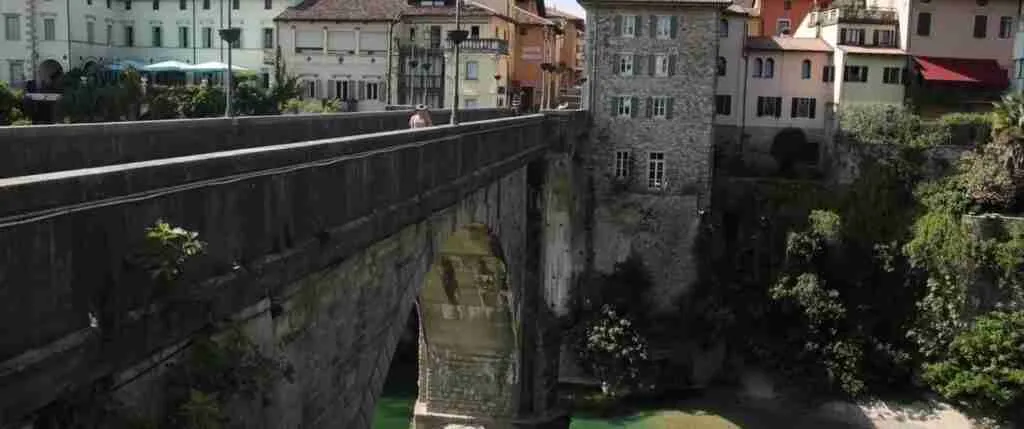
Begin at the Ponte del Diavolo (Devil’s Bridge), a single-span stone arch thrown over the deep Natisone gorge that has anchored the town’s skyline since the fifteenth century. Walk north through the medieval centre to the Duomo di Santa Maria Assunta, where the Museo Cristiano adjoins the cathedral and houses the extraordinary Altar of Ratchis (eighth century), a three-sided marble altar screen carved with relief scenes of the Nativity and Adoration of the Magi that represent the apex of Lombard sculptural achievement. Combined entry to the Museo Cristiano and the cathedral crypt costs approximately €4 (check museoarcheologiconazionale.beniculturali.it for current rates).
The Tempietto Longobardo — officially the Oratorio di Santa Maria in Valle — is reached through the courtyard of the Monastero di Santa Maria in Valle near the gorge. A small eighth-century oratory decorated with stucco relief figures in niches, their faces showing an extraordinary fusion of Byzantine, classical and Germanic aesthetic influence, it ranks among the most beautiful small spaces in all of Italian art. Entry costs approximately €4 (verify at the monastery). Nearby, the Ipogeo Celtico — a series of underground Celtic burial chambers discovered below the medieval city — adds an additional stratum to the town’s layered history; entry approximately €3.
The Collio Wine Road 2026: Gravner, Radikon and Orange Wine Country
The Collio Goriziano DOC stretches along a ridge of Eocene flysch — alternating layers of marl and sandstone — that runs east to west parallel with the Slovenian border. The combination of mineral-rich soil, cool nights from Alpine air and warm Adriatic afternoons produces white wines of unusual depth and complexity. The DOC is famous above all for Friulano (the local name for what was once controversially called Tocai), Ribolla Gialla, Malvasia Istriana and Pinot Grigio — but more specifically for what Josko Gravner and Stanko Radikon did with these grapes in the 1990s, pioneering extended skin contact fermentation and long aging in large oak or clay amphora that created the orange wine movement influencing winemakers from Georgia to California.
The town of Cormons is the Collio’s practical hub: a small country town with a good enoteca, the Enoteca di Cormons, operated by a consortium of local producers and open daily, where you can taste a structured cross-section of the appellation by the glass (€5–10 per glass for premium pours) without committing to a winery appointment. For serious wine visits, Radikon in Oslavia and Gravner in Oslavia both receive visitors by appointment — book at least two months ahead for Radikon (radikon.it) and farther ahead still for Gravner. Simpler drop-in tastings are available at many of the smaller Collio producers along the Strada del Vino e dei Sapori del Collio wine road signposted through the hills.
Dinner in the Collio belongs at Trattoria al Cacciatore de la Subida in Cormons, a Michelin-starred agriturismo serving the region’s most refined interpretation of Friulian cuisine — herb-gathered foraging menus, house-made pastas with game, extraordinary cheese boards with local honeys — at €60–90 per person including wine. Book well ahead at lasubida.it.
Day 6 in San Daniele del Friuli and Palmanova 2026
Day 6 combines a gastronomic pilgrimage with a UNESCO architectural experience that is entirely unlike anything else in Italy. The drive from Collio through the Tagliamento valley and over the plain to Palmanova covers approximately 60 kilometres and takes just over an hour, allowing a relaxed morning in San Daniele before an afternoon in the star-shaped city.
San Daniele del Friuli 2026: The World Capital of Prosciutto
San Daniele del Friuli sits on a hilltop above the Tagliamento river, 27 kilometres northwest of Udine, with dry Alpine breezes from the north meeting humid Adriatic air from the south — the microclimate that makes its DOP (Protected Designation of Origin) prosciutto unique among cured hams. Unlike Parma ham, which is produced in large industrial facilities, San Daniele prosciutto is still concentrated in a single town where roughly 30 prosciuttifici operate within the municipal boundaries, each aging their hams in the specific air that gives the product its sweet, delicate character. The entire Prosciutto di San Daniele DOP production must take place within the municipal territory.
Several producers offer free or nominally priced visits and tastings. Prosciuttificio Wolf (wolfbauer.it) and Prosciuttificio Dok Dall’Ava both receive visitors; most tastings cost €5–10 and include generous portions of thinly sliced prosciutto with bread. The annual Aria di Festa festival in late June opens all the prosciuttifici simultaneously for free public access, but advance visitor numbers make it crowded. Outside festival periods, call ahead. The town itself is pleasant: the fifteenth-century library (Biblioteca Guarneriana) holds one of the finest collections of illuminated manuscripts in northern Italy and merits a brief visit.
Palmanova 2026: The Perfect Star City
Palmanova is the most extraordinary urban planning exercise in Italy and one of the most intellectually stimulating destinations on this itinerary. Founded in 1593 by the Venetian Republic as an ideal defensive city, it was built from scratch in the shape of a nine-pointed star: nine bastions projecting from the outer walls, three hexagonal rings of boulevards converging on a central hexagonal piazza, six streets radiating from the centre like the spokes of a wheel. The geometry is absolute; the execution is complete. UNESCO inscribed Palmanova in 2017 as part of the Venetian Works of Defence alongside two dozen other Venetian fortifications from Bergamo to Cyprus.
Walking Palmanova is free. Enter through any of the three original gates — the Porta Aquileia, Porta Cividale or Porta Udine — and follow any spoke-road toward the central Piazza Grande, a vast hexagonal space ringed by uniform Renaissance-Baroque buildings. From the centre, the geometry is immediately legible: six identical perspectives stretch toward six gates, the whole town organized as a single unified composition. The full circuit of the outer walls on foot takes approximately 45 minutes and offers views across the Friulian plain to the Alps and, on clear days, toward the Adriatic. The Civico Museo Storico within the town walls covers the history of Palmanova’s construction, its military career and its later decline; admission costs €5 (check comune.palmanova.ud.it for current rates and hours).
Palmanova is a working town of approximately 5,000 residents who live in one of the world’s most extraordinary urban environments with an equanimity that visitors inevitably find charming. A caffè on Piazza Grande and a walk through the residential streets behind it — washing on lines between Renaissance facades, children cycling along the geometric boulevards — is as good a way as any to end the day.
Day 7 in Trieste 2026: Final Morning and Departure
Return to Trieste for the final night (Day 6) or the final morning (Day 7), depending on your departure time. Trieste repays a second morning: the experience of the city shifts when you know it, and there are destinations from Day 1 that a fuller itinerary doesn’t permit.
Museo Revoltella and Trieste’s Art Collections
The Museo Revoltella occupies the nineteenth-century palazzo of the Baron Pasquale Revoltella, a Venetian merchant who made his fortune in Trieste and left his home and art collection to the city on his death in 1869. The museum has expanded through a series of contemporary additions to house a substantial collection of Italian nineteenth and twentieth-century painting and sculpture. Admission costs approximately €10 adults (verify at museorevoltella.it); the combined ticket with the Teatro Romano and other civic museums offers additional value.
Risiera di San Sabba: A Necessary Memorial
The Risiera di San Sabba, a former rice-husking factory in Trieste’s industrial southern district, was converted during the German occupation (1943–45) into a transit and detention camp and, later, a killing site — the only confirmed Nazi death camp on Italian soil, with an active crematorium installed in 1944. It now operates as a national monument and museum documenting the occupation, the deportations and the specific history of the Triestine Jewish community, the Slovene partisan movement and the broader context of fascist and Nazi rule in the region. Entry is free. It is not a comfortable experience, but it is an important one: Trieste’s history in the mid-twentieth century is not reducible to its Habsburg elegance, and the Risiera makes that clear with unflinching documentary precision.
Final Coffee and Departure
Trieste’s airport at Ronchi dei Legionari is 30 minutes by car from the city centre. Venice Marco Polo is 90 minutes. Allow 2 hours before domestic European flights and 3 hours before intercontinental connections. A final caffè on Piazza Unità, watching the morning light come across the Adriatic, is the correct way to end a Friuli road trip in 2026.
Complete Budget Guide for 7 Days in Friuli 2026
Friuli-Venezia Giulia delivers outstanding value relative to better-known Italian regions. Mid-range accommodation, meals and wine that would cost €300–400 per person daily in Florence or along the Amalfi Coast typically runs €185–285 here. The breakdown below covers all daily expenses — car rental share, accommodation, all meals, entry tickets and incidentals — for two people sharing vehicle and accommodation throughout.
Budget Tier: €90–155 Per Person Daily in Friuli 2026
Budget travel in Friuli means hostel dormitories (€18–28 per bed in Trieste and Udine), budget double rooms (€50–80 per room in B&Bs and family-run pensioni, divided between two travelers as €25–40 each), lunch at a bar or standing buffet, dinner at the most modest trattorie, and selective spending on entry tickets. An economy rental car shared between two costs €20–35 per person per day including fuel. Key daily components: accommodation per person share €25–40, breakfast €5–8, lunch €12–18, dinner €18–30, coffee and snacks €5–8, transport share €20–35, attractions €5–15. Daily total: €90–155 per person. A full 7-day budget trip costs approximately €630–1,085 per person.
Mid-Range Tier: €185–285 Per Person Daily in Friuli 2026
Mid-range travel in Friuli means three-star hotels and charming B&Bs in good central locations (€120–180 per room per night, divided as €60–90 per person), sit-down lunches at established trattorias, evening meals at proper osterias with wine, and the full range of entry tickets without worrying about cost. A comfortable mid-range rental car shared between two runs €30–50 per person daily. Key components: accommodation €60–90, breakfast €10–15, lunch €20–30, dinner €40–58, coffee and snacks €8–12, transport €30–50, attractions €15–30. Daily total: €185–285 per person. A full 7-day mid-range trip costs approximately €1,295–1,995 per person.
Luxury Tier: €365–590 Per Person Daily in Friuli 2026
Luxury in Friuli means the four-star grand hotels in Trieste (Savoia Excelsior Palace, NH Trieste), boutique relais and design agriturismi in the Collio hills, Michelin-level dining (La Subida in Cormons, Vitello d’Oro in Udine), premium Collio wines by the bottle at winery prices, and private or guided tours at key UNESCO sites. Luxury car rental (premium compact, SUV or estate) divided between two runs €55–90 per person daily. Key components: accommodation €125–200, breakfast €20–30, lunch €40–65, dinner €80–120, coffee and snacks €15–25, transport €55–90, attractions €30–60. Daily total: €365–590 per person. A full 7-day luxury trip costs approximately €2,555–4,130 per person.
Sample Mid-Range Day Cost: Day 5 (Cividale and Collio)
This represents one specific mid-range scenario for Day 5. Collio agriturismo room €150 (two sharing, per person €75). Breakfast at the agriturismo €12. Morning coffee and Ponte del Diavolo walk in Cividale: €6. Cividale museum and Tempietto entry €8. Lunch at Enoteca di Cormons with two wine pours €30. Afternoon wine tasting at two Collio producers €20. Dinner at a Cormons trattoria (not La Subida) €55. Car fuel and transport share €20. Day total approximately €226 per person — within the €185–285 mid-range daily range.
Attraction Costs Quick Reference for Friuli 2026
- Miramare Castle and Park: €14 adults (museocastellomiramare.it for current rates)
- Grotta Gigante: €15 adults (grottagigante.it)
- Aquileia Museo Nazionale Archeologico: €6 (museoarcheologicoaquileia.beniculturali.it)
- Aquileia Basilica: free entry, voluntary donation customary
- Udine Archbishop’s Palace (Palazzo Patriarcale — Tiepolo frescoes): €8
- Udine Castello and Civici Musei: €8
- Cividale Museo Cristiano and cathedral: €4
- Cividale Tempietto Longobardo: €4
- Cividale Ipogeo Celtico: €3
- Palmanova Civico Museo Storico: €5
- Trieste Castello di San Giusto: €5
- San Daniele prosciuttificio visits: free to €10 depending on producer
- Grado Basilica di Sant’Eufemia: free entry
All prices are 2026 estimates. Check each site’s official website before your visit as prices update annually. Italy’s state museum system (Musei Statali) operates free entry on the first Sunday of each month — if your visit aligns with this, the Aquileia archaeological museum and other national-operated sites are free.
Where to Stay During Your Friuli Road Trip 2026
Accommodation in Friuli-Venezia Giulia organizes naturally into three geographic clusters corresponding to the itinerary: Trieste for Days 1–2 and Day 7; an inland base (Udine city, Collio hills agriturismo, or Cividale del Friuli) for Days 3–6; and optionally a lagoon stop near Grado for one night. The split-base strategy — two nights in Trieste, four nights in an agriturismo in the Collio or Udine, final night back in Trieste — is the most immersive and logistically sensible approach.
Accommodation in Trieste 2026
Trieste offers the most hotel variety in the region. At the luxury end, the Savoia Excelsior Palace on the seafront promenade is Trieste’s grande dame — a nineteenth-century hotel with views across the Gulf, a magnificent breakfast room and rooms ranging from €200–380 per night. The NH Trieste, in the Habsburg grid near the canal, is reliable four-star comfort at €140–200. For mid-range stays with central location, the Hotel Continentale near Piazza Unità (€110–160 per room) and numerous B&Bs in the old town (€80–130) deliver good value. Budget travelers find practical hostels (€20–30 per dorm bed) and simple two-star hotels (€60–90 per room) within walking distance of the centre.
Accommodation in the Collio Hills 2026
Staying in an agriturismo in the Collio for two or three nights is the definitive Friulian experience. The Agriturismo Subida near Cormons — connected to the Michelin-starred Trattoria al Cacciatore — offers beautifully appointed rooms amid vineyards at €180–260 per room, with breakfast and dinner available on-site. Smaller family agriturismi throughout the Collio wine road offer rooms from €90–140 per room with farm breakfasts that frequently include house-produced prosciutto, Montasio and Friulano wine. These book out in September (harvest season) and in early summer; reserve at least 6 weeks ahead for those periods.
Accommodation in Udine 2026
For an inland base that gives easier access to Cividale, San Daniele, Palmanova and the mountains, Udine offers mid-range hotels at good city-centre prices. Hotel Là di Moret, a family-run four-star on the southern approach, combines comfort with an excellent restaurant specializing in Friulian cuisine (€130–190 per room). The Hotel Astoria on Via Cividale, 10 minutes’ walk from Piazza Libertà, is reliable mid-market at €100–150 per room. Budget travelers find several B&Bs and rooms-above-restaurants in the old town for €65–95 per room.
Friulian Food and Wine: What to Eat and Drink in 2026
Friulian cuisine occupies a fascinatingly specific culinary position: it is Italian in its ingredients (olive oil, pasta, grilled meats, Adriatic fish) but Central European in its flavours (caraway, horseradish, sauerkraut, smoked meats) and Alpine in its reliance on dairy and polenta. Understanding what to order — and where — is the difference between a good meal and a great one.
Essential Friulian Dishes in 2026
Frico con patate is the region’s signature dish: a golden cake of aged Montasio cheese and potato, fried until crisp on the outside and molten at the centre, served with polenta. Every osteria and trattoria makes it; every version is slightly different. It costs €8–12 as a starter or shared antipasto.
Cjalson (also spelled cjalsons) are half-moon pasta parcels filled with a complex sweet-savory mixture of spinach, potato, herbs, raisins and ricotta, typically dressed with melted butter, smoked ricotta and cinnamon — a filling that encodes the trade routes between Venice, the Alpine valleys and the Central European world in a single bite. €12–18 as a first course.
Prosciutto di San Daniele DOP is Italy’s other great cured ham — sweeter, more delicate and more complex than Parma in the view of many experts. Eat it on its own, sliced to order at a prosciuttificio in San Daniele, with nothing more than unsalted bread.
Brovada e muset is a winter pairing: fermented turnip brovada (marinated in grape marc and aged) served alongside musetto, a fresh pork sausage heavy with black pepper and cinnamon. An acquired taste that rewards the adventurous palate; a classic of the Friulian autumn-winter table at €14–18 per portion.
Boreto alla gradese is the ancient fish stew of Grado: mixed small fish cooked in wine vinegar with olive oil and pepper, served over white polenta. Available at almost every restaurant in Grado; €16–24 per portion.
Gubana is the region’s great celebration pastry: a yeasted dough rolled around a filling of dried fruit, nuts, grappa and spices, baked as a spiral and served sliced. The Cividale del Friuli version and the Natisone valley version are the benchmarks; available in every pasticceria in the region at €12–20 for a whole gubana.
Friulian Wines in 2026: What to Order and Where
Friuli-Venezia Giulia is one of Italy’s most technically sophisticated wine regions, with a density of acclaimed producers per hectare that rivals Burgundy and Alsace. White wines dominate, representing roughly 65% of production in the premium DOCs.
Friulano (the local name for what was historically marketed as Tocai Friulano until a 2007 EU ruling prohibited the Tocai name) is the regional signature grape: pale gold with a slightly almond-bitter finish, mineral and persistent, capable of aging 5–15 years in the best vintages from Collio and Friuli Colli Orientali. By the glass at local enoteca: €5–10.
Ribolla Gialla is the grape responsible for the orange wine movement. In conventional skin-off production it is bright, citric and light; in the extended maceration versions pioneered by Gravner and Radikon — 6–12 months on the skins in large Slavonian oak barrels — it becomes amber, tannic, profound and polarizing. Both styles have merit; the Enoteca di Cormons in Cormons is the best place to taste a structured comparison. By the glass: €6–15 depending on producer and aging.
Ramato is Pinot Grigio made as the Venetians made it in the sixteenth century: with brief skin contact that extracts the grape’s naturally copper-pink pigment, producing a wine that is mineral and slightly textured rather than the thin neutral style that most of the world knows as Pinot Grigio. By the glass: €5–9.
Terrano (Carso DOC) and Refosco dal Peduncolo Rosso (Friuli Colli Orientali) are the reds to drink with the region’s cheese and cured meat heavy cuisine. Terrano from the Carso plateau is aggressively tannic and iron-mineral; Refosco is plummy and rustic. Both are best with food rather than alone. By the glass: €4–8.
Money-Saving Strategies for Your Friuli Road Trip in 2026
Time your visit to avoid peak season. Friuli’s peak tourist periods are July–August on the coast and the Grape Harvest Festival weeks in late September. Prices for accommodation in Grado and Trieste drop 20–35% in May–June and early October, and the crowds at Aquileia and Miramare are dramatically smaller before mid-July.
Book museum entries in advance. Miramare Castle in particular fills timed entry slots weeks ahead in high summer. Booking online at museocastellomiramare.it is free and guarantees entry at your preferred time. Aquileia’s Museo Nazionale Archeologico rarely requires advance booking outside peak weekends.
Use the free-entry first Sunday. Italian state museums (Musei Statali) offer free entry on the first Sunday of each month. If your visit falls on this date, the Aquileia archaeological museum, Museo Nazionale di Cividale del Friuli and other state-operated sites are free — saving €15–25 per person.
Eat lunch rather than dinner at good restaurants. Many of Friuli’s best trattorias offer a weekday pranzo fisso (fixed lunch menu) at €15–22 that includes first course, second course and house wine. The evening menu at the same restaurant for equivalent quality typically costs €40–60. Reserve the splurge dinner (La Subida, Vitello d’Oro in Udine) for one occasion and eat the fixed lunch throughout the rest of the week.
Buy wine at the winery. Collio wines at top producers cost €15–35 per bottle purchased at the cantina — 20–40% less than the same bottles in restaurants and 30–50% less than import pricing in northern Europe or North America. If you’re flying home, check airline liquid restrictions before loading up; shipping wine by postal service from Italy is straightforward for larger quantities.
Consider an agriturismo for multiple nights. An agriturismo in the Collio hills for three nights costs more per night than a budget hotel but typically includes an outstanding farm breakfast worth €12–18 in restaurant value, eliminates two or three restaurant dinners (many agriturismi offer a cena option), and positions you centrally for Days 4–6 of the itinerary without additional driving time.
Practical Tips for Driving Through Friuli in 2026
ZTL Zones and Historic Centre Parking 2026
Virtually all Friulian historic centres operate ZTL (Zona a Traffico Limitato) restricted driving zones, typically operational 8 AM–8 PM on weekdays and Saturday mornings. Your GPS will warn you; if not, look for the circular red-outlined ZTL sign. Violations are photographed automatically and fines — sent to the rental company and forwarded to you — typically run €80–150. Use designated car parks on the periphery of historic centres: Trieste (Piazza Libertà car park), Udine (Piazzale D’Annunzio or Piazzale Osoppo), Palmanova (designated external parking along the walls), Cividale (Piazzale Resistenza). All these are signed from the main approach roads and most charge €1.50–2.50 per hour.
Motorway Tolls and Routes
The A4 motorway (Trieste–Venice) and A23 (Palmanova–Udine–Tarvisio toward Austria) are both tolled. Keep a credit card accessible for toll payment or use Telepass-equipped rentals if available. Budget approximately €25–40 in tolls for the full week depending on your exact routing. The alternative SS (state road) network is mostly excellent and often faster for shorter hops: the SS56 between Cividale and Udine, the SS351 through the Collio hills and the SS352 toward the coast are all scenic and well-maintained.
Driving the Collio Wine Road
The Collio wine road follows narrow lanes through vine-covered hills on the Slovenian border; some sections are single-track with passing places. Drive slowly, watch for agricultural vehicles and tractors especially in September during harvest, and do not attempt the winding ridge roads after significant wine tasting. The border between Italy and Slovenia is open (both are Schengen countries) and you will cross it unannounced several times on the Collio route — this is fine and expected, but check your car rental agreement confirms EU cross-border driving is permitted (it almost always is for standard Schengen travel).
Connectivity and Navigation
Mobile signal is generally good throughout Friuli-Venezia Giulia, including the Collio hills, though it drops occasionally in deep Carso caves and in some mountain valleys north of Udine. Download Google Maps or Maps.me offline maps for the region before departing. Italian road signs follow standard European conventions. Petrol stations are common along major roads but sparse in the Collio hills — fill up in Cormons or Cividale before exploring the wine road.
Frequently Asked Questions About 7 Days in Friuli 2026
Is Friuli-Venezia Giulia worth visiting in 2026?
Friuli-Venezia Giulia consistently delivers one of the best value-to-experience ratios of any Italian region in 2026. Three UNESCO World Heritage Sites, one of Italy’s most distinctive cities (Trieste), a globally influential wine region, Italy’s finest prosciutto, and 2,000 years of layered cultural history — all within a compact geography that avoids the overtourism pressures of Tuscany and Veneto. Visitor numbers are growing but the region is not yet crowded by southern European standards. Anyone who has already visited Venice, Florence and Rome and wants to experience a more authentic and less commodified Italian cultural landscape will find Friuli-Venezia Giulia rewarding and — in many respects — superior.
Can I complete this 7-day itinerary without a car?
Partially. Trieste, Udine and Gorizia are connected by regional trains; Trieste to Udine takes 80–100 minutes by rail and costs approximately €9. Aquileia and Grado are reachable from Trieste by bus (Tpl Fvg regional buses). However, Miramare Castle, Grotta Gigante, the Collio wine road, San Daniele del Friuli and most Palmanova approaches are impractical or impossible by public transport. A compromise is to rent a car for three or four days specifically covering the rural portions (Collio, San Daniele, Carso) and use trains for the Trieste–Udine axis. For a fully car-free trip, compress the itinerary to Trieste, Udine, Gorizia and a day trip to Aquileia — a rewarding week but a different experience from the full road trip.
What is the best time of year for this Friuli road trip?
May–June and September–October are the optimal periods. May delivers light crowds, blooming vineyards and perfect driving weather. September combines warm days, the grape harvest atmosphere in the Collio, and the most dramatic light. August is hot and the Grado coast is crowded, though inland sites including Aquileia and Cividale remain manageable before 10 AM. Winter (November–March) is atmospheric in Trieste and Udine but some agriturismi close and mountain road access depends on snow conditions. The Aria di Festa festival in San Daniele (late June) opens all prosciuttifici simultaneously and makes an excellent specific destination if your timing allows.
How many days do I really need to see Friuli-Venezia Giulia?
Seven days is the minimum for a genuinely comprehensive first visit covering all three UNESCO sites, both major cities, the wine country and the coast. Five days is possible with tighter scheduling — compress Day 3 (Grado) and Day 6 (San Daniele) into shorter half-days and skip one of the two Trieste days. Ten days or more allows side trips into the Carnic Alps north of Udine (Tolmezzo, the Tagliamento headwaters, Sauris — a German-speaking enclave making excellent smoked ham and craft beer at altitude), the Dolomiti Friulane natural park, and more extended wine country exploration. First-time visitors consistently report that they wished they had booked more time; the standard one-day detour from Venice or two nights in Trieste that appear on most Italian itineraries barely scratches the surface.
Is Trieste expensive compared to other Italian cities?
Trieste is noticeably less expensive than Venice, Florence and Milan. Hotel rooms at comparable quality run 20–35% below Venice prices. Restaurant meals are modestly priced by northern Italian standards — a full dinner at a good osteria costs €30–50 per person, compared to €50–80 in Venice for equivalent quality. The city’s historic caffè culture operates at bar prices: coffee at the counter costs €1.50–2.00 at even the grandest establishments. Trieste also benefits from competition: the city receives far fewer international leisure tourists than Venice and hotels price competitively for the corporate and transit market this brings.
What Italian and English-language resources should I book before arriving in Friuli in 2026?
Book Miramare Castle timed entry well in advance (museocastellomiramare.it — English interface available). Book La Subida restaurant in Cormons at least a month ahead for dinner (lasubida.it). For Radikon winery visits, email months ahead; Gravner is harder still to arrange. Book Collio agriturismo accommodation for September before June. For prosciuttificio visits in San Daniele, Dok Dall’Ava and Wolf Bauer both accept email enquiries in English. No other major advance booking is required, though summer weekend lunchtimes at popular Udine osterias fill up by noon — arrive early or reserve the day before.
Are there good options for vegetarians traveling in Friuli in 2026?
Friulian cuisine is meat and cheese heavy, but vegetarians travel well here with modest adaptation. Frico con patate is fully vegetarian and one of the region’s best dishes. The cheese tradition — Montasio DOP in its multiple aging stages, latteria cheeses, Malga alpine cheeses — is extraordinary, and cheese-focused tastings at local latterie (dairy cooperatives) are available throughout the region. Mushrooms (porcini, chanterelles) are extensively used in autumn menus. Pasta dishes without meat are plentiful. Strict vegans face more difficulty in the traditional osteria context but the newer wine bar and contemporary trattoria sector in Trieste and Udine offers broader vegetable-forward options. The Collio wine country’s agriturismo kitchens typically accommodate dietary requirements with advance notice.
How does Friuli-Venezia Giulia compare to Tuscany as a road trip destination?
The comparison illuminates what makes both regions distinctive. Tuscany delivers rolling hills, Renaissance art cities and globally recognized wines in a landscape now heavily optimized for international tourism, with corresponding prices and summer crowds. Friuli delivers equal or greater cultural depth — three UNESCO sites, Tiepolo frescoes, Roman mosaics, medieval Lombard monuments, genuinely world-class wines — in a landscape that remains largely Italian in character and audience. Restaurant tables do not require weeks of advance booking. Wine producers in the Collio welcome visitors with a directness that the celebrity wineries of Chianti have long since abandoned. Hotel prices are substantially lower. The driving distances are shorter. The food is more distinctively regional. Travelers who have done Tuscany and want something equally rewarding but entirely different will find Friuli-Venezia Giulia to be the answer.