Friuli-Venezia Giulia Without the Crowds: A Curated Guide to Europe’s Cultural Crossroads
Tucked into Italy’s northeastern corner where the Alps descend to the Adriatic and the peninsula dissolves into Central Europe, Friuli-Venezia Giulia defies easy categorisation. This is a region shaped by Roman emperors, Lombard kings, Habsburg bureaucrats, Venetian merchants, and Slavic shepherds — a place where Italian, Germanic, and South Slavic worlds genuinely overlap rather than merely border one another. While millions flood Venice and Tuscany each year, Friuli-Venezia Giulia rewards the curious traveller with extraordinary depth and near-total freedom from tourist fatigue.
Key Takeaways
- Cultural complexity unlike any other Italian region: Friuli-Venezia Giulia sits at the genuine meeting point of Latin, Habsburg, and Slavic civilisations, producing an identity — in architecture, cuisine, language, and outlook — that exists nowhere else in Europe.
- Trieste is one of Europe’s great literary and café cities: The former Habsburg port retains its grand coffeehouses, a melancholy imperial elegance, and associations with James Joyce, Rainer Maria Rilke, and Italo Svevo that have shaped modern European literature.
- Aquileia preserves one of the Roman world’s most important lost cities: Once the fourth-largest city in the Roman Empire, Aquileia now sleeps beneath quiet fields and contains UNESCO-listed treasures including the largest surviving early Christian mosaic floor on earth.
- World-class white wines from Collio and Friuli Colli Orientali: The region’s hillside wine country produces Friulano, Ribolla Gialla, and Malvasia Istriana at a quality level that rivals any white wine region in the world, yet remains largely undiscovered by international visitors.
- Three separate UNESCO World Heritage inscriptions: Aquileia’s archaeological zone, Cividale del Friuli’s Lombard heritage, and the Renaissance star-fortress of Palmanova together demonstrate the region’s extraordinary layering of civilisations across two millennia.
- Visitor numbers remain a fraction of neighbouring regions: Even in peak summer, the region’s most significant cultural sites see a small fraction of the crowds found in Venice or Florence, making Friuli-Venezia Giulia one of Italy’s most rewarding and practical discoveries for culturally motivated travellers.
People Also Ask About Friuli-Venezia Giulia
What makes Friuli-Venezia Giulia different from other Italian regions?
Friuli-Venezia Giulia is unlike any other Italian region because it has never been purely Italian in the cultural, linguistic, or political sense. The western Friuli zone was long part of the Patriarchate of Aquileia, an ecclesiastical power independent of both Rome and Venice. The eastern strip around Trieste spent four centuries as the Habsburg Empire’s vital Adriatic outlet, developing a cosmopolitan identity rooted in Vienna, Prague, and Thessaloniki as much as in Rome. Slovenian and Friulian remain officially recognised minority languages, still spoken daily in villages across the region. The cuisine borrows from goulash to kaiserschmarrn, from Venetian cicchetti to Central European smoked meats. Even the landscape refuses Italian convention: the same region contains the jagged Friulian Dolomites, the bare limestone Carso plateau, the lagoons of Grado and Marano, and the Adriatic coast — all within a two-hour drive. This is a place where European crosscurrents created something singular rather than simply mixed.
What are the best places to visit in Friuli-Venezia Giulia?
The region’s essential destinations form a loose triangle of complementary characters. Trieste anchors the southeast with its Habsburg grandeur, great coffeehouses, and extraordinary seaside castle of Miramare. Udine offers a compact and elegant Venetian-influenced city with Tiepolo frescoes and lively aperitivo culture. Aquileia, south of Udine, stands as one of Italy’s most moving Roman and early Christian sites, with floor mosaics of staggering ambition. Cividale del Friuli preserves the most evocative Lombard monuments in existence, including the Tempietto Longobardo. Beyond these anchors: the star-shaped Renaissance fortress city of Palmanova, the wine country villages of Collio and the Colli Orientali, the fairy-tale hilltop castle of Spilimbergo, the Alpine town of Tarvisio near the triple border with Austria and Slovenia, and the little-visited medieval villages of the Carnia highlands all reward deeper exploration.
What is Friuli-Venezia Giulia known for?
The region is best known among food and wine lovers for San Daniele prosciutto, considered by many the finest in Italy, and for the white wines of Collio and Friuli Colli Orientali — Friulano, Ribolla Gialla, Malvasia Istriana, and Pinot Grigio produced with a seriousness and terroir expression that ranks among Europe’s finest. Culturally, Trieste holds a special place in European literary history as the city where James Joyce wrote most of Dubliners and A Portrait of the Artist as a Young Man, where Italo Svevo produced Zeno’s Conscience, and where Umberto Saba kept his bookshop for decades. Historically, the region is known for Aquileia’s Roman and early Christian heritage, the Lombard kingdom centred on Cividale, and the Habsburg port culture of Trieste. The region is also increasingly recognised for its extraordinary natural diversity, from the Dolomite peaks of Carnia to the Mediterranean-influenced limestone karst of the Carso.
How do you travel around Friuli-Venezia Giulia?
A hire car is the single most liberating way to explore Friuli-Venezia Giulia, particularly for reaching the wine villages of Collio, the Alpine communes of Carnia, the Carso plateau, and smaller towns like Cividale and Palmanova. The regional rail network connects Trieste, Udine, Pordenone, and Gorizia with reasonable frequency, and direct trains run from Venice Santa Lucia to Udine and Trieste in under two hours. Within Trieste, the city’s historic tram to Opicina — the world’s oldest funicular tram still in service, though subject to periodic maintenance closures — offers a memorable ascent to the Carso. Cross-border travel is seamless: Trieste connects to Ljubljana by rail in under two hours, and Tarvisio sits minutes from the Austrian and Slovenian borders. The region’s compact size means that Trieste, Udine, and Aquileia all fall within a roughly sixty-kilometre triangle, making day trips from a single base entirely practical.
Extended multi-day tours – 5+ days
Featured Northern Italy Multi-Day Tour Packages
3 days
Northern Italy 3-Day Discovery Tour
- ✓ Comprehensive Northern Italy experience
- ✓ Expert local guides included
- ✓ All accommodation included
- ✓ Transportation provided
5 days
Northern Italy 5-Day Highlights Experience
- ✓ Comprehensive Northern Italy experience
- ✓ Expert local guides included
- ✓ All accommodation included
- ✓ Transportation provided
7 days
Northern Italy 7-Day Cultural Journey
- ✓ Comprehensive Northern Italy experience
- ✓ Expert local guides included
- ✓ All accommodation included
- ✓ Transportation provided
10 days
Northern Italy 10-Day Complete Adventure
- ✓ Comprehensive Northern Italy experience
- ✓ Expert local guides included
- ✓ All accommodation included
- ✓ Transportation provided
Multi-day tour packages powered by TourRadar. Prices and availability subject to change.
Introduction: Italy’s Best-Kept Regional Secret
There are regions in Italy that everyone visits and regions that everyone means to visit. Friuli-Venezia Giulia occupies a third category: a region that most Italian travellers would freely name as extraordinary but that somehow remains perpetually overlooked in favour of more familiar alternatives. The reasons for this are partly structural — it lies at the end of the peninsula, past Venice, beyond the natural circuit of most northern European itineraries — and partly the result of a cultural reticence that characterises the region itself. Friulians are famously reserved, proud of their identity without needing to advertise it, and quietly confident that those who make the effort to find them will understand why they stayed.
What awaits those who make that effort is one of the most intellectually stimulating travel destinations on the continent. Nowhere else in Italy can you stand in a Roman mosaic workshop that predates Constantinople, drive twenty minutes to taste a Ribolla Gialla fermented in Georgian terracotta amphorae, continue another half hour to walk Habsburg neoclassical boulevards that would be at home in Vienna, and finish the day at a seafood counter where the menu is written in three languages, none of them English. The layering is not a museum exercise but a living texture: the Friulian language thrives in village bars, Slovenian surnames appear on doorplates in towns that look architecturally Venetian, and the espresso — ordered as a nero in Trieste’s inscrutable local nomenclature — arrives in a glass, not a cup.
The region divides naturally into two historic and administrative zones that were joined into a single administrative unit in 1963. Friuli, the larger western portion, traces its name back to the Roman colony of Forum Iulii (modern Cividale del Friuli) and encompasses the plains, the Dolomite foothills, the Carnia highlands, and the northern wine country. Venezia Giulia, the smaller eastern portion, centres on Trieste, the Carso plateau, Gorizia, and the Istrian border. The two zones share a regional parliament in Trieste but carry distinct personalities: Friuli feels agricultural and self-sufficient, a land of hard winters and prosperous farms; Venezia Giulia carries the melancholy grandeur of a former great-power capital, cosmopolitan and elegiac.
This guide covers both, with equal attention to the well-known anchors and the smaller discoveries that reward unhurried travel. The intention is not to overwhelm with comprehensive lists but to give the culturally curious traveller a genuine orientation to a place that has shaped European history more profoundly than its current profile suggests.
Understanding Friuli-Venezia Giulia: The Crossroads Explained
To understand Friuli-Venezia Giulia, it helps to discard the familiar map of Italy and substitute an older one. In the Roman imperial period, Aquileia was not a provincial backwater but one of the empire’s most strategically vital cities — the gateway to the Danube frontier, the base for campaigns into Pannonia and Illyricum, and the commercial hub connecting the Mediterranean to Central Europe. The Via Postumia, the Via Annia, and the Via Julia Augusta all converged here. When the empire required resupply for legions on the Rhine-Danube line, the goods moved through Aquileia.
After Rome’s fall, the same geographic logic attracted successive powers. The Lombards made Cividale (Forum Iulii, later Civitas Austriae) their first Italian capital after 568 AD, establishing a duchy whose cultural legacy survived centuries and whose artistic production — the Tempietto Longobardo, the altar of Ratchis, the baptistery of Callisto — remains among the finest surviving work of the early medieval period. The Patriarchate of Aquileia, established in late antiquity and centred alternately on Aquileia, Grado, and Cividale, functioned as an independent ecclesiastical power for nearly a millennium, mediating between Rome, the Byzantine exarchate of Ravenna, and the Carolingian court.
Venice controlled the western Friuli lowlands from the fifteenth century, imposing its architectural vocabulary — the Venetian Gothic loggia, the lion of Saint Mark in stone above city gates, the system of campielli and sottoportici — on towns that had previously looked toward Central Europe. Habsburg Austria controlled Trieste and the Giulia zone almost continuously from the seventeenth century until 1918, building the grand neoclassical city that still dominates the gulf and establishing the free port whose mercantile cosmopolitanism attracted Greeks, Serbs, Jews, Armenians, and merchants from every corner of the empire.
The twentieth century added further complexity. Trieste’s transfer to Italy after World War One brought Italian nationalist fervour and Fascist policy — including the suppression of Slovenian-language schools — that left lasting resentments. The Nazi occupation of 1943-1945 was particularly brutal: the Risiera di San Sabba, a former rice-husking facility converted into the only death camp on Italian soil, operated in a Trieste suburb and now functions as a national memorial. The postwar Free Territory of Trieste (1947-1954), nominally independent and administered in two zones by American-British and Yugoslav forces, was a last gasp of the old Mitteleuropean ambiguity before the city’s definitive incorporation into the Italian Republic.
The result of all this history is a region with a genuinely polyphonic identity. Three distinct minority communities — Friulian-speakers (a Rhaeto-Romance language closer to Ladin and Romansh than to Italian), Slovenian-speakers concentrated in the Carso and the border zone, and a historically significant German-speaking community in the northern Carnia — are recognised under Italian and European law. The regional cuisine, discussed at length below, draws from at least four distinct culinary traditions. And the built environment — Roman ruins, Lombard stonework, Venetian loggias, Habsburg neoclassicism, and twentieth-century industrial architecture — layers periods with a density that requires time and attention to read.
Trieste: The Habsburg City at the Edge of Italy
Trieste is one of the great European cities that most Europeans have never visited. It sits at the far eastern tip of a peninsula jutting into the Adriatic, backed against a limestone plateau, and carries the unmistakable atmosphere of a place that was once the centre of something vast and is now at the edge of something smaller. The Habsburg Empire made Trieste its principal seaport in the eighteenth century under Charles VI and Maria Theresa, granting it free-port status in 1719 and building the ordered neoclassical city that still defines the seafront and the Canal Grande quarter. At its peak in the late nineteenth century, Trieste handled more trade than either Marseille or Hamburg.
The central Borgo Teresiano, laid out on a rational grid north of the old hilltop city, showcases the neoclassical ambition of Habsburg urban planning. The Piazza Unità d’Italia — arguably the largest sea-facing piazza in Europe — opens directly onto the gulf with a theatrical confidence that belongs entirely to the imperial imagination. The surrounding palaces, built for insurance companies, shipping firms, and civic institutions in styles ranging from neoclassical to Art Nouveau to Viennese Secession, give the square a formal grandeur that becomes more moving the longer you sit with it.
Trieste’s coffeehouse culture is genuine rather than nostalgic. The Caffè degli Specchi, Caffè Tommaseo, and Caffè San Marco have been operating for well over a century and retain the atmosphere of places where ideas were still considered important. San Marco, opened in 1914, is particularly extraordinary: its Liberty-style interior, with its dark wood panelling and faded newspaper atmosphere, functions as a kind of living museum of Central European café culture. The local coffee nomenclature — nero for espresso, capo for macchiato, deca for decaffeinated — is Triestino rather than Italian, and locals will gently correct the uninitiated.
The city’s literary identity centres on a remarkable early twentieth-century constellation. James Joyce arrived in Trieste in 1904 and spent most of the following decade teaching English at the Berlitz school, writing in the evenings and revising constantly. He completed most of Dubliners here, drafted significant portions of A Portrait of the Artist as a Young Man, and began planning Ulysses. A walking map of Joyce’s Trieste, available at the city’s tourism offices, traces his various apartments, schools, and haunts through the old city. Italo Svevo — born Aron Ettore Schmitz, son of a German Jewish merchant and an Italian Jewish mother, writing in Italian while thinking in a mixture of Triestino dialect, German, and commercial pragmatism — was among Joyce’s English students, a friendship that shaped both men. Svevo’s masterpiece La Coscienza di Zeno (Zeno’s Conscience, 1923) remains the great novel of Triestine consciousness: ironic, psychoanalytically inflected, and constitutionally ambivalent. The poet Umberto Saba kept his antiquarian bookshop, the Libreria Antiquaria, in the old city for decades; it still operates at via San Nicolò 30, selling old books in a room that feels unchanged since the 1930s.
Beyond the literary geography, Trieste rewards unhurried exploration in its museums and hilltop quarters. The Museo Revoltella, a neoclassical palazzo converted into a modern art museum, contains an extraordinary collection spanning from nineteenth-century Biedermeier to postwar Italian abstraction. The hilltop Città Vecchia, with its Roman theatre, its medieval church of San Silvestro, and its Venetian-era Cathedral of San Giusto overlooking the gulf, provides a completely different register from the imperial grandeur below. The Castello di San Giusto, a fifteenth-century fortification incorporating Roman and medieval fabric, houses municipal museums and offers panoramic views across the gulf to the Istrian peninsula.
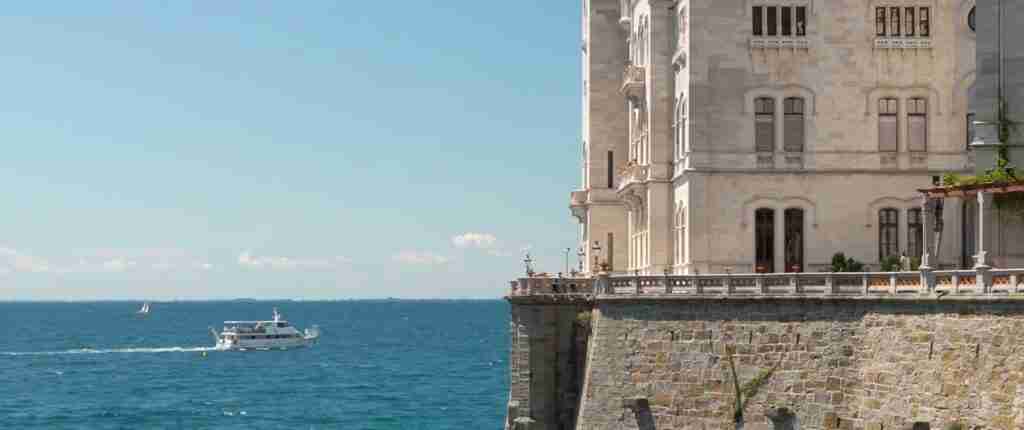
Six kilometres north of the city centre, the Castello di Miramare demands a half-day visit. Built between 1856 and 1860 for Archduke Maximilian of Habsburg — younger brother of Emperor Franz Josef I, who would later become the ill-fated Emperor of Mexico — the castle sits on a promontory above turquoise waters and combines neo-Gothic and Romantic architectural elements with the atmosphere of a story that ended badly. The interiors, recently restored, preserve Maximilian’s personal library, his navigational charts, his daughter’s nursery, and the peculiar mixture of imperial ambition and personal melancholy that characterised the man. The surrounding park, designed in the English landscape style, descends to a private beach and small harbour and remains one of the Adriatic coast’s most beautiful settings.
Trieste also offers the most accessible entry point into the Carso plateau via the Opicina tram — when it operates — and serves as a natural base for day trips to Muggia (the region’s last Venetian-era fishing village), the cave system of the Grotta Gigante (one of the largest accessible cave chambers in the world), and the wine villages of the Carso DOC zone.
Udine and the Heart of Friulian Identity
Udine occupies the geographical and psychological heart of Friuli: a compact, prosperous, and quietly elegant city of roughly 100,000 people that functions as the cultural capital of the region even though the administrative capital sits in Trieste. The city looks Venetian — the lion of Saint Mark presides over the loggia-framed Piazza della Libertà, which Casanova reportedly called the finest square in mainland Venetian territory — but feels distinctly Friulian in its pace, its food culture, and its relationship to the surrounding landscape.
The Piazza della Libertà, enclosed by a graceful fifteenth-century loggia on one side and the Renaissance Torre dell’Orologio on another, is among northern Italy’s most satisfying civic spaces. Unlike Venice’s permanently theatrical Piazza San Marco, it functions as a genuine daily meeting place rather than a tourist stage: locals eat lunch at the caffès, pensioners sit in afternoon sun, schoolchildren cut through on bicycles. The Venetian Gothic Loggia del Lionello (1448-1456), named for its architect Bartolomeo delle Cisterne (called Lionello), frames one entire side with a precision and delicacy that rewards extended study.
The Castello di Udine, perched on the artificial hill at the city’s centre — the legend that Attila the Hun piled the earth by hand to watch Aquileia burn is certainly false, but persists with affection — houses the Civici Musei e Gallerie di Storia e Arte, whose collection includes paintings by Tiepolo, Carpaccio, and Piazzetta alongside archaeological material from the Friulian plains. The castle’s position provides orientating views over the city and, on clear days, across the plains to the Dolomite foothills.
Giambattista Tiepolo spent three years in Udine (1726-1728) executing what many consider the finest fresco cycle of his career. The Gallerie del Tiepolo in the Palazzo Arcivescovile contains the Old Testament frescoes that established his reputation: the Fall of the Rebel Angels on the staircase ceiling, the scenes from the life of Abraham and Sarah in the Gallery, and the Judgement of Solomon in the Red Room. These are not museum pieces on walls but immersive ceiling paintings that require craning and moving and returning repeatedly; the light on the staircase fresco changes dramatically through the afternoon. Tiepolo also contributed to the Cathedral (Duomo) of Udine, where his collaboration with his son Giandomenico produced further ceiling canvases.
Udine’s street-level pleasures centre on the aperitivo culture that is deeply embedded in Friulian social life. The custom of the tajut — a small glass of local wine, typically consumed standing at a bar with a morsel of salumi or cheese — drives the city’s early evening energy through the osterie and wine bars of the centro storico. The Via Mercatovecchio and the warren of streets between the Piazza della Libertà and the Via Poscolle constitute the prime terrain for this ritual: small, dark, unpretentious bars where the wine is local, the food is serious, and the conversation is conducted in a mixture of Italian and Friulian.
Aquileia: Walking Through the Roman Empire’s Fourth City
Aquileia is a place of profound historical weight presented with minimal tourist infrastructure, a combination that produces one of Italy’s most genuinely moving travel experiences. Founded in 181 BC as a Latin colony on the edge of the Veneto plain, the city grew to become the fourth-largest in the Roman Empire — after Rome, Milan, and Capua — a commercial and military hub of perhaps 100,000 inhabitants at its first-century AD peak. The emperor Augustus met with Herod of Judea here. Marcus Aurelius used it as his base for the Marcomannic Wars. Constantine the Great and his co-emperors convened at Aquileia in 313 AD, the year of the Edict of Milan. The city’s bishops became patriarchs of enormous influence, administering a see that eventually claimed ecclesiastical authority over much of what is now northeastern Italy, Austria, and Slovenia.
Then Attila came. The Hunnic sack of 452 AD was so comprehensive that the city never fully recovered; Attila reportedly used the city’s storks as navigational guides, following them as they fled the burning city. The survivors who fled to the Venetian lagoon — tradition, disputed by historians, credits them with founding Venice — carried memories of urban grandeur that were never rebuilt. Today Aquileia is a village of roughly three thousand people, and the ground beneath it contains the buried remnant of a great city.
The UNESCO-inscribed Basilica of Aquileia constitutes the most important early Christian monument in the Western Alps region and arguably in the world. Built in the early fourth century under Bishop Theodore and subsequently modified, enlarged, and rebuilt over subsequent centuries, its greatest treasure lies underfoot: a continuous polychrome mosaic pavement covering approximately 760 square metres of the nave, representing the largest surviving early Christian mosaic floor on earth. The mosaics, created in the years immediately following Constantine’s legalisation of Christianity (when the new faith was still synthesising its visual vocabulary from Roman, Jewish, and Near Eastern traditions), show an extraordinary range of subject matter: the story of Jonah, portraits of donors, a famous rooster-versus-tortoise combat scene of disputed allegorical meaning, fish and marine life, and the seasons personified. The quality of tesserae work, the sophistication of spatial composition, and the sheer ambition of the programme make these among the most important ancient artworks accessible to the public anywhere in Europe.
Beyond the basilica, the Archaeological Museum of Aquileia (Museo Archeologico Nazionale) houses one of Italy’s finest provincial collections: portrait heads of extraordinary quality, amber objects (Aquileia was a major amber trade terminus connecting the Baltic to the Mediterranean), glass, jewellery, architectural fragments, and inscribed stones that record the social life of a lost imperial city with documentary precision. The Forum, partially excavated between the basilica and the river harbour, gives spatial orientation to the buried city. The Sepolcreto — a stretch of Roman road lined with tombs and funerary monuments on the city’s northern edge — offers one of Italy’s most evocative ancient landscapes, particularly in early morning when the flat light across the plain produces long shadows across the weathered stone.
Aquileia rewards slow walking. The village itself is unprepossessing, but it is well-supplied with trattorie serving regional food, and the absence of large tour groups — even in summer — creates conditions for genuine contemplative contact with the material. Allow a full day; a half-day visit to the basilica and museum alone is possible but leaves too much unseen.
Cividale del Friuli: The Lombard Capital and Its Lasting Legacy
Cividale del Friuli is perhaps the region’s most underestimated destination, a small town of fifteen thousand people that contains some of the most important early medieval art in existence and carries its UNESCO World Heritage designation with characteristic Friulian understatement. The town sits on the Natisone river where it cuts through soft limestone, producing the dramatic gorge — visible from the famous Ponte del Diavolo (Devil’s Bridge) — that defined the settlement’s strategic value and visual character simultaneously.
The Lombards, the Germanic tribe from the Pannonian plain who descended into Italy in 568 AD under King Alboin, made Forum Iulii their first Italian capital and renamed it Civitas Austriae (City of the East), from which the modern name derives. The first Lombard duchy of Friuli exercised authority over most of northeastern Italy, and the dukes and their court patronised artistic production of remarkable sophistication for the turbulent seventh and eighth centuries. Three monuments carry Cividale’s UNESCO inscription as part of the “Longobards in Italy, Places of Power” site:
The Tempietto Longobardo (Lombard Oratory), discovered largely intact in a building that had been converted to various uses over centuries, is the most extraordinary survival of Lombard court art. Built in the late eighth century, probably under the Lombard ruler Ratchis, it is a small room of profound beauty: the entrance wall carries a stucco relief — three-dimensional figural work in plaster — of exceptional quality, depicting Christ enthroned between angels, a composition of frontal Byzantine formality executed with sculptural confidence and decorative elaboration (vine scrolls, geometric borders, stylised drapery) that represents a distinctive Lombard synthesis of Roman, Byzantine, and Germanic visual traditions. The carved wooden choir stalls, the surviving frescoes, and the architectural proportions of the space create an atmosphere of concentrated sacred intensity unlike anything else in Italy.
The Museo Cristiano e Tesoro del Duomo, housed in the cathedral complex, contains the eighth-century Baptistery of Callisto (one of the earliest surviving Lombard baptisteries) and the Altar of Ratchis — a carved marble ciborium altar front depicting the Adoration of the Magi, the Visitation, and Christ in Majesty on its three visible panels. The carving style, simultaneously archaic and energetic, shows Lombard craftsmen working with Roman marble-carving techniques transformed by their own aesthetic instincts.
Beyond the Lombard monuments, Cividale offers an extremely pleasant historic centre. The Ponte del Diavolo, a fifteenth-century single-arch bridge over the Natisone gorge, provides one of the most photographed views in Friuli. The Archaeological Museum of Cividale, one of the oldest museums in Italy (founded 1817), occupies the fifteenth-century Palazzo de Nordis and contains Lombard grave goods — belt buckles, fibulae, glass vessels, weapons — that give material texture to the literary and architectural record. The town’s osterie, concentrated near the Piazza Paolo Diacono (named for the Lombard historian who grew up here), serve excellent Friulian food in an atmosphere of unpretentious local life.
The area around Cividale produces the Colli Orientali del Friuli DOC wines, with the Ramandolo DOCG — a sweet wine from the native Verduzzo Friulano grape, amber-coloured and complex — among the region’s most individual and least-known treasures.
Gorizia and the Story of Europe’s Most Extraordinary Border
Gorizia tells one of the most compressed and instructive stories in European history. A graceful small city of roughly 35,000 people, it occupies a hillside overlooking the Isonzo valley and was, until 1918, the capital of the Austrian Crown Land of Görz and Gradisca — a prosperous, multilingual border province whose Italian, Slovenian, and German inhabitants coexisted under Habsburg administration with relative stability for centuries. Then the twentieth century arrived, and Gorizia became a laboratory for nearly every catastrophe European nationalism could produce.
The First World War devastated the region. The eleven Battles of the Isonzo — fought between Italian and Austro-Hungarian forces along the river from 1915 to 1917 — consumed approximately 300,000 lives on each side and left the landscape scarred with trenches, tunnels, and cemeteries that are still visible. The Sacrario Militare di Oslavia, a monumental ossuary containing the remains of 57,000 Italian soldiers, stands on a hill a few kilometres west of Gorizia and constitutes one of the most sobering war memorials in Europe. The Kobarid (Caporetto) Museum across the Slovenian border, twenty kilometres to the northeast, tells the story of the twelfth and decisive battle from the other side — and from the perspective of Ernest Hemingway, who served as an ambulance driver on this front and whose novel A Farewell to Arms is partly set here.
After 1945, the Paris Peace Treaty drew a new border through the city itself, separating Gorizia (Italy) from Nova Gorica (Yugoslavia, later Slovenia). The border fence ran through streets, through cemeteries, through neighbourhoods — in some cases through individual buildings. Families were divided. The Transalpina railway station, which had been the city’s principal rail hub, found itself bisected by the frontier, its platforms in one country and its administrative buildings in another. The station’s forecourt, where the demarcation line ran across the pavement, has been converted into a symbolic piazza: the Piazza della Transalpina/Trg Evrope, where Italian and Slovenian flags fly side by side and where the original border line is traced in stone across the square as a historical reminder.
Since Slovenia’s accession to the Schengen Area in 2007, the border between Gorizia and Nova Gorica has been entirely open, and the two cities have increasingly collaborated as a unified urban space. The twin city’s joint designation as a European Capital of Culture brought renewed attention to this extraordinary experiment in post-national European urbanism. The combined museum, restaurant, and cultural venue offer is unusual: you can eat Slovenian potica (a spiral nut pastry) in a café that technically straddles the old border, visit the Gorician Museum in the hilltop castle (whose collections span the Habsburg, Fascist, and Yugoslav periods with unusual honesty), and walk from Italy to Slovenia in the time it takes to cross a piazza. Few places in Europe make the absurdity of twentieth-century borders, and the possibilities of their transcendence, as tangible as this.
The Carso Plateau: Limestone, Caves, and the World of Terrano
The Carso — known in Slovenian as the Kras and in German as the Karst, the word that gave the English geological term to the world — is a limestone plateau rising immediately behind Trieste and extending southeast into Slovenia and Croatia. This is the landscape that defines the phenomenon of karst topography: the dissolution of soluble bedrock by acidic water produces a surface of sinkholes, dry valleys, disappearing streams, and cave systems of extraordinary complexity, covered by thin soil supporting thorny Mediterranean scrub, juniper, and a few tenacious oaks.
The plateau’s surface appears inhospitable at first glance — treeless, rocky, wind-scoured by the bora (the violent northeast wind that can reach hurricane force in Trieste and knock pedestrians off their feet) — but rewards exploration with a stark beauty entirely unlike the rest of northeastern Italy. The villages of the Carso, built from the grey limestone in a vernacular style that uses the material with disciplined economy, cluster around the traditional osmize: temporary farm-gate wine sales where Carso producers sell their wines and simple food directly, marked by a frond of ivy hung at the roadside. The osmiza is one of the great informal pleasures of travel in this region, a custom with Habsburg-era legal roots (farmers were permitted to sell their wines tax-free for limited periods each year) that survives as a living institution combining excellent wine, extraordinary views, and a complete absence of tourist apparatus.
The Carso’s signature wine is Terrano, made from the Refosco dal Peduncolo Rosso grape on the thin iron-rich red soil that gives the wine its characteristic deep crimson colour, high acidity, and iron minerality. Terrano was historically prescribed by Triestine doctors as a tonic for anaemia — the high iron content in both soil and wine is genuine — and the local cuisine evolved alongside it: pork-heavy, smoke-inflected, designed to stand up to the wine’s tartness. The combination of prosciutto Karst, the local cotechino-style salami, and a glass of young Terrano in a Carso osmiza at dusk, with the lights of Trieste and the Adriatic visible below, is one of the region’s defining experiences.
The Grotta Gigante, accessible from Trieste by public transport, provides a different register of Carso experience. Discovered in 1840 and open to visitors since 1908, the single enormous chamber — 107 metres high and 280 metres long, large enough to contain Notre-Dame Cathedral — was formed by the collapse of cave ceilings over millennia and contains extraordinary stalactite and stalagmite formations alongside two pendulum seismometers that have monitored tidal deformation of the Earth’s crust since 1959. The scale of the chamber, experienced on a guided descent via iron stairways, produces a genuine sensation of geological time that is difficult to achieve above ground.
The Friulian Dolomites and Alpine Villages Without Masses
The northern third of the Friuli-Venezia Giulia territory rises into the Julian Alps and the Friulian Dolomites, a mountain zone of severe beauty that sees a fraction of the visitors attracted by the better-known Trentino and South Tyrol Dolomites to the west. The Friulian Dolomites Natural Park, established in 1996 and later awarded UNESCO Natural World Heritage status as part of the transnational Dolomites inscription, protects an area of jagged limestone towers, deep river valleys, and high alpine meadows concentrated around the municipalities of Forni di Sopra, Forni di Sotto, Claut, and Barcis.
The Carnia highlands, further east and north, comprise a network of high valleys — the Val Canale, the Val Degano, the Val But, the Canal di Gorto — where small communities of farmers and craftspeople maintained relative isolation until the postwar road-building era. The Carnia zone has its own dialect variants within Friulian, its own cuisine (strongly influenced by proximity to Austria and Slovenia), and its own craft traditions: the lacework of Gorizia and the Friulian plains has its equivalent in the woollen textiles and carved woodwork of Carnia. The village of Ovaro, with its Romanesque churches and intact medieval street pattern, and the fortified village of Illegio — where an extraordinary series of temporary exhibitions of sacred art has been held in the village church since 2001, drawing major loans from international collections to a mountain hamlet of 150 people — represent the depth of cultural life that exists in communities far from the main tourist circuit.
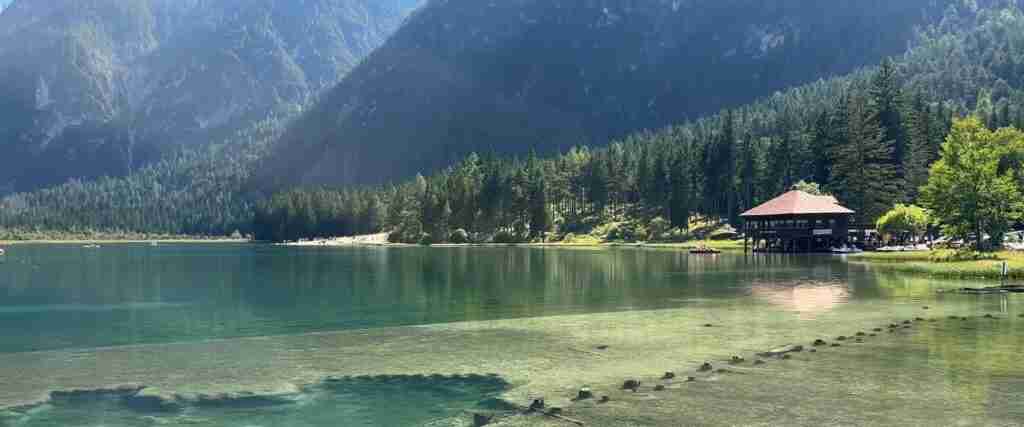
Tarvisio, in the far north at the triple point of Italy, Austria, and Slovenia, sits in the Val Canale where three linguistic communities — Italian, German, and Slovenian — have historically coexisted under successive sovereignties. The town is a practical base for skiing, hiking, and cross-border exploration, but its greatest value lies in the forest and lake landscape of the Parco Naturale delle Prealpi Giulie and the Laghi di Fusine — two glacially formed mountain lakes surrounded by the peaks of the Mangart massif, which produce reflections in the deep blue-green water that are among the most photographed natural scenes in the region.
The Tagliamento river, which drains the entire Friulian plain from its Alpine sources to the Adriatic, has been described by ecologists as the last morphologically intact alpine river in Europe — meaning it maintains the braided, shifting channel pattern of a pre-industrial mountain river, periodically flooding its wide gravel-and-sand floodplain and creating a mosaic of habitat types that has all but disappeared from the rest of the Alps. The ecological importance of the Tagliamento has generated increasing conservation attention, and travelling along its upper reaches — particularly between Tolmezzo and Gemona del Friuli — reveals a landscape of exceptional natural character alongside deeply human ones: the towns of Gemona and Venzone were largely destroyed in the catastrophic Friuli earthquake of 1976 and subsequently rebuilt, in Venzone’s case through a remarkable programme of anastylosis (reassembling original stones) that reconstructed the medieval walls and the fourteenth-century cathedral from the pieces.
Collio and the Colli Orientali: Italy’s White Wine Revolution
The wine country of Friuli-Venezia Giulia occupies a hilly zone extending from the Slovenian border westward through the communes of Cormons, Dolegna del Collio, San Floriano del Collio, Cormòns, and Buttrio — a landscape of continuous low hills covered in vine, their southern and southeastern exposures catching the maximum Adriatic light while the Alps block northern cold. The soils, a distinctive flysch mixture of compressed sandstone and marl called ponca in local dialect, drain well while retaining sufficient water, and the combination of continental and Mediterranean climatic influences produces a growing season with warm days and cool nights that preserves aromatic complexity in white grapes.
The Collio DOC (established 1968) and the Colli Orientali del Friuli DOC together form the backbone of a white wine culture that has been producing wines of international significance since the 1970s, when Friulian producers including Mario Schiopetto abandoned the high-yield, oxidative winemaking of the postwar period and introduced temperature-controlled fermentation and carefully managed skin contact to produce precise, mineral, fruit-expressive whites from native varieties. The region’s principal white grapes are Friulano (a grape with complex identity politics — formerly marketed as Tocai Friulano until a 2007 EU ruling following a dispute with Hungary prohibited the Tocai name, leaving producers to redesignate it as Friulano, a name that better expresses its terroir anyway), Ribolla Gialla, Malvasia Istriana, Pinot Grigio in its serious Friulian expression (a world removed from industrial Pinot Grigio), and Sauvignon Blanc.
Josko Gravner, based in Oslavia on the Slovenian border, transformed the international conversation about white wine in the late 1990s when he abandoned conventional winemaking entirely in favour of fermenting his wines on their skins in large terracotta amphorae buried in the earth, following practices he had studied in Georgia. The result — what the wine world calls orange wine or amber wine, skin-contact white wine fermented like a red — produced Ribolla Giallas of extraordinary complexity, tannic structure, and ageing potential. Gravner did not invent the method, which is ancient, but his application of it to Collio’s finest white variety and his willingness to wait a minimum of six years before release created a new reference point. Radikon, another Oslavia producer, followed a parallel path. The international orange wine movement that now encompasses producers from Slovenia to the Jura to California traces a direct lineage to these Collio experiments.
The Collio wine road — the Strada del Vino e dei Sapori del Collio — connects the zone’s producers through a network of cantina visits, wine bars, and restaurants concentrated in the towns of Cormons, Capriva del Friuli, and San Floriano del Collio. The Enoteca Regionale di Cormons serves as a showcase for the entire regional production and offers the most systematic introduction to the wine landscape. Driving the Collio in late September or early October during the harvest — when tractors pull trailers of hand-picked grapes along lanes between estates and the air carries the fermentation scent — is a complete sensory experience.
The Ramandolo DOCG, carved out of the Colli Orientali on a specific south-facing hillside above the village of Nimis, produces a late-harvest Verduzzo Friulano of golden-amber colour, dried-fruit concentration, and considerable complexity that deserves international recognition it has not yet received. This is a wine for contemplation rather than meal-matching: its combination of sweetness, high natural acidity, and nutty oxidative notes produces a complexity that develops over years in bottle. Most Ramandolo is drunk locally, which is a reasonable argument for visiting.
Friulian Cuisine: The Crossroads Kitchen
Friulian cuisine is substantial, carefully constructed, and profoundly shaped by the region’s geographic and historical position at the intersection of the Mediterranean and Central European food worlds. It is not a cuisine of delicacy or restraint — the winters are cold, the agricultural tradition is hard-working, and the food reflects both — but it achieves genuine complexity through its combination of ingredients and techniques that belong to different culinary systems.
San Daniele prosciutto requires extended discussion because it genuinely rewards it. Cured in the town of San Daniele del Friuli, where the microclimate — the convergence of cold Alpine air descending from the north and warm Adriatic humidity rising from the south — creates ideal salt-curing conditions, San Daniele is distinguished from Parma prosciutto by its more intense sweetness, its slightly firmer texture, and its characteristic shape (the trotter is left attached, distinguishing it immediately from Parma). The best San Daniele producers — Dok Dall’Ava, Principe di San Daniele, and smaller artisan houses — cure their hams for a minimum of thirteen months, and the top products age for twenty-four months or longer. Eaten in thin slices at room temperature, ideally with Friulian bread (pan di soia or the region’s excellent rye breads) and Friulano wine, it is a first course of profound simplicity and sophistication.
Frico is the Friulian dish that most surprises non-Friulians: a shallow-fried cake or crisp of Montasio cheese (a semi-aged cow’s milk cheese from the highland pastures), sometimes combined with potato or apple, cooked until the cheese melts and then crisps at the edges into a formation of crackling, savoury intensity. The soft version, with potato, functions as a side dish of extraordinary richness. The crisp version — cooked longer until the entire surface caramelises — is served as a single-bite snack in wine bars or eaten as a light meal. The combination of melted and crisped Montasio with a glass of young Friulano white wine is canonical Friulian hospitality.
Cjarsons (or cjarsòns) are the pasta expression of Friulian complexity: half-moon or plump filled pasta shapes whose filling combines sweet and savoury elements — dried fruits, herbs, smoked ricotta, chocolate, cinnamon, and local distillates — in proportions that vary by village, by family, and by season. The combination sounds improbable to anyone conditioned by Italian cuisine’s strict separation of dolce and salato, but the cjarsons tradition reflects the pre-modern Central European pantry, which did not enforce these boundaries. The pasta is dressed simply — brown butter, smoked ricotta, sometimes a single herb — allowing the filling’s complexity to speak without competition.
Jota, the bean and sauerkraut soup, is the dish that most directly expresses the Habsburg-Mitteleuropean inheritance. Dried beans, sauerkraut or brovada (turnip preserved in grape marc), smoked pork (typically a piece of cotenna or smoked rib), bay leaf, and garlic are cooked together slowly until the beans collapse into the broth and the sauerkraut loses its sharpness, producing a thick, deeply savoury soup that is filling, warming, and insistently regional. The border between Jota and its Slovenian and Croatian equivalents is purely cartographic.
Brovada — white turnip macerated for two months in the marc left after red wine pressing, then grated and cooked with sausage or pork — is probably the most demanding acquired taste in the Friulian repertoire, its combination of fermented sharpness, earthiness, and pork fat requiring full commitment. It is eaten from October to March, appears on virtually no restaurant menu outside the region, and constitutes the kind of deeply local flavour that exists specifically because it was never exported.
In Trieste and the Giulia zone, the Habsburg culinary heritage adds further layers: goulash (not the Hungarian original but a slower, more wine-inflected version), Vienna-style braised beef with grated horseradish, kaiserschmarrn (shredded pancake with powdered sugar and plum jam) appearing on café menus alongside Italian tiramisù (which, disputed as its ultimate origin may be, is found throughout the Friuli-Venezia Giulia region in convincing form), and the triestino specialty of presnitz — a sweet spiral pastry filled with nuts, dried fruits, spices, and grappa that is ceremonially exchanged at Easter.
The region’s dairy tradition produces Montasio DOP in multiple ageing grades (fresco, mezzano, stagionato, and stravecchio), the fresh cow’s milk cheese latteria that is eaten very young with local honey, and the smoked ricotta (ricotta affumicata) that appears as a condiment, a cheese course, and a pasta dressing throughout the region. The combination of these dairy products with the cured meat tradition — San Daniele prosciutto, speck from the northern valleys, various salami and musetto (a soft sausage for boiling) — produces a charcuterie and cheese culture of exceptional breadth for a single region.
Hidden Towns and Villages Worth the Detour
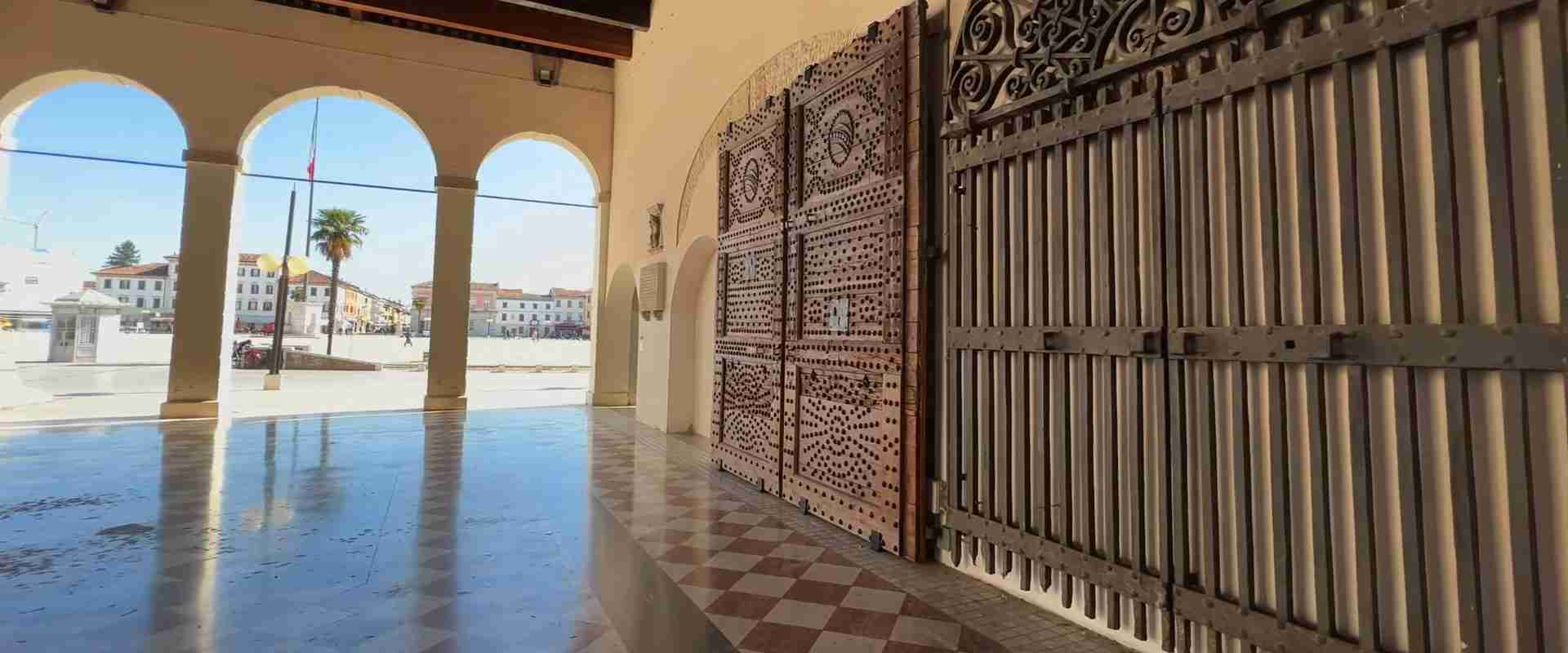
Palmanova is the most architecturally extraordinary town in Friuli-Venezia Giulia that most visitors have never heard of. Designed in 1593 as the ideal Renaissance fortified city — a nine-pointed star-shaped plan with three concentric rings of defensive walls, all streets radiating from a central hexagonal piazza — it was built by the Venetian Republic as a forward fortress against both Austrian and Ottoman threats. The plan was drawn from the theoretical work of Renaissance military architects including Francesco di Giorgio and Vincenzo Scamozzi, and it was executed almost perfectly: from an aerial perspective (available in a small museum near the main gate), Palmanova looks like a precise geometric theorem rendered in brick and earth. Walking its streets — which radiate at precise angles from the central Piazza Grande to three gates in the outer walls — produces a mild disorientation that is itself architectural information: you understand the Renaissance obsession with geometric order differently from inside it. Palmanova’s inclusion in the UNESCO transnational “Venetian Works of Defence” inscription (2017) alongside similar fortifications in Croatia and Montenegro recognised its exceptional completeness and integrity. The town’s population is roughly five thousand; the fortifications are largely intact; the tourists are largely absent.
Spilimbergo, forty kilometres northwest of Udine on the Tagliamento, is known principally as the home of Italy’s only school of mosaic art — the Scuola Mosaicisti del Friuli, founded in 1922, which trains students from around the world in traditional and contemporary mosaic techniques and has supplied mosaicists for projects from the Vatican to Washington DC. The town itself — a small medieval centre enclosed within the remnant of its castle walls, with a Romanesque-Gothic cathedral containing frescoes attributed to Pordenone — is precisely the kind of market town that rewards an afternoon of aimless walking and a long lunch. The Duomo’s fourteenth-century frescoes are among the finest in the region outside Udine, and the view from the castle promontory across the Tagliamento to the Alps is startling.
Pordenone, the region’s second city after Trieste and Udine, is consistently overlooked despite possessing one of the most impressive Renaissance loggias in Friuli — the fifteenth-century Palazzo Communale with its clock tower and arcaded facade overlooking the Corso Vittorio Emanuele II — and a significant art collection in the Museo Civico d’Arte that includes works by the Pordenone painter Giovanni Antonio de’ Sacchis (known as Pordenone), a dramatic and influential Mannerist whose work in the Duomo of Spilimbergo and the Duomo of Treviso demonstrates a colour sensibility and compositional dynamism that rivalled Titian.
Venzone, a small walled medieval town in the upper Tagliamento valley that was 90% destroyed in the 1976 earthquake, was rebuilt stone by stone through a methodical anastylosis programme that reassembled the original medieval fabric from its ruins over two decades. The result is not a facsimile but a genuine reconstruction of medieval urban form using the original materials, and it raises interesting questions about the nature of authenticity in historic preservation that make it intellectually as well as visually interesting. The Cathedral of Sant’Andrea, entirely reconstructed in this way, is more moving for the knowledge of what it represents. Venzone also hosts a renowned dried herb and natural remedy market each October, and its small size makes it genuinely penetrable in an afternoon.
Muggia, a fishing village on the last Istrian peninsula south of Trieste before the Slovenian border, preserves a small medieval centro with a Venetian Gothic church facade and a harbour front of characteristic Istrian character — ochre and terracotta buildings reflected in the water, fishing boats moored beside restaurant terraces, a pace of life that belongs entirely to the northern Adriatic. Triestines come here for Sunday lunch; the fish restaurants around the harbour serve the catch (sardoni, branzino, coda di rospo) simply prepared in the Istrian manner.
Grado, an island connected to the mainland by a causeway, occupies a unique position as an early Christian city (the Patriarchate of Aquileia transferred here after the Lombard invasions), a medieval fishing settlement, and an Austro-Hungarian beach resort simultaneously. The old quarter — a compact grid of narrow lanes entirely isolated from the modern beach resort town — contains the fifth-century Basilica di Sant’Eufemia with its spectacular early Christian mosaic floor (a smaller but comparably beautiful relative of Aquileia’s) and the Baptistery of Santa Giovanni (sixth century). The combination of Roman mosaic art, Adriatic seafood (Grado is famous for its spider crabs and sole), and the peculiar Habsburg nostalgia that still floats over the genteel seafront hotels makes Grado an extremely satisfying half-day escape from Trieste or Aquileia.
Practical Information for Visiting Friuli-Venezia Giulia
Getting there: Trieste Airport (Ronchi dei Legionari/Friuli Venezia Giulia Airport) operates direct flights to several European hubs, with Ryanair and Wizz Air providing low-cost connections. The airport is more usefully located — equidistant between Trieste, Udine, and Gorizia — than its name suggests. Venice Marco Polo Airport, two hours west by road or rail via Mestre, offers a substantially wider range of connections and functions as the practical international gateway for most visitors; high-speed trains run Venice–Trieste and Venice–Udine in approximately two hours. Car hire at Venice Airport is straightforward and the autostrada runs directly northeast. For visitors approaching from Austria, the Tarvisio border crossing on the A23 motorway connects seamlessly to Udine and the Friulian plain.
Getting around: A hire car is essential for reaching the wine country, the Carnia highlands, Aquileia, Cividale, and Palmanova with any flexibility. Regional trains connect Trieste, Udine, Gorizia, Pordenone, and Tarvisio with reasonable frequency, and the Udine–Cividale line (a scenic narrow-gauge route) operates with surprising regularity for a secondary line. Within Trieste, the city’s buses are efficient, and the hop between the central city, Miramare, and the Carso fringe is manageable without a car.
When to visit: Late spring (May–June) and early autumn (September–October) represent the optimal windows. May and June offer long days, moderate temperatures, and the emergence of outdoor café life before tourist numbers build. September and October coincide with the grape harvest in Collio and the Colli Orientali, the truffle season in the Carnia and around San Daniele, and the most saturated light of the year on the Carso plateau and in the Friulian Dolomites. Winter in Trieste has its own particular character — the bora wind, the grand coffeehouses, the absence of any crowd — and the city’s Habsburg Christmas market atmosphere is genuinely atmospheric rather than manufactured. The Friulian Dolomites offer skiing from December to March at Piancavallo, Forni di Sopra, and the Tarvisio area.
Languages: Italian is universal. In Trieste, Triestino dialect is spoken among older residents and in informal contexts; younger people speak standard Italian. Friulian (Furlan) is spoken by perhaps 500,000 people in the Friuli zone and is increasingly visible on bilingual street signs. Slovenian is the daily language in several communities near Gorizia and in the Carso villages. English is spoken competently in Trieste hotels and the main cultural institutions; in smaller towns and rural osterie, minimal Italian is a genuine asset.
Food and wine shopping: San Daniele del Friuli is the obvious stop for prosciutto purchases; most producers offer direct sales and vacuum-packing for travel. Cormons and the Collio zone offer estate winery visits and purchases throughout the year (call ahead for smaller producers). The Udine covered market (Mercato Coperto) is the best central destination for Montasio, local salami, seasonal vegetables, and Friulian pantry staples. In Trieste, the nineteenth-century Mercato Centrale covers similar ground with a more cosmopolitan selection and a seafood section that reflects the city’s Adriatic orientation.
Recommended bases: For a one-week itinerary covering the region’s principal destinations, Udine serves as the most efficient base — roughly equidistant from Trieste (one hour), Aquileia (45 minutes), Cividale (20 minutes), Collio wine country (40 minutes), and the Carnia highlands (one hour). Trieste is preferable for those whose primary interest is urban culture, the Carso, and cross-border exploration into Slovenia. A split week — three or four nights in Udine, three or four in Trieste — provides the most comprehensive coverage without sacrificing depth.
Frequently Asked Questions About Friuli-Venezia Giulia
How many UNESCO World Heritage Sites does Friuli-Venezia Giulia have?
Friuli-Venezia Giulia contributes to three separate UNESCO World Heritage inscriptions. Aquileia (inscribed 1998) protects the archaeological area and Patriarchal Basilica of the ancient Roman and early Christian city. Cividale del Friuli is among the Places of Power included in the transnational “Longobards in Italy” inscription (2011), recognised for the outstanding Lombard monuments including the Tempietto Longobardo and the Baptistery of Callisto. Palmanova is part of the transnational “Venetian Works of Defence between the 16th and 17th Centuries” inscription (2017), recognised for its exceptional completeness as a Renaissance star-fortress city. Together these represent a remarkable concentration of UNESCO heritage in a region that covers less than 8,000 square kilometres.
What is the best time of year to visit Trieste?
Trieste rewards visits year-round but offers its most distinctive experience in the shoulder seasons. September and October bring warm temperatures, clear light across the gulf, the vendemmia (grape harvest) in the surrounding wine zones, and the return of city life to its autumn rhythms after summer. May and June offer long Adriatic days and the first outdoor café season. Winter is arguably Trieste’s most authentic season: the bora wind drives locals into the magnificent historic coffeehouses, the Piazza Unità d’Italia takes on a theatrical emptiness, and the city’s Habsburg melancholy is most palpable. Summer brings heat, Adriatic beach crowds to the outer beaches, and the opera season at the Teatro Verdi. The specific bora-wind periods — usually multi-day events in winter and spring — are either an atmospheric highlight or a practical inconvenience depending on your tolerance for 100+ km/h gusts.
Is Friulian a dialect of Italian or a separate language?
Friulian (Furlan) is linguistically a separate language, classified as Rhaeto-Romance alongside Ladin (spoken in the South Tyrol Dolomites) and Romansh (spoken in Switzerland’s Graubünden canton). It is not mutually intelligible with Italian except to speakers who know both, and it preserves grammatical and lexical features that descend directly from Vulgar Latin without passing through the Tuscan standardisation that shaped modern Italian. Friulian has been recognised as a minority language under Italian Law 482/1999 and European Charter protections. It is actively spoken by an estimated 400,000–600,000 people, used in primary education in parts of the region, and appears on bilingual road signs throughout Friuli. It sounds somewhat like a mixture of French, Spanish, and Italian to outsiders, and hearing it in a village bar — particularly in the Carnia highlands — is one of the region’s more surprising linguistic experiences.
What is the food specialty most associated with Friuli-Venezia Giulia?
San Daniele prosciutto is the region’s most internationally recognised food product, a PDO-protected cured ham produced exclusively in and around the town of San Daniele del Friuli under conditions — the specific microclimate, the requirement that the trotter remain attached, the minimum curing period — that distinguish it from all imitations. Among locals, however, frico (the fried Montasio cheese cake) is considered the most characteristically Friulian preparation, and the combination of frico, polenta, and a glass of Friulano white is the canonical expression of Friulian domestic cooking. The region’s sweet pastry tradition — gubana (a yeast-leavened spiral filled with walnuts, dried fruits, and grappa from the Natisone valley), presnitz (a layered spiral from Trieste), and the various Christmas breads) — is less widely known but equally distinctive.
How does Collio wine compare to other Italian white wine regions?
Collio is generally considered Italy’s finest white wine production zone alongside Alto Adige, with a profile that differs substantially from both. Where Alto Adige whites tend toward alpine precision and crystalline aromatics, Collio whites — particularly the skin-contact and amphora-fermented Ribolla Giallas, the barrel-aged Friulanos of the best estates, and the single-vineyard Malvasia Istriane — offer greater textural richness, mineral complexity, and capacity for development in bottle. The zone’s greatest innovation — the skin-contact white wine movement pioneered by Josko Gravner and Stanko Radikon in the 1990s — has been globally influential, producing wines with the tannin structure and ageing trajectory of reds that nonetheless express the character of white varieties. These wines require patience and ideally food: the richer, more structured examples pair exceptionally well with the region’s cured meats, aged Montasio, and fish prepared simply. The entry-level Collio DOC whites — fresh, mineral, and precisely made — are among Italy’s best value in serious white wine.
What is the Risiera di San Sabba and should visitors go?
The Risiera di San Sabba is a former rice-husking factory in a southern suburb of Trieste that was converted by the Nazi SS into a transit and extermination camp following the German occupation of the city in September 1943. It is the only Nazi death camp on Italian soil, and it was used for the detention, torture, and murder of political prisoners, members of the partisan resistance, Jews, Slovenians, and others throughout the German occupation until 1945. An estimated 3,000–5,000 people were murdered at the Risiera, and thousands more were held there in transit to Auschwitz and other camps. The Risiera was declared a national monument in 1965 and converted into a museum and memorial in 1975 with a permanent installation designed by the architect Romano Boico. The museum is open Tuesday through Sunday and entry is free. A visit is not obligatory for every traveller to Trieste, but it provides an essential historical context for understanding what the twentieth century actually meant for this city — and it ensures that the Piazza Unità and the grand coffeehouses are seen in their full historical dimension, not only their aesthetic one.
Can you visit Friuli-Venezia Giulia without a car?
A meaningful visit to Trieste and Udine is entirely possible without a car, using the regional rail and bus network. Trieste’s main sites — the Piazza Unità, Miramare Castle (served by regular city buses), the Civico Museo Revoltella, the Città Vecchia, and the Carso plateau via the Opicina tram when operating — are all accessible by public transport. Udine’s centro storico is compact and entirely walkable. The train from Venice or Trieste to Udine runs frequently. The Udine–Cividale del Friuli railway makes the Lombard monuments accessible without a car. However, Aquileia requires either a car or a specific bus connection from Cervignano del Friuli station, and the Collio wine country, the Carnia highlands, and most of the region’s smaller villages are effectively inaccessible by public transport on any practical schedule. For travellers specifically interested in the wine country or the Alpine zones, car hire is not merely convenient but necessary.
What are the most common mistakes first-time visitors to Friuli-Venezia Giulia make?
The most common strategic error is treating Trieste as the region’s primary destination while leaving insufficient time for the rest. Trieste repays two to three full days; Aquileia alone warrants a full day; Cividale deserves at least half a day; Collio wine country, visited properly, occupies a full afternoon and evening. First-time visitors typically allocate a single day for the entire region en route between Venice and Ljubljana, which produces a frustrating sequence of superficial contacts with extraordinary things. A second common mistake is neglecting the smaller towns — Palmanova, Spilimbergo, Venzone, Cormons, Grado — in favour of the principal destinations; these are precisely the places where the region’s character reveals itself at the most human scale. A third is ignoring the food and wine as an afterthought; in Friuli-Venezia Giulia, the culinary culture is not separable from the cultural one, and investing time in an evening at a serious osteria, a Collio estate visit, or an osmiza on the Carso will produce understanding that no museum can supply.
How long does Friuli-Venezia Giulia require for a satisfying visit?
A minimum of five full days is required to achieve genuine orientation across the region’s distinct zones — one or two days in Trieste, one in Udine, half a day each in Aquileia and Cividale, and half a day in the Collio wine country, with Palmanova or the Carso as a further half-day addition. Seven to ten days allows the addition of Gorizia, the Friulian Dolomites, the Carnia highlands, and a more relaxed engagement with the food and wine culture that the five-day structure forces to rush. For travellers combining Friuli-Venezia Giulia with Slovenia (Ljubljana is two hours from Trieste by direct train), Austria (Klagenfurt is 90 minutes north of Udine), or the Veneto (Venice is two hours west), a flexible five-day base in the region with cross-border day trips produces excellent value for the distance covered.
What is the bora wind and how does it affect travel in the region?
The bora (from the Greek Boreas, the north wind) is a cold, dry, katabatic wind that descends from the Carso plateau and the Dinaric Alps to the Trieste coast with extraordinary force, typically arriving in multi-day episodes throughout autumn, winter, and spring. Wind speeds in central Trieste regularly exceed 80–100 km/h during bora events; the strongest recorded gusts exceed 200 km/h at plateau stations. The bora is so embedded in Triestine culture that the city has developed a specific infrastructure for it — iron handrails bolted to walls along the most exposed streets to prevent pedestrians from being knocked over, and a traditional social custom of wearing one’s hat forward rather than backwards during a bora to prevent it flying off. Travel during a bora event is not dangerous for pedestrians in sheltered streets, but the driving on the Carso plateau and the coast road can be hazardous. The bora also brings cold clarity: visibility from the Carso on a post-bora morning, with the entire Adriatic glittering under sharp light and the Istrian and Dalmatian mountains visible on the far shore, is among the most spectacular atmospheric effects in the region.