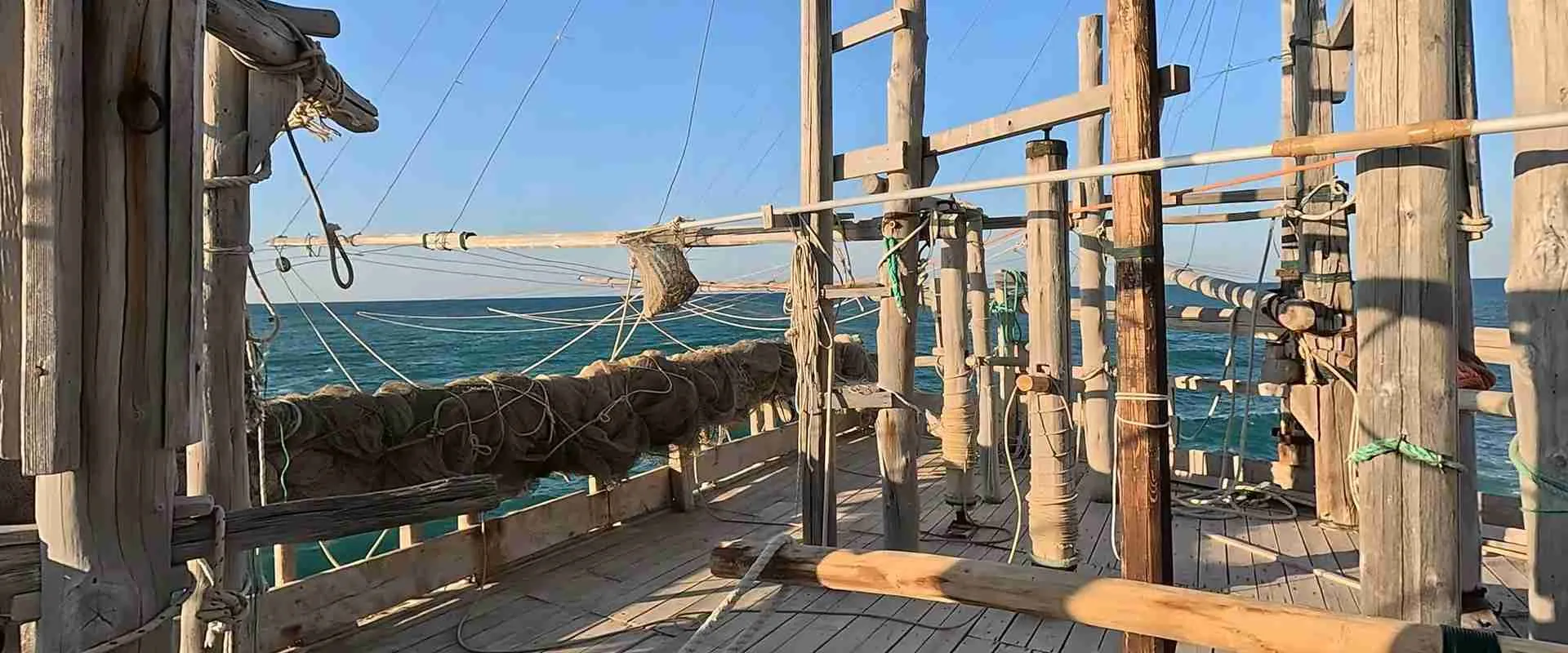
Wooden Cantilevers over the Adriatic: Structural Kinematics and Timber Engineering of the Gargano Trabucchi
On the rocky promontories of the Gargano peninsula, where the limestone cliffs of Puglia drop vertically into the Adriatic, a category of fishing machine evolved that belongs as much to structural engineering as to maritime tradition. The trabucchi — shore-fixed wooden platforms projecting long cantilever arms over open water — solve, in timber and rope, a set of mechanical problems that builders in Kerala, central Africa, and southern China independently confronted across centuries. This guide examines the structural kinematics, material science, and coastal topography that made these installations possible and enduring.
Key Takeaways
- A trabucco is a shore-anchored wooden cantilever system built entirely from Aleppo pine (Pinus halepensis), a species chosen for its workability, resinous heartwood, and relative resistance to the salt-laden Adriatic climate.
- The structural logic is that of a cantilevered lever: long timber arms called antenne extend over the water from a mast-like fulcrum fixed to the rock platform, supporting a large lift net (the trabocchetto) that is lowered and raised by rope-and-winch counterbalancing.
- Wave action and Mistral-driven gusts produce dynamic rather than purely static loading; the elasticity of Aleppo pine and the deliberate looseness of rope-mediated joints allow the structure to flex rather than fracture under cyclic stress.
- The earliest documentary evidence for trabucchi on the Gargano coast dates to the 18th century, though the most widely cited tradition links their general form to ancient maritime peoples of the eastern Mediterranean.
- The same rocky promontories that carry trabucchi also carried the 16th-century watchtower network of the Viceroyalty of Naples, creating a coastal landscape where fishing structures and military signal towers shared overlapping topographical logic.
- Structurally analogous cantilevered fishing systems appeared independently across the Indian Ocean world, most completely documented in Kerala’s Cheena vala (Chinese fishing nets), pointing to convergent engineering solutions rather than cultural diffusion.
People Also Ask About the Gargano Trabucchi
What type of wood are trabucchi built from, and why?
Trabucchi are built almost exclusively from Aleppo pine (Pinus halepensis), a conifer abundant in the coastal and near-hinterland forests of the Gargano. The choice reflects several overlapping practical factors. Aleppo pine is readily available from the Gargano’s extensive pine and mixed-Mediterranean woodland, including the ancient forest known as the Foresta Umbra. The wood is moderately dense, typically around 540 kilograms per cubic metre, and shows good dimensional stability — low swelling and shrinkage — which matters critically in a structure that passes through cycles of salt spray, sun exposure, and rain throughout its working life. Its high resin content impregnates the heartwood and substantially slows moisture penetration and fungal attack, a property the Gargano’s fishermen knew from long practical experience even before any scientific characterisation was available. The wood is also workable with the adze and hand tools that were standard in pre-industrial coastal communities with strong shipbuilding traditions. A final consideration is elasticity: Aleppo pine can flex significantly under bending loads before failing, a property that matters in cantilever beams subjected to the intermittent and sudden loads produced by wave action and wind gusts.
How does the mechanical counterbalance of a trabucco work?
The trabucco’s counterbalance operates on lever principles. Long cantilever arms called antenne extend from a central mast-like fulcrum anchored to the shore platform, projecting several metres over the water surface. The large lift net, the trabocchetto, hangs from the ends of the antenne. Its dead weight — substantial when filled with water during immersion — constitutes the primary load. A system of ropes, pulleys, and hand-operated winches allows a crew of four to six fishermen to lower the net smoothly into the current and raise it again by leveraging the mechanical advantage of the rope system. The counterbalancing logic is different from Kerala’s Chinese fishing nets, where stone dead-weights tied to the short end of the lever arm physically counterpose the net’s weight; in the trabucco system, the mechanical advantage is achieved through the winch and multi-purchase rope runs rather than a dead counterweight, though some installations include weighted rope arrangements at the inboard end of the antenne to reduce the manual effort of raising a laden net. The net is lowered to a depth of at least six to seven metres to exploit the coastal currents and fish passage routes that concentrate prey between promontories.
What was the relationship between the Gargano trabucchi and the coastal watchtower network?
The Gargano’s two most visible coastal heritage systems — trabucchi and Viceroyalty watchtowers — share a topographical logic without, as far as the documented record shows, a formal organisational connection. Both require elevated rocky promontories with unobstructed sightlines across open water. The towers of the 16th-century defensive network were positioned on headlands to maximise intervisibility and fire-signal range; the trabucchi were positioned on the same class of geological feature — a rocky spur projecting into current-bearing water — because that is where fish passage concentrates. The practical effect is that the same stretch of coast between Vieste and the Sfinalicchio bay supports both categories of structure in proximity. Whether the fishermen who worked the trabucchi ever served as informal coastal lookouts, extending the visual coverage of the official tower network, is not confirmed in the historical record but has been proposed by local historians as a plausible secondary function.
How does the structural engineering of a Gargano trabucco compare to other cantilevered fishing platforms worldwide?
The most completely documented parallel is Kerala’s Chinese fishing nets (Cheena vala) at Fort Kochi, where teak-and-bamboo cantilever structures about ten metres tall extend roughly twenty metres over the water, counterbalanced by large stones tied to ropes. The structural principle — a fixed-shore cantilever lowering and raising a net by leveraged counterbalancing — is identical to the trabucco’s, though the materials, scale, and counterweight mechanism differ. The Kerala structures use teak and bamboo, employ stone dead-weights, and are oriented to backwater and estuary fishing in tidally dominated water. The Gargano trabucco uses Aleppo pine throughout, relies on rope-and-winch mechanical advantage, and targets open Adriatic water with pronounced current patterns and exposure to oceanic swells. Comparable fixed-platform cantilevered fishing traditions existed along the coastal and riverine communities of southern China, where stationary lift nets operated from bamboo and timber frames were documented before the 14th century. The Congo River Wagenya fishing platforms — though oriented to rapid-current river fishing rather than tidal seas — share the cantilevered timber logic sufficiently that Bernard Rudofsky’s landmark 1964 exhibition Architecture Without Architects at New York’s Museum of Modern Art juxtaposed a Vieste trabucco with a Wagenya structure, framing both as examples of vernacular engineering intelligence that formal architectural history had ignored.
The Trabucco in Context: Architecture of Necessity on the Adriatic Shore
To understand the trabucco as a piece of structural engineering is to understand first the conditions it was designed to overcome. The Gargano peninsula, the great spur of the Italian boot jutting eastward into the Adriatic, presents a coastline fundamentally hostile to small-boat fishing. Between the town of Vieste on the eastern tip and Peschici to the northwest, the coast alternates between vertical limestone cliffs dropping fifteen to thirty metres directly into the sea and narrow rocky shelves from which launching a boat in any sea state above flat calm is dangerous. The Adriatic is not a benign body of water along its western shore: the Bora wind blows with sudden violence from the northeast, and the Scirocco drives swells directly against the Gargano’s exposed eastern face. For a fishing community whose entire economy depended on daily harvests from these waters, the risk of taking a small wooden boat into Adriatic weather was a permanent and lethal calculation.
The solution was to bring the fishing operation to the cliff’s edge and remove the boat entirely. A platform fixed to the rock, extending a net-bearing arm out over the water, eliminated the risk of capsizing, gave the fisherman a stable surface regardless of sea conditions, and allowed continuous working through weather that would ground any fleet. The earliest documentary evidence placing trabucchi on the Gargano coast dates to the 18th century, when written records begin to describe the structures in the hinterlands of Vieste and Peschici. The most widely cited tradition traces a general ancestral form to Phoenician maritime culture, on the basis of functional parallels with fixed-net fishing apparatus documented in the ancient eastern Mediterranean; this origin story appears in most local accounts but rests on typological inference rather than any documented chain of transmission, and should be understood as a folk etymology of technology rather than a historical lineage.
What the documentary record does establish, with some confidence, is a connection to the shipbuilding tradition of the northern Gargano coast. Historical archives record that in the Angevin period and subsequently under Bourbon rule, the towns of Vieste and Peschici hosted shipyards of regional importance, supplied by the extensive timber resources of the Gargano hinterland, including the Foresta Umbra’s dense beech stands and the coastal pine forests. These yards built warships and commercial vessels, training generations of master carpenters in the manipulation of large structural timbers, the cutting and fitting of complex joints, and the rigging of rope-and-pulley systems. When those craft skills were applied to a shore-fixed fishing structure rather than a floating hull, the result preserved the vocabulary of maritime engineering — masts, antenne (yardarms), lanyards, pulleys — in a machine fixed to the land. The visual similarity between a trabucco and a ship run aground on the cliffs has been remarked upon by every serious observer: the structural family resemblance is not accidental but genealogical, the fishing platform being a coastal adaptation of the same toolkit that built the Adriatic’s warships.
Structurally, the trabucco belongs to the class of shore-operated lift nets, which the Food and Agriculture Organization of the United Nations classifies as stationary lift nets — fishing gear in which the net is held below the water by the structure and raised vertically by mechanical advantage rather than being dragged or cast. Within that class, the Gargano trabucco represents a particularly sophisticated engineering response because it must operate in exposed open-water conditions with significant wave height and wind loading, as opposed to the sheltered estuaries and backwaters where most shore-operated lift nets were deployed. This exposure requirement drove the structural choices — the species of timber, the joint techniques, the geometry of the cantilever — in ways that distinguish the Gargano type from analogues elsewhere on the Italian Adriatic coast.
The coastal morphology of the Gargano also shaped a distinctive structural variant. Elsewhere on the Adriatic, in Abruzzo and Molise, the coast presents shallower sandy beaches rather than rocky promontories, producing a different installation type: the bilancia, a smaller platform positioned transversely to the shoreline and connected to land by a wooden walkway, typically using a single motor-driven winch and a smaller net. The Gargano trabucco, by contrast, is fixed to a rocky spur and aligned longitudinally with the shoreline, with its antenne projecting seaward over deeper, faster-moving water. The Gargano type typically carries two or more antenne, each extending to six metres or beyond, and a trabocchetto of substantially greater area than its Abruzzese equivalent. These scale differences are structural consequences of the site: a deeper, more exposed installation demands longer lever arms, a heavier net, and a more robust counterbalancing system.
Anatomy of a Trabucco: Structural Components and Load Paths
A trabucco resolves into four principal structural subsystems: the rock anchorage and platform, the vertical mast assembly, the cantilevered antenne, and the rope-and-winch net mechanism. Each subsystem addresses a distinct set of loads, and each is built from the same Aleppo pine stock, relying on different cross-sections and orientations of the same material to achieve the necessary combination of stiffness and flexibility.
The base platform is formed by large pine trunks driven or wedged into fissures in the coastal rock, creating a grid that is part foundation and part floor. The rock itself, Gargano limestone, is structurally ideal for this purpose: hard, stable, and rich in the natural fissures and ledges that the builders used as bearing surfaces and wedge points. The pine poles driven into these features are not truly embedded in the engineering sense — they are not set in concrete or excavated into the rock — but are packed and braced against the rock’s natural geometry with smaller timber wedges and rope binding. The loading transferred from this anchorage system is primarily horizontal: the wave action and wind load on the antenne produce large horizontal shear forces at the base of the vertical mast, and these forces are resisted by the geometry of the rock-contact surface rather than by any mechanical fastener. The system works because the rock ledges and fissures convert the horizontal pull of the cantilever into compression on the bearing faces of the limestone, and stone in compression is effectively limitless in capacity.
Rising from the platform, the central mast is the trabucco’s most heavily loaded single element. It receives the bending moment transferred from the antenne and must carry it down to the platform in combined bending and compression. The mast is the largest-cross-section timber in the assembly, typically a full trunk selected for straightness and freedom from major knots, since knots create stress concentrations in bending members. The antenne connect to the mast at their inboard end by lashed-rope joints, not rigid connections: this is the critical flexibility node in the entire structure. The rope binding allows a small amount of angular movement between the antenne and the mast, which means that a sudden gust that deflects the free end of an antenna does not transmit its full moment impulse rigidly into the mast. The rope acts as a damping element, absorbing kinetic energy that a rigid bolted connection would transmit directly.
The antenne themselves are slender, tapered timber members working as cantilever beams. In structural terms, they are most severely stressed at their inboard connection to the mast, where the bending moment reaches its maximum value, and are progressively less stressed toward the free end that hangs over the water. This moment distribution means that a straight-taper member — thicker at the mast connection, thinner at the tip — is mechanically appropriate, and the natural tapering of pine trunks toward their tops means that a well-chosen tree provides approximately the right geometry without expensive shaping. The antenne are not truly horizontal: they incline upward slightly from the mast so that the trabocchetto, when hanging from their tips, clears the water surface by the required margin, and the net descends vertically when the winch releases the haul line.
Secondary structural members — spreaders, cross-braces, diagonal poles — triangulate the connection between adjacent antenne, preventing them from spreading laterally under the weight of the net. These bracing elements work in tension and compression alternately as the antenne deflect under varying load, and their rope-lashed joints again provide the compliance that prevents load spikes from propagating as shock throughout the frame. The trabocchetto net itself is connected to the antenne tips by a system of lighter lines gathered into a single haul line that passes over a pulley at the mast head before descending to the winch drum on the platform. This purchase arrangement gives the four-to-six-person crew the mechanical advantage they need to raise a net that, when fully submerged and full of fish, may weigh several hundred kilograms.
The surface platform, from which the crew works, is a simple deck of lighter pine planks laid across the base poles. It carries no significant structural load but provides the working surface for net management and fish sorting. A small shelter hut — a baracca — is typically built at the landward end of the platform, providing weather protection for the crew during the waiting periods between net lowerings, which may last several hours. The shelter’s framing adds a small amount of bracing to the platform’s landward section but is not a structural element of the cantilever system.
The total load path of the trabucco, then, runs from the net weight and environmental forces at the antenne tips, through the antenne in bending, into the mast in combined bending and shear, and finally into the rock platform in compression and horizontal shear. At every node in this path, the joints are designed for flexibility rather than rigidity, a choice that is central to the trabucco’s survival in its exposed environment.
Static Equilibrium in Dynamic Marine Environments: The Physics of Timber Cantilevers
The structural challenge of the trabucco is not static but dynamic. A static analysis — treating the net weight as a fixed point load at the antenne tips and calculating the resulting bending moments — would describe the structure’s behaviour in dead calm. The Gargano coast in its normal operating condition is not dead calm. The Bora wind, which blows with particular violence through the northern Adriatic between October and April, can produce sustained gusts well above fifty kilometres per hour at the exposed promontories where trabucchi stand. Adriatic swells arriving from the northeast, often with peak periods of four to eight seconds, drive water against the base poles with a pulsing impact load. The platform oscillates, the antenne flex, and the net swings. The trabucco must be analysed as a structure under cyclic dynamic loading, not a static load case, and the engineering response to dynamic loading is fundamentally different from the response to static loads.
Tension and Bending Moments in Aleppo Pine Beams Under Wave Action
A cantilever beam loaded at its free end develops its maximum bending moment at the fixed end — in the trabucco’s case, at the point where each antenna meets the central mast. At this location, the upper face of the timber is in tension and the lower face is in compression. The bending stress at any cross-section through the beam’s depth follows the classical linear distribution of Euler-Bernoulli beam theory: zero at the neutral axis and maximum at the extreme fibres. Wood is not isotropic: its tensile strength parallel to the grain substantially exceeds its compressive strength parallel to the grain, and both vastly exceed its strength perpendicular to the grain. In a cantilever bent by a downward tip load, the upper face is in tension parallel to the grain — the direction of maximum wood strength — and the lower face is in compression parallel to the grain. Aleppo pine’s grain runs consistently along the length of the trunk, and a properly oriented antenna therefore exploits the wood’s best mechanical properties in the most severely stressed region.
The dynamic loading introduced by wave action adds a time-varying component to this bending moment. When a wave strikes the base poles of the platform, it transmits an impulsive horizontal force that deflects the mast and propagates as a lateral flexure through the antenne. The antenne respond not as rigid bodies but as elastic beams: they vibrate at their natural frequencies, which are functions of their length, cross-section, and the distributed mass of the ropes and net attached to them. If the wave frequency coincides with the antenne’s natural frequency, resonance amplifies the deflection and the bending stress far beyond the static equilibrium value. The rope connections at the mast junction act as energy dissipators: they deform slightly with each load cycle, converting kinetic energy to heat by friction and thereby reducing the amplitude of free vibration after each wave strike. This is a crude but effective form of damping, and its value is that it requires no maintenance and no engineered component — it is an intrinsic property of the rope-lashing technique.
Aleppo pine’s modulus of elasticity, reported in peer-reviewed material testing at approximately 17,000 megapascals for specimens from Algerian stands — which share the same Mediterranean climate as the Gargano — means that the wood deflects substantially before the stress in the extreme fibres reaches the failure threshold. A high modulus would produce a stiffer beam that transmits wave-induced forces more directly to the mast and platform; a relatively low modulus, such as that of Aleppo pine compared to structural hardwoods, means that the antenne absorb the wave energy as elastic strain rather than transmitting it entirely to the joints and anchorage. The deflection is visible: a heavy sea causes the antenne tips to bob noticeably, and observers who have filmed trabucchi in Bora conditions describe the structure’s motion as purposeful swaying rather than threatening vibration. The material properties of the chosen timber are not incidental to this behaviour but are a central reason the species was selected over alternatives.
The tension regime also explains why the primary failure mode of aging trabucchi is not bending fracture at the mast junction but rather the degradation of the rope-lashing that connects the antenne to the mast. As the ropes age, their fibres lose elasticity and eventually fail under the cumulative fatigue of cyclic loading. When the lashing fails, the antenna is no longer constrained against lateral spread, the bending moment is redistributed to remaining lashings in a sudden step increase, and progressive failure follows. Traditional trabucco maintenance was therefore organised around systematic rope replacement on a seasonal schedule, with the winter rest period — when the most severe Bora conditions make fishing impractical — used for full structural inspection and re-lashing of the critical joints.
Pin-Jointed Assemblies: Mortise-and-Tenon Adaptations for Wind Flexibility
The structural vocabulary of the trabucco is inherited from the shipbuilding tradition that, as the historical record attests, flourished in the Angevin-period yards of Vieste and Peschici. Shipbuilders working with large structural timbers developed two complementary joint philosophies for different loading situations: rigid mortise-and-tenon connections, where a projecting tenon cut at the end of one member locks into a mortised socket cut into another, producing a connection that resists both shear and moment; and lashed-rope connections, where ropes are wound tightly around overlapping timbers, producing a connection that resists shear loads well but allows some relative rotation between the members. The trabucco’s builders applied these two joint types in a principled distribution that reflects an intuitive structural logic, even if it was never formalised in engineering terms.
Mortise-and-tenon joints appear in the platform framing, where the horizontal deck members connect to the upright base poles. These connections must be rigid in the sense that the platform must not rack — must not distort parallelogram-like — under the horizontal forces transmitted from the wave-loaded mast. The mortise-and-tenon geometry prevents racking by creating a mechanical interlock that resists relative rotation between the deck beams and the uprights. In the context of marine timber construction, these joints are typically cut with generous tolerance — slightly loose, not tightly fitted — to allow a small amount of seasonal movement as the wood swells and shrinks with moisture changes, without cracking the joint faces. This tolerance has the secondary effect of introducing a small amount of compliance into the platform frame, reducing the peak forces transmitted to the rock anchorage during impulsive wave loading.
The connection between the mast and the antenne, and between adjacent antenne via the bracing poles, is handled differently. Here, the rope-lashing approach dominates, for reasons that the dynamic loading analysis makes clear. A rigid mortise-and-tenon connection at the mast-antenna junction would transmit the full bending moment of the loaded antenna into the mast without attenuation. The mast would need to be substantially heavier to carry this moment safely. More critically, the rigid joint would transmit dynamic load impulses — the sudden jerks produced by wave impact and wind gusts — directly into the mast and anchorage, maximising the peak stresses in those elements. Rope lashing, by contrast, introduces compliance: the lashing deforms slightly under each load impulse, spreading the peak force over a slightly longer time and thereby reducing its magnitude. The structural effect is equivalent to a pin joint in a timber truss: the joint allows rotation, preventing moment transfer, and the loads are carried as axial forces in the individual members rather than as moments in a continuous frame.
The wind flexibility conferred by this pin-jointed approach is most visible in the behaviour of the spreader braces — the secondary members connecting the antenne laterally. Under Mistral or Bora wind loading, the antenne are subject not only to vertical bending from the net weight but also to lateral bending from wind pressure on the ropes and net. The spreaders prevent lateral spread but must do so without introducing bending moments into the antenne, since the antenne’s cross-section is sized for vertical bending and would be overstressed if significant lateral bending were added. Rope-lashed connections between the spreaders and the antenne allow the spreader to rotate slightly in the horizontal plane relative to the antenne as the wind pushes the rig sideways, keeping the spreader in axial tension or compression rather than transmitting lateral bending into the antenna shaft. The trabucco in a crosswind therefore moves as a compliant mechanism rather than a rigid structure: the rig shifts slightly downwind, the spreader lashings tighten, and the antenne deflect laterally within their elastic range before the wind pressure and the restoring force of the rig geometry reach a new equilibrium.
This mechanical behaviour — structural compliance achieved through the deliberate use of non-rigid joints — is a design strategy that modern structural engineers recognise in flexible platform structures, offshore drilling rigs, and tension-leg platforms. The trabucco’s builders did not formulate it in these terms, but the practical outcome is indistinguishable: a structure that survives marine dynamic loading precisely because it accommodates rather than resists movement.
Timber Selection and Marine Durability: Aleppo Pine on the Adriatic Shore
The specificity of Aleppo pine (Pinus halepensis Mill.) as the trabucco’s structural timber deserves more than passing acknowledgement. The Gargano coast offered the builders several timber species — the Foresta Umbra contains ancient beech, and the coastal maquis includes holm oak and various Mediterranean pines — but the consistent choice of Aleppo pine across all documented trabucchi reflects properties that no readily available substitute could match in combination.
Pinus halepensis is the dominant pine of the western and central Mediterranean basin, distributed from Morocco and the Iberian Peninsula east to Lebanon and Turkey, with its Italian heartland in precisely the warm, dry coastal zones where it is most needed: Sardinia, Sicily, Puglia, and the Gargano. On the Gargano, it occupies the zone immediately above the shoreline, growing on thin limestone soils with characteristic root adaptations to drought and salt spray. The proximity of the trees to the construction site was not a trivial advantage in a period when heavy timber transport was expensive and limited.
The wood’s mechanical properties are those of a medium-density softwood. Studies of specimens from the Mediterranean basin — the best-characterised being material from Algerian forests, reported in a 2022 study in the journal iForest — Biogeosciences and Forestry — record a mean density of approximately 540 kilograms per cubic metre, a bending strength around 116 megapascals under three-point loading, and a modulus of elasticity in bending of approximately 17,500 megapascals. These figures place Aleppo pine in the mid-range of softwood structural timbers — stiffer than poplar, less stiff than Douglas fir, and sufficiently flexible to absorb dynamic loads without fracturing. Studies from Tunisian provenances have found somewhat lower bending strength, suggesting that mechanical properties vary with growing conditions, which is consistent with the general behaviour of softwoods: slower-grown, denser-ring timber from exposed coastal sites tends to produce higher moduli than faster-grown plantation stock. The Gargano’s coastal Aleppo pine, grown on thin soils in exposed positions, is expected to fall toward the higher end of the provenance range, though specific testing of Gargano specimens has not been published in the sources available for this article.
The property most important to the trabucco’s longevity is the heartwood’s resistance to marine degradation. Aleppo pine produces a strongly resinous heartwood — the resin canals that run through the wood fill with crystallised terpenic compounds as the sapwood converts to heartwood, creating a physical and chemical barrier against water infiltration. This resinous impregnation is the primary reason that Aleppo pine heartwood stands up significantly better in marine exposure than the sapwood of the same species: the sapwood, lacking this resin content, has been shown in decay resistance tests to be susceptible to fungal attack. Traditional trabucco builders were empirically aware of this distinction, even if they did not describe it in these terms. The selection of structural poles emphasised heartwood-dominant mature timber rather than sapwood-heavy young-growth material, and poles showing signs of sapwood exposure were understood to require more frequent replacement.
The wood’s high resin content also affects its working properties. Aleppo pine does not take a finish well, and the cut surfaces of freshly worked Aleppo pine exude resin that resists paint adhesion. For the trabucco, this is irrelevant: the structure is never painted or sealed. Instead, its surfaces are left exposed to season naturally in the salt-laden air. Over the first seasons of exposure, the surface layers of the timber are weathered and the resin oxidises and hardens, creating a grey-silver patina that is visibly identical to the weathered pine of old boat planking. Beneath this weathered surface, the resin-saturated heartwood remains resistant to further degradation for decades. The result is a structural behaviour in which the outer millimetres of a pine pole degrade relatively quickly, while the structural core — which carries the bending and compressive loads — remains serviceable for a generation or more under conditions of regular inspection and minor maintenance. Traditional trabucco records from the Gargano suggest that well-maintained installations were in productive use for thirty to fifty years before requiring wholesale reconstruction, with individual members replaced individually as they failed.
The Foresta Umbra, the ancient beech forest at the interior of the Gargano plateau, was protected from commercial felling partly because its timber was needed for ship construction. The coastal Aleppo pine stands, lower in commercial value than beech but easier to harvest and transport to the shoreline, provided the raw material for trabucchi with minimal processing. A straightish mature pine trunk, felled close to the shore, could be trimmed of branches, debarked, and installed as a working structural member within days of felling. The timber was not seasoned artificially: it was used green, and the seasoning occurred in situ over the first year or two of the structure’s life as the wood dried under salt air and sun. Green timber is more flexible than seasoned timber, which initially increases the compliance of the joints and reduces dynamic load transfer — a coincidental advantage of the low-cost, minimal-processing approach to material sourcing.
The Net Mechanism: Counterweighted Calamento and Operational Kinematics
The trabucco’s purpose is catching fish, and its structural elaboration serves a specific operational requirement: to lower a large net to depth, hold it there long enough for fish to swim over it, then raise it rapidly so that the catch cannot escape. The kinematic sequence of a trabucco lowering and raising its net is a revealing study in leveraged motion, where the geometry of the antenne, the purchase ratio of the rope runs, and the positioning of the crew all contribute to an operation of considerable mechanical efficiency for the manual power available.
The trabocchetto net — the name derives from trabocchetto, meaning “trap” or “pitfall” — is a large, fine-meshed lift net, its perimeter attached to a system of lighter gathering lines that converge at a central haul point. The net is not cast or dragged: it descends vertically below the antenne tips, held square by the geometry of the four-point attachment to the antenne. The descent is controlled by releasing the haul line from the winch drum; the net and its associated ropes descend under gravity, with the haul line running over a pulley at the mast head and then paying out at the winch. The speed of descent is regulated by the winch brake — releasing too quickly allows the net to bunch and tangle at depth, while releasing too slowly allows fish to scatter before the net reaches operating depth.
The waiting period, during which the net lies submerged at full depth, is the longest phase of the operation. The crew holds the haul line taut at the winch to maintain depth and watches the water surface for signs of fish activity — the brief disturbances and surface flashes that indicate a shoal moving over the sunken net. The positioning of the trabucco on a rocky spur exploits the hydraulic dynamics of the Adriatic current: the promontory deflects the longshore current, creating a downstream zone of reduced velocity and a convergence of planktonic food sources that concentrates small pelagic fish. Mackerel, anchovies, and sea bass were the primary target species, with the trabucco’s operating depth of six to ten metres targeting the water column where these species aggregate in response to bottom topography and current gradients.
The raising cycle is the most mechanically demanding phase. The crew winds the haul line onto the winch drum, lifting the net from depth with its entire water column weight plus any fish it contains. The mechanical advantage of the winch — a simple lever-arm reel with a crank handle — multiplies the crew’s effort by a factor that depends on the drum diameter and the length of the crank handle, typically five to eight times the applied force. Even so, a heavy net requires a coordinated team effort, with two or three crew members on the winch crank and the others managing the trailing lines that keep the net from swinging on the antenne tips during ascent. The raising of the net is the moment when the bending moment in the antenne reaches its maximum value: the static weight of the submerged net, reduced by buoyancy, is replaced by the full net weight in air as the trabocchetto breaks the surface, producing a step increase in the tip load. This is the peak stress event in the structure’s operating cycle, and it occurs not in storm conditions but in normal working — a reminder that the sizing of structural members in a trabucco must account for operational loads at least as much as for extreme weather loads.
The fish are harvested from the raised net by allowing it to drain briefly over the water and then hauling it in over the edge of the platform, where the crew sorts the catch by hand. Small specimens and non-target species are returned to the sea — a practical conservation behaviour driven by the desire to maintain the fish population that the installation depends on, rather than any formal fishery management framework. The entire lowering-waiting-raising cycle typically takes twenty to forty minutes, and a productive installation might complete six to ten cycles in a working day, with the fisher reading the current conditions, light quality, and surface behaviour to choose the timing of each lowering.
Coastal Defensive Topography: Intervisibility Between Watchtowers and Trabucchi
The Gargano coast’s geology produced a particular category of site that both the trabucco and the coastal watchtower independently required: a rocky promontory projecting far enough into the sea to offer unobstructed sightlines in multiple directions, with a stable base from which a fixed structure could be anchored to resist wave and wind loading. This shared topographical requirement produced a coastal landscape in which the two monument types appear in close proximity, and in some cases on the same promontory, along the stretch of coast between Vieste and Peschici. The relationship is one of shared geology rather than coordinated planning, but understanding it requires understanding both the military logic of the watchtower network and the fishing logic of the trabucco placement, and how the same limestone karst topography served both.
The 16th-Century Viceroyalty Defense Network: Torre San Felice to Torre Sfinale
The watchtower network of the Gargano coastline was the product of a specific military-political crisis. Through the first half of the 16th century, Ottoman naval forces and affiliated corsair fleets conducted increasingly destructive raids along the Adriatic’s western shore. The Gargano was particularly exposed: its promontory extended far enough east that it lay directly in the path of the shipping lanes between the Ottoman-controlled eastern Adriatic and the ports of southern Italy. The raid of 1554 on Vieste — which according to local chronicles cost the town approximately seven thousand captives taken into slavery within three days — concentrated the attention of the Spanish Viceroyalty of Naples on the urgent need for an early-warning system.
The formal construction programme began in 1537 under Emperor Charles V, with strategy attributed to the Viceroy of Naples, Pedro de Toledo, though the specific implementation on the Gargano was directed later in the century. In 1563, the construction of ten towers on the Gargano coast was formally authorised, commissioned by the Viceroy Don Pedro Afán de Ribera. The network was designed so that each tower was within visual range of its neighbours, creating a chain of observation posts from which a single fire signal could propagate news of an approaching fleet from the most exposed promontory to the fortified inland towns within minutes. The fire signal system used a code based on the number of fires or smoke columns, allowing the number of sighted enemy vessels to be communicated along the chain without voice or written message.
The towers of the Gargano system were built in two architectural generations. The earlier towers, sited on the northern Gargano coast, followed a cylindrical form with a truncated-cone base, approximately twelve metres tall, with a single internal vaulted chamber and a roof platform from which the signal fires were lit. The later towers, built after 1563, typically adopted a quadrangular plan with a slightly battered (inward-sloping) elevation and three internal levels, reaching approximately thirteen metres in height — the dimensions documented for the Torre di Sfinale in the Sfinalicchio bay northwest of Vieste. The walls’ slight inward slope reduced the profile presented to cannon fire while maintaining the internal floor area necessary for a garrison of several soldiers and their supplies.
Torre San Felice, standing on the promontory of the same name approximately nine kilometres from the historic centre of Vieste, was the eighth tower in the Gargano network sequence and is described in historical documentation as the easternmost installation in the system, strategically positioned to guard the “Testa del Gargano,” the easternmost point of the Puglia coastline. The tower stands within a dense Aleppo pine woodland above a cove, in conditions almost identical to those that would also favour a trabucco installation: a projecting rocky spur, unobstructed sightlines across the open Adriatic, and a coastal current-convergence directly below. The attribution of Torre San Felice’s construction to the military engineer Giovanni Tommaso Scala appears in one source associated with the Interreg Coastal Heritage Network project, but a more recent investigation of the surviving documentary record for this specific structure concluded that no signed architectural document has been identified, and the tower’s exact authorship remains uncertain.
The Torre di Sfinale, closing the northwestern end of the Sfinalicchio bay on the coast toward Peschici, was part of the same network. Surviving descriptions record a quadrangular tower of fourteen metres per side on a truncated-pyramid base, rising to approximately thirteen metres, with machicolations on the crown — the projecting corbelled elements that allowed defenders to drop objects or fire vertically downward on attackers at the base. The access was originally served by a retractable wooden stair rather than a fixed masonry opening, a detail that allowed the garrison to isolate the tower against assault. The Torre di Sfinale was abandoned in the 18th century, following the general demobilisation of the coastal tower network as the Ottoman threat receded, and is today a ruin, recognised as part of the Gargano National Park’s heritage inventory. The tower’s position on a low rocky promontory closing the bay is precisely the class of coastal site — projecting rock, clear water views in multiple directions — that also supports trabucco installation, and the Sfinalicchio area has historically hosted both categories of structure.
Optical Signaling Routes Across Karst Coastal Cliffs
The intervisibility requirement of the Gargano tower network is a direct consequence of the optical signaling technology it used. Fire and smoke are visible over long distances on a clear Adriatic day — smoke columns against a blue sky can be seen at fifteen to twenty kilometres by a trained observer in optimal conditions — but they require an unobstructed line of sight. The Gargano coast’s karst limestone topography simultaneously enabled and constrained the intervisibility geometry. The rocky promontories and headlands provided elevated, stable platforms from which long sightlines were possible. The recessed bays between them introduced interruptions in the line of sight if a tower were placed at the back of a bay rather than on its projecting headland.
The solution — situating each tower on a prominent headland — is the same solution that produced the trabucco’s placement logic. Both systems require sites that maximise visibility over open water. The tower’s intervisibility requirement operates laterally, along the coast, so that the signal can pass from tower to tower up the chain. The trabucco’s hydrodynamic requirement operates seaward, into the current-bearing water where fish concentrate. These are geometrically different requirements, but both converge on the same class of site: a rocky point projecting outward from the general coastal alignment, elevated enough above the sea to give clear sightlines in multiple directions, and stable enough in its geology to anchor a substantial fixed structure against wave and wind loading.
The karst limestone of the Gargano is ideal for both purposes in ways that other Italian coastal lithologies are not. Karst dissolves preferentially along joint and fault surfaces, producing the natural ledges, fissures, and cavities that the trabucco builders used as anchorage points for their base poles. The same dissolution process produces the dramatic headland geometry — sharp-edged promontories, vertical sea cliffs, isolated stacks — that gives the Gargano coast its character and creates the elevated sightlines the watchtower network required. The rock is hard enough that structures seated on it do not settle or shift with seasonal variation, providing the stable foundation that both a military observation post and a cantilever fishing machine require. The interplay between geological material, coastal erosion process, and the human systems built on the resulting landforms is particularly clear on the Gargano coast, where the karst’s tendencies toward dramatic headland formation have determined the layout of both heritage systems over a span of several centuries.
The signaling routes documented for the Gargano network — fire signals passed sequentially along the chain from the most exposed promontory toward the fortified inland settlements — were effective precisely because the tower builders had correctly identified the geological structure of the coast as a series of intervisible headlands separated by recessed bays. A 1594 inspection document by Carlo Gambacorta, Marquis of Celenza Valfortore, carried out on behalf of the Spanish Viceroyalty and preserved today in Paris’s Bibliothèque nationale de France, provides a detailed account of the Capitanata tower network’s condition and intervisibility, confirming that the design intent of mutual visual connection was substantially achieved in practice along most of the Gargano sequence. Whether the trabucco installations on the same headlands ever served as informal extensions of this signaling capacity — with fishermen who were habitually watching the sea for fish movements also watching for approaching vessels — is a question that no surviving document directly answers, but it is the kind of informal, community-level maritime intelligence that coastal communities historically provided in contexts where the formal observation system had limited manpower.
Cantilevered Timber Fishing Platforms Across Cultures: Global Parallels
The trabucco’s structural logic — a shore-anchored cantilever lowering and raising a net by mechanical advantage — was not invented once and then diffused around the world. It was arrived at independently, in different materials and configurations, by fishing communities across the Indo-Pacific and the eastern Atlantic who faced analogous problems: water that was too exposed or too deep to wade into with hand nets, currents that concentrated fish at predictable points, and the need to operate without boats in weather or sea conditions that made boat fishing dangerous. This convergent development is evidence of the universality of the underlying physics, not of a historical connection between the trabucco builders of the Gargano and their counterparts in Kerala or central Africa.
The most completely documented parallel is Kerala’s Chinese fishing nets, known in Malayalam as Cheena vala. These structures, installed along the waterfront of Fort Kochi and at several other locations in the Kerala backwaters, consist of teak-and-bamboo cantilever frames approximately ten metres tall, extending roughly twenty metres over the water. A large fine-mesh net hangs from the free end of the horizontal frame arm, and large stone counterweights — roughly thirty centimetres in diameter — are tied to the inboard end of the arm by ropes of varying lengths, providing the dead-weight counterbalance that allows the net to be raised with relatively modest applied force. Tradition holds that the structures were introduced to Kochi between approximately 1350 and 1450, associated by popular account with the maritime expeditions of Chinese Admiral Zheng He; some historians attribute their introduction to traders connected to the court of the Ming dynasty rather than to the admiral specifically, and the exact chain of transmission is not documented in primary sources. What is established is that the underlying technology — stationary lift nets operated from cantilevered timber frames — was in use in southern China’s coastal and estuarine fishing communities before the 14th century, suggesting that the Kerala structures represent a transfer of a mature Chinese coastal technique rather than an independent invention.
The Cheena vala’s structural contrast with the Gargano trabucco is instructive precisely because the shared principle is clear. Both use a cantilever to project a net-bearing arm over water; both use mechanical advantage to raise a heavy net with a small crew; both are built from locally available timber using traditional joinery and rope-binding techniques. The differences reflect differences in environment. The Cheena vala operates in the sheltered backwaters and coastal shallows of Kerala, where the wave climate is mild and the primary hydrodynamic concern is the tidal current rather than oceanic swell. This sheltered environment allowed the use of stone dead-weights as counterweights — a simple, effective solution where no horizontal dynamic force tends to dislodge the stones from their hanging position. The Gargano trabucco operates in open Adriatic exposure, where swell-induced horizontal platform motion would cause stone counterweights to swing and create additional dynamic loads; the rope-and-winch approach avoids this problem while providing the mechanical advantage the heavier, deeper-water net requires. The contrast between these two solutions to the same counterbalancing problem illustrates how the same engineering principle is adapted to local environmental conditions by builders who had no knowledge of each other’s work.
Beyond Kerala, the broader tradition of cantilevered fixed-platform fishing in coastal southern China supports the inference that this class of structure has ancient roots in the region’s maritime culture. Before the 14th century, the coastal and estuarine communities of Guangdong, Fujian, and adjacent provinces used fixed timber platforms with cantilevered net frames in shallow tidal waters, a tradition documented in early Ming-period texts and supported by the widespread distribution of structurally similar devices across the South China Sea’s coastal communities. These Chinese coastal platforms were built from bamboo and timber appropriate to each locality, sized to the local water body, and operated by small crews using the same basic lever-and-rope principle that appears in the trabucco and the Cheena vala. The structural convergence between these traditions and the Gargano trabucco is a case of independent development from the same underlying mechanical principles, not a case of historical diffusion.
The Congo River’s Wagenya fishing platforms represent yet another independent development of the same idea in a completely different ecological context. The Wagenya, fishing the Stanley Falls section of the Congo River near Kisangani, construct large wooden frames fixed to natural rock formations in the rapid-current water, from which cone-shaped basket traps are suspended on ropes into the current. The mechanism is not a lift net but a current-trap, and the structural frame is oriented to the river current rather than to sea conditions, but the fundamental principle — a fixed timber frame anchoring a fishing device below the water level by means of ropes and leverage — is structurally related. When Bernard Rudofsky juxtaposed a photograph of a Vieste trabucco with a Wagenya installation in his landmark 1964 exhibition Architecture Without Architects at New York’s Museum of Modern Art, the comparison was structural and conceptual rather than historical: both structures were evidence, in Rudofsky’s terms, of vernacular engineering intelligence operating without architectural pedigree, solving real problems with elegant economy of means.
The global distribution of cantilevered fishing platforms, arrived at independently across cultures with no contact, tells a precise story about the physics of fishing at the water margin. Where a community faces a body of water with reliable fish passage, insufficient boat-launching conditions, and access to long structural timber, the cantilever fishing platform is a solution that mechanical reasoning will find. The Gargano trabucco is the most elaborately engineered version of this class of structure in the Mediterranean, a fact that reflects both the severity of the environmental conditions it must withstand and the sophistication of the shipbuilding craft tradition from which its builders drew.
Heritage Status, Conservation, and the Trabucchi Today
The transition of the Gargano trabucchi from active fishing installations to protected heritage assets began gradually through the second half of the 20th century, as mechanised trawling and net fisheries made the labour-intensive trabucco economically uncompetitive for commercial fish production. By the 1990s, the number of trabucchi in active use for subsistence or commercial fishing had declined sharply from its 19th-century peak. Some installations fell into disrepair and collapsed; others were maintained by the families who owned them but fished only occasionally, for personal consumption or for the social ritual of the traditional practice.
The Gargano National Park, established in 1991, incorporated the trabucchi within its protected heritage inventory, recognising them as traditional cultural elements of the Gargano coastal landscape alongside the watchtowers, the Foresta Umbra, and the maritime communities of the promontory’s towns. Protection as heritage assets prevented demolition and created a framework for restoration funding, but it also raised the structural challenge of maintaining large timber structures whose original material logic required regular replacement of individual members as they degraded. A heritage maintenance approach that merely preserved the existing fabric as found — the standard approach for stone or masonry heritage — is not appropriate for a timber cantilever structure whose working life depends on the ongoing replacement of degraded elements. The Gargano Park’s management framework has addressed this by treating the trabucchi as living structures in a maintenance cycle rather than static monuments, allowing replacement of failed timbers with Aleppo pine of equivalent dimensions and quality.
Alongside the heritage preservation programme, a number of trabucchi on the Gargano coast have been converted to restaurant use, following the model established on the Trabocchi Coast (Costa dei Trabocchi) in Abruzzo, where a longer and more widespread tradition of trabocco-restaurant conversion had already demonstrated the commercial viability of the concept. In the Gargano conversion model, the trabucco’s platform is expanded and enclosed to provide dining space, and the net mechanism is maintained in working order — either for actual fishing that supplies the kitchen, or as a demonstration feature for diners who pay to participate in a lowering cycle. The Trabucco San Lorenzo, one of the named installations on the Gargano coast, is among the trabucchi that have developed this dual-function identity, serving simultaneously as a heritage installation and as a dining destination whose menu features fish caught by the platform’s own net. The conversion approach is controversial in heritage terms — it introduces structural elements and visitor-management infrastructure that alter the authenticity of the installation — but it also provides the operational revenue that funds maintenance and keeps the skills of trabucco operation alive in the local community.
The Abruzzese Trabocchi Coast received formal conservation protection in 1994, when the Abruzzo regional government passed dedicated legislation for the trabocchi, establishing the regulatory framework that governs restoration, repair, and the prohibition on constructing entirely new installations outside the historical inventory. This regional legislative framework gave the Abruzzo trabocchi a legal basis for conservation distinct from the Gargano trabucchi’s protection within the Gargano National Park structure. The Italian Ministry of Cultural Heritage has listed individual trabucchi as beni culturali — cultural assets — under national heritage protection, constraining any modifications that would alter their structural or visual character without formal authorisation.
The conservation challenge that most severely threatens the trabucchi in the medium term is the declining pool of craftspeople who possess the traditional skills to maintain them correctly. Trabucco construction and maintenance requires the combined skills of a timber framer and a rope worker, applied with knowledge of the specific structural logic of the cantilever assembly — knowledge of where to prioritise material quality, which lashings carry critical loads, and how to sequence a rebuilding operation so that the structure remains stable while individual members are replaced. These skills were transmitted through apprenticeship within fishing families, and the collapse of the fishing economy that created the demand for those skills has broken the chain of transmission in most communities. Current conservation efforts on the Gargano coast include documentation projects aimed at recording the construction details of surviving trabucchi in sufficient precision that the structural logic can be reconstructed from the record if the living knowledge disappears entirely. Photogrammetric survey and architectural drawing have been applied to several installations within Gargano National Park, creating a technical archive that supports both scholarly study and future restoration work.
Frequently Asked Questions
What does “trabucco” mean, and how is the name related to the structure’s function?
The word trabucco (plural trabucchi) derives from the same linguistic root as the medieval siege engine known in English as a trebuchet — a root meaning “trap” or “device for throwing,” from the Old French trebuchier, meaning to stumble or fall. The connection between the fishing platform and the siege engine is the mechanical principle of a counterweighted lever: both use a long arm pivoting about a fixed point to move a load. In the fishing context, the “trap” is the trabocchetto, the large net suspended from the cantilever arms, which descends to trap fish moving through the water column below. The name was applied to the net first and then transferred to the whole structure by the usual process of synecdoche — the part’s name standing for the whole assembly. In some southern dialects the structure is also called trabocco or travocc, local phonetic variants of the same word.
How many trabucchi currently survive on the Gargano coast?
The number of surviving trabucchi on the Gargano coast fluctuates as individual installations are restored or allowed to deteriorate. The Gargano coast between Vieste and Peschici — the core traditional zone — supports the majority of Gargano trabucchi, with a further group of installations at scattered sites north and south of this stretch. The Gargano National Park maintains an inventory of protected trabucchi, but the total count has not been published in a single authoritative figure available for this article; travellers planning a visit are directed to the Park’s official communications for the current inventory. This count is distinct from the considerably larger number of trabucchi (there called trabocchi) on the Trabocchi Coast in Abruzzo, which is a separate regional tradition.
Is it still possible to watch a trabucco in operation for fishing, rather than as a restaurant?
A small number of Gargano trabucchi continue to operate for actual fishing, particularly outside the main summer tourist season. The spring and autumn months, when the pelagic fish that are the trabucco’s primary target species are most active in the near-shore Adriatic, are the periods when operational fishing is most productive. Some restaurants that have converted trabucchi use the platform’s net for actual fishing and incorporate the catch into the menu, making the operation functional rather than purely decorative. For visitors specifically interested in witnessing the fishing operation rather than a demonstration, the best approach is to contact the Gargano National Park or local tourist offices in Vieste and Peschici for current information on which installations are actively fishing and in which seasons.
Why are trabucchi only found on the Gargano coast and the Adriatic, not on Italy’s Tyrrhenian coast?
The trabucco’s distribution along the Adriatic coast of Puglia, Molise, and Abruzzo rather than on the Tyrrhenian side reflects a combination of coastal morphology, current regime, and cultural geography. The central Adriatic’s relatively narrow width and the direction of its prevailing currents create a different pattern of fish movement and concentration than the broader Tyrrhenian. More directly, the Gargano and Abruzzo coastlines present the specific combination of rocky headlands in a current-bearing sea that makes the trabucco’s operating principle effective: a cantilevered net deployed at a point where topography concentrates fish passage. Many sections of the Tyrrhenian coast present different conditions — softer substrates less suitable for trabucco anchorage, different current patterns — that favoured different fishing methods. The cultural component also matters: the trabucco tradition is geographically concentrated partly because it developed within a specific community of practice, the shipbuilding communities of the Adriatic coast of Puglia and Abruzzo, and was not independently reproduced on the Tyrrhenian side where different maritime cultures used different techniques.
How deep does the net descend, and how are the currents used to concentrate fish?
The trabocchetto net is typically deployed at six to ten metres depth, within the zone where the primary target species — mackerel, anchovy, horse mackerel, sea bass — aggregate in response to bottom topography and current structure. The Gargano promontories deflect the longshore Adriatic current, creating flow acceleration around the headland and a reduced-velocity lee zone immediately downstream, with a current-convergence line at the boundary between the two flow regimes. Fish aggregating at these convergences are concentrated directly below the trabucco platform. The fishermen learn the current patterns through observation over many seasons and position their nets timed to the current-driven fish movements rather than simply lowering at random. The net remains at depth for a period that the experienced crew judges from surface behaviour — the flashes and disturbances of a shoal moving at depth — before raising.
What are the main differences between the Gargano trabucco and the Abruzzese bilancia?
The Gargano trabucco and the Abruzzese bilancia share the principle of a shore-fixed lifting net but differ in response to their different coastal environments. The Gargano type is anchored to a rocky spur and aligned longitudinally with the shoreline, with two or more long antenne projecting seaward over water deep enough that the net descends to operating depth with clearance beneath the surface. The bilancia of Abruzzo and Molise is typically built on shallower sandy coasts and positioned transversely to the shoreline, connected to land by a narrow wooden walkway rather than anchored to a rock ledge. The bilancia generally uses a single winch, often motor-driven even in calm conditions, and carries a smaller net. The antenne are shorter on the bilancia than on the Gargano type. These structural differences reflect the different physics of operation: the Gargano’s exposed rocky coast demands a more robust, flexible structure with heavier net-handling capacity, while the Abruzzese coast’s calmer, shallower conditions allow a lighter installation with simpler mechanical assistance.
What is known about who first built trabucchi on the Gargano coast?
The origin of the trabucco as a specific tradition on the Gargano coast is not established by any surviving documentary source that names a person or community as inventor. The earliest written records placing trabucchi on the Gargano date to the 18th century. The most widely repeated tradition in local historical accounts attributes the general form of the cantilevered fishing platform to ancient maritime peoples of the eastern Mediterranean — the Phoenicians appear most frequently in this tradition — but this attribution is a typological argument (the structure resembles what such peoples might have built) rather than a documented historical chain. What the historical record does establish is that the craft skills needed to build trabucchi were present in the Gargano by the time the first installations appeared: the historical shipyards of Vieste and Peschici, operating under Angevin and later Bourbon patronage, trained generations of master carpenters in exactly the timber framing and rigging skills that trabucco construction requires. The most historically grounded account of the trabucco’s origin is therefore that it was an application of the Gargano’s shipbuilding craft tradition to the specific problem of shore-fixed fishing, rather than a foreign import.
How does the bending stress in the antenne change when the net is raised compared to when it is submerged?
When the trabocchetto net is fully submerged, the water exerts upward buoyancy on the net fabric and the fish it contains, reducing the net’s effective weight compared to its weight in air. The bending moment at the mast junction — the maximum bending stress location in the antenna — is therefore lower during full submersion than during the period when the net has just broken the surface. The transition from submerged to airborne net, during the raising cycle, produces a step increase in tip load that peaks when the net clears the water surface and its full weight is carried entirely by the ropes and the antenna tips. This is the highest-stress moment in the operational cycle, occurring not in storm conditions but routinely every time the net is raised. The experienced crew mitigates this by raising the net smoothly and maintaining tension in the haul line so that the load increase is gradual rather than impulsive — a technique that reduces the dynamic amplification of the load step and keeps the bending stress within the wood’s capacity.
Are any trabucchi on the Gargano coast accessible to visitors who are not eating at a converted restaurant?
Several trabucchi on the Gargano coast can be observed from publicly accessible coastal paths and scenic viewpoints, particularly along the coastal road connecting Vieste and Peschici. The Gargano National Park promotes heritage itineraries that include the trabucchi as points of interest, and some installations have viewing platforms or interpretive signage accessible without charge. Access to the platforms themselves is generally restricted both for safety reasons — the structure is not designed for visitor loading beyond its operational crew — and for conservation reasons, since foot traffic on the wooden deck accelerates wear on the untreated timber. The summer season, when the Vieste-Peschici coastal road is most accessible, is when the largest number of visitors encounter the trabucchi, but the spring shoulder season offers better light for photography and a higher probability of observing actual fishing activity if any of the installations are operational.
How has climate change affected the long-term prospects for trabucchi conservation?
Climate change affects the trabucchi’s long-term conservation through several interacting mechanisms. Rising sea levels and the associated increase in wave run-up heights increase the frequency of wave loading events that strike the base platforms, accelerating the degradation rate of the rock anchorage contacts and the lower sections of the base poles. Increased frequency and intensity of extreme wind events — Bora and Scirocco episodes at sustained high velocities — subject the cantilever arms to greater cumulative fatigue loading over their service life. Changes in fish species distribution and abundance as Adriatic water temperatures rise affect the relevance of the trabucco’s operating position to current fish-passage patterns, a consideration for any installation maintained as a living fishing tool. Against these negative pressures, rising visitor interest in heritage and eco-tourism on the Gargano coast increases the economic case for maintenance and restoration investment. The Gargano National Park, in cooperation with regional and European heritage funding programmes, has been active in restoration work on priority installations, though the pace of conservation investment remains uneven relative to the rate of material degradation at the least-maintained sites.