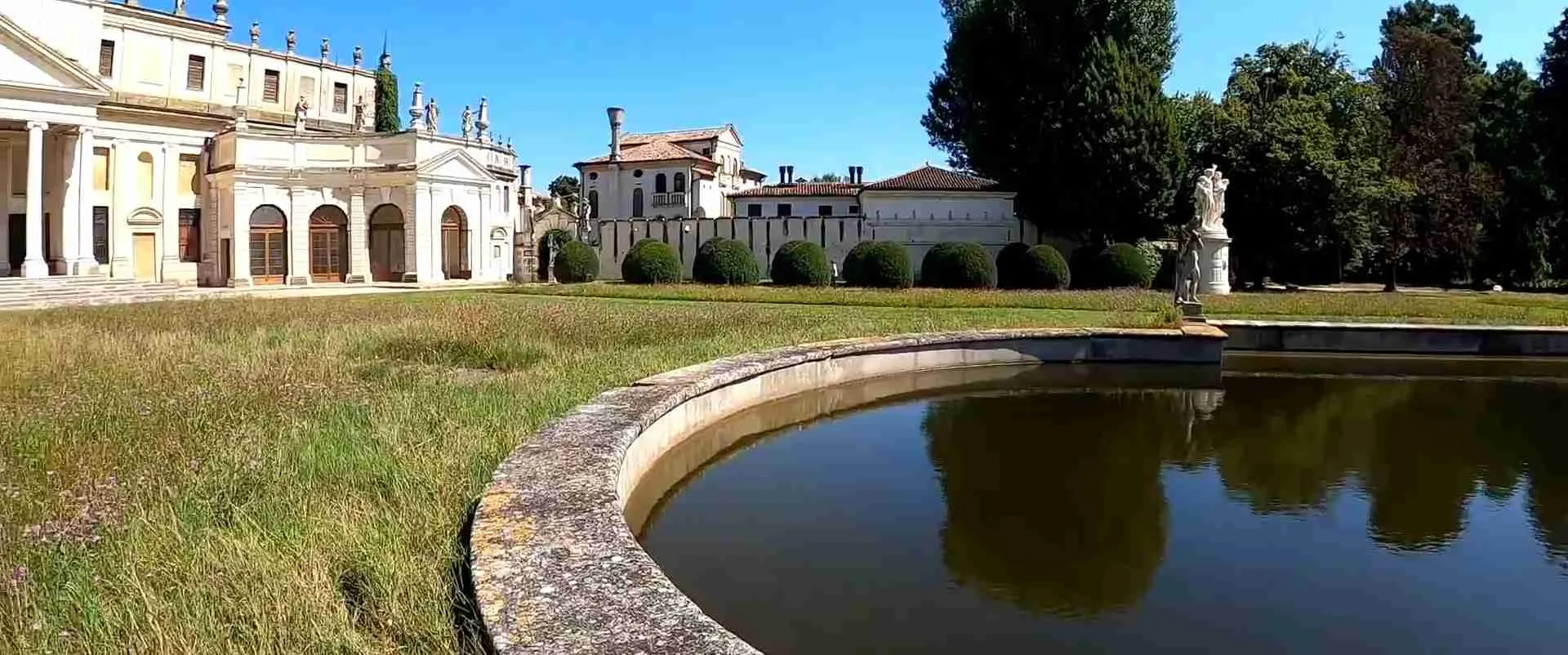
White Limestone and Human Will: How the Pietra di Vicenza Quarries Sculpted Renaissance Urbanism
Rising from the Berici Hills south of Vicenza, a pale limestone embedded with the fossils of ancient tropical seas became the physical substance of one of the most consequential architectural revolutions in Western history. Quarried from horizontal gallery tunnels, transported by river, and placed in the hands of craftsmen who could shape it with chisels almost as readily as wood, this stone did not merely supply building material for Andrea Palladio and his Vicentine patrons. It determined the vocabulary, color, and philosophical character of a city that the world would spend five centuries imitating.
Key Takeaways
- Ancient marine origin: The Pietra di Vicenza is a biocalcarenitic limestone formed during the Eocene and Oligocene epochs (roughly 50 to 20 million years ago) when the Berici Hills region lay beneath a warm, shallow tropical sea. Its visible fossils — nummulites, coralline algae, bryozoans, echinoids — are not imperfections but the substance of the rock itself.
- The soft-stone paradox: Known locally as pietra tenera (soft stone), the Pietra di Vicenza arrives from the quarry saturated with water and soft enough to cut with moderate effort. Upon exposure to air, a process of surface carbonation progressively hardens the stone, producing buildings that grow more resistant over centuries — precisely the inverse of many imported marbles that degrade under northern Italian weather.
- Palladio’s material choice was inseparable from his architecture: Every major Palladian building in Vicenza — the Basilica Palladiana, the Palazzo Chiericati, the Teatro Olimpico, the Loggia del Capitaniato — exploits the Pietra di Vicenza’s carvability to achieve the precision of classical entablatures, column capitals, and sculptural programs that harder stones would have made prohibitively expensive or technically impossible at the same scale.
- Color as urban argument: The stone’s palette — ranging from ivory white through warm straw-yellow (the Nanto variety) to silver grey — gave Vicenza a visual coherence that transcends individual buildings. Walking any of the city’s principal streets is an exercise in understanding how a single geological formation can produce urban identity at the scale of an entire Renaissance city.
- The quarrying landscape and the city are one heritage system: UNESCO inscribed the “City of Vicenza and the Palladian Villas of the Veneto” (reference 712) in 1994, extended in 1996 to include twenty-one villas across the Veneto, under criteria (i) and (ii). What this inscription protects — without naming it directly — is an entire material ecosystem: the quarry, the workshop, the river transport route, and the carved building constitute a single, indivisible cultural object.
- The philosophical dimension: Renaissance humanism insisted that universal classical forms should be realized in local materials, rooting the grand ambitions of antiquity in specific landscape and geology. The choice of Pietra di Vicenza over Istrian stone, Carrara marble, or Veronese red was therefore not merely economic — it was an act of intellectual will, a declaration that Vicenza’s own hills were capable of producing architecture equal to any in Italy.
People Also Ask About the Pietra di Vicenza and Renaissance Urbanism
What makes the Pietra di Vicenza unique among Italian limestones?
The Pietra di Vicenza stands apart through the combination of geological composition and mechanical behavior that no other major Italian limestone precisely replicates. As a biocalcarenite composed of Eocene and Oligocene marine organisms — nummulitic foraminifera, coralline algae, bryozoans, and echinoids — the stone arrives from the quarry saturated with moisture, giving it a softness that allows precision carving with relatively light tools. This fresh-quarry workability then reverses through a natural carbonation process: calcium carbonate crystallizes at the surface as the stone dries, progressively building a harder skin that proves resistant to atmospheric pollutants and freeze-thaw weathering cycles. The result is a stone that is easier to carve than Istrian limestone, harder in use than many marbles, and distinctively warm in color — properties that made it the preferred material of every significant architect who worked in Vicenza from the medieval period through the late Renaissance.
How did a single local stone shape the visual character of an entire Renaissance city?
Visual coherence in a pre-industrial city depends on material consistency more than on any single architectural gesture. When the same pale limestone appears in the columns, cornices, window surrounds, balustrades, and sculptural programs of dozens of buildings lining the same streets and piazzas, the result is a city that reads as a unified composition rather than a collection of individual monuments. Vicenza achieves this because the Berici Hills delivered essentially one stone — variable in color and grain between varieties but unified in character — to all the workshops and building sites of the city simultaneously. Palladio understood this material continuity and exploited it deliberately: his buildings do not impose classical Roman grammar onto a heterogeneous medieval fabric so much as they clarify and intensify a material logic that the city had already been developing for three centuries.
What is the geological relationship between the Berici Hills and the stone’s distinctive properties?
The Berici Hills south of Vicenza are essentially a compact island of Eocene and Oligocene marine sediment that emerged from the surrounding plain during Neogene tectonic movements. The limestone they contain formed when this region lay beneath a warm, shallow sea at latitudes close to the equator — a tropical environment recorded in the fossils of reef-building organisms that make up 80 to 90 percent of the rock’s volume. The hills’ internal structure, with horizontal beds of varying softness intercalated through the formation, determines both quarrying practice (horizontal gallery excavation follows the soft beds) and material behavior (the stone’s high porosity and water content at extraction). The specific chemical composition — predominantly calcium carbonate with varying amounts of silica, iron oxides, and clay minerals — governs the color range and the speed of the post-extraction hardening process.
Why did Palladio choose local Vicentine limestone over Istrian stone or Carrara marble?
Palladio’s choice of Pietra di Vicenza was simultaneously practical, economic, and ideological. Practically, the stone’s fresh-quarry softness allowed local carvers to execute the complex classical ornament — Ionic volutes, Corinthian acanthus, elaborate egg-and-dart moldings — that Palladio’s designs demanded, at a speed and cost that harder imported stones could not match. Economically, proximity to the Berici Hills quarries made the stone far less expensive than Istrian limestone transported by sea from the Adriatic coast, or Carrara marble transported overland from Tuscany. Ideologically, the use of local stone aligned with the humanist argument that Roman architectural universality did not require Roman materials: the genius of antiquity was transferable to any landscape whose craftsmen understood the underlying principles. When Palladio moved to Venice and designed San Giorgio Maggiore and Il Redentore, he used Istrian stone — the material logic of the lagoon environment. In Vicenza, he used what the hills produced, and what the hills produced proved sufficient for everything classical architecture required.
Extended multi-day tours – 5+ days
Featured Vicenza Multi-Day Tour Packages
3 days
Vicenza 3-Day Discovery Tour
- ✓ Comprehensive Vicenza experience
- ✓ Expert local guides included
- ✓ All accommodation included
- ✓ Transportation provided

5 days
Vicenza 5-Day Highlights Experience
- ✓ Comprehensive Vicenza experience
- ✓ Expert local guides included
- ✓ All accommodation included
- ✓ Transportation provided
7 days
Vicenza 7-Day Cultural Journey
- ✓ Comprehensive Vicenza experience
- ✓ Expert local guides included
- ✓ All accommodation included
- ✓ Transportation provided
10 days
Vicenza 10-Day Complete Adventure
- ✓ Comprehensive Vicenza experience
- ✓ Expert local guides included
- ✓ All accommodation included
- ✓ Transportation provided
Multi-day tour packages powered by TourRadar. Prices and availability subject to change.
Introduction: The Stone That Made a City Possible
Architecture requires material, and material has geography. The great cities of architectural history are inseparable from their geological circumstances: Rome from its tufa and travertine, Athens from its Pentelic marble, Paris from its lutite limestone, Bath from its oolitic Bath stone. Vicenza’s architectural identity is anchored with equal specificity to a pale biocalcarenitic limestone extracted from the Berici Hills — a compact range of Eocene and Oligocene marine sediment that rises from the Veneto plain a few kilometers south of the city center.
This is the Pietra di Vicenza, known locally as pietra tenera — soft stone — a name that captures its most practically important characteristic while entirely concealing its paradoxical durability. Soft enough when freshly quarried to carve with tools that would seem inadequate for the work, it hardens progressively upon exposure to air, building over years a surface resistance that has preserved the facades of Palladian buildings through more than four centuries of northern Italian winters, spring floods, and industrial-era atmospheric pollution. To understand why Vicenza looks the way it looks — why its streets have the luminous, warm pallor they have, why its cornices carry the precise classical ornament they carry, why its piazzas achieve the visual unity they achieve — requires understanding this stone.
The title of this article frames the story in terms of “human will,” and the framing is deliberate. The Pietra di Vicenza did not passively await its architectural destiny. It had to be chosen. In sixteenth-century northern Italy, a wealthy city commissioning major public buildings had options: it could import Istrian stone from across the Adriatic, Veronese red marble from the Adige valley, Carrara white marble from Tuscany, or Botticino limestone from the Brescian hills. Vicenza’s ruling oligarchy, advised by their architect, chose their own stone. That choice was an argument about landscape, civic identity, and the universality of classical reason — an argument that the architecture of the Berici Hills, given proper principles, could speak the language of Rome.
To trace the full story of the Pietra di Vicenza is to move from ocean floors fifty million years old to the quarry galleries of Zovencedo and Nanto today; from the hammer and chisel of the medieval stonecutters’ guilds to the diamond-wire saws of contemporary extraction; from the double loggia of the Basilica Palladiana to the restoration laboratories where conservators match fresh-cut stone to weathered four-hundred-year-old surfaces. It is a story about geology, craft, economics, philosophy, and the particular kind of civic ambition that Renaissance Italy made possible.
The Earth Beneath Vicenza: Geological Origins of a Building Stone
Warm Seas and Deep Time: How the Berici Hills Formed
Approximately fifty million years ago, the land now occupied by the Berici Hills lay submerged beneath a warm, shallow sea located at latitudes roughly equivalent to present-day North Africa. The Eocene epoch was a period of global warmth — atmospheric carbon dioxide concentrations were high, polar ice caps were minimal, and tropical marine environments extended far into what are now temperate zones. The shallow sea that covered the pre-Alpine foreland of northeastern Italy was home to a thriving ecosystem of reef-building organisms: large benthic foraminifera known as nummulites (lens-shaped creatures whose name derives from the Latin for coin), coralline algae, bryozoans, echinoids, mollusks, and planktonic organisms of many kinds.
As these organisms lived and died over millions of years, their skeletal remains accumulated on the sea floor, layer by layer, compressed by the weight of successive deposits and eventually cemented by the percolation of calcium carbonate-rich water through the accumulating sediment. The resulting rock — a biocalcarenite, meaning a limestone composed predominantly of biological material rather than chemically precipitated calcite — is between 80 and 90 percent calcium carbonate, with the remaining fraction comprising silica, iron oxides, aluminum compounds, and clay minerals (primarily montmorillonite). It is the proportions of iron oxide, silica, and clay that determine which color variety the stone will be: more iron produces the warm golden tones of Nanto stone, less iron and more clay produce the cooler ivory or grey varieties.
The Berici Hills that contain this formation emerged from the surrounding plain during the Miocene and Pliocene, when tectonic forces associated with the collision of the Adriatic microplate with the European plate began folding and uplifting the pre-Alpine foreland. The hills are geologically anomalous in the Veneto plain — a compact, isolated dome of Mesozoic and Tertiary rock surrounded by younger alluvial deposits brought down by the rivers draining the Alps. Their resistance to erosion, which preserved the hills while surrounding sediments were washed away, reflects the hardness of their internal Cretaceous limestone core, while the softer Eocene and Oligocene layers that flank and cap this core are precisely the material of the Pietra di Vicenza. The hills’ compact extent — approximately 165 square kilometers — defines the stone’s entire natural domain.
Nummulites, Coralline Algae, and the Architecture of Rock
The macroscopic appearance of a freshly cut Pietra di Vicenza surface reveals its biological origins to anyone who looks closely. Nummulite shells — disc-shaped foraminifera that can range from a few millimeters to several centimeters in diameter, their internal spiral chambers clearly visible in cross-section — appear scattered through the matrix, sometimes so densely packed that they constitute the dominant texture of the stone. Coralline algae appear as branching, roughly cylindrical structures; bryozoans contribute lacy, fenestrate fragments; echinoid spines create elongated needle-like inclusions. In the Nanto variety (Giallo Dorato), large macroforaminifera set in a golden sand-sized matrix of planktonic foraminiferal debris create a particularly rich textural density. In the Costozza variety (ivory white), encrusting coralline algae dominate, with the algal networks creating the thin, flowery texture that stonecutters and architects have favored for the most demanding decorative work.
These biological inclusions are not merely decorative. They are structural. The large, robust shells of nummulites and coralline algae create a natural framework within the calcium carbonate matrix, a kind of biological reinforcement that gives the stone greater toughness than its softness might suggest. At the same time, the spaces between organic fragments create the high porosity — visible macropores exceeding 200 micrometers — that gives the stone its water-holding capacity and therefore its characteristic fresh-quarry workability. A stone that holds more water remains soft longer; a stone that releases water gradually through evaporation hardens progressively rather than catastrophically, avoiding the cracking that rapid drying can cause in some materials.
The Castelgomberto Formation and Its Principal Varieties
Stratigraphically, the Pietra di Vicenza belongs to two related geological formations. The older material derives from the Nummulitic Limestone Formation of the early to middle Eocene — the period when nummulite populations were at their greatest density and ecological dominance. The younger material belongs to the Castelgomberto Limestone Formation of the Oligocene, formed after the reef communities had partially restructured following an Eocene climatic shift. Together, these formations span a geological interval of roughly thirty million years, from approximately fifty million to twenty million years before the present.
Within this stratigraphic range, the quarrying tradition of the Berici Hills has identified several commercially and architecturally distinct varieties. The Costozza stone — the traditional light ivory variety that Palladio’s buildings primarily employ — is characterized by its high content of encrusting coralline algae, large foraminifera, bryozoans, and echinoids set in a fine carbonate matrix. The result is what stonecutters describe as a “flowery” texture, dense with organic micro-detail, uniformly pale, and receptive to the finest chiseling work. The Nanto stone or Giallo Dorato (Golden Yellow), quarried near the town of Nanto along the eastern margin of the Berici Hills, comes from the basal layers of the Nummulitic Limestone Formation and is distinguished by its warm yellowish-brown hue resulting from elevated iron oxide content; its isoriented large macroforaminifera set in a golden sand-sized matrix give it a somewhat coarser but visually richer texture. The grey varieties — Grigio Argento and Grigio Alpi — derive from formations where iron is absent or depleted, replaced by higher clay mineral content, producing tones from cool silver to slate. Contemporary quarrying companies such as Grassi Pietre have codified this chromatic range into six commercial denominations: Bianco Avorio, Giallo Dorato, Grigio Argento, Grigio Alpi, Pietra del Mare, and Perla dei Berici — a taxonomy that reveals how precise the color distinctions actually are when examined systematically.
From Hillside to Building Site: The Art of Quarrying Pietra di Vicenza
Gallery Quarrying and the Cave System
The extraction method that defines Pietra di Vicenza production both historically and in contemporary practice is gallery quarrying — coltivazione in galleria — in which horizontal tunnels are driven into the hillsides following the natural bedding planes of the limestone. This technique exploits the stone’s geological structure: the Berici Hills contain a layered succession of beds with varying degrees of hardness, and the quarriable stone occurs in horizontal seams that can be followed laterally into the hillside for considerable distances. Open-pit quarrying, which dominates extraction of many harder stones, is secondary here.
The gallery system offers critical advantages for a material whose workability depends on retained moisture. Underground galleries maintain a stable humidity environment that keeps the stone saturated with quarry water throughout the extraction process. A block removed from a well-maintained gallery and delivered quickly to a workshop can be carved for days or weeks in the same freshly-extracted condition that makes the work easy. Open-air quarrying of the same stone would accelerate the drying process, beginning the hardening cycle prematurely and reducing the window of easy carving. The galleries therefore function not merely as extraction infrastructure but as a form of controlled environment for maintaining material quality.
The antiquity of this technique in the Berici Hills is documented by the existence of ancient galleries at Costozza, near the town of Longare, where extensive underground cave systems were already being exploited in Roman times. The Costozza caves — some of them architecturally significant spaces in their own right, used as wine cellars and summer retreats by Renaissance-era aristocrats taking advantage of their naturally cool temperatures — provide material evidence that gallery quarrying at this location predates the medieval stonecutters’ guilds by many centuries. The specific galleries that supplied Palladio’s building sites in the sixteenth century were part of an infrastructure already more than a thousand years old.
Labor, Guild Organization, and the Stonecutters of the Berici
The social organization of stone production in the Berici Hills was structured around guild institutions that regulated extraction rights, carving standards, transportation, and pricing from at least the high medieval period. The stonecutters’ guilds of the Vicenza area — the tagliapietra, a professional category that encompassed extraction workers, rough dressers, and finish carvers — operated within the broader framework of Venetian guild law after the city’s submission to the Serenissima in 1404. The Republic of Venice maintained careful oversight of craft guilds across its mainland territories, and the Vicentine stone trade was no exception.
Guild membership conferred specific rights: access to quarry faces, participation in the established pricing structures, protection from outside competition, and transmission of accumulated technical knowledge through the apprenticeship system. A young stonecutter entering the Vicentine trade in the fifteenth century would spend years learning not only the mechanics of extraction and rough dressing but also the subtleties of stone assessment — how to evaluate a face for the direction of bedding planes, how to identify the best material within a gallery, how to recognize the difference between stone that would carve cleanly and stone with internal fractures or clay pockets that would cause tools to slip or sections to break. This knowledge, accumulated through generations of practice at specific quarry faces, was practical science of the highest order, and it was transmitted through direct mentorship rather than written documentation.
Palladio’s relationship with this guild world was intimate and professionally essential. His designs could only be realized if the workshops that executed them had carvers capable of translating two-dimensional drawings of Ionic capitals and Corinthian entablatures into three-dimensional stone at architectural scale. The precision demanded by his classical proportional system — where the diameter of a column base determined every other measurement in an elevation through precise numerical ratios — required not just skilled carvers but carvers who understood the material’s behavior well enough to anticipate how a freshly cut surface would look after hardening, how deeply a particular face could be undercut without risk of fracture, and how different varieties of the stone would respond to different finishing techniques.
Water Transport and the Logistics of Stone Distribution
The distribution of Pietra di Vicenza from quarry to building site depended on the river and canal networks of the Veneto plain — one of the most elaborate pre-industrial hydraulic systems in Europe, constructed and maintained over centuries for agricultural irrigation, flood control, and commercial navigation. Stone extracted from the Berici Hills quarries was moved first by ox-cart down the slopes of the hills to the rivers — the Bacchiglione, the Retrone, the Astico — that drain the Veneto plain toward the Adriatic. Once afloat, it could travel relatively cheaply to Vicenza, Padua, and other cities of the terraferma, or be transferred to the Brenta river system that linked the inland cities to Venice’s lagoon.
The economics of water transport were decisive for the stone trade. Heavy materials like limestone are expensive to move by land: the energy cost of dragging a stone block on a cart over unpaved roads limited the practical range of distribution to distances at which the transport cost did not exceed the value of the stone itself. River transport, by contrast, could move large volumes of heavy material cheaply over long distances, provided the rivers were navigable and the journey could be made largely with the current. The Berici Hills’ position in the Veneto river network made the Pietra di Vicenza accessible to a wide geographic area at competitive cost, while more distant stones — Istrian limestone from across the Adriatic, Carrara marble from Tuscany — faced transport costs that made them luxuries rather than standard building materials for all but the most extravagant commissions.
The organization of stone transport on the rivers involved a specialized workforce of boatmen and stone-handlers whose guilds overlapped with but were distinct from the quarrying guilds. Stone arriving at Vicenza’s river docks was received by contractors who would store it in yards near the building sites, continuing the slow drying process that had begun in the gallery at a controlled pace. Managing this drying schedule — ensuring that stone arrived at the carving workshop in the optimal condition of partial drying but not yet hardened — was itself a form of technical knowledge embedded in the trade infrastructure.
Material Virtues: How the Stone Behaves in the Mason’s Hand
The Pietra Tenera Paradox: Soft When Cut, Hard When Seasoned
The defining characteristic of the Pietra di Vicenza — the property that above all others determined its architectural destiny — is the reversal of the relationship between workability and durability that most building stones present. Most hard, durable stones are difficult to carve. Most easily workable stones are soft and weather quickly. The Pietra di Vicenza violates this rule in both directions simultaneously.
Freshly extracted from the gallery, the stone is saturated with what stonecutters call acqua di cava — quarry water. This absorbed moisture — held in the abundant macropores of the biocalcarenitic structure — acts as a lubricant within the stone’s crystalline matrix, reducing the resistance between carbonate grains and facilitating shearing. The result is a material that, in its freshly extracted state, can be cut with a wooden saw using coarse sand as the cutting medium, or with relatively lightweight iron tools, at speeds that would be impossible with denser limestones. Contemporary quarrying uses diamond-wire saws and water-cooled blades, but the principle exploited is the same one that medieval and Renaissance carvers used: extract the stone, work it quickly while it remains soft, and allow the finished form to harden in place.
The hardening mechanism is carbonation. As the quarry water evaporates from the stone’s surface, the dissolved calcium carbonate it carries is precipitated at the stone’s outer face, crystallizing into a denser, less porous layer that progressively closes the surface pores. The deeper interior of a block continues to dry more slowly, but the surface — the architectural face exposed to weather and view — hardens first and most thoroughly. Over months and years, this process builds a surface layer that is measurably harder and less permeable than the stone’s freshly extracted interior. Buildings in Vicenza built with Pietra di Vicenza in the sixteenth century carry surface layers that have been progressively hardening for four and a half centuries; their resistance to atmospheric pollutants, frost action, and biological growth is substantially greater than that of identical freshly cut material.
Color Palette and Surface Texture: The Visual Grammar of the Stone
The color range of the Pietra di Vicenza — from the cool ivory white of Costozza stone through the warm straw-yellow of the most common varieties to the golden brown of Nanto stone and the silver grey of the iron-depleted variants — is one of the most architecturally consequential facts about the material. Color in building stone is not a superficial property: it determines how a surface absorbs and reflects light, how it reads in shadow versus direct sun, how it ages visually over decades, and how it relates to adjacent materials. A city built predominantly in one stone of one color range develops a characteristic visual atmosphere that cannot be separated from its architectural character.
The warm pallor of Vicenza’s historic center — the quality that gives the city its distinctive luminosity in morning and evening light, that makes its piazzas appear to radiate rather than merely reflect light — is entirely a product of the Pietra di Vicenza’s color. The stone absorbs enough warmth to avoid the coldness of pure white marble but reflects enough to avoid the heaviness of darker limestones. In direct sun, the iron-tinted varieties achieve a golden quality that seems to internalize light rather than merely bounce it back; in overcast conditions, the same surfaces shift to a softer, more diffused warmth. The grey varieties, used less frequently in monumental architecture but common in vernacular building and secondary decorative elements, provide chromatic depth and shadow that prevent the urban palette from becoming monotonously pale.
The surface texture of carved Pietra di Vicenza reveals its fossil content directly. A column shaft polished to a smooth finish shows the outlines of nummulites and algal fragments as ghostly circles and branching shapes in the pale matrix; a rough-dressed block face exposes these inclusions in relief, creating a naturally varied texture that catches light and reads differently at different scales. Architects who understood the stone could exploit this textural richness: smoothly finished surfaces for column shafts and entablature faces where precision was architecturally essential; rougher finishes for rusticated bases and secondary walls where texture contributed to compositional effect.
Porosity, Carbonation, and Long-Term Durability
The material science underlying the Pietra di Vicenza’s durability paradox involves the specific geometry of its pore structure and the chemistry of its carbonation process. The macropores — spaces exceeding 200 micrometers — are large enough to hold substantial quantities of water but also large enough to allow that water to evaporate relatively quickly once the stone is exposed to air. This rapid initial drying at the surface is what drives the fast surface carbonation that produces the hardened outer layer. Smaller pores, by contrast, hold water by capillary force more tenaciously, slow down drying, and may allow freeze-thaw cycles to propagate fractures if the pore is too small to drain fully before freezing temperatures arrive.
The carbonation process — technically, the precipitation of calcium carbonate from solution at the drying surface — does more than simply close pores. It creates a mineral cement between existing carbonate grains that is mineralogically continuous with the pre-existing matrix, producing a surface zone that is genuinely harder than the interior rather than merely coated with a different material. This is why the hardened surface of weathered Pietra di Vicenza does not peel or separate the way some protective surface treatments do: it is the stone itself, transformed by its own chemistry in response to atmospheric exposure.
The practical consequence for architecture is considerable. Pieces of carved Pietra di Vicenza that have been exposed for centuries — column capitals, cornice moldings, window surrounds — often retain sharp arris edges and readable ornamental detail that comparable carving in softer or more porous stones would long since have lost to erosion or biological colonization. Restoration conservators working on Palladian buildings regularly note that the original carved elements, where not physically damaged, are frequently in better condition than comparable stone introduced in nineteenth or early twentieth-century repairs using substitute materials that lack the carbonation property.
Palladio and the Pietra di Vicenza: An Architectural Alliance
The Basilica Palladiana: Stone as Urban Stage
Andrea Palladio’s intervention in the Palazzo della Ragione — the medieval Gothic civic building that he transformed beginning in 1549 through the addition of a continuous double loggia — is the building in which the relationship between the Pietra di Vicenza and Palladian urbanism is most publicly and dramatically demonstrated. The commission asked Palladio to wrap an existing, asymmetric medieval structure in a new classical skin, creating a two-story loggia of Doric order on the ground floor and Ionic order above, punctuated by the “Palladian motif” (the arched opening flanked by smaller rectangular openings within a larger bay) that would become one of the most influential architectural inventions of the sixteenth century.
The building’s success depends entirely on the quality of its stonework. The double loggia presents to the Piazza dei Signori a repetitive sequence of columns, arches, entablatures, and balustrades in which the precision of every element — the exact diameter of each column at base and capital, the height of each entablature course, the profile of every molding — is governed by Palladio’s strict proportional system derived from Vitruvius. This precision was achievable in Pietra di Vicenza because the stone’s freshly-quarried softness allowed carvers to work with a degree of precision that harder materials would have made much more expensive and time-consuming. The columns of the Basilica are not approximately the right diameter; they are exactly the right diameter, to the tolerance that Palladio’s modular system required. The capitals are not approximately in the right style; they are carefully studied Doric and Ionic capitals that would satisfy a scholar of Roman antiquity.
The color of the stone as used in the Basilica contributed as much to its urban effect as its formal precision. The pale, warm ivory of the Costozza-variety limestone used for the loggias reads against the surrounding medieval fabric of the city as a compositional statement in light: the Basilica illuminates its piazza in a way that darker or rougher masonry would not. When lit obliquely by morning or evening sun, the carved ornament of the loggias casts precise shadows that articulate the depth of the architecture in visual terms that no painted surface could replicate.
The Palazzo Chiericati and the Logic of the Classical Order
Designed beginning in 1550 for the nobleman Girolamo Chiericati on the edge of what was then the public island zone of the city (the Isola), the Palazzo Chiericati embodies a different use of the Pietra di Vicenza than the Basilica. Where the Basilica’s loggia is a continuous, repetitive screen, the Chiericati’s facade is a more complex composition: a double-story loggia running the full width of the building on the ground floor, with the upper story divided between a central solid section and flanking loggias. The result is one of the most sophisticated facade compositions in sixteenth-century European architecture, in which the interplay of solid and void, column and wall, light and shadow creates a visual rhythm that rewards prolonged observation.
The Doric order of the ground-floor colonnade and the Ionic order above are executed in Pietra di Vicenza with a precision that establishes them as the authoritative reference for these orders in the northern Italian context. Palladio had studied the Roman monuments — the Temple of Fortuna Virilis, the Theatre of Marcellus, the Baths of Diocletian — directly in Rome, measuring and drawing them with a care that no previous architect working in the Veneto had achieved. What he brought back from those observations was a set of proportional rules and ornamental profiles that his carvers then executed in local stone. The fact that the stone was local did not diminish the classical authority of the result; if anything, it reinforced it, demonstrating that the universal grammar of antiquity was genuinely portable — that it required only a sufficiently workable material and a sufficiently precise understanding of the rules, not a specific marble quarried in a specific ancient location.
The Villas of the Veneto and the Rural Limestone Grammar
The Palladian villas scattered across the Veneto — twenty-four of which are now included in the UNESCO World Heritage inscription alongside the city buildings — represent a different relationship between architecture and the Pietra di Vicenza. In the city, the stone functions as the medium of a public, demonstrative classicism: buildings along major streets and piazzas use it to project civic grandeur and classical authority. In the rural villas, the stone performs a more intimate role, combining with brick, local rubble, and rendered surfaces in compositions that translate classical grammar into a domestic register.
The Villa Almerico-Capra, universally known as La Rotonda, designed from approximately 1566 for Paolo Almerico on a hill just outside Vicenza, demonstrates the stone’s versatility at its most concentrated. The four identical Ionic porticoes that project from the central cube of the villa — each with a pediment, a flight of steps, and six columns — are carved in Pietra di Vicenza to the same standard of precision as the city buildings, but here they face not a public piazza but a panoramic landscape of vineyards and fields. The stone’s color interacts differently in this setting: against the green of the Veneto countryside rather than the stone and brick of an urban street, the pale limestone takes on a quality of isolated luminosity, almost theatrical in clear weather, that Palladio seems to have understood and intended. The Rotonda is a machine for viewing landscape — a point from which four identical perspectives of the surrounding countryside can be framed through four identical temple fronts — and the pale stone of those fronts serves as the visual instrument through which the framing is achieved.
In other villas, where cost constraints or the availability of good local stone introduced more variety into the material palette, Palladio adapted his grammar accordingly. Some villa complexes used brick for the main walls with stone reserved for the portico and major ornamental elements; others used local rubble finished with plaster render, with stone carved elements inserted at the structurally and visually critical points — column capitals, entablature courses, corner quoins, doorway surrounds. This strategic use of stone — concentrating the carved material at the moments of maximum visual and structural importance while using cheaper materials elsewhere — is itself a design philosophy that the Pietra di Vicenza’s relatively moderate cost made possible.
The Teatro Olimpico and the Interior Mastery of Carved Stone
The Teatro Olimpico, begun in 1580 and completed after Palladio’s death under Vincenzo Scamozzi, represents the culmination of the Pietra di Vicenza’s role in Palladian architecture. As the first permanent indoor theater built in the Western world since antiquity, the Teatro Olimpico posed problems of a different order from any of Palladio’s earlier work: not how to project classical architecture onto a public street or into a rural landscape, but how to construct an interior version of a Roman theater — the complete scena frons, the tiers of seating, the columnar architecture of the stage building — within the constraints of the elongated space of the city’s former prison building.
The scena frons — the elaborately articulated stage facade with its central triple portal, flanking bays, statues in niches, relief panels, and crowning attic — is the building’s primary architectural statement, and it is executed entirely in Pietra di Vicenza. The sculptural program includes more than forty statues of members of the Accademia Olimpica and classical subjects, carved in the stone and set in the niches and attic of the facade. The quality of carving visible in these figures — their drapery, their faces, their poses — demonstrates the full range of what Vicentine stonecutters of the 1580s could achieve in this material: work that in harder stone would have required more time and more labor, but that in Pietra di Vicenza could be achieved within the budget and schedule of a learned private academy commissioning a building to celebrate its intellectual ambitions.
How Stone Generates Urban Form: The Grammar of the Vicenza Street
The Continuous Loggia and the Limestone Cornice System
One of the most persistent observations made by visitors to Vicenza is the visual coherence of its historic streets — the sense that the city was designed rather than merely built, that the facades of successive buildings along Corso Palladio or Contra Porti constitute not a sequence of individual architectural statements but a continuous composition. This coherence is not accidental. It results from the convergence of several forces: Palladio’s role as the dominant architect of the city for three crucial decades, the patronage strategies of an oligarchic ruling class that competed with one another in architectural display while sharing a common aesthetic framework, and — underlying both — the availability of a single material that all workshops used and all buildings showed.
The cornice is the principal instrument through which the Pietra di Vicenza creates urban continuity. Running at roughly consistent heights along the major streets, the carved limestone cornices of Vicentine palaces establish a horizontal datum that the eye reads as a unifying element regardless of the architectural details above and below. Whether the building is by Palladio himself, by his contemporaries working in the Palladian manner, or by later architects working within the tradition he established, the cornice profile — which in this material could be carved to the precise classical profiles that Palladio’s system required — appears at a height and scale consistent with its neighbors. The street reads as a wall with regular punctuation rather than as a random assembly of facades.
The loggia — covered arcade at street level — reinforces this horizontal reading while adding a vertical dimension of light and shade. Vicenza’s streets are lined with loggia systems that shelter pedestrians from rain and sun while opening the ground floor of buildings to public circulation. The structural columns, arches, and entablatures of these loggias, all carved in Pietra di Vicenza, create a repeated rhythm of light (the open bays between columns) and shade (the vaulted ceiling within) that gives the street a distinctive visual beat. Walking beneath a Vicentine loggia is to experience architecture as rhythm, and the stone is the instrument on which that rhythm is played.
Palace Fronts, Piazzas, and the Visual Unity of Accumulated Stone
The major piazzas of Vicenza — Piazza dei Signori, Piazza delle Erbe, Piazza Biade — demonstrate most dramatically what the accumulation of a single stone can achieve at the urban scale. Each of these spaces is defined by facades of varying age and authorship, but the consistent presence of Pietra di Vicenza in columns, cornices, pilasters, window surrounds, and portal frames gives the enclosure a material unity that reads as compositional intention even where individual buildings were designed by different architects in different decades. The visual argument being made by the ensemble of a Vicentine piazza is that the city, not merely the individual building, is the unit of architectural composition — an argument that requires a common material language to be legible.
Palladio makes this argument explicitly in the Quattro Libri dell’Architettura, his 1570 theoretical treatise, where his discussion of streets and piazzas treats them as architectural problems requiring the same principled attention as individual buildings. The material dimension of this argument — that urban consistency requires a consistent material — is implicit in the treatise’s illustrations, which show the buildings of Vicenza as elements of coordinated street compositions rather than as isolated objects. What makes those illustrations convincing as urban designs rather than mere building-by-building surveys is the visual reading of uniform stone throughout.
How Material Constraints Shaped Architectural Typologies
The relationship between stone and architecture is never simply one of material serving design. Material also shapes design, constraining certain solutions and making others available. The Pietra di Vicenza’s properties — its relative softness at extraction, its lightness, its carving grain, its color — encouraged specific architectural choices and discouraged others.
Columns of Pietra di Vicenza can be produced at the diameters and heights that Palladian proportional systems require without the structural penalties that softer stones incur in compression. The stone’s compressive strength, once fully hardened, is adequate for the loads involved in single or double loggia systems. But columns of extreme slenderness — the kind that highly polished, highly dense marbles could achieve — would have been risky in Pietra di Vicenza, and Palladio’s column proportions for this material stay within the ranges that its strength supports. This is a constraint that shaped the robustness and groundedness of Palladian columns, their quality of weight and presence rather than ethereal delicacy — a quality that distinguishes Palladian architecture from later neoclassical elaborations that used denser, harder stones.
The stone’s carving grain — the way that chisel and mallet move through the material — favored certain ornamental profiles over others. The undercut volute of the Ionic capital, which requires the carver to work into deep shadow in the curling scroll, is achievable in Pietra di Vicenza without the risk of fracture that a more brittle material would present, because the stone’s clay mineral content gives it a slight plasticity that resists sudden failure. The deeply carved egg-and-dart molding, the precisely profiled cyma recta and cyma reversa of classical cornices, the acanthus leaves of Corinthian capitals — all of these were regularly and successfully executed in Pietra di Vicenza in ways that drove the typological development of Palladian ornament toward the specific forms that the material’s behavior encouraged.
Pietra di Vicenza and Pietra d’Istria: Two Stones, One Republic
The Venetian Material Hierarchy and Its Geographical Logic
The Venetian Republic governed a territory that included both the Berici Hills of the Vicentine terraferma and the limestone quarries of the Istrian peninsula — today the area shared between Croatia and Slovenia. Each region supplied a distinctive building stone to the Republic’s architectural projects, and the two stones occupied different positions in a material hierarchy that was simultaneously economic, aesthetic, and symbolic.
Pietra d’Istria — the stone of the Istrian quarries at Rovigno, Parenzo, and Orsera — is a compact, fine-grained limestone of Cretaceous age, denser and harder than the Pietra di Vicenza, whiter in color, and notably resistant to the salt-water environment of the Venetian lagoon. Its key practical advantage for Venetian building is precisely this salt resistance: in an urban environment where buildings rise directly from water that is salt, biologically active, and subject to tidal fluctuation, a stone that absorbs minimal moisture and resists chemical attack from dissolved salts is critically superior to one with higher porosity. The great buildings of Venice — the Palazzo Ducale, the Procuratie Vecchie, the church facades, the canal-side palace foundations — use Pietra d’Istria in the zones of maximum water exposure: the lowest courses, the plinths, the quays, the external facings at water level.
Why Venice Chose Istrian Stone and Vicenza Chose Its Own
The geographical logic of these two material preferences is straightforward. Venice, sitting in a saltwater lagoon, needed a stone that could resist the specific degradation mechanisms of that environment; Istrian stone, which its builders had been using since Roman times, met that need. Vicenza, sitting in a freshwater river plain sixty kilometers inland from the Adriatic, faced no comparable exposure to salt degradation; its climate — wet winters, warm summers, moderate frost — presented challenges for which the carbonation-hardened surface of Pietra di Vicenza proved well adapted. Each city used the stone best suited to its local conditions.
But the distinction was also aesthetic and symbolic. The denseness and whiteness of Pietra d’Istria gave Venetian architecture a particular quality of cool, polished precision — surfaces that took a moderate polish and reflected light evenly, facades that communicated wealth and refinement through the smooth perfection of their stone. The warmer, slightly textured surface of Pietra di Vicenza communicated a different quality: more tactile, more alive with the biological history of the stone, more responsive to the play of light across its carved relief. These are not objective superiorities in either direction but different aesthetic registers appropriate to different urban contexts and different architectural ambitions.
When Palladio designed buildings for Venice — San Giorgio Maggiore, Il Redentore, Le Zitelle — he used Istrian stone, not Pietra di Vicenza. This was not a betrayal of his Vicentine material allegiances but an acknowledgment of the material logic of the lagoon. Working in the context of existing Venetian architecture, already saturated with the white precision of Istrian stone, a Palladian building in pale golden limestone would have read as materially alien rather than architecturally coherent. The genius of Palladio’s Venetian churches lies partly in how naturally they inhabit the Venetian material tradition while transforming its formal vocabulary. That transformation required using the local material — Istrian stone — in a new way, not importing a foreign material from his own city.
Shared Projects and the Dialogue Between Regional Limestones
The clearest demonstration of the two stones’ complementarity comes in the building projects of the Venetian Republic’s provincial administration, where both materials appear in the same buildings allocated to different structural and decorative roles. In Vicenza, the governmental buildings and the interventions by Venetian-appointed architects show how the Republic’s architects managed the material question: Istrian stone for elements requiring maximum precision and weather resistance, Pietra di Vicenza for the broader decorative program and the major carved elements where the local stone’s workability gave it a decisive advantage.
The dialogue between the two limestones reflects a more general principle of sophisticated stone architecture: the recognition that no single material is ideal for all purposes and that the most accomplished buildings are those in which different materials are allocated to the roles that each performs best. This principle required architects who understood materials deeply enough to make principled choices rather than defaulting to a single material for everything, and patrons willing to pay for the logistical complexity that multi-material buildings involve.
Beyond Vicenza: How the Stone Traveled the Veneto
Padua, Verona, and Treviso as Secondary Recipients
The river network that made the Berici Hills quarries accessible to Vicenza also connected them to the other major cities of the Veneto. Padua, linked to Vicenza by the Bacchiglione and the system of artificial canals connecting the two river basins, received Pietra di Vicenza for use in its own major building programs. The great basilica complex of Sant’Antonio — where Donatello had worked in bronze and marble in the 1440s and 1450s — also incorporated Pietra di Vicenza in its architectural details, a reminder that the stone’s use in the Veneto pre-dates Palladio by more than a century and is not exclusively a function of the Palladian movement.
Verona, located on the Adige river, had its own excellent building stones — the red Veronese marble (technically a limestone, reddish from hematite inclusions) and various grey limestones from the Lessini Hills — that competed with and partially substituted for the Berici Hills material in that city’s building tradition. Nonetheless, Pietra di Vicenza appears in Veronese buildings where carving demands exceeded the capabilities of the local stones, and the exchange of craftsmen between the two cities’ building trades created technical cross-pollination that enriched both traditions. Treviso, farther east and north of Padua in the Venetian terraferma, used Pietra di Vicenza for high-prestige architectural elements while relying on brick — the dominant material of the eastern Veneto plain, where limestone outcrops are absent — for standard construction.
Venetian Commissions and the Flow of Limestone to the Lagoon
Venice itself, despite its preference for Istrian stone in the salt-exposed zones of its buildings, imported Pietra di Vicenza for interior architectural elements and carved decorative programs where the Berici Hills stone’s workability made it cost-effective for detailed work. The major Venetian scuole — the confraternity buildings that rank among the finest examples of Venetian Renaissance architecture — show evidence of Pietra di Vicenza use in their interior courtyard architecture and carved decorative programs. The stone traveled to Venice by boat via the Brenta river system, arriving at the city’s stonecutting yards to be worked by Venetian craftsmen who may have learned their carving techniques from contact with the Vicentine guild tradition.
The flow of stone from the Berici Hills to Venice also carried with it the flow of craftsmen. Stonecutters trained in the Vicentine tradition moved to Venice for major commissions, taking with them technical knowledge developed specifically for working the soft limestone. This migration of craft knowledge across the Venetian mainland and into the lagoon city created a network of material and technical exchange that linked the geology of the Berici Hills to the architectural ambitions of the Serenissima more intimately than the transport of stone blocks alone might suggest.
The Long Reach of Palladian Precedent in Material Selection
The diffusion of Palladianism as an architectural style across Europe and eventually to the Americas is a well-documented story of formal influence: the spread of the Palladian motif, the temple portico applied to domestic architecture, the proportional system derived from the Quattro Libri. Less frequently noted is what happened to the material dimension of this influence when it crossed the Alps. English Palladianism, developed by Inigo Jones in the early seventeenth century and formalized by Colin Campbell, William Kent, and Lord Burlington in the 1720s, executed Palladian forms in Portland stone, Bath stone, and English brick — materials that behaved quite differently from Pietra di Vicenza but that English architects learned to use in pursuit of similar formal goals. American Palladianism, as practiced by Thomas Jefferson at Monticello and the University of Virginia, worked in local Virginia brick and marble.
What these transplantations demonstrate is that the Palladian formal system — the proportional grammar, the ornamental repertoire, the compositional principles — was genuinely portable in ways that its material substrate was not. The Pietra di Vicenza did not travel with Palladianism; what traveled was the understanding of how stone of specific properties should be used in the service of classical proportion and ornament. English and American architects had to develop equivalent understandings of their own local materials to achieve comparable results. That this proved possible — that Bath stone and Portland stone could sustain Palladian detail as convincingly as Pietra di Vicenza — was itself a validation of the humanist argument embedded in Palladio’s original material choice: that classical universality was transferable to any sufficiently capable local material and any sufficiently principled local craftsman tradition.
Humanism, Will, and the Quarry: Architecture as Deliberate Act
Patrons and the Politics of Stone Choice in Renaissance Italy
The decision to build in Pietra di Vicenza rather than in an imported prestige material was not merely economic or technically pragmatic. In the context of Renaissance Italian patronage culture, the choice of building material was a communicative act with social and political dimensions that contemporaries read and understood. Carrara marble signaled the highest level of expenditure and the most direct connection to classical Roman and Florentine Renaissance precedent — it was the material of Michelangelo, of ancient Roman temples, of the most prestigious commissions in the peninsula. Choosing not to use it could be read as either inability or argument.
Vicenza’s ruling oligarchy — the wealthy families who commissioned the major buildings of the sixteenth century, who sat on the city councils that authorized public projects, who competed with one another in displays of architectural sophistication — chose, collectively and repeatedly, to argue. They chose local stone, and in choosing it, they made a claim: that Vicenza’s own resources were sufficient for the grandest ambitions of Renaissance civilization, that the universality of classical architecture did not require Roman materials but only Roman principles. This claim had a civic-patriotic dimension that was inseparable from the political context of the Venetian terraferma, where cities like Vicenza, Padua, Treviso, and Verona maintained strong local identities and competitive relationships even within the framework of Venetian sovereignty.
Building in local stone was therefore an act of civic self-assertion as much as an architectural or economic decision. The stones of the Berici Hills were Vicenza’s own; using them for the most prestigious buildings in the city was a statement that those buildings, however classical their aspirations, were rooted in the specific ground of the city and the specific geography of its landscape. This is what the title of this article means by “human will”: the deliberate choice, against alternatives, to say that what the local earth produces is enough — that will, intelligence, and craft can make it sufficient for any architectural ambition.
Transmitting Knowledge: The Stonecutters’ Guild and Apprenticeship
The will to use local material required, as its practical complement, the accumulated knowledge of how to use it. This knowledge lived not in treatises or pattern books — the intellectual tools of architects like Palladio — but in the bodies and hands of craftsmen trained in multi-year apprenticeships to extract, dress, carve, and finish the specific material of the Berici Hills. The stonecutters’ guild was the institutional vehicle through which this knowledge was protected, regulated, and transmitted across generations.
Apprenticeship in the Vicentine stone trade began in early adolescence and lasted seven to ten years. An apprentice would begin with the physically demanding work of rough extraction — learning which faces of the gallery yielded usable stone, how to split along bedding planes without shattering the block, how to assess the internal condition of a freshly extracted piece by sound and by the resistance of a probing tool. From rough extraction, the training progressed to rough dressing — producing the approximate shapes demanded by building specifications — and from there to finish work: the increasingly fine carving of molding profiles, ornamental details, and ultimately the full sculptural vocabulary of classical architecture.
At each stage, the apprentice was learning not only technique but also material knowledge: the difference between a block that would take fine undercutting and one whose clay content would cause the tool to slip; the point in the post-extraction drying process at which a particular kind of detail work became too risky; the grain orientation within a block that would determine whether a particular face could sustain the loads that an architrave or a column capital must bear. This material intelligence, accumulated through direct experience with a specific stone from specific quarry faces, was impossible to substitute. An architect could conceive a design; only a trained Vicentine stonecutter could translate it into Pietra di Vicenza.
Local Material, Universal Form: The Ideological Stakes of Stone Selection
The humanist intellectual framework within which Palladio and his patrons operated gave their material choices a philosophical dimension that was explicit in the literature of the period. Vitruvius, whose De Architectura (rediscovered in 1414 and disseminated in printed editions from 1486 onward) was the fundamental reference text for Renaissance architectural theory, had devoted his second book to the question of building materials — what they are, how they behave, what their properties recommend them for which uses. The Vitruvian framework was not a prescription for specific materials but a methodology for understanding what local materials offered and how to use them intelligently.
Leon Battista Alberti, whose De Re Aedificatoria (c. 1450) was the first major Renaissance theoretical text to engage with Vitruvius, developed this into an explicit argument for local materials: the best buildings are those that use the materials of their region wisely, adapting the principles of classical architecture to local geological circumstance rather than pretending that only the specific materials of ancient Rome could sustain classical ambition. This argument had obvious practical advantages — it made classical architecture affordable across a wider range of cities and patrons — but it also had genuine philosophical weight: it affirmed that classical reason was truly universal, not tied to specific geography or specific stone.
Palladio absorbed this framework through his reading, his engagement with the humanists of the Accademia Olimpica in Vicenza, and his own practice. His treatment of the Pietra di Vicenza in the Quattro Libri is notably confident: he describes the stone’s properties with the same methodological interest that Vitruvius brought to the stones of ancient Rome, presenting it not as a local substitute for superior materials but as a material with its own virtues that a knowledgeable architect knows how to exploit. The message is consistent with the broader humanist argument: local material used with understanding is not second-best architecture — it is architecture fully appropriate to its place.
Continuity, Decline, and Renaissance of the Pietra Industry
The Nineteenth Century and the Challenge of Industrial Materials
The quarrying and carving tradition of the Berici Hills entered a period of relative decline in the nineteenth century under the double pressure of new industrial materials and changing architectural fashions. Portland cement, introduced into northern Italy in the second half of the nineteenth century, offered builders a material that could be cast into almost any form, set quickly, and produced at scale and uniform quality that natural stone quarrying could not match for the vast quantities demanded by urban expansion. Reinforced concrete, which became dominant in structural applications from the 1910s onward, displaced stone from its traditional role as both structural and decorative material in most new construction.
At the same time, Historicist and then Modernist architectural movements of the late nineteenth and early twentieth centuries created contradictory pressures on traditional stone use. Historicism initially sustained demand for carved stone ornament by requiring neo-Gothic, neo-Renaissance, and neoclassical decorative programs in new buildings; but it also opened the Vicentine market to competition from processed stones from other regions, as rail transport eliminated the geographic advantage that had given the Berici Hills quarries their historical dominance in the Veneto. Modernism’s rejection of ornament then eliminated the primary market for carved Pietra di Vicenza entirely: a building that needed no cornices, no column capitals, and no window surrounds needed no soft limestone carving tradition.
Contemporary Quarrying and the Artisan Survival
The tradition survived, however — diminished, specialized, and ultimately transformed by the twentieth century’s catastrophes into something more focused and in some ways more technically sophisticated than its pre-industrial predecessor. The approximately fifteen quarries currently active on the Colli Berici extract stone primarily for two markets: restoration and conservation of historic buildings (the largest and most consistent demand), and luxury architectural cladding for international projects in which the stone’s aesthetic properties — color, fossil texture, natural variation — command premium prices in markets ranging from the Middle East and East Asia to North America and Northern Europe.
Contemporary extraction uses diamond-wire saws cooled with water rather than the iron tools of the Renaissance period, but the gallery system that defines Pietra di Vicenza production remains unchanged in its fundamental logic: horizontal tunnels following the stone’s natural bedding planes, maintaining the moisture levels that keep the material workable through to the cutting stage. The stone produced by these methods is mechanically consistent with what Palladio’s quarries yielded — same composition, same porosity, same carbonation behavior — which makes it uniquely appropriate for restoration work on historic buildings where material compatibility is critical.
The artisan carving workshops that survive alongside the quarrying operations occupy a specialized niche that machine production cannot fully occupy. Custom capitals, complex molding profiles, sculptural elements for restoration programs, and original carved work for prestige commissions all require the human hand and the trained eye that apprenticeship produces. The number of skilled stone carvers working in the Vicentine tradition is smaller than at any previous period in its history, but the apprenticeship and transmission systems have not entirely broken down — master carvers still train successors, and the knowledge of how Pietra di Vicenza behaves under the chisel remains embodied in a living craft community.
Conservation Practice: Restoring Palladio with Authentic Stone
The conservation of the Palladian buildings of Vicenza — a responsibility directly created by the UNESCO inscription of 1994 — generates a sustained and technically demanding demand for new Pietra di Vicenza production. When a Palladian building requires restoration of eroded or damaged carved elements, the choice of replacement stone is not aesthetically neutral: using a different limestone, however superficially similar in color, introduces a material that will weather, harden, and develop surface character differently from the surrounding original stone, creating visual discontinuities over time that are the signature of unsuccessful restoration.
The standard of best practice in the restoration of UNESCO-listed stone buildings in Europe requires that replacement materials be as mineralogically and physically similar to the original as possible. For Vicenza, this means using Pietra di Vicenza from the same geological formations — preferably from the same quarry areas — that supplied the original stone. The petrographic analysis of original building samples, comparing grain size, pore structure, mineralogical composition, and color parameters to the available quarry production, has become a standard preliminary step in major restoration projects on Palladian buildings. The quarries of the Berici Hills are not merely of historical interest; they are active participants in the conservation of the heritage that Palladio’s use of their stone created.
UNESCO Recognition and the Stone That Earned Heritage Status
Vicenza on the World Heritage List: What the Inscription Protects
The inscription of the “City of Vicenza and the Palladian Villas of the Veneto” on the UNESCO World Heritage List — reference 712, inscribed in 1994 for the city of Vicenza with its twenty-three Palladian buildings and three suburban villas, extended in 1996 to include twenty-one villas across the Veneto region — was made under criteria (i) and (ii) of the World Heritage Convention’s evaluation criteria. Criterion (i) recognizes Vicenza as “a masterpiece of human creative genius” in Palladio’s architectural contributions to the city’s urban character. Criterion (ii) recognizes the exceptional influence that Palladian architecture, as crystallized in Vicenza and the Veneto villas, has exerted on architectural and urban design across Europe and the world, giving rise to the Palladian movement that shaped building culture for three centuries.
What the inscription names explicitly — the buildings, the villas, the urban fabric of the historic center — is inseparable from what it does not name: the quarry landscape that made the buildings possible. The Pietra di Vicenza does not appear in the UNESCO inscription text as a protected element. No quarry is listed as a World Heritage component. Yet the Outstanding Universal Value that the inscription seeks to protect is materially constituted by the stone: remove the stone and the buildings cease to exist; cease to extract the stone and the capacity to conserve the buildings is permanently degraded.
Stone as Intangible Heritage: When the Quarry IS the Monument
The apparent gap in the UNESCO inscription — between what is named (the buildings) and what actually constitutes the heritage (buildings plus material plus quarrying knowledge) — reflects a broader challenge in international heritage thinking about the relationship between tangible and intangible heritage components. The stone of the Berici Hills is tangible, but the knowledge of how to extract it, assess it, carve it, and use it appropriately in restoration contexts is intangible — embodied in the craft community, transmitted through apprenticeship, and potentially irreversible in its loss if the community disperses.
The concept of intangible cultural heritage, formalized by the UNESCO Convention for the Safeguarding of the Intangible Cultural Heritage of 2003, provides a framework for thinking about the stonecutting traditions of the Berici Hills as heritage in their own right — not merely as instrumental knowledge serving the conservation of inscribed monuments but as a cultural practice with its own value and its own claim on protection. The craft of Vicentine stone carving, with its specific adaptation to the material properties of the pietra tenera, its guild traditions of knowledge transmission, its vernacular vocabulary of material assessment and quality evaluation, belongs to the same intellectual heritage as the buildings it creates and conserves.
Protecting the Source to Protect the Architecture
The practical implication of this analysis is that protecting the Palladian heritage of Vicenza requires protecting not only the buildings but the geological resource — the quarries, the formations, the active extraction infrastructure — and the human knowledge tradition that converts geological material into architectural material. This requires policies that do not always align naturally with the usual priorities of urban heritage management, which tends to focus on what is already built rather than on the landscapes and processes that building requires.
The approximately fifteen quarries currently active on the Berici Hills operate within a complex regulatory environment that includes landscape protection legislation, environmental impact assessment requirements, and the planning rules of the various municipalities across whose territory the hills extend. The potential tension between heritage conservation goals — which require sustained quarry access to produce restoration material — and landscape protection goals — which may seek to limit extraction in ecologically sensitive terrain — is real and has been the subject of ongoing negotiation between heritage authorities, quarrying interests, and environmental regulators in the Veneto region.
The most sophisticated understanding of this tension recognizes that it is not a conflict between heritage and nature but between two legitimate heritage values — the built heritage of Palladian Vicenza and the natural heritage of the Berici Hills landscape — that the same geological formation has simultaneously produced. A management framework that protects both requires detailed technical understanding of which quarry areas are critical for restoration supply, which can be worked without visible landscape degradation, and which alternatives might be available when specific formations are exhausted. This is precisely the kind of scientifically and historically grounded management challenge that UNESCO’s Outstanding Universal Value framework was designed to support — and precisely the challenge that the continued vitality of the Pietra di Vicenza tradition requires its sponsors to address.
Frequently Asked Questions About the Pietra di Vicenza
What exactly is the Pietra di Vicenza and why is it called a “soft stone”?
The Pietra di Vicenza is a biocalcarenitic limestone — a sedimentary rock composed predominantly of calcium carbonate (80 to 90 percent) together with silica, iron oxides, clay minerals, and the compressed skeletal remains of Eocene and Oligocene marine organisms including nummulites (large disc-shaped foraminifera), coralline algae, bryozoans, and echinoids. The name pietra tenera (soft stone) refers to the material’s condition immediately after extraction: saturated with quarry water held in its abundant macropores, the freshly extracted stone offers relatively low resistance to carving tools, allowing craftsmen to work complex classical ornament with less effort than comparable work in harder limestones. This soft condition is temporary: upon exposure to air, a carbonation process progressively hardens the stone’s surface, building over months and years a denser, less permeable outer layer that proves highly resistant to atmospheric weathering. The stone is therefore both soft (when quarried) and durable (when seasoned) — a paradox that made it ideal for ambitious architectural carving programs.
How old are the geological formations that produced the Pietra di Vicenza?
The Pietra di Vicenza belongs to two related geological formations spanning the early Eocene to the Oligocene: the Nummulitic Limestone Formation, deposited approximately 50 to 40 million years ago when the Berici Hills region lay beneath a warm, shallow tropical sea, and the Castelgomberto Limestone Formation, deposited during the Oligocene (approximately 34 to 23 million years ago) after the early reef communities had partially restructured. The Berici Hills themselves — the compact range of Eocene and Oligocene marine sediment south of Vicenza where the quarries are located — emerged to their present elevation during the Miocene and Pliocene, between roughly 23 and 2.5 million years ago, through tectonic uplift associated with the broader Alpine orogeny. The fossils visible in the cut stone — nummulites, algae, bryozoans, echinoid fragments — record an ecosystem that existed in the geologically distant past when this region of northern Italy lay in a very different latitudinal and climatic context.
Where are the Pietra di Vicenza quarries located?
All commercially significant Pietra di Vicenza extraction occurs within the Berici Hills (Colli Berici), a compact range extending approximately 165 square kilometers south of Vicenza city center. The principal quarry concentrations are at Zovencedo, Grancona, Nanto, and Costozza — small towns and localities spread across the hills’ southern and eastern slopes. The San Gottardo area near Zovencedo is particularly noted for high-quality ornamental stone. The Nanto stone (Giallo Dorato variety) comes specifically from quarries near the town of Nanto along the eastern margin of the hills. Approximately fifteen quarries are currently active on the Berici Hills, all using the traditional gallery (tunnel) extraction method that dates to at least Roman times; ancient extraction galleries survive at Costozza, where underground chambers were already in use before the current era.
How did Palladio specifically use the Pietra di Vicenza in his buildings?
Palladio used the Pietra di Vicenza as the primary structural and decorative material in every major Vicentine building commission. In the Basilica Palladiana (work began 1549), the stone provides all the columns, arches, entablatures, and balustrades of the famous double loggia wrapping the medieval palazzo, enabling the carving precision that his strict classical proportional system demanded. In the Palazzo Chiericati (from 1550), it constitutes the full facade loggia system in Doric and Ionic orders. At Villa Almerico-Capra (La Rotonda, from c. 1566), the stone forms all four identical Ionic porticoes with their columns and pediments. The Teatro Olimpico (1580–1584), completed after Palladio’s death, uses it for the elaborate scena frons with its statues, relief panels, and colonnade, and for its more than forty-figure sculptural program. When Palladio worked in Venice, he used Istrian stone instead — acknowledging that material choice must respond to climatic and contextual conditions — but in Vicenza, the Berici Hills material was always his foundation.
What are the main varieties of Pietra di Vicenza and how do they differ?
Three varieties dominate the historical and contemporary record. Costozza stone is the traditional ivory-white variety, a packstone rich in encrusting coralline algae, large foraminifera, bryozoans, and echinoids, with a thin, fine, “flowery” texture that was the preferred material for Palladio’s most demanding carved work — column capitals, entablature moldings, and sculptural programs. Nanto stone (Giallo Dorato or Golden Yellow) comes from the eastern margin of the Berici Hills, with a warm yellowish-brown hue produced by elevated iron oxide content and a coarser texture dominated by large macroforaminifera in a golden matrix; this variety was used extensively in vernacular and secondary monumental architecture. The grey varieties — Grigio Argento and Grigio Alpi — develop from formations where iron is absent or depleted, replaced by higher clay mineral content, giving tones ranging from cool silver to slate; these appear frequently in vernacular building, paving, and secondary architectural elements. Contemporary quarrying companies have codified a broader palette of six commercial varieties encompassing these ranges.
How does the Pietra di Vicenza compare to Istrian stone in architectural terms?
The two stones are both limestones but differ fundamentally in geological age, composition, and architectural behavior. Pietra d’Istria is a compact, fine-grained Cretaceous limestone — older, denser, and harder than Pietra di Vicenza, with much lower porosity and negligible water absorption. Its hardness makes it more resistant to salt-water degradation, which is why Venice — a city sitting in a tidal saltwater lagoon — preferred it for exposed building faces and water-level courses. Its white color and capacity for polishing gave Venetian architecture its characteristic cool precision. The Pietra di Vicenza, by contrast, is softer when freshly extracted (making complex carving more feasible and less costly), warmer in color, and more texturally rich due to its fossil content; its resistance to inland weathering conditions, achieved through the post-extraction carbonation process, is excellent but specific to non-marine environments. When Palladio moved between Vicenza and Venice, he changed materials accordingly — using each stone in the environmental and urban context that suited its properties.
Is the Pietra di Vicenza still quarried today, and for what purposes?
Approximately fifteen quarries remain active on the Berici Hills, all using the traditional gallery extraction method updated with contemporary diamond-wire saw technology. Production serves two primary markets. The largest and most consistent demand comes from restoration and conservation of historic buildings — particularly the UNESCO-listed Palladian monuments of Vicenza and the Veneto villas, where material compatibility with original stone is an essential technical requirement and where modern substitutes are demonstrably inferior in their long-term weathering behavior. The second market is international luxury architectural cladding: the stone’s color, fossil texture, and natural variation command significant premium prices in markets across the Middle East, East Asia, and North America, where contemporary architects seek materials that offer visual richness unavailable in commercially quarried homogeneous stones. Major quarrying companies including Grassi Pietre export the stone globally while simultaneously supplying restoration programs, maintaining the dual role that Berici Hills stone production has performed in the Veneto economy for centuries.
How does the Pietra di Vicenza contribute to Vicenza’s UNESCO World Heritage status?
The UNESCO inscription (reference 712, 1994 for the city and 1996 for the villas, criteria i and ii) recognizes the Outstanding Universal Value of Palladio’s architecture in and around Vicenza. That architecture is materially constituted by the Pietra di Vicenza: every building cited in the inscription — the Basilica Palladiana, the Palazzo Chiericati, the Teatro Olimpico, the Loggia del Capitaniato, the twenty-four listed villas — owes its specific visual character, its carved detail, its color, and its durability to the stone of the Berici Hills. The inscription therefore implicitly protects the material ecosystem that made the buildings possible, even though the quarries themselves are not listed components. Conservation practice under the inscription requires the continued availability of authentic Pietra di Vicenza for restoration, making the active quarries functionally integral to the management of the World Heritage property, whether or not they are formally recognized as such.
What role did the Pietra di Vicenza play in the wider diffusion of Palladian architecture?
The Pietra di Vicenza was the material medium through which Palladianism was first articulated — the stone in which the proportional grammar, the ornamental vocabulary, and the compositional principles of the Quattro Libri were originally instantiated. When Palladianism diffused across Europe and to the Americas in the seventeenth and eighteenth centuries, the stone did not travel with it: English Palladianism used Portland and Bath stone; American Palladianism used local brick, marble, and stucco. What diffused instead was the proof of concept that the Berici Hills material had provided — that classical universality was genuinely portable, that a local limestone of appropriate properties, worked by craftsmen who understood the material and the classical system, could sustain architecture of the highest intellectual and aesthetic ambition. The Pietra di Vicenza was the argument; Palladianism was the conclusion drawn from it by two centuries of European and American architects.
How is the Pietra di Vicenza used in modern conservation and restoration?
Conservation of Palladian buildings uses Pietra di Vicenza from the same Berici Hills formations as the original stone, selected through petrographic analysis to match the mineralogy, grain size, pore structure, and color parameters of the material being replaced. The process begins with sampling and thin-section analysis of original building fabric to characterize the specific variety of stone used at different phases of a building’s construction. Contemporary quarry production is then evaluated against these specifications, with preference given to stone from quarry areas most likely to match the formation of the original material. Freshly extracted stone in the appropriate quarry condition — still retaining quarry moisture — is used where possible for carved replacement elements, allowing carvers to work with the same soft-stone conditions that original craftsmen exploited. Over the months and years following installation, the new stone’s carbonation process brings its surface properties progressively into alignment with the surrounding original material, producing conservation results that are difficult to detect visually after appropriate seasoning periods.