Visiting Trentino & South Tyrol: Ultimate Planning Resource & Travel Guide 2026
Trentino and South Tyrol occupy the northeastern corner of Italy where the Dolomites rise from sun-drenched valley floors to jagged limestone spires inscribed as UNESCO World Heritage. Together they form one of Europe’s most rewarding alpine destinations — two politically distinct autonomous provinces sharing a landscape of extraordinary depth, where Tyrolean farmhouses and Italian piazzas coexist under the same mountain skyline. This guide covers everything you need to visit confidently in 2026, from verified costs and access restrictions to neighbourhood-by-neighbourhood accommodation advice and day-by-day itinerary frameworks.
Key Takeaways
- Budget spread for 2026: Budget travelers spending €70-110 per person daily; mid-range visitors €155-230; luxury seekers €305-470. All figures per person, per day, assuming two sharing accommodation.
- UNESCO Dolomites: Inscribed June 26, 2009 under criteria (vii) and (viii), the Dolomites World Heritage property spans nine component systems across five provinces, covering 141,902 hectares. Trentino and South Tyrol contain the majority of the inscribed systems.
- Free public transport: Most South Tyrol accommodation includes the Südtirol Guest Pass, giving free unlimited travel on all regional buses, trains, and selected cable cars throughout your stay — a saving worth €22-52 per person for typical visit durations.
- 2026 access restrictions are significant: Tre Cime di Lavaredo, Lago di Braies, and Alpe di Siusi all operate mandatory reservation or timed-access systems in peak season. Book parking and shuttle tickets online before arriving to avoid being turned away at the gate.
- Dual-language culture: South Tyrol is officially bilingual German-Italian; many villages in the Ladin valleys carry three official names. Most hospitality staff speak English fluently. Trentino is primarily Italian-speaking with strong Alpine heritage.
- Best 2026 window: Mid-June to late September for hiking and cable cars; December to March for skiing. Late May and October offer shoulder-season value with most infrastructure open and substantially lower crowds.
People Also Ask About Trentino & South Tyrol 2026
How much does a trip to Trentino & South Tyrol cost per day in 2026?
Daily costs in 2026 range from approximately €70-110 per person for budget travelers (two sharing a budget B&B or guesthouse, self-catering some meals, focusing on free hiking). Mid-range visitors staying in three-star hotels with breakfast included, eating at restaurants for lunch and dinner, and purchasing cable car tickets or museum admissions spend €155-230 per person daily. Luxury travelers at four or five-star wellness resorts with full-board dining and premium guided experiences invest €305-470 per person daily. All figures assume two people sharing accommodation, with the room rate divided before adding per-person expenses. A seven-day mid-range trip runs approximately €1,085-1,610 per person total. Verify current accommodation rates at booking platforms before finalizing your budget, as South Tyrol resort areas fluctuate significantly by season.
Do I need a car to explore Trentino & South Tyrol in 2026?
A car provides maximum flexibility, especially for accessing Dolomites viewpoints and smaller valleys, but it is not essential and in some areas actively discouraged. South Tyrol’s public transport network is comprehensive and affordable: the Südtirol Mobilcard covers all regional buses, trains, and selected cable cars for €22 per day, €32 for three days, or €52 for seven days, and most hotels include this free in the room rate via the Südtirol Guest Pass. Regional trains connect Bolzano, Merano, Bressanone, Brunico, and Trento reliably. Several of the most visited destinations — Alpe di Siusi, Tre Cime di Lavaredo, and Lago di Braies — have restricted or banned private car access during peak hours in summer 2026, making the public shuttle system the smarter choice regardless of whether you have a vehicle.
What are the must-see attractions in Trentino & South Tyrol in 2026?
The non-negotiable attractions span two provinces. In South Tyrol: Ötzi the Iceman at the South Tyrol Museum of Archaeology in Bolzano (adult admission approximately €13; reserve online to skip the queues); the Messner Mountain Museum network across six castles and peaks; the Tre Cime di Lavaredo circuit hike; Alpe di Siusi — Europe’s largest high-alpine plateau; and Lago di Braies, the turquoise jewel of the Pusteria Valley. In Trentino: Trento’s Piazza del Duomo and Castello del Buonconsiglio (adult €10-13); MUSE — the Renzo Piano-designed science museum (adult €11); the Brenta Dolomites around Madonna di Campiglio; Lake Garda’s northern shore at Riva del Garda; and the wine road through the Adige Valley. The Seceda ridgeline in Val Gardena, accessible by cable car (€74 per adult return in 2026), delivers what many consider the finest panoramic viewpoint in the entire range.
When is the best time to visit Trentino & South Tyrol in 2026?
Summer (mid-June through September) offers the longest cable car operating windows, snow-free Dolomites trails, lake swimming on the Garda shore, and all mountain huts open. July and August bring peak crowds and premium accommodation prices — the Mobilcard, Guest Pass, and advance booking of Dolomites access permits become essential. June and September deliver quieter trails, full infrastructure, and noticeably lower room rates than August. Winter (December through March) transforms the region into one of Europe’s premier ski destinations, with the Dolomiti Superski interconnected ski area covering 1,200 km of piste. Spring (April-May) and autumn (October-early November) are shoulder seasons: some cable cars remain closed, but accommodation prices drop 30-40% below summer peaks and the valley towns retain full services.
Extended multi-day tours – 5+ days
Featured South Tyrol Multi-Day Tour Packages

8 days
Hiking in the Dolomites
- ✓ Comprehensive South Tyrol tour
- ✓ Expert local guides included
- ✓ All accommodation arranged
- ✓ Transportation provided

8 days
Walking in the Dolomites – Campitello
- ✓ Comprehensive South Tyrol tour
- ✓ Expert local guides included
- ✓ All accommodation arranged
- ✓ Transportation provided
8 days
Self-Guided Walks in the Italian Dolomites
- ✓ Comprehensive South Tyrol tour
- ✓ Expert local guides included
- ✓ All accommodation arranged
- ✓ Transportation provided
8 days
Hiking in the Dolomites
- ✓ Comprehensive South Tyrol tour
- ✓ Expert local guides included
- ✓ All accommodation arranged
- ✓ Transportation provided
Multi-day tour packages powered by TourRadar. Prices and availability subject to change.
Trentino & South Tyrol in 2026: An Introduction
Two autonomous provinces, one spectacular landscape. Trentino (Provincia Autonoma di Trento) and South Tyrol (Provincia Autonoma di Bolzano/Bozen) together form the region of Trentino-Alto Adige in northern Italy, yet each operates independently with its own government, budget, and cultural identity. South Tyrol passed from Austria to Italy only in 1919 following World War I, and its villages, cuisine, and architecture remain deeply Central European in character. German and Italian are both official languages; a third, Ladin — an ancient Rhaeto-Romance language spoken by some 30,000 people in the high Dolomite valleys of Val Gardena, Val Badia, and Fassa — adds a third cultural thread. Trentino, to the south, is predominantly Italian in language and culture but equally Alpine in spirit, stretching from Lake Garda’s olive groves in the south to the glaciated summits of the Adamello group in the west.
What unites both provinces is the Dolomites — the extraordinary pale limestone mountain range whose nine distinct groupings were collectively inscribed on the UNESCO World Heritage List in 2009. Geologically, the Dolomites are an anomaly: ancient coral reefs from a tropical sea that existed 250 million years ago, uplifted thousands of metres by tectonic forces and carved by glaciers into the towers, spires, and vertical walls that make this landscape unlike anywhere else on Earth. UNESCO recognized this under two criteria: (vii) for the Dolomites’ superlative natural beauty, including the celebrated enrosadira phenomenon by which the pale rock glows red and orange at sunrise and sunset; and (viii) for the range’s outstanding geological record of Mesozoic carbonate platform evolution.
For travelers, the practical reality of visiting in 2026 is a region undergoing significant visitor management evolution. Success at the most iconic sites — Tre Cime di Lavaredo, Alpe di Siusi, Lago di Braies — depends on pre-booking, on understanding access windows, and on using the excellent public transport network rather than arriving by private car and discovering the parking lot is full at 8:45 AM. This guide makes all of that straightforward.
Getting to Trentino & South Tyrol in 2026
The region sits at the intersection of Italy’s main north-south rail and road corridor — the Brenner Pass route connecting Munich to Verona — making it highly accessible from both northern and southern Europe.
By Air to Trentino & South Tyrol in 2026
No commercial airport operates within the two provinces. The three most practical options are Verona Villafranca Airport (VRN), 120 km south of Trento with frequent train connections; Innsbruck Airport (INN), 100 km north of Bolzano via the Brenner motorway; and Venice Marco Polo Airport (VCE), 230 km southeast with direct train connections via Trento. Verona is the preferred gateway for most visitors: frequent Trenitalia regional trains reach Trento in approximately 45 minutes (€6-10) and Bolzano in approximately 90 minutes. Milan Malpensa Airport (MXP) serves the western approach, with trains to Trento in two hours via Verona.
By Train in 2026
The Brenner Railway (Trento–Bolzano–Bressanone–Brenner) is the spine of the regional rail network, with frequent Trenitalia regional services and some EuroCity trains. The journey from Trento to Bolzano takes 55-70 minutes; from Bolzano to Bressanone 25 minutes; from Bolzano to Brunico (for the Pusteria Valley) 70-90 minutes via Fortezza. A regional network of smaller rail lines branches into the valleys: the Venosta Valley train (Malles–Merano–Bolzano) and the Pusteria Valley train (Fortezza–San Candido) are included in the Südtirol Guest Pass and Mobilcard, making car-free valley exploration entirely practical. Milan Centrale to Trento takes 2.5-3 hours on direct trains; Venice Santa Lucia to Trento runs 2-2.5 hours.
By Car in 2026
The A22 Brennero–Modena motorway (toll road) runs the full length of both provinces from the Austrian border to Verona, with exits at Trento Nord, Trento Sud, Bolzano Sud, Bolzano Nord, Bressanone, Brunico, and San Candido. It is the most direct car route from Munich (90 minutes to the Brenner), Innsbruck (60 minutes), or Verona (45 minutes to Trento). A car is most useful for accessing the higher Dolomites valleys — Val di Fassa, Val Badia, Val Gardena, Valle Aurina — where public transport is less frequent. Note that several iconic destinations impose mandatory reservation systems for drivers in summer 2026 (see Access Restrictions section).
Exploring Trentino in 2026
Trentino covers 6,207 square kilometres from the northern tip of Lake Garda to the glacier-crowned Adamello group, encompassing alpine valleys, volcanic wine country, medieval castles, and some of the Dolomites’ most accessible hiking. The provincial capital Trento makes an ideal base for the southern province.
Trento 2026: The City of the Council
Trento (pop. 120,000) combines a Renaissance Italian character — arcaded streets, painted façades, the monumental Piazza del Duomo — with its alpine setting at 194 metres on the Adige River floor, surrounded by ridges rising to 2,000 metres. The city is historically significant as the site of the Council of Trent (1545-1563), the Catholic Church’s response to the Protestant Reformation, and this history informs its architecture and museums.
The Castello del Buonconsiglio, the former residence of the Prince-Bishops of Trent, is the city’s most visited monument. The castle complex spans three distinct architectural phases from medieval to Renaissance and contains exceptional late-Gothic frescoes in the Torre dell’Aquila — the months cycle (Ciclo dei Mesi) ranks among the finest secular Gothic painting cycles in Italy. Adult admission runs approximately €10-13; verify current pricing at buonconsiglio.it before visiting.
MUSE — Museo delle Scienze is Trento’s contemporary landmark. Designed by Renzo Piano and opened in 2013, the six-floor building in the Le Albere district uses the metaphor of the mountain as its organising structure, rising from tropical ecosystems at basement level to glaciers at the top floor. The museum covers natural history, evolution, biodiversity, and climate change with high-quality interactive installations. Adult admission is €11 (reduced €9 for ages 6-26, over 65, and groups). The ticket reservation via ticketlandia.com is strongly recommended, particularly on weekends and in school holidays. Free Wi-Fi is available throughout the building.
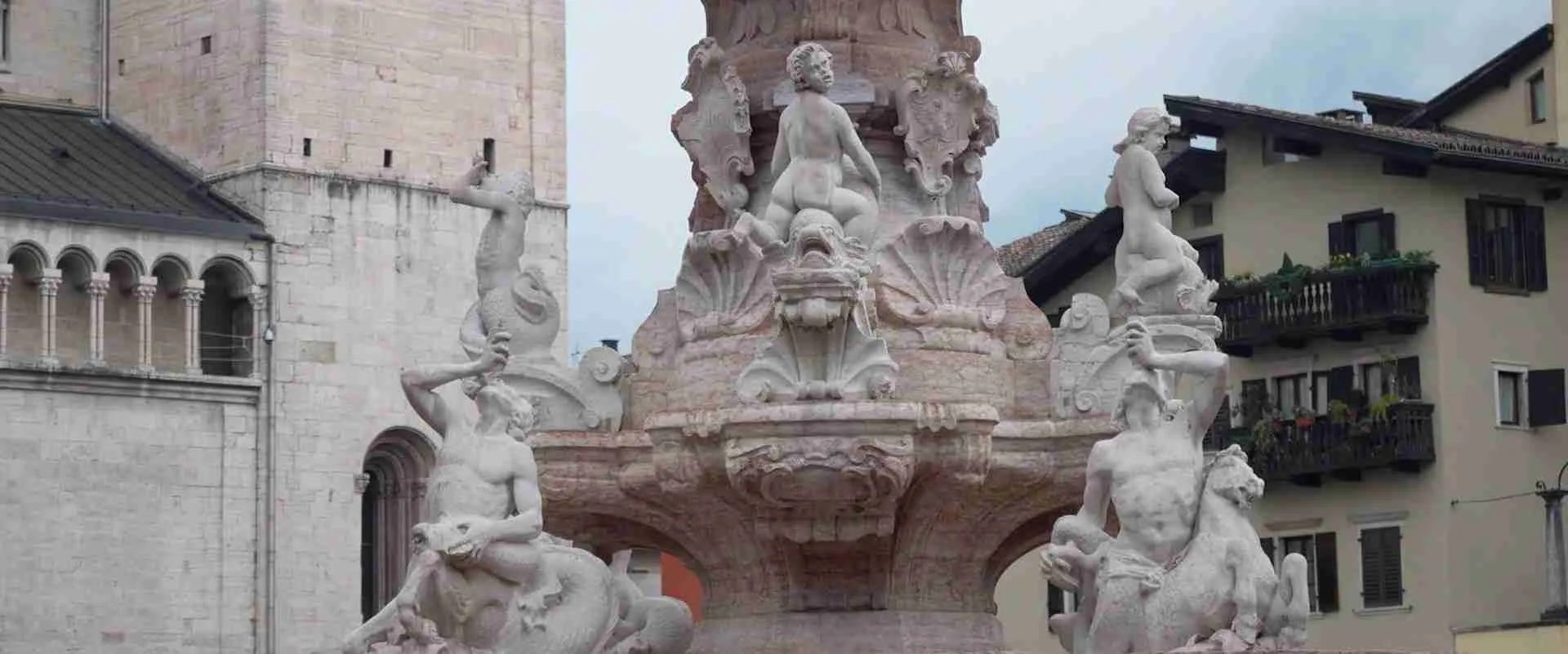
Trento’s historic centre repays a full half-day of walking: the Piazza del Duomo with its 16th-century Fontana del Nettuno; the Romanesque-Gothic Cathedral of San Vigilio; the underground Roman ruins of Tridentum (small entrance fee approximately €3-5); and the arcaded Via dei Portici leading north to the Piazza delle Erbe with its daily produce market.
Lake Garda (Trentino Shore) 2026
The northern 30 kilometres of Lake Garda fall within Trentino, giving the province an unexpected Mediterranean fringe. Riva del Garda and Arco at the northern tip receive 300 days of sunshine annually, grow olives and citrus, and offer a strikingly different environment from the alpine valleys 20 minutes to the north. Riva del Garda’s old town — the Piazza III Novembre with its medieval tower and arcaded waterfront — is one of the most charming squares in northern Italy. The lake itself is famous among windsurfers and sailors; the afternoon thermal wind (the Ora) blows reliably from south to north between noon and sunset.
From Trento, reach Riva del Garda by bus (approximately €5-7 one way, 60-75 minutes) or by car via the SS45bis lakeshore road. Day-trip cyclists use the Garda cycling path linking Riva to Torbole along the lakefront.
Brenta Dolomites & Madonna di Campiglio 2026
The Brenta Dolomites — the westernmost outcrop of the Dolomites, separated from the main range by the Adige Valley — form one of the most dramatic and least crowded sectors of the UNESCO World Heritage property. Their landmark is the Via delle Bocchette, a high-level ferrata route threading between the soaring towers above Madonna di Campiglio. In winter, Madonna di Campiglio is Trentino’s premier ski resort, home to the Dolomiti Superski area and a traditional stop on the Alpine World Cup ski circuit. In summer, the plateau opens to multi-day hiking and mountain biking, with cable cars running to high pastures from late June. Cable car day passes run approximately €38-46 for adults in summer 2026; verify current rates at funiviecampiglio.it.
Val di Fassa & Fassa Dolomites 2026
Val di Fassa cuts northeast from Trento into the heart of Ladin-speaking Dolomite territory, flanked by the Catinaccio/Rosengarten massif — whose towers glow the deepest crimson at sunset among the entire range — and the Sella group. Canazei, at the valley head, is the base for the Marmolada glacier, the highest peak in the Dolomites at 3,343 metres and the source of one of the most famous summer glacier experiences in Italy. A gondola from Malga Ciapela ascends to the Punta Rocca station at 3,265 metres. Canazei itself offers access to the Sella Ronda ski circuit in winter (one of the world’s great ski tours, linking all four Ladin valleys in either direction) and to the Dolomiti Supersummer card network in summer.
Exploring South Tyrol in 2026
South Tyrol (population 540,000) is Italy’s wealthiest province and one of Europe’s most successful alpine tourism destinations. Its capital Bolzano sits at just 262 metres in the Adige Valley, where Mediterranean warmth meets alpine drama within a single afternoon’s cable car ride. North and east, the province rises through wine country, apple orchards, and medieval castles before ascending to the high Dolomite valleys of Val Gardena, Val Badia, and the Pusteria.
Bolzano 2026: Gateway to South Tyrol
Bolzano (Bozen in German) is South Tyrol’s most cosmopolitan city — dual-language, culturally hybrid, with an excellent pedestrianised old town, a 14th-century Gothic cathedral, and a lively outdoor market on the Via dei Portici. The arcaded shopping street, the Walther Square, and the surrounding lanes make it the most pleasant urban base in the province. The city sits low enough to hold summer temperatures of 30°C or above, yet the Renon plateau (Ritten) is reachable by cable car in 12 minutes, offering cool mountain walking from Bolzano’s central station.
The South Tyrol Museum of Archaeology on Via Museo is Bolzano’s — and arguably Italy’s — single most compelling museum attraction. Ötzi the Iceman, the 5,300-year-old glacier mummy discovered in 1991 on the Similaun glacier at 3,210 metres, has been displayed here since 1998 in a purpose-built cold cell maintained at -6°C and 98% humidity. Visitors view him through a small window; the full exhibition across three floors covers the circumstances of discovery, his clothing and equipment (the world’s oldest fully preserved copper axe), Copper Age daily life, and multi-disciplinary research that has transformed understanding of prehistoric Europe. Adult admission is approximately €13 (verify current price at iceman.it before visiting). Online reservation is strongly recommended to avoid queues, particularly in summer; the museum opens Tuesday through Sunday, remaining closed Mondays outside July and August. Note that the Südtirol Guest Pass and the former Museumobilcard are no longer accepted as of 2025 — a standard admission ticket is required.
Bolzano’s other major cultural anchor is Messner Mountain Museum Firmian, housed in the medieval Castel Sigmundskron on a rocky ridge south of the city. The MMM Firmian explores mountaineering history and the philosophy of alpinism through Reinhold Messner’s personal collection. The full network of six MMM sites across South Tyrol — Firmian, Juval, Ortles, Ripa, Corones, and the temporarily closed Dolomites venue — can be visited on the MMM Tour Ticket (valid for one year from purchase). Individual site admission at MMM Ortles, for example, is €12 for adults and €6 for children aged 6-18.
Val Gardena 2026: Ortisei, Santa Cristina, Selva
Val Gardena (Gröden) is the most visited valley in South Tyrol’s Dolomites, and with good reason: it sits at the convergence of multiple iconic landscapes, offers direct access to both the Seceda ridgeline and Alpe di Siusi, and hosts three historic Ladin woodcarving villages. Ortisei (St. Ulrich) at the valley entrance is the largest, most convenient base.
The Seceda cable car from Ortisei ascends to 2,500 metres, where the view of the Odle group — a row of vertical dolomite pinnacles rising 600 metres above their base — is widely considered the most dramatic single panorama in the Dolomites. The full return cable car ticket from Ortisei costs €74 per adult in summer 2026 (verify at seceda.it). From summer 2026, tickets must be pre-booked online with a specific time slot to manage capacity; a €5 per person fee applies at the summit turnstile on the main ridgeline trail. The views justify every cent, but budget accordingly.
From Ortisei, the Mont Sëuc cable car (a separate lift) descends onto the western edge of Alpe di Siusi. The access rules for the plateau itself are discussed in the Access Restrictions section below. Selva di Val Gardena (Wolkenstein), at the valley head, sits directly beneath the Sella group and gives the shortest access to the Sella Ronda ski circuit in winter and the Dolomiti Supersummer cable car network in summer.
Merano 2026: Spa City in the Mountains
Merano (Meran) occupies a sheltered basin at the confluence of the Adige and Passer rivers, where the mountains block cold northern winds and create a microclimate mild enough for palm trees, citrus groves, and vineyards at 323 metres altitude. Victorian-era thermal baths and a long Habsburg tradition of health tourism — Empress Sisi visited repeatedly — give Merano a distinctive character: refined, Mediterranean in winter temperature, distinctly Austrian in architecture. The Merano Thermal Baths (Terme di Merano) are a contemporary wellness complex open year-round. The Kurhaus concert hall, the riverside promenades, and the surrounding Tyrol Castle and Trauttmansdorff Gardens (the former royal estate) justify a full day in the city.
From Bolzano, Merano is 40 minutes by regional train (included in the Mobilcard and Guest Pass). The city serves as the western gateway to the Val Venosta (Vinschgau), a long, dry valley running to the Swiss border at Malles/Mals — one of the sunniest valleys in the Alps, famous for apple production, thermal springs at Bagni di Trafoi, and the Stelvio National Park.
Pusteria Valley 2026: Brunico, San Candido, Three Peaks Country
The Pusteria Valley (Pustertal/Val Pusteria) runs east from Fortezza/Franzensfeste through Brunico/Bruneck to San Candido/Innichen near the Austrian border, with the Tre Cime di Lavaredo rising in the Sesto Dolomites to the south. Brunico, the valley’s main town, is a compact medieval centre worth an afternoon; its main attraction for visitors in 2026 is as the gateway to Plan de Corones/Kronplatz (2,275 metres), a broad summit plateau with a 360-degree panorama and home to MMM Corones at the summit. The cable car from San Vigilio/St. Vigil and the combined Lumen (photography museum) + MMM Corones ticket costs €22 for adults.
San Candido/Innichen, 10 minutes from the Austrian border and connected to Dobbiaco/Toblach by train, is the primary base for visiting Tre Cime di Lavaredo and Lago di Braies. The Sesto Dolomites around Dobbiaco are characterized by vast coniferous forests, wide pastoral valleys, and the dramatic limestone walls of the Sesto group — less frequently visited than Val Gardena but equally spectacular. The Three Peaks (Tre Cime/Drei Zinnen) rise to 2,999 metres and have been a symbol of Dolomite alpinism since the first ascent in 1869.
The UNESCO Dolomites: A World Heritage Landscape
The Dolomites World Heritage property, inscribed June 26, 2009, covers nine non-contiguous component systems totalling 141,902.8 hectares, with an additional 89,266.7-hectare buffer zone. Five Italian provinces share the property: Trento and Bolzano/South Tyrol hold the majority of the inscribed area, with smaller portions in Belluno, Pordenone, and Udine. UNESCO recognized the Dolomites under two natural criteria: (vii) — containing superlative natural phenomena and areas of exceptional natural beauty — and (viii) — representing outstanding examples of Earth’s geological history.
The nine systems include the Pale di San Martino (extending across the Trentino-Veneto border), the Marmolada massif (highest peak, 3,343 metres, largest glacier), the Pelmo and Croda da Lago mountains, the Brenta Dolomites (the westernmost, and the only isolated group), the Friuli Dolomites, the Settentrionali (Northern) Dolomites — including the Cadini peaks, the Sesto Dolomites, the Ampezzo Dolomites, and the Fanes-Sennes-Braies plateau — the Puez-Odle group in Val Gardena, the Sciliar-Catinaccio-Latemar trio straddling South Tyrol and Trentino, and the Marmolada massif itself.
What makes the Dolomites geologically extraordinary is their origin. They began as tropical coral reefs in the Tethys Sea approximately 250 million years ago, accumulating massive thicknesses of carbonate sediment. Over geological time this sediment was lithified, uplifted by Alpine tectonics, and then sculpted by glacial and fluvial erosion into the distinctive pale towers, vertical walls, and scree aprons visible today. The rock itself — dolomite, a calcium-magnesium carbonate named after the French geologist Déodat de Dolomieu — weathers differently from pure limestone, producing the extreme vertical relief and the pale coloration that transforms to pink, orange, and red during enrosadira. Marmolada’s glacier, the largest in the range, has lost more than 70% of its volume since 1910 and is projected to disappear entirely by 2040.
The World War I dimension adds a human historical layer that surprises many visitors. The Dolomites formed the Alpine Front between Italian and Austro-Hungarian forces from 1915 to 1918; both sides tunnelled into the mountains themselves at altitude, establishing the so-called “war in ice and rock.” The Tre Cime area, the Lagazuoi, and the Marmolada all contain remnants of this extraordinary conflict — tunnels, fortifications, memorials — accessible as part of hiking routes.
2026 Access Restrictions & Visitor Management in the Dolomites
The most significant practical development for visitors in 2026 is the expansion of mandatory reservation and timed-access systems at the three most iconic Dolomites destinations. These are not inconveniences — they are the mechanism by which these extraordinary landscapes are being preserved for future visitors. Understanding them in advance converts a potential source of frustration into a smooth, confident visit.
Tre Cime di Lavaredo: Access System 2026
From May 23, 2026, driving to Rifugio Auronzo — the trailhead for all Tre Cime hikes — requires a mandatory online reservation through the official booking portal. The toll road from Misurina to Rifugio Auronzo charges €40 per car for a 12-hour slot. The booked time slot opens access; you may arrive any time within the slot but must exit within 12 hours of slot start. Slots sell out weeks in advance in July and August — book immediately upon deciding your dates.
The alternative is the shuttle bus (Line 444), operated by südtirolmobil from Dobbiaco/Toblach station to Rifugio Auronzo, running from May 31 to October 11, 2026. Advance online reservation and payment are mandatory for this service as well; no walk-up tickets at the bus stop. The shuttle departs from Misurina every 30 minutes between 8:00 AM and 3:50 PM, with return services running from 8:30 AM to 5:30 PM. Booking opens at the beginning of the season at suedtirolmobil.info. The Südtirol Guest Pass is not valid on Line 444.
The circuit hike around the Three Peaks (Trail 101/105) covers approximately 9-10 km and takes three to four hours at a relaxed pace, with minimal elevation change from the Rifugio Auronzo starting point. Three mountain huts along the route provide food and drink. The walk is graded easy to moderate — well-paved paths, no technical terrain — but altitude (2,333 metres at the trailhead) and changeable weather demand appropriate clothing. The north face panorama from below the summits is genuinely staggering: three isolated towers rising 500 metres from the encircling rubble, framing nothing but sky.
Lago di Braies: Access System 2026
Lago di Braies (Pragser Wildsee) is the most photographed lake in the Italian Dolomites — an intensely turquoise oval of glacial water framed by the Croda del Becco and forested slopes in the Valle di Braies. From July 1 to September 15, 2026, the valley road is closed to private vehicles between 9:00 AM and 4:00 PM. During this window, access requires either a pre-booked parking space (via prags.bz) or the public bus. Pre-booked parking at the P1 lot includes a free shuttle ticket for up to 10 passengers; the full P1 combination ticket costs €44 per car (including a €22 restaurant voucher). Public bus route 442 connects the lake directly from Niederdorf/Villabassa and Toblach/Dobbiaco stations; this requires an online seat reservation and payment in advance between July 1 and September 10. The Südtirol Guest Pass covers the 442 bus outside the peak July 1-September 10 window; within that window, the paid online reservation applies regardless of pass type.
Outside the restriction period (before July 1 and after September 15), the valley road is open to normal traffic and parking is available at the P3 and P4 lots near the lake. The lakeside circuit trail covers 3.6 km and takes 60-90 minutes. Rowing boats are available for hire from the Hotel Lago di Braies on the shore. Swimming is prohibited throughout the lake — it is a protected nature reserve area.
Alpe di Siusi: Access System 2026
Europe’s largest high-altitude alpine plateau — 56 square kilometres of meadow at 1,680-2,350 metres, overlooked by the Sassolungo and Sciliar groups — operates a strict traffic limitation year-round when the cable car is running. The road from Siusi allo Sciliar to Compatsch is closed to private vehicles from 9:00 AM to 5:00 PM. Before 9:00 AM and after 5:00 PM, drivers may ascend to designated parking: P1 Spitzbühl at €15 per day (30-minute walk to Compatsch), or P2 Compatsch directly on the plateau at €30 per day. From June 29, 2026, both car parks require an advance online reservation — bookable up to six days before arrival at seiseralm.it. If both lots are full before the 9:00 AM road closure, access is denied even for cars with reservations; arriving before 8:00 AM on peak days is advisable.
The recommended approach for most visitors is the Seiser Alm Aerial Cableway from Seis allo Sciliar/Siusi (open May 22 to November 2, 2026, approximately 8:30 AM to 6:00 PM). The car park at the valley station is large and free. From Ortisei in Val Gardena, the Mont Sëuc cable car connects to the western plateau; this lift is included in the Südtirol Guest Pass (the main Seiser Alm Aerial Cableway from Siusi is not). The plateau itself is car-free once on foot — an extensive bus network (Seiser Alm Express, Almbus, internal shuttles) links the main points, with fares of a few euros per trip payable in cash. The hiking season at full operational capacity runs from late May to early November.
Val di Funes & Seceda: 2026 New Restrictions
Santa Maddalena church in Val di Funes, with its photogenic view of the Odle group, has new 2026 traffic restrictions: physical barriers prevent non-resident vehicles from driving to the Panorama Viewpoint above the church. Day visitors park in the village lots at Santa Maddalena (Ranui, Putzen, or Filler) and take Bus 330 to the Zans car park, which serves hikers on the Adolf Munkel Trail. The Zans car park itself has limited pre-bookable spaces; if the entry light is red, only those with prior reservations may proceed. At Seceda, the cable car company has introduced a paid turnstile (€5 per person) on the main ridgeline trail, and the meadows are now fenced to keep visitors on designated paths, with rangers enforcing the rules.
Accommodation Costs & Where to Stay in 2026
South Tyrol and Trentino span a wide accommodation range, from hostel dormitories to five-star mountain wellness resorts. The key characteristic that distinguishes this region is the Südtirol Guest Pass included with most South Tyrol accommodation: this digital card, issued automatically at check-in by participating hotels, gives free unlimited use of all regional buses, trains, and selected cable cars for the duration of your stay. The monetary value is €22-52 per person depending on length of stay, and in practice it means that transport costs effectively disappear from the budget calculation when staying at a pass-eligible property.
Budget Accommodation 2026
Budget accommodation in the two provinces runs from €60-90 per room per night for basic B&Bs, guesthouses (Pensionen/garni), and agriturismo farmstays. Hostel dormitory beds in Bolzano and Trento average €25-35 per bed. The lowest-cost areas are city centres — Bolzano (from approximately €68/night per room at the low end) and Trento, where university-city pricing keeps guesthouses competitive — and the lower agricultural valleys. Resort villages in Val Gardena (particularly Ortisei and Selva), Merano, and the areas immediately around Tre Cime charge significantly more: a room in Ortisei averages €766 per night across all categories (driven by the concentration of luxury wellness hotels), making lower-cost bases like Bolzano, Chiusa/Klausen, or Brixen/Bressanone smart economic choices for day-tripping into the Dolomites.
Budget travelers spending €60-90 per room should look at Bolzano B&B, Trento guesthouses, the Isarco Valley towns (Fortezza, Chiusa), and Merano pensioni slightly outside the thermal centre. Most include breakfast, making the daily meal calculation simpler. The B&B Hotel Bolzano chain provides reliable budget-category comfort at €80-120 per room in most seasons.
Mid-Range Accommodation 2026
Mid-range three-star hotels run €120-180 per room per night for a double with breakfast in most valley locations, rising to €160-250 in peak season at resort destinations. This category covers the best combination of value and quality in South Tyrol — family-run hotels (Gasthöfe) with regional cuisine, well-maintained rooms, and the Südtirol Guest Pass. Castelrotto (Kastelruth), the charming village at the foot of the Seiser Alm cable car, offers multiple mid-range options with direct shuttle access to the plateau, making it one of the highest-value bases in the region. Merano’s mid-range properties include spa access in many cases. In Trentino, the Adige Valley towns and the villages around Lake Garda offer mid-range pricing with excellent regional wine country access.
Luxury Accommodation 2026
South Tyrol is internationally recognised for its concentration of high-performing wellness hotels — large spa complexes, locally sourced cuisine, and intimate service in spectacular mountain settings. The luxury tier runs €250-500 per room per night for four and five-star properties. Highlights include Forestis Dolomites near Bressanone (one of Europe’s highest-rated mountain hotels), ADLER Resorts in the Dolomites Region Seiser Alm area, COMO Alpina Dolomites on the plateau edge at Compatsch, and the Relais & Châteaux properties in the wine country south of Bolzano. Five-star hotel chains in Merano, including the Grand Hotel Palace and Castel Fragsburg, combine thermal medicine traditions with contemporary wellness infrastructure. Book luxury properties well in advance for summer 2026 — July and August availability at the most sought-after addresses fills six to twelve months ahead.
Accommodation by Location: Key 2026 Price Ranges
- Bolzano city: Budget €68-100/room; mid-range €120-170/room; luxury €190-300/room
- Trento city: Budget €70-100/room; mid-range €110-160/room; luxury €160-260/room
- Merano: Budget €80-120/room; mid-range €130-200/room; luxury €220-400/room
- Val Gardena (Ortisei area): Budget €100-140/room; mid-range €160-280/room; luxury €300-700+/room
- Castelrotto/Seiser Alm area: Budget €90-130/room; mid-range €140-230/room; luxury €250-500/room
- San Candido/Pusteria Valley: Budget €85-120/room; mid-range €130-200/room; luxury €220-400/room
- Riva del Garda/Lake Garda: Budget €75-110/room; mid-range €120-190/room; luxury €200-400/room
Verify current rates at booking.com, expedia.com, or directly with properties before finalising your itinerary; prices fluctuate substantially by month and by local events.
Food, Wine & Dining in Trentino-South Tyrol 2026
The culinary identity of Trentino-South Tyrol is genuinely bicultural and genuinely excellent. South Tyrol’s kitchen is Central European in its bones: speck (juniper-cured smoked ham, DOP-designated), Knödel (bread dumplings, served in broth or with melted butter and chives), Schlutzkrapfen (half-moon pasta filled with spinach and ricotta), venison and wild boar preparations, apple strudel, and germinated rye bread. These dishes appear in every category of restaurant, from mountain huts to starred dining rooms. Trentino’s kitchen tilts more Italian: polenta, truffles from the Trentino hills, lake fish from Garda (carp, trout, sardines in saor), lucanica sausage, and the excellent Trentino IGT wines.
Wine is exceptional across both provinces. South Tyrol produces more DOC wines per planted hectare than almost any region in Italy, with the Alto Adige Wine Road south of Bolzano threading through Pinot Noir, Pinot Bianco, Gewürztraminer, Lagrein, and Vernatsch vineyards. A glass of estate Gewürztraminer costs €4-7 in a vineyard osteria. Trentino contributes the Trento DOC — Italy’s first dedicated appellation for metodo classico sparkling wine, with Ferrari Trento as its most prominent producer — and the distinctive Teroldego Rotaliano from the Campo Rotaliano plain north of Trento.
Restaurant Price Guide 2026
Budget dining in both provinces — bakeries (Bäckereien), supermarket counters, pizzerias, and self-service restaurants — delivers lunch for €10-18 per person and dinner for €18-28. A proper mid-range restaurant lunch (two courses, local wine, coffee) runs €25-40 per person; dinner €40-65. Upscale restaurants and starred dining rooms charge €70-130 per person for full menus with wine. Mountain huts (Hütten/rifugi) at altitude price a plate of Knödel at €12-18 and a half-litre of house wine at €8-14 — not cheap, but factoring the setting, extraordinary value.
The most affordable way to eat well is the lunch menu del giorno/Mittagsteller offered at most restaurants Monday through Friday: a full two-course meal with mineral water and coffee for €12-18. In Bolzano’s old town, the lunch trade in the arcaded restaurants under Via dei Portici peaks between noon and 2:00 PM; arrive by 12:30 PM to secure a table without reservations. Trento’s Le Albere district, next to MUSE, has a cluster of mid-range restaurants and a good covered market for picnic provisions.
South Tyrol Guest Pass Restaurant Discounts 2026
Many Guest Pass variants (the specific benefits vary by holiday area) include discounts at partner restaurants and mountain huts in addition to transport. Ask your accommodation about which version of the pass you hold and what the local benefits extend to. The Val Gardena Guest Pass, for example, includes benefits at Val Gardena partner businesses beyond transport alone.
Daily Budget Breakdowns for Trentino-South Tyrol 2026
All figures below are per person, per day, assuming two people sharing accommodation. Hotel costs are divided by two before adding to per-person meal, transport, and attraction costs. These ranges apply broadly across both provinces; resort villages in Val Gardena and the Alpe di Siusi area will push toward the top of each range.
Budget Traveler: €70-110 Per Person Daily 2026
Budget travelers sharing a basic B&B or guesthouse at €60-90 per room (per person share: €30-45), with breakfast included at most properties, keeping lunch to bakeries and markets (€10-15), and cooking or choosing pizzerias for dinner (€18-25), spending on Mobilcard or Guest Pass transport (€8-12), and focusing on free hiking rather than paid cable cars with occasional museum admission (€5-12), arrive at approximately €70-110 per person daily. Hostel dormitory stays in Bolzano or Trento bring costs toward the lower end of this range; guesthouses in popular Dolomites villages push toward the top. A week at budget level runs approximately €490-770 per person.
Mid-Range Traveler: €155-230 Per Person Daily 2026
Mid-range travel covering a three-star hotel at €120-180 per room with breakfast (per person share: €60-90), restaurant lunches (€20-28), restaurant dinners (€35-50), coffee and snacks (€5-8), Mobilcard or Guest Pass supplemented by cable car tickets (€12-20), and a museum admission or guided excursion most days (€20-35) totals approximately €155-230 per person daily. This range covers comfortable, highly enjoyable travel with proper restaurant meals, cable car panoramas, and full cultural engagement. A week at mid-range runs approximately €1,085-1,610 per person.
Luxury Traveler: €305-470 Per Person Daily 2026
Luxury visitors at four or five-star wellness hotels at €250-400 per room (per person share: €125-200), with hotel breakfast or full-board options covering morning meals, upscale mountain restaurant lunches (€35-50), fine dining dinners with regional wine pairings (€70-100), coffee and aperitivi (€15-20), rental car or private transfers (€25-40), and premium guided mountain experiences, spa access, or priority cable car packages (€40-65) invest approximately €305-470 per person daily. South Tyrol’s luxury hospitality sector is genuinely world-class; a week at this level runs approximately €2,135-3,290 per person.
Day-Trip Cost Examples 2026
- Tre Cime loop day trip (by shuttle from Dobbiaco): Shuttle bus reservation online (price varies; approximately €15-20 return), mountain hut lunch at the circuit (€18-25), snacks and water (€8-12). Total day attraction cost approximately €40-60 per person, plus accommodation and other meals.
- Bolzano city day: Ötzi Museum admission approximately €13, lunch in old town €20-28, gelato €3-4, afternoon city bus (included in Guest Pass or €1.50 single). Total attraction and food €36-50 per person.
- Seceda summit day from Ortisei: Cable car return €74, ridge turnstile €5, mountain hut lunch €20-28, coffee and cake €6-9. Total day approximately €105-116 per person excluding accommodation.
- MUSE + Castello del Buonconsiglio day in Trento: MUSE adult €11, Buonconsiglio €10-13, lunch €22-30, bus (Trentino public transport, included with most accommodations or ~€1.50 single ticket). Total €43-54 per person plus food.
Transportation & Getting Around in 2026
South Tyrol’s transportation infrastructure is a genuine model for sustainable alpine tourism, routinely recognised as one of Europe’s best regional public transport systems. The Südtirol Guest Pass (provided free by most accommodation) or the separately purchasable Südtirol Mobilcard covers the complete network.
Südtirol Mobilcard 2026
The Mobilcard provides unlimited travel on all südtirolmobil network services: regional and local express trains in South Tyrol (including the Brenner line to Trento, the Venosta Valley train, and the Pusteria Valley train), regional buses, city buses, and selected cable cars. The 2026 adult prices are €22 for one day, €32 for three days, and €52 for seven days. Children aged 6-13 pay €11 for one day, €16 for three days, and €26 for seven days; children under six travel free. The card does not cover long-distance trains (EuroCity, Railjet, Frecciarossa, Italo), Nightliner buses, or several specific tourist seasonal routes including Lines 439 (Braies shuttle), 442 (Braies bus), and 444 (Tre Cime shuttle). Purchase via the Südtirolmobil app, at train stations, or at tourist offices throughout the province.
Südtirol Guest Pass 2026
The Südtirol Guest Pass is the Mobilcard equivalent automatically distributed by participating accommodation providers. It activates from check-in to check-out and covers the same public transport network as the Mobilcard. In March 2026, the European Commission named the Südtirol Guest Pass the best European mobility project at the MOBILITYACTION Awards, recognising its success in reducing private car use in the province. Most three-star and above hotels, B&Bs, and guesthouses registered with local tourism associations provide the pass; confirm at booking that your chosen property participates. Where accommodation does not provide the pass, the Mobilcard is the alternative.
Regional Trains 2026
The four regional rail lines — Brenner (Trento–Bolzano–Bressanone–Brenner), Venosta (Bolzano–Merano–Malles), Merano (Merano–Bolzano), and Pusteria (Fortezza–Brunico–San Candido) — run at roughly hourly intervals throughout the day, with increased frequency during peak hours. The Bolzano–Trento segment of the Brenner line is particularly useful for visitors staying in one city and day-tripping to the other. Journey times: Bolzano to Trento 55-70 minutes, Bolzano to Merano 35-40 minutes, Bolzano to Bressanone 25 minutes, Bolzano to Brunico 70-90 minutes. The Renon cable car from Bolzano city centre to the Renon plateau (12 minutes) and the historic narrow-gauge Renon railway on the plateau are included in the Mobilcard and Guest Pass.
Renting a Car in 2026
A rental car provides maximum flexibility for exploring the higher Dolomites valleys and accessing multiple locations in a single day. Practical considerations for 2026: several key destinations (Tre Cime, Lago di Braies, Alpe di Siusi) actively restrict or prohibit private car access during summer peak hours, meaning a car adds cost without benefit for those locations. The A22 motorway toll between the Brenner and Trento Nord (approximately 110 km) runs approximately €10-14. Fuel in Italy is priced per litre at the pump; the nearest supermarkets (where self-service fuel is 10-15% cheaper than motorway stations) are the sensible choice. Parking in Bolzano and Trento city centres is paid and limited; use park-and-ride facilities on the urban periphery linked by city bus to the centre.
Intercity Connections 2026
Trentino’s own transport authority (Trentino Trasporti) operates a separate bus and rail network covering the province. A single-ride bus ticket within Trentino costs approximately €1.50-2.50 depending on zones; day passes are available. The Trento-Malé railway (narrow gauge, operated as Ferrovia Trento-Malé-Mezzana) runs northwest from Trento into the Val di Non and Val di Sole, giving car-free access to the western Dolomites area around Dimaro and Malé. The Trentino transport network does not connect seamlessly with the Südtirol Mobilcard; a separate ticket is required for travel within Trentino province.
Sample Itineraries for 2026
These frameworks are starting points; adjust based on your base location, interests, and seasonal availability.
Five Days: Best of Both Provinces 2026
Day 1 — Bolzano city: Arrive by train; Ötzi Museum (€13), old town walk, Piazza Walther, lunch under the arcades, afternoon Renon cable car ascent (included in Guest Pass), evening dinner at a South Tyrolean restaurant. Accommodation Bolzano city.
Day 2 — Val Gardena and Seceda: Train to Ortisei (45 minutes from Bolzano); Seceda cable car (€74, pre-book time slot); ridgeline trail with Odle panorama; mountain hut lunch; afternoon return, village walk in Ortisei; return to Bolzano. Day cost approximately €105-125 per person for cable car, meals, and transport.
Day 3 — Trento day trip: Train to Trento (55 minutes); MUSE science museum (€11); lunch Le Albere district; Castello del Buonconsiglio (€10-13); Piazza del Duomo; evening return. Day cost approximately €50-65 per person for admissions and meals.
Day 4 — Tre Cime di Lavaredo: Early train to Dobbiaco (90 minutes from Bolzano); pre-booked shuttle Line 444 to Rifugio Auronzo; full Tre Cime circuit hike (9 km, 3-4 hours, two mountain huts en route); shuttle return; evening return to Bolzano. Day cost approximately €55-80 per person for shuttle, hut lunch, and transport.
Day 5 — Merano and departure: Train to Merano (35 minutes); Merano Thermal Gardens (Giardini di Castel Trauttmansdorff, €14 adults); lunch in the old town; afternoon train to Bolzano connection, then onward departure. A five-night mid-range trip covering four nights accommodation, five days of meals, and the admissions and transport described across all five days runs approximately €800-1,150 per person total.
Three Days: UNESCO Dolomites Focus 2026
Day 1 — Lago di Braies and Pusteria Valley: Base San Candido or Dobbiaco; morning Lago di Braies (pre-book parking or bus reservation for peak season); afternoon walk around the lake (3.6 km); evening in San Candido village. Accommodation San Candido mid-range: €120-180/room.
Day 2 — Tre Cime di Lavaredo: Full day; pre-booked shuttle Line 444 or pre-booked toll road reservation (€40); Tre Cime loop hike; mountain hut lunch; return afternoon. Shuttle and road options both fully pre-booked.
Day 3 — Plan de Corones / MMM Corones: Cable car to Plan de Corones summit (2,275 m); combined Lumen Photography Museum + MMM Corones ticket €22; 360-degree Dolomites panorama; hiking descent or cable car return; afternoon departure. Total three-day mid-range budget approximately €620-900 per person including accommodation, meals, transport, and admissions.
Practical Tips & Essential Information for 2026
Booking Order of Priority in 2026
Book in the following sequence, as availability fills fastest at the top: (1) accommodation in Val Gardena, Alpe di Siusi area, or San Candido for July-August — these fill months in advance; (2) Tre Cime di Lavaredo toll road or shuttle slots for your chosen date; (3) Lago di Braies parking/shuttle reservation for July 1-September 15; (4) Alpe di Siusi P2 parking reservation from June 29; (5) Seceda cable car time slot from Ortisei; (6) museum admissions (MUSE, Ötzi Museum) with time slot to avoid queues; (7) flights and onward trains.
Language Practicalities 2026
South Tyrol is officially bilingual. Every sign, menu, and official document appears in both Italian and German. English is spoken fluently in all tourist-facing contexts — hotels, restaurants, cable car stations, tourist offices — throughout both provinces. In the Ladin valleys (Val Gardena, Val Badia, Val di Fassa), a third official language operates alongside Italian and German. Visitors who speak any one of Italian, German, or English encounter no language barriers anywhere in the region.
Currency, Payments & Tipping 2026
Both provinces use the euro. Credit and debit cards are accepted at essentially all hotels, restaurants, and larger shops. Mountain huts (rifugi/Hütten) operate on cash only in many cases — carry at least €30-50 in small bills on any alpine hiking day. The internal Alpe di Siusi shuttle buses also require cash (coins and small notes). Tipping is customary but modest: rounding up the bill or leaving €1-2 per person is appropriate; 10-15% tips are not standard.
Weather & Altitude Preparation 2026
Valley temperatures in Bolzano and Trento reach 30-35°C in July; at Tre Cime (2,333 metres) the temperature is 10-15°C cooler and wind is constant. Pack a waterproof jacket and warm mid-layer for any day involving high-altitude activity, regardless of valley forecast. Afternoon thunderstorms are common across the Dolomites from June through August — check mountain weather at suedtirol.info/en/weather and begin high-altitude hikes early to descend before afternoon storm windows. Sunscreen and sunglasses are essential above 2,000 metres, even in overcast conditions.
Health & Emergency Services 2026
Italy’s universal healthcare system covers EU citizens with a valid European Health Insurance Card (EHIC). Non-EU visitors need adequate travel insurance with mountain rescue coverage — alpine rescue (Bergrettung/Soccorso Alpino) services involve helicopter operations and are expensive without insurance. The European emergency number 112 operates across the region. Mountain rescue specifically: 118 in Italy. The Bolzano Central Hospital (Ospedale Centrale di Bolzano) and Trento’s Santa Chiara Hospital are the two main acute care facilities.
Altitude, Hiking Safety & Dolomites 2026 Rules
Wild camping is illegal throughout all Nature Parks (including Fanes-Sennes-Braies, Puez-Odle, Sciliar-Catinaccio, and Tre Cime areas). Emergency bivouacking by hikers above 1,500-2,000 metres, away from rifugi, is tolerated by convention. Drone flights within National Parks and Nature Parks require professional ENAC permits; unauthorized drone use carries fines of up to €3,000. Swimming is prohibited in Lago di Braies and most protected alpine lakes. Dogs are welcome on most trails but must be leashed and, in public transport, muzzled as well.
Frequently Asked Questions About Visiting Trentino & South Tyrol 2026
How many days do I need to visit Trentino and South Tyrol in 2026?
A minimum of five days allows coverage of Bolzano, one or two Dolomites excursions (Seceda, Tre Cime, or Alpe di Siusi), and a day in Trento. Seven days is the sweet spot for a comfortable, non-rushed visit including both provinces, key Dolomites sites, and time for at least one full valley — Val Gardena or the Pusteria. Ten or more days allow deeper exploration, multi-day hiking (the Alta Via 1 from Braies to Belluno takes 8-10 days), and coverage of Merano, the wine road, and Lake Garda’s Trentino shore.
Is Trentino-South Tyrol expensive compared to other Italian regions in 2026?
Yes, both provinces are among the most expensive destinations in Italy, comparable to the costs of a major city like Milan. Mid-range travelers spending €155-230 per person daily find quality and value excellent by alpine European standards — the Südtirol Guest Pass alone saves €52 per person over seven days of transport. Budget travel at €70-110 per person daily is viable by staying in valley cities, focusing on free hiking, and using self-catering options. The Dolomites resort villages (Val Gardena, Corvara, Madonna di Campiglio) command premium pricing in July and August; staying in Bolzano or Trento and day-tripping significantly reduces accommodation costs.
What is the Südtirol Guest Pass and how do I get it in 2026?
The Südtirol Guest Pass is a digital travel card issued by most registered accommodation providers in South Tyrol to their guests, automatically and at no additional charge. It covers unlimited travel on all südtirolmobil public transport — regional trains, buses, and some cable cars — for the full duration of your stay. You receive it by email as a digital PDF or smartphone wallet card before or at check-in. Validate it at the blue machines in every bus and at every station before each journey. It does not cover long-distance intercity trains, the Tre Cime Line 444 shuttle, the Lago di Braies Line 442 shuttle during peak season, or the Nightliner bus service. If your accommodation does not provide the Guest Pass, purchase the separately sold Südtirol Mobilcard (1-day €22, 3-day €32, 7-day €52).
Can I hike in the Dolomites without a guide in 2026?
The vast majority of Dolomites trails are waymarked and accessible to independent hikers at appropriate fitness levels. The Tre Cime loop, the Alpe di Siusi plateau circuits, the Seceda ridgeline walk, and hundreds of valley-to-summit routes require no guide. The high-level ferrata routes — the Via delle Bocchette in the Brenta Dolomites, the Oskar Schuster Steig at Catinaccio, and multi-day routes such as the Alta Via 1 — require a via ferrata harness and helmet for safety but are not technically guided-mandatory. Certified mountain guides (Bergführer/guide alpine) are highly recommended for glacier travel (Marmolada), off-trail terrain, and early-season routes where snow cover remains unpredictable. The Bolzano and Trento mountain guides associations operate year-round.
When do the Dolomites cable cars run in 2026?
Summer cable car operations begin in late May (Seiser Alm Aerial Cableway opens May 22, Gardena Card lifts from June 6) and close in late October or early November. Most summer operations run daily from approximately 8:30 AM to 6:00 PM, with last descent around 6:30 PM. The Seceda lifts from Ortisei require advance time-slot booking for summer 2026. The Tre Cime shuttle (Line 444) runs from May 31 to October 11. Winter operations commence mid-December for ski resorts. Shoulder seasons (April-May, November-early December) see partial infrastructure — check individual lift websites before planning alpine excursions in those months.
Is South Tyrol part of Italy or Austria in 2026?
South Tyrol is a province of Italy, but an autonomous one with exceptional self-governing powers granted by the 1972 Autonomy Statute and definitively settled by the 1992 Vienna Package. The province controls its own education, healthcare, police, culture, and public transport budget. German and Italian are co-official languages; all public signage appears in both. The cultural atmosphere, architecture, and gastronomy are distinctly Central European. The euro is the currency; Italian laws apply. The Brenner Pass border with Austria carries no passport checks for Schengen-area visitors.
What food should I try in Trentino-South Tyrol 2026?
In South Tyrol: Speck Alto Adige IGP — the juniper-smoked, dry-cured ham that is the province’s signature product; Schlutzkrapfen — spinach-ricotta half-moon pasta; Knödel in brodo — bread dumplings in broth, available in speck, cheese, and spinach variants; Graukäse — a sharp, low-fat grey cheese unique to the Val Venosta; venison goulash; apple strudel from heirloom Vinschgau orchards; and Gewürztraminer wines from the Alto Adige DOC. In Trentino: Trentino-style polenta with lucanica sausage; carne salada (cured beef served raw with capers); Trento DOC sparkling wines; lake fish from Garda prepared in the northern Italian style; and mountain cheeses from Val Rendena and the Adamello pastures.
Are there any free attractions in South Tyrol and Trentino 2026?
Numerous high-quality experiences are genuinely free. Hiking on the Dolomites trail network (outside the paid Seceda turnstile) is free. The centres of Bolzano and Trento — Piazza Walther, the Gothic Cathedral, Via dei Portici, Piazza del Duomo, the Council Church in Trento — carry no admission charge. The botanic gardens at the Renon/Ritten plateau are free. Most village churches, including the exceptional Romanesque and Gothic cycle in the Isarco Valley, are free. Merano’s riverside promenades and the wine road driving route cost nothing. Markets — Bolzano’s Piazza delle Erbe produce market, Trento’s weekly farmers’ market — are free and excellent for self-catering. The Trento Cable Car (Funivia Trento-Sardagna) is a scenic ascent for approximately €5-7 return.
What is the Dolomiti Superski pass and is it worth it in 2026?
The Dolomiti Superski is the world’s largest ski carousel, linking 12 resorts and approximately 1,200 km of piste across the Dolomites provinces of Trentino, South Tyrol, and Belluno. For skiers spending five or more consecutive days in the area, the six-day pass provides access to all connected ski areas from a single lift ticket, making it significantly more economical than buying day passes at individual resorts. Prices for the 2025-26 winter season were approximately €350-375 for a six-day adult pass; the 2026-27 winter pricing will be announced by autumn 2026. Val Gardena, Alta Badia, Val di Fassa, and Madonna di Campiglio are the most popular gateways to the Dolomiti Superski area within the two provinces. The Sella Ronda circuit — a 26-km ski tour linking all four Ladin valleys — is the iconic single-day experience.
What are the best day trips from Bolzano in 2026?
Bolzano’s central position in the valley network makes it one of the best-placed bases in the entire region. Day trips by public transport reach: Merano (35 minutes by train); Trento (55-70 minutes by train); Bressanone/Brixen and the Baroque cathedral precinct (25 minutes); Val Gardena (bus or train to Chiusa, then bus into the valley, 60-90 minutes total); Alpe di Siusi (bus to Siusi/Seis cable car station, 45-60 minutes); Plan de Corones/Kronplatz near Brunico (70-90 minutes by train). A rental car extends reach further in similar time, but the public transport options cover every major attraction listed in this guide without a vehicle.