
Visiting Taranto: Ultimate Planning Resource & Travel Guide 2026
Anchored between two bodies of water on the inner heel of Italy’s boot, Taranto is one of the south’s most historically layered cities — founded by Spartan colonists in 706 BC and built over 2,700 years into a place where Greek temples, Norman cathedrals, and a working naval fortress occupy the same few square kilometres. This guide covers every practical dimension of a 2026 visit: getting here from across Italy, choosing where to sleep and eat across all budgets, navigating the old island city and the modern mainland, and building day trips through Puglia and Basilicata. Whether you have a single afternoon or a full week, Taranto rewards careful planning with experiences that few Italian cities can replicate.
Key Takeaways: Visiting Taranto in 2026
- Compact and walkable: Taranto’s core attractions — the MArTA archaeological museum, the Aragonese Castle, the Cathedral of San Cataldo, and the Città Vecchia old town — are all within a 20-minute walk of one another on the historic island between the two seas.
- Exceptional museum value: The National Archaeological Museum of Taranto (MArTA) charges €10 for a full-price ticket and offers free admission on the first Sunday of every month, making it one of southern Italy’s best-value cultural experiences.
- Budget-friendly southern city: Budget travelers can manage Taranto comfortably for €60-90 per person daily (two sharing a budget hotel), while mid-range visitors should plan for €115-180 per person daily, and luxury travelers €240-365 per person daily.
- Bari is the gateway: Bari Karol Wojtyła Airport (BRI) connects Taranto to Europe, with trains running roughly hourly from Bari Centrale to Taranto station (approximately 1 hour 20 minutes, from €9). Car rental from Bari opens up the wider Puglia and Basilicata regions.
- Week-long stays: A full week in and around Taranto — incorporating day trips to Alberobello, Matera, Lecce, and the Ionian coast — costs approximately €420-630 per person for budget travelers, €805-1260 for mid-range, and €1680-2555 for luxury.
- Spring and autumn are peak-value seasons: April through June and September through October offer temperatures of 18-26°C, comfortable sightseeing conditions, and room rates 20-40% below July-August peaks, making them the optimal windows for a Taranto visit in 2026.
People Also Ask About Visiting Taranto 2026
How much does a trip to Taranto cost per day in 2026?
Daily costs in Taranto in 2026 range from €60-90 per person for budget travelers (two sharing a budget hotel, eating at local bars and trattorias, relying on public transport) to €115-180 per person for mid-range comfort (3-star hotel, sit-down meals with wine, occasional taxi). Luxury travelers sharing a 4-5 star property can expect €240-365 per person daily. These figures include the accommodation share for two people, all meals, local transport, and attraction entries. Taranto is significantly cheaper than Rome, Florence, or Venice, making it one of Italy’s best-value southern destinations.
Is Taranto worth visiting in 2026?
Taranto is strongly worth visiting in 2026 for travelers interested in ancient Greek history, authentic southern Italian culture, and off-the-beaten-path Mediterranean experiences. The MArTA archaeological museum holds one of Italy’s most important collections of Magna Graecia artefacts, including the extraordinary Gold of Taranto. The Aragonese Castle offers free Navy-guided tours of a perfectly preserved 15th-century fortress. The Città Vecchia old town and the dramatic dual-sea geography are unlike anything in northern Italy. Taranto also functions as an excellent base for Puglia’s greatest highlights — Alberobello’s trulli, Lecce’s baroque quarter, and Matera’s cave city in neighboring Basilicata.
What is the best time to visit Taranto in 2026?
The best times to visit Taranto in 2026 are April through June and September through October. Spring brings mild temperatures (18-24°C), blooming citrus trees across the old town, and the celebrated Holy Week processions in March or April — some of Italy’s most dramatic Easter traditions. Early autumn sees warm sea temperatures ideal for Ionian coast beaches, lighter crowds than August, and room rates 20-30% lower than summer peaks. July and August are hot (30-38°C) and busy but give access to beach resorts on the Ionian and Adriatic coasts within easy driving distance.
How do I get to Taranto from Bari or Naples in 2026?
From Bari, Trenitalia regional and Intercity trains run approximately every hour from Bari Centrale to Taranto station, with the journey taking 1 hour 10-25 minutes and tickets starting from €9. From Naples, direct Intercity and Frecciarossa trains cover the route in approximately 3 hours 45 minutes to 4 hours 30 minutes, with tickets starting from €25. From Rome Termini, trains take approximately 5 hours and cost from €40. Bari Karol Wojtyła Airport (BRI) is the main arrival point for international visitors, located about 75 kilometres from Taranto; a train from the airport via Bari Centrale takes roughly 1 hour 30-40 minutes total.
Extended multi-day tours – 5+ days
Featured Puglia Multi-Day Tour Packages
3 days
Puglia 3-Day Discovery Tour
- ✓ Comprehensive Puglia experience
- ✓ Expert local guides included
- ✓ All accommodation included
- ✓ Transportation provided

5 days
Puglia 5-Day Highlights Experience
- ✓ Comprehensive Puglia experience
- ✓ Expert local guides included
- ✓ All accommodation included
- ✓ Transportation provided
7 days
Puglia 7-Day Cultural Journey
- ✓ Comprehensive Puglia experience
- ✓ Expert local guides included
- ✓ All accommodation included
- ✓ Transportation provided
10 days
Puglia 10-Day Complete Adventure
- ✓ Comprehensive Puglia experience
- ✓ Expert local guides included
- ✓ All accommodation included
- ✓ Transportation provided
Multi-day tour packages powered by TourRadar. Prices and availability subject to change.
Introduction: Why Visit Taranto in 2026
Taranto sits at a singular crossroads of Mediterranean history. The ancient Greeks called it Taras; the Romans renamed it Tarentum; the Byzantines, Normans, Aragonese, and eventually unified Italy each left their architectural mark on the same narrow island between two seas. Today the city is known in Italy as the Città dei Due Mari — the City of Two Seas — because its historic Città Vecchia occupies an island between the open Ionian expanse of the Mar Grande and the enclosed inner lagoon of the Mar Piccolo, the two bodies of water connected by a navigable canal guarded by the Aragonese Castle.
For international visitors, Taranto remains refreshingly undiscovered. While Puglia as a region has entered the mainstream travel conversation thanks to Alberobello’s trulli houses and Lecce’s baroque architectural extravagance, Taranto draws a fraction of the visitors those destinations receive. This translates directly into experience: shorter queues at the MArTA museum, guided castle tours that feel like private access, Old Town lanes that belong to residents and curious visitors in roughly equal measure, and restaurant prices that reflect the real cost of living in southern Italy rather than a tourist premium.
The 2026 travel landscape for Taranto reflects the city’s ongoing investment in cultural infrastructure. The MArTA museum continues its programme of rotating special exhibitions alongside its permanent Magna Graecia collection. The Città Vecchia regeneration project — which has seen several historic palazzi converted into boutique accommodation and restaurant spaces — continues to deepen the dining and sleeping options in the old island district. The city’s Navy-managed attractions, including the Aragonese Castle and the Arsenale Militare museum, maintain their free-entry model, which makes Taranto one of Italy’s most budget-friendly cities for serious cultural tourism.
Taranto is also the logical anchor point for one of Italy’s most rewarding regional itineraries. Within 45 minutes by car or train, visitors can reach Alberobello’s UNESCO-listed trulli landscape, the cave city of Matera in Basilicata (also UNESCO-listed), the white hill town of Ostuni, the baroque city of Lecce, and the Greek ruins at Metapontum. The Ionian coast immediately south of the city offers sandy beaches that justify combining cultural sightseeing with proper seaside time from June through September.
Getting to Taranto in 2026: Complete Transport Guide
Taranto’s main station — Taranto Centrale — sits on the mainland side of the city, about a 20-minute walk or short bus ride from the Città Vecchia. All long-distance trains arrive here. The station has reliable left luggage facilities, a small bar, and taxi ranks outside. Bari is the primary gateway for visitors arriving from northern Italy or international flights, while Naples serves as the point of entry from Rome.
Flying to Taranto in 2026: Airport Options
Taranto has no commercial airport. The closest and most convenient is Bari Karol Wojtyła Airport (BRI), located approximately 75 kilometres north of the city. BRI handles flights from across Europe, including low-cost carriers from the UK, Germany, Netherlands, and other Puglia-popular markets. Brindisi Papola Casale Airport (BDS), about 70 kilometres east, is a secondary option with more limited connections; getting from Brindisi to Taranto requires a bus to Brindisi city and a connecting train (total journey approximately 1 hour 30 minutes) or a taxi (approximately €70-90 one way). For most visitors, BRI represents the superior arrival point.
From Bari Airport to Taranto, the standard approach combines the airport shuttle bus or metro line with Trenitalia trains from Bari Centrale. The airport connects to Bari Centrale via the Ferrotramviaria suburban rail (approximately 25 minutes, €5 from the airport terminal). From Bari Centrale, Trenitalia and Ferrovie del Sud Est regional trains run approximately every hour to Taranto, taking 1 hour 10-25 minutes. Total door-to-door journey from BRI arrivals to Taranto Centrale: roughly 1 hour 40 minutes to 2 hours. The combined train cost from Bari Airport to Taranto is approximately €14-17 (airport shuttle €5 plus Bari-Taranto regional train €9-12).
Trains to Taranto in 2026: Routes and Prices
Trenitalia operates the primary rail connections to Taranto. The Bari-Taranto route — the most-used approach — runs approximately 21 trains per day, with services from Bari Centrale starting around 5:00 AM and the last departure at 11:37 PM. Standard regional tickets cost €9-12 per person one way; advance booking is seldom necessary on this short domestic route, and tickets are available from self-service machines at both stations, the Trenitalia app, or the ticket desk. The journey covers 77 kilometres and takes 1 hour 10 minutes on the fastest Intercity services, up to 1 hour 25 minutes on slower regional trains.
From Naples, direct Intercity and Frecciarossa services reach Taranto in approximately 3 hours 45 minutes to 4 hours 30 minutes, with fares starting from €25 booked in advance and rising to €50-80 on flexible last-minute tickets. From Rome Termini, the best connections involve changing in Naples or Bari; direct services take approximately 5 hours and begin at €40. Booking these longer routes at least 2-3 weeks in advance through trenitalia.com secures the cheapest fares.
Getting Around Taranto in 2026: Local Transport
Within the city, Kyma Mobilità operates the local bus network. A standard Biglietto Ordinario a Tempo (90-minute ticket, valid across all buses with transfers) costs €1.30, payable on board by contactless card or at tabacchi shops. A weekly pass costs €16. For most visitors, the core attractions of the Città Vecchia, MArTA museum, and waterfront promenade are easily walkable — the island of the old town measures roughly 600 by 300 metres — making buses primarily useful for reaching the mainland districts of the Borgo Nuovo and for accessing the train station from the historic centre.
Taxis in Taranto are metered and can be flagged on main streets or found at ranks near the train station and Piazza Garibaldi. A typical trip within the city centre costs €8-15. Ride-hailing apps including Uber are not widely available in Taranto; local taxi numbers are the reliable option for on-demand transport. Car rental from Bari Airport gives significant flexibility for day trips and is advisable for visitors planning to explore the wider Puglia and Basilicata regions.
Taranto’s Historic Neighbourhoods: A 2026 Orientation Guide
Taranto divides cleanly into two distinct sections separated by the navigable canal: the Città Vecchia, the ancient island old town, and the Città Nuova (also called Borgo Nuovo), the planned 19th-century mainland extension where most modern city life takes place. Understanding this geography makes orientation immediate.
Città Vecchia: The Historic Island
The Città Vecchia occupies a narrow island entirely surrounded by water — Mar Grande to the south and the navigable canal to the north. Entry from the mainland side is via the Ponte di Pietra stone bridge; the famous Ponte Girevole (Swing Bridge) connects the island to the Borgo Nuovo on the canal side, opening mechanically several times daily to allow naval vessels and commercial ships to pass between the two seas. The visual spectacle of the swing bridge rotating while naval submarines or cargo ships transit beneath it is one of Taranto’s signature experiences, and there is no charge to watch.
The island’s urban texture is dense and atmospheric: narrow vicoli (alleys) lined with limestone buildings in various stages of restoration, small piazzas, the Byzantine cathedral of San Cataldo rising above the rooflines, and the Aragonese Castle commanding the canal-side tip. This is the most historically significant zone and the most immediately rewarding to walk, though some streets show the effects of decades of gradual depopulation and the ongoing regeneration effort. Budget accommodation options have increased here as restored palazzi enter the market.
Borgo Nuovo: The Modern City
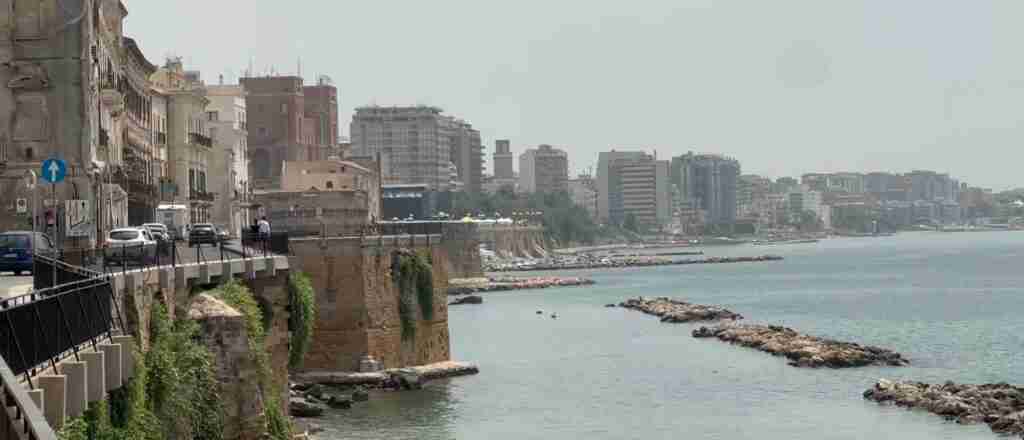
The Borgo Nuovo, developed after 1887 on a grid plan, holds the commercial heart of modern Taranto: Corso Italia as the main shopping street, Piazza Maria Immacolata with its gardens and fountain, the train station, most mid-range hotels, the majority of restaurants, and the Lungomare Vittorio Emanuele III promenade. The waterfront lungomare along the Mar Grande facing south is one of Taranto’s most enjoyable walking stretches, lined with palms and benches looking out towards the open Ionian Sea. Most visitors base themselves in the Borgo Nuovo for its transport connections and accommodation density while making the 15-minute walk to the Città Vecchia for sightseeing.
Mar Piccolo and the Northern Shore
The Mar Piccolo — the inner sea entirely enclosed on three sides by the mainland — is invisible from the city centre and requires a short bus or taxi ride to reach. This is the zone for mussel and oyster farming, the source of Taranto’s famous cozze. The most celebrated restaurant tables in the city sit on the Mar Piccolo’s northern shore, where diners eat directly-harvested shellfish with views across the inner lagoon. The seno (bay) of the Mar Piccolo is also navigable by leisure boat; several operators offer excursions, particularly in summer.
Taranto’s Top Attractions and Things to Do
Taranto’s principal cultural sites cluster within a manageable walking distance of one another in and around the Città Vecchia. The combination of the MArTA museum, the Aragonese Castle, and the Cathedral of San Cataldo alone constitutes a full day of serious cultural engagement, with the atmosphere of the old town and the maritime spectacle of the Ponte Girevole completing the experience at no additional cost.
Museo Nazionale Archeologico di Taranto (MArTA)
MArTA — the National Archaeological Museum of Taranto — is the city’s pre-eminent cultural institution and one of the most important archaeological museums in Italy. Established in 1887 and housed in the former Convent of the Alcantarini Friars on Via Cavour, the museum’s collections trace the history of Taranto and its territory from the Palaeolithic through to the 4th century BC with extraordinary depth and material richness.
The centrepiece collection is the Ori di Taranto — the Gold of Taranto — one of the world’s great assemblages of ancient Greek goldwork, comprising jewellery, diadems, earrings, and decorative objects of breathtaking technical sophistication produced in the 4th and 3rd centuries BC. Other highlights include the Tomba dell’Atleta di Taranto (Tomb of the Athlete), the Venus of Parabita prehistoric figurine, and the Zeus of Ugento, a spectacular bronze cult statue from approximately 530 BC. The three-floor arrangement moves chronologically from prehistory through the height of Taras as a Magna Graecia power city and into the Roman period.
Admission in 2026 costs €10 for adults aged 25 and over, €2 for visitors aged 18-25, and is free for those under 18. The museum offers free admission on the first Sunday of every month. The museum opens Tuesday through Saturday from 8:30 AM to 7:30 PM (last entry 7:00 PM) and on Sundays from 8:30 AM to 7:30 PM; it is closed on Mondays. Tickets are available on-site or through the museum’s booking partner at aditusculture.com — advance booking is recommended in summer to guarantee entry. Allow two to three hours for a thorough visit.
Castello Aragonese
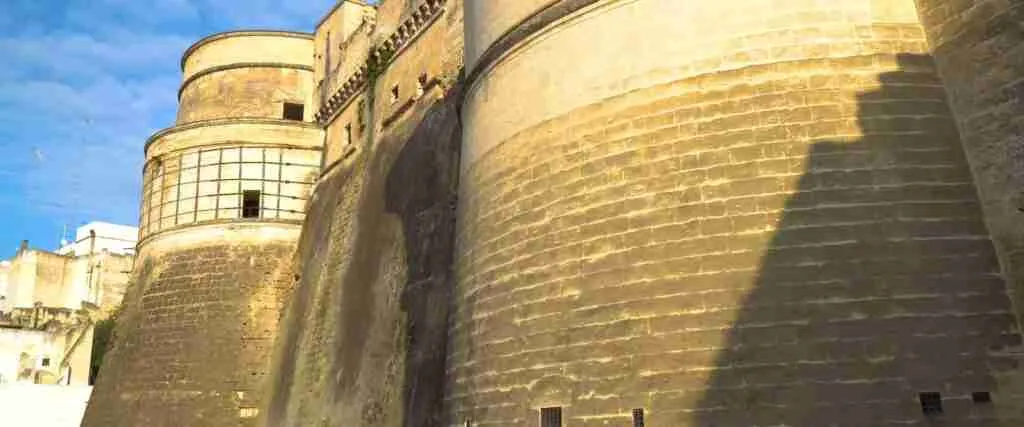
The Aragonese Castle stands at the western tip of the Città Vecchia island, where the canal connecting the two seas is at its narrowest. Built between 1480 and 1492 under Ferdinand II of Aragon, the castle replaced an earlier Byzantine fortification on the same strategic site and was designed according to Renaissance military principles: massive round towers at each corner, angled bastions capable of deflecting cannon fire, and a deep perimeter moat (now dry and open to visitors). It has served continuously as a military installation for over 500 years and today functions as an active base of the Italian Navy’s Ionian command.
Entry to the castle is free of charge, accessible exclusively through guided tours conducted by Italian Navy personnel. Tours depart throughout the day from 9:00 AM and run multiple times, covering the castle’s main halls, the underground moat, the tower interiors, and a museum space with models of historic naval vessels and archival documentation. Tours are conducted in Italian; non-Italian speakers can follow comfortably given the highly visual nature of the spaces. Advance booking is strongly recommended during July, August, and the Easter period. The castle’s upper terraces provide panoramic views over both seas and the historic city that rank among the best vantage points in all of Puglia.
Cathedral of San Cataldo (Duomo di Taranto)
The Cathedral of San Cataldo is one of the oldest and most layered churches in southern Italy, with structural origins dating to the 11th century Norman period. The building sits at the heart of the Città Vecchia on Via Duomo, and its imposing facade — reconstructed in baroque style during the 18th century — conceals an interior of extraordinary historical density: the crypt of San Cataldo (the Irish bishop who died in Taranto around 671 AD and is venerated as the city’s patron saint), Byzantine mosaic fragments, a Roman column repurposed as part of the nave structure, and a richly decorated sacristy. Admission is free. The cathedral is open daily for visitors outside of Mass hours.
Ponte Girevole (Swing Bridge)
The Ponte Girevole — literally the Rotating Bridge — is Taranto’s most photographed modern structure: a swing bridge built in 1887 to connect the Città Vecchia island to the Borgo Nuovo across the navigable canal. When operational, the bridge’s central section rotates 90 degrees to open a passage for ships transiting between the Mar Grande and Mar Piccolo. The opening schedule varies according to naval traffic, but openings occur several times daily and last 10-15 minutes. Watching a submarine or naval frigate move silently through the narrow canal while city traffic waits on both banks is genuinely singular. The bridge is free to cross and to watch from either shore.
Doric Columns of the Tempio Dorico
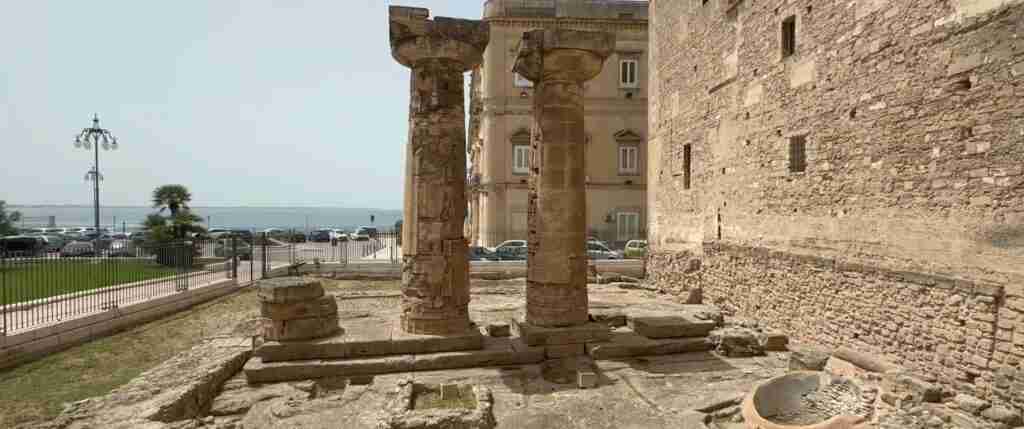
In Piazza Castello, immediately adjacent to the castle entrance, two surviving columns from what was once the temple of the Olympian gods of the ancient Greek city of Taras rise from an excavation site behind a railing. These two drums represent the oldest visible architectural remains of the city’s Magna Graecia period, dating to approximately the 6th century BC and making them among the oldest surviving Greek architectural elements on Italian soil. Viewing is free from the piazza level; the site does not currently offer interior access, but the excavation context is visible and a small interpretive panel provides historical background.
Jonian Dolphin Conservation
The Gulf of Taranto and surrounding Ionian waters host resident populations of bottlenose dolphins, striped dolphins, and sperm whales, and the Jonian Dolphin Conservation centre — based in the city — offers cetacean watching excursions by boat from the Taranto port area. These multi-hour boat trips operate primarily in summer (June through September) and combine naturalist commentary with open-sea navigation. Prices vary by operator and season; typical half-day excursions cost €30-50 per person. This is one of Taranto’s most distinctive experiences and particularly appealing for families.
Mar Piccolo: Inner Lagoon Exploration
The Mar Piccolo, Taranto’s enclosed inner sea, is the source of the city’s most celebrated gastronomic product: the cozze tarantine, mussels farmed in the lagoon’s nutrient-rich waters for centuries. The Mar Piccolo is also a nature reserve of significant ecological interest, home to diverse bird populations and the unique biological phenomenon of submarine freshwater springs (citri) that dilute the salinity of the inner sea and create the conditions for exceptional mussel growth. Boat tours of the inner sea depart seasonally from the canal area; several seafood restaurants along the northern shore allow diners to eat freshly harvested shellfish with views directly over the farming areas.
Food and Dining in Taranto 2026: Complete Cost Guide
Taranto’s cuisine belongs firmly to the maritime tradition of the Puglia-Basilicata border zone, with the Mar Piccolo’s shellfish at the absolute centre. The cozze tarantine — mussels from the inner lagoon — appear in virtually every format: raw with lemon, in pasta sauces, baked under a crust of breadcrumbs, or in the grand local dish of tiella (a baked casserole of rice, potatoes, and mussels that is the city’s most distinctive signature recipe). Fresh fish from the Mar Grande arrives daily at the old town’s fish market, making raw fish platters (crudi di pesce) a genuine local speciality rather than a tourist affectation. The city’s relationship with seafood is intimate and non-performative.
Budget Dining in Taranto 2026
Budget travelers in Taranto eat well by local standards at modest cost. A morning espresso at the bar costs €1.30-1.50 and a fresh cornetto (croissant) €1.50-2.50, making breakfast a genuine pleasure for €3-4 at any neighbourhood bar. The best lunch option for budget visitors is the tavola calda — a hot-counter lunch bar serving ready-prepared dishes including pasta, focaccia barese, stuffed vegetables, and arancini for €8-14 per person. Several excellent tavole calde operate near the MArTA museum on Via Cavour and along Corso Italia in the Borgo Nuovo. A full budget dinner at a neighbourhood pizzeria or informal trattoria, including a carafe of local house wine, costs €14-20 per person. Daily meals on a tight budget: €30-42 per person.
Mid-Range Dining in Taranto 2026
Mid-range dining in Taranto centres on the city’s many traditional trattorias and osterias, which serve the full Southern Italian menu — antipasto di mare (seafood starter platter), primi piatti (pasta with clams or sea urchin), secondi (grilled or fried fish), and dessert — at prices well below comparable quality in Rome or the Amalfi Coast. A full three-course dinner with house wine at a solid trattoria in the Borgo Nuovo costs €28-42 per person. The seafront lungomare area concentrates several fish-focused restaurants with terrace seating and Mar Grande views; these tend toward the upper end of the mid-range bracket (€35-50 per person for a full dinner). Lunch at these same establishments, which offer set-price primi and a drink from €15-22, represents good value. Daily mid-range dining budget: €57-84 per person including all meals and a coffee or gelato.
Fine Dining in Taranto 2026
Taranto’s most acclaimed restaurant tables sit on the shores of the Mar Piccolo, where proprietors have direct relationships with mussel and oyster farmers. These establishments — best reached by taxi (€12-18 from the centre) — charge €50-80 per person for a full tasting-style dinner of shellfish, crudo platters, and pasta courses, plus wine. Within the city centre, a small number of creative restaurants in recently renovated Città Vecchia spaces charge €45-70 per person for chef-driven menus that modernise the local seafood tradition. These represent genuine destination dining at prices that remain modest by any European standard. Daily luxury dining budget: €125-175 per person for upscale breakfasts, lunches, and dinners.
Street Food and Market Eating in Taranto 2026
Taranto’s street food culture deserves a dedicated section. The most local experience is the raw seafood stall near the old town’s fish market (Mercato del Pesce), where sea urchins (ricci di mare), raw mussels, and oysters are served directly from ice-filled containers for €5-12 per small platter — an authentic and affordable way to eat exactly what locals eat. Focaccia barese (thick oven bread with tomato, olive oil, and olives) costs €2-4 per piece at panifici (bakeries) throughout the Borgo Nuovo. The tarallo, a dry savoury ring biscuit specific to Puglia, is sold in bags at every alimentari for under €3 and serves as an excellent walking snack. Gelato at established gelaterie costs €2.50-4 depending on size.
Taranto Budget Guide 2026: Complete Daily Cost Breakdowns
Taranto is one of the most affordable cities in Puglia for overnight visitors, benefiting from a lower tourist premium than Lecce, Alberobello, or the coastal resorts of the Salento. The figures below represent realistic daily costs for two people sharing accommodation, expressed as per-person daily totals.
Budget Travel in Taranto 2026
Budget travelers in Taranto spending carefully — budget hotel or B&B room, bar meals, public buses, free attractions — can manage the city for €60-90 per person daily. The component breakdown: accommodation in a 1-2 star hotel or guesthouse costs €50-80 per room per night, making the per-person share €25-40. Daily meals at bars and tavole calde cost €30-42 per person. Local bus transport covers most needs for €3-5. Attraction costs average €3-6 per person (the Aragonese Castle is always free; MArTA’s €10 entry is offset by free days at the cathedral, columns, and lungomare). Total: approximately €60-90 per person daily.
For a 5-day budget stay in Taranto, the main cost components break down as follows. Accommodation in a budget hotel or B&B for 5 nights runs €250-400 per room, meaning €125-200 per person for two sharing. Meals for 5 days at bars and tavole calde add €150-210 per person. Local bus transport for 5 days adds €15-25 per person, and attraction entries average €15-30 per person over the stay. A 5-day budget trip costs approximately €305-465 per person total, with arrival transport from Bari adding €9-12 each way.
Mid-Range Travel in Taranto 2026
Mid-range travelers sharing a 3-star hotel in the Borgo Nuovo or Città Vecchia pay €90-140 per room per night, equating to €45-70 per person. Combined with trattoria dining (€57-84 per person daily), mixed transport of buses and occasional taxis (€5-12), and a mix of paid museum entries and free sites (€8-12 per person daily), mid-range visitors spend approximately €115-180 per person daily. This tier covers comfortable accommodation with private bathrooms, sit-down meals with wine at traditional restaurants, and full cultural engagement with all major sites.
A 5-day mid-range stay costs approximately €575-900 per person (accommodation share €225-350, meals €285-420, transport €25-60, attractions €40-60). Adding day trips to Alberobello, Matera, or Lecce by train adds €15-30 per round trip, or €60-120 per person for car rental over a week.
Luxury Travel in Taranto 2026
Luxury travelers sharing a 4-5 star property — the best options include the Relais Histò San Pietro sul Mar Piccolo for its location and spa facilities — pay €170-280 per room per night (€85-140 per person). Full luxury dining, including upscale lunches and tasting-menu Mar Piccolo dinners (€125-175 per person daily), taxis and private transfers (€15-25 per person daily), and premium experiences such as private boat tours and guided cultural excursions (€15-25 per person daily), brings the daily total to €240-365 per person. A 5-day luxury stay costs approximately €1200-1825 per person.
Seasonal Price Variations in Taranto 2026
Hotel rates in Taranto follow a predictable Puglia seasonal curve. July and August represent peak pricing, with 3-star rooms rising to €110-160 per night and 4-star properties to €170-240. The shoulder seasons of April-June and September-October see rates 20-35% below August peaks: mid-range rooms fall to €80-120 and budget options to €50-75. November through March is low season, with the lowest room rates (budget hotels from €40-55, mid-range from €70-90) and the fewest crowds, though some smaller family-run restaurants and B&Bs close for part of winter. The Holy Week period (March or April in 2026, depending on the Easter date) is a notable exception — Taranto fills with visitors for its extraordinary processions, and room rates during the Settimana Santa peak at or above summer levels; book at least 2-3 months ahead.
Hidden Costs and Fees in Taranto 2026
Several cost categories catch first-time visitors to southern Italian cities by surprise. The tassa di soggiorno (tourist tax) in Taranto applies to most overnight accommodation: €1-3 per person per night depending on the property category, payable directly to the hotel and not included in booking platform prices. A 5-night mid-range stay for two people generates approximately €10-30 in tourist tax. Seafood restaurant bills sometimes carry a coperto (cover charge) of €2-3 per person; this is legitimate and standard in southern Italy but should be checked before ordering. Parking in the Borgo Nuovo uses Kyma Mobilità’s paid system (marked zones), with rates of €0.50-1 per hour; visitors arriving by car should budget €5-10 per day for parking unless their hotel provides it. Car hire from Bari Airport costs €30-60 per day for a small car; booking in advance with international providers (Europcar, Hertz, Avis) at the airport secures better rates than arriving and booking on the day.
Where to Stay in Taranto 2026: Accommodation Guide
Taranto’s accommodation market has expanded meaningfully over the past five years as the Città Vecchia regeneration project has converted historic buildings into boutique rooms and apartment rentals. The city now offers genuine options across all budget tiers, with the primary choice being between the atmospheric (if still-developing) Città Vecchia and the more convenient, better-served Borgo Nuovo.
Budget Accommodation in Taranto 2026
The budget accommodation tier in Taranto — guesthouses, B&Bs, and 1-2 star hotels — runs €40-70 per room per night, placing it well below comparable Italian cities. Hotel Pisani, a 2-star property on Via D’Aquino in the Borgo Nuovo within 3 minutes’ walk of MArTA, consistently receives positive reviews for its clean rooms, welcoming staff, and excellent central location; rates fall in the €50-70 range. A small number of budget rooms are available in the Città Vecchia itself, in renovated apartments and small B&Bs; these offer superior atmosphere at the cost of fewer facilities and occasionally steep internal staircases. Hostel accommodation is limited compared to larger cities, but basic dormitory-style beds exist through platforms like Booking.com at €20-35 per person per night. Self-catering apartments represent excellent value for families or groups.
Mid-Range Hotels in Taranto 2026
Mid-range stays (€80-140 per room per night) are concentrated in the Borgo Nuovo near the train station and lungomare. Hotel Europa Taranto on Via Roma, a few minutes’ walk from the waterfront, offers comfortable 3-star accommodation with breakfast included and has received consistently excellent reviews for its service and position. Hotel Delfino Taranto on Viale Virgilio overlooks the Mar Grande and provides sea-view rooms (at a supplement) alongside a pool and room service. The Akropolis Hotel near the lungomare is another solid mid-range option with balconied rooms and good Wi-Fi. In this tier, most properties are in the €90-130 range for a double room in shoulder season, rising to €120-160 in July and August.
Luxury Accommodation in Taranto 2026
The standout luxury option in the Taranto area is Relais Histò San Pietro sul Mar Piccolo, an 18th-century manor farmhouse on the northern shore of the inner lagoon with panoramic water views, spa facilities, and direct links to the shellfish producers of the Mar Piccolo. This property sits in the upper tier at €200-280 per room per night in peak season and is widely considered the most distinctive hospitality option in the immediate Taranto area. Within the city, Salina Hotel on Via Mediterraneo is a modern 4-star property with pool, spa, and restaurant; rates fall in the €110-180 range. Park Hotel San Michele in nearby Martina Franca, in the Valle d’Itria zone about 30 kilometres from Taranto, is a popular 4-star option for visitors who want to combine Taranto sightseeing with trulli-country exploration.
Self-Catering and Apartments in Taranto 2026
Short-term apartment rentals through Booking.com and other platforms have grown significantly in Taranto’s Città Vecchia, where several restored limestone palazzi now offer self-catering units for €70-120 per night for a two-person apartment. These units are ideal for visitors who want to cook using the city’s exceptional seafood market produce and experience the old town from a residential perspective. The Mar Piccolo shoreline also has a small number of villa and apartment rentals with water views, popular with repeat visitors who know the city well.
Day Trips from Taranto 2026: The Best Excursions
Taranto’s position at the junction of the Ionian coast, the Valle d’Itria, and the border with Basilicata makes it one of Italy’s best-positioned city bases for regional exploration. The day trips below represent the most rewarding excursions, each achievable by train (where specified) or car within manageable distances.
Alberobello 2026: UNESCO Trulli Landscape
Alberobello, a UNESCO World Heritage Site since 1996, lies approximately 45 kilometres north of Taranto in the heart of the Valle d’Itria. The town’s Rione Monti district — a hillside of more than 1,400 conical-roofed trulli houses, all built from stacked limestone without mortar — is unlike any townscape in Europe. Train services from Ferrovie del Sud Est (FSE) connect Taranto to Alberobello via Martina Franca in approximately 1 hour 10 minutes, with tickets costing €5-8 each way; check FSE timetables as services are less frequent than Trenitalia routes. The town itself is free to wander (the Rione Monti street are all publicly accessible); the Trullo Sovrano, the only two-storey trullo in existence, charges €3 for entry. Half a day is sufficient for the town; combining with lunch at one of Alberobello’s countryside masserie adds a full day.
Matera 2026: Cave City of Basilicata
Matera, approximately 65 kilometres west of Taranto in the neighboring region of Basilicata, is a UNESCO World Heritage Site famous for its Sassi — ancient cave dwellings carved into two ravines that housed the city’s entire population until the 1950s. A European Capital of Culture in 2019, Matera has since become one of Italy’s most visited destinations, though it retains genuine power. Direct buses from Taranto (Sita Sud and FlixBus) reach Matera in approximately 1 hour 15 minutes to 1 hour 30 minutes; no direct train exists. Bus tickets cost approximately €6-10. Entry to the main Sassi neighborhoods is free to walk; individual cave churches charge €3-5 each, and the principal Matera museums (Museo Nazionale di Matera, Casa-Grotta di Vico Solitario) charge €4-6 per person. A full day is recommended.
Lecce 2026: The Florence of the South
Lecce, approximately 90 kilometres southeast of Taranto by train (1 hour 20 minutes, €8-12), is the baroque architectural capital of southern Italy: an entire historic centre built in warm golden lecce stone and decorated with an exuberance of carved facade ornament that earned it the Italian sobriquet “Firenze del Sud.” The Basilica di Santa Croce and the historic Piazza del Duomo are the centrepieces, but the entire centro storico is a designated heritage area where virtually every street offers baroque doorways, carved saints, and limestone garlands. Entry to most of Lecce’s churches is free; the Anfiteatro Romano below Piazza Sant’Oronzo is accessible freely from the square. Allow a full day.
Ostuni 2026: The White City
Ostuni, approximately 50 kilometres northeast of Taranto, is the “Città Bianca” — the White City — a hill town of whitewashed buildings cascading down a limestone hillside above the Adriatic plain. Its Gothic-Renaissance cathedral on the summit, the maze of white-walled lanes below, and views stretching to the Adriatic coast make it one of Puglia’s most photogenic small cities. Trains from Taranto via Brindisi take approximately 1 hour 15 minutes to 1 hour 30 minutes (€9-13). The old town is free to enter and explore; several small museums and the cathedral charge €2-5. Ostuni pairs well with the Adriatic beach town of Villanova or a masseria lunch in the olive-grove countryside.
Grottaglie 2026: Ceramic Capital
Grottaglie, barely 20 kilometres from Taranto (15 minutes by car or local bus, accessible via Kyma Mobilità provincial services), is the ceramic production capital of Puglia and possibly southern Italy. The Quartiere delle Ceramiche — an entire district of workshops and galleries occupying a historic cave-riddled ravine — is where master ceramicists have produced the distinctive local ware for centuries. Visiting the workshops is free; pieces range from €8-15 for small decorative items to €150-400 for significant traditional plates and vases. This makes Grottaglie an ideal half-day excursion from Taranto for visitors interested in artisan craft.
Taranto’s Holy Week Processions: Essential 2026 Information
Taranto’s Settimana Santa (Holy Week) processions are among the most famous and emotionally powerful Easter traditions in Italy, with roots dating to the 17th-century Aragonese-Spanish period. The processions of the two brotherhoods — the Addolorata (Friday evening) and the Misteri (Saturday early morning, beginning around midnight) — feature members of the confraternities walking barefoot through the streets for hours, wearing white or black robes and hoods, moving in a specific slow shuffle step (the nazzicata) while bearing heavy statues of the Madonna and the mystery groups. The Misteri procession in particular lasts approximately 14 hours continuously, circling the entire old town.
The 2026 Easter date falls on April 5, meaning Holy Week runs March 29 through April 5, 2026. The main processions take place on Good Friday evening (April 3) and through the night and morning of Holy Saturday (April 3-4). Viewing is free from the streets of the Città Vecchia and along the lungomare where processions pass. The city becomes extremely crowded during Holy Week; accommodation books out months in advance at significantly elevated rates. Visitors who specifically want to witness the processions should book hotels in January or February at the latest and should budget for accommodation at 50-100% above standard rates during the Holy Week period.
Best Time to Visit Taranto: Seasonal Guide
Taranto’s Mediterranean climate — hot dry summers, mild wet winters, warm extended autumns — means the city is broadly accessible year-round, but the visitor experience varies considerably between seasons.
Spring (March-May)
Spring is the period most experienced travelers recommend for Taranto. Temperatures reach 18-24°C by April and May, the walled gardens of the Città Vecchia are in flower, and the city is running at full cultural capacity without summer crowds. The Holy Week processions (late March or early April) are the major seasonal event. Museum queues are minimal; restaurant bookings are easy to secure; accommodation rates are at their most reasonable outside of the Holy Week peak. The sea temperature reaches 18-20°C by late May — not warm enough for extended swimming but sufficient for short dips from the Ionian coast beaches south of the city.
Summer (June-August)
Summer in Taranto is hot — July and August see regular temperatures of 32-38°C and sporadic highs above 40°C. This is the season for beach tourism on the Ionian coast: the resort areas around Lido Gandoli and Marina di Pulsano, 15-20 kilometres south, are at their most animated. The sea temperature reaches 25-28°C from July onwards, ideal for swimming. City sightseeing is best accomplished in the morning (8:30-12:00) before the heat peaks. August is the quietest month in the city itself as many local businesses and restaurants take summer holidays; paradoxically, this can be the least satisfactory month for experiencing Taranto’s authentic urban life while being the best for coastal relaxation. Accommodation rates are at their annual peak.
Autumn (September-October)
Early autumn is the second optimal window for visiting Taranto. September retains warm temperatures (26-30°C) and sea water still at 24-26°C, while crowds and prices begin to ease after mid-August. October brings lower temperatures (20-25°C), the last warm days for outdoor dining, and the best conditions for active sightseeing. The area’s olive harvest and the continuation of the mussel farming season make October particularly good for food tourism. November marks the transition to wetter, cooler weather.
Winter (November-March)
Winter in Taranto is mild by northern European standards (8-15°C daytime temperatures) but rainy and sometimes raw by the standards of a Mediterranean seafront city. The MArTA museum is excellent in winter — unhurried, uncrowded, and perfectly heated. The Castello Aragonese tours continue year-round. Many seafront restaurants reduce their hours or close on weekdays in the low season; the local bar and bakery culture, however, continues without interruption. Accommodation represents the best value of the year in winter, and the absence of tourists gives the Città Vecchia an authentic neighbourhood atmosphere that summer tourists rarely experience. The exception is Christmas and New Year, when the city hosts seasonal events and prices rise briefly.
Practical Tips for Visiting Taranto in 2026
The following practical information covers the everyday logistics of a Taranto visit in 2026 and addresses the questions most commonly raised by first-time visitors to the city.
Language and Communication in Taranto 2026
Taranto is not a heavily visited international city, and English is less widely spoken than in the major tourist centres of Rome, Florence, or Venice. At the MArTA museum and the larger hotels, English-speaking staff are available; at local bars, markets, and family-run trattorias, Italian (or at minimum a willingness to communicate by pointing and numbers) is genuinely helpful. A few phrases — un caffè per favore (a coffee please), il conto (the bill), quanto costa? (how much?) — go a long way in building goodwill with local businesses. The MArTA museum offers English-language labelling throughout its collections; the Aragonese Castle tours are conducted in Italian only, though the visual experience remains fully comprehensible.
Payment and Currency in Taranto 2026
Italy uses the euro. Contactless card payment is now widely accepted in Taranto’s hotels, restaurants, and larger shops; local buses (Kyma Mobilità) accept contactless payment directly on board for the €1.30 ticket, eliminating the need for exact change. Small bars, market stalls, and some traditional trattorias remain cash-preferred. Carrying €20-40 in cash for a day’s exploring is advisable. ATMs are located throughout the Borgo Nuovo on Corso Italia and near the train station; international cards are accepted at all standard bank machines with the usual foreign transaction fee.
Safety and Health in Taranto 2026
Taranto is safe for visitors, and the areas of tourist interest — the Città Vecchia, the lungomare, the Borgo Nuovo near the station — present no unusual security concerns. As in any Italian city, petty theft (pickpocketing) is possible in crowded spaces; standard urban precautions (wallet in front pocket, bag held close) apply. Some streets in the less-visited parts of the Città Vecchia are poorly lit at night; the main tourist circuits are well-illuminated. The presence of the Italian Navy throughout the old town area adds a baseline security presence. Taranto’s tap water is safe to drink and is of good quality. The nearest major hospital is the Ospedale S.S. Annunziata, approximately 3 kilometres from the city centre.
MArTA Museum: Booking and Practical Advice 2026
Advance booking for MArTA is available through aditusculture.com and is advisable on weekends and throughout July and August. The museum’s free first-Sunday-of-the-month opening attracts the longest queues of the month; visiting on any weekday morning except Monday (when it is closed) involves no queuing. The permanent collection covers three floors; the ground floor galleries contain the most directly spectacular material, including the Gold of Taranto and the Zeus of Ugento bronze. Audio guides are available for hire at the bookshop. Photography is permitted throughout the permanent collection without flash.
Castello Aragonese: Booking and Tour Advice 2026
Tours of the Aragonese Castle are free but require in-person registration at the castle entrance on the day, subject to available space, or advance reservation through the castle’s booking contacts. During Holy Week and the peak summer months, arriving at the castle early in the morning (9:00-10:00 AM) maximises the chance of securing a tour slot without pre-booking. Tours last approximately one hour. The castle precincts include a souvenir shop and exterior viewing areas accessible without joining a tour; the interiors, underground passages, and tower access are tour-only.
Connectivity and WiFi in Taranto 2026
Mobile data coverage in Taranto is reliable on all major Italian networks (TIM, Vodafone, WindTre). EU roaming visitors use their home plans without additional charges. Free WiFi is available at the MArTA museum, most hotels, many cafés, and on some buses. The Puglia regional WiFi network (PugliaWiFi) provides free access at registered public hotspots across the old town and lungomare areas.
Sample Taranto Itineraries 2026
One Day in Taranto 2026
A single full day in Taranto covers the essential cultural sites comfortably without rushing. Begin at MArTA (€10 entry; arrive at 8:30 AM for the best experience before any groups arrive), allocating 2 hours for a thorough visit to the permanent collection, prioritising the Gold of Taranto, the Zeus of Ugento, and the Tomb of the Athlete. Walk five minutes to the old fish market near Via Duomo for a mid-morning coffee and possibly the city’s raw sea urchin street food experience (€5-8). Visit the Cathedral of San Cataldo (free; 20-30 minutes) and walk the lanes of the Città Vecchia toward the Aragonese Castle. Join a Navy-guided castle tour (free; 1 hour) in the early afternoon. Walk the Ponte Girevole and watch the canal from the shore, then follow the lungomare promenade for sunset views over the Mar Grande before dinner at a lungomare trattoria (€28-42 per person).
One-day cost estimate: MArTA €10, meals and coffees approximately €35-55, bus rides €3. Total: approximately €48-68 per person, excluding accommodation.
Three Days in Taranto 2026
Day 1 follows the single-day itinerary above, with a more leisurely pace and a sunset aperitivo at a bar overlooking the navigable canal. Day 2 combines a morning visit to Grottaglie (20 minutes by bus or taxi, €12-18 return), the ceramic capital whose workshop quarter is free to explore, with an afternoon seafood lunch on the Mar Piccolo shore (€35-50) and an afternoon boat trip on the inner lagoon if weather permits. Day 3 is a full-day excursion to either Alberobello (train, approximately €10-16 return) or Matera (bus, approximately €12-20 return), returning to Taranto in the evening. Three-day budget per person (excluding accommodation): approximately €200-280 mid-range including day trips, meals, and entries.
Five Days in Taranto 2026
A five-day programme adds dedicated time for Lecce (Day 4, train €16-24 return; full day in the baroque centre) and a coastal beach day on the Ionian shore at Lido Gandoli or the pine-fringed beaches near Marina di Ginosa (Day 5, car or bus). Five days gives space to explore the Città Vecchia repeatedly at different times of day — the old town shifts character entirely between morning, noon, and after dark — and to return to a favourite restaurant or two. A five-day mid-range budget per person for the full stay: accommodation share €225-350, meals €285-420, transport (local + day trips) €80-120, entries €40-60. Total approximately €630-950 per person, or €815-1225 including arrival and departure trains from Bari.
Frequently Asked Questions About Visiting Taranto in 2026
Is Taranto a good base for exploring Puglia in 2026?
Taranto is an excellent base for Puglia exploration, particularly for the Valle d’Itria (trulli country around Alberobello and Locorotondo, 30-45 minutes north), the Salento peninsula (Lecce, 1 hour 20 minutes by train), and the Murgia plateau (including Matera in Basilicata, 1 hour 15 minutes by bus). The city’s train connectivity — with regular services to Bari, Brindisi, and through-routes to Lecce — makes it practical to reach major destinations without a car. For visitors who want to explore the Ionian coast south of the city or reach more remote masserie, a rental car from Bari Airport significantly increases range. Taranto also consistently offers lower hotel rates than Alberobello or Lecce, which makes it an economically rational base for regional exploration.
How much are the main attractions in Taranto in 2026?
The MArTA National Archaeological Museum costs €10 for adults (25 and over), €2 for visitors aged 18-25, and is free for those under 18; free admission applies to all on the first Sunday of every month. The Aragonese Castle is entirely free, accessible through free Navy-guided tours that run throughout the day. The Cathedral of San Cataldo is free to enter. The two Doric columns in Piazza Castello are viewable freely from the public piazza. The Ponte Girevole crossing and watching are free. In practice, a visitor to Taranto can access all the major attractions except MArTA at zero cost, making the total attraction spend for a two-day visit as low as €10-20 per person depending on choices.
What is Taranto famous for in terms of food in 2026?
Taranto is most famous for its cozze tarantine — mussels farmed in the Mar Piccolo lagoon, considered among the finest in Italy thanks to the lagoon’s unique combination of saltwater and submarine freshwater springs (citri). They are eaten raw, baked, in pasta, or in the tiella di Taranto (a baked rice, potato, and mussel casserole that is the city’s signature dish). The city is also known for raw seafood platters (crudi di mare), ricci di mare (sea urchins), fresh orecchiette pasta with turnip tops (cime di rapa), focaccia barese, and the local speciality sgagliozze (fried polenta squares). The daily fish market in the Città Vecchia is one of the most authentic and affordable seafood markets in southern Italy.
Is Taranto easy to reach without a car in 2026?
Taranto is reachable by train and bus from most of Italy without a car. Bari Centrale connects to Taranto in approximately 1 hour 20 minutes (from €9) with roughly hourly services. Naples and Rome connect via longer but direct or one-change train routes. Within the city, the Kyma Mobilità bus network (€1.30 per 90-minute ticket) covers all main districts, and the Città Vecchia is entirely walkable once reached. The main limitation of car-free travel is access to the Ionian coast beaches south of the city (reachable by seasonal bus services but less convenient than driving) and some of the more dispersed countryside attractions like masseria restaurants on the Mar Piccolo shoreline. Day trips to Alberobello, Matera, Lecce, and Ostuni are all viable by public transport.
Does Taranto have a beach in 2026?
Taranto itself does not have sandy beaches within the city proper, but excellent Ionian coast beaches begin approximately 15-20 kilometres south of the city at Lido Gandoli, Marina di Pulsano, and the pine forest-backed shores near Marina di Ginosa. These beaches are accessible by car in 20-25 minutes, or by seasonal bus services (check Kyma Mobilità and STP Brindisi timetables for summer routes). The water along this stretch of the Ionian coast is clear, warm (25-28°C in July-August), and clean. Lido clubs (stabilimenti balneari) charge €12-25 per person for a sun lounger and umbrella rental; free public beach areas exist alongside them.
What is Taranto’s Holy Week procession and is it worth seeing in 2026?
Taranto’s Settimana Santa processions are widely considered among the most intense and visually extraordinary Easter traditions in Italy. The two main processions — the Addolorata on Good Friday evening and the Misteri, which runs continuously through Holy Saturday night — feature hooded confraternity members walking barefoot in a distinctive slow shuffle through the old town for up to 14 hours. The 2026 Holy Week falls March 29-April 5 (Easter Sunday April 5). Witnessing the Misteri is a rare and powerful experience; the solemn atmosphere of the Città Vecchia after midnight, lit by candles and brass bands, is entirely unlike anything in mainstream Italian tourism. The primary practical challenge is accommodation: the city fills completely, rates increase significantly, and booking should happen in January 2026 at the latest.
How long should I spend in Taranto in 2026?
Two full days is the realistic minimum for engaging seriously with Taranto’s principal attractions: the MArTA museum (2-3 hours), the Aragonese Castle (1 hour), the Cathedral and Città Vecchia (1-2 hours), the lungomare, and one proper seafood dinner. Three to five days suits visitors who want to combine the city with day trips to Alberobello, Matera, or Lecce while retaining a genuine sense of Taranto itself. A week or more makes sense for those using the city as a Puglia regional base, adding the Ionian coast, the Valle d’Itria countryside, and the Salento to the programme. Taranto does not suit a rushed half-day diversion; the city rewards slowing down and walking the old town at different hours.
What are the best restaurants in Taranto for local seafood in 2026?
For the most authentic and celebrated local seafood experience, the restaurants along the northern shore of the Mar Piccolo — reached by taxi (€12-18 from the centre) — offer directly farmed mussels and oysters in settings that the city centre cannot replicate. Within the Borgo Nuovo, the lungomare strip has several reliable fish restaurants with terrace dining and Mar Grande views in the €28-45 per person range. The Città Vecchia is developing a small cluster of creative restaurants in regenerated palazzo spaces that modernise the traditional seafood repertoire. For street-level authenticity, the raw seafood stalls near the old fish market charge €5-12 for plates of ricci and cozze that represent the most direct expression of what makes Taranto’s coastal cuisine distinctive.
Are there guided tours of Taranto available in 2026?
Several local tour operators offer guided experiences of Taranto and the surrounding area. Walking tours of the Città Vecchia and its Byzantine and Greek heritage run through local agencies and Viator-listed operators, costing €15-30 per person for 2-hour walks with English-speaking guides. Electric carriage tours of the old town — a popular and atmospheric option — operate from Piazza Castello with tours lasting 30-45 minutes and costing €15-20 per person. Boat tours of the Mar Piccolo, combining views of the mussel farming areas with a guide’s explanation of the lagoon ecology, run seasonally in summer at €20-35 per person. The MArTA museum itself offers educational group tours and can be contacted for arrangements.
What is the weather like in Taranto in summer versus spring 2026?
In spring (April-May), Taranto sees average highs of 18-24°C with very occasional rain showers; conditions are ideal for walking and sightseeing without discomfort. July and August are the hottest months, with average highs of 30-36°C and periodic heat waves pushing above 40°C; outdoor sightseeing is most comfortable before noon and after 5:00 PM. Humidity stays relatively low thanks to the proximity of the sea, making the heat more bearable than inland southern Italy. The Ionian coast sea temperature reaches 25-28°C from late June through September, providing genuine swimming conditions for several months. Autumn (September-October) returns to conditions similar to spring, with the added bonus of warm sea temperatures persisting from the summer months.