Visiting Milan Cathedral & Rooftop Terraces: Complete Guide
Milan Cathedral stands as Italy’s largest Gothic cathedral and one of the world’s most architecturally ambitious religious structures, crowned by 135 marble spires and adorned with over 3,400 statues crafted across nearly six centuries of continuous construction. The rooftop terraces offer the rare opportunity to walk among flying buttresses and pinnacles while experiencing panoramic views across Milan toward the distant Alps, transforming architectural appreciation from distant observation into intimate encounter with Gothic craftsmanship.
Key Takeaways
- Construction spanned 579 years from 1386 to 1965, making Milan Cathedral one of history’s longest architectural projects involving 78 different architects across multiple stylistic periods
- The cathedral contains over 3,400 marble statues and 135 spires, all carved from distinctive pink-white Candoglia marble quarried near Lake Maggiore and transported via dedicated canals
- La Madonnina golden statue crowning the 108.5-meter main spire has protected Milan since 1774, with city regulations traditionally prohibiting any building from rising higher
- Rooftop terraces accessible via stairs or elevator provide 360-degree views and close examination of Gothic architectural details invisible from ground level
- The interior spans 157 meters long with five aisles supported by 52 massive columns, featuring 55 monumental stained glass windows depicting biblical narratives
- Combination tickets valid for multiple days provide access to the cathedral, museum, archaeological area, and terraces with time-slot reservations essential during peak seasons
People Also Ask About Milan Cathedral
How long does it take to visit Milan Cathedral and the rooftop terraces?
A comprehensive visit exploring the cathedral interior, rooftop terraces, and museum requires approximately 2.5 to 4 hours depending on crowd levels and your pace. The cathedral interior visit alone takes 45-60 minutes to examine the columns, stained glass, and artwork, while the rooftop terrace experience adds another hour for stair or elevator ascent, walking among the spires, and enjoying panoramic views. Including the Duomo Museum extends total time to 3-4 hours. Early morning visits starting at 9:00 AM opening time or late afternoon periods around 5:00 PM provide the most efficient touring with smaller crowds than midday peak hours when tour groups concentrate their schedules.
Should I climb the stairs or take the elevator to the rooftop?
The stair climb involves approximately 250 steps ascending through narrow medieval passages that reveal the cathedral’s construction details and structural systems, providing gradual perspective shifts as you rise through the building’s layers. The elevator offers faster ascent but still requires climbing 80 steps to reach the upper terrace level where the golden Madonnina becomes visible, with all visitors descending via stairs regardless of ascent method. The stair experience costs less and allows appreciation of the cathedral’s engineering, while the elevator serves visitors with mobility limitations or those prioritizing time efficiency. Both routes converge on the terraces where the architectural experience and views remain identical, making the choice between physical challenge and convenience rather than destination difference.
What is the significance of the Madonnina statue?
La Madonnina represents the Virgin Mary in gilded copper measuring 4.16 meters tall and standing atop the cathedral’s highest spire at 108.5 meters since installation in 1774, embodying Milan’s spiritual protection and civic identity. The golden statue designed by Giuseppe Perego became so integral to Milan’s self-image that traditional building regulations prohibited any structure from rising higher, maintaining the Madonnina as the city’s highest point until modern skyscrapers required placing replica statues atop their peaks. The statue’s visibility across Milan’s skyline created a shared reference point connecting neighborhoods through common sight of this protective symbol, while the copper gilding catches sunlight to create brilliant flashes visible from great distances throughout the metropolitan area.
Can I visit the cathedral for free or do I need tickets?
Worshippers entering for prayer and religious services access the cathedral free through dedicated entrances, with a reserved worship area separate from tourist routes allowing silent contemplation without purchasing tickets. Tourist visits exploring the full interior, artwork, and architectural features require paid admission starting at €10 for the cathedral and museum combination, with rooftop terrace access requiring additional payment through combo tickets priced at €22 for stair ascent or €26 for elevator access. This ticket structure balances the cathedral’s continuing religious function as Milan’s primary Catholic church with sustainable tourism management that funds ongoing preservation of the centuries-old structure requiring constant maintenance of marble, statuary, and structural systems threatened by pollution and weathering.
Extended multi-day tours – 5+ days
Featured Milan Multi-Day Tour Packages

3 days
Milan 3-Day Discovery Tour
- ✓ Comprehensive Milan experience
- ✓ Expert local guides included
- ✓ All accommodation included
- ✓ Transportation provided

5 days
Milan 5-Day Highlights Experience
- ✓ Comprehensive Milan experience
- ✓ Expert local guides included
- ✓ All accommodation included
- ✓ Transportation provided
7 days
Milan 7-Day Cultural Journey
- ✓ Comprehensive Milan experience
- ✓ Expert local guides included
- ✓ All accommodation included
- ✓ Transportation provided

10 days
Milan 10-Day Complete Adventure
- ✓ Comprehensive Milan experience
- ✓ Expert local guides included
- ✓ All accommodation included
- ✓ Transportation provided
Multi-day tour packages powered by TourRadar. Prices and availability subject to change.
Introduction: Italy’s Gothic Masterpiece
Milan Cathedral dominates Piazza del Duomo as the physical and symbolic heart of Lombardy’s capital, rising 157 meters long and 108.5 meters tall in a forest of marble spires that transforms limestone into ascending prayer. Unlike most Italian churches built in Romanesque, Renaissance, or Baroque styles, Milan Cathedral represents high Gothic architecture’s fullest Italian expression, importing northern European aesthetic principles while adapting them through Mediterranean sensibilities and Lombard building traditions. The result synthesizes French Gothic spatial drama with Italian decorative richness, creating architectural character distinct from both Alpine Gothic cathedrals and Tuscan Renaissance churches.
Construction spanning 1386 to 1965 makes the cathedral one of history’s longest architectural projects, requiring 579 years of continuous effort by 78 architects, hundreds of sculptors, and thousands of craftsmen across multiple generations. This extraordinary timeline resulted from the project’s unprecedented scale, technical challenges of vaulting such enormous space, periodic funding interruptions, changing architectural fashions, political upheavals, and the perfectionist ambition to ornament every surface with sculptural detail. What began as late 14th-century Gothic vision evolved through Renaissance modifications, Baroque additions, Neoclassical façade completion under Napoleon, and final 20th-century finishing touches that created architectural palimpsest where successive eras left visible marks.
The cathedral’s most distinctive feature visible across Milan’s skyline is its “marble forest” of 135 spires rising like organic growth from the roofline, each pinnacle crowned with individual statue and carved with geometric precision matching ground-level detail despite invisibility from below. This commitment to comprehensive decoration regardless of viewing perspective reflects medieval theological belief that architectural perfection honored God’s omniscient gaze rather than human sight limitations, resulting in thousands of sculptures positioned where only maintenance workers and modern terrace visitors can appreciate their craftsmanship. The rooftop terraces opened to public access transform this hidden sculpture garden into accessible experience, allowing visitors to walk among flying buttresses and examine details that would otherwise remain architectural secrets.
La Madonnina golden statue crowning the highest spire since 1774 became Milan’s civic symbol, representing both Catholic devotion to the Virgin Mary and secular civic pride in the cathedral’s architectural achievement. The 4.16-meter statue covered in gold leaf catches sunlight to create brilliant flashes visible across the metropolitan area, serving as orientation landmark and shared reference point connecting neighborhoods through common sight of this protective presence. Traditional building regulations maintained the Madonnina as Milan’s highest point, prohibiting taller construction until modern economic pressures required skyscraper development that preserved the tradition by placing Madonnina replicas atop their peaks, ensuring the Virgin’s protective gaze continued overlooking the city from every tallest structure.
The cathedral complex extends beyond the main church to include the Duomo Museum preserving original sculptures removed for conservation, the archaeological area revealing foundations of earlier churches demolished for construction, and the continuing Veneranda Fabbrica del Duomo administrative body founded in 1387 that still manages preservation and restoration. This institutional continuity across six centuries demonstrates how the cathedral functions as living monument requiring constant maintenance rather than completed historical artifact, with specialized workshops maintaining marble carving skills, structural engineering expertise, and conservation techniques passed across generations of craftspeople dedicated to preserving Gian Galeazzo Visconti’s original vision while adapting to contemporary preservation challenges.
Historical Evolution: Six Centuries of Construction
Milan Cathedral’s foundation stone was laid in 1386 when Archbishop Antonio da Saluzzo commissioned Gothic cathedral construction on the site of two ancient basilicas, Santa Maria Maggiore and Santa Tecla, whose remains still visible in the archaeological area beneath the current floor. Gian Galeazzo Visconti, Lord of Milan, transformed this religious initiative into political statement by establishing the Veneranda Fabbrica del Duomo in October 1387 as permanent institution responsible for design and construction, granting it exclusive access to Candoglia marble quarries and tax exemptions that enabled unprecedented building ambition. Visconti’s decision to build in marble rather than traditional Lombard brick required importing Gothic architectural expertise from across Europe, transforming the construction site into international collaboration where French, German, and Italian craftsmen exchanged ideas and techniques.
The initial construction phase under first chief engineer Simone da Orsenigo planned Lombard Gothic design in brick, but Visconti’s preference for marble and contemporary European styles prompted appointment of Nicolas de Bonaventure in 1389, who introduced French Rayonnant Gothic principles emphasizing vertical aspiration and elaborate tracery. Construction began from the apse whose massive stained glass windows established the building’s spatial character, proceeding toward the transept and nave while leaving the central vault closure unresolved due to structural challenges spanning such enormous width without Renaissance engineering knowledge. Pope Martin V consecrated the high altar on October 16, 1418, allowing religious services to commence despite incomplete construction that would continue for centuries.
The late 15th century saw Leonardo da Vinci and Donato Bramante compete in 1488 to design the central cupola, with Leonardo withdrawing his submission and the commission eventually awarded to designs creating the octagonal dome completed between 1500-1510 under Ludovico Sforza. This Renaissance cupola decorated with sixty statues portraying biblical figures introduced stylistic tension between the building’s Gothic skeleton and Renaissance ornament, establishing pattern of architectural evolution that would characterize subsequent construction phases. The Guglietto dell’Amadeo spire constructed 1507-1510 represents Renaissance masterwork that harmonized with Gothic surroundings through sensitive proportional relationships and decorative restraint.
The Counter-Reformation period under Carlo Borromeo, Archbishop from 1564-1584, and his cousin Federigo Borromeo shaped the cathedral’s interior through interventions inspired by papal Rome’s ecclesiastical architecture. The presbytery’s magnificent architectural framework, side altars, crypt redesign, baptistery installation, and new floor patterns reflected Counter-Reformation emphasis on liturgical space organization and congregational participation. This phase also saw removal of medieval monuments including the tombs of Visconti family members, demonstrating how changing religious priorities reshaped the cathedral’s commemorative functions to emphasize spiritual purpose over dynastic glorification.
Façade construction began in the 17th century with foundations laid by Francesco Maria Richini and Fabio Mangone, proceeding through 1638 with five portals and two middle windows before new chief architect Carlo Buzzi introduced dramatic revision in 1649, returning the design to Gothic style with large pilasters and two giant belfries that reversed earlier Renaissance modifications. The façade remained incomplete through the 18th century despite proposals from prominent architects including Filippo Juvarra and Luigi Vanvitelli, whose designs remained unexecuted due to funding limitations and continuing stylistic debates between Gothic authenticity and contemporary architectural fashions.
Napoleon Bonaparte’s 1805 coronation as King of Italy at the Duomo prompted façade completion within seven years, financed by French treasury with architect Carlo Pellicani largely following Buzzi’s Gothic design while adding neo-Gothic details to upper windows. Napoleon’s intervention finally resolved centuries of indecision, though promised French reimbursement for Fabbrica expenses never materialized, leaving the institution financially strained despite achieving façade completion. A Napoleon statue placed atop one spire commemorated his patronage, though the cathedral’s completion depended less on imperial generosity than on accumulated expertise and organizational capacity the Fabbrica had developed across four centuries.
The 19th century saw systematic completion of missing architectural elements including most spires, flying buttresses, and southern wall statuary, alongside comprehensive stained glass window replacement between 1829-1858 using enamel-painted glass techniques that produced less aesthetically refined results than earlier windows. The Madonnina spire completed in 1762 by Carlo Pellicani became the cathedral’s crowning achievement, with Giuseppe Perego’s golden statue transforming the architectural ensemble’s skyline silhouette into the iconic form recognized globally as Milan’s symbol. Final architectural elements received completion only in the 20th century, with the last portal finished January 6, 1965, marking official conclusion of the 579-year construction process.
Architectural Magnificence: Gothic Mastery in Marble
Milan Cathedral ranks as Italy’s largest Gothic cathedral and the world’s fifth-largest church, measuring 157 meters long and featuring interior capacity accommodating 40,000 people within five aisles stretching from entrance to apse. The cruciform plan follows traditional Gothic cathedral layout with nave, four side aisles, transept, choir, and apse, creating Latin cross geometry that organizes internal space through progressive revelation as visitors move from entrance toward altar. The nave rises approximately 45 meters to Gothic vaults reaching higher completion than any other church except the never-completed Beauvais Cathedral, demonstrating structural ambition that required sophisticated engineering solutions to support such soaring stone ceilings.
The exterior displays over 3,400 marble statues, 135 spires, 96 gargoyles, and countless decorative carvings created by hundreds of sculptors across construction centuries, transforming every surface into sculptural narrative depicting biblical scenes, saints, prophets, mythical creatures, and allegorical figures. This comprehensive decoration reflects Gothic aesthetic philosophy emphasizing vertical aspiration toward heaven and surface richness that demonstrates divine creation’s infinite variety. Each spire receives individual sculptural treatment with unique details and proportional relationships, creating visual complexity that rewards extended observation while contributing to overall compositional unity through repetition of Gothic decorative vocabulary.
Flying buttresses numbering in the hundreds transmit lateral vault thrust from interior walls toward exterior buttress piers, allowing walls to rise thin and tall while supporting massive marble ceiling weight. These structural elements receive extensive decorative elaboration transforming engineering necessity into artistic opportunity, with sculpted figures, geometric tracery, and pinnacles converting functional architecture into aesthetic expression. The flying buttresses visible from the rooftop terraces demonstrate Gothic structural logic through clear display of force transmission, allowing visitors to understand how medieval builders achieved unprecedented height through sophisticated weight distribution systems predating modern structural engineering calculations.
Candoglia marble quarried near Lake Maggiore provides the cathedral’s distinctive pink-white coloring that shifts appearance throughout the day as sunlight angle changes, ranging from brilliant white in direct sun to soft rose in dawn and dusk illumination. This marble’s crystalline structure and color variations create visual warmth distinguishing Milan Cathedral from French Gothic cathedrals built in gray limestone, demonstrating how material selection fundamentally shapes architectural character. The Fabbrica’s exclusive quarry access granted in 1387 remained active across construction centuries, with marble transported via dedicated canal system that reduced costs while ensuring consistent material quality throughout the building’s fabric.
The cathedral’s stylistic evolution incorporates Gothic, Renaissance, Baroque, and Neoclassical elements reflecting construction period’s changing architectural fashions while maintaining overall visual coherence through marble material unity and committed Gothic structural system. The façade presents the most evident stylistic mixture, with Neoclassical elements including triangular pediments and symmetrical organization overlaying Gothic pointed arches and vertical emphasis. Interior chapels display Renaissance and Baroque decorative approaches contrasting with nave’s Gothic austerity, while the octagonal cupola introduces Renaissance geometry into otherwise Gothic spatial composition, creating architectural palimpsest where successive eras contributed without completely effacing earlier work.
La Madonnina: Milan’s Golden Guardian
The Madonnina golden statue stands 4.16 meters tall atop the cathedral’s highest spire at 108.5 meters above ground level, designed by Giuseppe Perego and installed in 1774 to crown Carlo Pellicani’s main spire. The statue depicts the Virgin Mary in gilded copper constructed from 3,900 individual gold leaf pieces covering the copper substrate, creating brilliant reflective surface that catches sunlight to produce flashes visible across Milan’s urban landscape. The Virgin extends her arms in blessing gesture facing east toward sunrise, embodying maternal protection over the city while reinforcing the Catholic Church’s spiritual authority over civic life.
Traditional building regulations established following the Madonnina’s installation prohibited any Milan structure from rising higher than the cathedral’s main spire, maintaining the Virgin’s position as the city’s highest point for nearly two centuries. This regulation reflected both religious respect and civic identity invested in the cathedral as Milan’s defining landmark, with the golden statue serving as shared visual reference connecting neighborhoods through common sight of protective presence overlooking daily life. Modern economic development requiring skyscraper construction threatened this tradition in the 20th century, leading to compromise solution where new tall buildings received permission only after placing Madonnina replicas atop their peaks, preserving symbolic if not literal maintenance of the Virgin’s supremacy over Milan’s skyline.
The statue’s gold leaf requires periodic restoration to replace weathered sections and maintain brilliant appearance threatened by pollution, wind, and atmospheric exposure. Conservation work involves scaffolding installation around the spire, careful gold leaf removal and replacement following traditional gilding techniques, and structural inspection ensuring the copper substrate remains sound. These restoration campaigns typically occur every several decades, with most recent major intervention in 2012 returning the Madonnina to pristine golden condition through comprehensive regilding using modern materials that improve weather resistance while maintaining visual fidelity to Perego’s original design.
The Madonnina’s cultural significance extends beyond religious symbolism to encompass Milanese civic identity, popular culture references, and tourist marketing where the golden statue serves as instantly recognizable city emblem. Local idioms and songs reference the Madonnina as maternal protector watching over Milan’s people, while the statue appears in countless photographs, artworks, and commercial representations establishing visual shorthand for the city itself. This transformation from religious icon to civic symbol demonstrates how architectural elements acquire meanings beyond original intentions, becoming vessels for collective identity and shared cultural memory that transcends specific religious affiliations to embrace broader community belonging.
Rooftop Terraces: Walking Among the Spires
The rooftop terraces provide unprecedented access to Gothic architectural details normally invisible from ground level, allowing visitors to walk among 135 spires, examine flying buttress connections, and observe decorative carvings created with identical precision whether visible from below or appreciated only by heaven. Terrace access via stairs or elevator transforms the cathedral from distant object of contemplation into tangible environment where architectural theory becomes physical experience through intimate encounter with medieval building techniques, Renaissance sculptural refinement, and ongoing preservation challenges maintaining centuries-old marble exposed to urban pollution.
Stair access involves climbing approximately 250 steps through narrow passages ascending within the cathedral’s structural walls, revealing construction techniques and material transitions as the route progresses from ground level through successive building phases toward rooftop emergence. The stairway periodically opens to small windows providing preview views across Milan that build anticipation for the full terrace panorama, while the physical ascent creates earned appreciation for the achievement of reaching heights that would have impressed medieval visitors even more profoundly before elevator technology made vertical travel routine. The stairs accommodate moderate fitness levels with periodic landings allowing rest, though visitors with mobility limitations or those prioritizing time efficiency prefer the elevator alternative.
Elevator access provides faster ascent but still requires climbing 80 steps from the elevator terminus to the upper terrace level where the Madonnina becomes visible and panoramic views achieve maximum extent. All visitors descend via stairs regardless of ascent method, ensuring even those using the elevator experience the medieval passages and perspective shifts that stairs provide. The elevator serves visitors with physical limitations, families with young children, and time-constrained tourists prioritizing efficiency over immersive architectural experience, democratizing terrace access while maintaining connection to the building’s physical structure through the required stair descent and terrace exploration.
The terrace walkways wind among spires and flying buttresses following the roofline’s irregular geometry, creating constantly changing visual perspectives as visitors navigate between architectural elements. Close examination reveals sculptural details including individual statue faces, gargoyle expressions, decorative tracery patterns, and mason’s marks identifying specific craftsmen who carved particular blocks centuries ago. These details demonstrate the comprehensive artistic ambition where even elements positioned beyond normal sight received full decorative treatment, reflecting theological belief that architectural perfection honored divine omniscience rather than human visual limitations. Modern visitors gain privileged access to this hidden artistry, transforming rooftop exploration into archaeological investigation revealing secrets medieval builders never expected public audiences to appreciate.
Panoramic views extend across Milan’s urban fabric toward the Alps visible on clear days as distant white peaks marking the horizon approximately 100 kilometers north. The 360-degree vistas encompass historic city center landmarks including Sforza Castle, modern business district skyscrapers, and residential neighborhoods spreading outward in concentric circles from the Duomo at Milan’s geographic heart. Sunset timing provides particularly dramatic lighting as golden hour illumination transforms marble surfaces to glowing amber while the city below transitions from daylight activity to evening illumination, creating memorable photographic opportunities that explain why terrace visits rank among Milan’s most popular tourist activities despite additional ticket costs and physical effort required.
Weather conditions significantly affect terrace experience, with clear days offering Alpine visibility and comfortable temperatures while overcast or rainy conditions obscure distant views and create slippery marble surfaces requiring cautious navigation. Summer heat can make the exposed rooftop uncomfortable during midday hours, while winter cold and wind chill affect primarily Friday-Sunday extended hours when terraces remain open until 8:00 PM. Spring and autumn shoulder seasons provide optimal conditions combining moderate temperatures, reduced tourist crowds compared to summer peak, and higher probability of clear air following autumn rains or preceding spring weather system changes that push pollution away from the metropolitan area.
Interior Splendor: Five Aisles and Sacred Art
The cathedral’s interior creates dramatically different atmosphere from the exterior’s decorative exuberance, presenting Gothic austerity through soaring space defined by 52 massive columns supporting nave vaults that rise approximately 45 meters overhead. The columns’ vertical lines draw vision upward toward vaulted ceiling, creating spatial experience emphasizing transcendence and divine aspiration characteristic of Gothic religious architecture. The deliberate contrast between highly ornamented exterior and comparatively austere interior reflects theological program separating worldly complexity represented outside from spiritual simplicity within sacred space, though subsequent centuries added altars, chapels, and artwork that enriched the initially spare interior.
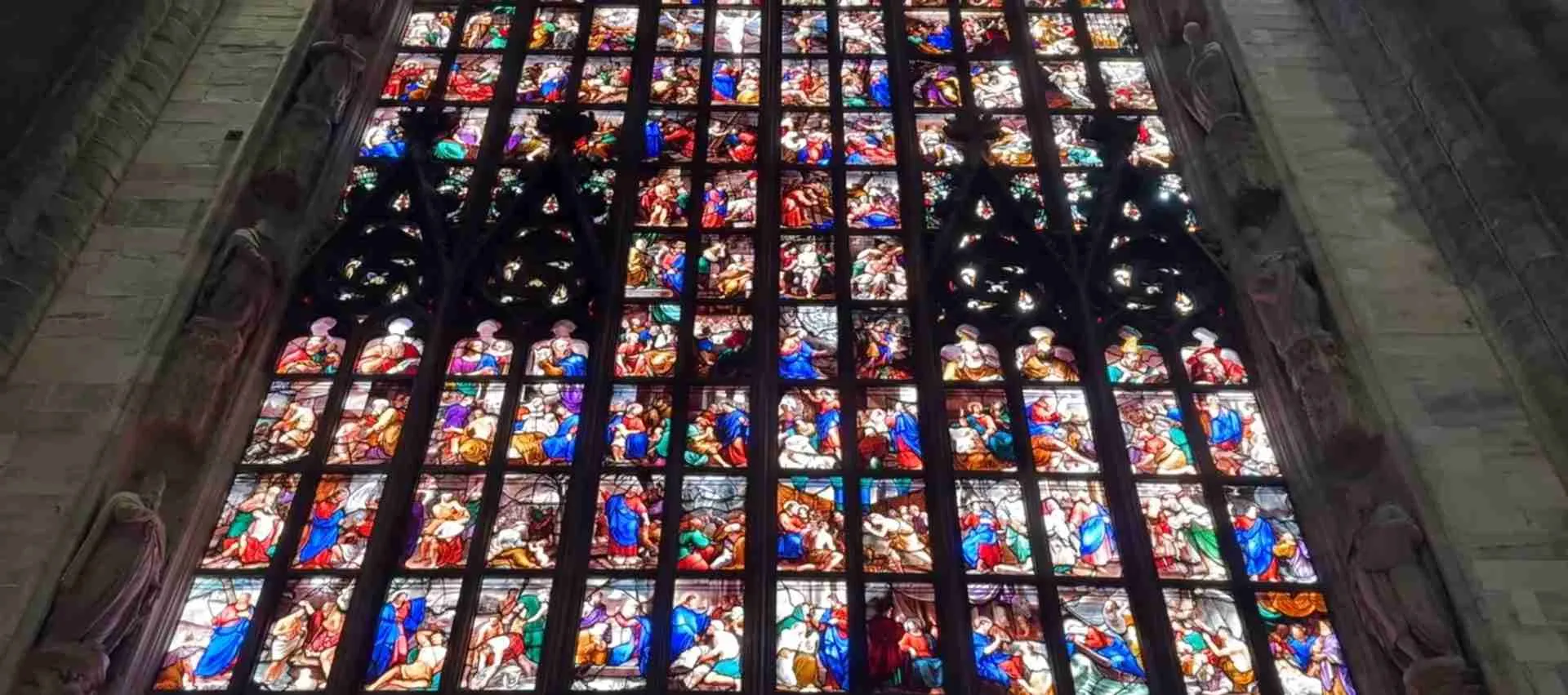
Fifty-five monumental stained glass windows spanning apse, transept, and nave create kaleidoscopic light effects as sunlight filters through colored glass depicting biblical narratives, saints’ lives, and allegorical subjects. The apse windows installed during initial 14th-15th century construction represent the cathedral’s most significant early glass, demonstrating medieval techniques and iconographic programs that established visual theology instructing congregations in scriptural knowledge. Later windows replaced originals between 1829-1858 using enamel-painted glass techniques producing different aesthetic character from earlier windows’ jewel-like translucency, creating stylistic variations that document changing glass-making technologies and artistic preferences across centuries.
The floor’s geometric patterns combine Candoglia marble with black and red marble varieties, creating polychromatic designs that guide processional movement toward the altar while providing visual interest for congregations during extended liturgical celebrations. The floor pattern redesign during Counter-Reformation renovations reflected new emphasis on congregational participation and spatial organization supporting post-Tridentine liturgical practices. Modern floor areas show wear from centuries of foot traffic, requiring periodic restoration that carefully matches historical patterns while introducing modern substrate materials improving durability without compromising aesthetic authenticity.
Notable artworks include the famous Saint Bartholomew Flayed sculpture by Marco d’Agrate from 1562, depicting the apostle carrying his flayed skin over his shoulder in gruesome anatomical detail that demonstrates Renaissance knowledge of human musculature and dramatic emotional expression. This sculpture attracts particular visitor attention through its visceral subject matter and technical virtuosity showing muscles, tendons, and veins with scientific precision serving theological purpose of illustrating martyrdom’s physical reality. Other significant works include the Trivulzio Candelabrum, medieval bronze masterpiece standing over five meters tall with intricate decorative details, and numerous side chapels containing paintings, sculptures, and funerary monuments created by major artists across construction centuries.
The high altar stands at the crossing beneath the octagonal cupola, creating liturgical focus where transept and nave intersect in architectural and theological centrality. The altar area contains the tomb of Saint Charles Borromeo preserved in rock crystal casket within the crypt, making this space pilgrimage destination where visitors venerate Milan’s most important Counter-Reformation saint. The presbytery’s architectural framework designed during Borromeo’s archiepiscopacy demonstrates how Counter-Reformation theological priorities reshaped medieval Gothic space to emphasize altar visibility, congregational participation, and hierarchical distinction between clergy and laity through spatial organization and decorative programs reinforcing Catholic doctrine against Protestant challenges.
The cathedral’s massive organ ranks among Italy’s largest and Europe’s most significant, featuring over 15,000 pipes producing vast tonal range employed in liturgical services, concerts, and recordings. The organ’s rich resonance benefits from the cathedral’s acoustic properties where stone surfaces and soaring vaults create reverberation enhancing musical complexity while the enormous interior volume prevents sound muddiness that would occur in smaller spaces. Organ concerts open to the public allow audiences to experience this instrument’s capabilities beyond liturgical functions, transforming the cathedral into concert hall where sacred music traditions continue while embracing contemporary performance practices.
Archaeological Area: Foundations of Faith
The archaeological area beneath the cathedral floor preserves foundations of earlier churches demolished for construction, revealing Milan’s Christian architectural evolution from early basilicas through medieval developments preceding the current Gothic structure. The Baptistery of San Giovanni alle Fonti dating from the 4th century represents Milan’s oldest visible Christian structure, where Saint Ambrose baptized Saint Augustine in 387 CE according to historical tradition, making this site foundational to Western Christian intellectual history. The octagonal baptistery plan follows early Christian conventions associating eight-sided geometry with resurrection symbolism, establishing architectural traditions that influenced subsequent baptistery designs across Italy including Florence’s famous example.
The Basilica of Santa Tecla served as Milan’s cathedral from the 4th through 14th centuries before demolition for current cathedral construction, with foundation walls and floor remnants documenting the earlier building’s scale and orientation. Archaeological investigation reveals construction techniques, material choices, and spatial organization reflecting early Christian and medieval building practices that would be superseded by Gothic innovations emphasizing height, light, and structural expression. The decision to demolish functioning cathedral for grander replacement demonstrates the 14th-century Milanese elite’s architectural ambition and willingness to sacrifice heritage for contemporary glory, prioritizing civic prestige over historical preservation in ways that would trouble modern conservation ethics.
The Basilica di Santa Maria Maggiore similarly fell to construction demands, with the old church exploited as stone quarry providing material for the new cathedral’s foundations and lower walls. This practical reuse of demolished buildings’ materials follows medieval building economics where transportation costs often exceeded quarrying expenses, making salvage and reuse standard practice. The archaeological stratigraphy visible in the excavated area shows successive building phases, material reuse episodes, and the gradual accumulation of floor levels as centuries of use raised interior surfaces through debris accumulation, periodic repaving, and intentional raising to combat water infiltration in Milan’s historically marshy terrain.
Access to the archaeological area requires combination tickets including cathedral and museum, with well-designed interpretation explaining excavated structures’ historical significance and relationship to the current building overhead. The underground space provides climate-controlled environment protecting fragile archaeological remains from weather exposure while creating contemplative atmosphere where ancient Christianity’s physical traces connect modern visitors to Milan’s religious heritage predating the visible cathedral by a millennium. Educational displays document excavation processes, archaeological findings, and scholarly interpretations that have evolved as investigation techniques improved and historical understanding deepened through comparative studies of other early Christian sites across Italy and the Mediterranean.
Duomo Museum: Preserving Artistic Heritage
The Museo del Duomo located in the Palazzo Reale facing the cathedral preserves original sculptures, stained glass panels, architectural models, liturgical objects, and construction documents removed from the building for conservation or replaced during restoration campaigns. The museum’s twenty-six exhibition rooms display chronological narrative tracing the cathedral’s construction, artistic evolution, and ongoing preservation challenges that have required removing weathered originals to climate-controlled storage while installing protective copies on the building. This dual presentation strategy allows the cathedral to maintain visual completeness while protecting priceless originals from further deterioration caused by pollution, weather, and structural movement.
Original sculptures removed from exterior niches demonstrate the artistic quality and iconographic sophistication that characterized the cathedral’s comprehensive decorative program, with individual statues showing distinctive hands of named master sculptors and anonymous craftsmen who contributed to collective achievement. Close museum examination reveals details invisible when statues occupied their intended positions high on the façade, including facial expressions, drapery textures, anatomical modeling, and tool marks documenting carving techniques. These preserved originals allow appreciation of artistic virtuosity while raising philosophical questions about whether sculpture created for specific architectural context retains full meaning when displayed in museum galleries divorced from intended viewing circumstances and theological programs.
Stained glass panels removed during 19th-century replacement campaigns preserve medieval glass-making techniques and iconographic programs that later windows’ enamel-painted glass methods superseded. The early glass demonstrates Gothic coloristic effects achieved through pot-metal glass where color permeates the entire glass thickness rather than being painted on surfaces, creating jewel-like translucency and color intensity that painted glass cannot match. Museum display allows close examination of leading techniques, figure painting methods, and compositional strategies impossible when windows occupy their intended positions high in the cathedral walls, transforming appreciation from distant contemplation of overall effect to detailed study of craft techniques and artistic decisions.
Architectural models include designs submitted during competitions for the cupola, façade, and various spires, documenting the cathedral’s evolution through alternative proposals that remained unexecuted. These models reveal how the building might have appeared under different architectural visions, demonstrating that the final form resulted from choices rather than inevitable development. Leonardo da Vinci’s withdrawn cupola design exists in drawings though not physical models, while various façade proposals from the 17th-18th centuries show Baroque and Neoclassical alternatives to the Gothic design that Napoleon’s intervention eventually imposed. These unrealized alternatives enrich understanding of the cathedral as contingent creation shaped by patronage decisions, aesthetic debates, and historical circumstances rather than predetermined outcome.
Liturgical objects including vestments, chalices, reliquaries, and processional crosses document the cathedral’s religious functions beyond architectural monument, revealing how the building served living religious community rather than merely representing artistic achievement. These objects demonstrate craft traditions in metalwork, textile production, and gemstone setting that paralleled architectural and sculptural arts, with ecclesiastical patronage supporting comprehensive material culture production serving liturgical needs. The museum’s preservation of these objects ensures their survival while removing them from active liturgical use creates the same decontextualization affecting the architectural sculptures, raising questions about how religious objects function when transformed into museum artifacts appreciated for aesthetic qualities rather than employed in ritual purposes.
Visiting Milan Cathedral: Practical Information
Milan Cathedral opens daily from 9:00 AM to 7:00 PM for cathedral interior and archaeological area access, with last entry at 6:10 PM allowing visitors time to complete viewing before closing procedures begin. The rooftop terraces maintain the same 9:00 AM to 7:00 PM schedule Monday through Thursday, extending to 8:00 PM Friday through Sunday with last admission at 6:00 PM on all days. The Duomo Museum operates daily except Wednesdays from 10:00 AM to 7:00 PM with ticket sales ending at 6:00 PM, requiring separate planning for comprehensive visits combining all cathedral complex elements across multiple days using combination ticket validity periods.
Ticket pricing effective from April 2025 offers several combinations balancing access and budget considerations. The Duomo+Museum ticket costs €10 for adults and €5 for concessions, providing single entry to the cathedral interior and museum but excluding rooftop terrace access, making it the most economical option for visitors primarily interested in the building’s artistic and religious significance rather than panoramic views. The Combo Stairs ticket priced at €22 adults and €11 concessions includes cathedral, museum, and rooftop terrace via stair access, valid for two days allowing flexible scheduling across separate visits. The Combo Lift ticket costs €26 adults and €13 concessions for elevator terrace access plus cathedral and museum, offering time-saving convenience for visitors with mobility limitations or those prioritizing efficiency.
Fast-Track tickets introduced April 2025 promise reduced waiting times through dedicated elevator access and priority entry, priced at €28 adults and €14 concessions for terraces-only Fast-Track or higher rates for combinations including additional areas. These premium tickets serve peak-season visitors willing to pay substantially more for queue avoidance, though arriving at opening time or late afternoon often provides comparable crowd avoidance at standard ticket prices. Family tickets offer reduced per-person costs for groups of two adults plus one or two children under eighteen, encouraging multigenerational visits while making the cathedral experience more economically accessible to families who might otherwise find individual ticket costs prohibitive.
Online advance purchase through the official Duomo website or authorized resellers provides guaranteed admission and time-slot selection, essential during peak summer months from June through August when same-day availability becomes unpredictable. Time-slot reservations control visitor flow to prevent overcrowding and ensure acceptable experience quality, though queues still form at security checkpoints where bag inspections and prohibited item screening create delays regardless of advance ticket purchase. Early morning visits immediately after 9:00 AM opening or late afternoon around 5:00-6:00 PM provide smaller crowds than midday peak hours when multiple tour groups concentrate their schedules, improving photography opportunities and reducing wait times at elevator or stair access points.
Dress code requirements mandate shoulder and knee coverage with prohibition on tank tops, shorts above the knee, mini-skirts, and other revealing clothing inappropriate for active religious site where Catholic services continue daily. These standards apply universally regardless of visitors’ religious affiliations or cultural backgrounds, enforced by entrance staff who deny admission to improperly dressed individuals without ticket refunds. Bringing a shawl, cardigan, or covering garment allows quick compliance if outfit questions arise, particularly during hot summer weather when minimal clothing tempts travelers to risk enforcement of modest dress standards protecting the cathedral’s religious character against complete tourism transformation.
Security screening processes similar to airport protocols require bag inspections, metal detector passage, and prohibited item surrender including large backpacks, suitcases, sharp objects, glass containers, and other potentially dangerous materials. Free luggage storage operates at Piazza Duomo for travelers managing bags between hotel checkout and departure, though storage capacity limitations during peak season may require seeking commercial luggage services at Milano Centrale train station or other facilities. Stroller access works for cathedral interior though the rooftop terraces’ stairs preclude stroller use there, requiring baby carriers for families wanting terrace access with infants.
Worship access for prayer and liturgical celebration remains free through dedicated entrances opening early for morning worshippers from 7:00 AM before tourist hours begin, maintaining the cathedral’s primary religious function alongside its role as cultural monument and tourist attraction. A reserved worship area separated from tourist routes allows silent contemplation and prayer without ticket purchase, respecting religious visitors’ needs while managing tourist flow through different entrances and routes. Mass celebrations occur multiple times daily at 7:00 AM, 8:00 AM, 9:30 AM, 11:00 AM (Latin), 12:30 PM, and 5:30 PM, with liturgical schedules subject to variation during major religious festivals and special celebrations.
Photography and Documentation
Photography regulations permit personal photography without flash or tripods throughout the cathedral interior and rooftop terraces, allowing souvenir images while protecting artwork from light damage and preventing equipment obstruction in crowded spaces. Commercial photography requires advance permission and fees through the Veneranda Fabbrica administration, with professional equipment and staged photography sessions prohibited during normal visiting hours. The cathedral’s Gothic architecture and Candoglia marble surfaces respond beautifully to natural light throughout the day, with morning sun illuminating the eastern apse windows and afternoon light creating dramatic nave shadows that enhance spatial depth perception.
Interior photography challenges include low ambient light levels requiring high ISO sensitivity or image stabilization to prevent motion blur when flash remains prohibited. Wide-angle lenses capture the nave’s soaring proportions and column rhythms, while telephoto capabilities allow detail photography of stained glass, sculptures, and architectural ornament positioned at heights defeating normal lens focal lengths. The cathedral’s vast scale makes comprehensive single-image documentation impossible, requiring either panoramic techniques stitching multiple frames or strategic compositional choices isolating particular architectural features that represent the overall character.
Rooftop terrace photography benefits from abundant natural light and unrestricted positioning among the spires, creating opportunities for architectural detail capture impossible from ground level and panoramic views documenting Milan’s urban context. Golden hour timing around sunrise or sunset provides warm color temperatures and long shadows enhancing marble texture and sculptural relief, while midday overhead sun creates harsh contrasts problematic for balanced exposures. The Madonnina golden statue photographs spectacularly when sunlight catches the gilded surface, though achieving both properly exposed statue and retained sky detail requires exposure bracketing or HDR techniques managing the extreme brightness range.
Exterior façade photography from Piazza del Duomo allows comprehensive documentation though achieves best results using wide-angle lenses from the piazza’s far end where sufficient distance prevents severe perspective distortion. Morning light illuminates the façade frontally, revealing marble detail and sculptural relief clearly though creating somewhat flat lighting that reduces dimensional modeling. Afternoon side-lighting from the west creates stronger shadows emphasizing architectural relief and providing more dramatic photographic character, while evening blue hour after sunset combines residual twilight sky color with artificial building illumination creating atmospheric images impossible during pure daylight conditions.
Conservation Challenges and Ongoing Preservation
Milan Cathedral confronts ongoing preservation challenges from urban pollution, weather exposure, structural movement, and the inherent deterioration affecting all stone buildings regardless of maintenance efforts. Sulfur compounds and nitrogen oxides in urban air create acid deposition that gradually dissolves Candoglia marble’s calcium carbonate composition, requiring periodic cleaning campaigns removing pollution-darkened surface layers and applying protective consolidants slowing future deterioration. The cathedral’s exposed position in Piazza del Duomo without surrounding buildings providing wind shelter intensifies weathering from rain, freeze-thaw cycles, and wind-driven particle abrasion affecting the marble surfaces and sculptural details.
The Veneranda Fabbrica del Duomo maintains specialized workshops employing marble carvers, structural engineers, and conservation scientists who apply traditional craft knowledge and contemporary preservation technologies to ongoing maintenance. Marble carving workshops train new craftspeople in techniques replicating original medieval and Renaissance sculptural styles, ensuring replacement capacity when deteriorated sculptures require reproduction. These workshops maintain centuries-old traditions while incorporating modern understanding of stone behavior, structural mechanics, and conservation chemistry that medieval builders lacked, creating synthesis of traditional craft and scientific knowledge applied to preservation challenges.
Structural monitoring systems track building movement, crack propagation, and foundation settlement using sensors providing continuous data about the cathedral’s physical condition. Gothic vaulting systems designed to transmit forces through specific structural paths require maintaining precise geometry, making movement detection essential for identifying emerging problems before they reach crisis levels. Foundation investigation in Milan’s historically marshy terrain addresses groundwater management, soil consolidation, and settlement patterns affecting the enormous structure’s stability across its 157-meter length and substantial height creating substantial loads on medieval foundations designed before modern geotechnical engineering existed.
Spire restoration campaigns address individual pinnacles requiring marble replacement, structural reinforcement, or decorative element restoration, with work typically executed by temporary scaffolding that obscures portions of the roofline for months or years during major interventions. Recent campaigns adopted donor sponsorship programs where individuals or organizations contribute €100,000 or more to “adopt” specific spires, receiving commemorative plaques acknowledging their support while generating essential preservation funding that cultural budget austerity has reduced. This crowdfunding approach democratizes heritage preservation participation while raising questions about privatization of public cultural monuments and appropriate recognition of donor contributions without compromising architectural integrity.
Comparative Context: Milan Cathedral Among European Gothic Cathedrals
Milan Cathedral exists within broader European Gothic cathedral tradition while displaying distinctive characteristics that set it apart from French, German, and Spanish examples demonstrating Gothic architecture’s geographic variations and local adaptations. French Gothic cathedrals including Notre-Dame de Paris, Chartres, and Reims pioneered the style’s structural systems and aesthetic principles through pointed arches, ribbed vaults, flying buttresses, and extensive stained glass, establishing models that subsequent European examples followed with varying degrees of fidelity or creative reinterpretation. Milan Cathedral’s adoption of Gothic architecture came relatively late when the style had reached maturity, allowing Lombard builders to import proven techniques while adapting them to Italian aesthetic preferences and material traditions.
The cathedral’s Candoglia marble construction distinguishes it from northern European examples built in gray limestone or sandstone, creating fundamentally different visual character through color, texture, and weathering patterns. Marble’s crystalline structure produces sharper carved edges and finer sculptural details than softer limestones permit, allowing the decorative richness that covers every Milan Cathedral surface. The material choice also affects conservation challenges, as marble reacts differently to pollution and weathering than limestone, requiring specialized preservation approaches developed through experience with this specific building rather than simply applying techniques proven effective on French Gothic cathedrals.
Italian Gothic generally shows less extreme vertical emphasis than French examples, with Milan Cathedral representing the Italian exception approaching French proportions through its 45-meter nave height and soaring vaults. Most Italian Gothic churches including Florence Cathedral maintain broader, lower proportions reflecting Romanesque heritage and Mediterranean aesthetic preferences for horizontal spatial extension rather than vertical transcendence. Milan’s Gothic extremity resulted from conscious decision to embrace northern European models completely rather than moderating them through Italian sensibilities, creating unique synthesis that remains distinctly Italian through marble use and decorative approaches while achieving Gothic spatial character rivaling northern European examples.
The rooftop terrace accessibility distinguishes Milan Cathedral from most European Gothic cathedrals where roof access remains restricted to maintenance personnel, transforming architectural appreciation from distant observation into physical exploration. This accessibility democratizes understanding of Gothic structural systems and decorative programs that would otherwise remain invisible to general audiences, making Milan Cathedral an exceptional educational resource where visitors gain intimate knowledge of medieval building techniques through direct observation impossible at comparable buildings. The terrace experience also provides tourism revenue supporting preservation while creating demand for continuous maintenance ensuring visitor safety and experience quality.
Frequently Asked Questions
What are the Milan Cathedral opening hours and ticket prices?
The cathedral interior and archaeological area open daily from 9:00 AM to 7:00 PM with last entry at 6:10 PM, while rooftop terraces maintain the same schedule Monday-Thursday and extend to 8:00 PM Friday-Sunday. The Duomo Museum operates daily except Wednesdays from 10:00 AM to 7:00 PM. Effective April 2025, ticket prices include: Duomo+Museum €10 (adults) and €5 (concessions); Combo Stairs (cathedral, museum, terraces via stairs) €22 adults and €11 concessions; Combo Lift (cathedral, museum, terraces via elevator) €26 adults and €13 concessions. Fast-Track elevator access costs €28 adults and €14 concessions. Combination tickets remain valid for two days allowing flexible scheduling across multiple visits to complete all cathedral complex elements.
Is the stair climb to the rooftop terraces difficult?
The stair climb involves approximately 250 steps ascending through narrow medieval passages at moderate incline manageable for most visitors with basic fitness, though people with mobility limitations, cardiovascular conditions, or claustrophobia concerns may prefer elevator access. The stairs include periodic landings allowing rest breaks, with the climb typically requiring 10-15 minutes depending on pace and crowd density. The passages reveal construction details and provide intermediate view windows creating engaging ascent experience rather than monotonous stair climbing, while the physical effort creates earned appreciation for reaching the terraces that enhances the achievement satisfaction. Descent via stairs applies to all visitors regardless of ascent method, ensuring even elevator users experience the stairway’s architectural interest and perspective shifts.
Can I visit the cathedral for religious services without buying tickets?
Yes, worshippers attending Mass or entering for silent prayer access the cathedral free through dedicated worship entrances separate from tourist routes, with a reserved area allowing contemplation and liturgical participation without ticket purchase. Early morning access begins at 7:00 AM before tourist hours, with multiple daily Mass celebrations at 7:00 AM, 8:00 AM, 9:30 AM, 11:00 AM (Latin), 12:30 PM, and 5:30 PM providing opportunities for religious participation. Tourist visits exploring the full interior, artwork, rooftop terraces, and museum require paid admission, maintaining separation between religious and cultural functions while ensuring the cathedral’s primary Catholic worship purpose continues alongside its role as architectural monument and major tourist attraction generating preservation funding.
What is the best time to visit to avoid crowds?
Early morning visits immediately after 9:00 AM opening or late afternoon around 5:00-6:00 PM provide the smallest crowds, as midday hours from 11:00 AM to 3:00 PM concentrate multiple tour groups and independent visitors creating peak congestion. Weekdays offer more relaxed experiences than weekends when both tourists and local worshippers increase visitor density, while shoulder seasons of April-May and September-October balance moderate weather and reduced crowds compared to summer peak season from June-August. Arriving with advance time-slot reservations allows bypassing on-site ticket purchase queues, though security screening creates unavoidable delays during all periods when bag inspections and prohibited item checks process every visitor regardless of ticket type or advance purchase.
Are there dress code requirements for visiting?
Yes, visitors must cover shoulders and knees with prohibition on tank tops, shorts above the knee, mini-skirts, revealing clothing, and other attire inappropriate for active religious site where Catholic worship continues daily. Enforcement staff at entrance security checkpoints deny admission to improperly dressed individuals without ticket refunds, applying standards universally regardless of visitors’ religious affiliations, cultural backgrounds, or stated intentions. Bringing a shawl, cardigan, or lightweight covering garment allows quick compliance if outfit questions arise, particularly during hot summer weather when minimal clothing tempts travelers to risk enforcement. These modest dress standards protect the cathedral’s religious character and demonstrate respect for Catholic worshippers sharing space with cultural tourists.
How long did it take to build Milan Cathedral?
Construction spanned 579 years from the 1386 foundation stone laying to the January 6, 1965 completion of the final portal, making Milan Cathedral one of history’s longest architectural projects. This extraordinary timeline resulted from the building’s unprecedented scale, technical vaulting challenges, periodic funding interruptions, changing architectural fashions requiring design revisions, political upheavals, and the perfectionist ambition to ornament every surface comprehensively. The project involved 78 different architects across construction centuries, with major phases including 14th-century Gothic apse and nave, 15th-century cupola, 17th-century façade foundations, Napoleonic-era façade completion in 1807-1813, 19th-century spire construction, and 20th-century final details creating architectural palimpsest where successive eras contributed without completely effacing earlier work.
What makes the Candoglia marble special?
Candoglia marble quarried near Lake Maggiore in northern Italy displays distinctive pink-white coloring with crystalline structure that shifts appearance throughout the day as light angle changes, ranging from brilliant white in direct sun to soft rose during dawn and dusk illumination. This marble’s fine grain and crystalline composition allows sharper carved edges and more refined sculptural details than softer limestones used in northern European Gothic cathedrals, enabling the comprehensive decorative richness covering every cathedral surface. The Veneranda Fabbrica’s exclusive quarry access granted in 1387 remained active across construction centuries, with marble transported via dedicated canal system reducing costs while ensuring consistent material quality throughout the building’s fabric, though modern quarrying capacity limitations now restrict extraction to conservation replacement needs rather than new construction applications.
Can I see the Alps from the rooftop terraces?
Yes, on clear days the Alps become visible as distant white peaks approximately 100 kilometers north of Milan, creating dramatic backdrop to the urban panorama. Atmospheric conditions determine visibility, with autumn and winter months following rainfall or cold fronts providing the clearest air and best Alpine views, while summer heat haze and pollution accumulation often obscure distant mountains despite otherwise sunny weather. Spring months offer variable conditions with some spectacularly clear days alternating with hazy periods. The Alps appear most prominently during morning hours before daily atmospheric heating reduces visibility, making early terrace visits around 9:00-10:00 AM optimal for mountain viewing when weather conditions cooperate and crowd levels remain relatively modest compared to midday peak hours.
Is photography allowed inside the cathedral and on the terraces?
Personal photography without flash or tripods is permitted throughout the cathedral interior and rooftop terraces, allowing souvenir images while protecting artwork from light damage and preventing equipment obstruction in crowded spaces. Commercial photography, professional equipment use, and staged photography sessions require advance permission and fees through the Veneranda Fabbrica administration, with such activities prohibited during normal visiting hours to avoid disrupting regular visitor flow. The cathedral’s Gothic architecture responds beautifully to natural light, though interior low-light conditions require high ISO sensitivity or image stabilization preventing motion blur when flash remains prohibited. Rooftop terraces provide abundant natural light and unrestricted positioning among spires creating excellent photography opportunities, with golden hour timing around sunrise or sunset offering warm color temperatures and dramatic lighting enhancing marble texture and sculptural relief.
What other attractions are included with combination tickets?
Combination tickets include the cathedral interior with its five aisles, columns, and stained glass windows; the Duomo Museum containing original sculptures, architectural models, and liturgical objects; the archaeological area preserving remains of earlier 4th-century baptistery and medieval basilicas beneath the current floor; rooftop terraces providing access to walking among 135 spires and panoramic city views; and the Church of San Gottardo in Corte near the museum. The highest-tier tickets add the Pinacoteca Ambrosiana art gallery and Crypt of San Sepolcro, extending the cathedral experience to related cultural sites. Ticket validity periods of two days for standard combinations or seventy-two hours for premium options allow flexible scheduling across multiple visits to complete all elements without rushing, accommodating travelers wanting comprehensive Milan cultural engagement beyond single-day cathedral exploration.