
Visiting Mantua: Ultimate Planning Resource & Travel Guide 2026
Mantua rises from the Mincio River like a Renaissance mirage — three artificial lakes encircle a compact historic centre where Gonzaga palaces, Andrea Mantegna’s illusionistic frescoes, and Giulio Romano’s architectural theatre have survived largely intact since the sixteenth century. Designated a UNESCO World Heritage Site alongside nearby Sabbioneta in 2008, this small Lombard city delivers world-class art at prices far below Florence or Venice, in a setting almost entirely free of mass-tourism crowds. This guide provides everything needed for a Mantua visit in 2026: verified ticket prices, accommodation costs by tier, day-by-day itineraries, and strategies to get maximum value from every euro.
Key Takeaways: Visiting Mantua in 2026
- UNESCO Heritage Status: Mantua and Sabbioneta were jointly inscribed as a UNESCO World Heritage Site in 2008 under criteria (ii) and (iii), recognising their exceptional contribution to Renaissance urban planning, architecture, and humanist culture under the Gonzaga dynasty (1328–1707). The serial property covers 235 hectares across both city centres.
- Daily Budget Ranges 2026: Budget travellers spend €75–110 per person daily (two sharing a budget B&B or hotel). Mid-range visitors spend €130–195 per person daily (two sharing a 3-star hotel). Luxury travellers spend €240–365 per person daily (two sharing a 4-star hotel).
- The Mantova + Sabbioneta Card: The 72-hour city pass costs €25 for adults and covers entry to 12+ museums and monuments — including Palazzo Te (€15 alone) and Palazzo Ducale Corte Vecchia (€11 alone) — plus free city bus transport to Sabbioneta and discounts at partner hotels and restaurants.
- Flagship Attraction: The Camera degli Sposi inside the Castello di San Giorgio — Andrea Mantegna’s landmark fresco cycle (1465–1474) — is the single most important artwork in the city and one of the Renaissance’s defining spaces. Admission to the full Palazzo Ducale complex including the Camera degli Sposi costs €18 (check official rates at mantovaducale.beniculturali.it). Advance booking is essential on weekends and in peak season.
- Getting There: Regional trains connect Verona to Mantua in 48 minutes (from €5) and Milan Centrale to Mantua in approximately 2 hours (€12.50 with Trenord, no change required). The entire historic centre is walkable once you arrive.
- Best Time to Visit: April through June and September through October offer the most comfortable conditions — mild temperatures, manageable crowds, and active outdoor dining. Summer (July–August) is hot, humid, and at peak hotel rates. Winter delivers the lowest prices and easiest access to the Camera degli Sposi without advance booking.
People Also Ask About Visiting Mantua 2026
How much does a day in Mantua cost in 2026?
A day in Mantua costs €75–110 per person on a budget (two sharing a budget hotel or B&B), €130–195 per person at mid-range comfort (two sharing a 3-star hotel), or €240–365 per person for luxury travel. All ranges include accommodation, three meals, local transport, and one to two museum admissions. Mantua sits well below the northern Italian tourist strongholds in overall cost: the same mid-range day that runs €200–280 in Venice or Florence costs €130–195 here, with comparable cultural depth and significantly fewer crowds.
Is the Mantova + Sabbioneta Card worth buying in 2026?
Yes, the card delivers clear value for most visitors staying two or more days. The €25 card covers a single entry to each of 12+ monuments — including Palazzo Te (€15 alone), Palazzo Ducale Corte Vecchia (€11 alone), Teatro Scientifico Bibiena, Palazzo d’Arco, Casa del Mantegna, and all museums in Sabbioneta — plus free APAM bus travel for 72 hours. Buying the two flagship sites separately costs €26; the card provides those at effectively the same price plus ten more museums and bus transport at no added cost. For access to the Camera degli Sposi specifically, card holders pay a €7 supplement rather than the full €18 ticket, bringing the combined outlay to €32 versus €33 for just those two sites purchased individually.
What is the best time to visit Mantua in 2026?
April through June and September through October deliver the best balance of weather, crowd levels, and value. Spring brings mild temperatures (15–22°C), blossoming lakeside views, and uncrowded monuments. September is Mantua’s cultural peak — the Festivaletteratura literary festival transforms the city in early September, while the rest of the month offers warm afternoons and harvest-season menus. July and August reach 32–36°C with added humidity from the surrounding lakes, and hotel rates climb 20–35% above shoulder-season prices. December through February brings cold and fog but also Mantua’s lowest hotel rates and the easiest access to the Camera degli Sposi without booking weeks in advance.
How do I get from Milan or Verona to Mantua in 2026?
From Verona, Trenitalia regional trains run approximately every hour, cover the 34 km in 48 minutes, and cost €5–7 (purchase at the station or on board). From Milan Centrale, Trenord runs a direct service in approximately 2 hours for €12.50 — no change required. There is no direct train from Venice; change at Verona for a total journey of roughly 2 hours 30 minutes. By car, Mantua sits on the A22 autostrada (Modena–Brennero); exit at Mantova Sud or Mantova Nord. The historic centre is a Restricted Traffic Zone (ZTL) — park free at Piazzale Montelungo or Viale Montello on the periphery and walk in.
Extended multi-day tours – 5+ days
Featured Mantua Multi-Day Tour Packages

3 days
Mantua 3-Day Discovery Tour
- ✓ Comprehensive Mantua experience
- ✓ Expert local guides included
- ✓ All accommodation included
- ✓ Transportation provided
5 days
Mantua 5-Day Highlights Experience
- ✓ Comprehensive Mantua experience
- ✓ Expert local guides included
- ✓ All accommodation included
- ✓ Transportation provided
7 days
Mantua 7-Day Cultural Journey
- ✓ Comprehensive Mantua experience
- ✓ Expert local guides included
- ✓ All accommodation included
- ✓ Transportation provided

10 days
Mantua 10-Day Complete Adventure
- ✓ Comprehensive Mantua experience
- ✓ Expert local guides included
- ✓ All accommodation included
- ✓ Transportation provided
Multi-day tour packages powered by TourRadar. Prices and availability subject to change.
Why Mantua Deserves a Place on Your 2026 Italy Itinerary
Mantua stands as one of northern Italy’s most underrated destinations — a Renaissance city of extraordinary artistic depth that most international visitors overlook entirely in favour of Verona or Venice. That omission is among Italian travel’s most persistent oversights.
The Gonzaga family transformed this ancient lakeside settlement into one of Europe’s most sophisticated Renaissance courts between 1328 and 1707. Their patronage brought Andrea Mantegna to Mantua in 1460 as court painter; he stayed 46 years and completed the Camera degli Sposi, the most technically innovative fresco cycle of the fifteenth century. The family commissioned Leon Battista Alberti to design the Basilica of Sant’Andrea — a church whose nave dimensions still startle visitors familiar with far larger Italian cities. They appointed Giulio Romano to reinvent Mantua’s entire architectural vocabulary, producing Palazzo Te as a tour-de-force of Mannerist design and remodelling dozens of buildings across the city centre.
The result is a city where world-class art concentrates within a 30-minute walking radius, admission prices remain reasonable, and the gelato queue at Caravati on Piazza delle Erbe is longer than the line at the Palazzo Ducale on most weekday mornings. Mantua’s compact historic centre — surrounded on three sides by the Lago Superiore, Lago di Mezzo, and Lago Inferiore, artificial lakes created by engineering works along the Mincio River in the twelfth century — feels simultaneously intimate and monumental.
UNESCO recognised the joint Outstanding Universal Value of Mantua and nearby Sabbioneta in 2008, inscribing the serial property under criteria (ii) and (iii). Criterion (ii) acknowledges Mantua’s role as a transmitter of Renaissance values, architectural innovation, and humanist culture across Europe; criterion (iii) recognises the exceptional testimony both cities provide to Gonzaga civilisation and Renaissance town-planning theory at its highest expression. The UNESCO property (reference number 1287) covers 235 hectares across the two city centres, with a 2,330-hectare buffer zone encompassing the surrounding Po Valley landscape.
Beyond the monuments, Mantua is a genuinely pleasant city in which to spend time. The local cooking — tortelli di zucca (pumpkin ravioli with a sweet-savoury filling of candied fruit and amaretti), risotto alla pilota, slow-braised river pike — represents a distinctive culinary tradition with deep historical roots. The Virgiliana literary culture runs through the city’s identity: Publius Vergilius Maro was born near Mantua in 70 BC at the town of Andes (present-day Pietole), and the city has maintained a relationship with literary life ever since, culminating in the annual Festivaletteratura, one of Italy’s most important literary events. Mantua was European Capital of Culture in 2016 — a designation that continues to produce cultural investments visible in the city today.
For 2026 visitors, Mantua offers something increasingly rare in Italian tourism: a city of genuine historical importance where you can move freely, dine authentically, and experience world-class art without fighting the crowds that have transformed many comparable Italian destinations into endurance tests.
Getting to Mantua in 2026: All Transport Options
Mantua is accessible by train from Milan (2 hours), Verona (48 minutes), Brescia (45 minutes), and Bologna (90 minutes with connection). The nearest commercial airports are Verona Villafranca and Bergamo Orio al Serio. There is no airport serving Mantua directly.
By Train: The Recommended Option
Train travel is the most practical way to reach Mantua. The city’s station (Stazione di Mantova, Piazzale Don Leoni) is approximately 1.2 km from Piazza Sordello — a 15-minute walk or a short bus ride on lines 4C, 4T, or CC.
- From Verona Porta Nuova (Trenitalia regional): 48 minutes fastest, approximately 1 hour 10 minutes average. Frequency: approximately every hour. Cost: €5–7 per person. Up to 15 direct trains daily. Verona is the ideal gateway for visitors flying into Verona Villafranca Airport.
- From Milan Centrale (Trenord direct): Approximately 2 hours, no change required. Cost: €12.50 per person in 2nd class. First departure from Milan: 6:20 AM; last from Milan: 8:20 PM. First from Mantua: 5:18 AM; last from Mantua: 8:42 PM.
- From Brescia (Trenitalia regional): Approximately 45 minutes. Cost: €6–9. A convenient connection for visitors arriving at Bergamo Orio al Serio (BGY) airport — take the Terravision or Autostradale bus to Brescia (about 1 hour), then the train to Mantua.
- From Bologna (change at Modena): Approximately 90 minutes total. Cost: €14–20.
- From Venice (change at Verona): Approximately 2 hours 30 minutes total. Cost: €15–25 depending on routing and timing.
By Car
Mantua sits on the A22 Modena–Brennero autostrada. Exit at Mantova Sud (from the south) or Mantova Nord (from the north). Journey times by car: approximately 40 minutes from Verona, 1 hour 30 minutes from Milan, 1 hour 15 minutes from Bologna.
The historic centre operates a ZTL (Zona a Traffico Limitato) enforced by cameras. Driving into the ZTL without authorisation triggers substantial fines (€60–160) delivered by post weeks later. Visitors with accommodation inside the ZTL must ask their hotel to register the vehicle’s licence plate with the municipality before arrival — do this in advance, not at check-in. Free parking is available at:
- Piazzale Montelungo: The main free lot, immediately south of the historic centre. 10–15 minute walk to Piazza Sordello.
- Viale Montello: Free parking near Palazzo Te, convenient for visitors arriving primarily to visit the palace.
- Lakeside car parks near Lungolago: Free, scenic, and within walking distance of the centre.
From the Nearest Airports
- Verona Villafranca (VRN), ~50 km: Shuttle buses and trains connect to Verona Porta Nuova station (about 15 minutes). From there, the regional train to Mantua takes 48 minutes. Total airport-to-city: approximately 1 hour 15 minutes.
- Bergamo Orio al Serio (BGY), ~100 km: Bus to Brescia (approximately 1 hour), then regional train to Mantua (approximately 45 minutes). Total: approximately 2 hours.
- Milan Malpensa (MXP), ~180 km: Bus or train to Milan Centrale (approximately 50 minutes), then Trenord to Mantua (2 hours). Total: approximately 3 hours.
- Milan Linate (LIN), ~150 km: Metro or shuttle to Milan Centrale (20 minutes), then Trenord to Mantua (2 hours). Total: approximately 2 hours 30 minutes.
Best Time to Visit Mantua in 2026
Mantua’s climate is shaped by its position in the Po Valley — one of the foggiest and most climatically extreme regions in Italy. Summers are hot and humid; winters are cold and damp. The shoulder seasons deliver the most enjoyable conditions for sightseeing.
Spring (April–June): The Best Season
April through June is Mantua at its finest. Temperatures rise from 14°C in April to 24°C in late June. The lake views are clear, gardens are in bloom, and visitor numbers remain well below summer peaks. Restaurant terraces open across the piazzas, and the city’s cycling culture comes alive on the lakeside paths. The Camera degli Sposi is accessible without months of advance booking — though weekend slots still sell out several weeks ahead in May. Spring is the ideal choice for first-time visitors wanting the full Mantua experience at a comfortable pace.
Summer (July–August): Hot and High Season
July and August bring Mantua’s highest temperatures (regularly 32–36°C) and maximum humidity from the surrounding lakes. Italian domestic tourism peaks during these weeks, and hotel rates climb 20–35% above shoulder prices. The Palazzo Ducale is busiest in the mornings, and Camera degli Sposi slots fill weeks ahead. Evenings are the reward — outdoor concerts, late museum openings, and piazza dining continue until midnight, and the lakeside at dusk is genuinely beautiful. Early-morning visits (8:15 AM opening) avoid the worst of the heat and crowds.
Autumn (September–October): Second Best Season
September is Mantua’s cultural high point. The Festivaletteratura (Literature Festival) occupies the first week of September, transforming every piazza and palazzo into a venue for readings, debates, and performances. Accommodation books out early and rates approach August levels during festival week; the rest of September and October see comfortable temperatures (18–26°C), harvest-season menus with truffles and mushrooms, and extraordinary light on the lakes. October is particularly quiet and atmospheric.
Winter (November–March): Quiet and Cheap
Winter delivers Mantua at its most affordable. Temperatures drop to 0–8°C, and fog is common from November through January. However, hotel rates fall to their annual lows, Camera degli Sposi access requires no weeks of advance planning, and restaurant prices carry no tourist premium. The Palazzo Ducale’s interiors are arguably more atmospheric in winter’s low, raking light than in the flat brightness of summer noon. The Carnevale Mantovano, held in the weeks before Ash Wednesday, brings costume processions and events to Piazza Sordello and the surrounding streets.
Seasonal Hotel Rate Variation (3-Star Double Room)
- January–February: €70–100 per room (lowest prices year-round)
- March: €75–110 per room
- April–June: €90–140 per room (shoulder-season pricing)
- July–August: €120–180 per room (high season)
- September: €95–160 per room (Festivaletteratura week reaches August-level pricing)
- October–November: €80–120 per room
- December: €70–105 per room
Where to Stay in Mantua 2026: Accommodation Guide by Budget Tier
Accommodation in Mantua costs significantly less than in nearby Verona or the Lake Garda resorts, despite the city’s UNESCO status and cultural significance. Virtually any centrally located property offers walking access to all major attractions.
Budget Accommodation in Mantua 2026 (€60–90 per Room per Night)
Budget-tier accommodation in Mantua centres on small family hotels, B&Bs, and a handful of hostel-style rooms. The strongest concentration of budget properties sits near the train station and along the streets approaching Piazza Mantegna — a 15-minute walk from Piazza Sordello.
Albergo Bianchi Stazione, directly opposite the train station, provides clean 3-star rooms at budget prices: practical for early train departures and late arrivals. Hotel Leon D’Oro in the Old Town district offers simple 2-star accommodation in the heart of the historic centre. Hotel Mantegna Stazione is another reliable station-area option with family-friendly facilities.
B&B operators throughout the centro storico offer double rooms in the €60–80 range, many including a simple continental breakfast. Properties inside the ZTL can arrange a vehicle access permit for check-in and check-out; confirm this when booking.
- Low season (Nov–Feb): €50–70 per room
- Shoulder season (Mar–Jun, Sep–Oct): €65–90 per room
- High season (Jul–Aug): €80–120 per room
Mid-Range Accommodation in Mantua 2026 (€90–160 per Room per Night)
The mid-range tier delivers the most comfortable base for exploring Mantua. Hotel Pex Mantova, 200 metres from the Rotonda di San Lorenzo, offers modern rooms with excellent central positioning. Hotel dei Gonzaga occupies a prime spot directly on Piazza Sordello, a few steps from Palazzo Ducale — a romantically located choice despite occasional morning noise from the square’s activity. Hotel Broletto in the centro storico provides solid 3-star comfort at honest mid-range prices.
For families or visitors spending several nights, the Smart Holiday group of serviced apartments and properties such as Residenza Accademia (MantegnaHotels) and Residenza La Torre offer apartment-style accommodation at mid-range room prices, with kitchen access for self-catering savings.
- Low season: €80–110 per room
- Shoulder season: €95–150 per room
- High season: €120–180 per room
Luxury Accommodation in Mantua 2026 (€160–300+ per Room per Night)
Mantua’s luxury sector focuses on boutique palazzo hotels and high-end residences in historic buildings. Grand Hotel San Lorenzo offers 4-star comfort in a restored Renaissance property steps from the Rotonda di San Lorenzo, with some rooms featuring direct views across the piazza. Cà Uberti Palace Hotel, part of the local MantegnaHotels group, provides 4-star accommodation 100 metres from Palazzo Ducale, combining heritage architecture with contemporary amenities and free Wi-Fi throughout.
Palazzo Castiglioni Luxury Suites occupies a restored 13th-century palazzo in the historic centre — individually designed suites in a building that predates the Gonzaga era entirely, representing the highest end of Mantua’s accommodation market.
- Low season: €130–180 per room
- Shoulder season: €160–230 per room
- High season: €190–300+ per room
Accommodation Near Palazzo Te
Visitors with a particular focus on Palazzo Te find the residential streets south of the historic centre — the zona stadio area — quieter and sometimes cheaper than the centro storico, with B&Bs and self-catering apartments within a 5-minute walk of the palace. Dimore al Te is a well-regarded option in this neighbourhood. Free parking is available directly in front of Palazzo Te, making this area convenient for visitors arriving by car.
Staying in Sabbioneta
Visitors combining Mantua with a Sabbioneta overnight find small agritourism properties and B&Bs in and around Sabbioneta town. Staying in Sabbioneta adds an authentic rural dimension to the UNESCO experience and allows you to experience the ideal city at dawn and dusk when it is completely devoid of day-trippers. A car is required for comfortable travel between the two UNESCO components.
Mantua’s Top Attractions and Admission Costs in 2026
Mantua concentrates an exceptional number of historically significant monuments within a 30-minute walking radius. Most visitors reach all major sites on foot in a single day, though two days allow a more thorough experience.
Palazzo Ducale (Ducal Palace): Mantua’s Defining Monument
The Palazzo Ducale complex is Mantua’s most important destination — a labyrinthine ensemble of buildings, courtyards, gardens, and galleries accumulated across four centuries of Gonzaga rule. With over 500 rooms distributed across three distinct sections (Corte Vecchia, Corte Nuova, and the Castello di San Giorgio), it represents one of the largest royal residences in Europe.
Admission is structured around two ticket options. The full ticket including the Castello di San Giorgio (Camera degli Sposi) and Museo Archeologico Nazionale costs €18 for adults and €2 reduced for EU citizens aged 18–25. Verify current official rates at mantovaducale.beniculturali.it before visiting, as pricing structures are updated periodically. A separate ticket covering the Corte Nuova and Corte Vecchia without the Camera degli Sposi costs €11 full price. Children under 18 (EU residents) enter free.
Advance booking is essential for Camera degli Sposi access, which operates on strictly timed entry slots. Book online at ducalemantova.vivaticket.it for visits until 30 June 2026 and at mantovaducale.coopculture.it for visits from July 2026 onward. On busy spring and autumn weekends, slots sell out several weeks in advance.
Opening hours: Tuesday–Sunday 8:15–19:15 (last entry 18:20). Closed Monday. First Sunday of every month: free admission to all state museums, including Palazzo Ducale. Camera degli Sposi timed slots are still required on free-entry days.
The Camera degli Sposi, inside the Castello di San Giorgio, is the reason for any Mantua visit. Completed by Andrea Mantegna in 1474, it is among the most technically revolutionary fresco cycles in the history of Western art. The north wall shows Ludovico III Gonzaga receiving a letter and turning to address his court, the entire scene rendered with such illusionistic depth that the room appears to extend beyond its actual walls. The celebrated oculus painted onto the ceiling — with putti and fashionably dressed women peering down from a fictive circular balcony — constitutes one of the earliest examples of trompe-l’œil ceiling painting in European art, predating similar effects elsewhere by decades.
The Sala del Pisanello, elsewhere in the Ducale complex, contains fragmentary but extraordinary remnants of Pisanello’s mid-fifteenth century fresco cycle depicting an Arthurian tournament — among the finest surviving examples of International Gothic painting in Italy, recovered from beneath whitewash in the twentieth century.
Palazzo Te: Giulio Romano’s Mannerist Masterpiece
Palazzo Te stands approximately 1 km south of Piazza Sordello — 15 minutes on foot or 5 minutes by the free Navetta Te shuttle. Built between 1524 and 1534 for Federico II Gonzaga by court architect and painter Giulio Romano, it functioned simultaneously as a summer retreat, entertainment complex, stabling facility for the Gonzaga horse-breeding programme, and architectural manifesto of Mannerist design principles.
Admission is €15 for adults, €11 reduced (visitors over 65, groups of 15 or more, Mantova residents, holders of specific partner cards), and €7 for youth aged 12–18 and university students. Children under 11 enter free. Current rates at centropalazzote.it. Opening hours: Monday 13:00–18:30 (summer: 13:00–19:30), Tuesday–Sunday 9:00–18:30 (summer: 9:00–19:30). The ticket office closes one hour before the museum.
The Sala dei Giganti is unlike any other room in Renaissance Italy. Giulio Romano designed it as a total illusionistic environment, with every surface — walls, ceiling, even the floor — covered by a single continuous composition showing the mythological Fall of the Giants in all its terrifying momentum. The room is designed to make the architecture itself appear to be collapsing; columns crack, masonry falls, and Jupiter’s thunderbolts rain down from directly above the viewer’s head. The Camera di Amore e Psiche delivers a different but equally overwhelming effect — a complete cycle of mythological scenes covering every surface in imagery that is erotic, technically brilliant, and at times genuinely startling in its explicit content.
Basilica of Sant’Andrea: Alberti’s Architectural Manifesto
Leon Battista Alberti’s Basilica of Sant’Andrea — built from 1472 onward from his original design — is the largest church in Mantua and one of the most influential buildings in Western architectural history. The coffered barrel-vault nave, the integration of triumphal arch forms into both façade and interior, and the handling of spatial ratios all provided solutions that defined church architecture across the following century. Michelangelo, Bramante, and virtually every major architect of the High Renaissance worked in Alberti’s shadow here.
Admission is free (donations welcome). The crypt beneath the crossing contains the reliquary purportedly holding soil mixed with the blood of Christ — a relic venerated in Mantua since the seventh century and the foundation of the city’s medieval importance as a pilgrimage destination. A chapel to the right of the entrance preserves Mantegna’s funerary monument and his remarkable painted self-portrait roundel.
Rotonda di San Lorenzo: Mantua’s Oldest Church
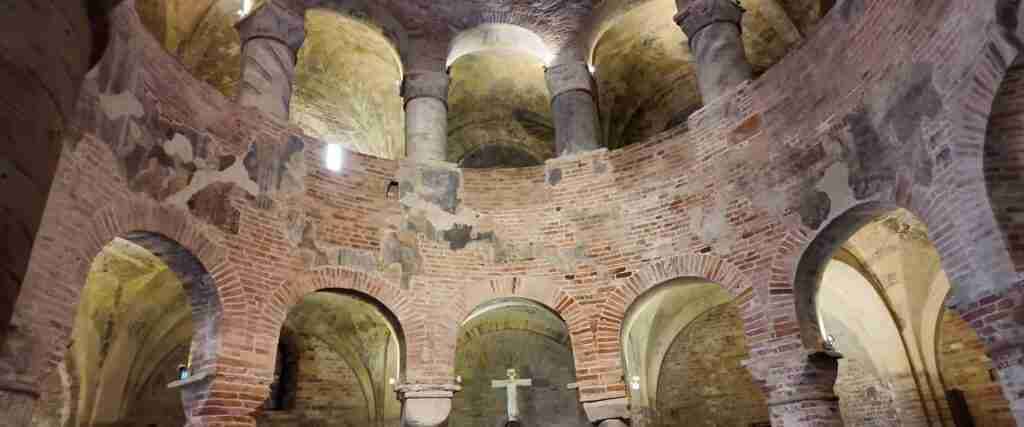
The Rotonda di San Lorenzo on Piazza delle Erbe is one of the oldest surviving churches in Lombardy — a circular Romanesque structure from the late eleventh century whose round form reflects the influence of Byzantine rotunda churches. Its interior retains fragmentary Romanesque frescoes of considerable age and rarity. The exterior can be viewed at any time at no cost. Interior admission is approximately €2–3 (payable on site).
Teatro Scientifico Bibiena
The Teatro Scientifico (also known as the Teatro Bibiena), designed by Antonio Galli Bibiena and inaugurated in 1769, is among the finest Baroque theatre interiors in Italy. Its four tiers of boxes curve in a distinctive bell shape rather than the standard horseshoe, and the original painted decoration survives almost entirely intact. Wolfgang Amadeus Mozart performed here on 16 January 1770, writing in a letter to his father that it was the most beautiful theatre he had ever seen — a judgement confirmed by every subsequent visitor. Individual admission approximately €3–4, or covered by the Mantova + Sabbioneta Card. Check current hours with the Mantova Musei network.
Palazzo d’Arco
Palazzo d’Arco, a late-neoclassical palazzo in the streets southwest of Piazza Sordello, contains one of Mantua’s great surprises: the Zodiac Room, frescoed by Giovanni Maria Falconetto around 1519 with an extraordinary cycle of astrological imagery. The palace remained in the d’Arco family until 1973 and retains its complete original furnishings, collections, and domestic atmosphere, giving visitors a uniquely unmediated encounter with aristocratic life across the centuries. Admission approximately €5–8, or covered by the Mantova + Sabbioneta Card.
Casa del Mantegna
The circular house designed by or attributed to Mantegna himself in the 1470s serves today as an exhibition space. The remarkable round courtyard — one of the most unusual architectural spaces in Mantua — and the direct connection to the artist who spent 46 years in the city make this a compelling stop for visitors with deep interest in Renaissance art and artists’ lives. Covered by the Mantova + Sabbioneta Card.
The Mantova + Sabbioneta Card 2026: Complete Value Analysis
The Mantova + Sabbioneta Card costs €25 for adults (€13 for visitors aged 12–17) and provides 72 hours of access from the moment of first use. Purchase at Mantua tourist information offices, Palazzo Ducale, Palazzo Te, or Palazzo della Ragione. Check mantovacard.it for the current participating sites list and any price updates.
The card provides a single entry to each of the following:
- Palazzo Te (including the permanent civic museum collections)
- Palazzo Ducale — Corte Vecchia only (Camera degli Sposi requires an additional €7 supplement for card holders)
- Museo Archeologico Nazionale
- Museo Diocesano Francesco Gonzaga
- Museo MACA and Tempio Leon Battista Alberti
- Museo di Palazzo d’Arco
- Palazzo della Ragione
- Torre dell’Orologio and Museo del Tempo
- Teatro Scientifico Bibiena
- Casa del Mantegna
- Museo Tazio Nuvolari
- All Musei di Sabbioneta
Additional card benefits: free travel on all APAM urban and Mantua–Sabbioneta extra-urban bus lines for 72 hours; discounts at partner hotels, restaurants, and shops; reciprocal reduced-admission agreement with the Vicenza Card and Card 4Musei.
Value Calculation: Buying the two flagship sites separately costs €15 (Palazzo Te) + €11 (Palazzo Ducale Corte Vecchia) = €26. The card at €25 covers those two for effectively the same price, plus ten additional museums and bus transport at no extra charge. For visitors also wanting the Camera degli Sposi, the card plus the €7 supplement totals €32 — versus €18 (full Palazzo Ducale) + €15 (Palazzo Te) = €33 for just those two sites separately. The card thus saves €1 while adding ten more museums and full bus access.
Who Benefits Most: The card delivers maximum value for visitors staying two or more days, planning to explore beyond the two flagship sites, travelling to Sabbioneta (the bus fare alone runs €5–7 return without the card), and using city buses for the Palazzo Te shuttle. Day-trippers spending all their time at Palazzo Ducale with the full €18 ticket and Palazzo Te may find the marginal savings less pronounced, though bus transport and restaurant discounts bring the card into clear value for most day-trippers as well.
Food and Dining in Mantua 2026: Costs and Must-Try Dishes
Mantua’s culinary identity is among the most distinctive in northern Italy. The cooking reflects the city’s agricultural surroundings — river fish from the Mincio and lakes, pumpkins and squash from the Po Valley, cured meats and slow-braised game from a landlocked tradition that diverges sharply from the olive oil and tomato cooking of central and southern Italy. Mantuan cuisine carries the memory of the Gonzaga court kitchen — sophisticated, unusual, and unmistakeable.
Mantua’s Essential Dishes
- Tortelli di zucca: Mantua’s signature dish — pasta parcels filled with butternut squash, mostarda di frutta (candied fruit in mustard syrup), amaretti biscuits, and Parmesan. The sweet-savoury balance is unique to the Mantuan tradition and unlike anything found elsewhere in Italian cooking. Order this everywhere.
- Risotto alla pilota: Rice cooked with finely ground pork sausage using a distinctive dry-absorption method developed in the rice mills (pile) along the Mincio. Rich, substantial, and deeply flavoured.
- Stracotto di asino: Donkey meat slow-braised for hours in red wine and aromatics — a local tradition rarely found outside the Mantovano territory. Do not be put off by the ingredient; the result is extraordinarily tender and deeply flavoured.
- Luccio in salsa: River pike from the lakes, braised in olive oil, capers, anchovies, and herbs. A recipe essentially unchanged since the Gonzaga court tables of the sixteenth century.
- Sbrisolona: The famously crumbly almond and cornmeal tart, traditionally broken with a closed fist rather than cut, eaten as a snack or dessert at room temperature. The best versions have a sandy, intensely nutty texture.
- Torta delle rose: A brioche-like sweet bread shaped into rose-like spirals, originating in the Gonzaga court kitchen. Available at pasticcerie throughout the city.
Budget Dining in Mantua 2026 (€12–22 per Person per Meal)
Budget dining in Mantua centres on bigolerie (shops specialising in fresh bigoli noodles with various condiments), market-adjacent lunch spots, and the fixed-menu lunch offerings at traditional trattorie. Al Torchio, a classic bigoleria near the historic centre, serves antipasti and fresh pasta for €12–18 per person. Trattoria La Bottega da Paolo offers weekday fixed menus (menù del giorno) from €9 for two courses and a drink. The market at Piazza delle Erbe on Tuesdays and Thursdays provides excellent materials for a self-assembled picnic: salumi, local cheeses, seasonal fruit, and fresh bread from nearby bakeries at €8–12 per person.
Mid-Range Dining in Mantua 2026 (€25–45 per Person per Meal)
Most established trattorie and osterie in the historic centre fall in this tier, delivering exceptional value by northern Italian standards. A typical mid-range dinner at a traditional osteria: tortelli di zucca as primo (€12–16), stracotto di asino or risotto alla pilota as secondo (€15–22), a glass of local Lambrusco or Lugana wine (€4–7), coperto cover charge (€2–3). Total: €33–48 per person, well below equivalent quality in Verona or Florence.
Osteria delle Quattro Tette near Piazza Sordello and the various osterie and trattorie around Via Corridoni, Via Oberdan, and Piazza delle Erbe consistently deliver honest traditional cooking at mid-range prices.
Fine Dining in Mantua 2026 (€55–90+ per Person)
Mantua’s fine dining scene has grown significantly in recent years. Several restaurants offer multi-course tasting menus drawing on traditional Gonzaga court recipes reinterpreted with contemporary technique. Expect €55–90 per person for a full fine dining experience with wine pairing, representing outstanding value against comparable restaurants in Milan or Verona.
Coffee and Breakfast Costs
Morning coffee culture follows the Lombard bar tradition. Espresso: €1–1.50. Cappuccino: €1.50–2. A croissant (cornetto) or torta delle rose slice at a pastry counter: €1–1.50. Morning coffee and pastry at a bar: €3–5 per person. The pasticcerie around Piazza delle Erbe and along Via Roma compete seriously for the best sbrisolona and local pastries — worth exploring before committing to a hotel breakfast.
Dining Hours Note: Mantuan restaurants observe strict service hours. Lunch runs 12:30–14:30; dinner runs 19:30–22:30. Arriving outside these windows and expecting a hot meal will consistently disappoint. Plan accordingly, particularly for groups with children.
Getting Around Mantua in 2026
Mantua is one of the most walkable small cities in northern Italy. The entire UNESCO World Heritage historic centre measures less than 1.5 km from north to south and east to west. Walking is the primary mode of transport for all visitors, and no public transport is needed within the centre itself.
On Foot
The train station to Piazza Sordello is a 15-minute walk on flat, pedestrianised streets. Palazzo Ducale to Palazzo Te is approximately 1 km (15 minutes). The complete circuit of major monuments — Palazzo Ducale, Piazza Sordello, Basilica Sant’Andrea, Piazza delle Erbe, Rotonda di San Lorenzo, and the lakeside promenade — covers roughly 3 km of very manageable walking.
The Free Navetta Te Shuttle
A free municipal shuttle connects the city centre to Palazzo Te every 15 minutes. Weekdays: 7:00–21:00. Weekends: 9:00–21:00. As of mid-2025, the shuttle boards from Piazzale Vittorio Veneto and Via Isonzo (temporary routing; the original Piazzale Montelungo stop was suspended). Confirm current boarding points via apam.it or at the tourist information office before your visit, as the route may have been restored to its original path by 2026.
By Bicycle
Cycling is ideal in Mantua — the terrain is completely flat, and an extensive cycle-path network covers both the historic centre and the surrounding lakes. The Ridemovi bike-share system operates at stations throughout the city, including at the train station and Piazza Sordello. Day rentals from private shops near the station cost €10–15. The lakeside cycling path between Lungolago Gonzaga and Porta Catena delivers extraordinary views of the city rising over the water — one of the finest cycling experiences in Lombardy.
APAM City Buses
APAM urban lines serve the city comprehensively. Single ride: approximately €1.50. City buses are covered free by the Mantova + Sabbioneta Card. Key lines from the station to the historic centre are 4C, 4T, and CC (approximately 10 minutes).
Getting to Sabbioneta
APAM buses serve the Mantua–Sabbioneta route approximately every 1–2 hours. Journey time: approximately 45 minutes. The Mantova + Sabbioneta Card covers this bus travel. Without the card, the return journey costs approximately €6–8. Sabbioneta’s monuments require advance planning — guided tours in English run at set times throughout the day, and some sites have limited opening hours. Check the Musei di Sabbioneta schedule before travelling.
Complete Daily Budget Breakdown for Mantua in 2026
All figures are per person per day, assuming two people sharing accommodation. Hotel room rates are divided by two before being added to per-person costs. Ranges reflect realistic variation within each tier rather than a single midpoint estimate.
Budget Tier: €75–110 Per Person Daily
Budget travellers base themselves in a B&B or budget hotel, eat at market stalls and lunchtime trattorie, and use the first-Sunday free admission or spread the Mantova + Sabbioneta Card across three days to minimise daily attraction spend.
- Accommodation (budget B&B, two sharing €60–80 room): €30–40 per person
- Breakfast (bar espresso and pastry): €3–5
- Lunch (bigoleria or fixed-menu trattoria): €12–18
- Dinner (budget osteria or trattoria): €18–25
- Local transport (walking plus 1–2 city buses): €2–5
- Attractions (selective visits or amortised card cost): €8–15
Total: approximately €75–110 per person daily, two sharing budget accommodation. A three-day stay using the €25 Mantova + Sabbioneta Card spreads that attraction cost to approximately €8 per day, keeping the total firmly in this range.
Mid-Range Tier: €130–195 Per Person Daily
Mid-range visitors stay in 3-star hotels, enjoy sit-down meals at traditional restaurants, and visit both flagship museums plus one additional site per day.
- Accommodation (3-star hotel, two sharing €100–150 room): €50–75 per person
- Breakfast (hotel or good café): €5–10
- Lunch (sit-down restaurant): €18–28
- Dinner (traditional osteria or trattoria, wine included): €30–45
- Local transport (buses and occasional navetta): €5–10
- Attractions (full Palazzo Ducale plus one additional site): €20–28
Total: approximately €130–195 per person daily, two sharing mid-range hotel accommodation.
Luxury Tier: €240–365 Per Person Daily
Luxury visitors book 4-star boutique hotels, dine at upscale restaurants, and include private guided tours or premium experiences.
- Accommodation (4-star hotel, two sharing €180–280 room): €90–140 per person
- Breakfast (hotel or upscale café): €10–15
- Lunch (upscale restaurant): €35–50
- Dinner (fine dining with wine): €60–90
- Private guide or premium experience: €20–30
- Transport (taxis when needed): €10–20
- Attractions (multiple museums and premium tours): €35–50
Total: approximately €240–365 per person daily, two sharing luxury accommodation.
Weekly Cost Estimates
Most visits to Mantua span two to four days. For visitors incorporating Mantua into a wider northern Italy itinerary, full-week estimates covering only the Mantua-based portion of travel are:
- Budget (7 days): approximately €525–770 per person
- Mid-range (7 days): approximately €910–1365 per person
- Luxury (7 days): approximately €1680–2555 per person
These weekly totals cover accommodation, all meals, local transport, and museum admissions. Intercity rail or flights to and from Mantua are additional.
Sample Mantua Itineraries for 2026
One Day in Mantua: The Essential Visit
A well-paced single day covers Mantua’s two flagship attractions with time for the piazzas and a proper lunch.
8:15 AM — Palazzo Ducale: Arrive at opening time and enter directly for the Camera degli Sposi (pre-booked timed slot required). Spend 2–2.5 hours exploring the complex: Camera degli Sposi, Sala del Pisanello, and the garden terrace overlooking Lago di Mezzo. Admission: €18.
11:00 AM — Piazza Circuit: Walk through Piazza Sordello and into the trio of historic squares — Piazza Broletto, Piazza delle Erbe, and Piazza Mantegna. Visit the exterior of the Rotonda di San Lorenzo (€2–3 for interior access) and the Basilica di Sant’Andrea facade. The morning light on the piazzas and the sheer concentration of historic fabric within this short circuit is overwhelming.
12:30 PM — Lunch: Choose a trattoria on or near Piazza delle Erbe. Order tortelli di zucca. This is non-negotiable on a first visit. Budget €18–28 for a full lunch with wine.
14:00 PM — Palazzo Te: Take the free Navetta Te shuttle or walk 15 minutes south. Allow a full 2 hours for the complete room circuit, with particular attention to the Sala dei Giganti and the Camera di Amore e Psiche. Admission: €15.
16:30 PM — Lakeside: Return to the historic centre via the lakeside promenade. Walk the Lungolago between Lago Inferiore and the city walls, or rent a bicycle from one of the shops near the port area for a 30-minute circuit of the lakes.
19:30 PM — Dinner: A traditional osteria on Via Corridoni, Via Mazzini, or the streets around Piazza Virgiliana. Budget €30–45 for dinner with wine. One-day cost estimate (not including accommodation): approximately €95–130 per person, covering both museum tickets, meals, a coffee, and minimal transport.
Two Days in Mantua: The Cultural Immersion
Day One: Follow the itinerary above.
Day Two, Morning: Basilica di Sant’Andrea at opening — the interior scale is genuinely astonishing even after seeing Palazzo Ducale the previous day. Spend time in the Mantegna memorial chapel in the crypt; the artist’s painted self-portrait medallion is one of the strangest and most moving works in Mantua. Cross Piazza Mantegna to the Duomo (Mantua Cathedral) and examine the interior redesigned by Giulio Romano in the mid-sixteenth century.
Day Two, Mid-Morning: Teatro Scientifico Bibiena. The Baroque theatre where Mozart performed at age 13 is one of the most beautiful small theatres in Italy and requires only about 30–45 minutes. Admission approximately €3–4 or covered by the Mantova + Sabbioneta Card.
Day Two, Lunch: Explore the Piazza dei Martiri area or Piazza delle Erbe (market on Tuesdays and Thursdays). A leisurely lunch at a local osteria: budget €20–30 per person.
Day Two, Afternoon: Palazzo d’Arco, southwest of Piazza Sordello. The Zodiac Room fresco cycle by Falconetto and the intact domestic collection of furniture, porcelain, and objects create an atmosphere unlike any public museum. Admission approximately €5–8 or covered by the card.
Day Two, Late Afternoon: Lakeside cycling. Rent bikes near the station and follow the cycle path from Porta Catena to Piazza Virgiliana for sunset views of the city across Lago Superiore.
Two-day cost estimate (mid-range, excluding accommodation): approximately €130–180 per person for two days of museums, meals, and transport. Using the €25 Mantova + Sabbioneta Card purchased on Day One covers Day Two’s museum entries entirely.
Day Trip to Sabbioneta: The Ideal City
Sabbioneta, 30 km southwest of Mantua, is the other component of the UNESCO serial property and among the most remarkable small towns in Renaissance Italy. Built from scratch between the 1550s and 1580s by Vespasiano Gonzaga Colonna as the physical realisation of Renaissance ideal-city theory, Sabbioneta is extraordinary in its completeness and philosophical ambition.
The APAM bus departs from Mantua’s bus terminal adjacent to the train station and takes approximately 45 minutes (covered by the Mantova + Sabbioneta Card; otherwise approximately €3–4 one-way). The return bus schedule requires planning — check current APAM timetables at apam.it before the visit.
Sabbioneta’s core monuments: the Teatro all’Antica (1588, designed by Vincenzo Scamozzi, the only theatre he completed and one of only two surviving Renaissance theatres in Italy alongside Palladio’s Vicenza Olympic Theatre); Palazzo del Giardino (Vespasiano’s private apartments, frescoed throughout); the Galleria degli Antichi (a 97-metre-long corridor designed for Vespasiano’s antique sculpture collection); and the Church of the Incoronata with its gilded equestrian statue of Vespasiano. Most sites are accessible only via guided tour; English tours operate at set times. The combined Sabbioneta sites ticket costs approximately €10–12 and is included with the Mantova + Sabbioneta Card.
Allow a full day: depart Mantua by 9:00 AM, return by 17:00 PM. Sabbioneta has one or two small restaurants for lunch — booking ahead on weekends is advisable.
Seasonal Price Variations in Mantua 2026
Mantua’s seasonal pricing follows the standard northern Italian rhythm, with meaningful variation between high and low seasons in accommodation and some activities.
Hotel rates drop most sharply in January–February and November–December, rising through spring and peaking in July–August and during the first week of September (Festivaletteratura). The festival week sees mid-range hotels charging near-August rates, with the best central properties booking out three to four months in advance.
Restaurant pricing in Mantua does not fluctuate seasonally the way coastal and lake-resort menus do. A plate of tortelli di zucca costs the same in July as in January. Seasonal variation in menus is significant, however: autumn brings game, white truffles, porcini mushrooms, and chestnuts; winter features braised meats, polenta, and lentil dishes; spring and summer emphasise fish from the lakes and lighter vegetable preparations.
Admission prices at state museums (Palazzo Ducale) have historically been stable year-round, with adjustments made at annual intervals rather than seasonally. Palazzo Te and the civic museums follow the same pattern. The only reliably free day across all state museums remains the first Sunday of each month, year-round.
The most cost-effective period for a Mantua visit is November through February, delivering approximately 25–35% lower hotel rates than the spring–summer peak, full access to all monuments, and the shortest queues at every site.
Day Trips from Mantua 2026: Beyond the City
Mantua’s position in the southern Po Valley places it within easy reach of several outstanding destinations. Most can be reached by train without a car.
Verona (48 Minutes, €5–7 Each Way)
Verona is the natural pairing for any Mantua visit and is easily combined in a single trip or a dedicated day out. The Arena di Verona Roman amphitheatre (admission approximately €10; opera season runs June–September 2026 with tickets from €30 upward), the Romanesque Basilica di San Zeno Maggiore, Castelvecchio museum, and the medieval historic centre — itself a UNESCO World Heritage Site — all sit within a 30-minute walking radius of Verona Porta Nuova station. Verona’s Piazza delle Erbe and the surrounding streets deliver exceptional food shopping and dining. A half-day in Verona combined with a half-day or full day in Mantua makes a compelling two-city visit from a single base.
Lake Garda Southern Shore (Approximately 1 Hour, from €6 Each Way)
The southern shore of Lake Garda is accessible from Mantua by train to Desenzano del Garda or Peschiera del Garda, with a connection at Brescia or Verona respectively. From Desenzano, ferries connect to Sirmione (20 minutes by boat), where the Scaligero Castle and the spectacular Grotte di Catullo — a Roman villa of extraordinary scale on the lake’s tip — justify the journey entirely. Sirmione also has thermal spa facilities, making it an unusually varied day trip combining archaeology, medieval history, and thermal relaxation.
Brescia (45 Minutes, €6–9 Each Way)
Brescia’s Museo di Santa Giulia, housed in an ancient Lombard monastery complex, ranks among the finest archaeological museums in northern Italy, covering Brescia’s history from prehistoric times through the Roman period and medieval era in extraordinary depth. The nearby Capitolium Roman temple complex is a UNESCO World Heritage Site. The Pinacoteca Tosio Martinengo houses an impressive collection of Brescian Renaissance painting including works by Raphael, Moretto, and Romanino. Brescia’s historic centre is completely walkable from the train station and substantially less visited than it deserves.
Cremona (Approximately 1 Hour, Change Required)
Cremona, the world capital of violin making, reaches Mantua via a connection at Casalmaggiore or on direct services (check current Trenitalia schedules as routing changes). The Museo del Violino inside the medieval Palazzo del Comune presents the history and craft of Cremonese lutherie in an internationally acclaimed permanent installation. The Torrazzo bell tower (112 metres — one of the tallest pre-modern towers in Italy) and the Romanesque Baptistery complete a historic centre of considerable quality. The tortelli di zucca in Cremona is identical to the Mantuan version — both cities claim the dish, and both are correct.
Mantua’s Festivals and Key Events in 2026
Mantua’s cultural calendar rewards visitors who align their trips with specific events.
Festivaletteratura (Early September): Mantua’s international literary festival is one of the most important cultural events in the Italian calendar, taking place in the first week of September. Authors, poets, philosophers, scientists, and journalists from across Italy and internationally fill Piazza Sordello, the Teatro Bibiena, the Palazzo della Ragione, and smaller venues across the historic centre for readings, debates, performances, and conversations. Free events on the open piazzas are supplemented by ticketed events that sell out months in advance. The atmosphere during festival week is extraordinary — the combination of world-class intellectual content and one of Italy’s most beautiful small cities creates an event unlike any other in Italian cultural life. Book accommodation for festival week three to four months ahead.
Carnevale Mantovano (February–March): Mantua’s carnival predates the more famous Venetian version and maintains local traditions including historical costume processions on Piazza Sordello and the surrounding streets. The Saturday before Fat Tuesday (Martedì Grasso) is the principal event day. The Carnevale adds colour and activity to what would otherwise be the city’s quietest and cheapest period.
Giro al Sacco (September): This medieval-games event revives a historical rivalry between Mantua’s four traditional neighbourhoods (quartieri), with competitors in period costume competing in games of historical origin. An entertaining spectacle of local civic pride and costumed tradition.
Opera and Chamber Music Season at Teatro Bibiena: The Bibiena theatre hosts an intimate opera and classical music season running from autumn through spring. Attending any performance in this extraordinary space — one of the most beautiful small theatres in Europe — constitutes a genuinely unique cultural experience. Check the theatre’s official programme for 2026 events and ticket availability.
Virgil and Literature (October): Mantua celebrates its most famous son — Publius Vergilius Maro, born near Mantua in 70 BC — with literary and scholarly events in October. Piazza Virgilio and the Museo di Palazzo Te host events linked to Virgilian scholarship and the city’s ancient literary identity.
Hidden Costs and Practical Fees in Mantua 2026
Several costs catch visitors unprepared. Accounting for these in advance removes unpleasant surprises from the experience.
Cover Charges (Coperto): Every sit-down restaurant in Mantua charges a coperto of €1.50–3 per person. This appears as a separate line item on the bill and is non-negotiable — it is standard Italian practice throughout the country, not a tourist levy. Budget for it in all sit-down dining calculations.
ZTL Fines: The automatic ZTL cameras register every vehicle entering the restricted zone without authorisation, and fines of €60–160 for the first offence arrive by post weeks or months later. Contact your hotel before arrival — not at check-in — to arrange licence plate registration if your accommodation is inside the zone. Never assume verbal advice at check-in is sufficient; confirm by email.
Advance Booking Fees: Online booking for the Camera degli Sposi through the official Vivaticket system carries no additional booking fee — the ticket costs exactly €18 whether purchased online or at the door. Third-party booking platforms sometimes add €1–3 service charges. Always book directly through the official system to avoid unnecessary fees.
Parking: Free parking at Piazzale Montelungo and Viale Montello costs nothing. Paid garages near the historic centre charge approximately €1–2 per hour. The free lots involve a 10–15 minute walk into the centre, which is entirely manageable given Mantua’s compact scale.
Church Entry: The Basilica di Sant’Andrea requests voluntary donations but is free to enter. The Duomo and most smaller churches are free. The Rotonda di San Lorenzo charges approximately €2–3 for interior access. Religious dress codes (shoulders and knees covered) apply at all churches — the Basilica occasionally turns visitors away during religious services.
Tipping: Tipping is not mandatory in Italy. Rounding up the bill by €1–2 per person is appreciated at traditional sit-down restaurants; no tip is expected at bars and cafes where you stand to consume. Hotel porters appreciate €1–2 per bag.
Wi-Fi: Most Mantua hotels and B&Bs include free Wi-Fi. The city centre and public areas offer free municipal Wi-Fi at key points. Mobile data from EU SIMs works throughout the city without additional cost for EU visitors.
Money-Saving Strategies for Mantua 2026
Use the First Sunday Free Museums Day: All state-managed museums, including Palazzo Ducale, offer free admission on the first Sunday of every month, year-round. Camera degli Sposi slots still require advance booking (free, but limited). Visiting on this day eliminates the €18 Palazzo Ducale ticket cost entirely — a meaningful saving for budget travellers.
Buy the Mantova + Sabbioneta Card on Day One: The 72-hour clock starts at first use. Activating the card on the morning of your first full day maximises coverage across three consecutive days of exploration. The bus access to Sabbioneta and the restaurant discounts add value beyond the museum entries.
Take the Main Meal at Lunch: Lunch at Mantua’s traditional trattorie costs 25–40% less than the equivalent dinner. A full two-course lunch with wine runs €15–22 per person; the same dishes at dinner cost €28–40+. The menù del giorno (daily fixed menu) at lunchtime is consistently the best value in Mantuan dining.
Free Attractions: These cost nothing and include genuine highlights. Basilica di Sant’Andrea (one of the most important buildings in the history of Western architecture, free admission). The three interconnected historic piazzas of Sordello, Broletto, and Erbe (an outdoor architectural gallery of extraordinary quality). The lakeside cycling and walking paths. The exterior of the Rotonda di San Lorenzo. The market at Piazza delle Erbe on Tuesdays and Thursdays. The entire urban fabric of the historic centre, which can be read as a continuous outdoor museum.
Self-Catering Breakfasts and Picnics: A bar breakfast of espresso and cornetto costs €3–5 and matches or exceeds the quality of most hotel buffets. A market-assembled picnic lunch beside the Lago Inferiore costs €8–12 per person for charcuterie, cheese, bread, and seasonal fruit.
Book Camera degli Sposi Early, Not Expensively: The booking system for the Camera degli Sposi charges no premium for advance booking — the price is €18 whether you book the day before or eight weeks ahead. The advantage of early booking is availability, not cost. Book as soon as your dates are confirmed; do not pay any third-party surcharge for this.
Stay Sunday to Thursday: Like most Italian cities, Mantua’s weekend hotel rates (Friday–Saturday nights) run higher than weekday rates. Scheduling your visit to include more weekday nights reduces accommodation costs at the mid-range and budget tiers.
Mantua for Different Traveler Types in 2026
Families with Children
Mantua suits families with children aged approximately 8 and above who can engage with Renaissance art and architecture. Children under 18 (EU residents) enter state museums including Palazzo Ducale free. The flat terrain and extensive cycle paths make the city ideal for family cycling; the lakes provide open outdoor space for less culturally focused activity. The Museo Tazio Nuvolari — dedicated to the legendary Mantua-born racing driver who dominated European motorsport in the 1920s and 1930s — captures older children and teenagers with its display of vintage cars, trophies, and racing memorabilia. The free Navetta Te shuttle removes the Palazzo Te walking challenge for younger children. Covered by the Mantova + Sabbioneta Card.
Families with two adults and two children under 18 find Mantua among northern Italy’s more accessible destinations: the children’s free museum admission significantly reduces attraction costs, the restaurants accommodate family dining without special arrangements, and the scale of the city prevents the overwhelming feeling that larger destinations can produce.
Solo Travellers
Mantua is among the most congenial small Italian cities for solo travel. The compact historic centre means no risk of feeling lost, restaurants are comfortable for single diners (a genuine consideration in smaller Italian cities outside major tourist circuits), and the Festivaletteratura creates exceptional opportunities for spontaneous intellectual engagement and conversation in September.
Solo travellers pay the full room rate without the two-sharing division applied to couple budgets. A solo visitor at mid-range comfort should budget approximately €180–270 per person daily — the complete room rate (€100–150) plus per-person costs — rather than the paired rate of €130–195. The Mantova + Sabbioneta Card provides identical value for solo visitors.
Couples and Romantic Visits
Mantua features consistently in lists of Italy’s most romantic small cities, and the designation is warranted. The combination of intimate scale, extraordinary architecture, lakeside restaurants with water views, and relative insulation from mass tourism creates an atmosphere of privileged discovery that many larger cities have lost entirely. The Grand Hotel San Lorenzo or any boutique palazzo hotel, an early-morning entry to an uncrowded Camera degli Sposi, an evening passeggiata along the lakeside, and a dinner of tortelli di zucca and risotto alla pilota — this is one of northern Italy’s finest experiences for couples, at substantially lower cost than the Lake Como or Verona alternatives.
Art History Enthusiasts
For visitors with deep interest in Renaissance art and architecture, Mantua provides a concentration of material unmatched in any city of comparable size. Three to four days of dedicated study encompass: Mantegna’s Camera degli Sposi (1474, the foundational moment of illusionistic wall painting in Western art); Giulio Romano’s complete architectural legacy across Palazzo Te, the Palazzo Ducale additions, his own house in the historic centre, and the Duomo interior redesign; Pisanello’s extraordinary Arthurian fresco fragments; Alberti’s Sant’Andrea as the theoretical foundation of High Renaissance church design; and the Gonzaga art collection’s remnants across the Ducale complex including Pisanello, Rubens, Tintoretto, and Fetti. A focused art-historical stay in Mantua rivals a week in Florence for intellectual density, at significantly lower cost and with markedly less competition for access to individual works.
Senior Travellers
Mantua’s flat terrain, compact centre, and accessible pace make it particularly well suited to senior visitors. EU citizens over 65 receive reduced admission at Palazzo Te (€11 instead of €15) and various other sites. The free shuttle to Palazzo Te eliminates the walk, and the city’s established café culture means rest stops are never far away. Winter visits offer the quietest conditions and lowest prices, with the Camera degli Sposi accessible without extended queuing or outdoor waiting.
Frequently Asked Questions About Visiting Mantua 2026
How many days do you need in Mantua in 2026?
Two days is the ideal minimum for Mantua in 2026: one day for Palazzo Ducale (with the Camera degli Sposi) and Palazzo Te, the second for the Basilica di Sant’Andrea, Teatro Bibiena, and the smaller museums. Three days allows comfortable time for a Sabbioneta day trip and cycling the lakes without rushing. One day is sufficient for the absolute essentials if your itinerary is constrained — prioritise the Camera degli Sposi booking above everything else.
Is Mantua expensive compared to other northern Italian cities in 2026?
Mantua is significantly less expensive than Venice, Florence, or Milan for comparable cultural experiences. Mid-range visitors spend €130–195 per person daily in Mantua versus €200–280 in Venice or €190–260 in Florence. Accommodation costs 20–35% less than comparable Verona hotels, and restaurant prices carry no tourist premium. It is one of northern Italy’s better-value UNESCO destinations relative to the depth of what it offers.
Do you need to book the Camera degli Sposi in advance in 2026?
Yes, advance booking is essential, particularly April through October and on all weekends throughout the year. The timed entry system for the Camera degli Sposi fills days or weeks ahead during busy periods. Book directly at ducalemantova.vivaticket.it for visits before 30 June 2026 and at mantovaducale.coopculture.it from July 2026 onward. The ticket price is the same whether booked in advance or purchased at the door; advance booking secures your preferred time slot rather than reducing cost.
Can you visit Mantua without a car in 2026?
Yes, entirely. Regional trains from Verona run approximately every hour, take 48 minutes, and cost €5–7. From Milan the Trenord direct service takes 2 hours for €12.50. Once in the city, the entire historic centre requires no transport — everything is within a 20-minute walk. Palazzo Te is reachable by free shuttle every 15 minutes. The APAM bus (covered by the Mantova + Sabbioneta Card) handles the Sabbioneta day trip. A car provides no advantage within Mantua and creates ZTL complications that a train journey avoids entirely.
What is Mantua’s most important sight in 2026?
The Camera degli Sposi inside Palazzo Ducale is Mantua’s most important work of art — a complete fresco cycle by Andrea Mantegna completed in 1474 that constitutes one of the most technically innovative spaces in the history of Western painting. The illusionistic ceiling oculus, the courtly scenes on the walls, and the overall programme of dynastic celebration and artistic virtuosity make this a mandatory visit. Palazzo Te is a close second — specifically the Sala dei Giganti, which is unlike any other room in Renaissance Europe.
What traditional Mantuan foods should visitors try in 2026?
Tortelli di zucca (pumpkin pasta with a sweet-savoury filling of candied fruit, amaretti biscuits, and Parmesan) is the dish Mantua is most famous for and the first to order on any visit. Risotto alla pilota (rice cooked with ground pork sausage by the dry-absorption method of the Mincio rice mills), stracotto di asino (slow-braised donkey meat in red wine), and luccio in salsa (river pike with capers and anchovies) complete the essential Mantuan menu. For sweets, sbrisolona (the crumble almond tart) and torta delle rose (brioche in rose-shaped spirals) are both original to Mantua and found at every pasticceria.
Is Sabbioneta worth a day trip from Mantua in 2026?
Yes, especially for visitors with interest in Renaissance urbanism and architectural theory. Sabbioneta is the most complete surviving example of Renaissance ideal-city planning — built to a single patron’s philosophical vision over 30 years and preserved with extraordinary completeness. The Teatro all’Antica (the only Scamozzi theatre to survive), the Galleria degli Antichi, and Palazzo del Giardino are all extraordinary. The APAM bus (covered by the Mantova + Sabbioneta Card) and the approximately €10–12 combined site ticket make the day trip accessible and affordable. Allow a full day and book the guided tour in advance.
What is the free first-Sunday admission policy in Mantua in 2026?
All state-managed museums in Italy, including Palazzo Ducale in Mantua, offer free admission on the first Sunday of every month throughout 2026. This policy requires no special registration — simply arrive and collect a free ticket at the entrance. For the Camera degli Sposi, a timed entry slot is still required even on free-admission days; these are also free but must be booked through the standard online system in advance. The policy applies to Palazzo Ducale and the Museo Archeologico Nazionale; civic museums such as Palazzo Te set their own policies and are not covered by the state free-Sunday scheme.
How do you get from Mantua to Lake Garda for a day trip in 2026?
The most convenient route from Mantua to Lake Garda’s southern shore runs via train to Desenzano del Garda, with a connection at Brescia (approximately 45 minutes Mantua–Brescia, then 20 minutes Brescia–Desenzano, total approximately 1 hour 10 minutes). From Desenzano, passenger ferries depart regularly to Sirmione (20 minutes by boat), where the medieval Scaligero Castle and the Roman-era Grotte di Catullo archaeological site justify the excursion. Return ferries and trains allow a comfortable full day at the lake. Check current Trenitalia schedules at trenitalia.com for the latest connections and prices.
What is the Mantova + Sabbioneta Card and where do you buy it in 2026?
The Mantova + Sabbioneta Card is a 72-hour museum pass costing €25 for adults (€13 for ages 12–17) that covers single entry to 12+ museums and monuments across Mantua and Sabbioneta, plus free travel on APAM city and inter-city buses. Purchase at any participating museum entrance (Palazzo Te, Palazzo Ducale, Palazzo della Ragione), at the Mantua tourist information offices, or check mantovacard.it for online purchase options and the current full list of included sites. Activate it on the first morning of your visit to maximise the 72-hour window across two to three full days of exploration.