Vintgar Gorge Day Trip from Bled: Slovenia’s Iconic Wooden Walkway
Four kilometers northwest of Lake Bled, the Radovna River has carved one of Europe’s most spectacular gorges through limestone cliffs rising 250 meters above the emerald waters below. The 1.6-kilometer wooden walkway suspended above the rushing river transforms this geological marvel into an accessible hiking experience that draws photographers, nature enthusiasts, and families seeking Slovenia’s most dramatic canyon scenery within easy reach of Bled’s resort conveniences.
Key Takeaways About Vintgar Gorge
- Engineering Marvel Meets Natural Wonder: The Žumer Gallery wooden walkway, first constructed in 1893 and continuously maintained since, attaches directly to vertical canyon walls and bridges the river multiple times, allowing visitors to walk suspended above rapids, pools, and cascades through sections where canyon width narrows to just meters across.
- Complete Hiking Experience Requires Planning: The gorge walkway itself covers 1.6 kilometers in 45 minutes, but the mandatory one-way system means visitors must return via thematic forest trails adding 1.6-4.1 kilometers, creating a total circuit of 4.3-5.7 kilometers requiring 2.5-3 hours minimum for the full experience from visitor center back to visitor center.
- Photographer’s Paradise With Timing Challenges: Long-exposure photography of the emerald river flowing through narrow canyon sections produces Slovenia’s most distinctive water landscape images, but narrow walkways during peak visitation hours make traditional tripod use impractical — early morning or late afternoon visits provide both better lighting conditions and space for equipment setup without blocking foot traffic.
- Seasonal Accessibility and Crowd Dynamics: The gorge operates April through October only, closing during winter months when ice formation creates dangerous conditions along walkways and cliff faces. Peak summer months (July-August) bring early morning opening times but also maximum visitor numbers, with midday hours between 10:00-13:00 experiencing the heaviest congestion on the one-way wooden walkways.
- Šum Waterfall Marks the Journey’s Crescendo: The walkway culminates at Slovenia’s highest river waterfall, where the Radovna drops 13 meters over a limestone ledge in a misty cascade visible from viewing platforms both within the ticketed gorge area and from free public access points requiring a short descent from the exit station.
- Transportation Infrastructure Favors Sustainable Access: Direct car parking at the gorge entrance was eliminated in favor of a central parking area with electric shuttle buses running every 7 minutes, reducing environmental impact while creating a 20-minute pre-walk shuttle experience that primes visitors for the natural setting — Bled-based visitors can also access the gorge via walking paths, bicycle routes, trains, or public buses without needing private vehicles.
People Also Ask About Vintgar Gorge
How Long Does It Take to Walk Through Vintgar Gorge?
Walking the 1.6-kilometer wooden walkway through Vintgar Gorge itself takes approximately 45 minutes at a steady pace without extended photo stops. The complete Vintgar experience requires 2.5-3 hours minimum because the one-way system implemented through the gorge means visitors cannot return via the same walkway — instead, two thematic return trails loop back to the visitor center through forest paths. The shorter King of Triglav Trail adds 1.6 kilometers and roughly 45 minutes of walking time, while the longer River of Trees Trail extends the return by 4.1 kilometers and approximately 2 hours. Photography enthusiasts, families with young children, or visitors stopping frequently to observe the river’s geological features should allocate 3-4 hours for the complete circuit to avoid feeling rushed.
What Makes Vintgar Gorge’s Wooden Walkway Special?
The Žumer Gallery wooden walkway transforms Vintgar Gorge from an inaccessible geological formation into one of Europe’s most intimate canyon experiences by attaching walkways and bridges directly to vertical cliff faces, allowing visitors to walk suspended mere meters above churning rapids and crystalline pools. First constructed in 1893 by Gorje villagers Jakob Žumer, Benedikt Lergetporer, and cartographer Oskar Kos after the gorge’s “discovery” (local residents knew of it for centuries but lacked access routes), the wooden pathway required engineering ingenuity to anchor supports into sheer limestone walls where conventional trail construction was impossible. The current walkway system, continuously rebuilt and maintained to modern safety standards, includes sections where visitors cross back and forth over the river on bridges offering changing perspectives of the same dramatic water features, wooden platforms that cantilever out over whirlpools for photography vantage points, and galleries carved through rock where the pathway tunnels beneath overhanging cliff sections. This engineering allows non-technical hikers wearing regular athletic shoes to access canyon views that would otherwise require climbing equipment and advanced skills.
Can You Photograph Vintgar Gorge Successfully During Busy Times?
Successful photography during peak visitation hours requires adapting equipment and techniques to narrow walkway constraints where traditional tripods block foot traffic and create bottlenecks. Photographers who visit during midday summer hours achieve best results using compact gorilla pods attached to handrails rather than full-sized tripods planted on walkways, timing exposures during brief gaps between passing visitor groups, and focusing on compositions that work with shorter shutter speeds rather than the extended multi-second exposures possible during early morning visits. The one-way traffic flow actually assists photography by ensuring people move in a single direction rather than trying to pass from both directions, reducing vibrations on suspended wooden platforms compared to the previous two-way system. However, the transformative difference in photographic opportunities between 7:00 opening time and 11:00 midday rush justifies building itineraries around early access when possible — photographers arriving at opening encounter nearly empty walkways for the first hour, can set up tripods in prime locations without disrupting flow, and capture the gorge’s emerald water colors under soft morning light filtered through canyon walls rather than harsh overhead sun creating extreme contrast between shadowed depths and bright sky patches.
Is Vintgar Gorge Worth Visiting if You’ve Seen Other Gorges?
Vintgar Gorge offers a distinctively different experience from typical canyon or gorge walks through its unique combination of extreme narrowness, suspended walkway engineering, and the Radovna River’s particular emerald coloration created by limestone bed geology and glacial source waters. Unlike wider gorges where visitors walk on canyon floors beside rivers, Vintgar’s wooden galleries suspend hikers above the water at varying heights, creating three-dimensional perspectives where you look down into pools and across at vertical walls simultaneously. The gorge’s narrowest sections compress water flow into tumultuous rapids and whirlpools rather than gentle streams, producing dramatic sound and motion that contrast sharply with calmer pools just meters upstream or downstream. Slovenia’s particular limestone geology creates the Radovna’s signature turquoise-green clarity distinct from the gray glacial melt typical of other Alpine gorges, and the relatively short 1.6-kilometer distance concentrates geological drama rather than spreading it across hours of hiking. Visitors who found inspiration in Arizona’s Antelope Canyon, Norway’s fjord waterfalls, or Switzerland’s Via Ferrata routes consistently describe Vintgar as offering a complementary rather than redundant experience, particularly valuing the accessibility that allows families, photographers carrying equipment, and visitors with moderate fitness levels to access scenery typically reserved for technical climbing routes.
Extended multi-day tours – 5+ days
Featured Bled Multi-Day Tour Packages
7 days
Slovenia Discovery
- ✓ Comprehensive Bled tour
- ✓ Expert local guides included
- ✓ All accommodation arranged
- ✓ Transportation provided

3 days
Best of Alpe Adria Trail
- ✓ Booking needs min. 2 travelers
7 days
Discover Croatia & Slovenia (Multi country)
- ✓ Comprehensive Bled tour
- ✓ Expert local guides included
- ✓ All accommodation arranged
- ✓ Transportation provided
3 days
3 days Boutique – green – diverse tour in sLOVEnia from Zagreb
- ✓ Comprehensive Bled tour
- ✓ Expert local guides included
- ✓ All accommodation arranged
- ✓ Transportation provided
Multi-day tour packages powered by TourRadar. Prices and availability subject to change.
Introduction: Slovenia’s Gateway Canyon to Triglav National Park
In the summer of 1891, cartographer and photographer Oskar Kos, mayor Jakob Žumer, and Gorje Parish priest Benedikt Lergetporer followed the Radovna River upstream from Podhom village through increasingly rugged terrain until vertical cliffs rising directly from the water blocked further progress. What they discovered — or more accurately, what they documented and made accessible, since local residents and hunters had known of the gorge for generations — transformed the Lake Bled region from a single-attraction resort centered on the lake itself into a multi-day destination where visitors could experience both the placid beauty of Bled’s glacial lake and the raw geological power of a limestone gorge carved by millennia of erosion.
The gorge these three men surveyed stretched 1.6 kilometers through the Hom and Boršt Hills, with the Radovna River cutting through limestone layers deposited during the Jurassic and Cretaceous periods. In its narrowest sections, vertical walls rising 250 meters above the water compress the riverbed to just a few meters wide, accelerating flow into rapids that contrast dramatically with the calm, pool-like stretches where the canyon opens into wider basins. The emerald-green clarity of the water — a product of limestone’s natural filtration and the river’s source in glacial springs — creates visibility to the rocky bottom even in sections several meters deep, allowing observers on the planned walkway to watch trout navigate between boulders and observe how water erosion polishes stone into sculptural forms.
Within two years of that initial survey, the first wooden walkway opened to tourists in 1893, making Vintgar the first protected natural attraction in what would eventually become modern Slovenia. The engineering challenge was substantial: conventional hiking trail construction was impossible along the sheer cliff faces that form the gorge walls, so builders developed a system of wooden platforms and bridges anchored directly to the rock using iron supports driven into the limestone. The Žumer Gallery, as the walkway came to be known, required continuous maintenance and periodic rebuilding as wooden elements weathered under constant exposure to river spray and seasonal temperature extremes, but the investment transformed an inaccessible geological curiosity into an attraction that quickly rivaled Lake Bled itself for visitor attention.
The modern Vintgar Gorge experience reflects both this pioneering 19th-century tourism infrastructure and contemporary environmental management approaches implemented to protect the fragile canyon ecosystem while accommodating hundreds of thousands of annual visitors. The current walkway system, rebuilt multiple times over the past century to modern safety standards while preserving the original routing concept, uses sustainably sourced timber and marine-grade hardware designed to withstand the gorge’s humid, spray-saturated environment. Access management evolved dramatically in recent years, with the introduction of a one-way traffic system (initially implemented during COVID-19 protocols, then retained permanently to improve visitor flow), timed entry reservations that cap simultaneous gorge capacity, and a shuttle bus system that eliminated direct car access to the entrance, reducing parking pressure and exhaust emissions in the immediate area.
Today’s visitors experience Vintgar as part of the broader Triglav National Park network, with the gorge serving as an accessible introduction to the Julian Alps’ characteristic limestone karst landscapes. The mandatory return trails that loop hikers back to the visitor center after reaching Šum Waterfall at the gorge’s terminus traverse mixed forests typical of the region’s mid-elevation zones, passing through ecosystems that provide context for understanding how water shapes this limestone terrain across geological time scales. Audio guide content available via smartphone enhances interpretation for visitors walking independently, while daily guided tours led by local naturalists provide deeper ecological and historical context during afternoon timeslots.
The gorge’s position just four kilometers from Bled’s resort infrastructure creates a unique combination of wilderness experience and logistical convenience. Visitors staying in Bled’s lakeside hotels can reach the gorge via a pleasant hour-long walk through villages and farmland, bicycle along dedicated paths that showcase the Radovna Valley’s rural character, or utilize shuttle buses that eliminate transportation concerns entirely. This proximity means Vintgar functions equally well as a focused half-day excursion for visitors with limited time or as the centerpiece of a full-day exploration combined with Triglav National Park’s other nearby attractions including Lake Bohinj, Savica Waterfall, and the Pokljuka Plateau.
The gorge’s seasonal operation April through October reflects the genuine safety concerns created by winter ice formation along the walkways and cliff faces, but this limitation also concentrates the experience into Slovenia’s most favorable weather window. Spring visits in April and May offer the dramatic combination of high water flow from snowmelt — creating the year’s most powerful rapids and loudest cascades — with emerging forest vegetation and fewer visitors than peak summer months. Autumn visits in September and October trade reduced water volume for spectacular fall foliage colors reflected in the emerald pools, with crisp air temperatures that make the forest return trails particularly pleasant. Summer months bring the extended operating hours, warmest temperatures, and peak visitor numbers that create both the most festive atmosphere and the greatest crowding challenges on the narrow walkways.
Understanding Vintgar’s evolution from inaccessible natural feature to internationally recognized attraction helps explain both its current appeal and the practical realities that shape the visitor experience. The wooden walkway that made the gorge accessible also created management obligations — protecting both the natural environment from tourism impacts and visitors from natural hazards — that resulted in today’s structured booking system, timed entry, and one-way traffic flow. These constraints represent not arbitrary bureaucratic complexity but rather responses to specific problems: walkway congestion, environmental trampling, visitor safety incidents, and parking overflow that emerged as annual visitation climbed from thousands to hundreds of thousands. Visitors who approach Vintgar with realistic expectations about crowds during peak hours, advance planning for timed reservations, and appreciation for how access management preserves both the gorge ecosystem and quality of experience consistently rank the visit among Slovenia’s unmissable natural attractions.
Understanding Vintgar Gorge: Geological Formation and Natural History
Vintgar Gorge exemplifies the distinctive karst landscapes that characterize Slovenia’s Julian Alps and Triglav National Park region, where limestone bedrock creates both the region’s most dramatic surface features and its hidden underground river systems. The gorge formation process began tens of thousands of years ago as glacial meltwater from the Pleistocene ice sheets sought the path of least resistance through existing fractures in the Jurassic and Cretaceous limestone layers underlying the Radovna Valley. Unlike volcanic gorges carved through hard basalt or sandstone canyons formed by gradual erosion over millions of years, limestone gorges develop relatively rapidly through a combination of mechanical erosion — the physical force of water moving rock particles downstream — and chemical dissolution, where slightly acidic river water dissolves calcium carbonate in the limestone itself.
The Radovna River’s source in high-elevation glacial springs provides the consistent flow volume necessary to maintain the erosive force that deepens and widens the gorge incrementally each year. During spring snowmelt periods, water volume increases dramatically, and the river transports larger boulder-sized rocks that act as grinding tools, polishing the canyon floor and walls into the smooth sculptural forms visible from the walkway. During lower summer and autumn flows, the decreased turbulence allows sediment to settle in pool sections, creating the temporary gravel bars and beach-like formations visible in wider stretches where the canyon opens briefly before constricting again downstream.
The emerald-green color that makes Vintgar photographically distinctive results from multiple optical phenomena working in combination. Limestone bedrock acts as a natural filter removing many suspended particles that would otherwise create turbidity, allowing exceptional clarity where observers can see to the bottom even in sections several meters deep. The limestone itself contains minerals that absorb red and yellow wavelengths while reflecting blue and green, creating the characteristic turquoise tint when sunlight penetrates the water column. Additionally, microscopic algae adapted to the cold, oxygen-rich conditions coat rocks in the shallows, contributing subtle green undertones particularly visible in areas receiving adequate sunlight for photosynthesis.
The gorge’s depth varies dramatically throughout its 1.6-kilometer length, with the deepest sections reaching approximately 250 meters from canyon floor to the ridge tops visible above. This extreme depth-to-width ratio creates the sense of intimacy and enclosure that distinguishes Vintgar from wider valleys or canyons where visitors feel exposed under open sky. The narrowest constriction points compress the riverbed to just three or four meters across, forcing water to accelerate through these “throat” sections in churning rapids before spreading out again into calmer pools downstream. These alternating patterns of constriction and expansion repeat throughout the gorge length, creating the rhythm that makes the walkway experience visually dynamic rather than monotonous despite covering relatively short distance.
Limestone’s susceptibility to weathering means the gorge continues evolving today, though at geological timescales imperceptible during human lifetimes. Small rockfalls occasionally deposit talus along the canyon floor, and undercutting by the river gradually widens the channel where water flow concentrates against one wall or the other. The gorge maintains its basic configuration year to year, but over centuries and millennia, the canyon will continue migrating slightly, deepening incrementally, and developing new waterfall features where particularly resistant limestone layers create temporary “steps” that the river gradually erodes into more dramatic drops.
The biological ecosystem supported by the gorge’s unique microclimate includes species adapted to constant moisture, cool temperatures maintained by shade and airflow through the canyon, and the calcium-rich conditions created by limestone geology. Mosses and ferns colonize the canyon walls wherever adequate moisture and minimal sunlight penetration allows photosynthesis, creating the lush green backdrop visible in photographs. Trout populations in the pools represent the top predators in a complex aquatic food web based on aquatic insects whose larvae thrive in the cold, oxygen-saturated water. The forest ecosystems visible from the return trails — mixed beech, spruce, and fir typical of mid-elevation Julian Alps slopes — provide context for understanding how the gorge fits within broader regional ecology as a specialized habitat supporting species that couldn’t survive in drier, warmer lowland environments just kilometers away.
Understanding this geological and ecological background enriches the walkway experience by providing context for the features visitors observe. The polished “potholes” visible in exposed bedrock sections represent spots where trapped rocks swirled in eddies for years or decades, gradually grinding circular depressions into the limestone. The stratification lines visible on canyon walls mark boundaries between limestone layers deposited during different geological periods under ancient seas. The occasional broader pools where the canyon widens represent locations where softer limestone layers eroded faster than harder, more resistant formations upstream and downstream. Even the smallest details — the way water beads on certain rock surfaces versus saturating others, the patterns of algae growth indicating sun exposure variations, the distribution of spray from rapids creating distinct moisture zones — tell stories about the physical processes continuously shaping this dynamic landscape.
The Wooden Walkway Experience: Architecture and Engineering
The Žumer Gallery wooden walkway represents one of Slovenia’s earliest purpose-built tourism infrastructure projects, transforming an impassable gorge into an accessible experience without requiring visitors to possess climbing skills or technical equipment. The original 1893 construction used locally sourced timber for platform decking, beams, and railings, with hand-forged iron brackets driven into natural cracks and crevices in the limestone walls to anchor support structures. Early photographs from the walkway’s inaugural season show remarkably similar routing to the modern path, suggesting the original surveyors identified the only feasible route through the gorge — places where the cliff face provided adequate anchor points, where canyon width allowed bridge construction across the river, and where the vertical rise could be managed with stairs rather than requiring ladders or cables.
Contemporary walkway construction uses marine-grade treated timber for decking and railings, stainless steel or galvanized hardware for all connections and anchors, and engineered support systems designed to withstand both the constant humidity from river spray and the dramatic seasonal temperature swings typical of Alpine climates. The entire walkway system undergoes inspection and maintenance annually during the winter closure period, with sections rebuilt on approximately 10-year cycles as wood weathering requires replacement. This continuous maintenance program explains how a wooden structure survives in conditions that would destroy untreated timber within years — the walkway visitors experience represents the latest iteration in over a century of engineering refinement rather than a historical artifact miraculously preserved.
Walking the Žumer Gallery reveals the engineering challenges the builders confronted and solved. In sections where the canyon wall angles slightly back from vertical, wooden platforms cantilever out from support posts anchored into rock, creating sections where hikers walk on decking suspended above the water with only the railing between them and the river several meters below. Where the canyon narrows sufficiently for bridge construction, wooden spans cross back and forth over the water, offering changing perspectives of the same rapid or pool from both canyon walls within seconds. In the gorge’s narrowest sections, the walkway tunnels beneath overhanging rock formations or threads between the cliff face and massive boulders wedged in the canyon, creating brief cave-like passages that heighten the sense of being inside the gorge rather than merely observing it from above.
The one-way traffic system implemented in recent years fundamentally changed the walkway experience in ways most beneficial during peak visitation periods. Previously, the entire route operated as two-way traffic, meaning hikers walking upstream toward Šum Waterfall encountered constant downstream traffic of those who had completed the gorge and were returning to the entrance. The narrowest sections — barely wide enough for two people to pass with care — created bottlenecks where groups backed up waiting for clearance, and the need to constantly watch for oncoming traffic reduced opportunity to observe the gorge itself or stop for photographs without blocking others. The current system eliminates these conflicts by routing all entry through the traditional entrance and requiring exit via one of two return forest trails, meaning everyone on the wooden walkway moves the same direction at roughly similar pace.
This traffic flow optimization particularly benefits photography, as vibration from passing hikers transmits through the suspended wooden platforms to affect tripod stability. Under the previous two-way system, photographers attempting long-exposure shots needed to time exposures during gaps in bidirectional foot traffic. The one-way flow reduces vibration duration and frequency since people approach from behind (where the photographer can see and anticipate them) rather than from both directions simultaneously. The system also improves safety on the handful of sections where the walkway includes steps or slightly uneven footing — everyone moves the same direction, eliminating the collision risks that existed when people ascending stairs met those descending around blind corners.
The walking surface itself varies throughout the gorge, with most sections featuring flat wooden decking interrupted periodically by metal grating designed to allow rainwater drainage and reduce ice accumulation during shoulder seasons when overnight freezing can occur even though daytime temperatures support operations. The handful of stair sections gain or lose elevation gradually rather than presenting athletic challenges — the entire walkway elevation change from entrance to exit totals only 80 meters despite the dramatic vertical cliffs rising above on both sides. This gentle grade makes Vintgar accessible to families with children as young as three or four years old (the official minimum recommended age), older adults with reasonable mobility, and visitors who consider themselves non-hikers but possess basic walking fitness.
Railing design prioritizes safety while minimizing visual obstruction for photography. The horizontal cable-and-post system used throughout most of the walkway provides secure hand-holding surfaces for visitors who prefer that security while walking suspended sections, but the cables string at heights that don’t bisect typical camera viewfinder frames when shooting from standing positions. This thoughtful design allows photographers to capture the gorge’s natural features without prominent modern infrastructure dominating images, preserving the wilderness aesthetic despite the extensively engineered access system. The few sections using vertical picket railings generally occur at stair locations or spots where the walkway width exceeds normal gallery dimensions, suggesting safety rather than aesthetic considerations drove those design choices.
Weather impacts walkway conditions primarily through moisture accumulation. Morning visits often encounter sections where overnight humidity condensed on wooden surfaces creates slippery footing until air temperature rises and evaporation begins. Rain immediately makes all wooden surfaces treacherous, and the gorge’s depth means sections remain shaded throughout the day even during summer, preventing quick drying after precipitation. Winter closure reflects not just ice on walkways but ice formation on cliff faces where seasonal seepage creates massive icicles that pose legitimate hazard if they detach and fall to walkway elevations. These seasonal closures represent necessary safety measures rather than overly cautious management, as historical records document incidents prior to standardized winter closures when ice-related accidents occurred.
The walkway experience culminates at Šum Waterfall, where the Radovna River drops 13 meters over a resistant limestone ledge in a broad curtain that fills the canyon with mist and sound. The official walkway route reaches viewing platforms positioned to observe the waterfall from upstream angles, then continues to the exit gate where visitors scan tickets to access the return trail system. Additional viewing platforms located just outside the ticketed area require descending a short trail from the exit station but provide frontal and side perspectives on the waterfall that many photographers prefer over the angled views from within the gorge itself. This free access to waterfall views ensures visitors who arrive at the gorge but cannot secure timed entry slots can still photograph Vintgar’s most dramatic single feature, though they miss the canyon walk experience that provides essential context for understanding how the landscape generates such a substantial waterfall.
Photography Guide: Capturing Vintgar’s Emerald Waters
Vintgar Gorge presents a combination of photographic opportunities and technical challenges that make it simultaneously one of Slovenia’s most rewarding and most frustrating locations for landscape photography. The emerald water flowing through narrow limestone channels, wooden walkways suspended above churning rapids, and filtered sunlight penetrating the canyon at specific angles create compositions immediately recognizable as distinctively Slovenian, but the narrow walkways, heavy foot traffic during peak hours, and extreme dynamic range between shadowed depths and bright sky patches require careful timing and technical adaptation for successful results.
Light conditions in the gorge vary dramatically with both time of day and season. The canyon’s depth and orientation mean direct sunlight only reaches portions of the walkway during specific midday hours, with most sections remaining in open shade throughout the day. This shade creates relatively consistent lighting without harsh shadows, but also generates significant brightness differences between the water and canyon floor (relatively dark) and the sky visible above the canyon rim (extremely bright). This dynamic range exceeds most cameras’ ability to capture detail in both areas simultaneously, requiring exposure choices that prioritize either the water detail (leaving sky overexposed) or sky tonality (leaving water and rocks underexposed to near-silhouette).
Successful photographers generally accept overexposed sky as inevitable rather than attempting to preserve sky detail at the expense of the gorge’s primary visual elements — the water, rock formations, and walkway structures. The bright sky patches serve compositional purpose by drawing the eye and creating depth, but they contain no detail worth preserving compared to the texture in the water, the moss on rocks, or the grain in weathered wood railings. Exposing for the shadowed gorge interior produces images where sky burns to pure white, but this accurately represents the visual experience of looking up from inside a deep canyon where the sky appears dramatically brighter than the immediate surroundings.
Water motion photography divides into two distinct approaches with opposite technical requirements. Long-exposure technique uses shutter speeds of one second or longer to blur moving water into silky, cloud-like forms that emphasize flow direction and create dreamlike ethereal aesthetic. This approach requires tripods or stable support for the camera during exposure, neutral density filters to reduce light reaching the sensor even in the gorge’s relatively dark conditions, and careful timing to avoid pedestrian traffic during the exposure. Short-exposure technique uses shutter speeds of 1/500 second or faster to freeze individual water droplets in mid-air, capturing the power and chaos of rapids in ways the human eye cannot perceive in real-time. This approach requires no special equipment beyond the camera itself but demands higher ISO settings or wider apertures to achieve fast shutter speeds in the gorge’s dim light.
Tripod use on the Žumer Gallery walkways creates genuine conflicts with other visitors during busy periods. The walkway width at most locations accommodates two people walking side-by-side comfortably but becomes constricted when a tripod occupies the space one person would normally use. Traditional tripods with splayed legs extending onto the walkway deck block passage entirely during peak traffic, creating bottlenecks where groups accumulate waiting for the photographer to complete their shot and move. Some photographers attempt to position tripods against the railing, placing the camera over empty space above the river, but this raises safety concerns about equipment potentially falling and risks collision when other visitors grip the same railing sections for security while walking.
The most practical solution for tripod use during peak hours involves compact flexible-leg tripods (such as Joby Gorillapods) that attach directly to walkway railings rather than standing on deck. These flexible tripods wrap around horizontal railing cables, creating stable camera platforms without consuming walkway space or blocking foot traffic. The attachment approach works best on cable railing sections rather than areas with vertical picket railings, and photographers must still time exposures during brief gaps between passing hikers to avoid vibration from footsteps transmitting through the connected wooden structure. Despite these limitations, flexible tripods attached to railings provide the stability necessary for multi-second exposures while maintaining considerate coexistence with other visitors.
Early morning visits (at the 7:00 or 8:00 opening times during peak season, or whenever opening occurs during shoulder months) provide transformative improvements in photographic conditions compared to midday arrival. The first hour after opening typically sees just dozens of visitors rather than hundreds, creating extended periods where the walkway ahead remains empty for composition without people in frame. The lower foot traffic means traditional tripods can be set up in prime locations without creating bottlenecks, and exposures can run for several seconds without vibration from passing groups. Morning light filtered through the canyon also tends toward softer quality compared to harsh midday sun, and the coolest air temperatures of the day maximize morning mist formation where temperature differences between cold water and warmer air create atmospheric effects.
Specific locations along the walkway offer reliably strong compositions regardless of photographer skill level or equipment sophistication. The first major bridge crossing, approximately 200 meters from the entrance, provides elevated perspective over a particularly narrow rapid section where compressed water accelerates into foaming turbulence. The walkway section between the second and third bridges offers a rocky ledge slightly wider than the standard gallery where photographers can set up equipment with less concern about blocking traffic, and the view from this position captures both upstream and downstream perspectives on the river. The final approach to Šum Waterfall includes a corner where the walkway turns to follow the canyon’s bend, creating a composition incorporating the wooden railing leading the eye toward the distant waterfall through progressively narrowing canyon walls.
Lens selection depends on desired compositional approach. Wide-angle lenses (16-35mm full-frame equivalent) capture the sense of enclosure within the canyon, including both water below and walls above in single frames that communicate the three-dimensional experience of being suspended in the gorge. These wider focal lengths also excel at incorporating walkway structures — railings, bridge spans, support posts — as foreground elements that add depth and human-scale reference to compositions. Moderate telephoto lenses (70-200mm) isolate specific water features, compress perspective to emphasize the stacked layers of rocks in rapids, and allow selective framing that excludes sky patches to reduce dynamic range challenges. Most successful Vintgar portfolios combine both approaches rather than exclusively committing to one focal length range.
Histogram monitoring becomes essential for exposure accuracy in the gorge’s high-contrast conditions. The camera’s LCD screen preview appears deceptively bright or dark depending on ambient light levels, making it unreliable for judging exposure. The histogram — the graph showing pixel brightness distribution from black (left) to white (right) — provides objective data about whether the exposure captured detail in the shadows (pixels near the left edge) without blowing out highlights (excessive pixels stacked against the right edge). Accepting some highlight clipping where bright sky appears is fine, but ensuring the histogram shows adequate pixel distribution through the middle and left portions confirms the water and rock detail that matters was successfully recorded.
Polarizing filters provide mixed benefits in the gorge’s specific conditions. These filters reduce glare from water surfaces and can slightly intensify the emerald color, but they also reduce light transmission by approximately two stops, requiring either wider apertures, slower shutter speeds, or higher ISOs to maintain proper exposure. In the already-dim gorge conditions, this light reduction often forces undesirable compromises. Additionally, polarizers work best when shooting at 90-degree angles to the sun’s direction, but the gorge’s depth and shade mean sunlight rarely strikes surfaces at the angles where polarization effects maximize. Photographers who bring polarizers should test the effect on LCD preview and be prepared to remove the filter if light reduction creates more problems than the glare reduction solves.
Post-processing workflow for Vintgar images typically involves shadow recovery to reveal detail in the darkest rock and water areas, highlight reduction in sky sections (accepting they’ll remain bright), and localized adjustments to bring the emerald water color into accurate representation rather than the blue-green cast many cameras record under open shade. Clarity or structure adjustments can enhance texture in the wooden walkway elements and rock surfaces without creating an over-processed artificial appearance. Photographers shooting RAW format rather than JPEG gain significant flexibility during post-processing to address the challenging exposure conditions, since RAW files preserve more shadow and highlight detail than the camera’s in-camera JPEG processing typically shows.
Compositional approaches beyond the obvious “point camera at water” include: using the wooden walkway itself as a leading line that draws the viewer’s eye into the frame; including hands on railings in the bottom corner to communicate first-person perspective and human scale; shooting back toward the entrance direction to capture approaching visitors on the walkway suspended over the water; photographing the reflection patterns where calm pools mirror the canyon walls above; capturing the micro-details of water flow over specific rocks rather than attempting to include entire rapid sections; and creating sequences that document the walk’s progression from entrance to waterfall rather than isolated single images. The gorge’s relatively short distance means a thorough photographer can work systematically through the entire route, ensuring coverage of all major features rather than focusing on just one or two spots.
Šum Waterfall: Slovenia’s Highest River Waterfall
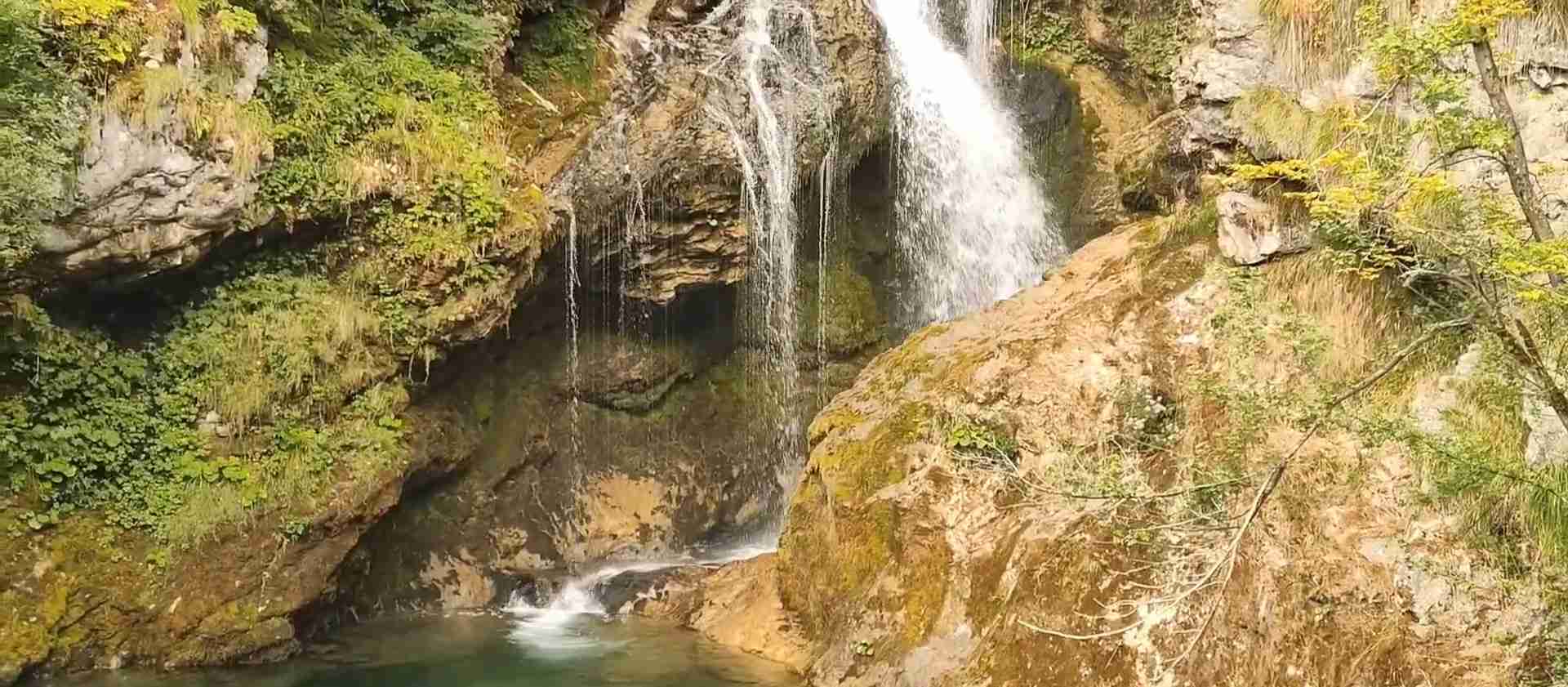
The Radovna River’s 13-meter plunge over a resistant limestone ledge at Vintgar Gorge’s terminus creates the spectacular finale that rewards the 1.6-kilometer walkway journey through the canyon. Šum Waterfall (pronounced “shoom,” from the Slovenian word for “noise” — an appropriate descriptor for the roar that fills this section of the gorge) holds the distinction of being Slovenia’s highest river waterfall, a title that specifically excludes alpine creek cascades and multistage falls where total drop exceeds 13 meters but no single drop matches Šum’s height. The waterfall’s width spans the full canyon, creating a curtain of water rather than a narrow jet, and the ledge’s orientation creates a slight overhang where water falls free from the rock face for much of its height before reuniting with the splash pool below.
The waterfall’s appearance varies dramatically with water volume. Spring snowmelt periods in April and May, and after substantial rain events during summer and autumn months, transform Šum into a thunderous torrent where the water curtain appears almost solid, spray fills the viewing area with mist, and the sound prevents normal conversation. During late summer and early autumn low-flow periods, the curtain segments into distinct streams that reveal the underlying bedrock ledge, allowing observation of the geological structure creating the drop. Neither condition should be considered “better” — the different volumes create equally valid but distinct aesthetic experiences, with high water emphasizing power and low water revealing structure.
Multiple viewing perspectives exist for experiencing and photographing the waterfall. The official Žumer Gallery walkway approaches Šum from upstream, providing angled views where the water curtain appears in three-quarter profile rather than direct frontal perspective. These upstream platforms position photographers close enough to feel spray on windy days and allow composition incorporating the pool at the waterfall’s base where water collects before continuing downstream through the lower gorge sections. After passing through the exit gate, a short trail descends to additional free-access platforms positioned at approximately the same elevation as the waterfall’s base, offering straight-on frontal views where the full curtain width and height become apparent. These lower platforms also provide side-angle perspectives where the waterfall appears in profile against the dark limestone wall behind it, and include foreground elements like river-polished boulders that add depth to compositions.
The geology creating Šum reveals the layered nature of the limestone formations underlying the Radovna Valley. The resistant ledge over which the river drops represents a particularly hard limestone layer deposited during a geological period when ocean conditions favored formation of dense, well-cemented rock. The softer layers immediately above and below this hard band eroded faster over time, creating the undercut ledge that allows the water to fall free rather than sliding down a sloped rock face. Observing the exposed cliff faces above the waterfall shows additional horizontal stratification lines marking boundaries between limestone deposits from different geological ages — these layers appear as subtle color variations and changes in weathering patterns across the vertical wall.
Aquatic life concentrates in the pool below the waterfall, where oxygen saturation from the churning water creates ideal conditions for trout and the insect larvae that form their prey base. Patient observers standing on the viewing platforms can watch trout holding position in the current, periodically darting to capture food items, and retreating to calmer water near the pool edges between feeding attempts. The constant spray from the waterfall supports specialized plant communities on the nearby cliff faces — mosses, liverworts, and ferns adapted to continuous moisture thrive in zones where conventional forest vegetation cannot establish due to the perpetual dampness and shade.
Photographing Šum presents similar challenges to the gorge walkway sections but with additional considerations. The spray creates water droplets in the air that can land on front lens elements, creating spots that blur the image or scatter light, so frequent lens cleaning becomes necessary during extended shooting sessions. A lens hood or sheltering the camera body with your own body position helps reduce direct spray contact. The brightness difference between the white water curtain and the dark pool or cliff backgrounds creates extreme dynamic range that no camera captures perfectly in a single exposure — photographers choose whether to preserve detail in the waterfall by accepting nearly black shadows, or expose for the rocks by accepting blown-out white areas in the falling water. Bracketing exposures (taking three versions at different brightness levels) provides options during post-processing for either selecting the best single exposure or combining them in editing software.
The waterfall’s appeal extends beyond photography into the experiential realm — the sound, the mist, the negative ions generated by falling water, and the visual drama of watching hundreds of gallons plunge through the air every second create immersive sensory experience that no photograph fully captures. Visitors who approach Šum purely as a photography subject risk missing the meditative quality that emerges from sitting on the viewing platforms and simply observing the water’s motion, the play of light in the spray, the occasional rainbow fragments that appear when sun angles allow, and the constant yet subtly changing patterns in the curtain as water volume fluctuates second by second with upstream conditions.
Historical photographs from Vintgar’s early tourism years show remarkably similar views of Šum Waterfall compared to contemporary images, suggesting the limestone ledge creating the drop has remained stable over the 130-year period since the gorge opened to visitors. This stability distinguishes Šum from many waterfalls carved through softer rock types where the falling water erodes the ledge and the waterfall gradually migrates upstream over decades or centuries. The hard limestone forming the drop point resists erosion at human timescales, meaning visitors today see essentially the same waterfall Jakob Žumer, Benedikt Lergetporer, and Oskar Kos encountered in 1891 — the wooden walkways have been rebuilt many times, the tourism infrastructure has transformed completely, but the waterfall itself remains unchanged across multiple human generations.
Return Trail Options: King of Triglav and River of Trees Routes
The one-way system through Vintgar Gorge necessitates choosing one of two thematic return trails that loop hikers back to the visitor center after reaching Šum Waterfall and exiting the ticketed gorge area. These forest trails serve multiple purposes: they eliminate the walkway congestion that occurred under the previous two-way system, they distribute environmental impact across broader area rather than concentrating all foot traffic on the canyon-bottom route, they provide ecological context by demonstrating the upland forest ecosystems that drain into the gorge, and they create opportunities for extended hiking beyond the 45-minute gorge walk for visitors seeking more substantial outdoor exercise. Neither route requires technical hiking skills or special equipment beyond normal athletic shoes, but they involve legitimate trail hiking through forested terrain rather than the flat, maintained surface of the Žumer Gallery walkways.
The King of Triglav Trail represents the shorter return option, covering approximately 1.6 kilometers and requiring roughly 45 minutes for hikers maintaining steady pace without extended stops. The route climbs moderately from the gorge exit elevation through mixed forest dominated by beech and spruce, reaching a high point that offers brief glimpses toward the Julian Alps before descending back to the visitor center. Interpretive content accessed via audio guide (included with admission) explains the ecological relationships between the various forest species, the soil development processes that allow tree growth on limestone bedrock, and the seasonal cycles that govern wildlife activity in these temperate forests. The trail’s moderate length and elevation change make it accessible to most visitors with basic fitness — families with elementary-age children, older adults who hike occasionally, and visitors who wouldn’t identify as serious hikers but maintain active lifestyles can complete the King of Triglav route without excessive difficulty.
The River of Trees Trail extends the return distance to approximately 4.1 kilometers, requiring roughly 2 hours at steady pace without stops. This longer option appeals to hikers seeking a more substantial wilderness experience beyond the gorge’s obvious dramatic features, and the extended route allows more thorough exploration of the forest ecosystems and geological formations characteristic of the Radovna Valley’s mid-elevation zones. The trail includes several stream crossings where seasonal water sources descend from the surrounding hills toward the Radovna River below, demonstrating how the broader watershed funnels precipitation into the main channel that carved the gorge. Elevation changes remain moderate throughout rather than including steep ascent or descent sections, and the trail surface varies from well-maintained gravel paths to natural dirt tracks that become muddy during wet conditions.
Choosing between the two routes depends primarily on available time, desired exercise level, and interest in forest ecology beyond the gorge itself. Visitors allocating exactly 2.5-3 hours total for the Vintgar experience should choose the King of Triglav route to ensure adequate time in the gorge proper without feeling rushed on the return. Those with 3.5-4 hours available can select the River of Trees Trail without time pressure. First-time visitors to the region might prefer the shorter return to preserve energy and time for Triglav National Park’s other nearby attractions like Lake Bohinj or Savica Waterfall, treating Vintgar as one component of a multi-site day rather than the exclusive focus. Return visitors who have already photographed the gorge extensively might appreciate the longer trail for variety and the opportunity to observe different aspects of the local environment beyond the limestone canyon.
Both trails include sections where the forest canopy opens sufficiently for views across the Radovna Valley toward the surrounding hills and distant Julian Alps peaks. These vista points provide geographical context for understanding the gorge’s position within the broader landscape — the Radovna River flowing from high glacial sources in Triglav National Park’s interior through progressively lower valleys before joining the Sava River system that eventually drains to the Black Sea. The elevation difference between the gorge floor and the trail high points creates perspective on the canyon’s depth that isn’t fully apparent when walking the floor-level Žumer Gallery, where the vertical walls above feel imposing but the actual elevation gain remains abstract until observed from outside the canyon looking down.
Trail maintenance standards on both routes match those typical for Triglav National Park’s extensive trail network — well-marked with red-white-red painted blazes on trees and rocks, cleared of dangerous fallen timber, and including wooden bridges or stepping stones at major stream crossings. However, neither route provides the engineered surface quality of the gorge walkway itself, meaning hikers should expect occasional roots across the path, sections of uneven footing where rocks or stumps create minor obstacles, and potentially muddy stretches during wet conditions. These minor challenges remain well within normal hiking parameters and shouldn’t concern anyone with experience on maintained but non-paved trails in parks or natural areas.
Wildlife observation opportunities on the return trails exceed those in the gorge proper, where human traffic and noise limit animal activity. The forest sections support populations of roe deer, red deer, various bird species including woodpeckers and nuthatches, and small mammals like squirrels and dormice that remain largely invisible during peak daytime hours but whose presence becomes evident through tracks, scat, and feeding signs visible to observant hikers. Spring months bring nesting songbirds whose territorial calls fill the forest, while autumn sees increased deer activity as the rut season approaches. Patient hikers who pause periodically and maintain relative quiet increase chances of wildlife sightings, though the forest density means most observations involve brief glimpses rather than extended viewing of animals in open terrain.
The Vintgar for Kids program transforms the return trail into an interactive educational experience for children roughly ages 4-12 through a series of stations along the King of Triglav route featuring questions, tasks, and activities designed to encourage observation of the forest environment. Children who complete the stations receive a book about the gorge’s history at the visitor center, creating tangible reward for engagement beyond just walking the trail. This program addresses a common family challenge: children who enjoyed the gorge’s visual drama may lose interest during the return forest walk unless provided specific activities to maintain engagement. The kid-focused stations give children reasons to observe their surroundings attentively rather than just trudging back to the parking area.
Best Times to Visit: Seasonal and Daily Timing Strategies
Vintgar Gorge’s seasonal operation April through October reflects genuine safety concerns during winter months when ice formation on walkways and cliff faces creates hazardous conditions, but this limitation also concentrates visitation into Slovenia’s most favorable weather window and forces timing decisions that significantly impact the experience quality. Understanding the interplay between seasonal characteristics, weekly patterns, and daily crowd dynamics allows strategic visitors to maximize their probability of encountering the gorge under optimal conditions while minimizing the frustrations created by peak-hour congestion on narrow walkways where hundreds of visitors funnel through the same confined space.
Spring visits during April and early May offer several distinct advantages despite more variable weather compared to summer months. Snowmelt from the Julian Alps peaks creates maximum water volume in the Radovna River, transforming rapids into thunderous torrents and amplifying the Šum Waterfall’s power to its most dramatic annual expression. The increased flow also generates more spray along the walkway, creating atmospheric conditions where mist diffuses light and coats vegetation in moisture that intensifies the green tones already prominent in the gorge’s color palette. Visitor numbers during these early-season weeks remain moderate compared to summer peaks, particularly on weekdays when the gorge operates but hasn’t yet become a standard stop on international tour bus itineraries. Forest vegetation along the return trails transitions from winter dormancy to spring growth, creating the “greenest” forest conditions of the year as new leaves unfurl in shades lighter and more vibrant than the darker mature foliage of summer.
Summer months from June through August bring extended operating hours (earliest opening times and latest closure), warmest air temperatures that make river spray refreshing rather than uncomfortable, and maximum daylight duration that supports visits at early or late hours when other attractions might be closing. However, these advantages come packaged with maximum visitor density that transforms walkway sections into slow-moving queues during midday hours between approximately 10:00 and 13:00. International tourism peaks during these months, with tour buses from coastal Adriatic resorts adding hundreds of daily visitors to the already-substantial numbers of independent travelers using Bled as their Slovenian base. The gorge’s one-way system prevents complete gridlock, but photographers seeking compositions without people in frame, families with young children who move more slowly than fit adults, and visitors hoping for contemplative nature experience rather than theme-park atmosphere should carefully time summer visits for early morning or late afternoon slots.
Autumn visits during September and early October trade reduced water volume for spectacular fall foliage colors that transform the return forest trails into showcases of seasonal change. The beech trees dominating the mid-elevation forests turn golden-yellow, creating warm tones that contrast beautifully with the gorge’s emerald waters and gray limestone walls. Water levels drop to their annual minimum during this period unless substantial autumn rain events intervene, reducing the Šum Waterfall to a delicate curtain rather than the powerful torrent of spring months, but revealing rock formations and pool structures that remain obscured under higher flows. Visitor numbers decline substantially compared to summer, particularly after mid-September when European school schedules resume and family travel reduces. The weather becomes more variable with increased probability of rainy days that make walkway surfaces slippery and photograph conditions less favorable, but clear autumn days offer exceptional clarity in the crisp air typical of this season.
Late-season visits in late October before closure bring additional advantages for visitors willing to accept weather uncertainty. The forest canopy loses most leaves by this point, opening views toward canyon walls and allowing more light penetration to the walkway level than occurs during full summer canopy coverage. Crowd density drops to near-minimum levels as international tourism essentially ceases, leaving mostly regional Slovenian visitors and the handful of off-season travelers exploring the country. However, operating hours contract significantly, sometimes opening as late as 9:00 and closing as early as 15:30, limiting the day’s flexibility for early or late timing strategies. Weather can range from perfect autumn clarity to cold rain or even wet snow that creates uncomfortable conditions despite technically remaining within the safe operating window.
Daily timing patterns follow predictable rhythms regardless of season. The first entry slot at opening time consistently offers the best conditions for photography and contemplative experience, with visitor numbers typically reaching only dozens rather than hundreds during the first 45-60 minutes of operation. Photographers can set up tripods in prime locations without creating bottlenecks, families move through at their own pace without pressure from faster groups behind them, and the gorge’s sound character shifts from dominated by human voices to focused on water’s roar. The practical challenge involves coordinating this early timing with transportation — shuttle buses from Bled typically don’t begin operation until after the first entry slot, requiring visitors committed to opening-time arrival to walk, bicycle, drive to the parking area, or arrange private transport.
Late afternoon visits, particularly during the final two entry slots before closure, provide the day’s second-best conditions for avoiding crowds. Tour buses and most day-trippers have departed by this time, leaving primarily visitors staying locally in Bled or the surrounding villages. Photographers gain similar advantages to morning visits regarding equipment setup space and composition opportunities. The lighting at this hour differs from morning — the canyon receives no direct late-day sun, but the golden-hour light above the rim creates warm tones that filter down to the walkway level and enhance the limestone’s natural colors. The practical consideration involves ensuring adequate time to complete the gorge walk and return trail before closure, as entry slots near closing time compress the experience into a faster pace than most visitors prefer.
Midday hours between approximately 10:00 and 14:00 consistently represent the least favorable timing regardless of season. Maximum visitor density creates congestion where groups walk inches apart, photography becomes difficult or impossible as people constantly enter frame, and the walkway’s acoustic properties mean dozens of simultaneous conversations generate sound levels that drown out the water’s natural roar. Direct overhead sun during summer months creates the year’s harshest lighting conditions with extreme contrast between bright sky patches and shadowed canyon walls. Visitors who can only access the gorge during these peak hours should adjust expectations accordingly — the experience remains worthwhile for first-time visitors seeing the gorge under any conditions, but it differs substantially from the serene wilderness encounter possible during optimal timing windows.
Weather considerations beyond just precipitation influence ideal visiting conditions. Overcast days create relatively even lighting throughout the gorge compared to sunny conditions with their harsh contrast problems, making cloudy weather actually preferable for photography despite seeming less attractive on weather forecasts. Morning mist formation in the canyon during cool conditions (common in spring and autumn) adds atmospheric quality to images and experience but requires warmer layers since temperatures in the shaded gorge can feel 5-10 degrees colder than in nearby sunny locations. Wind generally remains light in the gorge due to the enclosing canyon walls, but strong winds on open ridges above can create variable gusty conditions at walkway level and increase spray distribution from rapids and waterfall.
Temperature considerations affect primarily the return trail comfort rather than the gorge itself. The shaded walkway maintains relatively cool conditions even during summer heat waves, but the exposed forest trails can feel uncomfortably warm during midday summer hours when temperatures exceed 30°C. Conversely, early-season and late-season visits can encounter morning temperatures near freezing on the return trails even though gorge conditions remain safe for operation. Layered clothing that allows adding or removing pieces between the shaded canyon and sunny forest sections provides flexibility for managing these temperature variations without committing to attire appropriate for only one environment.
Getting to Vintgar Gorge from Lake Bled
The four-kilometer distance separating Lake Bled’s resort center from Vintgar Gorge’s entrance creates a logistical bridge requiring intentional navigation rather than casual walking discovery, but multiple transportation options accommodate different preferences for exercise level, environmental impact, cost, and convenience. Understanding these options and their practical implications — including the recent shift away from direct car access to the gorge entrance in favor of a central parking and shuttle system — allows efficient trip planning that avoids the timing complications and frustrations experienced by visitors who assume they can simply drive directly to the walkway entrance and find convenient parking.
Walking from Bled to Vintgar represents the most immersive approach, transforming the gorge visit from an isolated attraction into a broader countryside experience that provides context for the Radovna Valley’s rural character and agricultural landscape. The route follows a combination of village roads and newly constructed sidewalks, covering approximately 4.5 kilometers each direction through the villages of Blate and Podhom with gradual elevation gain that remains manageable for anyone comfortable walking extended distances. The path crosses under the railway via an underpass, continues past farmhouses and small holdings typical of this region’s agricultural economy, and arrives at the Vintgar Visitor Center having traversed the cultural landscape that surrounds the natural gorge itself. Round-trip walking distance totals approximately 9 kilometers before even entering the gorge, meaning visitors choosing this approach should allocate an additional 2-2.5 hours beyond the time needed for the gorge itself and return trail.
Bicycling offers similar immersion benefits as walking but cuts transportation time roughly in half and provides downhill coasting on the return journey that reduces fatigue after the gorge walk. Bike rental shops in Bled provide standard touring bikes, e-bikes for visitors preferring electric pedal assistance, and children’s bikes or trailers for families. The route follows the same roads used by pedestrians, with dedicated bike parking available at the Vintgar Visitor Center adjacent to the entrance. The practical advantage of bicycling becomes clear on the return trip when tired legs appreciate the mechanical assistance, particularly for visitors who’ve chosen the longer River of Trees return trail and completed 6-7 total kilometers of walking before even mounting the bike for the ride back to Bled. E-bikes essentially eliminate the exertion factor for the transportation segments, reserving energy entirely for the gorge and trail walking while still providing the countryside immersion that car or shuttle visits sacrifice.
The official VINTGAR Shuttle system represents the current recommended approach for visitors arriving by car or those preferring to minimize walking distance before the gorge experience itself. The system operates from two pickup points: Central Bled Bus Station (for visitors staying in Bled without cars) and Central Parking VINTGAR LIP (for visitors driving from elsewhere). Electric shuttle buses run every 15 minutes from Bled and every 7 minutes from the parking area, requiring approximately 20 minutes travel time to the Vintgar Visitor Center entrance. The shuttle component is included in the gorge admission ticket’s “Green Access” fee, making it functionally free rather than an additional charge.
Visitors arriving by car cannot drive directly to the gorge entrance — this represents the most common planning error among first-time visitors who expect to park at the walkway entrance as they might at other natural attractions. Instead, drivers follow signs to Central Parking VINTGAR LIP, located approximately 2 kilometers from the visitor center, where they park in the free lot and board shuttles for the final approach. This parking area also serves as the only physical location where tickets can be purchased in person (the visitor center itself does not sell tickets), though advance online purchase remains strongly recommended to guarantee entry time slots. The parking-plus-shuttle system was implemented specifically to address environmental concerns about exhaust emissions and parking overflow in the immediate gorge vicinity, and while it adds complexity compared to direct parking, the shuttle frequency ensures minimal waiting even during peak hours.
Public bus service from Bled to the Vintgar area exists via Arriva Slovenia buses traveling toward Gorje, with stops at Podhom or Spodnje Gorje requiring approximately 1-1.5 kilometers additional walking to the visitor center. Bus schedules typically provide 4-6 departures daily during operating season, but timing these connections requires checking current schedules and building significant buffer to avoid missing gorge entry slots. The train option — Slovenske železnice services from Bled Jezero station to Podhom station — runs hourly and covers the journey in just 4 minutes, but Podhom station lies approximately 1.5 kilometers from the visitor center, requiring that final leg on foot. These public transit options work best for budget-conscious visitors comfortable with walking moderate distances and willing to coordinate schedules carefully.
Private shuttle services operated by Bled-based tourism companies offer the most convenient approach for visitors prioritizing ease over cost savings. These services provide door-to-door transportation from Bled hotels directly to the Vintgar Visitor Center entrance, eliminating all navigation concerns and typically including return pickup at a predetermined time. The cost typically ranges €10-15 per person round trip, representing a premium over the included official shuttle but potentially worthwhile for visitors with limited time, families with young children preferring not to walk or coordinate public transit, or groups where splitting a private shuttle among several people reduces the per-person premium to nominal levels. Some services also bundle gorge admission tickets with the transportation, creating single-transaction convenience.
Taxi service provides maximum flexibility for visitors wanting car convenience without the parking coordination, with the short 5-kilometer distance from Bled to the gorge creating modest fares typically €12-18 each direction. The practical challenge involves ensuring return transportation, as taxis generally don’t wait at the gorge and cellphone service for calling return pickup can be unreliable in the canyon area. Visitors choosing this option should arrange return pickup time in advance with the driver or accept potential waiting time if calling for pickup after completing the gorge visit.
Timing coordination between transportation choice and gorge entry slots requires attention to avoid arriving late for reserved times. The official shuttle requires approximately 20 minutes from Bled Bus Station to the visitor center, meaning visitors with reserved entry slots should board shuttles at least 30-40 minutes before their time to accommodate shuttle waiting, travel duration, and final walking from shuttle drop-off to the entry turnstiles. Cyclists should allow 25-30 minutes for the ride, while walkers need 60-75 minutes depending on pace. Missing a reserved entry slot generally requires waiting for the next available opening, which during peak hours might be 1-2 hours later, creating significant itinerary disruption.
Return journey timing follows similar coordination requirements but with the added variable of not knowing exactly when the gorge visit will conclude. Visitors who walked or bicycled retain complete flexibility since they control their own transportation schedule. Shuttle users should allow buffer time rather than attempting to catch a specific shuttle departure — the frequent service (every 7-15 minutes depending on route) means a missed shuttle simply requires a short wait rather than substantial delay. Private shuttle users must coordinate pickup times accurately with the service provider, requiring estimation of total gorge and trail duration plus buffer for unexpected delays like extended photography or slower walking pace than anticipated.
Practical Planning: Tickets, Entry System, and Visitor Logistics
Vintgar Gorge’s evolution from walk-up admission to mandatory timed reservations reflects the broader tourism management challenges facing Slovenia’s most popular natural attractions, where exponential visitor growth over the past two decades necessitated capacity controls to protect both the fragile gorge ecosystem and the quality of visitor experience. Understanding the current ticketing system, entry procedures, and practical logistics transforms what could be a confusing and frustrating process into a straightforward visit where advance planning eliminates most potential complications.
Admission requires purchasing the “Vintgar Gorge All-in-One Pass,” which bundles gorge entry, shuttle transportation (the “Green Access” component), and audio guide access into a single ticket. Adult admission costs €15, children ages 3-15 pay €5, and dogs accompanying visitors require €3 pet tickets. These prices include the shuttle service, meaning there’s no separate transportation charge despite the mandatory shuttle use for visitors arriving by car. The ticketing system operates exclusively through advance online purchase at the official website or limited in-person sales at the Central Parking VINTGAR LIP location — the Vintgar Visitor Center itself does not sell tickets or admit visitors who arrive without reservations. This online-first approach eliminates the queues that previously formed at the entrance during peak hours but requires visitors to plan ahead rather than making spontaneous same-day decisions.
The timed entry system assigns specific entry windows (not exact minutes, but 30-60 minute slots depending on season and expected demand) when visitors may pass through the entrance turnstiles. The QR code ticket scans at the turnstile, which opens only during the purchased time window, preventing both early arrival and late entry. Visitors who miss their assigned time must wait for the next available slot, which during peak hours might not occur for 1-2 hours when the gorge reaches capacity limits designed to prevent walkway congestion. This system effectively spreads visitor arrivals throughout the operating day rather than concentrating everyone at opening time or creating unpredictable surge-and-lull patterns that lead to overcrowding followed by empty periods.
Booking strategy requires balancing advance planning with flexibility. Tickets for peak summer weeks (late June through August) and weekends throughout the season typically sell out for morning slots several days in advance, while afternoon slots may remain available even for same-day purchase. Shoulder season weekdays usually offer same-day ticket availability across most time slots. Visitors with fixed itineraries should purchase tickets as soon as their travel dates firm up, particularly for summer weekends when accommodation in Bled itself may be booked months ahead. Flexible visitors traveling during less-busy periods can check availability the evening before or morning of their intended visit, though accepting this uncertainty requires backup plans if tickets aren’t available.
The optimal entry time selection depends on priorities. Photography enthusiasts and visitors seeking quieter experience should select the earliest available slot (typically 7:00-8:00 during peak season), accepting the need to coordinate transportation for early arrival. Families with young children might prefer mid-morning slots (9:00-10:00) that allow more relaxed breakfast and departure from accommodation without rush. Afternoon slots (14:00-16:00) work well for visitors combining Vintgar with morning activities elsewhere, though they compress the total available time between entry and closing if selecting the final slots before closure.
Entry procedures at the visitor center follow a streamlined process. Upon arrival (whether via shuttle, bicycle, or foot), visitors access the visitor center building containing restrooms, a small café serving coffee and snacks, and benches in a courtyard area facing the Radovna River above the gorge entrance. These facilities should be utilized before entering the gorge since no facilities exist along the 1.6-kilometer walkway and returning to use visitor center facilities means exiting and forfeiting the ability to re-enter. When the assigned time window arrives, visitors proceed to the turnstiles, scan the QR code ticket from smartphone or printed paper, and the gate opens automatically to access the walkway entrance.
Mandatory helmet use represents a recent safety requirement that initially confused visitors expecting an optional recommendation. Helmets are provided at the entry point and must be worn throughout the walkway section, ostensibly protecting against potential rockfall from the cliff faces above. The requirement reflects risk management and liability concerns rather than frequent incident history, and while some visitors find the helmets uncomfortable or aesthetically unpleasing in photographs, compliance is enforced through monitoring and potential fines. Helmets are returned at the exit gate before accessing the return trails.
Dogs accompanying visitors must remain leashed throughout the gorge and return trails, and muzzles are required on the shuttle buses though not on the walkway itself. The €3 pet ticket requirement reflects the additional environmental impact and management burden created by animal presence. Dog owners should assess whether their pets actually enjoy this experience — the walkway crowds, confined spaces, and inability to explore off-trail can stress dogs accustomed to more freedom during hikes, and the return trail duration requires dogs capable of covering 4-6 total kilometers including the gorge walkway itself.
The one-way system means every visitor must complete one of the two return trails — there is no option to turn around and exit via the same entrance used for entry. This non-negotiable requirement catches some visitors unprepared, particularly those who planned for only the 1.6-kilometer gorge walk without realizing the mandatory 1.6-4.1 kilometer return component. Mobility-limited visitors who can manage the relatively flat gorge walkway may struggle with the forest trail elevation changes and uneven surfaces, and families with very young children (below the recommended 3-year minimum age) may find the return trails challenging. These factors should inform decisions about whether Vintgar suits particular visitors’ capabilities rather than assuming the gorge’s accessibility extends to the complete circuit.
Audio guide content accessed via smartphone enhances the educational value for visitors interested in geological, ecological, and historical context beyond just the visual experience. The guide uses numbered posts along the route to trigger relevant content, providing information about the rock formations, water dynamics, forest ecology on return trails, and human history of the gorge’s discovery and tourism development. The Vintgar for Kids version creates an interactive scavenger hunt experience for children, encouraging observation and engagement rather than viewing the walk as boring transportation between entrance and waterfall.
Weather contingency planning should acknowledge that the gorge operates in conditions many visitors might consider unfavorable. Light rain doesn’t close the gorge, though it makes wooden walkways slippery and photography difficult. Heavy rain or thunderstorms may trigger temporary closures for safety, and winter closure reflects genuine hazard rather than unnecessary caution. Visitors who encounter sudden weather changes during the walk must proceed forward through the one-way system to the exit rather than attempting to retreat to the entrance — the return trail through forest may actually provide better shelter during rain than the exposed walkway, as tree canopy blocks some precipitation.
Food and drink options are limited to the visitor center café (before entry) and a small refreshment stand near the return trail terminus. No food service exists along the walkway itself, and bringing food into the gorge for picnicking isn’t practical given the absence of suitable sitting areas along the narrow walkway. Carrying water bottles is essential, particularly during summer heat or for visitors completing the longer return trail, and the frequent presence of water along the route doesn’t make up for the inability to safely access and drink directly from the river (which despite its clarity shouldn’t be consumed untreated).
What to Bring: Essential and Optional Gear for Gorge Visits
The dual nature of the Vintgar Gorge experience — maintained wooden walkways requiring no technical hiking capability followed by forest trails involving legitimate outdoor hiking — creates a gear list broader than typical for purely urban tourism but not requiring the specialist equipment necessary for mountain or wilderness travel. Strategic packing addresses both the gorge’s specific conditions (humidity, slippery surfaces, photography opportunities) and the return trail’s more conventional hiking requirements (uneven terrain, elevation change, weather exposure), while avoiding the overpacking that burdens visitors with gear they never use.
Footwear represents the single most important gear decision, as inadequate shoes create genuine safety risks on the gorge’s often-slippery wooden surfaces and discomfort on the return trails’ rocky sections. Proper hiking shoes or trail runners with aggressive rubber tread patterns provide essential traction on damp wood and adequate ankle support for uneven forest trails. Running shoes designed for pavement lack the tread depth to grip wet wood effectively, and fashion sneakers with smooth rubber soles turn frighteningly slick when moisture coats the walkway planks. Waterproof or water-resistant footwear provides obvious benefits during rainy conditions but also keeps feet drier from the constant low-level spray that permeates the gorge atmosphere during high water periods. Sandals, flip-flops, or other open footwear should be avoided entirely — they provide neither the traction nor protection needed for safe navigation, and many visitors have learned this lesson painfully after slipping on walkways or stubbing toes on trail obstacles.
Camera equipment choices depend entirely on photographic ambitions versus the desire to travel light and focus on experiential observation. Smartphone cameras capture perfectly acceptable images under the gorge’s diffuse lighting conditions, particularly for visitors prioritizing documentation over artistry and not planning to create large prints from their images. The limited dynamic range that hampers smartphone performance in high-contrast situations actually matters less in the gorge than in many outdoor environments, since the shade keeps brightness differences somewhat compressed compared to, say, alpine meadows with direct sun and dark tree shadows. Serious photographers gain substantial benefits from DSLR or mirrorless cameras with larger sensors, wide aperture lenses that gather more light in the dim conditions, and RAW format capture that preserves editing flexibility for post-processing the challenging gorge lighting.
Tripod decisions involve weighing image quality benefits against the practical burden of carrying equipment and the restrictions on use during crowded periods. Compact flexible-leg tripods (Joby Gorillapods being the most recognized brand) provide the best compromise: they’re light enough to pack easily, attach to walkway railings rather than occupying deck space, and create stable platforms for multi-second exposures while remaining considerate of other visitors. Full-size tripods improve stability for conventional photography on flat ground but become liabilities on the narrow walkway, blocking traffic and drawing annoyed looks from visitors forced to detour around setup equipment. Visitors bringing full-size tripods should commit to visiting during the first hour after opening when foot traffic allows equipment deployment without creating problems.
Lens cleaning supplies achieve essential status in the gorge’s spray-filled environment. Microfiber lens cloths remove water droplets that inevitably land on front lens elements when shooting near rapids or the waterfall, and lens hoods provide some protection by extending beyond the front element to block directly-traveling spray. Visitors planning extensive photography should bring 2-3 microfiber cloths since they become saturated with moisture after cleaning lenses multiple times throughout the visit. Rocket air blowers help remove water without smearing it across the glass, though they’re less crucial than the cleaning cloths themselves.
Waterproof phone cases or dry bags protect electronics from the gorge’s pervasive moisture. Even when no rain falls, the spray-saturated air can penetrate phone ports and buttons over extended exposure. Simple zip-lock plastic bags provide basic protection for phones not being used for photography, while dedicated waterproof cases allow phone camera use without removing the device from protection. Serious camera equipment benefits from rain covers — lightweight fabric hoods that shield camera bodies and lenses while leaving controls accessible. These covers address both actual rain and the heavy spray near the waterfall that effectively duplicates rain conditions without precipitation falling from the sky.
Layered clothing addresses temperature variations between the shaded, humid gorge and the exposed, drier return trails. The gorge typically feels 5-10°C cooler than surrounding areas due to the shade and evaporative cooling from constant water spray, while the return trails receive full sun during summer months and can become uncomfortably warm during midday hours. Light fleece or insulating jacket layers that compress into small packages provide warmth in the gorge without excessive bulk on the return trail. Summer visitors might assume no warm layers are necessary given the calendar date, but the microclimate shock when entering the gorge from sunny conditions makes that extra layer worthwhile even during heat waves.
Rain gear becomes essential rather than optional during unsettled weather periods, as the gorge operates unless severe storms force closure. Lightweight waterproof rain jackets that pack into their own pockets or stuff sacks add minimal weight penalty while providing crucial protection if weather deteriorates during the 2.5-3 hour visit. The combination of rain falling from above and spray rising from the river creates thorough soaking conditions that ruin cotton clothing and make the entire experience miserable without waterproof protection. The return trail through forest provides some shelter under tree canopy, but open sections and the transition from gorge to trail both involve exposure to whatever precipitation is falling.
Water bottles address hydration needs during the 2.5-4 hour total experience depending on chosen return trail and walking pace. The visitor center café offers bottled water purchase before entry, but bringing water from accommodation avoids this expense. Capacity recommendations range from 500ml for short visits during cool weather to 1-1.5 liters for summer visits including the longer return trail. Despite the constant presence of river water throughout the gorge, drinking directly from the Radovna is inadvisable — upstream agricultural land, potential wildlife contamination, and the difficulty of accessing the water safely from the elevated walkways all argue for carrying drinking water rather than attempting to use the river as a source.
Sun protection surprises many visitors who don’t anticipate significant sun exposure in a gorge they correctly assume remains mostly shaded. However, the return trails include substantial sections through open forest or exposed ridge areas where summer sun creates genuine sunburn risk, particularly for visitors accustomed to northern latitudes with gentler solar intensity. Sunscreen, sun-protective clothing, and hats address these risks effectively. The gorge walkway itself requires little sun protection except near the entrance and exit areas where the canyon opens sufficiently for direct sunlight to reach trail level.
Snacks provide energy for the longer-than-expected physical activity, particularly for families with children who need frequent refueling. The visitor center café offers limited snack options, but bringing trail mix, energy bars, or fruit from accommodation ensures adequate supplies regardless of café inventory. The return trail includes no food service until the refreshment stand near the visitor center exit, meaning visitors who underestimated their hunger have no purchasing options during the 2-hour River of Trees trail.
Optional luxury items include binoculars for wildlife observation and birdwatching on return trails, field guides for tree and wildflower identification, small notebooks for journaling or sketching, and portable phone chargers for visitors using their devices extensively for photography and audio guide content. These items enhance the experience for visitors with specific interests but aren’t essential for the basic visit. Most visitors need nothing beyond good footwear, weather-appropriate clothing, water, and their camera of choice.
Safety Considerations and Environmental Protection
Vintgar Gorge’s transformation from inaccessible natural feature to mainstream tourist attraction required engineering solutions that make the canyon safely accessible, but the inherent risks associated with walking on wooden platforms suspended above a powerful river in a confined space between vertical cliffs remain present despite management efforts to minimize them. Understanding these risks and the environmental protection principles that govern gorge access creates both safer visits for individuals and better preservation outcomes for the natural resource that draws hundreds of thousands of annual visitors.
Slip and fall incidents on the walkway represent the most common safety concern, particularly during wet conditions when wooden surfaces become treacherous. The marine-grade treated lumber used for decking resists rot and weathering but becomes remarkably slippery when saturated with moisture from rain, river spray, or overnight condensation. The combination of smooth wet wood and enthusiastic visitors photographing rather than watching their footing creates predictable accidents, usually resulting in nothing worse than bruised egos and damp clothing but occasionally causing actual injuries requiring first aid or evacuation. The mandatory helmet requirement reflects concern about falling objects from cliff faces above, though actual rockfall incidents during operating seasons are rare — the greater head injury risk likely comes from slipping on walkways and striking railings or support posts during the fall.
Visitors can minimize slip risks through appropriate footwear (aggressive tread hiking shoes as discussed in gear section), conscious attention to foot placement rather than walking while looking at phone screens or through camera viewfinders, and using handrails on sections where wet conditions create obvious traction loss. The slow, single-direction traffic flow during peak hours actually provides a safety benefit despite causing photography frustrations — visitors move at speeds that allow reaction time if footing fails, and the presence of other people immediately ahead and behind means anyone who falls receives immediate assistance rather than lying injured in an isolated location.
Water hazards exist throughout the gorge despite the walkway’s elevation above normal river levels. The current in narrow sections can exceed speeds survivable by even strong swimmers, and the water temperature remains cold year-round due to glacial sources, creating rapid hypothermia risk. The depth in pools varies from ankle-deep to several meters, and submerged rocks create impact hazards invisible to anyone unfortunate enough to fall from the walkway. Signs prohibit swimming, wading, or any intentional water contact, but these rules address more than just environmental protection — they prevent visitors from experiencing the river’s genuine dangers firsthand.
The one-way system’s irreversibility creates situations where visitors experiencing problems must continue forward rather than retreating. Someone who realizes their fitness level isn’t adequate for the return trail duration, a child who becomes frightened or tired, or anyone who feels unwell during the walk cannot return to the entrance via the route they entered — the only exit requires completing the gorge walkway and choosing one of the return trails. This reality should inform pre-visit decisions about whether the complete experience suits particular visitors’ capabilities. Emergency evacuation routes do exist for genuine medical crises, but they’re not available for visitors who simply changed their minds or underestimated the commitment.
Weather-related hazards include thunderstorms that can develop rapidly in mountainous terrain, creating lightning risks for visitors on exposed ridge sections of return trails and flash flood potential in the gorge itself if heavy rain falls on the upstream watershed. Staff monitor weather conditions and may close the gorge or prevent new entries if conditions deteriorate, but visitors already in the system when storms develop must proceed through the one-way route rather than evacuating via the entrance. The limestone cliff faces above the walkway shed streams of water during heavy rain, creating localized waterfall-like conditions that add to the already-substantial spray levels. These temporary waterfalls pose drowning risk if someone positions themselves directly beneath one and gets overwhelmed by the water volume.
Environmental protection principles that govern visitor behavior serve both ecosystem preservation and future visitor experience quality. The “leave no trace” philosophy prohibits littering, feeding wildlife, removing natural objects (rocks, plants, flowers), or creating social trails by walking off designated paths. The gorge ecosystem remains surprisingly fragile despite the apparent durability of limestone and rushing water — the specialized mosses and ferns colonizing cliff faces are vulnerable to trampling or removal, the aquatic insect populations supporting the trout fishery can be disrupted by chemical contamination from sunscreen or insect repellent entering the water, and the forest species along return trails suffer when visitors create shortcuts between trail switchbacks that accelerate erosion.
Noise management receives less attention than physical impact concerns but matters for both wildlife and human visitors. The constant conversation, music from portable speakers, and children’s excited shouts that characterize peak-hour visits transform the gorge from a natural environment into something more resembling an outdoor shopping mall. While no formal quiet zones exist, visitors who maintain lower voice volumes and avoid playing music allow others to hear the water’s roar and potentially observe wildlife that retreats from excessively noisy human presence. This consideration represents shared community responsibility — no single person’s behavior ruins the experience, but the cumulative effect of everyone talking at full volume creates the problem.
Photography ethics on the narrow walkways involve balancing the desire to capture compelling images with the obligation to allow other visitors to proceed without excessive delay. Claiming prime locations for extended periods, setting up tripods that block passage, or demanding that other visitors stay out of frame while you shoot creates conflicts that degrade everyone’s experience. The compromise involves taking reasonable time for compositions while remaining aware of traffic backing up, using compact equipment that doesn’t obstruct the walkway, and accepting that peak-hour photography means people will appear in images rather than expecting the luxury of empty frames.
Beyond Vintgar: Combining the Gorge with Other Triglav Park Attractions
Vintgar Gorge’s position within the broader Triglav National Park network and its proximity to Lake Bled, Lake Bohinj, and numerous other natural and cultural attractions creates opportunities for multi-site itineraries that showcase the Julian Alps region’s diversity beyond the single gorge experience. Understanding these combination possibilities and the logistics connecting them transforms a Vintgar-focused half-day into a comprehensive exploration of northwestern Slovenia’s most compelling landscapes, with the gorge serving as either the anchor attraction around which other sites orbit or as one component in a broader park immersion.
Lake Bled itself demands at least partial-day attention for visitors not already familiar with Slovenia’s most iconic landscape. The 6-kilometer walking path circling the glacial lake provides gentle exercise and constantly changing perspectives on Bled Island with its pilgrimage church and Bled Castle perched on the cliff above town. Pletna boats — traditional wooden craft rowed by standing oarsmen — ferry visitors to the island for church visits and the opportunity to ring the wishing bell. The castle, while touristy, offers the region’s best historical museum explaining the Gorenjska region’s development from Roman times through medieval periods to modern Slovenia. Combining Bled and Vintgar works naturally since most visitors use Bled as their accommodation base, making morning gorge visits followed by afternoon lake activities or vice versa straightforward without requiring multiple accommodations.
Lake Bohinj, approximately 25 kilometers southwest of Bled, represents Triglav National Park’s less-developed but arguably more scenic glacial lake option. Where Bled feels like a resort destination with restaurants and hotels lining the shore, Bohinj maintains a quieter character with more restricted development and stronger emphasis on the natural setting. The lake’s eastern end features several swimming areas, boat rentals, and the Church of St. John the Baptist with its remarkable medieval frescoes. The Savica Waterfall, accessed via a steep but short trail from the lake’s southwestern edge, drops 78 meters in a dramatic single plunge that contrasts nicely with Vintgar’s cascades and rapids — where Vintgar showcases water’s erosive power over limestone, Savica demonstrates the visual drama of concentrated vertical drops. Combining Bohinj and Vintgar requires full-day commitment and private vehicle or tour operator support, as public transit connections between the two consume substantial time.
The Pokljuka Plateau, accessible via scenic mountain roads from either Bled or Bohinj, offers a completely different landscape character — high-elevation alpine meadows and coniferous forests favored for Nordic skiing in winter and hiking, mountain biking, and wildlife observation during summer months. The plateau’s most accessible attraction, the Pokljuka Gorge (a smaller, less-developed canyon than Vintgar), provides alternative gorge experience for visitors wanting to explore beyond Slovenia’s most famous example. Combining Pokljuka with Vintgar creates a thematic “gorges day” while also demonstrating the elevation-driven ecosystem differences between the mid-elevation Vintgar location and the high-alpine Pokljuka environment.
Radovljica, the medieval town 5 kilometers from Bled, preserves one of Slovenia’s best-maintained Renaissance town centers and hosts an excellent beekeeping museum explaining the craft’s cultural significance in this region where apiculture represents important rural tradition. The combination of morning Vintgar visit followed by afternoon Radovljica exploration (or reverse order) works efficiently since they lie in essentially the same direction from Bled, requiring minimal backtracking. This pairing appeals particularly to visitors who appreciate both natural and cultural attractions rather than focusing exclusively on landscapes.
The Triglav National Park’s more remote interior regions — the Soča River Valley with its emerald rapids, the Krma Valley approaching Mount Triglav itself, the Seven Lakes Valley — require serious hiking commitment and typically full-day or multi-day investments that make combination with Vintgar less practical. These destinations suit visitors spending multiple days in the region rather than attempting to pack everything into single long day trips. However, tour operators based in Bled offer full-day excursions combining Vintgar with Bohinj, Savica, and brief Soča Valley stops, though these inevitably sacrifice depth at each location in favor of breadth across multiple sites.
Seasonal timing considerations influence which combinations work best. Spring visitors benefit from combining Vintgar’s high water flows with Savica Waterfall, which reaches maximum power during the same April-May snowmelt period. Summer visitors might pair morning Vintgar walks with afternoon swimming at Bohinj or Bled. Autumn foliage seekers gain little from water-focused attractions like Savica but appreciate combining Vintgar (where the gorge walls create color contrast) with Pokljuka Plateau drives through deciduous forests showing fall colors at their peak.
Logistical coordination for multi-site days requires attention to operating hours, transportation connections, and realistic time allocations. Underestimating travel time between locations, failing to account for parking and facility time, or booking overlapping timed reservations creates rushed experiences where visitors spend more time in vehicles than at attractions. Successful multi-site itineraries either accept the tradeoff between seeing multiple locations versus experiencing any single one deeply, or commit to multiple days in the region to allow thorough exploration without perpetual hurry.
Frequently Asked Questions
How challenging is the Vintgar Gorge walk for people with limited mobility or fitness?
The 1.6-kilometer wooden walkway through Vintgar Gorge itself presents minimal physical challenge — the route is nearly flat with only 80 meters total elevation change, the deck surface remains even without stairs in most sections, and the mandatory slow pace during busy periods means cardiovascular demand stays low. Visitors who can walk 20-30 minutes continuously on flat surfaces will manage the gorge walkway successfully. However, the complete experience requires choosing one of two return trails adding 1.6-4.1 kilometers of legitimate forest hiking with uneven surfaces, roots, rocks, and moderate elevation changes. These return trails involve substantially greater physical demand and present genuine obstacles for people with mobility limitations. Visitors uncertain about their capabilities should assess the complete circuit rather than just the gorge walkway when deciding whether Vintgar suits their fitness level. No wheelchair-accessible routes exist through either the gorge or return trails, and the one-way system prevents turning back partway through if the experience proves too difficult.
Can you visit Vintgar Gorge during winter or when it’s officially closed?
No — winter access to Vintgar Gorge is officially prohibited and physically prevented through locked gates at the entrance. The seasonal closure from November through March reflects genuine safety concerns rather than arbitrary restriction, as ice formation on the wooden walkways creates extreme slip hazards, and icicles forming on cliff faces above the walkway can detach and fall with sufficient force to cause serious injury. Historical incidents prior to standardized winter closures demonstrated these risks are real rather than theoretical. Some adventurous visitors attempt winter access via unofficial routes or by circumventing entrance gates, but doing so involves trespassing on closed property, assumes all liability for any injuries, and contributes to maintenance damage that increases costs for the community organizations managing the gorge. Photography showcasing winter ice formations in the gorge comes from rare windows when management allows supervised access for specific projects, not from general public access. Visitors seeking winter gorge experiences in Slovenia should instead visit the Tolmin Gorges, which remain accessible year-round via different trail systems that avoid the specific hazards present at Vintgar.
Is advance ticket purchase absolutely necessary or can you buy tickets at the gorge entrance?
Tickets cannot be purchased at the Vintgar Gorge entrance itself — the visitor center ticket office was eliminated when the mandatory timed entry reservation system was implemented. The only physical ticket sales location is the Central Parking VINTGAR LIP area approximately 2 kilometers from the gorge, where visitors can purchase same-day tickets if availability exists for upcoming time slots. However, this approach involves substantial risk during peak summer weeks and weekends when morning slots typically sell out, meaning visitors who arrive hoping to purchase same-day admission may find no availability until late afternoon or the following day. Online advance purchase through the official website guarantees admission at preferred times and eliminates the uncertainty of arrival-day availability. Shoulder season weekday visits offer reasonable probability of successful same-day purchase, but even then, specific preferred time slots (particularly the early morning opening slots favored by photographers) may be full while less-popular midday times remain available. The practical recommendation involves advance purchase for summer visits, any weekend visits, and any situation where schedule constraints create time pressure, while accepting same-day uncertainty works better for flexible travelers during off-peak periods.
How cold is the water in Vintgar Gorge and is swimming ever permitted?
The Radovna River maintains cold temperatures year-round due to its glacial sources in the high Julian Alps, typically ranging 8-12°C even during summer months when air temperatures exceed 25°C. This cold remains tolerable for brief contact but would induce hypothermia within minutes for anyone immersed continuously. Swimming, wading, and any intentional water contact are prohibited throughout the gorge for multiple reasons: the current velocity in narrow sections creates genuine drowning hazard even for strong swimmers, the water depth varies unpredictably with submerged boulders creating impact risks, the wooden walkway doesn’t provide safe water access or exit points, and the ecosystem vulnerability to chemical contamination from sunscreen and body oils justifies keeping all visitors out of the water. These prohibitions are enforced through monitoring and potential fines, though the practical enforcement challenge in a 1.6-kilometer gorge with hundreds of simultaneous visitors means some people ignore the rules. The water’s cold temperature provides natural deterrent — most people who test the temperature by dipping hands or feet immediately lose interest in fuller immersion. Visitors seeking swimming opportunities should instead visit Lake Bled or Lake Bohinj, which offer designated swimming areas, warmer water temperatures, and appropriate facilities without damaging fragile gorge ecosystems.
What’s the best camera setting approach for photographing the emerald water?
The emerald water photographing successfully requires exposing for the water and shadowed rock areas rather than attempting to preserve detail in the bright sky patches visible above the canyon rim, since the extreme dynamic range exceeds camera capabilities. Set exposure mode to Aperture Priority (controlling depth of field while allowing shutter speed to vary), select f/8-f/11 aperture for adequate depth of field, and use exposure compensation of +0.3 to +0.7 stops to ensure the water doesn’t render too dark. The gorge’s open shade creates relatively consistent lighting without harsh shadows, but the brightness difference between water/rocks and sky means accepting blown-out sky as inevitable. For long-exposure water blur effects, add neutral density filter to reduce light and enable shutter speeds of 1-5 seconds even in daylight conditions, though the gorge’s shade means ND filters matter less here than in sunny environments. RAW format capture preserves more shadow detail for post-processing recovery compared to JPEG. White balance set to “shade” or “cloudy” mode counteracts the blue cast typical of open shade and brings the emerald green tones into accurate representation. Focus approximately one-third into the frame from front to back to maximize depth of field effectiveness using the lens’s hyperfocal distance. For visitors shooting smartphones, tap the screen on the water surface to set exposure and focus there, lock that exposure with the AE/AF lock if the phone offers it, then recompose without changing the exposure settings.
Are there any age restrictions and what age is appropriate for young children?
No formal age restrictions prevent families from bringing very young children, but official recommendations suggest 3 years old as a practical minimum age for children capable of walking the entire distance. Infants and toddlers unable to walk independently create complications because strollers cannot navigate the wooden walkway’s steps and narrow sections, meaning parents must carry non-walking children for the 1.6-kilometer gorge distance plus whichever return trail they select. This weight burden over 4-6 total kilometers challenges most parents physically, and the duration exceeds many young children’s tolerance for being carried, creating frustration and potentially unsafe situations if a child becomes uncooperative while being carried above rushing water with vertical drops beyond the railings. Children ages 3-7 who can walk independently benefit from the walkway’s gentle pace during busy periods, since the crowd-controlled speed prevents them from becoming tired before completing the route. The greater challenge emerges on return trails where uneven terrain, occasional roots and rocks, and the distance itself test young children’s endurance — families should carefully assess their children’s recent hiking experience rather than assuming park walk fitness translates to forest trail capability. The one-way system prevents turning back partway through if a child becomes exhausted, meaning parents must be confident their children can complete the full circuit before committing to entry.
How does Vintgar compare to other European gorges like Partnachklamm or Gorges du Verdon?
Vintgar Gorge occupies a distinct niche compared to other European canyon attractions through its combination of extreme narrowness, suspended walkway engineering, emerald water clarity, and accessibility from a major tourist center. Germany’s Partnachklamm near Garmisch-Partenkirchen shares the narrow limestone canyon and suspended walkway characteristics but involves significantly greater physical challenge with longer distances, more elevation change, and less developed access infrastructure. France’s Gorges du Verdon offers dramatically larger scale — a true river canyon where visitors view from rim perspectives hundreds of meters above the water rather than Vintgar’s intimate suspended-above-the-river experience — but requires serious hiking or rock climbing skills to access the most dramatic viewpoints, whereas Vintgar remains accessible to essentially any visitor capable of basic walking. Austria’s Liechtensteinklamm presents the closest analog in terms of scale and access style, with similarly narrow sections and wooden walkway systems, though slightly longer and involving more substantial elevation changes than Vintgar. Vintgar’s particular advantages include the combination of proximity to Bled’s tourism infrastructure (allowing easy half-day visits), the emerald water color distinctively different from the gray glacial melt typical of many alpine gorges, and the relatively gentle return trail options that make the complete experience accessible to a broader visitor range than more technical canyons. Visitors who found inspiration in other European gorges will find Vintgar offers complementary rather than redundant experience, particularly if they value the suspended walkway perspective and accessible forest return routes over the rim-view perspectives typical of larger canyon systems.
What happens if weather deteriorates during your visit to the gorge?
Visitors already in the gorge when weather conditions worsen must proceed forward through the one-way system to the exit rather than retreating via the entrance, as the turnstile design and walkway traffic flow prevent backward movement. Light to moderate rain continues operations without closure, though wooden surfaces become increasingly slippery and photography becomes impractical as camera equipment gets soaked. Heavy rain or thunderstorms may trigger closure decisions by staff monitoring conditions, but visitors already past the entrance turnstiles when closure occurs must complete their walk before evacuation, creating situations where people experience heavy rain exposure throughout the return trail. The limestone cliff faces above the walkway shed substantial water during storms, creating temporary waterfall conditions that add to the already-significant spray levels from the river itself. These sheet flows pose genuine hazard if someone positions themselves directly underneath, as the volume can overwhelm ability to breathe normally. Visitors who check weather forecasts before departure and see threatening conditions should seriously consider rescheduling rather than hoping conditions improve, since the commitment to complete the full circuit once entry occurs leaves no retreat option if experience becomes miserable or dangerous. The return trails through forest provide some shelter under tree canopy during rain, but the transition from gorge to trail and various open sections mean substantial exposure to precipitation. Lightning during thunderstorms creates genuine danger on exposed ridge sections of return trails, making these conditions the most serious weather hazard beyond the slip risks on wet walkways.
Can you do Vintgar Gorge as a day trip from Ljubljana or do you need to stay in Bled?
Ljubljana to Vintgar day trips work logistically but create significant time pressure that reduces the experience quality compared to overnight accommodation in Bled or nearby villages. The 55-kilometer drive from Ljubljana to Bled requires 45-60 minutes in light traffic, with parking at Central Parking VINTGAR LIP adding another 20 minutes via shuttle to the gorge entrance. The 2.5-3 hour minimum duration for the gorge visit plus return trail, combined with the 2+ hours total driving and shuttle time, creates a 5-6 hour commitment before accounting for any meal stops or buffer time for traffic delays. This timeline works for visitors departing Ljubljana early (7:00-8:00) to reach Vintgar near opening time, completing the visit by late morning/early afternoon, and returning to Ljubljana by mid-afternoon. However, this rushed approach sacrifices the opportunity to explore Lake Bled itself, visit other nearby attractions like Radovljica or Lake Bohinj, or experience the Bled area’s evening atmosphere. Alternatively, visitors can combine Vintgar with afternoon/evening Bled exploration and return to Ljubljana after dinner, creating a full but feasible day trip. The more relaxed approach involves overnight accommodation in Bled, allowing morning Vintgar visit (ideally timing the first entry slot when photography conditions and crowds optimize), afternoon rest or alternate activities, and continuation to Ljubljana or onward destinations the following day. Tour operators based in Ljubljana offer full-day excursions including Vintgar, Bled, and often Lake Bohinj or other sites, providing transportation coordination without requiring private vehicle rental but accepting the inherent limitations of moving groups through multiple locations on fixed schedules.
What’s the story behind the gorge’s “discovery” in 1891 if local people already knew about it?
The distinction between local knowledge and formal “discovery” reflects the difference between rural residents aware of a natural feature in their region versus systematic documentation, mapping, and tourism development that transforms that feature into a publicly accessible attraction. Gorje and Podhom villagers, hunters, and shepherds certainly knew about the Radovna River’s dramatic passage through the gorge for generations or centuries before 1891 — references in property records and oral histories confirm this long-standing awareness. However, the sheer cliff faces rising directly from the water made the gorge essentially inaccessible without technical climbing equipment or willingness to wade through dangerously swift current, meaning it remained a curiosity locals occasionally viewed from above but couldn’t explore thoroughly. When cartographer Oskar Kos, mayor Jakob Žumer, and priest Benedikt Lergetporer surveyed the gorge systematically in 1891, they documented the geological features, measured distances and depths, and most crucially, identified the route where wooden walkways could be anchored to cliff faces to create safe public access. The subsequent construction of the Žumer Gallery walkways (completed 1893) transformed the gorge from “something local people know exists” into “a place tourists can walk through and photograph,” which constitutes “discovery” in the tourism development sense rather than the geographical exploration sense. This pattern repeats throughout European Alps tourism history — natural features that rural populations knew about for generations become “discovered” when infrastructure makes them accessible to urban tourists, photographers, and scientists who document and publicize them to broader audiences. The credit given to the 1891 survey team reflects their role in making Vintgar accessible rather than literally being the first humans to view the gorge.