
Vasa Museum Stockholm: Complete Guide to the World’s Best-Preserved 17th-Century Ship
The Vasa Museum houses the only surviving 17th-century warship in the world, a magnificently decorated vessel that sank on its maiden voyage in Stockholm harbor in 1628 and remained underwater for 333 years. This extraordinary preservation allows visitors to examine authentic 17th-century naval architecture, craftsmanship, and maritime technology in unprecedented detail, making the museum one of Europe’s most important maritime heritage sites.
Key Takeaways
- Unprecedented Preservation: The Vasa is 98% original, with over 700 carved sculptures and virtually all structural timbers intact due to the Baltic’s unique low-salinity, cold, and oxygen-poor conditions that prevented wood-boring organisms from destroying the hull
- Swedish Imperial Ambition: King Gustav II Adolf commissioned the Vasa as a symbol of Swedish power during the Thirty Years’ War, representing the apex of Swedish naval engineering and artistic ambition in the early 17th century
- Catastrophic Failure: The ship sailed barely 1,300 meters before capsizing and sinking in 1628, killing approximately 30 people—a disaster caused by design flaws that prioritized decorative grandeur over naval stability
- Revolutionary Salvage: Anders Franzén’s 1956 discovery and the subsequent 1961 salvage operation pioneered modern underwater archaeology techniques and created new preservation methodologies for waterlogged artifacts
- Museum Architecture: The custom-built museum, opened in 1990, was specifically designed to house the ship while maintaining optimal preservation conditions—controlled temperature, humidity, and lighting that prevent further deterioration
- Cultural Context: Beyond the ship itself, the museum preserves over 40,000 artifacts and skeletal remains that provide intimate details about 17th-century Swedish naval life, social hierarchy, and maritime technology
People Also Ask About the Vasa Museum
Why did the Vasa sink on its maiden voyage?
The Vasa sank due to fundamental design flaws that made the ship dangerously unstable. The primary cause was insufficient ballast relative to the ship’s high center of gravity, created by the king’s demand for two complete gun decks with heavy bronze cannons. Naval architects of the period lacked mathematical formulas to calculate stability—they relied on experience and rules of thumb. The Vasa’s builder, Henrik Hybertsson, attempted to warn authorities about stability problems during construction, but political pressure to complete the prestigious warship quickly, combined with the king’s absence at the war front, prevented necessary design corrections. A stability test performed before launch—having 30 men run back and forth across the deck—was stopped after only three runs because the ship rolled so alarmingly. Despite this warning, officials proceeded with the maiden voyage. When the Vasa encountered even moderate winds in Stockholm harbor, water poured through the open lower gun ports, and the ship capsized within minutes.
How was the Vasa preserved underwater for over 300 years?
The Baltic Sea’s unique environmental conditions created perfect preservation circumstances. Unlike oceans, the Baltic has very low salinity due to limited connection to the Atlantic and massive freshwater input from rivers. This brackish water cannot support Teredo navalis (shipworms) and other wood-boring organisms that normally destroy shipwrecks. The Baltic’s cold temperatures and low oxygen levels further slowed bacterial decay. Additionally, the Vasa sank in soft mud that quickly covered the lower hull, creating an anaerobic environment that prevented deterioration. The ship settled at approximately 32 meters depth in an upright position, protecting it from strong currents. Over 333 years, the ship’s oak timbers absorbed water and became waterlogged, but the wood structure remained intact. This combination of factors—no shipworms, cold temperatures, low oxygen, protective mud, and stable positioning—preserved the Vasa to an extent unprecedented for wooden shipwrecks.
What makes the Vasa’s decorative sculptures historically significant?
The Vasa carries over 700 carved sculptures—the largest surviving collection of 17th-century maritime sculpture in the world. These carvings served multiple purposes: they demonstrated royal power and Swedish military might through iconography depicting biblical heroes, mythological figures, and Swedish royal symbols; they communicated political messages to foreign powers about Sweden’s emerging status as a major European military force; and they showcased the extraordinary craftsmanship available to the Swedish crown. The sculptures range from massive lions at the bow (symbolizing Swedish courage) to intricate figurines representing virtues, emperors, and biblical scenes. The iconographic program was carefully planned to project specific political and cultural messages. The preservation quality is exceptional—paint traces remain on many sculptures, allowing researchers to understand 17th-century polychrome decoration techniques. These carvings provide invaluable information about Baroque artistic traditions, workshop practices, and the intersection of art and political propaganda in early modern Europe.
How many people died when the Vasa sank?
Approximately 30 people died in the Vasa disaster, though exact numbers remain uncertain due to incomplete historical records. The ship carried an estimated 150 people during the maiden voyage—crew members, their families, and spectators invited to witness the grand departure. When the ship capsized suddenly, most people on deck managed to escape by swimming or being rescued by nearby boats. However, those below decks, particularly in the lower levels, had little chance of escape as water rushed in through open gun ports. Archaeological excavations have recovered the skeletal remains of at least 15 individuals trapped in the wreck. Analysis of these remains provides poignant details: some victims were women and children, confirming accounts that crew members brought families aboard; several showed signs of previous injuries and hard physical labor, typical of working sailors; and personal belongings found with the remains offer intimate glimpses into 17th-century life. The death toll, while tragic, was relatively low compared to the number aboard, partly because the sinking occurred in harbor with rescue boats nearby rather than in open sea.
Extended multi-day tours – 5+ days
Featured Stockholm Multi-Day Tour Packages
3 days
Stockholm 3-Day Discovery Tour
- ✓ Comprehensive Stockholm experience
- ✓ Expert local guides included
- ✓ All accommodation included
- ✓ Transportation provided
5 days
Stockholm 5-Day Highlights Experience
- ✓ Comprehensive Stockholm experience
- ✓ Expert local guides included
- ✓ All accommodation included
- ✓ Transportation provided
7 days
Stockholm 7-Day Cultural Journey
- ✓ Comprehensive Stockholm experience
- ✓ Expert local guides included
- ✓ All accommodation included
- ✓ Transportation provided
10 days
Stockholm 10-Day Complete Adventure
- ✓ Comprehensive Stockholm experience
- ✓ Expert local guides included
- ✓ All accommodation included
- ✓ Transportation provided
Multi-day tour packages powered by TourRadar. Prices and availability subject to change.
Introduction: A Maritime Time Capsule
The Vasa Museum on Stockholm’s Djurgården island presents an extraordinary paradox: a ship designed to project Swedish imperial power that instead became Sweden’s most famous naval failure, now preserved as one of the world’s most valuable maritime archaeology sites. The ship’s catastrophic sinking on August 10, 1628, transformed what should have been Sweden’s naval masterpiece into a cautionary tale about hubris and engineering miscalculation. Yet this disaster created unprecedented preservation conditions that allow contemporary visitors to examine 17th-century naval architecture, craftsmanship, and maritime culture with a completeness impossible for ships that completed successful careers.
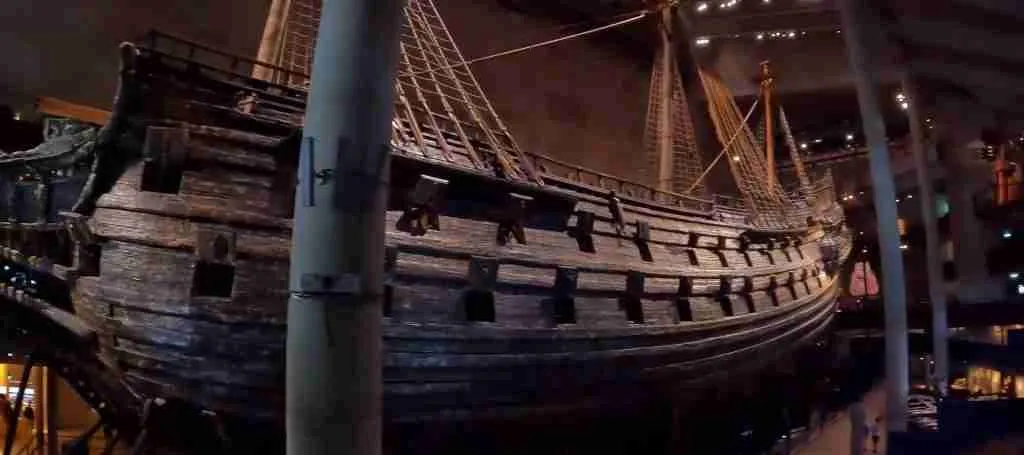
The museum experience centers on the physical presence of the ship itself—a massive wooden warship rising seven stories from the museum floor, its hull dominated by elaborate carved decorations and its structure revealing the sophisticated engineering of early modern shipbuilding. Walking around and beneath the Vasa provides perspectives impossible with museum ship replicas or archaeological fragments. Visitors confront the actual vessel, complete with its original timbers, bronze cannons, rigging elements, and decorative sculptures—a time capsule preserving a moment in Swedish history with remarkable fidelity.
Historical Context: Sweden’s Age of Greatness
Swedish Imperial Ambitions
The Vasa’s construction occurred during Sweden’s transformation from a regional Scandinavian kingdom into a major European power. King Gustav II Adolf, who ascended the throne in 1617 at age 16, inherited a kingdom with limited resources but significant military potential. The ongoing Thirty Years’ War (1618-1648) provided opportunities for Swedish expansion, but required a powerful navy to control Baltic trade routes and project Swedish power across Northern Europe.
Gustav II Adolf understood naval power’s political importance. A large, heavily armed warship served as both practical military asset and symbolic statement—a floating representation of royal authority and national strength visible to friends and enemies alike. The king commissioned the Vasa as the flagship of a new Swedish Baltic fleet designed to challenge Danish naval dominance and support Swedish military operations in Germany and Poland.
The ship’s design specifications reflected these ambitious goals: over 69 meters long, carrying 64 bronze cannons on two complete gun decks, and decorated with hundreds of carved sculptures depicting Swedish royal power. No Swedish shipyard had previously attempted a vessel of this size and complexity. The project pushed the limits of contemporary Swedish naval architecture and craftsmanship, making the Vasa both technical achievement and experiment in untested design concepts.
Construction and Design Challenges
Construction began in 1626 at the Stockholm naval shipyard under master shipwright Henrik Hybertsson, a Dutchman with extensive experience in Swedish service. The king’s specifications presented immediate challenges: the ship needed to carry heavy armament on two gun decks while remaining stable and seaworthy. Naval architecture in the 1620s relied on experience and proportional rules rather than mathematical calculations—shipbuilders learned through apprenticeship and trial-and-error.
Hybertsson recognized stability problems early in construction. The ship’s high superstructure—necessary to accommodate two gun decks—created a high center of gravity that made the vessel top-heavy. Adding sufficient ballast to counteract this tendency would make the ship too deep in the water, reducing gun port clearance and limiting operational capability. Hybertsson attempted to address these concerns, but the king’s insistence on maintaining the two-deck armament left limited room for design modifications.
The shipbuilder’s death in spring 1627, before the Vasa’s completion, further complicated matters. His successor, Hein Jakobsson, inherited a partially constructed ship with inherent design problems but faced pressure to complete the project quickly. The king, fighting wars on multiple fronts, demanded the Vasa’s delivery without understanding or accepting the technical constraints his specifications created.
Decorative Program and Symbolism
While construction crews grappled with structural challenges, sculptors created an elaborate decorative program transforming the Vasa into a floating propaganda statement. Over 500 individual sculptures, carved by teams working under German and Dutch master carvers, covered the ship’s stern, bow, and sides. The iconographic program, likely designed with input from court advisors, drew on classical mythology, biblical narratives, and Swedish royal symbolism to project messages about Swedish power and legitimacy.
The stern featured the most elaborate decoration: three tiers of sculptures showing Swedish royal symbols (crowned lions), allegorical figures representing virtues and military strength, and biblical and historical heroes exemplifying courage and justice. Roman emperors appeared alongside Old Testament kings, suggesting Swedish monarchy’s connection to classical and biblical authority. Tritons and sea monsters emphasized maritime dominion, while angels and religious figures invoked divine favor for Swedish military endeavors.
The bow carried massive carved lions, symbols of Swedish royal power, along with sculptures of Hercules and other legendary strongmen. These figures communicated military might to anyone viewing the ship from ahead—the perspective enemy vessels would see during naval combat. Every decorative element served propagandistic purposes: impressing allies, intimidating enemies, and demonstrating the wealth and artistic sophistication of the Swedish crown.
The sculptures were originally painted in brilliant colors—reds, blues, greens, and gold leaf—creating visual impact far exceeding the weathered wood appearance visible today. Traces of this polychrome decoration survived the centuries underwater, allowing conservators to understand the ship’s original appearance. The Vasa would have presented a spectacular sight: a massive warship gleaming with color and gilding, its decorations visible across Stockholm harbor and beyond.
The Maiden Voyage: Disaster in Stockholm Harbor
Preparations and Warning Signs
By summer 1628, the Vasa appeared ready for service. The ship had undergone fitting with rigging, sails, cannons, and provisions. However, concerns about stability persisted. Admiral Fleming, responsible for the ship’s delivery, ordered a stability test: 30 men ran back and forth across the main deck while observers watched the ship’s rolling motion. After only three runs, the test was stopped—the ship rolled so alarmingly that continuing seemed dangerous. Despite this clear warning, no one possessed the authority or willingness to delay the maiden voyage without the absent king’s approval.
Sunday, August 10, 1628, brought light winds from the southwest—favorable conditions for sailing from Stockholm into the archipelago. The Vasa departed from the palace quay with great ceremony, carrying approximately 150 people: crew members, officers, their families (a common practice for maiden voyages), and invited guests. Crowds gathered along the waterfront to watch Sweden’s magnificent new warship begin its career. The ship’s massive hull, tall masts, and elaborate decorations created an impressive spectacle as it moved under limited sail through the harbor.
The Sinking
The disaster unfolded with shocking speed. After sailing barely 1,300 meters, a modest gust of wind caught the sails. The ship heeled sharply to port (left side). As the ship tilted, water poured through the open lower gun ports, which sat only about 1.2 meters above the waterline. The incoming water rapidly increased the tilt, causing more water to flood in—a catastrophic feedback loop. Within minutes, the Vasa capsized and sank in approximately 32 meters of water, settling upright on the harbor bottom.
Panic ensued. Those on deck jumped or were thrown into the water. Nearby boats rushed to rescue swimmers. But many people below decks, particularly in the lower levels, found themselves trapped as water rushed in. The ship sank so quickly that escaping from interior spaces proved nearly impossible. Approximately 30 people drowned, their bodies trapped in the wreck along with personal belongings, tools, and supplies loaded for the ship’s intended deployment.
The disaster occurred within view of Stockholm’s population and visiting dignitaries. The ship’s failure—sinking in calm harbor conditions without even reaching open water—created immediate scandal. Sweden’s great naval pride had become an embarrassment visible to the entire city. The king, campaigning in Poland, received news of the catastrophe with fury. He immediately demanded investigation and punishment of those responsible.
Investigation and Blame
The subsequent inquiry, recorded in court documents that survive today, reveals the complicated politics and technical uncertainties of the disaster. Officials questioned everyone involved: the surviving shipbuilder, the captain, the admiral, and others who participated in the ship’s design and construction. The inquiry sought someone to blame—the king’s anger demanded accountability.
Testimony revealed the design problems: insufficient ballast, high center of gravity, open gun ports too close to the waterline. The aborted stability test emerged, showing officials knew about problems before the maiden voyage. However, assigning blame proved difficult. The original master shipwright had died. The king himself had specified the two gun decks that created the stability problems. No single person could be definitively identified as responsible—the disaster resulted from systemic failures in the design and approval process.
Ultimately, no one was punished. The king could not blame dead Hybertsson, could not acknowledge his own role in demanding impossible specifications, and could not punish surviving officials without revealing the decision-making failures that allowed a dangerously unstable ship to sail. The inquiry quietly concluded without assigning definitive responsibility. The Vasa, meanwhile, lay on the harbor bottom as an embarrassing reminder of Swedish naval ambitions exceeding technical capabilities.
Underwater Preservation: 333 Years on the Baltic Floor
Immediate Salvage Attempts
Salvage efforts began within days of the sinking. The ship represented enormous investment—the bronze cannons alone were extremely valuable. In the 1660s, Swedish engineer Albrecht von Treileben successfully recovered most of the cannons using a primitive diving bell—an innovation that allowed men to work underwater for extended periods. Treileben’s divers removed 53 of the 64 cannons, along with some other valuable items. This early salvage work left the ship largely intact but stripped of its most valuable portable contents.
After cannon recovery, the wreck was essentially forgotten. It appeared on harbor charts as a navigation hazard, but no technology existed to raise a ship of the Vasa’s size from 32 meters depth. As decades passed, the wreck’s exact location became uncertain. Harbor development and changing waterfront features made historical descriptions difficult to interpret. By the 19th century, most Stockholmers had forgotten the Vasa entirely—the disaster faded from popular memory, remembered mainly by historians studying Sweden’s 17th-century naval history.
The Baltic’s Preservation Conditions
While forgotten by humans, the Vasa benefited from perfect preservation conditions. The Baltic Sea’s low salinity—about one-third that of ocean water—creates an environment that cannot support Teredo navalis (shipworms) and other wood-boring marine organisms that normally destroy wooden shipwrecks within decades. These organisms require higher salinity to survive, making the Baltic one of the few seas where wooden shipwrecks can survive for centuries.
Additional factors enhanced preservation. The water temperature at 32 meters depth remains cold year-round, slowing bacterial activity that causes wood decay. Low oxygen levels in the deeper water further inhibit decomposition. The soft mud bottom quickly covered portions of the hull, creating an anaerobic environment that effectively sealed those sections from biological activity. The wreck settled upright and stable, protecting it from destructive currents that might have broken apart a listing wreck.
The oak timbers, while remaining structurally intact, underwent chemical changes during their centuries underwater. The wood cells absorbed water while losing many of the compounds that give wood its structural strength. This waterlogged state created a paradox: the timbers maintained their shape and appeared solid but had lost much of their original strength. This waterlogging would later create major preservation challenges when the ship was raised—how to preserve wood that was simultaneously intact and degraded?
Rediscovery and Salvage: Modern Archaeological Triumph
Anders Franzén’s Search
The Vasa’s rediscovery began with Swedish amateur archaeologist Anders Franzén’s obsession with Baltic shipwrecks. During the 1950s, Franzén recognized that the Baltic’s unique conditions should preserve wooden wrecks that would have disintegrated in ocean environments. He researched historical archives, finding accounts of the Vasa disaster and attempting to locate the wreck based on historical descriptions of the sinking location.
Franzén spent years methodically searching Stockholm harbor using a primitive coring device—a long pole that could retrieve bottom samples. He would row across areas where he thought the wreck might lie, repeatedly plunging the coring device into the mud and examining what it brought up. This laborious process continued for years, with Franzén searching whenever time and weather permitted. In August 1956, his persistence paid off: the corer brought up a sample of blackened oak. Further sampling confirmed the presence of a large wooden structure. He had found the Vasa.
Franzén’s discovery generated immediate excitement among Swedish archaeologists and government officials. The possibility of recovering an intact 17th-century warship captured public imagination. However, enormous technical challenges remained: How could a fragile wooden ship be raised from 32 meters depth? How could waterlogged timbers be preserved once exposed to air? What would the ship’s condition be after 333 years underwater?
The Salvage Operation
Preparatory work began in 1957. Navy divers examined the wreck, confirming its identity as the Vasa and assessing its condition. Reports were encouraging: the hull appeared remarkably intact, with decorative sculptures still attached and structural timbers in place. Planning for the salvage operation could proceed.
The salvage strategy, developed by engineer Per Edvin Fälting and executed by the Swedish Navy’s diving team, pioneered techniques that would influence underwater archaeology for decades. Divers worked in darkness and cold—visibility at 32 meters was essentially zero, requiring all work to be done by touch. They tunneled under the hull from both sides, creating passages through which steel cables could be threaded. This work took years, with divers working in shifts to dig channels through the mud while avoiding disturbing the fragile hull.
By 1959, six tunnels had been completed, and steel cables were positioned under the hull. The cables were attached to two lifting pontoons on the surface. The plan called for gradually lifting the wreck in stages—raising it slightly, allowing it to settle, and then repeating the process. This incremental approach would prevent structural failure that might result from trying to lift the entire weight at once.
The operation proceeded through 1959 and 1960. Each lift moved the wreck a few meters closer to the surface. Between lifts, divers inspected the hull, reinforced weak points, and prepared for the next stage. The wreck was also moved horizontally, repositioned from its resting place toward shallower water near Kastellholmen island, where a temporary dry dock could receive it.
On April 24, 1961, the Vasa broke the surface for the first time in 333 years. Crowds gathered to watch as the ancient warship emerged—dark, covered in mud, but recognizably a ship. The hull’s massive size and the visible carved decorations created immediate sensation. Media coverage was intense, with photographs and newsreels spreading globally. Sweden’s forgotten disaster had become Sweden’s greatest archaeological treasure.
Initial Conservation
Once raised, the Vasa presented unprecedented conservation challenges. The waterlogged wood would shrink, warp, and collapse if allowed to dry naturally. The ship needed to remain wet while conservators developed preservation strategies. A temporary structure was built around the ship, and sprinklers kept the hull constantly wet while experts debated preservation methods.
After extensive research and experimentation, conservators decided on polyethylene glycol (PEG) treatment. PEG is a waxy substance that can replace water in wood cells, preventing shrinkage and collapse while maintaining structural integrity. The treatment required spraying the ship continuously with PEG solution of gradually increasing concentration over many years. This allowed the chemical to slowly penetrate the wood cells and replace the water without causing destructive stresses.
The PEG treatment continued for 17 years, from 1962 to 1979. During this period, the ship remained in a temporary museum where visitors could observe both the vessel and the conservation process. The long treatment period allowed conservators to monitor the wood’s response and adjust concentrations as needed. By 1979, the treatment was complete—the wood had absorbed sufficient PEG to remain stable without continuous water application.
Museum Development: Designing for Preservation
Architectural Challenges
While the ship underwent PEG treatment, planning began for a permanent museum. The building needed to accomplish multiple, sometimes conflicting goals: provide optimal preservation conditions for the ship, allow visitors comprehensive viewing access, accommodate the thousands of artifacts recovered from the wreck, and create an architecturally appropriate structure on Djurgården, Stockholm’s park and museum island.
Architects Månsson and Dahlbäck, working with museum planners and conservation specialists, developed an innovative design. The building would be custom-fitted around the ship rather than trying to fit the ship into a conventional building. The main hall would be dark, limiting light exposure that degrades organic materials. Multiple viewing levels would allow visitors to see the ship from different heights—from below the waterline to above the deck level. Climate control would maintain constant temperature and humidity, preventing the wood from undergoing destructive expansion and contraction cycles.
The design also needed to allow future conservation work. The ship, while stabilized, would require ongoing monitoring and intervention. Access points for conservators, lifting equipment for removing and replacing parts, and laboratory spaces for analysis were all incorporated into the building design. The museum needed to function as both public exhibition space and active conservation facility.
Construction and Opening
Construction began in 1987 on a site adjacent to the temporary museum. The new building’s distinctive copper roof—green from oxidation—creates a landmark visible across Djurgården. The angular, modern architecture contrasts deliberately with Stockholm’s historical buildings, signaling the museum’s contemporary approach to presenting historical material.
Moving the ship from the temporary museum to the new building required careful planning. The hull, while stabilized, remained fragile. Engineers designed a wheeled platform that could support the ship’s weight evenly, preventing stress concentrations that might damage weakened areas. In December 1988, the Vasa made its final journey—a short distance from the old museum to the new, moving at walking speed while conservators monitored every movement. The transfer took several days but occurred without incident.
The Vasa Museum officially opened to the public in June 1990. The opening culminated 29 years of work since the ship’s raising—years spent in conservation, research, and planning. The result was Sweden’s most visited museum and one of the world’s premier maritime archaeology sites.
The Ship: Architecture and Technology
Hull Construction and Dimensions
The Vasa measures 69 meters in length and 11.7 meters in beam (width). The hull rises approximately 20 meters from keel to the top of the sterncastle. Displacement when fully loaded was estimated at about 1,200 tons. These dimensions made the Vasa one of the largest warships of its era, comparable to major English and Dutch vessels.
Hull construction followed traditional Nordic clinker building techniques modified for large warship construction. The keel, made from several pieces of oak scarfed together, provides the ship’s structural backbone. Massive oak frames (ribs) attach to the keel at regular intervals, defining the hull shape. Planking attached to these frames creates the watertight skin. The planks overlap slightly in clinker fashion, with oakum (tarred fibers) and pitch creating waterproof seams.
The construction required enormous quantities of timber—approximately 1,000 oak trees went into the hull alone. These trees, aged 150-200 years, came from Swedish forests. Shipwrights selected trees for specific purposes: straight trees for planking, naturally curved trees for frame pieces. This selective harvesting allowed efficient use of each tree’s natural characteristics, minimizing waste and maximizing strength.
Internal structure included multiple decks supported by massive beams. The orlop deck (lowest complete deck) sat just above the waterline. Above this, the lower gun deck carried 24-pound cannons, while the upper gun deck carried lighter weapons. Above the upper gun deck, the weather deck was open to the sky. Cabins for officers occupied the stern area, while crew spaces filled the bow. This vertical organization reflected both functional necessity and social hierarchy—officers lived in relatively comfortable stern cabins while ordinary sailors crowded into the dark, cramped bow.
Armament and Military Function
The Vasa was designed to carry 64 bronze cannons—a formidable armament for its era. The lower gun deck mounted 24-pound guns, heavy weapons capable of smashing enemy hulls at close range. The upper gun deck carried lighter 8-pound cannons, useful for damaging rigging and clearing enemy decks. Additional smaller weapons—swivel guns and muskets—would be deployed by marines during boarding actions.
The bronze cannons represented enormous investment. Bronze was expensive, requiring copper and tin in precise proportions, and casting large cannons demanded specialized expertise. Each cannon was individually cast, decorated with the Swedish royal coat of arms and other symbols. The cannons recovered by Treileben in the 1660s were melted down and recast for other uses, but replicas now occupy the gun ports, giving visitors a sense of the ship’s original armament.
Naval combat in the 1620s involved closing with enemy ships and exchanging broadsides at point-blank range—sometimes just a few meters apart. Cannons were most effective at these close ranges where their relatively low muzzle velocity and inaccuracy became less significant. The Vasa’s two-deck broadside could theoretically deliver devastating firepower, though the ship’s instability would have made accurate gunnery difficult even if it had reached combat.
Rigging and Sailing Characteristics
The Vasa carried three masts: a mainmast rising approximately 52 meters above the waterline, a foremast, and a smaller mizzenmast at the stern. Each mast was actually a composite of several sections—the lower mast, topmast, and topgallant—allowing portions to be replaced if damaged without dismasting the entire ship. Standing rigging (fixed ropes) held the masts upright, while running rigging (movable ropes) controlled the sails.
The sail plan included square sails on the main and foremasts, which provided power for sailing before the wind or on a broad reach. A lateen sail on the mizzenmast helped with steering and allowed some ability to sail closer to the wind. The total sail area was substantial, giving the ship reasonable speed in favorable conditions—probably around 8-10 knots maximum.
However, the ship’s poor stability limited its sailing capabilities. A properly designed sailing ship should be able to heel (tilt) significantly without danger—this allows efficient use of wind power. The Vasa’s tendency to heel dangerously even in light winds meant it could carry only partial sail in most conditions, drastically reducing speed and maneuverability. This design flaw, combined with the weight of the two gun decks, made the Vasa a poor sailor even before the fatal maiden voyage.
Decorative Program: Art and Propaganda
Sculptural Overview
Over 700 carved sculptures cover the Vasa’s exterior, representing one of the largest surviving collections of 17th-century maritime sculpture. The carvings range from massive figures several meters tall to small decorative elements. Different workshops produced various sculpture groups, leading to stylistic variations that art historians use to identify individual carvers’ work.
The sculptures were carved from oak and pine, chosen for their carving properties and durability. Carvers used both hand tools—chisels, gouges, and saws—and probably employed templates or full-scale drawings to ensure proportions and consistency across multiple workshops. The finest sculptures show extraordinary technical skill, with delicate details and complex undercutting that demonstrates master-level craftsmanship.
Iconographic Program
The decorative scheme follows a carefully planned iconographic program designed to communicate specific political messages. The stern, most elaborately decorated, presented to Swedish audiences in Stockholm harbor, emphasized Swedish royal authority and divine favor. The royal coat of arms occupied the central position, flanked by allegorical figures representing virtues associated with good governance: Justice, Fortitude, Prudence. Biblical heroes—David, Moses, Judith—provided exemplars of divinely favored leaders who achieved victory against overwhelming odds.
The bow decorations, visible to enemy ships during naval combat, emphasized military power and ferocity. Massive crowned lions—the Swedish royal symbol—dominated, their mouths open in roars of defiance. Hercules appeared, emphasizing strength and heroic achievement. Sea monsters and tritons demonstrated mastery over the ocean realm. These images communicated unmistakable messages: Sweden possessed both the power and divine favor to dominate Baltic waters.
Side decorations along the gun decks included figures of Roman emperors and military commanders. These classical references served multiple purposes: they demonstrated Swedish cultural sophistication through classical learning, connected Swedish military ambitions to Roman imperial traditions, and provided visual interest to break up the long hull sides. The emperors were painted and gilded, creating brilliant visual impact when the ship was complete.
Polychrome Decoration
All sculptures were originally painted in vibrant colors with extensive gilding. Scientific analysis of paint traces reveals the original color scheme: bright reds, blues, greens, and yellow ochre accented with gold leaf. This polychrome decoration followed Baroque aesthetic principles—the same colorful approach seen in contemporary church interiors and palace decorations. The painted surfaces also provided weather protection, helping preserve the carved details.
The gilding deserves special mention. Gold leaf application required specialized expertise, and the amount used on the Vasa represented significant expense. The technique involved applying size (adhesive) to selected surfaces, then carefully laying ultra-thin gold sheets. The gold would catch sunlight and reflect brilliantly, making the ship visible from great distances. This visual impact served both practical purposes—making the flagship identifiable in battle—and symbolic ones—demonstrating wealth and royal splendor.
Underwater preservation affected the paint layers variably. Some areas retained paint remarkably well, protected by mud or low oxygen conditions. Other areas lost paint completely. Conservation work identified and preserved these paint traces, allowing researchers to reconstruct the ship’s original appearance. Modern visitors see the weathered wood, but museum displays show how the brilliantly colored ship would have appeared in 1628.
Artifacts: Daily Life at Sea
Personal Belongings
The wreck contained over 40,000 artifacts beyond the ship’s structure. These objects provide intimate details about 17th-century Swedish naval life. Personal belongings recovered from the wreck include clothing, shoes, eating utensils, coins, and personal hygiene items. Each object tells stories about the people who boarded the Vasa that fatal August day.
Clothing fragments show the range of social classes aboard. Officers wore wool garments with silk decorations, while ordinary sailors made do with coarse linen and wool. Shoes range from leather boots for officers to simple wooden clogs for sailors. The variation reflects 17th-century social hierarchy—even aboard ship, visual appearance marked social status. Conservation of textiles proved particularly challenging, as waterlogged fibers deteriorate quickly when exposed to air. Freeze-drying and other specialized techniques preserved these fragile materials.
Coins found in crew members’ pockets or clothing help date the disaster precisely while showing the monetary economy. Swedish copper coins, along with foreign coins from Germany and elsewhere, demonstrate the international nature of Baltic trade and naval recruitment. Some coins bear dates from the 1620s, confirming the ship’s 1628 sailing. The presence of foreign coins suggests crew members from various countries, not unusual for Swedish naval service which actively recruited experienced foreign sailors.
Ship’s Equipment and Supplies
The ship carried extensive equipment and supplies for its intended deployment. Medical chests contained surgical instruments, medicine bottles, and supplies for treating battle wounds. These grim reminders of naval warfare’s realities show the primitive state of 17th-century naval medicine—amputation saws, cautery irons, and opiate-based pain relievers constituted the primary treatments for serious injuries.
Carpenter’s tools recovered from the ship demonstrate the woodworking technology available to 17th-century shipwrights. Axes, augers, saws, and planes show sophisticated metalworking capable of producing specialized tools. Ship’s carpenters performed constant repairs during voyages, making these tools essential equipment. The tools’ excellent preservation allows modern craftspeople to study 17th-century tool design and manufacturing techniques.
Food storage and preparation equipment provides insight into shipboard diet. Large wooden barrels held salted meat and fish—the primary protein sources for long voyages. Ceramic storage jars contained butter, which remained edible when stored in cool conditions. Smaller vessels held spices and condiments that made monotonous shipboard food more palatable. Cooking equipment was minimal—most food aboard ship was consumed cold or required only boiling water. This simple food preparation reflected space constraints and fire risk aboard wooden ships.
Skeletal Remains
Archaeological excavation recovered the skeletal remains of at least 15 individuals who died in the sinking. Modern forensic analysis of these remains provides remarkable information about 17th-century life and the disaster’s victims. The skeletons represent various ages and both sexes, confirming historical accounts that crew members brought families aboard for the maiden voyage celebration.
Several skeletons show evidence of hard physical labor—bone thickening and arthritis patterns typical of manual workers. Other remains show signs of previous injuries that had healed before the disaster. One skeleton shows evidence of scurvy, the vitamin C deficiency disease that plagued sailors on long voyages. Another shows healed fractures suggesting previous accidents, possibly work-related.
DNA analysis and isotope studies provide even more information. DNA reveals genetic relationships—some victims may have been family members who died together. Isotope analysis of bone and teeth shows what people ate during their lifetimes and where they grew up. Some victims spent their early lives far from Stockholm, suggesting recruitment from distant regions or even foreign countries. These scientific techniques transform anonymous victims into individuals with specific life histories.
The museum treats these remains with appropriate respect. They are displayed in ways that emphasize their humanity while providing educational value. The ethical considerations of displaying human remains are explicitly addressed in museum presentations, acknowledging both the scientific importance and the human tragedy these remains represent.
Conservation Science: Preserving the Impossible
The Challenge of Waterlogged Wood
The Vasa’s conservation represented unprecedented challenges when the ship was raised in 1961. Waterlogged wood presents specific problems: the wood cells have absorbed water while losing the lignin and cellulose that provide structural strength. If allowed to dry naturally, the wood would shrink drastically—up to 30% in some dimensions—while warping, cracking, and collapsing. The ship’s massive size made treatment exponentially more difficult than conserving small waterlogged artifacts.
Early experiments tested various preservation approaches. Freeze-drying, which works well for small objects, proved impractical for a ship of the Vasa’s size. Coating the wood with resins or plastics would prevent proper treatment and trap moisture, leading to eventual decay. Conservators needed a method that would replace water in the wood cells with something that prevented shrinkage while remaining compatible with the wood structure.
Polyethylene Glycol Treatment
The solution—polyethylene glycol (PEG) treatment—came from Swedish conservator Lars Barkman and chemist Gösta Knutsson. PEG is a waxy polymer that dissolves in water and can penetrate wood cells. As PEG concentration increases, it gradually replaces water while preventing the cells from collapsing. The treatment required maintaining the ship in saturated humidity while spraying it with PEG solution of increasing concentration.
The treatment phase lasted 17 years (1962-1979). Initial spraying used very dilute PEG solution—essentially PEG-enhanced water. Over time, concentration gradually increased as the wood absorbed PEG and released water. This slow process prevented destructive stresses that would occur if concentration changed too rapidly. Different wood types and different areas of the ship absorbed PEG at different rates, requiring careful monitoring and concentration adjustment for various sections.
The massive scale required industrial-level operation. Sprinkler systems circulated thousands of liters of PEG solution daily. The solution had to be heated to remain liquid and enhance penetration. As treatment progressed, the ship’s weight increased dramatically—the absorbed PEG added tons of weight. The temporary museum building had to be reinforced to support the increasing load.
Ongoing Conservation Challenges
PEG treatment stabilized the ship but did not solve all preservation problems. The sulfur content in Baltic seawater, absorbed by the oak during the ship’s centuries underwater, continues to create conservation challenges. Sulfur compounds react with iron fasteners (nails, bolts) present throughout the ship, creating sulfuric acid that degrades both iron and surrounding wood. This slow deterioration continues despite the PEG treatment.
Conservators monitor the ship constantly using sophisticated sensors that measure movement, humidity, and chemical changes. Computer modeling predicts stress points and potential structural failures. When problems are identified, conservators intervene with minimal interventions designed to stabilize specific areas without altering the ship’s overall appearance or structure. This ongoing conservation work continues in the museum, with scaffolding and conservation equipment visible to visitors as part of the museum experience.
The museum environment itself serves as preservation tool. Temperature and humidity remain tightly controlled—variations cause wood expansion and contraction that stresses the structure. Lighting is carefully managed to minimize light exposure while allowing visitors to see details. Air circulation removes pollutants that could accelerate deterioration. These environmental controls, invisible to most visitors, represent sophisticated engineering dedicated to preserving the ship for future generations.
Research and Reconstruction
Archaeological Investigation
The Vasa represents an unparalleled research opportunity—a complete 17th-century warship preserved with its equipment, supplies, and even skeletal remains. Research continues decades after the ship’s raising, with new discoveries and insights emerging regularly. Modern analytical techniques allow investigations impossible when the ship was first raised.
Dendrochronology (tree-ring dating) analyzed timber to determine when trees were cut and where they grew. This research revealed that most oak came from forests in southeastern Sweden, cut in 1625-1626. Some timber came from Germany, imported for specific purposes. This sourcing information illuminates 17th-century timber trade and Swedish naval logistics.
Material analysis examines everything from paint pigments to metal composition. Scientific instruments can determine paint recipes with extraordinary precision, revealing what pigments were used, how they were mixed, and how they were applied. Metal analysis shows the composition of bronze cannons, iron fasteners, and gold gilding. This data helps understand 17th-century manufacturing technology and trade networks that supplied materials.
Digital Documentation
Modern technology enables documentation impossible in the 1960s. Laser scanning created a complete three-dimensional model of the ship with millimeter precision. This digital twin serves multiple purposes: it provides baseline documentation for conservation monitoring (any movement or deformation shows clearly in comparison with the reference model), allows virtual reconstruction of missing elements, and enables detailed research without physically accessing fragile areas.
Photogrammetry—creating 3D models from photographs—documents sculptures and decorative elements in extraordinary detail. Researchers can examine carved details virtually, comparing sculptures to identify workshop patterns and individual carvers’ distinctive styles. These digital techniques preserve information even if physical deterioration eventually damages the actual carvings.
Reconstruction Projects
The museum commissioned various reconstruction projects to help visitors understand the ship’s original appearance and function. A full-scale section of the upper gun deck was built using period techniques, allowing visitors to walk on a recreation of the deck and see how cramped and dark conditions were. The reconstruction shows how cannons were mounted, how rigging attached to the deck, and how little space crew members actually had for moving and working.
Painted reconstructions show how the ship appeared when newly completed: brilliant colors, gleaming gilding, and flags flying. These images, based on paint analysis and historical descriptions, contrast dramatically with the dark, preserved ship visible in the museum. The reconstructions help visitors appreciate the visual impact the Vasa would have created in Stockholm harbor—a spectacle of color and wealth designed to inspire awe.
Museum Experience and Exhibits
Main Hall and Ship Viewing
The museum experience centers on the ship itself, displayed in a seven-story hall specifically designed for optimal viewing. Visitors can walk around the ship at multiple levels, providing perspectives from below the waterline to above the upper deck. This multi-level approach allows detailed examination of different ship areas: the hull structure below, the gun decks at mid-level, and the elaborate stern decorations from upper galleries.
The deliberately dim lighting serves preservation purposes while creating atmospheric viewing conditions. Dramatic spotlighting highlights specific features—a carved lion’s head, a row of gun ports, the massive rudder. This theatrical lighting emphasizes the ship’s scale and decorative richness. The dark hall also creates intimacy—visitors feel they’re discovering the ship in semi-darkness, similar to how early salvage divers first encountered it underwater.
Information panels throughout the viewing levels explain what visitors see: ship construction techniques, decorative programs, life aboard, the sinking, and subsequent preservation. These texts, available in multiple languages, provide context that transforms passive viewing into active learning. Interactive displays allow closer examination of details difficult to see on the ship itself.
Supporting Exhibitions
Beyond the ship, the museum includes extensive exhibitions covering various aspects of the Vasa story. A dedicated exhibition explores life in 17th-century Sweden—the political situation, social hierarchy, daily life, and cultural context that produced the ship. Historical artifacts, paintings, and reconstructions help visitors understand the world that built the Vasa.
Another exhibition details the ship’s construction, from timber selection through launch. Scale models show construction stages, while tool displays demonstrate shipbuilding technology. Video presentations explain specialized techniques like timber scarfing, frame construction, and caulking. This exhibition makes visible the enormous skill and labor required to build a 17th-century warship.
A forensic exhibition presents the disaster victims and research conducted on skeletal remains. Facial reconstructions based on skulls give the anonymous dead individual appearances. The exhibition handles this sensitive material with appropriate respect while emphasizing the scientific and historical insights the remains provide. The human scale of the disaster—individual stories and fates—complements the ship’s grandeur.
Conservation exhibitions show ongoing preservation work. Visitors can see conservators working on artifacts in visible laboratories, demonstrating the techniques and challenges of preserving waterlogged materials. These working displays emphasize that conservation never ends—the museum actively maintains the collection rather than simply displaying static objects.
Educational Programs
The museum operates extensive educational programs serving thousands of Swedish schoolchildren annually. Programs adapt to different age groups, from elementary students learning basic history to high school students studying specialized topics like archaeology or conservation science. The educational approach emphasizes hands-on learning: students can handle reproduction artifacts, try on period clothing, and participate in activities demonstrating 17th-century skills.
For international visitors, guided tours in multiple languages provide expert commentary. These tours, led by knowledgeable guides, cover the ship’s history, construction, sinking, and preservation while adapting to visitor interests and questions. Audio guides offer another option, allowing self-paced exploration with professional narration explaining key features.
Cultural Impact and Legacy
National Symbol
The Vasa transformed from national embarrassment to national treasure. The ship’s failure in 1628 represented Swedish hubris and miscalculation. Yet its rediscovery and preservation created a different narrative: Swedish determination, scientific expertise, and cultural commitment to preserving heritage. This transformation reflects changing attitudes toward historical failure—modern perspective values the ship precisely because it failed, providing unique preservation and research opportunities that a successful warship career would have prevented.
For contemporary Sweden, the Vasa represents both achievement and caution. The ship demonstrates 17th-century Swedish ambition and craftsmanship—the willingness to attempt challenging projects and the skill to realize them. Simultaneously, the disaster warns against hubris, technical overreach, and ignoring expert warnings for political expediency. This dual symbolism makes the Vasa a complex national emblem rather than simple celebration of past glory.
Maritime Archaeology Influence
The Vasa’s salvage and conservation pioneered techniques that influenced maritime archaeology globally. The PEG treatment method, developed specifically for the Vasa, became standard for preserving waterlogged wood worldwide. Salvage techniques, multi-year conservation programs, and interdisciplinary research approaches established models copied by museums and archaeology projects internationally.
The success of creating a popular museum around a single artifact—the ship itself—influenced how maritime museums present collections. Rather than displaying artifacts separately, museums increasingly preserve and display ships as complete environments that integrate structure, equipment, and associated artifacts into coherent narratives. The Vasa Museum demonstrated that proper presentation could make specialized historical subjects accessible and compelling to general audiences.
Tourism and Economic Impact
The Vasa Museum ranks among Sweden’s most visited tourist attractions, drawing over one million visitors annually. This makes the museum not just a cultural institution but an economic force. Tourism revenue benefits Stockholm’s economy through hotel stays, restaurant visits, and related spending. The museum’s international reputation enhances Sweden’s cultural tourism profile, attracting visitors interested in maritime history, archaeology, and unique museum experiences.
The museum’s success inspired other heritage preservation and presentation projects in Stockholm and throughout Sweden. Historic ships, archaeological sites, and other cultural heritage received increased attention and funding, with the Vasa serving as a model for how proper preservation and presentation create both cultural and economic value.
Comparative Context: Maritime Archaeology
The Vasa stands alone in maritime archaeology—no other 17th-century warship survives in comparable condition. Other famous historic ships, like HMS Victory or USS Constitution, remained in active service and underwent extensive modifications that altered their original character. Shipwrecks like the Mary Rose or La Belle, while important, were significantly damaged and incomplete when recovered. The Vasa’s combination of completeness, original condition, and rich artifact content makes it unique.
This uniqueness creates both opportunities and responsibilities. The museum possesses the only complete 17th-century warship available for study, making the Vasa essential for understanding this ship type. Researchers worldwide depend on Vasa documentation for comparative studies. This responsibility drives the museum’s commitment to ongoing research, conservation, and documentation—preserving not just a ship but irreplaceable historical information.
Future Challenges and Outlook
The Vasa’s long-term preservation remains uncertain despite decades of conservation effort. The ship continues to age, with ongoing chemical processes slowly degrading the structure. Conservators face the question: Can the Vasa be preserved indefinitely, or will it eventually deteriorate despite best efforts?
Current conservation strategies focus on monitoring and minimal intervention—allowing the ship to age gradually while preventing catastrophic failures. New technologies may offer better preservation methods, but they may also reveal new problems. The museum operates with long-term planning horizons, considering not just current conditions but what might be needed decades or centuries ahead.
Climate change presents particular concerns. Temperature and humidity stability depend on climate control systems that must function reliably over extremely long periods. Any failure could cause rapid deterioration. The museum continuously updates these systems while developing backup protocols to protect the ship from environmental variations.
Despite these challenges, the outlook remains optimistic. Swedish commitment to preserving the Vasa continues strong, with ongoing research developing improved conservation techniques. The museum’s status as a major tourist attraction ensures political and financial support. The Vasa, having survived 333 years on the Baltic floor and over 60 years of conservation, will likely remain accessible to future generations—a remarkable testament to both 17th-century craftsmanship and modern preservation science.
Frequently Asked Questions
How long does a typical museum visit take?
A comprehensive visit to the Vasa Museum typically requires two to three hours. This allows time to walk around the ship at multiple viewing levels, explore the supporting exhibitions covering ship construction, 17th-century life, the sinking and salvage, and conservation work. Visitors particularly interested in maritime history or archaeology may want additional time to read all information panels and examine artifacts in detail—four hours or more for in-depth exploration. Alternatively, visitors with limited time can see the ship itself and main highlights in approximately one hour, though this abbreviated visit necessarily skips many interesting details and supporting exhibitions.
Can you see inside the ship’s interior?
Visitors cannot enter the ship’s interior for preservation and safety reasons—the structure remains fragile despite conservation treatment, and human traffic would cause destructive wear and potentially introduce harmful contaminants. However, the museum provides extensive views into the ship through several approaches: large openings in the hull allow viewing interior spaces from external galleries; a full-scale reconstruction of a gun deck section, built using period techniques, allows visitors to experience shipboard conditions firsthand; video presentations using cameras inserted into closed spaces show areas not otherwise visible; and transparent floor sections in viewing galleries allow looking down into interior spaces from above. These various viewing methods provide comprehensive understanding of the ship’s interior arrangement without requiring physical access that would endanger preservation.
What happened to the bronze cannons recovered in the 1660s?
The 53 bronze cannons recovered by Albrecht von Treileben in the 1660s were melted down and recast into new weapons for the Swedish navy. Bronze was extremely valuable, and recycling cannons from the Vasa made economic sense—the metal retained its value regardless of form. This practice was standard in the 17th century, when material costs often exceeded manufacturing costs, making recycling financially sensible. The recast bronze likely served in Swedish warships for decades or even centuries, potentially participating in battles the original Vasa never fought. While historians regret the loss of the original cannons (which would now be invaluable museum artifacts), the decision made perfect sense in 1660s economic context. The museum displays several period-equivalent bronze cannons recovered from other wrecks, giving visitors accurate representation of what the Vasa’s armament looked like.
How accurate are the ship’s decorative color reconstructions?
The color reconstructions are based on scientific analysis of paint traces preserved on the sculptures, combined with historical documentation about 17th-century painting techniques and pigment availability. Modern analytical instruments can identify pigments at microscopic level, revealing original colors even when most paint has disappeared. Multiple paint layers often exist, showing the ship was repainted during its brief existence before sinking. Cross-section analysis distinguishes original colors from later applications. Historical accounts of similar ships and general Baroque painting practices provide additional guidance. However, some uncertainty remains: pigments fade and change chemically over time, making exact color matching difficult; we don’t know precisely how thickly paint was applied or how colors appeared when fresh versus weathered; and lighting conditions (natural daylight versus modern museum lighting) affect color perception. Despite these limitations, reconstructions represent the best available scholarship and provide reasonable approximations of the ship’s original appearance—certainly more accurate than leaving visitors to imagine colors on their own.
Why did they build a ship with obvious stability problems?
Several factors contributed to building an unstable ship despite warning signs. First, naval architecture in the 1620s lacked mathematical methods for calculating stability—shipbuilders relied on experience, proportional rules, and trial-and-error. No one could predict exactly how stable the ship would be until it was in the water. Second, King Gustav II Adolf personally specified many design features (particularly the two gun decks) without understanding their stability implications. His authority made questioning these specifications politically difficult. Third, the original master shipwright Henrik Hybertsson died before construction was complete, removing the most knowledgeable voice who might have prevented the disaster. Fourth, political and military pressure to complete the ship quickly discouraged the time-consuming redesign that would have been necessary to fix problems. Fifth, the stability test performed before launch, while alarming, was discontinued rather than definitively proving the ship unsafe—officials chose to interpret ambiguous results optimistically. This combination of technical limitations, political pressure, authority conflicts, and wishful thinking allowed the flawed ship to sail despite multiple warning signs.
How does Baltic Sea water chemistry preserve wood differently from ocean water?
The Baltic Sea’s unique chemistry creates ideal preservation conditions for organic materials. Salinity measures about one-third that of ocean water due to limited connection to the Atlantic and massive freshwater input from rivers draining Northern Europe. This low salinity cannot support Teredo navalis (shipworms) and similar wood-boring organisms that require higher salt concentrations. In ocean environments, shipworms can destroy a wooden ship within decades, boring through timbers and reducing structures to fragments. The Baltic’s brackish water prevents this biological destruction. Additionally, low oxygen levels in deeper Baltic waters (caused by limited water circulation and organic decomposition) inhibit aerobic bacteria that decay wood. Cold temperatures further slow any biological processes. The combination means wooden shipwrecks can survive for centuries with structural integrity intact, though the wood undergoes chemical changes that make it waterlogged and fragile. This preservation explains why the Baltic contains numerous well-preserved historic shipwrecks, from medieval cogs to 18th-century warships, creating what archaeologists sometimes call the “Baltic time machine.”
What role did women and children play aboard 17th-century warships?
Women and children aboard warships were less common than on merchant vessels but not unusual, particularly during peacetime activities like the Vasa’s maiden voyage. Naval regulations generally prohibited women from accompanying ships during active combat deployments, but this rule was often ignored or only loosely enforced during peacetime. Women aboard warships typically fell into several categories: officers’ wives who accompanied husbands, particularly on short voyages or deliveries of new ships; crew members’ wives who sometimes traveled with husbands, especially if the sailors had families but limited shore housing; laundresses and seamstresses who performed essential maintenance tasks mending clothes and linens; and prostitutes tolerated or sometimes officially sanctioned to maintain crew morale. Children aboard usually belonged to crew members, though some served as cabin boys or powder monkeys (young boys who carried gunpowder cartridges from magazines to guns during combat). The skeletal remains found in the Vasa confirm that both women and children were aboard during the maiden voyage, consistent with historical accounts describing it as a celebratory event where crew members brought families to witness the ship’s departure.
How do conservators decide what interventions to make on the ship?
Conservation decisions follow established principles balancing preservation necessity against intervention impact. Conservators prefer minimal intervention—only acting when problems threaten ship integrity. Continuous monitoring using sensors, laser scanning, and visual inspection identifies developing problems before they become critical. When intervention is necessary, conservators choose the least invasive approach that effectively addresses the problem. Interventions must be reversible when possible, allowing future conservators with better techniques to undo current work without damaging original material. Materials used must be compatible with historic materials—incompatible modern materials can cause more damage than they prevent. All interventions are thoroughly documented, creating detailed records for future reference. Decisions involve consultation among conservation specialists, materials scientists, structural engineers, and museum curators—no single person makes major conservation choices. International conservation standards and best practices guide decision-making, though the Vasa’s unique condition sometimes requires developing new approaches. The goal is preserving the ship for future generations while accepting that some deterioration is inevitable—perfect preservation is impossible, but appropriate interventions can significantly slow degradation.
What happened to the survivors of the sinking?
Most survivors of the disaster resumed normal lives, though detailed records about individual fates are limited. The ship’s captain, Söfring Hansson, faced the inquiry investigating the disaster but was not punished—testimony showed he had objected to sailing without additional ballast but was overruled by higher authorities. He likely continued in naval service, as skilled ship commanders were valuable even after failures. Ordinary crew members who survived probably transferred to other ships, though the disaster’s notoriety may have made finding new berths difficult. Officers from noble families would have used family connections to obtain new positions despite the Vasa association. The disaster’s investigation focused on assigning blame rather than punishing survivors, and since no clear culprit was identified, most involved in the disaster escaped serious consequences. For families who lost members in the sinking, compensation was probably minimal—17th-century Sweden provided limited support for naval casualties. The disaster’s relatively low death toll (approximately 30 out of 150 aboard) meant most people aboard survived, but the traumatic experience of watching the magnificent new warship capsize and sink, along with the deaths of colleagues and possibly family members, undoubtedly affected survivors for the rest of their lives.
How does the museum handle the ethical issues of displaying human remains?
The museum approaches human remains display with careful ethical consideration, balancing scientific and educational value against respect for the deceased. Display decisions follow international museum ethics guidelines while considering Swedish cultural attitudes and legal requirements. The skeletal remains are presented in contexts emphasizing their scientific importance and individual humanity rather than as mere curiosities. Facial reconstructions based on skulls give victims individual identities, while accompanying text describes their lives based on forensic analysis. The museum explicitly acknowledges the ethical complexities of displaying human remains and explains why the decision to do so was made—the remains provide irreplaceable information about 17th-century life and the disaster’s human cost. Visitors are informed before encountering the remains, allowing those uncomfortable with such displays to avoid them. The museum considers the remains under its stewardship rather than ownership—responsibility to preserve and study them while treating them with dignity. Periodic reviews ensure display practices remain appropriate as ethical standards evolve. The museum consults with ethicists, indigenous peoples’ representatives, and other stakeholders about best practices. This thoughtful approach has generally avoided controversy while allowing the remains to serve educational purposes and honor the victims’ memory through scientific understanding of their lives and deaths.