
Valtellina Cultural Itinerary 2026: Exploring Grosio and Val Grosina from the Tirano Hub
Tirano is where the Bernina Express arrives from St. Moritz, where Trenord trains from Milan terminate, and where most visitors catch a connection and move on. Fourteen kilometres west along the SS38, Grosio holds one of the largest engraved rocks in the Alps, two accessible medieval castle ruins, and a lateral valley whose paved road climbs through stone hamlets virtually unknown outside the province. This itinerary covers the logistical detail — rail connections, road timing, parking, guided-tour booking, and the vehicle-permit procedure for upper Val Grosina — so the day is spent looking at the landscape rather than solving it.
Key Takeaways
- Grosio lies 14 km from Tirano along the SS38 — roughly 15 to 20 minutes by car or reachable by Trenord regional train (R12 line, Sondrio direction).
- The Grosio Rock Engraving Park charges €6 per adult for the guided tour of Rupe Magna; the adjacent castle grounds are always open and free. Pre-book guided tour slots (10:30, 14:00, and 16:00 in the main season) by email at [email protected] or via WhatsApp, as places are limited.
- A paved road climbs from Grosio through the hamlet of Ravoledo to the Fusino junction at around 1,200 metres — an approximately 9-kilometre drive that is perfectly suited to standard cars; beyond Fusino toward Eita, a daily vehicle permit is required and available at the Comune di Grosio or the vending machine near the Fusino church.
- Budget day-trippers from Tirano should plan on €35–45 per person; those with a car and a sit-down restaurant lunch will spend €45–65 per person.
- The park operates Tuesday to Sunday from April through October, with weekend-only guided tours in winter; the castle grounds can be walked year-round, making this itinerary viable in all seasons with appropriate footwear and road awareness.
- The valley’s cuisine — pizzoccheri, sciatt, bresaola, and Casera — is available at genuinely local prices in Grosio, making lunch part of the cultural programme rather than an afterthought.
People Also Ask About the Valtellina Cultural Itinerary 2026
How do I get from Tirano to Grosio in 2026?
Tirano and Grosio are 14 km apart along the SS38, Lombardy’s main Valtellina trunk road. By car or a car rented near the station the drive takes 15 to 20 minutes, with free parking available on Via San Faustino in Grosio adjacent to the A2A power station. Alternatively, the Trenord R12 regional line (Tirano–Sondrio direction) connects the two towns; Grosio has a station on this local service, and the short-hop fare within the regional tariff structure runs approximately €2–3 each way — confirm the current rate at trenord.it or via the Trenord app before travel. The RegioExpress RE8 from Milan does not stop at Grosio, so travellers arriving on the fast service must change to the R12 at Tirano or take a local bus along SS38.
Is the Grosio Rock Engraving Park worth visiting in 2026?
Rupe Magna is the centrepiece: a single glacially smoothed rock face carrying over 5,000 engraved figures accumulated over roughly three millennia, from the end of the Neolithic period through the Iron Age. For scale, this makes it among the most densely engraved single surfaces in the Alpine arc. The two ruined medieval castles — St. Faustino’s Castle from the 10th–11th century and the 14th-century Visconti Castle — can be explored freely at any time without a ticket. Together, the complex makes for a meaningful two-hour visit even without the guided tour, and roughly three to four hours with one. At €6 adult admission for the guided component, the value proposition is exceptional by any comparison with comparable heritage sites in Lombardy.
What does a day trip from Tirano to Grosio cost in 2026?
For a traveller relying on the train and eating a simple trattoria lunch in Grosio, expect €35–45 per person for the full day — covering the return train fare, the guided tour ticket, coffee, and a meal. Those driving their own car and opting for a proper sit-down restaurant lunch with a glass of local Valtellina wine will spend €45–65 per person. Both figures exclude the return transport to Tirano if you are basing yourself there; if you are simply stopping through on the way between Milan and the Swiss rail network, the incremental cost of a Grosio half-day is principally the €6 park ticket and lunch. Accommodation in the area runs €70–100 per room in a B&B in Grosio or Tirano (two sharing, €35–50 per person) and €100–150 in a mid-range Tirano hotel (€50–75 per person).
Can I visit Val Grosina by car in 2026?
Yes — a paved asphalt road climbs from Grosio’s town centre through the hamlet of Ravoledo and continues approximately 9 kilometres to the Fusino junction at about 1,200 metres, and this section is accessible to standard cars without any permit. At Fusino the valley divides: the western branch toward Malghera (1,937 m) is also paved and car-accessible, though narrow; the eastern branch toward Eita (1,703 m) requires a daily vehicle permit, which can be obtained at the Comune di Grosio before departure or from the automated dispenser near the church in Fusino itself. Walkers and cyclists are free to use both branches without a permit. In winter and early spring the road above the valley floor carries snow; check conditions before attempting the drive between November and April.
Extended multi-day tours – 5+ days
Featured Trentino Alto Adige Multi-Day Tour Packages

3 days
Trentino Alto Adige 3-Day Discovery Tour
- ✓ Comprehensive Trentino Alto Adige experience
- ✓ Expert local guides included
- ✓ All accommodation included
- ✓ Transportation provided
5 days
Trentino Alto Adige 5-Day Highlights Experience
- ✓ Comprehensive Trentino Alto Adige experience
- ✓ Expert local guides included
- ✓ All accommodation included
- ✓ Transportation provided

7 days
Trentino Alto Adige 7-Day Cultural Journey
- ✓ Comprehensive Trentino Alto Adige experience
- ✓ Expert local guides included
- ✓ All accommodation included
- ✓ Transportation provided
10 days
Trentino Alto Adige 10-Day Complete Adventure
- ✓ Comprehensive Trentino Alto Adige experience
- ✓ Expert local guides included
- ✓ All accommodation included
- ✓ Transportation provided
Multi-day tour packages powered by TourRadar. Prices and availability subject to change.
Why Grosio Belongs on Your 2026 Valtellina Itinerary
Valtellina runs east to west along the Adda river, hemmed by the Rhaetian Alps to the north and the lower Orobie chain to the south. The valley has been a transit corridor since prehistoric times — a natural passage between the Po Plain and the Alpine passes leading into Switzerland and towards Tyrol. The SS38, the Statale dello Stelvio, follows essentially the same line today that ancient paths and medieval roads carved before it. Every town in the valley has some claim on history, but most visitors on the main tourist circuit see Sondrio, Tirano, and perhaps Teglio (known as the home of pizzoccheri) before heading onward. Grosio, sitting in what is sometimes called the Media Valtellina (middle valley), does not feature on most itinerary shortlists.
The oversight is partly structural. Grosio lacks a famous view, a Michelin-starred restaurant, or a dramatic gondola lift. What it has instead is density of layered time: prehistoric engravers, medieval lords competing for control of the ridge above the Adda, and the pastoral families who organised their agricultural year around the stone hamlets of Val Grosina in a pattern that continued, with modifications, into the twentieth century. The result is a site where the engraved rock, the ruined castles, and the abandoned or semi-active alpine farmsteads are all within a single day’s comfortable reach of each other — and of Tirano’s rail hub.
That positioning matters particularly in 2026. Increased demand for the Bernina Express, combined with the continuing growth of slow-travel itineraries in northern Italy, is pushing more visitors into the Tirano area in transit, but almost none are stopping long enough to use Tirano as a base for exploration rather than a junction. Grosio absorbs this demographic perfectly: it requires no specialist equipment, no great altitude, no advance booking beyond the rock art guided tour, and it returns the traveller to Tirano in time for an evening train or a comfortable dinner without rushing. The valley excursion into Val Grosina can be stretched or shortened to fit whatever time remains after the park, making this one of the most schedule-flexible itineraries in the middle valley.
The itinerary described here is built around a single full day beginning and ending in Tirano, with a morning at the Grosio Rock Engraving Park and an afternoon in Val Grosina. Practical variations are noted throughout: what to cut if time is short, what to add if the afternoon stretches, and how the itinerary holds up in the shoulder seasons and winter months.
Getting to Tirano in 2026: Your Rail and Road Options
Tirano has better rail access than most visitors realise, with two distinct systems meeting at adjacent but physically separate stations. The Italian station (operated by Rete Ferroviaria Italiana and served by Trenord) handles trains to and from Milan, while the Swiss station directly alongside is the southern terminus of the Rhaetian Railway’s Bernina line — the route that UNESCO inscribed as part of the Albula/Bernina Railway World Heritage Site.
From Milan by Trenord. The RegioExpress RE8 runs from Milan Centrale (and Milan Rogoredo) directly to Tirano with stops at Lecco, Colico, Morbegno, and Sondrio. Trenord lists the journey at approximately two hours and thirty minutes, with around fifteen departures per day. The second-class fare from Milan Centrale to Tirano starts from €12.50; check trenord.it for current rates and book via the Trenord app to avoid queuing at the automatic machines. Trains run roughly hourly throughout the day, with the first departure from Milan early enough to have you in Tirano before 09:00 if needed.
From Switzerland on the Bernina Express. Travellers arriving from the Swiss network change trains at St. Moritz or Chur and ride the Bernina Express — or the standard Rhaetian Railway regional service — south over the Bernina Pass to Tirano. The crossing is in itself a reason to build the journey; the Rhaetian Railway uses a narrow-gauge line that loops over the pass at nearly 2,300 metres before descending through Poschiavo to the Italian border. Tickets are sold by Rhaetian Railway (rhb.ch); advance booking is strongly recommended in summer. Swiss passengers do not need to clear customs between trains — the station exchange at Tirano is direct.
By car from Milan or Como. Driving from Milan, the standard route follows the SS36 north through Lecco to Colico, then turns east onto the SS38 along the valley floor to Tirano — approximately 155 kilometres and two to two-and-a-half hours depending on traffic. From Como, use the SS340 (Via Regina) to Menaggio, cross to Varenna by ferry or continue to Colico, then take SS38 east. Traffic along SS38 can be heavy on summer weekends; plan to be on the road before 09:00 or after 19:00 if possible. Parking in Tirano is available on the streets around the station and in the larger free areas near the basilica, with limited on-street parking directly at the station. If you are driving the full day-trip route, leave Tirano along SS38 westbound toward Sondrio — Grosio will be signposted on your left after approximately 14 kilometres.
By car from Bormio or Livigno. Visitors based in the ski resorts to the east reach Tirano by continuing west on SS38 through the Alta Valtellina. From Bormio the drive is approximately 45 minutes; from Livigno, factor in the journey over Passo di Foscagno or through the Munt la Schera tunnel, then SS38 westward — allow at least an hour and a quarter.
Cycling connections. The Valtellina cycling route, a long-distance path that follows the valley floor, connects Tirano to the wider network. Cyclists joining from the west can ride to Grosio directly without touching SS38 for much of the distance; from Tirano the on-road section uses SS38 briefly before joining the cycling path. Bikes are carried on the R12 regional train with a supplement; confirm the Trenord current bike supplement fee at trenord.it.
Tirano Station as Your 2026 Operations Base
The Italian Tirano station is compact and functional, with automatic ticket machines for Trenord services, a small waiting area, and a café. The adjacent Swiss Rhaetian Railway station has its own entrance and ticketing. Left-luggage facilities are not guaranteed at either; if you are arriving with bags and want to leave them, check with station staff on the day. The walk between the two stations takes under two minutes — they share the same piazza.
The Madonna of Tirano Basilica, Tirano’s most visible landmark, stands a five-minute walk north of the station along Via Madonna. The Renaissance pilgrimage church has been a focal point of the town since the early sixteenth century and is worth the brief detour for its interior and the decorated sixteenth-century façade — but for the purposes of this itinerary, it serves primarily as a useful navigation reference point for anyone parking and orienting on foot.
Provisions for the day can be gathered in Tirano before departure. A small mercato (market) operates in the town centre, and there are alimentari (delicatessens) near the main piazza where you can pick up bresaola, local cheeses, bread, and fruit for a picnic at Fusino if you prefer not to use a restaurant. The Fusino junction at 1,200 metres has a parking area beside the church, which makes an excellent lunch spot with the valley spread below you — ideal if you are hiking or cycling and want to avoid the trattoria pace.
The R12 regional train (Tirano to Sondrio direction, calling at intermediate stations including Grosio) departs from the main platform at regular intervals. No seat reservation is required; buy your ticket at the automatic machines or via the Trenord app, validate before boarding, and hold it for inspection. For this itinerary, the relevant departure from Tirano is one that has you at Grosio by 10:00 at the latest — check the live timetable on the Trenord app the evening before your visit, as engineering works occasionally alter the schedule on weekend mornings.
Full-Day Driving and Walking Route: Tirano to Grosio (2026 Update)
The mechanics of this itinerary are straightforward but the sequencing matters. The Grosio Rock Engraving Park’s guided tours depart at 10:30, 14:00, and 16:00 in the main season. If you take the morning tour you have the afternoon free for Val Grosina. If you miss the morning slot, you can either walk the castle grounds freely in the morning (no guide needed) and join the 14:00 tour, or take the 10:30 tour and skip Val Grosina. For a genuinely full day that covers both assets, aim for the 10:30 tour.
The SS38 drive from Tirano to Grosio. Leave Tirano on SS38 westbound (signed toward Sondrio). The road follows the valley floor, with the Adda river visible to your left and vineyards and orchards climbing the south-facing slopes to your right. This section of SS38 runs through Grosotto before entering Grosio — you will see the two towns effectively merge at road level. Distance from Tirano station to the Via San Faustino parking area in Grosio is approximately 14 kilometres. At normal mid-morning speeds — with no traffic incident on SS38 and no school-hour slowdowns through the village centres — allow 20 minutes. On summer weekends with heavy through-traffic toward Bormio, allow 30 minutes.
The turn-off for the park’s car park is signed from SS38: look for signs toward the park or the castles, and follow Via San Faustino. The free parking area lies alongside the A2A power station — a modern industrial building that serves as an easy visual landmark. Spaces are plentiful on weekday mornings; on peak summer weekends arrive before 10:00. From the car park, signs direct walkers up the slope to the Ca’ del Cap meeting point, which is the assembly point for all guided tours.
Morning Access to Rupe Magna and Castle Grounds
The walk from the Via San Faustino car park to Ca’ del Cap takes between eight and twelve minutes depending on your pace — a gently climbing path through the lower reaches of Castle Hill (the prominent knoll, known locally as the Dosso dei Castelli, that rises immediately behind Grosio’s village). Along the way you pass through the lower edge of the dry-stone terraces that were used for viticulture from at least the medieval period; the terrace walls form the same visual rhythm you see across the south-facing slopes of the Adda valley, and the Ca’ del Cap building — the park’s main visitor contact point and information centre — appears at the top of the first climb.
At Ca’ del Cap you register for the guided tour “Discovering Rupe Magna.” Pre-booking is strongly recommended because tour groups are kept small to protect the engravings from dust and physical contact; walk-ups are admitted when space remains, but during July and August and on bank-holiday weekends there is a real risk of being turned away from the 10:30 slot. Email [email protected] or message via WhatsApp (+39 346 333 1405) at least a day before arrival. The contact number is available during infopoint opening hours.
On Rupe Magna itself. The tour follows a marked route across the upper surface of the rock, which rises as a broad, smoothed glacial pavement from the hillside. The guide will orient you to the engraving typology: geometric cup marks and grooves are among the oldest elements, dating, by the scholarly consensus on comparative stratigraphy, to the final Neolithic and early Bronze Age; recognisable figurative images — deer, cattle, warriors, wheeled vehicles, ploughs — belong broadly to the Bronze and Iron Ages; Latin inscriptions near the rock’s edges are later still, suggesting the site continued to receive visitors and meaning well into the Roman period. The park’s own description notes that the engravings span from the end of the Neolithic to the Iron Age (broadly, the fourth millennium BC through the first millennium BC), with later additions. The total count of recorded figures exceeds 5,000.
The most reproduced single image on Rupe Magna is a standing figure apparently armed with a round shield and a long implement interpreted as either a sword or a staff. What the image meant to its makers is, as the park’s own materials note, genuinely unknown; the guides present it descriptively rather than asserting an interpretation, which makes for a refreshingly honest commentary. Wear sturdy footwear with a grip sole — the rock surface is uneven and walking socks or even double socks are recommended by the park to cushion the stone underfoot, particularly in cooler months when the surface is cold.
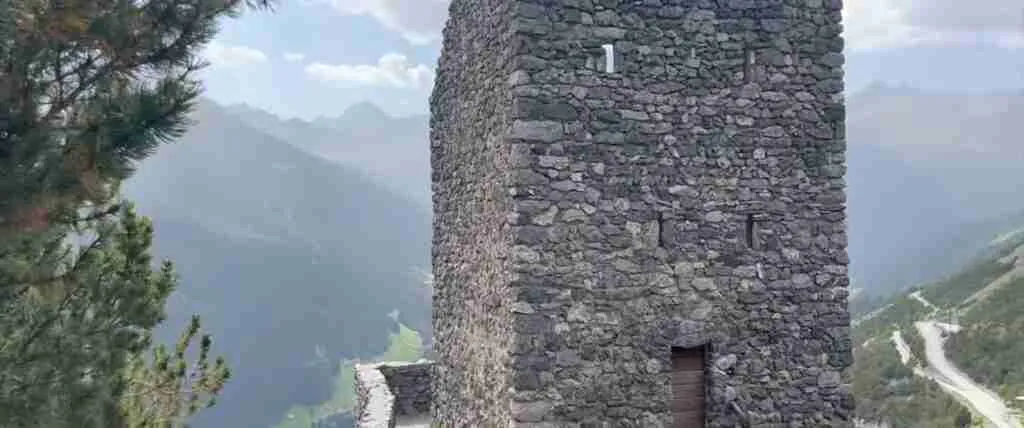
The guided tour lasts approximately one to one-and-a-half hours. Afterwards, you have free access to the castle grounds on the south summit of Castle Hill — and these are considerable. St. Faustino’s Castle (the older structure, from the 10th–11th century) is the more ruined of the two; its walls stand in partial elevation, giving a clear sense of the original perimeter without much interior standing fabric. The Visconti Castle (built between 1350 and 1375 for defensive and strategic purposes, according to the park’s own datings) is the better-preserved ruin and the more photogenic from below. Between and around the two castles, the terraced hillside opens views down to the Adda valley floor and across to the villages of Grosotto and Villa di Tirano on the opposite bank. The elevation is modest — Castle Hill rises to something over 800 metres — but the visual control it offered over the valley makes the strategic logic of the castle siting immediately obvious.
A small antiquarium within the park complex displays selected archaeological finds from excavations on the hillside: pottery sherds, metal objects, and worked stone from the different occupation phases. This is a genuine museum space, not a display cabinet, and adds another twenty to thirty minutes to the visit if you engage with it seriously.
Plan to be back at your car or the Grosio town centre by 12:30 to 13:00. The walk down from the castle grounds to the car park takes ten to fifteen minutes. From the car park, the town centre is two minutes’ drive; local restaurants begin lunch service from around 12:00 and continue to 14:30 or so.
Afternoon Excursions into Upper Val Grosina’s Stone Hamlets
The Val Grosina road departs Grosio from the town centre — follow signs for Ravoledo and then Fusino as you leave via the western end of the village. The first section of road is standard provincial asphalt, relatively wide, and rises moderately. Within about two kilometres you reach Ravoledo, the first of Val Grosina’s stone settlements. The hamlet is small and compact, built in the characteristic local material: slabs and rubble of micaschist quarried nearby, laid in rough courses with lime mortar. The roofs, originally covered with thin local stone tiles called scandole (split larch or slate wafers), have been largely replaced with corrugated metal sheet over the past century — this is almost universal in the alpine farmstead culture of the central Alps, where the economics of maintaining traditional roofs became prohibitive. The replacement material has its own rough honesty in an alpine context. From Ravoledo you can already see the valley opening above, with the two branches of Val Grosina beginning to separate against the mountain wall.
Continue from Ravoledo along the paved road, which narrows here but remains suitable for standard-wheelbase cars. The nine kilometres from Grosio to the Fusino junction climb approximately 600 metres; the gradient is consistent and undemanding for a modern car, with no significant hairpin sections on the main road. Allow fifteen to twenty minutes of driving. Fusino, sitting at around 1,200 metres, is the valley’s main inhabited focus — a cluster of stone houses and the church of the Madonna della Valle (Our Lady of the Valley), whose bell tower stands separate from the main church body in a configuration typical of certain Valtellina valley churches. Parking is available on the verge near the church; this is a practical stopping point whether you intend to walk, continue by vehicle, or simply take in the view down the valley to the Adda plain below.
At Fusino the valley divides. To the left (west), the western branch leads toward Malghera at 1,937 metres; to the right (east), the eastern branch leads toward Eita at 1,703 metres. For the western branch toward Malghera, the road continues paved but noticeably narrower — use pull-in points to allow oncoming vehicles to pass. Malghera itself is a cluster of stone alpine farmsteads (maggenghi) used seasonally for cattle pasturing; the buildings are low-roofed, thick-walled, and arranged around shared working spaces in the pattern common to high-altitude pastoral management across the Alps. Above Malghera the road ends and a path continues to Lake Malghera at 2,316 metres, a high alpine lake ringed by scree and late-season snow. On a half-day afternoon excursion, reaching the Malghera hamlet is a realistic target; reaching the lake requires a proper hiking excursion of several additional hours. For the eastern branch toward Eita, the daily vehicle permit is required for all motorised vehicles beyond the Fusino junction. Obtain it before leaving Grosio (Comune di Grosio, Via Roma) or from the automated ticket machine near the Fusino church before you drive past. Walkers and cyclists do not need the permit on either branch.
The notable landmark in the eastern branch, beyond the Eita hamlet at 1,703 metres, is the cascade locally known as the “pirla” — a waterfall that drops through a tight rock corridor in a double-stage fall. The Eita Mountain Hut (Rifugio Eita) operates seasonally and can provide a rest stop and simple food; check its current opening season before building it into your plan. The hut is approximately 4 hours on foot from Grosio via the main path, but considerably less from Fusino — perhaps an hour and a half of walking if you leave the car at Fusino and follow the eastern branch on foot.
Plan your return from Fusino or the upper valley to allow at least 30 minutes of driving to Grosio, then 15 to 20 minutes on SS38 back to Tirano. A 17:00 departure from Fusino gives you a comfortable arrival in Tirano before 18:00 — early enough for a station-area dinner or the early evening train toward Milan. If you intend to catch the last comfortable Trenord service back to Milan, check the RE8 evening timetable before your visit; the last trains depart Tirano in the late evening but the most convenient connections require leaving well before 20:00.
The Grosio Rock Engraving Park: Hours, Access, and 2026 Planning
The Grosio Rock Engraving Park — whose full Italian name covers both the municipalities of Grosio and Grosotto — was established in 1978 to protect the archaeological, historical, and landscape heritage of Castle Hill and its surroundings. The park is managed by a foundation whose members include the Province of Sondrio, the Comunità Montana di Tirano, and the municipalities of Grosio and Grosotto. Day-to-day operations are conducted in close coordination with the Archaeological Heritage Superintendency of Lombardy, which oversees research and conservation at the site.
Main season (1 April – 31 October): The infopoint and guided tours operate Tuesday through Sunday, with the infopoint open from 10:00 to 12:30 and from 13:30 to 17:30. The park is also open on Mondays that fall on public holidays. Guided tours of Rupe Magna depart at 10:30, 14:00, and 16:00. Places on each tour are limited, so advance booking is not merely recommended — on summer weekends it is effectively essential. Contact the park by email ([email protected]) or via the park’s WhatsApp line (+39 346 333 1405, available during infopoint hours). For groups of more than around eight to ten people, the park requires contact at least 48 hours before arrival so that a dedicated visit can be organised.
Winter and off-season: Outside the main season, the park operates on Saturdays and Sundays from 10:00 to 12:30 and from 13:30 to 16:00. The park announces special openings around the Christmas and New Year period. In December 2025, for example, the park was open on the last weekend of the month with guided tours at 10:30 and 14:00; similar arrangements are expected for the 2026 holiday period — confirm directly with the park as the calendar is published on a seasonal basis. The infopoint does not operate on certain public holidays even during the main season; a calendar of exceptions is maintained on the park’s official website (parcoincisionigrosio.it).
What the guided tour covers. “Discovering Rupe Magna” takes between one and one-and-a-half hours and follows a marked path on and beside the rock surface. The guide explains the engraving techniques (indirect percussion with a stone tool or metal point, depending on the period), the chronological layering of motifs, and the key identified images — the warrior figure, the wheeled-vehicle representations, the deer and bovine figures, and the abstract cup-mark and groove patterns. Guides also explain what cannot be said: which images belong to which cultural group is, in most cases, an inference from comparative regional material rather than a documented fact, and the park’s interpretation correctly presents these as working hypotheses rather than certainties.
Footwear advice from the park is explicit: bring walking shoes with a good sole, and consider wearing two pairs of socks or thermal socks in cooler months, because the tour involves standing and walking on the rock surface itself. Children under ten are admitted free; those between 11 and 18 pay €3. There is no café within the park but the infopoint sells basic refreshments; bring water and a snack for the tour itself.
The antiquarium. Within the park complex, a small antiquarium displays objects recovered from archaeological excavations on Castle Hill and the surrounding area. The material includes ceramics, worked flint, and metal objects from the Bronze Age and Iron Age layers, as well as post-Roman finds from the medieval castle phases. The display is modest in scale but directly related to what you see on the rock above — making the antiquarium worth a twenty-minute visit as contextual material.
Photography. Photography of the engravings is permitted for personal, non-commercial use. The best light on Rupe Magna falls in the morning hours, when low-angle sunlight rakes across the surface and throws the shallow-cut engravings into sharp relief. By afternoon the flat overhead light can make subtler marks difficult to see or photograph. This is one practical reason to prioritise the 10:30 tour over the 14:00 slot: the difference in photographic quality is significant.
Upper Val Grosina 2026: Road Conditions, Permits, and Hamlet Access
Val Grosina is a lateral valley of the Valtellina, draining north from the ridge that forms the Italian-Swiss watershed. The valley carries the Roasco torrent, which meets the Adda at Grosio. It divides after Fusino into the western branch (Val Grosina Occidentale, toward Malghera) and the eastern branch (Val Grosina Orientale, toward Eita). Together the two branches contain a variety of stone hamlets, high alpine farmsteads, and mountain huts that represent the pastoral economy of Grosio and Grosotto as it was organised from at least the medieval period through the twentieth century.
Road conditions: Grosio to Fusino. The road from Grosio rises through Ravoledo and reaches Fusino in approximately 9 kilometres. This section is paved with asphalt and maintained as a provincial road; it is suitable year-round for standard saloon cars in summer and autumn, and passable in winter with winter tyres or chains when snow is present on the road above Ravoledo. In practice, the risk period for snow on the lower section runs from roughly November to late March; the Grosio town hall or local weather services can advise on current conditions. Passing places exist along the narrower stretches; oncoming traffic is infrequent outside of holiday weekends. The parking area at Fusino, adjacent to the church of the Madonna della Valle, accommodates perhaps twenty to thirty cars comfortably; in high summer it can fill by mid-morning on weekends.
Road conditions: Fusino to Malghera (western branch). From the Fusino junction, the western branch rises toward Malghera through a series of tight but not technically demanding bends. The road surface is asphalt; width restricts passage to one vehicle at a time in places, so give priority to vehicles descending and use the pull-in points. There is no formal permit requirement for this branch. Malghera at 1,937 metres is the practical road terminus; beyond it, the terrain transitions to marked walking paths. Even during the core summer season the road above Fusino sees relatively low traffic volume by comparison with the busier alpine valleys further east.
Road conditions: Fusino to Eita (eastern branch), vehicle permit required. The eastern branch beyond Fusino requires a daily permit (permesso giornaliero) for all motor vehicles. Obtain this before leaving Grosio at the Comune di Grosio offices, or on the day from the automated vending machine installed near the Fusino church — the machine accepts the standard card and cash methods; confirm the current price and operating hours with the Comune di Grosio, as these details may change between seasons. Walkers, cyclists, and animals are exempt from the permit requirement. The eastern road leads to the Eita plateau at 1,703 metres and to the double-cascade waterfall known locally as the pirla, which is the branch’s main scenic attraction.
The stone hamlets: what to look for. The buildings in the maggenghi (alpine farmsteads) of Val Grosina follow the construction logic of the central Alps: thick walls of locally quarried schist laid in rough courses, small openings to conserve warmth, larch-beam interior structures, and storage volumes at ground level for hay and animals with living quarters above. The original stone tile roofs (scandole) — split from local slate or larch — have been replaced in almost all cases with corrugated metal sheeting, which extends building life substantially at a fraction of the maintenance cost. In the higher farmsteads around Malghera and Eita, buildings cluster around shared water points and tracks, forming small nuclei where the social and economic organisation of the summer pastoral cycle is still legible in the spatial arrangement. The inhabited buildings in the lower reaches of the valley (particularly around Ravoledo and the lower Fusino area) are often refurbished as holiday homes or occasional residences, while the higher-altitude clusters retain more of the working-farmstead character.
The Valgrosina Trail system, a network of marked hiking paths running through both branches of the valley and connecting to the wider Stelvio National Park and Swiss border trails, provides walking options for every level. Trail maps are available at the Grosio municipality or the park infopoint. On an afternoon excursion from the castle visit, a round walk from the Fusino car park to the lower Malghera farmsteads and back takes approximately two hours at an easy pace and offers the valley’s characteristic mix of open pasture, stream crossings, and stone architecture.
Off-Season Access in 2026: Autumn, Winter, and Spring Visits
Visiting Grosio and Val Grosina outside the main summer season involves trade-offs that are, on balance, often favourable. The valley is substantially quieter from October onward, and the landscape carries a different character in each shoulder season.
Autumn (September–October). This is arguably the finest month range for this itinerary. The park operates its full programme through October, the valley road is clear of snow, and the combination of lower temperatures, golden larch foliage, and directional light makes Castle Hill and the upper valley exceptionally photogenic. The Valtellina harvest season — grape picking along the valley terraces, chestnut gathering on the lower slopes — adds an agricultural dimension to the landscape that summer obscures. Restaurants are in full operation and the local wine, Sforzato di Valtellina (made from partially dried Nebbiolo grapes), is very much in season. Visitor numbers drop noticeably after the first week of September.
Winter (November–March). The park shifts to its weekend-only schedule; guided tours are available on Saturdays and Sundays with departures at 10:30 and 14:00, and the castle grounds remain freely accessible at any time. The Val Grosina road becomes snow-covered above Ravoledo and is typically safe only with chains or winter-rated tyres; the section from Grosio to Ravoledo is generally passable with standard winter equipment. Special park openings around Christmas and the New Year provide a themed reason to visit in the deep winter, and the park announces these dates on its website and social channels in advance.
Spring (April–May). The park reopens to its full Tuesday-to-Sunday schedule on 1 April, making late spring an excellent window. The upper valley is still snowbound above Fusino in April, but the road to Fusino itself usually clears by late March to early April. The Roasco torrent runs high with snowmelt, making the waterfalls notably dramatic. Wild flowers appear in the pastures around Fusino from late April onward. Spring weekdays are among the quietest times to visit the park — guided tours run with small groups, the parking on Via San Faustino is almost always empty on a mid-week morning, and the trattorie in Grosio are attentive to the few tables in service.
SS38 is an all-season road and is not subject to closure except in the most exceptional weather events. Tirano’s Trenord service runs year-round. There is no operational reason not to do this itinerary in any month; the seasonal choices affect what is open and what the landscape looks and feels like rather than whether the core visit is possible.
Valtellina Food and Wine: Where to Eat on the 2026 Route
Valtellina has one of the most coherent regional food identities in northern Italy: a small set of dishes made from a small set of local ingredients, repeated with enough regional pride that quality is generally reliable even in modest establishments. The combination of altitude, alpine meadow pasture, and the valley’s particular microclimate for wine production gives the cuisine a distinctive character that contrasts sharply with the richer butter and cream cooking of the western Alps or the seafood culture of the Lombardy lakes.
Pizzoccheri. The defining dish of Valtellina is a pasta made from a mixture of buckwheat flour and wheat flour, cut into short thick ribbons, boiled with cabbage and potatoes, and dressed with Casera DOP cheese (a semi-fat cows’ milk cheese from the valley) and browned butter. The final dish is dense, savoury, and warming — exactly right for a lunch between a morning at altitude and an afternoon drive up a mountain valley. Teglio, on the slope above Chiuro between Grosio and Sondrio, is the town most associated with the pizzocchero tradition, but the dish is prepared across the valley and every creditable trattoria in Grosio serves it.
Sciatt. A local fritter made by coating cubes or strips of Casera in a thick buckwheat-flour batter, then deep-frying until the exterior is crisp and the cheese interior melted. They are served hot as an antipasto or a snack and disappear quickly from the table. The name is dialect for “toad” — a reference to the irregular shape of the fritters rather than their flavour, which is distinctly more appealing than the name suggests. Order a plate of sciatt while you wait for the main course; they make a good introduction to the local cheese character.
Bresaola. Bresaola della Valtellina holds a Protected Geographical Indication (IGP) status, requiring production within the valley. It is air-dried beef (typically topside) cured with salt and spices, with the characteristic deep red colour and fine grain of a properly made product. It is served sliced thin, most commonly as a carpaccio with rocket, shaved Grana or Casera, olive oil, and lemon — a refreshing contrast to the heavier cooked dishes. A trattoria antipasto including bresaola, sciatt, and local salami makes a generous first course before pizzoccheri.
Sforzato di Valtellina DOCG. This wine, made from partially dried Nebbiolo grapes grown on the steep terraced vineyards of the valley’s north-facing slopes (confusingly, these face south into the valley), is the valley’s most distinctive product: a minimum 14% alcohol red wine with concentrated dark fruit character and notable depth. It pairs well with the pizzoccheri and the heavier meat courses. A glass with lunch is entirely appropriate; the bottle list in any Grosio trattoria will include a local Sforzato at a price significantly lower than you would pay for the same wine in Milan or on the Swiss side of the border.
Where to eat in Grosio. La Locanda di Giovanna in Grosio is the most consistently praised local option, with reviewers describing it as “cucina casalinga con cuore” — home-style cooking made with genuine care. Pizzoccheri, sciatt, and local meat dishes make up the menu. Portions are generous and the atmosphere is informal; this is a working local restaurant rather than a tourist trattoria. It carries a 4.7 average on Google (over 1,000 reviews) and a 4.5 on TripAdvisor. Booking for lunch on summer weekends is advisable. The Agriturismo Baita del Gufo in Grosotto, immediately adjacent to Grosio, serves a set menu of traditional Valtellina dishes — pizzoccheri, abundant salumi, sciatt, local cheeses, and homemade desserts — and operates with a fixed-price communal-dining format that makes it better suited to groups than individual travellers. For a quick lunch on a budget, Pizzeria Al Castello near the castle access road provides a simpler, faster option.
In Tirano. If you prefer to eat before or after Grosio rather than in it, Tirano has several trattorie near the station and the basilica. Trattoria Valtellinese in the town centre serves the local standards at fair prices. Expect to pay €18–25 for a full meal at a simple trattoria (sciatt or salumi starter, pizzoccheri, dessert, water); €28–40 in a slightly more polished restaurant setting with wine.
Day-Trip Budget for 2026: What It Costs from Tirano to Grosio
The following costs are expressed per person per day, assuming two people travelling together where accommodation is involved.
What you will always pay: The Grosio Rock Engraving Park charges €6 per adult for the guided tour — the only cost that is genuinely fixed for both tiers. The castle grounds are free at all times. Parking on Via San Faustino is free. The Val Grosina road from Grosio to Fusino is free; a permit is required (and costs a modest daily sum — confirm the current amount with the Comune di Grosio, as it is set annually) if you drive the eastern branch beyond Fusino toward Eita.
Budget tier — €35–45 per person. This covers: the regional train return from Tirano to Grosio (approximately €2–3 each way; confirm the exact fare at trenord.it), the guided park tour at €6, a coffee and pastry in Grosio before the morning tour, a simple trattoria lunch (pizzoccheri and water, €18–25), and an afternoon coffee. This tier does not include a Val Grosina drive, since without a car the upper valley requires either walking or a taxi; budget travellers without a vehicle can spend the afternoon at the castle grounds and the lower part of the valley accessible on foot from Fusino (if they can arrange a local taxi to the junction and back, add approximately €15–25 for the taxi portion).
Mid-range tier — €45–65 per person. This covers: a shared share of car fuel for the 28-kilometre round trip on SS38 (minimal cost, approximately €2–4 per person at current Italian pump prices), the guided park tour at €6, a coffee before the tour, a restaurant lunch with a glass of local Sforzato di Valtellina (€28–42), and an afternoon coffee or gelato in Grosio before returning. This tier includes the afternoon drive up Val Grosina to Fusino and back — the road is free up to Fusino, and the valley drive adds negligible fuel cost.
Overnight addition (per person, two sharing). B&B accommodation in Grosio or Tirano runs approximately €70–100 per room per night, translating to €35–50 per person. Mid-range hotels in Tirano (better equipped for the transit-passenger market, with consistent Wi-Fi and breakfast options near the station) run approximately €100–150 per room, translating to €50–75 per person. There is no high-end hotel product directly in Grosio; visitors seeking superior comfort should base themselves in Tirano and drive or train to Grosio on the day of the excursion.
What costs nothing. Castle Hill grounds and both ruined castles (St. Faustino’s Castle and the Visconti Castle) are free and open 24 hours. The drive or walk up Val Grosina from Grosio to Fusino costs nothing beyond fuel. The park’s antiquarium is included in the guided tour ticket. Browsing Grosio’s historic centre — the old town streets, the church of the Madonna delle Grazie, the views toward Castle Hill — requires no payment.
Where to Stay Near Grosio and Tirano in 2026
The accommodation offer in the immediate Grosio area is small but well-suited to the itinerary. B&B Villa Verde in Grosio positions itself near the centre and has free on-site parking — useful if you are arriving by car and want to use Grosio as your base rather than Tirano. Several other B&Bs and private rental apartments are listed in Grosio on TripAdvisor and Booking.com; prices from around €70–100 per room reflect the rural market rather than the tourist-premium pricing of the lake towns. Reviews across multiple platforms consistently highlight the local-knowledge hospitality offered by owner-operated properties in the area.
Tirano offers a wider range. Visitors arriving on the Bernina Express with onward plans often stop a night to position themselves for the morning train north or for a day in the valley, and the accommodation market around the station reflects this: there are serviced apartments, B&Bs, and small hotels within walking distance of the Tirano stations, with many properties offering free parking. The Bernina Suites apartment property, cited at around €120–130 per room per night for a 2026 spring booking in recent listings, is one example of the mid-range serviced option that suits self-catering travellers. Budget the €35–50 per person per night range for the more economical B&Bs and the €50–75 range for the mid-tier hotels; higher-end options require driving to Sondrio or Bormio.
For those who want to embed themselves in the valley rather than the main road corridor, agriturismi in the Grosio and Grosotto territory offer a genuinely different experience. Agriturismo Baita del Gufo in Grosotto, which also serves communal dinners, is the best-known option in the immediate area; several smaller farmstay properties operate in the lower Val Grosina around Ravoledo. Staying at this type of property means a self-contained evening with local food and local wine, no driving after dinner, and the morning light on Castle Hill from a position below the park — a compelling combination if you are spending more than one day in the area.
The practical argument for basing in Tirano rather than Grosio is train access: if you are relying on rail for onward travel (toward Milan or toward Switzerland), Tirano gives you the flexibility of the full Trenord and Rhaetian Railway timetable. If you have your own car for the duration, basing in Grosio itself saves the daily SS38 commute and keeps you within walking distance of the park for early morning access.
Practical Tips for Visiting Grosio and Val Grosina in 2026
Day of week. The park is closed on Mondays (except when Monday is a public holiday). Tuesday through Sunday are all valid visit days. Weekend crowds peak in July and August, particularly around Ferragosto (15 August) and the bank holidays of late April and early May. The quietest productive days are Tuesday through Thursday in the main season — full-programme operation with small tour groups and easy parking.
Timing the morning. The 10:30 guided tour is the best option for several reasons: morning light on Rupe Magna, cooler temperatures in July and August, and a clear afternoon for Val Grosina. To make 10:30 comfortably, leave Tirano no later than 09:45 if driving, or take the R12 train that arrives in Grosio by 10:00 and walk to Ca’ del Cap. Late risers can join the 14:00 tour, but this gives no afternoon for the valley; consider instead spending the morning freely exploring Castle Hill and the lower valley by foot, then joining the guided tour after lunch.
What to bring. Sturdy walking shoes with a grip sole — the Rupe Magna surface is uneven and sometimes slippery after rain. Water (at least one litre per person for the full day). Sunscreen in summer: the Castle Hill slope and the Rupe Magna surface are exposed, with little shade during the midday period. A light windproof layer for Val Grosina above 1,200 metres, where afternoon winds can pick up even in summer. A camera with a macro or close-focus capability to capture the shallower engravings on Rupe Magna — a wide phone lens does reasonably well in morning light, but the subtler marks benefit from getting close.
Language. The default language for guided tours at the park is Italian. If your party requires an English-language tour, request this explicitly when booking — the park can accommodate English commentary for groups with advance notice, but it is not guaranteed for walk-up visitors. The valley and road signage is entirely in Italian; basic familiarity with directional terms (sinistra/destra = left/right; centro/uscita = centre/exit; parcheggio = car park; chiuso = closed) is helpful.
Children. Children under ten are admitted free to the Rock Engraving Park guided tour. The walk to Ca’ del Cap is moderate and suitable for children of school age. The castle grounds are freely explorable and hold the attention of children well — the ruined walls provide natural framing for imaginative exploration. The Val Grosina road to Fusino is an easy car ride; the Fusino church area and the lower meadows around it are suitable for younger children on foot. The upper valley hikes toward Malghera and the pirla waterfall are suited to older, more confident walkers.
Mobile coverage. Signal is generally adequate on SS38 and in Grosio town. In the upper Val Grosina above Fusino, coverage becomes patchy and should not be relied upon for navigation — download offline maps before you leave Tirano. The Eita Mountain Hut may have Wi-Fi for guests when in season; do not count on connectivity above 1,500 metres for anything time-critical.
Frequently Asked Questions
When was Rupe Magna discovered, and how many engravings does it contain?
Rupe Magna was discovered in 1966. Since that date, systematic documentation has recorded over 5,000 individual engravings on its surface. The figures span a chronological range that the park’s own materials describe as running from the end of the Neolithic period to the Iron Age — broadly from the fourth millennium BC through the first millennium BC — with Latin inscriptions from the Roman period also present near the rock’s edges. The site is described by the park as one of the largest engraved rock surfaces in the Alpine arc, a characterisation that reflects the scale of the single contiguous surface rather than the total count of all engravings across a wider district.
Do I need to book the guided tour at the Grosio Rock Engraving Park in advance in 2026?
Pre-booking is strongly recommended and, during the summer peak (July through August and around bank holidays), effectively essential. Tour group sizes are kept deliberately small to protect the engravings, which means slots fill quickly. Contact the park by email at [email protected] or via WhatsApp on +39 346 333 1405 — the WhatsApp line is monitored during infopoint hours. State the date, the number of adults and children, and your preferred tour time (10:30, 14:00, or 16:00). The park will confirm availability and whether spaces remain. Walk-ups are admitted when space allows but this cannot be relied upon at peak times. Groups of more than approximately ten require at least 48 hours’ notice for a dedicated session.
What are the exact opening hours of the Grosio Rock Engraving Park in 2026?
During the main season (1 April to 31 October), the infopoint and tours operate Tuesday through Sunday, with the infopoint open from 10:00 to 12:30 and from 13:30 to 17:30; the park is also open on Mondays that fall on public holidays. Guided tours of Rupe Magna depart at 10:30, 14:00, and 16:00. Outside the main season, the park operates on Saturdays and Sundays from 10:00 to 12:30 and from 13:30 to 16:00, with special openings around the Christmas–New Year period. Exact dates of holiday closures and special winter openings are published on parcoincisionigrosio.it and should be confirmed before travel. The castle grounds are accessible on foot at any time of day, year-round, free of charge.
Is there parking at the Grosio Rock Engraving Park?
Yes. The official parking for the park is a row of free spaces on Via San Faustino in Grosio, adjacent to the A2A power station. From the car park, follow the signed path uphill to the Ca’ del Cap meeting point — the walk takes approximately eight to twelve minutes. On weekday mornings outside the summer peak, parking is rarely a problem; on summer weekends and around bank holidays, arrive before 10:00 to be sure of a space. No parking fee is charged. There is no separate designated car park within the park itself, since access to the upper site is on foot only.
Can I visit the castle grounds without buying a guided tour ticket?
Yes. The area of the two medieval castles — St. Faustino’s Castle and the Visconti Castle — on the south summit of Castle Hill is always open and free to explore without any ticket or guide. You can walk up to the ruins at any time of day or night, year-round, independently. The guided tour ticket covers access to Rupe Magna itself, which requires a guide for access. If you are visiting on a Monday (when the infopoint is closed and tours do not run, except on public holidays) or arriving outside infopoint hours, the castle grounds remain accessible and make a worthwhile standalone visit.
What is the daily vehicle permit required for Val Grosina beyond Fusino, and where do I get it?
The daily vehicle permit (permesso giornaliero) is required for all motor vehicles wishing to use the eastern branch of the Val Grosina road beyond Fusino — the road toward Eita. It is not required for the western branch toward Malghera, nor for the road from Grosio to Fusino. The permit can be obtained from the Comune di Grosio offices (Via Roma, Grosio) before you leave for the valley, or on site from the automated ticket machine installed near the church of the Madonna della Valle in Fusino. The current price is set annually; confirm the amount and machine operating hours with the Comune di Grosio before your visit. Walkers, cyclists, and non-motorised users of the eastern branch do not require the permit and may use the road freely.
How long does the full-day Tirano to Grosio to Val Grosina itinerary take?
A comfortable full-day schedule runs from approximately 09:30 departure from Tirano to 17:30–18:00 return. The breakdown is roughly: 20-minute drive to Grosio; 10-minute walk to Ca’ del Cap; 90-minute guided tour of Rupe Magna; 30-minute free exploration of the castle grounds; 30-minute walk down and drive to a restaurant; 75-minute lunch; 30-minute drive up Val Grosina to Fusino; 90 minutes exploring the valley (on foot from Fusino or by car if using the western branch toward Malghera); 30 minutes’ drive back to Tirano. The itinerary compresses to a half-day if you skip the valley excursion entirely — park, castle, and lunch fit easily into a 09:30–13:30 window, leaving the afternoon free for Tirano itself or an onward train.
What local dishes should I try near Grosio in 2026?
Pizzoccheri is the essential first course: short buckwheat-flour pasta cooked with cabbage and potatoes and dressed with Casera DOP cheese and melted butter. Begin with sciatt — Casera cheese fritters deep-fried in a buckwheat batter — as an antipasto; they are served hot and should be eaten immediately. Bresaola della Valtellina IGP, air-dried beef served thinly sliced with olive oil and lemon, makes a lighter alternative starter. Casera cheese itself, at various stages of ageing, appears on cheese plates and in cooking throughout the valley. For wine, order a Sforzato di Valtellina DOCG — a concentrated, high-alcohol red made from partially dried Nebbiolo — for a glass with your main course. La Locanda di Giovanna in Grosio is the most-praised local option for all of these dishes.
Is Grosio accessible from the Bernina Express route?
Grosio is not a stop on the Bernina Express or Rhaetian Railway line, which terminates at Tirano (Italy) having crossed from St. Moritz or Chur via the Bernina Pass. From Tirano, passengers wishing to visit Grosio have two options: rent a car or use a taxi from Tirano (about 14 km on SS38, taking 20 minutes), or take the Trenord R12 regional train from the adjacent Italian Tirano station in the direction of Sondrio (Grosio is a stop on this local service). Many travellers arriving on the Bernina Express stop a night in Tirano to recover from the crossing and explore the immediate area; adding Grosio as a day excursion during that Tirano stopover is a natural fit.
What is the best time of year to visit Grosio and Val Grosina in 2026?
Late spring (late April to early June) and early autumn (September to mid-October) are the recommended windows for this itinerary. In late spring, the park is in full operation from early April, the valley road is clear of snow, wildflowers appear at altitude, and visitor numbers are well below the summer peak. In early autumn, larch foliage turns gold, the Sforzato di Valtellina harvest is underway on the terraced vineyards below, the light is warm and directional for photography, and the park still operates its full guided-tour schedule until the end of October. July and August are perfectly viable but bring significantly more traffic on SS38 and more competition for tour slots and restaurant tables. Winter visits are best focused on the castle grounds and a weekend guided park tour, combined with the specific pleasures of an alpine valley under snow.