
Toledo UNESCO World Heritage Guide: Three Cultures City
Perched on a granite outcrop above a tight bend in the Tagus River, Toledo holds more than two thousand years of layered history within a single square kilometer of medieval lanes and stone monuments. Inscribed on the UNESCO World Heritage List in 1986 under four cultural criteria, the Historic City of Toledo reflects an extraordinary concentration of civilizations — Roman, Visigothic, Islamic, Jewish, and Christian — that built, inhabited, and transformed this ridge. Toledo’s identity as the “City of the Three Cultures” makes it one of the most compelling heritage destinations in Spain.
Key Takeaways
- The Historic City of Toledo was inscribed on the UNESCO World Heritage List in 1986 under cultural criteria (i), (ii), (iii), and (iv), recognizing it as one of the world’s most remarkable accumulations of monumental heritage from multiple civilizations.
- Toledo served successively as a Roman municipium, the capital of the Visigothic kingdom (542–725 CE), a stronghold of the Emirate of Córdoba, a seat of the Castilian crown, and, in the 16th century, the imperial residence of Charles V — earning it the additional title of “Imperial City.”
- The city’s “Three Cultures” identity refers to the medieval coexistence — complex, unequal, and at times violently contested — of Christian, Jewish, and Islamic communities, whose architectural legacies survive in a remarkable density of monuments.
- Major monuments include Toledo Cathedral (begun 1226), the Alcázar of Toledo (housing the Army Museum), the El Tránsito Synagogue with its attached Sephardic Museum, the Santa María la Blanca synagogue, the Cristo de la Luz Mosque (built 999 CE), and multiple sites connected to the painter El Greco.
- Toledo is 70 kilometers south of Madrid and reachable in approximately 30 minutes by high-speed train, making it the most accessible major UNESCO site from the Spanish capital and one of the most visited day-trip destinations in the country.
People Also Ask About Toledo UNESCO World Heritage
What makes Toledo a UNESCO World Heritage Site?
UNESCO inscribed the Historic City of Toledo in 1986 under four cultural criteria. Under criterion (i), the city is recognized as a unique and uninterrupted artistic achievement encompassing Visigothic churches, Mudéjar monuments, Gothic and Renaissance masterpieces, and Baroque ensembles spanning nearly fifteen centuries. Under criterion (ii), Toledo’s influence extended across the Iberian Peninsula and, through its School of Translators, helped transmit Greek and Arabic scientific thought to medieval European scholarship. Criterion (iii) acknowledges the city as an exceptional witness to civilizations — most notably the Visigothic kingdom and the Hispano-Moorish world — that have since profoundly transformed. Criterion (iv) recognizes the historic urban ensemble itself as an outstanding architectural example where three major religions coexisted and whose combined monuments form an irreplaceable cultural landscape. The designated property covers 259.85 hectares of the historic core, with a buffer zone extending to nearly 7,670 hectares of the surrounding territory.
What are the three cultures of Toledo?
The phrase “Three Cultures” refers to the Christian, Jewish, and Islamic communities that inhabited Toledo during the medieval period, primarily between the Moorish conquest of the early 8th century and the expulsion of Jews in 1492 and the forced conversion of Muslims in subsequent decades. During Toledo’s most celebrated era — roughly the 10th through 14th centuries — these communities lived in relative proximity within the city’s walls, each maintaining its own religious institutions, legal frameworks, and cultural practices. Historians use the Spanish term convivencia (coexistence) to describe this period, though it is worth noting that scholars debate the nature and extent of this coexistence: relations between communities were governed by legal hierarchies of subordination rather than equality, and periods of genuine cultural exchange alternated with episodes of persecution, violence, and forced conversion. Toledo’s contemporary use of the Three Cultures identity celebrates the genuine architectural and intellectual exchanges of the medieval city while increasingly acknowledging the complexities of the underlying history.
What are the must-see monuments in Toledo’s historic center?
Toledo Cathedral, begun in 1226, is the non-negotiable starting point — a Gothic masterpiece housing works by El Greco, Caravaggio, and Titian alongside the extraordinary Baroque Transparente altarpiece. The El Tránsito Synagogue, built in 1355–1357 for treasurer Samuel ha-Levi, displays some of the finest Mudéjar stucco work in Spain and contains the attached Sephardic Museum. The Cristo de la Luz Mosque, dating to 999 CE, is among the oldest and most complete surviving Hispano-Moorish structures in Castile. Santo Tomé Church houses El Greco’s masterpiece The Burial of the Count of Orgaz (1586–1588) in an intimate and properly lit setting designed for the painting. The El Greco Museum, the Alcázar of Toledo, San Juan de los Reyes Monastery, and the Santa María la Blanca synagogue round out a circuit that can occupy a full day comfortably. The Toledo Tourist Bracelet (€12) offers combined entry to seven of these monuments at a meaningful saving over individual tickets.
How does Toledo’s Mudéjar architecture reflect its multicultural heritage?
Mudéjar architecture is one of Toledo’s most distinctive contributions to the history of world art and a direct material expression of the city’s multicultural past. The style emerged from the work of Muslim craftsmen and builders who remained in Castilian Toledo after the Christian reconquest of 1085, applying Islamic decorative vocabularies — geometric tilework, intricate stucco arabesques, ornamental brickwork, artesonado (coffered) timber ceilings — to buildings commissioned by Christian and Jewish patrons. The result is a hybrid aesthetic found nowhere else at this concentration: churches with minaret-shaped towers (such as Santo Tomé Church’s 14th-century tower), a synagogue built entirely in the manner of a mosque (Santa María la Blanca), and royal chapels where Gothic arches spring from surfaces tiled in Moorish geometric patterns. Toledo’s Mudéjar monuments were among the earliest examples recognized as a distinct historical style, and the city remains the best single location in Spain to understand how medieval Christian patronage absorbed and transformed Islamic artistic traditions.
Extended multi-day tours – 5+ days
Featured Toledo Multi-Day Tour Packages
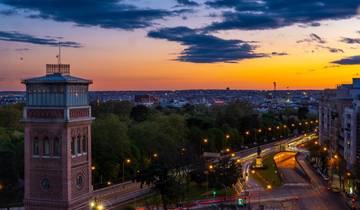
7 days
7 Days in Madrid: Echoes of Empire: Madrid, Ávila & Segovia
- ✓ Comprehensive Toledo tour
- ✓ Expert local guides included
- ✓ All accommodation arranged
- ✓ Transportation provided

4 days
Madrid: Cultural Experience with Toledo Half-day tour, City Break
- ✓ Comprehensive Toledo tour
- ✓ Expert local guides included
- ✓ All accommodation arranged
- ✓ Transportation provided
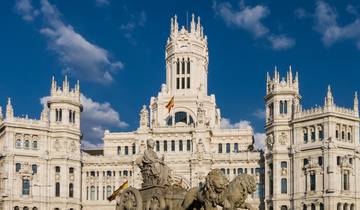
5 days
5-Day Madrid Including Toledo, Avila and Segovia
- ✓ Comprehensive Toledo tour
- ✓ Expert local guides included
- ✓ All accommodation arranged
- ✓ Transportation provided
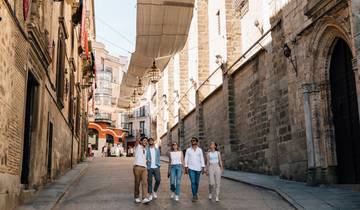
2 days
Segovia, Avila and Toledo in 2 days from Madrid
- ✓ Comprehensive Toledo tour
- ✓ Expert local guides included
- ✓ All accommodation arranged
- ✓ Transportation provided
Multi-day tour packages powered by TourRadar. Prices and availability subject to change.
Introduction: Two Thousand Years on the Tagus
Few cities in Europe pack as much civilizational weight into as compact a terrain as Toledo. The old city occupies a peninsula of granite barely a kilometer across, wrapped on three sides by the looping Tagus River and accessible from the surrounding plain only across a narrow causeway to the north. This natural fortification attracted successive powers over two millennia — each leaving buildings, languages, and customs that the next partially absorbed and partially replaced. The result is a city where, within a ten-minute walk, a visitor passes a Moorish city gate, a Visigothic church, a Gothic cathedral, a synagogue built by Muslim craftsmen, a mosque repurposed as a hermitage, and an imperial palace rebuilt as a military museum. Toledo is not a museum of one civilization; it is a palimpsest of many.
The Romans knew Toledo as Toletum, and by the imperial period it was already a significant settlement on the road between Mérida and Zaragoza, famed for the quality of its steel. The Visigoths raised Toledo to the capital of their kingdom in 542 CE under King Athanagild, and for nearly two centuries the city hosted a succession of church councils — the Councils of Toledo — that shaped the ecclesiastical and legal foundations of early medieval Iberia. The councils, some convening more than a hundred bishops from across the peninsula, made Toledo the primatial see of Hispania, a status that Toledo’s archbishops have defended — with varying success — ever since.
The Islamic conquest of 711–712 CE brought Toledo into the orbit of the Umayyad Emirate of Córdoba. The city became known as Tulaytulah, and over the following three and a half centuries it developed into a substantial urban center with mosques, markets, and a diverse population. The reconquest of Toledo by Alfonso VI of Castile in 1085 — secured by treaty rather than siege — opened a new chapter in which the city’s Muslim inhabitants (the Mudéjars who chose to stay) and its Jewish community (long-established and economically prominent) continued to live under Christian rule, contributing to the intellectual and architectural efflorescence of the 12th and 13th centuries.
This chapter, sometimes called Toledo’s golden age of translation, saw teams of scholars at the city’s School of Translators working to render into Latin the scientific, philosophical, and mathematical works preserved in Arabic — Aristotle, Ptolemy, Avicenna, al-Khwarizmi — making Toledo a primary channel through which classical learning re-entered European intellectual life. The school was not a formal institution with a building but a loose community of scholars, some working under archiepiscopal patronage, who operated across much of the 12th and 13th centuries. Its significance in the broader history of European scholarship is widely recognized and has contributed materially to Toledo’s UNESCO designation under criterion (ii).
By the 14th century, Toledo was the largest city in Castile and the preferred residence of the Castilian court. It was also a city of growing tensions: the 1391 pogrom swept across the city’s Jewish quarter with devastating effect, the 1449 anti-converso riots produced some of the earliest articulations of “limpieza de sangre” (blood purity) statutes in Iberian history, and the 1492 Alhambra Decree expelled the remaining Jewish population. The city’s Muslim community was effectively forcibly converted between 1502 and 1526. The multicultural medieval city came to an end not gradually but through a series of specific and documented ruptures — a history the city’s monuments bear witness to with considerable fidelity.
Charles V chose Toledo as his imperial seat in the early 16th century, bestowing on it the title of “Imperial City” and commissioning extensive building projects — including the enlargement of the Alcázar — that added a Renaissance and Plateresque layer to the accumulated medieval fabric. When Philip II moved the court permanently to Madrid in 1561, Toledo’s political centrality ended, but its cultural weight endured. The painter Doménikos Theotokópoulos, who arrived from Rome in 1577 and remained until his death in 1614, made the city the setting of his mature work and became inextricably associated with it under the name by which he is universally known: El Greco.
Toledo and UNESCO: The Inscription and Its Criteria
The UNESCO World Heritage Committee inscribed the Historic City of Toledo at its tenth session in 1986, naming the city officially as the “Historic City of Toledo” and assigning it reference number 379. The inscription covers 259.85 hectares of the historic core and designates a buffer zone of approximately 7,669 hectares of surrounding territory, reflecting the importance of the river landscape and the views of the city from across the Tagus that have been captured in paintings, engravings, and photographs since at least the 16th century — most famously in El Greco’s View and Plan of Toledo, the original of which hangs in the El Greco Museum.
The four UNESCO criteria under which Toledo is inscribed capture the full range of the city’s significance. Criterion (i) recognizes Toledo as a unique artistic achievement: the city presents an uninterrupted succession of remarkable monuments from the Visigothic period through the Baroque, with no single dominant style but a continuous accumulation that makes the historic center itself — its streets, gates, towers, and river views — an artwork in the broadest sense. Criterion (ii) acknowledges the city’s influence beyond Spain: through its translation school, its model of multicultural urban administration, and its artistic exports (most significantly El Greco, whose work profoundly influenced Spanish and European painting), Toledo shaped intellectual and aesthetic developments across the continent. Criterion (iii) designates Toledo as an exceptional testimony to civilizations that have since disappeared or profoundly transformed: the Visigothic kingdom, the Hispano-Islamic city, and the Sephardic Jewish community of medieval Iberia exist in Toledo as tangible and accessible remains. Criterion (iv) recognizes the historic city as an outstanding example of an architectural ensemble in which the coexistence of three major religions over centuries produced a unique built environment.
Jewish Toledo: The Medieval Judería and Sephardic Legacy
Toledo’s Jewish community, known collectively as the Aljama of Toledo, was among the largest and most prominent in medieval Iberia. Though the precise origins of Jewish settlement in Toledo are not definitively established, documented evidence places an active and legally recognized Jewish community in the city by the early Visigothic period. Under Islamic rule the community continued and expanded, and under the early Castilian kings — particularly Alfonso VI and Alfonso X (“the Wise”) — it reached its greatest prosperity and cultural production. Jewish scholars participated in the translation school, Jewish courtiers served as royal treasurers and administrators, and Jewish craftsmen contributed to the mixed artistic workshop culture that produced Toledo’s Mudéjar monuments.
The Jewish quarter, known as the Judería, occupied the southwestern corner of the historic center, a dense network of lanes around what is now the Calle de Samuel Levi. At its height, Toledo may have had as many as ten or eleven synagogues; two survive as the most significant examples of medieval Jewish architecture on the Iberian Peninsula.
The El Tránsito Synagogue and the Sephardic Museum
The El Tránsito Synagogue stands as the preeminent surviving monument of Spanish Jewish culture. It was commissioned by Samuel ha-Levi Abulafia, the treasurer of King Pedro I of Castile, and built between approximately 1355 and 1357. The building is documented by its own fabric: Hebrew inscriptions in the stucco work praise both King Pedro and Samuel ha-Levi, the latter identified as the patron of the work. The scale and ambition of the synagogue reflect Samuel ha-Levi’s extraordinary wealth and royal favor — a favor that did not ultimately protect him; in 1360 he was arrested on the orders of Pedro I, his property confiscated, and he died in prison in Seville.
The interior is among the finest surviving examples of Mudéjar decorative art anywhere in Spain. The main prayer hall is a single rectangular space dominated by a spectacular carved and gilded timber ceiling, its design deriving from the elaborate artesonado tradition of Islamic woodworking. The walls rise through multiple registers: a lower zone of plain stone, then a band of exceptionally fine carved stucco panels combining vegetal arabesques, geometric patterns, and calligraphic inscriptions in both Hebrew and Arabic. The Hebrew inscriptions quote Psalms and praise the building’s patron; the Arabic inscriptions (written in Nasrid-style script closely related to the decoration of the Alhambra in Granada) are largely ornamental but demonstrate the degree to which Islamic decorative conventions were available as a shared artistic vocabulary for all communities in 14th-century Toledo.
Following the expulsion of the Jews in 1492, the Catholic Monarchs granted the building to the Military Orders of Calatrava and Alcántara, who converted it into a church. The name “del Tránsito” derives from a 17th-century painting of the Assumption of the Virgin that once decorated the altar of the church. During the Napoleonic occupation, the building served as a military barracks; declared a National Monument in 1877, it underwent restoration and was opened to the public as the Sephardic Museum in 1971.
Today the museum contains artifacts, documents, and objects relating to the Sephardic Jewish communities of Spain and their diaspora — those expelled families who settled in the Ottoman Empire, North Africa, the Netherlands, and elsewhere, many preserving the Judeo-Spanish language (Ladino) and Iberian cultural traditions for centuries. Admission costs €3 for adults; children under 18, seniors over 65, and university students enter free. Entry is free for all on Saturday afternoons and all day Sunday. The museum is open Tuesday through Saturday, 9:30 am to 6 pm (to 7:30 pm in summer), and Sunday 10 am to 3 pm; it is closed Mondays.
The Santa María la Blanca Synagogue
A short walk from the El Tránsito Synagogue stands the Santa María la Blanca synagogue, one of the most architecturally distinctive religious buildings in Spain — distinguished above all by the paradox of its appearance: a building that looks, at first glance, far more like a mosque than a synagogue, and which was eventually converted into a Catholic church. The building is generally dated to the late 12th or early 13th century, though the precise original patron and date of construction are not firmly established in the surviving documentary record. What is clear from the structure itself is that it was built by Muslim craftsmen working in the Almohad tradition for a Jewish community, producing a space whose five aisles are separated by octagonal brick piers topped with pine-cone capitals supporting horseshoe arches — an aesthetic derived directly from Andalusian mosque architecture.
The white-washed interior, with its slender columns and rhythmic arcades, has a singular atmosphere that draws visitors regardless of any religious or historical context. The lower walls carry Mudéjar plaster decoration in geometric patterns; the upper registers give way to plain whitewashed surfaces that enhance the sense of light and space. The overall effect is calming, almost hypnotic — a quality that may explain why the building has attracted so many reinventions. In 1411, during the wave of anti-Jewish violence associated with the preaching of the Dominican friar Vincent Ferrer across Castile, the synagogue was seized and converted into a Christian church, taking the name of Mary the White (Santa María la Blanca). Later it served as a hermitage, a convent for reformed women, and a military barracks before being declared a National Monument in 1851.
Santa María la Blanca is open daily 10 am to 5:45 pm (hours may vary seasonally — confirm locally). Admission costs €3 for adults, with reduced rates of €2.50 for students, youth card holders, and children aged 11 to 14. Children under 11 enter free.
The Expulsion of 1492 and the End of Sephardic Toledo
The Alhambra Decree of March 31, 1492, issued by the Catholic Monarchs Ferdinand and Isabella, ordered the expulsion of all Jews from Spain who refused baptism. The Jewish population of Toledo — estimates suggest several thousand individuals — faced the choice of conversion or exile, with a deadline of July 31. The exodus was one of the largest forced migrations of the late medieval world. Those who left became the Sephardim (from the Hebrew name for Spain, Sefarad), establishing communities across the Mediterranean — most significantly in the Ottoman Empire, where Sultan Bayezid II reportedly encouraged their immigration — as well as in North Africa, the Netherlands, and later the Americas. Many descendants of these communities preserved Ladino, the Judeo-Spanish language, into the 20th century; it remains spoken by small communities today.
The Sephardic Museum in Toledo carries the primary responsibility for telling this story to visitors, and does so with particular attention to the communities that formed in exile rather than ending the narrative with 1492. The museum has become an important site for Sephardic heritage tourism, with visitors from Israel, Turkey, Morocco, and the broader Sephardic diaspora making deliberate pilgrimages to the Judería of their ancestral city.
Islamic Toledo: Mosques, Mudéjar Craft, and the City’s Moorish Layer
Toledo was part of the Umayyad Emirate of Córdoba from the early 8th century, and its development as an Islamic city over three and a half centuries left a deep imprint on the urban fabric — in its street pattern (still following roughly the medieval grid of the Moorish city), in its artisan traditions, in its cuisine, and above all in the hands of the Muslim craftsmen who continued working long after the Christian reconquest and whose skills shaped the Mudéjar monuments that define Toledo’s architectural character.
The Cristo de la Luz Mosque
Of the approximately ten mosques that existed in Islamic Toledo, only one survives in recognizable form: the Cristo de la Luz Mosque (Mezquita del Cristo de la Luz), a small but extraordinarily important building in the north of the historic center, just inside the old city walls near the Bisagra Gate. An Arabic inscription preserved inside the mosque gives its foundation date as the year 999 CE, during the reign of the Caliph Hisham II, and records the name of its patron as Ahmad ibn Hadidi. This makes it one of the rare surviving Hispano-Umayyad buildings in Castile and one of the most precisely dated small mosques in the medieval Islamic world.
The building is tiny — its prayer hall measures roughly 8 by 8 meters — but its nine equal bays, each covered by a small ribbed dome of different design, constitute a sophisticated exercise in structural variety. The arches are horseshoe in form, carried on slender columns with Visigothic capitals reused from earlier buildings on the site, an architectural spolia practice common throughout the early Islamic period in Iberia. The variety of the nine domes — no two identical — suggests a virtuoso demonstration of the mason’s art, displaying the range of muqarnas, ribbing, and interlacing patterns available in the Córdoban repertoire at the turn of the first millennium.
After Alfonso VI reconquered Toledo in 1085, local tradition holds that the king’s horse knelt at the site and a hidden image of Christ was found with an oil lamp still burning — hence “Cristo de la Luz” (Christ of the Light). Whether this foundation story reflects any historical event is impossible to verify; it reads as a typical type of reconquest legend that attributed miraculous discoveries to the restoration of Christian sovereignty. What is documented is that the building was subsequently used as a church for several centuries, with an apse added to the east end in the 12th century, before eventually falling into disuse and undergoing restoration in the 20th century.
Today the mosque is open daily from 10 am to approximately 6:45 pm (with a midday closure on weekdays). Admission costs €4 for adults; children under 11 enter free.
Mudéjar Architecture: The Cross-Cultural Synthesis
The greatest architectural legacy of Toledo’s Islamic heritage is not a single building but a style: Mudéjar. The term derives from the Arabic word for those permitted to remain (mudajjan), and refers to Muslim craftsmen and builders who continued working in Christian territories after the reconquest, adapting Islamic decorative techniques to the requirements of Christian and Jewish patrons. Toledo was the original home of Mudéjar architecture; the style developed here before spreading across Castile, Aragón, and ultimately the Americas, where its influence can be traced in colonial cloister designs and azulejo tilework from Seville to Lima.
The Toledo Mudéjar tradition is most visible in the series of Romanesque-Mudéjar churches built in the 12th and 13th centuries — particularly in their towers, which closely resemble Islamic minarets in their square form, multiple arcaded storeys, and geometric brick decoration. The tower of Santo Tomé Church, rising above the Jewish quarter, is among the best-preserved examples. San Sebastián Church and Santiago del Arrabal Church also display characteristic Mudéjar tower forms, the latter notable for its exceptional quality of blind arcading and geometric brickwork.
Mudéjar also appears abundantly in domestic architecture and in institutional buildings: the cloister of the San Juan de los Reyes Monastery incorporates Mudéjar tiles and decorative elements within its Gothic structure; the Taller del Moro (workshop of the Moor), a surviving fragment of a 14th-century palace, preserves magnificent carved plaster ceilings in the Nasrid style; and the palace-chapel of the Alcázar de Toledo has Mudéjar elements embedded within its successive rebuildings. The city’s artisan tradition — still active in the production of ceramic tiles and decorative metalwork — draws directly on this Mudéjar inheritance.
The City’s Gates and Walls
Toledo’s defensive circuit preserves several important medieval gates that mark the boundaries between the Islamic, Christian, and transitional phases of the city’s development. The most monumental is the New Bisagra Gate (Puerta Nueva de Bisagra), the principal northern entrance to the city, rebuilt in its current Herreran form in 1559–1566 on the orders of Cardinal Silíceo. Its twin circular towers and massive central arch carry the imperial coat of arms of Charles V, framing the view up the main thoroughfare toward the city’s center. A short distance to the east, the much older Puerta Vieja de Bisagra (Old Bisagra Gate) dates to the Hispano-Moorish period, likely the 9th or 10th century, and retains its horseshoe arch in a near-intact state — a rare survival of a pre-Romanesque gateway.
The Sun Gate (Puerta del Sol) stands somewhat inside the medieval perimeter and dates to the 14th century. It is a particularly fine example of Mudéjar gateway construction, its upper zone carrying a horseshoe arch framed within a rectangular alfiz and decorated with a carved tympanum that mixes Christian iconographic elements with Islamic decorative borders. The gate once served as a checkpoint for the Knights Hospitallers and preserves its medieval wooden doors.
Christian Toledo: Gothic Grandeur, Imperial Power, and Royal Patronage
Christian Toledo accumulated its own extraordinary layer of monuments from the reconquest of 1085 through the imperial period of the 16th century. The most significant were built in concentrated bursts of patronage — the 13th-century gothic cathedral under a series of powerful archbishops, the late 15th-century San Juan de los Reyes Monastery under the Catholic Monarchs, and the 16th-century Alcázar expansion under Charles V — leaving a Christian monumental heritage that rivals in scale and quality anything in Spain outside Seville and Santiago de Compostela.
Toledo Cathedral: The Primate of Spain
Toledo Cathedral is officially styled the Primate Cathedral of Spain, reflecting the archdiocese’s historical claim to primacy over all other sees in the country — a claim long contested by the see of Tarragona but recognized in ecclesiastical practice. The building that stands today was begun in 1226, though portions of an earlier Visigothic cathedral and a Moorish mosque occupied the same site previously. Construction proceeded across nearly three centuries, giving Toledo Cathedral the layered quality typical of great medieval building campaigns: early sections in a relatively pure French Gothic style, later additions introducing Spanish Gothic innovations, and final elements — particularly the choir stalls and the magnificent Transparente altarpiece — reaching into the 15th and early 18th centuries respectively.
The scale of the cathedral is immediately impressive: five aisles, eighty-eight columns, twenty-two side chapels, and what are commonly reported to be approximately 750 stained glass windows — figures that convey the cathedral’s ambition as a building of continental significance within the Gothic tradition. The main façade, facing the square known as the Bishop’s Plaza, presents three elaborately carved portals: the central Perdón Gate (Door of Pardon), the Inferno Gate to the right, and the Judgment Gate to the left, all bearing sculptural programs developed across the 13th through 15th centuries.
Inside, several elements demand particular attention. The choir, enclosed within gilded ironwork screens (rejas) of exceptional craftsmanship, contains carved walnut stalls depicting scenes from the conquest of Granada (lower stalls, 15th century) and alabaster figures of the apostles and prophets (upper stalls). The Sacristy houses a remarkable collection of paintings: a large El Greco composition depicting the disrobing of Christ (El Expolio), a Caravaggio, a Velázquez, and works by Van Dyck, Titian, and Goya — an accumulation that reflects both the archdiocese’s historic wealth and its role as a center of artistic patronage over centuries.
The single most theatrically spectacular element in the cathedral is the Transparente, a Baroque altarpiece carved in stone, marble, and gilded stucco by Narciso Tomé, completed in 1732. Tomé opened a lantern in the Gothic vault above the altarpiece to flood it with natural light, creating an effect of apparently supernatural illumination: figures of angels, clouds, and sunbursts cascade through the opening in controlled ecstasy. It is one of the most audacious pieces of Baroque spatial design in Spain and has been both celebrated as a tour de force of light manipulation and criticized as excessive. It remains the object that most surprises visitors who encounter it unprepared.
Toledo Cathedral is open Monday to Saturday from 10 am to 6:30 pm and Sunday from 2 pm to 6:30 pm (last entry 30 minutes before closing). It is closed January 1 and December 25. General admission costs €10, including access to the cathedral building, Sacristy, Treasury, Choir, Chapter House, and a compulsory audio guide. Reduced admission of €9 applies to visitors over 65, families with more than two children, and teens aged 13 to 15. Children under 12 accompanied by an adult enter free, as do residents of the Archdiocese of Toledo. Check the official website for current rates and holiday schedules, as special timetables apply on numerous feast days throughout the year.
San Juan de los Reyes Monastery
The San Juan de los Reyes Monastery occupies the western edge of the historic center above the Tagus gorge, and its construction history encodes the political ambitions of 15th-century Castile. The Catholic Monarchs, Ferdinand and Isabella, commissioned it as a thanksgiving monument following their victory at the Battle of Toro in 1476 — a confrontation that secured their hold on the Castilian throne against the rival claim of Juana la Beltraneja backed by Portugal. Documents attribute the architectural design to Juan Guas, the master mason who also worked on the Cathedral in Segovia and brought a distinctive synthesis of Flemish Gothic and Spanish Plateresque to Castilian royal patronage.
The style of San Juan de los Reyes is often termed Isabelline Gothic, a specifically Castilian variant of late Gothic characterized by exuberant surface ornament, heraldic devices deployed at architectural scale, and structural logic somewhat subordinated to decorative ambition. The cloister is the finest element: a double-storey structure combining Gothic tracery windows with Mudéjar tile paving and carved capitals that escalate in complexity from naturalistic foliage to full narrative scenes. The exterior of the church bears, on iron hooks affixed to the masonry, the actual chains freed from Christian prisoners liberated during the Granada campaign — a deliberate act of triumphal display that required seeing the building as a monument in a continuing royal narrative, not merely as a place of worship.
The monastery was intended by the Catholic Monarchs as their mausoleum, but after the conquest of Granada in 1492 they chose to be buried there instead, and Toledo’s complex was abandoned to the Franciscan friars who occupied it. Napoleon’s troops damaged it severely in 1808; it was partially rebuilt in the late 19th century. The restored cloister and church are open to visitors daily, with the Toledo Tourist Bracelet (€12) covering admission as part of its seven-monument circuit.
The Alcázar of Toledo and the Army Museum
The Alcázar — a massive square fortress dominating the highest point of the historic rock — has been rebuilt so many times that relatively little of any single historical period survives in its current form. The Romans fortified the site; the Visigoths built a palace here; the Moors maintained a citadel; Alfonso VI converted it to Christian use after 1085; Alfonso X constructed the royal residence that Charles V subsequently enlarged into an imperial palace in the 16th century. The court architect Alonso de Covarrubias designed the main façades in the early Renaissance style, and his plans gave the building the square plan with four corner towers that its silhouette still presents across the Toledo skyline.
The Spanish Civil War produced the Alcázar’s most dramatic chapter. In July 1936, the Nationalist colonel José Moscardó barricaded himself inside with roughly 1,300 military cadets, guardsmen, and civilians, withstanding a Republican siege of seventy days until Franco’s relief column arrived in September. The building was reduced to ruins in the process; the reconstruction, completed by 1961, is entirely modern in its interior fabric, though preserving the external Covarrubias silhouette. The ruins of the original basement and the colonel’s telephone booth where he reportedly received a telephone ultimatum are preserved as a memorial within the current museum complex.
Since 2010, the Alcázar has housed the Army Museum, relocated from Madrid. The museum’s extensive collections — uniforms, weapons, military models, maps, and documents spanning from the medieval period to the 20th century — are displayed across the Alcázar’s modernized interior with considerable exhibition sophistication, though the space prioritizes encyclopedic coverage over narrative interpretation. The museum is open Thursday through Tuesday, 10 am to 5 pm; it is closed Mondays and on January 1 and 6, May 1, and December 24, 25, and 31. General admission is €5; concessions (groups of cultural or educational institutions of 15 or more) cost €2.50. Visitors under 18 enter free. Admission is free for all on Sundays.
El Greco and Toledo’s Golden Age of Art
No figure is more closely identified with Toledo than the painter known as El Greco. Doménikos Theotokópoulos was born in Crete, probably around 1541, and trained in Venice within the tradition of late Byzantine icon painting before studying in Rome in the orbit of Italian Mannerism. He came to Toledo in 1577, apparently in pursuit of a commission to paint the altarpiece for the Monastery of Santo Domingo el Antiguo. He remained in the city until his death in 1614 — 37 years — producing the bulk of the mature work that established his reputation as one of the great singularities of European painting.
Why Toledo held El Greco so tenaciously is a question that art historians have approached from multiple angles. The city offered a demanding but appreciative market in its numerous churches, convents, and wealthy ecclesiastical patrons; it had an active intellectual life centered on its cathedral chapter; and it contained a cosmopolitan residue of Greek, Italian, and Flemish influences that may have made El Greco feel less foreign than he would have in Madrid. His workshop produced at extraordinary scale — painting large altarpieces for institutional clients while simultaneously developing the elongated, flame-like figures and lurid atmospheric light that would define his late style and beguile 20th-century artists and critics who saw in his Expressionistic distortions a precursor of their own sensibilities.
The Burial of the Count of Orgaz
El Greco’s most celebrated work in Toledo is The Burial of the Count of Orgaz, painted between 1586 and 1588 for the church of Santo Tomé and visible there today in the setting for which it was designed. The painting was commissioned in 1586 by the parish priest Andrés Núñez de Madrid to commemorate the legendary burial of Gonzalo Ruiz de Toledo, the 14th-century lord who had been a generous benefactor of the church. According to the foundation legend, at the moment of Ruiz de Toledo’s burial, Saints Augustine and Stephen miraculously descended and lowered his body into the tomb with their own hands. El Greco depicted this legend in a double-register composition: the lower half shows the funeral attended by a crowd of identifiable Toledo contemporaries (including, by tradition, El Greco himself and his son Jorge Manuel), their black robes and ruffs rendered with forensic precision; the upper half erupts into the distorted, ethereal world of the heavenly vision, with angels, prophets, and the Virgin in an ecstatic swirl of light and movement completely unlike the gravity of the scene below.
The painting is displayed in the original chapel, now a small dedicated room entered through a separate ticket. It hangs at eye level, illuminated to maximize its visibility without the artificial light of which El Greco’s time had no conception. Seeing it in this context — in the city, in the church, roughly in the position for which it was made — is one of the most instructive experiences in European art: the painting reads as a community document as much as a devotional image, its lower register a group portrait of Toledo’s aristocratic and clerical establishment as they wished to be remembered.
Santo Tomé Church is open Monday to Sunday from 10 am to 6:45 pm (closing at 1 pm on December 24 and 31; closed January 1 and December 25). Admission costs €3 for adults and €2.50 for students, youth card holders, and teenagers aged 11 to 14. Children under 11 enter free.
The El Greco Museum
The El Greco Museum occupies a compound in the Judería that includes a reconstructed 16th-century residence with a courtyard, a garden, and a modern purpose-built exhibition wing. It was established in the early 20th century by the Marquis de Vega-Inclán, a patron of the arts who acquired the property under the mistaken belief that it had once belonged to El Greco himself — a misconception that subsequent research has not been able to confirm. The museum he created nonetheless serves a genuine purpose: it houses a significant collection of El Greco’s later works, including the full series of portraits of the twelve apostles (among the most reproduced images in the shop), the altar panel of San Bernardino, and the celebrated View and Plan of Toledo, a painting in which the city itself — its gates, bridges, river, and skyline — is rendered with the same ecstatic atmospheric intensity as El Greco’s sacred subjects. The painting is the only topographical view of Toledo that El Greco produced, and it has become the city’s iconic self-image.
The museum also traces the history of the institution itself, turning the Marquis’s misapprehension into an exhibit: the story of how a wealthy Spanish patron in the early 20th century invented and promoted a particular version of El Greco’s Toledo has become part of the city’s cultural history in its own right. Admission costs €3 for adults and €1.50 for students; visitors over 65 and those under 17 enter free, as does everyone on Saturdays after 4 pm and all day Sunday. The museum is open Tuesday through Saturday from 9:30 am to 7:30 pm (winter hours shorter), and Sunday from 10 am to 3 pm; closed Mondays.
Other El Greco Sites in Toledo
Beyond Santo Tomé Church and the El Greco Museum, El Greco’s work appears in several other Toledo institutions worth visiting. The Santo Cruz Museum, a Renaissance hospital building housing one of Spain’s finest regional museum collections, contains several important El Greco paintings including The Holy Family with Saint Anne and the damaged but still powerful The Disrobing of Christ (El Expolio) — the original commission for the cathedral sacristy, of which the museum holds a workshop version. The Cathedral Sacristy itself displays the cathedral’s version of El Greco’s El Expolio. The Monastery of Santo Domingo el Antiguo, the institution that first brought El Greco to Toledo and the site of his first major Toledan commission, preserves several of his altarpiece paintings in situ. And in the Hospital of Tavera, outside the city walls near the Bisagra Gate, the ducal collection includes the large late canvas The Baptism of Christ, painted by El Greco in his final years. Toledo is in effect an open-air El Greco museum distributed across a dozen sites — a concentration that rewards extended and repeated visits.
Artisan Toledo: Swords, Damascene Work, and Marzipan
Toledo’s reputation as a city of skilled craftsmen predates the Romans and persists into the present. The city’s productive identity across two millennia has rested on three overlapping craft traditions that each reflect, in different ways, the multicultural layers of its history: the manufacture of bladed weapons, the decorative metalworking technique known as damascene work, and the confection of marzipan.
Toledo’s Bladed Weapons
Toledo steel has been associated with weapons manufacture since at least the Roman period. The Latin writer Strabo noted the quality of the iron ore and the spring water of the Tagus River valley as contributing factors to the durability and flexibility of Toledo’s metalwork. The swords produced here equipped Roman legions, Visigothic warriors, medieval crusaders, and Renaissance knights; Toledo blades reached as far as Japan through the intermediary of Spanish colonial trade networks. The technique involves multiple passes of folding and hardening the steel to achieve a blade that combines edge retention with resistance to breaking under lateral stress.
Today Toledo blades remain a living craft industry. The workshops of the Calle Comercio and surrounding streets produce decorative swords, letter openers, and ornamental weaponry for the tourist market, but several artisan producers also maintain the tradition of functional sword-making using historical techniques. The Army Museum in the Alcázar displays historical blades from the Toledo tradition, providing context for the craft’s long continuity.
Damascene Work
Damascene work — the inlaying of gold, silver, or other metals into a prepared steel surface using fine-wire techniques — is practiced in Toledo in a variant derived from the Islamic metalworking traditions that flourished in the city during the Moorish period. The name derives from Damascus, the Syrian city historically associated with this technique, and the Toledo version reached its current form during the medieval period under Islamic and subsequently Mudéjar artisans. Modern Toledo damascene production focuses on jewelry, picture frames, and decorative objects whose gold-on-black steel surfaces display geometric and arabesque patterns that read as direct descendants of the Mudéjar ornamental repertoire. Shops displaying and selling genuine artisan-made damascene work are concentrated in the streets around Zocodover Square and the Calle Santa Isabel; machine-made tourist imitations are common, and purchasing from workshops that allow visitors to observe the process provides both a quality guarantee and a more meaningful experience.
Marzipan: Toledo’s Confectionery Heritage
Toledo marzipan (mazapán in Spanish) is a Protected Geographical Indication product, meaning only marzipan produced in the province of Toledo using a specific recipe can legally carry the name. The confection — ground almonds, sugar, and water pressed and baked into figurines, fruits, and pastry casings — is sold in the convents and pastry shops of the historic center year-round, with particular elaboration around Christmas and the feast of Corpus Christi, Toledo’s most important religious festival. The Benedictine nuns of San Clemente convent produce one of the most highly regarded traditional versions; their products are sold through the convent’s revolving wooden door without any face-to-face transaction, a practice preserving the enclosure rules of the monastic community.
The origins of Toledo marzipan are disputed between those who attribute it to the convent tradition of the Christian medieval city and those who suggest its roots lie in the Moorish confectionery traditions of Andalusia. The question is probably unanswerable — the product exists in a cultural zone where Christian, Jewish, and Islamic culinary traditions overlapped extensively, and attributing it definitively to any single community is an enterprise more ideological than historical.
The Historic Urban Landscape: Streets, Squares, and Viewpoints
Toledo’s historic center is, beyond its individual monuments, a remarkably coherent and immersive urban environment. The narrow, winding lanes — many of them following the alignments of the medieval city, and some the paths of pre-medieval predecessors — create an experience of enclosure and discovery that feels qualitatively different from most Spanish historic cities. There are no grand boulevards here, no 19th-century urban regularization projects that opened up the old grain; instead a dense web of calli (lanes) and plazuelas (small squares) that disorients first-time visitors and rewards those who abandon the map.
Zocodover Square
The hub of daily life in Toledo is Zocodover Square, an irregular trapezoid lined with arcaded commercial premises that has served as the city’s central market, meeting point, and public stage for at least a thousand years. The name derives from the Arabic Suq al-Dawabb, meaning the livestock market, reflecting the square’s function in the Islamic city. Under Christian rule it became the Plaza Mayor, the scene of public proclamations, auto-da-fé proceedings during the Inquisition era, bullfights, and civic celebrations. Today it functions primarily as the point of arrival for bus groups from Madrid, the location of the tourist information office, and the transit hub from which the narrow lanes of the historic center radiate. It is not architecturally distinguished, but it is unavoidable and useful as an orientation point.
The Old Quarter: The Medina and Its Lanes
The most rewarding experience of Toledo’s historic center lies in the network of streets between the Cathedral and the Jewish quarter. This area preserves, more faithfully than any single monument, the palimpsest quality of the city: a lane named after a medieval Jewish family abuts a church built on a mosque site; a Mudejar tower rises above a restaurant; a Renaissance palace doorway opens onto a courtyard that contains nothing more than a well and a potted geranium. The Calle de Alfonso X el Sabio (Alfonso X the Wise), the Calle de Esteban Illán, and the area around the Plaza de Valdecaleros offer the best sense of the medieval grain without the monument-following crowds.
The Jewish quarter itself — the Judería — is defined roughly by the Calle Samuel Levi and the surrounding streets descending toward the Tagus on the southwestern slope of the rock. Alongside the two synagogues, the quarter contains the Taller del Moro (a preserved fragment of a medieval Islamic palace now used as a craft museum), the Victorio Macho Museum (housed in the studio of a 20th-century sculptor and notable chiefly for its terraced garden above the Tagus), and the route of the medieval ritual bath (mikveh), fragments of which survive in excavated form.
Mirador del Valle and the Tagus Views
The definitive view of Toledo — the panorama that appears on postcards, in travel magazines, and in the background of El Greco’s View and Plan of Toledo — is obtained from the southern bank of the Tagus, from the vantage point known as the Mirador del Valle (Valley Viewpoint), accessible by road or on foot via the Bisagra Gate and the circumvallation road. The view presents the entire historic rock: the Alcázar dominant on the right skyline, the Cathedral tower and spire rising to the left, the tight mass of rooftops and church towers descending to the river, and the twin medieval bridges — the Alcántara Bridge to the east (largely rebuilt in the 14th century) and the San Martín Bridge to the west (14th century) — spanning the deep gorge. Evening light, particularly in the golden hour before sunset, transforms the pale stone of the city into tones that El Greco’s contemporaries would have recognized.
Conservation, Heritage Management, and the UNESCO Framework
Toledo presents challenges of heritage management that are common to many inscribed historic cities but acutely concentrated here by the physical constraints of the site. The historic rock is bounded by the river on three sides and by the neck of the peninsula on the fourth; there is essentially no room for expansion within the historic core, meaning that all new uses must be accommodated in existing buildings and that pressure for hotel, restaurant, and commercial development must be managed against the conservation of the fabric. The city has experienced significant growth in tourism across the past three decades, and the infrastructure demands of large numbers of day-trippers — arriving overwhelmingly from Madrid on the high-speed train — have created tensions between visitor management and residential quality of life.
The responsible authority for the UNESCO site is the Urban Planning Service of the Toledo Town Hall (Ayuntamiento de Toledo), in coordination with the Autonomous Community of Castilla-La Mancha and, for state-owned monuments, the Ministry of Culture and Sport in Madrid. The Spanish system of heritage protection applies multiple overlapping layers to the historic center: the UNESCO inscription, the designation of the historic center as a Conjunto Histórico-Artístico under Spanish national law, and individual monument protections under the BIC (Bien de Interés Cultural) system, which covers every significant building in the old city.
Conservation challenges include the management of urban vibration from tourist vehicles, the maintenance of the medieval street surfaces (which present significant accessibility barriers), the ongoing stabilization of structures built on the porous granite of the Tagus gorge, and the regulation of light, noise, and commercial signage in a historic environment that must continue to function as a living city rather than a theme park. Toledo’s resident population of approximately 87,000 overwhelmingly inhabits the modern city below the historic rock, using the old city primarily for work, commerce, and tourism — a spatial dynamic that reduces residential pressure on the historic center while creating some of the anonymity typical of over-touristified historic cores.
UNESCO’s periodic reporting process, most recently updated in the early 2020s, has noted Toledo’s generally well-maintained state of conservation while flagging concerns about the visual impact of tourism infrastructure and the need for stronger integration of the buffer zone into heritage management planning. The city’s own tourism authority has invested in interpretive signage, free app-based audio guides, and thematic itineraries (including dedicated Jewish heritage and El Greco routes) designed to distribute visitor pressure more evenly across the historic center rather than concentrating it at the four or five most-visited monuments.
Practical Visitor Information for Toledo
Toledo sits 70 kilometers south of Madrid and is accessible from the Spanish capital in approximately 30 minutes on the AVE high-speed train from Madrid-Atocha station to Toledo station. High-speed trains run multiple times daily; check renfe.com for current timetables and fares, which are competitive. The train drops visitors at a modern station about 1.5 kilometers from the historic center; a frequent bus service connects the station to Zocodover Square, or the walk takes approximately 25 minutes along a pleasant riverside route. The historic center itself is compact and best explored on foot; flat shoes with good grip are essential, as the stone lanes are often steep and irregular. Driving within the historic center is restricted and parking is limited; arriving by train is strongly recommended.
The Toledo Tourist Bracelet (€12), available at participating monuments, offers combined entry to seven monuments — Santo Tomé Church, Cristo de la Luz Mosque, Santa María la Blanca synagogue, San Juan de los Reyes Monastery, the Jesuit Church, the Church of the Savior, and the College of Noble Maidens — at a significant saving over individual entry prices. Holders may visit each venue up to three times within its validity period. The bracelet is issued and managed by the Archdiocese of Toledo and does not cover the Cathedral, the Alcázar/Army Museum, or the state-managed El Tránsito Synagogue and El Greco Museum, which must be purchased separately.
Toledo’s tourist season runs year-round, with peaks during spring (Easter week, when the Corpus Christi festival preparations begin) and summer. Day-trip crowds from Madrid are heaviest on weekends; visiting on a weekday allows for a significantly more relaxed experience of the major monuments. The Corpus Christi festival, usually held in late May or June, is Toledo’s most important civic and religious event: the streets of the historic center are decorated with elaborate floral carpets and tapestries, and a solemn procession carries the cathedral’s famous golden monstrance through the city’s lanes — an event that draws visitors from across Spain and from the international Catholic community.
The city’s main tourist information office is located in Zocodover Square. An official Toledo city app provides audio guides in multiple languages and maps of all major monuments and routes. The Municipal Tourism website (turismo.toledo.es) maintains current opening hours, event calendars, and booking links for all major sites.
Frequently Asked Questions About Toledo UNESCO World Heritage
When was Toledo inscribed on the UNESCO World Heritage List, and under which criteria?
The Historic City of Toledo was inscribed by UNESCO in 1986, at the tenth session of the World Heritage Committee, under cultural criteria (i), (ii), (iii), and (iv). Criterion (i) recognizes Toledo as a unique and continuous artistic achievement spanning from the Visigothic period to the Baroque; criterion (ii) acknowledges its influence on the Iberian Peninsula and beyond, particularly through the 12th–13th-century School of Translators that transmitted Greek and Arabic scholarship to medieval Europe; criterion (iii) designates it as an exceptional witness to civilizations including the Visigothic kingdom and the Hispano-Islamic city; and criterion (iv) recognizes the historic urban ensemble as an outstanding example of the architectural coexistence of three major religions. The designated property covers 259.85 hectares with a buffer zone of approximately 7,669 hectares.
What does “City of the Three Cultures” mean?
The designation refers to the coexistence of Christian, Jewish, and Islamic communities in medieval Toledo, principally between the 8th and 15th centuries. Scholars use the Spanish term convivencia (coexistence) to describe this period, though it is increasingly recognized as a complex and sometimes contested historical reality: the three communities lived under legal frameworks of Christian supremacy, and periods of genuine cultural exchange were accompanied by periodic violence, forced conversion, and systematic subordination. The Jewish community was expelled in 1492 and the Muslim community effectively forcibly converted by the 1520s. Toledo’s contemporary use of the Three Cultures identity celebrates the genuine architectural, artistic, and intellectual cross-fertilization of the medieval city while acknowledging that the term “coexistence” papers over significant historical inequalities and ruptures.
How long should I spend visiting Toledo?
A single day is sufficient to visit the major monuments — the Cathedral, one or both synagogues, the Cristo de la Luz Mosque, Santo Tomé Church, and the Alcázar/Army Museum — if you arrive early and move efficiently. However, Toledo rewards an overnight stay considerably more than a rushed day trip. Staying overnight allows you to experience the old city in the evening, when the day-trippers have departed, the lanes quiet down, and the lit stone façades take on a wholly different character. A second morning gives time for the El Greco Museum, San Juan de los Reyes Monastery, the Santa Cruz Museum, and unhurried wandering in the Jewish quarter. Those with a particular interest in El Greco’s work, or in the detailed history of the Three Cultures, would benefit from two full days and nights.
What is the best way to travel between Madrid and Toledo?
The high-speed AVE train from Madrid-Atocha station to Toledo is by far the most convenient option: the journey takes approximately 30 minutes, trains run several times a day, and fares are affordable (check renfe.com for current prices). The historic center is about 1.5 kilometers from the Toledo train station, reachable by a frequent bus service or a 25-minute walk with pleasant river views. Alternatively, buses run from Madrid’s Estación Sur (Méndez Álvaro) to Toledo bus station, with a journey time of approximately one hour. Driving from Madrid is straightforward on the A-42 motorway, but parking near the historic center is severely limited and the restricted-traffic zones within the old city make an arrival by car significantly more stressful than by public transport.
Which monuments are covered by the Toledo Tourist Bracelet?
The Toledo Tourist Bracelet (€12) covers seven monuments administered by the Archdiocese of Toledo: Santo Tomé Church (containing The Burial of the Count of Orgaz), the Cristo de la Luz Mosque, the Santa María la Blanca synagogue, the San Juan de los Reyes Monastery, the Jesuit Church (San Ildefonso), the Church of the Savior, and the College of Noble Maidens. Each monument may be visited up to three times with the bracelet during its validity period, and wristbands are issued at the first venue visited. The bracelet does not cover Toledo Cathedral (€10), the Alcázar/Army Museum (€5 weekdays; free Sundays), the El Tránsito Synagogue (€3; free Sundays and Saturday afternoons), or the El Greco Museum (€3; free Sundays and Saturday afternoons). Individual admission prices apply to these sites.
What is the El Tránsito Synagogue, and why is it significant?
The El Tránsito Synagogue is the most important surviving monument of Sephardic Jewish culture in Spain. Built between approximately 1355 and 1357 for Samuel ha-Levi Abulafia, treasurer of King Pedro I of Castile, it displays some of the finest Mudéjar decorative stucco work in existence — carved plasterwork in geometric and calligraphic patterns combining Hebrew inscriptions with Arabic-derived ornamental conventions, all supporting an elaborate artesonado timber ceiling. The building directly evidences the cross-cultural artistic exchange of medieval Toledo: a Jewish patron commissioned Muslim craftsmen to build a synagogue using Islamic decorative vocabulary. After the 1492 expulsion it became a church and later a military barracks; restored as the Sephardic Museum in 1971, it now documents the history and culture of the Sephardic communities that formed in exile after the expulsion. The museum is free on Sundays and Saturday afternoons; general admission is €3.
What is El Greco’s connection to Toledo?
Doménikos Theotokópoulos — universally known by the Spanish nickname El Greco (the Greek) — arrived in Toledo in 1577 and remained until his death in 1614. The city provided him with ecclesiastical patrons, a demanding artistic environment, and a community of intellectuals that sustained his mature development. His major Toledo commissions include the altarpiece for the Monastery of Santo Domingo el Antiguo (1577–1579), El Expolio (The Disrobing of Christ) for the Cathedral Sacristy (1577–1579), and the monumental The Burial of the Count of Orgaz for Santo Tomé Church (1586–1588). His late work — characterized by ever-more elongated figures, turbulent atmospheric light, and a color palette of cold silvers, acid yellows, and deep blues — was painted in Toledo and is most richly represented there. The El Greco Museum, the Cathedral Sacristy, Santo Tomé Church, the Santa Cruz Museum, the Monastery of Santo Domingo el Antiguo, and the Hospital of Tavera collectively form one of the densest concentrations of any major European artist’s work in the city of their adoption.
What is Mudéjar architecture, and where can I best see it in Toledo?
Mudéjar is an architectural style that emerged in Christian Toledo after the 1085 reconquest from the work of Muslim craftsmen who continued building for Christian and Jewish patrons, applying Islamic decorative traditions — geometric tilework, carved stucco, elaborate timber ceilings, horseshoe arches — to buildings serving new religious functions. Toledo is the acknowledged origin and finest single showcase of the style. The best examples include: the tower of Santo Tomé Church (14th century), a near-perfect miniature minaret; the El Tránsito Synagogue interior, where Mudéjar stucco achieves its highest refinement; the tower of Santiago del Arrabal Church; the portal of the Sun Gate (14th-century gateway); the cloister of San Juan de los Reyes Monastery, where Gothic tracery meets Mudéjar floor tiles; and the Taller del Moro, a fragment of a medieval palace with exceptional carved plaster ceilings. The style later spread across Castile, Aragón, and Latin America, making Toledo’s concentration of early examples uniquely important for understanding its origins and dissemination.
When is Corpus Christi in Toledo, and should I plan my visit around it?
Corpus Christi is Toledo’s most important traditional festival and one of the most spectacular in Spain. The date varies with the liturgical calendar — usually falling in late May or early June, sixty days after Easter. The festival’s central event is a solemn procession through the historic center carrying the Cathedral’s 16th-century golden monstrance, an object of extraordinary size and craftsmanship created by Enrique de Arfe and weighing nearly 180 kilograms. In the days preceding the procession, residents cover the streets of the route with elaborate carpets of flowers, herbs, and decorative materials; the resulting floral installation is both a community achievement and a temporary artwork. The procession itself draws large crowds, and accommodation in the city fills quickly for the surrounding days. Visiting for Corpus Christi offers the most concentrated expression of Toledo’s Christian heritage and civic identity, but it requires booking well in advance.
Is Toledo accessible for visitors with mobility limitations?
Toledo presents significant accessibility challenges. The historic center is built on a steep granite ridge with cobbled lanes, frequent changes of level, and medieval staircases that are inherent to the urban fabric and cannot easily be modified without damaging the heritage environment. Many of the major monuments have step-free entry routes (Toledo Cathedral uses the Puerta Llana — the Flat Door — specifically because it is step-free), and the Army Museum in the Alcázar is designed with elevator access to all floors and ramps throughout. The El Tránsito Synagogue and El Greco Museum are generally accessible. The Cristo de la Luz Mosque and the more complex monastic buildings present more difficulty. The Toledo tourist board publishes accessibility guides for specific routes and monuments; the tourist information office in Zocodover Square can advise on current conditions. The high-speed train from Madrid is fully accessible, and accessible transportation between the station and the historic center is available through the Tuzsa city bus service.