
Todai-ji Temple Nara: Great Buddha Complete Guide
Todai-ji Temple stands as Japan’s most historically significant Buddhist monument, housing the world’s largest bronze Buddha within what was once the world’s largest wooden building. This UNESCO World Heritage site in Nara represents the pinnacle of 8th-century Japanese Buddhist architecture and continues to inspire millions of visitors who walk through its massive gates into a realm where spiritual grandeur meets architectural mastery.
Key Takeaways
- World’s Largest Bronze Buddha: The 15-meter-tall Daibutsu (Great Buddha) represents Vairocana Buddha, completed in 752 AD and weighing approximately 500 tons of bronze and gold.
- Architectural Superlative: Daibutsuden (Great Buddha Hall) remains one of the world’s largest wooden structures despite being rebuilt at two-thirds its original size in 1709.
- UNESCO Recognition: Inscribed in 1998 as part of the “Historic Monuments of Ancient Nara” World Heritage designation.
- Living History: Functions as the head temple of the Kegon school of Buddhism and hosts active religious ceremonies throughout the year.
- Spiritual Symbolism: The pillar with Buddha’s nostril hole offers visitors the legendary chance to achieve enlightenment by passing through.
- Accessible Wonder: Located within walking distance of Nara Park and accessible via public transportation from Kyoto and Osaka.
People Also Ask About Todai-ji Temple
Why is Todai-ji Temple so significant in Japanese Buddhist history?
Todai-ji Temple represents the apex of state Buddhism in ancient Japan. Emperor Shomu commissioned its construction in 743 AD as the head temple of all provincial Buddhist temples throughout Japan, establishing a hierarchical religious system that unified the nation through Buddhist philosophy. The temple grew so politically powerful that the capital relocated from Nara to Kyoto in 784 specifically to reduce Todai-ji’s influence on government affairs. This architectural and spiritual achievement symbolized Japan’s commitment to Buddhist principles during the Nara period and served as the prototype for temple construction throughout East Asia. The Great Buddha’s casting required nearly all of Japan’s bronze reserves, demonstrating unprecedented national mobilization for a religious project. Today, Todai-ji remains the head temple of the Kegon sect and continues practicing the same Buddhist traditions established over 1,270 years ago.
What makes the Great Buddha at Todai-ji unique?
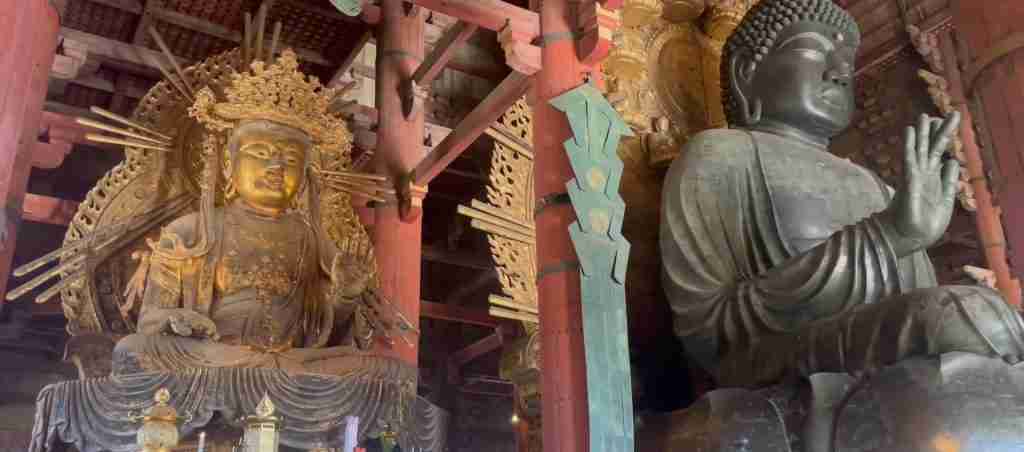
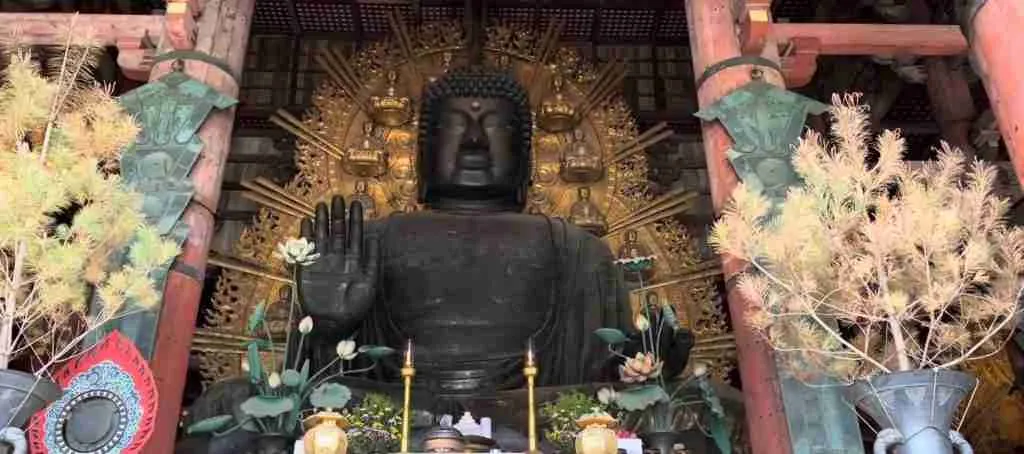
The Daibutsu at Todai-ji stands as one of the world’s largest bronze Buddha statues at 15 meters tall, representing Vairocana Buddha—the cosmic Buddha who illuminates all things. The statue’s massive scale required revolutionary casting techniques, with bronze poured in stages over three years. Each hand measures over 2.5 meters, and the face alone spans 5.3 meters. The original 752 AD statue contained 437 tons of bronze and 130 kilograms of gold, though earthquakes and fires damaged it multiple times. The current head dates to 1692, while portions of the body retain original 8th-century components. The Buddha’s right hand displays the abhaya mudra (fearlessness gesture) while the left extends the varada mudra (wish-granting gesture), symbolizing protection and generosity. The statue’s artistic achievement lies not just in scale but in conveying serene majesty despite its enormous dimensions.
How has Todai-ji Temple survived for over 1,200 years?
Todai-ji’s survival represents remarkable resilience through natural disasters and warfare. The original 752 AD construction established foundations so massive they’ve supported multiple rebuildings. The temple suffered catastrophic damage twice—in 1180 during the Genpei War when Taira clan forces burned it, and in 1567 during the Sengoku period. Each time, successive generations mounted herculean reconstruction efforts. The 1692 restoration of the Great Buddha took decades and required sourcing bronze from across Japan. The current Daibutsuden, completed in 1709, measures only two-thirds the original’s size yet remains among the world’s largest wooden buildings. The complex employs traditional Japanese joinery without nails, allowing structures to flex during earthquakes. Regular preservation efforts, including replacing the Great Buddha Hall’s roof in 1913 and comprehensive reinforcement work in the 1970s-1980s, ensure continued survival. The UNESCO designation in 1998 brought international recognition and preservation support.
What other structures should visitors explore at Todai-ji besides the Great Buddha Hall?
Todai-ji’s 85-acre grounds contain numerous National Treasures beyond Daibutsuden. Nandaimon (Great South Gate), rebuilt in 1199, houses two massive guardian deity statues called Nio carved by master sculptors Unkei and Kaikei. Nigatsu-do Hall, perched on a hillside with panoramic views of Nara, hosts the famous Omizutori water-drawing ceremony every March—a ritual performed continuously since 752 AD. Sangatsu-do (Hokkedo Hall), the oldest surviving structure at Todai-ji dating to 733 AD, contains priceless 8th-century Buddhist statues including a 3.6-meter Fukukenjaku Kannon. Kaidan-do Hall, though modest in size, holds historical importance as the site where famous monk Ganjin performed ordination ceremonies. The Todai-ji Museum displays rotating Buddhist art treasures, including statues normally stored away from public view. Shoro (Bell Tower) houses a 26-ton bronze bell cast in 732 AD. The grounds’ expansive gardens and stone lanterns create contemplative spaces that enhance the spiritual atmosphere.
Extended multi-day tours – 5+ days
Featured Japan Multi-Day Tour Packages

3 days
Japan 3-Day Discovery Tour
- ✓ Comprehensive Japan experience
- ✓ Expert local guides included
- ✓ All accommodation included
- ✓ Transportation provided
5 days
Japan 5-Day Highlights Experience
- ✓ Comprehensive Japan experience
- ✓ Expert local guides included
- ✓ All accommodation included
- ✓ Transportation provided
7 days
Japan 7-Day Cultural Journey
- ✓ Comprehensive Japan experience
- ✓ Expert local guides included
- ✓ All accommodation included
- ✓ Transportation provided

10 days
Japan 10-Day Complete Adventure
- ✓ Comprehensive Japan experience
- ✓ Expert local guides included
- ✓ All accommodation included
- ✓ Transportation provided
Multi-day tour packages powered by TourRadar. Prices and availability subject to change.
Introduction to Todai-ji Temple
Walking through the deer-filled paths of Nara Park toward Todai-ji Temple, visitors encounter one of humanity’s most audacious architectural and spiritual achievements. The temple’s very existence challenged the technical limits of 8th-century Japan, requiring the mobilization of an entire nation to cast the Great Buddha and construct a hall large enough to house it. Emperor Shomu’s vision created not merely a temple but a statement of Japan’s Buddhist commitment, visible for miles and designed to inspire awe in all who approached.
The scale becomes apparent only gradually. First, the Nandaimon gate looms ahead, its massive wooden pillars and guardian deities suggesting the grandeur beyond. Then, rounding the final approach, the Daibutsuden itself comes into view—a building so enormous that photographs fail to convey its true dimensions. The structure stretches 57 meters wide, 50 meters deep, and 49 meters tall, yet represents only two-thirds of the original 8th-century building’s footprint. Inside, the Great Buddha dominates all perception: 15 meters of bronze and gold depicting Vairocana Buddha in eternal meditation.
Todai-ji’s significance transcends its physical measurements. As the head temple of all provincial Buddhist temples during the Nara period, it established Japan’s Buddhist hierarchy and influenced temple design across East Asia. The temple’s political power grew so immense that authorities moved Japan’s capital from Nara to Kyoto specifically to diminish Todai-ji’s governmental influence. This historical importance, combined with architectural excellence and spiritual continuity, earned UNESCO World Heritage designation in 1998 as part of the “Historic Monuments of Ancient Nara.”
Today, Todai-ji functions as both active religious center and cultural treasure. Monks conduct daily services and ceremonies, maintaining Buddhist traditions unbroken since 752 AD. Visitors from around the world walk the same paths as Nara-period pilgrims, experience the same sense of wonder before the Great Buddha, and participate in the same symbolic acts—from bowing at temple gates to attempting passage through Buddha’s nostril pillar. The temple grounds blend spiritual purpose with natural beauty, where freely roaming deer—sacred messengers of Shinto kami—add another layer to Nara’s unique religious landscape.
Understanding Todai-ji requires grasping multiple contexts: the historical circumstances of its creation, the technical achievements of its construction, the religious philosophy it embodies, and its continuing role in Japanese spiritual life. This guide explores each dimension, providing the historical depth and practical information needed to appreciate fully one of Asia’s greatest cultural monuments. Whether approaching as pilgrim, architecture enthusiast, history student, or curious traveler, Todai-ji offers encounters with beauty, scale, and spiritual meaning that resonate across thirteen centuries.
Historical Foundation and Emperor Shomu’s Vision
Todai-ji’s origins lie in one emperor’s response to national crisis. During the early 8th century, Japan suffered devastating epidemics, earthquakes, and political instability that threatened the young nation’s survival. Emperor Shomu, ascending the throne in 724 AD, embraced Buddhism as the solution, believing that Buddhist teachings and monumental religious construction could restore cosmic order and protect the realm. His vision culminated in 743 AD with the imperial decree to construct the Great Buddha and Todai-ji Temple.
The project’s scale was unprecedented. Emperor Shomu commanded that every province contribute labor, materials, and resources to the Great Buddha’s creation. The bronze casting alone required 437 tons of copper, 130 kilograms of gold, 80 kilograms of mercury, and significant quantities of tin and lead—nearly exhausting Japan’s metal reserves. Over 2.6 million people participated in the construction over eight years, including laborers, craftsmen, monks, and artisans from across Japan and from China and Korea.
Casting such an enormous bronze statue pushed metallurgical knowledge to its limits. Artisans developed the technique of octuple casting, pouring molten bronze in eight stages from the statue’s base upward. Each pour required coordinating hundreds of workers and precise timing to prevent cracks or air bubbles. The clay molds alone weighed tons and had to withstand extreme temperatures. When completed in 749 AD, the Great Buddha represented the largest bronze casting achievement in the ancient world.
The consecration ceremony on April 9, 752 AD (by the Japanese calendar), drew 10,000 monks and dignitaries from across Asia. Indian monk Bodhisena performed the eye-opening ritual, symbolically animating the statue by painting pupils onto the Buddha’s eyes. The ceremony’s elaborate music, dance, and Buddhist ritual demonstrated Nara’s position as an international Buddhist center. Following consecration, construction continued on surrounding halls and structures, gradually expanding Todai-ji into a massive temple complex.
The temple’s name—Todai-ji, meaning “Great Eastern Temple”—reflected its positioning and purpose. “Eastern” referenced its location east of the imperial palace, while “Great” acknowledged both physical scale and spiritual significance. As kokubunji, or head temple of all provincial temples, Todai-ji sat atop Japan’s Buddhist hierarchy. Provincial temples received architectural plans and Buddhist teachings from Todai-ji, spreading standardized Buddhist practice throughout the realm.
This hierarchical system gave Todai-ji tremendous political influence. The temple controlled vast landholdings, employed thousands of monks and workers, and wielded religious authority that rivaled secular government. Temple administrators advised emperors on policy, blessed military campaigns, and interceded in succession disputes. By the late 8th century, Todai-ji’s power concerned imperial authorities enough that they relocated the capital to Kyoto in 784 AD, seeking distance from the temple’s overwhelming presence.
Despite losing its capital city location, Todai-ji retained religious importance. The Kegon school of Buddhism, which Todai-ji represented, taught that all phenomena exist in cosmic interconnection—a philosophy embodied in Vairocana Buddha’s universal illumination. This intellectual framework attracted scholar-monks and established Todai-ji as a center for Buddhist studies. The temple’s library preserved sutras and Buddhist texts, while monks engaged in copying scriptures, philosophical debates, and meditation practice.
Architectural Marvel of the Daibutsuden
The Great Buddha Hall (Daibutsuden) stands as one of history’s boldest architectural experiments. The current structure, completed in 1709, measures 57 meters wide, 50 meters deep, and 49 meters tall—yet represents only two-thirds the original hall’s dimensions. Even at reduced scale, it remains among the world’s largest wooden buildings, requiring massive pillars measuring over one meter in diameter and a complex interlocking framework of beams and supports.
The original 8th-century Daibutsuden stretched 86 meters wide with flanking towers adding another 23 meters of height—proportions designed to overwhelm viewers and convey Buddhist cosmic scale. The vast interior created acoustic and spatial effects that amplified chanting and enhanced the Great Buddha’s imposing presence. Massive wooden pillars, some requiring entire ancient trees, supported a roof weighing thousands of tons through traditional Japanese joinery techniques that employed no nails.
This nail-free construction method, using complex interlocking joints, allows the structure to flex during earthquakes rather than breaking rigidly. The framework distributes weight across multiple pillars, preventing catastrophic collapse if individual supports fail. Diagonal bracing and careful load distribution create stability despite the building’s enormous size. These engineering principles, refined over centuries, represent sophisticated understanding of structural mechanics achieved without modern calculation methods.
The building’s destruction and reconstruction history reveals both vulnerability and resilience. Taira clan forces burned the original structure in 1180 during civil war. Monk Chogen led the first major reconstruction, completed in 1195, employing new architectural techniques learned from Chinese temple builders. This version stood until 1567, when warfare during the Sengoku period again destroyed the hall. The Great Buddha sat exposed to elements for over a century before reconstruction began in the 1680s.
The current 1709 Daibutsuden employed traditional methods while incorporating lessons from previous destructions. Builders sourced timber from across Japan, including ancient cypress and zelkova trees from remote mountain forests. The construction process took 25 years and required rebuilding craftsman guilds that had lost temple-building expertise during Japan’s century of warfare. Master carpenter Kihei Kouno supervised the work, coordinating hundreds of craftsmen in traditional building techniques passed down through apprenticeship.
The building’s roof presents particular engineering challenges. Japanese temple roofs employ multiple layers of heavy ceramic tiles creating distinctive curved profiles, but this weight requires exceptional structural support. The Daibutsuden’s roof contains approximately 97,000 tiles, each weighing several kilograms, totaling over 1,000 tons. This mass sits atop the wooden framework, requiring pillars strong enough to support both static weight and dynamic forces from wind and earthquakes.
Interior space organization reflects Buddhist cosmology. The Great Buddha sits on a bronze lotus throne rising 3 meters from the floor, placing the statue’s face at optimal viewing height. Flanking Bodhisattva statues—Nyoirin Kannon and Kokūzō Bosatsu—complement the central Buddha, while guardian statues (Komokuten and Tamonten) occupy front corners. This arrangement creates visual hierarchy guiding viewers’ eyes toward the central Buddha while suggesting the populated Buddhist universe of deities and protectors.
The hall’s maintenance requires constant attention. Roof tiles need periodic inspection and replacement as weather degrades them. Wooden structural elements receive treatments to prevent insect damage and rot. Major restoration occurred in the 1970s-1980s, when structural reinforcement work employed modern materials while preserving historical appearance. Steel cables embedded within wooden members prevent splitting, while foundation reinforcement improves earthquake resistance. These interventions balance preservation ethics with practical necessity, ensuring the structure survives for future generations.
The Great Buddha: Artistic and Spiritual Significance
The Daibutsu transcends mere sculpture to become a profound statement of Buddhist philosophy materialized in bronze. At 15 meters tall, the seated figure of Vairocana Buddha represents the cosmic Buddha whose light illuminates all existence. The statue’s iconography conveys complex Buddhist teachings through gesture, proportion, and symbolic elements that reward close observation and contemplative viewing.
Vairocana Buddha differs from historical Buddha Shakyamuni, representing instead the universal Buddha-nature underlying all reality. This theological distinction explains the statue’s cosmic scale and otherworldly bearing—it depicts not a historical figure but the eternal principle of enlightenment itself. The Kegon Buddhist philosophy taught at Todai-ji emphasizes interconnection of all phenomena, with Vairocana as the unifying source from which all existence emanates and to which all returns.
The Buddha’s hand gestures (mudras) communicate specific meanings. The right hand, raised in abhaya mudra, signifies fearlessness and protection, assuring devotees of safety under Buddhism’s shelter. The left hand, extended downward in varada mudra, represents wish-fulfillment and compassion, offering blessings to all beings. These gestures, standardized across Buddhist iconography, allow practitioners to “read” the statue’s teachings through visual language transcending verbal explanation.
Facial features exhibit remarkable subtlety despite massive scale. The Buddha’s expression conveys serene compassion—neither smiling nor somber but radiating peaceful acceptance. The elongated earlobes reference Shakyamuni Buddha’s renunciation of princely jewelry, while the ushnisha (cranial protrusion) symbolizes wisdom and enlightenment. The urna (dot between eyebrows) represents the third eye of spiritual insight. Each feature follows iconographic conventions established in Indian Buddhist art and transmitted through China to Japan.
The lotus throne supporting the Buddha carries its own symbolism. Lotus flowers, rooting in mud but blooming pure and unstained, symbolize enlightenment arising from worldly existence. The bronze lotus petals surrounding the throne’s base contain etched images depicting Buddhist cosmology—hundreds of small worlds each containing a Buddha, illustrating the Kegon teaching that countless Buddha-realms exist simultaneously throughout infinite space. These engravings, though difficult to view closely, represent some of Todai-ji’s finest artistic achievement.
The statue’s construction history involves repeated disaster and restoration. The original 752 AD Buddha suffered head damage from an earthquake around 855 AD, requiring extensive repairs. The 1180 fire destroyed most of the statue, leaving only lower portions intact. Reconstruction in the 1180s-1190s created a replacement head and upper body. The 1567 fire again damaged the head and upper portions. The current head, cast in 1692, joins with torso sections from various periods—some original 8th-century bronze in the lower body, 12th-century sections in mid-torso, and 17th-century components above.
This patchwork history creates a statue embodying Japan’s Buddhist continuity across thirteen centuries. Rather than completely recasting after each disaster, artisans preserved and integrated whatever original bronze remained, maintaining physical connection to the 752 AD creation. This approach reflects Buddhist teachings about impermanence and repair rather than replacement—the statue’s value lies not in pristine originality but in accumulated history and continuous veneration.
Gold originally covered the entire statue, representing the pure light of Buddhist wisdom. Historical records describe the original gilding’s brilliance, visible from great distances and creating dazzling effects when sunlight entered the hall. Most gold has worn away over centuries, though traces remain in protected areas. The current dark patina, developed naturally through oxidation, has become the statue’s accepted appearance, though periodic conservation work maintains structural integrity against further degradation.
The famous pillar with Buddha’s nostril hole offers visitors direct interaction with the Great Buddha’s presence. This wooden pillar, located behind the statue’s right side, contains a hole measuring 37 by 30 centimeters—supposedly matching the Buddha’s nostril dimensions. Legend promises enlightenment in the next life to anyone squeezing through the opening. While primarily children successfully navigate the tight passage, the ritual provides tangible connection between worshipper and sacred object, transforming passive observation into participatory experience.
Additional Temple Buildings and Structures
Todai-ji’s extensive grounds contain numerous structures of historical and artistic importance beyond the central Daibutsuden. Exploring these secondary buildings reveals the complex’s full scope and provides deeper understanding of Japanese temple architecture, Buddhist iconography, and monastic life.
Nandaimon (Great South Gate) serves as the temple’s monumental entrance. Rebuilt in 1199 after the 1180 fire, this gate stands 25 meters tall and employs the Daibutsu architectural style imported from China—characterized by thick pillars, bracketing systems, and imposing presence. The gate houses two 8.4-meter guardian statues (Nio or Kongō-rikishi) carved by master sculptors Unkei and Kaikei. These fierce protectors, positioned on either side of the gate passage, ward off evil spirits while demonstrating the sculptors’ ability to convey dynamic movement and muscular power in wood. The statues, designated National Treasures, represent pinnacle achievements of Kamakura-period Buddhist sculpture.
Nigatsu-do Hall perches on Mount Wakakusa’s eastern slope, offering panoramic views across Nara. This hall, rebuilt in 1669 after fire, hosts the famous Omizutori (Sacred Water-drawing) ceremony every March—a ritual performed without interruption since 752 AD. The ceremony involves monks carrying enormous flaming torches across the hall’s wooden veranda, their sparks believed to bring good fortune. The dramatic nighttime spectacle attracts thousands of spectators annually. Inside, the hall enshrines Eleven-Faced Kannon, a Buddhist deity of compassion, though the statue remains hidden from public view. The hall’s elevated position and architectural grace make it a photographer’s favorite, especially at sunset when warm light illuminates its weathered wooden facade.
Sangatsu-do (Hokkedo Hall), dating to 733 AD, ranks as Todai-ji’s oldest surviving structure. This modest hall predates the Great Buddha Hall, originally serving as a practice hall for monks. It houses an extraordinary collection of 8th-century Buddhist statues, including the 3.6-meter Fukukenjaku Kannon surrounded by attendant deities. These statues, executed in dry lacquer and clay, exhibit the refined artistic sensibility of Nara-period Buddhist art. The close proximity allows detailed observation of iconographic details—facial expressions, hand gestures, jewelry, and garment folds—revealing the individual sculptors’ artistry. The hall’s intimate scale creates atmospheric viewing conditions impossible in the vast Daibutsuden.
Kaidan-do Hall holds special religious significance as the site where Chinese monk Ganjin performed ordination ceremonies establishing proper Buddhist monastic practice in Japan. Ganjin, who endured multiple failed voyages and lost his eyesight before finally reaching Japan in 754 AD, brought orthodox Buddhist ordination rituals that gave Japanese Buddhist clergy legitimacy. The current hall, rebuilt in 1731, enshrines four guardian deity statues representing the Four Heavenly Kings protecting Buddhist law. These clay statues, though smaller than the Daibutsuden’s guardians, exhibit remarkable preservation of 8th-century sculptural style and original polychrome decoration.
Shoro (Bell Tower) houses one of Japan’s largest temple bells, cast in 732 AD and weighing 26 tons. The bronze bell measures 3.9 meters tall and 2.7 meters in diameter, producing deep, resonant tones audible across Nara when struck during ceremonies. The bell’s surface features decorative bands and inscriptions documenting its creation and dedication. Striking temple bells carries religious significance in Japanese Buddhism, the sound symbolically awakening beings from delusion. The bell rings 108 times at New Year—once for each earthly desire in Buddhist teaching—a ritual drawing thousands of worshippers.
Todai-ji Museum, opened in 2011, displays the temple’s vast collection of Buddhist art and historical artifacts. The museum rotates exhibits to prevent light damage to delicate objects, showing statues, paintings, ceremonial implements, and documents that trace Todai-ji’s history. Many displayed items are National Treasures or Important Cultural Properties normally stored away from environmental damage. The museum’s climate-controlled environment allows closer examination of artistic details than possible in historic temple buildings. Special exhibitions focus on specific periods, sculptors, or themes, providing scholarly context for understanding Todai-ji’s artistic heritage.
The temple grounds themselves constitute significant cultural landscape. Ancient stone lanterns line pathways, donated by devotees over centuries. Gardens designed according to Japanese aesthetic principles create contemplative spaces encouraging meditative walking. Ancient trees, some hundreds of years old, provide shade and seasonal beauty—cherry blossoms in spring, green canopy in summer, autumn colors, and winter’s stark branches. The integration of natural and built environments reflects Japanese Buddhist philosophy’s emphasis on harmony with nature and impermanence’s beauty.
Buddhist Religious Practice and Ceremonies
Todai-ji functions as an active religious center, not merely a historical monument. The temple serves as headquarters for the Kegon school of Japanese Buddhism, housing resident monks who maintain daily religious practice and perform ceremonies marking the liturgical calendar. Observing these living traditions provides insight into Japanese Buddhism’s continuing vitality and Todai-ji’s role beyond tourism.
Daily services occur in various halls throughout the complex. Monks conduct morning and evening chanting services, reciting sutras in rhythmic patterns accompanied by bells, drums, and woodblocks. These services, though not typically accessible to casual visitors, create the temple’s spiritual atmosphere. The chanting’s sounds echo through the grounds, especially audible in early morning or late afternoon when tourist crowds diminish. The disciplined practice maintains religious continuity with the temple’s founding monks, preserving traditions across 1,270 years.
The Omizutori ceremony at Nigatsu-do Hall represents Todai-ji’s most famous annual event. Performed every March 1-14 since 752 AD, this ritual involves monks undertaking rigorous spiritual practice including prayer, meditation, and physical austerity. The ceremony’s climax occurs nightly when monks carrying 6-meter-long pine torches run along the hall’s wooden veranda, their flames creating spectacular visual displays. On March 12, monks draw sacred water from a well beneath the hall—water believed to have miraculous healing properties. Thousands of spectators attend despite cold weather, seeking the torches’ burning embers, considered lucky charms for the coming year.
Setsubun festival in early February marks the transition between winter and spring. Monks perform bean-throwing ceremonies (mamemaki) to drive away evil spirits and welcome good fortune. The Daibutsuden hosts special services, and participants throw roasted soybeans while calling “Oni wa soto! Fuku wa uchi!” (Devils out! Luck in!). This folk Buddhist practice, combining indigenous Japanese beliefs with Buddhist ritual, demonstrates the syncretic nature of Japanese religious practice.
Bon Festival in mid-August honors ancestral spirits, who Buddhist belief holds return to visit the living during this period. Todai-ji conducts memorial services and lights lanterns to guide spirits back to their realm. The temple’s large open spaces accommodate festival gatherings where families remember deceased relatives while participating in community celebration. This blend of solemn remembrance and joyful reunion characterizes Japanese Buddhism’s approach to death and afterlife.
The annual Great Buddha Cleaning in August draws volunteers who dust and clean the statue’s surface. This practical maintenance doubles as religious ritual, allowing laypeople to approach and touch the sacred object. Participants climb scaffolding to reach the Buddha’s face and head, using large dusting implements to remove accumulated dirt. The cleaning’s communal nature—hundreds of people working together caring for their shared Buddhist heritage—reinforces social bonds and religious identity.
New Year celebrations bring massive crowds seeking Buddhist blessings for the coming year. The temple conducts special services and distributes blessed talismans. The Shoro bell rings 108 times at midnight, each strike representing one of the earthly desires causing human suffering. Listening to the bells while meditating on the past year and making resolutions for improvement constitutes a widely observed New Year practice. Food stalls, entertainment, and festive atmosphere transform the usually contemplative temple grounds into a joyous celebration.
Beyond scheduled ceremonies, individual worship occurs continuously. Visitors bow at temple gates, make offerings at various altars, purchase and write on wooden prayer tablets (ema), and buy protective amulets (omamori) blessed by monks. These personal devotions, though often brief, represent genuine religious engagement rather than mere tourism. The temple provides spaces for quiet prayer and meditation separate from the Daibutsuden’s tourist flow, acknowledging that many visitors seek spiritual experience alongside cultural education.
Practical Visitor Information
Opening Hours and Admission
The Daibutsuden (Great Buddha Hall) opens daily from 7:30 AM to 5:30 PM (April through October) and 8:00 AM to 5:00 PM (November through March). Last entry occurs 30 minutes before closing. Admission costs ¥800 ($5.30) for adults, ¥400 ($2.65) for children ages 6-12. Children under 6 enter free. This admission covers only the Daibutsuden interior—other buildings require separate tickets.
Hokkedo Hall (Sangatsu-do) and Kaidan-do Hall maintain 8:30 AM to 4:00 PM hours year-round, also costing ¥800 adults, ¥400 children. The Todai-ji Museum operates 9:30 AM to 5:30 PM (April-October) or 9:30 AM to 5:00 PM (November-March), with last entry 30 minutes before closing. Museum admission costs ¥800 adults, ¥400 children. Combination tickets (Daibutsuden + Museum) cost ¥1,000 ($6.60) adults, ¥600 ($4.00) children, offering minor savings over separate purchases.
The temple grounds remain open beyond building hours—Nandaimon gate, Nigatsu-do exterior, and park areas accessible without time restriction or admission fee. Audio guides rent for ¥500 ($3.30) from the Daibutsuden entrance area, available in Japanese, English, Chinese, Korean, French, German, Spanish, Italian, and Vietnamese, providing 30-minute historical and architectural information.
Getting to Todai-ji
Todai-ji sits within central Nara Park, accessible by multiple transportation options from Kyoto, Osaka, and other Kansai region cities. From Kyoto, the Kintetsu Limited Express train reaches Kintetsu-Nara Station in 35-45 minutes (¥1,160), while local trains take 45-55 minutes (¥640). The JR Nara Line offers similar journey times to JR Nara Station at comparable cost, though JR Nara Station sits farther from Todai-ji than Kintetsu-Nara Station.
From Osaka, Kintetsu trains from Namba Station reach Nara in 35-40 minutes (Limited Express ¥1,070, Regular Express ¥680). JR trains from Osaka Station take 45-50 minutes (¥820). The JR Pass covers JR routes but not private Kintetsu lines, affecting transportation choices for pass holders.
From Kintetsu-Nara Station, Todai-ji lies approximately 1.5 kilometers east, a 20-minute walk through Nara Park. The walking route passes deer grazing areas and offers pleasant introduction to Nara’s atmosphere. Alternatively, buses departing from station bus terminals reach Todai-ji Daibutsuden stop in 7-10 minutes (¥220 one-way). The loop bus circuit includes major Nara attractions, providing transportation flexibility for multi-site visits.
From JR Nara Station, the distance increases to approximately 2 kilometers, requiring 30 minutes walking. Buses provide faster transport (¥220, 10-15 minutes to Daibutsuden stop). The longer walk from JR Nara Station traverses commercial districts before reaching parkland, offering different perspective on Nara’s urban-rural transition.
Time Allocation and Visit Planning
Minimum visit duration of two hours allows viewing the Daibutsuden interior, walking temple grounds, and visiting Nandaimon gate. This condensed itinerary provides essential Todai-ji experience but omits secondary buildings and careful exploration. Three to four hours enables visiting Hokkedo Hall, Nigatsu-do, the museum, and enjoying grounds without rushing. Full-day visits combining Todai-ji with nearby Kasuga Taisha Shrine and Nara Park attractions create comprehensive Nara experience.
Optimal visiting times avoid midday crowds when tour groups concentrate. Morning visits (opening time to 10 AM) provide tranquil conditions, softer light, and calmer deer. Late afternoon (3 PM to closing) offers similarly reduced crowds with dramatic lighting angles. Midday (11 AM to 2 PM) experiences peak congestion, particularly on weekends and during Japanese holidays. The Daibutsuden interior becomes uncomfortably crowded, reducing contemplative atmosphere and creating photography challenges.
Frequently Asked Questions
What makes Todai-ji Temple different from other temples in Japan?
Todai-ji’s distinction lies in its historical supremacy as the head temple of all provincial Buddhist temples during the Nara period, its architectural superlatives (world’s largest bronze Buddha, one of the world’s largest wooden buildings), and its unbroken 1,270-year continuity of Buddhist practice. While Japan contains thousands of temples, Todai-ji uniquely combines scale, historical importance, artistic achievement, and living religious tradition. The temple’s founding as a state project mobilizing the entire nation distinguishes it from private temple foundations. Its survival through multiple disasters and reconstructions demonstrates resilience exceeding most historic monuments.
Can visitors participate in Buddhist activities at Todai-ji or is it only for observation?
Todai-ji welcomes visitor participation in certain practices while restricting others to ordained monks. Anyone can make offerings at altars, purchase and hang wooden prayer tablets (ema), buy protective amulets, and attempt passage through Buddha’s nostril pillar. During public ceremonies like New Year services or Omizutori, visitors can attend and participate through prayer and observation. However, formal meditation sessions, sutra chanting, and monastic rituals remain restricted to clergy and serious Buddhist practitioners. The temple balances openness to spiritual engagement with maintaining religious integrity and respecting monastic practice boundaries.
How long did the original Great Buddha take to build and what challenges did builders face?
The initial bronze casting took approximately three years (746-749 AD) using the octuple casting method, where bronze was poured in eight successive stages from base to head. The challenges were immense: Japan possessed limited bronze-working experience at such scale, required sourcing copper, tin, and gold from across the country, needed to develop clay molds withstanding extreme heat without cracking, and coordinated hundreds of workers for each pour. The mercury amalgamation technique for applying gold gilding proved particularly dangerous, causing illness and death among workers exposed to mercury vapor. Over 2.6 million people contributed labor, materials, or resources—an unprecedented mobilization demonstrating the project’s national significance and the organizational capacity of Nara-period government.
Why did the capital move away from Nara if Todai-ji was so important?
The capital relocated to Kyoto in 784 AD specifically because Todai-ji and other Nara temples had become too powerful, interfering in political affairs and reducing imperial government’s autonomy. Temple-owned estates generated massive wealth, ordained monks numbered in thousands, and religious authorities exercised influence rivaling secular government. Several succession disputes involved temple intervention, with monks sometimes supporting particular claimants or opposing imperial decisions. Emperor Kanmu decided physical distance from the temples would reduce their political leverage while maintaining their religious importance. The move succeeded in rebalancing power without destroying Buddhism’s social role, with Nara temples continuing as important religious centers but losing direct political influence.
What is the Kegon philosophy that Todai-ji represents?
Kegon Buddhism, based on the Avatamsaka Sutra, teaches that all phenomena exist in perfect interconnection, with each element containing and reflecting the entire universe. The famous metaphor describes Indra’s Net—an infinite cosmic web where each intersection holds a jewel reflecting all other jewels, symbolizing mutual interpenetration of all existence. Vairocana Buddha represents this cosmic unity, the universal Buddha-nature underlying reality. Kegon philosophy influenced Japanese aesthetic concepts emphasizing harmony, interconnection, and finding the universal within the particular. The Great Buddha’s cosmic scale physically manifests these philosophical teachings, while Todai-ji’s role as head temple exemplified hierarchical organization reflecting Buddhist cosmological order.
Are there good times to see traditional ceremonies or festivals at Todai-ji?
The Omizutori ceremony (March 1-14) at Nigatsu-do Hall represents Todai-ji’s most spectacular annual event, featuring monks carrying massive flaming torches across the hall’s wooden veranda nightly. The sacred water-drawing ritual on March 12 attracts particular crowds. The Great Buddha Cleaning in August allows public participation in caring for the statue. New Year (January 1-3) brings special services and bell ringing. Setsubun (early February) features bean-throwing ceremonies. These events provide opportunities to observe living Buddhist traditions and community participation in religious practice, offering cultural insights beyond architectural tourism.
What’s the story behind the Buddha’s nostril pillar and does it really grant enlightenment?
The wooden pillar with a hole supposedly matching the Great Buddha’s nostril dimensions emerged from folk tradition rather than formal Buddhist doctrine. The legend promises enlightenment in the next life to anyone successfully squeezing through the opening, creating popular participatory ritual especially enjoyed by children. The practice likely developed during the Edo period when temple visits combined pilgrimage with entertainment. While not theologically significant within Kegon Buddhism, the ritual provides tangible engagement with the Great Buddha’s presence—transforming passive viewing into active participation that enhances memorability and personal connection to the sacred object.
Can the temple grounds accommodate visitors with mobility limitations?
The main Daibutsuden provides level access from entrance to interior viewing area, with ramps supplementing steps at key points, making it wheelchair accessible. The Todai-ji Museum meets modern accessibility standards with elevators and barrier-free facilities. However, reaching the temple from station areas involves uphill gradients that may challenge some visitors—bus transportation minimizes this difficulty. Secondary buildings like Nigatsu-do Hall involve stairs and elevated locations inaccessible to wheelchairs. The grounds’ gravel paths, while generally level, present surface irregularities complicating wheelchair navigation. Visitors with mobility limitations should focus on the Daibutsuden, Nandaimon area, and museum for the most accessible experience.
How does Todai-ji relate to the deer in Nara Park?
The deer’s sacred status derives from Shinto tradition (as messengers of Kasuga Taisha Shrine’s deities) rather than Buddhist belief, illustrating Japanese religious syncretism where Shinto and Buddhist elements coexist harmoniously. While Buddhism generally discourages harming animals, the deer aren’t specifically Buddhist symbols. They’ve coexisted with Todai-ji for over a millennium, freely roaming temple grounds and creating the distinctive Nara experience of sacred architecture amid natural wildlife. Temple monks tolerate and protect the deer, viewing their presence as enhancing the spiritual atmosphere and demonstrating harmony between human religious activity and natural world.
What should visitors definitely not miss when visiting Todai-ji?
Essential experiences include viewing the Great Buddha’s magnificent scale and serene expression, examining the Nandaimon gate’s guardian statues demonstrating Kamakura-period sculpture mastery, attempting passage through Buddha’s nostril pillar for the memorable symbolic experience, walking to Nigatsu-do Hall for panoramic Nara views and atmospheric architectural beauty, and encountering the deer that add unique character to the temple grounds. Allow sufficient time for contemplative viewing rather than rushing through—the Daibutsuden’s interior rewards extended observation, revealing details invisible during brief visits. Early morning or late afternoon visits provide optimal lighting, reduced crowds, and more reflective atmosphere conducive to appreciating the site’s spiritual dimensions alongside architectural grandeur.