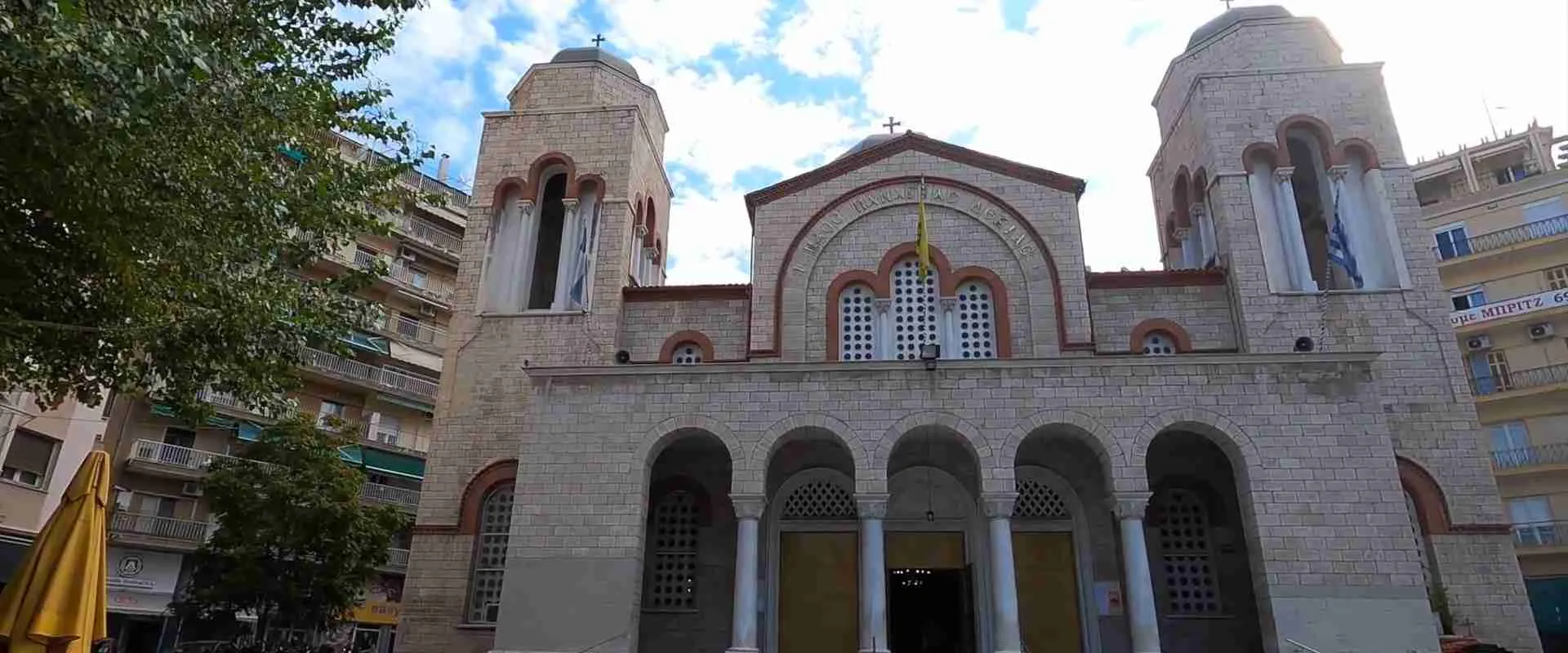
Thessaloniki’s Open-Air Museum: Walking Among UNESCO Byzantine Walls and Churches
No other city in Europe concentrates as many centuries of early Christian and Byzantine heritage within a single walkable urban fabric as Thessaloniki. Fifteen monuments inscribed by UNESCO in 1988 span eleven centuries of architectural and artistic evolution — from a Roman emperor’s circular mausoleum to frescoed Palaeologan churches — scattered through living neighborhoods where coffee bars open beside medieval walls and monks tend gardens inside ancient fortress towers. Walking Thessaloniki means moving continuously through time.
Key Takeaways
- 15 UNESCO components inscribed in 1988: The Paleochristian and Byzantine Monuments of Thessaloniki form one of the world’s most concentrated collections of early Christian and Byzantine heritage, spanning the 4th to the 15th century within a single living city.
- Eleven centuries in one walk: The monuments represent an unbroken typological sequence from the earliest Roman-era Christian adaptations through every stage of Byzantine architectural development to the Late Byzantine Palaeologan renaissance — a complete visual education in the art of a civilization.
- Three world-class mosaic masterpieces: The gold-ground mosaics of the Rotunda, the votive panels of Hagios Demetrios, and the extraordinary apse vision of Hosios David together constitute three of the greatest surviving works of early Christian art in the world, all within a few kilometers of each other.
- Four kilometers of living walls: Thessaloniki’s Byzantine city walls survive across significant stretches of the upper city, complete with towers, gates, and the Heptapyrgion fortress — still defining the city’s northern and eastern skyline as they have for sixteen centuries.
- Byzantium’s second capital: Thessaloniki held the formal title of Symvassilevousa (co-reigning city) of the Byzantine Empire, a status that generated the wealth and imperial patronage behind its extraordinary density of monuments and artistic production.
- Monuments in active life: The majority of Thessaloniki’s UNESCO churches remain active places of Orthodox Christian worship, meaning visitors encounter living liturgical tradition alongside some of the earliest Christian art in existence — a combination found nowhere else on Earth at this scale.
People Also Ask About Thessaloniki’s Byzantine Monuments
How many UNESCO World Heritage monuments does Thessaloniki have?
Thessaloniki has 15 UNESCO World Heritage monuments, collectively inscribed in 1988 under the designation “Paleochristian and Byzantine Monuments of Thessaloniki” (reference 456). The 15 components span from the 4th-century Rotunda of Saint George and the city’s defensive walls to 14th-century Palaeologan churches and the Byzantine Bath. No other Greek city holds a comparable concentration of UNESCO-listed components, and no other European city contains this many intact elements from the complete chronological arc of Byzantine architecture. The inscription was recognized under cultural criteria i, ii, and iv — outstanding artistic achievement, significant exchange of human values, and exceptional testimony to a significant historical period. The collection encompasses every major phase of church design, from the earliest basilicas through the transitional domed basilica to the elaborate multi-domed cross-in-square structures of the Late Byzantine period.
What is the best walking route to see Thessaloniki’s Byzantine monuments?
The most effective walking approach divides Thessaloniki’s Byzantine heritage into two complementary circuits. The Lower City route connects the Galerius complex (Arch and Rotunda), the Acheiropoietos basilica, Panagia Chalkeon, Hagios Demetrios, and Hagia Sophia in a two-to-three-hour walk through the city’s central streets. The Upper City route, centered on the walled Ano Poli neighborhood, links the Byzantine walls, the Trigonion Tower, the Heptapyrgion fortress, Hosios David, Vlatadon Monastery, and the cluster of Palaeologan churches in a longer half-day circuit with significant uphill walking along cobbled lanes. Combining both circuits over a full day covers all 15 monuments. The Museum of Byzantine Culture serves as an ideal orientation point before beginning either route.
What makes the Byzantine walls of Thessaloniki historically significant?
The walls of Thessaloniki represent one of the most complete surviving Byzantine urban fortification systems in Europe. Built primarily in the late 4th and 5th centuries on Hellenistic and Roman foundations, they stretch approximately four kilometers along the northern, eastern, and partial western perimeters of the upper city. Their construction technique — alternating horizontal courses of stone masonry with rows of brick — became the defining method of Byzantine military architecture and was exported across the empire. The walls successfully defended Thessaloniki against Slavic, Avar, Arab, and Norman attacks across many centuries. They incorporate the Heptapyrgion citadel at the northeastern corner and the Trigonion Tower, the best-preserved and most accessible section for walking visitors today.
Which Thessaloniki churches contain the finest Byzantine mosaics?
Three churches stand above all others for Byzantine mosaic art in Thessaloniki. The Rotunda of Saint George preserves 4th-century gold-ground mosaics showing early Christian saints and martyrs within elaborate architectural settings — among the oldest large-scale Christian mosaics in existence. Hagios Demetrios contains 7th-century votive mosaic panels on its nave piers, showing the patron saint with donors and children in a style of remarkable devotional directness. Hosios David (Latomou Monastery) holds the most extraordinary mosaic in the city: a late 5th-century apse composition depicting a beardless young Christ in a vision of Ezekiel, plastered over during the Ottoman period and only rediscovered in 1921. The Acheiropoietos basilica additionally preserves rare 5th-century decorative mosaics in the arcade soffits of the nave — floral, avian, and geometric programs on gold backgrounds of exceptional quality.
Extended multi-day tours – 5+ days
Featured Thessaloniki Multi-Day Tour Packages
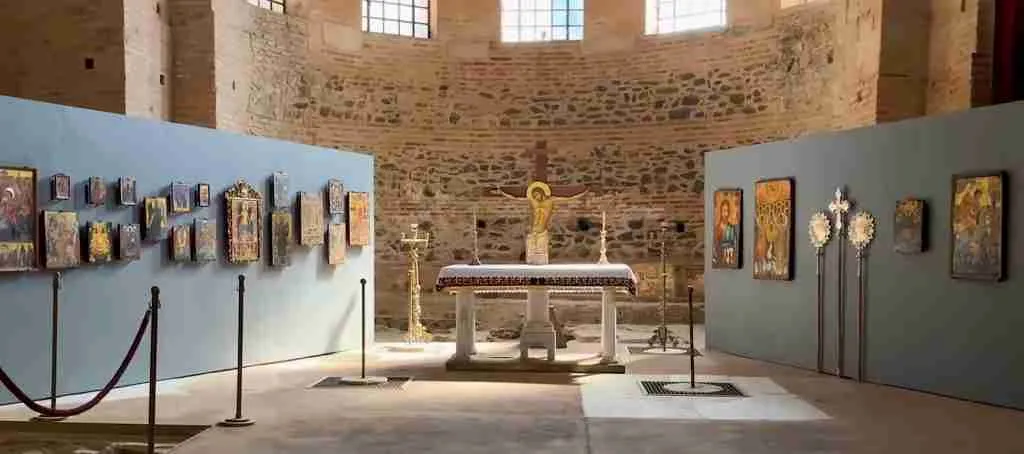
3 days
Thessaloniki 3-Day Discovery Tour
- ✓ Comprehensive Thessaloniki experience
- ✓ Expert local guides included
- ✓ All accommodation included
- ✓ Transportation provided
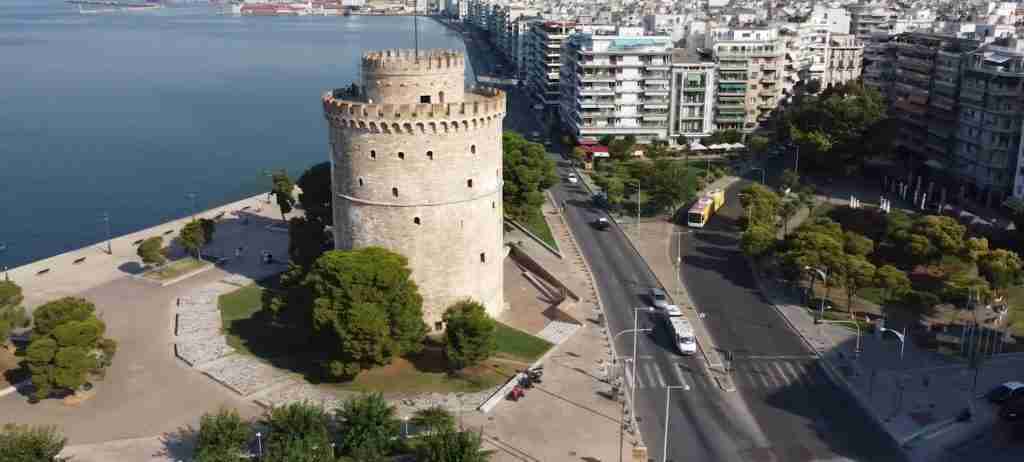
5 days
Thessaloniki 5-Day Highlights Experience
- ✓ Comprehensive Thessaloniki experience
- ✓ Expert local guides included
- ✓ All accommodation included
- ✓ Transportation provided
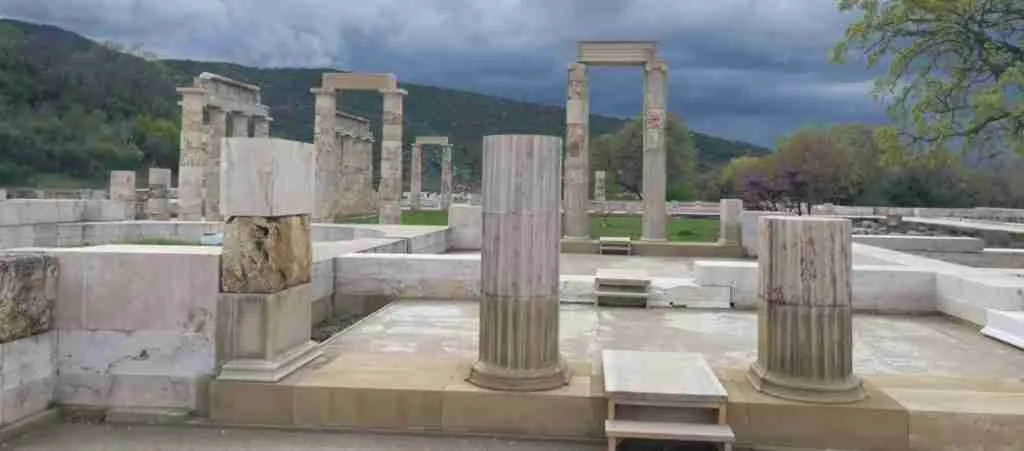
7 days
Thessaloniki 7-Day Cultural Journey
- ✓ Comprehensive Thessaloniki experience
- ✓ Expert local guides included
- ✓ All accommodation included
- ✓ Transportation provided
10 days
Thessaloniki 10-Day Complete Adventure
- ✓ Comprehensive Thessaloniki experience
- ✓ Expert local guides included
- ✓ All accommodation included
- ✓ Transportation provided
Multi-day tour packages powered by TourRadar. Prices and availability subject to change.
The Symvassilevousa: How Thessaloniki Became Byzantium’s Second Capital
Thessaloniki has served as a crossroads of civilizations since its founding in 316 BC by the Macedonian king Cassander, who named the city after his wife — the half-sister of Alexander the Great. The city’s position at the western end of the Via Egnatia, Rome’s great highway linking the Adriatic coast to Constantinople, guaranteed its strategic and commercial importance for nearly two millennia. When Emperor Constantine I refounded Byzantium as Constantinople in 330 AD, Thessaloniki became the logical counterweight: the second city of the Eastern Roman Empire, the gateway to the Balkans, and the first major European urban center where Christianity took hold and spread northward across the continent.
The city’s Byzantine transformation began decisively under Galerius, the Caesar of the tetrarchic system who made Thessaloniki his imperial residence between 299 and 311 AD. His architectural intervention — the Arch, the Rotunda, and the extensive palace complex of which fragments survive beneath the modern city — stamped Roman imperial power onto the urban fabric in monuments that remain standing to this day. It was in Thessaloniki that Emperor Theodosius I issued, in 380 AD, the Edict of Thessalonika (Cunctos populos) declaring Nicene Christianity the official religion of the Roman state — a decree that fundamentally redirected the religious history of Western civilization and whose proclamation in this city was no accident of geography.
Throughout the Byzantine centuries, Thessaloniki bore the formal title of Symvassilevousa — co-reigning city — a designation acknowledging its status as the empire’s second most important urban center after Constantinople. This honorific brought imperial resources: major church-building programs, venerated relics, artists, scholars, and the theological controversies that defined Orthodox Christianity. The city gave the world Saint Demetrios, Byzantium’s most important military martyr-saint, whose shrine drew pilgrims from every corner of the Christian world. It gave the world the brothers Cyril and Methodius, native Thessalonikans who created the Glagolitic alphabet and brought literacy to the Slavic peoples. Its metropolitan see ranked immediately below Constantinople in the hierarchy of the Orthodox church.
Thessaloniki withstood Arab attacks in 904 AD, Norman sackings in 1185, crusader occupation between 1204 and 1224, and the devastating Serbian campaigns of the 14th century. It fell to the Ottoman Empire on March 29, 1430 — a date still commemorated in the Orthodox liturgical calendar. The Ottoman sultans, recognizing the city’s importance, preserved its Christian monuments rather than demolishing them, converting many churches to mosques but leaving their structural fabric largely intact. When Thessaloniki rejoined Greece in 1912, much of its Byzantine heritage survived, though the catastrophic fire of 1917 destroyed significant portions of the historic city center. What remains of the Byzantine city is vast, layered, and remarkably accessible to visitors who choose to explore it on foot.
The Byzantine Walls and Fortifications: Four Kilometers of Living History
The walls of Thessaloniki define the upper city as visibly today as they did in the 5th century. Stretching approximately four kilometers along the northern, eastern, and partial western perimeters of the Ano Poli (Upper City) neighborhood, they stand as one of the most complete surviving Byzantine urban defense systems in Europe. Inscribed among the 15 UNESCO World Heritage components in 1988, the walls are not a passive archaeological ruin but a living boundary — inhabited on both sides, traversed through its ancient gates, walked alongside on a maintained path that follows much of the exterior perimeter. Walking their length reveals the full drama of Byzantine military architecture: towers, curtain walls, posterns, and the mighty citadel at the northeastern corner.
The current walls rest on foundations first laid in the 4th and 5th centuries, incorporating material from earlier Hellenistic and Roman defenses. Byzantine builders used the characteristic technique of alternating horizontal bands of stone masonry with rows of brick — a construction method both structurally sound and visually distinctive, creating the striped pattern seen throughout the surviving sections. The walls reached their final form by the 5th century, with reinforcement and extension campaigns mounted in response to successive military threats. Slavic and Avar attacks of the 6th and 7th centuries, Arab raids of the 9th century, and Norman invasions of the 12th century each prompted repair and improvement. The Ottoman period added further modifications, particularly in the Heptapyrgion complex at the northeastern corner.
The lower sections of the walls along the seafront were demolished in the early 20th century to allow port expansion and the development of the modern coastal promenade. Their loss, while mourned by historians, opened the city to the sea in a way that defines Thessaloniki’s contemporary character. The upper ring — the northern, eastern, and partial western circuits visible today — remains largely intact, with towers placed at intervals of approximately 50 meters and postern gates positioned for emergency sortie operations. The strategic placement of the entire circuit, following the natural contours of the hillside terrain above the lower city, explains precisely why Thessaloniki proved so difficult to take by storm across twelve centuries of siege warfare.
The Trigonion Tower and the Northeastern Circuit
The Trigonion Tower rises at the northeastern bend of the wall circuit as the most scenic and best-preserved tower in the entire fortification system. Its name derives from its triangular plan — an unusual choice in Byzantine military architecture that created a sharp projecting salient designed to cover a wider field of defensive fire along two intersecting wall faces. The tower dates from the Late Byzantine period and represents one of the final major military construction efforts of the Byzantine state in Thessaloniki. From its base, visitors follow the wall path northward toward the acropolis enclosure, passing through stretches where the original curtain wall height — up to 10 meters in places — survives intact with merlons still in position. The panoramic views from this section of the walls, encompassing the Thermaic Gulf, the city’s rooftops, and the distant peak of Mount Olympus on clear days, provide a visual orientation to Thessaloniki’s geography that no map fully replicates.
The Heptapyrgion: The Seven-Towered Citadel
The Heptapyrgion (Seven Towers) — known by its Ottoman name Yedi Kule — occupies the northeastern corner of the fortification system as a self-contained fortress within the larger defensive perimeter. Byzantine in origin, substantially rebuilt by the Ottomans after 1430, and used as a prison through much of the 20th century, the Heptapyrgion is a layered monument of extraordinary historical depth. The name refers to its seven primary towers, though the complex incorporates additional smaller structures and extensive courtyard space within a fortified enclosure that operated as a semi-independent stronghold. The fortress compound today functions as a cultural venue and archaeological museum space, with tower interiors accessible by narrow internal stairs that reveal the full thickness of the Byzantine-Ottoman masonry. The highest accessible tower offers a panoramic view across the entire city toward the sea — the same view that Byzantine garrison commanders used to monitor approaching threats from every direction.
The Acropolis and Upper Wall Circuit
The northern section of the walls climbs to the acropolis of Thessaloniki — the highest fortified point of the ancient city, commanding views over the entire urban area and the Thermaic Gulf beyond. The acropolis formed a separate enclosure, a citadel within the city, where the Byzantine governor’s residence and later the Ottoman administration occupied the commanding high ground. Walking the wall path along this section reveals the construction logic of Byzantine military engineering with particular clarity: towers placed at calculated intervals to allow overlapping missile coverage, postern gates cut through the wall fabric at points where the terrain favored rapid deployment, and the overall circuit positioned to exploit every natural defensive advantage the hillside terrain offered. The density of Late Byzantine ecclesiastical monuments within and immediately below the acropolis enclosure — Vlatadon Monastery, the Church of Prophet Elijah, Saint Catherine, and others — reflects the protection that proximity to the walls provided to religious communities in an era of chronic military threat.
The Galerius Complex: Where Rome Became Byzantium
At the heart of modern Thessaloniki, where the ancient Via Egnatia meets the city’s central commercial district, two monuments from the reign of the tetrarchic emperor Galerius stand as the oldest components of the UNESCO inscription: the Arch of Galerius (Kamara) and the Rotunda of Saint George. Together with the partially excavated remains of Galerius’s palace that surface in fragments beneath the surrounding blocks, they form the most visible Roman-era legacy in the city — and the architectural foundation upon which Thessaloniki’s Christian identity was built. These structures document the precise moment in history when Roman imperial power and Christian religious culture began their long entanglement.
The Arch of Galerius (Kamara): Imperial Propaganda in Stone
The Arch of Galerius, universally known in Thessaloniki as the Kamara (from the Greek for “vault” or “arch”), was built between 298 and 305 AD to commemorate Galerius’s victorious campaign against the Sassanid Persian Empire. What survives today is a portion of a much larger structure: originally the arch consisted of eight massive piers arranged in two parallel rows, creating three vaulted passageways aligned with the Via Egnatia. Only two central piers remain standing, but they preserve enough of the original sculpted marble relief panels to convey the full ambition of the monument’s program.
The relief panels covering the surviving piers represent one of the most important examples of late Roman narrative sculpture in existence. Arranged in horizontal registers, they depict Galerius’s Persian campaigns in extraordinary documentary detail: battle scenes showing Roman legions overwhelming Sassanid cavalry, formal submissions of defeated enemies, ceremonial sacrifice sequences, and portraits of the tetrarchic emperors — Galerius, Diocletian, Maximian, and Constantius — presenting a unified front of imperial power. The ideology of the Tetrarchy, the system of co-rule among four emperors devised by Diocletian to stabilize the over-extended empire, pervades every register of the imagery. Galerius appears in armor, on horseback, in sacrifice, and in triumph; the supporting cast of emperors underlines the shared, collegial nature of late Roman imperial authority.
A notable feature of many relief figures is systematic face damage — damnatio memoriae, the deliberate obliteration of a person’s memorial image carried out in later centuries when certain associations became politically or religiously inconvenient. Despite this damage, the reliefs retain exceptional sculptural quality and provide an unparalleled primary document of tetrarchic imperial ideology. The Kamara stands today in a small pedestrianized square surrounded by outdoor cafés — a social gathering point as much as a UNESCO monument, representing the way Thessaloniki has integrated its ancient fabric into the rhythms of daily life.
The Rotunda of Saint George: From Mausoleum to Mosque
The Rotunda of Saint George stands approximately 125 meters northeast of the Kamara: a massive circular building, 24.5 meters in interior diameter, with walls nearly six meters thick. Built by Galerius around 300 AD, its original function is debated among scholars; the most widely accepted interpretation identifies it as a temple dedicated to Zeus or the Kabeiroi, since Galerius died far from Thessaloniki — in his Serbian imperial palace, now the UNESCO site of Gamzigrad-Romuliana — and was never interred here. The Rotunda’s design draws directly from the Pantheon tradition of monumental Roman rotundas: a perfect cylinder surmounted by a hemispherical dome, with walls thick enough to support both the dome’s weight and the oculus that originally opened to the sky.
Emperor Theodosius I consecrated the Rotunda as a Christian church in the late 4th century, transforming it through the addition of an eastern apse, an ambulatory corridor around the exterior, and the extraordinary mosaic program whose remnants still cover portions of the dome interior. The dedication to Saint George gave the building the name it bears today. A minaret added on the southern side during the Ottoman conversion of 1590 — when the building became the Hortaç Süleyman Paşa Camii — remains standing as an architectural record of the building’s Islamic phase. After 1912, the Rotunda was restored to Christian use and today functions simultaneously as an active Orthodox church and a monument open to visitors.
The Rotunda’s 4th-century mosaics survive across approximately one-third of the original dome surface and stand among the oldest large-scale Christian mosaics anywhere in the world. Set against an intensely luminous gold background, the compositions show saints and martyrs standing within elaborate architectural niches — domed ciboria, colonnaded palace façades, and fantastical architectural settings that draw on both the Roman tradition of illusionistic painted architecture and the emerging Christian vision of the heavenly Jerusalem. The figures display a transitional aesthetic between late Roman classical naturalism and the increasingly frontal, hieratic style that would come to define Byzantine art in the following centuries. These mosaics constitute Thessaloniki’s first and perhaps most technically accomplished entry in the catalog of early Christian mosaic masterpieces. Morning light, entering through the dome windows at an angle that strikes the gold tesserae directly, produces an effect of almost physical luminosity that no photograph adequately captures.
The Great Paleochristian Basilicas
Two of Thessaloniki’s UNESCO monuments represent the basilica form that defined the first three centuries of Christian church architecture: Hagios Demetrios, the great five-aisled pilgrimage church dedicated to the city’s patron saint, and the Acheiropoietos, a superbly preserved three-aisled basilica from the 5th century. Together they demonstrate the full range of the basilica tradition — from intimate parish devotion to vast urban pilgrimage center — and preserve mosaic programs that place Thessaloniki among the supreme centers of early Christian artistic production.
Hagios Demetrios: The Patron Saint’s Shrine
The Church of Hagios Demetrios is the largest church in Greece and one of the most spiritually charged sites in the Orthodox world. It stands over the site where, by Christian tradition, the Roman officer Demetrios was imprisoned in the baths of the city’s governor and martyred during the persecutions of Emperor Diocletian in 303 AD. The first church on the site rose shortly after 313 AD, when Constantine’s Edict of Milan legalized Christian worship. The current building — a five-aisled basilica with transept, narthex, and dedicatory atrium — represents the reconstruction completed in the 7th century following a devastating fire, preserving the plan of the earlier 5th-century basilica at significantly larger scale.
The interior achieves an effect of extraordinary spatial grandeur. Rows of green and red marble columns define the five aisles, their capitals supporting arcades that draw the eye toward the eastern apse and the ciborium above the saint’s tomb. Light enters through the clerestory windows above and through the semi-transparent marble screens that originally filled the lower openings of the side aisles. The transept arms projecting at the eastern end create a cruciform emphasis that anticipates the cross-in-square churches of later Byzantine centuries and gives the building a spatial complexity unusual for the basilica form.
The mosaic panels on the nave piers constitute the church’s most celebrated artistic treasures. Dating primarily from the 7th century — commissioned after the rebuilding that followed the fire — these votive mosaics show Saint Demetrios in a series of intimate devotional compositions commissioned by individual donors seeking the saint’s intercession. In the most famous panel, the saint stands between a bishop and a city prefect, his hands resting on their shoulders in a gesture of protective intercession that communicates both his martial authority and his accessibility as an intercessor. In another panel equally beloved, he appears with two children who reach toward him with the trusting gestures of those who have known the saint only through answered prayers. The mosaic faces have suffered damage over centuries of fire, earthquake, and conversion to mosque use, but enough survives to communicate their original emotional directness and technical refinement — a quality of intimate personal devotion unusual in Byzantine monumental art.
Below the church, a crypt traces the history of the site from its Roman origins. The bath structure where Demetrios was allegedly imprisoned remains visible in the masonry, and the space carries the concentrated devotional atmosphere of seventeen centuries of continuous pilgrimage. The crypt is accessible from the northern aisle and houses early Christian architectural fragments, collections of ancient lamps, and ex-votos accumulated across many centuries. A small silver casket reputedly containing the saint’s relics occupies a position of veneration within the main church; the chapel of Hagios Efthymios in the southeast corner adds an additional architectural layer to the building’s complex spatial history.
The Acheiropoietos: The Basilica Not Made by Human Hands
The Acheiropoietos — its name meaning “not made by human hands,” referring to a miraculous icon of the Virgin believed to have appeared spontaneously within the building — is among the finest surviving early Christian basilicas in the world. Built between approximately 450 and 470 AD during the reign of Emperor Theodosius II, it preserves its original three-aisled basilica form with remarkable completeness: the marble columns, the original paving, the gallery arcades above the side aisles, and — most remarkably — its 5th-century mosaic program in the nave arcade soffits.
The Acheiropoietos mosaics appear not in an apse or dome but in the undersides of the arcade arches in the nave — an unusual placement that covers them in floral garlands, birds, fruits, and geometric patterns on gold backgrounds. These are decorative rather than figural programs, but their technical quality is exceptional: birds perch between acanthus scrolls with individualized naturalistic detail; peacocks spread their tails in patterns of blue and green glass tesserae; flowers and medallions frame vignettes of surprising compositional sophistication. The mosaic workshops of 5th-century Thessaloniki commanded a command of decorative grammar that can be appreciated by any visitor willing to pause in the nave and look upward into the arches. This visual experience — standing in a 1,500-year-old basilica, light falling through clerestory windows, gold glinting in the vault soffits above — represents one of the most complete early Christian spatial environments surviving anywhere.
History left a specific physical mark on the Acheiropoietos at a recorded historical moment. When Ottoman forces entered Thessaloniki on March 29, 1430, soldiers reportedly entered this church through the south door while a liturgy was still in progress — the first building in the city to pass into Ottoman hands. According to preserved tradition, handprints impressed into the soft plaster of columns near the south entrance marked the moment of entry, and these impressions remain visible, giving the building an immediacy of historical witness that no chronicle fully replicates. The church functioned as a mosque (the Eski Cami, Old Mosque) from 1430 until 1912 and was returned to Christian use in a condition considerably better than many of its counterparts.
Hagia Sophia Thessaloniki and the Age of Transition
The Church of Hagia Sophia in Thessaloniki — deliberately named to evoke the great cathedral in Constantinople — stands as the pivotal architectural monument in the city’s Byzantine sequence, bridging the age of the basilica and the age of the domed cross-in-square church. Built in the 8th century, the building adopts the plan of a domed basilica: a large central nave covered by a dome approximately ten meters in diameter, flanked by side aisles with galleries above, and terminating in a semicircular apse with a mosaic program that documents one of Byzantine art’s most dramatic moments of historical rupture.
The mosaic decoration of Hagia Sophia Thessaloniki preserves evidence from two distinct phases that bracket the great theological controversy of Iconoclasm. In the apse, a large cross mosaic — dating from the Iconoclast period (726-843 AD) when the imperial church prohibited figural religious imagery — shows the kind of purely symbolic decoration mandated by the Iconoclast emperors. Above the arch framing the apse, a later composition added after the restoration of icon veneration in 843 AD depicts the Virgin Orans (standing in prayer) in a mosaic of exceptional quality that demonstrates the immediate post-Iconoclast renaissance of Byzantine pictorial art. The dome preserves a mosaic of the Ascension: Christ in a medallion supported by angels, with the apostles arranged around the drum below — a compositional scheme that became standard in Byzantine dome decoration and can be traced from this building across hundreds of subsequent churches throughout the Byzantine world.
The interior of Hagia Sophia Thessaloniki achieves a quality of spatial light unusual among the UNESCO monuments. The high dome windows, the side aisle openings, and the apse window together create a complex shifting illumination that changes dramatically through the day, at certain hours producing the impression of disembodied light that Byzantine theological writers associated with the divine presence. The spatial experience of standing beneath the dome and looking through the bema arch into the mosaic apse replicates, on a more intimate scale, the spatial drama that Justinian’s architects achieved in Constantinople. The church remains an active place of Orthodox worship.
The Three Mosaic Masterpieces of Thessaloniki
Thessaloniki’s claim to world significance in early Christian art rests on three mosaic works that the UNESCO citation specifically identifies as masterpieces: the mosaics of the Rotunda, the votive panels of Hagios Demetrios, and the apse composition of Hosios David. Each represents a different historical moment in the development of early Christian and Byzantine art; each embodies a distinct theological and aesthetic program; and each has survived its building’s turbulent history through a combination of structural durability, benign neglect, and in one extraordinary case, deliberate concealment.
The Rotunda mosaics, dating from the late 4th or early 5th century, represent the first flowering of Christian monumental mosaic art in the imperial tradition. The surviving dome panels show saints and martyrs standing within architectural settings of deliberate fantasy — columned niches, domed ciboria, and palatial façades that evoke both Roman illusionistic painting and the Christian vision of paradise. The figures display a studied blend of classical bodily proportion with the frontal, direct gaze that would become the defining visual language of Byzantine art across the following millennium. These mosaics are among the five or six greatest early Christian mosaic programs surviving anywhere in the Mediterranean world.
The Hagios Demetrios panels, dating from the 7th century, represent a completely different register of mosaic art: devotional and intimate rather than imperial and programmatic. The votive panels on the nave piers were commissioned by individual donors seeking the saint’s intercession, and they show in their small scale and direct emotional appeal how Byzantine mosaic art served the needs of personal piety as fully as it served imperial theology. The technical quality of these works — the delicate rendering of faces, the gradated gold halos, the attentive rendering of gesture and expression — demonstrates that Thessaloniki’s mosaic workshops maintained the highest professional standards even as the city struggled against external threats that made imperial commission increasingly rare.
The apse mosaic of Hosios David stands alone among all Thessaloniki’s artistic treasures — and arguably among all early Christian mosaics anywhere. Dating to the late 5th century and preserved under a layer of protective plaster applied during the Ottoman period, it was rediscovered in 1921 in a condition of exceptional preservation. The composition shows a beardless young Christ seated within a circular mandorla of light, his right hand raised in blessing, his left holding an open scroll. The four tetramorphs surround the mandorla: the eagle of John at the upper right, the lion of Mark at the upper left, the ox of Luke at the lower right, and the winged man of Matthew at the lower left. In the lower register, the prophet Ezekiel kneels at the left shielding his eyes from the vision’s intensity, while the prophet Habakkuk sits cross-legged at the right — both overwhelmed by what they witness.
The beardless young Christ of Hosios David connects this mosaic to early Syrian and Egyptian theological traditions that emphasized Christ’s transcendent divine nature rather than his historical incarnation. By the time this mosaic was created, the mature bearded Pantocrator type was already emerging as Byzantine art’s dominant iconic image, making the Hosios David composition a precious survival from an earlier theological aesthetic. The gold tesserae of the mandorla retain their original luminosity after fifteen centuries. The psychological depth in the faces of Ezekiel and Habakkuk — their expressions conveying uncertainty, wonder, and incapacity before the divine — achieves a level of emotional communication that remains genuinely affecting regardless of the viewer’s religious position. Standing in the small apse of this hidden monastery church and looking at this mosaic is among the most concentrated aesthetic experiences available to any traveler in the Mediterranean world.
Panagia Chalkeon and the Middle Byzantine Period
The Church of Panagia Chalkeon — Our Lady of the Copper Workers — marks the decisive architectural transition from the basilica and domed basilica types to the mature cross-in-square plan that defined Byzantine church building for the remaining centuries of the empire. Built in 1028 AD by Christopher Domestikos, a Byzantine military official, and his wife Maria, it stands in what was then the copper market district of the lower city and represents one of the earliest fully developed examples of the cross-in-square formula in Thessaloniki.
The cross-in-square plan organizes church space with mathematical clarity: a central square bay covered by a dome on four columns, with four barrel-vaulted arms extending to the four cardinal directions, and four subsidiary bays filling the corners. The central dome, raised on a drum pierced with windows, floods the interior with zenithal light while the barrel-vaulted arms draw the eye eastward to the apse. Panagia Chalkeon’s exterior displays the characteristic brick decorative patterning of the mature Byzantine style: recessed brick patterns in the wall surface, blind arcading running beneath the roofline, and decorative cornices that articulate the building’s massing with refined geometric precision.
The church’s interior preserves traces of fresco decoration that complement what the architecture communicates: this is a space designed for the liturgical life of a parish congregation rather than for imperial display or civic pilgrimage. The founder’s dedicatory inscription survives in the narthex, establishing both the construction date and the social context — a donation by the military aristocracy to serve a commercial neighborhood — that characterized middle Byzantine church patronage. The building’s location at the center of Thessaloniki’s outdoor market area means that it has been embedded in busy urban commerce for a thousand years, a relationship between sacred and commercial space that defines the character of Byzantine cities more broadly.
The Late Byzantine Flowering: Palaeologan Renaissance in Thessaloniki
The 13th and 14th centuries witnessed one of the most remarkable artistic renaissances in Byzantine history, concentrated in Thessaloniki with an intensity found nowhere else outside Constantinople. Despite the empire’s political fragmentation following the Fourth Crusade of 1204 and the constant military pressure from the Ottoman advance, Palaeologan dynasty patronage supported an extraordinary outpouring of church construction and monumental fresco painting. Thessaloniki’s UNESCO inscription includes seven monuments from this period — a concentration that makes the city the single most important surviving location for understanding the Late Byzantine artistic achievement in its full range and quality.
The Palaeologan style is immediately recognizable once encountered in Thessaloniki’s churches. Architecturally, it favors elaborate exterior brickwork — intricate patterns of recessed brick, blind arcading, and ceramic tile inlays applied to wall surfaces with a craftsman’s attention to decorative effect — combined with the cross-in-square plan crowned by multiple domes of varying heights that create a complex stepped silhouette. In painting and mosaics, the style shows slender emotionally expressive figures moving through architectural settings of genuine pictorial depth, narrative scenes animated by crowd dynamics and individual characterization, and a range of emotional expression — grief, joy, wonder, tenderness, exhaustion — that represented a fundamental humanizing development within Byzantine pictorial tradition and that Byzantine scholars have long linked to contemporary developments in Italian proto-Renaissance art.
The Church of the Holy Apostles
The Church of the Holy Apostles, built between 1310 and 1314 AD by the Patriarch of Constantinople Niphon I, is the finest complete example of the Palaeologan architectural style in Greece. Its exterior is a sustained exercise in decorative brickwork brought to its highest possible refinement: the walls articulated with intricate patterns of recessed brick, the blind arcading carrying ceramic ornament, the surface of the building reading as a textile woven in terracotta and ochre at every scale from the overall silhouette down to the individual brick unit. The five-domed configuration — a central dome of the greatest height surrounded by four smaller domes at the corners, each on its own drum — creates a stepped pyramidal composition that rewards examination from every angle.
Inside, original mosaics and frescoes survive in exceptional condition. The dome mosaic depicts Christ as Pantocrator (Ruler of All) in the central roundel, surrounded by the Virgin and apostles in the drum zone below, with narrative scenes from Christ’s life in the barrel-vaulted arms. A mosaic of the Nativity in the narthex shows the Virgin reclining in an attitude of naturalistic exhaustion rarely encountered in Byzantine monumental art — a frankly human rendering of physical fatigue in a moment of divine significance that stands as one of the most emotionally direct images in the Palaeologan repertoire. The slender, expressive figures, the atmospheric architectural backgrounds, and the compositional sophistication of the Holy Apostles’ pictorial program establish it as a defining monument of the Late Byzantine artistic achievement.
The Church of Saint Nicholas Orphanos
Saint Nicholas Orphanos stands in the Ano Poli and preserves what many Byzantine scholars identify as the finest complete fresco cycle surviving from the Palaeologan period. The church’s name — Orphanos meaning “orphan” — derives from origins that remain obscure, possibly a reference to its early patronage or location within the urban fabric, but the frescoes covering its interior from floor to vault establish it as one of the supreme monuments of Byzantine pictorial art regardless of its nomenclature.
Dated to approximately 1310-1320 AD, the fresco cycle depicts scenes from the life of Christ, the life and miracles of Saint Nicholas, and a range of devotional compositions distributed across the nave and narthex with the sophisticated theological and aesthetic program of the mature Palaeologan tradition. The narrative cycles unfold across the walls with cinematic fluency: figures move through architectural settings that create genuine pictorial space, crowds press forward with individual urgency and variety, and the emotional content of key scenes achieves a level of pathos that was new in Byzantine art. The Lamentation over the body of Christ — one of the most emotionally demanding subjects in Byzantine iconography — here reaches a degree of controlled grief that places it among the greatest works of medieval painting in any tradition. The colors retain their intensity across seven centuries: deep blues, warm terracottas, luminous greens, and the ochre of architectural settings build a chromatic environment of sustained beauty.
The Church of Saint Catherine
The Church of Saint Catherine (Hagia Aikaterini), dated to approximately 1280-1320 AD, documents the transition from the mature middle Byzantine style to the full Palaeologan sensibility in both architecture and pictorial decoration. Its exterior achieves perhaps the highest level of decorative brick refinement of any 13th-century Thessalonikan building: blind arcading, recessed brick patterning, and ceramic tile inlays create a surface that functions as monumental architectural embroidery. The five-domed plan — with drums of varying height producing a stepped pyramidal silhouette — demonstrates the Thessalonikan master builders’ command of complex three-dimensional composition in brick and tile.
The interior preserves fresco fragments from multiple campaigns, with earlier layers showing the characteristic solid rounded figures of the middle Byzantine tradition and later additions displaying the elongated expressive figures of the Palaeologan development. Encountering both styles on the same wall surfaces provides a compressed visual history of Byzantine painting’s transformation across a single generation of artistic production.
Vlatadon Monastery
Vlatadon Monastery, established in the 1360s with imperial Palaeologan patronage by the brothers Dorotheos and Markos Vlattis, occupies a commanding position on the acropolis terrace enclosed within its own fortified precinct. It is the only functioning monastic community in Thessaloniki today — monks live and pray within its walls in unbroken continuation of the original foundation — and this continuity of monastic life gives it a quality of authentic devotional atmosphere distinct from the museum character of many of its counterparts. The sound of liturgy drifting from the katholikon into the courtyard on an early morning visit places the monastery’s Byzantine heritage within a living religious tradition rather than a historical exhibit.
The monastery church, substantially rebuilt in the 14th century, preserves fresco fragments of high quality in the narthex and naos, together with Byzantine-period architectural elements incorporated from earlier structures on the site. The monastery grounds include a garden courtyard — peacocks move through it, a piece of Byzantine symbolic imagery that feels less like decorative choice than historical continuity — and an exceptional panoramic view over the entire city toward the Thermaic Gulf. The monastery library holds Byzantine manuscripts of scholarly importance. The Ecumenical Patriarchate of Constantinople maintains Vlatadon as a stauropegic monastery — a direct dependency of the Ecumenical Patriarch rather than the local diocese — a status reflecting its direct imperial Byzantine origins.
The Church of Prophet Elijah
The Church of Prophet Elijah (Profitis Ilias), built in approximately 1360 AD, is among the largest Palaeologan churches in Thessaloniki — a massive cross-in-square building with five domes that demonstrates the continuing ambition of Late Byzantine architectural patronage even as the empire contracted around it. Its exterior brickwork follows the decorative vocabulary established by the earlier 14th-century monuments but at a scale that imposes genuine urban presence. The church stands near the Byzantine walls in the upper city, in a neighborhood where the density of late medieval monuments creates the sustained impression of moving through an intact Byzantine townscape. The combination of the church’s mass, the adjacent wall circuit, and the narrow cobbled streets of Ano Poli visible in every direction produces a spatial experience unique to this part of the city.
The Churches of Saint Panteleimon and Christ Saviour
The Churches of Saint Panteleimon and Christ Saviour complete the cluster of Palaeologan monuments in Thessaloniki’s upper city. Saint Panteleimon (14th century) preserves a well-articulated exterior of decorative brick patterning and ceramic inlay, with a cross-in-square plan and dome arrangement characteristic of the period. Its modest scale — a parish church rather than a monastic or imperial foundation — makes it a valuable counterpoint to the grander Palaeologan monuments nearby, demonstrating that the Late Byzantine architectural vocabulary operated at every scale of church construction across the full social spectrum of Byzantine urban society. The Church of Christ Saviour similarly represents the Thessalonikan craftsman tradition of the 14th century applied to a neighborhood context, with the same decorative precision and spatial intelligence found in the major monuments reduced to a more intimate register.
Hosios David (Latomou Monastery): The Hidden Masterpiece of the Upper City
Of all fifteen UNESCO monuments in Thessaloniki, Hosios David — formally the katholikon of the Latomou Monastery — demands the most effort to find and offers the most extraordinary reward. Located in the Ano Poli within the ancient fortification ring, accessible by climbing narrow cobbled lanes through one of the least touristed neighborhoods of central Thessaloniki, it is a small building whose interior contains one of the most significant works of early Christian art anywhere in the Mediterranean world. The effort of finding it — the uphill walk, the consultation of maps, the arrival at an unremarkable monastery gate in a quiet residential street — belongs to the experience. Nothing announces what is inside.
The church dates from the late 5th or early 6th century. Originally a cruciform martyrium — a memorial church marking a holy site or housing significant relics — the building was incorporated into a monastery at a later point and underwent multiple modifications across the Byzantine, Ottoman, and modern periods. Its current appearance reflects this layered history, but the apse retains the spatial quality and light conditions of its original construction, and it is the apse that holds everything that matters.
The apse mosaic shows a vision of theological and artistic complexity that rewards extended contemplation. In the center, a beardless young Christ sits within a circular mandorla (an almond-shaped aureole of light), his right hand raised in the gesture of blessing and his left holding an open scroll bearing inscriptions. The four tetramorphs — the living creatures of Ezekiel’s vision that symbolize the four Evangelists — surround the mandorla: the eagle of John at the upper right, the lion of Mark at the upper left, the ox of Luke at the lower right, and the winged man of Matthew at the lower left. In the lower register, the prophet Ezekiel kneels at the left, his hands raised and his body inclined away from the vision in an attitude of overwhelming awe, while the prophet Habakkuk sits cross-legged at the right, equally undone by what he witnesses.
The theological significance of the beardless Christ here connects the mosaic to early Syrian and Egyptian Christian theological traditions that emphasized the transcendent pre-temporal divinity of Christ — a theological register that predates the more historically grounded incarnational imagery of the mature Pantocrator type. By the late 5th century, the beardless young Christ was already being displaced by the mature bearded Pantocrator that would define Byzantine iconography for the following millennium, making the Hosios David composition a rare and precious document of an earlier theological aesthetic that almost entirely failed to survive.
During the Ottoman period the mosaic was covered with plaster — a protective measure that preserved it in exceptional condition until its rediscovery in 1921 by Greek scholars working to document Thessaloniki’s monuments after the liberation of 1912. The scholarly response to its emergence was immediate and emphatic: an apse mosaic of this quality, age, and iconographic rarity, surviving under Ottoman whitewash in a hidden monastery church in the upper city of a northern Greek provincial town, was one of the most significant art-historical discoveries of the early 20th century. The gold tesserae of the mandorla retain their original luminosity. The faces of Ezekiel and Habakkuk, modeling a range of emotional responses to divine encounter — awe, inadequacy, the vertiginous confrontation with something wholly other — display a psychological depth of expression that remains affecting and strange regardless of the viewer’s relationship to the theological content.
The Byzantine Bath: Thessaloniki’s Unique Survival
The Byzantine Bath, inscribed among the 15 UNESCO components in 1988, occupies a unique position in the architectural history of Greece: it is the only Byzantine bath building surviving in the entire country. Located in the Ano Poli near the church of Hagios Nikolaos Orphanos, the bath dates primarily from the 14th century in its preserved form, though earlier Byzantine bathing facilities likely occupied the site. The building saw continuous use through the Ottoman period — when it functioned as the Yagcilar Hamam — until its closure in 1940. Decades of neglect followed, compounded by significant structural damage in the 1978 earthquake. A four-year restoration program culminated in the building’s reopening in 2015 as a museum and cultural venue.
The bath’s architecture follows the standard scheme of the Byzantine-Ottoman hammam: a cold reception room, a warm intermediate room, and a hot bathing chamber, with the characteristic starfish-shaped domed roofs over the caldarium. The hypocaust system — the under-floor heating network that circulated hot air beneath the bathing chamber floors and through the wall channels to warm the rooms — remains visible in the restored sections. The building provides an indispensable domestic counterpoint to the ecclesiastical and military monuments that dominate Thessaloniki’s UNESCO inscription. It demonstrates that the city’s Byzantine heritage encompasses not only the sacred and the defensive but the quotidian infrastructure of urban life — the bathing, socializing, and bodily care that structured daily existence in a Byzantine city across many centuries.
As the sole surviving example of its type in Greece, the Byzantine Bath carries a particular weight of historical significance disproportionate to its modest scale. Comparable structures survive in Istanbul, Bulgaria, and other former Byzantine territories, but within Greece, this building alone documents the physical reality of an institution — the bath house as public civic space — that defined urban life from the Roman period through the late Ottoman era.
The Museum of Byzantine Culture: Essential Companion to the Monuments
The State Museum of Byzantine Culture in Thessaloniki — awarded the Council of Europe Museum Prize in 2005 — is not itself among the 15 UNESCO components but functions as the essential intellectual companion to all of them. Opened in 1994 in a purpose-built building designed by the architect Kyriakos Krokos, the museum houses approximately 3,000 objects spanning from the early Christian period through the post-Byzantine centuries, displayed in permanent galleries that move chronologically through Byzantine history with scholarly clarity and curatorial intelligence.
The early Christian galleries contain sarcophagi, portrait mosaics, textile fragments, and baptismal objects that establish the material culture context within which the great church buildings of the UNESCO inscription were created and used. The Byzantine metalwork collection — reliquaries, liturgical vessels, jewelry, and military equipment — provides evidence of the wealth and craft sophistication that underwrote the artistic programs visible in the monuments themselves. A gallery devoted to post-Byzantine icons demonstrates the continuity of Byzantine artistic traditions beyond 1430 and into the Ottoman period, establishing a visual connection between the UNESCO monuments and the living Orthodox tradition that animates them today. The museum’s permanent galleries on Byzantine architecture, including architectural fragments from demolished buildings and graphic reconstructions of lost monument interiors, allow visitors to extend their understanding of the surviving sites into the broader urban fabric that once surrounded them.
Visiting the Museum of Byzantine Culture before beginning the monument walks repays the additional two to three hours invested. The collection provides chronological orientation, introduces iconographic programs and artistic conventions that recur across multiple buildings, and presents conservation evidence about the monuments’ original appearances — many of which have been substantially altered by fire, earthquake, conversion, and restoration campaigns across the centuries. The museum’s bookshop carries the most comprehensive selection of scholarly literature on Thessaloniki’s Byzantine heritage available anywhere in the city.
Walking Byzantine Thessaloniki: Routes Through Eleven Centuries
All 15 UNESCO monuments in Thessaloniki are reachable on foot from the city center, though the Upper City circuit requires sustained uphill walking along cobbled lanes with significant elevation change. Two complementary routes — one through the lower city, one through the upper — together cover all 15 components and can be combined over a long day or distributed across two half-days with distinctly different characters and physical demands.
The Lower City Circuit: Roman Foundations and Early Christian Art
The Lower City circuit begins at the Galerius complex — the Kamara (Arch) and the Rotunda — reached most naturally from Egnatia Street, Thessaloniki’s main east-west artery that follows the course of the ancient Via Egnatia with remarkable geographical fidelity after twenty-three centuries. From the Kamara, the route proceeds westward to the Acheiropoietos basilica two blocks away, then south to Panagia Chalkeon in the Aristotelous Square area, then northwest to Hagios Demetrios — the most important pilgrimage site on the circuit and the natural focus of any visit to Thessaloniki’s Byzantine heritage. From Hagios Demetrios, Hagia Sophia lies approximately 500 meters to the southeast. The lower city circuit covers three to four kilometers and takes two to three hours when spending meaningful time inside each building.
The Byzantine Bath lies slightly north of the lower circuit’s natural path, in the transitional zone between the lower city and the Ano Poli. Visiting it requires a short detour but rewards the effort with a building type and scale completely different from the churches, and with a thoughtful museum presentation of Byzantine domestic infrastructure that contextualizes the ecclesiastical monuments.
The Upper City Circuit: Walls, Monasteries, and Hidden Churches
The Upper City circuit begins at the Trigonion Tower, most easily reached by following the wall path from the eastern edge of the lower city uphill into the Ano Poli. From the Trigonion, the wall path leads northward toward the Heptapyrgion fortress, providing the best sustained walking experience along the fortifications with views over the city and sea that open and close as the path turns with the wall circuit. Descending back into the Ano Poli neighborhood from the Heptapyrgion, through cobbled streets lined with Ottoman-era wooden-balconied houses, brings visitors to the cluster of Palaeologan churches: the Church of Prophet Elijah, Vlatadon Monastery, the Church of Saint Catherine, Hosios David, Saint Nicholas Orphanos, Saint Panteleimon, Christ Saviour, and the Church of the Holy Apostles are all within 10-20 minutes’ walk of each other on the hillside.
The upper city circuit covers four to five kilometers with significant elevation change and takes three to four hours at a reasonable pace. The cobbled lanes and stepped passages of Ano Poli form one of the best-preserved pre-modern urban landscapes in Greece, and the combination of Byzantine churches, Ottoman wooden houses, small squares with views over the city, and the continuous presence of the fortification walls make the upper city walk a complete cultural experience that extends well beyond the UNESCO monuments themselves.
Two Days for Full Engagement with All Fifteen
For visitors who wish to spend genuine time inside each monument — reading mosaic programs, sitting in nave spaces, walking the wall circuits fully rather than glimpsing them from the path — two dedicated days allow proper engagement with all 15 components. The first day covers the lower city circuit combined with the Museum of Byzantine Culture: morning at the museum followed by the Galerius complex; afternoon through the basilicas and transitional churches with time to sit and absorb in Hagios Demetrios and Hagia Sophia. The second day covers the upper city: morning for the wall walk and Heptapyrgion; afternoon for the Palaeologan churches and the essential encounter with Hosios David.
Single-day visits are achievable for visitors comfortable with selective emphasis, prioritizing the Rotunda, Hagios Demetrios, and Hosios David as the three monuments that most fully justify any journey to Thessaloniki. The majority of the UNESCO churches remain in active liturgical use, which means visitors enter with covered shoulders and knees and accept the possibility that services on Sunday mornings will temporarily restrict access. Several of the smaller Palaeologan churches in the upper city maintain limited opening hours that are best confirmed through the Thessaloniki Tourism Organization before planning a visit.
Frequently Asked Questions About Thessaloniki’s Byzantine Monuments
When were Thessaloniki’s monuments inscribed as UNESCO World Heritage Sites?
The Paleochristian and Byzantine Monuments of Thessaloniki were inscribed on the UNESCO World Heritage List in 1988, during the 12th Session of the World Heritage Committee. The inscription covers 15 components under reference number 456, recognized under cultural criteria i, ii, and iv — representing outstanding artistic achievement, significant cultural exchange across the Byzantine world, and exceptional evidence of a civilization of world historical importance. The inscription encompasses monuments spanning eleven centuries, from the 4th-century Rotunda of Galerius and the city’s defensive walls to 14th-century Palaeologan churches and the Byzantine Bath.
Is the Arch of Galerius (Kamara) part of the UNESCO inscription?
Yes. The Arch of Galerius forms part of the UNESCO World Heritage inscription alongside the adjacent Rotunda of Saint George, the two monuments together documenting the tetrarchic imperial building program of the early 4th century. The arch was built between 298 and 305 AD to commemorate Galerius’s victory over the Sassanid Persian Empire and is one of the finest surviving examples of late Roman triumphal sculptural relief, with marble panels depicting Galerius’s military campaigns, ceremonial sacrifice sequences, and formal portraits of the Tetrarchy’s co-emperors.
Can visitors walk along the Byzantine walls?
Visitors walk along a maintained path that follows much of the exterior face of the northern wall circuit through the Ano Poli. The path passes multiple towers and gate structures and provides close access to the wall fabric, allowing examination of the alternating stone-and-brick Byzantine construction technique. Climbing on top of the walls themselves is not permitted at most points. The Heptapyrgion fortress offers the closest approximation to the experience of moving through the fortifications at height, with tower interiors accessible by internal stairs. The Trigonion Tower section provides the best combination of wall proximity, panoramic views, and maintained walking conditions.
How long does it take to see all 15 UNESCO monuments?
A thorough visit to all 15 components requires two full days. One day covers the lower city — Museum of Byzantine Culture, Galerius complex (Arch and Rotunda), Acheiropoietos, Panagia Chalkeon, Hagios Demetrios, and Hagia Sophia — covering roughly three to four kilometers on mostly flat ground. The second day covers the upper city — Trigonion Tower, Byzantine wall circuit, Heptapyrgion, and the seven Palaeologan churches plus Hosios David and the Byzantine Bath — covering four to five kilometers with significant elevation change. A single long day is possible for visitors comfortable with prioritizing and moving at pace, though the depth of the individual monuments rewards slower engagement wherever time allows.
What is the theological significance of the Hosios David mosaic?
The apse mosaic of Hosios David depicts a vision of the divine that connects to early Syrian and Egyptian Christian theological traditions emphasizing Christ’s transcendent pre-temporal divinity rather than his historical incarnation. The beardless young Christ seated in a mandorla of light, surrounded by the four tetramorphs of Ezekiel’s vision, represents a theological image type that was already rare by the time this mosaic was created in the late 5th century — being displaced by the mature bearded Pantocrator (Ruler of All) that became Byzantine art’s definitive icon. The mosaic therefore preserves a theological aesthetic that almost entirely disappeared from Christian art, making it both a masterpiece and a historical document of the first importance. Its survival under Ottoman plaster and its rediscovery in 1921 constitute one of the most significant events in the modern history of Byzantine art scholarship.
Are Thessaloniki’s Byzantine churches open to visitors?
The majority of Thessaloniki’s UNESCO churches are active Orthodox places of worship and are open to visitors outside of liturgical services. Hagios Demetrios, Hagia Sophia, the Acheiropoietos, Panagia Chalkeon, the Rotunda of Saint George, and most of the Palaeologan churches in the upper city maintain regular visiting hours throughout the week. Vlatadon Monastery receives visitors to its church and grounds while maintaining its monastic character. The Byzantine Bath and the Heptapyrgion function as dedicated museums with posted admission and opening hours. Smaller churches in the Ano Poli — including Hosios David — maintain limited visiting hours that vary seasonally; the Thessaloniki Tourism Organization provides current information. Appropriate dress covering shoulders and knees is required in all active church buildings.
What distinguishes the Palaeologan architectural style visible in Thessaloniki?
The Palaeologan style, flourishing under Byzantium’s last dynasty (1261-1453), is distinguished architecturally by elaborate exterior brickwork — intricate recessed patterns, blind arcading, and ceramic tile inlays applied to wall surfaces with jeweler’s precision — combined with the cross-in-square plan topped by multiple domes of varying heights creating complex stepped silhouettes. In pictorial art, the style features slender emotionally expressive figures moving through architectural settings of genuine pictorial depth, narrative scenes animated by crowd dynamics and psychological individualism, and emotional registers — grief, wonder, tenderness, exhaustion — that represent a fundamental humanizing development in the Byzantine tradition. The Church of the Holy Apostles and the frescoes of Saint Nicholas Orphanos are the definitive Thessalonikan monuments of this style; together they establish the city as the most important surviving location for Palaeologan art outside Istanbul.
How does Thessaloniki’s Byzantine heritage compare to other Greek cities?
Thessaloniki’s Byzantine heritage is unmatched by any other Greek city. Athens contains far fewer Byzantine monuments of comparable scale and artistic quality — its Byzantine heritage, while present, is overwhelmed by its ancient Greek monuments. Mystras in the Peloponnese, also a UNESCO World Heritage Site, preserves an exceptional group of Palaeologan churches and palace structures but represents a single period of artistic activity in a deserted city. Thessaloniki’s 15 UNESCO components span the entire arc of Byzantine history in a still-living urban context, combining architectural monuments with mosaic programs, fresco cycles, active religious communities, and functional military structures. No other city outside Istanbul — where Byzantine monuments survive embedded in a much larger Ottoman and modern urban fabric — provides a comparable density and chronological range of Byzantine heritage within a single walkable environment.
What did Theodosius I accomplish in Thessaloniki?
Emperor Theodosius I performed two acts in Thessaloniki that shaped the subsequent history of Western civilization. In 380 AD he issued the Edict of Thessalonika (Cunctos populos), declaring Nicene Christianity the official state religion of the Roman Empire — the foundational legal act that transformed Christianity from a tolerated faith to the empire’s established church, with consequences that reverberate through European history to the present. He also oversaw the conversion of the Rotunda of Galerius to a Christian church in the late 4th century, transforming the building’s identity from a pagan structure to one of the earliest and largest Christian spaces in Europe. Both acts were performed in or from Thessaloniki, underscoring the city’s central role in the Christianization of the Roman world.
Is the Museum of Byzantine Culture worth visiting alongside the monuments?
The Museum of Byzantine Culture is among the finest specialist museums in Greece and functions as the essential intellectual preparation for any serious engagement with the UNESCO monuments. Its 2005 Council of Europe Museum Prize reflects the quality of its permanent collection and presentation. The museum’s chronologically organized galleries cover early Christian material culture, Byzantine metalwork and jewelry, post-Byzantine icons, and Byzantine architectural fragments from buildings no longer standing — providing context that makes the surviving monuments significantly more legible. The two to three hours invested in the museum before beginning the monument walks return their value multiple times over in deeper engagement with the mosaic programs, fresco cycles, and architectural sequences encountered in the buildings themselves.