The Volcanic Heartland Off the Beaten Path 2026: A Curated Road Trip Through Etruscan and Medieval Tuff Towns
Tucked between the volcanic hills of northern Lazio and the wild Maremma of southern Tuscany, one of Italy’s most underappreciated road trip corridors passes through a landscape shaped by ancient fire and patient erosion. Entire cities balance on crumbling tuff rock spurs, Etruscan roads plunge metres into living stone, and a 16th-century prince installed monsters in a mossy forest. This 2026 guide maps the circuit, prices every major attraction, and provides full budget breakdowns for five to seven days of exploration.
Key Takeaways
- The circuit: Ten Etruscan and medieval tuff towns spread across northern Lazio (Tuscia Viterbese) and southern Tuscany (Grosseto Maremma), accessible only by rental car and best explored over five to seven days on a loop from Rome.
- Budget travel 2026: Expect €85-130 per person daily (two sharing a budget hotel or agriturismo), totalling €425-650 for a five-day circuit. Car rental and petrol are already included in this figure.
- Mid-range travel 2026: Mid-range travellers spend €150-225 per person daily (two sharing a mid-range hotel), or €750-1,125 for the five-day loop.
- Luxury travel 2026: Boutique relais and countryside estates push costs to €275-470 per person daily, totalling €1,375-2,350 for five days in comfort.
- Best seasons: April-June and September-October offer the ideal combination of comfortable temperatures, wildflowers on the tuff cliffs, lower crowds, and active local harvests.
- Critical planning note: Palazzo Farnese at Caprarola, Villa Lante at Bagnaia, the Sutri archaeological park, and several museums all close on Mondays — plan driving days or outdoor via cava walks around any Monday in the itinerary.
People Also Ask About the Volcanic Heartland Road Trip 2026
How much does a volcanic heartland tuff towns road trip cost per person in 2026?
Budget travellers need €85-130 per person daily (two sharing a budget hotel or agriturismo), with a five-day circuit totalling €425-650 per person. That figure includes accommodation share, all meals, car rental and petrol split between two people, and admission fees. Mid-range travellers spend €150-225 per person daily, or €750-1,125 for five days at mid-range hotels and trattorias. Luxury travellers at boutique relais and countryside estates pay €275-470 per person daily, or €1,375-2,350 for the full circuit. The region’s limited tourist infrastructure means accommodation fills quickly in spring and autumn — booking two to three months ahead is strongly advised.
How many days do you need to explore the Etruscan and medieval tuff towns in 2026?
Five days covers the classic circuit comfortably: Bomarzo, Viterbo, Tuscania, Civita di Bagnoregio, Pitigliano, Sorano, Sovana, and Calcata on the return leg. Seven days is ideal, allowing a more relaxed pace, a morning walk along the via cave in the Sorano area, the Farnese Triangle extension, and a proper second evening in Viterbo’s medieval quarter. A three-day highlights trip is possible but forces choosing either the Lazio tuff towns or the Tuscan ones, making the full landscape feel incomplete. If you have only a long weekend, base yourself in Viterbo and cover Bomarzo, Tuscania, Civita, and Calcata; leave Pitigliano for a dedicated return.
Is a rental car essential for the volcanic heartland road trip in 2026?
A rental car is the only practical way to complete this circuit. Most tuff towns are either unreachable by public transport or served only by infrequent COTRAL buses that require hours of waiting and multiple connections. Between Pitigliano and Sorano, between Bomarzo and Viterbo, and throughout the via cava landscape, the roads are empty and the countryside is rural. An economy car from Rome costs €30-45 per day (check the official site for current rates); mid-range options run €45-65 per day. Petrol adds €6-15 per person per day depending on daily mileage. Book the car from Rome Fiumicino or Ciampino airports, or from Viterbo’s town-centre agencies if you arrive by train.
What are the best base towns for the volcanic heartland road trip in 2026?
Viterbo is the ideal base for the Lazio half of the circuit: centrally placed between Bomarzo, Tuscania, Civita di Bagnoregio, Villa Lante, and Caprarola, with accommodation ranging from budget hotels to boutique properties in the medieval quarter. For the Tuscan half, Pitigliano is unbeatable — a spectacular clifftop village with hotels in the historic centre, excellent Maremma restaurants, and a five-minute drive to Sorano and fifteen minutes to Sovana. Travellers reluctant to change base twice can compromise on Orvieto (Umbria), just 30 km east of Civita di Bagnoregio, though this adds driving time to the southern Tuscan sites and slightly extends daily mileage.
Extended multi-day tours – 5+ days
Featured Tuscany Multi-Day Tour Packages

4 days
The Best of Tuscany: Florence, Chianti & Cinque Terre Escape | 4 Days
- ✓ Comprehensive Tuscany tour
- ✓ Expert local guides included
- ✓ All accommodation arranged
- ✓ Transportation provided
3 days
Taste of Tuscany: A San Gimignano Wine Escape | 3 Days
- ✓ Booking needs min. 2 travelers
7 days
Tuscany to Cinque Terre: Wines, Villages & Unforgettable Walks
- ✓ Comprehensive Tuscany tour
- ✓ Expert local guides included
- ✓ All accommodation arranged
- ✓ Transportation provided
5 days
5 Day Tuscan Food & Wine Tour Package
- ✓ Comprehensive Tuscany tour
- ✓ Expert local guides included
- ✓ All accommodation arranged
- ✓ Transportation provided
Multi-day tour packages powered by TourRadar. Prices and availability subject to change.
Why the Volcanic Heartland Belongs on Your 2026 Italy Itinerary
Every visitor to Italy knows the Amalfi Coast, Cinque Terre, and the Chianti hills. Far fewer know the Tuscia — the ancient Etruscan heartland that sprawls across the province of Viterbo and edges into southern Tuscany — yet this region quietly assembles the ingredients of a perfect road trip: extraordinary geological drama, four millennia of layered civilisation, deeply local food and wine, and almost total absence of the mass tourism that characterises Italy’s headline destinations.
The landscape here is the direct product of volcanism. Some 700,000 years ago, a series of major eruptions blanketed the region in pyroclastic flows that hardened into tuff — a volcanic rock soft enough for the Etruscans to carve with bronze tools but durable enough to survive as cliffs, plateaux, and spurs for millennia. The result is a terrain of table-topped highlands separated by deep ravines, where every prominent rock outcrop has, at some point in the last 3,000 years, supported a human settlement. Many still do. Some no longer can.
The Etruscans arrived first, building prosperous city-states across the region between the 9th and 3rd centuries BC. They cut sunken roads — the famous via cave — deep into the tuff, creating a hidden road network that connected necropolis to settlement. They buried their dead in elaborate rock-cut tombs that still open onto these lanes. When Rome absorbed Etruria in the 3rd century BC, the settlements survived under new management. When the papacy needed distance from a turbulent Rome in the 13th century, it relocated to Viterbo. When Renaissance cardinals sought pleasure palaces, they chose the volcanic hills of Lazio. And when the modern age arrived with highways and airports, it largely bypassed this landscape — which is precisely why it remains so extraordinary to visit in 2026.
The circuit described in this guide is not an exhaustive survey of the region; it is a curated road trip connecting the most compelling towns, the best-maintained archaeological sites, and the most atmospheric overnight bases, assembled into a sequence that makes geographical and logistical sense. It begins just 100 km from Rome and returns to the city five to seven days later, having traced a loop through country that most Italian road-trippers never discover.
Understanding the Tuff Landscape: Geology and Etruscan Heritage
The geological foundation of this road trip is a single rock type: tuff. Tuff — tufo in Italian — is formed when volcanic ash, ejected by eruptions, settles and compresses into rock. The region contains several varieties, each shaped by different eruptions. The softer tufo giallo (yellow tuff) is quarried and carved with ease; the harder peperino, darker and denser, was used by Romans and Renaissance builders alike for major construction. Both types form the cliffs, plateaux, and isolated spurs on which the tuff towns are built.
The volcanoes responsible for this landscape are long extinct but not forgotten. The Vulsini complex, northwest of Rome, erupted repeatedly and eventually collapsed to form what is now the caldera of Lago di Bolsena — the largest volcanic lake in Europe by area. The Cimini complex produced the forested mountains around Viterbo and Soriano nel Cimino. The Sabatini complex, south of Viterbo, created the Lago di Bracciano. These calderas, now filled with lakes of remarkable clarity, are visible from clifftops throughout the road trip.
The Etruscans were the first to exploit the tuff landscape systematically. Their most distinctive engineering achievement — the via cava, or hollow roads — remains the most visceral experience available to visitors today. These lanes were cut vertically into the tuff plateau, in some cases to depths of 20 metres or more, creating passages barely wide enough for a cart. Their purpose is debated: they may have served as routes between fields and settlements, as defensive corridors, as ceremonial paths between the living world above and the necropolis below, or as all three simultaneously. The best examples in the Sorano and Pitigliano area are still walkable on foot, their moss-covered walls unchanged since the Etruscans first cut them.
The Etruscan necropolises that accompany nearly every settlement on this route are equally extraordinary. Unlike Roman burials, Etruscan tombs were designed as complete domestic environments for the afterlife — carved to resemble the houses of the living, equipped with coffered ceilings, architectural columns, and, in the grandest examples, elaborate facade decoration. The Tomb of Ildebranda at Sovana, arguably the finest Etruscan monument in Tuscany, reproduces a full temple facade in miniature, its columns and frieze carved directly from the cliff face. These are not ruins in any diminished sense; they are full architectural statements from a civilisation that built for death with the same seriousness it brought to life.
After the Roman conquest in the 3rd century BC, the tuff settlements continued under Roman administration, many evolving into prosperous municipalities. In the medieval period, the region passed between competing powers — the papacy, the Holy Roman Empire, local noble families — with the popes eventually establishing Viterbo as their preferred alternative seat when Rome became ungovernable. For much of the 13th century, Viterbo effectively was the centre of Western Christianity. The Palazzo dei Papi, where several papal elections (including the longest in church history, from 1268 to 1271) took place, still dominates the city’s medieval skyline.
The modern story of the tuff towns is one of slow contraction. Many settlements were never large to begin with; some, like Civita di Bagnoregio, lost most of their population to the more accessible towns in the valley below. Others, like Calcata, were officially condemned and evacuated in the 1930s as unsafe — only to be reoccupied by artists and bohemians in the 1960s and 1970s when the condemnation order was quietly lifted. Each town on this circuit carries its own version of this story, and part of the pleasure of driving the route is piecing them together.
Planning Your 2026 Volcanic Heartland Road Trip: Practical Essentials
The volcanic heartland road trip requires a car and five to seven days. There is no meaningful public transport connecting these towns — a few COTRAL bus services link larger centres like Viterbo and Pitigliano to nearby villages, but they are infrequent and do not serve the smaller Etruscan sites. Hire the car in Rome (Fiumicino and Ciampino airports both have major rental agencies) and return it to Rome at the end of the loop; one-way rentals between Rome and Florence or Siena are possible for those combining this circuit with a Tuscan tour, but carry a one-way surcharge.
The route described in this guide runs in a clockwise loop from Rome: north to Bomarzo and Viterbo, west to Tuscania, south to Civita di Bagnoregio, deeper south to Pitigliano and Sorano, then north-east back to Rome via Calcata. This sequence keeps daily driving distances reasonable — the longest day is the return from Pitigliano to Rome (approximately 155-175 km) — and groups geographically related sites together. An anti-clockwise version is equally valid.
Road quality on the main circuit is good: the SS2 Via Cassia, the Via Aurelia, the SR74, and the A1 motorway form the arterial links, while provincial roads (SP) connect the smaller towns. For truly off-beaten-path sites like Norchia or the deeper via cave systems around San Quirico, short sections of unpaved track are normal; a standard compact car handles these without difficulty, but a slightly higher clearance helps on the roughest sections.
Navigation is straightforward provided offline maps are downloaded before departure. Google Maps and maps.me both work well; the Tuscia is well enough mapped that even minor provincial roads appear. Mobile signal is patchy in the deep valleys, so downloading maps for the Viterbo and Grosseto provinces before leaving Rome is wise.
Fuel stations are less frequent in the interior than on major highways. Fill up in Viterbo, Pitigliano, and Civita Castellana rather than gambling on finding an open station in smaller villages. Many rural stations close for a long lunch break (13:00-15:30) and on Sunday afternoons; card-operated pumps are available but not universal.
Parking is free or very low cost outside town centres. Viterbo has paid parking in the centre but free areas just outside the walls. Civita di Bagnoregio charges €1 per hour at the parking area below the bridge. Pitigliano and Sorano have free parking lots at the edge of the historic centres. Always check for ZTL (limited traffic zones) signs in walled medieval towns; violating a ZTL generates an automatic fine that follows the rental car company back to the hirer.
A final planning note that bears repeating: Monday closures affect several of the most significant sites on the route, including Palazzo Farnese at Caprarola, Villa Lante at Bagnaia, and the Sutri archaeological park. The Parco Città del Tufo sites around Sorano and Sovana close on Wednesdays outside July and August. Build driving-only days or outdoor via cava hikes around these closure days to avoid frustration.
The Essential Tuff Towns: What to See at Each Stop
Bomarzo: Where Renaissance Monsters Guard a Sacred Grove
The Sacro Bosco (Sacred Grove) at Bomarzo — universally nicknamed the Parco dei Mostri (Park of Monsters) — is one of the most singular artistic achievements of the Renaissance and the most bizarre attraction on any Italian road trip. Commissioned around 1547 by Prince Pier Francesco Orsini (“Vicino”) and designed by the architect Pirro Ligorio, the park breaks entirely with the symmetry and rational geometry of the Italian garden tradition, scattering enormous stone sculptures of mythological creatures, grotesque faces, leaning towers, and tilted tempietti across a mossy forest floor. The Mouth of Hell — a giant face with gaping jaws large enough to walk through — is the signature image; the gigantic warrior tearing a man in half nearby is arguably more disturbing.
Admission to the Sacro Bosco costs €13 per adult in 2026, and the park opens daily from 9:00. Tickets are available at the entrance or online at the official site (sacrobosco.eu). Allow two hours to explore the full circuit at a contemplative pace; the labyrinthine paths reward slow movement and repeated looking. The borough of Bomarzo itself, a ten-minute walk from the park entrance, contains the Palazzo Orsini (now the town hall) and a handful of medieval lanes worth exploring for lunch. From Rome, Bomarzo is approximately 100 km and 1 hour 20 minutes, exiting the A1 motorway at Attigliano from the north or Orte from the south.
Viterbo: The City of Popes
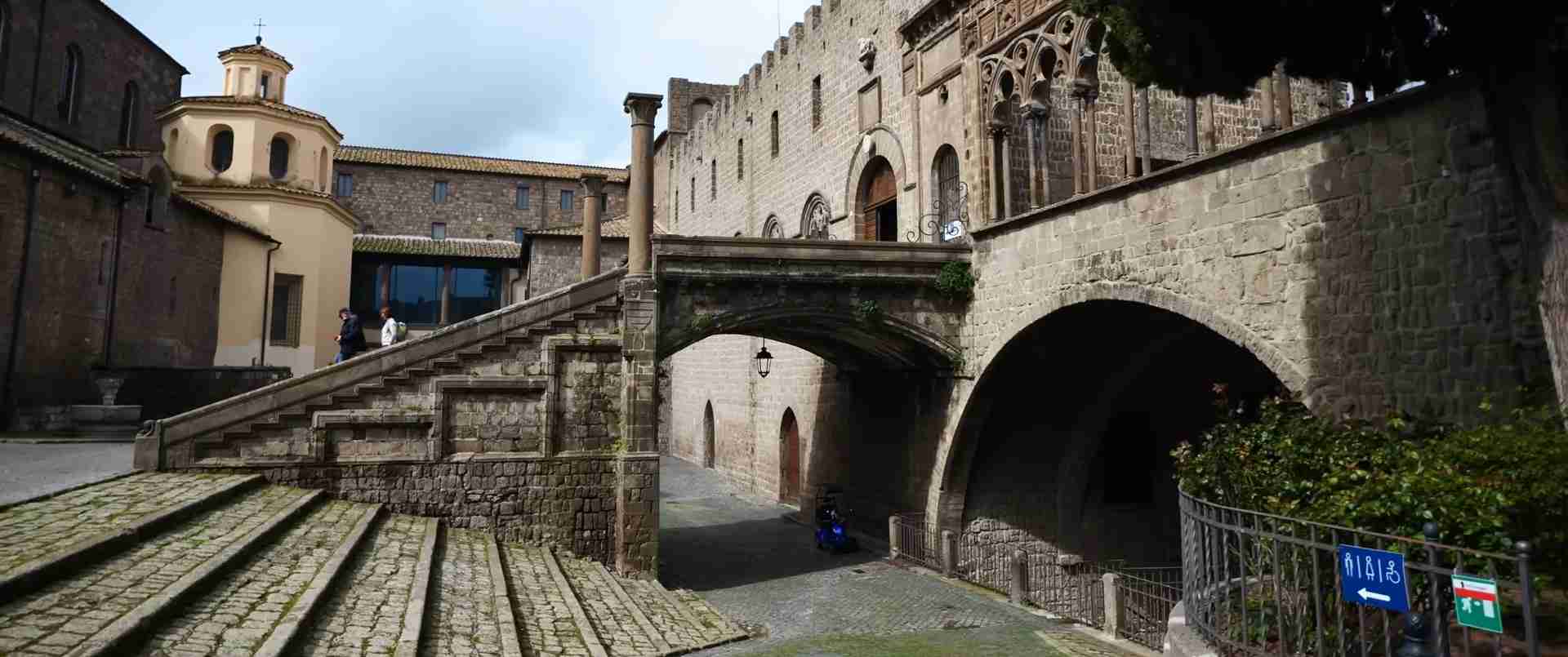
Viterbo is the largest city on the circuit and its most complete medieval urban environment. The walled city (centro storico) preserves a remarkable consistency of 12th and 13th-century architecture — a landscape of grey peperino stone, external staircases, loggias, and towers that makes every other Italian medieval quarter feel slightly reconstructed by comparison. The Quartiere San Pellegrino, the most intact medieval neighbourhood in Lazio, is essentially unchanged in streetscape since 1280.
The Palazzo dei Papi (Papal Palace), built against the cathedral of San Lorenzo between 1255 and 1267, is Viterbo’s defining monument. Its great Gothic Loggia dei Papi — an open arcade above the main square, visible from the approach — became the stage for papal proclamations during the decades when Viterbo served as the reluctant home of the papacy. The Conclave of 1268-1271, the longest in church history at nearly three years, took place here; local citizens eventually locked the cardinals in and removed the roof to speed their deliberations. Opening hours and admission prices vary by season and managed access; check the comune di Viterbo tourism website for current details before visiting. Walking the medieval quarter and Piazza del Plebiscito is free. The thermal baths (terme) at Bullicame, just outside the city walls, are free natural pools of sulphurous water — a Dantesque experience cited in the Inferno and still used today.
Viterbo makes an excellent overnight base for the first two days of the circuit. The city has a full range of accommodation, good restaurants specialising in Viterbese cuisine (acquacotta, vignarola, various preparations of local beans and cured pork), and a well-preserved evening atmosphere in the centro storico. From Viterbo, all key sites in the Lazio half of the circuit are within 50 km.
Tuscania: The Forgotten Romanesque Jewel
Tuscania, 24 km west of Viterbo, is among the most historically layered towns in the region and among the least visited by non-Italian travellers. Its significance rests on two extraordinary Romanesque basilicas built outside the medieval town walls on a tuff spur that was once the Etruscan acropolis — a site continuously inhabited since at least the 7th century BC.
The Basilica of San Pietro (12th century) stands alone on Colle San Pietro, backed by two medieval watch-towers, facing an empty expanse of countryside. Its facade combines Lombard Romanesque stonework with a carved rose window; the interior contains a cosmati-work mosaic floor, a forest of recycled Roman columns, a crypt supported on 28 columns of different periods, and a parade of Etruscan sarcophagi in the left nave — an accidental museum assembled from centuries of reuse. The Basilica of Santa Maria Maggiore, a few hundred metres below, is the earlier of the two, its facade featuring a polychrome Last Judgement carved above the central portal and a baptismal font still fed by running water. Both basilicas are open to visitors without an admission charge; a donation to the custodial fund is appreciated. The surrounding tuff plateau conceals substantial Etruscan necropolis sites — the necropolis of Pian di Mola is accessible from the car park near San Pietro and takes 45-60 minutes to walk without a guide.
Tuscania’s medieval centre suffered severe earthquake damage in 1971 but has been largely restored; the Piazza Basile and surrounding lanes retain a genuine medieval atmosphere. The town makes a good lunch stop rather than an overnight base, though a handful of agriturismo options in the surrounding countryside provide quieter alternatives to Viterbo.
Civita di Bagnoregio: The Dying City
Civita di Bagnoregio is the most photographed place on this route and, despite its fame in Italy, still manages to feel genuinely haunting. The city occupies a narrow tuff plateau connected to the neighbouring town of Bagnoregio by a single pedestrian bridge 300 metres long. The plateau is eroding: each decade, its edges crumble into the Valle dei Calanchi below, and the buildings nearest the edges inch closer to falling. The city’s resident population has dwindled to between ten and twenty full-time inhabitants, with cats outnumbering people year-round. It has been inhabited for 2,500 years and is, slowly and visibly, disappearing.
Admission to cross the bridge costs €5 per person in 2026 (check casacivitabagnoregio.it for current rates). Tickets are available at the information point at the bridge’s foot, open daily from 8:00 to 20:00 in summer and 8:00 to 19:00 in winter. The village itself — a single main street, a small piazza around the Church of San Donato, a geological museum in the Palazzo Alemanni, and a handful of craft shops and restaurants — takes about 90 minutes to explore. Arrive before 10:00 on weekends to avoid the worst crowds; midweek mornings are almost empty.
The view of Civita from the Lubriano belvedere, across the valley on the opposite ridge, is arguably the more powerful experience — the full drama of the eroding plateau with the village on top becomes apparent only from a distance. Stop at Lubriano (7 km from Bagnoregio) for fifteen minutes before or after the bridge crossing. Overnight stays in Bagnoregio or Lubriano make the most of the golden-hour light on the plateau, when day-trippers are gone.
Calcata: The Artists’ Village Above the Gorge
Calcata hangs over the Valle del Treja in the Viterbo province, about 50 km from Rome. A medieval village built entirely on a tuff outcrop above a deep river gorge, Calcata was officially declared uninhabitable in the 1930s due to structural instability and evacuated. Residents relocated to the modern village of Calcata Nuova, 500 metres away. Then, in the 1960s and 1970s, artists, musicians, and countercultural figures moved into the abandoned medieval core, restored the buildings, and created what is today one of Lazio’s most distinctive communities — a village where the lanes are lined with galleries, ceramics studios, and alternative-lifestyle businesses, and where the medieval architecture has been preserved not by heritage authorities but by bohemian occupants.
Entry to Calcata is free and the village is open year-round. The single gatehouse entrance leads onto a small piazza flanked by the 17th-century Church of the Holy Name and the Palazzo degli Anguillara with its Ghibelline tower. From the piazza, narrow lanes thread between tuff houses to lookout points above the gorge. The Parco Regionale della Valle del Treja begins at the foot of the rock; walking trails descend to the river and continue through oak-and-hazel woodland. The village has several small restaurants and a reputable ceramics market on weekends. Calcata fits naturally into a Day 5 return to Rome — a last stop 50 km from the city before handing back the car.
Sutri: An Empire Carved in Rock
Sutri sits on the Via Cassia, the ancient road from Rome to Florence, 53 km north of the capital. It is one of the most compact and rewarding archaeological sites in Lazio — a Roman amphitheatre, an Etruscan necropolis of 64 rock-cut tombs, and the extraordinary Mitreo (a Roman Mithraeum later converted into the underground Chapel of the Madonna del Parto) all occupy a single tuff escarpment outside the medieval town walls.
The Sutri Pass (Sutri Pass — all sites including amphitheatre, necropolis, Mitreo, and Villa Savorelli garden) costs €15 per adult. The park opens Tuesday to Sunday from 10:00 to 19:00. The amphitheatre is among the handful of Roman arenas carved directly from natural rock rather than built from masonry — its seating tiers, external gallery tunnels, and arena floor are hewn from a single tuff cliff in the 1st century BC. The experience of sitting in this structure, overgrown with grass and surrounded by birdsong, is entirely different from the monumental enclosed atmosphere of larger Roman arenas.
The Mitreo deserves particular attention. This long, barrel-vaulted underground chamber, originally dedicated to the mystery cult of Mithras and later appropriated by the church (hence its alter ego as a Christian chapel), contains frescoes from multiple periods and a peculiar spatial quality — more cave than building, yet architecturally precise — that makes it one of the most atmospheric spaces on the circuit. Access to the Mitreo is timed (groups of up to 15 enter every 20 minutes), so plan arrival accordingly. Sutri pairs well with Calcata on a Day 5 return from Pitigliano.
Pitigliano: Little Jerusalem of the Maremma
Pitigliano is the southern anchor of the circuit and, on first approach along the road from Manciano, one of the most astonishing sights in Italy: an entire medieval city apparently growing from the top of a tuff plateau that drops sheer on three sides to the ravines below. The walls of the buildings and the face of the cliff form a continuous vertical surface 30 metres high, broken only by windows and the dark mouths of wine caves cut directly into the rock. The effect is theatrical on every approach.
The town is known as “La Piccola Gerusalemme” (Little Jerusalem) for its historic Jewish community, which arrived in the 16th century when families expelled or persecuted by papal decrees and Medici regulations found protection under the tolerant Orsini lords of Pitigliano. The ghetto, synagogue, and associated community spaces — ritual bath, kosher butchery, bakery for unleavened bread, wine cellar, dyeworks — were entirely carved into the tuff beneath the town, creating an underground complex of extraordinary cultural significance. The Jewish Museum, Synagogue, and Ghetto complex (La Piccola Gerusalemme) charges €6 per adult for entry, with reduced tickets at €5; it opens April to October from 10:00-13:00 and 14:30-18:00, closed Saturdays and Jewish holidays.
The rest of Pitigliano is free to explore and rewards several hours of wandering. The Palazzo Orsini (now containing the Diocesan Museum and archaeological collections), the aqueduct visible from the northern approach, the Etruscan rock-cut stairways outside the walls, and the tuff caves used as cantinas for the local Vernaccia di Pitigliano DOC white wine are all part of a visit. In the evening, the town takes on a golden light that the photographs cannot prepare you for. Pitigliano has a good selection of mid-range hotels and excellent local trattorias; it is the best overnight base for Days 3 and 4 of the circuit.
Sorano: The Fortress Above the Gorge
Twelve kilometres east of Pitigliano, Sorano occupies a narrow tuff ridge above the gorge of the Lente river. Where Pitigliano is theatrical and relatively polished for visitors, Sorano is raw and more intimate — a town of dark stone lanes, arched passages, and steep drops, dominated by the massive Fortezza Orsini that once guarded the Orsini lords’ holdings across southern Etruria. The fortress, part of the Parco Città del Tufo, contains an archaeological museum and a network of underground defensive tunnels and passageways accessible on guided tours.
The cumulative ticket for the Parco Città del Tufo — covering the Sovana necropolis (see below), the Fortezza Orsini in Sorano, and the Museo Mamiliano in Sovana — costs €10 per adult; entry to the Sovana necropolis alone costs €7. This combined ticket is excellent value and valid for a month, allowing visits to be spread across multiple days without re-purchasing. The via cave around Sorano are among the most impressive on the circuit: the Via Cava di San Rocco, descending from the Porta dei Merli just below the fortress, winds through overarching tuff walls to the valley floor and the necropolis area.
The Vitozza insediamento rupestre (rock-cut settlement) at nearby San Quirico di Sorano, included in the cumulative ticket, is one of the largest cave-dwelling complexes in central Italy — over 200 caves cut into a single cliff face, used as homes, barns, columbaria, and storage from Roman times through the medieval period. The site receives few visitors and has an almost spectral atmosphere.
Sovana: Where the Etruscans Built Their Afterlife
Sovana is a hamlet of perhaps a hundred inhabitants in the municipality of Sorano, and its scale belies its historical significance. This small village was, from the 6th to the 3rd century BC, the capital of an Etruscan city-state commanding the fertile tuff plateau between the Fiora and Albegna rivers. Its necropolis, extending for several kilometres along the Poggio Felceto and Poggio Stanziale ridges west of the village, contains the most elaborate collection of Etruscan rock-cut tombs in Tuscany.
The Tomba Ildebranda (early 3rd century BC) is the centrepiece: a full temple-facade tomb, its engaged columns, moulded entablature, and carved frieze surviving in remarkable condition despite 2,300 years of exposure. Other major tombs in the necropolis include the Tomba dei Demoni Alati (with a winged demon on the facade), the Tomba della Sirena, and the Tomba del Tifone — each carved directly from the cliff face, each representing a different moment in Etruscan funerary taste. The necropolis is accessible on paths through Mediterranean scrub; bring sturdy shoes, as the terrain is uneven. Entry with the €10 cumulative Parco Città del Tufo ticket, or €7 for the Sovana sector alone.
Sovana’s medieval village, gathered around the Romanesque Cathedral of Santi Pietro e Paolo (12th century, with a carved portal and an unusual crypt containing Roman and pre-Roman capitals), is the birthplace of Hildebrand of Sovana — who became Pope Gregory VII, the pope whose confrontation with Holy Roman Emperor Henry IV at Canossa in 1077 defined the boundaries of medieval church and secular power. The village has one good restaurant and two small museums; a half-day is sufficient for a thorough visit, making it a natural pairing with Sorano on Day 4 of the itinerary.
Off the Beaten Path: Hidden Discoveries Beyond the Main Circuit 2026
Via Cava Trekking and the Deeper Etruscan Landscape
The via cave around Pitigliano and Sorano reward dedicated walking that goes well beyond a quick look on the way between two towns. The best multi-hour itinerary follows the Via Cava di Poggio Cane from the Pitigliano end, passes through the Via Cava di Fratenuti (where sheer tuff walls rise 15 metres above the lane), and links to the Sorano system at the Porta dei Merli. This 8-10 km circuit takes three to four hours on foot, entirely on Etruscan-cut paths. Trail conditions vary; after heavy rain, the clay-bottomed lanes become slippery. A free trail map is available from the Parco Città del Tufo office in Sorano (Piazza Busatti).
Several via cave contain carved wayside shrines and medieval churches at their ends — small tuff-rock chapels that integrated the Etruscan sacred landscape into the Christian one. The Madonna delle Catene chapel near Pitigliano, carved into a cliff face at the end of a via cava, is a particularly atmospheric example: a three-arched facade cut directly from the rock, still used for local religious ceremonies.
Norchia, Blera, and the Lost Etruscan Cities
Norchia (approximately 30 km northwest of Viterbo) is the most dramatic uninhabited Etruscan site in the region. A medieval fortress town abandoned in the 14th century after plague, Norchia occupies a tuff promontory above the confluence of two streams; its necropolis lines both ravines with hundreds of rock-cut tombs, including several monumental cube tombs with elaborate facade carvings. The site is free to visit, accessible via a rough track from the hamlet of Norchia (off the SP127), but requires care: there are no fences, no guardrails, and some paths along the gorge edges are exposed. The walk from the car park to the main necropolis takes 30-40 minutes one way through scrub oak and thorn.
Blera (Bieda), 35 km southwest of Viterbo, is an inhabited village perched above the same tuff-ravine landscape, with a large and largely unvisited Etruscan necropolis along the Via Clodia and tuff gorges walkable from the town. The Via Clodia itself — the ancient Roman road running northwest from Rome toward Saturnia — is partially traceable as a walking route in this area. Blera’s medieval centre is modest but genuine; the Thursday market is a good opportunity to encounter the local agricultural economy. Free to visit; no entrance fees for the landscape.
Caprarola and the Farnese Triangle
The three great 16th-century architectural monuments of the Farnese family — Palazzo Farnese at Caprarola, Villa Lante at Bagnaia, and the Sacro Bosco at Bomarzo — form a roughly triangular cluster in northern Lazio within 50 km of each other. They share a period (all created between roughly 1547 and 1590), an architect (all three involve Pirro Ligorio or his influence), and a patron family (all three are Orsini or Farnese commissions). Seeing all three in sequence offers an extraordinary insight into the visual culture of Mannerist Italy.
Palazzo Farnese at Caprarola is the most monumental: a pentagonal fortress-palace designed by Vignola for Cardinal Alessandro Farnese, its cylindrical courtyard and spiral staircase among the high points of late Renaissance architecture in central Italy. Admission costs €10 per adult; the palace opens Tuesday to Sunday from 8:30 to 19:30 (closed Mondays). The park behind the palace, informal and overgrown compared to Villa Lante’s precision, is included in the ticket.
Villa Lante at Bagnaia (5 km east of Viterbo) is the finest Renaissance garden in Lazio and a masterpiece of water engineering: a terraced hillside garden through which water cascades from pool to pool via a continuous axial sequence of fountains, canals, and basins, flanked by two perfectly symmetrical garden houses. Admission is currently €5 per adult during ongoing PNRR restoration works (normal rate €8); check the Direzione Regionale Musei Lazio website for updates as restoration may conclude in 2026. Open Tuesday to Sunday.
Sample 5-Day Road Trip Itinerary 2026: The Classic Tuscia Loop
Day 1: Rome to Bomarzo and Viterbo (130 km driving)
Depart Rome early on the A1 motorway north, exiting at Attigliano or Orte (approximately 85-90 km). Drive 15 km east to Bomarzo. Arrive at the Sacro Bosco by 10:00 and spend two hours among the stone monsters. Admission: €13. Have lunch in the village of Bomarzo — the handful of trattorias serve standard Viterbese fare; budget €12-20 per person for a simple lunch with wine.
After lunch, drive 25 km southwest to Viterbo. Check into accommodation, then spend the afternoon walking the Quartiere San Pellegrino and the area around Piazza del Plebiscito. Visit the Palazzo dei Papi and cathedral from the exterior; guided access to the interior varies by season. In the evening, Viterbo has numerous restaurants in the centro storico serving acquacotta (bread and vegetable soup), torta al testo (unleavened flatbread), and local charcuterie. Budget dinner €20-40 per person at a mid-range trattoria.
Estimated Day 1 costs per person (excluding accommodation): attractions €13, lunch €12-20, dinner €20-40, incidentals €5-10. Total approximately €50-85.
Day 2: Viterbo, Tuscania, and Civita di Bagnoregio (70 km driving)
Start with a morning visit to Villa Lante at Bagnaia (5 km east of Viterbo). The garden opens at 8:30 and is most magical before 9:30 when tour groups arrive. Admission: €5. Spend 90 minutes walking the water terraces. Return to Viterbo for a second brief look at the Papal Quarter if time allows, then drive 24 km west to Tuscania.
Arrive at Tuscania for a 90-minute exploration of the Basilica di San Pietro and Santa Maria Maggiore (both free, donation appreciated) and a quick walk around the Colle San Pietro. Lunch in Tuscania at one of the local trattorias — budget €12-20 per person. Afternoon drive (46 km, 55 minutes) southeast to Civita di Bagnoregio. Stop at the Lubriano belvedere on the opposite ridge for the panoramic view before parking in Bagnoregio (€1 per hour). Cross the bridge (€5 entry) and spend 90 minutes in the village.
Overnight in Bagnoregio, Lubriano, or the nearby town of Montefiascone. Estimated Day 2 costs per person (excluding accommodation): Villa Lante €5, Civita bridge €5, lunch €12-20, dinner €22-40. Total approximately €45-70.
Day 3: Into the Maremma — The Drive to Pitigliano (95-110 km driving)
Day 3 is primarily a driving day, but the landscape traversed justifies lingering. The route south from Civita di Bagnoregio crosses into Tuscany via Acquapendente and the Via Cassia, passing through a succession of small volcanic lake towns (Bolsena, Grotte di Castro) before turning southwest toward the Maremma. Allow 1.5-2 hours of total driving, spread across a morning of unhurried progress.
An optional stop at Saturnia, 20 km north of Pitigliano, adds a spectacularly photogenic experience: the Cascate del Mulino, natural thermal pools fed by sulphurous water at 37.5°C, cascading over a travertine shelf. They are free to use and open around the clock; the best experience is early morning before tour groups arrive. Basic lunch facilities at a roadside bar near Saturnia (budget €10-15 per person) before the final stretch to Pitigliano.
Check into accommodation in Pitigliano in the early afternoon. Spend the remainder of the afternoon exploring the historic centre on foot: the aqueduct, the Via Zuccarelli, the Palazzo Orsini, and the terrace above the eastern gorge. The Jewish Museum and Ghetto complex (€6) is open until 18:00 in the spring-autumn season; visit in late afternoon when the crowds have thinned. Dinner in one of Pitigliano’s trattorias — try the local fagioli di Sorano (Sorano bean soup), pappardelle al cinghiale, or pecorino aged in tuff caves. Estimated Day 3 costs per person (excluding accommodation): Jewish Museum €6, lunch €10-18, dinner €22-40. Total approximately €40-65.
Day 4: Sorano, Sovana, and the Via Cave
Day 4 is the most historically concentrated day on the circuit. Base the day from Pitigliano and drive the triangle between Pitigliano (base), Sorano (13 km), and Sovana (20 km from Pitigliano).
Start at Sorano by 9:00. Buy the €10 cumulative Parco Città del Tufo ticket at the Fortezza Orsini ticket office. Visit the fortress and its underground tunnels on a guided tour (departing at 11:00, 15:30, 16:30, and 17:30 on most days except Monday; confirm times at the office). Walk down the Via Cava di San Rocco from the Porta dei Merli. Allow 2.5-3 hours in Sorano total.
Drive 7 km to Sovana for a light lunch (the village has one restaurant and a small bar; alternatively, picnic provisions from Pitigliano’s deli shops work well). After lunch, walk the Sovana necropolis circuit (included in cumulative ticket), taking in the Tomba Ildebranda, the Tomba dei Demoni Alati, and the atmospheric via cava leading to the tombs. Allow 2 hours at the necropolis. Visit the Cathedral of Santi Pietro e Paolo before returning to Pitigliano for a final evening in the village.
Estimated Day 4 costs per person: Parco Città del Tufo €10, lunch in Sovana €10-18, dinner in Pitigliano €22-40. Total approximately €42-68.
Day 5: Return to Rome via Calcata (155-175 km driving)
The final day traces the route north from the Maremma back toward Rome. The drive from Pitigliano to Calcata takes approximately 2-2.5 hours on state roads via Capalbio and the Via Aurelia north. Calcata village is reached from the Valle del Treja road off the SS3 Via Flaminia, about 50 km from central Rome.
Arrive in Calcata around midday. Park in the designated lot (free) at the head of the access path and walk into the medieval village through the gatehouse. The village itself is free to enter and takes 90 minutes to explore thoroughly — the lookout terraces above the gorge, the ceramic and craft workshops, and the Church of the Holy Name occupy the principal lanes. Lunch at one of Calcata’s small restaurants or artisan food shops (budget €12-20 per person). The surrounding Valle del Treja park offers 30-minute gorge walks for those with energy after four days of intensive sightseeing.
Continue to Rome on the SS3 and the ring road, arriving in time for a final evening. Return the rental car to the airport or city agency. Estimated Day 5 costs per person: Calcata free, lunch €12-20, fuel for 175 km approximately €8-12 per person. Total approximately €20-32.
Extended 7-Day Road Trip Itinerary 2026: Adding the Farnese Triangle
A two-day extension at the beginning of the circuit transforms the five-day loop into a comprehensive seven-day exploration of the Farnese Triangle and the northern Lazio hinterland. Days 1-2 of the extended version are inserted before the Bomarzo visit, and the rest of the itinerary shifts forward accordingly.
Extended Day 1: Rome to Caprarola (60 km). Drive to Palazzo Farnese at Caprarola (open from 8:30, admission €10). Allow three hours for the palace and its park. After lunch in Caprarola, drive 30 km northwest to Soriano nel Cimino, a medieval village beneath the beech forests of the Monti Cimini, and continue to Viterbo for the first overnight.
Extended Day 2: Villa Lante, Viterbo Quarter. Morning at Villa Lante (admission currently €5 during restoration works). Afternoon in Viterbo’s medieval quarter and Palazzo dei Papi area. Overnight Viterbo.
Days 3-7: Resume the classic itinerary from Day 1 above (Bomarzo, Tuscania, Civita, drive to Pitigliano, Sorano/Sovana, return via Calcata). For a seventh day rather than sixth, add Sutri to the Day 5 return leg: drive from Pitigliano via Viterbo to Sutri (175 km, 2.5 hours), visit the Sutri Pass archaeological park (€15, open 10:00-19:00 Tue-Sun), then continue to Calcata and Rome.
Budget travelers doing the 7-day extended circuit spend €595-910 per person total. Mid-range travelers spend €1,050-1,575. Luxury travelers pay €1,925-3,290 for seven days at top-tier properties, including all admissions, meals, and car costs. All figures assume two sharing accommodation.
Accommodation Costs and Best Bases 2026
Accommodation in the volcanic heartland ranges from basic family-run pensioni and agriturismo to boutique hotels in converted medieval buildings and luxury relais on working farms. The region’s limited hotel infrastructure means that quality within each tier is reasonably consistent — a mid-range agriturismo near Viterbo delivers genuine character and local hospitality that a city hotel at the same price point in Rome or Florence might not.
Budget Accommodation in the Volcanic Heartland (€55-80 Per Room Per Night)
Budget accommodation runs €55-80 per room per night for a double — the per-person share for two travellers is €28-40. This tier encompasses basic agriturismo rooms in working farms around Viterbo and in the Maremma, family-run B&Bs in smaller villages, and the few budget hotels in Viterbo’s outer quarters. Breakfast is sometimes included (a simple continental spread of bread, jam, and coffee) but frequently not; factor in €4-7 per person for a bar breakfast in town.
Key budget options by base: in Viterbo, several B&Bs operate in the medieval quarter and near the train station at €55-70 per room. Near Civita di Bagnoregio, the B&B market in Bagnoregio and Lubriano fills a useful gap at €60-80 per room. In the Pitigliano-Sorano area, agriturismo properties in the surrounding farmland offer the best budget value — a working farm double room with dinner-by-arrangement option at €65-80 per room is not uncommon in this category. Booking platforms (Booking.com, Airbnb, Agriturismo.it) cover the region adequately; direct booking with the agriturismo often produces a small discount.
Mid-Range Accommodation (€100-160 Per Room Per Night)
Mid-range accommodation from €100-160 per room is the sweet spot in the volcanic heartland: at this level, properties occupy historic buildings (converted convents, medieval townhouses, 17th-century farmsteads), provide private bathrooms with genuine character, and serve locally sourced breakfast. The per-person share for two travellers is €50-80.
In Viterbo, several boutique hotels in the centro storico — occupying renovated medieval buildings along the main lanes of San Pellegrino — fall within this range. Il Richiastro (a converted palazzo near Piazza del Plebiscito) and similar properties offer comfortable rooms with medieval stonework at €100-140 per room. Near Civita di Bagnoregio, a small number of restored farmhouses and B&Bs with pool have entered the mid-range category. In Pitigliano, Hotel della Fortezza — occupying caves and medieval cellars cut into the tuff cliff beneath the Palazzo Orsini — is the most distinctive property in this range at approximately €110-150 per room; book well in advance for spring and autumn.
Luxury Accommodation (€180-350 Per Room Per Night)
Luxury accommodation in the volcanic heartland is available primarily through upmarket agriturismo estates and boutique relais that combine working farms or heritage buildings with high-quality service. The per-person share for two travellers is €90-175. Options range from converted Renaissance farmhouses near Viterbo (with pools, cooking courses, and estate wine tastings) to standalone luxury properties in the Pitigliano-Sorano area offering private terraces above the gorges.
The Terme di Saturnia Spa & Golf Resort (25 km from Pitigliano), while not a classic tuff-town property, provides the region’s highest-tier thermal hotel experience at €280-500 per room, including access to private thermal pools. Agriturismo properties near Pitigliano in the €180-250/room range include estate-grown Vernaccia di Pitigliano wine, farm dinners, and outdoor spaces in settings of genuine natural beauty. Caprarola’s surroundings have several luxury country-house hotels aimed at visitors combining the Farnese Triangle with agriturismo stays.
Best Overnight Bases by Position on the 5-Day Loop
Night 1-2: Viterbo or surrounding countryside. The medieval city is the most complete urban base for the Lazio sites; countryside agriturismo between Viterbo and Bagnoregio minimises driving on Day 2. Night 2 can be in Bagnoregio or Lubriano to experience Civita di Bagnoregio without the day-tripper crowds. Night 3-4: Pitigliano or Sorano. Pitigliano has the widest range of accommodation and dining; Sorano offers a quieter experience inside the medieval fortress town. The 12 km between them makes the choice easy to switch during the trip. Driving back from Pitigliano to Rome on Day 5 is 155-175 km — perfectly manageable in a half-day with one or two stops.
Food and Dining Costs in the Volcanic Heartland 2026
The Tuscia Viterbese and Grosseto Maremma are two of the least-known but most rewarding food regions in Italy. The cuisine here is genuinely rural — built on ingredients produced within a few kilometres of where you eat — and largely untouched by the standardisation that affects more tourist-oriented areas. Local specialities include acquacotta (a peasant soup of water, greens, eggs, and day-old bread), pappardelle al cinghiale (pasta with wild boar ragù), vignarola (spring vegetable stew), various preparations of local fagioli (beans), pecorino aged in tuff caves, and the local wines: Est! Est!! Est!!! from Montefiascone, Vernaccia di Pitigliano (a dry white DOC from native grape varieties), and Orvieto DOC from across the Umbrian border.
Budget Dining in the Volcanic Heartland (€32-46 Per Person Per Day)
Budget dining centres on the bar breakfast (coffee and cornetto: €3-5), a trattoria lunch (pasta course, bread, water, house wine: €10-18), and a basic evening trattoria dinner (two courses, house wine: €18-25). Total for the day: €32-46 per person. Pitigliano and Sorano have several no-frills trattorias where a complete meal with local wine costs €18-25 per person; these are among the best-value dining experiences on the circuit, not just the cheapest. Self-catering from local deli shops and markets reduces costs further; the Viterbo and Pitigliano weekly markets sell excellent local produce — beans, olive oil, pecorino, salumi — that travel well for picnics at archaeological sites.
Mid-Range Dining (€55-77 Per Person Per Day)
Mid-range dining opens the full range of Tuscia restaurants: morning at a pasticceria (local pastries, cappuccino, fresh orange juice: €7-12 per person), lunch at an enoteca or sit-down trattoria with a full menu (€20-30 per person with wine), and dinner at an established restaurant with a regional menu and proper wine list (€28-40 per person). This tier includes the better Pitigliano restaurants (Osteria Il Tufo Allegro is widely considered the reference address for Maremma cuisine; budget €35-50 per person for dinner including wine) and the agriturismo dinner option, where farm-produced courses come to the table at fixed prices around €30-40 per person including wine.
Culinary Specialties Worth the Splurge
Several food and drink experiences on this circuit justify a specific budget allocation. A guided cave-cellar tasting of Vernaccia di Pitigliano at one of the historic producers costs €10-20 per person. The Pitigliano Jewish Museum tour (€6 entry) passes through the reconstructed kosher bakery, winery, and butchery — a direct encounter with the food culture of the ghetto community that is part history lesson, part culinary tour. In Sorano, the Sorano bean (fagiolo di Sorano, a Slow Food Presidium product) appears on virtually every menu; it is worth ordering specifically as a dish rather than as a side, served as a soup or stewed preparation with local oil. The Terme di Saturnia, if you stop for the free outdoor pools, has a roadside bar selling local snacks and Morellino di Scansano wine — a DOC red from the nearby area — at fair prices.
Car Rental and Transportation Costs 2026
A rental car is the single most significant transport expense on this circuit, and planning it correctly significantly affects total costs. Economy cars (Fiat Panda, VW Polo, or equivalent) cost €30-45 per day from major Rome airport agencies; mid-range cars (Renault Clio, Citroën C3, or equivalent) run €45-65 per day. A compact SUV with slightly higher clearance (useful for Norchia and rougher via cava access tracks) costs €55-75 per day. These figures are for standard manual transmission; automatic transmission adds approximately €10-15 per day. Rates fluctuate significantly by season: spring and autumn are the peak periods for this circuit, and prices rise accordingly. Booking four to six weeks ahead saves 20-30% against walk-up rates.
Petrol (benzina) costs approximately €1.70-1.90 per litre in 2026. The full five-day circuit covers roughly 600-700 km; a compact car consuming 6 litres per 100 km uses 36-42 litres over the circuit, costing €60-80 total. Split between two people, that is €30-40 per person for the full five days — approximately €6-8 per person per day. Diesel (gasolio) is marginally cheaper (€1.60-1.75 per litre) and gives better fuel economy on rural roads; LPG (GPL) and hybrid rentals are available at larger Rome agencies and reduce fuel costs further.
Motorway tolls on the A1 (Rome-Orte section) add approximately €5-8 for the outward journey from Rome to the Bomarzo exit. Return from Calcata to Rome uses the SR3 Via Flaminia (toll-free). Total toll costs for the five-day circuit are minor — €8-12 for the entire trip.
Parking is free at nearly all archaeological sites and tuff town car parks on this route. Paid parking applies in central Viterbo (approximately €1.50-2 per hour in blue-zone areas), at the Civita di Bagnoregio bridge car park (€1 per hour), and at a few metered areas in Pitigliano. Budget €3-6 per day for parking in towns across the full trip.
For travellers arriving without a car, trains from Roma Termini to Viterbo (2 hours, €7-9 on the regional FL3 line) provide a base from which the central Lazio sites can be day-tripped by hired bicycle or taxi; the Pitigliano area, however, remains inaccessible by train.
Complete Daily Budget Breakdown 2026
The following daily cost summaries are per person, per day, assuming two people sharing hotel or agriturismo accommodation. Hotel room rates are divided by two before calculating the per-person total. Car rental and petrol costs are also split between two travellers.
Budget Travelers (€85-130 Per Person Daily)
Budget travelers sharing a budget hotel room (€55-80 per room per night) allocate approximately €28-40 per person for accommodation. Meals at bar breakfasts and local trattorias cost €32-46 per person. A split economy car rental with petrol adds €21-33. Admissions and incidentals account for €5-12. Total: approximately €85-130 per person daily, assuming two sharing budget accommodation. Over five days this equals €425-650 per person for the full circuit. Budget travellers saving further by picnicking at archaeological sites, using free agriturismo farm access roads, and visiting free sites (Tuscania basilicas, Calcata, Pitigliano street exploration) on afternoons can keep daily costs toward the lower end of this range.
Mid-Range Travelers (€150-225 Per Person Daily)
Mid-range travelers sharing a mid-range hotel or agriturismo (€100-160 per room) allocate €50-80 per person for accommodation. Sit-down meals at proper trattorias and enotecas cost €55-77 per person. A mid-range car rental with petrol (split two ways) adds €31-45. Admissions, tastings, and incidentals account for €13-25. Total: approximately €150-225 per person daily. Over five days: €750-1,125 per person. This tier represents the most rewarding balance of comfort and authenticity on the circuit — the agriturismo experience in particular delivers far more character per euro than urban mid-range hotels in more visited parts of Italy.
Luxury Travelers (€275-470 Per Person Daily)
Luxury travellers sharing a boutique relais or upmarket agriturismo (€180-350 per room) pay €90-175 per person for accommodation. Upscale dining at the region’s best restaurants — including agriturismo tasting dinners, wine cave visits, and lunch at properties like Osteria Il Tufo Allegro in Pitigliano — costs €115-175 per person. A premium rental car with petrol, split two ways, adds €45-65. Private guided tours of the Etruscan necropolises, wine tastings at estate producers, and priority admission packages account for €25-55. Total: approximately €275-470 per person daily. Over five days: €1,375-2,350 per person. The Terme di Saturnia, which can be visited as a day addition or used as the main overnight base for one night, adds materially to the luxury total if its premium accommodation is chosen.
Admission Prices at Every Major Site 2026
The following admission prices were verified in 2025; all entries noted “check official site” have variable pricing or seasonal tariffs. As a general rule, state-managed Italian heritage sites offer free entry on the first Sunday of each month — a significant saving if your circuit happens to fall on one of these dates.
- Sacro Bosco di Bomarzo (Parco dei Mostri): €13 per adult; reduced rate €8 for children aged 4-13. Private park, no free-entry Sundays. Open daily. Check sacrobosco.eu for current rates before visiting.
- Civita di Bagnoregio bridge access: €5 per person. Open daily, 8:00-20:00 summer / 8:00-19:00 winter. Reduced or free for registered accommodation guests. Check casacivitabagnoregio.it for current rates.
- Villa Lante (Bagnaia, Viterbo): Currently €5 during PNRR restoration works (normal rate €8). Closed Mondays. Check Direzione Regionale Musei Lazio website for current restoration status and pricing.
- Palazzo Farnese (Caprarola): €10 per adult. Reduced €2 for EU citizens aged 18-25. Closed Mondays. Open Tuesday-Sunday 8:30-19:30.
- Parco Città del Tufo — cumulative ticket (Sovana necropolis + Fortezza Orsini Sorano + Museo Mamiliano Sovana): €10. Valid for one month. Single-sector Sovana necropolis only: €7, reduced €5.
- Pitigliano Jewish Museum, Synagogue, and Ghetto: €6 per adult; reduced €5. Open April-October: 10:00-13:00 and 14:30-18:00. Closed Saturdays and Jewish holidays.
- Sutri Pass (amphitheatre, necropolis, Mitreo, Villa Savorelli garden): €15 per adult; reduced €12 for under-18s and groups over 20. Open Tuesday-Sunday 10:00-19:00.
- Tuscania — Basilica di San Pietro and Santa Maria Maggiore: Free entry; donation to the custodial fund appreciated.
- Calcata: Free to enter and explore year-round.
- Pitigliano historical centre, aqueduct, tuff cave exterior: Free; no admission required for street-level exploration.
- Saturnia Cascate del Mulino thermal pools: Free; open around the clock.
First-Sunday-of-the-month free entry applies to state-managed sites including Villa Lante, Palazzo Farnese, and the Sutri archaeological park. Bomarzo (private) and the Parco Città del Tufo (managed by the Comune di Sorano) do not participate. Planning a visit on the first Sunday of a month saves approximately €25-30 per person in admissions across the main state-run sites.
Best Time to Visit: Seasonal Planning Guide 2026
The volcanic heartland has four distinct seasons, each with different implications for road trip planning. The two windows of ideal conditions are April-June (late spring) and September-October (early autumn).
April-June (recommended): Spring is the best time to experience the tuff landscape in its full colour. Wildflowers — poppies, broom, wild iris — cover the cliff edges and via cave margins from mid-April through early June. Temperatures are comfortable for walking (15-25°C in May) and the light for photography is exceptional. The Parco Città del Tufo is at its most atmospheric in spring, with the necropolis paths flanked by flowering vegetation. Accommodation is available without the summer premium, but the most characterful properties book quickly for April-May weekends; reserve two to three months ahead. The festival of the Infiorata (flower carpet processions) in Bolsena and several nearby towns takes place in late May and June around the Corpus Christi period — a photogenic coincidence if the timing aligns.
September-October (recommended): Early autumn brings the grape harvest (vendemmia) across the Pitigliano wine zone, the olive harvest beginning in October, and a return of comfortable walking temperatures after the summer heat. The tuff landscape turns amber and ochre as vegetation dries; the necropolises are particularly dramatic in the low-angled autumn light. Accommodation prices retreat from summer peaks in mid-September. October weekends in the Viterbo area feature the Macchina di Santa Rosa (the first Saturday of September, when Viterbo carries an enormous illuminated tower through the medieval streets — one of Italy’s most visually extraordinary popular festivals).
July-August (acceptable with caveats): Summer brings temperatures above 35°C in the interior, making afternoon archaeological site walking uncomfortable. Accommodation fills completely in August, prices rise substantially, and Pitigliano in particular becomes significantly more crowded with Italian summer tourists. Morning visits (sites open from 9:00-10:00) and afternoon agriturismo pool time are the standard adaptation. The via cave themselves are refreshingly cool even in August, their depth providing natural shade. Evening temperatures are pleasant in the hill towns.
November-March (limited but possible): Winter in the volcanic heartland is cold, wet, and often foggy — the tuff ravines trap morning mist for hours. Many smaller accommodation options close entirely from November to March. However, the Parco Città del Tufo sites remain open (with reduced hours), Viterbo retains its medieval atmosphere year-round, and the complete absence of tourists gives the most well-known sites an entirely different quality. The truffle season (November-December) brings tartufo nero to menus across the region, and the Christmas markets in Viterbo’s medieval centre are genuinely local rather than tourist-directed.
Money-Saving Strategies for the Tuscia Road Trip
The volcanic heartland road trip is inherently economical by Italian standards — this is not the Amalfi Coast or the Cinque Terre, and the price infrastructure reflects that. The following strategies push costs further toward the lower end of each budget tier.
Use the cumulative Parco Città del Tufo ticket. The €10 ticket covers the Sovana necropolis, Fortezza Orsini guided tours, and the Museo Mamiliano — three distinct half-day experiences. Paying for each separately would cost more, and the ticket remains valid for a month, allowing return visits if time permits.
Target First Sunday of the Month for state-run sites. Free entry to Villa Lante, Palazzo Farnese, and the Sutri archaeological park on the first Sunday of any month saves €25-30 per person on admissions. This works particularly well for a weekend trip that starts on Sunday at state-run sites and continues through the week at private or communal sites.
Book the rental car early. Prices for the same vehicle and dates routinely vary by 30-40% between booking eight weeks ahead and booking two weeks ahead during spring peak season. Booking at Rome Fiumicino or Ciampino airports saves the fuel and time of a city pick-up, particularly useful if arriving by plane.
Base yourself in agriturismo outside town centres. Agriturismo properties in the countryside between Viterbo and Bagnoregio or in the Pitigliano farmland charge €60-100 per room — the same or less than town-centre hotels — and include the use of outdoor spaces, sometimes pools, and occasional farm dinners at prices competitive with local trattorias.
Picnic at archaeological sites. The Norchia, Sovana necropolis, and via cava paths make extraordinary lunch settings. Local deli shops (alimentari) in Pitigliano, Sorano, and Viterbo sell excellent picnic provisions — local olive oil, fagioli di Sorano, pecorino, house-pressed wines — at genuine local prices.
Visit Saturnia’s free thermal pools instead of resort spas. The Cascate del Mulino, the free outdoor thermal waterfall and pools accessible from the roadside near Saturnia, are as visually spectacular as the paid resort facilities and cost nothing. Arrive before 9:00 or after 17:00 to avoid the busiest periods.
Hidden Costs and Practical Considerations 2026
Fuel and motorway tolls. Detailed above in the transport section; budget €35-50 per person for the full five-day circuit fuel cost (economy car, two sharing). Motorway tolls on the A1 section from Rome to Bomarzo add €5-8.
Parking. Most sites offer free parking. Paid parking applies in central Viterbo (€1.50-2 per hour in blue zones), at Civita di Bagnoregio (€1 per hour), and in a few metered areas. Total parking costs for five days: €5-15 per person.
Restaurants with coperto. Italian restaurants charge a coperto (cover charge) of €1.50-3 per person at sit-down meals. This is listed on menus and is obligatory; it is not a tip. Budget €3-6 per day per person for coperto at two meals.
Monday closures. The full financial cost of arriving on a Monday at Palazzo Farnese (€10 admission, saved if you reallocate) and Villa Lante (€5-8) is not trivial when combined with Sutri (€15) — all three close on Monday. Planning the itinerary so that Monday falls on a driving day, a via cava walk, or the Sorano-Sovana combination (which closes on Wednesday, not Monday) eliminates this risk entirely.
ZTL fines. Driving into a historic town centre within a ZTL (limited traffic zone) generates a fine, which the rental agency passes back to the hirer along with an administrative charge (€25-50 on top of the fine itself). These fines are issued by camera and arrive after the trip; they are difficult to contest. Always look for ZTL signs on approach roads and park outside the walls in all historic centres.
Weather delays at outdoor sites. The Norchia access track and the deeper via cave paths become impassable or dangerous in heavy rain. If the forecast shows rain on a planned outdoor day, swap that day with a town-based day (Viterbo, Pitigliano) and rearrange accordingly. No additional cost, but important for safety.
Language barrier. English is less widely spoken in this region than in Rome or Florence. In Viterbo, Pitigliano, and Sorano, English-speaking restaurant staff are found but not universal. At rural archaeological sites, English signage is minimal. A translation app on a phone and a pocket phrasebook reduce frustration significantly; the effort to use basic Italian phrases is invariably appreciated by locals in the smaller villages.
Frequently Asked Questions
How much does the full 5-day volcanic heartland road trip cost per person in 2026?
Budget travelers (two sharing a budget hotel) spend €425-650 per person for the full five-day circuit, covering accommodation, all meals, a shared economy car rental and petrol, and admissions. Mid-range travelers spend €750-1,125. Luxury travelers at boutique relais spend €1,375-2,350. These figures include everything: there are no major additional costs beyond the occasional incidental.
Do I need to pre-book sites on the volcanic heartland road trip in 2026?
Pre-booking is not required for most sites on the circuit. The Sacro Bosco di Bomarzo, Civita di Bagnoregio, and the Parco Città del Tufo all sell tickets on arrival or online without mandatory advance booking. The exception is the Mitreo at Sutri, which operates timed entry for groups of up to 15; if visiting on a weekend, arriving early (10:20 for the first entry) avoids waiting. Guided tours of the Fortezza Orsini at Sorano run on set times (11:00, 15:30, 16:30, 17:30); no pre-booking required, but confirming times with the Parco Città del Tufo office on arrival is advised. Accommodation, however, should be booked two to three months ahead for spring and autumn visits.
What is the best order to visit the tuff towns in 2026?
The clockwise loop from Rome — Bomarzo, Viterbo, Tuscania, Civita di Bagnoregio, Pitigliano, Sorano, Sovana, Calcata, Rome — produces the most logical sequence of increasing remoteness followed by a return toward civilisation. Driving from Pitigliano back to Viterbo on the return leg rather than cutting directly home via the coast allows the addition of Sutri as a final stop without extending daily driving beyond comfortable limits. An anti-clockwise version beginning with Calcata and Sutri is equally valid and reverses the build toward the Maremma.
Can I combine this road trip with the Etruscan UNESCO sites at Cerveteri and Tarquinia in 2026?
The UNESCO World Heritage Etruscan Necropolises of Cerveteri (Banditaccia) and Tarquinia are both within logical reach as extensions of this circuit. Cerveteri is 67 km southwest of Viterbo on the Tyrrhenian coast; Tarquinia is 80 km southwest. Both contain far larger and more densely concentrated necropolis complexes than the Parco Città del Tufo sites, but cover different aspects of Etruscan funerary culture — the Sovana area specialises in elaborate rock-cut facades and via cave, while Cerveteri and Tarquinia are known for painted tomb chambers. A two-day extension at the circuit’s beginning (Tarquinia from Rome, then north to Tuscania) makes a compelling opening to the full trip for anyone with a serious interest in Etruscan civilisation.
Is the volcanic heartland road trip suitable for families with children in 2026?
Yes, with some planning. The Sacro Bosco at Bomarzo is genuinely captivating for older children and teenagers. The Civita di Bagnoregio bridge walk is straightforward. The Sutri amphitheatre and necropolis offer strong visual impact without lengthy walking. For younger children, the via cave paths need supervision at the edge of the raised plateau sections, and the Norchia optional extension involves rough terrain unsuitable for pushchairs. The Saturnia thermal cascades are suitable for children though can be slippery; supervise carefully. Agriturismo accommodation — often working farms with animals — is a reliable draw for families with younger children. Children under 13 receive reduced admission at most sites.
How far in advance should I book accommodation for a spring 2026 visit?
For April and May visits, booking two to three months ahead is essential for the most characterful properties (Hotel della Fortezza in Pitigliano, boutique medieval B&Bs in Viterbo’s centro storico, and popular agriturismo estates). Budget accommodation has more availability but still benefits from advance booking, particularly for weekend nights. Autumn visits (September-October) require slightly less advance notice but follow the same general rule: the better properties fill first. Summer (July-August) accommodates more last-minute booking simply because the best rural properties have more capacity, though August in particular is difficult across the entire region.
What are the via cave and where is the best place to walk them in 2026?
The via cave are ancient Etruscan hollow roads cut vertically into the tuff plateau, creating lane-like passages with sheer rock walls rising 5-25 metres on both sides. Their origin and precise purpose remain debated; they may have served as routes between fields and settlements, ceremonial paths to necropolises, or defensive corridors. The best via cave experience in 2026 is in the Sorano-Pitigliano-Sovana triangle. The Via Cava di San Rocco, descending from the Porta dei Merli in Sorano, is the most dramatic single example: 18-20 metres deep in its widest sections, moss-covered, and reaching the necropolis area in about 40 minutes on foot. The system near Pitigliano includes the Via Cava di Fratenuti and Via Cava di Poggio Cane. A free trail map from the Parco Città del Tufo office in Sorano covers all walkable routes. Access is free; include in a full Day 4 Sorano and Sovana itinerary.
What food and wine should I prioritise in the volcanic heartland in 2026?
Five experiences stand out. First: acquacotta (literally “cooked water”) — a soup of local greens, dried bread, eggs, and olive oil that is Tuscia’s most characteristic dish. Second: fagioli di Sorano, a white bean variety grown in the tuff soil around Sorano, achieving Slow Food Presidium status for its unusually sweet and buttery flavour; eat it as a soup or simply dressed with estate olive oil. Third: pecorino stagionato nelle fosse (aged in tuff caves), available from local cheesemakers and markets throughout the region. Fourth: Vernaccia di Pitigliano DOC — a dry white wine made from the Vernaccia and Trebbiano grapes grown on the tuff slopes above Pitigliano, with a distinctly mineral quality that reflects its volcanic terroir. Fifth: anguilla di Bolsena — lake eel, roasted or in sauce, from the waters of Lago di Bolsena; a regional speciality less easily found elsewhere in Tuscany or Lazio.
Are there any free Etruscan sites on the volcanic heartland circuit in 2026?
Several significant Etruscan sites on and near the circuit are free to visit. The Norchia necropolis (30 km northwest of Viterbo) is unmanaged open land accessible on foot; no entry fee, no facilities, impressive rock-cut tombs in a wild setting. The via cave themselves are free to walk throughout the Sorano-Pitigliano area (the Parco Città del Tufo ticket covers the managed archaeological zone but not the outdoor via cave paths). The Etruscan rock-cut stairways and tomb fragments visible from the road outside Pitigliano’s walls are free. In Tuscania, the necropolis paths around the Colle San Pietro are freely accessible from the car park. The UNESCO World Heritage necropolises at Cerveteri and Tarquinia, if added to the circuit, charge admission (verify on the official site), but their scale and state of preservation are exceptional.
What happens if it rains during the volcanic heartland road trip in 2026?
Rain transforms the outdoor Etruscan sites — the via cave become slippery and hazardous, and the Norchia track turns to mud. The practical response is to swap outdoor days for town-based days: Viterbo’s medieval quarter, Pitigliano’s museum complex, the Bomarzo Sacro Bosco (walkable in light rain under the tree canopy), and covered sites like the Fortezza Orsini underground tours all work well in wet weather. Viterbo’s Quartiere San Pellegrino is arguably more atmospheric in misty rain. Pitigliano’s tuff cave complex and the Sovana archaeological museum (indoor collections) provide full half-days without exposure. A waterproof layer is essential packing for any season; even spring visits can bring afternoon showers.