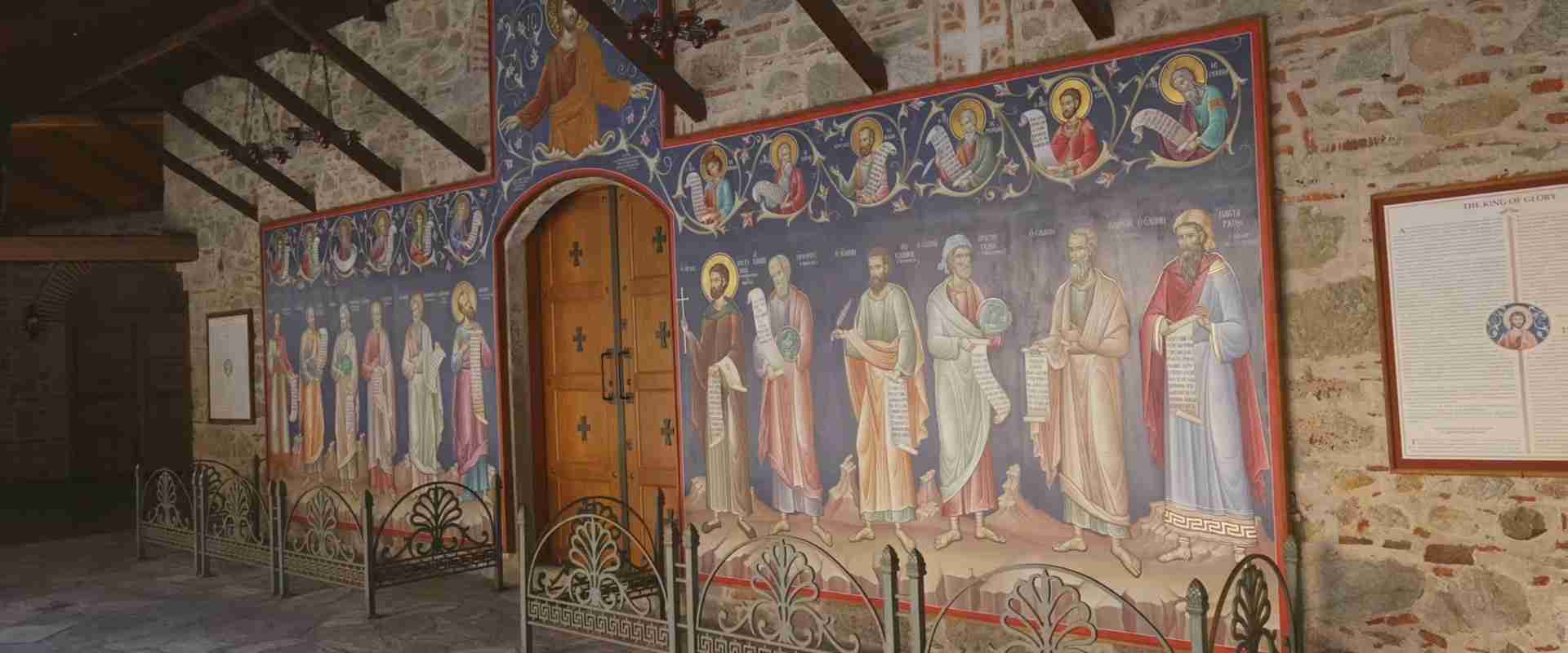
The Stone Cells: A Cultural Journey Into the Hermit Caves and Hidden Sanctuaries of Meteora
The monasteries of Meteora draw millions of visitors every year, yet the deeper story of this sacred landscape lives not in the six great abbeys perched on their summits, but in the caves, crevices, and hidden sanctuaries carved into the cliff faces far below. Centuries before a single monastery rose above the Thessalian plain, solitary hermits occupied these stone cells in radical silence, founding a contemplative tradition that would eventually shape one of the most extraordinary monastic complexes in the world. This is the journey into that earlier, quieter, and far less visited layer of Meteora’s spiritual history.
Key Takeaways
- The hermit tradition at Meteora predates the great monasteries by at least three centuries, with the first confirmed ascetics settling in the cave fissures of the rocks from the 9th to 10th century AD — some historical accounts trace habitation even earlier.
- The hermit Varnavas established the Chapel of the Holy Spirit around 950–970 AD, creating the earliest confirmed sacred site at Meteora and the symbolic birthplace of the entire monastic tradition that followed.
- The Hermit Caves of Badovas, clustered around the Pyxari rock near Kastraki village, preserve physical evidence of eremitic life including wooden balconies and rope ladder remnants dating to the 14th century. The last hermit monks lived in these caves just over two centuries ago.
- The 60-million-year-old sandstone and conglomerate pillars of Meteora were not shaped by human hands — their natural fissures, overhangs, and deep cavities created the stone cells that hermits occupied, with geology and spirituality intersecting in one extraordinary landscape.
- Three distinct forms of Eastern Orthodox monasticism — eremitic solitude, the semi-communal skete, and the fully communal coenobium — evolved sequentially at Meteora and still coexist in this valley, making the site a living archaeology of the Orthodox contemplative tradition.
- Meteora was inscribed as a UNESCO World Heritage Site in 1988 under combined natural and cultural criteria, recognised for its extraordinary architecture, its 16th-century post-Byzantine frescoes, and the survival of ancient monastic forms that elsewhere in the Orthodox world have largely disappeared.
People Also Ask About the Hermit Caves and Hidden Sanctuaries of Meteora
What are the hermit caves of Meteora and where are they located?
The hermit caves of Meteora are ancient eremitic dwellings carved into or occupying natural fissures within the sandstone rock pillars near the villages of Kastraki and Kalambaka in Thessaly, central Greece. The most accessible cluster is found at the Hermit Caves of Badovas, on the face of the Pyxari rock just outside Kastraki village — a short walk from the village centre brings visitors to a vantage point from which the ancient wooden ladders and cave openings are clearly visible. Other significant cave sites include the Holy Spirit cave chapel (Agio Pnevma), associated with the first hermit Varnavas; the hidden Monastery of Ypapanti, built 70 metres high into a cliff face between the Great Meteoron and Ypapanti rocks; and the Panaghia Doupiani chapel at the base of the Doupiani rock, the focal point of the first organised monastic community. These sites are not the six active and well-visited monasteries on the summit rocks, but an older layer of sacred geography that predates the monasteries by several centuries and remains far less visited by tourists.
Who were the first hermits of Meteora and when did they arrive?
The earliest ascetics at Meteora arrived in the 9th to 10th centuries AD, drawn to the inaccessible rock formation as an ideal landscape for the radical withdrawal from society that the Eastern Orthodox tradition calls anachoresis. The hermit Varnavas is identified in historical accounts as the first confirmed religious figure at Meteora, credited with founding the Chapel of the Holy Spirit around 950–970 AD — a cave sanctuary that survives to the present day near Kastraki. These early hermits lived alone in natural fissures and rock cavities, receiving food lifted on ropes by villagers from below, practising extreme fasting and continuous prayer. By the late 11th century, an informal community of scattered hermits occupied the caves of the Meteora formation, and in the 12th century the monk Nilos organised them into the first semi-communal monastic structure, the Skete of Doupiani, centred on the Panaghia Doupiani chapel. The monastic tradition reached its institutional peak in the 14th century with the founding of the Great Meteoron by Athanasius the Meteorite in 1356.
What is hesychasm and how does it connect to the caves of Meteora?
Hesychasm is the central contemplative practice of Eastern Orthodox monasticism, derived from the Greek word hesychia meaning sacred stillness or interior silence. Hesychast monks pursued unceasing prayer — particularly the Jesus Prayer, “Lord Jesus Christ, Son of God, have mercy on me, a sinner” — as a path toward direct experiential encounter with the divine light. The practice, theologically defended by Gregory Palamas in the 14th-century Hesychast Controversy, was most purely expressed in total solitude, which is precisely what the cave cells of Meteora provided. Athanasius the Meteorite, the founder of the Great Meteoron, himself withdrew to a cave five days a week to practise hesychasm even after building his monastery — a detail that illustrates how the eremitic cave tradition was never superseded by the coenobitic monasteries but remained their spiritual core. The caves of Meteora are not incidental to the region’s religious significance: they are the physical embodiment of hesychast theology, stone containers for the practice of sacred silence.
Can visitors access the hermit caves and hidden sanctuaries of Meteora?
Most of the hermit cave sites at Meteora are accessible to visitors on foot, though the experience differs markedly from visiting the six active monasteries. The Hermit Caves of Badovas are reached via a short hiking trail from Kastraki village, and visitors can view the cliff face with its wooden ladder remnants, cave openings, and the skete of St. Nicholas Badovas from viewpoints along the trail — no entrance fee applies. The cave interiors themselves are at height on vertical cliff faces and are not entered by visitors. The hidden Monastery of Ypapanti is accessible only on foot via an unmarked hiking trail of approximately 60 minutes from Kastraki; the structure is a restored cultural monument and a local guide is strongly recommended both for navigation and historical context. The Panaghia Doupiani chapel, the 12th-century focal point of the Skete of Stagoi, still stands at the base of the Doupiani rock near Kastraki and can be visited as part of a village walk. The Holy Spirit cave chapel, associated with the hermit Varnavas, is a stop on guided hermit cave hiking tours departing from Kastraki.
Extended multi-day tours – 5+ days
Featured Meteora Multi-Day Tour Packages
2 days
Two Days Tour from Athens to Meteora
- ✓ Comprehensive Meteora tour
- ✓ Expert local guides included
- ✓ All accommodation arranged
- ✓ Transportation provided

6 days
6 Days in Athens, Sightseeing Tourist Bus, Delphi and Meteora Tour & Day Cruise.
- ✓ Comprehensive Meteora tour
- ✓ Expert local guides included
- ✓ All accommodation arranged
- ✓ Transportation provided

2 days
2-Day Delphi & Meteora Tour
- ✓ Comprehensive Meteora tour
- ✓ Expert local guides included
- ✓ All accommodation arranged
- ✓ Transportation provided
5 days
5-Day Journey Through Classical Greece
- ✓ Comprehensive Meteora tour
- ✓ Expert local guides included
- ✓ All accommodation arranged
- ✓ Transportation provided
Multi-day tour packages powered by TourRadar. Prices and availability subject to change.
Introduction: The Vertical Desert — Meteora Before the Monasteries
Every tradition has its deeper origin story, its point before the visible monuments existed — and at Meteora that story belongs to the caves. The six monasteries that command the skyline above Kalambaka are magnificent achievements of Byzantine architecture, engineering against gravity, and centuries of sustained religious life, but they arrived late in the spiritual biography of these rocks. The caves came first. The silence came first. The solitary human figure clinging to a vertical surface with nothing between himself and the sky came first, and everything that followed — the stone churches, the frescoes, the manuscript libraries, the UNESCO designation — grew from the seed of that original withdrawal.
The theological concept behind the first hermits of Meteora was anachoresis: departure, flight, withdrawal. The word shares its root with anachorite, the technical term for a hermit monk, and it carries within it the Desert Fathers’ conviction that the world as constituted — its politics, its commerce, its social noise — was incompatible with the pursuit of God. In the 3rd and 4th centuries AD, the Desert Fathers of Egypt — Anthony the Great, Pachomius, the Macarii — translated this conviction into a practice of physical withdrawal into the Egyptian and Syrian deserts, and through their example established the foundational grammar of Christian monasticism. Their cells were not metaphorical but literal: small stone or mud-brick rooms in which a solitary figure spent years in continuous prayer, minimal eating, and manual work.
By the 9th century, the concept of anachoresis had long since spread throughout the Byzantine world, and monks in search of the vertical desert — places so inaccessible, so inhospitable, so completely removed from ordinary human life that the spiritual work of interior silence could proceed without disturbance — were drawn to the rock formations that later acquired the name Meteora. The word itself means “elevated” or “suspended in the air,” and the rocks of Thessaly deserved the name: columns of sandstone and conglomerate rising over 400 metres above the surrounding plain, their surfaces pocked with fissures and cavities, their summits inaccessible except by rope and sheer determination. For a hermit in the Eastern Orthodox tradition, this landscape was the closest available approximation of the Egyptian desert — not sandy and horizontal but vertical and stone, offering the same essential gift: absolute remoteness.
This article traces the pre-monastic and early monastic history of Meteora through its caves and hidden sanctuaries — the stone cells occupied by the first ascetics, the cave chapels where communities first gathered, the hermitages built onto cliff faces centuries before roads or stone staircases connected the rocks to the valley, and the surviving physical evidence that allows visitors today to stand at the actual beginning of one of the world’s most significant monastic landscapes.
Meteora Geology and the Creation of Sacred Space
The stone cells of Meteora did not require human creation — they were already there, formed over 60 million years of geological time. Understanding the geology of the Meteora formation is not merely background information for a cultural article: the specific character of these rocks directly determined the character of the eremitic tradition that developed within them.
The Meteora pillars are enormous residual masses of sandstone and conglomerate, their origin rooted in the Pliocene epoch when the entire region was covered by an inland sea and the great rivers flowing down from the proto-Pindus Mountains deposited enormous quantities of sediment — stone fragments, sand, mud — at a delta into that sea. Over millions of years these deposits compacted under pressure into the thick layer of rock that forms the basis of the Meteora formation. Around 60 million years ago, during the Paleogene period, a series of massive tectonic movements pushed the ancient seabed upward, creating a high plateau and generating extensive vertical fault lines through the thick sedimentary layer. Wind, water, temperature extremes, and continued seismic activity then worked on these fault lines over geological time, isolating individual rock masses and sculpting the sheer pillars — the “heavenly columns” of Byzantine description — that rise so dramatically from the flat Thessalian plain today.
The consequences for habitation were significant. The sandstone and conglomerate of Meteora is relatively soft compared to granite or basalt, and the same processes that created the pillars honeycombed their surfaces with natural fissures, overhangs, and cavities of varying sizes. Some of these natural openings were barely large enough to shelter a single prone figure; others opened into chambers of several square metres with reasonably flat floors and protective overhangs that kept out rain. The leaning angle of the Pyxari rock at Badovas — tilting slightly toward the cave face — meant that its wooden constructions were partially shielded from direct rainfall, which is why structural remnants from the 14th century survive there in a condition unmatched elsewhere in the formation. Geology created the shelter that spirituality chose to inhabit.
The rocks also offered a characteristic that the hermit tradition prized above all: irreducible physical difficulty. To reach even the lowest cave opening on many of the Meteora pillars required technical climbing using handholds cut into the rock, rope ladders, or wooden stakes driven into crevices — a physical ordeal that functioned as a built-in deterrent to casual intrusion and a daily reminder, for the monk making the climb, of the discipline required for the interior life. The inaccessibility of the cells was not accidental but purposeful: the vertical stone face between the hermit and the world below was geography performing the function of a monastery wall.
The Thessalian plain that spreads below the Meteora rocks provides the essential visual counterpoint: a broad agricultural landscape through which the Pineios River winds toward the Aegean, with the Pindus mountain range as a backdrop to the west. From within a cave opening at height, a hermit would have looked down on precisely the world from which he had withdrawn — not as a landscape to be escaped and forgotten, but as a constant reminder of the choice being made and re-made every day in the stone cell. The view from the hermit cave, in this sense, is not a distraction from the spiritual work but a component of it.
The First Ascetics of Meteora: Origins of Eremitic Life in Thessaly
Precise dates for the earliest human settlement of the Meteora caves are impossible to establish with certainty, and historical accounts vary in their framing of the chronology. The most conservative scholarly consensus, reflected in the UNESCO World Heritage designation, places the beginning of organised hermit settlement at “probably the 11th century.” Other historical and Byzantine sources, however, trace the presence of ascetics in the Meteora formation to the 9th century AD, with some accounts suggesting even earlier transient occupation. What is not in dispute is the nature of this first phase of religious life: it was eremitic in the purest sense — individual hermits occupying separate caves with no organised community, no shared prayer, no administrative structure, sustained by the provisions lifted to them from below by the faithful villagers of Kastraki and Kalambaka.
These first ascetics occupied a position in the religious imagination of local communities that requires some historical translation to appreciate today. In the Byzantine spiritual world, a hermit monk who had withdrawn entirely from society was not a marginal figure or a curiosity — he was a holy man of the first order, a person believed to stand in a position of particular intimacy with the divine. The practice of bringing food and water to the base of the rocks and having it pulled up by rope or basket was not simply charity: it was a form of devotional participation, a way for ordinary people to sustain a spiritual intermediary who prayed on their behalf. The hermits of Meteora were, in the understanding of their contemporaries, living saints — a category that carried immense theological weight in the Orthodox tradition, where the boundary between human holiness and divine presence was understood to be permeable for those who had advanced far enough in the contemplative life.
The daily existence of these early hermits was austere to a degree that strains modern comprehension. Orthodox ascetic literature describes the standard hermit’s regime as encompassing the canonical hours of prayer (up to seven offices distributed across the twenty-four-hour cycle), extended periods of manual work (basket weaving, rope making, and other simple crafts that allowed the mind to remain in prayer while the hands were occupied), severe dietary restriction (bread, water, and whatever edible plants could be gathered from the cliff face, with extended fasts on Wednesdays and Fridays and throughout liturgical fasting seasons), minimal sleep (a few hours on a simple pallet or bare stone), and the continuous recitation of the Jesus Prayer in a discipline aimed at transforming prayer from an occasional activity into an unceasing interior orientation.
In the cave cells of Meteora, this life took on additional physical dimensions. The hermit climbing down from his cave to receive provisions from below — or the first movement of morning light entering through a narrow rock fissure — these were not incidental features of the environment but integral elements of a spiritual practice in which the physical and the interior were understood as inseparable. Eastern Orthodox theology does not understand the body as a prison of the soul but as its companion and, in the hesychast tradition specifically, as a participant in the divine light — which meant that the cold of the stone, the difficulty of the climb, and the radical simplicity of the cave were not punishments but instruments, engaging the whole person in the work of purification and contemplative ascent.
The Holy Spirit Cave and the Hermit Varnavas: The Birthplace of Meteoran Monasticism
The earliest named figure in the spiritual history of Meteora is the hermit Varnavas — known in Greek as Varnava or Barnabas — who according to historical tradition founded the Cave Chapel of the Holy Spirit around 950–970 AD. This small cave sanctuary, carved into the cliff face near what is now the village of Kastraki, is considered the symbolic birthplace of monastic life at Meteora, the point at which the presence of individual hermits in the rocks crystallised into the creation of a permanent sacred place.
The Chapel of the Holy Spirit is a modest structure by any architectural measure: a cave opening fitted with a simple iconostasis and altar, with traces of fresco work on its interior walls. Its significance is entirely biographical — it is where the tradition began. Varnavas, like the Desert Fathers whose example he followed, came to Meteora seeking the radical solitude that the cave landscape provided, and the small chapel he created represented the minimal accommodation that any hermit life required: a place to celebrate the Eucharist, to orient prayer toward its proper liturgical form, to make the solitary life something more than private spiritual exercise and root it within the sacramental life of the Church.
The choice of the Holy Spirit as dedication is itself theologically significant. In Orthodox pneumatology, the Holy Spirit is the energising presence that sustains and animates spiritual life, the divine power operative in prayer, in the sacraments, and in the contemplative experience of divine light that hesychast theology describes. A cave chapel dedicated to the Holy Spirit is, in this sense, a declaration of purpose: this is a place where the Spirit’s work is specifically invoked and sought, where the hermit’s interior life and the divine energy he pursues converge in a physical location.
The tradition of Varnavas represents a pattern recognisable across the Eastern Mediterranean: an individual hermit establishes a permanent sacred site in an otherwise uninhabited landscape, and that site becomes the nucleus around which a wider spiritual community eventually forms. The Desert Fathers had established this pattern in Egypt; Benedictine monasticism had played it out in the forests of central and northern Europe; and the hesychast monks of the Byzantine world replicated it in Macedonia, on Mount Athos, and in the rock formations of Thessaly. At Meteora, the chain from Varnavas’s cave chapel to the great monasteries of the 14th and 15th centuries is direct and traceable.
Today the Holy Spirit cave chapel remains a stop on guided hermit cave hiking tours departing from Kastraki, and its modesty relative to the imposing monasteries visible above the valley is itself a kind of instruction. Everything that followed — the churches with their elaborate frescoes, the libraries of Byzantine manuscripts, the architectural engineering of monasteries built on sheer rock faces — was latent in the small cave where a solitary monk lit a candle and began to pray sometime in the tenth century.
The Hermit Caves of Badovas: A Vertical Archive of Eremitic Life
The Hermit Caves of Badovas, clustered on the Pyxari rock at the edge of the valley between Kastraki and Kalambaka, constitute the most physically legible surviving record of the eremitic tradition at Meteora. Three distinct religious establishments occupy this single cliff face: the cave monastery of St. Nicholas Badovas at the base, the hermitage of St. Gregory rising above it, and the hermitage of St. Anthony on the same rock — three sites representing three different centuries and three different expressions of the Orthodox monastic vocation, coexisting on a single leaning sandstone pillar in the plain of Thessaly.
The monastery of St. Nicholas Badovas — also known as Agios Nikolaos Kofinás — was built into a large natural cavity in the mid-14th century, making it a near-contemporary of the Great Meteoron founded by Athanasius the Meteorite in 1356. The monastery takes its name from its founding patron, and its placement inside an existing cliff cavity rather than on a summit rock distinguishes it architecturally from the six monasteries that most visitors encounter: this is not a structure imposed on the landscape from above, but a building growing organically from the stone itself, the natural overhang forming the roof and the monastery’s walls emerging from the cave floor. The character of the construction — intimate, cave-like, without the palatial ambitions of the great summit monasteries — preserves the flavour of the earlier eremitic tradition even while representing a step toward more organised communal life.
Higher on the same cliff, the hermitage of St. Gregory dates from 1374 AD — confirmed by documentary evidence as one of the earliest precisely dated eremitic structures in the Meteora formation. Unlike the cave monastery below, the St. Gregory hermitage represents the purest architectural form of the solitary life: multiple-storey cells built directly inside cave openings in the cliff face, with wooden balconies projecting from the rock and rope ladders providing the only vertical connection between levels. The leaning angle of the Pyxari rock created a natural shelter for the wooden constructions, and remnants of these 14th-century structures survive in a condition that gives the site its most affecting quality: the sense of time compressed, of an abandoned life whose physical traces are still intelligible.
The hermitage of St. Anthony was built approximately four centuries later than St. Gregory’s — around 1782 AD or earlier — representing a significant revival of the eremitic tradition at a time when the great monasteries above the valley were in a period of relative decline. The St. Anthony hermitage is a three-storey structure built inside three interconnecting caves, with a basilica on its upper floor — a more complex arrangement than the primitive single-room cells of the earliest period, reflecting the accumulated architectural knowledge of centuries of cave-building at Meteora. Restored in 2005 following a fire in 1970, the St. Anthony hermitage is the most physically complete of the Badovas caves and provides the clearest impression of how a working eremitic dwelling functioned.
The last hermit monks of Meteora are recorded as having lived in the Badovas caves somewhat over two centuries ago — a remarkably recent terminus for a tradition with ninth-century roots. Their departure marked the end of the eremitic phase of the Meteora tradition, leaving the Badovas caves as an empty but physically eloquent archive of a way of life that had persisted at this particular cliff face for approximately a thousand years. The wooden ruins of ladders and scaffolding that remain visible today — preserved by the sheltering angle of the rock — are the literal remnants of the last occupants’ means of daily movement: not museum pieces but tools, the practical infrastructure of a life lived in intimate relationship with vertical stone.
The significance of the Badovas site is amplified by a theological dimension specific to the Orthodox monastic tradition. The three sites on the Pyxari rock — the cave monastery of St. Nicholas, the hermitage of St. Gregory, and the hermitage of St. Anthony — represent three distinct forms of organised religious life within the Eastern Orthodox Church: the coenobitic monastery, the eremitic hermitage, and an intermediate semi-communal form. That all three coexist in physical proximity on a single cliff face makes the Badovas complex an unusually concentrated demonstration of how the Orthodox tradition understands the contemplative vocation as encompassing multiple valid forms — not a hierarchy with the monastery superior to the hermit cell, but a range of legitimate responses to the same divine calling, each suited to different temperaments and stages of the spiritual life.
Hesychasm and the Theology of Sacred Stillness at Meteora
The hermits of Meteora were not eccentric individuals who happened to like living in caves. They were practitioners of a specific and sophisticated theological tradition — hesychasm — whose intellectual architecture was one of the defining intellectual achievements of Byzantine Christianity and whose practical implications shaped every aspect of eremitic life in the rock formations of Thessaly.
Hesychasm takes its name from the Greek hesychia, meaning stillness, quietness, or repose — not the stillness of inactivity but the specific interior condition in which the mind has been gathered from its habitual dispersal across sensory experience, discursive thought, and emotional reaction, and directed with complete intensity toward the divine. The central practice of hesychasm is the Jesus Prayer — “Lord Jesus Christ, Son of God, have mercy on me, a sinner” — recited with such sustained repetition and such depth of interior attention that it gradually ceases to be a verbal formula and becomes, in the hesychast understanding, an orientation of the entire person: mind, heart, and body.
The tradition’s most important medieval theorist was Gregory Palamas (1296–1359), Archbishop of Thessaloniki, whose defence of hesychast practice in the Palamite or Hesychast Controversy of the mid-14th century established the theological foundations on which the monastic life of Meteora was subsequently built. The controversy centred on whether the divine light experienced by advanced hesychast practitioners — described most famously in accounts of the Transfiguration of Christ on Mount Tabor — was a created phenomenon (as the nominalist philosopher Barlaam of Calabria argued) or an uncreated energy emanating directly from the divine nature (as Palamas defended). The Orthodox Church’s eventual endorsement of the Palamite position, affirming that human beings could achieve genuine experiential contact with uncreated divine energy through the practice of hesychasm, gave profound theological weight to the ascetic programme that the hermits of Meteora were already practising.
The connection between the Palamite victory in the Hesychast Controversy and the subsequent monastic explosion at Meteora in the second half of the 14th century is direct and causal. Athanasius the Meteorite, the founder of the Great Meteoron, had been a disciple of the hesychast tradition, trained in the discipline that Gregory Palamas had defended and whose principles Gregory of Sinai had helped disseminate across the Byzantine world. Athanasius himself practised hesychasm in the most rigorous form available to him: even after founding his coenobitic monastery, he withdrew to a cave five days a week to remain in continuous prayer, fasting, and silence — a pattern that makes explicit the relationship between the monastery above and the cave below. The great monastery was, in a sense, the social and liturgical infrastructure that supported and surrounded the individual hermit’s cave practice at its centre.
The hesychast framework also explains why the specific geography of Meteora — its extreme inaccessibility, its silence, its visual separation from the busy plain below — was not merely convenient but theologically necessary. Hesychast practice requires the reduction of sensory input to the minimum compatible with physical survival, so that the interior faculty of attention can be concentrated without distraction. The cave cell accomplishes this structurally: its dimensions foreclose movement, its stone walls block external sound, its elevation removes it from the noise of human commerce, and its access difficulty ensures that intrusion is rare. The hermit in the Meteora cave was not escaping the world in any casual sense — he was constructing, through the choice of an extreme environment, the material conditions required for an extreme spiritual practice whose goal was nothing less than direct experiential union with the divine.
Inside a Stone Cell: The Architecture and Daily Life of a Meteoran Hermit
A hermit cell at Meteora is architecture reduced to its absolute minimum: a space just large enough for a single human being to sleep, pray, and perform the minimal manual work that sustains life. Understanding the physical character of these spaces — their dimensions, their furnishings, their orientation — illuminates the interior logic of the eremitic life in a way that no amount of abstract description can achieve.
The natural cavities of the Meteora sandstone varied considerably in size, and hermits occupied them according to the spiritual principle that a smaller space was a more useful one. A cave cell of two by three metres was generous; many hermits sought cavities barely large enough to contain a single prone figure. Within this minimal space, the essential elements of a religious life were arranged with precise intentionality. At the eastern end — or the wall most easily oriented toward Jerusalem — a small shelf or niche carved into the rock served as the altar focus, with an icon of Christ or the Theotokos positioned at its centre. This was the axis of the cell’s spiritual geography, the point toward which the monk oriented himself for prayer and from which the sacred radiation of the holy image extended across the confined space.
The sleeping arrangement was a simple pallet of woven rushes or rough cloth laid directly on the stone floor, sometimes elevated slightly on a wooden frame. Orthodox ascetic tradition discouraged sleeping on a proper bed as an excessive indulgence, and many hermits slept sitting or semi-reclined against the cave wall to ensure that sleep remained a minimal biological necessity rather than a comfort. The prayer rope — the komboskini, a knotted cord of wool or cotton used to count repetitions of the Jesus Prayer — was the hermit’s constant companion, held and worked through the fingers during every waking moment that was not devoted to reading, manual work, or the celebration of the liturgical offices.
The daily rhythm of the cave hermit followed the canonical hours with strict regularity: the midnight office of Matins beginning the formal prayer cycle, followed by Lauds at dawn, Prime, Terce, Sext, None, Vespers, and Compline distributed across the remaining hours of the day. Between offices, manual work provided the economic basis of life — basket weaving, rope making, and the production of simple religious items that could be exchanged for essential provisions. More learned hermits copied manuscripts or painted icons, and some of the most important Byzantine icon-painting traditions at Meteora trace their origins to the individual cells rather than the monastery workshops.
Food was provisioned through a system that remained essentially unchanged from the earliest phase of hermit occupation: a basket on a long rope, lowered from the cave opening when villagers approached the base of the rock with bread, dried legumes, olives, or water. The villagers’ role in this system was not merely practical but devotional — to provide for the hermit was to participate in his prayer, to share in whatever spiritual merit accrued from a life of radical dedication. The hermit, in turn, was understood to pray not only for his own soul but for the souls of all those who sustained him, making the rope and basket a physical manifestation of the exchange of spiritual goods that connected the cave above to the village below.
Access to the cells was managed through rope ladders and wooden stakes driven into the rock face — infrastructure that was deliberately kept minimal and that the hermits maintained according to a theological logic that modern sensibilities might find challenging. The ladders were not repaired until they were nearly impassable, and their structural condition was understood as a matter of divine providence: a ladder that held was God’s permission for the climbing; a ladder that broke was God’s instruction to remain. This passive relationship to physical safety was not recklessness but a specific expression of the total trust in divine guidance that the hesychast tradition cultivated. A hermit who had advanced sufficiently in the contemplative life was, in this understanding, living under a more reliable guarantee than any well-maintained wooden structure could provide.
The Skete of Doupiani: The First Community Among the Hermits
The transition from scattered individual hermits to organised monastic community at Meteora was not a single event but a gradual process spanning several centuries, and its first concrete institutional expression was the Skete of Doupiani — the small monastic community that formed around the Panaghia Doupiani chapel in the late 12th century and established the model for all subsequent communal religious life at Meteora.
A skete occupies the middle ground between the solitary hermit life and the fully communal coenobitic monastery. In the Orthodox monastic tradition, the skete is a community of two to five monks — under the direction of a spiritual elder, who pray privately for most of the week in their individual cells and come together for communal liturgy on Sundays and feast days. The skete form preserves the essential character of the eremitic life — the solitude, the individual cell, the personal practice of continuous prayer — while providing the liturgical community, the sacramental regularisation, and the minimal social structure that pure eremitism lacks.
Around 1160 AD, or in the course of the broader 12th-century organisation of the Meteora hermit community, a monk named Nilos gathered the scattered ascetics of the formation around a small chapel at the base of the Doupiani rock. The Panaghia Doupiani — the chapel of the Mother of God at Doupiani — became the focal point of what historical sources call the Skete of Stagoi, the first named monastic entity at Meteora. Every Sunday, the hermits descended from their cave cells across the formation and gathered at the Doupiani chapel for a common celebration of the Eucharist and a shared meal — the two forms of communion, divine and human, that constituted the minimum of organised monastic life.
The significance of this transition cannot be overstated. The Doupiani skete represented the institutionalisation of Meteora’s spiritual community: the transformation of what had been a collection of individual ascetics, known to each other perhaps but operating without common governance, into a recognised entity within the Greek Orthodox Church with its own chapel, its own liturgical schedule, and its own elected spiritual leadership. Nilos, as the organising figure, established rules and norms for the community — the first monastic legislation at Meteora — that created the framework within which the subsequent development of the great monasteries became possible.
The Panaghia Doupiani chapel still stands today at the foot of the Doupiani rock on the northwestern edge of Kastraki village. It is not a grand structure — a modest stone chapel whose interior contains frescoes of some antiquity and whose exterior blends almost imperceptibly into the rock face behind it — but its survival is remarkable for a building of its age and its structural vulnerability. The continuity it represents is genuine: the chapel that hermit monks walked to every Sunday in the 12th century and the chapel that can be visited by a traveller today occupy the same site, the same stone, the same orientation toward the divine that first called the scattered hermits of Meteora into community.
Ypapanti and the Hidden Sanctuaries of the Cliffs
The Monastery of Ypapanti is the hidden monastery of Meteora in the most literal sense: built 70 metres above the valley floor into the face of a steep cliff between the Great Meteoron and Ypapanti rocks, accessible only on foot via an unmarked trail of approximately 60 minutes from Kastraki, and overlooked by the overwhelming majority of the millions of visitors who come to Meteora each year. It is also one of the most historically significant religious structures in the formation — a direct product of the cave-building tradition that preceded and coexisted with the summit monasteries, founded in 1366 or 1367 by Neilos, the abbot of the Doupiani skete.
The name Ypapanti is the Greek term for the Presentation of Christ in the Temple, one of the Twelve Great Feasts of the Orthodox liturgical calendar — the feast celebrating the moment when the infant Jesus was brought to the Jerusalem Temple and recognised by the prophets Simeon and Anna as the long-awaited messiah. The choice of dedication places the monastery within the devotional cycle of the incarnation: a cave sanctuary on the face of a cliff in Thessaly, oriented toward the same theological event that links human time to divine eternity.
The structure of the Ypapanti Monastery exemplifies the architecture of the transitional period between pure eremitic cave dwelling and the fully developed stone monastery: a construction that uses the natural cave as its primary architectural element, with man-made walls and vaulting added where the natural rock is insufficient, creating a hybrid structure in which the distinction between building and cliff is deliberately blurred. The monastery’s position — 70 metres above the valley floor, accessible in earlier centuries only by a hanging wooden staircase that was removed when the community fell into disuse — reflects the same logic of protective inaccessibility that governed the earlier hermit caves: the difficulty of access was a feature, not a defect.
The Ypapanti Monastery was abandoned in the 19th century, as the broader decline of Meteoran monasticism during that period left many smaller foundations without sufficient monks to sustain community life. The narthex added to the church in 1784 — painted by the artist Dimitrios Zoukis and his student Georgios — represents the last significant architectural addition to the structure before its abandonment and preserves frescoes of sufficient quality that their restoration became a priority when systematic conservation work at Meteora began in the modern period. The monastery now functions as a protected cultural monument and a dependency (metochi) of the Great Meteoron, the monastery whose founding preceded Ypapanti by just a decade.
Beyond Ypapanti, the cliff faces of Meteora preserve traces of other hidden sanctuaries at various stages of survival: the ruins of the small church of Panaghia near the Badovas valley, dating from the 19th century; the cave chapel that Athanasius the Meteorite’s community occupied on the Platys Lithos rock before the construction of the Great Meteoron proper; and numerous unnamed niches, carved ledges, and painted rock surfaces that testify to the density of sacred habitation that the Meteora rocks supported at the peak of their monastic occupation in the 15th and 16th centuries. The landscape is not merely decorated with religious sites — it is saturated with them, every significant rock feature having been, at some point in the formation’s spiritual history, the site of a human being engaged in the work of prayer.
From Cave to Cloister: How Hermit Cells Became the Great Monasteries
The founding of the Great Meteoron Monastery by Athanasius the Meteorite between 1356 and 1372 marks the decisive institutional moment in the history of Meteoran monasticism, but it did not represent a rejection of the cave tradition. It represented its transformation: the energy, the discipline, and the spiritual vision of the eremitic life translated into permanent stone architecture that could sustain community across generations.
Athanasius Koinovitis was born in 1302 in the Byzantine town of New Patras and trained in the hesychast tradition through contact with disciples of Gregory of Sinai. Following a period of preparation on Mount Athos — the other great centre of Byzantine monasticism — he was compelled to leave in 1344 when Turkish pirate raids made the Athonite peninsula increasingly unsafe. With two companions, the monks Gregory and Moses, Athanasius made his way to Thessaly, having been advised by a bishop who was himself a disciple of the Sinaite tradition that the rock formations near Kalambaka provided conditions suitable for the contemplative life.
The three monks initially settled on the top of a rock called Stylos or Pillar, where a rock-carved chapel already existed — evidence that the cave-dwelling tradition was well established before their arrival. Athanasius subsequently began a community on the adjacent Platys Lithos (Broad Rock), building individual cells and a cave chapel that formed a kind of prototype for the larger monastery to come. The Great Meteoron itself, rising on the second-highest rock in the formation, was built between 1356 and 1372, funded initially by the Serbian Emperor Symeon Uros and expanded significantly by Symeon’s son John Uros, who retired to the monastery as the monk Ioasaph around 1373 and succeeded Athanasius on his death in 1380 or 1383.
The architectural programme that Athanasius and Ioasaph executed was on a scale that the cave-building tradition could not have imagined: a fully equipped coenobitic monastery with a main church (the katholikon) dedicated to the Transfiguration of Christ, refectory, guest quarters, library, ossuary, and all the functional spaces required for communal monastic life. Materials were lifted to the summit by rope, pulley, and net — the same basic technology that had been used to provision individual hermits for centuries, now scaled up for industrial purposes. The net system at Varlaam Monastery, where pilgrims and provisions were hoisted vertically up a 373-metre cliff face, became one of the defining images of Meteoran monasticism and a symbol, recognised by UNESCO, of the extraordinary determination that built these communities.
Yet even within the coenobitic monastery, the cave tradition persisted at the personal level of individual practice. Athanasius himself, as recorded in his biography, continued to withdraw five days a week to a cave where he remained in hesychast practice — continuous prayer, fasting, radical silence. The monastery provided the liturgical community, the social fabric, the library, and the material infrastructure; the cave provided what the monastery structurally could not: the absolute solitude required for the deepest hesychast work. This complementarity between monastery and cave, between communal life and eremitic withdrawal, was not a contradiction or a compromise but a deliberate expression of the Orthodox understanding that the fullest religious life encompasses both forms.
By the end of the 15th century, 24 monasteries had been built across the Meteora formation, constituting the largest monastic complex in Greece after Mount Athos. The 16th century brought the Golden Age of Meteoran monasticism, with major renovation programmes, the commissioning of extraordinary fresco cycles from painters including Theophanes the Cretan (who painted the church of St. Nicholas Anapafsas in 1527) and Frangos Katelanos, and the compilation and preservation of manuscript collections of major importance for Byzantine scholarship. This flourishing was not despite the cave tradition but because of it: the spiritual seriousness that had sustained the hermits in their stone cells for centuries was the same energy that built the libraries and commissioned the icons.
Three Types of Orthodox Monasticism at Meteora: Eremitic, Sketic, and Cenobitic
The Eastern Orthodox tradition recognises three formal types of monastic organisation, and the Meteora formation is among the very few places in the world where all three remain physically present and historically legible in the same landscape — not as museum reconstructions but as living monuments to different expressions of the same fundamental spiritual vocation.
The first and oldest form is the eremitic, derived from the Greek eremos (desert) and identified with the first Desert Fathers of Egypt and Syria. The eremitic monk lives in complete individual solitude, with no regular community prayer except perhaps on the most solemn feast days, no shared property, no institutional structure, and no obligation toward any other person except the informal devotional relationship with the villagers who provide provisions. The eremitic life is understood in Orthodox theology as the most demanding form of the monastic vocation, requiring a level of interior stability and spiritual maturity that is rare, and the tradition consistently warns against attempting it without adequate preparation. The hermit caves of Meteora — the Badovas caves, the Holy Spirit cave of Varnavas, the unnamed cells scattered across the cliff faces — are the physical expression of this form.
The skete (from the Greek word for a basket — reflecting the manual work that sustained these communities) represents the middle form: a small group of two to five monks living in adjacent cells under a common spiritual elder, praying privately for most of the week and gathering for communal liturgy on Sundays and feast days. The skete combines the solitude of the eremitic life with the minimal social infrastructure of community — the shared celebration of the Eucharist, the mutual accountability of living under a recognised elder, the practical advantages of having a small number of people in close proximity. The Skete of Doupiani, organised by the monk Nilos in the 12th century, is the founding expression of this form at Meteora, and the Doupiani chapel still stands as its physical embodiment.
The coenobitic (from the Greek for “common life”) monastery is the fully communal form in which everything is shared — property, meals, prayer, work, the entirety of daily existence — under the authority of an abbot (igoumenos) who governs according to an established rule. All six active monasteries at Meteora operate as coenobia, following the strict Athonite model that Athanasius the Meteorite introduced from Mount Athos in the 14th century. The three rules of coenobitic life in the Orthodox tradition are purity (celibacy), lack of property (everything belongs to the community), and obedience (to the abbot and to the community’s established norms). Daily life in the active Meteora monasteries begins with Matins at 3:30 in the morning, and the day continues through the canonical offices with communal meals and assigned work in between.
The sequential development of these three forms at Meteora — from the earliest pure eremitism of the cave hermits, through the semi-communal skete of Doupiani, to the fully organised coenobitic monasteries of the 14th and 15th centuries — is not a linear progress from primitive to sophisticated, but a diversification: each form remained available alongside the others, each serving different spiritual temperaments and different phases of a monk’s development. The presence of all three forms in the same valley, visible from the same vantage points, is a theological statement as much as a historical accident: the Orthodox tradition holds that the contemplative life is not a single path but a range of paths, and the landscape of Meteora demonstrates this range with unusual completeness.
The Cave Heritage of Meteora Today: What Survives and Where to Find It
The physical survival of Meteora’s eremitic heritage varies considerably by site, from the substantially preserved to the fragmentary, but across the formation a remarkable quantity of evidence remains accessible to visitors willing to move beyond the circuits of the six active monasteries.
The Hermit Caves of Badovas represent the most physically complete and most historically layered of the eremitic sites. Approached via a short hiking trail from Kastraki village — the walk takes approximately 20 to 30 minutes from the village centre — the site presents a cliff face that is still actively legible as an inhabited landscape: the cave openings are visible at height on the Pyxari rock, the wooden scaffolding remnants of the St. Gregory and St. Anthony hermitages cling to the stone face, and the small restored monastery of St. Nicholas Badovas at the base provides an architectural anchor for the site. No entrance fee applies. The cave interiors are not accessible to visitors — their positions on the vertical cliff face make interior access both physically impractical and archaeologically inadvisable — but the exterior view from the trail is comprehensive and highly photogenic, particularly in the raking light of early morning or late afternoon when the shadows in the cave openings deepen and the wooden remnants become most visible against the warm ochre of the sandstone.
The Panaghia Doupiani chapel, the 12th-century focal point of the Skete of Stagoi, stands at the foot of the Doupiani rock on the western edge of Kastraki village and is accessible as part of a village walk. The chapel is a small stone building of great antiquity whose interior frescoes span several centuries of Byzantine and post-Byzantine painting. Its significance is almost entirely historical rather than architectural — a modest building in a modest position — but for a visitor who understands what the chapel represents (the first permanent sacred site of an organised monastic community at Meteora, the building around which a thousand years of spiritual life organised itself), its modesty becomes a form of eloquence.
The Holy Spirit cave chapel of Varnavas is included in guided hermit cave hiking tours departing from Kastraki, alongside the Badovas caves. The cave itself is small and the chapel fittings are simple, but the historical weight of the site — the conceptual origin point of the entire Meteoran monastic tradition, inhabited by the first confirmed religious figure in the landscape — makes a visit to it something considerably more significant than its physical scale would suggest.
The Ypapanti Monastery is the most demanding of the eremitic sites to reach and the most rewarding for a visitor with the historical framework to appreciate it. The 60-minute hike from Kastraki on an unmarked trail should be undertaken with a local guide — not merely for navigation but for the interpretive narration that transforms the physical experience into a genuine encounter with the site’s layered history. The structure’s position on the cliff face, the frescoes of the 1784 narthex, and the view across the valley toward the great monasteries from a height that makes them seem not distant but parallel — peers on the same cliff faces — constitute an experience that no description adequately prepares for.
The six active monasteries — Great Meteoron, Varlaam, Rousanou (St. Barbara, nunnery), St. Nicholas Anapafsas, Holy Trinity, and St. Stephen (nunnery) — belong, in this context, not to a separate category from the cave sites but to the same spiritual and architectural lineage, representing its most developed institutional expression. The frescoes of Theophanes the Cretan in St. Nicholas Anapafsas (1527), the winch and net system at Varlaam that still operates for provisions, the ossuary at the Great Meteoron with its arrangement of monks’ skulls, the library manuscripts at multiple monasteries — all of these are the downstream achievements of the tradition that began in the stone cells of the cliff faces below. A visit to the cave sites before visiting the active monasteries provides an orientation that transforms what might otherwise be an encounter with impressive monuments into a genuine comprehension of what this valley represents in the history of human spiritual life.
The UNESCO inscription of 1988, under the combined natural and cultural criteria that recognised both the extraordinary geological landscape and the architectural, artistic, and monastic achievements it sustained, named Meteora a Monument of Humanity. The designation holds, in principle, not only the great monasteries but the entire spiritual geography of the formation — the cave chapels, the abandoned hermitages, the still-standing skete chapel, the wooden remnants of rope ladders on a leaning sandstone cliff. All of it is the heritage; all of it belongs to the same story.
Frequently Asked Questions About the Hermit Caves and Hidden Sanctuaries of Meteora
How old are the hermit caves of Meteora, and when was the eremitic tradition established there?
The hermit caves of Meteora have been occupied as religious dwellings since the 9th to 10th century AD, with the hermit Varnavas founding the Chapel of the Holy Spirit around 950–970 AD as the first confirmed sacred structure in the formation. The geological cavities these hermits occupied are of course far older — the rock pillars of Meteora formed approximately 60 million years ago during the Paleogene period, and their natural fissures and cavities were waiting, in geological time, for the purpose to which the Byzantine ascetic tradition eventually put them. The continuous eremitic occupation of the Badovas caves extended from approximately the 9th century until the early 19th century, when the last hermit monks of Meteora departed, making the tradition’s span roughly one millennium.
What is the relationship between the hermit caves and the six monasteries that visitors see today?
The six active monasteries of Meteora are the institutional and architectural successors of the hermit tradition, not replacements for it. The eremitic phase — individual ascetics in cave cells — preceded the organised monasteries by three to four centuries, and the first organised community, the Skete of Doupiani, was itself semi-eremitic in character. When Athanasius the Meteorite founded the Great Meteoron in 1356, he was building on a spiritual landscape already populated by cave dwellers and the established community of the Skete of Stagoi. Furthermore, Athanasius himself continued to withdraw to a cave five days a week even after founding his coenobitic monastery, demonstrating that the cave tradition was never superseded but remained the inner core of the monastic life even as the outer institutional form became grander and more complex.
What does the name Meteora mean, and how does it relate to the spiritual significance of the site?
The name Meteora means “elevated,” “suspended in air,” or “lofty” in Greek, and it is etymologically related to the modern word meteor (from the same root, referring to atmospheric phenomena occurring in the elevated reaches of the sky). The name derives specifically from Athanasius the Meteorite’s identification of the highest rock in the formation as “Meteoro” (suspended in air), a designation that subsequently extended to the entire landscape. The theological resonance of the name is deliberate and significant: elevation in the Orthodox monastic tradition is not merely physical but spiritual, and the choice to describe the rock pinnacles as “suspended in air” — belonging neither fully to earth nor to heaven — captures something essential about the intermediary position that the contemplative life occupies in Orthodox theology: between the material world below and the divine realm above.
Who was Athanasius the Meteorite and what was his connection to the earlier hermit tradition?
Athanasius the Meteorite (1302–1380) was a Byzantine monk and hesychast practitioner who founded the Great Meteoron Monastery in 1356, establishing the coenobitic institutional form of Meteoran monasticism. Born in New Patras, he trained in the hesychast tradition on Mount Athos before coming to Meteora in 1344 with two fellow monks, Gregory and Moses. His connection to the earlier hermit tradition was not merely historical but personal: he arrived at Meteora when the formation was already populated by cave dwellers, settled initially on a rock where a rock-carved chapel already existed, and maintained his own individual cave practice throughout his life as founder and abbot, withdrawing five days a week to a cave for hesychast prayer. He is canonised as a saint by the Eastern Orthodox Church, with his feast celebrated on April 20.
What are the three types of Eastern Orthodox monasticism and how are all three represented at Meteora?
Eastern Orthodox monasticism recognises three formal types: eremitic (solitary hermit life in individual cells), sketic (a small community of two to five monks who pray individually through the week and gather communally on Sundays and feast days), and coenobitic (fully communal life in which everything is shared under the authority of an abbot). At Meteora, all three forms are physically present and historically traceable. The eremitic form survives in the Badovas caves, the Holy Spirit cave chapel, and the numerous abandoned cave cells scattered across the cliff faces. The sketic form is represented by the Panaghia Doupiani chapel, the 12th-century focal point of the Skete of Stagoi. The coenobitic form is expressed in the six active monasteries, all of which operate as coenobia following the strict Athonite rule introduced by Athanasius the Meteorite in the 14th century. The Badovas site is particularly notable as a location where all three types coexist in immediate physical proximity on a single cliff face.
What is hesychasm and why is it central to understanding the Meteora cave tradition?
Hesychasm is the central contemplative practice of Eastern Orthodox monasticism, built around the sustained repetition of the Jesus Prayer (“Lord Jesus Christ, Son of God, have mercy on me, a sinner”) as a path toward direct experiential encounter with the divine. The word derives from hesychia (stillness, interior silence), and the practice requires conditions of radical solitude — minimal sensory input, freedom from distraction, and sustained physical stillness — that the cave cells of Meteora provided in ideal form. The 14th-century theologian Gregory Palamas defended hesychasm as a legitimate path to genuine encounter with uncreated divine light, and his Palamite theology was endorsed by the Orthodox Church at precisely the moment when the great monasteries at Meteora were being founded. The first generation of Meteoran monastery builders, including Athanasius the Meteorite, were trained hesychasts, and the cave practice was not abandoned when the monasteries were built but continued as the spiritual core within the institutional structure.
What physical evidence of the hermit tradition survives at Meteora today?
The most significant surviving physical evidence includes: the wooden balcony and ladder remnants on the St. Gregory hermitage at Badovas, dating from 1374 AD and preserved by the sheltering angle of the Pyxari rock; the restored structure of the St. Anthony hermitage (c. 1782) at Badovas, a three-storey cave-built structure containing a basilica; the cave monastery of St. Nicholas Badovas at the base of the Pyxari rock, built in the mid-14th century into a natural cliff cavity; the Panaghia Doupiani chapel near Kastraki, dating from the 12th century; the Holy Spirit cave chapel associated with the hermit Varnavas; and the Monastery of Ypapanti, founded 1366/67, built 70 metres high into a cliff face and preserved as a restored cultural monument. The six active monasteries also preserve fresco cycles, manuscript collections, and architectural elements that trace their origin to the transition from cave to cloister in the 14th century.
Why did the hermit tradition at Meteora eventually decline?
The decline of the eremitic tradition at Meteora was part of a broader contraction of Meteoran monasticism that began in the 17th century and continued through the 18th and 19th centuries. At its institutional peak in the 16th century, Meteora supported 24 active monasteries as well as numerous hermitages and cave cells; the combination of Ottoman political pressures, reduced patronage from the Byzantine aristocracy that had sustained the foundations, general depopulation of the Greek heartland, and the practical difficulty of maintaining complex structures in an extreme physical environment created conditions in which smaller, less institutionally established communities — including the individual hermitages — became impossible to sustain. The last hermit monks at Badovas departed approximately two centuries ago, ending a continuous eremitic occupation that had lasted roughly a millennium. The six active monasteries represent the survivors of this contraction, sustained in part by their scale and resources and in part by systematic restoration work that began in the 1960s with support from the Greek state, the Church, and eventually UNESCO.
How does Meteora compare to other major Eastern Orthodox monastic centres?
Meteora is consistently ranked as the second most important Eastern Orthodox monastic complex after Mount Athos in northeastern Greece, and the comparison is instructive. Mount Athos, an autonomous peninsula with approximately 20 active monasteries and a combined monastic population of around 2,000 monks, represents the coenobitic tradition at its most institutionally complete and is accessible only to men with special permits. Meteora, with its six active monasteries, smaller monastic population, and physical accessibility to all visitors, occupies a different position: its significance is as much archaeological and historical as it is a living spiritual community. Where Mount Athos demonstrates what the Byzantine monastic tradition looks like at full institutional development, Meteora demonstrates what it looked like at its beginning — the cave tradition, the skete, the transition to cloister — making the two sites complementary rather than competing embodiments of the same fundamental spiritual heritage.
What is the cultural and artistic legacy of the Meteora cave tradition beyond the religious history?
The cultural legacy of the Meteora cave tradition extends well beyond the history of Eastern Orthodox monasticism into the history of Byzantine art, manuscript culture, and architectural innovation. The fresco cycles preserved in the Meteora monasteries — particularly the work of Theophanes the Cretan in St. Nicholas Anapafsas (1527) and the subsequent work of Frangos Katelanos — are recognised by UNESCO as marking a foundational moment in the development of post-Byzantine wall painting, establishing conventions of iconographic representation and technique that influenced Orthodox sacred art across the Balkans and the eastern Mediterranean for centuries. The manuscript collections at Meteora, accumulated in the monastic libraries from the 14th century onward, contain codices and documents of major importance for Byzantine ecclesiastical, legal, and cultural history. The architectural achievement of building structurally complex and artistically ambitious monasteries on sheer rock faces using only ropes, nets, and human labour represents one of the most extraordinary engineering achievements of the medieval world. All of this cultural production was possible because the cave tradition had first created, in this improbable landscape, a community of sufficiently serious spiritual intent to sustain it.