
The Northern Marche Renaissance & Medieval Itinerary 2026: Alternative Crowdfree Loops from Pesaro
The northern Marche hinterland offers three distinct road loops from Pesaro connecting some of Italy’s finest Renaissance hilltowns — Mondavio, Sassocorvaro, Gradara, Fossombrone — along the ancient Via Flaminia corridor, yet most visitors drive straight to Urbino and see nothing else. This guide plots the alternative circuits in detail, with specific routing through the dramatic Furlo Gorge, fortress-by-fortress timing windows, verified parking logistics, and pre-calculated daily budget ranges that make a four-day Pesaro-based itinerary both practical and genuinely crowd-free.
Key Takeaways
- Three day loops from Pesaro cover the Furlo Gorge (Via Flaminia section), the Montefeltro fortress chain (Mondavio–Sassocorvaro–Gradara), and the upper Metauro Valley (Pergola–Sant’Angelo in Vado) — none exceeds approximately 180 km round trip from the coast.
- Budget travelers need €75–120 per person daily (two sharing), mid-range travelers €125–200, and luxury visitors €210–345; check official booking platforms for current rates as all figures are based on shoulder season (April–June and September–October).
- The Furlo Gorge road — the old Via Flaminia through the canyon — operates as an alternating single-file corridor managed by traffic lights; the parallel modern SP3 superstrada bypasses it through a tunnel, but the historic road is the one every driver should use.
- Rocca Ubaldinesca at Sassocorvaro opens weekends and public holidays only (10:00–13:00 and 15:00–18:00); plan the fortress circuit around this constraint or pre-book a weekday group visit.
- Mondavio’s Rocca Roveresca opens Tuesday–Sunday in winter, daily in high summer (9:00–12:00 and 15:00–19:00); Gradara Castle opens Monday 9:30–14:00 and Tuesday–Sunday 9:30–18:30 year-round.
- Parking is free and ample at Mondavio, Sassocorvaro, and the Furlo Gorge approach points; Gradara’s outer borough car parks are free, while paid zones cover parts of Pesaro’s seafront and city-center streets.
People Also Ask About Northern Marche Itinerary 2026
How many days do I need for a Northern Marche Renaissance itinerary from Pesaro in 2026?
Four days forms the minimum comfortable itinerary, with one day per loop plus a half-day on arrival for a warm-up at Gradara Castle. Travelers with only three days can prioritize two loops: pairing the Furlo Gorge circuit with the Montefeltro fortress chain covers the highest-density attractions within manageable driving distances of 35–65 km each way from Pesaro. A fifth day accommodates the upper Metauro extension to Pergola’s Gilded Bronzes Museum and Sant’Angelo in Vado without rushing either stop. A sixth day allows a properly paced visit to Urbino itself, which works best as a benchmark against which the alternative circuit becomes fully intelligible — the same architect, the same court patronage, a fraction of the visitor pressure.
Which inland towns offer the best crowd-free alternative to Urbino in 2026?
Mondavio and Sassocorvaro are the most compelling alternatives. Both were designed by Francesco di Giorgio Martini — the same architect responsible for Urbino’s defensive network — and both receive a fraction of Urbino’s visitor numbers. Mondavio’s Rocca Roveresca opens most days without pre-booking for individuals; Sassocorvaro’s Rocca Ubaldinesca opens weekends only, making it less convenient but correspondingly emptier. Cagli offers a third option: a working hill town with a surviving Renaissance-era cylindrical tower, a genuine local commercial district, and no tourist pressure. Gradara Castle, the fourth choice, is busier than the others but still highly manageable, with excellent timed-entry flow and free access to the medieval borough around the castle walls.
Is the Furlo Gorge road open and safe to drive in 2026?
The Furlo Gorge road — the ancient Via Flaminia through the canyon — was restored and formally reopened in summer 2022 following closure for rock stabilization and slope-reinforcement works, and sources from early 2026 confirm it remains accessible. The road operates as an alternating single-file corridor managed by traffic lights at each end of the gorge section, meaning brief waits are normal, particularly on summer weekends. Standard cars and motorcycles use the road without restriction; the narrow gorge width makes it unsuitable for coaches or large campervans, which should use the modern SP3 superstrada tunnel running parallel. Because the gorge geology requires ongoing monitoring, always verify current status at riservagoladelfurlo.it before making a special journey.
How much does a 4-day Northern Marche road trip from Pesaro cost in 2026?
A four-day road trip from Pesaro costs approximately €300–480 per person for budget travelers (two sharing), €500–800 at mid-range, and €840–1,380 at luxury level — check official sites for current rates as pricing varies seasonally. These figures are per person based on two people sharing accommodation in shoulder season; August accommodation costs in Pesaro can run 50–100% above these baselines. Attraction admission is low throughout: Gradara Castle costs €10 per adult (check the official site for current rates), the Rocca Roveresca €5–6, the Rocca Ubaldinesca €5, and the Furlo Gorge itself is free to enter. Fuel for the three loops adds roughly €12–22 per person per day shared between two passengers, with total loop distances averaging 130–180 km each.
Extended multi-day tours – 5+ days
Featured Region Lazio Marche Abruzzo Hiking Trekking Multi-Day Tour Packages

3 days
Region Lazio Marche Abruzzo Hiking Trekking 3-Day Discovery Tour
- ✓ Comprehensive Region Lazio Marche Abruzzo Hiking Trekking experience
- ✓ Expert local guides included
- ✓ All accommodation included
- ✓ Transportation provided

5 days
Region Lazio Marche Abruzzo Hiking Trekking 5-Day Highlights Experience
- ✓ Comprehensive Region Lazio Marche Abruzzo Hiking Trekking experience
- ✓ Expert local guides included
- ✓ All accommodation included
- ✓ Transportation provided
7 days
Region Lazio Marche Abruzzo Hiking Trekking 7-Day Cultural Journey
- ✓ Comprehensive Region Lazio Marche Abruzzo Hiking Trekking experience
- ✓ Expert local guides included
- ✓ All accommodation included
- ✓ Transportation provided

10 days
Region Lazio Marche Abruzzo Hiking Trekking 10-Day Complete Adventure
- ✓ Comprehensive Region Lazio Marche Abruzzo Hiking Trekking experience
- ✓ Expert local guides included
- ✓ All accommodation included
- ✓ Transportation provided
Multi-day tour packages powered by TourRadar. Prices and availability subject to change.
Why Northern Marche Rewards the Independent Driver in 2026
Italy’s tourism infrastructure directs the overwhelming majority of visitors to a well-worn quadrangle — Venice, Florence, Rome, the Cinque Terre — while the Marche region absorbs less than two percent of the country’s annual visitor count despite containing architecture that matches anything in Tuscany or Umbria for ambition and quality. The northern quarter of the Marche, anchored on one side by the Adriatic city of Pesaro and reaching inland to the Apennine foothills, concentrates this disproportion most sharply. Urbino, the region’s UNESCO-listed centrepiece and home to one of the Italian Renaissance’s defining ducal courts, draws hundreds of thousands of visitors annually and is genuinely crowded during school group season and high summer. The hilltowns ten to sixty kilometres beyond it — towns built by the same architects on the same Montefeltro commission, using the same stone and the same military geometry — may receive a few thousand visitors in an entire year.
The practical explanation for this imbalance is simple: most of the alternative destinations are inaccessible without a car. There is no rail branch reaching Mondavio or Sassocorvaro or Cagli. The SP3 Via Flaminia — the former Roman highway running inland from the Adriatic coast — connects the key sites along a single corridor, but the side roads branching from it toward hilltop fortresses are strictly the province of independent drivers. This is not a disadvantage. It is a structural guarantee of low crowd density. Every traveler who elects to rent a car at Pesaro station or Rimini airport and follow the three loops described in this guide is, by that decision alone, filtering out the bus-tour and rail-dependent visitors who dominate the Urbino experience.
The Furlo Gorge section of this itinerary deserves separate mention as a driving experience. The old Via Flaminia, which has carried wheeled traffic continuously since the Roman Republic, passes through a limestone canyon of exceptional drama — sheer walls dropping to the River Candigliano, a first-century Roman tunnel blasted through solid rock, an Edwardian hydroelectric dam forming an artificial lake inside the gorge — all accessible from a narrow road that the modern SP3 superstrada bypasses entirely through a parallel tunnel. Drivers who take the bypass miss it completely. Drivers who turn off onto the old gorge road find one of central Italy’s most remarkable short drives, and are likely to have it almost entirely to themselves on any weekday morning.
Historically, these three loops correspond to three distinct layers of the northern Marche’s cultural identity: the Roman layer (Via Flaminia, Vespasian’s Tunnel, the ancient settlements at Fossombrone and Sant’Angelo in Vado), the medieval-to-early-Renaissance layer (Gradara’s Malatesta castle, the Montefeltro fortress network designed by Francesco di Giorgio Martini), and a third layer that is specifically of the late 20th century — the wartime art rescue that turned Sassocorvaro’s Rocca Ubaldinesca into the secret repository for over ten thousand artworks during the Second World War. None of these stories is well known outside specialist circles. All three can be experienced on foot within hilltop villages that charge modest admission, offer excellent local food, and park your car for free.
The independent driver’s advantage compounds with geography. The Metauro River, which the ancient Romans used as their logistical axis for the Via Flaminia road-building campaign, still organizes the landscape. Its valley system connects the Adriatic coast at Fano to the Apennine passes in a series of tightening bends and dramatic gorges. Following it by car is to follow the same structural logic that Julius Caesar, medieval pilgrims, Renaissance dukes, and Second World War partisans all used: the valley floor when open, the ridgelines when the valley closes. The three loops in this guide are essentially three segments of this river system, each offering a different temporal and architectural register while sharing the same underlying landscape grammar.
Pesaro as Road-Trip Base 2026: Logistics, Car Hire, and Departure Strategy
Pesaro anchors the itinerary as a genuine city rather than a base camp chosen for convenience alone. Birthplace of the composer Gioachino Rossini and host to the annual Rossini Opera Festival each August, it has a functioning cultural life independent of tourism, a walkable historic center around its People’s Square, a Ducal Palace (the residence of the Della Rovere dynasty before the family’s energies shifted to Urbino) housing a significant civic museums collection, and a seafront that transitions cleanly between working Adriatic town and beach resort. It is large enough to offer competitive hotel prices and car rental options, compact enough to reach any inland loop within forty minutes of departure.
Car hire: the most convenient collection points are Pesaro train station, where multiple national agencies maintain desks, and Rimini Miramare Airport, twenty-five kilometres to the north, which has a wider selection and potentially lower rates for international arrivals. Ancona Airport, sixty-five kilometres to the south, serves as an alternative hub. A standard hatchback is entirely adequate for all three loops; larger vehicles are discouraged on the narrow gorge road and some upper-valley secondary routes. Book at least a week in advance for summer travel and confirm fuel type before collection.
Pesaro accommodation: three-star properties in the city average €69–91 per room per night in shoulder season and €90–140 per room in July and August based on recent booking platform data; check official sites for current rates as pricing varies. Four-star properties and seafront hotels average €100–126 in shoulder season and considerably more in peak August. Budget B&B and family-run pensione accommodation starts from €50–75 per room. The city has no hotel concentration near a specific transport node in the way that rail-dependent cities do — all central hotels are within walking distance of the main square and parking facilities.
Parking within Pesaro follows the Italian urban pattern of blue-line paid zones near the seafront and historic center and free street parking on the city’s residential periphery. For a Pesaro base with three daily road loops, the most practical approach is a hotel with its own car park, which many three-star properties offer either free or at a modest nightly charge. Always verify ZTL (Zona a Traffico Limitato) boundaries before driving into the historic center: the restricted zone operates around the People’s Square and Ducal Palace area, and cameras enforce it automatically. GPS navigation systems should be set to avoid ZTL zones, and the boundary markers on the street are clearly posted.
The Gradara warm-up: Gradara Castle, fifteen kilometres north of Pesaro via the SP1 coastal road, makes an ideal first afternoon. It is the most visited attraction on the entire circuit — over two hundred thousand visitors annually, with very good visitor management — and functions as both an orientation exercise in the regional castle typology and a first encounter with the Della Rovere family whose patronage threads through all three loops. The castle’s interior, including frescoed rooms, a painted altarpiece by Giovanni Santi (father of Raphael, attributed in official sources), the notable torture chamber, and the famous study of Lucrezia Borgia, takes ninety minutes at a comfortable pace. The medieval borough surrounding the castle has free access and is pleasant for an early dinner before the road-trip proper begins the following morning. Admission: €10 per adult, €2 for EU citizens aged 18–24, free for EU citizens under 18; check gradara.org for current official rates. Hours Monday 9:30–14:00, Tuesday through Sunday 9:30–18:30.
Departure directions: Loop One (Metauro Valley and Furlo Gorge) departs Pesaro heading southwest on the SP3 Via Flaminia toward Fano and then Fossombrone. Loop Two (Montefeltro Fortress Circuit) departs heading south and then inland on the SP3 toward Mondavio. Loop Three (Upper Metauro) follows the Metauro Valley upstream beyond Fossombrone. All three share the same initial road for the first fifteen to twenty kilometres, which makes the departure sequence straightforward regardless of loop order.
Loop One: The Metauro Valley Arc 2026 — Fossombrone, Cagli, and the Furlo Approach
The first loop follows the valley floor of the Metauro River from the coast to the Furlo Gorge and back, covering approximately 140–160 km round trip from Pesaro and filling a comfortable full day at an unhurried pace. The Via Flaminia — in its modern designation as the SP3, a four-lane superstrada for most of this section — runs parallel to the old road and the river, making navigation entirely stress-free until the Furlo turnoff, where the character of the drive changes completely.
Fossombrone: Via Flaminia Gateway and Lunch Base
Fossombrone, forty-five kilometres from Pesaro, sits on the north bank of the Metauro at the point where the valley narrows before opening into the Furlo approach. The town has Roman origins — it occupied the site of ancient Forum Sempronii, a civic centre on the original Via Flaminia — and its medieval and Renaissance overlay has left a compact historic center worth an hour’s walk. The stretch of old Via Flaminia road surface near the town is one of the best-preserved sections of the ancient highway in the northern Marche, with original road bed partly exposed in the flat zone (the “Piano di Fossombrone”) between the river and the town. For drivers continuing to the Furlo Gorge, Fossombrone is the natural coffee and light lunch stop: the central streets have several good bars and trattorias serving local food at genuinely local prices, a significant advantage over the Pesaro seafront establishments. There is free street parking along the main road entering town from the east.
The Furlo Junction: Where the Two Roads Split
Approximately twelve kilometres beyond Fossombrone the SP3 superstrada begins its run toward the Furlo tunnel. The junction that matters for drivers is the turnoff toward Villa Furlo and the old gorge road, reached by exiting the superstrada and following the SP111 local road toward Furlo. The signage at this junction has historically been inadequate — local operators and regional journalists have noted that GPS navigation often directs drivers to the superstrada tunnel exit rather than the scenic gorge road — so watch for the SP111 sign before the superstrada tunnel entrance, not after it. The village of Pianacce, at the southwestern mouth of the gorge, is your landmark: if you emerge from the superstrada tunnel and are approaching Acqualagna, you have overshot the old road and will need to backtrack approximately two kilometres to the Furlo exit.
Cagli: The Mountain Alternative
Drivers who want a longer, more mountainous variant of Loop One can add Cagli, twenty kilometres south of the Furlo Gorge via the SP3 continuation. Cagli is a compact hill town with a surviving cylindrical tower of Renaissance military design (attributed in local and regional sources to Francesco di Giorgio Martini’s influence, though the documentation for this attribution is less definitive than for Mondavio or Sassocorvaro) and a functioning pedestrian historic center without tourist infrastructure. The road connecting Cagli to Acqualagna climbs through oak woodland and offers views back toward the Furlo limestone ridge. Adding Cagli extends the loop by approximately sixty kilometres and two to three hours. On the return from Cagli, the most efficient route back to Pesaro is via the SP3 superstrada rather than retracing the gorge road, saving time and avoiding the traffic-light queue on the narrow old road a second time.
For the Acqualagna stop at the northeastern end of the gorge: the town is Italy’s leading centre for white truffle commerce and hosts a series of truffle fairs in October and November. Outside truffle season, it functions as a quiet market town with good restaurants along the main street. A mid-morning or lunch stop here works well after the gorge drive, with the return to Pesaro via the superstrada taking under an hour.
Driving the Furlo Pass: Transit Regulations, Parking Hubs, and Peak-Hour Mitigation 2026
The Furlo Pass road through the Furlo Gorge operates as a single-file alternating corridor on the ancient Via Flaminia, managed by traffic lights positioned at each end of the canyon section. This arrangement — known in Italian as senso unico alternato — means drivers approaching from either the Pianacce end or the Furlo hamlet end wait at a red light, are then released as a short convoy, and pass through the gorge while traffic from the opposite direction waits its turn. Brief waits of five to fifteen minutes are normal at busy periods; on quiet weekdays in spring or autumn, the system often clears before drivers have fully stopped. A parallel modern highway — the SP3 superstrada — runs adjacent through a long tunnel for through-traffic and is the appropriate route for coaches, caravans, large campervans, and any vehicle wider than approximately 2.5 metres. Standard passenger cars, motorcycles, and small vehicles use the gorge road freely without any permit, toll, or seasonal pass requirement.
The two-road system in practice: the modern SP3 tunnel was built precisely to remove heavy through-traffic from the old road, which was inadequate for the commercial vehicle volumes of the late twentieth century. The result is structurally ideal for visitors: the superstrada carries trucks and coaches at speed through the mountain, while the ancient Via Flaminia is left to the traffic volume it can support — which, outside peak summer weekends, means very light use. The gorge road is officially the old Via Flaminia alignment, currently under provincial road designation. It is not a tourist-only or pedestrian-priority zone: local residents and farm vehicles use it, and it forms an important emergency alternative when the superstrada tunnel requires closure for maintenance.
Vehicle restrictions: no formal weight or length restriction is posted at the gorge road entrances, but the practical constraint is width. The carriageway narrows at several points inside the gorge, and the single-file management system exists precisely because two standard cars cannot pass each other in the narrowest sections. Large campervans and motorhomes should treat the superstrada as their route and park at either end of the gorge on foot. Motorcycles pass through the gorge in both directions under the standard light system.
What you see while driving through: the gorge runs for approximately three kilometres between towering limestone walls of Calcare Massiccio (Massive Limestone), dropping toward the River Candigliano below. The Furlo Dam, built in 1922 for hydroelectric generation, creates an artificial lake that fills the gorge floor and gives the canyon its distinctively tranquil, lake-within-mountain character. About two-thirds of the way through, the road passes Vespasian’s Tunnel — the Roman passage cut through solid rock under Emperor Vespasian, completed between 76 and 77 AD according to the Latin inscription still visible above the northeastern entrance. The tunnel is 38.3 metres long, 5.47 metres wide at its widest point, and 5.95 metres high, cut entirely by chisel into compact limestone with no lining; the chisel marks of the Roman workers remain clearly visible on the walls. Adjacent to it is a shorter, earlier passage of Etruscan or pre-Roman origin, eight metres long and narrower than the Vespasian cutting. A small medieval chapel (known locally as the Chapel of the Barrel, or “della Botte”) sits beside the tunnel entrance. A short walk north of the road, still within the gorge, leads to the Furlo Gorge State Nature Reserve Information Centre, which is open in August from 9:30 to 13:00 and 14:30 to 17:30 daily; free entry.
Parking hubs: three parking areas serve the gorge for day visitors.
- Pianacce pullout (SW entrance): A small paved layby at the southwestern mouth of the gorge, reached by exiting the SP3 superstrada at the Furlo junction and following the SP111 to the village of Pianacce. This is the official starting point for walking the gorge road on foot; the Furlo Gorge State Nature Reserve information point is nearby. Space for approximately fifteen to twenty cars; no charge; no barriers. Approach from the Fossombrone direction.
- Villa Furlo hamlet parking: A larger informal parking area in and around the small hamlet of Villa Furlo, roughly mid-gorge on the northeastern side. Several bars and restaurants (including Bar Il Furlo and La Ginestra) are concentrated here, making it the practical lunch and refreshment hub. Parking is free and unorganised; in peak summer, arrive before 10:30 or after 15:00 to find space without difficulty.
- Acqualagna end: Free municipal parking is available in Acqualagna town centre, approximately one kilometre from the gorge exit. Drivers who pass through the gorge from Pianacce to Acqualagna and need to park for a longer stop should use the town streets or the area near the truffle market building on the main road.
Peak-hour mitigation: the gorge road can become noticeably congested on Saturday and Sunday afternoons in July and August, when Italian summer tourism peaks and the Via Flaminia corridor fills with day-trippers from Pesaro, Fano, and the Adriatic resorts. The traffic-light system creates a natural flow-control mechanism, but in extreme peak moments the queue can extend several hundred metres from each end. The solution is timing: arrival before 9:00 or after 16:30 on peak-season weekends eliminates the problem. On weekdays at any season, and on weekends from September through June, the road is essentially clear. The gorge is at its most photogenic in early morning light in spring and autumn — limestone walls warming in low-angle sun, water calm in the artificial lake, essentially no other vehicles.
Road status and ongoing monitoring: following the 2022 rockfall stabilization works, permanent electronic monitoring equipment was installed on the gorge walls to track micro-movements in the limestone face. The Furlo Gorge State Nature Reserve website (riservagoladelfurlo.it) is updated when road conditions change, and the provincial authority maintains the alert system. Given the gorge’s structural history — it was closed without warning in February 2021 after sudden rockfall onto the road surface — a pre-visit check of the reserve website remains prudent for any visit where the gorge road is central to the day’s plan rather than opportunistic.
Combining Coastal Hubs with Inland Castles: A 2026 Logistical Blueprint for the Metauro Valleys
The logistical challenge of the Northern Marche itinerary is structural: the best sites are distributed across three parallel valley systems, none of which is linked by rail or frequent bus service to the others or to Pesaro. A coastal base at Pesaro solves the logistics problem by placing the driver within 35–65 km of every significant inland destination, enabling a hub-and-spoke model in which each loop is a day trip rather than an overnight commitment. The inland castles open at 9:00 and close for the midday break at noon; the drive out from Pesaro takes thirty to forty-five minutes; the practical window for the first morning stop opens reliably at 9:30. This is the structural rhythm that makes the four-day Pesaro-base model work, and it applies to all three loops without adjustment.
Distance and time matrix (approximate values; verify with current navigation tools):
- Pesaro → Fossombrone: ~45 km, 40 minutes via SP3
- Fossombrone → Furlo Gorge (Pianacce): ~12 km, 15 minutes via local road
- Furlo Gorge → Acqualagna (exit): ~7 km through the gorge, 15–25 minutes including light wait
- Acqualagna → Pesaro (return via SP3 superstrada): ~55 km, 45 minutes
- Pesaro → Mondavio: ~35 km, 40 minutes
- Mondavio → Sassocorvaro: ~20 km, 25 minutes via SP14
- Sassocorvaro → Pesaro (via SP16): ~45 km, 50 minutes
- Pesaro → Pergola: ~50 km, 55 minutes
- Pergola → Sant’Angelo in Vado: ~35 km, 40 minutes
- Sant’Angelo in Vado → Pesaro: ~70 km, 1 hour 10 minutes
The standard four-day blueprint from Pesaro:
- Day 1 (arrival afternoon): Depart Pesaro mid-afternoon, drive fifteen kilometres north to Gradara (free parking outside the medieval walls). Visit Gradara Castle (€10 per adult; 90 minutes). Walk the borough. Return to Pesaro for dinner. Total driving: 30 km.
- Day 2 (Metauro Valley and Furlo Gorge): Depart 8:30. Fossombrone stop for coffee and the Roman road section (45 km, 40 minutes). Continue on SP111 to Pianacce. Drive the gorge road through to Villa Furlo (15–25 minutes, traffic lights). Walk the gorge section on foot if desired (allow 1–1.5 hours round trip). Lunch at Villa Furlo hamlet. Continue to Acqualagna. Return via SP3 superstrada. Optional extension to Cagli for afternoon (+60 km, +2.5 hours). Total driving: 140 km standard, 200 km with Cagli.
- Day 3 (Montefeltro Fortress Circuit): Depart 8:45. Mondavio Rocca Roveresca (9:00–12:00 morning session, 2 hours minimum; ~35 km from Pesaro). Lunch in Mondavio or en route. Afternoon at Sassocorvaro Rocca Ubaldinesca (Saturday or Sunday essential; 15:00–18:00 afternoon session; ~20 km from Mondavio). Return to Pesaro via SP16 (~45 km). Total driving: 100 km.
- Day 4 (Upper Metauro): Depart 9:00. Drive to Pergola via Mondavio road or directly via SP3 (~50 km). Gilded Bronzes Museum morning visit (10:00–12:30; €6 per adult). Lunch in Pergola. Drive to Sant’Angelo in Vado (35 km, 40 minutes). Afternoon visit to the Roman mosaic displays and medieval center. Return to Pesaro (~70 km). Total driving: 155 km.
The single-overnight inland variant: travelers who prefer to reduce daily driving can base one night at Fossombrone or in an agriturismo near Mondavio. This variant works best when Day 2 (Furlo Gorge) and Day 3 (Fortress Circuit) are combined into a two-day sequence: Day 2 evening at Fossombrone or Acqualagna agriturismo, Day 3 morning to Mondavio (25 km from Fossombrone), afternoon to Sassocorvaro. This reduces the Pesaro-to-inland driving to a single outward journey and a single return, with local driving of 30–60 km per day between destinations in the valley system. The tradeoff is complexity of booking and packing; the advantage is more time at each destination.
The split-route option for Loop 1 and Loop 2 combined: a particularly efficient routing for a long day connects the Furlo Gorge with the Mondavio fortress in a single loop. From Pesaro: southwest on SP3 to Fossombrone, then via SP111 through the Furlo Gorge to Acqualagna, then north on the SS3 and SP251 toward Mondavio (approximately 35 km from Acqualagna, 1 hour). Arrive Mondavio for the afternoon opening at 15:00. Return to Pesaro directly from Mondavio (35 km). Total driving approximately 155 km; covers two of the three principal attractions in a single day, leaving the Sassocorvaro weekend visit and the upper Metauro loop for remaining days.
Loop Two: The Montefeltro Fortress Circuit 2026 — Mondavio, Sassocorvaro, and Gradara
The Montefeltro Fortress Circuit links three hilltowns designed or significantly influenced by the Florentine architect Francesco di Giorgio Martini (1439–1502), the military engineer most responsible for translating the Montefeltro court’s defensive requirements into physical form across the Pesaro-Urbino territory. All three buildings were commissioned during the period of Federico da Montefeltro’s rule as Duke of Urbino (died 1482) or under his immediate successors — a concentrated burst of architectural production that created, within a sixty-kilometre radius, the most coherent surviving ensemble of early Renaissance military architecture in central Italy. Driving this circuit on a single day connects three buildings separated by twenty to forty-five kilometres of secondary road, each representing a different moment in the development of gunpowder-resistant fortification design.
Mondavio’s Rocca Roveresca: The Francesco di Giorgio Martini Benchmark
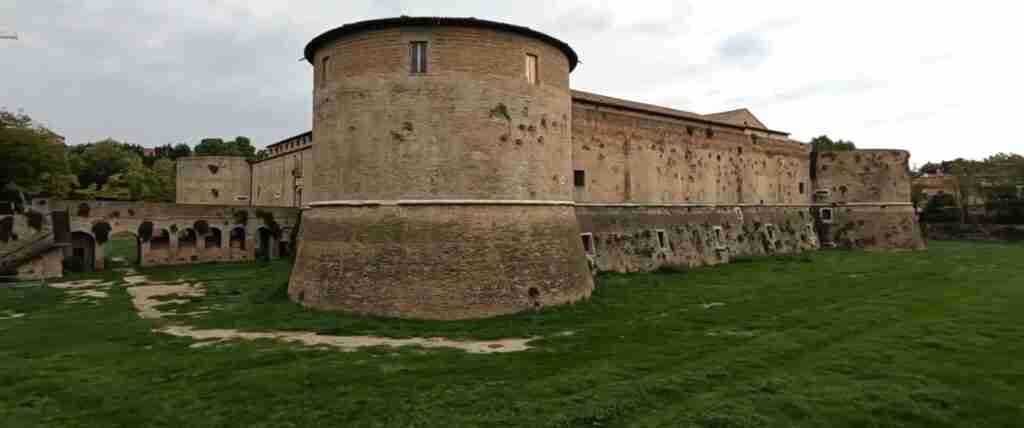
Mondavio’s Rocca Roveresca, thirty-five kilometres from Pesaro on the hillside above the Metauro tributary valleys, is the most accessible and best-documented of the three. Commissioned by Giovanni Della Rovere (lord of the Mondavio vicariat and son-in-law of Federico da Montefeltro) and designed by Francesco di Giorgio Martini, it was built between 1482 and 1492 — a precise construction window documented in primary sources and standard in the scholarship. The plan is anchored by a ten-sided polygonal keep, its facets angled to deflect cannonball impact rather than present a flat surface to artillery. Connected by curtain walls to a semi-elliptical supporting tower and a secondary flanking tower, and surrounded by a deep dry moat, the building never received a serious military test: local tradition holds that the Rocca, for all its martial intimidation, never fired its guns and never sustained a siege, though this claim is worth treating as a local pride narrative rather than a documented military record.
The visit covers two levels of the fortress. Ground floor and mezzanine rooms contain the Armory, displaying a substantial collection of Renaissance artillery and hand weapons: falconets, spingards, arquebus variants, and a six-hundred-kilogram bombard breech (the largest surviving piece, positioned in the entrance ravelin). Upper floors house the Historical Reenactment Museum, furnished with wax figures reconstructing court and garrison life — banquet scenes, stables, a prison and torture chamber, a guardroom — executed with enough accuracy to communicate the spatial logic of a functioning fortress without overwhelming historical detail. The small Apollo Theater, included in the admission ticket, occupies a converted upper chamber and seats approximately eighty in a delicately painted 18th-century interior; performances are rare but the room itself is notable as an example of the repurposing of fortresses into aristocratic residences over the course of three centuries. In the outer moat, full-scale reconstructions of siege machines drawn from Martini’s own technical drawings stand for outdoor inspection free of charge.
Admission: €5–6 per adult (check mondavioturismo.it for current official rates); €3 reduced for visitors aged 6–12 and over 65. Opening hours summer (April–October): 9:00–12:00 and 15:00–19:00; Monday closed October–May; open daily June–September. The Rocca sits on People’s Square within the walled borough; parking is available outside the walls at no charge. Mondavio carries the “I Borghi più belli d’Italia” (Most Beautiful Villages of Italy) designation and has a complete surviving circuit of medieval walls 780 metres in perimeter. The walk between the car park and the fortress gate takes five minutes.
Rocca Ubaldinesca at Sassocorvaro: The Art-Rescue Fortress
The Rocca Ubaldinesca at Sassocorvaro, commissioned by Ottaviano degli Ubaldini (chief counsellor to Federico da Montefeltro) and attributed by multiple institutional sources to Francesco di Giorgio Martini, was completed before 1477 — earlier than the Mondavio Rocca Roveresca and representing an earlier phase in Martini’s experimentation with circular massing. The building’s defining visual feature is its turtle-shaped plan: a compact configuration of curved and rounded masses designed to eliminate the flat wall surfaces most vulnerable to cannon fire. Local sources describe the turtle form as connected to the alchemical interests of its commissioner Ottaviano degli Ubaldini, and the fortress does contain documented alchemical imagery and symbolism in its interior spaces; the extent to which this influenced the architectural design, as opposed to being incorporated into a building whose circular massing was primarily a military calculation, is a matter of interpretive debate rather than documented intent.
The Rocca’s most remarkable historical chapter is its Second World War role. In 1940–1944, the then-Superintendent of Monuments for Urbino, Pasquale Rotondi, systematically transferred over ten thousand artworks at risk from bombing and looting into the Rocca’s deep-walled spaces, including major paintings by Raphael, Piero della Francesca, Titian, and other canonical names from the collections of Urbino’s Ducal Palace-National Gallery and Venice’s Accademia. The fortress’s thick walls and remote location — unknown to German forces occupying the region — made it effective as an undetected deposit. After the war, the artworks were returned to their originating institutions and the Rocca was returned to civic use. The permanent exhibition “Arca dell’Arte” (Art Ark), installed in ground-floor rooms of the fortress, documents this rescue operation with original photographs, correspondence, and inventories. A small art collection dating from the 14th to 19th centuries occupies the upper rooms alongside the fortress architecture itself.
Admission: €5 per adult, €3 reduced for children aged 6–12 and groups of fifteen or more (check roccaubaldinesca.it for current official rates). Hours: Saturday, Sunday, and public holidays only, 10:00–13:00 and 15:00–18:00. Weekday visits are possible by group pre-booking (telephone: 375 556 9162). An ample free car park occupies the square in front of the fortress entrance. The town sits above Lake Mercatale — a 1960s reservoir created by damming the Foglia tributary — with the artificial lake providing a pleasant foreground view from the fortification. Distance from Mondavio: approximately 20 km.
The practical consequence of Sassocorvaro’s weekend-only opening is that Loop Two functions most smoothly on a Saturday or Sunday. If your itinerary has flexibility, assign the fortress circuit day to a weekend slot; if weekdays are unavoidable, contact the fortress management at least two days in advance to arrange a group-rate weekday visit for parties of fifteen or more, or accept visiting the Mondavio Rocca Roveresca alone and scheduling Sassocorvaro as a standalone weekend half-day.
Loop Three: The Upper Metauro 2026 — Pergola, Sant’Angelo in Vado, and the Apennine Fringe
The third loop ascends the Metauro Valley above Fossombrone, where the river narrows and the settlements become smaller, older, and considerably less visited. The road climbs through rolling farmland toward the Apennine watershed, passing through Urbania (the second Della Rovere dynastic seat, with its own ducal palace and historical archive), reaching the Metauro-source towns of Sant’Angelo in Vado and Mercatello sul Metauro before the valley closes into its highest reaches. The one destination that justifies a full day trip from Pesaro — and that merits its own planning priority separate from the route — is the Gilded Bronzes Museum in Pergola, reached by branching from the upper Metauro axis toward the east.
Pergola’s Gilded Bronzes Museum: Rome’s Only Surviving Gilded Bronze Group
The Gilded Bronzes Museum in Pergola houses what multiple authoritative sources describe as the only complete group of gilded bronze statuary surviving from the ancient Roman world: six figures — two veiled female figures and two armoured horsemen with richly ornamented horses — discovered in 1946 by farmers excavating near Cartoceto di Pergola, where they had been buried in fragments in antiquity, apparently following deliberate dismemberment during a period of conflict or iconoclasm. Their dating is scholarly consensus placed between the late Republican period and the reign of the Emperor Tiberius — approximately the 1st century BC to early 1st century AD — with the mid-1st century BC proposed as a working hypothesis in the Ministry of Culture’s documentation, though this remains within a scholarly range rather than a precisely established date. What is not contested is their uniqueness: the only comparable gilded bronzes of ancient Roman origin are the equestrian statue of Marcus Aurelius in Rome and the Horses of Saint Mark in Venice.
The statues are displayed in a dedicated climate-controlled room within the 14th-century former convent of San Giacomo (now the museum’s primary building), installed under a controlled microclimate maintained by an “air curtain” system that manages temperature and humidity without physical barriers between viewer and object. The effect is unusual: life-size gilded figures at three metres’ distance with no glass or protective cage in the conventional sense. The museum also contains a picture gallery (paintings and wooden sculptures 14th–19th centuries), a numismatic section (238 coins), a Roman archaeological section including polychrome floor mosaics from a local Roman settlement, and a contemporary art section dedicated to the Pergola-born graphic artist Walter Valentini.
Admission: €6 per adult, €5 reduced (over 65, Coop and Touring Club members), €3 for children aged 6–11, free under 6 (check bronzidorati.com for current official rates). Summer hours (July–August): 10:00–12:30 and 15:30–19:00 daily. Other months: 10:00–12:30 and 15:30–18:30, Monday closed. Pergola is approximately 50 km from Pesaro via the SP3 and secondary roads; allow fifty to sixty minutes driving each way. The museum sits in the town centre with municipal street parking nearby.
Sant’Angelo in Vado and the Upper Valley Towns
Sant’Angelo in Vado, thirty-five kilometres beyond Pergola on the upper Metauro, occupies the site of ancient Tifernum Metaurense — a Roman municipal centre identified with the modern town by the scholarly consensus of regional archaeology, based on inscriptions, street grid analysis, and the distribution of Roman-period finds, though the definitive excavation of the site has never been completed. The town’s most compelling attraction for visitors is its collection of Roman mosaic floors, excavated from a large Roman domestic building (a domus) beneath and adjacent to the town centre; the mosaics are displayed in a purpose-built local museum adjacent to the excavation site. The medieval town above them is essentially unaltered: a grid of stone streets, a central piazza, and a parish church with minor but genuine Renaissance-period interior works.
Mercatello sul Metauro, fifteen kilometres further upstream, is the highest significant medieval town on the river — a concentrated borgo perched on a spur above the narrowing valley with a 13th-century church of San Francesco containing documented interior features. At this altitude the road landscape shifts from rolling farmland to chestnut-covered slopes and the first suggestion of mountain character. Mercatello is a natural turnaround point for Loop Three: beyond it the road climbs steeply toward the Apennine passes, and the driving time back to Pesaro from Mercatello (approximately seventy-five kilometres, one hour twenty minutes) is sufficient to arrive before dark even in winter.
Urbania, on the lower Metauro between Fossombrone and Sant’Angelo in Vado, offers an optional extension: a small Ducal Palace — the Della Rovere summer court — houses historical archives and a civic collection open to visitors. The town also claims a notable “City of the Dead” tradition around All Saints’ Day in November. For drivers planning Loop Three between October and December, Urbania adds modest cultural weight to a route that also benefits from the upper valley’s truffle season: Sant’Angelo in Vado is a white truffle market town, with a dedicated truffle fair (Mostra Nazionale del Tartufo Bianco Pregiato) typically running from late October through November.
Seasonal Access and Crowd Windows 2026: When to Drive Each Loop
The northern Marche operates on Italian seasonal rhythms that differ from those of the major Tuscan and Umbrian tourist circuits in two important respects: the peak season is genuinely coastal (July–August, when the Adriatic beach resorts at Pesaro, Fano, and Cattolica fill with Italian domestic holiday-makers) rather than cultural, and the interior hilltowns experience their own micro-peak during the annual reenactment events at Mondavio and Gradara rather than during the general summer. Understanding these patterns is the key to genuine crowd avoidance on the loops.
Best window: April–June. The spring period combines warm, dry weather, low accommodation costs at the Pesaro base, open landscapes before full leaf, and a driving environment that is essentially empty on the secondary roads. Most fortress sites extend their afternoon hours in April (to 18:00 or 19:00) and operate Tuesday–Sunday. The Furlo Gorge in spring has the most consistent road conditions after any winter closures for inspection. Truffle season has passed for the white variety (which peaks November–December), but black truffle (March–April) is still available in Acqualagna. School group visits to Gradara peak in April–May, but these are managed well and concentrated in the morning session: arriving after 14:00 avoids the school schedules entirely.
July–August: the complex peak. Pesaro hotel prices surge and the beach seafront fills with Italian holiday-makers, but this has minimal impact on the interior loops until Sunday afternoon gorge traffic. Mondavio holds its annual medieval reenactment festival — the “Caccia al Cinghiale” (Boar Hunt) — in the second week of August, centred on 13–15 August; the Rocca Roveresca has modified hours during this period (typically closed on one of the reenactment days and reduced-capacity on others), the village fills with costumed participants, and accommodation within thirty kilometres books out months in advance. This event is worth planning a visit around if medieval reenactment is of interest; it is worth planning a visit away from if not. The Rossini Opera Festival in Pesaro runs through most of August, elevating accommodation costs in the city significantly.
September–October: the optimal harvest window. Shoulder season pricing returns to Pesaro hotels, the gorge road traffic drops sharply, morning light on the limestone walls is excellent for photography, and the Metauro Valley begins its truffle pre-season. The fortresses operate on their standard autumn hours (closing at 18:00 rather than 19:00). Gradara tends to be significantly quieter in September than in any summer month. October brings the Sant’Angelo in Vado white truffle fair and the Acqualagna regional truffle market, adding a food dimension to Loop Three that is absent in other seasons.
November–March: selective viability. Winter driving in the northern Marche is generally manageable below 400 metres altitude, but secondary roads in the upper valley and toward Cagli can carry ice and snow above this level after hard frosts. The Furlo Gorge road is typically open year-round when conditions allow (the gorge itself is frost-free because of the valley floor microclimate), but verification via the reserve website is more important in winter. Many agriturismo properties close between November and March. The hilltowns are genuinely quiet, and Mondavio in a light snow is architecturally remarkable, but the practical challenge of reduced opening hours and seasonal closures makes winter itinerary planning more effortful than spring or autumn.
ZTL Zones, Paid Parking, and Free Car Parks 2026
Navigating Italian ZTL zones is the single most consistently misunderstood aspect of driving in historic towns, and the northern Marche circuit involves enough walled hilltowns to make a clear briefing valuable. The ZTL (Zona a Traffico Limitato) is a camera-enforced restricted traffic zone around historic centres; driving through one without an authorised vehicle identification number triggers a fine by post. The good news for this itinerary is that the vast majority of parking for the circuit’s destinations is outside ZTL boundaries, making the restricted zones easy to avoid as long as the driver does not attempt to park inside the medieval walls rather than adjacent to them.
Pesaro: the ZTL covers the historic centre around the People’s Square, the Ducal Palace, and the adjacent streets. The restricted zone is active on specific hours that are posted on road signs approaching the centre and available on the Pesaro municipal website; these hours should be verified at comune.pesaro.pu.it before arrival as they can change seasonally. The simplest approach is to stay in accommodation with private parking (available at most three- and four-star hotels) and walk to the historic centre. Free street parking is available in the residential zones east and south of the ZTL boundary, typically a five-to-ten-minute walk from the main attractions.
Gradara: the inner medieval borough inside the castle walls is pedestrian-only. All vehicle access terminates at the outer car parks on the hillside below the walls. Two main car parks serve visitors: a large free car park at the base of the hill (Piazzale Paolo e Francesca) reachable from the main access road, and a secondary car park mid-hill for visitors with mobility difficulties. From the lower car park, the walk through the outer gate to the castle entrance takes approximately ten minutes uphill. No ZTL enforcement applies because the restriction is straightforward physical: there is no through-road into the interior beyond the outer gate.
Mondavio: vehicle access into the walled borough is limited by the width of the medieval gates, which excludes most standard vehicles. The practical approach is to park outside the walls at the free car park immediately adjacent to the gate giving access to People’s Square and the Rocca Roveresca. The walk from this car park to the fortress entrance is three minutes. No ZTL camera enforcement has been noted by visitors, but the gate width functions as a physical deterrent to large vehicles and the narrow internal streets are clearly not designed for through-traffic.
Sassocorvaro: an ample free car park occupies the square directly in front of the Rocca Ubaldinesca entrance — confirmed by official visit information. No ZTL complications reported at this location. Large vehicles can park here. The Lake Mercatale area below the town also has free green-space parking.
Acqualagna: free municipal street parking on the main road and in the town centre; no ZTL restrictions on the commercial main street. The truffle market area has dedicated parking on fair days.
Fossombrone: free street parking on the approach roads to the historic centre; blue-line paid zones may apply on the principal central street. For a coffee stop, on-street free parking is almost always available within one hundred metres of the main street.
Furlo Gorge parking summary: all three gorge parking areas (Pianacce pullout, Villa Furlo hamlet, Acqualagna end) are free. The Pianacce pullout holds fifteen to twenty cars; the Villa Furlo hamlet area accommodates more but is informal. During peak-season weekends, arrive early to find space at the Villa Furlo hamlet. No ZTL applies to any section of the gorge road itself.
General ZTL avoidance strategy: set your GPS navigation to route around ZTL zones (most modern devices have this option in traffic settings). Watch for rectangular blue-and-white signs reading “ZTL” or “Zona a Traffico Limitato” at the zone boundary; cameras are positioned immediately after the sign, not at a distance from it. If you accidentally enter a ZTL zone, exit immediately by the same route. Do not attempt to park inside the walled sections of any hilltown on this circuit: all the attractions have accessible free car parks outside the walls, and there is no practical benefit to attempting interior access with a vehicle.
Budget Planning for the Northern Marche Road Trip 2026
The northern Marche offers some of the best cost-to-experience ratios in central Italy, primarily because it has not undergone the accommodation price inflation that affects Tuscany and Umbria. Pesaro hotel prices are modest even in shoulder season; attraction admission fees are uniformly low; meals in the hilltowns range from genuinely cheap to very good value at the quality end. Check official booking platforms for current rates before travel, as all pricing below is based on recent data and is subject to seasonal and year-on-year variation.
Budget tier — €75–120 per person daily (two sharing). At the low end, B&B and family-run pensione accommodation in Pesaro ranges from €50–75 per room per night in shoulder season; divided between two, that is €25–38 per person. Breakfast at a bar (espresso and cornetto) costs €3–5. A bar or trattoria lunch runs €12–18 per person. A simple trattoria dinner with local wine costs €20–28 per person. Fuel for the day’s loop, split between two passengers, adds €8–11. Free gorge access, free parking at most hilltowns, and fortress admissions of €5–6 keep the attraction line to €5–10 on a fortress day. Budget travelers: hotel €25–38 per person, breakfast €5–8, lunch €12–18, dinner €20–28, fuel share €8–11, parking €2–5, attractions €5–10. Total approximately €77–118 per person daily in shoulder season, rounded to €75–120; check official sites for current rates as these figures vary seasonally.
Mid-range tier — €125–200 per person daily (two sharing). A three-star Pesaro hotel (typically including private parking) averages €90–140 per room in shoulder season; per person: €45–70. Breakfast at the hotel or a good café: €8–12. Lunch at a restaurant: €18–28. A good trattoria or osteria dinner with regional wine: €35–50. Fuel: €8–12 per person. Parking: €3–7. Attractions including the occasional guided visit: €10–20. Total: hotel €45–70, meals €61–90, fuel €8–12, parking and attractions €13–27. Sum: approximately €125–200 per person daily in shoulder season, with August Pesaro accommodation adding significantly to the upper end.
Luxury tier — €210–345 per person daily (two sharing). A four-star Pesaro seafront property or a quality country estate agriturismo averages €160–280 per room; per person: €80–140. Quality meals — lunch at a destination restaurant in Fossombrone or the upper Metauro, dinner at one of Pesaro’s better establishments — run €28–45 and €60–90 respectively. Total: accommodation €80–140, meals €100–153, fuel and miscellaneous €28–52. Rounded to approximately €210–345 per person daily.
Four-day trip totals (per person):
- Budget: approximately €300–480 per person for four days (two sharing; shoulder season; check official sources for current rates)
- Mid-range: approximately €500–800 per person for four days (two sharing; shoulder season)
- Luxury: approximately €840–1,380 per person for four days (two sharing; shoulder season)
Seasonal adjustment: July–August Pesaro accommodation surges sharply — average 3-star rates can reach €150–200 per room per night in peak August according to recent booking platform data, compared to €69–91 in shoulder months. This adds €40–55 per person per night to the mid-range accommodation line, shifting the August mid-range daily total to approximately €165–255. All other cost categories (fuel, attractions, most meals) are essentially seasonal-flat in this region.
Admission cost reference (single visit, current rates confirmed; check official sites before travel):
- Gradara Castle: €10 per adult, €2 for EU citizens aged 18–24, free under 18 (gradara.org)
- Mondavio Rocca Roveresca: €5–6 per adult, €3 reduced (mondavioturismo.it)
- Rocca Ubaldinesca, Sassocorvaro: €5 per adult, €3 reduced (roccaubaldinesca.it)
- Pergola Gilded Bronzes Museum: €6 per adult, €5 reduced, €3 children 6–11 (bronzidorati.com)
- Furlo Gorge State Nature Reserve: free access to the road and gorge; free Information Centre (August)
Hidden costs to budget for: ZTL fines if inadvertently triggered (typically €80–150; avoid entirely by parking outside historic centres as described above). Autostrada tolls do not apply to the SP3 Via Flaminia secondary road sections, but connecting to the A14 Adriatica motorway from Pesaro for the initial departure adds a minor toll segment. Petrol costs in Italy include a higher tax component than in most northern European countries; refuelling is most economical at self-service pumps on the motorway service areas rather than in-town stations.
Accommodation Strategy 2026: Pesaro Base and Strategic Overnights
The Pesaro base model works best for a majority of travelers because it concentrates accommodation logistics in a single booking, removes the complexity of luggage transfers between hilltowns, and places the driver within forty-five minutes of every loop departure. Within Pesaro, the most practical accommodation for road-trippers is a three-star hotel with private parking in the northern or western residential districts, where ZTL-free access is straightforward and prices are meaningfully below the seafront premium. Properties on and immediately adjacent to the seafront lungomare command a 20–40% premium over comparable inland addresses and offer no logistical advantage for a driving itinerary.
Mid-range properties averaging €90–140 per room (verified from booking platform data; check official rates before booking) cluster in the area between the train station and the historic centre, within ten minutes’ walk of the People’s Square and the Ducal Palace civic museum collection. Four-star seafront properties and the Hotel Vittoria (a historic seafront landmark) serve travelers for whom Pesaro is partly a destination rather than purely a base; these average €150–250 per room in shoulder season. Budget B&B and pensione options start from €50–75 per room and are scattered throughout the city’s residential fabric, many without private parking.
Agriturismo alternatives along the loops: the Metauro Valley has a moderate supply of working farm stays (agriturismo) along the SP3 corridor, typically offering half-board options (dinner and breakfast included) that reduce the daily meal budget substantially. Properties near Fossombrone, Cagli, and Acqualagna are the most numerous and the most relevant to Loop One; a night at an agriturismo near Mondavio is the most practical base for a two-day fortress circuit if you want to maximize time at Mondavio and Sassocorvaro without the long drive back to Pesaro. Most agriturismo properties close November–March; the best ones book up for August weeks in advance. Booking via Agriturismo.it or direct telephone is more reliable for smaller properties than third-party platforms.
Fossombrone town has modest hotel accommodation suitable for an overnight if the Cagli extension makes returning to Pesaro impractical; its central piazza has two small hotels and a family-run B&B within walking distance of the Via Flaminia restaurant strip. Sant’Angelo in Vado and Mercatello sul Metauro offer limited accommodation that suits upper-valley truffle-season visitors who want an early start for October morning market visits. Pergola itself has one well-reviewed B&B and several self-catering apartment options for travelers making it a destination rather than a day-trip stop.
Frequently Asked Questions
Do I need a permit, access pass, or seasonal ticket to drive through the Furlo Gorge in 2026?
No permit, pass, or ticket is required to drive the old Via Flaminia through the Furlo Gorge. Road access is free year-round to all standard vehicles. The Furlo Gorge State Nature Reserve imposes prohibitions on motorised off-road vehicles and on activities within its protected zones, but these do not affect drivers using the public carriageway through the gorge. The nature reserve information centre has no admission charge. There is no seasonal access system in operation for the public road. The only operational constraint is the alternating traffic-light system that manages single-file flow — this is a traffic management measure, not a permit gate. Always check riservagoladelfurlo.it before visiting, as the road has been closed temporarily in the past for safety works.
Is the Furlo Gorge road suitable for large campervans or motorhomes?
The gorge road is not suitable for large campervans, motorhomes, coaches, or any vehicle wider than approximately 2.5 metres or longer than approximately 7 metres. The carriageway narrows at multiple points to single-vehicle width, and the alternating traffic system exists precisely because the gorge cannot accommodate bidirectional vehicle movement. Drivers of large campervans should use the parallel SP3 superstrada, which runs through the Furlo tunnel and is fully capable of accommodating all vehicle sizes. Parking for campervans near the gorge is limited to the Acqualagna town area at the northeastern end, where space is more generous. Motorcycles, bicycles, and pedestrians use the gorge road freely.
Can I visit the Rocca Ubaldinesca at Sassocorvaro without pre-booking in 2026?
Individual visitors can walk in without booking on Saturday, Sunday, and public holidays during the standard opening hours of 10:00–13:00 and 15:00–18:00. No advance reservation is required for individual or small-group visits on these days. Weekday visits — Monday through Friday — require pre-booking by telephone (375 556 9162) and are available for groups. The fortress is managed by the local Pro Loco association with volunteer guides; tours are conducted in Italian, but English-language materials and some English-speaking guides can be arranged if requested when booking. The guided visit is included in the €5 admission price with no supplement. Allow ninety minutes for the full visit including the Arca dell’Arte exhibition documenting the wartime art rescue.
What is the best combined day trip from Pesaro that covers both the Furlo Gorge and a fortress in 2026?
The most efficient single-day combination pairs the Furlo Gorge (morning) with Mondavio’s Rocca Roveresca (afternoon). Depart Pesaro at 8:30, drive forty minutes to Fossombrone for coffee, continue to the Pianacce pullout at the gorge entrance (9:30), drive or walk through the gorge, lunch at Villa Furlo hamlet, exit at Acqualagna by 13:00, then drive approximately thirty-five kilometres to Mondavio for the afternoon opening at 15:00. The fortress closes at 19:00 (summer), giving two hours of visit time before the fifty-minute return to Pesaro. Total driving approximately 155 km. This routing avoids doubling back and naturally stages the two attractions with the gorge experience providing the transition between valley floor and hilltown.
How do I avoid Pesaro’s ZTL zone when driving in from the motorway?
Drivers arriving on the A14 Adriatica motorway should exit at Pesaro–Fano and follow signs for the hotel zone (zona alberghi) or seafront (lungomare) rather than centro storico. Most three-star and four-star hotels with private parking are outside the ZTL boundary and reachable from the motorway exit without crossing it. Set your GPS to avoid ZTL zones in the traffic settings; most modern navigation applications have this option. The ZTL boundary in Pesaro is clearly posted with regulatory signs and camera-detection notices at each entry point; do not pass these signs in a vehicle. If you need to visit the Ducal Palace or People’s Square on foot, park in the nearest free zone outside the restricted boundary and walk in — the historic centre is compact and most points are within ten minutes on foot from the ZTL perimeter.
Are there any free attractions on the Northern Marche road trip?
Several attractions on the circuit charge no admission. The Furlo Gorge road drive itself is free, as is the gorge road walk — one of the most memorable landscape experiences in central Italy. The medieval boroughs surrounding the paid fortresses (Mondavio’s walled town, Gradara’s outer borough, Sassocorvaro’s hill village) are free to walk. The Furlo Gorge State Nature Reserve Information Centre is free in August. The Via Flaminia road surface sections near Fossombrone and in the gorge itself are publicly accessible at no charge. Many of the churches in the upper Metauro towns have free entry and contain genuine secondary artistic works. The Lake Mercatale green areas adjacent to Sassocorvaro are free-access. In total, a day combining the Furlo Gorge drive with exploration of the borghi and Via Flaminia road sections can be executed at zero admission cost if fortress visits are saved for a separate day.
When is the Mondavio medieval reenactment festival in 2026?
Mondavio’s annual medieval reenactment, the “Caccia al Cinghiale” (Boar Hunt), is traditionally held in the second week of August, centred on Ferragosto (15 August). Based on historical patterns, the event runs from approximately 11–15 August, with the principal reenactment day on 13 August and theatrical performances on the evening of 14 August. The Rocca Roveresca operates modified hours during festival week — typically closed on one day and open with modified ticket prices on others; confirm the exact 2026 schedule directly with the Mondavio tourism office (Tel. 0721 977758) or at mondavioturismo.it in early 2026. The festival transforms the entire borgo with costumed processions, archery tournaments, and a Renaissance banquet; accommodation within thirty kilometres books out months in advance for this week, so plan well ahead if attending.
Is Pergola’s Gilded Bronzes Museum worth the detour from a Pesaro base?
For visitors with any interest in ancient art, the Pergola Gilded Bronzes Museum is unambiguously worth the fifty-kilometre drive. The bronzes are the only group of this type and scale surviving from the ancient Roman world: there is no equivalent anywhere else in Italy or Europe, and the display conditions — life-size figures at close viewing distance in a dedicated climate-controlled room — make the encounter qualitatively different from the glass-case experience of most Roman bronzes. The museum visit takes approximately ninety minutes including the associated collections. Pergola itself is a pleasant Marche market town without tourist infrastructure, with good restaurants along the central street. Pair the Pergola visit with Sant’Angelo in Vado and its Roman mosaics for a coherent upper valley day; this combination requires approximately seven hours including driving from Pesaro and back.
Can I do the Northern Marche itinerary without a car?
The itinerary as designed is not viable without a car. Mondavio, Sassocorvaro, the Furlo Gorge approach road, Sant’Angelo in Vado, Pergola, and Cagli have no practical rail connection to Pesaro, and bus services on the secondary routes run infrequently and do not connect the destinations to each other in a day-trip pattern. Gradara Castle is the one exception: regular bus service runs from Pesaro (Piazzale Matteotti) to Gradara’s outer car park roughly every hour on weekdays in season. Fossombrone and Acqualagna are reachable by infrequent regional bus from Pesaro, but the Furlo Gorge approach road section from the superstrada exit to the gorge itself is not covered by public transport. For car-free travelers, the alternative is to base in Pesaro and hire a driver for the inland loops or book a guided day tour, which local agencies offer on a pre-booked basis.
How difficult are the secondary roads connecting Mondavio, Sassocorvaro, and Cagli?
The roads linking these three hilltowns are typical Marche secondary routes: well-maintained, paved, single-carriageway with passing places on the narrower sections, and requiring attentive driving rather than specialist skill. The SP14 from Mondavio to Sassocorvaro (approximately 20 km) climbs through forested ridgelines with moderate gradients and well-surfaced bends; a standard hatchback manages it comfortably in dry conditions. The mountain roads descending from Cagli toward Acqualagna or the Metauro Valley involve steeper gradients and tighter bends but remain within the capability of any standard vehicle with attentive driving. In wet conditions, reduce speed appropriately on the single-carriageway sections; in snow or ice (October–April above 400 metres), verify road conditions via the province website (provincia.pu.it) before committing to the mountain extensions. Large SUVs or vehicles with high ground clearance are not necessary; standard European hatchbacks are the appropriate vehicle for all loops described in this guide.