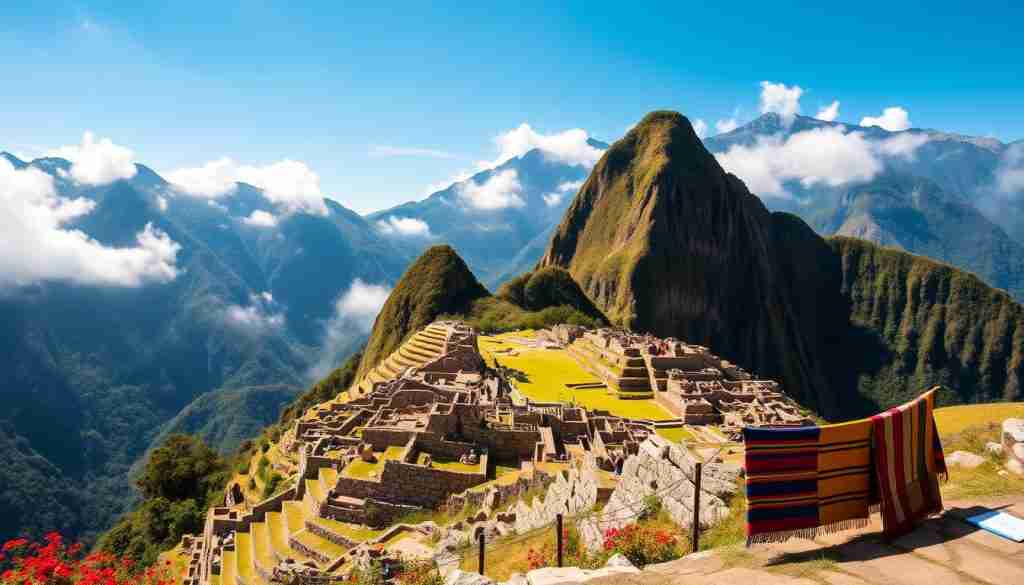
Machu Picchu, an ancient Inca citadel in Peru’s Andes Mountains, has fascinated travelers globally. The Inca Trail, a 26-mile (42 km) trek, is a famous way to reach it. It connects Incan sites and ends at the Sun Gate, offering a view of the ruins. This hike, over 13,000 feet high, takes 4 days and 3 nights to finish.
The Inca Trail’s history goes back to the 15th century. It was a sacred path for the Inca Empire. In 1913, American scholar Hiram Bingham found Machu Picchu, hidden since the Spanish conquest in the 1500s. Today, it’s a top spot for those seeking adventure, offering a dive into Peru’s culture and landscapes.
Key Takeaways
- The Inca Trail to Machu Picchu is a 26-mile (42 km) trek that takes 4 days and 3 nights to complete, with an elevation of over 13,000 feet.
- The trail connects several Incan archaeological sites and culminates at the Sun Gate overlooking the Machu Picchu ruins.
- The Inca Trail has a rich history dating back to the 15th century, when it served as a sacred pilgrimage route for the Inca Empire.
- Hiram Bingham, a Yale scholar, rediscovered Machu Picchu in 1913 after it had been hidden for centuries following the Spanish conquest of the Incas.
- The Inca Trail is considered one of the most famous trails in South America and a sought-after destination for adventure-seeking travelers.
- Contact us for a comfortable and personalized itinerary (Free Service)
Understanding the Ancient Inca Trail History and Legacy
The Inca Trail was a key part of the Inca Empire’s vast network across the Andes Mountains in Peru. It was called the “Royal Road.” This trail was for Inca royalty and religious pilgrims. Today, it’s a top hiking spot, showing the rich history and culture of the Quechua people.
The Royal Road’s Cultural Significance
The Inca Trail was more than a path; it was a sacred journey. It linked Cusco to Machu Picchu. Inca rulers used it for rituals, showing their spiritual and political power.
Archaeological Discoveries Along the Trail
The Inca Trail is full of Inca ruins and sites. Many have been restored. Hikers see ancient way stations and impressive stone structures like Runcuracay and Wiñaywayna. These show the Inca Empire’s advanced engineering.
Sacred Mountains and Ceremonial Sites
The trail goes through stunning landscapes with sacred Quechua mountains. Hikers see amazing views, diverse wildlife, and feel the trail’s spiritual essence. They get closer to Machu Picchu.
| Key Inca Trail Statistics | Details |
|---|---|
| Inca Road Network | Approximately 25,000 miles, connecting cities, government centers, agricultural areas, and sacred complexes |
| Classic Inca Trail Duration | 4 days, covering approximately 43 km |
| Highest Point on Classic Trail | Llulluchapampa, at an altitude of 4,215 m |
| Short Inca Trail Duration | 2 days, reaching a maximum altitude of 2,750 m |
“The Inca Trail is more than just a hike – it’s a journey through time, where the vestiges of a remarkable civilization come alive before your eyes.”


What is the longest way to get to machu picchu
Getting to Machu Picchu can be done in many ways. The longest and toughest route is the extended Inca Trail. It’s longer than the classic Inca Trail, which is about 26 miles. The extended routes can last from 7 days to more, taking you through more Inca sites and tough terrain.
The Choquequirao Trek is one of the toughest and most rewarding options. It takes 8 days to finish and covers over 100 kilometers. It starts in the Apurimac Valley and has very challenging parts that test your physical limits.
The trek goes up to 4,130 meters above sea level. It can get very cold, with temperatures sometimes dropping to 0°C. Hikers are told to use hiking poles to ease the strain on their legs and knees.
Despite its difficulty, the Choquequirao Trek offers a deep connection with nature. You’ll see different landscapes, like valleys, rivers, and mountains. You might even see rare plants and animals, like orchids and condors.
After finishing the trek, you can take a train back to Cusco or Ollantaytambo. The Choquequirao Trek is seen as a major accomplishment. It requires a lot of physical and mental effort. Only a few people have done it.
Best Seasons and Weather Conditions for the Trek
The Inca Trail is a remarkable hike that offers a unique glimpse into the ancient Inca civilization. Choosing the best time to undertake this journey is important. The dry season, from May to September, is the prime time. June to August is the peak tourism months.
Peak Season vs Off-Peak Benefits
During the peak season, visitors enjoy warm and sunny days. This is perfect for exploring the trail and taking in the stunning vistas. But, this also means more crowds and competition for permits and accommodations.
The shoulder seasons of April-May and September-October offer fewer crowds. This makes for a more serene trekking experience. But, there might be some rainy days.
Monthly Weather Patterns
- The dry season from May to September features hot and dry conditions. It has clear skies and excellent hiking weather.
- The rainy season from December to March brings heavy precipitation. January and February are the wettest months.
- The early rainy season, from late September to early December, offers cooler weather. It also has lush, green landscapes.
Altitude Considerations by Season
Hikers should be mindful of the significant altitude changes along the Inca Trail. It ranges from 2,600 meters (8,530 feet) at the start to over 4,200 meters (13,780 feet) at the highest point, Dead Woman’s Pass. Proper acclimatization and preparation are crucial, regardless of the season.
By understanding the Inca Trail’s seasonal patterns and weather conditions, travelers can make an informed decision. This helps them choose the best time to embark on this unforgettable journey and maximize their experience.
Essential Gear and Packing List for Extended Hiking
Getting ready for the Inca Trail to Machu Picchu means you need the right Inca Trail equipment. You’ll want sturdy hiking gear and key trekking essentials. This guide will show you how to pack for your Andean journey.
The duffle bag you’ll get can hold up to 7 kg/15.4 lbs. You should bring a 30-liter backpack for your day items. It’s crucial to have good hiking underwear from Icebreaker, Adidas, and Under Armour. You’ll need 4-6 pairs of breathable sports underwear and 2-3 base layer tops and bottoms.
For your clothes, plan for 4-7 hiking shirts. You’ll also need a hard-shell jacket like The North Face Resolve and insulated jackets from The North Face, Patagonia, and Arc’Teryx. A warm fleece jacket from Helly Hansen, The North Face, or Patagonia is a must. Plus, bring a pair of Craghoppers, Columbia, or O’Neills trekking pants and shorts.
| Gear Category | Recommended Brands | Quantity |
|---|---|---|
| Hiking Underwear | Icebreaker, Adidas, Under Armour | 4-6 pairs |
| Base Layers | – | 2 tops, 1 bottom |
| Hiking Shirts | – | 4-7 |
| Hard-shell Jackets | The North Face Resolve | 1 |
| Insulated Jackets | The North Face, Patagonia, Arc’Teryx | 1 |
| Fleece Jackets | Helly Hansen, The North Face, Patagonia | 1 |
| Trekking Pants/Shorts | Craghoppers, Columbia, O’Neills | 1-2 |
Other must-haves include inner gloves from Pearl Izumi and Karrimor, and outer gloves for cold weather from Dakine, The North Face, Outdoor Research, or Black Diamond. Don’t forget a hiking hat with neck cover for sun protection.
For your feet, get quality hiking boots from Scarpa, Salomon, Berghaus, Hi-Tec, or Karrimor. Pair them with hiking socks from Coolmax, Smartwool, Bridgedale, or Point 6. Also, have thermal socks from Smartwool, Wigwam, or Bridgedale.
Lastly, a warm and durable sleeping bag from The North Face or Marmot will keep you cozy at night.
“Preparation is the key to a successful and enjoyable Inca Trail trek. Invest in the right gear and you’ll be rewarded with an unforgettable experience.”
Physical Preparation and Altitude Acclimatization
Getting ready for the Inca Trail means focusing on altitude acclimatization. Arriving in Cusco a few days early helps your body get used to the high elevation. Cusco sits at 11,152 feet (3,399 meters) above sea level.
Training Schedule Recommendations
Before your trip, start with regular cardio and strength training. This boosts your endurance and muscle strength. It makes the tough hikes easier to handle.
Altitude Sickness Prevention
Altitude sickness can hit anyone, no matter their age, gender, or fitness level. Drink at least 0.5 liters of water per hour when you’re active. Stay away from alcohol, as it can make dehydration worse at high altitudes. Try coca tea or crystalized ginger chews for mild symptoms.
Medical Considerations
If you’ve had altitude sickness before, talk to a doctor about medication. They might suggest acetazolamide (Diamox) or dexamethasone. These can help your body adjust to the high elevations.
| Elevation | Location |
|---|---|
| 2,430 meters (7,972 feet) | Machu Picchu |
| 3,399 meters (11,152 feet) | Cusco |
| 4,215 meters (13,828 feet) | Warmiwañusca Pass (Dead Woman’s Pass) |
By following these physical preparation and altitude acclimatization tips, you’ll be ready for the Inca Trail. You’ll get to see the stunning beauty of Machu Picchu.
Choosing a Reputable Tour Operator
Planning your trip to the Inca Trail and Machu Picchu? Picking a good tour operator is key. They make sure your trip is not just fun but also done right. This means caring for the environment and treating porters well.
Alpaca Expeditions is a great choice for this. They are owned by locals and pay their guides and porters fairly. They focus on porter welfare and ethical trekking.
Waman Adventures is another top choice. They welcome people from 5 to 80 years old. Their groups are small, with up to 8 people. They are quick to respond, making booking easy.
| Tour Operator | Age Range | Group Size | Response Rate | Response Time |
|---|---|---|---|---|
| Kantu Peru Tours | 10-80 years | Up to 18 people | 92% | Within 8 hours |
| Waman Adventures | 5-80 years | Up to 8 people | 100% | Within 10 hours |
| LimaTours | 10-90 years | Up to 4 people | 100% | Within 9 hours |
| G Adventures | 12-90 years | Up to 9 people | 96% | Within 2 hours |
| PVTravels | 1-99 years | Up to 30 people | 96% | Within 2 days |
| Alpaca Expeditions | 10-65 years | Up to 8 people | 100% | Within 2 days |
| Unu Raymi Expeditions | 18-75 years | Up to 8 people | 96% | Within 9 hours |
When looking at Inca Trail tour companies, check their values and how they treat employees. Also, book early. Only 500 people, including staff, can go each day.

Choosing a good tour operator means your trip will be meaningful and help preserve this cultural site. It will also be a memorable experience.
Day-by-Day Trail Navigation and Camping Sites
Starting the Inca Trail to Machu Picchu is a unique adventure. It takes you through stunning landscapes filled with Inca history and culture. The 4-day trek covers 45 kilometers, ending at the breathtaking Machu Picchu.
Major Checkpoints and Rest Areas
The journey starts at Kilometer 82, near Ollantaytambo. The first day’s hike is 14 kilometers long, reaching Wayllabamba camp at 3,100 meters. It takes about 5.5 hours.
The second day is tough, with a climb to Dead Woman’s Pass at 4,215 meters. This 16-kilometer hike can take up to 12 hours.
Camping Facilities and Amenities
Campsites along the trail have basic facilities. Some tours offer hot showers on the first night. Porters carry your bags, limited to 7 kilograms.
The third day’s hike through cloud forests is 15 kilometers long. The final day’s 6-kilometer hike ends at the Sun Gate for a Machu Picchu sunrise view.
Trail Difficulty Levels
- The Inca Trail is a “moderate” hike, needing good fitness and preparation for its tough terrain and high altitudes.
- The first day’s hike is moderate, with a 350-meter elevation gain over 11 kilometers in 6-7 hours.
- The second day’s climb to Dead Woman’s Pass is the toughest, with a 16-kilometer hike and over 900 meters elevation gain, taking up to 12 hours.
- The third day’s descent and the final day’s trek to the Sun Gate are less demanding but still require careful pacing and acclimatization.
Knowing the daily challenges and camping facilities helps hikers prepare for the Inca Trail. It ensures a safe and unforgettable journey on the ancient Inca roads to Machu Picchu.
Cultural Experiences and Archaeological Sites En Route
Embarking on the extended hike to Machu Picchu, you’ll dive into the rich Andean culture. You’ll also explore amazing Inca ruins along the way. The trail goes through several key archaeological sites, showing the Inca civilization’s legacy.
First, you’ll visit Llactapata, an Inca settlement. It’s a great start to learn about the ancient empire’s architecture and farming. Then, you’ll see Runcuracay, a former Inca tambo or resting station. Next, you’ll reach Sayacmarca, a complex of structures on a mountain.
| Archaeological Site | Key Features |
|---|---|
| Llactapata | Inca settlement, architecture, and agriculture |
| Runcuracay | Inca tambo (resting station) |
| Sayacmarca | Complex of structures atop a mountain spur |
| Phuyuptamarca | Inca religious and ceremonial site |
| Wiñaywayna | Inca agricultural terraces and religious complex |
As you move forward, you’ll see Phuyuptamarca, a sacred Inca site. Then, there’s Wiñaywayna, with its terraces and religious complex. Each site shows the Inca’s advanced engineering and spiritual life.
Along the way, you’ll meet local Quechua communities. They keep their traditions and cultural heritage alive. This cultural experience enriches your hike, giving you a deeper understanding of Andean life.
“The Inca Trail is not just a hike, but a journey through time, where the past and present converge, revealing the enduring spirit of the Andes.”
Sustainable Hiking Practices and Environmental Protection
Trekking the Inca Trail to Machu Picchu means we must care for the environment. The Peruvian government has strict rules to keep this site safe. These include limits on visitors and the need for official guides. It’s important for us to follow Leave No Trace to protect this delicate area.
Good tour operators lead eco-friendly trekking trips. They focus on keeping the Inca Trail safe. They use eco-friendly camping, follow strict waste rules, and support local communities.
- Follow the Leave No Trace rules, like proper waste disposal and respecting local cultures.
- Choose tours that care about the environment and treat porters fairly.
- Learn from guides about the Inca Trail’s history and nature.
- Be careful not to harm the Andean environment or disturb local people.
By following these steps, we help keep the Inca Trail and Machu Picchu safe for the future. This way, others can also see the beauty and importance of this place.
“The Inca Trail is a sacred and fragile path that demands our utmost respect and care. As visitors, we have a responsibility to tread lightly and protect this remarkable legacy.”
Conclusion
Hiking the Inca Trail to Machu Picchu is a tough but rewarding Machu Picchu experience. It offers amazing views, deep cultural learning, and a great sense of achievement. With the right prep, respect for the land and people, and a good tour guide, you’ll have an unforgettable adventure travel trip.
The hard trek ends with a stunning view of Machu Picchu from the Sun Gate. This moment is often called awe-inspiring. By following the best tips, like getting permits early and getting used to high altitudes, you can have a safe and enriching trip.
Whether you pick the classic Inca Trail or another path, the trip to this famous Andean site is a challenge. It tests your body, engages your mind, and feeds your soul. With good planning and an open heart, your journey to Machu Picchu will be a memorable adventure.
