The Lombardy Industrial and Liberty Counter-Narrative: An Alternative Self-Drive Road Trip Guide 2026
The industrial heartlands north of Milan conceal a road-tripper’s secret: a trail of smoking chimneys turned cultural monuments, silk-weaving dynasties expressed in floral stonework, and workers’ villages now carrying UNESCO protection. This self-drive guide maps the Lombard counter-narrative for 2026, tracing an arc from Sesto San Giovanni’s Stalingrad mythology to the Art Nouveau boulevards of Varese, with the UNESCO workers’ village of Crespi d’Adda and Como’s silk-heritage corridor filling the days between — a route that most visitors to northern Italy never discover.
- Key Takeaway 1 — Route and Duration: The core three-day circuit covers 250–280 km; five days is the recommended pace for a complete experience, with optional extensions to Lecco (Moto Guzzi country) and the industrial Brianza furniture heartland.
- Key Takeaway 2 — Admission Costs: Crespi d’Adda village entry is free; guided tours cost €7–12 per person (check official rates at visitcrespi.it before visiting). Museo della Seta Como is €9 per person; Villa Bernasconi in Cernobbio is €10 full price. Galleria Campari in Sesto San Giovanni runs free guided visits every second Saturday of the month.
- Key Takeaway 3 — Daily Budget Ranges 2026: Budget travelers need €110–160 per person daily (two sharing a budget B&B). Mid-range visitors spend €195–275 per person daily (two sharing a mid-range hotel). Luxury travelers invest €345–520 per person daily (two sharing a four- or five-star hotel). All figures include accommodation, meals, car rental share, fuel, parking, admissions, and incidentals.
- Key Takeaway 4 — Driving Practicalities: ZTL restrictions apply in Como’s historic center and Bergamo Alta; park outside these zones and continue on foot. Sesto San Giovanni, the industrial base camp, is fully car-friendly and sits twelve kilometers from Milan Centrale by autostrada or Milan’s Metro MM1 Red Line.
- Key Takeaway 5 — The Liberty-Industrial Link: Art Nouveau in Lombardy was not an aristocratic indulgence — it was the architectural language of industrial capitalism. The same entrepreneurs who built the factories funded Liberty villas, model workers’ villages, and brewery campuses. Following this road trip is following the money of Italy’s first industrial age.
People Also Ask About the Lombard Industrial and Liberty Road Trip 2026
How much does a self-drive industrial and Liberty road trip in Lombardy cost per day in 2026?
Daily costs range from €110–160 per person for budget travelers to €195–275 per person for mid-range comfort, both figures assuming two people sharing accommodation. Budget travelers share a B&B room costing €65–85 per night, eat at simple trattorias and bars, and drive an economy rental split between two people. Mid-range travelers share a three-star hotel at €100–150 per night, dine at sit-down restaurants, and drive a compact car. A luxury day sharing a four- or five-star hotel costs €345–520 per person. A five-day trip runs approximately €550–800 per person at budget, €975–1,375 mid-range, or €1,725–2,600 luxury.
Is Crespi d’Adda worth visiting in 2026 and how do you get there by car?
Crespi d’Adda is among the most rewarding industrial heritage sites in Europe and requires roughly three hours on site. From Sesto San Giovanni, follow the SS525 northeast through Trezzo sull’Adda and cross the Adda river into Capriate San Gervasio — total distance is approximately 37 kilometers and takes under 40 minutes without motorway tolls. Parking is free at the village entrance. The village itself is free to explore independently; guided tours of the village with multimedia museum cost €8 per person on Saturdays and Sundays, and the fuller package including the hydroelectric plant runs €12 per person on the first and third Sunday of each month (book at visitcrespi.it and check official rates before visiting).
How many days do you need for the Lombard industrial and Liberty counter-narrative road trip in 2026?
Three days covers the essential corridor: Day 1 for Sesto San Giovanni and Crespi d’Adda with an overnight in Bergamo; Day 2 for Como’s silk museum, Villa Bernasconi in Cernobbio, and overnight on the lake; Day 3 for the Varese Liberty circuit and Birrificio Poretti in Valganna before returning to Milan. Five days allows a slower pace with the addition of Bergamo’s lower city architecture, an optional extension into the Brianza furniture district, and a detour to Lecco and Mandello del Lario for Moto Guzzi heritage.
What are the best Liberty architecture sites in Lombardy open to visitors in 2026?
Five Liberty sites stand out for accessibility and quality. Villa Bernasconi in Cernobbio (€10 admission, 10am–6pm) is the finest Art Nouveau villa-museum on Lake Como, with exterior decoration depicting the silk production cycle. Galleria Campari in Sesto San Giovanni offers free visits inside a genuine 1904 Liberty factory building, now embedded in a Mario Botta-designed corporate campus. Birrificio Poretti in Valganna combines a Jugendstil brewery complex with guided tours bookable via Carlsberg Italia (€150 per group of up to 15 people, approximately €10–75 per person). Varese’s open-air Liberty circuit includes Palazzo Estense and the former Palace Grand Hotel, viewable on foot or via the Varese Liberty Tour bus. The hydroelectric plant at Crespi d’Adda rounds out the picture as a spectacular piece of Liberty industrial architecture in its own right.
Extended multi-day tours – 5+ days
Featured Lombardy Multi-Day Tour Packages
5 days
Milan with Last Supper, Bernina Train, St. Moritz, Lake Como, Bellagio – 5 Days
- ✓ Comprehensive Lombardy tour
- ✓ Expert local guides included
- ✓ All accommodation arranged
- ✓ Transportation provided
4 days
The Wonders of the Italian Lakes – 4 Days
- ✓ Comprehensive Lombardy tour
- ✓ Expert local guides included
- ✓ All accommodation arranged
- ✓ Transportation provided

5 days
5 Day North Italy Tour Package – Milan, Verona & Lakes
- ✓ Comprehensive Lombardy tour
- ✓ Expert local guides included
- ✓ All accommodation arranged
- ✓ Transportation provided
8 days
North of Italy, Private Tour
- ✓ Comprehensive Lombardy tour
- ✓ Expert local guides included
- ✓ All accommodation arranged
- ✓ Transportation provided
Multi-day tour packages powered by TourRadar. Prices and availability subject to change.
Introduction: The Road Italy Does Not Market
Italian tourism has a hierarchy. At the apex sit the Renaissance cities, the classical ruins, and the lake-house vistas. Descending, you find the baroque churches, the hilltop villages, the wine roads. Somewhere much lower, rarely promoted in any official brochure, sits the industrial north — the Lombardy that actually made Italy wealthy, that defined the word “industrialization” for the Italian peninsula, and that left behind a built landscape of extraordinary richness and almost systematic neglect.
This guide proposes a deliberate inversion of that hierarchy. For three to five days, the road trip visitor drives not toward the celebrated but toward the overlooked: the factories that have been converted, the workers’ villages that have been preserved, the Art Nouveau buildings that were built not for courts and cardinals but for the new industrial bourgeoisie and, in one remarkable UNESCO-listed case, for the workers themselves.
The route is anchored at three poles. Sesto San Giovanni, the “Stalingrad of Italy,” was once the most concentrated industrial municipality in the country — a five-kilometer strip of steelworks, chemical plants, armaments factories, and train manufacturers that by the mid-twentieth century employed more than 100,000 workers. The strikes of 1943 and 1944 here directly preceded the liberation of northern Italy. Today, the Falck steelworks have been partially demolished, partially converted, and the neighborhood retains a fierce working-class memory that no amount of gentrification has fully erased.
Thirty-seven kilometers east, Crespi d’Adda represents the utopian alternative to the anarchic industrial city. Built from 1877 by the cotton industrialist Cristoforo Benigno Crespi on the banks of the Adda river, it is a complete, intact, still-inhabited workers’ village: company housing, a church, a school, a hospital, a cemetery designed to resemble a factory floor, and the Liberty-influenced villa-castle of the Crespi family itself, all arranged around a hydroelectric-powered textile mill that operated until 2003. UNESCO inscribed it in 1995 as the best-preserved industrial workers’ village in southern Europe.
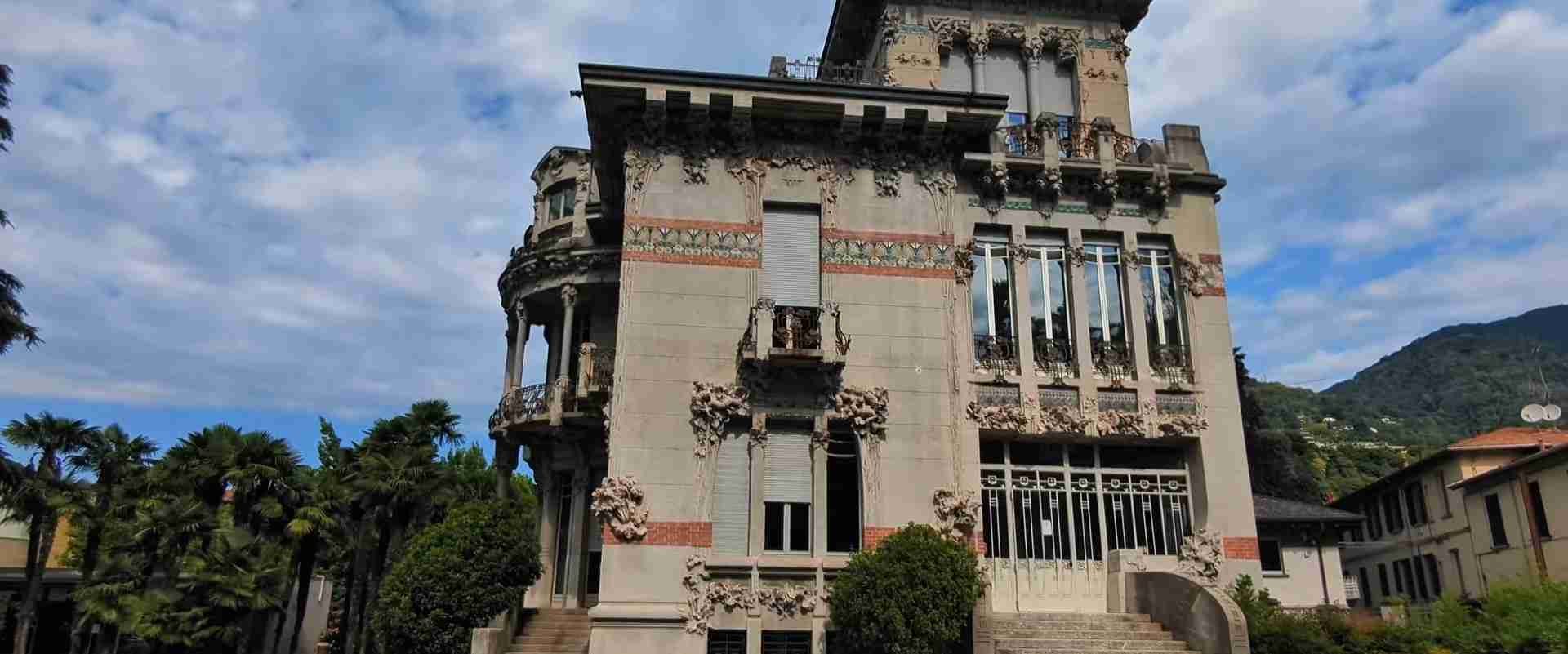
The third pole — Varese and its province — supplied what Sesto and Crespi expressed in steel and cotton: the Art Nouveau aesthetic that the Lombard industrial class adopted as its defining architectural language. Varese’s wealthy industrialists commissioned Liberty villas in such numbers and quality that the city is now described as an “open-air museum of Art Nouveau.” The Birrificio Poretti in nearby Valganna, a brewery designed in 1901 by the Stuttgart architectural firm Bihl and Woltz in flamboyant Jugendstil, and Como’s Villa Bernasconi — a silk industrialist’s house covered in silkworm reliefs and mulberry foliage — fill in the thematic detail between these poles.
Between them lies the Silk Road of Como: a city whose global reputation for luxury fabric sits on a century and a half of industrial production, and whose Museo Didattico della Seta documents the entire production chain from silkworm to finished fashion-house cloth, all on machines that were still running commercially within living memory.
This is the road Italy does not market. This guide maps it in practical detail for 2026.
The Counter-Narrative Explained: Why This Route Matters
Lombard industry did not simply produce goods. It produced an aesthetic. The entrepreneurs who financed the steelworks, the cotton mills, the chemical plants, and the silk-printing factories had money to spend on their houses and their workers’ housing, and they spent it in the most fashionable language available around 1900: the floral, sinuous, anti-historical style known in Italy as Stile Liberty, after the London department store whose imported fabrics brought the look to Italian middle-class notice.
The result is a tight geographic and chronological overlap. The industrial boom of the 1870s to 1920s that created Sesto San Giovanni, Crespi d’Adda, the Como silk industry, and the Varese metalworking and textile economy also produced the Liberty buildings that decorated those same districts. The Campari factory in Sesto, opened in 1904, was designed as a Liberty palazzina — a building meant to signal taste and modernity alongside commercial success. Villa Bernasconi in Cernobbio, built 1905-1906, was commissioned by a silk manufacturer who incorporated silkworm motifs into every facade as a proud industrial branding exercise. The Poretti brewery in Valganna was expanded in a deliberate Jugendstil style to signal to visitors that beer here was not a rough product of a rough trade but a sophisticated industrial achievement deserving beautiful surroundings.
This is the argument of the counter-narrative: that in Lombardy, industrial heritage and Art Nouveau heritage are not two separate topics but one. The money is the same; the ambition is the same; and the built legacy occupies the same streets and hillsides. A road trip that connects these dots is not cherry-picking niche interests but tracing the central story of how northern Italy became rich.
What the route offers that standard tourism does not: the shock of scale — industrial buildings that dwarf anything the Renaissance built; the political dimension of workers’ housing and strikes and resistance; the material specificity of industries (silk, steel, cotton, beer) that produced the wealth but are never mentioned in the conventional narrative; and the unexpected beauty of a style that was designed precisely to make industrial capitalism look like a natural, flowering, inevitable force.
Planning Your Lombard Counter-Narrative Road Trip in 2026
The route is a rough triangle in the northern Lombard plain and its lake-fringe hills, with Milan as the starting and finishing point. Total driving distance for the three-day core circuit is approximately 250–280 kilometers, almost none of which requires motorway travel. The route threads state roads (strade statali) and provincial roads (strade provinciali) through industrial suburbs, riverine agricultural land, and lake-edge towns, and the driving itself is part of the experience — these are roads built to serve factories, not tourists, and the infrastructure tells the story.
Pick up a rental car in Milan city center rather than at an airport. City-center pickup agencies on Via Vittor Pisani, Via Captaini, and around Stazione Centrale offer better rates than airport counters and place you twelve kilometers from the first stop. Economy cars — a Fiat Panda, a Citroën C3, or similar — are fully adequate for this route and cost €40–55 per day from a city-center location in 2026 when booked at least two weeks in advance. Mid-range compact cars run €55–75 per day. Book through an aggregator (Rentalcars, Skyscanner Cars) at least a week ahead for better pricing, and verify insurance coverage before signing.
Petrol (benzina) costs approximately €1.90 per litre on ordinary roads in June 2026 and around €2.00 per litre on motorways. Diesel runs slightly higher at approximately €2.00–2.09 per litre. An economy car covering the full 280 kilometers of this route consumes roughly 17–20 litres in total — a fuel cost of approximately €32–40 for the entire trip, or €16–20 per person for two travelers.
The preferred season for this route is April through October. Spring offers mild temperatures and clear industrial sight-lines before summer haze; autumn gives the Liberty facades their best light for photography. July and August are manageable but the industrial suburbs near Milan are hot and some smaller sites reduce opening hours. The route is driveable year-round, with the exception that Crespi d’Adda’s Visitor Centre closes from December 22 to January 5.
A practical GPS note: program each stop by its full address rather than by name. “Galleria Campari” may route to Milan rather than Sesto San Giovanni; use the full address Viale Antonio Gramsci 161, 20099 Sesto San Giovanni. Similarly, Crespi d’Adda is in the municipality of Capriate San Gervasio — set navigation for Corso Manzoni 18, 24042 Capriate San Gervasio BG to reach the Visitor Centre.
Day 1 in 2026: Sesto San Giovanni — Italy’s Stalingrad Reimagined
Depart Milan Centrale heading north on the Via Fulvio Testi or Via Sesto. Sesto San Giovanni begins almost immediately as the apartment blocks of Milan’s northern suburbs cede to something different: wider streets, lower buildings, vacant lots that were once factory yards, and the occasional surviving industrial structure of considerable mass. This is twelve kilometers of city, not countryside, and the transition is the point.
Spazio MIL and the Carroponte Complex
Begin at Spazio MIL, Via Luigi Granelli 1, a 3,000-square-meter cultural complex built within the surviving warehouses of the former Breda Siderurgica factory. Breda was for most of the twentieth century one of Italy’s largest manufacturers of trains, aircraft, and armaments; at its peak it employed tens of thousands of workers in Sesto alone. The surviving structure is a long, light-industrial brick building of the 1920s and 1930s, unpretentious and massive, now containing a permanent museum of labor history, a contemporary exhibition space, a co-working facility, and a restaurant. The permanent collection documents the work processes and social history of the Sesto industrial complex with photographs, machinery, and documentary material. Admission to the permanent museum component is free; special exhibitions vary in cost and are posted on the Spazio MIL website.
Immediately adjacent stands the Carroponte, a vast covered venue built around the retained overhead travelling crane from the Breda factory floor — a piece of industrial infrastructure so large it became the building rather than being cleared for it. The entrance is marked by the Porta Breda, a monumental gate in Corten steel by sculptor Michele Festa, installed in 2004, whose folded and torqued planes embody what the rest of this road trip will confirm: that the materials and forms of industry are, handled rightly, genuinely beautiful.
Galleria Campari: The Liberty Factory as Art Museum
Drive four minutes south to Viale Antonio Gramsci 161 for Galleria Campari, the most immediately surprising stop of the entire route. From the street, the Campari Headquarters presents a slick corporate campus designed by the Swiss architect Mario Botta and completed in 2009. But embedded at its core is a 1904 palazzina in Stile Liberty — the first production facility Gaspare Campari’s heirs built after moving the business from Milan’s Corso Garibaldi to Sesto San Giovanni. The Liberty building, with its terracotta cornices and tall arched windows, survived Botta’s rationalist enclosure and became the showpiece of a corporate museum inaugurated in 2010 to mark Campari’s 150th anniversary.
The Galleria is substantially a museum of Italian graphic art and advertising design, organized around Campari’s commissioning history: over 3,000 original works on paper including Belle Époque posters by Leonetto Cappiello, advertising graphics by Fortunato Depero and Bruno Munari, photography campaigns, and the famous Caroselli television commercials of the 1960s and 1970s directed by Federico Fellini and Paolo Sorrentino. For visitors interested in the intersection of industrial production, visual culture, and Italian modernity, it is among the best free museums in Lombardy.
Standard guided visits operate on the second Saturday of each month, free of charge. Group bookings and English-language guided visits require advance reservation via [email protected]. The Campari Art and Cocktail Experience — a guided tour followed by a cocktail masterclass — is available for small groups at approximately €16–20 per person and requires advance booking. Check the official Campari website (campari.com) for the current exhibition and any temporary closures; the gallery closed on Saturday June 27, 2026, for maintenance as an example of the intermittent scheduled closures that recur periodically.
The Villaggio Falck and the Memory Walk
After Galleria Campari, take twenty minutes for a walk or a slow drive through the Villaggio Falck neighborhood — the company housing development built by the Falck steel dynasty from the 1920s onward to accommodate the workers of the Acciaierie e Ferriere Lombarde Falck, which at its height was Italy’s largest private steel producer. The housing is conventional workers-domestic architecture rather than Liberty, but the urban fabric — a complete planned neighborhood with its own schools, churches, sports facilities, and internal street grid, embedded within the larger Sesto urban tissue — is historically significant and rarely recognized. The main Falck steelworks site adjacent to the housing has been partially demolished and partially regenerated; the landmark chimney stacks visible from Via Mazzini are scheduled for preservation as industrial monuments.
Drive to Crespi d’Adda
From Sesto San Giovanni, head northeast on the SS525 (Via Padana Superiore/Via Martesana) following the Naviglio Martesana canal — an artificial waterway dating to the fifteenth century that was the original commercial artery of the same industrial zone this road trip traces. The drive to Crespi d’Adda takes 35–40 minutes through Trezzo sull’Adda, where the medieval Visconti castle above the river is worth a five-minute stop for the view before crossing the bridge. Total distance is 37 kilometers.
Crespi d’Adda: The Ideal Town
Crespi d’Adda sits on 85 hectares of river plain on the right bank of the Adda, administered as part of the municipality of Capriate San Gervasio in the province of Bergamo. UNESCO inscribed it in 1995 as an outstanding example of the workers’ villages that arose in northern Italy and Europe between the nineteenth and twentieth centuries, and specifically as “the most complete and best preserved” in southern Europe.
The village was built from 1877 by Cristoforo Benigno Crespi alongside his cotton textile mill, which was powered by the Adda’s current via a hydroelectric plant of exceptional engineering quality. The founding logic was paternalist capitalism at its most elaborate: by providing workers with decent housing, a church, a school, a hospital, a cooperative shop, a sports ground, and a dopolavoro (after-work social club), the Crespi family aimed to eliminate labor instability, guarantee workforce loyalty, and demonstrate what enlightened industrial management could achieve. It worked, to the extent that the village remained fully operational until 2003, when the last Crespi-family cotton mill finally closed, and it remains inhabited to this day — visitors should be aware that they are walking through a living neighborhood whose residents deserve courtesy and privacy.
Entry to the village is free for self-guided visitors. The Visitor Centre at Corso Alessandro Manzoni 18 provides maps, information, and access to guided tours. Hours run Monday to Friday 8:45–13:00, Saturday 8:45–17:45, and Sunday and public holidays 8:45–18:30 (January opens only Saturday and Sunday 9:00–17:00). Guided tours cost €8 per person for the village walk and multimedia museum, available Saturday and Sunday; the fuller package combining the village with the operative hydroelectric plant and the museum costs €12 per person and runs on the first and third Sunday of each month. Night tours and themed tours are also bookable at €12 per person. All tickets are bookable at shop.visitcrespi.it; verify current rates before visiting as these prices are from the 2025–2026 season.
The self-guided walk takes 90 minutes at a comfortable pace. Key points of interest: the symmetrically arranged workers’ cottages on Corso Manzoni, each with its own garden plot; the neo-Romanesque church on the village piazza; the doctor’s house and the priest’s house (grander than the workers’ cottages, as befits their roles); the cemetery, whose plan mirrors the orthogonal logic of a factory floor in a deliberately unsettling way; and the castle-villa of the Crespi family itself, a turreted Liberty-eclectic pile at the northern end of the village that communicates the family’s social aspirations in every corbel and finial. The guided tour of the hydroelectric plant adds the final dimension: a turbine hall of extraordinary spatial quality, its cast-iron machinery still maintained and operational, representing precisely the Liberty industrial aesthetic that the rest of this route traces.
After Crespi d’Adda, drive 22 kilometers south to Bergamo city center for overnight. Budget accommodation in Bergamo’s lower city starts at €60–85 per room per night; mid-range three-star hotels run €90–140; the historic hotels in and near Bergamo Alta charge €150–250 and up. The lower city neighborhood around the train station and Piazza Brembana has good value options within walking distance of restaurants and bars.
Day 2 in 2026: Como’s Silk Economy and Liberty Masterpieces
From Bergamo, take the A4 motorway westward to the Milan ring, then the A9 northward to Como — total distance approximately 65–70 kilometers, 55–60 minutes including toll booths. Tolls on this combination of motorways run approximately €5–7 for the full stretch. Alternatively, the SS36 (Lecco road) offers a slower but more scenic approach along the eastern shore of Lake Como, turning left at Lecco and arriving at Como via Erba — 80 kilometers, 90 minutes, no tolls. The scenic route passes through the silk-weaving territory of the Brianza and gives an early sense of what Como’s industrial geography looked like before the mills went to Bangladesh.
Parking and Orientation in Como
Como’s historic center is a partial ZTL (Zone a Traffico Limitato) zone, particularly along the Lungo Lario lakefront. Approaching from the south, the largest accessible parking area is at Largo Porta Vittoria, immediately outside the old city walls on the south side — approximately €1.50–2.00 per hour with a daily cap at most facilities. From here it is a ten-minute walk through the Roman street grid to the Museo della Seta.
Museo Didattico della Seta
The Museo Didattico della Seta, at Via Castelnuovo 9 (a short walk from Piazza Volta), is the only museum in the world that documents the complete silk production process from silkworm cultivation to finished dyed and printed fabric — all on original machines dating from the late nineteenth and early twentieth century, many of which were still in commercial operation within the curators’ professional memories. The museum opened in 1990 under the auspices of the Fondazione Museo della Seta di Como, the industry’s own preservation body, and it rewards an attentive two-hour visit.
The eight permanent rooms move through the process sequentially: silkworm biology and cocoon cultivation; the filatura (silk reeling and throwing) with its extraordinary cast-iron machinery; the jacquard loom hall; the printing room with hand-applied wooden blocks and copper rollers; and a fashion archive room connecting the industrial production to the Milanese couture houses and international luxury brands — Gucci, Hermès, Louis Vuitton — that remain Como’s primary clients. The museum is not large and is not architecturally spectacular, but its collection is irreplaceable and its explanatory register is precise and historically serious. An audio guide in multiple languages is included in the admission price of €9 per person (check the official website at museosetacomo.com for current rates before visiting). The museum opens Tuesday afternoons only (14:00–18:00) and Wednesday through Sunday 10:00–13:00 and 14:00–18:00; it is closed Mondays.
Como’s Silk Heritage on Foot
After the Museo della Seta, walk ten minutes into the historic center. The silk industry’s presence in Como’s urban fabric is visible to anyone looking at the right level: the long, low shed roofs of former silk-throwing factories behind the medieval walls near Via Vittorio Emanuele II; the weaving-related street names (Via Seta, Via dei Tintori, Via dei Filatori) in the neighborhoods south of the Duomo; and the extraordinary Gothic-Renaissance facade of the Duomo itself, which was funded partly through silk-trade wealth from the fourteenth century onward and which includes decorations of silkworm motifs in its northern portal — a fact that most visitors walk past without registering.
For lunch, Como’s old-town trattorias serve Lombard lake cuisine centered on lake fish, polenta, and risotto. Expect to pay €22–35 per person for a full sit-down lunch at a mid-range restaurant, or €10–14 for a bar lunch of panino and coffee. Ristorante Il Solito Posto (Piazza Volta area) and Osteria dell’Angolo (near the Broletto) are reliable options for mid-range Lombard cooking at non-tourist prices.
Villa Bernasconi, Cernobbio: The Silk Industrialist’s Liberty Manifesto
Drive eight kilometers northwest from Como center along the SS340 (Via Regina) to Cernobbio, a lakeside town at the foot of Monte Bisbino. Park near the town center — free roadside parking is available on Via Regina north of the ferry dock — and follow signs to Villa Bernasconi, about four minutes on foot.
Villa Bernasconi, built 1905–1906 to designs by the Milanese architect Alfredo Campanini, is the most explicit expression of the industrial-Liberty overlap on this entire route. Its patron, Davide Bernasconi, founded a weaving company in Cernobbio producing silk, wool, and cotton fabrics and built his private house not as a retreat from industry but as a celebration of it: the entire exterior is covered in Art Nouveau decoration representing the silk production cycle — silkworm pupae in their cocoons, chrysalis forms, mulberry leaves, butterflies emerging from the silk thread. The building is, in effect, a Liberty-style advertisement for its owner’s trade.
The interior, now managed as a museum by the Municipality of Cernobbio since 1989, continues the logic: original woodwork, stained glass, wrought iron, and tile work all maintain the floral-industrial iconography. The rooms also house a collection documenting the Bernasconi family and their exploration and collecting activities — Davide’s grandson participated in twenty-one scientific expeditions to Africa and South America, and the museum preserves both the Liberty architecture and this polymath heritage. The Bernasconi museum is a reminder that liberty was not only an architectural style but a confidence — the social self-assurance of a manufacturing class that had made itself and intended to show it.
Admission is €10 full price, €9 with a paid parking receipt from Cernobbio’s parking facilities, €5 reduced, and free for visitors under 14 and over 75. The museum opens 10:00–18:00 with last entry at 17:00 (check villabernasconi.eu for current seasonal hours before visiting; the museum is municipally managed and hours can vary). Allow 90 minutes. The views from the upper rooms to Lake Como are part of the experience.
Overnight accommodation options from Cernobbio: remaining in Cernobbio or Como is convenient for an early start to Varese the next morning. Budget B&Bs in Como start at €70–100 per room; mid-range lake-area three-star hotels run €100–160; lakefront properties charge €180–350 and beyond in summer.
Day 3 in 2026: Varese, Italy’s Open-Air Art Nouveau Museum
From Como or Cernobbio, head northwest along the SS340 (Via Regina) and then pick up the SP1 or A9/A8 motorway junction toward Varese — approximately 50 kilometers, 45–60 minutes depending on the route. Using the A8 motorway involves a toll of approximately €2–3. The scenic alternative via Brinzio and the Valceresio is longer but passes through woodland and small Liberty-era lake villages that belong thematically to the day ahead.
The Liberty City: Varese on Foot
Varese accumulated its Liberty heritage through a specific social mechanism: from the 1880s onward, wealthy Milanese families and provincial industrialists chose the Varese hills as their preferred location for summer villas, drawn by the lake views, the wooded hills, the cooler temperatures, and the new tram and railway connections to the city. What they built — and what they commissioned local architects to build for the commercial fabric of the city itself — was consistently and confidently in the Stile Liberty. Varese became, by accident of wealth and fashion, Italy’s most concentrated provincial Art Nouveau city.
Park in the Piazza del Podestà underground car park or in the surface parking off Via Montanara (approximately €1.50 per hour) and walk the Liberty circuit on foot. The route needs about two hours at a leisurely pace; it is hilly in the direction of the Sacro Monte but the city center section is flat. The tourist office at Piazza Monte Grappa can supply a printed Liberty walking map.
Key stops on the Varese Liberty circuit:
- Palazzo Estense: The seat of the Province of Varese, on Via Luigi Sacco, is a late baroque palace converted and extended in the Liberty period. The gardens (free public access) are formally designed in the French manner, with a viewing axis toward the lake. The palazzo itself can be viewed from outside; the administrative interior is occasionally open for cultural events.
- Villa Recalcati (now Prefettura): On Piazzale Libertà, this late baroque building was transformed with Liberty-era additions including elaborate ironwork gates and a Liberty-influenced garden. Now the seat of the Prefettura, exterior viewing is unrestricted.
- The Palace Grand Hotel (Hotel Palace): On Via Manin, this Liberty hotel was designed by Giuseppe Sommaruga, the Milanese architect who defined the Lombard Liberty style at its most exuberant. Sommaruga’s characteristic use of massive stone forms, heavy ornament, and almost Expressionist surface tension marks the building clearly as his. The hotel remains in operation; non-guests can view the lobby and request access to the ground-floor public spaces.
- Liberty villas along Via Fincará and Via Sacco: The hill roads ascending toward the Sacro Monte are lined with Liberty villas of varying quality and preservation — some still in private hands, several converted to offices or apartments. The concentration is remarkable simply as urban fabric: this is what a successful industrial city spent its surplus capital on when ornament was fashionable and property was cheap.
- Villa Menafoglio Litta Panza (Villa Panza): Managed by the FAI (Fondo Ambiente Italiano), this neoclassical villa on the Biumo Superiore hill has become most famous for its contemporary art collection assembled by the collector Giuseppe Panza di Biumo and donated to the FAI in 1996. While not a Liberty building, its grounds and the views from its terraces over Varese and the lake make it a natural extension of the city walk. FAI admission applies; check fondo.ambiente.it for current rates.
The Varese Liberty Tour Bus
The Varese Liberty Tour, organized by Morandi Tour in partnership with the Municipality and the Tourism Agency, is the only dedicated Art Nouveau city bus tour in Italy. It departs from the Varese railway station and visits ten stops including Palazzo Estense, Villa Recalcati, and the former Palace Grand Hotel in approximately two and a half hours, with commentary (in Italian) on each building’s architect, patron, and stylistic significance. The tour includes an exclusive visit to the Birrificio Poretti and the Lindt chocolate factory as part of its extended program. Booking is essential; check the Morandi Tour website or the Varese tourism portal (vareseturismo.it) for dates, departures, and current prices for 2026 — the standard tour price runs approximately €20–30 per person.
Birrificio Angelo Poretti, Valganna: The Jugendstil Brewery
Drive eighteen kilometers north from Varese center into the Val Clivio and Valganna on the SP45 toward Brinzio and Induno Olona to reach Birrificio Angelo Poretti, Via Olona 103, Induno Olona. The brewery was founded in 1877 by Angelo Poretti — one year before Crespi d’Adda and in the same year as Villa Bernasconi was being planned — making it a precise contemporary in the industrial-Liberty moment. In 1901, after Poretti’s death and under the direction of his nephews, the brewery was expanded and redesigned by the Stuttgart architectural firm Bihl und Woltz in a full-blown Jugendstil (the German variant of Art Nouveau): the Sala Cottura (brewing hall) is covered in naturalistic reliefs, grotesque masks, medallions, shell forms, and hop-flower festoons in a style that is simultaneously a celebration of organic nature and a precise statement of industrial sophistication. The Villa Magnani, Angelo Poretti’s private residence within the brewery grounds, pushes the aesthetic further still into the domestic Liberty idiom.
The brewery is now owned by Carlsberg and remains in active production. Guided tours are available by prior booking at approximately €150 per group of up to 15 people — approximately €10–75 per person depending on group size — through the Carlsberg Italia website (carlsbergitalia.it/azienda/visita-il-nostro-birrificio). The 90-minute tour covers the Sala Cottura, Villa Magnani, the botanical park, and concludes in the brewery shop. Individual visitors wishing to experience the building without the group tour can access the shop and the grounds during retail hours (confirm current opening times directly with the brewery before visiting). The brewery sits at the source of the spring water that Poretti identified in 1877 as essential to his production — the same logic of locating industries near natural resources that drove every factory on this route.
Return to Milan
From Valganna/Induno Olona, the A8 motorway south from Varese reaches Milan in approximately 45 minutes; the toll from Varese to Milan runs approximately €2.50–3.00. Return the rental car to the city-center agency by the agreed time. Alternatively, extend the trip for Days 4 and 5 (see Optional Extensions below).
Road Trip Costs and Budget Planning 2026
The following costs are expressed per person per day, assuming two travelers sharing accommodation throughout. Car rental is included in daily costs as a shared expense; the division is rental cost divided by two people.
Budget Travel on the Industrial-Liberty Route 2026
Budget travelers on this route spend €110–160 per person daily. The breakdown is: a budget B&B room at €65–85 per night shared between two people (€33–43 per person), simple meals at bars and trattorias totaling €34–48 per person, a shared economy rental car at €40–55 per day divided between two (€20–28 per person), fuel and tolls shared at approximately €8–12 per person for the day, parking at €3–5 per person, attraction admissions averaging €8–15 per person, and incidentals of €5–8.
The budget traveler’s specific strategy: enter Crespi d’Adda for free on a self-guided walk rather than paying for a tour; visit Galleria Campari on the second Saturday of the month (free); use the Museo della Seta audio guide rather than a private tour; view the Varese Liberty buildings from the street rather than booking the bus tour; and eat bar lunches and a single sit-down trattoria dinner each day. A three-day trip at budget tier costs approximately €330–480 per person; a five-day trip runs €550–800 per person.
Mid-Range Travel on the Industrial-Liberty Route 2026
Mid-range travelers spend €195–275 per person daily. The breakdown: a three-star hotel at €100–150 per night shared (€50–75 per person), meals at sit-down restaurants for both lunch and dinner with wine totaling €78–102, a compact rental car at €55–75 per day shared (€28–38 per person), fuel and tolls at €14–20 per person, parking at €5–8, admissions including guided tours at €15–25, and incidentals at €10–15.
The mid-range approach adds the comprehensive guided experience: the Crespi d’Adda package tour including the hydroelectric plant (€12), a guided visit to Galleria Campari (€16–20 with aperitivo if booked for a group), and the Varese Liberty Tour bus. These premiums raise the admission line to €15–25 per person daily but substantially deepen the experience of each site. A three-day mid-range trip costs approximately €585–825 per person; five days runs €975–1,375 per person.
Luxury Travel on the Industrial-Liberty Route 2026
Luxury travelers on this route spend €345–520 per person daily. The accommodation component — four- or five-star hotels, including lakeside properties in Como and Cernobbio — accounts for €100–175 per person (hotels at €200–350 per room divided by two). Upscale restaurant meals total €145–195 per person per day. A premium or SUV rental at €80–120 per day costs €40–60 per person. Fuel, tolls, and valet parking together run €18–27 per person. Premium experiences including private brewery tours, private guides at Crespi d’Adda, and cocktail masterclasses at Galleria Campari cost €20–35 per person. A three-day luxury trip runs approximately €1,035–1,560 per person; five days costs €1,725–2,600 per person.
Sample Admission Fees Along the Route 2026
- Crespi d’Adda village (self-guided): Free
- Crespi d’Adda village tour + multimedia museum (Sat/Sun): €8 per person
- Crespi d’Adda village + hydroelectric plant + museum package (1st and 3rd Sunday): €12 per person
- Galleria Campari, Sesto San Giovanni (second Saturday guided visit): Free
- Galleria Campari Art and Cocktail Experience (pre-booked, small groups): approximately €16–20 per person
- Spazio MIL permanent collection: Free
- Museo della Seta, Como: €9 per person with audio guide (check museosetacomo.com for current rates)
- Villa Bernasconi, Cernobbio: €10 full price; €5 reduced; free under 14, over 75 (check villabernasconi.eu)
- Birrificio Poretti guided tour (group, pre-booked): €150 per group of 2–15 people
- Villa Panza, Varese (FAI): Check fondo.ambiente.it for current FAI admission rate
Fuel and Toll Reference 2026
Fuel for the full 250–280 kilometer circuit: approximately €32–40 total for the vehicle, or €16–20 per person for two travelers sharing. Motorway tolls if using the recommended combination of A4, A8, and A9: approximately €10–15 total per vehicle for the round trip from Milan. Per person share for two travelers: €5–8. Parking over three days totaling approximately €15–25 per vehicle, or €8–13 per person.
Where to Stay Along the Route in 2026
The route offers three natural overnight options across the core three-day circuit: Bergamo after Day 1, the Como–Cernobbio area after Day 2, and Varese if extending to five days.
Bergamo: Best Base After Day 1
Bergamo’s lower city (Città Bassa) offers the best value on the route. The neighborhood around Viale Papa Giovanni XXIII and the Bergamo railway station has multiple B&B and three-star hotel options within easy walking distance of good restaurants. Budget B&Bs start at €60–85 per room per night; mid-range three-star hotels like the Arli Hotel or similar run €90–140 per room. The Città Alta — Bergamo’s walled hilltop medieval city — is exceptional as a post-Crespi evening walk, accessible by funicular from the lower city, but note that driving into the Città Alta requires a resident permit; park at the Colle Aperto car park or take the funicular from Piazzale Mercatone.
Como and Cernobbio: Best Base After Day 2
Staying in Como city center gives easy morning access to the Museo della Seta and a five-minute drive to Cernobbio for Villa Bernasconi. Budget B&Bs in the Viali district of Como (south of the historic center) start at €70–100 per room; three-star hotels in central Como run €100–160 per room. Staying in Cernobbio itself, in one of the village’s family-run hotels, adds a lakeside atmosphere at prices broadly similar to central Como. Larger lakefront properties — the Grand Hotel Tremezzo, the Villa d’Este in Cernobbio — charge €300–800 per room and represent the luxury tier of this section of the route.
Varese: Base for Extended Itineraries
Varese’s accommodation market is quieter and less price-inflated than Como’s lake properties. Mid-range three-star hotels in the city center area run €85–130 per room. For a Liberty-adjacent experience, the Hotel Palace (Sommaruga’s original building) and the Varese historic center hotels position guests within walking distance of the Art Nouveau circuit. Budget accommodation starts at €55–80 per room in B&Bs in the residential neighborhoods around Piazza Monte Grappa.
Food and Drink 2026: Eating Along the Industrial Belt
The food culture of the industrial Lombard belt is not the food culture of the Italian tourism brochure. This is not truffle-and-Barolo country. It is a cuisine of working-class substance, of the factory canteen elevated by home cooking: risotto alla milanese (Sesto San Giovanni claims its own strong tradition), polenta uncia (enriched with butter and cheese, a staple of the bergamasque countryside), lake fish from Como and Lugano, pizzoccheri (the buckwheat pasta of the Valtellina that arrives on Como tables via the northern valleys), and a general orientation toward abundant, affordable portions that reflects the feeding requirements of a manual workforce.
In Sesto San Giovanni, the restaurants around Via Risorgimento and the rebuilt post-industrial quarter near Spazio MIL serve modern Lombard cooking at city prices — lunch from €12–18 at a bar, dinner at a trattoria from €25–35 per person with wine. The Spazio MIL complex itself has a restaurant in the former factory hall that serves contemporary Milanese-industrial fusion cuisine at mid-range prices.
In Bergamo, the lower city streets around Via Pignolo and Sentierone are the restaurant zone. Lombard classics — polenta, casoncelli (bergamasque stuffed pasta with butter and sage), brasato (braised beef) — appear at every level from pizzeria to fine dining. Budget €25–35 per person for a full trattoria dinner with wine; €40–55 for mid-range sit-down; €60–90 for the upscale versions near the funicular.
Como’s restaurant geography follows the lake. The Lungo Lario and the streets immediately behind it have the tourist-facing restaurants at the higher end of the price scale; moving one or two streets back into the Filippo Corridoni and Via Boldoni areas finds more honest local trattorias. Lake perch (persico) and white fish (lavarello) are the local specialties; a proper lake fish secondo costs €18–28 in a mid-range restaurant. Budget a total of €35–50 per person for a two-course dinner with wine in the mid-range Como options.
In Varese, the Corso Matteotti and Via San Martino cafe and restaurant strip is the main dining artery. The Varese food tradition emphasizes its role as a crossroads between the Alpine north and the Po plain: you will find polenta dishes alongside Milanese preparations, risotto alongside gnocchi with game, and a strong aperitivo culture (Campari was brewed here, after all, and remains locally dominant). A Campari spritz in a Varese bar at approximately €4–6 is a thematic obligation on this route.
Driving in Lombardy 2026: ZTL Zones, Tolls, and Parking
This section addresses the practical driving concerns that determine whether a Lombardy road trip is enjoyable or expensive.
ZTL (Limited Traffic Zones) on This Route
The ZTL (Zona a Traffico Limitato) is a restricted-access zone in Italian city centers, monitored by cameras that photograph entering license plates. Foreign rental vehicles without a resident permit that enter a ZTL will receive a fine from the relevant municipality sent to the rental agency, which will charge it to the renter’s credit card plus an administrative fee — running €80–200 total. On this route, three cities require ZTL awareness.
In Como, the historic center east of Via Rubini is a partial ZTL from 7:30–19:30 on weekdays and 7:30–14:00 on Saturdays. Park at Largo Porta Vittoria or at the Via Innocenzo parking garage and walk. Most navigation apps indicate ZTL zones in Italian cities, but verify with the parking facility attendant before driving into the center.
In Bergamo Alta, the walled upper city is essentially closed to non-resident traffic; the funicular or on-foot access from Porta Sant’Agostino is the standard visitor approach. The lower city has no blanket ZTL but specific streets near the train station have restricted hours.
In Varese, the historic center around Piazza del Podestà and Via Volta operates ZTL restrictions on weekday mornings. Use the underground parking at Piazza del Podestà or surface parking on Via Montanara outside the restricted zone.
Sesto San Giovanni, the industrial base of Day 1, has no significant ZTL complications for this route. Parking is plentiful and free on many residential streets surrounding the Spazio MIL and Galleria Campari areas.
Motorway Tolls on This Route
The core three-day circuit can be driven almost entirely on free state and provincial roads, incurring minimal tolls. If using motorways for speed:
- Milan to Bergamo via A4: approximately €3.00
- Bergamo to Como via A4 + A9: approximately €5–7
- Como to Varese via A9 + A8: approximately €2.50–3.00
- Varese to Milan via A8: approximately €2.50–3.00
Total round-trip toll cost for the full circuit using motorways throughout: approximately €13–16 per vehicle, or €7–8 per person for two travelers. Italian motorways accept cash and all major credit cards at manned toll booths; Telepass electronic tags (standard in Italian-registered vehicles) do not apply to most short-term rentals unless specifically equipped.
Fuel Stops
The route passes through densely populated suburbs and provincial towns; fuel stations are never more than fifteen to twenty minutes apart. Avoid motorway service station (Area di Servizio) fuel wherever possible, as prices run approximately €0.09–0.10 per litre higher than the national road average. Fill up in Sesto San Giovanni before heading northeast, and again in Bergamo or Como before the Varese leg.
Driving in Industrial Zones: Practical Notes
The streets around Spazio MIL and Galleria Campari in Sesto San Giovanni are wide, well-surfaced post-industrial arterials; parking on the road or in designated lots near the sites is free and unrestricted during standard visiting hours. The road into Crespi d’Adda (SP171 from Trezzo sull’Adda) is a narrow provincial road that handles standard cars without difficulty. The Valganna valley road to Birrificio Poretti is a good-condition provincial road that narrows in the village of Induno Olona; the brewery’s own approach road (Via Buccari 1) is signed and adequate for standard vehicles.
Extending the Route: Optional Detours for Five-Day Trips
The three-day core circuit leaves several significant threads available for a longer itinerary.
Lecco and the Moto Guzzi Heritage (Day 4 Extension)
From Bergamo or Como, a 40-kilometer drive northeast along the eastern shore of Lake Como reaches Lecco, the city at the Lecco branch of the lake, and the small town of Mandello del Lario, seven kilometers north of Lecco on the SS36. In Mandello, the Museo Moto Guzzi preserves the history of one of Italy’s oldest motorcycle manufacturers, founded in 1921 by Carlo Guzzi and Giorgio Parodi on the exact spot where the factory still operates today. The museum contains more than 160 machines from 1921 to the present in a production-adjacent setting — a working factory that has been accumulating historical motorcycles since it started — and is open for guided tours, currently on Friday afternoons and Saturday mornings (book via motoguzzi.com well in advance, as tours fill quickly). This is a tighter, more specialized kind of industrial heritage than Crespi d’Adda, but its factory authenticity is unmatched anywhere on the Italian Art Nouveau circuit.
The Brianza Liberty Villas (Day 4 Alternative)
The Brianza — the sub-Larian plain between Milan, Lecco, and Como, dominated by small-scale furniture and textile manufacturing since the eighteenth century — harbors a concentration of Liberty villas commissioned by Milanese and provincial industrialists as summer residences from the 1890s to the 1920s. The towns of Eupilio, Canzo, and Asso on the eastern Brianza, and Meda, Carate Brianza, and Desio on the western side, each contain examples visible from the street that extend the architectural argument of the main route. This extension requires willingness to navigate between towns on provincial roads without a single anchor site, and is best for travelers who respond to the aggregate experience of a built landscape rather than the singular monument.
Busto Arsizio: The Cotton City (Day 3 Extension)
On the return to Milan from Varese, the SS527 passes through Busto Arsizio, a city whose identity was defined entirely by cotton manufacturing from the nineteenth century through the late twentieth. The Museo del Tessile e della Tradizione Industriale in Busto (currently undergoing extended renovation phases; verify status at comune.bustoarsizio.va.it before planning a visit) documents the cotton industry with machinery and social history. The city center retains Liberty-era commercial buildings and the Villa Ottolini Tosi, a notable Liberty villa now used for civic functions. The detour adds thirty minutes to the return drive.
The Industrial-Liberty Connection: Why These Two Stories Are One
The historical argument behind this road trip is straightforward: Art Nouveau in Lombardy was not an art movement in the conventional sense. It was an economic ideology expressed in architecture.
The Stile Liberty arrived in northern Italy around 1895–1900, carried by the same trade networks that brought Como silk to London, French design magazines to Milan, and German engineering know-how to the Valganna valley. The Lombard industrial class adopted it enthusiastically because it said precisely what they needed to say: that modernity was beautiful; that industry was as worthy of aesthetic expression as religion or aristocracy; that organic nature and mechanical production were not opposites but continuations of each other; and that the new wealth deserved new architectural languages rather than nostalgic revivals of Renaissance or Baroque styles that carried the prestige of a social class they had displaced.
Campari’s 1904 factory in Sesto was a Liberty building because the Campari family wanted it known that their aperitivo was not a rough digestive for workers but a sophisticated product for a sophisticated market. Villa Bernasconi’s silkworm facades said that the silk industry of Como was not merely a production process but an aesthetic achievement continuous with the natural world it transformed. The Poretti brewery’s Jugendstil Sala Cottura argued that German technology and Italian entrepreneurship, combined in a valley with perfect spring water, deserved a building as beautiful as any Romanesque church. Cristoforo Crespi built a Liberty-eclectic castle-villa at the head of his workers’ village because his workers needed to see that their employer was not merely a utilitarian exploiter but a patron of beauty — and because Crespi himself believed it.
What all of this shared was the confidence of industrial capital at its historical apogee: the thirty years before the First World War, when the productivity gains of the second industrial revolution were generating wealth faster than it could be spent, and when the Stile Liberty was available to spend it on. The buildings that survive are not nostalgia for a pre-industrial past but a monument to industrial confidence — and this is why they feel different from the ruins of the ancient world or the piety of the medieval: they were built by people who believed they were winning, and the energy of that belief is still visible in every sinuous cornice and cast-iron column.
Money-Saving Strategies for the Lombard Counter-Narrative Route in 2026
The route’s most significant cost reduction is timing. Galleria Campari’s free guided visits on the second Saturday of each month are the anchor; plan the entire trip around this date to eliminate what would otherwise be a €16–20 per person cost. Crespi d’Adda village entry is free by default — a self-guided walk with the downloadable map from visitcrespi.it costs nothing and covers the essential visual experience. The admission fee for the guided tour (€8) adds museum access and expert interpretation; the €12 package adds the hydroelectric plant, which is excellent value; skip this only if time is tight.
Pre-booking car rental at least fourteen days ahead reduces rates by fifteen to thirty percent on average, based on current Lombard rental market data. City-center pickup points (Via Vittor Pisani near Milan Centrale) are consistently cheaper than airport pickups by €8–15 per day. Returning the car with a full tank to avoid agency refueling charges (running €15–25 above pump price) saves a meaningful amount on a three-day rental.
Avoid the motorways entirely on Days 1 and 2. The SS525 from Sesto to Crespi d’Adda and the SS36 or the provincial roads from Bergamo to Como are entirely adequate and save €7–10 in toll fees per vehicle. Use the A8 or A9 on Day 3 only if time is short — the return from Varese to Milan via motorway saves approximately twenty minutes at a cost of €3.
The Museo della Seta Como offers occasional free entry days; check the official website museosetacomo.com for any 2026 free-entry promotions before arriving. Villa Bernasconi reduces its €10 admission to €9 for visitors who present a paid parking receipt from Cernobbio’s municipal parking, a modest saving but one that incentivizes using the designated parking rather than free roadside spots that can be scarcer in summer.
For accommodation, the optimal cost reduction is avoiding lake-front rooms in Como in high summer (July–August), when prices approximately double compared to spring and autumn. The same three-star hotels that cost €100–140 per room in May run €160–220 in August. The Bergamo lower city’s accommodation is less subject to lake-tourism seasonality and remains more stable year-round. Booking fourteen to thirty days ahead with free cancellation locks in good rates without commitment risk.
Food savings are substantial at lunch. The industrial Lombard tradition of the bar lunch — a panino with bresaola or salumi, a coffee, perhaps a small pastry — costs €9–13 and is entirely authentic. Save the sit-down restaurant experience for dinner, where the Lombard trattoria tradition is at its best: a primo of risotto or pasta, a secondo of braised meat or lake fish, a shared carafe of local wine, for €25–40 per person including cover charge. This pattern (bar lunch + trattoria dinner) costs €35–55 per person daily for meals versus €78–102 for two sit-down meals — a saving of €25–50 per person per day that does not reduce the quality of the food experience.
Seasonal Strategy: The Best Windows for This Route
The Lombard industrial and Liberty road trip works in almost any season but has clear optimal windows. April through June combines the best light for Liberty-facade photography (sharp angle, no summer haze), comfortable temperatures for walking industrial districts that lack shade, and full opening hours at all sites. The Crespi d’Adda hydroelectric plant tours run on the first and third Sunday year-round, and in spring the village gardens are at their most photogenic against the mill backdrop.
September and October offer a second-best window: post-tourist-season accommodation prices, autumn light that photographs the brick and terracotta of the industrial buildings exceptionally well, and the added interest of harvest season in the Brianza and the lake valleys. The Birrificio Poretti releases seasonal beers in autumn that can be purchased at the brewery shop.
July and August are manageable but have two drawbacks: the industrial suburbs near Milan are genuinely hot without shade, and some smaller institutions reduce their hours or take August vacation breaks. The Museo della Seta Como and Villa Bernasconi maintain standard hours through the summer season, but confirm directly before any long-distance trip in August.
December through February is the least favorable window: Crespi d’Adda’s Visitor Centre closes December 22 to January 5; the Varese Liberty circuit is enjoyable in winter light but cold; and short daylight hours compress the driving day. The exception is if the Galleria Campari December exhibition is of particular interest — the gallery remains open through winter on its standard second-Saturday schedule.
Frequently Asked Questions
Do I need to speak Italian to follow this road trip in 2026?
English is sufficient for navigating all the primary sites on this route. Galleria Campari’s English-language guided tours require advance booking via [email protected]. The Crespi d’Adda Visitor Centre has English-language materials and the official website visitcrespi.it is bilingual. The Museo della Seta Como provides English-language audio guides included in the €9 admission. Villa Bernasconi has English-language signage. In Varese, the tourist office at Piazza Monte Grappa has English-speaking staff and provides the Liberty walking map in English. Restaurant and hotel interactions require minimal Italian at tourist-facing establishments in all four towns on the route.
Can this road trip be done using public transport instead of a rental car?
The route is substantially doable by public transport with compromises. Sesto San Giovanni is on Milan’s MM1 Red Metro line (Sesto Rondò or Sesto Marelli stops, approximately eight minutes from Loreto). Galleria Campari and Spazio MIL are a five-minute walk from Sesto Rondò. Crespi d’Adda requires a bus connection from Bergamo railway station (Bus 1 or 2 toward Capriate San Gervasio, approximately 45 minutes; check Bergamo TPB schedules for current routes). Como is served directly by train from Milan Centrale (Trenord regional service, 30–40 minutes, €5.20); Cernobbio is a twelve-minute boat ride or a taxi from Como. Varese is served by Trenord from Milan Nord (35 minutes from Cadorna station, €5.30). The Birrificio Poretti in Valganna is accessible by bus from Varese (Autolinee Varesine toward Induno Olona) but timetables are infrequent. A hybrid approach — rail for the main legs and a taxi or Uber for site-specific detours — reduces car costs by half while maintaining flexibility.
Is the Crespi d’Adda guided tour worth paying for?
The self-guided walk through the village is free and covers the visual experience well — the cottage rows, the church, the castle-villa, the cemetery. The guided tour (€8 on Saturdays and Sundays) adds museum access with multimedia exhibits and archival film footage of the mill in operation, significantly deepening the historical context. The €12 Sunday package that adds the hydroelectric plant is genuinely excellent value: the Sala delle Turbine is a remarkable space and the plant still operates, making it a rare example of living industrial heritage. If visiting on a first and third Sunday, the full package is recommended without reservation.
What should I do if Galleria Campari is not running on my visit day in 2026?
Galleria Campari runs free guided visits on the second Saturday of each month, with paid Art and Cocktail Experiences available most weekends by advance booking. If your visit falls outside these windows, the exterior of the Campari campus on Viale Antonio Gramsci is viewable from the street and the Liberty palazzina is identifiable from outside. The Spazio MIL permanent collection in the same Sesto San Giovanni neighborhood is open most days and offers a substantial substitute industrial-heritage experience. Groups of any size can book a private visit outside standard hours by emailing [email protected]; the corporate nature of the gallery means responsive management for group inquiries.
How much does the Lombard industrial and Liberty road trip cost for a week in 2026?
A full seven-day version of this trip, incorporating the core three-day circuit plus the Lecco-Moto Guzzi extension, the Brianza detour, and a final day in Milan at the Museo della Scienza e della Tecnologia Leonardo da Vinci, costs approximately €770–1,120 per person at budget tier, €1,365–1,925 per person at mid-range, or €2,415–3,640 per person at luxury. All figures include accommodation, meals, car rental, fuel, tolls, admissions, and daily incidentals for two people sharing accommodation throughout.
Are the Liberty buildings in Varese visible without a tour or a ticket?
The majority of Varese’s Liberty architecture is visible from public streets without charge. Palazzo Estense has public gardens freely accessible from Via Luigi Sacco. Villa Recalcati’s exterior and gates are viewable from Piazzale Libertà. The Hotel Palace (Sommaruga building) is a functioning hotel whose public spaces are accessible to non-guests during normal business hours. The Liberty villas along Via Fincará and the Sacro Monte road are private residences or converted buildings viewable from the road. Villa Panza (FAI) has its own FAI admission charge for the interior and gardens; the exterior is viewable from Via della Sanità. The Varese Liberty Tour bus (Morandi Tour) adds commentary and selective interior access to buildings not otherwise open to the public.
Is the Birrificio Poretti accessible without pre-booking?
The brewery shop in Induno Olona is open without booking and sells the full range of Poretti beers at source prices. The exterior of the Jugendstil complex is partially visible from Via Olona. The full guided tour of the Sala Cottura, Villa Magnani, and the botanical park requires prior booking through Carlsberg Italia (carlsbergitalia.it) at €150 per group of up to 15 people. Booking requests for the 90-minute experience can be submitted through the brewery’s tourism inquiry page, or through the Varese tourism portal (vareseturismo.it/offerte). Individual travelers unable to form a group of sufficient size for the price to be reasonable can join tours organized by the Varese Liberty Tour operator, which includes the brewery as a stop in its bus-tour itinerary.
What is the best single day to visit if I only have one day for this route?
The second Saturday of the month is the optimal single-day visit, allowing free access to Galleria Campari in the morning (tours at multiple times from 10:00 onward) and a guided tour at Crespi d’Adda in the afternoon (tours run Saturday 8:45–17:45). This single-day itinerary covers both the Sesto industrial-Liberty thesis and the definitive example of the Lombard paternalist workers’ village in one compact circuit of approximately 100 kilometers round-trip from Milan center. Add Villa Bernasconi on the return via Como if time allows — the Como-Cernobbio detour adds 60 kilometers and approximately three hours including the villa visit.
What type of car is best for this route?
A standard economy hatchback — Fiat Panda, Volkswagen Polo, Citroën C3, or equivalent — handles all roads on this route without difficulty. The Valganna valley road to Birrificio Poretti is a well-surfaced provincial road requiring no special vehicle capability. A compact car is preferable to an SUV for navigating the narrow approach roads in Crespi d’Adda village and the old streets of Cernobbio near Villa Bernasconi. Avoid large vehicles for this route; the industrial districts are not constrained for width, but the Liberty-villa neighborhoods are uniformly built on the street patterns of the early twentieth century and tight corners are occasional.
Are there industrial heritage sites in this area that are free to enter?
Several key sites on this route carry no admission charge. Crespi d’Adda village is free for self-guided visitors — the village is inhabited and the streets are public. Spazio MIL’s permanent collection is free. Galleria Campari operates free visits on the second Saturday of each month. The Villaggio Falck neighborhood in Sesto San Giovanni is fully accessible on foot as a public street environment. The exterior architectural circuits of Varese, including Palazzo Estense gardens, Piazzale Libertà and Villa Recalcati, and the Liberty villa streets toward the Sacro Monte, are all freely walkable. Bergamo’s lower city Liberty buildings and the streets around the Città Alta require no ticket. The route can be navigated substantially at zero admission cost for visitors who prioritize exterior architecture over museum interiors.